The Grand Tour Part 3: Nirvana in Tacoma

Picture3

There is one site only of major interest to Nirvana fans visiting Tacoma: 5441 South M Street, otherwise known as the Community World Theater. Mike Ziegler, a major name among long-time Nirvana fans online, has the most detailed resource regarding CWT: http://www.mikeziegler.com/cwt/ including a picture of the short-lived site back in its heyday while there’s a first hand discussion at this blog (from which I took the photo above – credit where due!) http://10thingszine.blogspot.co.uk/2009/07/community-world-theater.html

This is a picture taken from Flickr (credit to http://www.flickr.com/photos/justintron/7173805306/) and photographed in May 2012 of the former building – funny thinking how many identities this place has had. Compare it to Mike’s photo at the head of this page.

Picture1

Incredibly, the venue had only opened in February 1987 but its all-ages-policy and willingness to put punk on stage meant that in a brief eighteen months of existence the venue staged some 130 shows including a significant number of underground stars. If the venue hadn’t closed in June 1988 Nirvana were scheduled to perform there in July with The Fluid and Blood Circus — a show that instead became Nirvana’s inaugural Sub Pop Sunday show at The Vogue in Seattle.

Picture2

The Kurt Cobain and Nirvana Tour Part 2: Aberdeen, Hoquiam and Montesano

href=”https://nirvana-legacy.com/wp-content/uploads/2013/08/state-of-washington.png”>State of Washington

To tour the key Nirvana and Kurt Cobain locations in the State of Washington doesn’t require a car, merely some patience. Contrary to popular belief the United States of America does indeed run fairly regular public transport services that will serve most of the desired locations. There are some outlying places that probably aren’t worth the effort depending on how completist you wish to be; you could go see 17 Nussbaum Road, Raymond to get a sense of how tiny and ordinary Nirvana’s origins in 1987 were – you could visit the house at 33401 NE 78th Street, Carnation but it’s hard to see it without invading and trespassing on the property which is probably best avoid, meanwhile looking at old concert venues in Bellingham, Auburn or Ellensburg seems uninteresting.

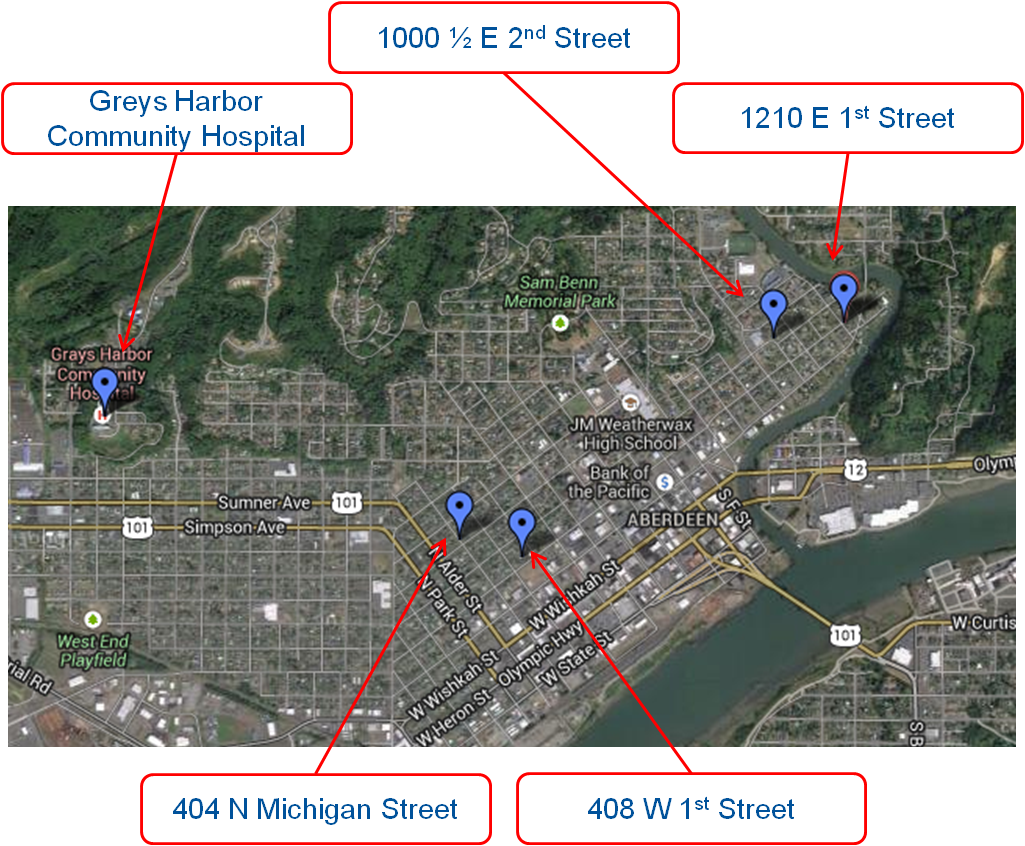
There is, however, a decent cluster of sites in the area around Aberdeen, Hoquiam and Montesano over on the Pacific Coast. The maps below indicate locations, primarily of homes from early in Kurt Cobain’s life:

Aberdeen

The Aberdeen map shows a couple of his early rented places, the house he lived in from 1968 through 1976, plus the hospital he was born at and briefly slept in during one of his spells of homelessness in his late teens.

Moving ever so slightly along the coast takes you to the house in which a newly born Kurt Cobain lived out his first year:

Hoquiam<a

And finally, heading down the highway to the East takes you to Montesano and to the home Kurt shared with his father for a number of relatively unhappy and troubled years.

Aberdeen-Montesano

The Grand Tour: Map of Nirvana & Kurt Cobain Sites in Seattle

Naturally this post is open to additions and corrections, for example, I can’t locate The Music Source Studios at present, I’ve missed out Union Station and I can’t find Squid Row Tavern. I’ve been plotting the former locations where Nirvana played or recorded, plus three of Cobain’s homes onto Google Maps. Basically I’ve never seen one full summary on a website, I’ve seen addresses here, photos there, bit and pieces, but not a consolidated source explaining what Nirvana sites exist and could be visited. So I thought I’d give it a whirl and see if people had more to add. Of course I’ll move on to other crucial locations in State of Washington as soon as possible.

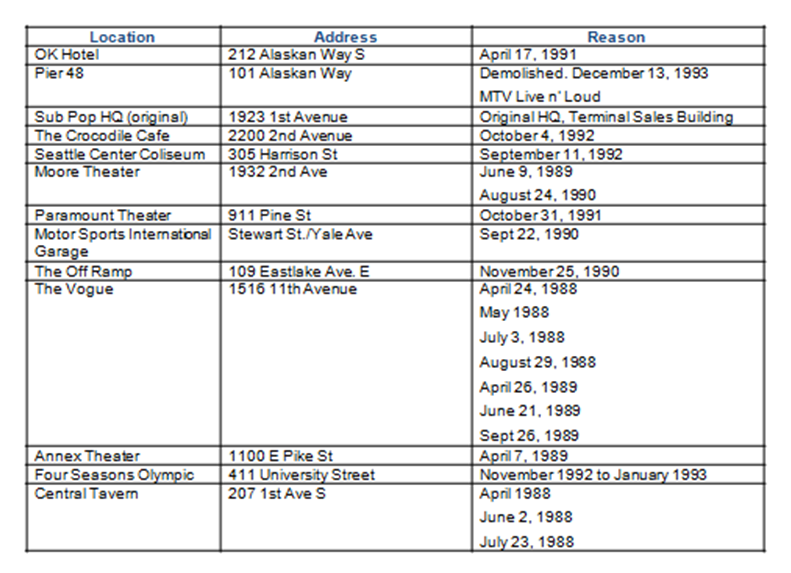
Don’t go expecting mystical moments of vast self-realisation and time-slipping revelation; a lot of these sites are now refurbished, or have been demolished:

Hotel_1

And the sites outside of Central Seattle:

Hotel_2

I’m not sure you could use these for actually walking the city, you’d need a far better map but at least this might get you started:

Nirvana_Seattle Tour_1

Nirvana_Seattle Tour_2

Nirvana_Seattle Tour_3

Stunning News: Cobain Sign to Stay

http://www.timescolonist.com/entertainment/after-hearing-from-kurt-cobain-nirvana-fans-aberdeen-keeping-come-as-you-are-welcome-sign-1.320640

I’d like to assure you that the ‘stunning news’ line was definitely a touch sarcastic. One thing I did take from the Halperin/Wallace Cobain conspiracy books was a reconfirmed sense that often the news is a manipulated object in which hard-working (indeed over-worked) people — with harsh deadlines and a need to pump a certain amount of news product per-day, per-week, per-month — take the easy route and occasionally take some non-news to bulk things out and fill space giving them time to focus on items that deserve and require more time and energy.

…I know this to be true because I think it’s fair to say I’ve occasionally done it myself here on http://www.nirvana-legacy.com — there have been weeks where the data work or background thinking for a piece has required substantial hours to grind out (and remember I have a proper job too so I leave the house at 7.20am, I return home at 6.30pm, I sometimes work much later, I generally maintain some kinda social life, I do exercise sometimes too all of which compresses and compacts the time available to prepare the blog posts for here; Allahu akbar, praise be to God for giving me a high typing speed.) When those times come around I’ll admit to dashing off quick thoughts, ramming an undigested idea out into the world always with the intention to return to it later. I even try to keep a lightweight piece or two tucked in my belt for emergencies.

In the case of this article regarding Aberdeen, State of Washington we’re greeted with the revelatory news that the town is going to keep the Cobain lyric adorning the town sign. On the positive side, 300 people can make a difference to a local situation — in a world where the might of little people acting locally is often underrated it’s nice to see more evidence of that truth. As an example local to me:

http://www.castlesupporters.org.uk/

This pub is just down my road. Not the finest looking building but there’s been a pub there since before the founding of the United States of America and it’s a real boon to the area. So far at least the motivation and mobilisation of local residents has kept its new owners from bulldozing it despite several attempts (ongoing) and the kicking out of the people running the pub. My fingers are crossed that the resistance keeps going.

I digress, in the case of the Aberdeen sign, I admit I read this article with a touch of cynicism; Aberdeen is famous for Kurt Cobain and Nirvana and…Yup, that’s the only reason most people will have ever heard of Aberdeen as anything more than a brief mention in a bio somewhere. I’m not convinced that the town would ever seriously consider removing the minor league tribute to their most famous resident. But, on the other hand, I am fairly sure that reporting they were considering doing it may have drawn some attention to the town.

I admit I was surprised they only received 300 messages but I’m wondering whether the supposed ‘threat’ was so local that only a tiny number of people were even aware such an idea was being discussed and the whole affair was drawn to a close before it could go further.

I have to thank Tom Grant too at this point for making the tape available of Courtney Love admitting to having planted stories in the media; the tapes he’s put up are worth a listen just to lend some colour to things. And hey, in things that meant something to me this week? I dropped a mention of the last few articles detailing my objections to the murder theories onto the Justice for Kurt page on Facebook, being respectful, and the individual running the site took the time to like the link and acknowledge me — now that really does mean something to me. We may be divided on one issue but we each enjoy and even adore the music of Nirvana and that’s enough. So, if I might be allowed a dedication, I’d like to dedicate today to decent Nirvana fans because, as the gentleman at Justice for Kurt says: “Hey I appreciate you taking interest in the subject and…even if we have different opinions, it’s nice to hear that people still care for Cobain.”

Roots Bloody Roots

http://www.breakingnews.ie/discover/from-cork-kurt-cobain-595334.html

A pleasantly whimsical post today, a piece from an Irish website discussing Kurt Cobain’s statements about bonding with Cork.

It’s hard for any individual to feel unmoved or uninterested when their past threads are brought to light — it’s slightly more unusual in the case of Kurt Cobain. The reason I say that is simply that, outwardly at least, Kurt Cobain’s most immediate roots, his mother and father, were a cause of significant pain and dismay. For a man who deliberately seems to have avoided all contact with the latter (barring one well-known encounter in 1992) and who limited contact with the former, to feel tears at discovering the Irish roots behind his name seems over-elaborate.

Except there he is saying it. It’s significant because, despite Nirvana’s extensive travelling, Kurt Cobain’s affections for other countries seems to have been limited — there are no tour diary tunes, the only physical locations in his songs are either fictitious or are firmly State of Washington, he seemed thoroughly unhappy in South America, has lashed the British, was barely awake or undrugged enough to notice Australasia. It’s also remarkable for the fact that his memorialisation of Seattle/Olympia/home in song wasn’t nostalgic or happy — images of poison and revenge were the primary links. But he had love for Ireland…

My take is that the answer lies in blood. Kurt Cobain’s view, expressed in his suicide note, expressed in his repeated linkage of sex, love, enslavement and family through his songs, seems to have been that genetics essentially dictated the resulting human being. The theme of biology ranks as probably the most significant core within his music and, while significantly conflicted over his parents, their importance (though malevolent) in his eyes was undeniable. Ireland was, therefore, something more than a tourist experience, more than just another gig stopover. Instead of being a journey out into the world, it was a journey into himself.

I despise it when people talk about travel broadening the mind. Most people I know come home precisely as ignorant or ignorable as they were when they went out — most come back with a pretty photo collection and some knickknacks to show for it — it’s rare that brief work breaks in a foreign culture for two-three weeks blossoms into a true insight into international togetherness or cultural difference. Travel alone doesn’t do much for the mind; it’s meaningful journeys, one’s that mean something to the person involved, that make the difference. This means setting out with a purpose, something to be reinforced, discovered, made flesh. In the case of Kurt Cobain, journeys all over the world led him no closer to comfort either with home or away.

Kurt Cobain’s words are remarkable, “I walked around in a daze…I’d never felt more spiritual in my life…I was almost in tears the whole day…Since that tour, which was about two years ago, I’ve had a sense that I was from Ireland.” He’s determined as well to emphasise the reality of what seems like hyperbole; “I have a friend who was with me who could testify to this…”

A tour guide in Egypt complained that each time a cluster of tourists joined him he was beset by “half a dozen Cleopatras and a good few pharaohs.” Essentially statements about one’s ancestors are as much a present-day gesture of identity as they are a record of truth — that’s why so many adherents of reincarnation are beset by grandiose visions of past glory (a similar phenomena is the British love of period costume dramas about the upper classes — when times are hard the British like to forget that most of their ancestors were poverty stricken miners choking on coal dust, itinerant labourers dying in their forties, or part of the many thousands of women who took to prostitution either as a trade or a temporary measure.)

In the case of Kurt Cobain, the Irish connection provides him with an alternative root — one located thousands of miles from the U.S. working class and from the alcoholism and depression that seems to have haunted the roots of Cobain’s immediate family. By looking beyond his immediate circumstance, toward a past that he could base on his sanitised modern tourist experience of Cork, he was able to remove himself from the current circumstance of his family. It’s a repeat of his desire, as a child, to imagine he was an alien baby from outer space, or images of being adopted. Visiting Cork, Ireland gave him a way of alienating himself from his real life.

It also didn’t require him to get in touch with the earthy reality of what life in Ireland, during the period his forbearers left Cork, was like. He wasn’t imagining ‘being’ his ancestors, he was imagining being himself, in the present-day, simultaneously a thousand miles from his real life and a hundred and something years after his closest Irish heritage. He didn’t have to acknowledge the squalor or misery of nineteenth century Ireland because it’s not what he was yearning for, he was just imagining being a young man who might have grown up differently. It’s the same trick pulled by those who wish to imagine a past as Cleopatra — they’re not asking to experience the dirt, dust and relative (compared to modern day) poverty of even royal life in Ancient Egypt, they’re just after a talisman of power to ward off the demons around them today. There’s a constant underestimation of how much behaviour and activity in the here and now is nothing more than a statement of “here I am and this is who I am”; the past is present as a way for people to declare their chosen alternative and mythical identities.

Four Walls and What Was Made

Kurt Cobain's Homes_1967-1994

A pause to give credit where it’s due, http://www.shapedbox.blogspot.co.uk featured an excellent range of photos of the houses and I have used a number of them for the collage above. Credit for the Pear Street photo must go to Diamond Brooke and her Flickr feed – again, worth a look for Nirvana fans.

Over the past two days we’ve been dividing Kurt Cobain’s life down into time spent in specific ‘homes’. Naturally I accept that a lot of what I do on this site is simply aggregate existing data but I’m often stunned by the picture that results simply by loading data into a single view.

My reasons for compiling the data, initially, was that I wanted to attempt (as best as possible) to correlate Kurt Cobain’s song-writing to where he was while writing. In the kind of coincidence to gladden the heart of any data chimp (a friend once bought me a t-shirt reading “I love data” repeated over and over — thanks Shane!) the picture that emerges is remarkably clear.

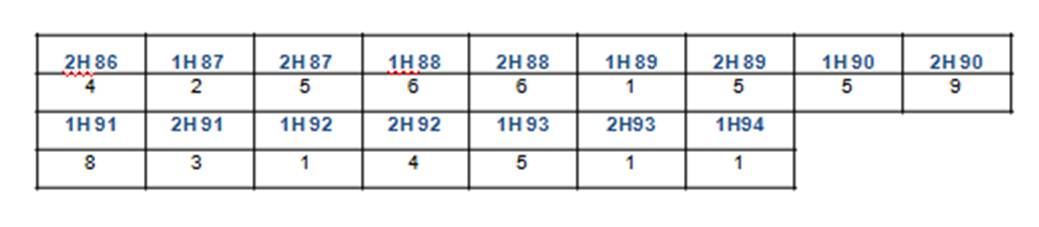
To the best of my ability, in the Over the Edge chapter of Dark Slivers: Seeing Nirvana in the Shards of Incesticide, I’ve tried to pin down, to periods of six months, roughly when Kurt Cobain wrote various songs. The approximate result is as follows:

Songs by Half Year

I’ve not included the Fecal Matter songs (e.g., Spank Thru or Downer), nor have I included Kurt Cobain’s solo experiments (i.e., Montage of Heck) simply because it’s hard to pin down when they were made with any degree of guesswork. The only changes I’ve made since the book are to include Opinion in 1H 1990 and shift Tourette’s to 2H 1989. When compared to Kurt Cobain’s living arrangements, however the results are emphatic:

Songs by Home_Figure

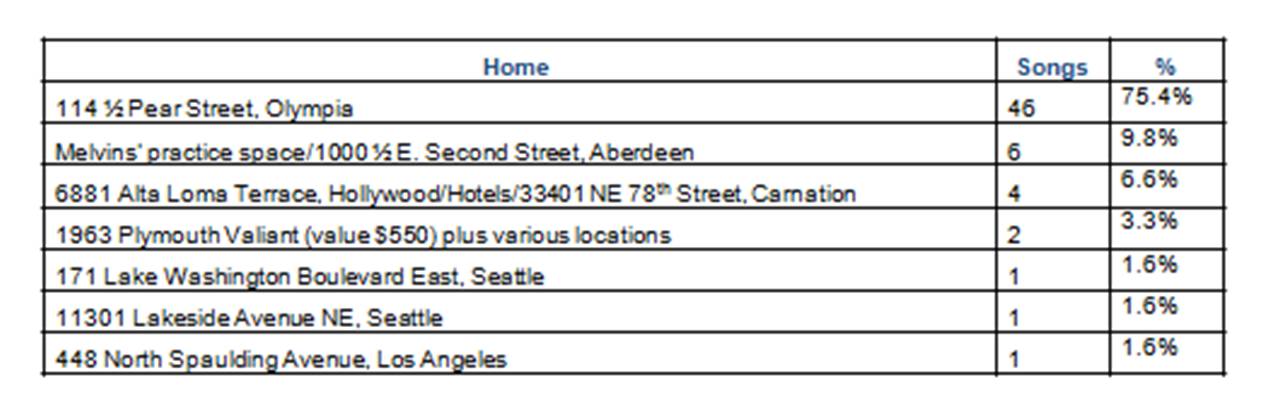
While money may still have been hard to come by during the years Kurt Cobain spent in Olympia, it truly was his artistic home. Given how long he spent in that location it’s no surprise that he wrote more songs there but the sheer quantity is overwhelming:

Songs by Home_%

Dividing the figures by time spent in the location doesn’t alter that picture of dominance:

Songs by Home_Per Month

While making clear that Kurt Cobain’s peak occurred in Olympia, there is some fudging involved that I can only acknowledge but do not have sufficient information to fix. If I could untangle Kurt Cobain’s living arrangements from January 1992 until January 1994, it wouldn’t erase the overall picture but it would make clearer whether, for example, the Carnation house permitted a real focus on writing or whether most of the work was done while running around hotels and temporary accommodation with Courtney. Similarly, the two songs written in the second half of 1992, I’ve noted as Curmudgeon and Talk to Me (based on live data) but Curmudgeon at least might more properly belong earlier in 1991, I can’t prove it. The dominance of the Olympia spell may be even more pronounced given Kurt moved there in April 1987 so my estimates, based on six month periods, don’t correspond perfectly — 114 ½ Pear Street may filch a song or two from the previous eight months spent in the Melvins’ practice space and at 1000 ½ E. Second Street.

The first spell of relative stability Kurt Cobain had enjoyed since he was a child seemed to allow him the space and time to write and create. Tracy’s willingness to support him also meant he didn’t have to divide his time quite so much between work and music — though she, very reasonably, came to resent him sponging off her it did have a beneficial effect on his core pursuit. Similarly it can’t be underestimated that Krist Novoselic provided Kurt a steady and dependable musical collaborator reducing the impact of changing drummers so often and ensuring ideas could be turned into full work relatively swiftly. Kurt was surrounded by beneficial circumstances thanks in large part to the individuals he could now rely on.

My ultimate thought on the ‘meaning’ of all this information is that the place of greatest veneration for any Nirvana fan shouldn’t be the house at 171 Lake Washington Boulevard East. The place where the majority of Nirvana’s music was created, where Kurt Cobain truly lived as a creative soul, was at the unassuming and unglamorous property at 114 ½ Pear Street, Olympia between April 1987 and July 1991. To my mind, celebrating the place that gave the safe cocoon needed to build something is of far more importance and significance than the barely lived in site where he chose to tear everything down.

Life Long Latchkey Kid: Kurt Cobain’s Homes Part 2

Yesterday we examined the record of Kurt Cobain’s childhood wanderings, how he was shunted from home to home throughout his teens. Finally relative stability arrived in the form of his first long-term relationship with Tracy Marander and a resulting departure from Aberdeen. That single residence on Pear Street in Olympia ended up being his home for just over four years, the longest he’d been in one place since he was nine years old though the couple did change flats within that building and Tracy did move out to be replaced as flatmate by Dave Grohl.

Returning home in the aftermath of the recording of Nevermind, the move to a major label, standing on the cusp of his true fame Kurt managed to get himself thrown out for not paying the rent. That was the end of the stable spell of life. It’s genuinely fascinating realising that the rock star who ruled planet Earth for that spell in the early nineties didn’t have a home from July 1991 until January 1992; imagine it, the biggest rock star on the planet as living in his car.

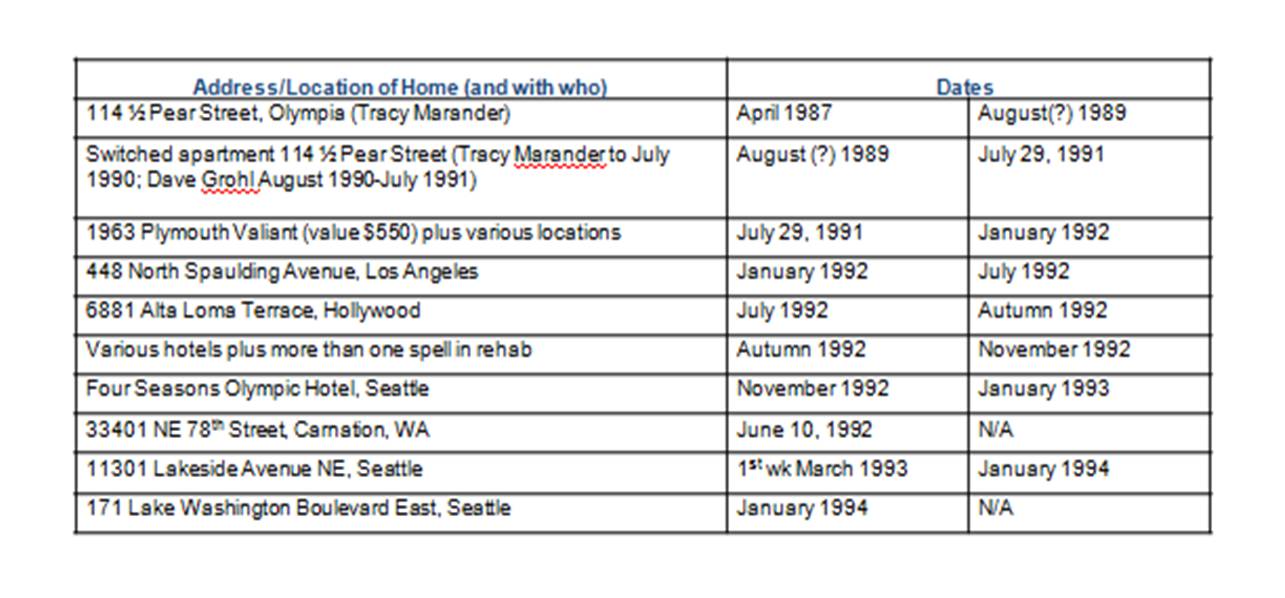
Even after that, there was still nothing close to a home. Kurt Cobain — now with wife in tow — bounced between rented apartments, tour hotels and hotels in LA and Seattle right through until spring of 1993. Even with all the money now floating around him, it doesn’t cease being the case that he was essentially homeless. At least this time there were comprehensible reasons, the Cobains were trying to purchase a home but there was little time in between tours, festivals, recording, battles with the authorities over custody of their child and major drug problems. In the chart below I haven’t calculated the spells spent in a number of rehab facilities:

KC_Homes_1987-1994

It’s curious, having arbitrarily made the start of Nirvana and of Kurt’s relationship with Tracy the dividing line between his youth and adulthood, that the pattern is much the same as his childhood with the stable period being superseded by yet another spell, this time of three years from age twenty four until his death, during which he lived in six definite locations and a slew of temporary accommodation.

One link (www.city-data.com/king-county/N/NE-78th-Street-1.html) has conveniently placed the sales record and other details of the Carnation home online:

Carnation

It’s an intriguing property because, despite the understandable attention paid to the site of Kurt Cobain’s death, it was the Carnation property that was the first home he owned and that was retained throughout the maelstrom of mid-1992 through 1993. It’s also mysterious because it’s impossible to tell how much time Kurt Cobain actually spent living at the house or why it seemed to be less than wholly beloved. For whatever reason retreating to a country village, one with a population of just 1,243 in the 1990 census, where Wikipedia lists the local activities available as “Harvold Berry Farm where you can pick your own berries in the summer”, doesn’t seem to have worked regardless of whether the idea was to evade drugs or intrusion in general. There is a rumour Kurt returned to the home sometime in early April having fled rehab.

Working out the estimated dates of accommodation also throw Cobain’s relationship with his place of death into the spotlight. The Cobains moved into the Lake Washington house in January 1994. Nirvana toured until January 8. Kurt joined the band for their final studio session on Jan 30 then they left on tour two days later. He was in Europe until March 12 when he was definitely home given the Police were called to a domestic incident that night and again on March 18. He headed into rehab on March 30 returned home around April 3. At most Kurt Cobain lived in that house for three weeks in January, then just over two weeks in March.

Observing his entire life, ranking locations, what emerges is as follows:

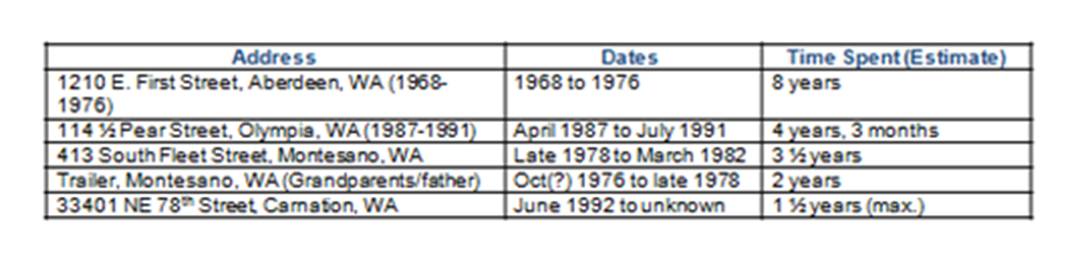
KC_Top Living Locations_1967-1994

Of the 25 ‘phases’ identified, only five added up to more than a single year. Worse, of the years spent in solid locations, 13 ½ of those years took place from the age of less than one to only just fifteen years old. The remaining half of Kurt Cobain’s life, his entire rise to young adulthood, involved only the briefest of respites in which he had something that could be called a home.

Life Long Latchkey Kid: Kurt Cobain’s Homes Part 1

Reading the various biographies of Kurt Cobain and Nirvana, the point is frequently made that Kurt had lived what could gently be described as an unsettled and nomadic existence pretty well from the time of his parents’ divorce in 1976. Ladled out on top of that is a patina of genuine poverty throughout his later teenhood leading to periods of homelessness stretched right through until he hit twenty in 1987. Relative stability arises from that point yet still there are tales of being slung out of rented homes even as late as the middle of 1991 when he was now 24. Linking together the references makes his later life seem a more moneyed return to drifting with hotels filling gaps even when he wasn’t on tour or fulfilling band duties. Purchasing a home for the first time in 1993 simply doesn’t stop that sense of a man floating free of physical locale — the final year of his life saw him buying one home, renting another, buying another, while simultaneously spending regular nights in motels and drug hangouts.

Sourcing the data, I ended up simply staring at it — adding up the regular moves brought home precisely how devoid of refuge the life of Kurt Cobain had been:

KC_Homes_1967-1987

This is the life of Kurt Cobain to age twenty. It was hardly a comfortable life in the early days given the combination of tight financial circumstances, mounting parental discord leading to the parents splitting in March 1976 before a final legal pronouncement of divorce in July, then the spell sharing a trailer with his father and grandparents, followed by the spell with his father and eventually his father’s new partner and her children. But it was from March 1982, once he had turned fifteen, in the aftermath of ever-increasing battles with his father, that Kurt’s living arrangements implode.

From the age of fifteen until the age of twenty he barely stayed a year at any address. There are nine definite homes in which he lived during that phase and one period where, at best, it could be said he was a ‘guest’ of various relatives and relations. During this crucial phase of life it’s easy to understand why the conclusion of formal schooling became challenging, likewise why, existing disaffection would be expanded into an all-encompassing sense that he was unloved and unwanted.

Further reinforcing the sad picture, in each of 1984, 1985 and 1986 he endured spells of homelessness. To be fair, none could have lasted longer than a couple months but still, for certain periods of his late teens Kurt Cobain barely knew from day-to-day where he was sleeping. He was even forced back in with his father despite the extreme tension between them — his dad found him living on a couch in a back-alley. Again, it makes it easier to understand why locating regular employment proved challenging given his disrupted living arrangements.

By 1987 he had lived through seventeen different locations or phases in his young life. The longest he had a home for was the eight years that corresponded with his infancy and the only time when he was part of a true family — the coincidence of family love and physical security reinforces why he would remember it as an idyll lost forever.

Nirvana Abroad Versus Nirvana U.S 1988-1994

Over past weeks we’ve looked at Nirvana’s U.S. tours via maps, simply showing them criss-crossing the country, the standard patterns and behaviours.

Gigs Abroad 1988-1994

All I wanted to show here is how Nirvana go from being their Washington State beginnings to a fairly even split between U.S./Europe for in 1989 and 1991 to the hugely warped statistics for 1992 and 1994. The chart shows how focused Nirvana’s activity became; while in those earlier years they’re able to cope with playing close on 100 shows in a year and covering both the U.S. and Europe in a single year, post-fame its becomes a two year cycle to make it through those areas. There’s no balance.

I’m more accepting of a U.S.-centric Nirvana (1990, 1993) given they’re an American band, the product of a continent-sized country with the world’s then biggest music audience and touring network. I’m surprised how much of Nirvana’s time was spent abroad overall:

Gigs Abroad vs Gigs U.S.

Oh the seduction of pretty pictures. My eyes are lured toward the easy comparison of 1989 to 1991, of 1992 to 1994, of 1990 to 1993. I’m not sure there’s anything to be learnt in delving deeper into those patterns, they were not designed ratios, but they are pretty.

What the maps really brought home to me was Nirvana’s progress; their existence solely as a Washington State presence in 1987-1988, virtually a hobby band; the way that, from 1989 onward, whenever they retreat home after a tour their territory now covered Washington, Oregon and California and their quiet phases would still involve shows in all three states — they’d gone from being a Washington grunge band to being a West Coast alternative rock band. The regular patterns in the touring also; the tours round the East Coast tending to circle Illinois, Michigan, etc. before taking a dip across the border to Canada before criss-crossing the U.S. North-Eastern states. The pattern for concluding tours had a similar stability; a jagged dash in the direction of home usually swooping down the West Coast then haring across country back to refuge in Seattle. It was interesting as well seeing the scale of the In Utero tour; while earlier years had seen comparable (or even higher) numbers of shows, the 1993 U.S. tour seemed designed to take in as many tours as possible, it wasn’t as concentrated as in earlier years. Nirvana’s ubiquity as a popular act meant bringing them to new states made sense; they’d get a decent paying audience — not something that could have been guaranteed pre-1992.

1992-1994: Maps

I don’t want to lose whatever respect or credibility I’ve earned with you but I confess I’m listening to Pavement’s Slanted and Enchanted for the first time ever today. Apologies for delay too, office systems down so all a bit chaotic.

Now…As promised, the conclusion of Nirvana U.S. touring in map form! Though not the Salem of witch trial legend, it still seems neatly coincidental that Nirvana’s most testing year would commence in a town of that name. While previous years have taken me two or three slides to capture, the whole of 1992 can be taken in one:

1992_Shows

I even abandoned the naming convention I’d previously adopted given Salem is the only ordinary looking show on the map. Nirvana essentially abandoned America for the full year; two TV shows, two benefits, two secrets. If it wasn’t for the thirty days out in the Pacific (Australia, New Zealand, Japan, Hawaii), and the smattering of European festival shows, it’d be entirely possible to declare the band missing, presumed dead. I’m being gentle including the TV shows.

It does explain some part of why, despite Nirvana being an American band, something like Reading 1992 should loom so large in the popular imagination; the entire peak of Nirvana’s fame, as far as live concerts went, was spent off abroad at these kinds of show. Reading would have been one of the view shows all year where a massive press contingent could be guaranteed. It’s precisely the reason Britain receives tonnes of U.S. news; there’s lots of footage and reportage, it’s therefore cheap to buy and as a result we all get to learn it.

1993 was basically more of the same; America’s finest nowhere to be seen — I’m being kind including Saturday Night Live just to expand the engagements:

1993_Jan-Sept_Shows

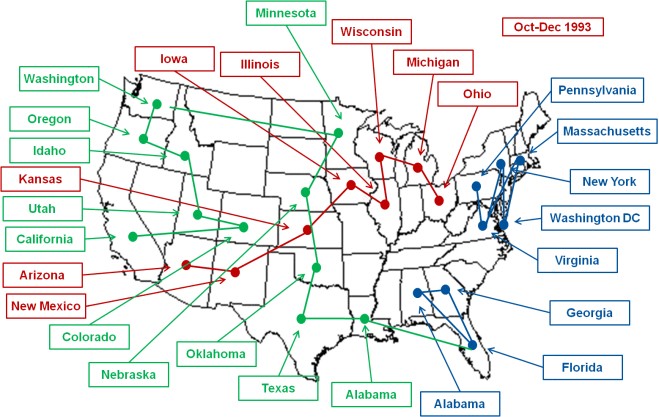
That changes, however. The map becomes almost impossible to follow given how much the band crams into the final months of 1993. This is the most extensive touring Nirvana has done in the U.S. in their entire history. Looking back at past posts, at the maps for 1991, 1990, 1989, there had been big tours before but the scale and coverage achieved this time around was unprecedented. Of course, one thing to point out is that this kinda touring isn’t exactly uncommon for bands — this was the age of multi-year tours taking place, show after show… Nirvana staying out for the best part of three months was long by their standards. Having kicked off in Arizona (red line) the band took the obligatory pop over to Canada between Ohio and the start of the North-East U.S. visitation (blue line, November) and then the criss-crossing of central and western states in December:

1993_Oct-Dec_Shows

1994 was the usual post-Christmas smattering of appearances. On this occasion, however, given the finality of ensuing events, it seems apt that Nirvana should retreat so far into their own past. The map needed to show the band’s U.S. presence in 1994 barely needs to show more than the map for 1987, or 1988—they hop across the borders of Washington State to two locations, they head home, then gone:

1994_Shows