Come on Death!

http://www.youtube.com/watch?feature=player_embedded&v=k4Q3zKfBRnI

Obama paying tribute to Led Zeppelin a couple days back. Its the fate of all history to be softened, sugared, reduced to soundbites – it’s intriguing that Nirvana’s career hasn’t really undergone that reduction to family-friendly status given the self-inflicted brutality of its ending. When I mentioned Nirvana or Kurt Cobain to people the responses are fairly uniform; “he’s the one who shot himself?” “Wasn’t he a massive drug addict – did he die of an overdose?” “He was married to that mad woman wasn’t he?” and then, increasingly regularly, “who’s Kurt Cobain?” There’s too much darkness surrounding the collective memory to be eased away and made fit for a Presidential tribute.

I’ve been asking, when people ask to be placed on the pre-order list, how/when people first got into Nirvana – what’s their story? As a personal part of my own, Kurt Cobain was my first experience of death. It seems strange but I was fourteen years old, I’d been at most three years old when my last major relative died, other family deaths were off too far in the extended network for me to really notice. Kurt Cobain was the first time death had penetrated my existence as anything other than a cartoon element in action films, comics, play fighting. Suddenly it was a real presence. I didn’t know the guy, I live thousands of miles from Seattle, but that didn’t stop it being a knife wound. Something I cared about so deeply had been unexpectedly and sharply severed.

This weekend I spent sat with my grandfather. Until as recently as three years ago he was a powerful, immaculately dressed gentleman with a raft of stories always worth a retelling. He’d been a sportsman for most of the first part of his life, then a professional rugby referee, then a coach of professional rugby referees, only retiring from his involvement in his late Seventies. This was a guy who at age 72 bought an x-type Jaguar and had the most gleeful look on his face as he showed me he could kick it to 125mph without even touching the Sports Button. At age 76 a drunk tried to attack him in a newspaper shop – my grandfather decked him with a single punch then stuffed the guy over the top of the shop counter. You’ve never seen a happier ‘bad boy’, he was so chuffed with himself, a permanent suppressed grin for the next week.

Quadruple heart bypass in between the death of his wife and one of his two daughters , my grandmother and aunt respectively and truly one of the worst years I’ve ever heard of. He came back from that, began living again and its a joy to see someone restored, realising how they hadn’t been themselves in so long. He had the cartilege kicked out of his kneecaps during his playing career leading to a knee replacement operation he never really recovered from. Then cancer shut down one of his kidneys, all dormant but requiring regular observation – untreatable, inoperable, just sits inside there. Meanwhile his hips had been compensating for his knees so hip pain resulted, then his back began to go. The drugs that keep his blood thin mean he can’t be treated for the cancer, nor for the frozen shoulder that is causing him immense pain. The diabetes killed the circulation to his feet while the back problem made him walk less and less. Gangrene set in this year and ended with a toe being amputated and weeks of treatment to drain the feet. There’s a hole where the bone had to come out of. This weekend was the first time I’ve ever, in my entire life, seen him unshaven. I lived with him a year and there was never a day when he didn’t spend his morning preening himself ready to face the world. This weekend it was, as always, a pleasure and an honour to spend time in his company. He sat dozing with his head resting on his chest for most of the two days, he won’t wear the hearing aid so conversations are shouted over a TV with the volume dial up on fifty. The heating is up so high I get headaches but he’s still cold.

And there’s nothing to be done for it. He’s enduring a bad death. A drawn out three years of mounting problems making this great man a prisoner in his home. All we can do is make him comfortable, show him he’s cared for, find ways to reduce the burdens on him and keep him happy – bare witness.

So I didn’t post yesterday. I love Nirvana, Kurt Cobain is a hero, but real life and those I love will always be more important. It makes me wonder how hard 1992 was for Krist Novoselic and Dave Grohl; forcing smiles to avoid media intrusion while being able to visibly see their friend reduced to a skeleton. What do you do? Most of the time all you can do is witness. It saddens me he couldn’t find a way back to life, I can’t even begin to understand what its like to carry so much physical and mental pain around though so I don’t give much credit to those who suggest he just needed to pull himself together, get over it. I’m watching a man die and I can see he hurts, but I can’t share in that pain, only acknowledge it. Pain is private, it can’t be passed from one body to another, ultimately Kurt Cobain endured alone.

Oh. And the bloody draft book still hasn’t shown up – delay is driving me nutty. It’ll be here today/tomorrow and then, with my say so, the full print run will be returned to me at the end of the week.




Nirvana 1990 Tours

Darn. Got home late last night and no sign of the draft book – cross fingers for today!

1990 contains a virtual repeat of the first half of 1989. The band kick off in Washington State, then swoop down the west coast through California, dipping out into Mexico, briefly visiting Arizona, back into California, back home. A further jaunt abroad, just across to Canada, follows then, finally, April sees the band off on the road again.

April kicks off in Chicago, then is broken up by further shows in Canada, dropping across the order to Toronto and Montreal before returning to blanket the North-East U.S.:

April 1989_Part 1 and Part 2

That second part is certainly confusing, the band returned to Massachusetts three times, Pennsylvania twice, hence the “cat’s cradle” style map work. This led directly into another run right back across the U.S., twelve shows and a mere fifteen days getting them all the way back to Idaho and then on to home (waving goodbye to drummer Chad Channing at the same time):Tour_May 1990


This was followed by a decent pause as the band regrouped, acquired temporary drummers, then returned to the road with a short jaunt down the West Coast:

August 1990 Tour


That tour, starting in Las Vegas, ended with a run from Seattle across to Vancouver. September-October was a quiet spell; Dan Peters only show, then two practice outings in Olympia for Dave Grohl before his full ‘blooding’ in the full European tour that saw out the year.


A Relic: Kurt Cobain Obituary April 9, 1994

Memory fades.

I can no longer recall if this obituary came from Saturday April 9, 1994 while I was still in the U.S. on a family holiday, or whether it was the following week upon return to the U.K. My memory tries to tell me that my dad somehow got hold of his regular copy of the British newspaper the Daily Telegraph while in Florida and I artlessly preserved then tore out the Kurt Cobain in memoria.

Either way this scrap of paper had accompanied me ever since, sandwiched in a May 1994 edition of Metal Hammer magazine which lost its cover a long while back (good Sonic Youth interview with Lee Ranaldo and Thurston Moore while Kim Gordon was at home awaiting the birth of Coco Hayley Gordon Moore on July 1.) I should preserve it better, it’s yellowing, faded. But still. It remains one of the few objects I hold genuinely dear.

Obituary_April1994

This is the full text in case you’re interested:

Obituary_April1994_Full


An Aside: Trends in Nirvana Facebook Groups

This is merely an observation but one based on viewing somewhere around 500+ Facebook groups dedicated to Nirvana and/or Kurt Cobain. I’ll update this post if I recognise fresh characteristics or anything deviating from these points.

Firstly, South America owns Facebook! It’s incredible how many South American sites there are. At least fifty percent of the 500+ groups I’ve observed are from the region (I’ll accept they might also be from Spain or Portugal — my language skills are minimal.) My theories range from the speed of development of Internet connections meaning it was the age of Facebook before that region sought to express its Nirvana fandom; to a preference for social groupings as opposed to the very individualistic style of Europe and the U.S. More views are welcomed.

Britain and the U.S. oddly don’t seem to have too many Facebook groups dedicated to Nirvana. Then again, why would we? In the case of the English-speaking world, there have been effective channels for relaying Nirvana information and unifying fans for over a decade with LiveNirvana and the Internet Nirvana Fan Club leading the pack. British and U.S. users also seem mistrustful of unofficial efforts, instead congregating in the greatest numbers around the official/semi-official sites of individuals, bands or labels. Also, instead of actively engaging with groups it seem more the norm for people to present themselves as unique individuals (“I’m special! I’m me!” screamed the dust speck.)

The Italians have a beautiful habit of using lines from songs as the title of their Facebook groups; it was such a common characteristic I could usually tell at once if the group was for Italian Nirvana fans. The Polish similarly tend to incorporate their references to Kurt Cobain or Nirvana into longer sentences — group titles can be ten words. They also all seem to give personal email addresses at the top of their groups so that people can contact them individually. This is unusual, most sites are fairly anonymous revealing little of the individual who built them.

Not wishing to spread national stereotypes but I’ve yet to find a Nirvana Facebook group in Germany that permits strangers to participate or comment. They’re all closed. I’ve frankly found Eastern Europe and the Balkans more welcoming. I’ve seen a few from Asia-Pacific, nothing from the Middle East outside of Israel or Africa but I need to mine more deeply.

I’d like to state, for the record, that my favourite site names so far are definitely “Give Us Back Kurt Cobain and We’ll Give you Miley Cyrus” and “God, Give Us Kurt Cobain and We’ll Give you Justin Bieber.” Oh, and those named “Come to the Dark Side…We Have Cookies.” There’s also a guy on Twitter who makes me chuckle with his macabre Dead Kurt Cobain @gunreviews; “Kurt Cobain, dead but effectively brings you reviews of weapons and tactics from the great beyond. A total parody, unless you are intoxicated.” He’s a pretty good artist too.

I’m also stunned by how friendly and decent people are. The NirvanaItalia site happily added information about the book. LiveNirvana, Nirvana Live Guide and the Internet Nirvana Fan Club have all been a delight. On Facebook too, remarkable friendliness on all sides, a mass of people, sharing a love of a band, simply being polite and encouraging. It’s been a nice feeling; helps me keep going.

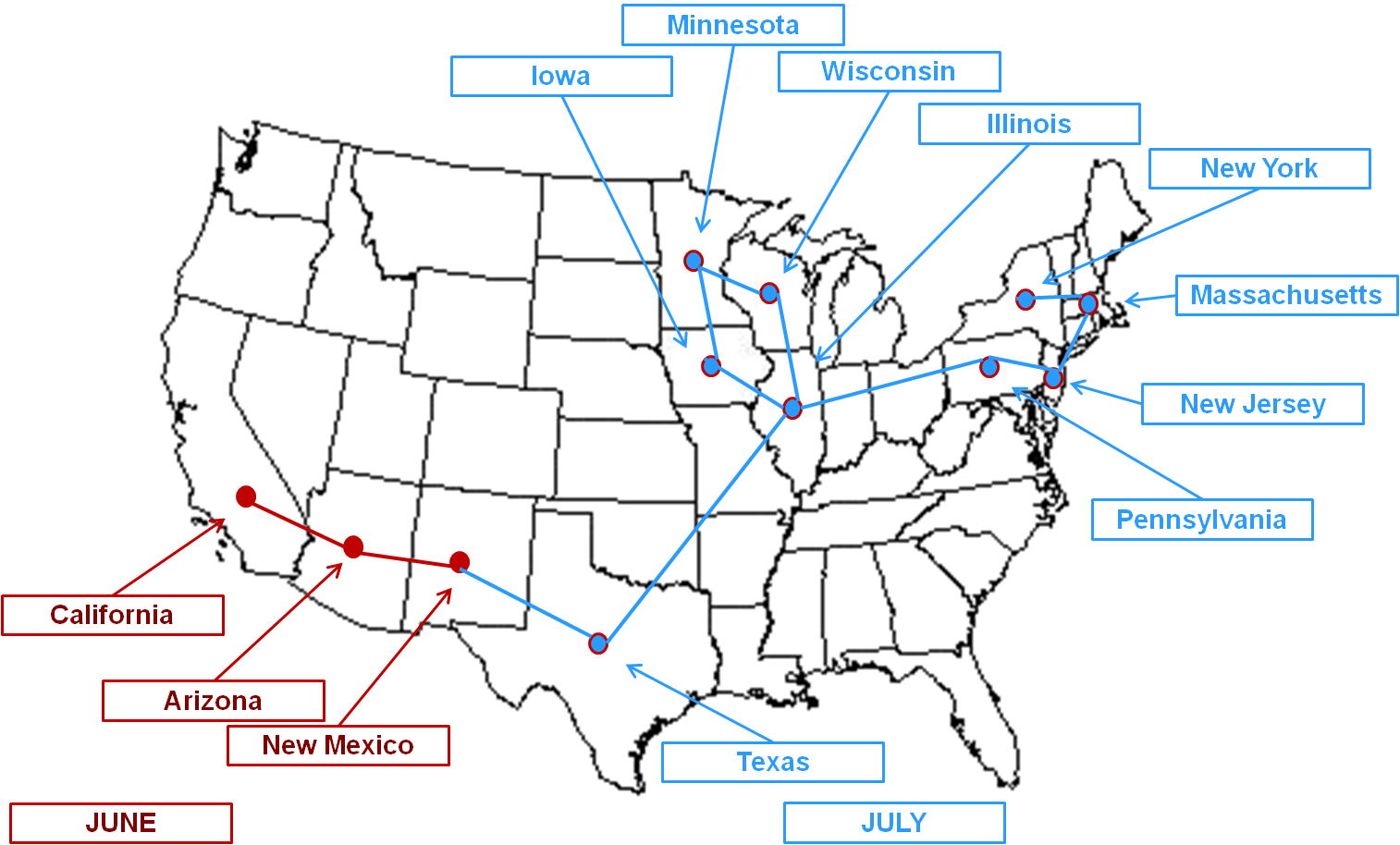
Mapping Part II

From January 1989 onward, Nirvana finally broke their boundaries and moved on:

January sees Nirvana’s circle widen to encompass Portland, February and they make it as far as San Francisco and San Jose. Though persisting in their retreats to the safety of home, the band are spreading down that Western seaboard. It’s like seeing a child growing in confidence; come June they return to Portland, return to Seattle, back out to San Francisco…And then, thanks to Sub Pop’s ambitious plans, the doors open:

It gets harder to follow the band in map form, but let’s try. It’s just a different way of looking at things; the storytelling mode has been well done:

Followed by a breather back in Seattle for a couple months before:

It took the band two years to even make it two states on, then suddenly, in the next six months the band play in eighteen states scattered across the entire United States and over thirty shows, more than in the whole of 1987-1988. That must have been quite an experience.

Mapping Nirvana in the U.S. 1987-1990

In yesterday’s posts I just rambled over the tables, today I’m doing the same via maps. I find it intriguing watching the band’s horizons widen and expand. In 1987 this was a band that barely made it more than a few hours from home, even a drive all the way from Tacoma to Raymond is barely 100 miles. Nirvana really was a band from the middle of nowhere; a lot of bands wouldn’t travel to Seattle because it was so far from the main strip of big audiences and gig locations yet this band wasn’t even a Seattle band at this point – here’s 1987:

The gathering momentum is visible, again, when 1988 is mapped:

There’s still a time lag, however, it isn’t like 1988 starts and the band have moved up a gear. Until that first April show in Seattle, over a year since their first gig, the band are still stuck trolling between Olympia and Tacoma.

It’s clear though that from April Seattle becomes the adopted live ‘home’ very swiftly. Between April 1988 and the end of the year those eleven Seattle shows immediately mean the band have played there more than anywhere else, Olympia may be important but it’s no longer where the future lies.


Mileage Part II

Just a brief evening component…


Again, looked at by country, I’m not sure we’re seeing any great surprises except how closely matched the U.K. is by Germany. In terms of their presence as a ‘live’, real-life experience rather than just a consumable video/audio product, the rest of Europe had as much claim to the band as we Brits did. The thorough criss-crossing of these countries is noticeable too, for example, this is Nirvana’s visits to Germany:


It’s a rash! They peppered the country with visits and took in most major cities at least once. The U.K. is even more thoroughly carpet bombed. Again, Canada stands out simply as an indicator of how centred Nirvana was in North America; quick jaunts across the border made sense over and over again hence Vancouver earning its six visits.

Mileage out of Nirvana

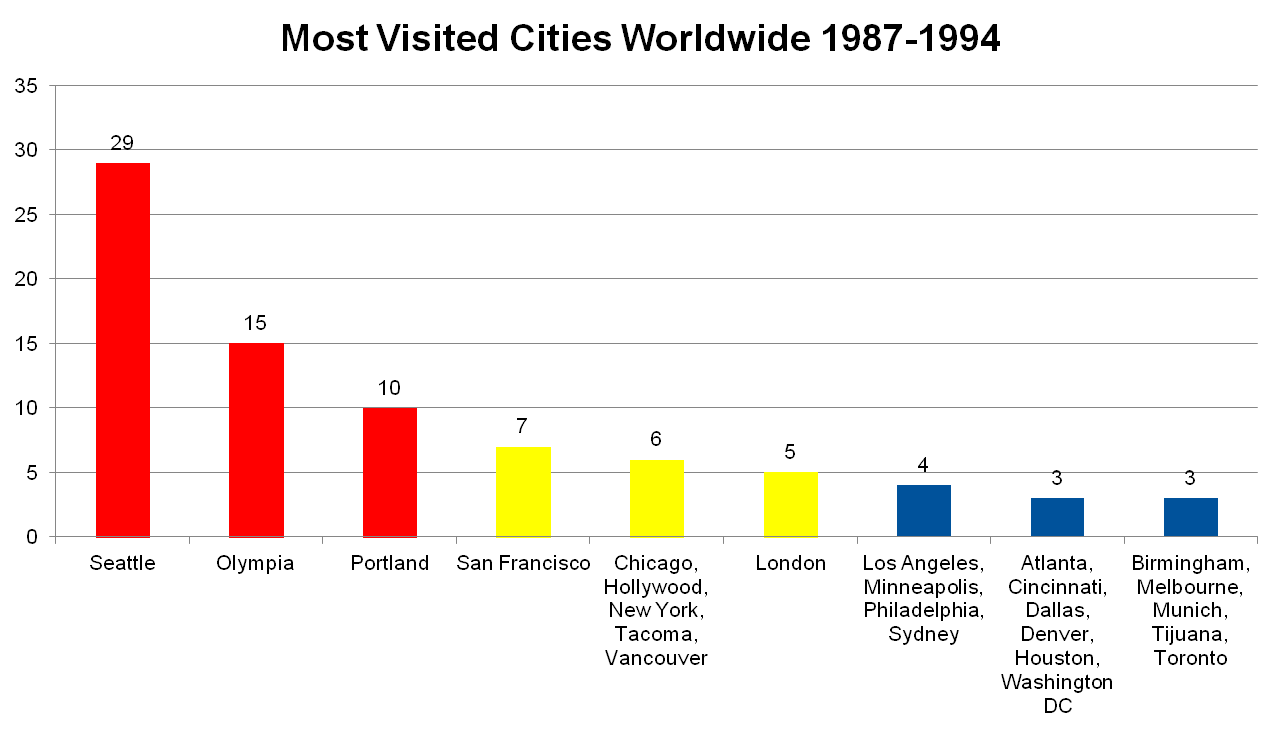
Firstly, a sincere thank you to Nirvana Live Guide, their guide to Nirvana shows sets an incredible bar and I haven’t seen anything of similar depth or knowledge for any other band. Amazing. I’m sure the next chart won’t show anything people aren’t already aware of — for me, cramming the data simply acted as a reemphasis of how true some statements are:

Yes, Nirvana truly are a Seattle band and yes, they really are a Pacific North-West band with an allegiance to Washington State. Just for emphasis…

I guess I simply hadn’t realised how dominant Washington State was in the history of Nirvana. The band visited Tacoma as much as New York. It also emphasises how U.S.-centric the band was; despite eight tours abroad (plus two one off foreign shows in 1992) only seven non-U.S. cities receive more than two visits, three of them still being in Canada or Mexico. It’s intriguing to me how much attention Reading 1991 or 1992 receive, or the Astoria Lamefest in 1989; what I think we’re seeing is how influential the U.K. based music press are in comparison to any other nation’s music media. Sub Pop were right in terms of their strategy; take the U.K. media and you won the world…So long as you toured like crazy in the U.S. to back it up. The story of Nirvana is dominated by foreign shows but I can’t tell at this range whether I’m seeing reality at the level of the fans, or whether I’ve adopted and assimilated a message written mostly by U.K. music journalists in which the U.K. shows look huge despite the low numbers. Seeing how much work Nirvana put in within U.S. borders I admit it makes me think that their fame was more down to that hard graft and less to self-regarding British journalists declaring XYZ U.K. based gig crucial…But as the majority of us never experienced the band live, as we only know them as an audio, video, photographic experience – does that then make the U.K. shows the winners?

This final graphic shows two elements; one, the fact that Nirvana were so heavily focused on Washington State and their West Coast U.S. neighbours that they performed over one hundred shows in just three states. To put that in context, Nirvana only played 121 shows abroad in their entire career — given how centred the U.S. entertainment business is in California, in some ways gaining a reputation in that region was as significant as all the work abroad.

This table also emphasises, to me, how much work Nirvana put in to their success; they visited 37 of 50 U.S. states — significant mileage into some backwood locations to spread the word. It makes Nirvana’s rise to fame less miraculous but far more impressive in many ways; the status they achieved was down to hard slog not just because moneyed powers plucked them from obscurity and set them atop the music industry.

We’ll play more with geography later today – its a neat diversion and I enjoyed crunching the information…

Monday 26th: Countdown to Dark Slivers Release

More stats and general musings on Nirvana to follow…But wow, things are getting busy. The book is due back from the printers this Friday – fingers crossed! In the meantime…This is an early summary of each chapter – just a set of snapshots rather than a full picture of what is covered in each one. Oh, and yes you’re right, each chapter is named after an album by a band Kurt expressed a liking of (The Minutemen, Scratch Acid, Big Black, etc.) the exception being Songs the Lord Taught Us, but it was too good a title to pass on:

Foreword

Months of total immersion in Nirvana has not always led me in healthy directions…You have been warned… J

1.0 The Greatest Gift

Incesticide sold more albums than any punk album in American history…Yet its qualities and pleasures have been roundly ignored. I set out the case for the album’s status in terms of the quality of what it contained, the care the band took over its creation, its artwork, its liner notes, its songs

2.0 (MIA) The Complete Anthology

Biographies of the band have stated that Nirvana’s first label Sub Pop teamed up with DGC to combine efforts and create Incesticide…They’re wrong

Fresh interviews with the key individuals at Sub Pop indicate that there never was a planned Sub Pop release. Incesticide was dreamt up and planned entirely at DGC and by Nirvana

3.0 Two Nuns and a Pack Mule

Even Incesticide’s back cover was a comedic image and with the selected cover songs, plus Sliver, on the album its always been the most fun of Nirvana’s albums

Yet Nirvana’s brand of humour was often caustic, aggressive and used as a form of attack — the band were at their funniest when taking sarcastic swipes at the scenes, bands and individuals they despised which can be seen in lyrics, in behaviour on stage and their approach to media and TV

4.0 The Rich Man’s Eight Track Tape

The chapter indicates the deep thought that Kurt Cobain put into structuring and sequencing the songs on the album — there’s a joke running through the entire album and likewise an attempt to mimic Nevermind, making this album its mirror

It’s now possible to see how many songs were refused for this album and to reconstruct the logical decisions that were being made in terms of what was included and why these fifteen songs were chosen

5.0 My War

Nirvana are portrayed as an apolitical band yet they were permanently committed to anti-sexism, anti-racism, anti-homophobia throughout their career which has been ignored because Nirvana’s approach was to have the conversation with their fans rather than to focus on ‘big banner’ causes aimed at attracting media comment

The liner notes within Incesticide are exceptional — a rock star deliberately driving away his audience by telling them to “leave us the fuck alone!” and doing so on the basis of their views on gender, sexuality and race

6.0 Double Nickels on the Dime

Nirvana were not an inevitability, despite the subsequent focus on jokes about ‘destiny’ and how they were going to be rock stars

Nirvana as a phenomenon occurred as a half dozen identifiable factors came together. Incesticide was part of the band’s attempt to resist and sabotage fame

7.0 Project Mersh

The literature simultaneously portraits Kurt Cobain as anti-commercial on a gut level and ruthlessly ambitious and commercial in his actions. I feel this schizophrenic portrayal arises from a misunderstanding of what music meant to him

In this chapter I focus on the desire for control and freedom as the driving motivations; whether an action was commercial/non-commercial simply wasn’t something that Kurt Cobain was primarily interested in hence the consequences of his actions could be either without it representing a ‘fracture’ within his personality

8.0 Post-Mersh

Incesticide showed Nirvana trying on different styles as they learned and evolved with a far more underground sound, with the sound of Kurt Cobain’s first recordings entirely abandoned then resurrected for Bleach

Alongside the album Kurt Cobain attempted numerous experiments with his vocals, with recording techniques and with guitar that ended as he headed mainstream

Incesticide represented the span of Nirvana’s experiments…But not necessarily of Kurt Cobain’s experimental urges

9.0 Hairway to Steven

Nirvana’s evolution can be followed by examining how they switched from covering metal songs to alternative rock tunes to more mainstream fare — Incesticide was their key statement not of the bands that did influence them but of those they wished to be seen to be influenced by, the album serving a ‘propaganda’ purpose that downgraded their rock roots in favour of emphasising their punk favourites

10.0 Big Black Songs About…

Like any writer Kurt Cobain had a personal style, one that evolved between the songs seen on Incesticide that originated in 1987 and those he became famous for. I suggest that he had three key song modes

Kurt Cobain wrote quite a number of ‘story’ songs between 1987-1990 then abandoned linear narrative altogether, similarly the character sketch was a regular trope of that period which he soon abandoned in favour of direct personal addresses announcing his mind-set and situation via song

11.0 Over the Edge

Having shown the forms in which Kurt Cobain created lyrics, we look here at exactly when his writing underwent changes and what may have events drove those changes

12.0 Family Man

As well as his writing style Kurt Cobain dwelt on specific themes and ideas that either evolved or remained constant all the way back to his first recordings in 1985 — the focus was regularly on issues arising from family, gender, sexuality

This chapter proposes a unifying concept that draws together material from as far back as 1985 and as late as 1993 — I posit that Kurt Cobain was the most psychologically motivated rock star the mainstream had ever seen

13.0 Songs the Lord Taught Us

A song by song dissection of the fifteen tracks on Incesticide seen in the light of the lyrical themes, musical patterns and Nirvana background described in this volume

The chapter synthesises the themes and ideas that have been expressed throughout this work and applies them to each of Incesticide’s tracks here ordered by the dates on which they were recorded/released keeping the songs in their chronological context and alongside their immediate ‘family’

14.0 Dry as a Bone

By 1992 Kurt Cobain was barely writing songs, yet there are still rumours of unreleased material. The paucity of truth in such rumours, the absence of truly impressive outtakes shows Incesticide was actually the cream of Nirvana’s leftovers

This entire work has been made possible by the depth of work done by bootleggers and unofficial releases over the past twenty years creating a situation in which the band and the record label have been supplanted in terms of knowledge

15.0 Coda

From 1992-1994, Nirvana barely existed as an actively creative unit. This chapter makes the case for seeing those years as the story of a band that was barely alive

Kurt Cobain’s suicide note was the third of just three written statements made to his public 1991-1994; the first was the Incesticide liner notes, the second his contribution to The Raincoats’ album release. What stands out is that the suicide note was a deliberate concealment, an attempt to avoid having to explain himself or his reasons

Reading Nirvana: A Bibliographical Note

In the case of Nirvana, fan-led initiatives online are actually the best source of raw data — whether on live shows, songs, sessions, past interviews and media reports — so this chapter begins with a brief tribute to LiveNirvana, the Nirvana Live Guide and the Internet Nirvana Fan Club

The chapter then summarises the various strands of the bibliography; biographies, cultural-historical studies of grunge as a phenomenon, song/album studies, then onward into photo books and other more unusual items covering English language publications on Nirvana through to October 2012


Bringing Hope for ’94

Sometimes Nirvana’s rise to glory is looked at as an inevitability. Rather it’s safe to say that as late as mid-1990 there was no guarantee the band was going to win a major label deal. Certainly the release of Bleach didn’t lead irrevocably to the triumph of Nevermind. Other steps intervened to make Nirvana into the band the world knows.

Similarly, however, there’s no inevitability to Kurt Cobain’s grim demise or the dwindling life left in Nirvana across the period 1992 to 1994. There could have been a resurgence, a resurrection. This inability to know what might have been, or what might still exist in the archives, allows those who wish to believe, to keep faith that in 1994 Kurt laid down worthwhile demos for future releases of some sort. Take a look at the following graph:

I’ve deliberately not shown the actual figures for how many songs were written because what I’m interested in is the lulls not the activity itself. While 1993 and 1994 seem to have been even worse than 1992 in terms of the number of songs written, the overall pattern was at least in line with the norm for his working practices with lulls after each album.

The lull in early 1989, during which Dive was the only song definitely written, is followed by a quiet spell throughout late 1991 and early 1992 during which Tourette’s, Talk to Me, Curmudgeon and Heart Shaped Box come together. The gap in late 1993 through early 1994, when only You Know You’re Right and Do-Re-Mi can be proven, isn’t exceptional when seen in these terms. It gives rise to two conclusions; firstly, that there’s a chance Eric Erlandson’s comments in March 2012 about unknown 1994 demos may carry weight. Secondly, that Kurt Cobain’s decline need not have been permanent barring his decision to make it so.

In early 1993, Kurt relied on a bedrock of earlier material he could cherry-pick to bulk up In Utero to the twelve songs (plus bonus) he seems to have felt was ideal. He carried a full seven songs onto In Utero era releases. If he was willing to use Do Re Mi, You Know You’re Right, Talk to Me PLUS Verse Chorus Verse and Vendetagainst (Help Me, I’m Hungry), he would still have needed an exceptional second half 1994 to have an album ready to record in early 1995.

At my estimate, the most Kurt wrote in a six month period was eight-nine songs ranging down to a norm of four or five. To get as far as an album recording in 1995 he would have needed to exceed his finest ever spells of writing which had been late 1990 and early 1991 (first and second best with nine and eight songs respectively.) It seems unlikely. Unless something extraordinary happened, or he’d pumped out a ten track album (which in Nirvana terms would have meant just a half hour or so of music) we wouldn’t have seen a new Nirvana/Kurt Cobain album until 1996 at the earliest.

On the positive side, this isn’t an uncommon occurrence. Many bands lean heavily on material written prior to the heavy touring, TV and media engagements of fame in order to sustain them past a second major release. Likewise, it isn’t unusual for performing artists to drain the well of inspiration and need lengthy periods to recover some measure of creative flow. A drug-free Kurt Cobain looking toward the future could have had one…if he had wished. If he had, we probably wouldn’t even be talking about the lull in productivity 1993-1994, it would just be an irrelevant blip on the graph with no more significance than the ones after Bleach or Nevermind.