McCartney/Nirvana Collaboration in Studio Quality Sound

http://pitchfork.com/news/48962-watch-paul-mccartney-front-nirvana-again-on-snl/

It seems the collaboration was a positive experience for all involved – so much so that they did it again for Saturday Night Live, have released the studio audio recording and are featuring the song on Dave Grohl’s upcoming Sound City documentary soundtrack…Gosh. Plenty going on.

There’s a certain poetry to it; a survivor of the first supergroup of the rock n’ roll era working with the survivors of the final supergroup of the rock n’ roll era (before the steamroller of electronic music took full control). Similarly, those who had to suffer through the death of their friend in one of rock music’s first gun-related shocks (Lennon’s assassination) teamed up with those who endured the decline and ultimate annihilation of their friend in rock music’s last great gun-surprise (Cobain’s suicide.)

The nicest thing, however, is that their response to it hasn’t been to let bad things decide who they are. The response of Paul McCartney and the Nirvana’s guys always seems to have been life-affirming and positive – they look happy.

…OK it’s still a shame there isn’t more ‘edge’ to the recording but still…It’s nice.


Nirvana Abroad Versus Nirvana U.S 1988-1994

Over past weeks we’ve looked at Nirvana’s U.S. tours via maps, simply showing them criss-crossing the country, the standard patterns and behaviours.

Gigs Abroad 1988-1994

All I wanted to show here is how Nirvana go from being their Washington State beginnings to a fairly even split between U.S./Europe for in 1989 and 1991 to the hugely warped statistics for 1992 and 1994. The chart shows how focused Nirvana’s activity became; while in those earlier years they’re able to cope with playing close on 100 shows in a year and covering both the U.S. and Europe in a single year, post-fame its becomes a two year cycle to make it through those areas. There’s no balance.

I’m more accepting of a U.S.-centric Nirvana (1990, 1993) given they’re an American band, the product of a continent-sized country with the world’s then biggest music audience and touring network. I’m surprised how much of Nirvana’s time was spent abroad overall:

Gigs Abroad vs Gigs U.S.

Oh the seduction of pretty pictures. My eyes are lured toward the easy comparison of 1989 to 1991, of 1992 to 1994, of 1990 to 1993. I’m not sure there’s anything to be learnt in delving deeper into those patterns, they were not designed ratios, but they are pretty.

What the maps really brought home to me was Nirvana’s progress; their existence solely as a Washington State presence in 1987-1988, virtually a hobby band; the way that, from 1989 onward, whenever they retreat home after a tour their territory now covered Washington, Oregon and California and their quiet phases would still involve shows in all three states — they’d gone from being a Washington grunge band to being a West Coast alternative rock band. The regular patterns in the touring also; the tours round the East Coast tending to circle Illinois, Michigan, etc. before taking a dip across the border to Canada before criss-crossing the U.S. North-Eastern states. The pattern for concluding tours had a similar stability; a jagged dash in the direction of home usually swooping down the West Coast then haring across country back to refuge in Seattle. It was interesting as well seeing the scale of the In Utero tour; while earlier years had seen comparable (or even higher) numbers of shows, the 1993 U.S. tour seemed designed to take in as many tours as possible, it wasn’t as concentrated as in earlier years. Nirvana’s ubiquity as a popular act meant bringing them to new states made sense; they’d get a decent paying audience — not something that could have been guaranteed pre-1992.

Misheard Lyrics

http://www.nytimes.com/2012/07/15/magazine/lady-mondegreen-and-the-miracle-of-misheard-song-lyrics.html?pagewanted=all&_r=1&

A neat piece from the New York Times, I enjoyed this very much…Right up to the conclusion. The author basically posits the usual either/or approach to a topic. This isn’t uncommon, there seems to be a discomfort with the idea that something can be more than one thing at once — people prefer a simplistic “it is THIS” answer, a single definition, one unified truth or experience. The conclusion seems to be that parsing and dissecting something ruins the fun of it, that it distances the listener from the music being discussed, that it destroys the mystery and removes the visceral pleasure of musical sensation.

My objection would be that the direction of music for a long time has been toward the purely physical, the voiding of active intelligence in favour of lizard-mind flashy sound. I see few supporters among mainstream musicians or mainstream music commentators who aren’t happy to treat all music as ‘dumb fun’ and leave it sitting there on the plate to be devoured like fast food, filling an immediate hole rather than any deeper nutrition.

…And that’s fine. But, as you might be able to tell from the nature of the content on this blog, I believe, as a life philosophy, that most things are more than one element all at once. Nirvana wrote bloody-knuckled, pummelling music that hits so good…They also wrote music that lends itself to deeper consideration and understanding. I enjoy it on both levels and rather than considering the application of intellect to a subject a way of annihilating its magic, it usually leads to silver linings I didn’t know existed.

Especially in a world where, to an ever greater degree, it seems we’re only meant to use our minds in service of our paid employment, I find it nice to use my mind for the purpose of pleasure, selfish enjoyment, whimsical diversion and journeys into the sounds I love. The mind and body are friends studying a picture from different perspectives, not strangers unable and unwilling to communicate. If I wanted to live the world, to engage with it, only on the physical level I’d be a dog not a man. It seems sad to be encouraged, to an ever greater degree, to refuse to engage our lives with the full power of our minds except if paid to do so.

Shifting focus though, the content of the article is great and highly applicable to Nirvana given the work thrown in to taking the lyrics apart across the years. In my case I’ll admit also to falling completely for the belief that the chorus of You Know You’re Right was “pain” rather than “hey.” Either way I like it; my original hearing seeming more revealing of what I expected of Kurt Cobain circa 1994, while the latter ties into the apparent boredom and self-parody present in so much of what he did with his final years — taking the stereotype of Nirvana to the nth degree.

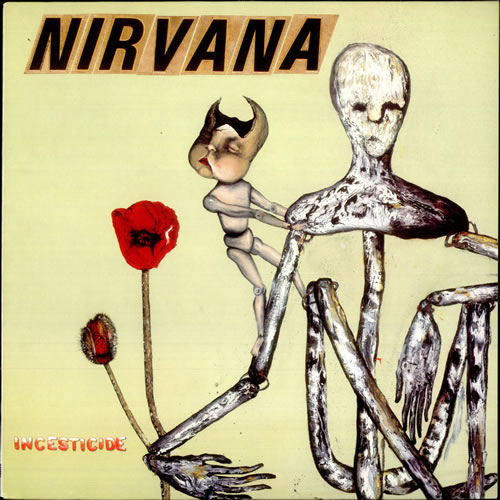
Incesticide is 20 Today! Celebration.

Nirvana-Incesticide-258802

Kurt Cobain was so interested in the Incesticide project that he personally created the art work for the front cover, selected the image for the back cover, wrote the liner notes and, as I argue in chapter four of Dark Slivers, gave detailed personal attention to the song selection and order. Each element of the record benefitted from his attention, he didn’t compromise on any aspect of the release and it remains as one of only four major releases to have his intense focus.

I argued the other week on this blog (Incesticide: Kurt Cobain Gives a Christmas Present & Celebrating Incesticide at 20 Years Distance) that the album represented Kurt kicking back against fame, against Nevermind – that it was this release NOT In Utero that formed the reaction to unwanted superstardom. I also explained that the release was a reaction against cosy family vibes and the demand that he release ‘Christmas product’. Faux-offensiveness is often cynically used to promote bands; Incesticide was the real deal on every level.

But it was also a release of sheer quality; there are no untidy, untrimmed demo versions of existing songs, no dulled live recordings, nothing that sounds obviously unfinished. This was the CD era, the band had enough material for a full 70 minute release cramming on anything and everything. Instead they stuck to their usual 40-45minutes of actual music, vinyl-length in other words.

(New Wave) Polly stands out – the only alternative version of an album song on the compilation. Why? Well, again I talk about this more in the book, but the release is riddled with games in terms of creating parallels. Incesticide was about reacting to Nevermind therefore what could be more appropriate by taking one of Nevermind’s softest tracks, finding a far more roughed up version of it, then placing that same song in the same position at end of Side A?

Without the clear, rigid deadline of Incesticide’s anniversary I’d never have got all this finished. Also, with the book finished (logistically speaking), finally I should be able to get back to building up more material for the blog. For the time being though, there are now 70 articles on here, around 50,000 words, to go on top of the 72,000 words in the book Dark Slivers. So! I hope you Nirvana fans are enjoying having a full book worth of content free – all yours! Merry Christmas and Happy Birthday Incesticide!

McCartney/Nirvana Update

http://www.youtube.com/watch?v=PmZw9e0vciM

Plenty of footage on YouTube – corrections to previous ‘first take’, Pat Smear along too. They played a new song called ‘Cut Me Some Slack’ and seem to have left it at that. Phew!

Looks like an enjoyable enough evening – a poppy enough new song. I’ve always wondered what that move is called where guys on stage play ‘to each other’ (you’ll know it when you see it) and why its visually effective.

Courtney is restrained enough in her comments – nothing particular to worry about…The Lennon preference is a fair one if we’re talking reasonable comparisons to Kurt Cobain:

http://www.huffingtonpost.com/2012/12/12/courtney-love-paul-mccartney-nirvana-not-amused_n_2289015.html

All Respect to McCartney…But.

http://www.guardian.co.uk/music/2012/dec/12/paul-mccartney-kurt-cobain-nirvana

Please imagine the first paragraph of this post as a morass of colourful swearing interrupted by attempts to draw breath and come up with something that beats the imagination of the previous elaborate expletive. It was looking ever more likely these past few years that the surviving members of Nirvana (version circa 1990-1993) were ever more likely to get together more formally. A charitable examination would compare it to the period of time it took Johnny Rotten to become comfortable playing Sex Pistols’ songs while on tour with Public Image Ltd, then the ongoing time before the surviving Sex Pistols were able to get back on stage together. Alternatively, perhaps the span of time prior to Jimmy Page and Robert Plant getting together for the No Quarter collaboration and then the, eventually, stage appearances of the remnants of Led Zeppelin. It takes a while before one’s own past feels like a costume one would wish to inhabit again.

On the other hand, a less charitable view would be that gazing into one’s past happens once one’s inspiration, one’s vision of the future, runs dry. Kurt Cobain is a fair example of that (in my view) given the covers he played, the originals he (apparently) was practising in his basement, the calls to family members not seen in a decade, addressing the suicide note to his childhood imaginary friend… Again, Johnny Rotten is a good example — by the time he began singing the odd Sex Pistols’ song he had shed the whole of the first (and best) edition of PiL and was about to start the long decline in PiL’s creative energies that led eventually to the Sex Pistols reprise. In the case of Foo Fighters…With all due respect to a really cool bloke, it’s a long time since Foo Fighters set the world alight musically and a while since they had a new musical idea. It’s understandable, to me, why Dave Grohl might be open to looking back to Nirvana. Krist has barely been involved in music in years yet has recently looked like a man more than happy to acknowledge his part in the most important rock band of the past few decades. Paul McCartney meanwhile is a very pleasant bloke, a surprisingly underrated musical and lyrical talent compared to his former Beatles’ comrade John Lennon, and a willing collaborator with anyone going. But. He’s also a guy with a voice now on its last legs if the Olympics 2012 performance is anything to go by and one who hasn’t had a genuinely fresh musical thought since before Nirvana even existed.

I have a feeling the story is being over-hyped; a one-off charity performance with celebrity friends (see the Living Like a Rock Star post from last week) likely consisting of a couple of the softer-edged Nirvana tracks, a smattering of Foo Fighters songs plus some Beatles classics is a perfectly worthy endeavour but, no, it isn’t a reformation. And in the end, it’s harmless. Given Kurt’s respect for The Beatles, having Paul McCartney sing is songs would probably tickle his ego no end. The fact that it turns Nirvana into a slightly fluffy cabaret act doesn’t bear thinking about…Just focus on the money for a good cause and pray no one gets it into their heads to call it Nirvana, or, worse, to persist with it beyond this one-off display.

1992-1994: Maps

I don’t want to lose whatever respect or credibility I’ve earned with you but I confess I’m listening to Pavement’s Slanted and Enchanted for the first time ever today. Apologies for delay too, office systems down so all a bit chaotic.

Now…As promised, the conclusion of Nirvana U.S. touring in map form! Though not the Salem of witch trial legend, it still seems neatly coincidental that Nirvana’s most testing year would commence in a town of that name. While previous years have taken me two or three slides to capture, the whole of 1992 can be taken in one:

1992_Shows

I even abandoned the naming convention I’d previously adopted given Salem is the only ordinary looking show on the map. Nirvana essentially abandoned America for the full year; two TV shows, two benefits, two secrets. If it wasn’t for the thirty days out in the Pacific (Australia, New Zealand, Japan, Hawaii), and the smattering of European festival shows, it’d be entirely possible to declare the band missing, presumed dead. I’m being gentle including the TV shows.

It does explain some part of why, despite Nirvana being an American band, something like Reading 1992 should loom so large in the popular imagination; the entire peak of Nirvana’s fame, as far as live concerts went, was spent off abroad at these kinds of show. Reading would have been one of the view shows all year where a massive press contingent could be guaranteed. It’s precisely the reason Britain receives tonnes of U.S. news; there’s lots of footage and reportage, it’s therefore cheap to buy and as a result we all get to learn it.

1993 was basically more of the same; America’s finest nowhere to be seen — I’m being kind including Saturday Night Live just to expand the engagements:

1993_Jan-Sept_Shows

That changes, however. The map becomes almost impossible to follow given how much the band crams into the final months of 1993. This is the most extensive touring Nirvana has done in the U.S. in their entire history. Looking back at past posts, at the maps for 1991, 1990, 1989, there had been big tours before but the scale and coverage achieved this time around was unprecedented. Of course, one thing to point out is that this kinda touring isn’t exactly uncommon for bands — this was the age of multi-year tours taking place, show after show… Nirvana staying out for the best part of three months was long by their standards. Having kicked off in Arizona (red line) the band took the obligatory pop over to Canada between Ohio and the start of the North-East U.S. visitation (blue line, November) and then the criss-crossing of central and western states in December:

1993_Oct-Dec_Shows

1994 was the usual post-Christmas smattering of appearances. On this occasion, however, given the finality of ensuing events, it seems apt that Nirvana should retreat so far into their own past. The map needed to show the band’s U.S. presence in 1994 barely needs to show more than the map for 1987, or 1988—they hop across the borders of Washington State to two locations, they head home, then gone:

1994_Shows


Aging Gracefully

http://www.politico.com/news/stories/1112/83331.html?hp=l13

In their heyday, Nirvana were atypical rock stars. It’s heartening to see that Krist Novoselic, as much as Dave Grohl, has persisted in evading the lame clichés, the tedious spectacle of mainstream rockers behaving like grey-haired apes. I talked the other week about Bruce Pavitt’s continued efforts to support grassroots music (his book Experiencing Nirvana will split profits with The Vera Project http://www.theveraproject.org/) — it’s another case of a denizen of the grunge scene continuing to make a worthwhile contribution to things that are important to them.

In the case of Krist, his long involvement in political causes is well-known particularly from his publication of the exceedingly readable Of Grunge and Government. At the time of Nirvana, Krist arguably formed the band’s heart contributing substantial amounts of its humour and leading the band into several of its political engagements notably against censorship laws and the raising of substantial funds for Serbian rape victims. To see him move on to the FairVote organization (http://www.fairvote.org/) has been heartening.

The generation that had come of age in the time of mass movements wrote the script regarding Generation X; they defined the youth of the late Eighties and early Nineties as some kind of passive, uninspired and morally/socially disinterested mass. This was always a simplification, one that could just as easily be applied to any generation, based on an inability to comprehend a generation that didn’t use massive organisations as their key method of political expression. That reaction was certainly real; it was a move away from bodies that imposed a set persona and character upon their followers. Instead individuals were equally capable and willing to commit time, money, energy to causes — they just didn’t feel that being in favour/against one issue meant they were part of a single congealed mass (left wing, right wing, etc.), nor that it meant they automatically agreed with other related or unrelated causes or issues.

The ‘slacker’ tag overlooked the fact that the scene from which Nirvana emerged, and a substantial amount of work within the alternative music scene, was focused on causes not as easily reduced to mass appeals for cash. A lot of the ‘new politics’ couldn’t be solved that way given they were about attitudes rather than the presence or absence of a political permission, or a physical element. Krist exemplifies Generation X, showing the forebears of modern activism that, despite not lining up alongside the megalomaniacal LiveAID style of action, a generation wanted to seek change and had decided to do so by focusing locally, attending to the lives of those around them rather than to distant abstracts, and were attentive to things that were less photogenic, less interesting to TV news, but were no less worthwhile.

This doesn’t, of course, mean that there weren’t weaknesses in the political nature of the generation. The absence of a specific organisational identity — such as a political party, a cohesive movement with an administrative core, a trade union, a web of think tanks or entities (as existed for the U.S. Conservative Movement) — while laudable in theory (anti-hierarchical! Individualistic! Open to opinions and debate!), made it very difficult for conversations to take place with the wielders of actual power. In a world run via conversations between organisations, where organisations act as the proxy for individual voices, it’s hard for diverse cacophony to have an impact. Again, however, the trajectory of Nirvana — or perhaps Krist specifically — shows a move from individual awareness, to initial actions (marches, protests, concerts, speeches) to committed organisational politics via a defined body.

I take the message of Nirvana to be to engage positively and soulfully with the world. Seeing Krist Novoselic use his middle age, not to turn into another embarrassing wreck, but to fight for something…It’s good to see Nirvana’s heart still beats.

Nirvana in the U.S. 1991 – Maps

These maps take time, apologies for the delay!

The onset of major label time did break up Nirvana’s touring activity, the band barely made it out of the West Coast for most of 1991. In some ways this was the key Nirvana trend, long periods of localised activity, sticking to ‘home turf’ for months on end: Tour_Jan-Aug 1991

Of course, compared to 1987 to mid-1989 that ‘turf’ did now extend all the way down through California with Washington State only soaking up a certain amount of time. The band’s trip round the U.S. in September-October followed a regular pattern with the path set so that after running in circles in the North-Eastern states, most of October was always bringing them closer to home:

Tour_Sept-Oct 1991


Kurt Cobain and Lyrical Meaning

There’s a late 1993 interview on YouTube in which Kurt Cobain, when asked about the meaning in his lyrics, straight up denies his lyrics have any meaning raising his hand in the air and declaring “swear to God brother…”

If he means, “I don’t intentionally write meaningful stuff” he would still be playing loose with the truth; he admits over and again to songs having a story line or an autobiographical element, he just refuses to do so in a uniform way or without disclaimers. If he means “my songs have no meaning” then he’d be either (take your pick) wrong, lying or willfully self-deceptive. It’s a well known fact that, at least after his early writing visible on Incesticide, Kurt often mashed lyrics together at short notice. Again, however, that wasn’t a uniform writing pattern. There’s no evidence of how long the songs written in late 1990-early 1991 took to write but they were written at home, in private, not in the run up to album recordings or on the spot at rehearsals.

Also, the key point is that ‘meaning’ isn’t automatically entangled in authorial intent. If an artist writes a song and deliberately makes it about a specific topic (i.e., Sweet Child of Mine was written, deliberately, as a wistful love song hence the focus of all the lyrics) then fine, its about that topic but it doesn’t mean that the images used aren’t tied to other ideas in an artist’s work. The other way to void meaning would be to do a William S. Burroughs style cut-up in which all lyrics are found and thrown together from other sources – the author doesn’t write any of them. But even Burroughs arranged those cut ups into narratives and stories that he did, deliberately, construct. Therefore authorial meaning was returned to words that didn’t originally have any.

In the case of Kurt Cobain, the fact that he wrote fast, that he wrote things on the spot, actually brings us closer to interior meaning. Why? Because all the words and images poured onto pages came from his internal world without being warped or corrupted by deliberate intention – these words and images were what spilt out of him.

This is why, when studying Kurt Cobain’s life and works, the same themes occur again and again whether in lyrics, in diary entries, in his suicide note, in the authors he payed homage to or in his art work. He didn’t deliberately set out to write more songs about rape than about heterosexual sex – but that’s what came out when he sat down. He didn’t mean to write numerous songs in which the character is restrained, bound, under control – but that’s what came out.

A good comparison would be to query the meaning of a quality film. The Godfather is a film about the Mafia. Well, yes! True! …But it’s also a film about the bonds of family, about inheritance, the corrupting of good intentions…And on top of that it’s a film displaying Hollywood’s love affair with glamorous violence and crime, its relationships with organised crime (the tale is that the word Mafia is never used because the makers were pressured by associates of local crime families) and also the influence on screen portrayals of crime can have on individuals who have modelled themselves on it since then. Kurt Cobain’s lyrics aren’t Transformers; all surface explosions and no depth. Kurt Cobain’s lyrics bear comparison to detailed cinematic work.

The quest for meaning has given too much credibility to his own statements regarding his ‘meaninglessness’ while simultaneously every Nirvana fan looks at In Utero and can add up countless personal references and links to other songs in the Nirvana catalogue. Its part of the reason I adore Kurt Cobain so much; I think he’s, inadvertently, one of the most psychologically honest artists ever to breach the mainstream world and the linkages and connections between songs written across his entire career are quite stunning to behold.