These recordings have been floating around for a while; October 1992, the peak of the Cobain’s siege mentality as Vanity Fair’s poison-pen letter had sparked the intervention of Child Welfare Services who removed Frances Bean Cobain from her parents at two weeks old so an investigation could take place regarding their drug usage and fitness as parents. Kurt and Courtney had to endure a guessing game of figuring out which ‘inside sources’ (what the rest of us would get to call ‘friends’) had made anonymous accusations against them – who could they trust? Relationships with Cobain’s closest friend – Krist Novoselic – had been rocky since early that year given a few disagreements between respective spouses – another link broken. And, being frank, Cobain was hitting a peak in his drug usage. While it’s pointless (and impossible – though potentially fun) to try and plot a calendar of ‘how high?’ or to argue he was OK on the basis of X or Y photograph or video footage, ultimately Kurt Cobain really did have a drug problem of sufficient scale that he had spent parts of the year in rehab and even greeted his own daughter’s birth having been fetched from there by his wife – not exactly perfect virtue. The weeks after the arrival of a child are a busy, tiring, fraught time for any set of parents – for these two, at this time, the media light, the pharmacology of the father, the mistrust of those around them…It added up.
All I feel is that it was sheer bad luck and misfortune for two U.K. journalists to walk into the middle of this environment where the slightest sign of intrusion could be deemed to have negative intent, or a traitorous edge. Victoria Mary Clarke tells her own tale and I’ve no desire to take her words from her so here she is:
June 26, 1992 – it’s already going wrong. That’s the date of the Roskilde Festival. Denmark beat Germany in the European soccer championships so the whole nation was celebrating – Nirvana even agreed to go on an hour or two late because the audience wanted to see the match on the big screens on stage. Cobain met a Geffen-hired photographer for a quick ceremony handing over gold discs for sales of Nevermind in Denmark – he was happy, courteous, complimented the football result. It was a good show. He gave an interview that day, a little more edgy, a little more withdrawn – but, again, not particularly difficult. And somewhere in amidst it he’s had management kick this journalist out of the festival.
September 1992, out comes Vanity Fair – things kick off more deeply. It seems to be the news that Britt and Victoria have spoken to Lyn Hirschberg that provokes the final storm…36 minutes of vitrolic voicemails from various sources:
The Dave Grohl call is…Something I’d not checked before. Wow. Grohl calls claiming that he’s heard a rumour that they’ve slept together – he’s clearly unhappy, for whatever reason, he threatens legal action on top of the death threats from Kurt and the barrage from Courtney.
Then it gets truly surreal…Kurt’s aunt now calls up to demand that no material from her interview be used in the book – again, legal threats, a statement that the understanding is that the intended book is a hatchet job.
There’s a wider orchestration at work – multiple levels of attack coming down on the two journalists – calls from the couple at the centre seem to be leading to these reactions from other people, meanwhile the record company’s legal people and the Cobain’s private representatives are tackling the publishers in both U.K. and U.S. Full defence at play. Ultimate result is that a book never materialises – just an ugly incident.
Listening to it all is voyeuristic, for sure – don’t think I’ll listen to these again any time. The fact that Kurt calls sometime on the night of October 22 – early morning on October 23 doesn’t bode well for his condition, the tape is fascinating in the sense that more than the Sao Paolo performance in January 1993 or the post-overdose performance in July 1993 in New York, he’s visibly wasted. Nirvana are one week before the poor performance in Buenos Aires where Cobain is invisible except for the performance and brief backstage time before – he’s ill? Yeah…For sure.
The comments under the YouTube clips tend to be a bit of a ‘right/wrong’ battle at points with people taking sides. I’m not sure there’s a side to be taken here. The voicemails are vicious, unpleasant, unnecessary – it’s harassment, it’s threatening, it’s gross behaviour from both Kurt and Courtney. On the other hand, the scale of the threat to their family at that point, their love for one another and for their child, the situation they’re currently in – their terror, their rage, their misery is all understandable also. Of course we do live in a society governed by rule of law so that doesn’t justify extra-judicial intimidation but it makes their verbal violence comprehensible if not forgivable. I’m into reasons (why something happens and someone does something) not excuses (why something happens and therefore someone’s actions aren’t their fault.)
As far as Victoria and Britt…Again, similar splitting of the difference. Journalism by its very nature is intrusive – it’s meant to be. The bargain any artist makes with the media is that by giving away a certain amount of privacy they’ll receive a certain amount of benefit resulting from coverage. The individual artists draw their lines, journalists are independent and therefore entitled to explore, question, find other routes to clear understanding. The ‘quest for the truth’ doesn’t negate them receiving blame for the harm that the truth can cause. Revealing someone as a killer obviously hurts their family, their friends – but there’s a greater good at play. Music biography, a trickier field. Instinctively I’d hate it if the only biography permitted was the sugar-coated faux-honesty of artists telling their own tale – they’re entitled to try but I think most artists are flippant, deceptive, sometimes blind. We all are – it’s human to underplay or reinterpret one’s sins.
I can’t imagine Victoria or Britt gathered anything other than the truth about the situation around the Cobains; that Courtney Love had made herself a less than beloved figure long before meeting Kurt Cobain, that drugs were a major part of the scene around both people, that Cobain was on drugs throughout the pregnancy, that Courtney came off as soon as she knew but it’s hard to believe there wasn’t some blurring of early lines while still ignorant and still kicking. Revealing the views of others wouldn’t have been flattering, but wouldn’t have been dishonest either. The band’s lack of cooperation certainly didn’t help the situation – in a way it’s a shame they didn’t continue given Lime Lizard had followed Nirvana from their early days around the 1989 European tour, it may have been nice to see someone from the indie publishing world rather than the corporate music press create the first authorised biography of Nirvana.
End result? I think Victoria Clarke’s blog piece summarises things nicely. That it was grim on every front – that no one emerged untarnished or totally spotless. As a fan of Nirvana, therefore a fan of Kurt Cobain, I never want to turn admiration for someone’s creative works, or an attempt to understand a person one admires much of the time, into an application for sainthood (bleugh!) A recording like this is a good reminder that everyone has times they’re not all they are at their best – I wouldn’t wish you to see me at my worst either. It’s a grim recording, but a human one and a nice reply to the less balanced, more gushing end of Nirvana coverage and writing. A specific moment in time caught forever.
This is a piece I was invited to contribute recently by Anton and the kind people of the Vinyl Factory. As I say at the start, it would have been so easy just to list a batch of well known hits but…I think there’s so much music was pouring out of the region and so much that has been glossed over and erased from all but the deepest musicological explorations. These are ten I picked out – there are plenty of others worth a look – with a desire to provide ten contrasting sides of the State of Washington music scene. hope you enjoy and hope my verbal histrionics don’t distract too much from the quality of the releases I’m discussing.
Thanks to the crew at Soul Jazz for passing this request onto me – damn it was fun. Whittling anything down to ten is quite the exercise…
Just a little round-up today of pieces from around Europe…I admit I can’t read half of them!
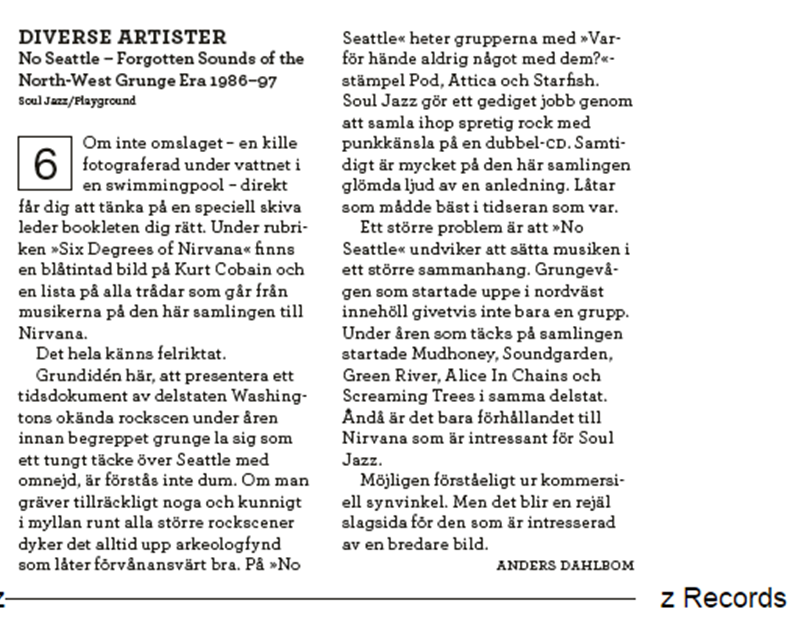
This first one is from Sweden – a fair and moderate review but points deducted because in his view the release isn’t ‘grunge enough’, he’s dubious about it not containing, essentially, “the greatest hits of Sub Pop”. It’s a bit of a defining challenge really – what made me interested in doing the release in the first place was to try and show that there was more to the State of Washington / State of Oregon than this single stereotype…But seeing the word grunge in the title makes some people confused why that’s not the be-all-and-end-all of what they get across the two discs. The reduction of entire musical cultures to single shorthand ways of speaking about them – it’s exactly why I thought a release was needed.
In a relatively centralised nation like the U.K., it’s very hard for subcultures to escape notice of the media or to be ignored by the British music industry – even if most of those bands never penetrate the U.S. market. The same is true of other Europe states – massively smaller than the U.S. geographically, massively centralised media and massively centralised music industry infrastructure. The result is that the music media are unused to scenarios in which music escapes their attention. Faced with a release on which they’ve never encountered any of the bands, where they ‘might’ (if they’ve delved deeper) have come across Bundle of Hiss as a footnote to Tad or Mudhoney, it seems to give them uncertainty. They equate the attention given to the grunge bands as an indication that those bands were the best the North West had to offer rather than of an industry machinery momentarily fixating on a particular sound and milking one version of a regional identity while neglecting the greater sum of the diverse music present there. Sheesh, I feel awful second-guessing someone’s review – they’re entitled to say whatever they wish – but…I think the hole in awareness is a fair point. On the other hand, it does say that the songs themselves are likeable, so that’s good.
This is a nice one ‘auf Deutsch’ from a Swiss publication called Loop – the guy has definitely delved in and his piece brings out the various debates that are fair to have around the release; to what extent was the ‘Seattle sound’ just ‘the Sub Pop sound’? To what extent is the industry different between U.S. and elsewhere? Were Nirvana unique in many respects and deserving of their meteoric success? Then he focuses on the songs themselves and just comments on what he’s hearing.
Again, a very mellow cool review from a German publication – same approach, picking out labels, the variety of sounds, the connections between individuals and bands – citing the release as being a bit of a documentary / sampler of the scene.
From France, here’s two pieces, one from Les Inrocks – a pretty major magazine there – and Rock n Folk. I’ve met a guy who worked for both publications actually…Nice to see familiar names.
I rather like what “Les Inrocks” says, it comes out with a comment about how one of the beautiful things is the booklet and seeing the musicians themselves speak of their “misspent youth”! Neat. It quotes Abe Brennan of My Name and his comment that “when I was a boy we had to walk five miles in the snow just to see a shitty punk band. Those were the days!” Stephane responds “et c’est beau.” Bien…Tres bien…
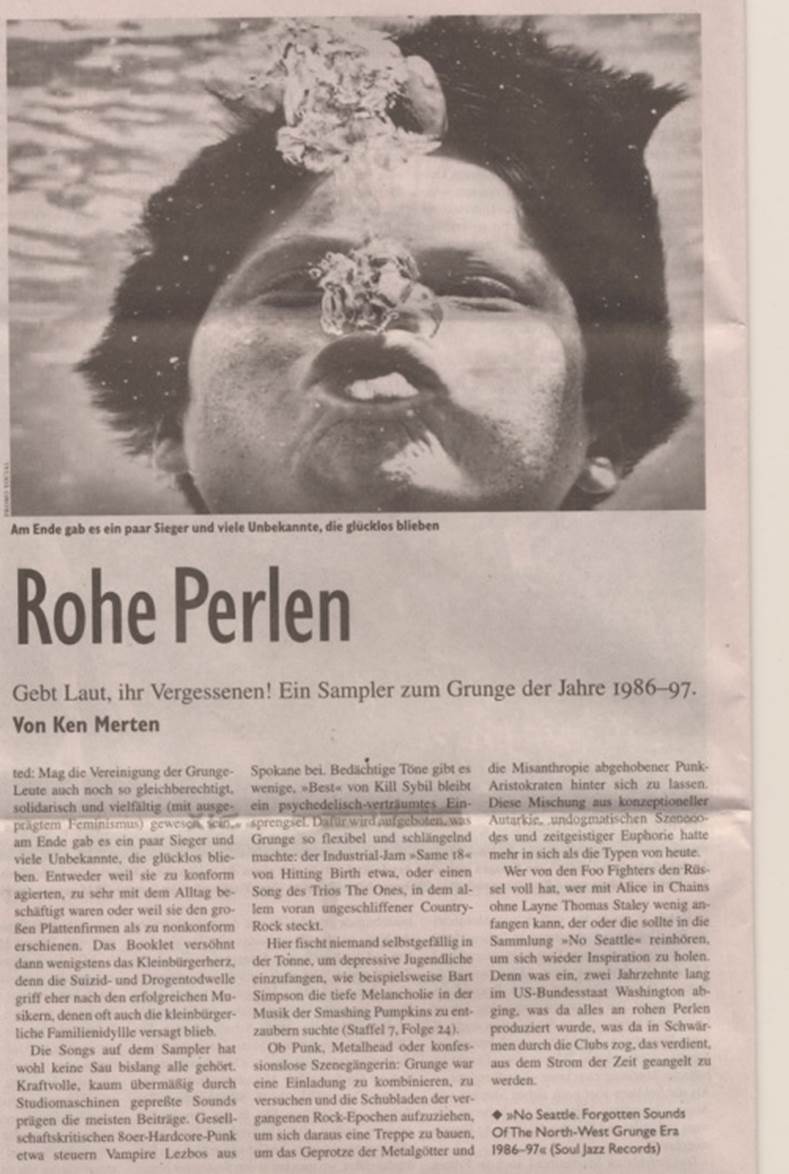
This final piece is a little hard to read without zooming (sorry!) and comes from Tageszeitung Junge Welt – a German left wing newspaper who gave it a full half page and picture, how nice of them! The title basically translates as “Raw Pearls” and the sub-title is something like “Listen to the Forgotten”. It goes on to say stuff about the mash-up of genres that took place in the North West, the diversity of music on the discs, the reconciling of this small number of global superstars versus the many who just kept on playing to this day…A nice read.
Oh – that earlier piece from Les Inrocks isn’t the only place where someone is quoted. German site Laut chooses to go with the words of Jaime Robert Johnson –
What I quoted from him was an honest statement about how the traditional path to fame wasn’t something that most kids in the North West would ever be accepted within. That it was up to people to do it themselves “the kids themselves built that scene…Music made by the kids – for the kids is so important you can’t leave it to professionals.”
HHV also found time for this and dwells on the unpredictability of the results – the variety of approaches found. They highlight Shug for just being awesome, Hitting Birth for playing ‘tribal industrial’, Small Stars for being tentatively Sonic Youth-esque (intriguing…hadn’t thought of that…)
I found it intriguing to conceive of Nirvana’s tours in a more physical way – as movement from one location to the next rather than just gigs or recordings of gigs – a reemphasis on the journeys rather than the outcomes.
Having diligently plotted the band’s first tour down the West Coast in early 1989, I moved on and tracked the summer and autumn 1989 tours in the U.S., then the April/May tour of 1990 followed by the West Coast jaunt in August, next the Sept-Oct tour of 1991, moving on to the October-December 1993/January 1994 tour finally. I don’t think I looked much deeper than that really – I made the maps, followed them round, left them there.
What I didn’t really focus on was the shift in approach across those years – for some reason it was on my mind today. For a start, the band’s complaints in multiple sources and biographies regarding the grim experience of living in a van for weeks, perhaps point to a shift in approach. The first tour commenced in Seattle, carried on through California, then on to the rest of the U.S. – logical huh? Well…No. The reason is that it meant by the time the band reached the east coast and played New York they were simultaneously exhausted and as far from home as they could be. The result was the cancellation of seven shows – a significant portion of a tour in which the band only played sixteen shows outside of State of Washington and California. The original tour plan would have taken them home as follows:
So; Toronto, Newport, Detroit, Champaign, Denver, Salt Lake City, Boise – cancelling the tour meant Nirvana basically made the route home in a day or two as opposed to two weeks…But they were still just skipping the path home.
For the September tour they were more focused. They’d played the west coast plenty of time so they simply skip it altogether and instead commence the tour in Minnesota – in other words, a long drive done quickly to start things off rather than the slow progress from the North West. This allows them to polish off the gigs they didn’t do the previous time and makes the entire tour a progression heading ever closer to home – a positive for tired guys.
It’s clear that they’d learnt something from the early experience because the route planning in 1990 reflects the new pattern; they clear the west coast up in February, then come April 1st they simply drive to Chicago from State of Washington and commence there – no ‘long beginning.’ From the time they hit Florida on May 4, they’re on their way home – every gig a step closer. They still overestimate their own stamina – yet again that long in a van means a band member is flung out at the end of the tour. September-October 1991, a full year and a half (and one label change) later and they still kick off by driving all the way over to Ontario, Canada before working their way home, this time going back up the West Coast rather than directly home.
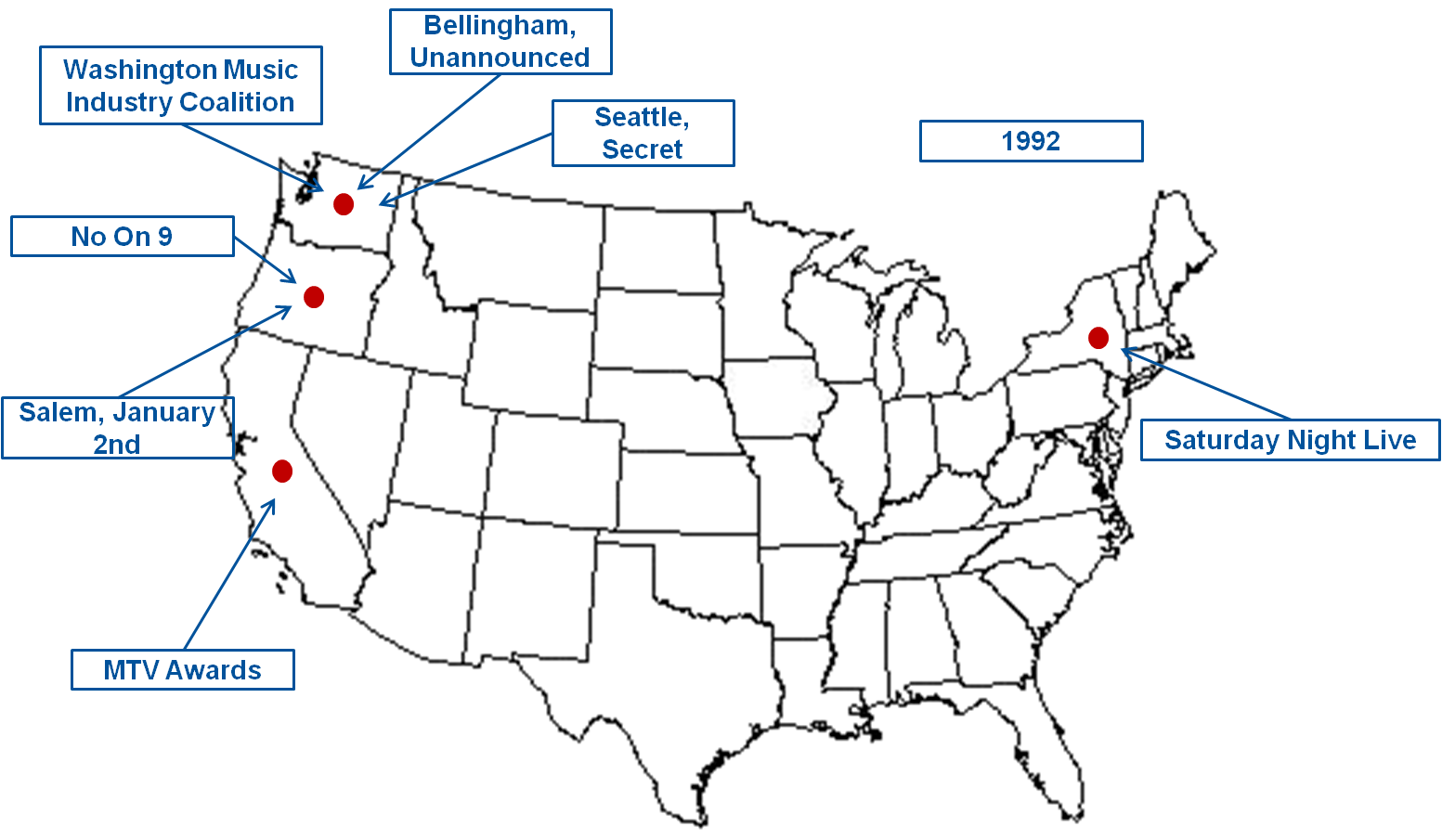
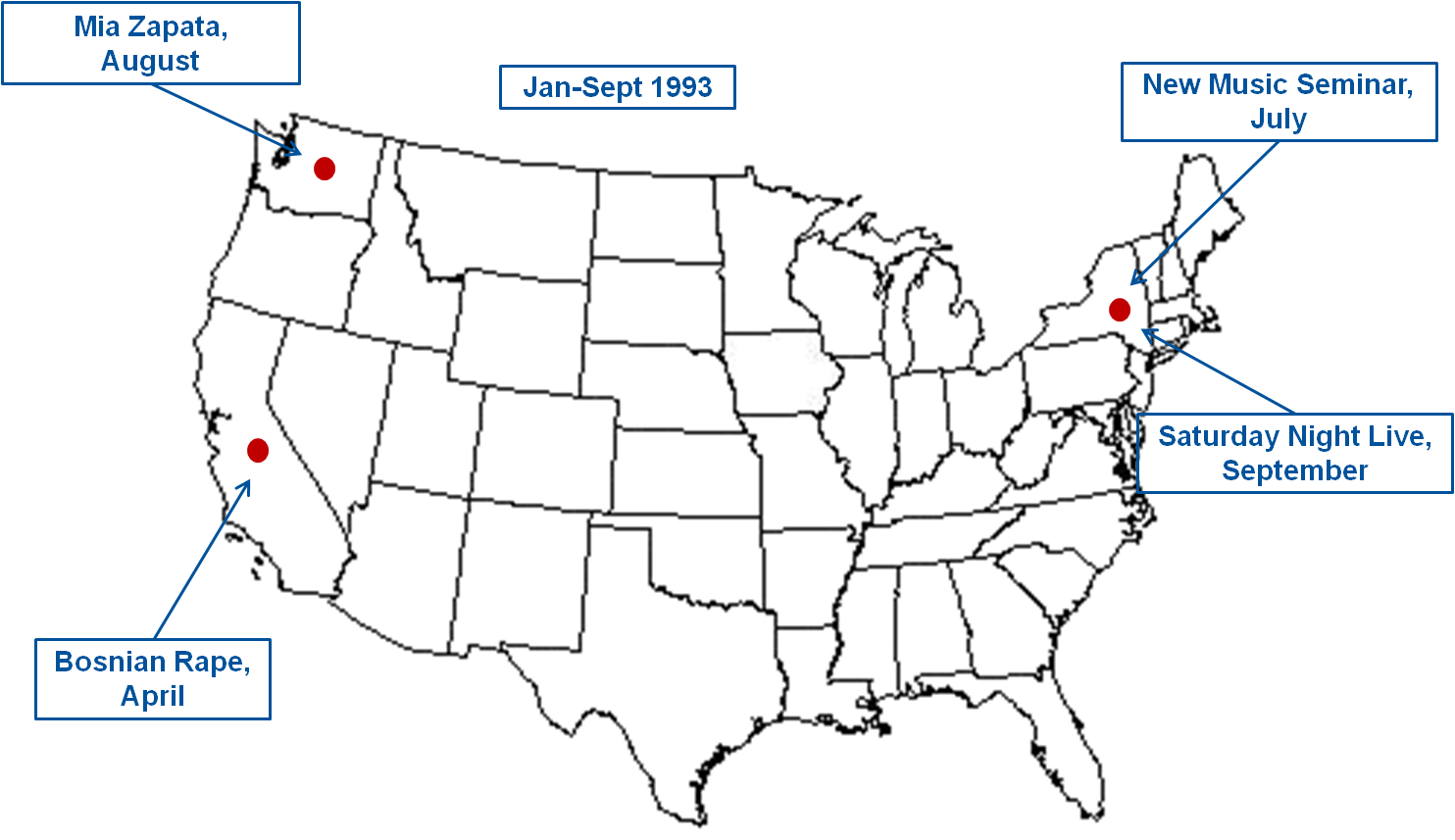
Here’s the bit I realised I’d failed on though…The big change between 1989-1991 and 1992-1994? Well, sure, there’s the bit where they stay home and barely play for months, but more significantly it’s the way air travel becomes a feature of their touring within the U.S. I’d not noticed it because, of course, the band were flying to Europe regularly, but before they hit fame they’re still driving the continental U.S. From 1992 this isn’t necessarily so – it results in the West Coast / East Coast ‘pinging’ in 1992/1993.
The band no longer have to plot out routes, they can fly in for lucrative one-offs and head home immediately (pretty well what they did with the European festivals and South American shows in 1992.) The In Utero tour – while more extensive – still retains that determination to start well away from home, this time in Arizona, before crashing round the East Coast. The route home is still there but it’s a lot more convoluted given they arrive back in Seattle for Live and Loud then head out again from there.
That basic pattern remains; first tour, the tour has a long start and an abrupt finish – they run out of steam. After that they go for the ‘quick start’ somewhere far across the continent and then the ride home. It’s late 1993 before relative comfort stretches that pattern out.
A few neat little distractions today…Firstly, the deeply pleasant gentlemen from long lost Bellingham band Saucer (who’s songs “Jail Ain’t Stopping Us” and “Chicky Chicky Frown” are on the No Seattle compilation) shared a lost demo with me that they’ve recently dropped up online. I asked their permission to share it onwards – I mean, what the hey, nice to have something to listen to while looking over today’s musings isn’t it? I like the musical bait n’ switch – the chanted verse flipping over to the thrashing chorus, nice seeing diversions and surprises within songs.
Next, just a small thing – someone I know was browsing the online archive of a newspaper and located the two adverts below:
How curious…The Nirvana Live Guide quotes Blood Circus as the band Nirvana supported that night – I’m curious whether the local band, Annihilation Association, had to drop off for some reason, or if it was the other way around and Blood Circus dropped out. The only references I can find to the band online are a live recording from 1988 at http://319dude.bandcamp.com/album/live-1988 and a reference to a guy called David Murray having been in the band, a live photo at https://www.flickr.com/photos/23989451@N00/2703637399/ plus the link back to the newspaper from which the adverts came: http://dailyiowan.lib.uiowa.edu/DI/1989/di1989-07-05.pdf
Anyways, I just want to ask around and see if Nirvana did play with this band and vice versa. There’s a distraction for the evening…
Departed this realm about five weeks ago to go get moving on various other activities so rather a lengthy absence from the blog this past month. I can’t for the life of me remember whether I shared this piece – “No Seattle” was chosen as the album of the month for Seattle’s City Arts magazine. Pleasing once again to see different songs plucked from the release – this time Chemistry Set’s “Fields” and Hitting Birth’s “Same 18” – as highlights. Ah, diversity…Such a pleasure.
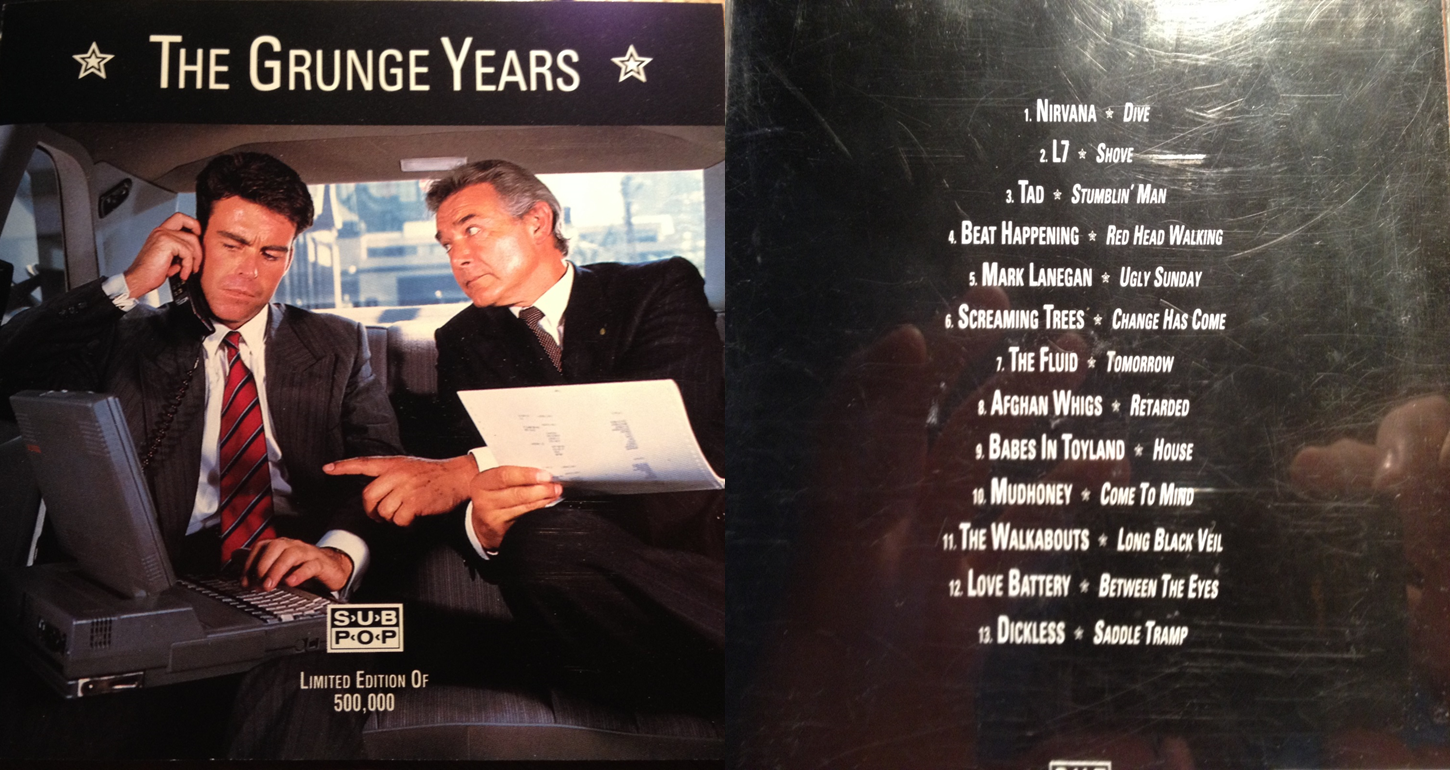
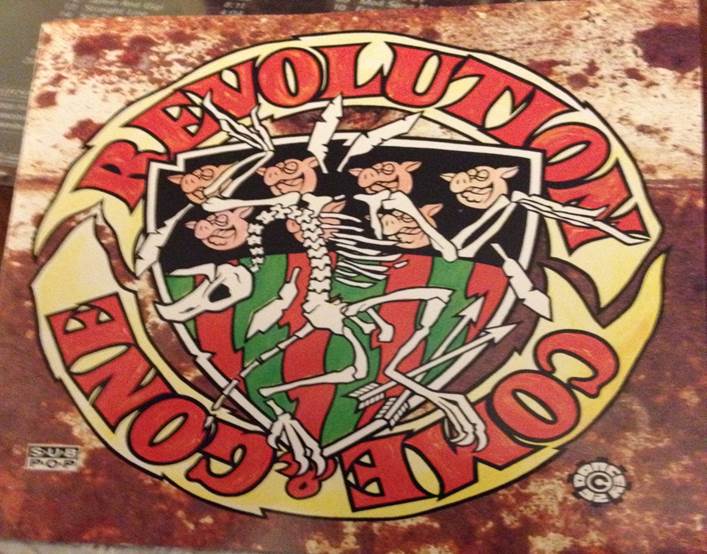
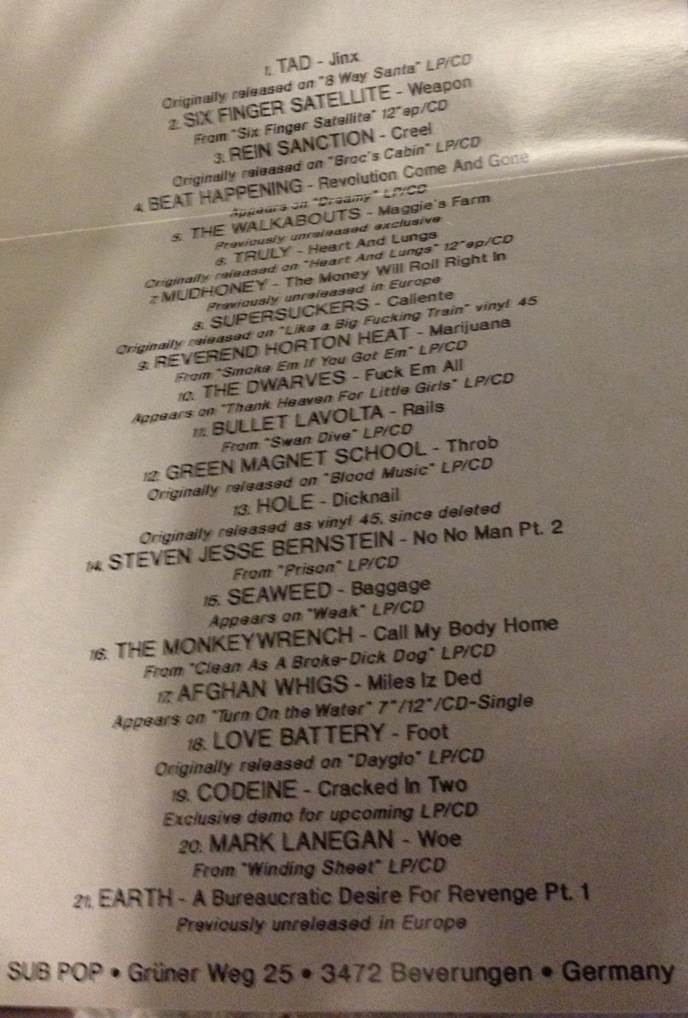
Anyways, where was I? Well, one fortuitous discovery this past month was a copy of 1991’s Sub Pop compilation “The Grunge Years” and a further compilation from 1992 called “Revolution Come and Gone” – a neat twosome bookending pre/post Nirvana explosion. Nirvana’s career was almost as neatly sub-divided by compilations – their appearance on “Sub Pop 200” in 1988 saw their second release escape into the world, while “The Grunge Years” was the second-to-last Sub Pop release of the band’s active lifespan (the reissue of Bleach being the final piece.)
Listening to the two compilations intrigued me; take a look at the bands listed – the number of past alumni is so extensive that it does give an impression of a label living on its laurels. With “The Grunge Years” it’s understandable. The ‘grunge’ phase was still a piece of the past – a strange phrase coined and applied in 1989 so the release, while never explicitly saying so, seems to be a harking back, a review, a retrospective. “Revolution Come and Gone” intrigues me because it shares that same ‘looking back’ air in the title – it could be a reference to grunge being dead and gone, or it could be a reference specifically to Nirvana viewed in the rear-view. “The Grunge Years” had pegged ‘Dive’ onto the release which capitalised neatly on Nirvana’s past patronage and it emphasizes how ‘of a piece’ Dive was to the existing output of Sub Pop – lot of gnarly punk rock moves, lashings of distortion, a very visible product of Nirvana circa mid-1989 rather than Nirvana late-1990 let alone 1991.
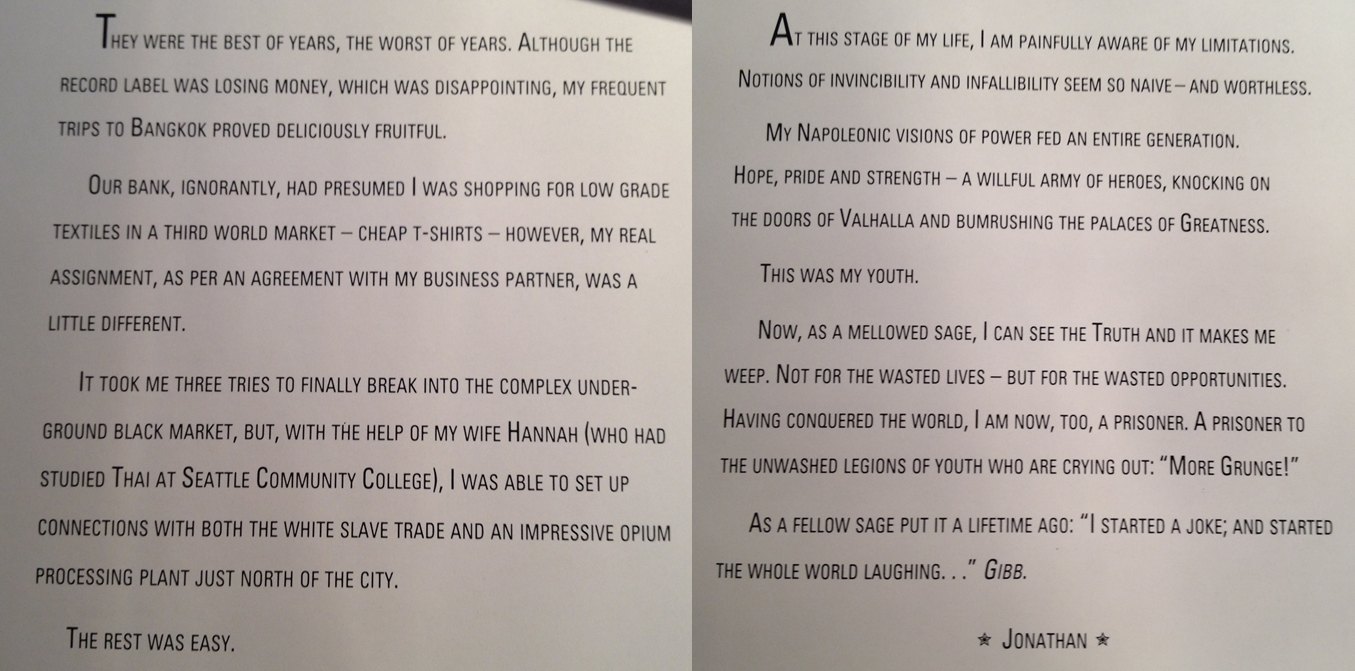
My issue with Sub Pop is that it’s humor relied so much on disposability, glibness, sarcasm – all very enjoyable – but that means I’m not sure Sub Pop ever managed to translate its releases into more respectful retrospective glances. “The Grunge Years” is a good example. The front cover plays the same ol’ joke that the label had played right back in the notes of Sub Pop 100 in 1986; Sub Pop as globe-spanning corporate conglomerate – heck, the two characters made me think immediately of the film Wall Street. The inlay, again, combines jokes and jadedness in an appealing slalom-ride through whatever is on the mind of Jonathan Poneman that day. The problem is it leaves me shrugging and thinking “why’s this release here at all? Is it really just ‘more grunge’ for the masses?” Product…?
I guess so. As a starting point for appreciating the music that doesn’t bode well. Luckily the music is pretty good! Eleven of the thirteen songs are solid representatives of the North West explosion – with Babes in Toyland and L7 wedged in. It’s, in many ways, Sub Pop 200 Mk.2 – another rendition of the local scene review and that ‘centredness’ has a strong appeal. I’m also enjoying hearing that expanded female presence given the boys club vibe of Sub Pop 200 which made way only for the token presence of Girl Trouble’s Bon von Wheelie. The linkages between K Records and Sub Pop are on display on the release when often Olympia/Seattle was presented as a competition. In reality, Bruce Pavitt was a long-time friend of Calvin Johnson of K and the two labels had teamed up to get Girl Trouble’s first album out – “The Grunge Years”‘ inclusion of Beat Happening doesn’t seem an anomaly, it looks more a reminder of dues paid.
While the packaging and absence of context is even worse on “Revolution Come and Gone”, the music by contrast is a lot more energetic. The variety of bands has expanded – there’s even room for Earth on here – and the scope is now widening up to encompass even more non-North West representatives. While “The Grunge Years” hammers a single sound home, this 1992 compilation sees the label reaching forward to new hopes like Codeine, tagging on burgeoning names like Hole who were creating quite a stir in the underground by 1992 (as well as marriage related publicity and gossip courtesy of the Cobain couple), reaching back to long time stalwarts like Mark Lanegan and Mudhoney, without forgetting newbies like Truly (incidentally, apparently Robert Roth of Truly was a further candidate for second guitarist in Nirvana circa 1989-1990 – the unsettled nature of the Nirvana line-up in those two years seems ever clearer as time goes on.) The result is a more diverse and energetic set.
The pleasure of both, of course, is that between them it’s a fairly comprehensive overview of the key bands of the ‘grunge’ whatever-it-was or that used to get quoted in lazy review thereof. Tad? Check! Nirvana? Check! Screaming Trees? Check! Mudhoney? Check! The Walkabouts? Check! Earth? Check! Beat Happening? Check! Love Battery? Check! the Dwarves? Check! The Fluid, Afghan Whigs, Dickless…Then an assortment of fellow-NW travellers and friends. It’s a shame that Sub Pop has never pulled back from the attitude long enough to create a comprehensive and dignified review of it’s own back catalogue because a respectful look at what it pumped out in it’s crucial years, one that doesn’t smirk all the time, is long overdue.
This individual puts up some intriguing stuff on YouTube, noted this one a while back and find it pretty revealing.
Core reality of my life; I’m British white middle class working an office job. My day doesn’t involve being on the receiving end of any form of discrimination, it doesn’t involve a macho environment full of people spoiling for a fight or running on drugs or adrenalin, I’m unlikely to be sexually assaulted (unlike, as the current government estimate states, anywhere between 60,000 and 90,000 women this year in the U.K. http://www.theguardian.com/news/datablog/2013/jan/11/male-female-rape-statistics-graphic – as a sidebar, dang, kinda upsetting number huh? I know one friend who has been raped and two who have been attacked so it’s a fair guarantee even more of my loved ones will be…), I’m rarely exposed to aggression in any form – which means when I see violence in real-life I find it quite a punch in the gut – but frankly I’m delighted to lead such a lucky life, one where I’m totally unused to any such unpleasantness.
At first viewing perhaps it’s easy to say “oh, look, it’s Kurt Cobain being aggressive,” but I actually feel a far greater empathy as a result of viewing this. Let’s start with the obvious and with the end item; the notorious Dallas, Texas performance in 1991. Cobain smashes a piece of equipment with his guitar, a bouncer (I can’t remember if he owned it or if his friend did) takes offence, waits for Cobain to dive into the crowd then proceeds to grab him by the hair, takes the opportunity to get some punches in – Cobain twats him with the guitar and on they go, bit of a fight, gang of people step in, blood, stand-off, audience chanting… That’d put a spoiler on anyone’s day. This isn’t the only fight in Nirvana’s history – but physical violence is mercifully rare, as it should be in anyone’s life.
The video, however, is wonderfully edited to include events leading up to the incident. Cobain’s equipment is malfunctioning, people are fiddling with his pedals, eventually the guitar cuts out altogether but he tries to soldier on and keep singing, keep performing. This is the difference between being a performer and most other jobs; your entire job is compressed into one hour, two hours – if something goes wrong then that’s it, you’ve achieved nothing that day. Worse, not only do you fail, you can’t fix it quietly – you fail publically, in front of your audience, you can’t hide it or take it back. That kind of full exposure is rare in the majority of jobs. You drop something? Fine, most of the minor worries of the day-to-day can be fixed without anyone even noticing. Something goes wrong? Most of the time you have hours left to fix it and can go to bed without it excising your mind too hard. I have a boss – a couple times a year I have to own up, my bad, I screwed up. It never feels good. Cobain doesn’t have one boss, he has a crowd of people all there witnessing things he often can’t control. That must be an unusual feeling – stand up, give a presentation, see how embarrassed you feel when you drop something in front of them, or the PowerPoint slides don’t click on, or someone points out you’ve made an error…It feels personal.
The technical failures are present here and also in the clip from November 1993. OK, if my laptop switches itself off and I can’t complete my work, I’m furious. I leave the room, I cuss the machine – I’m frustrated, I’m annoyed. Cobain doesn’t have the virtue of being able to walk away – he’s stuck there on stage with a few thousand people observing, he feels responsible and, of course, he’s pretty well trapped in a cone of human focus and attention. It’s the same frustration present whenever one’s tools are defective, they’re letting you down at the critical moment, it ruins what one is trying to do. In the Dallas incident and the Bethlehem, PA case Cobain takes some brief anger out on the equipment – Gods, some days I do wish I could hurl the laptop down a stairwell…Know that feeling? Then these two clips will make more sense.
Add something more to that, however, Cobain complained of people walking over his effects peddles and equipment to get on stage. Heh! Again, sat at my desk it’s unlikely anyone is going to tread on my keyboard or kick my phone – but to not only suffer an equipment malfunction as a consequence but also for there to be someone obviously and thoughtlessly responsible…Again, the annoyance is understandable. In the Dallas’ clip, whatever the guys crouched at his feet – who seem to be trying to sort the peddles out – do, they accidentally cut the guitar altogether to a long howl of feedback. Unhelpful. Similarly, trying to do one’s job, trying to blast through the 90 minutes one has to get right that day only to have a whacking great spotlight blinding you altogether as in the opening clip? I’ve seen people throw fits because of the glare on their screen as they try to work, they can’t see what they’re doing…How’s about an industrial size searchlight’s worth of glare? Feel better? I can’t think of any job that would be improved by someone at the back of the room aiming a torch at your eyes. Again, rather than seeing it as Cobain being moody, it seems a pretty reasonable reaction to a rather major annoyance. Getting back to the time factor; do your whole job in a ninth of the time – sure, sounds good to keep things short but it’s more like compression, a ratcheted up intensity level that also deepens the impact of negatives.
The opening show on the clip, Brazil, is notorious for Cobain’s basically drug-addled performance. Again, I’ve seen people with migraines leave the office because of strong light, can’t imagine how ugly enduring a comedown on stage in front of 45,000 people must feel. Most of us have felt time crawl during a hungover day or the day we crawl in feeling like death warmed up because of sickness, or travel conditions fry us or soak us before we make the office and have to endure a full day of discomfort – watching this clip reminded me of that equivalence between anyone’s world, anyone’s day job, and that of a top-level musician. Even without the drug issue he’d be entitled to days where it’s a wonder he doesn’t puke on stage or lose a lung coughing. Top marks for attendance!
Personal pride has a lot to do with it too. Most human beings want to do a job well, they don’t want to fail. Cobain doesn’t want a crowd of people telling him he’s sh** – no one would become a performer if their only interest was in failing or being ignored, dismissed, criticised. Cobain took his work seriously, he wanted to do his best by crowds – at least through the majority of the band’s performances. The band at one point were getting sick of playing “Love Buzz” but he reminded them that, at the time, it was their best known song, it was what people wanted to hear and he thought they had to do it – he cared about satisfying the ‘judges’ stood in front of him for that hour or two. The band may have practised for hours in the run up to a tour, they were tired, run-down, exhausted, home-sick, hungry – they had to make it all count for something. For something to interfere with and prevent that from happening must have felt terrible.
The July 1989 show in New York was the end of the tour – they felt so awful by then they cancelled the rest of their dates and headed home. Jason Everman was unceremoniously kicked out the band – or simply never asked back, the kind of personal circumstance that, understandably, would affect anyone trying to do their best. Instead a drunk grabs the second mic, shouts “fucking shit!” and proceeds to interfere with the gear as the band alternate between trying to usher him off the stage and encouraging him in the right direction by nudging and shoving him – what else are they meant to do? Remarkably, they’re still playing even as he demolishes the song – it must be embarrassing trying to complete one’s job while a drunk sprawls around in the middle of it. It all spills over into minor violence and the song breaks down. No wonder. There’s a well-known bootleg of a show in Vienna in 1989 where the band are heckled by a drunk who shouts “play songs about fucking girls!” at them for the best part of five minutes – that’s an awfully long time for someone to shout at you. Enduring the intoxication of others is irksome even when it’s a friend (mea culpa – sorry friends! Your tolerance has been appreciated many a times!) but to endure the drunkenness of strangers is a really drain. When they move on to actively interfering and interrupting your performance, souring the experience of those you’re trying to impress and perform for…Rotten.
Just as I’m not subject to aggression or violence in my day-to-day, I’m not subjected to unwanted physical attention either. At the Leeds 1990 show on the clip Cobain is trying to play as a guy proceeds to hug him. Overreaction? It seems more like a violation of personal space at a really rotten moment to be honest. You’re trying to do your job, you’re trying to concentrate, you could screw up in front of a thousand people, some lumbering drunk grabs you – great. It clearly wasn’t meant maliciously, most things aren’t, but it doesn’t make Cobain’s reaction disproportionate or unreasonable – last thing needed when trying to sing, play guitar, keep up with your band is an outside factor getting involved. Plus if I was suddenly grabbed from behind I’d flinch at the very least. Unfortunately there’s a perspective that performers are public property – that, as entertainers, their bodies are there to be touched, groped, molested at the whim of the audience. It’s a curiosity actually, that buying a ticket for a performance, to some people, entitles them to view interference with the performer as acceptable – the enjoyment and entertainment of one or more members of the audience takes priority over anything the performer might feel, a very dehumanised and dehumanising response to having bought entry.
It isn’t just audience members and bouncers who might interfere; November 1991, the Paradiso…Cobain glares into the camera lens then eventually snaps and gets right up in the cameraman’s face, smothering him. There’s a sense of that children’s game, you know the one where you hover your finger just an inch off someone’s skin then say “I’m not touching you,” so you can annoy and still claim mock innocence? Kids are so cunning – always pure malice, they know when they’re doing wrong. The cameraman feels he’s entitled to get ‘his shot’ so intruding into Cobain’s performance, getting in the audience’s way, hovering the lens next to Cobain’s face – so long as he doesn’t actively hit him – it’s all fine. Of course it’s not, Cobain makes his “how would you like it?” point by standing over the cameraman, interfering with the guy’s camera, waving his guitar over them – again, it’s not violent but he’s crossed the line into physical contact because the intrusiveness of the camera has been sorely underrated. Again, imagine doing your job as someone hovers by you, staring, watching, observing your every move. Musicians already have to get used to an abnormal environment in which they will be watched with that intensity – so they create other lines and boundaries to their psychic space. As a contrast, Cobain seems nonplussed by the stage-divers charging past in Leeds – any contact is incidental, any proximity is accidental (though probably a bit irksome if too close and if uninvited) …Bar that one deliberate moment. Same with the cameraman – it’s the deliberateness of the observation, not its mere existence, that pushes over the boundary.
The second clip is simply Cobain clipping his mouth on the mic in 1991. Minor, but still, getting popped in the face by a piece of metal, catching it in the teeth – it’s not a pleasant experience being smacked in the mouth, teeth are sensitive! Things being thrown on stage, thrown at the band, that’s not uncommon. Trying to work and being spat at, just being rapped by bits of metal or plastic – it’s a niggling irritation and an occasional pain. Again, it’s a fair reason to get annoyed, to react poorly – it’s more a sign of the band’s chosen path that they’re clearly used to it, there are few cases of them stopping or asking people to desist. If someone chucked stuff at me just because I was stood in front of them I’d have a heck of a lot more to say. In a way it’s an indication of the band’s learned discipline as performers that this kind of incident barely pauses them if at all. That’s a major factor when viewing this video; the determination to keep playing, to continue singing, to not fall out of time…That’s a demonstration of serious practice and strong discipline – something underestimated when it comes to serious musicians. An unpractised, untrained human being would usually react or fail when subjected to such things – these guys? Nah. Strong.
That leads us to the final clip for discussion – penultimate one on the video. Cobain chucks down his guitar rushes to the front of the stage and points out the person he wants removing; the band taunt them on their way out. This wasn’t an uncommon occurrence unfortunately, the band witnessing guys in the crowd using the tightness of the space to grope and molest girls. One of the favoured clichés of the tabloid newspaper is to describe some awful act – a mugging, assault, sexual assault, theft, whatever – and make sure to say how no one did anything, that people didn’t want to get involved. It’s a sad truth that caught in a moment, indecision and inactivity are understandable first reactions after which the chance to do anything has usually passed. It’s to Cobain’s credit, and the band’s, that they didn’t let it pass. There were some things they didn’t want to play witness to at their shows.
So…A long ramble…But what does a bad day at the office look like for Nirvana? It might mean verbally abusive drunks, physically aggressive drunks, physically aggressive staff, invasion of space, unwanted physical attention, others damaging your property, others interfering with your equipment, people sabotaging you as you try to get stuff done, people throwing things at you, people doing unpleasant things a few feet away in front of you, equipment malfunctioning or breaking down altogether stopping you in your tracks…Add that to the challenges of the physical environment; a sweaty club, a smoky room, a wind-swept outdoor venue, lights so strong they hurt, equipment too loud or so quiet you can’t hear it, a crowd yelling, staff wandering around, tight space so you can barely move or so wide you can barely communicate with your comrades as you work – imagine the niggling difficulties one has to overcome and get round if you’re changing workplace every single day…Then just add on the normal day-to-day stuff that affects most of us; clumsy moments, bad moods, not being at one’s best, walking into things, walking on things, being off rhythm, just failing like everyone always does at some point – of course, multiply that by the fact that a band performance means that each band member is subject to whatever failings their colleagues feel that day, not just their own. Nirvana played around 370 shows in their life span – in that space of time they must have grown one hard skin, far more than I have in thousands of days of working. That’s a lot of intense days at work for the Nirvana boys.
Now, if you’ll excuse me, I need to go stand at the window and rubberneck on the couple having the argument in the street outside.
Gosh, this bloke has already found the vinyl – I still need to see them but I admit it I’m starting to become one of those people who strokes vinyl album sleeves and says how pretty they are…
Wanted to do a quick round-up of reviews I’ve seen of the “No Seattle” release – I’m making such a fatal newbie error by actually reading the reviews, I guess my fragile lil’ soul will be crushed the first time I see one saying “this is worthless” but for now I’m pretty chuffed seeing that there’s pretty clear good feeling about the bands and songs on this release. Kudos bands! Whoop!
One cause of satisfaction is how different reviews state completely different favourites! I mean, personally, the two songs I sing around the house are Starfish “Run Around” and Medelicious “Beverly” but other tunes play in my head – I love Yellow Snow too…Looking through what’s below, however, there’s such a diversity of taste – people pulling out completely different preferences. Definitely a cause for satisfaction that a compilation should accommodate such divergent interests and preferences.
I found this one on Norman Records’ site – the one below is the official Irish Times review:
What consistency! 8 out of 10 and 4 out of 5! Heh! Lovely…But look at it – Helltrout, Vampire Lezbos and Bundle of Hiss on one – Kill Sybil, Crunchbird and The Ones on the other.
Have I said this already somewhere? Over the past two years as I’ve paid out my evenings in endless Nirvana working – the 50 hour working week followed by 20-30 Nirvana hours – I’ve found myself asking daily whether all this work is an exploitation of something I love or a celebration? Have I stayed on the right side of the line, behaved with integrity, fairness, honesty, decency? I’m fully aware that ultimately others decide that – it’s why I’m so pleased in one sense when people call me out on something, challenge me, argue against me – if people didn’t do so I fear becoming immune to reality, unable to even consider that I might be screwing up. Of course it’s pretty crucial in life that one put away the questions ultimately and make a leap into action – without justifying amorality or a refusal to recognise the moral consequence of a choice.
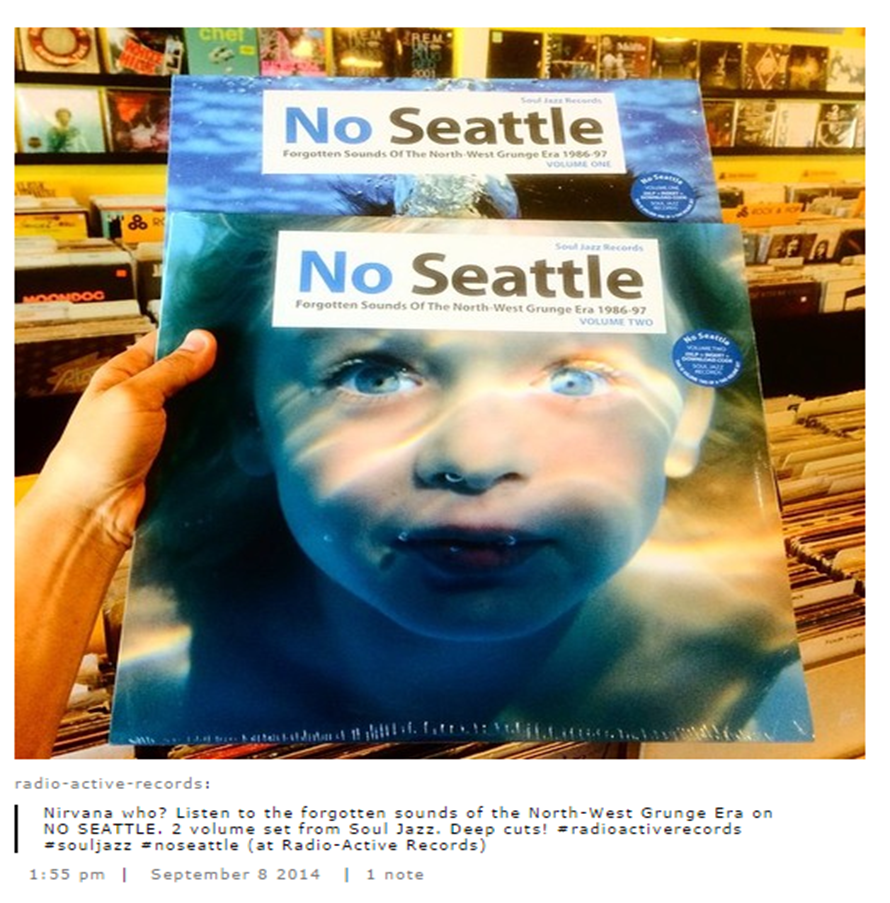
Given that awkward combination I’d have to say I adore the artwork Soul Jazz have chosen for the “No Seattle” compilation. Why? Well, genuinely, I had nothing whatsoever to do with it so it came as a surprise to me – it’s intelligent, nuanced, affectionate, funny, vicious…What a combination – complexity writ large as the packaging to a compilation that I’ve said all along is about restoring a bit of complexity to the overly simplistic picture that claims all the late Eighties-early Nineties in State of Washington was about is Grunge. Each image introduces something new.
So. I felt uncomfortable when I first saw the front cover – and that’s a true compliment given I’m rarely moved by album art. The cover brought me face-to-face with my dilemma; when is doing honour to a memory taking advantage of it? The cover is, of course, a parody of the long-since clichéd and over-used “Nevermind” cover. But no…It’s more. It’s a raspberry being blown underwater by a puffy cheeked youngster. For a start it’s funny – it’s said in many a book that people underrated how funny grunge was, how funny the bands involved were and how much fun and humour there was in that scene. The photo foregrounds that more casual fun right there on the cover. Nice to see some irreverence rather than the po-faced and funereal weight that period often comes attached to (mea culpa, I’m as guilty as anyone on that score.) Of course, look closer and you’ll see sweet young thing ain’t sweet no more – touch of stubble maybe? Acne perhaps? Freckles for sure… Awww, the smooth-skinned lil’ blonde is long long gone…Time has moved on and we’re looking back at something warts n’ all. Idea shown in an image – I’m the inferior in trying to tell you about something that a single picture captured so well.
That raspberry fits the image for the whole release – “Forgotten Sounds of the North West Grunge Era” – raspberry blown at the whole damned cultural baggage wrapped around it, an expelling of the near-religious veneration of a long dead man of just 27 years of age, moving on, moving on, celebrating what else was there – a pool party, something entertaining. Going deeper under the surface – finding what else lies there. In the case of the Pacific North West – a ton of really good bands like Thrillhammer, Shug, Machine or Kill Sybil. It’s appropriate and using an image that has been cheapened by magazines and media with not even the slightly respect for the North West music scene…It’s nice to bring it on home to people who deserve it.
The back cover contains a visible camera lens – a mouth swallowing the image. Yeah, I’m thinking too much maybe but there’s a reason that image is there; someone at Soul Jazz decided that what we were trying to escape was the over-sold banner of “grunge” so chose an image that suggests it was less a musical reality and far more a well-marketed convenience, a media lens not a god-honest-truth we were receiving undiluted and uncontrolled. The black surround blots out everything except what the photographer has chosen to focus on – now tell me that’s not the entire tale of North West guitar music in its media heyday? The reality eaten by an open mouth devouring all – the selective truth that was stuck in front of the camera and snapped until it drowned. Again, “No Seattle” was a release Stuart and Steve at Soul Jazz spoke of as trying to capture what else was going on, drawing in the lost and forgotten – that back image sums up “No Seattle” not in the central picture but in the black surround – it’s that blackness we’re looking to see what bands were there, what fun songs and tunes to be discovered.
The couple on the back cover though, again, another contrast with the original underwater picture anyone who knows anything about Nineties music can conjure inside their head in a heart-beat – go on, you know the one, baby – fish hook – dollar – dick. Here, it’s suddenly clear that far from repeating Spencer Elden’s immortalised penis, his foregrounded and clear masculinity, we’re looking at a girl. More so, far from 1991’s innocent and exposed nakedness, this child covers up, protected with goggles, hair net – there’s no innocence now, Seattle-Grunge is it even possible to mention the words without ending up hooked to the cavalcade of sales and marketing that spewed out during those years? Again, I’m brought back to my own self-criticism; I am fully aware that acknowledging the legacy and exposure Nirvana has given to an entire scene makes it easy for kneejerk accusations of taking advantage to be made. They’re unavoidable. Well, I’ve got my swimwear on, ear plugs-and-goggles, I’m ready to hear those who want to call bullshit. And I’m ready to defend too; there are twenty-three bands here who were kicking out a joyous noise to the heavens back when I was a pre-teen soaking up my Transformers the Movie Official Soundtrack – that’s what this release is celebrating, a fertile and lost web of creativity from which certain individuals were snatched and well done to them!
The thumbs up intrigued me…Again, I think it’s a wise choice. Even on the surface detail – it’s a positive, warm and celebratory gesture rekindling the happiness of the North West scene where all these friends and colleagues mingled, partied, played, collaborated. The release at least catches a sliver of that – I think it’s possible to link near every band on the release and usually not just through the Nirvana lens acknowledged in the middle. The big thumbs up carried a darker thought for me – again, a reason why I’m impressed with the art – in that I think it clearly said shows neither participant in the photo unaware of the moment in the way the baby was in 1991. Let’s face it, the underground sold up two decades back, we’re all here in 2014, some twenty-three years later and there isn’t much more than a pretence of resistance to the dollar on a fish-hook. The mainstream music culture reverted to type and now doesn’t care about questions of integrity so long as everyone claims they’re having a good time, shouts about a party over and over to numbness – the point of the cover of “Nevermind” wasn’t that the baby was going to refuse the dollar, it was just how deep was that hook going to go when the baby caught hold? The two figures bend their knees in submission to something that’s pretty inevitable – we live in a culture with money as the medium of exchange and we all need a bit of it to live and to create. The compromise, the bent knee, is not something resisted, it’s just something where we choice how low we bow, what for and when. The child grew up so self-aware; thumb raised in acknowledgement that we should worry, it’s a choice and she knows what she’s doing. Again, kudos Soul Jazz for making me think about the artwork so well – and heck, I darn hope the release sells because I think they do great work which deserves supporting and I think the bands deserve a day in the sun too! I reckon it’s worth more than a few dollars.
I think it means something that the child is accompanied by an adult by the way – this is all the music people made in their wild youth and now they mostly have kids of their own, people to care for. That’s no disgrace, it’s a glory – everyone gets a few second lives, a few repeats and new beginnings. And it doesn’t have to be a conflict, sometimes it’s a pleasure. That’s a happy photo on the back of two people safe n’ happy. Must be a lot of people these same bands inspired in the past to copy their “hell yeah!” thumbs up and just play, make some noise! Do something! The adults on this release can look back with pride on their own youth and simultaneously have a few art babies copying their gestures too.
The image on the CD and inside the back cover took my breath away. The light, shade, turquoise water, crystal eyes and blonde hair – it’s a simply beautiful photo. No qualifications for once, no deeper thought – it’s just beautiful. In amid the thoughtfulness, the knowingness, the sarcasm and parody there’s something of beauty. Darn straight! It’s called the music – and here it is as an image. For all the observation, the looking at the outside all I’d say is it’s about overcoming doubt and qualification and opening this up to see what’s on the inside – and I see beauty in the music on this release. I’m so glad they chose to use such a variety of participants for this release. The child is near androgynous beauty – no gender, I think a girl which would be another neat lil’ kicker in that it’s concealed on the back to some degree and exposed inside. I think there was a sore gender imbalance in what the mainstream bought from Seattle and the North West. For a scene that contained so many kick-ass girls and female-fronted bands and female participants it’s a tragedy record companies only bought the boys with the lank hair…There wasn’t a quota to the release, no ‘gender bar’, but I was satisfied with the way the end line-up shared a lot more space boy-friends, girl-friends, just FRIENDS! Everyone in together – good. Now that is a far more truthful picture than was ever drawn.
Then again, there’s one last trick isn’t there? Oh the horror, the horror…Could they have chosen a child that looked any more like a young Kurt Cobain? So, returning to the daily question I shared at the start of this night time composed ramble…I think work inspired by the love of music that Nirvana gifted to me so many years ago, I tend to come back to a few lines of a song. I like the lines for not denying compromise, failure, the need to constantly and repeatedly re-examine and re-judge oneself but for clenching teeth and finding the courage to go forward though I wince at the accusatory last line unless aiming it at myself. Minor Threat “In My Eyes” is one heck of a call-to-arms:
“You tell me that nothing matters / You’re just fucking scared…You tell me that I make no difference / Well at least I’m fucking trying / What the fuck have you done?”
An immediate thank you to Mr. Douglas Baptie for arranging me the opportunity to ramble a bit for the Digital Fix – a rather snazzy, funky, fresh n’ cool blog and culture site of far greater sophistication and professionalism than anything I do here!
It’s a bit of a rant – being fair – but essentially what I’m trying to say is that grunge was one part only of a very strong community of guitar-based sounds and styles in the U.S. North West and that it’s nice to give a touch of credit to the wider circle of participants.
There have been local compilations and celebrations – like http://www.spokanarchy.com/ for example, or “North of Nowhere: Nineteen Bands from Bellingham” plus some of the output of K Records – but never an attempt to survey the region across that core decade from mid-Eighties to mid-Nineties and to present a proper retrospective of what was happening outside what Sub Pop was selling and the majors were buying.
I do wish Sub Pop would collate a couple of good compilations consisting of material from the Sub Pop Singles Club plus the wider range of stuff that they released on singles and EPs and LPs back in their first spell of glory – there’s so much there…








 Nirvana Legacy