Thurston Moore ‘Solo’ Part Three: Breathing Out in Studio

To Thurston’s credit, even with a catalogue this wide, he’s completely avoided that most ignominious musical horror; the genre exercise. There’s nothing in Thurston’s catalogue straying toward Axl Rose yelling “give it some reggae!” on the Guns n’ Roses live album and the band, oh what a surprise, being able to do a passable white boy reggae rhythm, or Snoop Dogg’s half-hearted conversion to Snoop Lion. Thurston has stepped very clearly into areas only when he has an established reason for being there. The biggest diversions are both inside the last ten years; the run of acoustic albums was well-trailed by the increasing presence of gentler rhythms and melodies on SY records – interlocked with the logical shift to semi-acoustic wintry sounding releases under his own name – making the run of solo acoustic albums perfectly comprehensible. The establishment of some kind of narrative plays an underrated role in most human endeavour, there’s a satisfaction in seeing where something has come from as well as a legitimacy and credibility derived from something that doesn’t just appear like a classroom exercise or a bored afternoon diversion. Thurston’s moonlighting with Twilight in 2014 stands as the sole example of Thurston stepping out of his ‘regular’ terrain but frankly by 2014 he’s blown so many barriers that involvement in an entity that involves a shifting cast of playing and guest stars makes total sense.

Back in 1995 though, all this was still to come. SY-esque rock was still the focus when Thurston tag-teamed a release with Loren Mazzacane Connors as part of the ‘Instress’ series on Road Cone, a Portland Oregon label. Thurston’s contribution was a track with the conversational title “Just Tell Her That I Really Like Her. The title itself is a bit of a Thurston trait actually as we’ll see with “Please Just Leave Me” and with his “Sensitive/Lethal“ release later in this piece. The track was basically a “Psychic Hearts” outtake with the unit assembled for that release presence; Tim Foljahn contributing guitar and Steve Shelley on drums – it ended up as a bonus track on the 2006 vinyl reissue of that ‘solo’ album. It sounds very much akin to that album’s results – both guitars thudding away to make up for the absence of bass or interlocking to weave pretty patterns of notes. The Loren Connors side is actually less typical of the musician in question. The echo-hazed guitar and cloudy production preferences are in place from square one but the four parts of “Deirdre of the Sorrows” feature significantly rocking qualities – the first two tracks are quite a howl before things settle into the mournful regularity of a Loren Connors tale on part three and finish with a piece somewhere between his acoustic work and his electric era – a clean guitar unpinned by a purring rhythm matching it step for step. I adore Loren Connors’ work so the prospect of more from these two together naturally intrigued me.

It wasn’t long in coming. 1997 brought “MMMR” – a collaboration consisting of Loren Mazzacane Connors, Thurston, Jean-Marc Montera and Lee Ranaldo. Jean-Marc is an intriguing fellow in his own right – founder of an experimental music organisation (GRIM – Groupe de recherche et d’improvisation musicales) in the late Seventies in the city of Marseilles. It’s worth considering the extent to which Thurston, for a time, was gathering teachers (Loren Connors born 1949, Glenn Branca born 1948, Evan Parker born 1944, Wally Shoup born 1944, Richard Hell born 1949, William Hooker born 1946) from the generation one step above his own to initiate him into the field in which he was seeking to perform. I guess a touch of hero worship can’t be ruled out either – getting on vinyl with one’s heroes and inspirations is any record-collecting fan-boy’s dream, more power to the man’s elbow! Again, it’s surprising how tight the peak of this tendency is, it stretches from “Shamballa” in 1994 with William Hooker, to the first team-up with Wally Shoup in 2000 after which it becomes hard to spot a new elder entering Thurston’s on vinyl orbit. A generational shift takes place once Thurston’s apprenticeship passes. The album itself, an all-guitar affair, is hard to disentangle, I’d be lying if I said I was clear which was Thurston’s guitar. Track two on the album brings him in to join Jean-Marc and Loren for a patient ten minutes in which humming sound-fields surge and flex beneath what sounds like Loren’s tactic of long-held notes and brief clustered phrases. Only at the halfway mark does the track begin to open beyond that ‘front / back’ formation and for the final two minutes someone other than Loren tears a far noisier hole in the piece. The twenty minute collaboration with Lee Ranaldo now involved sees each guitar chipping in phrases – brief sounds – as if finishing one another’s sentences at a press conference. It’s an effective approach of course because one can appreciate the sheer variety of what they produce. A ‘Loren toned guitar’ pings decaying notes in the blend; a scraped, crunched guitar becomes a consistent backdrop; stray notes from another as strings are mutilated and the recognisable notes vanish before they ever become something as stereotypically DONE as a riff; a final guitar shakes down electricity.

A chunk of the same sessions emerged on the Loren Connors record “A Possible Dawn” (1998) – primarily a solo release ending with a thirty minute long collaboration between Loren, Thurston and Jean-Marc. And then an exercise in patience ensued – 2011 saw the emergence of “Les Anges du Peche” consisting of the final unreleased portion of that session. The liner notes, from Philippe Robert who ran Numero Zero Audio which arranged the recording sessions, explain that the session was set up following contact during Sonic Youth’s Washing Tour when it reached France and hit Marseille. It sounds like it took a few months to arrange financing to allow recording to go ahead with the result being three days recording in New York at the Echo Canyon studios. The liner quotes Lee Ranaldo dropping in after attending “David Bowie’s fiftieth birthday party,” which Bowie staged on January 9, 1997 (the day after his birthday.) Side A of the release is one of the most rock-orientated of Thurston’s outings – essentially reads like the instrumental breaks in Eighties-era Sonic Youth, like an expanded coda to the “Washing Machine” album’s “The Diamond Sea.” Gently knocked wood plays against dreamy strums and an underlying bass throb in an extended opening gambit. The tapping swells to encompass the shiver of strings shaken to live, wayward guitar lines spiral slowly though the heart in gentle tunefulness, swiped strings creak…Then the guitars crank up a notch, all players rise to the new volume level, two guitars hold a steady backline over which the third solos until calm descends and we return to distant expanding clouds of amp rumble, sparks hitting the ground, shimmering jangled wire. There’s a heavenly unison throughout with all three guitarists matching each other’s moves to create moments, for example, where all guitars flutter on the high notes. This contributes to the effective tailing off in the outro as guitars slow, soften, fade. Of course, it does sound exactly like what I imagine Sonic Youth jammed on all the time for the preceding decade and a half but when something sounds so familiar and so good there’s no reason to dismiss it. Side B meanwhile commences with a honking, scronking set of cranked up crack and glitter from the various musicians – short sounds predominate with each musician punctuating the others’ contributions. How to describe it? One guitar might ping strings steadily, while another is strummed frantically with strings bridged or muted in some way and the third guitarist lets the amp hum or smacks or jabs at the strings. There’s not really forward motion, one combination of sound simply replaces another – one guitarist scalps his guitar, the sound of repetitive tapped bone pouring out the speaker, another seems snapped off leaving only the high notes to sound like pebbles ground together, the last echoes metallically like a struck oil drum. Again, it’s a very different approach to the majority of efforts visible at this stage – a nasty, noisy and disorganised one, but still one built round a common conceptualisation and intent that hangs it together. Toward the end something approximating the strained sound of a sampled gypsy violin comes through, awkward scrapes tailing away – it’s a sound I’ve not heard explored elsewhere on this trek through the discography and I admit I’d love to hear more of it.

2013 until the Loren Connors and Thurston would team up for another release. “The Only Way to Go is Straight Through” combines a performance on July 14, 2012 at a NYC venue called The Stone with an October 17 performance at a Brooklyn venue called Public Assembly. I’m presuming, given each side is only just over twenty minutes, that these are more like extracts from the performances but I can’t tell. There’s a sense of each letting the other lead for a performance – Side A kicks straight into what I’d describe, in a kneejerk way, as ‘Thurston territory’ with power and force to the fore, while Side B is more ethereal and feels like ‘Loren soil’.

Before deviating into the sum of Loren/Thurston collaborations I mentioned studio work, however, let me return to it. 1993 led off with Thurston’s first release of his experimental studio work on a single. It’s then a gap to 1996 when we suddenly encounter two further studio excursions (and the Nels Cline “Pillow Wand” collaboration in the background.) Thurston’s improvisational work has remained a predominantly live entity at this point even if it was increasingly being documented. A quality diversion to commence with is the “Piece for Yvonne Rainer” (initially a cassette in 1996 – I only have the 1998 CD) composed with the Boredoms’ Yoshimi and Mark Ibold from Pavement. A closer tie is that both individuals were members of Free Kitten at the time alongside Kim Gordon; it gives the impression Thurston roped them in sometime around the recording of the “Punks Suing Punks” EP that outfit released in 1996 which features a song apparently name-checking Thurston and Kim’s daughter Coco. Jesus…Frankly, your tolerance for this release will depend on how amusing you find the idea of people twanging away on Jews Harps for minutes on end. Actually, being fair, stay calm – the variety of pings and boings extracted is surprisingly high and the clarity of the recording makes it a remarkably listenable experience at high volume. Hearing Thurston, Yoshimi, Mark (and I suspect Kim’s voice at one point) chatting on in the background and either commenting on their dining arrangements or on their ability to persevere with the instrument gives this a domestic edge which appeals. Think of it as the sound of genuinely creative people who don’t just make music, don’t just make sound when the cameras are on them or there’s a few thousand quid of performance fees on offer – they’re playing or thinking about playing all the time. Hearing them actively trying to uncover new ways to extract sound from the instrument is intriguing…But, in fairness, I think it is the only record of Jews’ Harp I need in my collection. It cuts at about ten minutes in, a couple of quick shreds of random rock n’ roll then straight into the far more interesting guitar instrumental. The choice on track one is to par the guitar down to the sound of sheet metal. Raps and rumbles emanate from one guitar while another is simply left to hum. It’s a sound I’m attracted to – somewhere between dark ambience and traffic sounds building and decaying. It’s more like a collage of ideas. After six minutes or so that first idea cuts rapidly and another effort, similar in style, commences. The throb of electric from one amp is far more prominent but it’s a relaxing ebb and sway, the second guitar mimics it with a deeper tone until eventually overwhelming that early ambience. Just the addition of volume to the existing cycle adds fresh overtones and detail – the guitar starts to sound like a warning klaxon with occasional interventions by a human agent marked by sudden slaps. The track plays with electric tones for its duration. Track two dispenses with the Jews’ Harp and over the gravelly sound of an ex-Soviet conveyor belt there’s some detuned hacked chords that sound like the advance of the Terminator or some part of Coil’s unused soundtrack for the film “Hellraiser.” That breaks two minutes in to be replaced by a prepared guitar offering a sound close to some kinda Eastern chimes, quite a somnolent, plumb sound, that also falls away after a couple minutes in favour of “Confusion is Sex” era menace. By five minutes in there’s the gentlest plucking at the guitar heads – by six and a half minutes it’s shattering peals of guitar, like running a buzzsaw against metal – and then on it goes again to some fuzzed up fast chopping for ten minutes combining that absence of motion in which everything is shifting and moving so nothing is leaving the boundaries of the screen. Twenty minutes; hotel room desultory hung-over tentativeness – a neat contrast to what has come before. There’s something skeletal here, hearing the bones of Thurston’s work has he tries to find new combinations of notes and guitar neck motion.

That same year saw one piece that has always left me uncertain what to think – “Please Just Leave Me (My Paul Desmond).” The CD I possess states on the disc “You can take everything there, it’s cool, I don’t care. Yeh, I need room. I’m sick of all those fucking records man – just take ‘em. Yeh, you know, but if you can please just leave me my Paul Desmond.” (Actually it says “my my Paul Desmond” – minor quibble.) the Paul Desmond in question being a jazz saxophonist and one-time member of the Dave Brubeck Quartet. That title reference is one of the first overt jazz references in Thurston’s oeuvre and, moreover, a statement of intent requesting the removal of the music of which he’s tired, to permit him the space for something new with only this solitary jazz marker still present. It’s a single thirty-one minute long track apparently involving at least one guitar left to feedback against an amp, or on a table-top, at extreme volume then tampered with. Taps, raps, strikes to strings or guitar body, they all drag the track away from its centre which consists of the always indelibly difference whine of pure feedback. Listening to it casually, a lot of the detail passes me by. Focusing on it with greater determination it’s far easier to identify the experiment being undertaken with tactics deployed to interrupt and interfere with the nature of the roar created, to make it bend, rise, cease suddenly, resume or give way entirely to the tactile thuds and thumps against the material of the guitar. It’s an intriguing piece simply because it so clearly demonstrates some of Thurston’s actual tactics for extracting sound from an instrument. Enjoyment of this document depends on your willingness to tolerate piercing extended amplifier whine and to focus on the interventions Thurston makes throughout the duration of the recording. The glory of the record is in the gestures, both large and small, that serve to derail the combination of instrument, amp and electric – it requires a pleasure in the diversity of brief moments he can haul out from the guitar. There’s no overall flow or direction to the recording, it has a kinship to certain of John Wiese’s noise recordings which might bombard a listener with 30+ minute-long tracks each showcasing one particular effect dredged from whatever source. In this case the unifier is the desire of Thurston’s guitar to return to either zero or one – noise or silence – while Thurston tips it in various directions amid that range and ultimately changes the qualitative nature of what the guitar creates. Having achieved so much in the early stages of the session it’s a disappointment when Thurston resorts to actually plucking the guitar strings for a few minutes around the fifteen minute mark – it isn’t conventional strumming but so much had been demonstrated without any need to make that standard connection. The diversion into what sounds like a casually sampled lounge jazz piece playing on a turned down record player is a neat ending, it’s background quality emphasised by the sound of Thurston engaging someone in conversation in the background as it plays. This gentle (and rather dull) jazz does outstay its welcome – the contrast with the preceding twenty-eight minutes is pointed but, more significantly, it’s a riposte to those who would claim Thurston’s noise-making was intolerable, I’d say it’s this overlong four minutes of xylophone, polite brushed drums and unobtrusive guitar is the intolerable bit.

It’s almost unbelievable that Thurston’s dedication to collaboration and the challenges brought by cooperation/contest with others means it’s a full decade before the next fully solo full-length release. Well…OK, by full length we mean the 30 minute long “Flipped Out Bride” release of 2006 issued on Blossoming Noise. By this point in time, Thurston has become well known for his patronage and support of other artists whether through contributing songs to splits, inviting them on tour, joining in as a contributor, or simply buying tonnes of music and talking about it wherever possible. I’ve spoken before – and it’s been well-noted elsewhere – that Kurt Cobain’s main joy in fame 1991-1993 came from supporting others in the scene; well, that model was bequeathed to him by Thurston and the Sonic Youth crew who continued with it through to the present day. This release on Blossoming Noise bequeathed Thurston’s ‘alternative mainstream’ cachet to a label of significance at the noisier, industrial end of the scale – one regularly featuring artists like Aube, Merzbow, Genesis P-Orridge’s outfit Thee Majesty, KK Null, Sudden Infant, John Wiese. The noise scene was well-ensconced by that point and it’s hard to distinguish whether Thurston’s willingness to add a more high-profile recording (a studio solo release rather than just an archived live cast-off) brought more than money to one of the hubs of the scene. As for the release itself, the title track consists of an elongated rather gnarled zap of electric which throbs in various ways for a full quarter of an hour. It doesn’t outstay it’s welcome, it shares a surprising amount with “Please Just Leave Me” from ten years before in i’s fixation on what can be coaxed from the guitar when strictly limiting the degree of interference with its natural inclination – without resorting to something as ‘done’ as actually playing the thing. At twelve minutes in the raps that ping the strings against the guitar body are a direct throwback as well as being the most extensive and overt manipulation to occur. The issue is that it’s such a diversion from the initial direction, it’s as if Thurston got bored or lacked the will to continue restraining himself – that he still pulls neat stretched metal tones from the instrument is fine, but in a piece that had relied so firmly on a particular approach it’s a shame to lose the focus. By fourteen minutes the singular direction re-establishes itself at a higher tone with a undercurrent of mangling persisting behind, beneath, below to take us through to the sixteen minute cut mark. Track two, “O Sweet Lanolin”, builds a beat rapped out fairly constantly in the background while a second guitar is struck, bowed, sliced, hacked at. The rumbling beat palm-thumped into the guitar sometimes forms a breathing space before Thurston’s fresh attacks, a place of retreat but also a creeping warning – shark fin piercing the water. At four minutes in the song switches and a hum of electric intervenes before the combination of pounding and scraped interventions resumes. For all the reputation of Sonic Youth (and Thurston and Lee specifically) as the archetype string-scraping guitarists, it’s amazing in Thurston’s solo discography that it’s rare that he releases a piece in which the scrape of one object across the guitar is audible – usually it’s disguised by effects boxes and heavy distortion so hearing it relatively naked is a fresh hearing for a familiar sound. At six minutes the song becomes almost an instrumental interlude for 1983’s “Confusion is Sex” LP, a harking back to the ground out sound of that early era. Time and again this song pulls back to the beat prior to a next direction – heard as a suite of ideas built around a central theme it’s surprisingly effective and becomes easier to appreciate the movement between ideas as something more than just really dang loud whimsy. It’s also a deeply effective way to create momentum for a solo guitar track. In the absence of rhythm section or song structure a solo guitar can often become trapped – either hovering motionless or pouring out momentary inclinations to the extent that it feels similarly immobile. Here, Thurston uses the motif to mark beginnings and ends, to transition to-and-from ideas, to bind things that don’t have much more than source musician/source instrument in common to a simple structure. By the close of the track one feels one has had a Chinese banquet of small dishes wrapped into twelve minutes.

Returning to the oft-made association of Sonic Youth’s erstwhile denizens and noise, it remains noticeable how rarely Thurston crossed into the scene. The 2000s saw a significant outpouring of recordings belonging to that realm, a huge array of takes and variations owing more or less to SY’s kicked open doors while another entirely span of noise evolved out of Dylan Carlson’s Earth and more metal inclined interests. Certainly the influence of Thurston’s parent band introduced many listeners of the punk/alternative/indie field to the idea that music could be a far more factitious, fragmented and wild thing than the fairly stable forms of the (then) underground allowed. SY also patronised and promoted bands from these far out places by taking them on tour and referencing them…But Thurston’s solo work rarely coincides with such outfits. A 7” with John Wiese and a cassette performance with Aaron Dilloway – still of Wolf Eyes at that time – emerged in 2004 and 2006 respectively…That’s about it. That slim line of distinction between a noise artist and an improvising free jazz artist might seem imaginary but given Thurston’s well-testified enjoyment of many of their works it’s curious that he didn’t play more with the key figures who made up ‘noise’ as a scene rather than a sound.

Still, the depth of commitment is clear; Thurston worked with two major figures, contributed to a label then openly penned praise of the scene – on top of his interview statements. 2008’s “Sensitive/Lethal” shared not only its solo nature with “Please Just Leave Me” from 1996, but also the presence of another of Thurston’s inlay addresses to an unknown person. It’s an open hymn of praise to the then ascendant noise scene; “why don’t you come over to my house babe and help me alphabeticize my noise tapes. There’s only one we’ll really play and that’s the Haters/Merzbow banned production cassette. It is theee quintessential. And then basement jam and then wine and then marijuana and then the continuous heaven. Blessed are the noise musicians for they shall go down in history. Way, way down.” A back-handed compliment memorialising the deliberately marginal scene Thurston was a patron of – the release even came out on Carlos Giffoni’s “No Fun Productions”, one of the freshest labels in the scene. The release, however, has a difficult nature. The first track puts a noise guitar solo against a monotonous, leaden guitar rhythm. The idea in itself has an intellectual credibility, the same instrument letting lose in two completely different ways and placed alongside one another as if ignorant of the other’s existence. The challenge is that the latter rhythm annihilates any ability to observe the progression or intrigue of the noise guitar, while itself being utterly uninteresting. The constant shifting directions make it impossible to settle into any kind of mantra-like listening experience, there’s nothing meditational, but also nothing to focus on. In some ways achieving such an alienating sound is impressive but it doesn’t mean it’s an experiment that has any need to be played twice. Track 2’s crepuscular sea shanty rises and falls like an automated machine, a relentless cycle of creaks and shudders, metal on metal – listening carefully, however, there’s a second guitar playing something akin to a blue trumpet wailing in the background, the occasional throb or moan of electric. This second layer rises up over the automata, subtly layering the sound field so for a long time it goes unnoticed…And then it’s all over. Done. The final track, I’d be hard pressed to lend it a name, presses a descending high tone over the eruptions of a pummelled guitar chopping in and out…And then a simpler track arises, the bleating high pitch over a crackling, scraped and clattering guitar assault ultimately resolved as both instruments dissolve into brutal sine-tones dancing around one another, possible the nearest the release has come to a duet as well as an echo of “Pleasure Just Leave Me” and it’s similar decision to dance at those high pitches. The whole release seems to focus on this desire to use a second track over the first while maintaining minimum linkage between them – like a full album of anti-collaborations.

“Built for Loving” (2008) is primarily built on short pieces – a relatively effective way to appreciate the tones and sounds Thurston can rip out of a guitar. There’s a kinship with Lee Ranaldo’s infamous 1987 release “From Here To Infinity” LP (I once heard tell that the large etching on Side B was intended to deliberately destroy your record player needle – I don’t know the truth of that) which consisted of brief experimental noise loops. There’s that feeling that this is a simply excerpts from a much larger library of tests Thurston has built up over the years – no proof but it would seem odd if these pieces were recorded solely for this release. There’s a compilation feel to the blend of brief song fragments that seem to be sketches for a late-era (re: mellowed out) SY album, the basement tape hardcore group effort at one point, then the different versions of torn out noise. The porn film interludes don’t really lend much to proceedings – they’re neither integrated sufficiently to provide a backdrop to anything music, nor warped or deranged enough to be intriguing in and of themselves. The brevity of the pieces is to their benefit and that isn’t a criticism. While live improvisation with a collaborator permits someone else to lead, to make decisions, while one rests and gathers one’s own muse, a solo setting puts a lot of weight on a single individual which has a consequence with individuals either tempted to over-perform (too much happening) or to coast (too little.) A brief solo piece allows a set arc or destination, allows a sound to be explored, shuffled, prodded and then halted as it reaches its end. Here, in vinyl format, it’s possible to hear even the longest tracks as discreet events, as suites. The release certainly highlights the difference between Thurston ‘playing’ versus Thurston quite clearly evading any such action. Side B’s final five minute piece, “Sex Addict”, are the most satisfying with the use of silence and space surrounding each emerging sound – whether submarine sonar pips, or the dry stutter that runs through most of the track, it’s an idea taken for a ride. Similarly, side A’s conclusion, “Los Angeles”, inhabit a particular type of noise for a period of time then depart. What’s the difference between purposeful noise and noise? I think it’s a sense of remaining with a recognisable sound without twisting it so far it becomes something different, yet continuing to see how that one sound can be tweaked and driven within its boundaries…And knowing when there’s nothing more to dredge from it. Side A track “Hell” heads too much that way for me; the sound has reached its limit within the first thirty seconds, it’s essentially a beat made on a vocoder – it does one thing, nothing more, all you can do is move it faster, slower like a microwave tone telling you it’s done. I guess it’s also fair to mention that the release sits alongside a long-running porn-thread in Thurston’s work starting with the angelic visage of Traci Lords on the 1990 12” “Disappearer” single, continuing with the “Weapons of Ass Destruction” collaboration and onto this one release. Then again, it’s not unique to SY – the band’s interest in America’s trash culture is well-documented, Madonna’s entire shtick continues to the present day in the pop world – it’s all representative of America’s yin-yang relation to commercial sexuality and the female body in general but let’s not go into that here.

A crucial concluding point here is how rare these true solo efforts are and that there’s a clear trajectory within them. Thurston’s discography, runs to some 127 releases yet ultimately the only completely solo releases of the Nineties are the “Sulphur” 7” in 1993 then “Please Just Leave Me” in 1996 with the partial diversion of “Piece for Yvonne Rainer.” After that there’s a silence for some ten years – Thurston devotes himself to a ten year spell in which his discography only features collaborative works. It emphasises the sense of a musician both seeking to learn from others and also enjoying the musical pleasure of communion and community. The paucity of solo work makes it easy to suggest that 2006 onward is a significant divergence. There are actually three strands at that point. Firstly there’s the continuation of his electric guitar work via “Flipped Out Bride” (2006), “Sensitive/Lethal” (2008) and “Built for Loving” (2008.) Secondly, he deviates significantly in terms of his regular instrumentation into a number of solo acoustic explorations consisting of “Suicide Notes for Acoustic Guitar” (2010), “Solo Acoustic Volume 5” (2011) and “12 String Meditations for Jack Rose” (2011) – prior to that the most visible acoustic pieces involving Thurston had been 1994’s “Winner’s Blues” kicking off SY’s “Experimental Jet Set, Trash and No Star” then a piece called “Altar Boy, Church Basement” on the “Hurricane Floyd” release of 2000. The use of an acoustic in a guitarist’s vocabulary would barely raise mention except Thurston’s reputation and discography is built so solidly on electrics that the sudden emergence in just those two years makes as big a point as SY’s attempt to shake off the mainstream/alternative/grunge hangover in 1993-1994 does; it’s a deliberate wrong-footing of audience expectations and a documenting of an aspect of his work that’s either been unseen or has taken this long to gain confidence or is simply ringing the changes while coinciding with his more mellow approach around this time. There’s also a far smaller thread of solo releases that pointedly emerged on cassette; “Free/Love” (2006), “Black Weeds-White Death” (2007), “Blindfold” (2008), then a true oddity, the “Voice Studies: Love Song as a Lion/Lonely Charm” cassette of 2011. Thurston acted as editor for the book “Mix Tape: the Art of Cassette Culture” published in 2005 which posited the cassette mixtape (and the more current cassette underground) as a form of folk art and lo-fi communicator among scenes and musicians without the money to press vinyl or CD – it seems no coincidence that he should suddenly add his weight to the cassette scene just as even cassettes gave way to downloads as the cheapest medium for new bands to share. Thus, the break back to solo improvisation combined with two further breaks in Thurston’s output – one instrumental, the other related to the medium used.

For me, these truly solo releases allow an opportunity to study Thurston’s technique in isolation, without distraction. It’s his omnivorousness as a guitarist that has always made him hard to peg to a specific sound while clearly marking his work. While not underrating the deeper complexities of their abilities, someone like Derek Bailey, or Loren Connors, has a signature based on the guitar deployed with a particular instrumental technique. Thurston roots his style in the use of the guitar as a channel, not for the motion of his hands, but for the sounds that can be created from it – this includes incorporating and manipulating sound produced by the amplifier (and by amplification) into a complete loop dissolving the boundaries between player-instrument-equipment. At times he’s merely tempering or unleashing the sounds a chosen combination of amp and effect is producing – a gateway, a limiter, an accelerant. That’s the key aspect of the ‘Thurston Moore guitar sound’; he doesn’t slave the guitar to a technical expression of fast finger-work, nor to a vast interest in the playing of traditional chords and notes. That isn’t to say he isn’t in control but his confidence is clear in how he’ll acquiesce to a momentary impulse – tapping, muting, plucking, strumming, rapping, punching – and see how the instrument reacts. He then decides whether the result is something that should be cut off at once, or permitted to proceed, or repeated for further study and investigation. At times he’s effectively ‘unplaying’, evading anything as practised as soloing or as posed as rhythm. Thurston Moore, in his more out-there ventures, is willing to surrender to the instrument; a unique and very intriguing characteristic of his playing. The flipside to that is his usually quite choppy and savage mastery when he does choose to play nice – even on acoustic he hacks out chords and very audibly strikes the guitar strings in what a more mannered guitarist would think of as an uncultured style. He evades traditional technique through constancy, his core tactic is to have one hand strumming without any allegiance to a traditional time signature with deviations created via a shift in position or combination on the guitar neck or a change in tempo. The result is a more liquid progression rather than the ‘blocks’ from which most guitar music is formed. It’s like continuous soloing and it’s what marries Thurston’s improvisational approach to his alternative rock chops.

Thurston Moore’s Solo Work Part 2: The Big Rock Era and Emergence

Trend

…But not yet. The early Nineties are dominated by Sonic Youth’s major label adventure during which they solidify a reputation as the best boosters any struggling musician in the music scene could wish for, hoist Nirvana to the top of the tree, generally run themselves ragged and come as close to recording a straight forward alternative rock record as they can. All of which postpones Thurston’s solo work near completely. The “Barefoot in the Head” recording doesn’t come out until 1990 while “Stinkfist and the Crumb” again disguises how bare of alternative works this period is. 1989 through 1991 there are no new Thurston Moore solo releases of which I’m aware. 1992-1993 sees two singles with his wife and bandmate Kim Gordon; a cover with Epic Soundtracks of Bob Dylan’s “Sitting on a Barbed Wire Fence” on a promo 12” (an effectively dirty cover with Thurston’s vocals treated and musical accompaniment that’s as reverential as SY’s “Into the Groove(y)” – there’s even room for some Iggy Pop style whooping at the end); then the more substantial but still indie rock orientated Mirror/Dash single (a very likeable bit of work incidentally.) In the background there’s the Dim Stars project with Steve Shelley, Don Fleming and punk legend Richard Hell, again, a pretty likeable and decent punk rock project yielding a five song EP in 1991, then a full album in 1992 (plus a CD promo featuring one song from the album backed with one track from the EP.) It’s all great guitar playing, all good rock side-project fodder…But not really what we’re looking for.

The first inkling of what is to come emerges with a 1993 7” single on Table of Elements featuring “Starfield Wild”, an extrapolation from, or sketch for, the Sonic Youth song “Starfield Road” – a pretty awesome rocker – and the “Earth/Amp” experimental piece on the B-Side. Again, what he’s displaying is his mastery of improvisational rock guitar, of using every aspect of the instrument to create sound but mainly focusing on feedback and volume to create impact.

“Klangfarbenmelodie and the Colorist Strikes Primitiv” (1995) was my introduction to Thurston Moore at his most out there – a school trip to London in about 1996 brought it into my possession. Examining it now, what allowed me to access the music therein was that it’s ultimately so close to an extended Sonic Youth solo, a more naked example of what Thurston was doing with his main outfit. The sparseness of the live sound, the absence of any major production gloss or polish, pointed back to pre-major label Sonic Youth with its lengthy strumming – the guitar-work is no more alien than some of the work on “Bad Moon Rising.” In a way that’s what’s clearest here is that Thurston is having to revert to earlier habits and approaches to the guitar in order to undergo the relearning necessary to perform in the improvisational sphere. The briefer second track on the release – “Phase II” – is a step forward, less a barrage of guitar, more an open and parched plain but ultimately it reverts back to strumming.

A year further on and Thurston performed with William Winant and Tom Surgal at the Festival International de Musique Actuelle de Victoriaville on May 17, 1996, released as “Piece for Jetsun Dolma.” Thurston’s range of tactics has expanded – the record makes more use of pauses and silences, a surprisingly rare thing in any mainstream/alternative record where pausing for breath is an exceptional event except where a track ends. What dominates in terms of vibe is, almost inevitably, percussion. Two drummers create a hell of a lot of sound and motion and Thurston has definitely evolved once more, his playing tends to keep pace with the activities of his colleagues and he’s brought his guitar back to its basic nature as a percussive unit – a guitar sound built on spikes and strikes rather than on runs of notes. He also exhibits an interest in simply not playing at points; there’s a lot of use made of the power connection to the guitar, tugging at it and manoeuvring the cable to deliver jolts of pure electricity, jabbing it in/out of the socket to yield sharp peaks of static – in the company of tumbling drums it’s a really effective way to rise above the clatter while creating a striking sound. Often he lets the guitar hum, almost as a way to permit breaks in activity, the drums often fall away and the moving static fills the space until the next direction is chosen and approached. It’s visible that with an hour to spare Thurston is uncomfortable sticking to one approach or one methodology, instead the record reveals a wealth of approaches tried for size, worn briefly, then discarded – it’s the musical equivalent of an indecisive pre-date night teen wardrobe experience. It makes it hard to describe a style, or to label the performance in any singular way; Thurston’s hyperactivity is mostly what’s on display. Of course, given the full bag of tricks he has to play with – everything from swelling vibrations tapped out through the guitar body, to glass rattling sounds, to scrunched strings, to yanked notes – it’s no surprise that in this early spell he still wants to throw everything at the wall.

1997 brought the “Lost to the City/Noise to Nowhere” release offering another chance to inspect Thurston in the company of Surgal and Winant. The guitar is a foregrounded presence by comparison to “Piece for Jetsun Dolma.” It reads more as an out-of-control noise solo in many ways with a fairly sustained array of rubbed and scraped strings fed through whatever battery of effects Thurston has present. Striking strings as they’re warped beyond their usual limits to create bell like sounds and chimes is so familiar from Thurston’s work with SY that it’s too easy to forget that it was probably him who made it a valid approach for other avant-guitarists – he’s allowed to use it. The performance wraps together vestigial ideas that on another day, intended for future development and not as a live experience in one place and time, would fill moments and peg together the components of numerous songs. There’s nothing here you wouldn’t hear in a avant-rock song, it’s simply that we’re listening to dozens of ideas for sound-generation strung together in an album length chain of momentary impulses or longer explorations. The brief eight minutes of “Noise to Nowhere” is a very effectively subdued piece conducted solo – or as near as dammit. Gusts of static hover, swell and deepen. In the background a series of near-electric cracks and pops presumably delivered by gentle work against the outer casings of a drum set, or an assorted selection of well miced percussive gadgetry, provide a neatly scrappy presence – like hail stones tapping against a house as clouds pass over. There’s a temptation, just in the final brief minute or so, to relinquish the restraint held over the piece but it never comes and it’s all the better for it. Sound is simply coaxed into the air, shifts and falls once more. The release leads to the question of whether one prefers the more frenetic and splutteringly active Thurston or the controlled and patient conjurer of ghosts present on the second track.

Thurston teamed with Tom Surgal yet again for 1998’s “Not Me” which came backed with a track called “Lydia’s Moth” (I’ll be intrigued to learn someday if this is a reference of some kind to Madame Lunch…) There’s no crowd noise on the first track, no sense of wider location though I’m presuming it was captured at the same time as track two which is punctuated with coughs, stray conversation and a single burst of applause somewhere in the middle of the effort – an unusual crowd, either totally silent or unable to avoid interrupting. The two players trace and follow one another all around the first track – it’s explicit at three minutes in where Tom’s drum work reduces to a simple thud with Thurston’s matching time. Later each instrument skitters, patters and squeaks – again, seeming to match one another’s interest in light and brief sounds. Bursts of louder volume and longer duration are greeted with accompanying drum rolls and sustained patterns until at ten minutes in the guitar falls away to the hum of electric with occasional drum-work marking a gentle descent to conclusion. “Lydia’s Moth”, again, treads similar territory. Single plucked notes with no obvious tonal relationship are fired and allowed to fall onto a bedrock of cymbal work. The notes become pairs – usually quite piercing, usually a fair distance apart on the scale – then eventually slow runs develop, cycles of notes rising, pausing, then descending once more. Tom maintains a constantly active backdrop to this sometimes chilly recording – the black and white only artwork with its austere picture of British Sixties’ model Twiggy on the front then a blankly staring alt-teen on the back contributes to that bleached out air – the high tones make me think of icy mornings. Thurston is genuinely playing here – constructing combinations of notes, building several passages and developments to the piece and never masking the string sound with overdriven effects. The purity of the playing matches the packaging neatly for this curt 21 minutes.

In the background, a further fertile collaboration was occuring with Nels Cline (most famous for his time in Wilco but very much a man with feet in the jazz camp.) Jumping ahead, I’d like to highlight one release as possibly my favourite Thurston solo catalogue entry. January 2001’s performance at Easthampton Town Hall and the subsequent release thereof benefitted the Flywheel Community Arts Space (www.flywheelarts.org) – phew, thank God it was properly documented in such superb sound quality, it’s a contender for one of my favourite live releases in the Thurston Moore catalogue (“Live at Easthampton Town Hall.”) The two guitarists, Thurston and Nels Cline, align themselves with the sound of Zeena Parkins’ electric harp, the release is a series of high tones and chimes layered over her shimmering sustained field of sound. It’s that coherence and cohesion between the noises produced by the three participants that makes it so satisfying, there’s a unified direction achieved throughout. While one guitar predominantly contributes solitary notes or clusters thereof, the other embarks on strummed runs that give the whole a song-like feeling. That willingness to pluck repeating, then shifting, riffs over the bell-like core of the piece gives the piece a real density lacking from a lot of the guitar/drum duo releases – plus it doesn’t rest solely on one player to propel the piece forward. It also gives the wilder flurries something to push against – there’s less a feeling of randomness, more a sense of a guitar player selecting ways in which to harry and shove at the relative static contentment of his associates. The links to a traditional rock performance seep in so by twenty minutes in there’s a solid rhythm guitar kicking at a steady pace over rumbles and bird squawks eased from the other two instrumentalists. This ebbs and the next tide of crackles, wails and scrapes washes in. There’s a conversational style, sometimes no one says anything for surprisingly lengthy periods – then one player will fire off a sound and the others will respond, or talk over one another. There’s something like a warped gypsy jazz going on – runs of notes, little solos, reduced to electronically-dosed blooping. Some beautifully spectral slide work from about the 43 minute mark pleases me infinitely. This whole release isn’t a million miles from some of the wilder work of the instrumental post-rock bands who had their brief peak in the lead-up to the millennium.

Perhaps it helps that Nels Cline has both past form with Thurston and has his own experience of operating in the jazz realm and the rock world too. Watching Nels throttle the life out of a guitar during his stint as Wilco’s guitarist a couple years back (2011? Thank you for letting me come with you Charlie Tee and for giving me the spare ticket!!) was awe-inspiring – watching him seesaw to his own internal urges was what kept me in the room. The guy bears a passing resemblance to Thurston, like his more muscular and stocky brother or something, and it was so visible how much he was putting into the instrument – the physical effort involved in choking, bending, stretching the guitar mirrored by his own physical contortions. In that performance his noise diversions worked well over a solid rhythmic backing – a traditional rock set-up given fresh accents and ad-libs which kept the randomness in a box. It’s easy to criticise these kinds of instrumental rock treatments for the limited moves available – loud bit, quiet bit, fast bit, slow bit, hum or strum, note or not – but that’s a critique of the nature of sound not of this style of music; ultimately there are only so many approaches to sound available in this world. There’s a fair critique to be made, however, that the recordings produced of performances such as Easthampton lose a vast quantity of the sweat and toil that went into them as live spectacles. Watching these two guys hack a myriad of sounds out of their instruments in a live environment where the sound surrounds and enfolds the listener and where the eyes can constantly draw physical associations between the motion and movement of a guitarist and the emerging sounds is a very different prospect to hearing it float out of a stereo.

(Thurston Moore and Nels Cline – live in 2011)

The “In-Store” performance by Thurston and Nels at the Rhino store on Westwood Boulevard in LA on December 30, 1996 sounds like a wicked note on which to end a year (side-bar: Nirvana played there in 1989. The footage is online if you want a sense of the store as a physical space before listening to this performance by Thurston n’ Nels.) One niggle is that they’ve gone to the trouble of identifying four ‘songs’ or title-worthy performances that took place during the in-store…But I’m damned if I can pick the bones out of it. There’s a fairly standard rock approach to performing with another guitarist often present here – one guitar lays down the backing rhythm, in this case more often a soundfield provided by roaring noise, while the other plays stunt guitar over the top, whacking in contrasting peaks and spikes. These were among the most effects-driven releases in the solo catalogue – an apology at this point that I’m not better at parsing out the different sounds created by different boxes of treats. Nels (my assumption) contributes the finger-picked patterns also present at the Easthampton performance as a contrast to Thurston’s straight forward rock hammers and trills. For a Sonic Youth fan, or an alternative rock fan in general, the recordings with Nels Cline form possibly the best introduction to Thurston’s more esoteric interests and diversions. It also leads one to stress the similarities between the two players with Nels perhaps having a more traditional guitar style but operating equally happily in Thurston’s more disjointed stomping ground. But still, what we’re listening to is an avant-rock guitarist working only just beyond that terrain – on all these releases there’s a lot of retreating to comfortable modes and repetitions. Total command isn’t yet established.

(Thurston Moore and Nels Cline – THE in-store video)

That same statement is true of the studio document – “Pillow Wand” – created by these two gentleman at New Zone Studio on that same day in 1996. It explains why the “Where the Hell is Tommy Hall?” piece incorporates elements of the “Tommy Hall Dragnet” piece from earlier/later that same day – Tommy Hall, incidentally, being a founder member of the 13th Floor Elevators and a player of the electric jug…No clue I admit whether the piece is intended as an actual musical interpretation of his instrument or playing style. While still an exercise in experimental guitar, it’s safe to refer to these five pieces – all circa 10-15 minutes in length – with reference to song-craft. The opener, “Burnt Klubgirl Lid Tone”, as an echoing feel, a gentleness, with plenty of space for a vocal or backing rhythm to peg it together into a non-traditional rock song, something along the lines of the song “Move Away” from the Demonlover OST. The “Blues for Helen Burns” continues this introspective vibe, perhaps more tentatively, it deviates several times until settling into the overlapping walking guitar lines that suggest a direct channelling of Sonic Youth’s work in the “Washing Machine”/”A Thousand Leaves” era. The “Tommy Hall Dragnet” pulls the album out of its established mode in favour of a circular rubbery sounding backing played against a slicing high-pitch shiver of guitar – the stuttering ambience is a real contrast to the open spaces permitted earlier. “We Love Our Blood” is the highlight for me, solemn wintry guitar notes descending over the cracks and snaps of a rickety ranch porch – breaking into a fuller composition at about four minutes in, a cycle in minor keys over an echoing guitar solo. Finisher “I Inhale You” walks very similar terrain, there’s something country-tinged in the jangling guitar backing over which Thurston picks complimentary notes – it’s akin to Velvet Underground’s “Sister Ray” in its endlessness, a seemingly static backing in which details are constantly shifting and moving on as sloppiness or deliberate changes impact the overall form and send it elsewhere. There’s a similarity too versus “Tommy Hall Dragnet”, another clearing of the throat where constant sound replaces the manners of the other three compositions. This is deeply picky but I wish the soft strums of the final few minutes of “I Inhale You” replaced the noise diversion that tears apart the whispered threat of “We Love Our Blood” – it’d make it a perfect composition. Still, a small quibble with what is an accomplished studio collaboration between two very well-matched guitarists.

I’ve pulled out just these two consistent collaborations from the discography while thoroughly acknowledging that what is visible on releases represents perhaps only a fraction of the live work that was occurring in this spell. It seemed a way to focus conversation. This’ll get increasingly difficult over the following few days – essentially as the discography explodes and the records are hurled into the world it gets harder to tease threads…Let’s see how I do huh?

New Year, New Indulgence – the Solo Discography of Thurston Moore Part One

And a happy New Year to one and all! Totally self-indulgent desire to rampage through my own record collection and use the blog as an excuse to think about some of it in more detail; I’d like to dissect the discography of Thurston Moore.

My first Sonic Youth release was an SST greatest hits in 1998 called “Screaming Fields of Sonic Love” (still an awesome title.) A copy of the “Dirty Boots” EP followed and I was hooked forever more; an open statement of allegiance – I agree with the critical hype and think Sonic Youth are the most significant rock band of the last thirty years bar none. My engagement with their work became a full scale fetish which led me into collecting solo material by each band member. Alas, the sheer scale became so gargantuan (and so pricey) I had to halt the forward motion – despite retaining great affection for Steve Shelley’s Two Dollar Guitar outfit, for Lee Ranaldo’s solo works (“Dirty Windows” and “Amarillo Ramp” being key recommendations), for Kim Gordon’s work as Harry Crews in 1989 or Free Kitten on and off ever since. I persisted with Thurston’s work in a far more devoted fashion and this is a ramble through his non-Sonic Youth outings which I’ll refer to, as convenient shorthand, as his solo career.

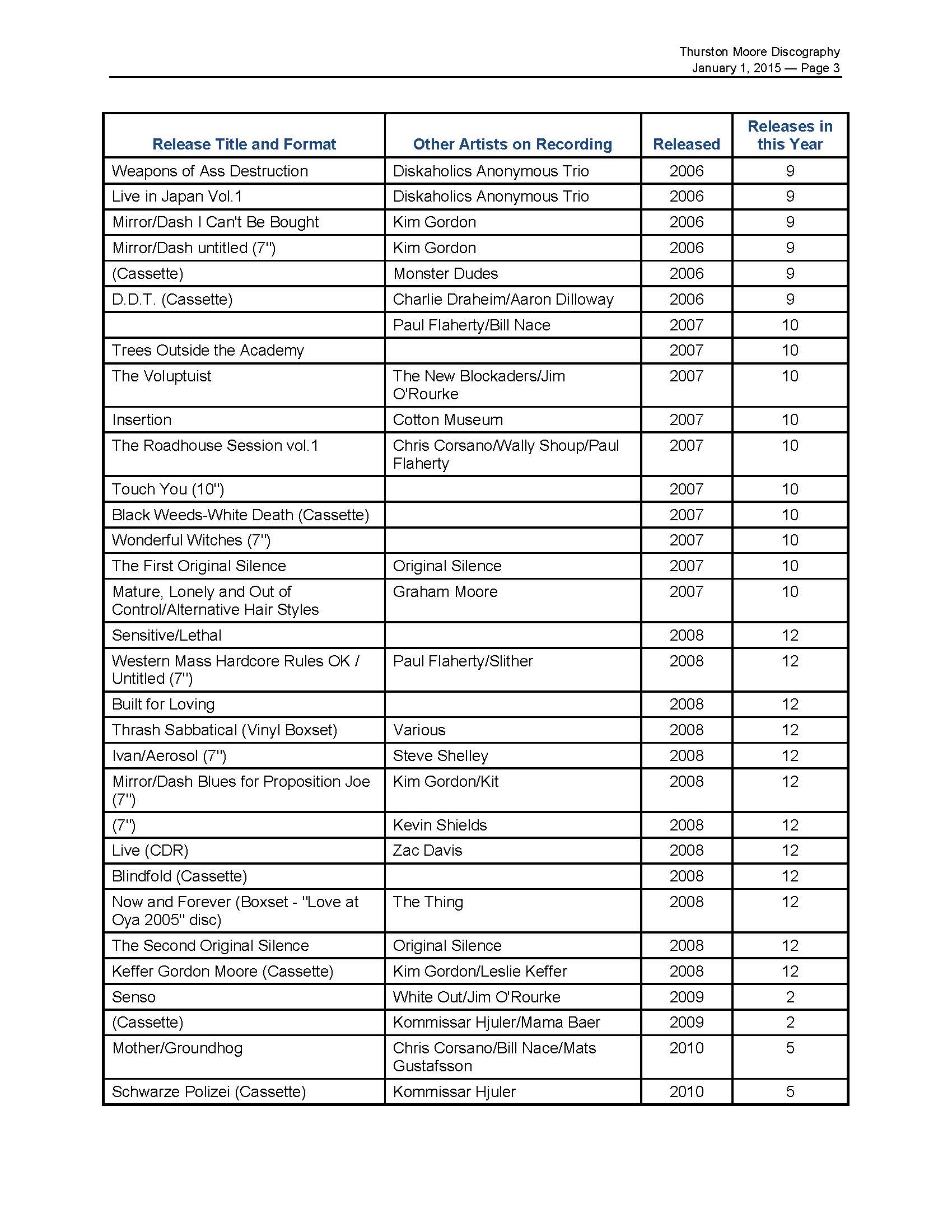
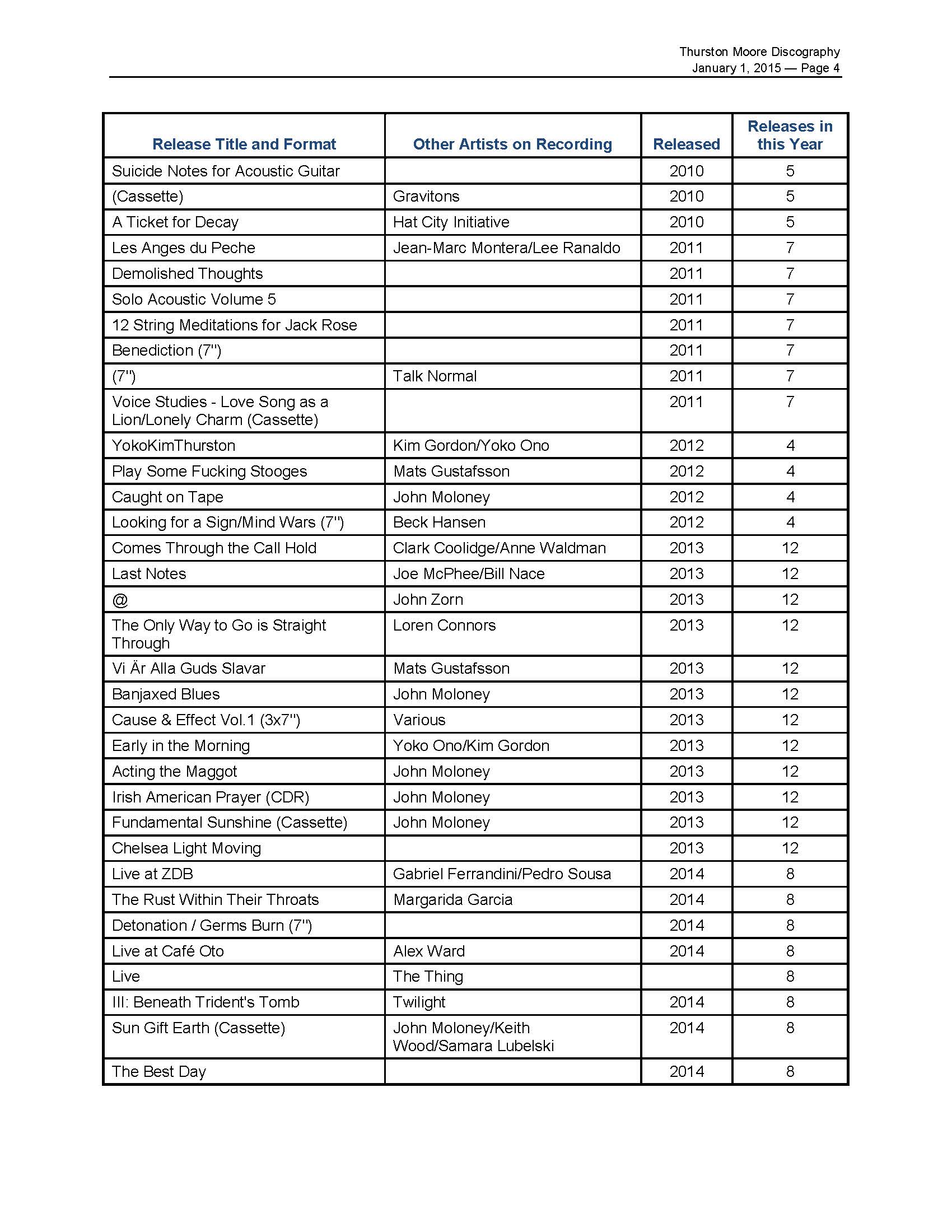
Combining a variety of online sources (and still feeling fairly positive my list is incomplete), I count 127 non-Sonic Youth releases by Thurston Moore either under his own name, with various co-credited collaborators, or under band guises. Very few of those releases are singles and I refuse to count single track contributions to compilations either; it’s an immense body of work allowing one to track the development of his style and approach across those years. You’ll see on the table below – and accepting that I may be missing or misdating a few releases given how much Thurston has blurted out into the world – that there’s a definite trend in Thurston’s release schedule. Prior to 2006, the most he puts out in a single year is six releases in 1995, six in 1997 and six in 2000. Those years emphasise a trend, however, as in 1995 four of those releases are briefer seven inch single tracks, in 1997 only one is, by 2000 none of them are. I’m stretching some by including the “Cindy” and “Ono Soul” singles of 1995 as full Thurston releases but in that first decade and a half of his career the paucity of non-Sonic Youth releases is very clear. Of course, by that I mean his release rate is comparable to a typical musician.

Increasingly after 1995 Thurston’s releases are made up of LP length live recordings and LP length studio compositions. A related but distinct trend, however, is his increasing devotion to creating documentation of those events. While the nature of his releases started to change from 1995, the release schedule only truly explodes in 2006. There’s definitely pent-up activity at first; he released nothing in 2005, an exceptional year, then the dam busts wide open. There are nine Thurston Moore releases in 2006 – he’s at ten in 2007 – by 2008 he hits a peak of twelve. Then suddenly there’s a dip encompassing 2009-2011. Without prying a knife around in the details it’s fair to say that much was going on in Thurston’s personal life and therefore his professional life given the crossover between the two. The result is clear in his release schedule; just two in 2009, the lowest tally since 1993-1994. That steps up rapidly to Thurston’s ‘new normal’ with five releases in 2010, seven in 2011 – a breath drawn in 2012 with only four – then back to a maniacal peak of twelve in 2013, eight in 2014 and 2015 already promises a planned split single on the Fuzz Club label and a further live collaboration with John Moloney. That’s an incredible rate of activity; Thurston has released 70 recordings in just eight years – in the rock domain the only peers I can think of are Psychic TV’s attempt to release a record of their semi-improvisational concert ‘happenings’ every month or the manic live releases of someone like Yellow Swans.

Where did it all start?

Quietly is the inappropriate and amusing answer. Thurston is very honest that he arrived in his first band, the Coachmen, essentially unable to play a note of guitar – the 1988 release “Failure to Thrive” collected early demos on friend Mike Watt’s label New Alliance but isn’t much of a guide to his ensuing path in music. The only other visible evidence of Thurston’s pre-1982 endeavours consist of a 50 second rip called “The Fucking Youth of Today” released in 1981 on an LP for a magazine called ‘Just Another Asshole’ (run by Glenn Branca and Barbara Ess), March 1982’s first Sonic Youth EP on Branca’s label, plus Sonic Youth’s first ever performance in June 1981 at an event Thurston curated called ‘Noise Fest’:
(Sonic Youth’s First Performance)

His participation – under strict structural guidance – in the early guitar symphonies of Glenn Branca are the true commencement of Thurston’s music. The early Branca releases on which Thurston features consist of a 1982 release of the musical accompaniment to a dance performance called ‘Bad Smells’, two live guitar symphonies released in 1983 and recorded in July 1981 and January 1983 respectively (Symphony 1 and 3), then a further May 1982 performance emerging a decade later on Atavistic as Symphony 2 (God I love this label!) Glenn Branca’s website suggests (as of September 2, 2014) that there’s going to finally be an MP3 release of Symphony 4 “Physics” which has always been a blatant gap in his recorded repertoire. I believe that it was during the European touring of no.4 in 1983 that the Sonic Youth crew and Branca parted company. Sonic Youth basically piggybacked their own first European tour onto his symphony tour – something he was apparently none too happy about. The cut-off point between the two bands is pretty blatant; January 1983 Lee Ranaldo and Thurston are both part of Symphony 3, February 1983 Sonic Youth release their first proper album “Confusion is Sex” – the line is drawn and Branca is history.

(Glenn Branca Symphony No.2 Excerpt from YouTube)

The Lydia Lunch collaborations commence during this same period with the November 1982 recording for the “In Limbo” EP (1984) on which Thurston is credited for composing the music on four efforts. While it’s rare that Thurston composes music for others outside of SY, the release doesn’t tell us much about his capabilities as a band leader and Thurston sticks to bass guitar throughout. The songs all stay true to Lydia’s then dominant gothic vibe – how ‘composed’ the songs are is a matter of debate, they’re looser than his work for Sonic Youth but by no means ad-libbed jams (http://www.youtube.com/watch?v=hp-vYVF0z3I). With no intention for this to sound like criticism his playing very much sounds like a man learning an instrument – he provides a solid, stable bedding for the other musicians to romp around on. It’s akin to his early Sonic Youth playing where the sound n’ fury was a case of volume masking poor equipment and limited technique – of course, the restrictions of that early work became a leitmotif of the band’s work, I’m a genuine believer that the best art is usually a result of artists reacting to limitations with imagination where easy answers, cash solutions, bought answers usually produces lazy, rote results.

(Lydia Lunch performing with Thurston in 2013)

It’s nearly two years before Lydia lends her high profile (and distinctive talent) to the July 1984 recording of Death Valley ’69; Sonic Youth’s first hit and first real classic. Thurston is later able to repay her profile-raising support in the 1987-1989 period when Sonic Youth have risen to the top of the underground. In May 1987 Thurston records one song with Lydia and Clint Ruin (a JG Thirwell pseudonym), “The Crumb”, which emerges on a 1988 single and a later 1989 CD compilation. Around that same time (or perhaps on the same occasion) he adds contributions to two songs on Lydia’s “Honeymoon in Red.” “The Crumb” shows how far Thurston has come – aspects of it are close to the chaotic experimentation of the Ciccone Youth project (1986-1988) or of Sonic Youth’s Master Dik EP (1987) with drums foregrounded, unusual cuts and shifts between sections, Moore’s vocals deliberately dramatized, plus studio effects provided by Clint Ruin. The song shows Thurston’s openness to playing with sound, a willingness to be used as raw material. It’s also the first time, on a non-SY release, in a non-live setting that he’s really given himself over to something approaching noise as opposed to well-structured songs. The two songs on “Honeymoon in Red” are “So Your Heart” – another trio with Lydia and Clint Ruin – and “Three Kings” where, in both cases his work was added during remixing of Lydia’s 1982 recordings with the Birthday Party. “So Your Heart” is a beautiful phantom tune, echoing guitar, no drums or rhythm marking time, a mist hanging behind the voice. Meanwhile on “Three Kings” Thurston’s “sonic holocaust guitar” (as credited) doesn’t cut in until around the two-and-a-half minute mark. While “The Crumb” said more about SY’s then side-project entertainments, it’s here on “Three Kings” that it’s absolutely visible that Thurston’s own musical voice has solidified – he sounds like ‘him’. Firstly, the expert whipping of feedback and effects from the guitar is unmistakable, secondly there’s an inkling of what would become SY’s ever-more-prevalent working method in which a song would consist of the solid rhythm section, a strong lead guitar line to the fore, then one guitar designated to provide effects and emphases often lower in the mix.

In his earliest days there are no surprises yet; it’s clear that Thurston’s milieu remains the New York No Wave set of which Sonic Youth are seen as inheritors and bearers of the legacy. It’s also very visible how central Sonic Youth is to his creative identity. Essentially his non-Sonic Youth endeavours for the entirety of the Eighties and on into the Nineties consists of 1981-1983’s Glenn Branca gigs, then the three releases with Lydia Lunch breaking evenly between the one effort in 1982 then the three songs of 1987. There’s one offcut performed with SY buddies as ‘Lucky Sperms’ but that’s it…So far undeviated. While Thurston’s SY identity is set by then, June 1988’s session with two-thirds of Borbetomagus is the first real indication of where he might be bound.

Sonic Youth’s reputation as quintessential noiseniks does them a sore disservice. It underrates their true talent which was the weaving and controlling of unconventional sounds to enhance songs that drew directly on standard pop and rock approaches; they were a deviation not a repudiation of rock music just as punk was a reforging not an extermination. In a way its quaint how unwelcoming the mainstream was given it’s now commonplace for pop and dance hits to consist of structured static and spitting wires. Borbetomagus, at their rawest, are far better claimants to the ‘lords of noise’ title than Sonic Yout were with two saxophones shrieking for all they’re worth and near drowning out the guitar. The “Barefoot in the Head” collaboration with Jim Sauter and Don Dietrich would be the next big step for Thurston’s solo efforts and actually his comrades are surprisingly restrained during this session. “All Doors Look Alike” seems to be about clearing cowards from the room before they really get going. It’s a really atmospheric record, controlled breathing turning the saxophones into a series of jabs, thrusts, underpinning tones. Thurston chips in a combination of rubbed jangling strings and thumped necks which can sometimes make him seem quite backward in terms of his experimental urges – he may sound like rock guitar God Thurston Moore, but he isn’t the man leading this ensemble or making its most telling connections. It’s actually really understandable; while a rock band might deviate from plan on stage, devolve into lengthy jams, record endless noodling, there’s usually a core of bass/drums, perhaps a time signature, almost always a place to come back to or someone ‘holding the line’ while the others thrash it out – plus while they might spin out for a while the bulk of what they do is defined song forms, structures they’re taught, practice, drill and learn by heart. This isn’t true of an improvisational unit. There’s a level of action and reaction when working in a collaboration of this nature – of making sound not for the heck of it but because it fits or works with or against other members of the unit. Similarly, the absence of conventional timing and rhythm means having to find new ways to provide momentum and progress within a song, a new way to create a logical beginning and end. Thurston can do the rock guitar stage moves and he’s become one of the most talented manipulators of a guitar in the world at that time…Here he’s attempting to learn an entirely new language.

For those completists among you (and anyone who can tell me what I’ve missed! Message me on NirvanaDarkSlivers@gmail.com – I’d welcome the updates!) here’s the complete table of 127 releases in the Thurston Moore solo discography.

Thurston Moore_Page_1

Thurston Moore_Page_2

Thurston Moore_Page_3

Thurston Moore_Page_4

As a PS John Moloney very kindly got in touch and pointed out that I’m missing two releases he’s aware of (that further support the weight of his collaborative relationship with Thurston – as an aside I always feel weird using first name for people I’ve never been closer to than sharing space in the crowd as Byron Coley reads on a small stage, but calling people ‘Moore’ feels like being in that school again…) Firstly, The Peeper “Time Machine” from 2008 – http://www.discogs.com/Peeper-Time-Machine/release/1586898 and, secondly, a February 2012 outing for the Sunburned Hand of Man entitled “The Tingle of Casual Danger” – http://www.discogs.com/Sunburned-Hand-Of-The-Man-The-Tingle-Of-Casual-Danger/release/3700384

As a PPS Would you believe me if I said this just started as a way to take a break from working away on a Nirvana book? I Found My Friends is out in March so if anyone reading this would be willing to share the link with friends I’d be honoured and delighted:

New Nirvana: “I Found My Friends” – 210 Musicians, 170 Bands – the Oral History of Nirvana 1987-1994

Beyond Nirvana: 10 Under the Radar Records of the North West Grunge Era Worthy of your Ears

Beyond Nirvana: 10 essential under-the-radar grunge records from the Seattle era

This is a piece I was invited to contribute recently by Anton and the kind people of the Vinyl Factory. As I say at the start, it would have been so easy just to list a batch of well known hits but…I think there’s so much music was pouring out of the region and so much that has been glossed over and erased from all but the deepest musicological explorations. These are ten I picked out – there are plenty of others worth a look – with a desire to provide ten contrasting sides of the State of Washington music scene. hope you enjoy and hope my verbal histrionics don’t distract too much from the quality of the releases I’m discussing.

Thanks to the crew at Soul Jazz for passing this request onto me – damn it was fun. Whittling anything down to ten is quite the exercise…

Nirvana – July 5 1989 in Iowa City plus a Lost Song by Saucer (not on the Soul Jazz No Seattle release)

A few neat little distractions today…Firstly, the deeply pleasant gentlemen from long lost Bellingham band Saucer (who’s songs “Jail Ain’t Stopping Us” and “Chicky Chicky Frown” are on the No Seattle compilation) shared a lost demo with me that they’ve recently dropped up online. I asked their permission to share it onwards – I mean, what the hey, nice to have something to listen to while looking over today’s musings isn’t it? I like the musical bait n’ switch – the chanted verse flipping over to the thrashing chorus, nice seeing diversions and surprises within songs.

Next, just a small thing – someone I know was browsing the online archive of a newspaper and located the two adverts below:

_2 July 5 1989_Iowa City_Daily Iowan

How curious…The Nirvana Live Guide quotes Blood Circus as the band Nirvana supported that night – I’m curious whether the local band, Annihilation Association, had to drop off for some reason, or if it was the other way around and Blood Circus dropped out. The only references I can find to the band online are a live recording from 1988 at http://319dude.bandcamp.com/album/live-1988 and a reference to a guy called David Murray having been in the band, a live photo at https://www.flickr.com/photos/23989451@N00/2703637399/ plus the link back to the newspaper from which the adverts came: http://dailyiowan.lib.uiowa.edu/DI/1989/di1989-07-05.pdf

Anyways, I just want to ask around and see if Nirvana did play with this band and vice versa. There’s a distraction for the evening…

Terry Lee Hale: the Sub Pop 200 True Exception

Everyone says they love a maverick, an exception – most people shrug and simultaneously say they aren’t but think they are. As Calvin from Calvin & Hobbes put it “I’m significant!!! …Screamed the dust speck.” To be fair, the tragedy of failed imagination displayed when people strive to be precisely the same as everyone else is grim to behold so in some ways I’d rather at least attempt to live life as a howling dust speck than give up and ‘be realistic’.

I think what happens is people define someone as an exception in the full totality of their being when in actual reality people are only exceptional in discreet components of who they are and what they do; we all make our compromise with the norm even if it just means we can exchange verbiage. Which brings me to Terry Lee Hale who precisely defines it with a smile and a shrug; “conformity is a funny thing…Even if one rejects the more acceptable ‘normal’ lifestyle choices there is still a kind of conformity in alternate choices right?”

I’ve known Mr Hale’s name a good many years as the true exception on the Sub Pop 200 statement of intent – a singer songwriter playing acoustic amid the wall-to-wall guitar image Sub Pop were determined to pump out at the time. In a way it keeps Cobain and co.’s then presence in perspective for me; no criticism of them implied. Their rebel yell consisted of conforming to a particular underground milieu that was rising in Seattle and being deliberately dredged up by Sub Pop. Sometimes it’s just the case that one’s voice is attuned to those around, at other times one walks one’s own path – in Mr Hale’s case, ending up as a lone singer-songwriter on the Sub Pop 200 release and a real harbinger of the direction in which Sub Pop would proceed from around the time of Mark Lanegan’s The Winding Sheet onwards. Ever heard Dead is Dead? It’s a charmer – naturally i’ll encourage you to download it legally so the artist actually receives a touch of commission; contrary to popular opinion most musicians are not rich millionaires who can afford all and sundry valuing their hard work at zero.

A further point of intrigue in his story is how the choice that united Hendrix, Sub Pop and others down the years remained true in the 1990s; it was often easier to be a viable musician and to be valued as such by jumping across the waters; Terry Lee Hale made the trip over to Europe in the mid-Nineties and has made his base here.

The song at the top of the page is from his latest album, song and album both entitled The Long Draw – guitar reminds me of those brilliant recordings Michael Gira, of Swans notoriety, would make playing solo but cleaner and far more expert though.

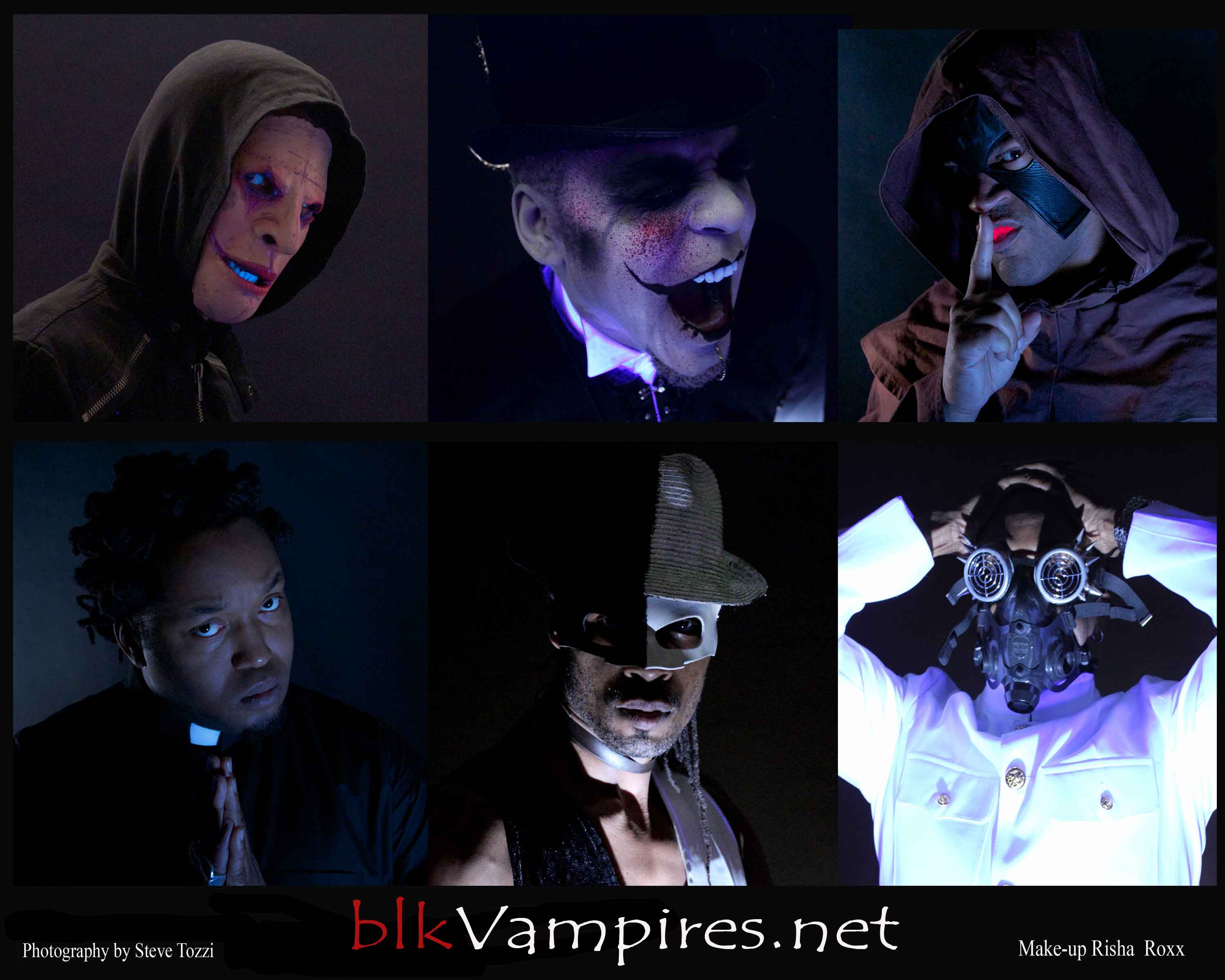
BlkVampires, Nirvana, the HarlequinX and a Riot on the Dance Floor

new bv flier poster 2011 small size

A few months ago I made a passing comment on the racial divide around the alternative rock scene and one respondent, quite reasonably, took issue with the idea that Nirvana were in anyway racist. Less reasonably, that wasn’t what I was commenting on; the undeniable reality was that there was a significant colour bar, an unintentional one, that meant the world of alternative rock in the Eighties and Nineties was an almost entirely uniform race phenomenon. Decades of ‘white flight’ leading up to and into the Eighties built upon the segregation arising from class (which substantially mirrors the racial lines in society) to create large numbers of almost all white suburbs and smaller settlements. Music doesn’t float free of society and increasingly came to be a de-facto reflection of what was occuring. This doesn’t mean that audiences were in anyway racist or that musicians were either – they simply played what they wished with the friends around them. What it meant was a minimal representation from the non-white community in punk/alternative rock.

http://www.tabletmag.com/scroll/150886/a-horror-story-set-in-crown-heights

http://blkvampire.homestead.com/Book-Release.html

Substantial coverage is always given to the Bad Brains (Fishbone and Living Color have been pointed out to me also) not just because they were superb (they were) but also because they were an exception within the scene. Reasonably enough they emerged from the more mixed environment of New York City. That simply couldn’t be reproduced in State of Washington which, even in 2010, was 77.3% ethnically white, 7.2% Asian, 5.1% ‘other’, 4.7% mixed race, 3.6% African American, 1.5% native American and 0.6% Pacific islander. The result in the Seattle scene is pretty visible – Soundgarden possessed Kim Thayil (Indian extraction) also Hiro Yamamoto (Asian) and…Oh. That’s pretty well it.

The music of the alternative revolution fairly closely reflected the boundaries established with the kind of fusion artists like Jimi Hendrix had attempted more or less erased, Led Zeppelin’s genre experiments forgotten in favour of their pure rock muscle and the more funk-orientated artists of the late Eighties and early Nineties more likely to emerge from LA (Red Hot Chilli Peppers being the prime example) than from the regional punk scenes – the Minutemen’s Mike Watt, a further exception.

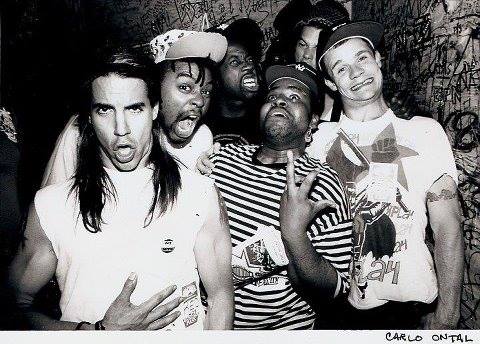
rhcp

This is in no way a criticism of any of the music of the era – there’s no judgment involved. It is, however, a background to Nirvana and their emergence and observing the bands with whom they played minority-representation is little and far between even while the female presence is higher than the mainstream rock star norm. The band’s music reflected a music culture that also reflected population demographics.

While a common cliche is the adoption of African American music styles by racially white artists all the way back to Elvis (and perhaps tragically best represented today by Miley Cyrus – *shudder*) there are far fewer cases of enthusiasm and respect running in the opposite direction. One exception was a band that crossed paths with Nirvana on two occasions in 1989 and 1990 – 24/7 Spyz. Recently I made contact with Mr. Forrest Thinner of the band who recalls what is an under-discussed aspect of the ‘alternative rock revolution’ and who clearly lived and breathed for that scene and the love of playing – still does. The photo above shows 24/7 Spyz goofing about with RHCP and in the meantime I’ll let Forrest speak about the scene he was a witness to and a part of…

“Alternative rock really came from the college circuit…and yes the scene was super white; Bad Brains/Fishbone & Living Colour stuck out like a light bulb – the white teenage males had a lot to get off there chest socially they needed answers and it seemed the music was a way to be heard! For 24-7 Spyz to exist in those times were an anomly we were ‘Bad Brains’ from da HOOD to see us in those times was like seeing Eminem now like how Em is respected by the black rap community well we were respected by the Skinheads/MetalHeads/SkaKids/Punks/Hip Hop/StreetThugs/etc…Bad Brains is the inventors of Hardcore music period but not PUNK! Brains are not like the Sex Pistols/the Ramones or the Exploited they invented a musical style called ‘HardCore’ also they mixed it with Reggae Music which we all know that you can smoke weed and get high at the same time while playing music like some LSD hippie days shit so H.R. became like Jim Morrison (:-)) Giving the Brains big ups is Tokenism with a sense of honor and respect for being the FIRST of their kind.”

His new band furthers the agenda to the extent of ‘white-ing up’ with the corpse paints more prevalent in Death Metal circuits or Marilyn Manson’s ilk. Again, there’s no novelty intent, it’s a genuine love of the musical form and style plus a musical openness and omnivorousness:

“My first decision to dive into music was when The Jackson 5 came out, Micheal was only two years older than me and i still remember trying to sing all the words to ‘I want you back’…that’s when i became hooked into music. Metal & Hardcore came when i went into the Army and my platoon mates started introducing me to Van Halen/Molly Hachett/38 Special/Iron Maiden etc….I really got into all of it Queen/Led Zepplin everything and everybody. I was already hip to PFUNK and James Brown plus ALL of the 70’s funk bands i played Alto Sax then Guitar then Bass and i write my songs on Bass till this very day….24-7 Spyz wasn’t my first musical endeavor as a teen i was in a couple of local bands (Supreme Funk/Knights and then i started 24-7 Spyz)…We were also friends with Fishbone so Murphy’s Law took us under their wing and brought us to the world of HardCore where we got expose to Bad Brains/Agnostic Front/Raw Deal/Cro-Mags/Dead Kennedy’s/Sick Of It All etc…And when the Hardcore world got a hold of us it was DONE sooo fast.”

This is a truly original path forged through the underground, a brave one given the punk rock circuits were running through states lacking the liberal mindset of the North-West. This went hand-in-hand with a respect and love for the music around them. Speaking about playing with Nirvana back in the day Forrest’s exuberant comment was “I never heard of them before that night so i didn’t know they songs or set list but some of the kids did i just remember the rawness and power of them and they were loud as hell. I was very surprised to see them on ‘David Letterman’ i thought to myself DAMN Alternative Music has got a face now…Thank God!” which has an embracement of what occured that is very foreign to the reaction of a lot of musicians in the scene who were more concerned with hiding the scene as if it was a private secret.

I think anyone who has read the ‘New Music, New Discoveries’ category of this blog might have noticed I get a bit awed by people just willing to do what they feel, create something, think of something expressively or spiritually and just make it happen in spite of profit or obstacles. Do for self. In the case of Forrest he’s moved on, moved up and in the form of BlkVampires is expanding into multiple spheres as a true artist not just a musician willing to kick genre boundaries in the same way Meat Puppets, Minutemen, Big Black, Butthole Surfers and (yes) Bad Brains did in the early-to-mid Eighties.

“What I’m doing now in 2014 is a triple threat (Music/Book/Film) with my band ‘blkVampires’ we are a New York City based band that plays ‘Hard Alternative Gothic Soul’ music kinda like Pantera meets Al Green w/a little bit of the Exorcist inside…A soulful version of Marilyn Manson. We’ve been around for 4 years building a following & buzz. I just finished my first supernatural horror fiction novel ‘the HarlequinX’ and there’s a music documentary film coming out called ‘Riot On The Dance Floor’ in 2014 that has 15 of the TOP Hard Alternative Punk Artist EVER!! and i have the honor to BE in this film! If i was to recommend a song that personified us i would ask you to listen to “Blkenstein” from the Devil’s Music EP and there are too many highlights for me to pick just one because we’re ALWAYS asked to do something good but i would say that we are the ONLY all black band that has ever been featured in Fangoria Magazine and they been around since the mid 70’s and in April 2014 our 3rd EP Tutankhanum X will be out along with our Film & Book.”

That’s a lot of action. Forrest and the BlkVampires, I salute you and thank you for allowing me to point to you and your past endeavours as an exceptional journey through the rising alternative rock scene of the Eighties and Nineties and on into the present.

http://www.blkvampires.net

blkVampires Poster

7 Corners: The Recording History of Dave Grohl and Foo Fighters

http://7corners.foofighterslive.com/

The lines between past and future are rarely absolute. In the case of Dave Grohl, the clock hands moved incrementally, a few halting ticks at a time, between his decision to dispel the ghost of Nirvana by walking back into Robert Lang Studios in late November 1994 and hammering out an album, the unveiling of Foo Fighters to friends and family on February 19, 1995 on a houseboat and the more public performances that followed from March starting on the home turf of Portland and Seattle. On March 4, just over a year since Nirvana’s final performance, Krist Novoselic stood and watched as his friends and fellow survivors, Grohl and Pat Smear, stepped out with their new identity.

But that wasn’t the start…The fifteen songs recorded at the November session had been seeping out of Mr. Grohl throughout his time in Nirvana – only four of the songs recorded were post-Cobain works. The background to Nirvana was always this guy’s evolution and progress as a musician and song-writer in his own right. And it turns out someone has taken the time to catalogue, explain and tell the story of that long process and the journey to the present day.

I’ve always been stunned by the energy and effort Nirvana fans have committed to documenting the band; the work that has gone into the Nirvana Live Guide, LiveNirvana and the Internet Nirvana Fan Club is astounding. And in the case of Simon Kilmore he’s consistently been a worthy presence in that world… But it turns out much more besides.

Simon runs http://www.foofighterslive.com/ which is, I say this without any shade of doubt whatsoever, the most crucial online resource for anyone wanting to get the fullest view of Foo Fighters. As what will become a continuously evolving further resource, Simon has taken the time to interview people involved with the band, to document over fifty known sessions, to pull together information stretching back as far as 1984 into a 263 page ebook demonstrating the full story. There’s a free sample on the site at the top of this post and its available in multiple formats so wherever you are in the world you’ll be able to settle back and take a read.

As ever, my support for those who decide to commit the time and energies needed to do put something like this together is absolute. Get up, DIY, may the punk message never die.

In Utero: Further Confirmation…And Viewing The Parasite

Parasite

A first thank you, Mr. Marcus Gray was the individual who first shared the Mojo article over at LiveNirvana. Much appreciated! Next, further beautiful entries in Mr. Gray’s Parasite art project:

PARASITE laundry

I’ve commented on it before (https://nirvana-legacy.com/2013/03/02/art-on-the-end-a-fresh-cobain-artwork/) and still find so much to enjoy in these knowing glimpses of meaningfulness that rest on the bedrock of two decades of Nirvana/Cobain knowledge to gain their deeper associations. The brain flickers back through other images and photos when faced with Marcus’ work – a chain between past works and this present shot. The bridge with KURT etched into the paintwork stands out for me also. Digest and enjoy, there’s a fine mind at work here playing visual games with over-informed viewers.

Picture1

On the In Utero subject, for the best synthesis of information and options get over to LiveNirvana and enjoy the 69 pages (!) of the ‘Speculation Thread’ – I’m just summarising and giving my take here. Thank you to http://nirvananews.tumblr.com/image/56900709444, for the picture and, alas, unfortunately for rather knocking the wind out of everyone’s sails. In summary, the Live n’ Loud Audio/DVD components are confirmed, the debate remains around the precise contents of Disc 1 and Disc 2 which seems to be listing:

Remastered Original Album
B-Sides & Bonus Tracks

Original Album 2013 Mix
Demos

I’ve gone bug-eyed trying to zoom, refocus and discern the slightly obscured text on the picture of Disc One but it reads right to me. In summary, it looks like the Mojo article didn’t hide or veil any of the rarities on the release – I guess they somehow scooped the exclusive.

With the full album remastered plus the remix from Steve Albini the track count changes to:
Disc 1: 13 track original album, plus Marigold, MV, I Hate Myself & I Want to Die, Verse Chorus Verse (Sappy) = 17 definite
Disc 2: 13 track original album, plus SA from Rio, 1990 Marigold, Word of Mouth instrumentals x 4 = 19
Live n’ Loud: 17 tracks times two = 34, plus a clutch of bonus video footage
Total: 70 plus the bonus video material

I’m open to seeing this change a bit but not by much – if the bonus video footage and any unmentioned songs added up to ten, or even just to five further tracks I’d expect the release to say 75 or 80 tracks. So don’t hold your breath for more than the stated content is all I’m saying. I don’t foresee Universal withholding mention of other significant unheard material if it was to feature. Disappointed? A touch. It seems to suggest that Universal is run by audiophiles who appreciate a slight tweak to a song, or by dance/pop fans who haven’t quite realised that rock fans are far less impressed by remixes, something Cobain and co. never saw fit to indulge in during their lifespan as a band. Again, I’m open to reinterpretations and reconstructions but ultimately I’m happier with lower sound quality but more intriguing vestigial practice material showing songs coming together. But there’s no happy answer, I remember With the Lights Out getting flak for including Cobain’s acoustic home demos because of the low fidelity and whacked out style they displayed – what the hey, I loved them.

Oh, incidentally…This wins my ‘most misleading title’ award.
http://consequenceofsound.net/2013/07/nirvana-to-reissue-in-utero-with-70-bonus-tracks/

A Musical Aside: Trunk Records and a Moment in British Music

MMsPackshot

While I’m whiling away the tail of the weekend spreading news of obscure music I’d like to draw attention to what I believe is the most bizarre record ever released. I’m referring to Trunk Records’ release of the buffet carriage announcements from the Midland Mainline train company’s London-to-Leicester route.

I’ve known of the release for years but never had the courage to order it. Basically, Trunk Records is an exqusitely eccentric outfit run by one Johnny Trunk. They seem to make many of their release decisions by going down the pub, drinking twelve pints of beer and waking up two days later to discover whether they unleashed a moment of genius or madness. I swear to you now, if you like downloads, take a look, if not, then make your life better by ordering one of their final copies of the “Now We Are Ten” sampler – it’s less than five pounds (as is the latest Lard sampler) and will make your life better.

http://www.trunkrecords.com/intro.shtml

At its most eccentric, Trunk has released recordings of his sister’s porn starlet fan mail set to music and other material that is funny for a listen or two but no more. At the other end of the spectrum, however, it has been an outlet for an entire era of British music that has been overlooked, minimised, dismissed and under-appreciated. The label specialises in rare film music (the finest are the soundtrack to Blood on Satan’s Claw and the Psychomania soundtrack), TV soundtracks with quite a few children’s shows (I own both the Fingerbobs music and The Clangers), old BBC electronics music (I recommend the Tristram Cary compilation, The John Baker tapes and an old school programme called The Seasons), plus a load of jazz-orientated material with other deviations into advert music and commercial music libraries.

Now, let’s be fair, I’m not expecting to be more than bemused by the MMS Bar Recording – I’m certainly going to wave a copy at my father and at my uncle (both train fans). The label, however, by its willingness to pursue a vision to the nth degree, to pause for playfulness, combined with the obvious effort put into finding much of this music and the extensive notes that help me make sense of their discoveries, have made a loyal fan.

The music I love from Trunk is that which captures a particular time in British music when the world was trying to come to terms with the arrival of new instruments – electronics – that offered a brief window when escape from the traditional structures of the western musical tradition seemed possible. its that sense that here i’m listening to a genuine moment of escape – to music that was trying forty-fifty years ago, in vastly more difficult technological circumstance, in a deeply conservative environment, to flee centuries of inherited musical systems. The window never opened too far, most music ever since has retreated to the rulebook with the new musical potential of electronics simply added to the palette alongside traditional acoustic instrumentation rather than acting as a way out into something truly new.

That doesn’t mean I think “modern life is rubbish”, not at all. The prominence of these experimental forms in primetime TV broadcasts helped create the vast appetite of today’s music for sounds and styles that are a world beyond what came before. Even in the most mainstream pop recordings we’re regularly hearing sounds that squelch, crackle, burr and quiver in ways that would never have been envisaged as any part of musical composition barely a single lifetime ago.

The other element that’s so potent (the Ghost Box label really delves into it), particularly on the Blood on Satan’s Claw soundtrack, is the brief openness to quite esoteric subject material. This was the height of British consideration of laylines, druidic rites, UFOs, mysterious big cats loose in the countryside – the merging of the ancient, wild and uncontrollable rammed directly into the ultramodern and similarly unknown potentials of new technology and new futures. It was a tantalising vision and a beautiful meshing of what seemed at first to be opposing interests. Musically the result was recordings that featured the latest in synthesiser technology, tape experimentation and early drum machines – while ghostly string and wind instruments played over the top or known forms would intrude.

On Psychomania,the link between past, present and future is made explicit. It follows the attempts by a young biker gang delinquent to use his mother’s talents as a witch to die and return as the undead. The soundtrack flares in all directions with modern funk and acoustic interjections sitting alongside slithers of uncomfortable conversation from the film and haunting electronic effects…

…What the hey. Go buy the samplers. I just fleshed out the collection a little and barely spent a tenner. Have a good Monday!