Kurt Cobain’s Contributions to Melvins’ Houdini Album

Gosh, has it really been a month since I was working on this? Darn…Sorry…Sorry…

A diversion today though, wanted to look at Melvins’ Houdini record. I’d always noticed that commentary on Cobain’s involvement with the album is focused on his role/non-role on the production side with barely a mention made of the part he played as a musician on the release. I couldn’t help but want to satisfy my curiosity by grabbing a copy of the album and finding out why…

…Oh dear…It’s pretty obvious. The real story of Houdini, the real fun and drama, come from discussing the record company’s cynical behaviour – their determination to have the name ‘Kurt Cobain’ written on the record by any means necessary and to see if Melvins’ association with Nirvana could be turned, at the peak of Nirvana’s fame, into success for their own artist. I’d have to admit though that a lot of albums never make money I can understand a label executive wanting to exploit the very clear and visible connection between their ‘token grunge band’ and the world’s biggest group – it’s logical, it’s sensible, it’s helpful. Melvins’ status at the time is also fascinating, this was a pretty drug-addled time and examining the album, it’s not bad but there’s definite filler compared to their most glorious excursions. Thing is, for Cobain’s name to be exploited in this way he had to agree to it – his instinct to support his friends, coupled with the fact that it’s fair to say that in the early days he’d made use of his Melvins’ connections and owed them to some extent for early breaks, meant he was happy to involve himself despite there being no apparent evidence of him being interested before in the mechanics of recording beyond asking for a particular sound and a producer fulfilling the desire as best they could. Similarly the mood is visible in the way the relationship between Melvins and the production staff broke down a touch, you can see it in the way that Jonathan Burnside – an experienced producer who’d worked on several other Melvins’ albums and releases – was relegated to ‘engineer’ in the credits when it’s become very obvious that Cobain certainly was not producing in any active sense. Melvins also had to join in with the urge to use Cobain’s presence for commercial purposes. Buzz Osbourne has stated he wanted Cobain there for inspirational purposes and so forth – yeah? Let’s just check, Kurt Cobain had been a presence in the life of Melvins for some ten years by that point but suddenly he was wanted as a collaborator? Alas, hate to say it, but I think it’s more likely that just as Melvins’ arrival on a major label was tied directly to Nevermind’s explosion, the arrival of Cobain in an amorphous and vague role on Melvins’ first major label record was simply a knowing desire to try to keep the label happy and gain some commercial glitter. Nothing wrong with that, useful to have a rock star friend.

Did I say filler earlier? That’s where the Cobain contributions come in; Cobain is given a credit for playing on two songs – Spread Eagle Beagle and Sky Pup. What that involvement amounts to is participation in Melvins’ very own Moby Dick (a la Led Zeppelin.) Spread Eagle Beagle is a lengthy percussion piece that doesn’t feel the desire to go anywhere in a hurry. Lulls at about five minutes and ten minutes – where the drums give way to the light rumbling of what sounds like a steel sheet then the patter of drum sticks being rubbed – almost count as moments of tension simply because so little happens. I’m a fanatic for unusual noise records, for a certain quantity of extremity, but this doesn’t have the same momentum Melvins lent to something like their collaboration with Lustmord – it’s just ten minutes of relatively static thudding, little intricacy or drama. On live bootlegs of Nirvana sometimes you’ll hear for a few seconds the drummer warming up, clattering a few drums before the start of an actual song, just setting the beat and waiting for his comrades to join in…This feels like Melvins playing those few seconds ad infinitum, over and over, while everyone else is too busy nodding out to join in. It could be a joke – that they’ve tagged this nothingness onto the end of a real record in which case it’s a bit sad because Melvins have always managed to be whimsical, experimental, out for just trying things and seeing what might happen – without creating ‘nothing.’

There are several sources within the song. First, a drum kit keeping up a solid heavy thump in the middle, a consistent zing of bent metal that echoes accentuates or follows certain moments in the main rhythm, a separate and far lighter set of accents is being added by a separate drum kit occasionally echoing the main rhythm while a further piece of equipment producing something like the sound of a light switch or thin stick being hit on the edge of a drum – a whip sound – sometimes intervenes. The rhythm is fairly unvarying – the pauses give me the impression of active improvisors pausing to look one another in the eye before a change of direction…Except the direction doesn’t change. The ‘song’ pauses then simply proceeds in pretty much the same manner as it had been. There’s a change up at about six minutes in to a far denser drumming with each instrument gradually rising up for the next couple minutes and the pace picking up while still amounting to little more than a swifter clatter.

For evidence of Cobain’s continued collaborative or creative impulses in the 1993-1994 period Spread Eagle Beagle isn’t the place to go. It’s impossible to tell what contribution he made, there’s no way of teasing out a signature sound or anything identifiably Cobain-esque. In a way that’s perhaps what makes me smile widest because, if I was being generous and clever-clever, I’d suggest that the anonymity of Cobain’s presence is precisely the point. The album’s own merits were being overshadowed by the mere presence of an (unwilling) global superstar. Whatever Melvins did on the album, the label were far more concerned with just plastering Cobain’s name on it. Cobain himself undoubtedly knew that he was helping friends but simultaneously that he was being exploited due to his fame and that it wasn’t just ‘helping friends’, it was also supporting the label people suggesting and coaxing them into it…These are musicians, while most people simply say what they feel is wrong/right, musicians can comment via music, via performance. What Melvins create at the end of the album, was a graffitti track stating “yes, Kurt woz ‘ere” at the same time as it makes him completely invisible, a cipher, a name, nothing more. They’d erased him from the track even as they satisfied their bosses that they’d included him. Great! Doesn’t mean I necessarily am going to listen to the track often even if it potentially says much about the circumstances of the album. Buzz Osbourne’s apparent resentment/irritation with Cobain’s posthumous status perhaps has roots in this kind of moment where Melvins’ own achievements are pushed to one side in favour of their friend’s commercial cachet. Understandably annoying.

So what of Sky Pup where Cobain was coaxed into handling a guitar? Hmm. Perhaps this feels disrespectful but in the songs four minute duration the usual heavyweight chug of Melvins at full pelt is stripped back to a pretty jazzy bass/drums duet which works neatly, but the guitar is missing in action. Oh, no wait! There it is. There’s a repeating sequence during the early minute or so of the song – I was aware that this was Cobain on a right-handed guitar with Buzz Osbourne manipulating the peddles but then it dissolves to a low-in-the-mix watery sounding diarrhea that eventually becomes nothing more than drain noises for the rest of the song matched against some vocal chokes and coughs and ad-libbed squarks. I was hoping to say more about it but there really isn’t anything there to comment on. Apparently Cobain handed the guitar back as rapidly as possible – there’s no indication that this was a live jam, it sounds like a recording of the guitar was mixed in later with the rest of the band playing over the top. I wouldn’t even be surprised if that introductory semi-riff was looped after the fact or if the same minute or two was reused throughout most of the song. There’s some kind of a solo from about 1.50 through around 2.30 then a skeletal 25 seconds in which the finger positions move back-and-forth a couple of times without achieving anything much. There’s a hint of Gallons of Rubbing Alcohol’s spindly moments at that point but it makes the latter Nirvana jam look like gold-dust by comparison (I really like Gallons I admit.)

The most crucial reason that the two Cobain contributions stand out is simply that everything else on the album actually sounds like a Melvins’ song. This is a cohesive and coherent album if one erases Sky Pup and deletes the ten minute marathon finale. That final track simply feels like a band low on inspiration needing to get the song up to some kinda contractually mandated run-time though, in tone, it at least feels consistent with the album as a whole. Sky Pup is a mid-album interlude adding neither a pause for breath nor an intriguing switch to leftfield – it doesn’t sound like it belongs on the same album as the other tracks. It’s a remarkable commentary really – to make the interloper stand out so prominently on the album that it’s clearly the thing that simply didn’t fit into what the Melvins were doing with the Houdini album prior to the intervention of major labels and the potential cash bonanza.

Anyways, a good album…If one deletes Sky Pup and Spread Eagle Beagle.

Smothered in Musical History, Jaded by Reissues and Reprisals Galore

Picture1

Lengthy absence acknowledged – sorry peoples, normal service to be resumed as soon as possible and I’m still itching to talk about a few things I’ve been up to on the Nirvana front. Soon…Soon…

Over here, is it me or has the reissue/retrospective/boxed set/deluxe edition industry kicked into overdrive recently? I’m currently whipping through the three CD edition of Oasis Definitely Maybe which reminds me precisely why I enjoyed these guys at age fifteen – singing out loud while working the day job has it’s appeal plus they had b-sides most bands would kill for.

Similarly, if the nation of Ireland had done nothing else other than come up with the Therapy? Troublegum album then i’d still count their entire history a success. As it is, they didn’t just come up with Troublegum, they did pretty well with Infernal Love too so I can only recommend that if you have a little spare cash both reissues are well-worthy (three CD Troublegum being the best, two CD Infernal Love still top notch.) A complete reminder of why these albums tore my head off all those years ago – Troublegum is musical perfection.

Thing is…I’m also looking at the three CD Young Marble Giants package on my shelf alongside then the four disc Heartbreakers LAMF Definitive Edition next to the Heartbreakers Down to Kill rarities collection; on the shelf above is the complete Beatles in Stereo next to Iggy and the Stooges three CD/1 DVD Raw Power deluxe edition and the Stooges Complete Funhouse Sessions eight CD box and the Dinosaur Jr Visitors 7″ vinyl Record Store Day boxset; in the middle just above me is the Nevermind Super-Deluxe plus the Singles box plus With the Lights Out bookended by the glorious Joy Division Heart and Soul boxset and the Sex Pistols four disc from 2001 or so; and I know over my shoulder if I spin this chair around I’ll see the two Unwound vinyl boxsets Kid is Gone and Rat Conspiracy nestled next to my Pennyroyal Tea Record Store Day 7″; to the left of me you can find the two Throbbing Gristle live boxs, plus the Rage Against the Machine Super Deluxe, plus the Arab Strap box, plus the Nirvana In Utero super-deluxe and the Bleach deluxe…Elsewhere there’s Weezer Pinkerton deluxe, Sonic Youth Goo/Dirty/Daydream Nation deluxe, the Throbbing Gristle album reissues, the Jimi Hendrix album reissues, Superfuzz Bigmuff deluxe, the Crass reissues, more Stooges, Azura Plane, the Slits, a Bob Marley retrospective, the Deathprod boxset… Get the picture?

Picture2

Essentially, I think it does say many things about me (not wishing to turn this into a personal reminiscences blog but what the heck…) that I’m totally the target audience for these kinds of releases – musically omnivorous, prone to obsessiveness, collecting bug on overdrive, not much money but even less sense…I’m a dream consumer for the music industry. There’s a certain internal revulsion too – do I really need…? No of course I don’t, there’s no belonging I possess that, in an existential sense I really ‘need’, it’s all about want and wish – which somehow feels so unnecessary but ultimately harmless, pleasurable, no worse than someone else’s desire for art, clothes, property – any physical display. But the actions of others doesn’t rob me of that nagging discomfort with myself nor of a right to feel disconcerted by my consumption of music.

There’s nothing sinister about the re-heating of old releases – it’s entirely overt behaviour by record companies, entirely welcomed by fans (if done well), definitely interesting for the musically inquisitive. Likewise, though books like Retromania make good points about the crowding of the culture industry with repetition and repeat, ultimately it was a foreseeable consequence of the accumulation of physical recording media – there was going to come an age where the glut of material available meant new releases from new bands were just a tiny pimplehead on a Jabba the Hutt style long and thick body. It has a positive too, the willingness to discover the past, to acknowledge past creation, past moments of inspiration – it doesn’t have to fall into maudlin nostalgic comfort though some would argue that’s all any of it consists of.

Anyways, though it’s nice to play it safe and re-purchase old favourites for those slightly battered, shambolic, tinny or hiss-consumed shades of the main release, though it’s fun to be reminded precisely how stunning certain albums were and always will be (usually more to those who experienced them first time around but often to those who never had that chance)…There’s still plenty going on out there, plenty to be explored so I don’t think it’s the death knell just yet. But I still need a break which is no bad thing.

January 16, 1993 — Cobain Quits on Stage

After all the rumours of sheer catastrophe, the latest additions to the audio/video record of Nirvana’s performance in São Paulo in January 1993 actually didn’t seem so bad…But. It took me some time to realize that it’s only just over thirty minutes into the performance before Cobain gives up on playing and more-or-less goes on strike. For his comrades on stage it must have seemed like no time at all before things fell apart.

Making it worse, this isn’t a situation where it’s NIRVANA as a unit wrecking things, Buenos Aires back in October is the obvious contrast where they’re all sabotaging the show in one form or another. This time around it’s Cobain, on his own, ignoring Novoselic and Grohl and doing precisely what he feels like doing with no consideration for them. Throughout the rest of the show there are moments where they both seem to be coaxing him along, encouraging him – when Grohl insists on them playing Rio it sounds so enthusiastic but simultaneously looks like a way of keeping Cobain playing something, anything. It’s a tragedy that the existing record doesn’t show the moment when Novoselic walked off or where Kurt started mashing a watermelon into his strings. It does make one wonder whether the performance was as bad as stated given the moment where Cobain sang “we will f*** you” during the Queen classic isn’t clearly present either.

This is the first time they’ve been on stage together since Nirvana had witnessed an audience tear Calamity Jane to shreds in Argentina so, though the noise is muted on the recording, the audience are unlikely to have been passive recipients of whatever was going on. Imagine tens of thousands of revved up locals staring down the band – is it any wonder no one is willing to call it quits and step off stage? If the legal/contractual threats that stopped Novoselic from quitting part way through weren’t sufficient then a relatively buoyant audience certainly must have helped keep the tension levels elevated.

I admit I marveled at how functional Cobain is while high. Later the same year he overdosed in New York and was still on stage later, even if it did create a poor performance he still staggered through it. Here in Brazil the reports from backstage emphasise that Cobain was visibly drugged up before he went on, heck, he’s certainly no zombie even if there are so many moments where it’s obvious something isn’t right – the foul-ups in Teen Spirit where he can’t even hit the two notes of the verses quite right are a fair example. His voice is certainly not at its best, he sounds strained and hoarse at numerous points – even more grainy than his regular approach and loses the note entirely at the end of Teen Spirit. Whinging about the lighting twice over inside the first fifteen minutes of the recording isn’t anything, stage lighting blinding musicians isn’t exactly uncommon, but this is a guy who barely has his eyes open and doesn’t interact with crowds a whole lot – what’s he planning on looking at?

Negative Creep has that same tentative vibe as Buenos Aires where the first minute or so of each song felt like he was trying to remember it, tuning, preparing at a time when the band had plenty of guitars all tuned and ready to go. His yelp of “is everyone having a good time tonight? Rock n’ Roll!” has the same feel of sarcasm his applause at the conclusion of Live and Loud does – that he knows it’s not amusing, that it’s not going well. “I could shave on stage and you’d eat it up,” within a very ad-libbed (enjoyably so) rendition of Something in the Way sums up his feeling that he feels he’s faking it and no one’s noticing – it’s followed by the line about Brett Michaels and Poison then a reference to Guns n’ Roses/Led Zeppelin, I usually take his references to hair metal bands as points where he’s feeling self-critical or conscious of reasonably made comparisons given his band has stepped over into that pop-rock sphere – in this context that interpretation, that it’s his inner issues on display, makes sense.

Of course, he’s been through these songs so many times that he can’t fuck up hugely, most of the set are tracks he’s played in concert right the way back to 1990 if not before – there are four tracks from Bleach, Polly/Breed/Dive/Been a Son/Molly’s Lips he’s been rocking since 1989 – yet he’s still not putting much into them. It isn’t, however, a disaster at first – just lacklustre. It emphasizes how deliberate a choice it is to go from pausing, tentative performance to simple destructiveness – that’s an aspect I don’t think I’ve seen mentioned before, that it isn’t just a bad performance, it’s a deliberate refusal to cooperate. The solo in Blew is just bizarre, there’s not even an attempt to work within the confines of the song.

And that’s it, off he spins. Krist and Dave do their best to set down some kinda base but Cobain just ignores them and crunches the most cackhanded chords and directionless note runs without any reference to attempting musical cooperation or performance. There are moments when the band try to lock in behind him and he just spirals off to wherever – I love noise records and the ten minutes or so from Blew onwards certainly qualify. Staging the kinda guitar-wrecking he normally saves for the finale at this early stage is a declaration that the show is over.

I’ve always wondered about the presence of TV cameras and their effect on Cobain; think back – Top of the Pops (takes the piss), Jonathan Ross show (plays a different song to the one intended), first MTV live appearance (finishes early), MTV VMAs (refuses to play Teen Spirit and annoys them with Rape Me), Live and Loud (eliminates Teen Spirit again and spends fifteen minutes making noise and harassing cameramen), MTV Unplugged (plays barely half a set of Nirvana originals and avoids any ‘hits’ – questions about the ability to play some of those hits acoustically to one side for a moment), Rio de Janeiro (‘mocksturbation’ to cameras of Brazil’s largest TV network)… TV seems a guarantee of non-cooperation from Cobain. Why? It’s certainly the clearest indication that he’s moved to a different level of fame, it’s definitely showing he’s been moved into the “TV musical light-entertainment” category which may have itched and it’s showing him that whatever he’s doing is now acceptable mainstream music. Did that worry him? No idea, but the chain of less than cooperative behaviour is telling.

I’ll leave you to work through the covers – he at least sounds like he’s having more fun, they’re pretty competent renditions. Apparently around the time of the Mia Zapata benefit Cobain was deeply into a drug spell – noticeable that, again, the show revolved more around covers and casual fun. Part of me thinks a rendition of the Stooges’ classic “No Fun” at this show would summarise the decision to just stop, give up, surrender and do something more enjoyable – playing sappy covers almost flaunting the unwillingness to please the audience even if the band weren’t willing to risk legal action and financial damage by finishing early.

Cobain Postcard from Death Scene Plus PDF Police Review of Evidence

Picture1

http://www.cbsnews.com/news/kurt-cobain-death-scene-note-mocks-vows-to-courtney-love/

It’s one way to commemorate an anniversary…The Seattle Police Department chose to mark the twentieth anniversary of Cobain’s death by reviewing the evidence they hold and releasing a report summarising their views. Their conclusion? Nothing contradicting the verdict of suicide. In terms of new information, there’s almost nothing; they uncovered that on Tuesday April 2, 1994 Cobain took a taxi into town to purchase the shotgun shells that he then used. There’s an interesting discussion of the movement of the gun at time of firing which concludes that Cobain’s death grip on the gun results in the final position of one shotgun casing and one misfired round. Oh, and in what should delight murder theorists, turns out the 1.52 milligrams per litre level of heroin in Cobain’s blood stream is entirely correct though the report also notes the presence of fresh needle tracks and puncture wounds indicating sustained use of heroin and more than one recent injection (wounds is a plural in the report – not just one indicating injection at time of death but several.)

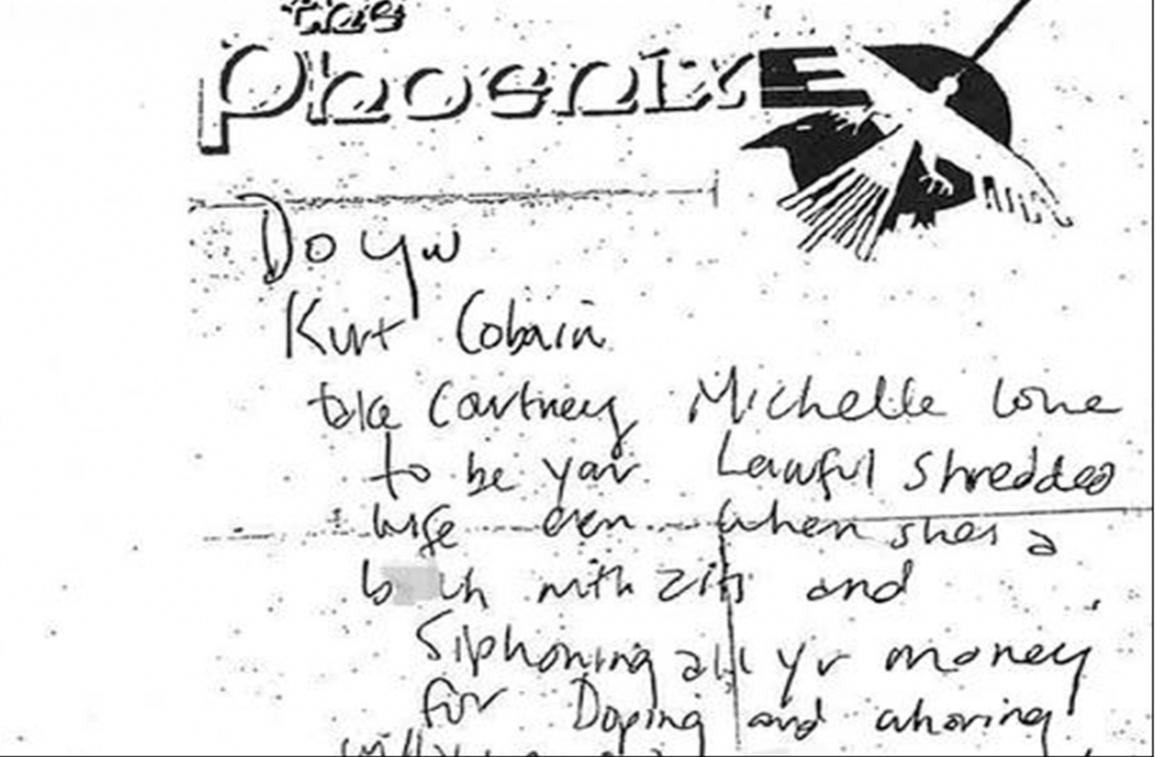
They also released a postcard that was in Cobain’s wallet but unsent in which he scribbles down “Do you Kurt Cobain take Courtney Michelle Love to be your lawful shredded wife even when she’s a bitch with zits and siphoning all (your) money for doping and whoring…” Apparently there’s more not included in the photo released. Funnily enough, the stationery Cobain uses for the postcard above, that was found in his wallet, comes from a San Francisco hotel called the Phoenix – apparently popular with a rock clientele, perhaps partially due to its proximity to a neighbourhood known for drug dealing. As an aside, Cobain doesn’t visit San Francisco in March 1994 – however, Roddy Bottum, keyboardist for Faith No More and a friend of the Cobain couple flew in from San Francisco sometime after March 18 and left before 25 suggesting he might have left the postcard at the house and Cobain had later scooped it up and used it as scrap paper sometime among the smattering of days between Friday March 25 and Tuesday April 5. (Added Note: pointed out in comments, it’s likely the card was written by Courtney herself – sheesh, couples! They have the weirdest sense of humour. :-))

This is the Police Report incidentally:

SPD_policefile_27df

A thank you at this point to Jon for adding a YouTube link in the comments a week ago to Tom Grant’s response to Mike Ciesynski which, neatly, includes detective Ciesynski’s verbal comments on his review.

For once I’m going to give an inch to the murder theory – Cobain isn’t exactly a candidate for world’s tidiest human being as demonstrated by the photos last month of how he and Courtney Love left one apartment they shared and the numerous comments on his apartment in Olympia previous to that. The idea that he put the syringe back in his box and put the caps on is a bit weird…BUT. Suicide isn’t a normal act, it isn’t a normal time and this is a guy who has shown meticulous attention to the staging and positioning of art projects suggesting it isn’t that he’s constitutionally incapable of being tidy, orderly and precisely arranged. Having laid out items next to his body, putting away the syringes was just one more preparation…Or his supposed killer takes the time to it which is pretty unconvincing too. I’m sure the Seattle police are pretty aware that by this stage people will just believe what they believe.

The postcard’s main fascination comes from the way in which it’s such a common behaviour on Cobain’s part; the Journals are riddled with unsent letters, vicious missives to all and sundry explaining their sins and crimes. My perspective was always that it was his way of discharging his more negative views and I’ve always doubted that any of the letters were meant to be sent because I think Cobain knew fine well that what he was writing was usually extremely slanted and didn’t even capture the totality of his own feelings. Instead it was more akin to the sentiment put out in his lyrics about politeness (“if you wouldn’t mind/if you wouldn’t care…”, Come as You Are, All Apologies) that he often felt he couldn’t say things, or just as likely knew he’d be talking sh** if he did. Really I put the postcard in with that, a semi-nonsensical scree aimed at his wife who has just threatened to take his child away and to divorce him. I mean, those couple of lines are pretty silly.

Writings on the Twentieth Anniversary of Cobain’s Demise

I was too busy that week of the anniversary (April 5-8, wherever you want to draw the line) to really dedicate some time to doing something so rather than dashing something off I thought it was better just to say nothing if I had nowt to say well.

It didn’t mean I didn’t find time for quite a significant amount of reading though. Now. I try to make a real point of avoiding sweeping generalisations except in error, but here’s one; the Cobain anniversary really brought out the worst kinda space-filling, low quality pop culture criticism I’ve witnessed circulating around any event this side of a British royal wedding – a vast array of dashed off click-fodder.

If you feel like playing bullshit bingo sometime, go to Google news, tap in Kurt Cobain and scan through a few – you’re looking for the following; James Dean/rebel references, references to the power of Cobain’s voice or ‘voice of generation’ hyperbole, inability to name one song other than Teen Spirit and endless quoting from same song, repeated summarization of the Nirvana life story cribbed from existing biographies, point of article confined to a paragraph or two at most surrounded by repetition of tragic/flawed eulogies cut/paste from a thousand other articles.

Sadly, in amidst it, there were a few interesting thoughts but usually without the knowledge of the topic to advance or develop the idea. Here are a few examples:

http://www.telegraph.co.uk/culture/music/rockandpopfeatures/10751850/Kurt-Cobain-had-nowhere-to-go-musically-when-he-died.html

Of six paragraphs, only the fourth and the fifth aren’t autopilot recitations designed for people who neither know about nor are interested in Nirvana/Cobain. There simply isn’t the depth to answer the question set – it argues Cobain may have struggled to articulate anything fresh as he aged without offering any evidence supporting the proposition. This is a shame because it’s a worthwhile line of inquiry. The fifth paragraph deviates entirely to discuss the changing landscape of music post-Cobain – again, it’s not a bad topic (though spit-roasted to the consistency of leather by this point in time) and could have carried a full article.

Pop Matters made a far better show of asking the question raised in the fifth paragraph of the Telegraph articleeven if, again, the depth into which the average music journalist can go is simply to make surface-skimming points about modern guitar music compared to Nirvana:

http://www.popmatters.com/post/180441-the-legacy-of-kurt-cobain/

http://www.bbc.co.uk/news/entertainment-arts-26776170

This is how to do it (God bless the BBC!) A very brief article but an original story about a specific point in time and Youri Lenquette is a top notch individual. Similarly, here’s NME doing a quick burst about plans to record. The issue would be that these are news bulletins rather than criticism or proper thought-pieces but, again, I’m ok with the idea that one says as little as possible if one has nothing fresh to say.

http://www.nme.com/news/nirvana/76574

Again, in the Oregon Live piece below, the idea of discussing the topic of how Cobain changed anything at all is a topic worth exploring…Thing is, Charles Cross has already done it for this anniversary (I scanned the rather light, rather small, hardback of his new book in a store today and somehow couldn’t stomach the £14.99 asking price – I’ll wait for the paperback) so what’s left are nine barely related factoids with no central thesis and no link to the title. It’s mainly an ad for the Cross book. A tragic waste of a good angle that could have worked well in this media format.

http://www.oregonlive.com/books/index.ssf/2014/04/kurt_cobain_9_ways_his_life_an.html

CNN disgrace themselves by pegging a space-filling slideshow under the title “Kurt Cobain: His Death and the 1990s” – I mean, I almost like the 90s-palooza thing but even that could have been more stylish; Nostalgiapalooza perhaps? I mean, what’s next? “The Manson Murders: Fun and Frolicsome Memories of the 1960s”? Tagging this photobook of amusing “d’ya remember when…?” pieces to a death feels pretty wrong even beyond the depthless ‘commemoration’ aspect.

http://edition.cnn.com/2014/04/04/showbiz/kurt-cobain-death-anniversary/

At least one of the local Seattle papers did a better job by making a few light comparisons between Seattle c1990s versus modern Seattle – there’s surely a lot more to be added on this one but let’s not quibble given its a concise and distracting enough job well done on an original angle. I mean, heck, it’s a different city now entirely:

http://www.seattlepi.com/entertainment/music/article/Kurt-Cobain-and-Seattle-in-the-90s-Then-and-now-5375275.php

MTV do some truly uninteresting merging of personal bio and Cobain text that could be sold in a box as a word game – construct your own posthumous Cobain article:

http://www.mtv.com/news/articles/1725695/kurt-cobain-man-who-changed-world.jhtml

And the other week I mentioned not being particularly impressed by Everett True’s “I knew him, you didn’t” (I summarise tragically fairly accurately) piece in the Guardian – the guy has done so much better before. I enjoyed the reprint of Jonathan Freedland’s original 1994 report for the intriguing reportage on Seattle at that moment in time, local reaction and questions regarding the depth or otherwise of Cobain’s representation of a generation.

http://www.theguardian.com/music/from-the-archive-blog/2014/apr/05/kurt-cobain-an-icon-of-alienation

What’s lacking is commentary that has an argumentative depth, an original angle, a willingness to assume sufficient knowledge on the part of the audience that the rehashing can be abandoned, a degree of depth on the part of the critic allowing them to roam more widely through the Cobain tale and greater effort having been put into finding primary sources to speak on specific questions or debating points – I’m presuming the North West was flooded with dashed off journalistic inquiries along generic lines no more evolved or intelligent than “so…tell me…What was he LIKE?” or “what’s your biggest memory of him?”

Essentially pop culture media seems to have been stripped down to nothing more than the simple relaying of soundbite and imagery courtesy of PR agencies on behalf of their clients with any attempt at depth confined to full-scale books – there have been some impressive ones in recent years. I may not enjoy hagiography and applications for Cobain’s sainthood but he genuinely is one of those few standout figures in the musical world that would seem to demand that a commentator know a bit more about than is on evidence in the above pieces – it’s like someone writing a piece on Shakespeare based on reading the back cover of a biography plus a sonnet or two.

Just for balance though, here’s an article I genuinely did appreciate (in part) for its willingness to marry the subject of Cobain to a wider question, to a new angle, to evidence I hadn’t heard or considered before:

http://www.ft.com/cms/s/2/32fd8cf0-b42c-11e3-a102-00144feabdc0.html#slide0

I saw it in the FT in which it was a four column full-page piece and for sure, it does suffer from some of the sins of pieces described earlier. The first column strings together a set of non-sequiturs and clichés taking in the recent statue in Aberdeen, quick references to Cobain’s art, two brief quotations from his lyrics (simultaneously marking the beginning/end of Kurt Cobain’s existence to a majority of people – Smells Like Teen Spirit he begins, You Know You’re Right he ends) then finally states that the article has a point. The first two paragraphs, really, are a document describing how the writer failed to find any information out from a primary source so had to rely on quoting another media site to fill some space; the third column in the newspaper returned once more to a retelling of the Nirvana tale at least pepped up with some quotes from Bruce Pavitt related to the article’s main topic.

The redemptive components of the article are the second column – everything from the mention of Scott Sandage to the next … break – plus the final three paragraphs (column four.) The dissertation regarding the evolving model of what failure has meant over time is a welcome one – giving a historical context to the entire ‘loser/slacker’ topic is a really rich theme to run with and certainly sparks thought about where Cobain/grunge belong in the overall narrative of American social/political/economic history.

In fact, it’s a good angle despite the fact I disagree with the author’s point fundamentally. He simply asserts that ‘Generation X’ was the slacker generation and that it was self-evident that a wave of young people were embracing a form of nihilism at the time – untrue. The generation coming of age alongside and around Cobain was just as likely to be employed, more likely to be entrepreneurially active, more likely to have pursued getting an education as a potential advantage in the jobs market (I hate to rely on a Wikipedia article but what the hey, it’s a decent summary and raises the wider point about the different forms of ‘Generation X’ worldwide – http://en.wikipedia.org/wiki/Generation_X), has a higher level of involvement in social causes…Need I go on? The flipside was that it was the generation that had to deal with a new economic/political complex that no longer believed the point of the government was to aim for 100% employment for citizens; in other words, no matter what anyone/everyone did, there would always be more jobs than people and no way for some people to find a job. The tales of over-qualified individuals taking service industry positions wasn’t the tale of a lack of ambition it was the tale of an economic realignment toward a service-orientated economy with more part-time jobs, more unskilled jobs, fewer opportunities overall.

The author has conjoined two separate arguments here; one is about the overall nature of the post-baby boom generation, the other is about the professional respect to be offered to artists and musicians. He essentially – and oddly for a ‘pop critic’ – is claiming those who pursue income via the creative arts are the same thing as slackers. This is a really tangled arena; are only those musicians who aim to be multi-millionaires from the outset worthy of being deemed professionals and accorded the respect that any entrepreneur should receive? Are musicians who are content developing steady but predominantly local audiences unambitious or just establishing a secure and realistic measure of success as opposed to the fantasists who see visions of cheering throngs in their heads even while touring the toilet circuit? Is it only Cobain’s ability to sell millions that makes his art worthy of note despite the fact all the songs on Nevermind originated long prior to his band being anything more than another underground band with reasonable respect? The question of why precisely the author deems Cobain to be a failure, or whether he’s reserving that epithet for the bands around Cobain who didn’t miraculously go through the roof, is the piece he doesn’t answer – again, like the assumption that Generation X were the slacker generation, he assumes it’s self-evident that Cobain was a loser simply because that’s the casual association made regardless of whether it has substance behind it.

I’m not specifically answering that question here (might have a go another time though!) but what I’m saying is that article raises an intriguing intellectual argument that made me think a lot more than most of the pieces published these past weeks – it just doesn’t particular answer or pursue its own subject matter to a finale.

Similarly, there’s a disjointedness within the article’s wider point given Generation X itself has been the biggest purveyor of the ugly blend of new age self-help philosophies coupled with hard-nosed Social Darwinian economics that is manifested via latter-day mainstream hip hop and via the economic politics of a majority of voters. The broad brush tarring doesn’t explain that ‘Generation X’ wasn’t a single phenomenon and therefore was, on the one hand, the ‘me generation’ of the Eighties (recently toasted and semi-celebrated in The Wolf of Wall Street) and the ‘stocks only go up’ cash-in crowd of the Dot-com bust and the same crew recently found corruptly manipulating financial markets, selling financial products that created systemic risks and cashing out million pound bonuses, as well as, on the other hand, being the generation that has pushed for ever more ethical decisions by corporates, is more involved in green causes, anti-corruption campaigns, anti-war movements, local grassroots social activities and so forth than ever. The mythical drop-outs the article is taking aim at don’t have too much in common with Kurt Cobain, nor with the majority of their own generation.

The final three paragraphs are a separate article really pointing out that Jay Z’s appropriation of a Nirvana sample for a recent song was simply a way of contrasting the failure of others to rise within a certain paradigm with his own claim to self-made success. That’s a really neat and sour point and at least a strong conclusion. Unfortunately, having failed to identify why exactly Cobain should be deemed a loser or a slacker, these final paragraphs barely connect to the main thesis.

There was potentially a far more coherent angle for the article. The second column explained that success/failure were concepts that changed over time according to specific circumstances, needs, opinions and therefore are not intrinsic physical realities that can be scientifically defined – that the current definition is NOT the absolute, eternal way it was or should be. The article could have either taken aim at the lazy reporting of Generation X clichés (that really had more to do with typical “older generation dismissing younger generation” thinking) as fact – or debated why Cobain is held up as an icon of failure when by many measures he’s one of society’s one percent of high-achievers. At least, however, it was an article with a bit more substance to it. If there was anything to be taken from a couple of weeks of magazines, newspapers and online media sources deciding to fill a few quick pages with Cobain-talk it’s that an ‘icon of depression’ twenty years dead managed to achieve more, inspire more, pump more thought and effort into his works and make a far less shoddy job of what he did than a vast number of media commentators (who I’m presuming all self-define as relative successes) manage here in the enlightened future.

Nirvana, Gender, Rock and Roll Hall of Fame Musing

http://www.rollingstone.com/music/news/the-inside-story-of-nirvanas-one-night-only-reunion-20140416

Never say never I guess…Given the three musicians involved have reached whatever state of peace required to allow them to approach the work they formulated with their friend Kurt Cobain, there seems no obstacle to more activity going forward. For a long time, this is just my feeling, I think there was a pretty reasonable taboo at the idea of original members of Nirvana playing Nirvana songs simply because the originator of the vast majority of the music had shut the door so firmly on his way out. It’s hard to explain to a fan in their teens that time really does make these things fade but here we are twenty years later and I’ve not noted anyone reacting negatively to the presence of Dave, Krist and Pat on a stage together playing as some unnamed form of Nirvana. Partially this is because of the gentle way in which they edged toward it over the years – everyone was used to Pat and Dave in Foo Fighters, then the occasional appearances by Krist made the idea of them altogether seem less of a jump, eventually a Nirvana song dropped in casually here and there showed it wasn’t such a heavy thing anymore if a song built by Kurt appeared under different guise but with the stamp of authority provided by at least some of its originators. There were some murmurings about the decision to play with Paul McCartney but in general the choice of songs, the way the individuals spoke about the performances, the fact they were playing a new song intended for a specific one-off project – it all put things in that interesting space where it both was and wasn’t a Nirvana reunion, it was implicit but not made explicit which made it easier to focus on whether the new song was any good, whether the concerts looked like fun, rather than having an overt argument over the idea of a Kurt-less Nirvana. The Rock and Roll Hamm of Fame show and the aftermath performance were the lengthiest ‘Nirvana’ set these guys had played in twenty years, the timing was pretty well perfect, there was an occasion that provided some justification for doing it and they made such a point of making it ‘different’ from a Nirvana performance that its simply been accepted as an impressive thing. It’s like slowly squeezing out a spot (sorry for the metaphor!); rather than excessive pressure then POP! and a big mess, they’ve eased it and worked at it over years with no great drive or aggressive attempt to force a result and the result has been a smoother, less painful, less dramatic experience – sheesh, we just saw a band that died twenty years ago do something that back at the time we thought would never happen! And I barely looked until now!

http://kristnovoselic.blogspot.co.uk/2014/04/punk-rock-gender-parity.html

Nirvana’s commitment to gender politics was always present back at their peak – over and again its possible to add up the ways in which they brought the issue to the fore either explicitly by supporting pro-female events (Rock Against Rape, Rock for Choice, Home Alive), by drawing female-fronted bands on stage (Calamity Jane, L7, Shonen Knife…) or by simply stating their views when given the opportunity in interview – or implictly, for example in Cobain’s original feeling that there should be a Girl and a Boy side to Nevermind, the dress wearing on the In Bloom video, the female imagery deluging In Utero, various lyrics, video imagery and components… The conversion of Nirvana’s hits into female vocal performances was a superb choice in terms of providing a true surprise within the performance the other week, turned a historical occasion (apologies for the hyperbole) into a quick summation of some of the strong female figures of past and future (note Joan Jett’s strong links to the Seattle scene – she fronted a post-Mia Zapata version of the Gits in order to help raise money for the Home Alive organisation), plus it showed a continued desire to foreground the subject of women in music. That Krist has used that as a springboard for a wider commentary on the roles open to women in society and their treatment is a step that 1992-1993 Nirvana couldn’t have made because they’d simply have been pointing people to the works of others while, now, in 2014, Krist was able to point to work done by an organisation in which he is personally involved and committed. I guess sometime I should write a piece purely talking about the subject of ‘personal connection’ as a guiding principle in Nirvana’s music and activities.

Here’s the actual report produced by Fair Vote – a worthy piece of work. In general gender issues are a pretty fascinating area, I sometimes get this sense that there was a deliberate effort to demonise the phrase ‘feminist’, to eliminate the positivity within the phrase and to endlessly link it to conflict and aggressive tactics and attitudes rather than to the rational and well-argued points being made. The repetitive focus on more controversial (thus entertaining) individuals, to ignore the matter under discussion in favour of coverage of shock tactics or harsher soundbites – there’s been a thirty year effort to drive the issue of female participation in society into specific boxes and to legislate so that organisations can claim compliance with the letter of the law rather than having to truly consider the right/wrong of a female individual for a role.

The music industry certaintly has done a phenomenal job of reverting to type; the Nirvana era came complete with quite a number of female acts and personalities but ended up focusing on the rather ideological side (Riot Grrl) or the stripper-ish side (Hole) – women were pushed back into the channel of being able to coo softly over gentle songs, the idea of ‘women who rock’ still remained in a ghetto rather than mingling on the same streets as the mainstream. The replacement of hair metal with hip hop as the dominant American music – and that music’s subsequent merger with most other music forms in the charts – brought the music industry back to a position where the dominant gender philosophy is that of an unsophisticated nineteen year old. A friend of mine went to a DMX concert a decade ago and was thrilled to be picked out of the audience to come ‘meet’ the artist. She was queued with the girls then each one was led to a room individually. She dissolved into tears when told she was expected to give oral sex to a bouncer and that the same was expected of her when backstage – “what did you think you were back here for?” she was asked as if she was the one who had the problem or who had the weak grip on reality.

There could be a fair study done of the remarkable way in which pro-female soundbites stretching back to the Spice Girls’ “Girl Power” phrase have been slaved to a visual and lyrical language in which a woman’s power is deemed to lie in her ability to titilate, entice or please men. In some ways that is equality – speaking in the same language as the male stars who rate their value in terms of their attractiveness to and ability to dominate women. I guess what’s sad is that people expected ‘equality’ to mean something more than sexual boasts – that it could mean being better than the low expectations of male behaviour. The bit that’s disturbing, however, is not the expression of the artists but the industry built up entirely to select, mould and propagate those female images – there are entire organisations whose sole purpose is to locate marketable female flesh, ensure that body shapes only sustainable via surgery are prioritised, that choreographed dry-humping is substituted for dancing, that lingerie substitutes for clothing and that appropriate press releases are issued all wrapped in the language of female empowerment. That’s what’s worrisome, it isn’t about a female artist saying one thing or another, wearing one thing or another, it’s about the way in which they’re converted to manufactured product with the ‘wrapping paper’ plastered with the kinds of imagery and ideas that the average pimp could get behind and that wouldn’t look out of place in the lyrical philosophy of an Eighties hair metal band. Ah well, I digress.

http://www.representation2020.com/our-report.html

Oh, so, anyways, i’ve not been around these past weeks – a family medical emergency means I’ve been at the parental home in Spain. It did make me chuckle that Nirvana seemed to follow me there anyways. I didn’t get to go to the Charles Peterson exhibition but my bus back through Malaga yesterday did take me past this familiar image…How nice…

IMG_0528

Secret ‘Nirvana’ Show a Couple Nights Back Plus More Nirvana Writing

http://freewilliamsburg.com/video-nirvana-played-a-surprise-show-in-greenpoint-last-night/

Courtesy of my comrade Isabel Atherton.

Similarly, a fellow named Bob Wilson was in touch having poured quite a bit of time and energy into this piece below which I’m delighted to share:

Tragic Suicide Or Something More Sinister: Examining The Death Of Nirvana’s Kurt Cobain

Regurgitation – Photos of Cobain’s 1992 LA Apartment

http://news.radio.com/2014/03/25/kurt-cobain-courtney-love-gross-apartment-photos/

Sorry I’m just passing along stuff at the moment rather than actually writing stuff and adding stuff on here – I can promise you it’s because there’s substantial amounts of Nirvana-related homework happening at the moment that I’ll tell y’all about as soon as I can! Sorry, sorry!

Anyways, photos, the charming devastation left after these fine-upstanding-citizens left one of the apartments they rented in LA. The interest for me comes from this being Cobain’s transition between living in the art-orientated cheap-as-chips accomodation he’d haunted for years and was used to simply smothering in artwork and layering to knee-height in debris – to LA apartments and then further homes for which he would be paying a far more significant amount, presumably (in the case of the rental properties) with some requirement to keep them in good order. Not being used to what is essentially a middle-class property he simply treats it like it was just another cheap place he could do whatever he wanted with – this time because he could bloody well afford to.