Battle of the Birds: Kurt Cobain’s Girlfriends

An immediate apology for flippantly using the term ‘birds’ just to come up with a slightly more catchy title to what is a relatively flippant bit of data-play. As a proviso it’s safe to say that this post isn’t entirely serious — it’s merely a tumescent growth that arose from the work done this week on Kurt Cobain and the subject of his living arrangements. There’s a risk in the title, of course, of suggesting that one or another individual could be held ‘responsible’ for whatever peak or fall occurred in Kurt’s creativity — as I’ve made clear before (see the “www.nirvana-legacy.com/2012/11/20/if-she-floats-in-defense-of-courtney-love” post) I genuinely don’t believe anyone other Kurt Cobain was responsible for these trends.

Having looked at the matter of where Kurt was when he wrote the majority of his songs, I wanted to examine who was his key, official, partner during these periods of time. As a second disclaimer, I’m doing this because I’m feeling playful; as an exercise it’s a perfect example of how any data can be compared to any other data whatsoever without leading to enlightenment or meaning — why do it then? Sheer curiosity. Not everything has to lead somewhere or mean something to be worth taking a crack at.

Discounting Mary Lou Lord who apparently backed up Kurt’s statements that they had never been romantically involved, Kurt Cobain was attached to three individuals between early 1987 and his death; Tracy Marander, Tobi Vail and Courtney Love. In each case, the relationships have been reduced in the retelling — to dependence, one-way head-over-heels, to mutually destructive passion — which probably has nullified any sense of the enjoyment and pleasure taken from all three. That’s not uncommon, question most people about their ex-partners or judge the relationship in the rear-view mirror and they end up being judged by the outcome not the time-specific experience, which is a shame.

Tracy was Kurt’s first real girlfriend and lasted from around January 1987 until May 1990 — 41 months. Tobi was the whirlwind in the middle making it less than six months from May to November 1990. Courtney arrived as a permanent fixture in October 1991 — 30 months:
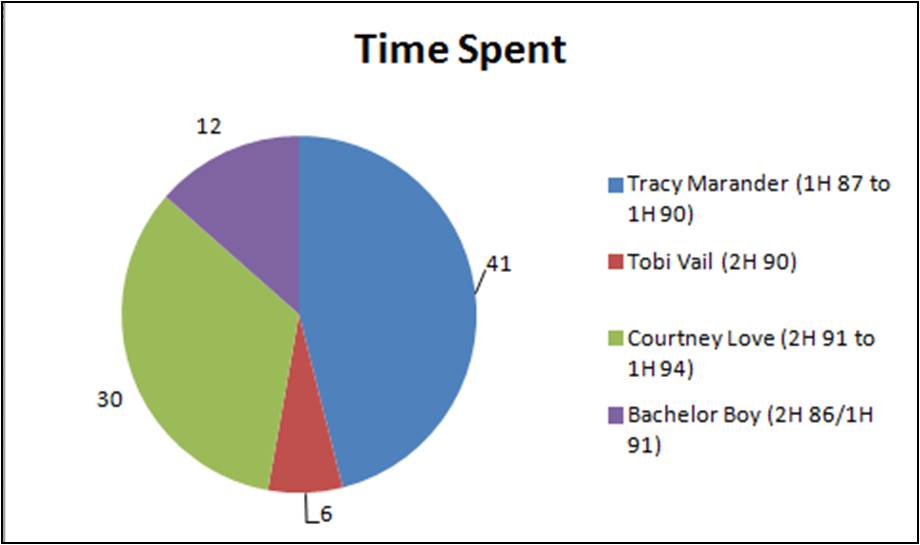
KC_Girlfriends_Time Spent

Now…What did Kurt Cobain do during those periods of time?
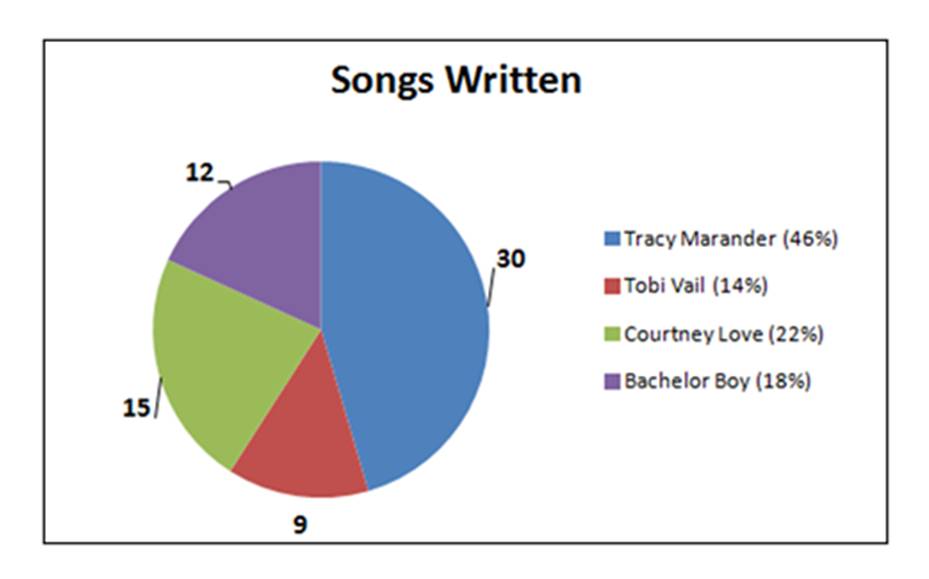
KC_Girlfriends_Songs Written

A solid victory for the time spent in Olympia with Tracy Marander but, as usual, fun to look at the percentages also:

KC_Girlfriends_Songs Per Month

Told you it was fun to look. Suddenly it seems that the periods of domestic stability didn’t come close to the rough n’ tumble of Tobi and her loss. So, if I felt like being cynical I’d say “guys, if you want to make things happen in life — ditch the comfy woman!” But I’m only teasing. The coincidence of Kurt Cobain’s freedom, solitude, non-drug addiction, favourite drummer, major label shot and so forth all made late 1990-early 1991 a massive time for Kurt Cobain. What we’re looking at is a flaw in the data; it’s unclear how many of the songs I’ve placed in the second half of 1990 were in fact created prior to Kurt being dumped by Tobi, just as it’s unclear how many of the songs written in the first half of 1991 were finalised before Courtney’s arrival.

Sighhhhh…All this work just to conclude that not everything gives a meaningful correlation and that statistics are indeed the playthings of the data devil. Oh, because my friend asked (thank you Josephine! This one’s for you!), here’s the full record of Kurt Cobain’s known dalliances with the female of the species, as noted in the book Heavier Than Heaven, just for her. And yes, it feels voyeuristic and intrusive listing all this but for the sake of completism:
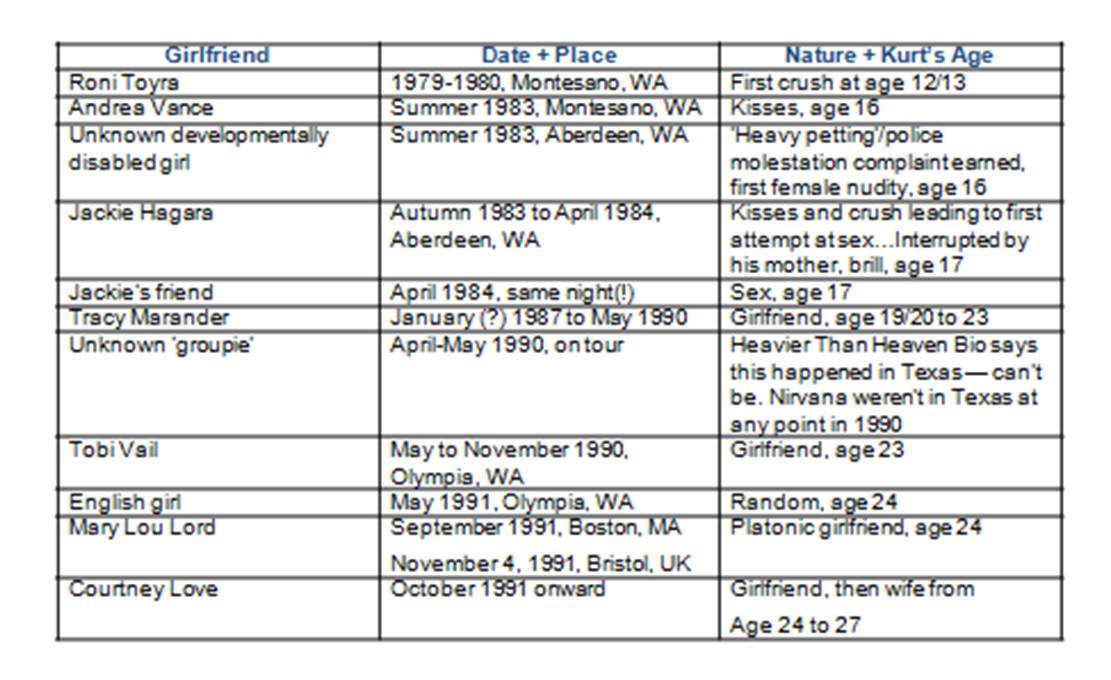
KC_All Girlfriends and Female Encounters_Table

Addendum: Cheers to Selena for raising this. The summer 1983 incident is controversial. Buzz Osborne has suggested its completely untrue – meanwhile it’s been cited twice including a full audio recording of Cobain seen in Montage Of Heck. Unfortunately, despite the ‘story telling format’ of the audio recording, despite Buzz’s reservations regarding whether public shaming in school happened at all, it’s impossible to say to what extent it was just a bizarre fantasy by Cobain – or, alternately, based on some personal experience. There’s no evidence determining that Buzz’s word should be credited over and above Cobain’s voice. Either way it’s one heck of story and pretty disturbing if it’s an invented tale of sexual discomfort, manipulation, inability to perform, shame, etc.

Anyways, context: this was a throwaway post written in December 2013. It’s neither scientific nor particularly interesting. The core of this blog is about the music of Nirvana and that’s where the heart is.

Four Walls and What Was Made

Kurt Cobain's Homes_1967-1994

A pause to give credit where it’s due, http://www.shapedbox.blogspot.co.uk featured an excellent range of photos of the houses and I have used a number of them for the collage above. Credit for the Pear Street photo must go to Diamond Brooke and her Flickr feed – again, worth a look for Nirvana fans.

Over the past two days we’ve been dividing Kurt Cobain’s life down into time spent in specific ‘homes’. Naturally I accept that a lot of what I do on this site is simply aggregate existing data but I’m often stunned by the picture that results simply by loading data into a single view.

My reasons for compiling the data, initially, was that I wanted to attempt (as best as possible) to correlate Kurt Cobain’s song-writing to where he was while writing. In the kind of coincidence to gladden the heart of any data chimp (a friend once bought me a t-shirt reading “I love data” repeated over and over — thanks Shane!) the picture that emerges is remarkably clear.

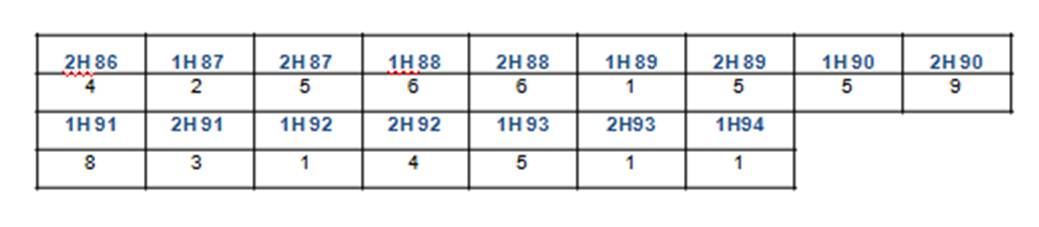
To the best of my ability, in the Over the Edge chapter of Dark Slivers: Seeing Nirvana in the Shards of Incesticide, I’ve tried to pin down, to periods of six months, roughly when Kurt Cobain wrote various songs. The approximate result is as follows:

Songs by Half Year

I’ve not included the Fecal Matter songs (e.g., Spank Thru or Downer), nor have I included Kurt Cobain’s solo experiments (i.e., Montage of Heck) simply because it’s hard to pin down when they were made with any degree of guesswork. The only changes I’ve made since the book are to include Opinion in 1H 1990 and shift Tourette’s to 2H 1989. When compared to Kurt Cobain’s living arrangements, however the results are emphatic:

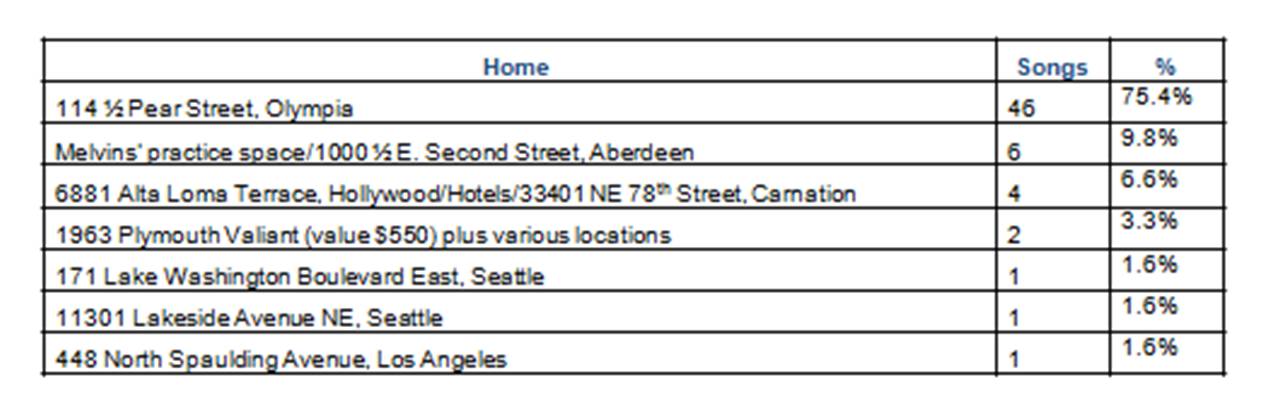
Songs by Home_Figure

While money may still have been hard to come by during the years Kurt Cobain spent in Olympia, it truly was his artistic home. Given how long he spent in that location it’s no surprise that he wrote more songs there but the sheer quantity is overwhelming:

Songs by Home_%

Dividing the figures by time spent in the location doesn’t alter that picture of dominance:

Songs by Home_Per Month

While making clear that Kurt Cobain’s peak occurred in Olympia, there is some fudging involved that I can only acknowledge but do not have sufficient information to fix. If I could untangle Kurt Cobain’s living arrangements from January 1992 until January 1994, it wouldn’t erase the overall picture but it would make clearer whether, for example, the Carnation house permitted a real focus on writing or whether most of the work was done while running around hotels and temporary accommodation with Courtney. Similarly, the two songs written in the second half of 1992, I’ve noted as Curmudgeon and Talk to Me (based on live data) but Curmudgeon at least might more properly belong earlier in 1991, I can’t prove it. The dominance of the Olympia spell may be even more pronounced given Kurt moved there in April 1987 so my estimates, based on six month periods, don’t correspond perfectly — 114 ½ Pear Street may filch a song or two from the previous eight months spent in the Melvins’ practice space and at 1000 ½ E. Second Street.

The first spell of relative stability Kurt Cobain had enjoyed since he was a child seemed to allow him the space and time to write and create. Tracy’s willingness to support him also meant he didn’t have to divide his time quite so much between work and music — though she, very reasonably, came to resent him sponging off her it did have a beneficial effect on his core pursuit. Similarly it can’t be underestimated that Krist Novoselic provided Kurt a steady and dependable musical collaborator reducing the impact of changing drummers so often and ensuring ideas could be turned into full work relatively swiftly. Kurt was surrounded by beneficial circumstances thanks in large part to the individuals he could now rely on.

My ultimate thought on the ‘meaning’ of all this information is that the place of greatest veneration for any Nirvana fan shouldn’t be the house at 171 Lake Washington Boulevard East. The place where the majority of Nirvana’s music was created, where Kurt Cobain truly lived as a creative soul, was at the unassuming and unglamorous property at 114 ½ Pear Street, Olympia between April 1987 and July 1991. To my mind, celebrating the place that gave the safe cocoon needed to build something is of far more importance and significance than the barely lived in site where he chose to tear everything down.

Life Long Latchkey Kid: Kurt Cobain’s Homes Part 2

Yesterday we examined the record of Kurt Cobain’s childhood wanderings, how he was shunted from home to home throughout his teens. Finally relative stability arrived in the form of his first long-term relationship with Tracy Marander and a resulting departure from Aberdeen. That single residence on Pear Street in Olympia ended up being his home for just over four years, the longest he’d been in one place since he was nine years old though the couple did change flats within that building and Tracy did move out to be replaced as flatmate by Dave Grohl.

Returning home in the aftermath of the recording of Nevermind, the move to a major label, standing on the cusp of his true fame Kurt managed to get himself thrown out for not paying the rent. That was the end of the stable spell of life. It’s genuinely fascinating realising that the rock star who ruled planet Earth for that spell in the early nineties didn’t have a home from July 1991 until January 1992; imagine it, the biggest rock star on the planet as living in his car.

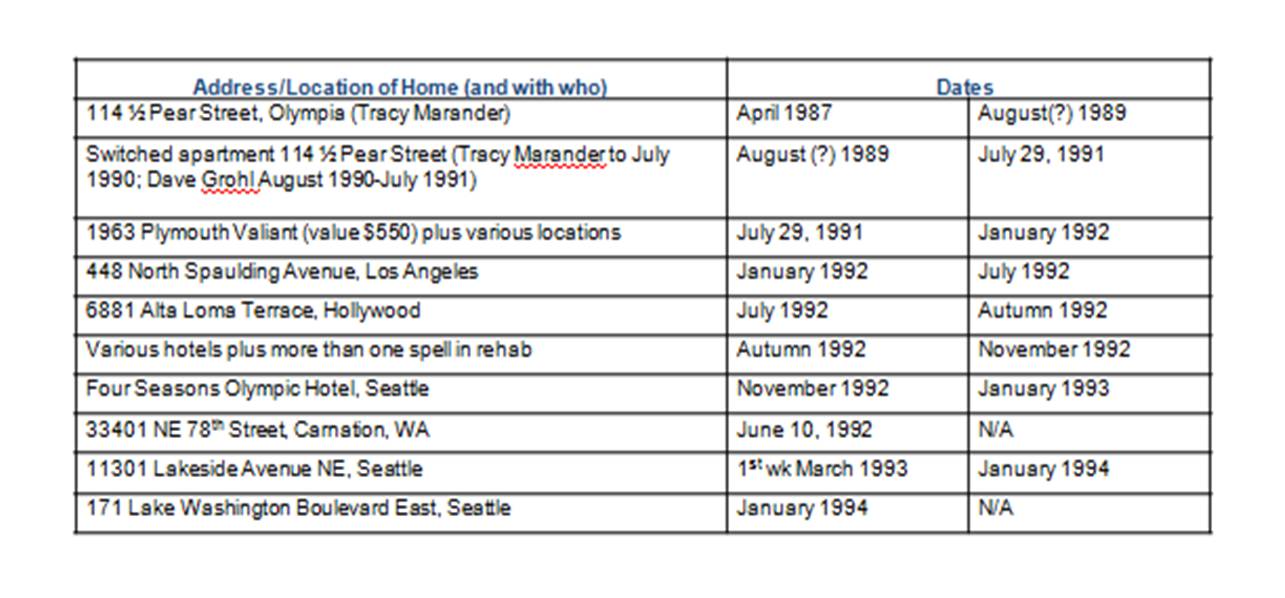
Even after that, there was still nothing close to a home. Kurt Cobain — now with wife in tow — bounced between rented apartments, tour hotels and hotels in LA and Seattle right through until spring of 1993. Even with all the money now floating around him, it doesn’t cease being the case that he was essentially homeless. At least this time there were comprehensible reasons, the Cobains were trying to purchase a home but there was little time in between tours, festivals, recording, battles with the authorities over custody of their child and major drug problems. In the chart below I haven’t calculated the spells spent in a number of rehab facilities:

KC_Homes_1987-1994

It’s curious, having arbitrarily made the start of Nirvana and of Kurt’s relationship with Tracy the dividing line between his youth and adulthood, that the pattern is much the same as his childhood with the stable period being superseded by yet another spell, this time of three years from age twenty four until his death, during which he lived in six definite locations and a slew of temporary accommodation.

One link (www.city-data.com/king-county/N/NE-78th-Street-1.html) has conveniently placed the sales record and other details of the Carnation home online:

Carnation

It’s an intriguing property because, despite the understandable attention paid to the site of Kurt Cobain’s death, it was the Carnation property that was the first home he owned and that was retained throughout the maelstrom of mid-1992 through 1993. It’s also mysterious because it’s impossible to tell how much time Kurt Cobain actually spent living at the house or why it seemed to be less than wholly beloved. For whatever reason retreating to a country village, one with a population of just 1,243 in the 1990 census, where Wikipedia lists the local activities available as “Harvold Berry Farm where you can pick your own berries in the summer”, doesn’t seem to have worked regardless of whether the idea was to evade drugs or intrusion in general. There is a rumour Kurt returned to the home sometime in early April having fled rehab.

Working out the estimated dates of accommodation also throw Cobain’s relationship with his place of death into the spotlight. The Cobains moved into the Lake Washington house in January 1994. Nirvana toured until January 8. Kurt joined the band for their final studio session on Jan 30 then they left on tour two days later. He was in Europe until March 12 when he was definitely home given the Police were called to a domestic incident that night and again on March 18. He headed into rehab on March 30 returned home around April 3. At most Kurt Cobain lived in that house for three weeks in January, then just over two weeks in March.

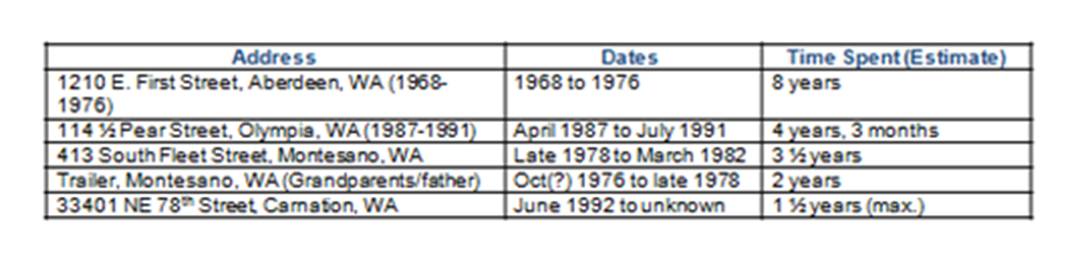
Observing his entire life, ranking locations, what emerges is as follows:

KC_Top Living Locations_1967-1994

Of the 25 ‘phases’ identified, only five added up to more than a single year. Worse, of the years spent in solid locations, 13 ½ of those years took place from the age of less than one to only just fifteen years old. The remaining half of Kurt Cobain’s life, his entire rise to young adulthood, involved only the briefest of respites in which he had something that could be called a home.

Life Long Latchkey Kid: Kurt Cobain’s Homes Part 1

Reading the various biographies of Kurt Cobain and Nirvana, the point is frequently made that Kurt had lived what could gently be described as an unsettled and nomadic existence pretty well from the time of his parents’ divorce in 1976. Ladled out on top of that is a patina of genuine poverty throughout his later teenhood leading to periods of homelessness stretched right through until he hit twenty in 1987. Relative stability arises from that point yet still there are tales of being slung out of rented homes even as late as the middle of 1991 when he was now 24. Linking together the references makes his later life seem a more moneyed return to drifting with hotels filling gaps even when he wasn’t on tour or fulfilling band duties. Purchasing a home for the first time in 1993 simply doesn’t stop that sense of a man floating free of physical locale — the final year of his life saw him buying one home, renting another, buying another, while simultaneously spending regular nights in motels and drug hangouts.

Sourcing the data, I ended up simply staring at it — adding up the regular moves brought home precisely how devoid of refuge the life of Kurt Cobain had been:

KC_Homes_1967-1987

This is the life of Kurt Cobain to age twenty. It was hardly a comfortable life in the early days given the combination of tight financial circumstances, mounting parental discord leading to the parents splitting in March 1976 before a final legal pronouncement of divorce in July, then the spell sharing a trailer with his father and grandparents, followed by the spell with his father and eventually his father’s new partner and her children. But it was from March 1982, once he had turned fifteen, in the aftermath of ever-increasing battles with his father, that Kurt’s living arrangements implode.

From the age of fifteen until the age of twenty he barely stayed a year at any address. There are nine definite homes in which he lived during that phase and one period where, at best, it could be said he was a ‘guest’ of various relatives and relations. During this crucial phase of life it’s easy to understand why the conclusion of formal schooling became challenging, likewise why, existing disaffection would be expanded into an all-encompassing sense that he was unloved and unwanted.

Further reinforcing the sad picture, in each of 1984, 1985 and 1986 he endured spells of homelessness. To be fair, none could have lasted longer than a couple months but still, for certain periods of his late teens Kurt Cobain barely knew from day-to-day where he was sleeping. He was even forced back in with his father despite the extreme tension between them — his dad found him living on a couch in a back-alley. Again, it makes it easier to understand why locating regular employment proved challenging given his disrupted living arrangements.

By 1987 he had lived through seventeen different locations or phases in his young life. The longest he had a home for was the eight years that corresponded with his infancy and the only time when he was part of a true family — the coincidence of family love and physical security reinforces why he would remember it as an idyll lost forever.

Sunday Night…Buying Dark Slivers: Seeing Nirvana in the Shards of Incesticide

Well, perhaps go to the ‘About’ section first and check out the sample chapter. I moved it to there so those who weren’t sure whether my writing was worth taking a £10 chance on had a chance to see my way of thinking and exploring things…If you find it an entertaining read, maybe check more of the short pieces on the blog (there are over 100 articles now so plenty to choose from) and think “would a NEW BOOK ABOUT NIRVANA amuse and interest me…?”

There are two ways to get the book – first, go to Amazon, buy the ebook if you’re a Kindle fan.
If you like your reading experience ‘old school’ then simply email me at NirvanaDarkSlivers@gmail.com or nicksoulsby@hotmail.com. I’ve sold almost all of the first edition of 100 now and, so far (touch wood!), every copy has arrived safely with its new owner (phew!)

I’m going to use these anonymously (there’s a review on Amazon from one guy too – which was nice of him) but here are some of the other comments received so far – thank you to the individuals who took the time to write me their thoughts, I hope they’re not offended I used these – and YES, you all made me blush:

“I love the insightful approach and I definitely feel as though I am learning new content regarding my favorite band. The charts and such add to overall experience. I am very pleased and am absolutely blown away that you have tackled this often forgotten album. I have found myself listening to Incesticide quite frequently lately.”

“The book is a real gem, no doubt about it; I thoroughly enjoied it and managed to read it in week despite doing PhD work at the same time.
1. You’ve got this really interesting, almost statistical, approach when analysing the genesis of each song. This allows you to trace the ‘ontogenetic development’ of individual songs, compare them with each other and derive all sorts of interesting information on that basis (manner of song writing, etc.).
2. Portraying Kurt Cobain as more of an all-round artist, instead of purely as a musician.
3. Your take on what music meant for Kurt — being a person who’s compelled to create and at the same time someone who’s using music as a way to escape from…personal problems…probably reality in general.”

“i don’t really want to waste time talking about that cynical piece of crap internal memo for the in utero anniversary reissue, but i have to admit i thought of you when i read the line “If you must mention
Incesticide, be sure to call it a “stopgap” release”. it’s such a shame that this really is how incesticide is viewed but i guess that’s the whole point of why you decided to write your book. which i have almost finished by the way and enjoying very much!”

“Nirvana is verrrrrrrrrrrrrrrrrrrrrrrrry important to me. So whenever i have the opportunity to engage with like-minded and knowledgeable individuals, i try to do so. it’s a topic very personal and dear to my heart. So, i am just as grateful that someone such as yourself literally appeared out of the woodwork and had the motivation/desire to write an original work and keep the spirit alive so to speak!”

The Unknowing

One of the final chapters of Charles Cross’ Heavier Than Heaven consisted of a long, well-evidenced, but ultimately fictitious recreation of Kurt Cobain’s final day on Earth. Unless one wishes to deny all objective reality and to declare all recorded history a fiction, then sometimes all one can do is use evidence to suggest likely possibilities. I’m certainly not a believer that only those who were present can comment or reveal or I wouldn’t be writing this material.

The world is simply too complex, the result of too many interactions of human and non-human, to succumb to human classification, description and control. The result is ‘the unknowing’, those patches of any story or subject where there’s no way to fill the space. The death of Kurt Cobain is a fine example. As noted in the If She Floats blog post the other month, I’m certainly no believer in the conspiracy theories around his death, but, as an event with no witnesses, taking place at a time when only a few people have been able to report even a small part of Cobain’s movements, there are going to be things that cannot be established without doubt.

Another example would be something as simple as establishing how many times a song was played. Big Long Now was definitely performed live (I summarise this argument in the Songs the Lord Taught Us chapter of Dark Slivers) but it simply isn’t known when or where. The available video footage in the With the Lights Out DVD shows it still required some work in early December prior to its recording for Bleach and subsequent discarding. The likelihood is then that it was showcased on stage during the ten shows of January-April 1989 for which no track listing is known. This gives a physical location of Portland, Olympia, Seattle, Ellensburg, San Francisco or San Jose — we’re unlikely ever to know. Its performance is an imaginary event.

As a further alternative, we can look at things like the Organised Confusion demo of 1982, the loss of planned Cobain songs when his bathroom flooded in 1992, or whatever shredded intentions made it further than his mind in 1994. We’ll likely only ever see some small part of these items — the rest will remain definite factual events…But with no physical substance to give them character, no content to contextualise them alongside Cobain’s other songs.

Immense work can go into filling those holes; quotations sourced; physical relics identified; opinions (including my own — a lot of what I’ve done on here is just conjecture) debated and honed ad nauseum. Yet I admit that often filling the hole brings only a small jolt of satisfaction compared to the depth of tension that comes from contemplation of, and desire to fill, that absence — a full answer is neat, tidy and ultimately disappointing. It often feels like the urge to believe in mysteries is a force in and of itself, one immune to evidence and indeed so ruined by it, that when faced with evidence people need to find new holes to consider.

Brilliantly, the consequence of non-existence in the present day, is to remind us constantly of the genuine existence of that element in the past. We spend more time looking at the lost pieces, because they’re interesting and enthralling, than we do at what is known. Setting something in concrete eliminates a lot of the appeal and the enjoyment. Indeed, Kurt Cobain and Nirvana retain their aura primarily because of death — if they were still around we wouldn’t be as fascinated by them. Nirvana is a hole that our curiosity leads us to peer into.

Which leads me to a final thought; Kurt Cobain’s word can’t always be trusted. The cases of him exaggerating are fairly well-known, likewise cases of outright lying — he claimed for a chunk of 1992 that he didn’t have a drug problem, for example. A lot of the time he can’t be taken as the final arbiter of his intentions or objectives, at least not in his recorded public statements. Kurt was a deeply private individual, who wrote in his Journals of how violating he found it when people stole them, who dedicated substantial portions of In Utero to anger at how his life and loved ones were being used as fodder for others. It’s fair to say he didn’t feel informing the public of his every inner thought was a fundamental desire. This leads me to simply doubt and to dismiss his claims that his lyrics had no meanings, or few of which he was aware. I’m willing to accept he veiled and obscured meanings; and I am sure that many words, themes and phrasings were products of his damaged psyche and therefore that he may not have realised he was reproducing over and over.

I think it’s worth remembering in any consideration of Kurt Cobain, that his priority was protecting his privacy so whether or not he raises his hand in the air and says “swear to God brother” treat his answers with caution. And simply enjoy the discussion because we may never know all the answers or pin down all desired truths of Nirvana’s tempestuous career.

Embryonic, Proterozoic, Larval Damage: Nirvana Jams

http://music.thedigitalfix.com/content/feature/15412/nirvana-live-tonight-on-tape-.html

This neat article by Brett Anderson of band Eggs, Eggs dwells on remaining worthy moments in the increasingly stripped bare record of Nirvana. It’s a great selection — I headed off immediately and listened/re-listened to all of them — yet noticeably fleshed out with a number of live jams. I’m not saying those jams aren’t each of interest, but they do lay bare the increasing absence of interesting, and glossier, leftovers as well as the minimal evidence of Nirvana’s improvisations evolving into full songs.

The primary evidence of the band’s talent as improvisers rests on only a smattering of officially released studio efforts. Endless Nameless constitutes the core item; it’s a performance so powerful that it churns on for its seven minute running time (nine minutes on the equally genius radio version) with permanent drama and interest, never outstaying its welcome. Later In Utero’s bonus track, Gallons of Rubbing Alcohol Flow Through the Strip, alongside The Other Improv piece captured on With the Lights Out, both display an ability to pull together loose, but workable, pieces based around reasonably worked out Cobain monologues and screams.

Around those efforts the only other remains from Nirvana’s studio sessions are the longer slices, clipped from jams taking place on October 26, 1992 and January 30, 1994 respectively, featured on the With the Lights Out DVD’s title menus — and the first shot at Scentless Apprentice which we’ll mention in a moment. The jams are certainly energetic, fired up guitar-throttling but, though interesting, nothing really marks itself out as a product of genius. The only other notable studio piece lies in the bootleg domain with the track known variously as Horrified or Crisco (among other titles) from the VPRO Radio performance in November 1991. The band all changed instruments and it doesn’t exactly glisten with quality but it still shows the band pulling together something from nothing much, regardless of the fact that the end product still doesn’t add up to something much.

Sonic Youth’s deluxe reissues of Goo and Dirty (plus their rarities release The Destroyed Room) demonstrated the band’s extensive use of rehearsal jams to hone the structure of a song, to par multiple competing ideas down to core lines; a group of musicians working in unison to fashion the ideas each one brought to the table. With Nirvana, the rarest piece available is the demo take of Scentless Apprentice on With the Lights Out which shows Nirvana performing a similar process of familiarisation and then amendment. Unfortunately, as so little Nirvana rehearsal material is available, there’s no way of seeing how often this kind of group activity was enacted. That’s where the primary gap lies; while other bands have let their rehearsal space try-outs escape into the world, whatever remains of Nirvana’s are under lock-and-key.

There’s a reason, however, to believe that improvisation wasn’t the norm at all. The renegotiation of Nirvana’s publishing royalties in 1992 left Krist Novoselic, Dave Grohl and Chad Channing with a percentage interest in only a dozen songs — it suggests they had a minimal involvement in writing or introducing musical elements. Instead, if one wishes to observe Nirvana’s process of construction, it’s the acoustic demos that are the Ur-text of Nirvana’s songs. Essentially they show Kurt Cobain had already plotted, in ragged form, the structure he intended each song to have. There was room for an on-the-spot solo, for bass and drum flourishes, but essentially he knew what was wanted to the extent of instructing Dave and Chad on how he wanted the drums. I suspect that the reason not much rehearsal material showcasing recognisable Nirvana compositions has been released, bar that one song, is because there isn’t much that became a part of their more formal legacy.

Positively, however, having laid down a song in pretty solidly concluded form, the live arena saw the band occasionally taking a song and dismantling it, using its components within wider compositions. Readily available examples are a jam from on-stage in Australia in 1992 where the band shoved Hairspray Queen into the colander sound of a ten minute session, or alternatively the revised version of Vendetagainst that sometimes goes under the name of Come On Death taken from a late September 1991 gig in New York. The latter sounds like a late attempt to wring fresh life into the tune, to make something of a song he seemed unsure of; it’s a shame there’s not more evidence of this destructive creativity in relation to other neglected Nirvana songs; he clearly had a good knowledge of what was left in the archive given the long gaps between appearances by certain songs. On the other hand, to be fair, besides echoes in the half-visible vocals, it’s the bass rhythm that is most clearly cribbed from Vendetagainst so there’s a chance credit should go to Krist Novoselic not Kurt for its reintroduction.

Alas, checking the readily available selection of live jams present on YouTube, it seems clear that, in the live arena, the always engaging noise breaks and finales were off-the-cuff disposables. There’s no evidence this was a band that sat checking its live outtakes to see if there were neat accidents that could be reused…But. Very late in the day, there’s the intriguing case of the December 1993 jams. On both November 12 and December 29, 1993 Nirvana closed out the set with a typical round of destruction, but in the midst of it wedged a recurring piece, with lyrics, that seems to be at least the fledgling beginnings of a song. Similarly, on November 10, 1993 Kurt inserted the riff from You Know You’re Right. While the link from that song’s late October unveiling, through that single stolen jam-piece, to the January 1994 session is self-evident, an intriguing rumour states that the Nov/Dec unknown piece resurfaces in the tiny snippet of Nirvana’s January jams present on the With the Lights Out DVD. It’s at least pleasing, if accurate, to see a hint of further musical thoughts at that late stage, a piece of potential circling in the Cobain mind. It also appears to indicate that, far from heading in an acoustic direction, Nirvana was still roaring into the louder, harsher, nastier sound seen at the Rio sessions back in January 1993.

But it’s just a hint. Ultimately we’re still left feeling that more evidence of Nirvana’s rehearsal work, of the progress of songs from first thought to final concept, would be welcomed.

As a post-script, it was pointed out to me yesterday that Kurt actually jammed briefly on the Black & White Blues tune at a show in 1990 (February 14, 1990 – San Francisco, Kennel Club) as seen here – thanks to David Willhauk on LiveNirvana for this information:

Which can be compared to the demo outtake of Black & White Blues seen here:

On this Day; January 23, 1988 the Journey to Incesticide

Twenty five years ago today, Kurt Cobain, Krist Novoselic and Dale Crover entered the studio with Jack Endino and recorded five of the songs that would end up on Incesticide.

Back last year I asked Jack Endino if, when listening to the songs he worked on that made it onto Incesticide, whether there were any moments that gave him a particular pride and he replied: “No. None of them were recorded or mixed with any time spent (due to budget), plus I had only been working as a recording engineer for three years at that point. The songs with Dale drumming were all mixed in a total of two hours… ten songs on the original 1/23/88 demo, do the math. It would have been nice to remix them with some care taken.” It’s interesting to me that I’ve listened to these songs for some eighteen years now and never had any complaint regarding the sound quality or its features, yet, to the ear of a trained recording engineer, it felt less satisfactory – maybe sometimes less sonic knowledge is aural bliss.

The stories regarding this first studio session are well known; Nirvana recorded at speed, just six hours or so of work, instrumental versions done first, then Kurt’s vocals, mixing done within two hours, out the door. The session was paid for from Kurt’s wages as a janitor hence the fade-ending to the song Pen Cap Chew because “the multitrack master tape ran out just at the start of the second chorus, and the band didn’t want to buy another reel, so more correctly the song is “permanently incomplete”, not “unfinished”. You can’t finish it when a third of the song is missing. I did the fade ending for the hell of it, just so they could listen to what was there less jarringly.” That same night the band played all the songs from the studio session in the precise same order with two more songs tacked on the end.

This is what intrigues me, the guesses that can be made based on the band’s behaviour. LiveNirvana contains a ‘set-list’ for one practice session prior to the January 23, 1988 studio visit and suggests there were two more preparatory sessions. The band knew before they arrived in studio that they needed to move quick; the banged through the instrumentals then Kurt did his vocals one after the other in just one take; that evening, having driven umpteen miles to a performance, they then ran through all the songs in precisely the same order. It suggests to me that between the January 3 practice and the January 23 session, the band actually planned out a clear order of what they were going to play and practiced it ensuring they could act smoothly in studio and explaining why they duplicated the studio running order that evening. The extrapolation that can be made from this is that one of the preceding practice sessions, if a recording ever turns up, should have the same (or a close) order. As a touch of support to this, in March when Dave Foster joins the band, the set list has curious similarities:

Set Lists Jan-Mar 1988

The top line is the January 23, 1988 performance – the bottom line and a bit is March 19, 1988. Note immediately that despite a change of drummer and a gap of three months the only changes to the opening five songs are Love Buzz has supplanted If You Must as the opener and Papercuts and Spank Thru swap fourth and fifth place. The next disconnect is interesting too; the next song in March was Hairspray Queen. On January 23, though the next full song played was Aero Zeppelin, in fact Nirvana attempted Hairspray Queen and stopped due to a broken string – if not for that accident of fate, the same song would have been in sixth place both nights. The next point of comparison is to look at Beeswax, Mexican Seafood, Aero Zeppelin and Pen Cap Chew as a unit – in January the broken string meant the band shunted that unit up by one song, in March they play those same four songs together, with Hairspray Queen back in place, with If You Must dropped in beforehand having been shoved out of its starting position. The only other change is that Beeswax and Aero Zeppelin have swapped positions. Now the band bring in the new songs; Big Cheese replaces Annorexorcist, Blew is squeezed into the longer set…But the ending is still pre-determined; Erectum is the big set closer with whatever jams and covers the band feel like shoved on the end (the band play Bad Moon Rising at the end in March.)

From the coincidences surrounding January 23, 1988 it’s therefore possible to extrapolate the decisions taken by the band before that date; to suggest a likely set-list for at least one practice prior to the session; to suggest that Kurt and Krist taught Dave Foster this specific set-list in practice after that date; and to suggest a likely set-list for the only other show the band played between January 23 and March 19.

As my tribute to Nirvana’s first studio session I thought I’d simply show how an event taking place so long ago could still inspire thought and consideration today. Happy twenty-fifth!

Dark Slivers: What do the Chapter Titles Mean?

I perhaps over-thought each element of this book…But at least I was thinking and I love the result too! I mentioned the front cover previously? It’s an echo of the incident in 1992 when Kurt Cobain returned from tour to discover all the stuff he was storing in his bathtub, including journals full of song ideas, had been destroyed by a sewage leak. This simple accident means we’ll never know if he had enough stored up in there for a few more quality songs, a few more lyrics that would have compared to his best, music turned to lost dreams. In a world full of generic Kurt Cobain/Nirvana covers I wanted to put a bit more work in and do something a little different to the (tedious) norm; that desire drove me throughout the writing too.

Now, the chapters…Again, taking a Nirvana song title as a chapter heading, it had been done. Sometime early in the process I had an album title stuck in my head, no clue why. A little later, as I was frantically scribbling notes as fast as they poured out my mind I kept using album titles to help me break them up — one of the first, and most obvious, was using The Hammer Party to head up a note suggesting comparing Nirvana’s drummers (eventually used in a post on this site rather than in the book: https://nirvana-legacy.com/2012/11/03/the-hammer-party-nirvanas-drummers/). I eventually realised that, given Incesticide was essentially a record of Eighties’ underground derived sounds and styles, using albums from that scene made absolute sense. Also, it felt good, to me, to be able to pay some small tribute (a tip of the hat) to a series of albums that I adore also and that Nirvana had led me to.

So, why each title? What do they mean…? Well, I’ve left Foreword, Acknowledgements and Reading Nirvana: A Bibliographical Note to one side…

Table_1

Table_2

Table_3

Table_4

Table_5

Kurt Cobain and Hip Hop Ubiquity

IMG-20130121-00080

When Public Enemy were nominated last year for the Rock and Roll Hall of Fame and Museum they explained that the band had “brought a new level of conceptual sophistication to the hip-hop album, and a new level of intensity and power to live hip-hop, inspiring fans from Jay-Z to Rage Against the Machine to Kurt Cobain.”

Beyond the desire to name-drop a still iconic superstar, the reference does display the one real indication that Kurt Cobain acknowledged the world outside guitar-based music. Public Enemy’s It Takes a Nation of Millions to Hold Us Back featured on the list of Top 50 albums in his Journals as a sole representative from hip hop. It’s an easy album for non-hip-hop punk rock-orientated music lovers to like given the extreme sonics, the densely layered sound and the talented polemical vocals on display; it even earned Chuck D a Sonic Youth cameo. Cobain went so far as to state that “rap music is the only vital form of music introduced since punk rock,” which acknowledged its impact accurately, yet there was no cross-pollination — Nirvana’s music existed in a solidly guitar-based milieu with nothing bar that nod of respect.

On the other hand, however, acknowledgement of Kurt Cobain has become a relative commonplace within hip hop. Previous articles and online discussions have documented his presence within lyrics, in the past twelve months I’ve noted “you a broke N****, kill yo’self Kurt Cobain” from Waka Flocka Flame on Gucci Mane’s Trap God mixtape; Kayne West opting for “rocking flannels all summer like Kurt Cobain,” on the song White Dress (from The Man With the Iron Fists soundtrack); while The Game opted for “so strange had to blow they mind, Cobain” on the title track of Jesus Piece; the up-to-the-minute burst of “Kurt Cobain even died because you scrutinise” from A$AP Rocky song Phoenix released earlier this year. What’s immediately obvious is that these aren’t precisely highly inspiring lines. Hip hop’s level of engagement with Kurt Cobain hasn’t moved on at all since Eminem rapped “my favourite colour is red, like the blood shed from Kurt Cobain’s head” a full decade ago (Cum on Everybody.)

The references are far wider than the lyrics too; Tyler the Creator, almost tragically, displayed the deepest Cobain knowledge on display for referencing Kurt Cobain’s baiting of Rolling Stone. Tinie Tempah shows he’s taken his view of the world from PR-puff-piece reporting with the following January 2013 facile comments:
http://www.contactmusic.com/news/tinie-tempah-waiting-for-new-kurt-cobain_3437647

While Jaz-Z barely rose above that level in November 2012 with this snippet:
http://www.stereoboard.com/content/view/175763/9

The other week, in a comment on Nirvana-Legacy.com someone asked about the impact death has on the ‘love’ for a person; the presence of Kurt Cobain as a meme with hip hop is one of the consequences. No other figure from the world of rock music has even a fraction of this pull. His death, a cultural news event that was inescapable anywhere in the United States, was large enough to cross the musical boundary in a way that the mere success of a band like Guns n’ Roses, or the outrageousness of their frontman Axl Rose, was unable to. Timing is also crucial; John Lennon was the previous music world event of this weight but it took place before most of the hip hop stars of the past ten years were even born; this leaves Cobain as the reference.

Yet, despite having been allowed to penetrate the world of quips and quick studies that constitutes modern hip hop lyricism, it’s very clear that there’s no point taking seriously the depth of consideration given within any of the songs discussed here. There’s no piece of art here that has spent more than blinking time on their Cobain reference. What we’re witnessing is a consequence of the commercial nature of present hip hop which values the ability to pump out product at high-speed and therefore favours those able to slap together endless rhyming couplets over song-long (or frankly even verse-long) meditations on a topic. It’s not worth wasting emotion being worried about the depth of these song references when none of them constitute more than single bar of punch-line thought on any theme.

What we’re witnessing though does have interest. Firstly, we’re witnessing the impact of death on an individual. What occurs, and this is not a characteristic specific only to hip hop, is that they’re reduced to snapshots in a process of reduction and simplification. A non-musical example would be the way that Winston Churchill (at least in Britain) is barely more than a gruff-voiced metaphor for stubbornness and patriotism. An individual becomes a short-hand reference, a meme that everyone knows even if they know nothing else about the person being referenced. In the case of Kurt Cobain, the lyrics quoted summarise him as, primarily, suicide via a gunshot wound to the head. There are some that dredge up drug references, not even, necessarily, heroin. Kurt has simply become another all-purpose image, likely to die out inside of a decade as a generation for whom Kurt Cobain is distant past take the pop mantle, but serving, for the time, being as an easy rhyme and a quick way of saying blood and mess.

Slightly more disturbing is the way in which PR stories substitute for any contact with reality at all. Kayne West’s grunge-wear reference (*shudder*) doesn’t make it any deeper than a scan of glossy women’s magazines circa-1992-1993. The connection between Kurt Cobain and flannel is…A load of old flannel. What Kayne has absorbed is the sillier manifestations of the grunge explosion with Cobain having to wear all its results given he was held to be its figurehead. Similarly, Tinie Tempah’s, quite charming, desire for an individual to ignite and unite the world of music has absolutely no basis in reality. Cobain never ‘spoke for a generation’, he was never the voice of an identifiable and unified group, let alone for the full diversity of youth c1991-94. Again, the desire at the time to explain Nirvana’s rise by a reference to some brand-new social grouping, was an oversimplification used by the media and that has now been repeated so often that a man who was a mere nine years old at the time of Cobain’s death has totally absorbed it.

Jaz-Z’s curtailed history of hip hop’s rise in the early nineties has, initially, an appeal. Yet it too, ultimately, has no substance. He’s unable to equate a broad culture with anything other than chart success and PR-presence in the pop world. He can’t see that hip hop didn’t ‘pause’ in the slightest just because a few rock bands took a large share of a declining rock audience. A$AP Rocky, unusually given he’s the youngest of all the individuals mentioned, is at least closer to the truth with his one-liner implying that the loss of privacy was a factor in Kurt’s death.

I’d love to point to Kurt Cobain’s ‘realness’ — his absence of career-motivated fakery, his unwillingness to bow to the demands of PR — and make a link to hip hop’s fetishisation of that concept as a reason why he should be so acceptable to hip hop’s stars such as Lil Wayne. And certainly the musically omnivorous nature of hip hop means it’s no surprise a few of its denizens appreciate the music of Nirvana. But there’s not much depth to the connection, no more than there was when pop music went through its brief spell of ‘rock star’ catchphrase worship a few years back. It’s good Kurt Cobain meant something to them, but in terms of it translating into a genuinely imbuing of his anti-commercial spirit into the modern pop world…No. Hip hop, in its mainstream manifestations, increasingly speaks for a triumphant few who wish to parade their wealth; misogyny; aggressive self-centredness. While enjoying some of the music I often feel I’m the equivalent of people buying books by the CEOs who have just put them out of work just to learn the awe-inspiring truth that those bosses see themselves as unique individual successes based wholly on their own genius. Kurt Cobain never led the indulgent lifestyle of conspicuous consumption; never willingly exposed his whole life for PR benefit; ensured his political values (anti-sexism, anti-racism, anti-homophobia) were declared loud n’ proud on multiple levels and never wrapped his arms around business.

IMG-20130121-00081