Ownership of Nirvana Part One

Nirvana as a business, as a commercial product, has been quite a saga in itself. The first time the whole subject reared its head was right back in 1992 with a significant argument between Cobain and his partners in the band. The royalties and money due to the band consisted of a direct percentage of sales, then an additional percentage consisting of the publishing royalties.

The band’s contract with Sub Pop, signed in early 1989, was a fairly basic effort offering $6,000 in 1989, $12,000 in 1990 and $24,000 in 1991…To be split between the three band members. The band relied on their cut of sales plus touring income (the band’s descriptions suggest that even in 1990 the latter amounted to only a few hundred dollars each at the end of a couple months of touring.) Sonic Youth talk about how it was only the success of Daydream Nation, eight years into their career, that allowed them to quit their day jobs — Nirvana in 1989-1990 were living barely above the poverty line and only a relatively ascetic life made this liveable.

The contract signing with DGC sometime around April 30, 1991 certainly made life a lot more comfortable. The band described speculation about the size of their advance as “journalism through hearsay…The numbers kept getting bigger so that a lot of people believed that we were signing for a million dollars.” The amount they actually signed for, an advance of $287,000 split between the three of them and spread over two albums, was certainly a huge step up on their previous situation but, on the other hand, hardly immeasurable wealth; circa $95,700 each. The money was also whittled down by the 20-25% that had to go to their management company amid other expenditures including a group accountant from the firm Voldal-Wartelle & Co. In terms of the benefit to Sub Pop, there was a payment of $75,000 made, but an equally useful stream of secured revenue via two percent on Nevermind’s sales and then on Incesticide’s.

In a smart move, however, the band decided to take a higher percentage of sales rather than a higher advance. Subsequent successes made this a substantial money-spinner, enough to earn the band comfort but at the time the band still needed to repay the advance before they’d make any further money from this source — there was also the matter of taxes being due on all this. Money from merchandise would also be of surging importance for Nirvana though the sums earned are unknown. Revenue from live performance was a further source, the festival appearances in 1992-1993 undoubtedly netted the band above average sums for one-off shows helping to explain their ability to stay off the road for most of a year and a half.

Separately there was the matter of publishing royalties. The deal is that the record company pays for making a copy of the recording of the published music which is why publishing is significant. Nirvana received a reduced rate consisting of 75% of the compulsory publishing royalty rate, and only on ten songs on each album, because as they were the recording group as well as the songwriters they were deemed to have control over the length of recording (meaning otherwise they could inflate the royalties due by including more or longer material.)The publishing company’s duty was to chase payments due from use, performance or broadcast of Nirvana’s music, to maintain the full accounts of the money due and received, and, having taken their percentage (in the 30% region) to pay the band. 1991 saw Cobain set up ‘The End of Music’ under Virgin Publishing with each member receiving $1,000 a month on top of the advance — again, good money, not regal sums of stacked cash. The even division of royalties from this source was because, with the sales figures the band expected (remember DGC only printed 50,000 copies of the album initially), and given they had to repay their advance, it was the publishing that was expected to be their main source of income. This sum formed an additional percentage on top of the direct amount the record company would pay the band on each sale — again, minus management fees, taxes, and so forth.
The brawl in 1992 related entirely to this amount. The ill-tempered result was that Krist Novoselic and Dave Grohl receive a cut on only eleven Nirvana songs including 12.5% each on Smells Like Teen Spirit — Kurt receiving the remaining 75% on those songs, plus 100% of those deemed to be entirely is creation.

An amount went to Chad Channing for his involvement in Polly and some songs on Incesticide. This made Krist and Dave entirely dependent on their direct cut of record sales plus live performance and merchandise sales. It’s easy to look back and think “wow, but they were on the road to being millionaires!” At the time, in mid-1992, it was impossible to know how high Nevermind would rise, whether they’d have worthwhile income in two, three years time. In a career path that doesn’t come with a regular salary, to have someone bite the lion’s share of that publishing royalty was understandably unnerving.
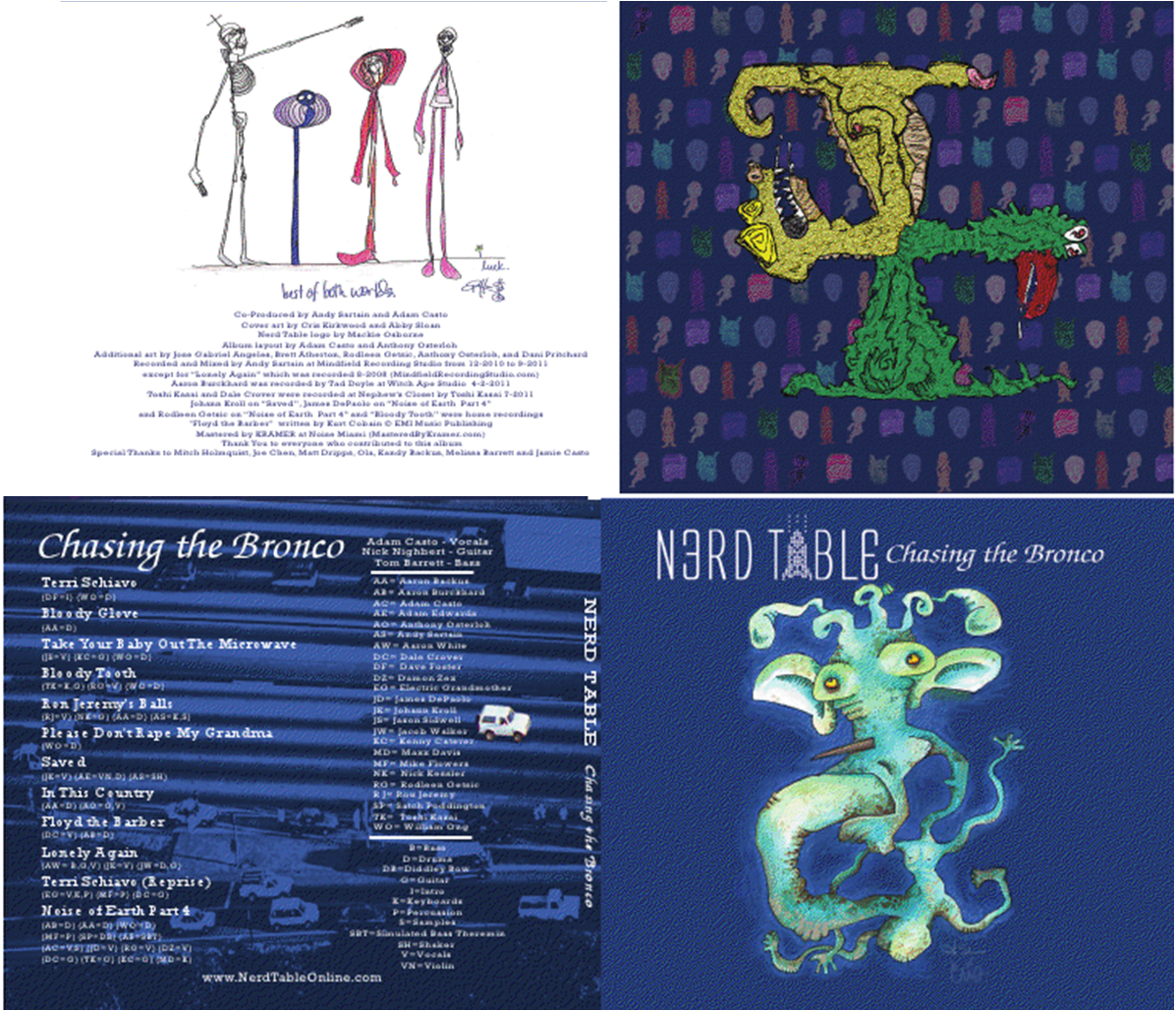
A Nirvana Cover on the Nerd Table

    This past week I heard from a guy called Adam Casto who dropped me a line very kindly just saying “just discovered your website. Man, it’s killer.” Maybe it’s my Britishness but, as I say when people leave comments on the blog, I’m still pleasantly surprised and pleased each time anyone tells me they’ve been enjoying what I’ve been up to here.

    Turns out that Adam supplies vocals to a rather intriguing band called Nerd Table (www.nerdtableonline.com) with quite a remarkable cast of collaborators on their 2012 album release Chasing the Bronco…

    Nerd Table

    Aaron Burckhard and Dale Crover both play on a cover of Floyd the Barber (drums and backing vocals respectively), on a track called Noise of Earth Part 4 (drums and guitar respectively) and Dale also provides guitar on Terri Schiavo (Reprise.) Further adding to the universe of Nirvana-circling figures, Cris Kirkwood of the Meat Puppets contributed to the artwork.

    The cover of Floyd the Barber is available at the band’s homepage, definitely worth a listen — I like how good the tune sounds even shorn of its murky grunge, late Eighties sound. What I like about this, and about Deervana (see last week’s post) is that in each case the band simply enjoys playing the music they love, they’re not mimicking or trying to forcibly press their own sound into a Nirvana-shaped mould. The fact Adam has a more snarling voice sounds great with these lyrics, no karaoke pretence of ‘becoming’ Kurt Cobain, just taking the song on, making it less glowering and dank (Kurt always made it sound so seedy and rundown), more of a razor, more ‘metal’.

Sliver = Rug Burn: Nirvana and Renamed Songs

Sliver
Credit for this post goes out to Adam Harding — a true gent. Having written to say he’d received his copy of Dark Slivers he took the time to drop me a line about a scanned newspaper article that can be seen in the Mudhoney Documentary “I’m Now.” The article basically suggests that a different name was publicised for Sliver prior to its release; Rug Burn. It’s also fascinating to see how, at twenty years distance, this spell of miscellaneous drummers and multiple options (Patty Schemel, J Mascis, Dan Peters…) now looks like just a ‘blip’, a pause before the arrival of Dave Grohl. The article gives a sense of confusion, of uncertainty, with Dan Peters genuinely under consideration for a longer stint.

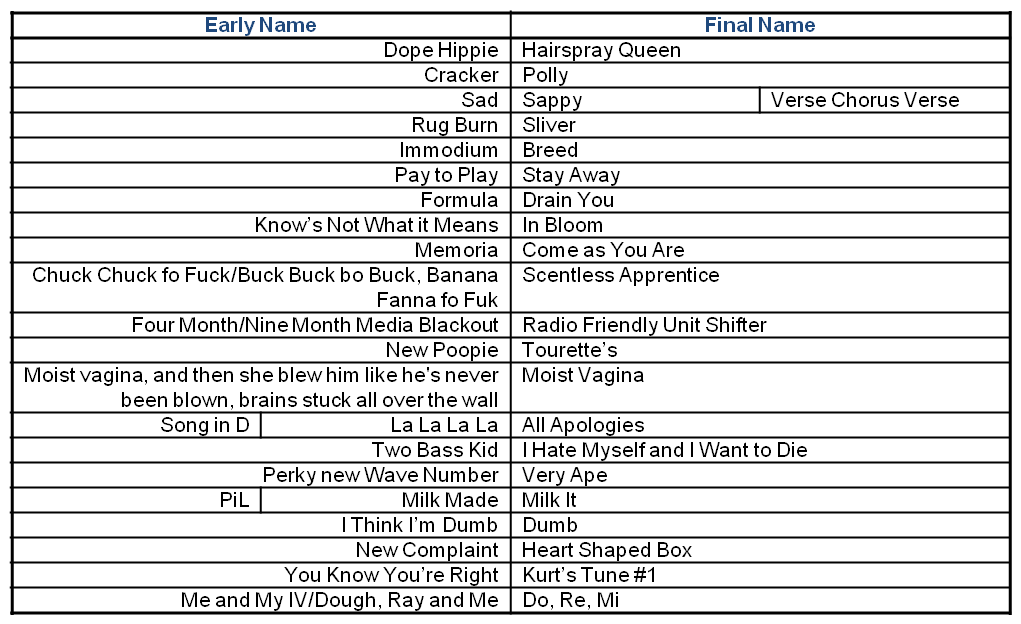
The wider point that Nirvana songs existed under a multiplicity of working titles is old news. What intrigues me, however, is the window those working titles often gave onto what was on the mind. This song follows quite a regular pattern in terms of the shift in titles; from the specific to the generic. Rug Burn, as a title, has a very precise domesticity and childhood connection — Sliver could mean just about anything. Two other fair examples from the same phase were the shift from Immodium — a diarrhoea medicine, pointing to the on-the-road experience of Tad Doyle’s extreme stomach problems during the 1989 spell when the song was being written — to the universal Breed. Pay to Play also relates to touring experiences, the practice of bands being forced to buy tickets from a venue then sell them on in order to make any money, and changes to the generic Stay Away. Other examples would be Formula/Drain You, Memoria/Come as you Are. The key exception is New Complaint’s evolution into the highly personal Heart Shaped Box — it emphasises the love song aspect of it, the song as a gift to Courtney Love, named after one of the gifts they had given one another.

The following list, based on the information compiled at LiveNirvana (with thanks to what is an amazing website), lists all the known previous names:
Nirvana Songs_Name Changes

What the list emphasises is that Kurt Cobain did put thought into the details of his music, it wasn’t all just on-the-spot inspiration. It’s also interesting to see him regularly modifying his tendency to make lame quips, opting for more palatable, often more deftly and poetically phrased, titles. There are still further habits and tendencies present.

Firstly, a simple (and not uncommon approach) was to simply refer to a song by a line from its lyrics until it was fully formed; I Think I’m Dumb, New Complaint, Memoria, Knows Not What it Means — they’re all fairly obvious matches. With more visible evidence of the full evolution of songs from first demo to final recording it’s likely that a lot more songs traced this path from namelessness, to lyric-naming, to a final statement.

Naming a song after it’s sound, or feel, was another clear approach. My favourite example is Scentless Apprentice with its over-elaborate working titles mimicking the core riff beautifully. It’s a delightfully humorous example too, I mean, taking the time to write Buck Buck bo Buck, Banana Fanna fo Fuk — fun! There’s no other example as explicit as that one, where the title really is the tune, but, there are a few examples of naming the song after how it felt; All Apologies seems to align with the 1991 Nevermind sessions’ Song in D (this is unconfirmed as yet) then became La La La La which also fits the mood of the song.

As an aside, Dope Hippie/Hairspray Queen is an unusual switch — they’re not necessarily targeting the same audience unless my understanding of the U.S. rock scene is flawed and the last remnants of the Grateful Dead hippy crowd were morphing into the big-hair and androgynous glam metal crowds around Mӧtley Crüe and their ilk. The initial title reeks of Kurt’s later comment about “I wouldn’t wear a tie-dyed tee shirt unless it was dyed with the urine of Phil Collins and the blood of Jerry Garcia.” The latter title seems to shift to a separate target of his ire. It’s a real one-off.

The rapid fire writing around the Rio de Janeiro recording sessions in January 1993 yields a spell of such titles with Very Ape simply being called Perky New Wave Number while I Hate Myself and I Want to Die’s heaviness fits the Two Bass Kid line well (with the later titles both being far better.) Scentless Apprentice only evolved in rehearsals at the end of 1992 so, again, a scribbled down name until it really has to be thought about in February. The nicest example is Tourette’s being listed as New Poopie; pure and simple, “new shit”, how much more blunt can you get? No time for naming, they knew they’d get round to it. In Utero was certainly the most visibly interesting spell of song renaming what with Sad/Sappy/Verse Chorus Verse making its long transition from 1988 acoustic demo name (Sad) describing its mood, to its mid-period shrug (Sappy) before finally pickpocketing from a now discarded song to take on its final glum, bored with standard pop trope, title (Verse Chorus Verse.)

The band’s final spell offered two fun cases. Firstly, You Know You’re Right seems to have never made it further than a tape marked Kurt’s Tune #1 — a total lack of involvement similar to the way Pennyroyal Tea was the first single since Smells Like Teen Spirit that had no Cobain involvement. On the other hand, the demo known on With the Lights Out as Do Re Mi, and potentially actually called Me and My IV or Dough, Ray and Me, has a different interest. In this case, all three potential names are equally normal Cobain naming approaches — a simple repeat of the chorus line, or rhymes based on the chorus line; or, again, a random snatch from the song or two personal references (Me and My IV a reference to increasing familiarity with hospital stays, the latter potentially about a real person according to http://shutuplittleman.com/history.php?idd=19) that, if they followed the usual Cobain trend, would have been revised into something less personal.

Nirvana Live: Missing From Action Part Two

It’ll be no surprise to learn that a lot of Incesticide’s early material suffers from the limitations of our vision at twenty years distance. Yet, what is noticeable is more the centrality of some songs to Nirvana’s live identity in the early days. Mexican Seafood is remarkable, it’s present in every fully known set-list from March 1987 when the band first perform, until February 1989 just days before the band departs for their first gigs in California. Hairspray Queen and Aero Zeppelin have a similar dependability which elevates these three songs above the rarities described in Part One of this piece, as well as above a number of the dashed off last-minute additions to Bleach. It certainly looks like these three songs were held in higher affection than the barely performed Scoff or Swap Meet.

As an aside on those two songs, it’s fascinating how deep Nirvana’s collective memory was; they seem never to banish a song from mind; Scoff and Swap Meet are reprised in September 1991 and June 1992 respectively as cases in point. It’s a fascinating working practice specifically related to the way they play their live performances; songs are stashed away, like Vendetagainst, then after a year, two years, out of favour, they’re given an airing. It suggests that, at least from 1987-1992, there was substantial practice going on behind the scene to keep a solid grip on the lesser songs. On the one hand, it gives credibility to the rumours about songs like Clean Up Before She Comes, Opinion and Talk to Me springing to life in the Cobain basement in 1994 — no song seems to have been forgotten if there was any use that could be made of it. On the other hand, it makes one wonder why Mrs. Butterworth, utterly unseen, invisible, unknown (and actually unnamed) until the With the Lights Out box-set was erased so thoroughly alongside, according to Gillian G. Gaar, two other 1987 compositions. The song stands alongside Big Long Now as a genuine ghost in the catalogue; a song with a murky past, a gossamer thin presence, and no future.

Similarly, Beeswax looks ever more like a lucky addition to the January 23, 1988 session and doubly-lucky to still merit a place on Incesticide. The song receives just two work-outs in 1988 with only one intervening show at which its presence is therefore likely. This is a no more impressive record than Annorexorcist or Rauchola, Downer, If You Must and Pen Cap Chew are all given more visible shots as part of the Nirvana live experience.

While all of Nevermind gets its day on stage, the higher percentage of available set-lists makes the rapid fall off in appearances from certain songs at least noteworthy. Lounge Act is the very last of the Nevermind tracks to make it on stage and the quickest to depart; after that one show in Ireland it crops up just once more that year, returning only in 1992 to make inconsistent appearances in sets throughout the year.

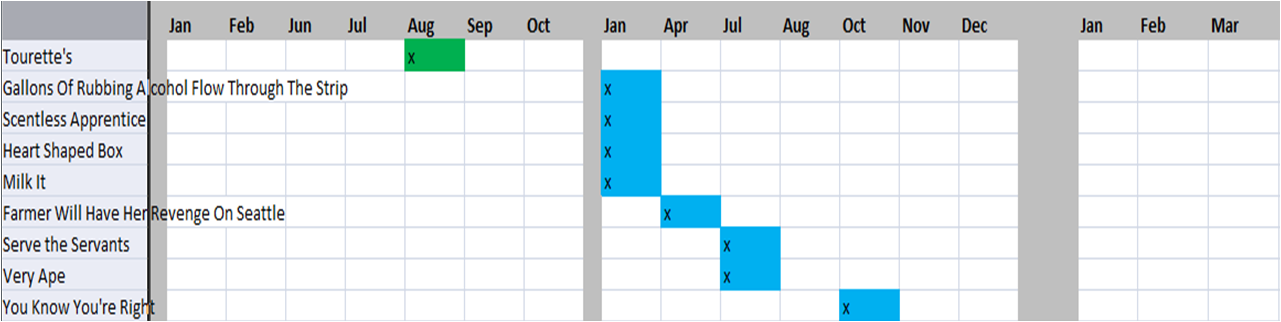
When it comes to In Utero, the drawn out nature of the album’s creation is the greatest point of note. The first appearances of Milk It in January, plus Gallons of Rubbing Alcohol’s only known appearance, is slightly misleading given it was only a soundcheck appearance, it’s April before the band really give it a full live shot. There’s still an ‘outlier’, however, on the album just as Scoff and Swap Meet were on Bleach, just as Lounge Act was on Nevermind. Very Ape doesn’t make an appearance until late July, it serves a purpose on the album but fades from the live set only to be brought back in to pep things up for 1994. It’s curious that the song should follow the exact same trajectory as Lounge Act, again, it’s a positive feature that even on the In Utero tour there was some apparent desire to add at least some freshness to playing, the reappearance of Sappy after a long absence also bearing this out.

There is a persistent tendency to trial songs live, for a month, two months, at a time then move on. Thus tracks like Curmudgeon, Sappy, Talk to Me, Oh The Guilt, Verse Chorus Verse receive brief flurries of activity then either vanish permanently, or vanish until the next time the band are considering the need for songs for future releases. This fits with Kurt Cobain’s method of writing; most lyrics seem to be written in a flurry of inspiration, tweaked for a short period, then concluded – potentially with later rewriting before a recording session. He never seems to have mused on a song for lengthy periods (six months, a year…) even if a song remained unused for that long. Thus the appearances and disappearances mark renewed enthusiasm, keeping a song in mind, then putting it away again. He doesn’t seem to have ever wholly forgotten many songs though, especially after 1989.

On the other hand, in the late spell, the enthusiasm for working songs over seems to vanish. As someone commented the other week, there’s a rumour that I Hate Myself and I Want to Die, but no definitive confirmed sighting in 1993-94. You Know You’re Right appears once in full form (plus its main riff appears in an on stage noise jam), M.V. doesn’t appear at all, Gallons of Rubbing Alcohol makes it into a soundcheck apparently but that’s it. These songs were functional items fulfilling a need for extra material to be used wherever. Their absence from setlists simply confirms there B-Side status.

Nirvana Live: Missing From Action Part One

There were clear gaps in the live record, songs that showed up far later than seems realistic or that simply don’t show up at all. This post is just a brief look at those two circumstances.

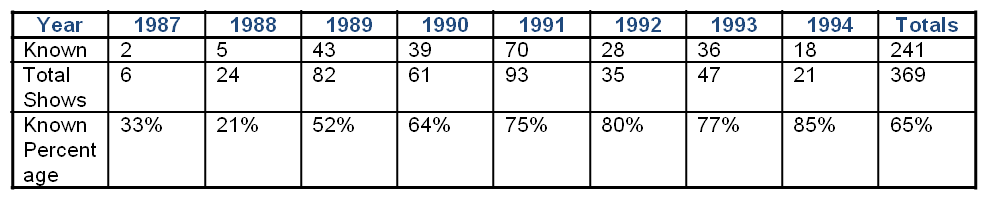
The early days of the band were deservedly the core of Gillian G. Gaar’s latest book Entertain Us. Beyond the reprised tale of rags to riches, the early days retain a mystery. The band’s rising status and ‘most likely crossover success’ status in 1990 owed a lot to Sub Pop’s success at shoving a low-selling strictly local scene onto a global stage — in 1987-1988 this was just one band in a field of thousands. The live stats support this with just 7 of 30 set-lists known:

Set Lists 1987-1994

Understandably this leads to a raft of suggestive stats. As a first example, the fact that Annorexorcist appears in the set-list in mid-1987 and then again six months later in January 1988 suggests it likely featured at two further intervening shows. Likewise, given it was a leftover from Fecal Matter, there’s a possibility it may have appeared at the two shows prior to its May 1987 appearances. Raunchola (A.K.A. Erectum) flops into the territory of God knows — a first appearance in January 1988, a last appearance in March with just one intermediate show, yet then a space of sixteen performances until the next fully revealed set. There’s simply no way of knowing when either song died out. There is, however, good reason to believe there was more live life to them than there strictly limited edition status. Pen Cap Chew and If You Must also have a chequered history; they appear at the start of 1987, are excluded from the May gig (though Pen Cap Chew did make the KAOS Radio performance), then reappear in January-March 1988. In conversation with Jack Endino early in 2012 he stated, with regard to If You Must “…at the time we recorded it (Jan 88), they were opening their set with it. Much later he decided he didn’t like it, who knows why.” There’s a good chance that he’s correct and that both songs featured in the final two gigs of 1987 but then hard to discern if the January 23, 1988 appearance was their final showing or if they made some brief resurrection later in the year.

We’re looking at the gap between reality and posthumous truth. Vendetagainst (A.K.A. Help Me, I’m Hungry) exists for a brief appearance in 1987…Then a gap of 83 shows and 29 months until it pops up twice; November 5 and 8 with a gap of one show. Blandest, only ever seen on June 11, 1988 in studio, likewise appears for two shows in July. Blandest may have been present at the eight ‘ghost’ shows between March and that date, or the show a week later in Ellensburg. It’s also hard to believe that the song wasn’t featured at all earlier.

On a related note, it isn’t a surprise Chad Channing knowing Blandest, but it’s unusual that he would be aware of Vendetagainst, a song recorded a full year before his arrival in the band. I’m speculating but, in the month pause between their show in August 1989 and the commencement of touring in late September, the band seems to have decided to take stock of the songs they had left in reserve and trained up on them. During this phase the band are varying elements of their set almost nightly, it’s as if they’re keeping material alive with new releases in mind. The set is knee-deep in, as yet, unreleased songs; Token Eastern Song, Dive, Polly, Even in His Youth, Breed, Vendetagainst, Sappy, even a jam on Hairspray Queen. Nirvana were a very smart unit, already one eye to the future and a range of possibilities.

While unsurprising that the rarities are conspicuous by their relative absence from the live record, it’s fun to consider the fate of a certain portion of Bleach. Essentially the gaps in the known set-lists cast a veil over the likely presence of some songs. Blew, Mr. Moustache and Sifting were all given a first airing in June 1988 in studio, but eight set-lists are unknown meaning it’s October 30, 1988 before the songs are first seen. Likewise, it’s unlikely that Negative Creep and Scoff were first performed when they’re first ‘visible’ to us twenty years later, in April and May 1989 respectively given they were definitely finalised and recorded by the start of the year and there are ten shows leading up to the known displays.

The most remarkable disappearances from the Bleach sessions are Big Long Now (I dissect it’s likely performance in the Songs The Lord Taught Us chapter of the Dark Slivers book) and the way Swap Meet doesn’t appear at all until November 1990 — that gap for the latter just doesn’t ring true. A further curious feature is that, with the exception of Blew, the ‘late arrivals’ from Bleach into the Nirvana live record are all clustered toward the back-end of the album. Apparently Bruce Pavitt and Jonathan Poneman were involved in deciding how to sequence Bleach and it’s quite intriguing that those songs that were rushed into place to fill out the album, that weren’t ready for live performance until late 1988 or even later in 1989, were all shoved to the rear. The first side of Bleach places some of the band’s earlier recorded works (Floyd the Barber, Love Buzz, Paper Cuts) to the front of the album so it seems Sub Pop were aware at the time that certain songs were rush-jobs.

Nirvana Live and Live Covers: 1992-1994

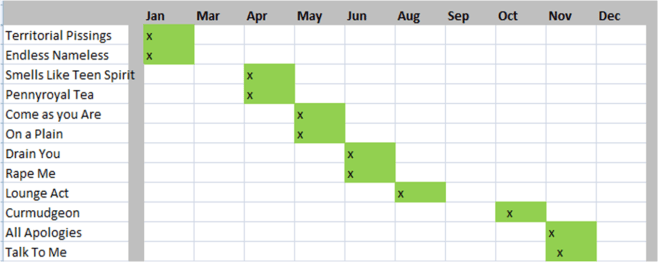
After the happy peak of 1990-1991, it feels sad to bring this little series crashing back down. The following graph shows the sum total of Nirvana originals appearing in set-lists for the final two and a half years of the band’s existence:

New Originals_1992-1994

As pointed out the other week in a blog comment, there’s a rumour that I Hate Myself and I Want to Die was played in 1993 — I’ve stuck to the Nirvana Live Guide as it stood in December 2012 for the time being. It’s intriguing really to see the band revert to a pattern most similar to 1987 or 1988 where they weren’t playing many shows…But the reduction in workload also seems to have reduced the amount of new works being creating. There’s a idiom my mum uses sometimes “the less you have to do, the less you do,” that sometimes pressure helps get results. Nirvana’s live shows derail the pattern of 1989-1991. 1992 gives the impression of a rabbit in headlights, too scared to move in any direction for fear of what might happen:

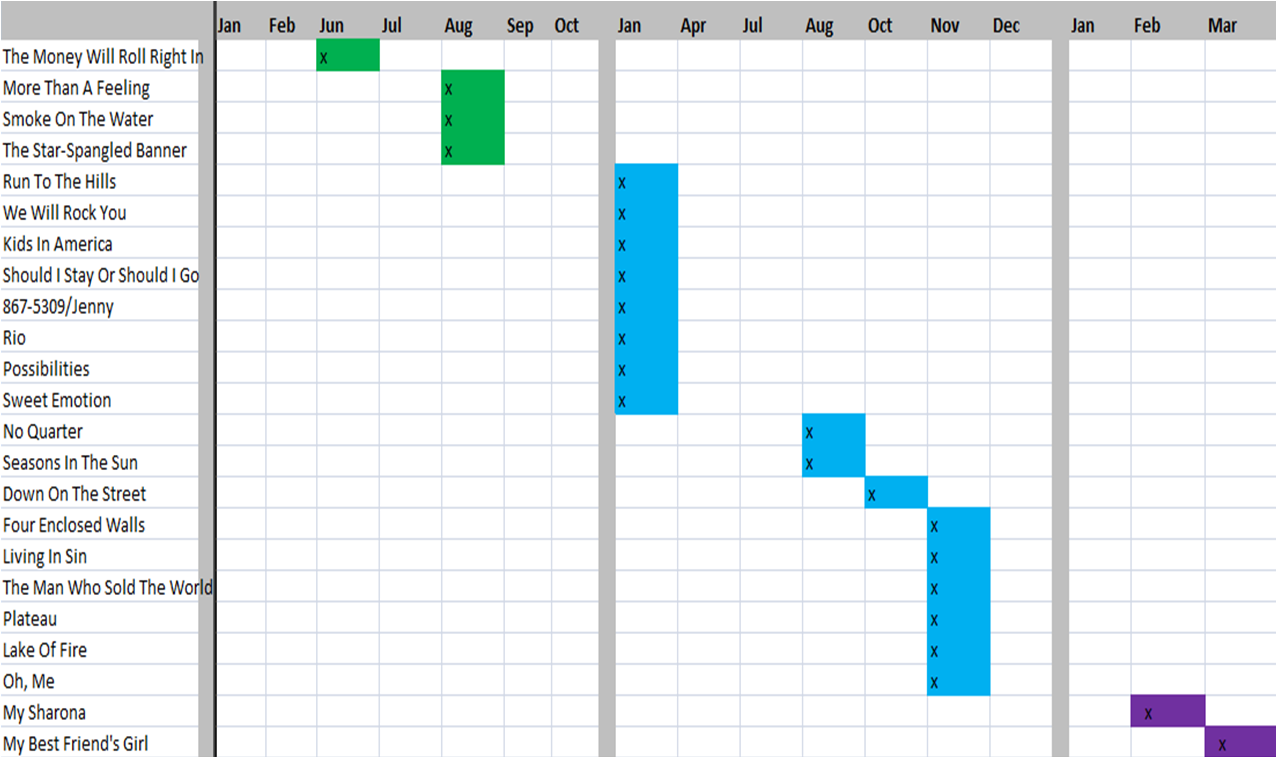
Cover Songs_1992-1994

The work rate of 1989-1991 required a band that were practising solidly, working up new covers and so used to playing together night-after-night that they could readily lock into each new selection seamlessly. The band could still pull out a solid cover if they’d practiced (Seasons in the Sun, The Money Will Roll Right In, The Man Who Sold the World) but most of these covers are bare skin n’ bone. The January 1993 deluge in Sao Paolo was the result of Kurt barely being willing to play; the band had to swap instruments, Kurt on drums, and plod through covers just to fill their contractually obliged stage time with Krist lobbing his bass at Kurt and storming off in sheer frustration at one point.

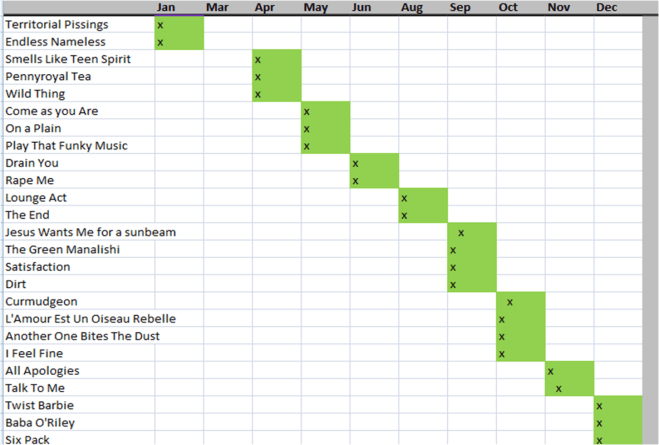
While 1989, 1990 and 1991 were so busy each year required its own screen shot, the full summary of 1992-1994 is as follows:

New Live 1992-1994

Each year from 1989-1991 the band had been knocking out twelve new original Nirvana songs a year on stage, in 1992, they manage one, in 1993 they rocket up to eight…Then nothing. 1992 is a write-off, 1993 relies on cover songs to maintain the stepped momentum, 1994…

No words.

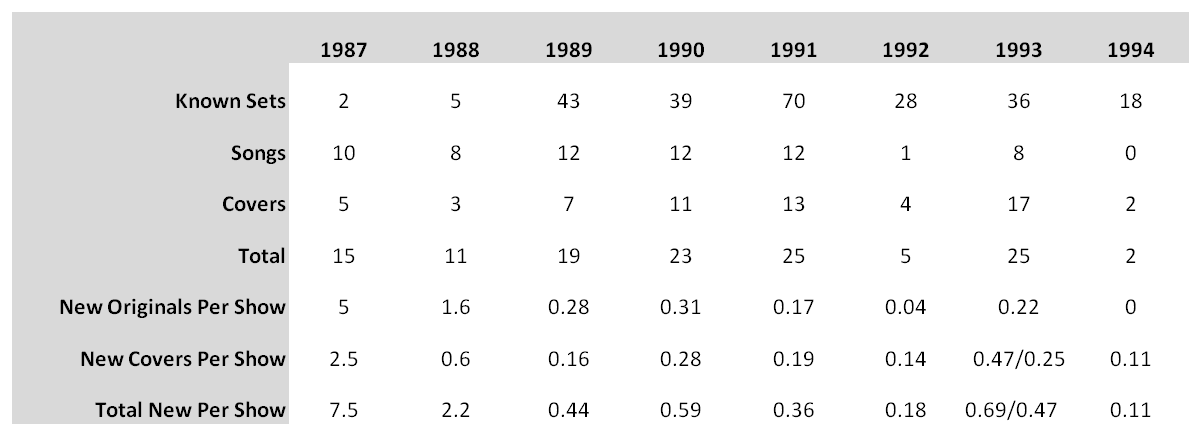
Another way of looking at it is to examine how many new songs or covers Nirvana knocked out in how many shows:

Nirvana New Live Divided

Of course 1987 is irrelevant given how skewed it is by their first performance (all new!), also 1988 suffers from the extensive gaps in the set-list record. The pattern across the succeeding years are fairly solid, however, Nirvana were cranking out a new song ever two/three shows 1989-1991, even the large number of set-lists available for the extensive touring in 1991 can’t substantially dilute the result — this was one hard-working band. It does make 1993 look like a resurgence, heck, Nirvana are pulling fresh originals on stage at the same rate as they do in 1991, roughly one new song for every five shows. The cover number is buoyed up to a ridiculous level by Sao Paolo and MTV Unplugged in 1993. In fact, removing those two shows, each a special circumstance, from the equation and just looking at their ordinary gigs would bring the stat down to 0.14, a fresh cover appearance every ten shows or so, the same as 1992, the same as 1994.

As usual, it all depends how you look at things, how you want to see things…What the hey. It’s fun to play with the point of view.

Something Mellow for the Weekend…

http://www.rollingstone.com/music/videos/deervana-deer-tick-play-gripping-nirvana-set-20110611

With thanks to Paul Tripi, it’s time to relax, and you know what that means…

…Well, today it means checking a band playing full sets of Nirvana covers and indulging their inner fan boy. What’s neat is how well Nirvana’s songs sound in other hands, the simplicity of construction and sound make the instrumental attack easy to duplicate. The voice is the element representing the greatest difficulty, John McCauley does it well simply by leaving things unpolished, his voice fraying at the edges. The idea of an established band taking time out to play the songs of their heroes is certainly endearing (no pun intended) and pleasantly whimsical; the fact they do it well is pleasing. It enhanced it for me that the band don’t bother dressing up or trying to disguise themselves AS Nirvana, it’s better this way as they’re never anyone over than themselves. That honesty is welcome.

Just thought we’d go with something gentle today, conclude the ‘first appearance’ stats tomorrow, end of the first week of 2013…Breathe.

Nirvana Live and Live Covers 1990-1991

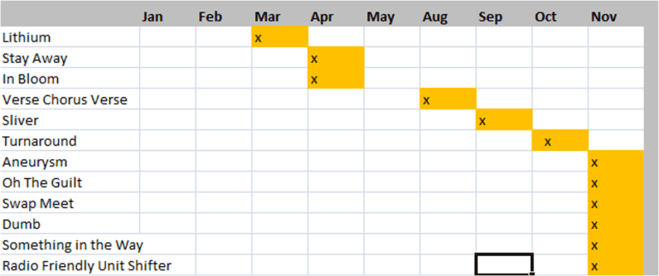
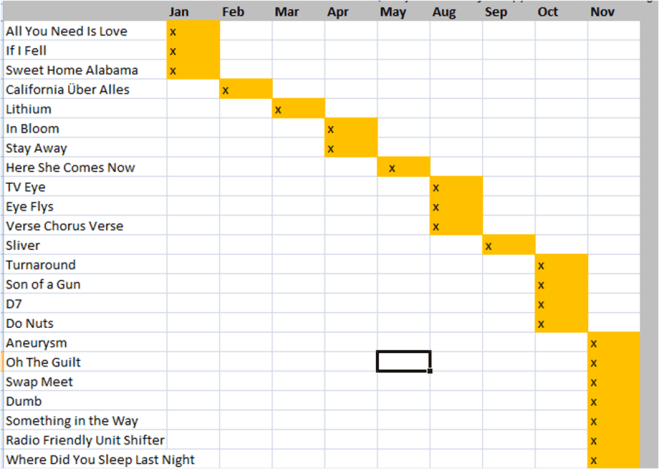
The live record shows the lengthy gestation period leading into what became Nevermind. Polly arrived first as part of Cobain’s acoustic ‘experiments’ from 1987-1988, then Breed as part of the fuzzy sounding punk tunes appearing in late 1989. The 1990 record shows two distinct phases, firstly, the flurry of Lithium, Stay Away and In Bloom in March-April, then the first appearance of Something in the Way later in the year.

 New Originals_1990

Seven of Nevermind’s thirteen songs were then drip-fed into the set between January and August 1991:

New Originals_1991

That single November 1990 show at The Off Ramp in Seattle tops LiveNirvana’s Overall Best Shows list for good reason given the cornucopia of thrills on offer. The show was a real statement from the band with new songs and rare old songs flung into the set with abandon. It looks like Nirvana’s victory lap; it must have really stretched and tested them performing so much material that was so rarely a part of their shows, or that had only just come into existence. With thirty-one songs performed in total it’s also the longest show the band ever performed barring the far less cheerful occasion of Sao Paolo in January 1993. This was their party and listening to it now, the enthusiasm, the “we’ve made it!” happiness is so audible.

The overall trend commenced in 1989 remains solid throughout 1990 and 1991; there’s a new Nirvana original entering the set every single month. Still accepting the limitations of the record (64% of 1990’s set-lists are known and 75% of 1991’s) the regular refreshing of the pool of songs is remarkable. These were the peak years of Kurt Cobain’s writing and each year 1989-1991 twelve new Nirvana songs can be proven to have entered Nirvana’s set.

Looking at the 1990-1991 live arrivals also shows the transition in Nirvana’s sound very clearly. In 1989 Bleach’s grunge dirge phase passes away to be replaced by a lighter tone, yet still the Nirvana ‘formula’ verse-chorus dynamic hasn’t yet clunked into place. The three tracks that appear in early 1990 inaugurate the spell during which the stereotype ‘Nirvana sound’ holds sway. Usually one thinks of Nevermind and In Utero as separate objects but listening to the songs appearing in the spell from March 1990 through November 1991 brings a lot of similarities into tighter focus. The furthest the band went from the norm in that time was going quiet (Something in the Way, Dumb) or going all out noisy (Radio Friendly Unit Shifter, Curmudgeon.)

Cover Songs_1990

The record of covers being played over these two years continues to show the musically omnivorous nature of Nirvana —  they’re grabbing at songs from across the spectrum of rock; their punk tastes are a firm presence in 1990; they’re chucking brief snatches into the set-list spontaneously alongside more practiced and full renditions.

Cover Songs_1991

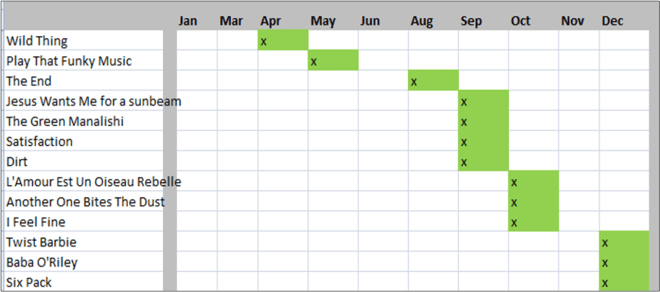
Despite the break in performance in late 1990-early 1991 the band continue almost as if this two year spell is all one long trek, there’s no change in the patterns. One intriguing decision is to start using either Jesus Wants Me for a Sunbeam or L’Amour Est Un Oiseau Rebelle as the set-openers. It seems to be a way to defuse the craziness in the moshpit, starting with mellow songs to calm everything down before ratcheting things back up as the performance proceeds.

These years were the pinnacle of Nirvana as a live experience and as creative musicians. The sheer quantity and quality of what they were throwing on stage, this is a million miles from the bands that tour a single barely shifting set-list across a hundred shows. The band are showing such complete enthusiasm and love for performing and for music, it’s part of the buzz around Nirvana, the much-vaunted ‘energy’ that they were bringing to stages at this point in time. It also shows their self-assurance, that they were such skilled masters of the stage by this point that they could deviate from the script at will, could shift gears at a moment’s notice. It’s such a busy two years it takes me two screen shots to capture it:

New Live 1990 New Live 1991

This was a band that could do anything.


Nirvana Live: Covers 1987-1989

Cover Songs_1987-1988

The regular arrival of fresh covers reinforces the point made in yesterday’s blog that, particular in the early days, while new songs may not have arrived too swiftly in 1987, the set could still be spiced up a little. What is noticeable is that, though accepting that there are gaps in the record, there’s no evidence of the band displaying the punk side of its tastes — they stay solidly reliant on hard rock and pop despite the inclusion of quite a few late Sixties-early Seventies oddities. This seems in part a fair reflection of the band’s own taste and also a crowd-pleasing match for the Led Zeppelin worship prevalent in the Seattle scene of the day.

Cover Songs_1989

Nirvana’s work is full of wonderful symmetries, some coincidences, others not. One I particularly like is that Do You Love Me’s performance in June marks the passing of that early hard rock spell in Nirvana cover songs. November then marks the new life, Lead Belly arrives in the set-list, The Vaselines; the songs that would mark the alternative identity the band was happier to place on vinyl after that time. A second passing took place at the same time, however. In the early spell, with the exception of the tribute to Led Zeppelin’s Moby Dick, the band were playing mainly full, if ragged, covers. With certain key exceptions over the years to come (i.e., the songs that made it onto Incesticide or that were reprised for MTV Unplugged) an awful lot of Nirvana’s live covers became brief bass jams, or snippets covering up restringing, retuning, other on stage logistics and live administration.

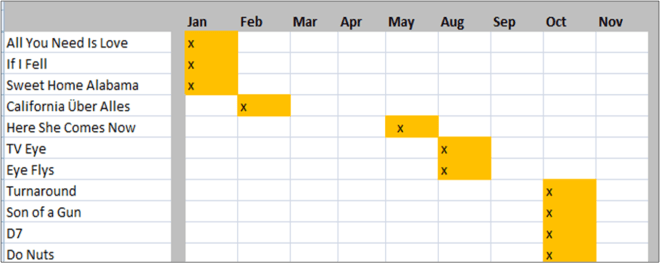
Seeing the first two years, originals and covers altogether, emphasizes how hard-working this band was in their performances:

New Live 1987-1988

Similarly, 1989 — this was a band working exceedingly hard learning, practising and performing new songs month after month. It can’t have come easy, this was a triumph of will and the desire to excel in performance. They could have simply whacked out the same set-list over and again but instead there’s a visible striving to do more:

New Live 1989

Jack Endino Got His Copy of Dark Slivers

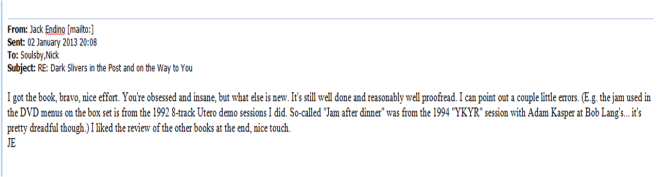
As a thank you for his decency and vastly appreciated willingness to help me out when I commenced working on Dark Slivers, I despatched a copy to Jack Endino over in Seattle. I arrived home late last night to find a quick message from him.

Jack Endino Email

Phew! Nice to know I didn’t make a complete mess of this from someone so thoroughly important to the subject. Was so chuffed I really wanted to share this on here.