Nirvana Live and Live Covers 1990-1991

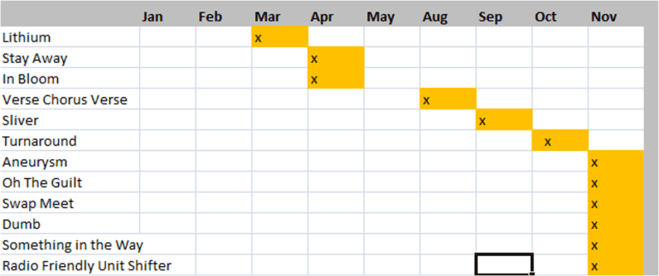
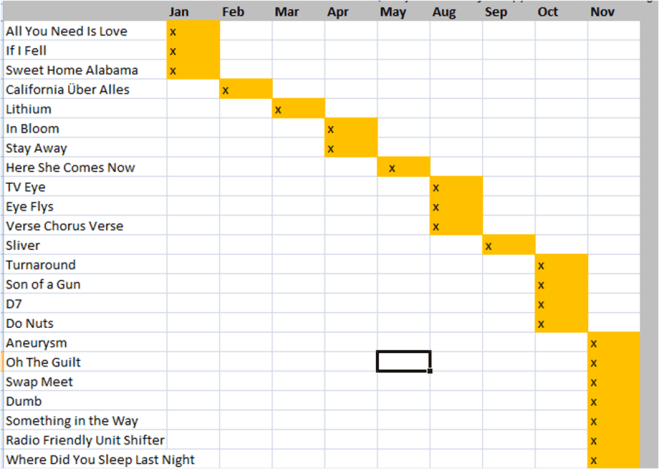
The live record shows the lengthy gestation period leading into what became Nevermind. Polly arrived first as part of Cobain’s acoustic ‘experiments’ from 1987-1988, then Breed as part of the fuzzy sounding punk tunes appearing in late 1989. The 1990 record shows two distinct phases, firstly, the flurry of Lithium, Stay Away and In Bloom in March-April, then the first appearance of Something in the Way later in the year.
 New Originals_1990

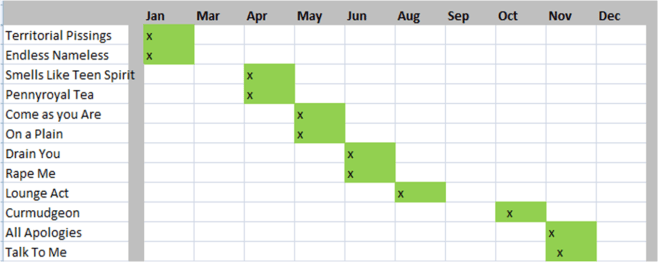
Seven of Nevermind’s thirteen songs were then drip-fed into the set between January and August 1991:
New Originals_1991

That single November 1990 show at The Off Ramp in Seattle tops LiveNirvana’s Overall Best Shows list for good reason given the cornucopia of thrills on offer. The show was a real statement from the band with new songs and rare old songs flung into the set with abandon. It looks like Nirvana’s victory lap; it must have really stretched and tested them performing so much material that was so rarely a part of their shows, or that had only just come into existence. With thirty-one songs performed in total it’s also the longest show the band ever performed barring the far less cheerful occasion of Sao Paolo in January 1993. This was their party and listening to it now, the enthusiasm, the “we’ve made it!” happiness is so audible.

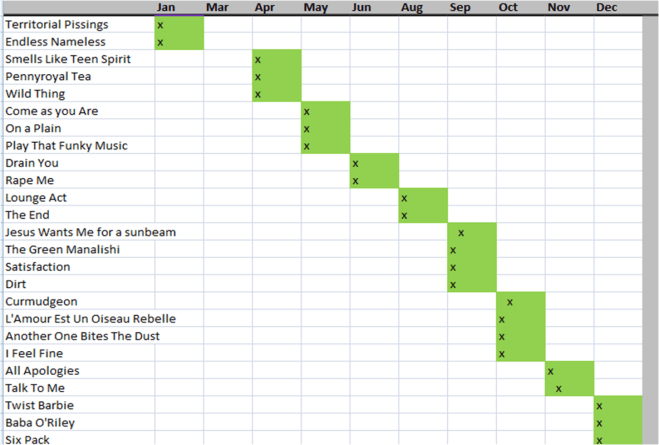
The overall trend commenced in 1989 remains solid throughout 1990 and 1991; there’s a new Nirvana original entering the set every single month. Still accepting the limitations of the record (64% of 1990’s set-lists are known and 75% of 1991’s) the regular refreshing of the pool of songs is remarkable. These were the peak years of Kurt Cobain’s writing and each year 1989-1991 twelve new Nirvana songs can be proven to have entered Nirvana’s set.

Looking at the 1990-1991 live arrivals also shows the transition in Nirvana’s sound very clearly. In 1989 Bleach’s grunge dirge phase passes away to be replaced by a lighter tone, yet still the Nirvana ‘formula’ verse-chorus dynamic hasn’t yet clunked into place. The three tracks that appear in early 1990 inaugurate the spell during which the stereotype ‘Nirvana sound’ holds sway. Usually one thinks of Nevermind and In Utero as separate objects but listening to the songs appearing in the spell from March 1990 through November 1991 brings a lot of similarities into tighter focus. The furthest the band went from the norm in that time was going quiet (Something in the Way, Dumb) or going all out noisy (Radio Friendly Unit Shifter, Curmudgeon.)
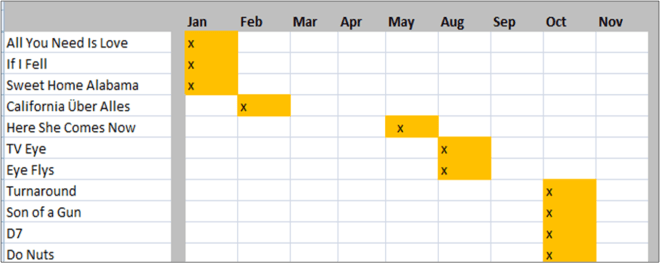
Cover Songs_1990

The record of covers being played over these two years continues to show the musically omnivorous nature of Nirvana —  they’re grabbing at songs from across the spectrum of rock; their punk tastes are a firm presence in 1990; they’re chucking brief snatches into the set-list spontaneously alongside more practiced and full renditions.
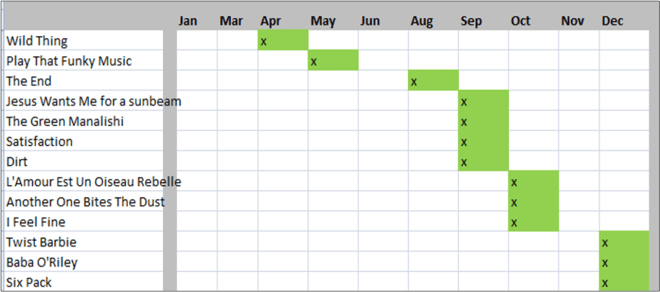
Cover Songs_1991

Despite the break in performance in late 1990-early 1991 the band continue almost as if this two year spell is all one long trek, there’s no change in the patterns. One intriguing decision is to start using either Jesus Wants Me for a Sunbeam or L’Amour Est Un Oiseau Rebelle as the set-openers. It seems to be a way to defuse the craziness in the moshpit, starting with mellow songs to calm everything down before ratcheting things back up as the performance proceeds.

These years were the pinnacle of Nirvana as a live experience and as creative musicians. The sheer quantity and quality of what they were throwing on stage, this is a million miles from the bands that tour a single barely shifting set-list across a hundred shows. The band are showing such complete enthusiasm and love for performing and for music, it’s part of the buzz around Nirvana, the much-vaunted ‘energy’ that they were bringing to stages at this point in time. It also shows their self-assurance, that they were such skilled masters of the stage by this point that they could deviate from the script at will, could shift gears at a moment’s notice. It’s such a busy two years it takes me two screen shots to capture it:
New Live 1990 New Live 1991

This was a band that could do anything.


Nirvana Live: Covers 1987-1989

Cover Songs_1987-1988

The regular arrival of fresh covers reinforces the point made in yesterday’s blog that, particular in the early days, while new songs may not have arrived too swiftly in 1987, the set could still be spiced up a little. What is noticeable is that, though accepting that there are gaps in the record, there’s no evidence of the band displaying the punk side of its tastes — they stay solidly reliant on hard rock and pop despite the inclusion of quite a few late Sixties-early Seventies oddities. This seems in part a fair reflection of the band’s own taste and also a crowd-pleasing match for the Led Zeppelin worship prevalent in the Seattle scene of the day.

Cover Songs_1989

Nirvana’s work is full of wonderful symmetries, some coincidences, others not. One I particularly like is that Do You Love Me’s performance in June marks the passing of that early hard rock spell in Nirvana cover songs. November then marks the new life, Lead Belly arrives in the set-list, The Vaselines; the songs that would mark the alternative identity the band was happier to place on vinyl after that time. A second passing took place at the same time, however. In the early spell, with the exception of the tribute to Led Zeppelin’s Moby Dick, the band were playing mainly full, if ragged, covers. With certain key exceptions over the years to come (i.e., the songs that made it onto Incesticide or that were reprised for MTV Unplugged) an awful lot of Nirvana’s live covers became brief bass jams, or snippets covering up restringing, retuning, other on stage logistics and live administration.

Seeing the first two years, originals and covers altogether, emphasizes how hard-working this band was in their performances:

New Live 1987-1988

Similarly, 1989 — this was a band working exceedingly hard learning, practising and performing new songs month after month. It can’t have come easy, this was a triumph of will and the desire to excel in performance. They could have simply whacked out the same set-list over and again but instead there’s a visible striving to do more:

New Live 1989

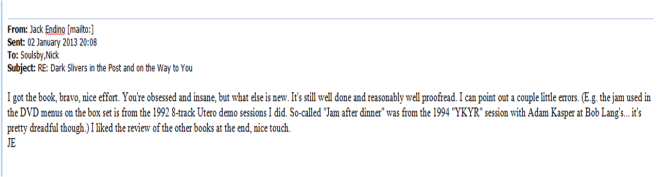
Jack Endino Got His Copy of Dark Slivers

As a thank you for his decency and vastly appreciated willingness to help me out when I commenced working on Dark Slivers, I despatched a copy to Jack Endino over in Seattle. I arrived home late last night to find a quick message from him.

Jack Endino Email

Phew! Nice to know I didn’t make a complete mess of this from someone so thoroughly important to the subject. Was so chuffed I really wanted to share this on here.

Nirvana Live: 1987-1989

Tail end of last year we started looking at a chart showing the first appearances of Nirvana songs in concert as detailed at the Nirvana Live Guide — shall we continue?

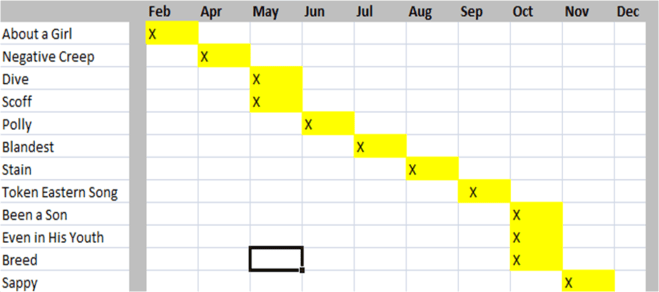
New Originals_1987-1988

Naturally it’s worth disregarding the tranche of new songs in March — anything they played was by definition a new performance given it was Nirvana’s first show. What’s most noticeable really is how many of the songs emerging in 1987 and the first month of 1988 were simply discarded; Hairspray Queen, Aero Zeppelin (these two until 1992), Beeswax (until 1991), Downer, If You Must, Pen Cap Chew, Annorexorcist, Vendetagainst, Erectum/Raunchola — most of an album is thrown away by the end of January 1988. The speed with which new songs were appearing would be impressive were it not for the fact that the band wasn’t exactly overworked at the time so there was plenty of time to come up with new songs. The issue was perhaps one related to the nature of the songs being created — Nirvana’s 1987 identity lay in relatively complex new wave songs, with extremely long-winded lyrics, hardly conducive to fast preparation. To be fair, Kurt Cobain was honest in saying that he was hardly a constant or prolific writer, he relied on catching the moments of inspiration and getting them noted down, recorded, before they burnt out. 1987 still relied on three year old songs refreshed and reprised from their Fecal Matter form to flesh out the setlist. On the other hand, wow, almost every month Nirvana perform (and for which a set-list is available) there’s a new song featured. The band were moving at speed.

Of course, particularly in the early years, we’re looking at a record with gaps — a particularly low percentage of set-lists from 1987-1988 are present, even in 1989 only just over 50%. Given Mr. Moustache and Sifting were present in vestigial form back at the June 1988 recording sessions for the first Sub Pop single, it’s likely they made it onstage for the first time during the seven-eight shows seen between that recording session and the next full set-list on October 30. Likewise it seems unlikely that the apparent appearance of Blandest in July 1989 was the first or only time the song received an airing before its abandonment:

New Originals_1989

What’s also interesting is the ‘late’ arrival of a handful of the tracks from Bleach. A good portion of Bleach was written long before the album session, however, there was significant rewriting of Blew, Sifting and Mr. Moustache after their first appearance and as late as mid-December (evidenced by the footage captured on the With the Lights Out DVD.) Meanwhile, the fact Negative Creep and Scoff don’t make any showing of any sort until April-May 1989, though partially a consequence of the long gap in the record, also suggests that those two songs specifically were last minute hurried additions to Bleach; the brevity of their lyrics likewise.

The nearly uniform month by month drip of new songs is quite remarkable in 1989, December is the first month in which the band play that year (even if only a smattering of shows) in which they don’t chuck either a fresh original, or a rarity into the mix. It says a lot about their desire to keep the experience of playing entertaining that they vary their shows so much. It made sense in 1987 through early 1989 when the band were repeatedly replaying Washington State venues (take a look back at the maps on this blog) — they’d be seeing the same audiences quite regularly — yet, from mid-1989 they were setting off on their travels, the audiences were brand new to Nirvana’s performances, the knowledge and trade of Nirvana rarities was minimal, the only people who would know it was a new song, or an abandoned track, were the band. I feel that it was for the band’s own pleasure that they made these efforts to vary their performances.

Kurt Cobain: Hell (and a Happy New Year)

IMG-20121222-00040

Written by James Joyce while at college:

“…never to be free from those pains; ever to have the conscience upbraid one, the memory enrage…ever to curse and revile the foul demons who gloat fiendishly over the misery of the dupes, never to behold the shining raiment of the blessed spirits; ever to cry out of the abyss of fire to God for an instant, a single instant, of respite from such awful agony…”

Joyce was describing a visceral vision of Hell as a physical and simultaneously mental experience in which torture took place both upon the body and the mind.

Not that I’m becoming monomaniacal or anything — I’m starting to feel like a vicar on a Sunday morning beginning a sermon “…And THAT made me think of God/the Bible/blah blah blah…” in relation to any experience of life whatsoever — but I’d been trying for weeks to summarise how difficult Kurt Cobain’s life seems to have been. This quotation came closest.

Kurt’s life, by the end of 1993, involved physical pain (from an eternally undiagnosed stomach ailment) along with the damaging effects of persistent drug abuse including overdoses and what must have been regular (and uncomfortable) comedowns; he felt buffeted and lacking control over the persistent demands of music as a career — unable to find peace when called on by management, band, press, fans; he looked to the future with fears including whether his daughter would inherit his wounded nature, whether his marriage could survive, whether he had the money to avoid being flung back into penury and employment (he’d never enjoyed working for a living); as In Utero shows he was a very angry and frustrated man at this point, ferociously defending his family from the intrusions of muck-raking journalists, the authorities, in fact anyone who felt they could comment on his life — there’s a tiredness within In Utero, an exhaustion.

On top of this, his creative muse seems to have burnt itself out — this can’t have failed to escape his notice, that the crucial thing he had achieved in life had ceased to give him pleasure or to flow as naturally as it had until hitting age 25, he must have worried if he was done already. His friendship group, his social life, had shrunk away to nothing, core relationships (primarily with his band and wife) were troubled at best robbing him of a primary confidante and isolating him (semi-deliberately) from others.

A further issue with Kurt Cobain is the way he seems to have had a deeply active conscience ‘upbraiding him.’ His songs lavish nothing but blame and criticism upon his own shoulders; as the clearest cases he writes Lithium on Nevermind and All Apologies on In Utero calling down responsibility for his situation upon his own failings. His suicide note dwells on the same elements; he doesn’t lash out at the world, he simply cracks a sardonic half-smile and points out how useless he feels he is and how much of a danger to his daughter’s future happiness — that’s a phenomenally harsh thing to think of oneself, that one’s personality is so toxic it could pollute one’s child in such a way. There’s not much funny in his regular self-flagellation, no matter how sarcastically phrased — the same joke replayed year-after-year finding different ways to call himself a bad person; he doesn’t even blame anyone for it, not even his parents, he seems to feel that he was an unloved and unwanted child because he deserved it like the figure at the centre of Scentless Apprentice.

With all this going on, what aspects of Hell were not being visited upon him in his view? He had the physical pains, the conscience, the anger, the audiences he felt were gloating over his predicament, the absence of relief or visible hope. Whatever responsibility he bore for this perception of the world, it’s a brutal blend wrapped up in a slim frame and a lot for one being to carry day-after-day.

Disquiet: MTV Unplugged in New York

http://www.nirvanafreak.net/art/art18.shtml

Earlier today we focused on the subject of Nirvana cover songs and pointed out that in 1993 there were two performances strongly dependent on cover songs; Sao Paolo and then MTV Unplugged in New York. The latter show is, of course, a triumph — it’s funny, beautifully performed, featuring some of the vocal performances for which Cobain will always be known. It also led to the CD release which is the Nirvana album that anyone who doesn’t really like rock music has in their collection. The quality of what took place on stage is undeniable and I have no wish to deny it, I love the performance same as anyone else.

…But. I don’t wish to be a killjoy but all the talk of how the band ‘wanted to do something different’, or how ‘most Nirvana songs don’t really sound good acoustically’ feels a little like press statements to put a positive gloss on what occurred. Six of fourteen songs performed were covers, there’s no reason at all why the band couldn’t have worked over their extensive catalogue and brought a few more originals to the blend. The With the Lights Out box-set indicated that a surprising number of the late era Nirvana songs started off as acoustic tracks, so did Sappy, while other songs had been attempted in acoustic format at one point or another (see LiveNirvana’s guide to Rehearsals to see the band trying to work out songs acoustically in July 1993.) With that in mind it wasn’t that the Nirvana catalogue couldn’t be adapted…It was that they weren’t willing to take the time required to do so.

Instead, Nirvana played every single acoustic, or at least QUIET, song they ever placed on an album; there was nothing left unless they wanted to do some more work — a handwritten set-list mentioned at NirvanaGuide.com states Marigold and Old Age were also under consideration just one day before the band were due on stage, apparently Been a Son was considered. The band went on stage nervous about a lack of practice and comments, for example by the Kirkwood brothers, indicate Kurt was hardly a meticulous attendee at the rehearsals, nor a sober one. The last-minute nature of their practicing doesn’t indicate an enthusiastic desire to engage with the performance.

The band clearly didn’t put deep thought into the shows. The Meat Puppets toured with Nirvana for seven shows in late October-early November so their inclusion seems to have been dreamt up on the spot during the negotiations with MTV, barely a few weeks before it took place. Their three songs in the Unplugged set are beautiful, and gorgeously performed, but there’s genuinely no reason to speak of them as anything more than rock star level karaoke on a batch of tracks Cobain had known for years and with guests handling the instruments. Likewise the claim that the acoustic format meant they couldn’t play most Nirvana songs is belied by the fact that Nirvana’s performance was quite clearly amplified (particularly on The Man Who Sold the World) so it’s not like they couldn’t airbrush some volume over their songs.

The band added precisely one new song — The Man Who Sold the World — during their preparation for the show. Jesus Don’t Want Me for a Sunbeam and Where Did You Sleep Last Night had been honed and perfected years before. While a revelation for audiences who hadn’t witnessed those songs, for the band there was little fresh or new about what they did on stage. Though I’m happy to give credit to the band’s explanation that they wanted to ‘break the mould’ of the MTV Unplugged series, I’m still unsure that it truly explains why the band could barely pull eight originals, all predictable choices long practiced as acoustic or semi-acoustic renditions, together. Plus, the series had only commenced in November 1993 so why did it require ‘its mould’ breaking? Surely Springsteen’s all electric performance the next year was far more daring? If they’d been willing to practice they could have adapted a few more originals. Kurt’s refusal to play an encore, explained by how well he’d done on Where Did You Sleep Last Night, could just as readily be about the fact that there was nothing else that they had bothered trying.

Rather than seeing Unplugged as ‘the Phoenix rising from the ashes’ one last time, perhaps look at the show as very much apiece with the overall trajectory of Nirvana in 1993-1994. The concert featured no new originals — neither did any of the sixty shows from October onward. There was an unwillingness to practice or dedicate time to the band — precisely as Kurt exhibited at their studio visits from 1992 onward, he was going through the motions and doing the minimum required. The band only played one cover that wasn’t long perfected — just like their voracious appetite for on-stage covers collapsed after 1991. The band resisted playing their best songs — just as they tried to avoid Nevermind’s core songs in their final radio performances in 1991 or tried to insert Rape Me into the 1992 VMAs.

I think what we’re seeing is a far more curmudgeonly set of decisions taking place; firstly, to stubbornly refuse to give MTV even a sniff of a hit; secondly, a refusal to spend time working hard on music prior to the show; thirdly, a lack of desire to spend time on Nirvana or creating music as a band. The deliberately funereal stage decoration has been commented on before but I think it was a very stark and deliberate comment by Cobain, who had a tendency to incorporate art and other creative elements as self-expression. Nirvana really was dying by November 1993 and he knew it. MTV Unplugged in New York came wrapped in songs mentioning death, dressed as death, wreathed in bad vibes amongst the band itself…The show was a quiet death.

Nirvana Cover Songs 1987-1994

This week we’ve been looking at the graphs showing the trends in Nirvana’s introduction of new songs to live performances. To be fair, the sheer quantity of material Nirvana are pulling out of the hat, the amount being created or learned in a relatively tight period of time, it’s unsurprising that sustaining the pace of 1987-1991 would prove difficult if not impossible. Some other time we’ll compare Nirvana’s live touring to that of other bands but, as a statement of belief, Nirvana never exactly spent a vast amount of time on the road, they had many breaks, plenty of time off. That perhaps allowed them the time to learn more material than the average band so while their live ‘presence’ might be lower than that of other bands, the originality of those performances was untouchable for a long time.

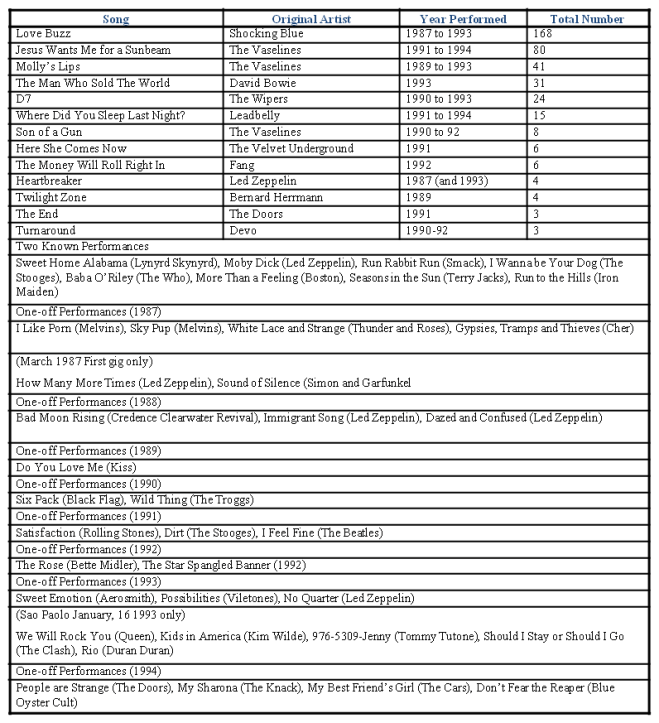
In terms of cover songs, the band introduced some 64 songs to their known performances though shreds of other songs did appear (i.e., The Who’s I’m a Boy, Bette Midler’s The Rose for example.) The table below shows every cover song listed on NirvanaGuide.com:

Nirvana Cover Songs_Total

Given the sheer number of songs the band attempted live it’s likely that the unknown set-lists and missing recordings actually conceal a significant number of other renditions. I don’t have that faith that many unheard Nirvana originals are hidden there, but I’m fairly comfortable believing that the band attempted other covers — they seemed to use cover songs as a way of covering up the ‘logistics’ of stage performance whether restringing guitars, checking equipment and so forth. Many of the performances are just snatches, not full songs, but the quantity is impressive. On the other hand, reading the list, it’s hard to equate the hard rock orientated direction with the declarations of punk or alternative rock fidelity — The Wipers, Fang, The Knack, Viletones, The Clash, Black Flag, Melvins, that’s it on the punk front, the rest is firmly mainstream, solidly pop rock.

Sao Paolo, sadly, features as both the most extensive set of covers the band ever did live…But it’s famed as a concert the band could barely be bothered to play. One element I’d draw attention to is that, once fame hit and the Nirvana experience went sour, quite a few of the covers were increasingly sarcastic, sneering jibes aimed at the band’s own success; My Sharona, the whole of the Sao Paolo event, The Rose and The Star-Spangled Banner, The Money Will Roll Right In. It’s a shame the use of cover songs lost so much of its happiness. MTV Unplugged in New York was also another performance of that year that depended on covers but we’ll discuss it later today.

Nirvana Covers_1987-1994

The sheer quantity of songs the band introduced is incredible. At first there’s a cover used in every early month for which a set-list exists which suggests the band was bulking out their set with covers. But the run the band goes on from late 1989 through 1991 is impressive; half of the live covers appear between November 1989 and December 1991.

Nirvana in June 1994

http://www.guardian.co.uk/music/2012/dec/14/courtney-love-nirvana-paul-mccartney

The only person that would be… with Kurt as of June ‘94 … and would still be…Was Pat. They broke UP.” Quite a quotation from Courtney Love, never exactly short of words worth chewing over. Though her ungenerous attitude is sad to behold, I admit I really can’t doubt the truth of what she says — as usual, Courtney’s problem is being far too sharp and intemperate in her comments, not that she’s inaccurate, unintelligent or a liar (she’s rarely any of these things.)

In 1994 the only person Kurt invited to collaborate, while out on tour, was Pat Smear as described in an exclusive interview on The Internet Nirvana Fan Club from 2002. As an aside, the suggestion that Pat should add a guitar part to You Know You’re Right seems to indicate that the song might have been intended for release in that form and as a Nirvana song; but March 1994, the last collaborations, look like nothing usable or worthwhile being achieved.

The decision to simply ignore the deadline for deciding on Lollapalooza is a very consistent behavioural pattern of course. In past years, having decided to essentially sack people from the band, Kurt’s approach had been to avoid the conversation altogether unless it became essential. In 1994, the idea that he simply sat on his hands and waited for everyone to draw their own conclusions is an entirely normal way of behaving, for him. The fact he continued to invite Pat Smear to be present says everything — this was not a guy who continued to hang around with discarded band members or associates, when they were gone, they were gone.

The tense incidents within the band; absence of substantial collaboration 1992-1994, the falling-out between the Cobains and the Novoselics in early 1992, the argument over royalties in mid-1992, Krist’s disgust at Cobain’s low effort in Sao Paolo in January 1993… It doesn’t look like a functioning unit. Courtney is, sadly, right as far as the evidence shows.

Anyways, in the meantime, at least the surviving members of Nirvana remain on cordial terms though the chances of a more formal collaboration has been ruled out:

http://musicfeeds.com.au/news/dave-grohl-there-wont-be-a-nirvana-reunion-tour/

Nirvana Originals Live: Month-by-Month 1987-1994

Nirvana Originals_1987-1994

Nirvana played some 67 original Kurt Cobain/Nirvana compositions in the seven years the band performed live. Yet it becomes very clear how low on fresh material the band were getting in the years post-fame. A grand total of 58 of those new additions to the set-list came prior to the end of 1991. To borrow a phrase from the British monarchy, it emphasises that 1992 was Nirvana’s annus horribilis with only Tourette’s, a song that almost counts as Nirvana’s only officially released instrumental (the lyrics aren’t exactly a priority with that track), entering set-lists. 1993 rapidly ran out of steam too but that’s well-known; post-October not a single new Nirvana original. What concealed the weakness of Nirvana’s archive was the way so much material was carried over from prior to fame, enough material to fuel half of the In Utero era releases. It also emphasises how many of the new songs developed in late 1992/early 1993 were considered throw-aways even by the band, jammed together at the last-minute thanks to an album deadline; Moist Vagina, I Hate Myself and I Want to Die never enter the set as far as can be seen.

It’d be more understandable if performances of new songs in the early years were missed; there are greater gaps in the available record of set-lists. Post-1991, however, at least 75% of set-lists are known for each year – it’s far less likely there’s an error or that fans have overlooked a song. As the clearest example, as described in the book Dark Slivers, it’s highly likely that Big Long Now was played sometime in the first half of 1989 given other supporting evidence and despite the absence of an actual live recording.

Nirvana were also comprehensive in their use of the live arena to road-test material. In fact every Nirvana song released on a compilation or single appeared in concert…Until 1993 where we’re missing Marigold, Moist Vagina and I Hate Myself and I Want to Die – only the well-known (and persistent) Sappy reappeared. In the early years it’s only the songs that Kurt never shared with the band – Don’t Want it All, Beans, Creation/Bambi Slaughter/Bambi Kill (unknown real name) – that don’t appear though Mrs. Butterworth never, apparently, made it out of the rehearsal room. That desire to enliven the band’s own experience playing live, by playing songs they hadn’t attempted before or often, was a very strong feature of the ‘fun years’ of Nirvana. But it apparently went missing on the In Utero tour…The stability and lack of freshness is so clear.

Nirvana Live: New Songs By Month 1987-1994

Around May I started working on a spreadsheet showing each month in which a Nirvana song appeared. Understandably other priorities (i.e., writing, re-writing, re-re-writing Dark Slivers) took over and it was unlikely I was ever going to finish.

…Until that is my friend, Mr. Shrikant Kabule, took a shot at it. My absolute gratitude to Shrikant for his hard work on this! I was thrilled to see it! He focused on one objective – showing when Nirvana played a new song or cover:

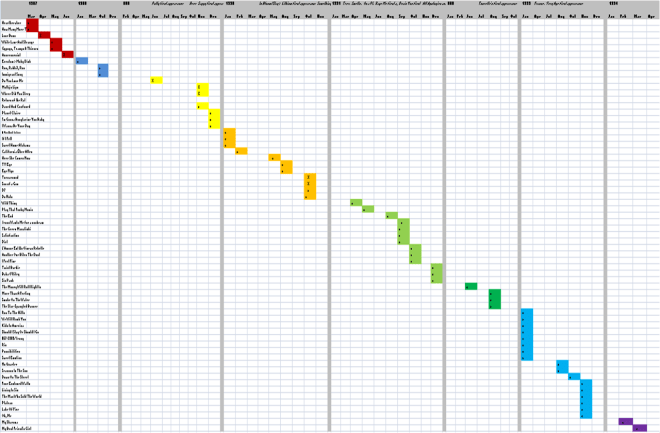
Songs_Live_By Month_1987-1994

As you might be able to tell, we’re going to have to take it piece by piece, but what I wanted to focus on today was the overall pattern; essentially Nirvana played a new original, or a new cover song (or slice thereof) almost every month during which they performed live throughout their entire career for which a set-list, or part thereof, exists.

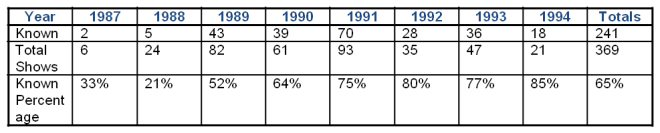
Using the stats at the Nirvana Live Guide (check it! It’s brilliant – thanks to Kris and Mike) its amazing to see how many of Nirvana’s setlists are known in full (241 of 369 shows):

Set Lists 1987-1994

The gaps in the record of the early years make it likely that covers and originals have been overlooked (see Dark Slivers chapter Songs The Lord Taught Us for discussion of Big Long Now) but the later years are heavily covered, particularly 1992 and 1994. This makes the trend stand out even more – up until 1992 there had only been two months (December 1988 and March 1991) in which no unheard material was performed. Suddenly in 1992 the band perform in seven months yet there are five months in which they play no new songs. In 1993 there’s at least a fresh flush of covers and originals but again, it tails off until, from December 1993 onward the covers of My Sharona and My Best Friend’s Girl are the only things they can come up with.