Buzz Osborne Ranting About Cobain and Montage of Heck — So What?

http://thetalkhouse.com/music/talks/buzz-osborne-the-melvins-talks/

The media landscape is all about opinions – people giving their views. The debates over what they say hinge, firstly, on the basic test of ‘provable lie/fact’ then, if that can’t be answered either way, secondly, on a questioning of legitimacy. In the case of Buzz Osborne speaking about the accuracy and/or merits of “Montage of Heck”, Osborne kicks off that game by stating the case for his authority at the start (in summary; I was big buds with Cobain and the Nirvana boys and played shows with them from start-to-finish.)

There’s definitely no disputing his centrality to the Nirvana story (re: https://nirvana-legacy.com/2012/11/24/no-melvins-no-nirvana/) and his presence as a witness – Tad may have played far more shows with Nirvana (enter “My Friends” into the search bar on here to check the stats) but Melvins played with Nirvana across more years – five of seven years of the band’s existence – than any other and that’s ignoring Cobain’s pre-Nirvana outings with either Dale Crover or Buzz Osborne. The issue, however, is that his legitimacy as a witness doesn’t have much bearing on whether his views on “Montage of Heck” are worth much.

Osborne states three elements are untrue; Cobain’s self-told tale of his failed attempt to lose his virginity and to take his own life; Cobain’s claim to having had stomach issues that predated, were an excuse for and independent of his drug addiction (again, legitimacy; Osborne is a former heroin user so could be deemed to know that of which he speaks); then Courtney Love’s tale that the Rome suicide attempt was provoked by non-consummated cheating.

In the first case, Cobain’s claim that everyone in school knew about it does seem overblown – but ultimately all the story illustrates is that, if it was a fiction, then Cobain had one sick and slightly morbid imagination for grim detail, and if it was true then he was a pretty morbid fellow who perceived people were talking about and criticizing him. It doesn’t undermine the overall picture or necessarily say charming things about him. On the second question, again, I admit I feel there’s substantial room for doubt regarding the nature of Cobain’s stomach issues – given the evidence that he was using drugs of one sort or another throughout the Nirvana years, given the disorganized dining arrangements resulting from poverty plus touring, given his apparently fussy eating habits, disentangling drug challenges from medical challenges seems tricky. Again, Cobain seems to have believed in his stomach issues, but there’s room for doubt over their origins. On the final point, about what provokes the Rome suicide attempt – well, I’m guessing we’ll never know for sure. Certainly Courtney Love’s relationship with gospel truth has been an unstable one and I’m far from granted Cobain psychic powers either.

Thing is…Osborne’s point doesn’t seem to be to argue for some more positive vision than what the film suggests; he sums up the entire second half of the film as “malodorous, doped-up rock & roll miscreants deeply fouling an unsuspecting apartment.” His point regarding Cobain’s stomach issues is that Cobain was a lying junkie. His point on Courtney Love seems to be that she was a lying CHEATING junkie. His point about the ‘retard’ tale seems to be that Cobain was a liar. Osborne has been on record before basically in a self-righteous growl about how fed up he is of talking about Cobain, how Cobain was a “fucking loser,” and how much he despises Courtney Love – this doesn’t seem dramatically different. His issue seems to be with the narrative of the damaged teenager growing up into a damaged adult who ends up in a damaged relationship…Except he’s in total agreement with the last two bits of that.

A separate point was made at the Seattle Q&A for Montage of Heck by Alice Wheeler:

http://www.seattletimes.com/entertainment/music/qa-kurt-cobain-doc-director-gets-a-mixed-reception-in-seattle-video/

Wheeler’s point is that the Cobain she knew was a pleasure to be around, a nice guy – the “Courtney’s view” she objects to is that air of morbidity that clings to Cobain and that the film certainly doesn’t dispel. I heard a similar perspective from a friend who knew him during the Tacoma/Olympia days who, again, thought the film chopped out those years of Cobain altogether. They have a point – that Cobain wasn’t always gloomy, or sad, or unfunny, or gross…But the film’s focus was on two things; his childhood upbringing and his own marriage and child. The Nirvana story has been fairly well-covered and the film deliberately reduces the band story down to shreds of imagery rather than retelling a story that’s been told over and over again. Criticizing the film for not being a different film – a band documentary – would seem harsh. I can understand though that losing those crucial four years where Cobain seems to have been a popular presence in town, someone who wasn’t outgoing but was warm and friendly and enjoyed his band…It’s sad that little window wasn’t opened. But then again, if that wasn’t part of the footage and material that exists in the Cobain vault, if no one was able to capture it, then it’s hard to make a film of it.

Morgen’s film is set up as a mirror – Cobain’s parents’ marriage and his upbringing versus Frances’ upbringing and her parents’ marriage. That’s where the film’s focus is and it does that successfully using the materials available. Morgen does show Cobain had a multifaceted character, that he was humorous, that he did take pleasure in his success, that he could parody himself…The film can’t ignore the rather grim tale of Cobain’s artistic creations, self-image and self-reporting even though it does mitigate those elements. Intriguingly it seems Osborne would like to see the tale blackened further to show a lot more of the squalor of the final years. Krist Novoselic and Cobain’s parents and sister all tell their parts and the audience is given credit for intelligence and is allowed to pick the bones out of their stories – I think that’s respectable and brave, to allow audiences to make their own minds up. I thought that Cobain’s mother was still spouting bile at her husband several decades after the end of the marriage which gave a telling indication of how poisonous the atmosphere must have become and why Cobain’s own view of his father might have been damaged further if that’s what he was around; I thought her tale about “buckle up,” sounded like nonsense but at least showed Cobain being proud of his success; I thought she looked scarily like Courtney Love does too. All those points don’t invalidate the film – they make it interesting.

It seems Osborne would like a film that shows Cobain as the dupe, rather than the partner and co-conspirator, of a ‘devil woman.’ His claim that “90% of Montage of Heck is bullshit” seems to be a case of Osborne letting his dislike for Courtney Love and his renunciation of his own druggy past overwhelm critical distance or assessment of the film. I certainly don’t hold that Osborne’s legitimacy as a commentator makes him the arbiter of truth or fact in the story of Kurt Cobain. Osborne is just one more truth added to the pile.
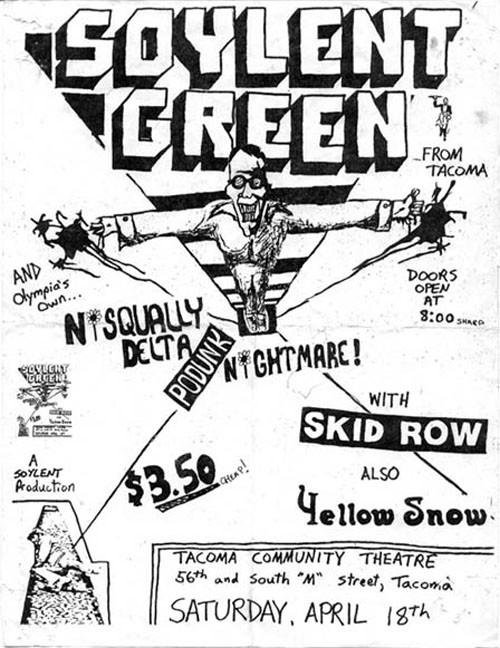
“Bands Who Played With Nirvana”: Part One — Soylent Green

soylentgreenflyer

Shows Shared with Nirvana:

  • April 18, 1987 — Community World Theater, Tacoma, WA
  • June 27, 1987 — Community World Theater, Tacoma, WA

I’ve been rather blessed these past couple years by the Purkey brothers, both Bruce and John were a huge support during the work on “I Found My Friends.” Today I’d like to focus on Bruce’s band Soylent Green who played alongside Skid Row (A.K.A. Nirvana’s incarnation for much of 1987.)

http://www.youtube.com/watch?v=Io7eYW_30ao

Bruce Purkey — The band I was in previous to Soylent Green, The Grind, featured Kurt Flansburg on lead vocals. (he was later in Dangermouse.) At the time he was in our band, he was dating Tracy Marander, so I got to know her pretty well. I am sure you know that name…

My brother and I grew up in a pretty boring house-hold musically. My parents listened to the worst of 70’s AM music. They didn’t really restrict us from music, but they also didn’t really encourage or help our musical tastes grow. By the time I reached Jr. High, in the late ‘70’s, I was mowing lawns and doing chores, earning money to buy my own albums. I started with KISS and Judas Priest, Scorpions, AC/DC, catching up on all the rock that had passed us by. Before long, my two friends and I were ahead of the curve, leaping head-long into NWOBHM with bands like Motorhead, Iron Maiden, Saxon, Tygers of Pan Tang. We were deep into heavy music at that point.

In high school, I and my friends George and Bill, would take art classes pretty much just to make our own Motorhead and Saxon t shirts. It was in this class that we met a kid who was into punk. He made us a mixtape of Killing Joke, Sex Pistols, Circle Jerks, Black Flag, Dead Kennedys. We were hooked. It had the aggressive edge of metal, but was actually about something. It seemed more primal and really tapped into all of the feelings we had as teenagers. In addition, it seemed accessible. We were never going to take the time to reach the technical prowess of our favourite metal gods, but even we might be able to start a punk band. So, there it started, we were going to buy any punk we could find and try to start our own band.

I bought a cheap guitar and a shitty amp. My little brother John, only 12 or 13 then, had a couple of drums, my friend George got a bass and amp, and my friend Bill would sing/scream. We came up with a band name, ATG (Against the Grain). It seemed suitably anti-establishment. Little did we know, we were literally one of the first and only punk bands from Tacoma. We played a couple of house parties, my brother John’s Junior High School, then John met some other punks from across town  — real punks with a real punk rock house. John Grant, one of the guys from the 56th Street house, AKA the Hell House, enlisted John into his own band, Noxious Fumes. John played with us too, for just a bit longer. Next Bill got his girlfriend pregnant and left the band so we got John’s friend, David, to sing and changed our name to Vampire Circus. That band only played a couple shows — most notably a show at The Tropicana in Olympia, where I got to play through Buzz’ (Melvins) amp — before my brother left the band for good. Without him we had to start again. The band reformed with Shawn (later guitarist for Subvert) and Kurt (later singer for Dangermouse), plus a second guitarist whose name I can’t recall. George was really into skating by this time so we ended up renaming ourselves The Grind, partly to describe the music, partly as a skating reference.

So, it’s ’83-’84 by now, we start playing a few shows in Seattle, mostly at a place called the Gorilla Gardens. It was an abandoned movie theater split into one side which would usually have metal acts while the other side had punk acts. Again, times changed, our second guitarist moved to California, Kurt moved on, so we turned into a four-piece with myself on guitar, George (the other founding member) on bass, Matt on vocals and Fred on drums and now became Soylent Green. As you can tell, I’m an avid movie fan hence why I always pushed for horror/sci-fi movies as band names hence Vampire Circus (Hammer Films) and Soylent Green. Fred’s father owned a meat packing plant, Crown Meats, so we made that our practice space. At first, we tried practicing out in a storage shed, but it had metal walls and was very noisy. For a short while, we actually practiced in the meat locker, surrounded by sides of frozen beef (think Rocky). Once again, it was very cold and the concrete echoed. Eventually, we moved our practices to the sales office. It was warm, well-lighted, carpeted. We dreamed of recording a single or album, but sadly never did. Finally, we decided to just record our own tapes and sell them at shows. We rented a multi-track PA mixer from a local music shop and recorded our music live straight onto cassette. It was very rudimentary, running, essentially four mics to a stereo mix, then flipping the tracks to even it out and dub copies. We made two demo tapes over the next year or so, even selling a few copies. We had a few fans, but mostly just played for fun and an excuse to go to lots of shows and hang out with people. After the summer of ’87, I went to college in Bellingham and the band broke up for good.

Before and after The Community World Theater, there were not a lot of band-friendly venues. Most of the venues were pretty quick to close down, or just bars, rarely good to bands, pretty much paying them little to nothing, run by people who didn’t really love the music scene. The Community World Theater was a rare thing. Run by Jim May, one of us. He didn’t make anything on the venture, I’m sure. It was probably a huge headache and I would guess it lost him money, but for a brief moment, the kids had their own place to play. Sure, it was a former porn theatre with no heat and a shitty PA, but it was ours. It is no accident that The Community World Theater is remember fondly by most everyone who ever played there, or saw a show there. It was as if for a moment, the punks actually ran things.

http://www.youtube.com/watch?v=421W5SmQowM

You’ll notice the “no dancing” sign isn’t always present. If I remember correctly, that was behind the movie screen. What Jim May used to do was set up the headlining band’s equipment behind the screen, then, when the earlier bands were done they would just take their equipment off-stage, raise the screen, and the final band was ready to rock. I think this night was one of the few times we headlined. Frankly, we weren’t near as good as Skid Row, but at that point, we were more of a known quantity.

And I drew the flyer for the Nisqually, Skid Row, Soylent show.

An Interview with Bob McFadden: Nirvana’s First Drummer

Profile pic

I was reading an early interview with Nirvana a couple months back and at one point they’re asked about their history with drummers. This is during Chad Channing’s time on the stool and Cobain replies “Is Bob in…Should we count Bob?” Novoselic and Cobain eventually decide not to count Bob McFadden. On that occasion, however, the band are being so strict with their timeline that they also state that Nirvana didn’t form in Aberdeen, “…as Nirvana we formed in Olympia and Tacoma…” Which is technically accurate but overlooks the tentative period from mid-1986 through early 1987 when ‘something’, a no-name-band at the time, was starting up. It made me curious to learn more about Mr. McFadden — what role had he played in the first foray of the Cobain/Novoselic five-year-plan?

I browsed the books — there’s barely a mention. A few comments online and that’s it. So, here I have to make an immediate thank you to a friend who was willing to pass on a note for me. Within just a few hours I’d received a very polite message back and was able to explain that my sole desire was to hear a little more about the time Mr. McFadden spent with the future stars. Hope it’s of interest — from my side it was a pleasure, a really enjoyable conversation with a really pleasant fellow. In summary, in August-September 1986, for a period of up to four-five weeks, Mr. McFadden was invited to be part of a new band just getting together…

Bob McFadden, first man on the Spinal Tap roster of ‘Nirvana’ in its early years, thank you.

Bob: Years ago I had a chance to do a couple of interviews but I was in a place in my life where I was a little selfish and I declined. Nice to have it come back around. I don’t know how much I have to share but if you’re interested and your heart’s in the right place then I’m happy to share a little of my history and feel pretty good about it.

Nick: Your name’s come up again and again with regard to the Nirvana story and yet, looking through all the books, you’re kinda not there. But I was reading an interview the other day, a very early interview, where the interviewer asks Kurt and Krist how many drummers the band has had and the first thing Kurt asks Krist is whether they still start with Bob or not… I just wanted to flesh out what that time was — my first question was what was your story? There was quite a small crew into the punk scene in that area, how did you come to be part of the crew?

Bob: I grew up in Aberdeen, that’s where I went to elementary school and high school. This was pre-grunge movement and though there were a few punk rockers around Aberdeen most of us were just in cover bands and doing covers of Black Sabbath, Led Zeppelin, some of the old rock n’ roll. That’s what we were getting together and rehearsing then we’d go out and play the parties. I never envisaged myself as a musician then seventh grade jazz band I was asked to play the drums — never studied it but I was asked so I got up there and kept the beat. Guess I got bitten by the bug — it intrigued me — and I ended up getting a kit then hanging out with a bunch of people, the Dale Crovers, the Aaron Burckhards. There was just a little clique of us who hung around and jammed a lot…

Chris Novoselic’s brother — Robert — me and him started a thing with Evan Archie and ended up doing a lot of parties. So I was always going over to Chris and Robert’s house to do some rehearsing — which is how I met Chris, it was actually through his brother Robert. There weren’t many venues up there — we were really young, still in high school, not really thinking about that as a career. Fast forward a little bit, I’m still hanging out with Robert while Chris was actually playing guitar for us in that little cover group. I got approached by Chris late in my senior year, maybe right after, and that’s when he asked me to come hang out with him at Maria’s Hair Salon and sit in with him and Kurt.

I didn’t actually know Mr. Cobain very well. I’d seen him around some of the parties and some of that scene, but he was a pretty quiet, reserved guy. So, I was asked by Chris to come and sit in so I met them over at Maria’s Hair Salon — I was only there for a few short weeks and that’s why you won’t see my in a lot of the publications because I was only involved pre-Nirvana, in the really early stuff. It was brief, just a few weeks of me going over and we’d rehearse two-three times a week. I have to be honest I just didn’t get it. I didn’t get what they were trying to do. Unfortunately! Because a couple of years later they’re properly produced and they’re ‘NIRVANA’ of course! I didn’t get it, I didn’t understand the movement that was taking place. It is what it is. Back then it wasn’t all put together nice and neat in the studio, it was pretty raw, I didn’t get what they were doing — I was used to doing cover tunes and this was all brand new to me.

Then I had to make a decision. I was talking to my girlfriend, who became my wife — Mrs. Tina McFadden — she was asking me what my plans were; “are you going to work and have a family or are you going to go out on the road?” And at that point I had to make that decision; did I want to go do this music thing, or was I going to raise a family and join the working class? I’m really glad I chose the path I did because I have two beautiful daughters — Kayla and Kenzie — a good career and I still know some people in the industry so — bonus. Had I chosen that rock n’ roll path I may not be here today talking to you. If you go into it thinking of it as a job, in an industry, I think you’re a little better off but some of us get a glorified vision of what it’s about. Today that’s how I think of it — people getting together and making this product and then putting it out into the market then you go out and play to show it off — but back then that’s not how I felt and that wasn’t my vision of what rock n’ roll was all about. But yeah, at that point all of us had a vision that this could go somewhere — we all wanted to go do that until I had that discussion with my girlfriend and got some perspective on it. Everybody we were hanging around with was trying to break out.

Nick: So, it was known locally you were a drummer and Chris approached you around the time you finished high school?

Bob: Yeah I was still playing with Evan Archie — he was now the guitar player in the band — and Robert Novoselic, Chris’ little brother. We were doing some things, starting to play small clubs, couple of wedding receptions, that type of thing. Very semi-professional stuff. And Chris just came up to me one day, “hey, I’ve got this guy, you want to get together?” And I was just “sure, I’m up for anything.” So that was it, we got it together. Like I said, it was just for a brief three—four week deal and I bowed out gracefully and off they went. It was ’86 but it’s a long time ago so it’s after graduation in June but I’m guessing we definitely started off around summertime — sometime around August.

Chris and Kurt had some material written but they needed someone to help out on the drum track portion of it. So they definitely wanted some input — like I said, I don’t recall all of it, but they had songs and I just didn’t understand what they were trying to do. Kurt seemed in charge of what was happening — Chris would always give his input even when we were doing cover songs before this. Chris had great vision, I was always able to envisage him producing things because he had a lot of good insight. But mostly Cobain was the driving force. I’d call it a democratic process, just with a leader — we all got our say. I’ve listened to a lot of Nirvana but I don’t recall anything that I’d played on at that time, nothing I remember.

Nick: And Maria’s Hair Design was the only place you practised or were there other places?

Bob: For this particular thing it was Maria’s — before that Chris was part of what we were doing at his house. I remember Kurt showing up a few times there, playing some covers. But this period at Maria’s was geared toward a particular thing which was putting together what their vision was. I think they were trying to put this thing together and to go do what they did — but unfortunately I couldn’t see that. Kurt and Chris played together comfortably — I’d say they were very comfortable with each other. I remember they had a Tascam four track recorder hung up with one microphone in the center of the room so they could do some playbacks. They seemed serious about what they were doing.

Nick: Do you remember a day where it felt ‘right’ where it felt like “yes, we could do this!”?

Bob: I don’t recall. Typically people only remember the worst but I’m sure there were points where we gelled as musicians and it felt right, felt good. I don’t remember contributing anything specific — I’m the kind of guy who would have said something if I’d had something to add, but it’s a long time ago and I don’t remember. Worth asking, you might jog a memory or two! It was quite a serious time commitment at the time — pretty organized. They knew where they wanted it to go and it was pretty well-structured. So they’d put some thought in before they contacted me and made sure they had their material together. I’d taken a little time off music in order to finish and graduate high school so in that time I think they were getting together and pre-rehearsing it because that was what Chris said when he first spoke to me about it, that they had stuff ready and they wanted to see if they could get it worked up. I think they wanted to find a drummer so they could go to a studio, record a demo, then go do the clubs. It definitely seemed they had a vision. I didn’t practice outside of playing with them because my drum kit stayed there at Maria’s so it was just about showing up and playing when we got together. I just remember they were working well together and I think they had that vision…

Nick: Do you remember the kinds of covers you were playing together at the time while you were at Maria’s?

Bob: Just the classic rock n’ roll — Black Sabbath…We played Cream, Sunshine of Your Love was on our list for sure. Mustang Sally — that was one of Chris Novoselic’s favorites but that’s because he was playing a Fender Mustang around that time which is why he liked it so much. Chris was always kind of reserved — you’d never think it when you see him stepping out with the bass in his hands, or now when he’s doing the political stuff. You’d never know he could be a quiet guy — I don’t think he ever wanted to be a front man.

Nick: How did things end?

Bob: I recall having that conversation with them. We rehearsed and I cut that off a little early and said “hey, I need to talk to you guys — I’ve made a decision…” and then I broke the news to them, packed my kit up and headed home. I didn’t just leave them hanging in the wind. I wish I had the recordings just for memorabilia sakes, I know a gentleman who does — I don’t know if it was my recordings at Maria’s but he just sold them back to the Cobain estate. I don’t personally have anything from that time frame.

Nick: Did you learn back then that Aaron took over from you sometime after, around November or December?

Bob: I actually didn’t know about Aaron until just recently — literally a couple years ago — I didn’t discover that Aaron had been a big part of that until some of the stuff with him on it got released. I see he’s back in the scene, he’s playing with some fellas and doing that, good for him. I’m glad to see him back out!

I know that at one point I harboured a few feelings just out of jealousy — just because I’d not become part of what happened to them. But I worked through all of that really well. But I know some people in the area, people in the scene, who went through a lot of dark stuff because of what happened to Nirvana and had a degree of envy because they weren’t a part of that. It’s weird when you’re friends with somebody and suddenly they’re famous and you’re not. It’s human but most of us move on and I definitely have. I didn’t stay in touch with Chris or Kurt once things started happening to them. I’m still in touch with Robert, Chris’ brother. I’d love to have a cup of coffee with Chris, see where he’s at in life, but I don’t want to feel like I’m intruding given how much he must get contacted by people.

Managing the Cobain Legacy – How Does One Create Lasting Memory and Appeal?

Times change.

Sure, some artists will always have a place in musical histories – but that’s not the same as giving them a vibrant posthumous life. This is a simple consequence of life; musical tastes change as generations succeed one another. The greatest shifts in music in the past half century were the handover of the baton from classical to jazz, from jazz to rock, from rock to hip hop/R n’ B/urban (I’ve long since lost track of what to call it.) Sat in a darkened cinema that seats perhaps fifty people, seeing there were still seats for “Montage of Heck” free – it certainly reminded me that Nirvana weren’t as big a force in the U.K. as they were in the U.S. and that Cobain’s enduring appeal isn’t as total as it might seem among fan circles.

Nirvana circles are constantly caught between a number of kneejerk reactions that can be read in the comments sections beneath most articles online; firstly, “can’t we stop exploiting the guy? Isn’t this done? Can’t he rest in peace? Do they have to keep pumping out new material when only the three albums plus Incesticide are essential?” The second, “why aren’t they releasing X known archive recording? Where is the official release of Y? Can’t the record label get it together and put Z out after all these years?” It’s a feast or famine narrative; one part of the audience has had enough, one part wants more. Someone somewhere has to arbitrate between these two audience segments and ensure the conversation keeps going if a legacy is to be supported.

Before that, there’s a basic legal decision to be made. Many fans get caught up in the acquisitive urge – the idea that a creative individual’s works ‘belong’ to the audience rather than to the family, friends and loved ones of that individual. It’s usually couched in the language of freedom (the same way conservatives couch the withdrawal of government support for the needy as a way of giving those people freedom) when I’d have to say the idea of stripping an individual of any rights to define the inheritance they leave to others, or of stripping those others of any right to benefit, seems unjustifiable. The individual’s will is always the first step same as for a house or any other property. Next the family claim wherever rights aren’t owned by third parties (record companies, publishing companies, management companies, etc. all of whom have paid an artist – and had their payment accepted – for a particular component of the rights over the works under discussion) There’s nothing to stop fan communities bidding for such rights and purchasing them of course but in the meantime the rights are defined by these agreements. Those stakeholders need to decide what they wish to do – do they even want the work involved in managing a legacy when posthumous rights are such amorphous and difficult legal constructs?

Many personal wills and inheritances are disputed or leave various parties dissatisfied – imagine how much more complicated this is when the inheritance under discussion consists of business rights, commercial shares, ongoing financial relationships rather than simply a house and its contents. The aftermath of the Sex Pistols, of the Beatles, of Elvis, of Hendrix – all were beset by years of legal wrangling before a cleaner approach could emerge without a fudge of arguments, writs and protests swamping the positive celebration of someone’s work. The resolution of this overhang of business seems to be crucial – in the case of Nirvana it caused a cessation of releases from the time of “From the Muddy Banks of the Wishkah” in 1996 until the greatest hits and “You Know You’re Right” in 2002. The legal bedrock needs to be solid before a legacy can begin to address what fans want.

At this point – if a memory isn’t to fade – new material, new content, new information is needed and it needs to spark several reactions; newcomers who haven’t experienced the artist need to be provoked into being curious enough to learn about them or hear them; people who grew bored of them need to want to pick them up again; those who remain devoted need the least work really but still need to feel simultaneously interested and like there’s more to come. Flooding a market with product lessens the impact, creates over-familiarity, achieves little additional benefit for all the extra cost and effort involved – it’s a waste. It’s also inhuman, it takes no account of the fact that hearing a new live recording every couple years might remind one of what one loved about a band but hearing 100 live takes of the same song all at once just provokes disinterest. Releases must be managed to ensure warmth of feeling persists, that continued fandom is rewarded regularly, that interest is staggered to catch new age groups, that boredom and over-saturation doesn’t set in.

Legitimacy is also crucial. Elvis Presley’s reputation suffered mightily during his lifetime from cheap budget releases and an over-proliferation of repetitive live recordings. It took time after his death to pause, restore respectability to the catalogue and the perceived ownership and to proceed from there. The legacy of Jimi Hendrix had a similar challenge; while the first few Hendrix archive releases were appreciated the decisions being made by the mid-Seventies to overdub and re-make tracks meant the authenticity of the resulting recordings was increasingly in doubt. Again, it took a substantial reset – the acquisition of rights to his music by Hendrix’s family, the setting up of Experience Hendrix – before the credibility of the catalogue returned. Interference with recordings isn’t such a challenge in the case of some musical sources; Michael Jackson’s catalogue is a fair example – his vocal is deemed the crucial requirement so updating the backing tracks, updating the collaborators, tweaking the sound is all deemed (within reason) acceptable.

Over-saturation is always an issue. Tupac Shakur’s vast archive of studio vocal tracks left rich pickings for his record label (Death Row) and the business his mother set-up to manage his affairs. The deluge that followed over the decade after his death, unfortunately, exhausted much good will; two disc compilations ever two years were so lengthy they were tiring to listen to and exposed a lack of differentiation or development that might have been less obvious with slimmer releases; the choices made musically often seemed to the detriment of Tupac’s impact; side-bar releases (a live record, two volumes of remixes, various unofficial compilations of early material, the movie soundtrack, reissues) created a jumble in which it was hard to feel any new release was notable or special. All this material failed to quell the call from some quarters for ‘the original tapes’ to be released, or the sense that there was yet more to come – the fanatics still wanted more long after most people had stopped looking. By the time the Tupac campaign shriveled down to one disc releases (the Eminem-helmed release, the soundtrack, one final Tupac disc overloaded with collaborations) it seemed to be a response to dwindling material of quality rather than a decision based on paying attention to audiences.

Joy Division went down a similar – though slightly different path starting at an earlier stage. A well curated leftovers release, “Still”, hit right back in 1981 – a fine record at a peak of interest in the band. While that would seem to be a best practice (look at Nirvana’s “MTV Unplugged in New York” to see this in action) the subsequent development of the band’s legacy fell short. This was based on regular issues of ‘half heard’ compilations with the odd bonus thrown in – then a truly excellent box-set (Heart and Soul) which unfortunately made subsequent archive efforts look threadbare. At least the live shows were worthy of interest but sound quality issues are a heavy factor given Joy Division never made it to vast acclaim (and vast live recording budgets) during their lifetime as a band. It’s been a disjointed process. That issue of a lack of material impacted the Notorious BIG’s posthumous records – ultimately the guy didn’t record enough music to sustain a legacy though both his main albums are remarkable. The “Born Again” release required padding out with collaborations to make anything of the slim pickings of his vocals – “Duets” was even worse – the “Greatest Hits” was fair enough then the film soundtrack added next to nothing. Each made money, none really burnished credentials. Maybe hip hop just moves too fast for a legacy to ever last long – that’s a different question however.

Every back catalogue ends up dealing with the question of eking out a dwindling supply of material. Often this results in claims of exploitation of fans who end up paying in order to get hold of one, two tracks. The thirtieth anniversary “Never Mind the Bollocks, Here’s the Sex Pistols” reissues kept it simple; deluxe containing a good quality live show, super-deluxe containing some (fairly well known) demos plus the supposedly long-lost and recently rediscovered studio version of “Belsen Was a Gas” with Johnny Rotten on vocals, plus various other ephemera. After thirty years such limited means seems acceptable. At some point there has to be a projection of how long an artist’s critical cachet will last and therefore how to stagger releases. Being able to release new live recordings and demo dribbles forever might be possible but once there’s a bare handful bothering to listen there’s no point. This question would seem to emerge sooner rather than later in most cases; how long was it worth holding back Tupac’s music? How long is it worth holding back Kurt Cobain’s music?

In the case of the Beatles’ Anthology reissues there was at least a good portfolio of practices, warm-ups and early takes to refer to which satisfied fans. The challenge here, however, was that their legacy had been swamped in legal action for so long that there’d be next to no attempt to develop it properly – it all came too late at the tale end of too many re-parceled sets of known songs. Expectations had reached extreme levels meaning Anthology couldn’t fail to underwhelm even with the ‘reunion’ songs included – waiting for decades to discover scratch efforts, having to parse warmed over rock n’ roll or edited together takes of whatever…Whereas a gradual release of material over the years might have kept interest alive without wounding anticipation, what happened was too much all at once everything was over and done with between November 1995 and October 1996. It was a failure of scheduling that put too much attention on why leftovers stay leftovers when a gentler approach could have pleased many people.

Without careful bundling, quality and substance become crucial. The remastered Led Zeppelin issues were a triumph of modernity – a facelift on old friends. The extras included, however, were of limited interest and limited divergence from the known songs. Issuing songs with only one verse from Michael Jackson while foregrounding his name as if it’s still his record rather than a stitched up compilation ends up an embarrassing failure of honest and fair description which, again, wears down good will (and therefore potential buyers.)

Where does this leave us with the Nirvana legacy? Well, in my ‘umble opinion, the last decade has actually been a really effective performance and there is credit due to the various parties involved. Perhaps that’s a controversial perspective but let me explain further…

The MTV Unplugged album was a huge success – it’s outsold “In Utero” and has done much to mellow perceptions of Kurt Cobain, to open doors to his music that Nirvana’s noisier aesthetic hadn’t necessarily permitted. The rapid-fire timing made absolute sense. The next steps – issuing the last work Cobain had been really committed to (Live! Tonight! Sold Out!) in 1995 as well as the singles box in some countries kept interest alive and plugged a hole given Nirvana hadn’t issued a live record or a visual recording at that point. While From the Muddy Banks of the Wishkah was unsatisfying to many fanatics who were already gorging on live bootlegs it did provide a rapid-fire retort to the softer image of Unplugged and did no harm. The pause for the next few years could have been a challenge except it meant Nirvana’s reappearance occurred as a new generation discovered the band (take a look at the performance of most great artists and note most have a wilderness phase then rediscovery based less on quality of fresh output and more on new audiences after the generation that needed to react against it’s predecessors has moved on).

The Greatest Hits had the ‘golden ticket’ in the form of You Know You’re Right – there had to be a greatest hits at some point, it was a sensible reentry point (or starting point for some bands) and there wasn’t much debate on the choices made. It did what it said on the tin. The box-set struck a decent middleground – known b-sides, a slew of true unknowns, home demos, different versions, the DVD element. While fans gripe about the sound quality on some choices, that better versions existed elsewhere, it was still an extensive and pretty comprehensive entry. After this point Nirvana fans have had something to look forward on what is normally a two year cycle with DVDs and live recordings filling the hole until the anniversary releases came out.

The doubling up of album anniversaries and DVD releases has prevented over-saturation because the visual and the audio components are such separate entities. Time has been left in the schedule for people to yearn for something fresh each time. I think Montage of Heck’s release in 2015, two years after the In Utero anniversary campaign fills an appropriate hole and – again – adopts a multi-channel approach which prevents it clogging fans up or confusing them regarding what to choose. It also provides a narrative that gives legitimacy to the issue of Cobain’s more shredded and non-commercial pieces – I think it’s a clever move that will help deflect criticisms of its ropey nature. It’ll be appreciated as part of an attempt to show Cobain in a flawed and naturalistic light rather than as simply “the next archive release.”

The anniversary releases were, again, comprehensive mashups of the live and studio material that remains related to “Nevermind” and “In Utero” – it’s a shame there wasn’t a deeper look at the “Bleach” era but that release was relatively low-key by comparison to its successors and was no embarrassment. There’s been good logic behind each release, the exclusions and repetitions were kept to a minimum, it’s clear why the combinations of material used were put there. While some have queried the mixing efforts, or the absence of one or t’other song, those are minor complaints when judged against the wholesale rewriting of history that happened to someone like Hendrix, or the massively unsatisfied desires of Beatles fans or Led Zeppelin fans, or the threadbare results of the BIG effort. It’s been respectful, regular, neither gluttonous feast nor bone-thin famine.

The only missteps really have been “Sliver” in 2005 – a fairly pointless rehash of the box-set which really was open to accusations of cash-grab given the tagging on of extras only a year after the majority of the release had already been seen – plus the “Icon” greatest hits set that no one can figure out why it’s out there. That’s not bad for a twenty year old legacy that’s put so much material into the public space.

Is there more? Why yes. That’s the crucial element – there’s got to be more to keep things going, to keep the excitement. So sure, I’d like to hear Fecal Matter, Sound City Sappy, whatever someday…But I’ll wait. So far I’m pretty confident it’ll come because so far there’s always been something in the pipeline. It’s smart commerce and smart management and compared to the treatment of many artist’s work posthumously I have few complaints.

So…I Went to See Brett Morgen’s Montage of Heck and…

…And I think you should too.

No, really. I can say, hand on heart, Montage of Heck is the best film about Kurt Cobain and the Nirvana phenomenon ever released. I did a quick sketch a month back summarizing other films on the topic and it’s safe to say there’s nothing like this out there (https://nirvana-legacy.com/2015/02/18/nirvana-and-kurt-cobain-on-film/). There’s a strong echo of Live! Tonight! Sold Out! in the editing style that doesn’t seem accidental and I hope that sounds like a fair compliment; it looks like a video work Cobain himself helped put together. Gosh.

At the ICA in London the viewing was shown ‘at the director’s desired volume’ which made a real difference – I don’t think I’ve ever heard Nirvana material sound so good. The sheer intensity of the sound, often tipping right over into a whine of white noise, made the live footage feel as close as I can imagine is possible to being there. There’s a relentlessness about the sonic layer of the film, long sections clamp down on your hearing and won’t let go, whole spittle-flecked mad dog raging going on – then suddenly a sharp cut, or a switch to a single voice, numerous moments where the near silence becomes equally hard-edged and intriguing. Again, that surge and mute approach seems very ‘Nirvana’ – a fair indication of the deep attentiveness paid to all aspects of this film.

The talking heads aspect of the film is actually kept exceedingly brief – the conversations with Don Cobain, Kim Cobain, Wendy O’Connor, Krist Novoselic, Tracy Marander, Courtney Love are a way to add emphasis to key points, to flesh out various topics. I enjoyed listening to Jenny Cobain – she was a down-to-earth lady and I felt nothing but sympathy for the description she gave of this increasingly unruly (and even cruel) teenager. Don Cobain came across as a quiet man, at one point he seems to have tears in his eyes, but he can’t get words out – again, I can understand why he might be a difficult person to maintain a bond with. I was slightly creeped out noticing how similar Cobain’s mother and ex-wife look these days. Comments about the absence of Dave Grohl and so forth don’t really get the point – this isn’t an interview centred film. Most people are stripped down to a bare few sentences, each well-chosen. It means the words do stick in the mind. Wendy describing watching her son come home looking ever more destroyed by heroin was desperately sad. Novoselic’s emphasis and re-emphasis of how much Cobain hated being humiliated is a very powerfully made point.

There’s tight interweaving of key themes. Novoselic’s point about humiliation is then returned to in Love’s description of Cobain’s reaction to her ‘thinking about’ cheating on him, which in turn harks back to Cobain’s audio tape recounting an early sexual humiliation, which links to the present issues around masculinity and physicality that run through the tale. The family ‘issue’ is obviously core – it’s funny seeing the early footage of a Cobain family Christmas circa 1970 echoed in the Cobain family Christmas circa 1993. Each one positioned just before a collapse, a disaster. There’s a lot of skill involved in having a film appear to barrel along at this seemingly unhinged velocity while discreetly creating these connections.

It’s great how much of the ‘Nirvana story’ is let pass by-the-by. The big milestones are logged via imagery rather than dwelt on with wordy exposition – the film allows existing biographies (and the endless churn of articles year-after-year) fill that role while it focuses on showing Cobain himself changing and reacting. I’ve seen comments stating that x or y isn’t mentioned and should be – I didn’t notice. Tobi Vail maybe is the biggest absence but there’s so much of more interest going on that losing an on-off girlfriend from the mix didn’t strike me as a crucial or noteworthy flaw. Of far more interest was the film’s see-saw with Cobain’s family life and upbringing at one end of the movie – and Cobain’s family life and bringing up of his daughter at the other. While the stuff about Cobain’s childhood doesn’t add anything fresh to what is already known, the material focused on Frances Bean Cobain, Courtney Love and Kurt Cobain as a family unit is genuinely interesting because it’s perhaps the most detailed portrayal of that aspect of Cobain’s life ever seen. I’m not gooey about love and kids and so forth but there is something very sweet watching this young couple playing with one another, then watching them with their daughter too. I found it heart-warming and rather than feeling voyeuristic it stirred empathy and affection. Kudos! Like it! Watching Kurt, in bizarre drag, mimicking a letter Courtney reads out is both bizarre and funny – it’s also an indication of how connected the two seem to be, Cobain’s miming seems perfectly timed, Courtney’s words, his mouth. There are also plenty of moments where the physical similarity between the two is obvious, they’re very much alike.

The film certainly packs a punch the way watching any destructive path can be expected to. I did watch intently for the entire duration. The whirl of live footage, home movies, animations, cartoons, press interviews, studio footage, words on screen kept the accelerator pressed firmly to the floor. Notes of disquiet the film raised for me were that it quietly makes a very strong case for Cobain as poster-boy for mental health issues – the imagery taken from his artworks is almost entirely unpleasant, bloody, gynecological. Sure, most teens have a dark phase as they begin to expand their worldview and incorporate not just the fairy tales of youth but also the harsher sides of reality, but Cobain’s seems to extend throughout his rather short life. The well-known tale of his failure to sleep with a girl is disturbing not for the intertwining of suicide plans and sex, nor for the squeamish details of the girl’s unpleasant scent, but for the very fact that he took the time to perform the tale to tape – what for? Why? This endless self-documentation feels uncomfortable in itself. The early discussion of childhood hyperactivity and medication puts this theme front and centre, as does discussion of stomach issues and let alone the new theory raised about the reasons for Cobain’s suicide which – if true – does make him look manic. A few weeks ago I watched “Night Will Fall”, documentary film footage of the concentration camps (well worth a watch incidentally) and was shocked by the conjunction of images of skin-bone bodies being poured into pits then suddenly people walking or being held up, somehow still alive despite the seeming absence of any content to their emaciated bodies. There’s something brutal about the human body and in this film Cobain spends a lot of time half-naked and just looks so tiny. Beyond all the discussion – the statement from his diary claiming that he’d tried heroin ten times between 1987 and 1990 was a big addition to understanding of his use of chemicals (it looks unlikely that there’s a year from age 15 onward where he’s not on something frankly) – I felt the sight of his body made a silent case for there being something very wrong.

Wendy O’Connor’s sniping at Don Cobain – a man she hasn’t been married to in over three decades – did a neat job of undermining the ‘loving mum’ image, it’s probably the moment in which the problems in Cobain’s childhood stand out moststarkly; if this is the kind of spite and bile this lady can summon at this far remove, decades after the end of their marriage, it suggests the atmosphere in the house at the time must have been toxic. It made me feel infinite sympathy for Don Cobain who has received such harsh reviews from his son and others yet comes across more as chronically ill-equipped to deal with emotion rather than harsh or unpleasant. Already seen in the trailer, Wendy tells a tale of Cobain visiting in the autumn of 1991 and playing her a pre-release tape of “Nevermind” to which Wendy responds by warning Cobain that it’s going to make him a star (“better buckle up kid because you are not ready for this.”) I admit it still just didn’t ring true for me – one listen to “Nevermind” and his mum had the foresight to see he was about to become a runaway success…? I mean, fine, but Cobain himself still looked surprised and disarmed for the next few months after this supposed warning, it’s never mentioned by him in any interview, lots of people hearing that pre-release tape thought it was going to do well but I can’t recall anyone listening to it and thinking this was the next global smash in the making. It was clearly too good a story not to include but it’s one of the few moments where my immediate reaction inside the auditorium was to feel doubt about the honesty of what I was hearing.

I don’t have any time whatsoever for the murder theories that have circulated around Cobain/Love and seeing the couple together in this welter of home footage simply emphasised the unlikeliness of anything of that nature – yet, I’m not convinced of the new “Kurt felt I’d betrayed him just by thinking of cheating on him” tale. I mean, another one? Another tale…? I think I’m a bit jaded and fed up of fresh explanations. On the one hand, Love comes across as an intense being and it’s an intense topic she’s discussing so I can understand the bundle of hand activity she goes through when discussing it (cigarettes, water bottles, waves, etc.), on the other, not a clue what to make the tale. As a similar aside, Morgen has reiterated again and again that Love had no say in what went in the film – I certainly believe this is all his work but I have trouble believing any director would put this much footage of Courtney Love’s breasts on screen without any permission or sign-off of any sort. Frankly I can’t believe he’d leave himself that open to a lawsuit by not having worked out a very solid contract backing up what he could/couldn’t do with all this material prior to commencing the film. I really did get tired of seeing Courtney’s breasts by the way. This is not a sexy film though Cobain’s still photos of Courtney naked surrounded by flowers were remarkably beautiful.

Now…Do I have any criticisms? Well, yeah, I do. I’ll reemphasise that it is the finest film about Kurt Cobain and Nirvana ever made – it’s probably the only film I’d say is essential to the canon. Having said that, however, it isn’t “Senna.” The latter movie did an awesome job of bringing one closer to a genuinely likable individual, teased out the various threads of his being and life, had real zip to it, speed, momentum, fast motion. So a first difficulty here is that watching Cobain doesn’t make one ‘like’ Cobain particularly – he doesn’t come across as a particularly sympathetic character. In many ways its fascinating watching this much intimate and personal material yet feeling he’s still a closed book – the similarity between him and his father in this regard stood out for me. I think it’s a consequence of seeing someone who can talk about actions (“I planned to kill myself…I invited myself over to her house…I was grossed out so I left…”) but quite clearly has so much difficulty openly stating his feelings. There’s an intriguing match in the way that Jenny Cobain seems to do the talking for Don – then later there’s the sequence I mentioned where Courtney Love speaks for Kurt Cobain (which in itself points toward the way Courtney Love often spoke for Cobain in interviews and so forth.)

There are funny moments in the film, good lines, plus he’s a natural at playing with his baby – but, again, those moments where he comes across as amusing and quick-witted and self-depreciating are outweighed by the gory cartoons, the vicious one-liners, the harsh writing. The footage from MTV Unplugged toward the end is enjoyable and brings something new to this mix because he seems at ease and the wise-cracks are actually funny. This film doesn’t make the case for Cobain as a fun person to be around, it doesn’t focus much on him as someone concerned about supporting a wider musical community or particular social or political causes, it doesn’t show him as a friendly person…It’s not easy to warm to someone who is both distant and seemingly so self-centred.

“Senna” was also – by contrast – cut to the bone, whippet-fit. Morgen’s fandom is clear in that it seems he’s had great difficulty cutting things out. The film is overlong and it is over full – I’m a Nirvana fanatic and I still felt restless at points. The technique was usually to spend time advancing the plot, then suddenly there’d be a five-to-ten minute ‘drum solo’ in which imagery and sound was slung at the audience. It really was like watching a band suddenly derail a song with elongated solos. Once, maybe, a few times over the full span of the film, cool…But this was constant and began to feel more like a way to cram more clips in rather than a way to illustrate or expand on a theme or key point. If the film wanted to be less plot-orientated and more impressionistic then cool, that’s fine, but it’d still need to be a chunk shorter in that case. On that same point, just removing the over-familiar live footage, the pieces cribbed from Live! Tonight! Sold Out!, the well-known interview footage would have left a far more fighting-fit result. If the film is aimed at Nirvana novices then I’d understand the overload of totally non-exclusive material but not the way it assumes so much pre-knowledge on the part of the viewer. If the film is aimed at Nirvana fanatics then I’d understand the assumption of pre-knowledge but not the overload of well-known material. This isn’t a ‘huge’ criticism by the way, I just think it’d be a more effective film if it was shorter and if it was clearer in its intent; rare material junkies or novices?

Another point would be that I’m not sure I learnt anything particularly new. That’s fair enough really; the tale is well-known, well documented. Barring that realisation that I’d never seen such a good case made for Cobain as loving family man and talented child amuser – there’s nothing else that didn’t stick close to “Come as You Are”/”Heavier Than Heaven”. There was no revelation. Did I feel ‘closer to the real person’? Yep, in the sense that I thought “wow, so young…Wow, so thin…Wow, so fucked up…” at several points. Ultimately I think it’s a true and honest portrayal of the real person; sometimes funny, sometimes loving, sometimes intensely focused, sometimes vicious, sometimes defensive. Cool, all good. Again, this is a very minor criticism. I did like the way comment was made on the Vanity Fair piece and on the derailment of that Nirvana book in 1992 in a way that didn’t get stuck into who was right or wrong in each case. Not shying away from the worst sides of Cobain was an honest move. Watching the home movie footage in “Montage of Heck” ultimately made me think that I’m not surprised people told Lynn Hirschberg that there was something really grim about the way the Cobain couple were living – and it’s long since been shown that most of what she stated in the article was basically true with slight tweaks needed to dates and times. Fans have long debated the extent and depth of Cobain’s heroin addiction and I think “Montage of Heck” does leave little room for doubt that while Cobain’s addiction flexed and varied it was a pretty solid presence – almost everything in this film post-1991 looks a touch sordid even before Cobain seems to nod out during his child’s first haircut.

I’d been trying to consider what the film might look like to a non-Nirvana fan – could it be watched just casually? Could it be watched and enjoyed by a fan of documentaries in general rather than of this topic in particular? The answer is yes, it’s a good primer on the subject of Kurt Cobain and it’s worth a look…But I can’t imagine it being held up as a masterclass of documentary film making simply because of that excessive length, the flabbiness, the overuse of what are innovative techniques once, twice, even three times but not as often as here. There’s too much about it that wouldn’t be of interest if one wasn’t a fan – but it should deservedly receive a wide-viewing on its TV debut next month. It’ll reignite both the “Kurt was so beautiful”  and the “I don’t wanna support a junkie scumbag” viewpoints – both have ample support herein. I can’t imagine there’ll be many converts outside of the next generation of teenage angst-ers looking for an idol who looks and sounds like an angry seventeen year old throughout the entire film. I’m also delighted that the film didn’t go down the posthumous deification angle; that Tupac: Resurrection film was gross in how one-sided and ‘touched up’ its portrayal of the subject was. “Montage of Heck” most definitely does not make Cobain look glamorous, charming or delightful. It does make him look very damaged.

So there we have it. A solid piece of work, some beautifully imaginative directorial touches, a few shards of new Cobain music, a great insight into the life and times of the last rock icon, a more human portrayal than has yet been managed. On the other hand, I can see what the Guardian meant now when its critic Peter Bradshaw said he wanted to learn more about the music. I was hoping to see more about Kurt Cobain as artist and creative but instead – beyond emphasising that he worked hard and did an awful lot of drawing, writing and playing music – that whole area felt like a sidebar to its core concern which was to show Kurt Cobain reacting to family pre-Nirvana and to family-post-fame. Fine! It’s a good piece of work. Kudos Mr Morgen.

Staying ‘Umble: I Found My Friends Gets a Cheery Kicking in Pitchfork!

http://pitchfork.com/thepitch/725-the-latest-nirvana-oral-history-is-more-mythmaking/ Rather chuffed to get a mention in Pitchfork – and the critic clearly can’t stand me! Heh! Made me chuckle. He’s got it right though, the reason I wrote the book was to put other people’s voices first rather than my own so wanting more of them and less of me seems pretty reasonable. I’d have to say my desire was to get away from the same ol’ superstar voices ad infinitum, ultimately if one wants to know Krist Novoselic’s view on Cobain and Nirvana then there are several hundred interviews over the past twenty years providing that… It does put me in mind of the difficulty of wearing several hats. Am I a writer preparing a book on Nirvana? Am I a fan and hobbyist doing something because it amuses me? If the former, then the obsessiveness and the personal journey kinda stuff is irrelevant and distracting. If the latter, then why should a critic take it anymore seriously than any other garage project…? Being fair, to professional journalists and writers trying to make a living in an ever more difficult space, squeezed by the ever declining quantity of space provided to ‘culture’ in the mainstream media, working long years learning the theory and practice of their trade, it must be fairly galling having some amateur pop up and take a shot. I can imagine if I was busy pursuing my professional skills I’d look askance at someone popping up and trying to do it as a part-time activity… Criticism isn’t a bad thing – ultimately its fairly un-actionable, that’s the intriguing part. I’ll not be going back and re-writing the book to fit a critic’s views. All one can do is see if there’s a lesson or two, some ongoing reading or research to be done. But, like most things, one must close a lot of it off – both praise and criticism – and just do whatcha gon’ do. I saw someone the other week state “I wouldn’t be surprised if Courtney paid him to write this – same old myths about how Kurt was at the end,” while in the Pitchfork review the guy claims the book heaps abuse on her. Sheesh, I thought I’d minimised her presence because I was bored of her being such a strong part of Nirvana’s story…And I thought I’d decided not to use a lot of the unpleasant stories people told of her for that same reason. People are uncomfortable not just with multiple hats but with multiplied responses also. On the one hand, I think there’s something to be taken from the criticism, things I didn’t do, things I could do, things I’ll maybe use on the blog at some point. On the other hand, sure, there are aspects and elements I discount and believe are wrong and disbelieve. That’s life; you can’t be everyone’s friend all the time and you can’t be so open to their thoughts and feelings that one forgets ones own. So! Pitchfork did me a true honour by commenting on the book on their site – I mean, wow, I read Pitchfork every morning, it’s part of my daily routine. So to be mentioned there, for me, is a real pleasure. And the positives were nice to read also – the things that I wanted to do and that he says I did (even if he doesn’t like them!) 🙂 The crucial thing, for me, the reason I think it’s sound criticism, is that he commences with the key question; is a new book on Nirvana important? Does it add anything different thus validating the effort and energy? In this case, though he acknowledges what I did was a valid idea, he doesn’t like the execution and result – that’s an entirely reasonable position to take and I certainly would feel a heel chuntering about that.

Nirvana’s Sudden Rise: September 1991 – November 1991

In an interview for European broadcaster VPRO in late November 1991, Dave Grohl and Krist Novoselic explained:

Chris Novoselic (Krist): Yeah, I haven’t really come to grips with it yet. We’ve been in Europe ever since everything’s happened.

Dave Grohl: We haven’t been back to America since this whole thing’s blown up, so we really don’t know how insane it is over there yet.

In some ways these are odd statements. Nirvana returned to the U.S. in early September, were touring from the middle of that month right the way through to their homecoming show at the Paramount Theatre in Seattle on Thursday, October 31. The interview on Monday, November 25 in Amsterdam took place just over three weeks later. Had so much changed in just three weeks…?

The indications are that they did. “Smells Like Teen Spirit” had been on the radio since August 27 – the band acknowledged it was getting a good reaction, that it was popular, that it was doing well. That wasn’t the same, however, as ubiquitous domination of the airwaves. The release of “Nevermind” followed early in the brief September tour but, again, it was doing better than expectation but it wasn’t – yet – crushing all before it. ‘Lift off’ was finally achieved with the video premier on September 29 on MTV’s 120 Minutes and its move to the Buzz Bin on MTV in the first week of October. That left barely three weeks for Grohl, Novoselic and Cobain to detect what was occurring before they departed the country once more.

What they could see happening was limited. The shows were all booked in larger club venues but still just clubs – all sell-outs, all crazy, but not packed stadium level attendances. From the stage there’d be no way of seeing that the band’s power had shifted in between the shows playing support to Dinosaur Jr back in June, through the larger European shows with Sonic Youth in August, now their own headlining shows in October.

In terms of press attention, likewise, there was certainly more of it – September/October was the heaviest attention Nirvana had ever seen with some 25 interviews (judged by the LiveNirvana Interview Archive) across those two months in the U.S. They were, of course, being invited on TV consistently for the first time (though these were not their first interview with a TV camera present) so the nature of the attention had also changed but while ratcheting up, it wasn’t yet madness. Europe, by contrast, sees 39 interviews in a little over a single four week period in November – sometimes 4-5 interviews in a single day.

Translating that increased attention into sales and star-level popularity…That’s another step altogether. The record label shipped a quantity of albums to retailers – they didn’t know what had happened until sales figures were returned to them so September sales wouldn’t be accurately reflected until well into October (at least.) This wasn’t an instantaneous process – information took time to flow in and to be recorded officially. So, increased attention and sell-out shows demonstrated to the band that they were doing well – but didn’t give them the total vision of what was happening. The media engagements were a means to an end – a necessary evil which Nirvana would increasingly lament from the end of the year onward, Cobain was already starting to turn down interviews by the time they left Europe. The interviews of September/October were mainly only visible as magazine covers and TV broadcasts in November – there was a delay in the band’s actions becoming omnipresent imagery.

“Nevermind” was certified Gold and Platinum by the Recording Industry Association of America on Nov 27. The expectation that the album might achieved 200,000 in sales had been vastly exceeded in just ten weeks from Sept 23. The band’s awareness of this velocity consisted of their management telling them backstage before or after shows what new milestone had been reached. What does one say except “hey, cool…”? Nirvana, however, still needed to pay back their $287,000 advance to the record company before they would see royalties from those sales (See ‘Ownership of Nirvana’ post from 2013: https://nirvana-legacy.com/2013/01/11/ownership-of-nirvana-part-one/). That meant they were seeing performance revenue but it would be quite some time after before they saw royalties for record sales. The shows, at that point in time, were not increasing in size compared to months earlier – the spaces might be full but that didn’t mean vast new wealth reflecting their status, all it meant was more people failing to get in – it would be the Asia/Pacific tour of 1992 before venues were consistently scaled up to accommodate numbers in the many thousands.

The final issue is ‘momentum’. Hearing the album was meeting expectations in early October, hearing it was exceeding expectations by mid-October, hearing it was five times what the label and management had expected by late October…Nirvana’s limited visibility of the velocity of what was happening went hand-in-hand with being unable to see when it might subside. What distinguished “Nevermind” was that it continued to sell right the way through the next two years – 3 x multiplatinum by February 1992, 4 x multiplatinum by June 1992, 5 x multiplatinum by November 1993. That’s the difference between a satisfying, but temporary success versus an enduring triumph. Each week, throughout October and November, everyone was waiting for the other shoe to drop and it never did.

Thus, I hope it’s clear why shell-shocked members of Nirvana might sit in an interview in late November with no idea what awaited them in the U.S. or what had truly occurred in their absence. They had been on the road and hadn’t seen the racks of magazine covers, hadn’t heard or seen the permanent rotation on U.S. radio or MTV, they had only a limited awareness of crowds wanting Nirvana tickets and unable to get them, and they certainly weren’t rich men just yet.

Why am I thinking of that this week? Well, people – very reasonably – ask me how “I Found My Friends” is going…Answer? I’ve no idea. Via Amazon I can access the Nielsen ratings which currently state ‘zero copies’ under the SOLD category. Meanwhile Amazon’s sales ranking shows this table:

Picture3

Which is actually just a record of a book compared to other books – the book might only sell 20 copies a day but would move up the rankings if other books suddenly sold fewer than 20 or down the rankings if other books sold more than 20. Since March 24 it’s been ranked 20,000 – 60,000 – 5,000 – 15,000 and everywhere in-between. There’s no actual knowledge to be drawn from it.

Similarly, so far, media attention has – to a large extent – been non-spontaneous. That’s starting to change; 4-5 organisations have been in touch of their own accord, without prompting from me or the publisher, asking for review copies or interviews. That’s nice to see. Likewise, it’s tricky comparing activity to what might then occur; I’ve been on a couple of U.S. student radio stations, plus written two pieces for U.S. newspapers, seen the press release go up in a number of places…All of which is bloody good fun actually! But I’ve no idea whether it means the book is doing well or not. Likewise, books and music releases mainly do well in the moment – the massive triumphs have that momentum we spoke of earlier. I’ve no idea what momentum the book might have.

The main thing, ultimately, is I’m waiting to see what reviews say. I’m intrigued – I’m a grown man (nearly!) and can cope with measured criticism, all good. So far, it’s all been pretty positive, which is pleasing and I’m delighted that – so far – people who took part in the book are pleased with it…But I want to know more; are they happy? Are Nirvana fans like the crew at LiveNirvana chuffed with it? What do random Amazon users say? Will the magazine/newspaper reviews continue to be friendly…? I’m curious…How could I not be intrigued…? It’s a fun journey and its only week one. 😉

March 31, 2015: “I Found My Friends” Book Launch Day…Thanks and Acknowledgements Due

Kurt sleeping at WNYU 1989 300 dpi

Thanks for the photograph to Hugh Foley – and like the individual pictured, my day started with a lie-in. Well…I mean…It started with the dog getting me up for an 8am walk, THEN with a lie-in. The rest of the day? Well, I checked the paintwork on the two tables I stripped, sanded and varnished yesterday – then I hung some family pictures for my mum. Another dog walk, a little book work, a pleasant lunch, arrival of my little sister…A pleasant day in Spain.

And that’s the truth really, a ‘book launch day’ is just like any other day – were you expecting more? Books are all about the early days – think about it, does any site/paper/station review an old book? For the last few months I’ve been putting in a little blood, sweat, tears and toil to get it out there, do what I can to support, make sure I feel I’ve done enough and that I feel nothing but happiness and pride over here.

So, here I sit waiting to see if “I Found My Friends: the Oral History of Nirvana” meets the approval of fans, of critics…We’ll see shall we? Naturally I hope it lives up to billing, that it makes the people involved proud, that it shows proper respect all round.

So, all I can do today perhaps is make the many thank yous due…Apologies for the lonnnnng list but as I’ve said all along, 210 individuals, 170 of the bands who played with Nirvana 1987-1994, two-thirds of Nirvana’s shows…That’s a lot of people due a thank you! Hope it gives you a sense too of who was a part of this and who you’ll hear from:

24-7 Spyz (Forrest), 3 Merry Widows (Charles Shipman, Alice Spencer, Sean Garcia, Marc Enger)

Aaron Burckhard (Nirvana/Under Sin), Adam Kasper, Alex Kostelnik, Amorphous Head (Joe Goldring), Andre Stella, Jux County (Andrew Monley), Anxiety Prophets (Josh Kriz), Arm (Danielle Mommertz, Stephan Mahler, Marcus Grapmayer)

Bad Mutha Goose (Tim Kerr), Barb Schillinger, Bayou Pigs (David Yammer), Becca Jones-Starr, Bhang Revival (Lori Joseph), Bible Stud (Glen Logan), Biquini Cavadão (Bruno Castro Gouveia), Björn Again (Rod Stephen), Black Ice (Duke Harner, Tony Poukkula), Blank Frank and the Tattooed Gods (Bill Walker), Blood Circus (Geoff Robinson), Bruce Pavitt, Butthole Surfers (Paul Leary)

Calamity Jane (Lisa Koenig), Calamity Jane/Sister Skelter (Gilly-Ann Hanner), Captain America (Andy Bollen, Gordon Keen), Carl Chalker (the Twist), Cat Butt (James Burdyshaw), Caustic Soda (Rénee Denenfeld), Chad Channing (Nirvana), Charmin’ Children (JB Meijers), Cheater Slicks (Dana Hatch), Chemical People (Dave Naz), Chemistry Set (Scott Vanderpool), Chokebore (Troy von Balthazar), Claw Hammer (Jon Wahl), Cliffs of Doneen (Lex Lianos and Flynn), Coffin Break (Peter Litwin), Come (Chris Brokaw), Come (Thalia Zedek), Conrad Uno, Cordelia’s Dad (Peter Irvine, Tim Eriksen), Cows (Kevin Rutmanis), Crash Worship, Crow (Peter Fenton), Crunchbird (Jaime Robert Johnson), Cynthia Bergen, Cypress Hill (B-Real)

D.O.A. (Joe Keithley), Dangermouse (George Smith), Dave Foster (Nirvana/Helltrout/Mico de Noche), David Von Ohlerking, Death of Samantha (Doug Gillard), Defalla (Castor Daudt, Edu K), Dickless (Lisa Smith), Distorted Pony (Ted Carroll), Dominic Davi, Dr Sin (Ivan Busic)

Eleventh Dream Day (Janet Beveridge Bean & Rick Rizzo), Enas Barkho

Fitz of Depression (Ryan von Bargen), Flor de Mal (Marcello Cunsolo)

Gillian G. Gaar, Girl Trouble (Bon von Wheelie), Gobblehoof (Tim Aaron), God Bullies (Mike Hard), Grinch (Billy Alletzhauser), Grind (Ben Munat, David Triebwasser, Pete Krebs), Gumball (Don Fleming)

Half Japanese (Jad Fair), Haywire (Vadim Rubin), Heavy into Jeff (Robin Peringer), Hell’s Kitchen (David Chavez), Helltrout (Jason Morales), Herd of Turtles (Shawn Lawlor), Hitting Birth (Daniel Riddle), Hole (Eric Erlandson, Jill Emery), Holy Rollers (Joseph Aronstamn)

I Own the Sky (Joseph Hayden), Industrial Pirata (Elias Ziede), Inspector Luv and the Ride Me Babies (Ty Willman)

Skin Yard (Jack Endino), Jacob’s Mouse (Hugo Boothby, Jebb Boothby, Sam Marsh), Jardal Sebba, Jello Biafra, Jesse Harrison, Jim Merlis, JJ Gonson, Jonathan Burnside, Jose Soria (Happy Dogs)

Kai Kln (Neil Franklin, Scott Anderson), Kaptain ‘Scott Gear’ Skillit Weasel, Kevin Kerslake, Kill Sybil (Larry Schemel), King Krab (Nathan Hill), Knife Dance (Tom Dark)

Leaving Trains (Falling James), Lisa Sullivan, Lonely Moans (J.M. Dobie), Lonely Moans (Shambie Singer), Loop (Robert Hampson), Los Brujos (Gabriel Guerrisi), Love Battery (Kevin Whitworth)

Machine (John Purkey, Ryan Loiselle), Yellow Snow (Brian Naubert and Pat Watson), Bobby Delcour (Sleeper Cell), Maria Mabra (Hell Smells), Meat Puppets (Cris Kirkwood), Medelicious (Henry Szankiewicz), Melissa Auf der Maur (Hole), Mexican Pets (Patrick Clafferty), Midway Still (Paul Thomson), Monkeyshines (Tom Trusnovic), Mousetrap (Craig Crawford), Mudhoney (Steve Turner), My Name (Abe Brennan)

Napalm Sunday (Ed Farnsworth), Nardwuar, New Radiant Storm King (Peyton Pinkerton, Matt Hunter), Nubbin (Timo Ellis), Nunbait (Shaun Butcher)

Oily Bloodmen (Seth Perry)

Pansy Division (Jon Ginoli), Paradogs (Eric Jeevers), Paul Harries, Paul Kimball (Helltrout/Landsat Blister), Pele (Ian Prowse), Pirata Industrial (Elias Ziede), Portia Sabin (Kill Rock Stars), Power of Dreams (Keith Walker), Psychlodds (Ryan Aigner)

Rat at Rat R (John Myers, Victor Poison-Tete), Rawhead Rex (Eric Moore), Rhino Humpers (Brian Coloff), Roger Nusic

S.G.M. (Cole Peterson and Rich Credo), Saucer (Beau Fredericks, Fred Stuben, Scott Harbine (Saucer), Screaming Trees (Mark Pickerel), Second Child (Damien Binder), Seven Year Bitch (Valerie Agnew), Shawna at Cosmic Primitive, Shonen Knife (Naoko Yamano), Sister Double Happiness (Gary Floyd, Lynn Truell), Sister Skelter (Chris Quinn), Slaughter Shack (Colin Burns, Dana Ong), Slim Moon (Nisqually Delta Podunk Nightmare, Lush, Witchypoo, Kill Rock Stars), Sons of Ishmael (Tim Freeborn, Mike Canzi, Paul Morris, Glenn Poirier, Chris Black), Soylent Green (Bruce Purkey), Sprinkler (Steve Birch), Steel Pole Bath Tub (Mike Morasky), Stone by Stone (Chris Desjardins), Strange Places (Xavier Ramirez), Sun City Girls (Alan Bishop), Surgery (John Leamy), Swallow (Chris Pugh and Rod Moody), Swaziland White Band (Lloyd Walsh, John Farrell, Dennis Fallon), Sweet Lickin’ Honey Babes (Jim Roy)

Tad (Tad, Josh Sinder and Kurt Danielson), Teenage Fanclub (Gerard Love), Television Personalities (Dan Treacy), Terry Lee Hale, The Bags (Crispin Wood), The Bombshells (Siobhan Duvall), The Boredoms (Yamantaka Eye), The Buzzcocks (Steve Diggle), The Cateran (Cam Fraser and Murdo MacLeod), The Derelicts (Duane Lance Bodenheimer), The Didjits (Rick Sims), The Doughboys (John Kastner), The Dwarves (Blag Dahlia), The Fluid (Matt Bischoff), The Gits (Steve Moriarty), The Guttersnipes (Andrew Rice, Mark Hurst, Michael McManus, Paul Brockhoff), The Jesus Lizard (David Yow), The Thrown Ups (Leighton Beezer), The Wongs (Kevin Rose), Thinking Fellers Union Local 282 (Anne Eickelberg and Mark Davies), Thornucopia (Jed Brewer), Tracy Marander, Treacherous Jaywalkers (Josh Haden), Treehouse (Ronna Myles-Era and Damon Romero), Tumbleweed (Richard Lewis)

Unrest (Mark Robinson), Unwound (Justin Trosper)

Vampire Lezbos (David Whiting), Vegas Voodoo (Kevin Franke and Marc Barmotholomew), Victim’s Family (Tim Soylan), Volcano Suns (Peter Prescott), Vomit Launch (Lindsey Thrasher)

Wool (Al Bloch, Franz Stahl)

Youri Lenquette

A Blog Post About the Quest for Bands who Supported/Were Supported By Nirvana 1987-1994

On writing and Nirvana

I was invited by Isabel Atherton, my dear agent and all-round quality soul, to contribute a blog post to her site…I had an inkling very swiftly of what I wanted to say…Then late night, in amid preparing something else, I kept scribbling away and the result was what I hope is an overdue thank you to the bands and individuals who took part in the book…

Writing “I Found My Friends: the Oral History of Nirvana” – Tips for Writers (From a Complete Amateur)

http://www.examiner.com/review/author-nick-soulsby-explores-oral-history-of-nirvana-new-book

http://www.orlandoweekly.com/Blogs/archives/2015/03/26/grunge-obsession-an-alphabetical-list-of-all-the-bands-quoted-in-nick-soulsbys-oral-history-of-nirvana

http://www.masslive.com/entertainment/index.ssf/2015/03/nirvana_rise_and_fall_recalled.html

When I started the Nirvana-Legacy blog what really thrilled me was translating Nirvana’s career into statistics, pie charts, lo-fi PowerPoint maps, whatever I felt provided a contrast to the usual impressionistic flood of hyperbole and personal impressions. So, to start with the numbers, what was writing “I Found My Friends” like? Well, may I show you in a few ways? I would wake for work at 6.30am, get home at 6.30pm, take a few hours to eat, wash, do chores, exercise…Then from 8 or 9 I’d sit and commence writing. I’d finish between 1-2am, wake up at 6.30am, go again. Each week I’d spend between 20-30 hours working on Nirvana. Life looked like this:

Picture1

In those 5+ hours (on weekdays, often more at the weekend), I’d also maintain the Nirvana-Legacy blog – you may have noticed (I have) that the blog isn’t as deep and rich as I feel it once was…Hard to focus totally in too many spaces I guess.

What would I do in those hours? Well, the book emerged from a blog post in spring of 2013 about bands Nirvana supported/who supported Nirvana – I was so curious about all the band names listed on the Nirvana Live Guide (www.nirvanaguide.com)…I wondered, initially just as material for the blog, whether I could find any of them. The first individual I contact was Troy von Balthazar of Chokebore, next Ben Munat of Thrillhammer/Grind, then Leighton Beezer of the Thrown-Ups…It began building. So I sketched out a book concept – things I wanted to answer or examine about Nirvana as a live experience or moments I wondered if I could find a witness to… I ended up writing a 30-40,000 word document which across the next year and a half was erased, deleted, replaced with the words of people who were there. Ultimately I don’t think my words are important or interesting – I wanted this whole work to be about other people’s experiences.

How did I get hold of people? Well, I would sit for hours using Google to tap in band names, trying to hunt down the names of people in bands. Most of these bands halted pre-Internet boom era, sometimes I’d be reading scanned newspaper pages from the mid-Eighties. Hour after hour on Google after that with an individual’s name trying to see if I could find a source connecting the name and the band and then providing a contact email, a Facebook page, anything. Conservatively I estimate I sent around 10,000 emails. Add in the replies and responses to people who came back to me and its anyone’s guess where the total reached. 10,000 emails, lets say 2 minutes an email? That’s 20,000 minutes – 333 hours email…

Next, I wrote out the questions for each individual so they could see them in advance – I wanted to reassure people I wasn’t some muckraking pain, I wanted them to see what I wished to ask. In total I wrote 120,000 words of questions – that’s a long novel just of questions. I have a document here called ‘Nirvana_Questions’ recording all of them. In total I now have over a million words of notes. A desire of mine being to add a new section to the blog in which I write about each of the bands I spoke to – so there’s a permanent record of all of them (at least until I drop dead and no one pays for the blog.)

Next I had to write a proposal for my agent. This is quite a long document – a fresh revision was prepared based on the feedback from my agent (Isabel Atherton of Creative Authors – http://www.creativeauthors.co.uk/instrumental-architects-music-recommendations-by-cas-clients/). There’s a standard requirement, deviation not really welcomed. Firstly, a half page summary of the book – like the text on the back. Next, a deeper description of two pages. The following section would describe the ‘market’ – who would want to read this? Why? What events made it a good moment to do this? Who would be interested in providing press coverage so people knew it existed? An addition to that would be a full two page description of other books comparable to this one – ways for a publisher to understand whether the book was worth taking a risk on, did it fill a gap? Had something similar succeeded? Was it a trustworthy approach? Then a bio – why trust me with this? Could I deliver…? After which a proper summary of the projected chapter structure over a few pages and, finally, a draft chapter.

That was provided to an independent reader to consider. Being an agent is NOT an easy life. Publishers will not consider manuscripts from authors. Why? Because it costs time and money to read. Instead they’ve outsourced that entire component. The agent only gets paid a percentage of the advance – not much money. They need to find reliable authors with good work which might find a home. Agents reject nine of ten manuscripts. I was lucky and blessed by Isabel.

Isabel then delivered the revised proposal to her contacts at publishers. I’d been very lucky with Isabel having moved to the U.S. which is a far larger opportunity for books of this sort. You’ve heard the publishing industry is having trouble? Well, music book publishing has had even more. It’s ever easier to be forgotten or ignored. In the U.K. each year 100,000 books are published – in the U.S. its over 1 million. Yet publishers refuse 9 of 10 manuscripts. And the majority of authors will never make a penny in royalties on their work – its all about the book advance…But book advances are shrinking given the market pressure. It’s even lower if you’re a first timer. But what the hey, if you’re putting in 20-30 hours a week it’s unlikely you’re in it for the money. You’d be better off getting a part-time job in that case – more reliable income. Writing is sub-minimum wage unless you fire out 3-4 books a year and/or happen to write 50 Shades or Harry Potter.

The publisher made specific demands about what needed to happen, when and how. Simple choice; obey or not? Ultimately you have no power. Amazon has used its media connections to constantly project the idea that self-publishing leads to miraculous success – no. Sorry, it’s a lie. A handful have succeeded out of the hundreds of thousands, the millions who have put an ebook online. The reasons are that an individual cannot match the ‘broadcast’ capabilities of a traditional publisher; it’s harder to get anyone to know you’re there. Amazon takes a delivery fee on each book, plus a royalty on each sale – it isn’t all yours. Remember also the need for artworking, for editing, proof-reading, fact-checking. In the final chapter of “I Found My Friends” I unfortunately approved an addition confusing Calvin Johnson and Daniel Johnson – if these errors creep in on a mass market paperback imagine what happens on a self-published effort. Everyone needs a second eye. A traditional publisher also offers the reassurance of quality; two separate layers of people (agent, editor, plus internal approvals within the publisher) have said the book is worthwhile. That mark does make a difference.

As I said, if you’re focused on getting your work out, and you want to do it the traditional way, then you have to bow to the editor at the publisher. That’s fair enough too. The publisher needs to pay for production, to cover failures, to pay for all the support services from which a book and an author benefit (legal, proof-reading, publicity, marketing, artwork, photography, royalties…) Imagine if your job was dependent on some egotistical bloke in another country, who you’ve never met, would you put your money, your safety, your family’s security on the line just to obey some person who’ll probably underappreciate what you’re giving to them? A publisher needs to sell product, that’s a simple fact. They also need to put enough product in the market to cover all the marginal successes and the outright failures. That means constantly seeing new proposals, negotiating with new agents, managing authors, reviewing and then all the internal work of a publisher. They don’t have much time for kid-gloves or for being ‘nice’ to you. Just deal with it. They’ll TELL not ask a lot of the time. I was told to change the title or they wouldn’t take the book. I was told I had to source photos for the book. I had to sign a contract promising completion and delivery of the book inside ten weeks or the contract would be annulled.

Part of that means that your personal ‘stuff’ isn’t relevant. It’s business. My grandfather died in August 2013, my father died in April 2014, my godfather died in January 2015 – three of the eight people I love most in the world all gone inside 16 months… My publishers were sweet and kind…And still needed to see results. That’s the way it is. If you can’t stomach it then go self-publish. If you can’t deliver a book-length volume (100,000 words) on schedule then go self-publish. If you can’t obey the extensive formatting requirements of the publisher then go self-publish. Your flakiness costs them time and energy…And even better it’ll cost you because it’ll come back to you to fix it. Best to get it right first time.

You’ll be surprised how little you hear from the editor – they’ll write when they need you to do something. That’s it. Read your contract fully. In the case of non-fiction works remember that they will insert an index and you will pay for it – it’s in your contract. Remember you only get 20 or so free copies – after that you pay half the marked cover price for each copy you want – oh, and each photographer who contributes gets one of YOUR free copies. The book advance covers all licensing fees for photographs, for quotations (check the rules around quoting other works), any travel, any purchases made to support the book…The advance comes in two halves too – one half when you sign the contract, one half when the publisher actually accepts the manuscript. They will review your work, you’ll have to make changes, then the other half is released. If you refuse and it becomes irreconcilable then you’ll have to give back the rest of the advance. So, throughout the writing process you’re potentially staring a debt in the face. Remember that and don’t go crazy. I received $7,500 dollars. I gave 15% to my agent, I pay 40% in tax, I spent several thousand dollars preparing the book. My profit? I can no longer tell but I think it’s about $1,000 for a year and a half of work.

On the other hand, however, writing an oral history of this sort meant I got to meet some wonderful people, spend time with people I admire for their musical efforts – for having a get up and go I didn’t have at age 15-20 – listen to stories I enjoyed, to enjoy the process of creating something…That was the point, always was. Before you begin you have to decide your motivation. I’ve never had any illusions about my personal shtick being interesting to anyone – but creating a work about a band that I do find interesting? Great! I’ve simply tried to stay true to writing books that I would want to read. Without wishing to insult anyone, there are 40-50 books on Nirvana out there, I think only about 10 of them are essential. I at least wanted to aim to hit that top ten of books on Nirvana – to do something worthwhile, fresh, different even this far away from ground zero. Similarly, I’ve tried to keep my ‘fan radar’ – I look at Nirvana books skeptically, i’d see a new Nirvana book and nudge it around thinking “mmm…Another one? Do I bother?” When I started thinking of this volume it was evolving, growing, becoming something organically without any pressure at all – it just happened…I was lucky someone else agreed. Again, I’d like it to be the kinda book that I – or the fanatics at LiveNirvana (all respect and a low bow) – might say was something new, something different…

To finish with motivation might seem silly…But it’s crucial to the whole enterprise. You need to endure commercial negotiations, you need to deliver a full manuscript that’s near perfect, you need to lay down 100,000 words at least, you need to pay for so much stuff, you need to do it all for far less than you’d receive for simply keeping your head down and doing a job, you need to endure some flak from online critics and people trolling, you’ve got to sacrifice parts of your life too. I’ve neglected exercise because there’s no time – i’m in the worst shape of my life. I’ve neglected social ties – there are people I’ve barely seen these past years. Other interests fall away – it’s three years since I last picked up a guitar, I can’t watch a film to conclusion because I feel I’m wasting time, I turn up late for everything to squeeze in more words or thoughts…

Is this enough detail? I just wanted to lay out in full what is involved. Your turn! Rock it!