Writing “I Found My Friends: the Oral History of Nirvana” – Tips for Writers (From a Complete Amateur)

http://www.examiner.com/review/author-nick-soulsby-explores-oral-history-of-nirvana-new-book

http://www.orlandoweekly.com/Blogs/archives/2015/03/26/grunge-obsession-an-alphabetical-list-of-all-the-bands-quoted-in-nick-soulsbys-oral-history-of-nirvana

http://www.masslive.com/entertainment/index.ssf/2015/03/nirvana_rise_and_fall_recalled.html

When I started the Nirvana-Legacy blog what really thrilled me was translating Nirvana’s career into statistics, pie charts, lo-fi PowerPoint maps, whatever I felt provided a contrast to the usual impressionistic flood of hyperbole and personal impressions. So, to start with the numbers, what was writing “I Found My Friends” like? Well, may I show you in a few ways? I would wake for work at 6.30am, get home at 6.30pm, take a few hours to eat, wash, do chores, exercise…Then from 8 or 9 I’d sit and commence writing. I’d finish between 1-2am, wake up at 6.30am, go again. Each week I’d spend between 20-30 hours working on Nirvana. Life looked like this:
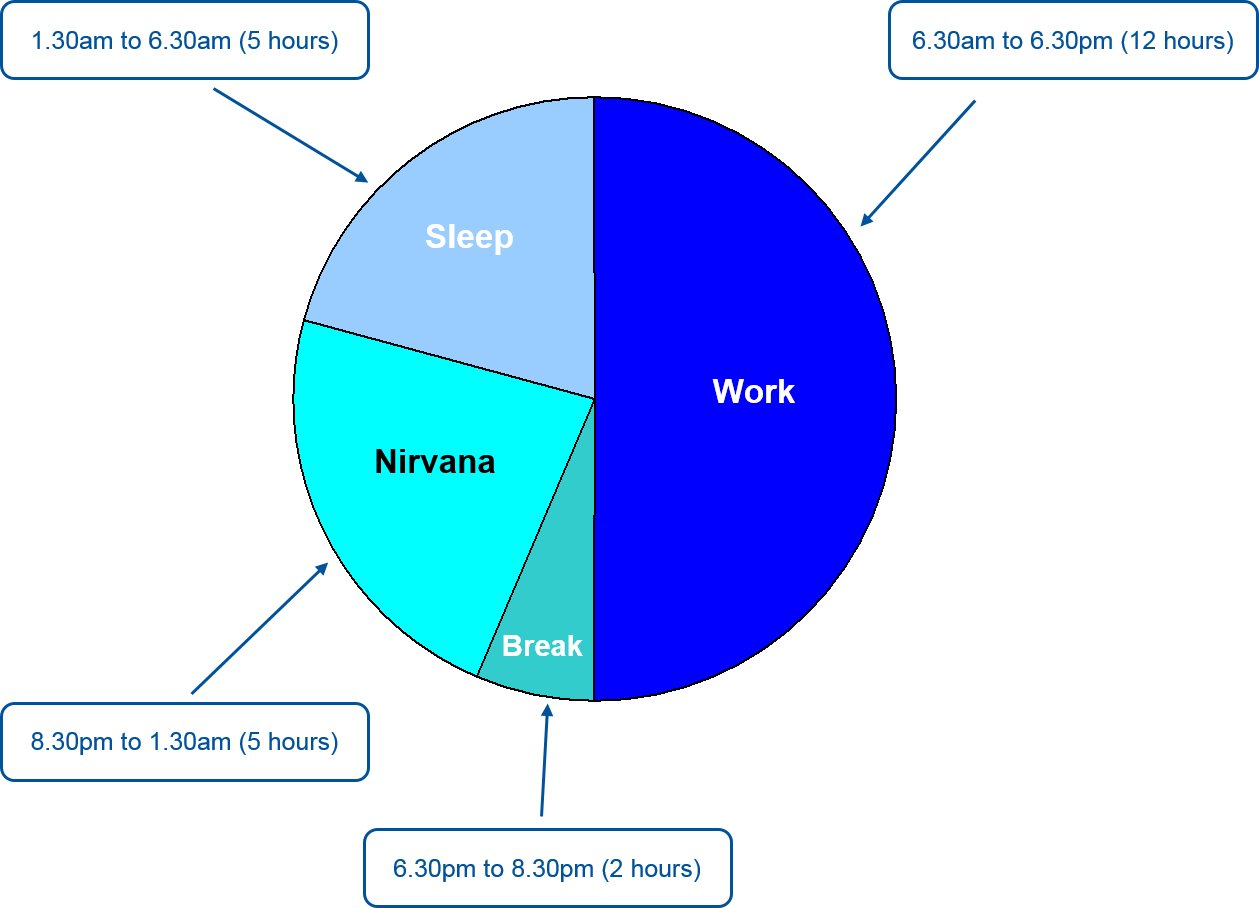
Picture1

In those 5+ hours (on weekdays, often more at the weekend), I’d also maintain the Nirvana-Legacy blog – you may have noticed (I have) that the blog isn’t as deep and rich as I feel it once was…Hard to focus totally in too many spaces I guess.

What would I do in those hours? Well, the book emerged from a blog post in spring of 2013 about bands Nirvana supported/who supported Nirvana – I was so curious about all the band names listed on the Nirvana Live Guide (www.nirvanaguide.com)…I wondered, initially just as material for the blog, whether I could find any of them. The first individual I contact was Troy von Balthazar of Chokebore, next Ben Munat of Thrillhammer/Grind, then Leighton Beezer of the Thrown-Ups…It began building. So I sketched out a book concept – things I wanted to answer or examine about Nirvana as a live experience or moments I wondered if I could find a witness to… I ended up writing a 30-40,000 word document which across the next year and a half was erased, deleted, replaced with the words of people who were there. Ultimately I don’t think my words are important or interesting – I wanted this whole work to be about other people’s experiences.

How did I get hold of people? Well, I would sit for hours using Google to tap in band names, trying to hunt down the names of people in bands. Most of these bands halted pre-Internet boom era, sometimes I’d be reading scanned newspaper pages from the mid-Eighties. Hour after hour on Google after that with an individual’s name trying to see if I could find a source connecting the name and the band and then providing a contact email, a Facebook page, anything. Conservatively I estimate I sent around 10,000 emails. Add in the replies and responses to people who came back to me and its anyone’s guess where the total reached. 10,000 emails, lets say 2 minutes an email? That’s 20,000 minutes – 333 hours email…

Next, I wrote out the questions for each individual so they could see them in advance – I wanted to reassure people I wasn’t some muckraking pain, I wanted them to see what I wished to ask. In total I wrote 120,000 words of questions – that’s a long novel just of questions. I have a document here called ‘Nirvana_Questions’ recording all of them. In total I now have over a million words of notes. A desire of mine being to add a new section to the blog in which I write about each of the bands I spoke to – so there’s a permanent record of all of them (at least until I drop dead and no one pays for the blog.)

Next I had to write a proposal for my agent. This is quite a long document – a fresh revision was prepared based on the feedback from my agent (Isabel Atherton of Creative Authors – http://www.creativeauthors.co.uk/instrumental-architects-music-recommendations-by-cas-clients/). There’s a standard requirement, deviation not really welcomed. Firstly, a half page summary of the book – like the text on the back. Next, a deeper description of two pages. The following section would describe the ‘market’ – who would want to read this? Why? What events made it a good moment to do this? Who would be interested in providing press coverage so people knew it existed? An addition to that would be a full two page description of other books comparable to this one – ways for a publisher to understand whether the book was worth taking a risk on, did it fill a gap? Had something similar succeeded? Was it a trustworthy approach? Then a bio – why trust me with this? Could I deliver…? After which a proper summary of the projected chapter structure over a few pages and, finally, a draft chapter.

That was provided to an independent reader to consider. Being an agent is NOT an easy life. Publishers will not consider manuscripts from authors. Why? Because it costs time and money to read. Instead they’ve outsourced that entire component. The agent only gets paid a percentage of the advance – not much money. They need to find reliable authors with good work which might find a home. Agents reject nine of ten manuscripts. I was lucky and blessed by Isabel.

Isabel then delivered the revised proposal to her contacts at publishers. I’d been very lucky with Isabel having moved to the U.S. which is a far larger opportunity for books of this sort. You’ve heard the publishing industry is having trouble? Well, music book publishing has had even more. It’s ever easier to be forgotten or ignored. In the U.K. each year 100,000 books are published – in the U.S. its over 1 million. Yet publishers refuse 9 of 10 manuscripts. And the majority of authors will never make a penny in royalties on their work – its all about the book advance…But book advances are shrinking given the market pressure. It’s even lower if you’re a first timer. But what the hey, if you’re putting in 20-30 hours a week it’s unlikely you’re in it for the money. You’d be better off getting a part-time job in that case – more reliable income. Writing is sub-minimum wage unless you fire out 3-4 books a year and/or happen to write 50 Shades or Harry Potter.

The publisher made specific demands about what needed to happen, when and how. Simple choice; obey or not? Ultimately you have no power. Amazon has used its media connections to constantly project the idea that self-publishing leads to miraculous success – no. Sorry, it’s a lie. A handful have succeeded out of the hundreds of thousands, the millions who have put an ebook online. The reasons are that an individual cannot match the ‘broadcast’ capabilities of a traditional publisher; it’s harder to get anyone to know you’re there. Amazon takes a delivery fee on each book, plus a royalty on each sale – it isn’t all yours. Remember also the need for artworking, for editing, proof-reading, fact-checking. In the final chapter of “I Found My Friends” I unfortunately approved an addition confusing Calvin Johnson and Daniel Johnson – if these errors creep in on a mass market paperback imagine what happens on a self-published effort. Everyone needs a second eye. A traditional publisher also offers the reassurance of quality; two separate layers of people (agent, editor, plus internal approvals within the publisher) have said the book is worthwhile. That mark does make a difference.

As I said, if you’re focused on getting your work out, and you want to do it the traditional way, then you have to bow to the editor at the publisher. That’s fair enough too. The publisher needs to pay for production, to cover failures, to pay for all the support services from which a book and an author benefit (legal, proof-reading, publicity, marketing, artwork, photography, royalties…) Imagine if your job was dependent on some egotistical bloke in another country, who you’ve never met, would you put your money, your safety, your family’s security on the line just to obey some person who’ll probably underappreciate what you’re giving to them? A publisher needs to sell product, that’s a simple fact. They also need to put enough product in the market to cover all the marginal successes and the outright failures. That means constantly seeing new proposals, negotiating with new agents, managing authors, reviewing and then all the internal work of a publisher. They don’t have much time for kid-gloves or for being ‘nice’ to you. Just deal with it. They’ll TELL not ask a lot of the time. I was told to change the title or they wouldn’t take the book. I was told I had to source photos for the book. I had to sign a contract promising completion and delivery of the book inside ten weeks or the contract would be annulled.

Part of that means that your personal ‘stuff’ isn’t relevant. It’s business. My grandfather died in August 2013, my father died in April 2014, my godfather died in January 2015 – three of the eight people I love most in the world all gone inside 16 months… My publishers were sweet and kind…And still needed to see results. That’s the way it is. If you can’t stomach it then go self-publish. If you can’t deliver a book-length volume (100,000 words) on schedule then go self-publish. If you can’t obey the extensive formatting requirements of the publisher then go self-publish. Your flakiness costs them time and energy…And even better it’ll cost you because it’ll come back to you to fix it. Best to get it right first time.

You’ll be surprised how little you hear from the editor – they’ll write when they need you to do something. That’s it. Read your contract fully. In the case of non-fiction works remember that they will insert an index and you will pay for it – it’s in your contract. Remember you only get 20 or so free copies – after that you pay half the marked cover price for each copy you want – oh, and each photographer who contributes gets one of YOUR free copies. The book advance covers all licensing fees for photographs, for quotations (check the rules around quoting other works), any travel, any purchases made to support the book…The advance comes in two halves too – one half when you sign the contract, one half when the publisher actually accepts the manuscript. They will review your work, you’ll have to make changes, then the other half is released. If you refuse and it becomes irreconcilable then you’ll have to give back the rest of the advance. So, throughout the writing process you’re potentially staring a debt in the face. Remember that and don’t go crazy. I received $7,500 dollars. I gave 15% to my agent, I pay 40% in tax, I spent several thousand dollars preparing the book. My profit? I can no longer tell but I think it’s about $1,000 for a year and a half of work.

On the other hand, however, writing an oral history of this sort meant I got to meet some wonderful people, spend time with people I admire for their musical efforts – for having a get up and go I didn’t have at age 15-20 – listen to stories I enjoyed, to enjoy the process of creating something…That was the point, always was. Before you begin you have to decide your motivation. I’ve never had any illusions about my personal shtick being interesting to anyone – but creating a work about a band that I do find interesting? Great! I’ve simply tried to stay true to writing books that I would want to read. Without wishing to insult anyone, there are 40-50 books on Nirvana out there, I think only about 10 of them are essential. I at least wanted to aim to hit that top ten of books on Nirvana – to do something worthwhile, fresh, different even this far away from ground zero. Similarly, I’ve tried to keep my ‘fan radar’ – I look at Nirvana books skeptically, i’d see a new Nirvana book and nudge it around thinking “mmm…Another one? Do I bother?” When I started thinking of this volume it was evolving, growing, becoming something organically without any pressure at all – it just happened…I was lucky someone else agreed. Again, I’d like it to be the kinda book that I – or the fanatics at LiveNirvana (all respect and a low bow) – might say was something new, something different…

To finish with motivation might seem silly…But it’s crucial to the whole enterprise. You need to endure commercial negotiations, you need to deliver a full manuscript that’s near perfect, you need to lay down 100,000 words at least, you need to pay for so much stuff, you need to do it all for far less than you’d receive for simply keeping your head down and doing a job, you need to endure some flak from online critics and people trolling, you’ve got to sacrifice parts of your life too. I’ve neglected exercise because there’s no time – i’m in the worst shape of my life. I’ve neglected social ties – there are people I’ve barely seen these past years. Other interests fall away – it’s three years since I last picked up a guitar, I can’t watch a film to conclusion because I feel I’m wasting time, I turn up late for everything to squeeze in more words or thoughts…

Is this enough detail? I just wanted to lay out in full what is involved. Your turn! Rock it!

Courtney Love to Sue over Fake Nirvana Song

http://consequenceofsound.net/2015/03/courtney-love-suing-person-behind-this-fake-nirvana-song-called-flaccid-bone/

Immediate respect to Mr. John Jung for passing this on to me – how fascinating. If the individual who started this whole sorry tale wanted attention they’ve certainly got it. Incidentally, to focus on more positive issues worthy of attention, do check the Facebook pages for Monkeywrench and Bloodloss, two early Mark Arm bands – John supports both pages.

First things first, it’s very visibly a fake. If this was a Nirvana cut then it’d be near incredible for it to be so fully formed yet not to arise in the comprehensive record of Nirvana studio work. Similarly, a full Nirvana cut in this type of quality that wasn’t recorded in studio? Near impossible on the technology of the time – this isn’t a pre-digital or early-digital effort. if you wanted to dissect it further then instrumentally there are plenty of points where the ‘squareness’ of the backing doesn’t match Nirvana’s more fluid style – that’s even before one gets to the voice. The treatments applied in an attempt to make it sound more like Cobain, or at least to veil it, are pretty ineffective – it just isn’t Cobain.

Second things, do I believe there really is going to be a legal action? Not really. I feel it’s more like a ‘cease and desist’ situation. There is a valid claim that the back story the person has constructed involving thieving from Courtney Love, involving hacking into supposedly digitized archives, is pretty fair reason for a mild bit of legal action – they’re using Courtney as a source of legitimacy to try and back up the credibility of their fake. I think it’s a warning shot – but I’m also sure locating the individual concerned isn’t a difficult business. One view might be “why is Courtney bothering if it isn’t real?” I think it isn’t unreasonable for her to be pretty annoyed by the individual concerned and the way they’ve formulated things – I can also imagine that having been recently involved in the premieres of “Montage of Heck” perhaps issues involving Kurt Cobain are sensitive right now? But I’m speculating. I see no reason why the threat of legal action should make anyone doubt that this is a fake song.

A shame in a way, there’s clearly a talented musician or group of musicians at work behind the smokescreen. And I don’t mind fakes really – it keeps collectors on their toes, is an irritant at best, an understandable attempt to get a rise out of people…And sometimes, just sometimes, I can see why people would want to test themselves against the individuals they see as the finest examples of their art. On the other hand, however, it does soak up the time and the minds of people who put a lot into sourcing lost Nirvana material, it is a bit tiresome hearing another awful impersonation – the joke gets old pretty quick. I mainly shrug and feel a little bit sorry for people – it isn’t worth being annoyed about.

In the meantime, yep, guess you may have noticed, the team at my publisher for “I Found My Friends” arranged for the final chapter to be provided to SPIN and ESQUIRE magazine on Friday. I confess it was a nice surprise – I didn’t know about either, I only found out when people sent me the links. Naturally I blush that there’s a lazy factual error (Daniel or Calvin Johnson? Oops…) that came about when I was rushing during the post-completion editing process – I think I even seeing it but not reading it properly. Naturally though I just hope you enjoy the chapter. I wanted it to not be about Cobain’s death – this book was about the memories of the musicians who shared the stages with Nirvana, who shared the band’s life in the underground, so though it couldn’t be ignored, his death wasn’t as important to me as so many good lives in the book. Likewise, I wanted to make some small mark of respect to other people who lost someone close, to other musicians who didn’t survive. Having felt loss these past years I think it is a special feeling, I think our loved ones deserve our pain, and that both Kurt Cobain AND the others mentioned all deserve to be recalled by those who cared for them. Paying small respect was the least I could do.

Here’s the links if you didn’t see them. Book is out March 31 in the U.S., it’ll be much later on European sites.

http://www.spin.com/articles/nick-soulsby-oral-history-of-nirvana-excerpt/

Full chapter at Esquire:

http://www.esquire.com/entertainment/books/a33510/nirvana-kurt-cobain-book-excerpt-i-found-my-friends/

As a passing comment, there are hundreds of comments on the relevant Facebook posts for Spin and Esquire. My favourite was the one stating that they suspect I’ve been paid by Courtney Love to write the book. Gosh, she’s one impressive woman – to pay off 210 people from 170 bands, plus my agent, the team at the publisher…Incredible. On a personal note, if anyone is looking for a ghost writer I’d totally go for it! 😉

Any Thoughts at all on Kurt Cobain’s Birthday…?

So, everyone taken a moment with a Nirvana song today…?

I admit I usually avoid writing just to mark the occasion of Kurt Cobain’s birthday or his death either. This site has been going some two and a bit years, there are 400 posts up here and though I’ve been running low on the deeper analyses that I prefer to run I’ve never felt much need to switch over to thinking my random musings are anywhere near as good or interesting as some proper discussion of a big meaty Nirvana topic. So I’ve always felt I’ll write when there’s something to say, not just to mark an occasion.

But breaking that habit…Even today I spoke to two separate people who both said “I remember where I was when he died.”

I don’t think Kurt Cobain was ‘more special’ than anyone. While writing “I Found My Friends” I learnt of more than a dozen musicians who played alongside Nirvana and died tragically young – they’re each worth remembrance by those who loved them. But that’s where I find the point to be. It’s not about superstars and god-heads and icons and saints. It’s about people who have connected with one’s life. Cobain reached a position where millions felt that connection, some form of link – and that’s worthy of respect. There’s no disrespect in the way he commands a wider reach than one’s own lost loved ones; more people mourning or remembering doesn’t mean the remembrance is of greater value, nor does remembering someone you may or may not have seen or met in person devalue it. Sometimes people sneer at feeling expressed toward something one did not experience or someone one never met – but they’re wrong to privilege their personal lived reality so highly as to ignore the many things that impact our lives, that are of significance, that we don’t touch or speak to directly. Those things are also worthy of note and remembering too.

As I said, I don’t think Cobain was ‘more special’ but I truly do think he deserves to be seen as an inspirational figure. Social mobility, the dream of the equal playing field where anyone can rise from the bottom to the top is – frankly – a damned lie these days as money entrenches privilege to a degree not seen in America ever and in the U.K. since the days of rule by the aristocracy. Only a tiny number will make it, but that’s no reason to be cynical about their achievement – it shows it can be done, it shows the limitations too, but it is worth admiring and wanting to make happen. These past few years I’ve felt truly privileged to speak to musicians, writers, artists and instigators the world over – it’s amazing to see people putting their time and energy into making anything that is about self-expression not just about money, or obeying orders, or pleasing others. All of it, from the smallest effort, is worth respect and celebration. Cobain’s ability to go from semi-homeless, emotionally damaged drop-out to the pinnacle of his chosen field is a testament to hard work, to compromise, to non-compromise, to the support of others and to self-sufficiency all at once. We can celebrate all those things for the part they played rather than privileging one over the other.

I also think Cobain’s rise provides an example of how to live. I don’t want to live fast and die young. I don’t want to leave grieving relatives alongside an immortal reputation. But I do want to believe that there’s a lot more to life than acquiring excessive cash, exercising power over others, doing what it takes to be popular. Standing here seven years after the worst downturn since the 1930s, looking at the evidence of banks manipulating entire markets, bankers actively deceiving democratically elected governments, the media stealing data from ordinary people just to make a story or corrupting coverage to protect wealthy investors…I’m glad to look on Kurt Cobain as a hero of mine for reaching a position where he could have had all the corrupt indulgence he wished…And decided he didn’t want it.

I also think looking at Cobain’s sad end made me think about what kinds of heroes I want and what about them I’d like to live up to. At the moment I think Hervé Falciani is one of the bravest men I’ve ever witnessed – he has risked life and liberty to expose that a bank was laundering money for drug gangs, purchasing equipment to be relayed to them, deliberately helping people who felt that only the ‘plebs’ like you or I should pay for the infrastructure of our country. Looking across the last few years I look at Mohammed Bouazizi – maybe the future isn’t what we hoped in 2011 it might be but one man acted, did what he felt was right, and brought down governments who had stood with a foot on people’s throats for decades. Who can still believe that they, one person alone, can make no difference in this life after that moment? When I look at the inspiration Cobain has provided to people to do things with their lives I see a lot of goodness. People can change the world or they can just change the lives of those who know and love them. Again, both are worthy of respect – both mean that you, I, we matter.

Thinking back on Nirvana now in February 2014 I do get self-indulgent; my grandfather died one week before I visited Seattle for the first time – I can’t think of Seattle without missing him. My father died the week I handed in “I Found My Friends” – I can’t think of the book without missing him. My godfather died just weeks ago – I’ll never think of these days before the book release without missing him. But I also think that losing people I love meant I appreciated more how much pain people must have experienced when Cobain died – that it was a personal experience for them and speaking of him needs to be treated respectfully because he wasn’t just some TV screen or on vinyl ghost.

Anyways. Happy Cobain Birthday to every true fan out there. Hope there’ll be a lot of Nirvana pleasures ahead this year and there’ll be something each of you chooses to do to make your lives or the lives of those you love that bit more amazing in 2015.

Nirvana and Kurt Cobain on Film

2015 promises to be a bit of a bumper year it seems for film treatments of the band Nirvana…Or, more precisely, of Kurt Cobain. The rise/fall model, plus the icon status accorded to Cobain since his death, place him in a separate category to the average superstar musician – he’s into the realm of Elvis, Lennon, Hendrix, Ian Curtis…There’s a dependency on the ‘one man’ model of cinema in which a plot is played out via a central character who must possess certain talismanic qualities. Retelling the story of Nirvana thus becomes a retelling of the tale of Kurt Cobain because, let’s be fair, without his remarkable rise to fame and his tragic ending there’d probably not be a cinema interest in him and he’d be confined to the same fan-only band releases as most artists on music DVDs. What I want to do here is just briefly glimpse over the record of Nirvana and Cobain on film from the earliest commercial release through to the present, ignoring (mostly) performance releases like Live at Reading.

The progress of Nirvana on film commences with brief appearances in Dave Markey’s 1991: the Year Punk Broke. Released at the peak of Nirvanamania, it captured Nirvana in August 1991 playing sideshow to Dinosaur Jr and Sonic Youth – just one band among peers. This entire vibe was emphasised by the back stage footage of the friends pranking around and amusing each other – a community feel. Cobain wasn’t even a particularly elevated presence though perhaps he did gain a little more airtime than his colleagues it was the scantest difference. It’s a great music film incidentally, lots of neat asides about what was already occurring prior to the eruption of Nevermind. Thurston Moore’s famous declaration about 1991 as the year that punk broke was made prior to Nirvana becoming the world’s biggest band – a prescient comment. I’d have a suspicion that more Nirvana footage was incorporated during the editing process across 1992 given what had subsequently happened to the band – a comment on sudden lucrativeness.

Next came Nirvana’s own attempt to speak to their experience. Live! Tonight! Sold Out! (1994) is mainly remembered – rightly – as a stitched together compilation of band performances. I’d suggest, however, that it’s the first real attempt to make a cinematic treatment of the Nirvana tale. The format worked out by Kurt Cobain himself in collaboration with Kevin Kerslake and his team is a montage piecing together chunks of Cobain’s own collection of interview footage, back stage material and whatever else band members had taped of one another over the year. There isn’t necessarily a storyline, it’s more a portrayal of a single moment in Nirvana’s career – a whirl of 1992 confusion which still manages to be, at times, amusing, funny, irreverent as well as confused and disjointed and uncertain. While the net is cast relatively wide in terms of gathering material, there are still limitations and the mood remains rooted in that one location and in a certain petulant aggression aimed at fame and the Nirvana mythos at that moment in time when Cobain was contemplating its creation. Still, it’s a starting point. There are similarities to Nirvana’s earlier appearance in 1991: the Year Punk Broke and the timing seems non-coincidental – Markey’s film came out in December 1992 with Cobain having already started discussions and some work earlier that year with Kerslake as the vision of what the ‘film’ would be expanded. Ultimately what stops it advancing is the In Utero tour and the sad end of Cobain but this might have been something more. Still, it sits comfortably in the band DVD realm currently.

The next big endeavour took a few years to emerge. Kurt and Courtney (1998), I’ll admit, is entertaining as heck. Hand on heart, I don’t believe the murder conspiracies, but that’s irrelevant to this tale of watching a guy trying to make a film. Given the experiences the Cobain couple had in 1992-1993 with outsiders prying into their lives and running around asking anyone and everyone for tales, I’m not hugely surprised that Nick Broomfield’s bull in a china shop haring about was ever going to make him appealing. Again, irrelevant. The result is a rather scattershot enterprise combining the interviews he acquires with his own narration and ‘making of’ tale that set the style for films about Kurt Cobain and Nirvana – focused on death, often ad-libbed or experimental in approach, not necessarily an advert for slickness. It’s a talking heads set-up in the main but there are enough people who are interesting to see talk to make it rewarding. Wonderfully it could be taken as a fine argument for or against the conspiracy tales given everyone in the movie – barring his aunt who thinks he committed suicide – comes across as unusual if not outright embittered or loopy. Please take that as a statement of opinion not fact of course – give it a watch, have fun! It marked the emerging focus on the death of Cobain as the moment of critical public interest beyond Nirvana fans and music fans, the piece that made it social/cultural history rather than just music ‘stuff’.

As an aside, I’m not neglecting the ongoing procession of straight-to-DVD interview and commentary collections that have emerged; I just gave up on them after a bit through no great fault of there’s. You’ll know the ones – Teen Spirit, All Apologies, the Nevermind ‘making of’ disc, there’s one on my shelf called ‘Too Young to Die’ which is a taping of a German TV show…Nothing to add on them except the obvious marketability of Kurt Cobain and Nirvana – with Cobain being the bigger draw. He’s overshadowing his own band.

By the next decade Cobain’s standing had truly grown. The band of which he was a part has kinda become back story at most to the crucial figure as Cobain becomes a dramatic model – a template for whatever one wishes, doomed youth? Wronged victim? Man? Last Days (2005) performed a thinly fictionised take on Cobain’s final week in Seattle on the lam. Again, no pretence that my perspective on the film is the only one possible, but as a cinematic experience there comes a point where the absence of a plot creates a definite level of boredom. It’s a film perfect for those who believe myths of the millennial generation’s ennui, who believe that there really are millions of people out there just gazing blankly at mirrors then hoping people look at them. Ultimately there’s nothing to the film bar staring at the main character in various states of dress/undress, activity/inactivity, glasses on/off – other people are barely relevant. There’s an absence of any commentary on the subject – but there’s also an absence of any commentary from the subject either. By taking no stance, placing no words in the character’s mouth, there’s a void. Being charitable I’d point out that it allows meaning to be imposed and created by the observer – the puppet’s head fills with whatever one might wish. A contrast with the director’s work Elephant, however, is that in Elephant there’s an end point building amid the lives being lived that maintains a tension and creates forward motion – that’s gone here.

About a Son (2006) was a further experiment in documentary-making. Michael Azerrad’s tapes of Cobain in interview across autumn/winter 1992 and spring 1993 were combined with a tourist guide video of Cobain related scenery and locales. Criticisms that could be levelled are that the reliance on one set of interviews, from one specific time in Cobain’s life, creates a uniformity of mood and perspective – a certain deadness. Similarly it spray-paints over Cobain’s sometimes flexible relationship with truth – not a criticism of him, we all embellish and tell stories differently depending on time and place – without any corrective provided by other sources. I’ve commented on the film before that Cobain basically flames an awful lot of people and places in the recordings – a negative posture that doesn’t leave much room for warmth. I guess that’s my ultimate criticism perhaps, that while a very watchable (and listenable) film, it still circles the ‘tragic end’ school of cinema because it’s hard not to get to the end without thinking; “gee, this guy was gloomy and depressed and negative,” which seems such a one dimensional vision…

So, onwards to the New Year – two new entries. Soaked in Bleach comes out later this year and, at least judging by early material, there’s been substantial effort expended on it with full scale replicas of required locations and attention to the kind of knit-picking detail that keeps the average conspiracy buff typing in capital letters to their heart’s content. Essentially it’s the Cobain death trip retold by private investigator Tom Grant – if you’ve absorbed the material in the two Halperin books, plus the material on Grant’s own website then you’ll pretty much have what to expect plot-wise. More intriguing, of course, is that this is a cinematic experience and therefore it’ll be nice to see how they approach it, portray it, explore it. There are live actors involved, various people interviewed – I’m expecting a combination of re-enactment coupled with talking heads and voiceovers but we’ll see.

All of which rambling brings me to Montage of Heck, this year’s other major Cobain film. Again, I’ve not seen it, others have, the reviews are floating around – why am I particularly pleased to see it? Well, the other week the director Brett Morgen explained his reasons for leaving Cobain’s death well-alone (http://www.thedailybeast.com/articles/2015/01/28/the-secret-life-of-kurt-cobain-brett-morgen-s-eye-opening-documentary-montage-of-heck.html). It’s certainly a little mischievous as an explanation, it’s not like the film doesn’t sound haunted by Cobain’s death, it’s not like it doesn’t set up ‘reasons’ for the end – death is coming and it is in the room regardless of where the film cuts. However, when looking back over the record of Cobain as a cinema experience it’s a pleasure to contemplate a film that extends beyond Cobain as ghost voice speaking at a difficult moment as part of a campaign to orchestrate positive stories about Nirvana/Cobain (and to fill the hole awaiting a book about the band and its lead singer) and focuses more on birth and life. It’s interest in him as a person rather than as a whodunit is what makes me feel pretty warmly toward it – a fuller entity rather than just an episode. The yardstick against which I’m judging it is the Tupac: Resurrection movie – which was basically a hagiography which glossed an awful lot of the unpleasantness in the life of Tupac Shakur in favour of a rousing application for contemporary sainthood. Morgen’s effort takes a similar approach – combining footage sources from throughout his life with his own voice recordings – but seems far more personal; the core of Resurrection stemmed from more commercial sources like TV interviews, video shoots and so forth rather than the personal archive and self-filmed/self-recorded matter Cobain and his loved ones built up. The weaving of multiple source formats – art, music, journals, spoken word recordings, video recordings – also feels original and leads me toward a strong degree of positivity here. Eight years in the making? Sheesh, it’s just nice to see a genuinely new cinematic take.

Is there anything left to say after 2015? Oh, there’ll always be someone willing to give it a shot. My presumption is the full-on biopic must be out there somewhere… Otherwise, I’m uncertain. One varied reprisal would be the lacing of interview material from multiple sources and eras (there’s enough of it out there) to reprise the About a Son approach with greater diversity of sources. Similarly, tales of Nirvana created in that way might be a possibility given the official Nirvana DVDs have made scant use of the interview footage. Maybe the Spinal Tap style comedy treatment is somewhere down the line…

Ten SWANS Records you Need to Hear

Young God: 10 early Swans records you need to hear

I was invited to contribute this to the Vinyl Factory (previously benefactors who permitted me to rave about the Pacific North West – http://www.thevinylfactory.com/vinyl-factory-releases/beyond-nirvana-10-essential-under-the-radar-grunge-records-from-the-seattle-era/) essentially just yelling “SWANS are awesome!!!” at everyone in a foam-flecked and spitting mass of shiny-eyed, head-rushed devotion.

It’s not a ‘top ten’, it’s simply a declaration of ten Swans releases from the 1982-1998 period that I feel best represent the band in particular eras or that are particularly unique and rewarding. Certainly it’d be hard to ever claim Swans were a ‘nice’ band, their concerns were deeply metaphysical; flesh as an anchor forcing compromise and failure upon the soul and spirit, the voluntary subjugation of mind and soul beneath ideologies and social arrangements, the potential for oblivion as the only freedom, the eventual declarations of scorn upon those who ignored the band and blunt statements of the end of the project. Cheery stuff for a Wednesday but genuinely superlative and significant music.

I Found My Friends Nirvana Book: Bands Participating in the Book from 1989

1989, the year Nirvana go from being nobodies to somebodies. I think that’s a fair statement – genius doesn’t just live out there with a pre-allotted meeting with destiny all set up so that definitely everyone of true talent is captured, noticed and gets to where they’re going. Regardless of Nirvana’s talents they needed support, product that people might actually be able to see, supporters able to get them in front of bigger audiences, media coverage to lure in a few more eyes…Otherwise they’d just be another band playing great stuff in obscurity on lo-fi equipment, recorded on the cheap, performed over junk PA systems in butt-end of nowhere clubs.

Nirvana needed Sub Pop – Sub Pop needed decent bands. But in 1989 it was clear that Tad were higher up the pecking order while Mudhoney were at the top. And that’s just the running order on one label, it doesn’t reflect how far down the ‘grunge’/’Seattle’ buzz running Nirvana were. It’s trick getting back in that mindset really – to the idea of a future superstar as a band that hasn’t played anywhere except at home, that can’t keep a drummer (even Chad is barely over the six months in), that has a single out that no one can get hold of and one song on a compilation that isn’t exactly spread far and wide.

Nirvana’s tentativeness is visible physically. They pop down to Portland then retreat home. They stretch themselves a little further and hit a couple of venues in California, then home. They ramble about Washington State catching time with Sub Pop bands and local friends – there’s always a ‘buddy’ along which saves Sub Pop a bit of cash and helps promote the label all in one. Nirvana are, to the greatest degree, at the beck and call of forces beyond their control. Album recorded by early January but requires a while for the label to get it manufactured and out into the world. Tour awaiting the label’s acquisition of a van – Nirvana aren’t really self-starters when it comes to self-releasing or self-promoting, others do it for them. But still, its progress…

I interviewed members of 170 bands for the “I Found My Friends” book, the following list is intended to show which gigs those bands played alongside Nirvana – just as a guide to coverage and scope. Hope its looking good to you… March 31, oh I am definitely looking forward to it…

1989
January 6, Portland — Mudhoney
January 21, Portland
February, Olympia — K Dorm. Helltrout and Psychlodds
February 10, San Francisco, CA
February 11, San Jose, CA — Mudhoney, Vomit Launch
February 25, Seattle — The Fluid, Skin Yard
April 1, Olympia — Helltrout, S.G.M., Tree House
April 7, Seattle — Love Battery
April 14, Ellensburg — King Krab
April 26, Seattle — Steel Pole Bath Tub
May 26, Auburn — Bible Stud, Skin Yard
June 9, Seattle — Mudhoney, Tad
June 10, Portland — Grind
June 16, Olympia (as Industrial Nirvana) — Lush
June 21, Seattle
June 22, San Francisco, CA — Bad Mutha Goose
June 23, Los Angeles, CA
June 24, Los Angeles, CA — Clawhammer, Stone by Stone
June 25, Tempe, AZ — Crash Worship, Sun City Girls
June 27, Sante Fe, NM — 27 Devils Joking, Monkeyshines
June 30, San Antonio, TX — Happy Dogs, Swaziland White Band
July 1, Houston, TX — Bayou Pigs, David von Ohlerking
July 2, Fort Worth, TX
July 3, Dallas, TX
July 5, Iowa City, IA — Blood Circus
July 6, Minneapolis, MN
July 7, Madison, WI
July 8, Chicago, IL
July 9, Wilkinsburg, PA
July 12, Philadelphia, PA — Napalm Sunday
July 13, Hoboken, NJ — Tad
July 15, Jamaican Plain, MA — Cheater Slicks, Death of Samantha
July 18, New York, NY — Cows, God Bullies, Lonely Moans, Surgery
August 20 & 28 — Cobain and Novoselic take part in The Jury recording sessions — Screaming Trees
August 26, Seattle — Cat Butt, Mudhoney
September 26, Seattle — Dickless, Knife Dance
September 28, Minneapolis, MN
September 30, Chicago, IL — Eleventh Day Dream
October 1, Champaign, IL — Steel Pole Bath Tub
October 2, Kalamazoo, IL — Steel Pole Bath Tub
October 3, Ann Arbor, MI — Steel Pole Bath Tub
October 4 or 5, Toledo, OH — Steel Pole Bath Tub
October 6, Cincinnati, OH — Grinch
October 7, Lawrence, KS — 24/7 Spyz
October 8, Omaha, NE — Mousetrap
October 11, Denver, CO — The Fluid
October 13, Boulder, CO
October 23, Newcastle, U.K. — The Cateran, Tad
October 24, Manchester, U.K. — The Cateran, Tad
October 25, Leeds, U.K. — The Cateran, Tad
October 27, London, U.K. — The Cateran, Tad
October 28, Portsmouth, U.K. — The Cateran, Tad
October 29 until December 2 — Tad
December 3, London, U.K. — Tad, Mudhoney

I Found My Friends: the Oral History of Nirvana – Which Bands in Which Nirvana Shows 1987-1988

Felt it was time to share the information about the individuals telling the tale in “I Found My Friends.” Basically with 210 people, with some 170 bands, it’s a long list but I hope an intriguing one. I’ve arranged it as a chronology so you can see who was playing with Nirvana when and so forth… When I first started all this there was that curiosity about who these bands were, I want to write pieces about them on the blog as soon as possible, but I also felt that here were were at 25 years distance at least and that as the limits of memory are reached maybe it was a good moment to begin recording those memories. Turning them into a book, into this bigger compilation of stories and experiences, meant a fleshed out picture told by people who were actually there at the time – not just observers but guys and gals who were up on the same stages, sharing gear with Nirvana, hanging out with the band or just breezing past a band who – in 1987-1988 – were just another band…

1987
I confess the early days truly intrigued me…The start or end of something always has a certain emphatic edge that invites curiosity. Of the ten bands Nirvana played with in 1987 I was blessed and managed to speak to members of eight of them; Nisqually Delta Podunk Nightmare, Yellow Snow, Danger Mouse, Soylent Green, Lansdat Blister, Hell’s Kitchen, Inspector Luv and the Ride Me Babies and the Sons of Ishmael. I was informed via a contact that no one in Silent Treatment recalls much about the show with a young Nirvana – meanwhile, unfortunately, I only spoke to members of the Magnet Men after the deadline for the book had passed so that was that. As a wonderful addition – in my eyes – I received true help and support from Ryan Aigner, Nirvana’s first manager, and the guys from the band Black Ice who lived at the house where Nirvana played their first house party – the Raymond show. On the “With the Lights Out” box set, on the Led Zeppelin cover, it’s actually Tony Poukkula who can be heard yelping how he doesn’t know the solo to “Heartbreaker” before cracking out a brief rip.

1988
Nirvana had a busier year but still, twenty-three gigs is hardly awe-inspiring. They supported twenty nine bands in 1988 of whom I was able to speak to members of Attica, Blood Circus, the Butthole Surfers, Chemistry Set, Coffin Break, DOA, Herd of Turtles, King Krab, Lansdat Blister, Leaving Trains, Lush, Moral Crux, My Name, Psychlodds, Sister Skelter, Skin Yard, Swallow, Tad, the Fluid, the Thrown-ups, Treacherous Jaywalkers and Vampire Lezbos. Alas, Happy Dead Juans, we were too late…Too late…Likewise, though locating a former member of Millions of Dead Leninz (definitely one of the bands I obsessed over the longest) we didn’t get to discuss anything. That’s twenty two of twenty nine…Not bad…Not bad…

Anyways…There we go…Let’s see where next shall we? Incidentally, if you prefer to buy from a non-Amazon source then the book is up for pre-order at IndieBound and B&N:

B&N: http://hyperurl.co/nirvBN
Indiebound: http://hyperurl.co/nirvIND

The list below is intended to show a complete record of Nirvana’s shows (with date/location from the Nirvana Live Guide) then which shows feature a band from whom a member or various members took part in “I Found My Friends.” There are six shows in 1987-1988 that were not played by a musician featured in the book.

1987
March, Raymond — Black Ice
Skid Row plays one undated house party in Aberdeen March/April
April 18, Tacoma — Nisqually Delta Podunk Nightmare, Soylent Green, Yellow Snow
May 1, Olympia — Dangermouse, Lansdat Blister, Nisqually Delta Podunk Nightmare
May 27, Tacoma — Hell’s Kitchen, Soylent Green
August 9, Tacoma — Inspector Luv and the Ride Me Babies, Sons of Ishmael

1988
January 23, Tacoma — Moral Crux
March — Dave Foster plays the Caddy Shack house in Olympia as the band’s drummer
March 19, Tacoma — Lush, Vampire Lezbos
March/April — One show at The Witch House, Olympia plus Nirvana’s first Seattle show
April 24, Seattle — Blood Circus
May 14, Olympia — Lansdat Blister, Sister Skelter
May 21, Olympia — Herd of Turtles, Lansdat Blister
May 28, Olympia— Sister Skelter
May — In time for an undated Seattle show Chad Channing joins on drums
June 2, Seattle — Chemistry Set
June 17, Ellensburg — King Krab, Lush
July 3, Seattle — Blood Circus, The Fluid
July 23, Seattle — Leaving Trains
July 30, Seattle — Skin Yard
August 20, Olympia — My Name, Swallow
August 29, Seattle — Treacherous Jaywalkers
October undated house party on Bainbridge Island
October 28, Seattle — Blood Circus, Butthole Surfers
October 30, Olympia — Lansdat Blister, Lush
November 23, Bellingham — Coffin Break, Skin Yard
December 1, Seattle — Coffin Break, D.O.A.
December 21, Hoquiam — Attica, Psychlodds
December 28, Seattle — Blood Circus, Swallow, Tad, the Thrown Ups

Throughout the book I do deviate from chronology – sometimes there were topics I wanted to tackle in more detail, or people said things that were so interesting to me I wanted to delve in and reinforce them with the views and opinions of others. I hope it makes sense to you as a reader and that the slalom ride between following the live dates and making sense of the journey works for you. Often it was a simple question of memory – this is a LONNNNnnnnng time ago now, where were you twenty-five years ago? I was seven/eight years old – I remember nothing. Plus, shocking statement, the truth is that Nirvana – for quite a long time in fact – were just ‘another band’. That’s what really engrossed me was this sense of Nirvana as being a fairly indistinguishable part of the overall scene, surrounded by friends and comrades doing exactly the same thing with deviations in sound, style, energy…Before Nirvana gradually become something else all their own… It felt good to restore a sense of normalness…That this was people doing something they loved not rock-demi-gods momentarily visiting Earth…

Brett Morgen: Montage of Heck Reviews from Sundance

An immediate thank you to my friend James who collated the Montage of Heck reviews thus saving me a ton of time and energy! Kudos and thanks.

http://www.hollywoodreporter.com/review/kurt-cobain-montage-heck-sundance-766524

http://www.rollingstone.com/movies/features/sundance-2015-kurt-cobain-montage-of-heck-20150125?page=2

http://www.theverge.com/2015/1/25/7888931/kurt-cobain-montage-of-heck-sundance-film-festival-2015

http://collider.com/kurt-cobain-montage-of-heck-review/

http://www.hitfix.com/the-fien-print/review-kurt-cobain-montage-of-heck-definitively-doesnt-define-the-nirvana-icon

I’ve nothing to add really – I would hate to comment too deeply on something I haven’t seen or where I only have a certain quantity of information. Basically it looks/sounds like there’s been some deep love gone into the visual realisation of the project, that the selection of footage and material has been pretty unflinching, its been reviewed by film critics not music critics so I can understand why there’s no mention of unheard Kurt Cobain music in the early reviews (picking out what is previously released versus unreleased would take quite a deep knowledge and awareness), sounds like the focus is precisely what Brett Morgen promised – far more interest in Cobain as a personality and as an emotional being and far less in recounting the well-known narrative of Nirvana’s career…Cool, all good. I await with pleasure.