Buzz Osborne Ranting About Cobain and Montage of Heck — So What?

http://thetalkhouse.com/music/talks/buzz-osborne-the-melvins-talks/

The media landscape is all about opinions – people giving their views. The debates over what they say hinge, firstly, on the basic test of ‘provable lie/fact’ then, if that can’t be answered either way, secondly, on a questioning of legitimacy. In the case of Buzz Osborne speaking about the accuracy and/or merits of “Montage of Heck”, Osborne kicks off that game by stating the case for his authority at the start (in summary; I was big buds with Cobain and the Nirvana boys and played shows with them from start-to-finish.)

There’s definitely no disputing his centrality to the Nirvana story (re: https://nirvana-legacy.com/2012/11/24/no-melvins-no-nirvana/) and his presence as a witness – Tad may have played far more shows with Nirvana (enter “My Friends” into the search bar on here to check the stats) but Melvins played with Nirvana across more years – five of seven years of the band’s existence – than any other and that’s ignoring Cobain’s pre-Nirvana outings with either Dale Crover or Buzz Osborne. The issue, however, is that his legitimacy as a witness doesn’t have much bearing on whether his views on “Montage of Heck” are worth much.

Osborne states three elements are untrue; Cobain’s self-told tale of his failed attempt to lose his virginity and to take his own life; Cobain’s claim to having had stomach issues that predated, were an excuse for and independent of his drug addiction (again, legitimacy; Osborne is a former heroin user so could be deemed to know that of which he speaks); then Courtney Love’s tale that the Rome suicide attempt was provoked by non-consummated cheating.

In the first case, Cobain’s claim that everyone in school knew about it does seem overblown – but ultimately all the story illustrates is that, if it was a fiction, then Cobain had one sick and slightly morbid imagination for grim detail, and if it was true then he was a pretty morbid fellow who perceived people were talking about and criticizing him. It doesn’t undermine the overall picture or necessarily say charming things about him. On the second question, again, I admit I feel there’s substantial room for doubt regarding the nature of Cobain’s stomach issues – given the evidence that he was using drugs of one sort or another throughout the Nirvana years, given the disorganized dining arrangements resulting from poverty plus touring, given his apparently fussy eating habits, disentangling drug challenges from medical challenges seems tricky. Again, Cobain seems to have believed in his stomach issues, but there’s room for doubt over their origins. On the final point, about what provokes the Rome suicide attempt – well, I’m guessing we’ll never know for sure. Certainly Courtney Love’s relationship with gospel truth has been an unstable one and I’m far from granted Cobain psychic powers either.

Thing is…Osborne’s point doesn’t seem to be to argue for some more positive vision than what the film suggests; he sums up the entire second half of the film as “malodorous, doped-up rock & roll miscreants deeply fouling an unsuspecting apartment.” His point regarding Cobain’s stomach issues is that Cobain was a lying junkie. His point on Courtney Love seems to be that she was a lying CHEATING junkie. His point about the ‘retard’ tale seems to be that Cobain was a liar. Osborne has been on record before basically in a self-righteous growl about how fed up he is of talking about Cobain, how Cobain was a “fucking loser,” and how much he despises Courtney Love – this doesn’t seem dramatically different. His issue seems to be with the narrative of the damaged teenager growing up into a damaged adult who ends up in a damaged relationship…Except he’s in total agreement with the last two bits of that.

A separate point was made at the Seattle Q&A for Montage of Heck by Alice Wheeler:

http://www.seattletimes.com/entertainment/music/qa-kurt-cobain-doc-director-gets-a-mixed-reception-in-seattle-video/

Wheeler’s point is that the Cobain she knew was a pleasure to be around, a nice guy – the “Courtney’s view” she objects to is that air of morbidity that clings to Cobain and that the film certainly doesn’t dispel. I heard a similar perspective from a friend who knew him during the Tacoma/Olympia days who, again, thought the film chopped out those years of Cobain altogether. They have a point – that Cobain wasn’t always gloomy, or sad, or unfunny, or gross…But the film’s focus was on two things; his childhood upbringing and his own marriage and child. The Nirvana story has been fairly well-covered and the film deliberately reduces the band story down to shreds of imagery rather than retelling a story that’s been told over and over again. Criticizing the film for not being a different film – a band documentary – would seem harsh. I can understand though that losing those crucial four years where Cobain seems to have been a popular presence in town, someone who wasn’t outgoing but was warm and friendly and enjoyed his band…It’s sad that little window wasn’t opened. But then again, if that wasn’t part of the footage and material that exists in the Cobain vault, if no one was able to capture it, then it’s hard to make a film of it.

Morgen’s film is set up as a mirror – Cobain’s parents’ marriage and his upbringing versus Frances’ upbringing and her parents’ marriage. That’s where the film’s focus is and it does that successfully using the materials available. Morgen does show Cobain had a multifaceted character, that he was humorous, that he did take pleasure in his success, that he could parody himself…The film can’t ignore the rather grim tale of Cobain’s artistic creations, self-image and self-reporting even though it does mitigate those elements. Intriguingly it seems Osborne would like to see the tale blackened further to show a lot more of the squalor of the final years. Krist Novoselic and Cobain’s parents and sister all tell their parts and the audience is given credit for intelligence and is allowed to pick the bones out of their stories – I think that’s respectable and brave, to allow audiences to make their own minds up. I thought that Cobain’s mother was still spouting bile at her husband several decades after the end of the marriage which gave a telling indication of how poisonous the atmosphere must have become and why Cobain’s own view of his father might have been damaged further if that’s what he was around; I thought her tale about “buckle up,” sounded like nonsense but at least showed Cobain being proud of his success; I thought she looked scarily like Courtney Love does too. All those points don’t invalidate the film – they make it interesting.

It seems Osborne would like a film that shows Cobain as the dupe, rather than the partner and co-conspirator, of a ‘devil woman.’ His claim that “90% of Montage of Heck is bullshit” seems to be a case of Osborne letting his dislike for Courtney Love and his renunciation of his own druggy past overwhelm critical distance or assessment of the film. I certainly don’t hold that Osborne’s legitimacy as a commentator makes him the arbiter of truth or fact in the story of Kurt Cobain. Osborne is just one more truth added to the pile.

Brett Morgen: Montage of Heck Reviews from Sundance

An immediate thank you to my friend James who collated the Montage of Heck reviews thus saving me a ton of time and energy! Kudos and thanks.

http://www.hollywoodreporter.com/review/kurt-cobain-montage-heck-sundance-766524

http://www.rollingstone.com/movies/features/sundance-2015-kurt-cobain-montage-of-heck-20150125?page=2

http://www.theverge.com/2015/1/25/7888931/kurt-cobain-montage-of-heck-sundance-film-festival-2015

http://collider.com/kurt-cobain-montage-of-heck-review/

http://www.hitfix.com/the-fien-print/review-kurt-cobain-montage-of-heck-definitively-doesnt-define-the-nirvana-icon

I’ve nothing to add really – I would hate to comment too deeply on something I haven’t seen or where I only have a certain quantity of information. Basically it looks/sounds like there’s been some deep love gone into the visual realisation of the project, that the selection of footage and material has been pretty unflinching, its been reviewed by film critics not music critics so I can understand why there’s no mention of unheard Kurt Cobain music in the early reviews (picking out what is previously released versus unreleased would take quite a deep knowledge and awareness), sounds like the focus is precisely what Brett Morgen promised – far more interest in Cobain as a personality and as an emotional being and far less in recounting the well-known narrative of Nirvana’s career…Cool, all good. I await with pleasure.

The Montage of Heck Film: More Musings on Narrative and What Might be Delivered

http://www.theguardian.com/music/2014/dec/04/courtney-love-kurt-cobain-montage-of-heck-documentary

Just a link from the Guardian regarding where editorial control is resting with the project – in the hands of the director with advice where required or solicited, which seems pretty darn reasonable all round doesn’t it? I’m good! I don’t mind who gets to give their thoughts so long as it’s clear and stated aboveboard which it has been.

My musings are elsewhere. There’s been a lot of focus on “rare music!” “Unseen footage!” “Art from the vaults!” “Unseen writings!” That’s led fans (and the media to be fair) into a bit of a frenzy of excitement over what may/may not exist and what may/may not be seen within the film. I admit i’m not sweating on that score. Why not?

Well, it’s a film. Sure, I don’t doubt there’ll be fleeting images and sounds that entice and intrigue – no doubt at all given how clearly statements in that regard have been made (while still keeping the big unveil of precisely what for another time.) A film, however, can only deliver so much. My expectation is scanning shots across a few canvas or installations in no intense detail, brief clips of old handheld footage from the pre-fame life then more professional stuff post-1991 but with nothing left to play longer than 15-20 seconds, music down low in the background behind commentary then flaring up momentarily over silent footage before disappearing again. That’s not a jaundiced view, I’m not being cynical, it’s the nature of the medium – imagine how tedious a cinematic experience it’d be if it stapled together a full five-ten minutes of Kurt tinkering away in his wardrobe with an acoustic, if it played the entire home movie of “Kurt attends a family barbecue” (sheesh, does anyone even watch their own family home movies in their entirety?), if it just let live footage run ad infinitum…I might watch it on YouTube or play that in the background but it wouldn’t form a crafted work that I’d wish to see in a cinema, or that would drag people back after a five minute home ad break.

A valid cinematic experience isn’t the same as an interactive archive or museum piece – I’m pretty sure I’m saying nothing controversial here. Brett Morgen has a quality record when it comes to creating film that has momentum and pace; again, those elements that stop an audience getting restless across a ninety minute/two hour documentary, mitigate against anything being left to run to conclusion so what the hardcore collectors are gaining here is glimpses, snatches, teasers to material residing in the ‘vault.’ Think more that brief glimpse at “Stinking of You” during the “Hit So Hard” documentary rather than the full songs performed on “Live! Tonight! Sold Out!” Different intentions, the latter was a live clip reel.

My focus, instead, is on the narrative – the ‘plot’ if you will – of the film that’ll arrive next year. This is where my curiosity lies given it’ll be the dominant foreground which the background sound (music), background visual (video/art/writing), excerpted statements (writing/lyrics) will serve and/or illustrate. This is where I’m wondering whether “Montage of Heck” might land a few surprises…

So, the declared format is (a) predominantly Cobain giving his own views and telling his own tale (b) a very limited number of crucial individuals such as Courtney Love and Krist Novoselic providing commentary or memory where needed. Fine and dandy! Cool! I’m wondering, of course, whether this is intended to be a celebration or an exploration and how revealing each individual or each surviving artifact might prove. For example, I’ve read quite a number of Cobain’s interviews – 250 to 300? More? And there’s only so much said because, understandably, no one says everything to a camera, to a tape machine, to a witness. The lost journal entries may fill in gaps but I’m not sure I expect Cobain to be wholly honest in any public source. That leads onto that celebration/exploration point. It doesn’t sound like it’ll be the hagiography that Tupac: Resurrection proved to be – I enjoyed that film but ye Gods, it really was an application for contemporary sainthood. It’s impossible to ask hard questions of a dead man and the surviving individuals whose cooperation was required were understandably unwilling to speak ill of the dead to camera. Given the necessity of getting and maintaining participation from people there’s a fair reason not to hammer anyone either – frankly it’s simply impolite too particular in something like a film about a cultural icon (which certainly does not carry the weight of the Watergate tapes or the Pentagon papers.)

Next, there’s my curiosity about whether the film will deviate from the well-established narrative that has been written and re-written since the authorised Nirvana bio in 1993 (Come as You Are by Michael Azerrad.) Essentially, the well-trodden path goes as follows; ‘tough childhood and legendary divorce, ambitious but still punk, surprise capitalist triumph met with discomfort, drug problems overrated and he wasn’t that bad, artistic resurgence and triumph, depression and shock ending for all concerned. The End.’ (Roll credits to maudlin piano-led rendition of a Cobain hit and some grainy footage or nature imagery fading into close-ups of the icon’s eyes.) If the film stays in that comfort zone then…Well…It’ll be nice to look at the short clips of art and video, to hear the short music clips and then to walk away having learnt nowt new of any consequence.

Brett Morgen, on the other hand, has promised a deeper glimpse at Cobain the ARTIST – if that’s been fully followed through on then that’d provide a potentially very enlightening and truly new approach. It would thread together Cobain’s childhood life in which he was surrounded by relatively musical and/or artistic relatives, where his father’s dismissal of those influences deemed ‘feminine’ (art, music, literature, contemplation) led him to take a side against his father’s definition of ‘masculine’ pursuits, would trawl for evidence of his teenager ambitions and desires in terms of pursuing the full spectrum of art (painting, collage, writing, video, drama, animation…Oh, and music too) then show how those elements blossomed in Cobain the young adult. This’d be a valuable shift away from the ‘soap opera’/biopic approach to an artist’s life story – a true focus on connecting up and tying their works into a lattice in which the mode of expression varied to fit the impulses or desires the individual was seeking to express. I’d be enthralled to see this less controversial, more unified, more complete vision of Cobain brough to the fore.

Even if that dramatic revision is not the approach, or forms only part of the approach, again I’ll come back to the point that there are numerous points of unclarified curiosity about the Cobain tale which would be intriguing to learn. Sad to say but I would be curious to learn precisely how many times (and for how long) Cobain was in rehab between 1992 and 1994 as it would either reinforce the extent to which he sought to fight his drug issues, or indicate that he didn’t feel much need to except when forced – each alternative would bring fresh clarity and a very different understanding of his last years. Similarly, disentangling his medical challenges would be welcomed given I think it’s fair to say even Charles Cross didn’t full explain them – Cobain’s narcolepsy was a cover story for when he kept nodding off in interviews, yes? No? He really did have curvature of the spine and it was/wasn’t treated or affecting him? The stomach issues weren’t actually resolved despite statements to the contrary (given he speaks of his burning nauseous stomach in the April ’94 note? I guess I sometimes want to ask “What Was Eating Kurt Cobain?” in that regard. The establishment of a clearer narrative of Cobain’s final year would also be beneficial; was there any truth to the divorce rumour? Did Krist or any other member of Nirvana believe they’d broken up in early March 1994 or was it really perceived as simply a pause in the band’s ongoing progress – what did they feel was going on? And did Cobain indicate at any point prior to departure for Europe that he didn’t want to go on tour or was it only as the tour progressed that fatigue (and drugs) and discomfort got the better of him? Understanding if the much vaunted ‘jam’ from November/December 1993 that was revisited during the Robert Lang sessions was actually a scrap of a song the band or Cobain had practiced any more fully would also be rather a welcome detail given it’d then become the second to last ‘new’ Nirvana song (Do Re Mi is not a Nirvana song just to clarify.)

Looking earlier in Cobain’s career it’d be quite the commentary to show precisely how poor he was in his late teens through early twenties – I’ve never found it much of a surprise that he should end up with dietary issues and so forth given a brief tour round the Pacific North West left me thinking “damn…This guy lived in shacks…” I met one guy who bumped into Cobain who was tossing an apple up and down in his hand. It turned out the apple was the only food he had been in possession of for about two-three days but he said he was “saving it until I’m really hungry.”

Anyways, there we go. That’s my primary speculation; (What’s the Story of) Morgen’s Glory? I’m intrigued to find out.

Yup, Brett Morgen Kurt Cobain Biopic Due in 2015: Montage of Heck

http://pitchfork.com/news/57601-kurt-cobain-authorized-documentary-montage-of-heck-coming-to-hbo/

Intriguing…It does strike me as too much of a coincidence that a few weeks ago the press suddenly ‘discovered’ the Montage of Heck sound collage and claimed it was new/unreleased despite it having floated round the bootleg world and fan community for a decade and a half at least…And then this week the title “Montage of Heck” appears for the new biopic that is apparently neatly down the line. I suspect ‘priming of the pumps’ – getting that title out in the media, getting the name running around the Internet, getting the search stats up for it, then piling on the news.

Brett Morgen’s press release quotation doing the round is:
“…I figured there would be limited amounts of fresh material to unearth. However, once I stepped into Kurt’s archive, I discovered over 200 hours of unreleased music and audio, a vast array of art projects (oil paintings, sculptures), countless hours of never-before-seen home movies, and over 4000 pages of writings…”

Intriguing…I’d be curious to hear how the archive that Brett has seen differs from the archive that Charles Cross claimed access to for the ‘Cobain Unseen’ book, or that he used in relation to ‘Heavier Than Heaven’ – I can’t imagine that a guy who went from living in a one room apartment in Olympia behind the Pear Street house, then lived in hotels and temporarily rented apartments and so forth for most of summer 1991-late 1992, carted an unbelievably huge archive with him in a truck…Nor do I really believe that 1993/1994 was sufficient time to create a ‘vast’ archive of artwork though I happily believe he kept everything he could and had a remarkable memory for his projects. Potentially it suggests Cobain kept quantities of material with relatives and friends which has subsequently been centralised into a single archive – again, I’d want to hear more detail substantiating and explaining that…

…Then again…The early cuts of Live! Tonight! Sold Out! were built from video tapes Cobain had in Los Angeles and subsequently in Seattle. He clearly was accumulating video footage of Nirvana – I presume Geffen were supporting and assisting in this and that any local TV footage was copied to Geffen/Cobain also. That would align with Krist Novoselic’s 2009 comment:

http://www.rollingstone.com/music/news/no-more-unreleased-nirvana-songs-krist-novoselic-says-20090310

“There’s not going to be any new Nirvana records, what there is, is video. There’s a lot of video.” Novoselic also, apparently, spent the 1992 Australia tour with a brand new camcorder and is known to have taken one with him on earlier European tours. It suggests that someone, somewhere, was gathering all this material and it seems understandable that Brett would now have access to that.

The ‘200 hours’ of unreleased music and audio…That’s quite a lot of material…OK, rehearsals, home demos, copies of taped interviews, live recordings, radio broadcasts – and general mucking about with tape. Do I believe for a second that Brett has compared those tapes to what fans have been accumulating over the years and that it’s ‘unreleased’ compared to the bootleg archive? Nope. Do I believe he means compared to the stuff on official Geffen/Universal releases and archive projects for Nirvana? Sure. That’s a picky distinction but does hold down expectations here. 36 minutes is already Montage of Heck it would seem. After that the mind can run riot. Also, to return to Krist’s comment, we’re clearly looking at a lot of Cobain solo material versus a range of lo-fi Nirvana stuff. It sounds like the studio material has been truly scourged in the quest for anything worth releasing – heck, if the boombox demos could be released then it suggests there are no formal sessions left and little from the ‘late period’ (i.e., anytime 1991 onwards.) That would have implications in terms of sound quality and overall quality of what is contained with that blank number…

As for the 4,000 pages of writing…Don’t want to be too cynical – this sounds like an awesome film with heavy and deep research committed – but how are 4,000 pages of writing going to translate into a cinematic experience? And likewise, having read the Journals, what would another 4,000 pages of them reveal that wasn’t clear in the first volume a decade and a half ago? My feeling would be a lot of ‘nice to know not need to know’ – “oh, another draft of early lyrics for a song…How interesting…” I’m assuming cherry-picked lines from the writing will be used to add dialogue to the film, likewise that photos of particular pages will be used as click-bait in the media campaign, maybe down the line there’ll be a Journals II (This time…It’s Personal…) where those 4,000 pages might be better translated.

So, overall, cool news – expectations duly managed, questions I’m curious to understand the answers to and definitely sounds like a top class job being done by Mr. Morgen and all involved. Delighted. And lucky ol’ U.K…Cinema release? How nice!

Waffling About Nirvana on Studio Brussel

Well, that’s my five minutes of fame all used up – nice! It was fun while it lasted, time to retire. Here’s the MP3 of me breathing heavily down the phone, using the present-tense rather than the past-tense when mentioning Kurt Cobain, giggling…

It was fun. I was genuinely surprised when this nice email arrived asking me if I was game to come on and discuss the interview clip…also fascinating seeing how reports slip around on the web these days – same piece in numerous locations within bare hours of first posting.

http://www.lalibre.be/culture/musique/une-interview-de-kurt-cobain-retrouvee-dans-les-archives-de-studio-brussel-53e26ad635702004f7dc841e
http://www.gelderlander.nl/algemeen/show/vrt-vindt-verloren-gewaand-interview-met-kurt-cobain-terug-1.4479787
http://deredactie.be/cm/vrtnieuws/cultuur+en+media/muziek/140806-stu-bru-cobain-interview
http://www.nieuwsblad.be/article/detail.aspx?articleid=dmf20140806_01207251
http://www.spitsnieuws.nl/archives/entertainment/2014/08/verloren-interview-kurt-cobain-ontdekt
http://www.zita.be/nieuws/bizar/3440523_vrt-vindt-uniek-interview-met-kurt-cobain-terug-in-archieven.html
http://www.standaard.be/cnt/dmf20140806_01207250
http://focus.levif.be/culture/musique/une-tres-belle-interview-de-nirvana-sortie-des-placards-de-stubru/article-normal-15565.html

Nirvana Interviewed on Studio Brussel – Ghent, Belgium November 23, 1991

http://www.stubru.be/programmas/intomusic/attentionthisiskurtfromnirvana

…Oh…And part way down the page, you see that gray tab? Click it if you’ve ever been curious to hear my actual voice. I really do sound like that – Studio Brussel kindly asked me if I’d like to come on air and discuss the interview with them. They’d forgotten they possessed it until I emailed a couple weeks back inquiring if they still had it.

This interview went missing in the station’s archives. A huge thank you to Manu, Eva and Sam for taking the time to locate it – really appreciated.

Cobain Postcard from Death Scene Plus PDF Police Review of Evidence

Picture1

http://www.cbsnews.com/news/kurt-cobain-death-scene-note-mocks-vows-to-courtney-love/

It’s one way to commemorate an anniversary…The Seattle Police Department chose to mark the twentieth anniversary of Cobain’s death by reviewing the evidence they hold and releasing a report summarising their views. Their conclusion? Nothing contradicting the verdict of suicide. In terms of new information, there’s almost nothing; they uncovered that on Tuesday April 2, 1994 Cobain took a taxi into town to purchase the shotgun shells that he then used. There’s an interesting discussion of the movement of the gun at time of firing which concludes that Cobain’s death grip on the gun results in the final position of one shotgun casing and one misfired round. Oh, and in what should delight murder theorists, turns out the 1.52 milligrams per litre level of heroin in Cobain’s blood stream is entirely correct though the report also notes the presence of fresh needle tracks and puncture wounds indicating sustained use of heroin and more than one recent injection (wounds is a plural in the report – not just one indicating injection at time of death but several.)

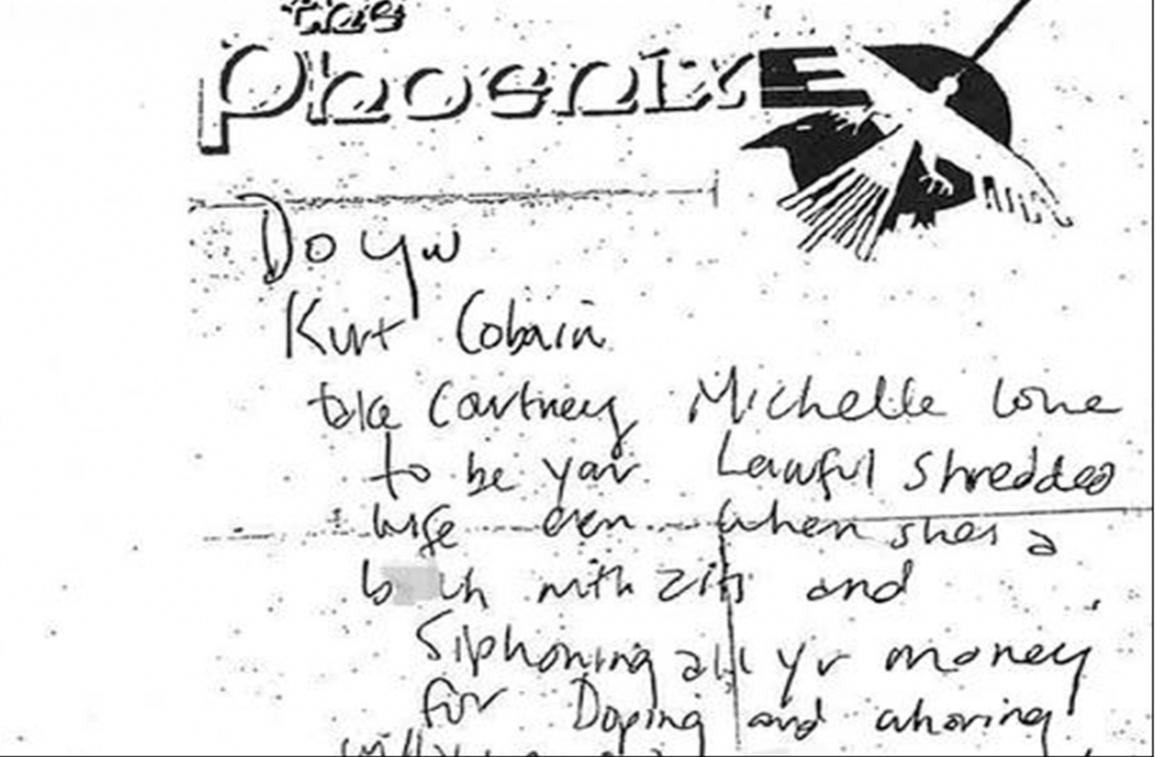
They also released a postcard that was in Cobain’s wallet but unsent in which he scribbles down “Do you Kurt Cobain take Courtney Michelle Love to be your lawful shredded wife even when she’s a bitch with zits and siphoning all (your) money for doping and whoring…” Apparently there’s more not included in the photo released. Funnily enough, the stationery Cobain uses for the postcard above, that was found in his wallet, comes from a San Francisco hotel called the Phoenix – apparently popular with a rock clientele, perhaps partially due to its proximity to a neighbourhood known for drug dealing. As an aside, Cobain doesn’t visit San Francisco in March 1994 – however, Roddy Bottum, keyboardist for Faith No More and a friend of the Cobain couple flew in from San Francisco sometime after March 18 and left before 25 suggesting he might have left the postcard at the house and Cobain had later scooped it up and used it as scrap paper sometime among the smattering of days between Friday March 25 and Tuesday April 5. (Added Note: pointed out in comments, it’s likely the card was written by Courtney herself – sheesh, couples! They have the weirdest sense of humour. :-))

This is the Police Report incidentally:

SPD_policefile_27df

A thank you at this point to Jon for adding a YouTube link in the comments a week ago to Tom Grant’s response to Mike Ciesynski which, neatly, includes detective Ciesynski’s verbal comments on his review.

For once I’m going to give an inch to the murder theory – Cobain isn’t exactly a candidate for world’s tidiest human being as demonstrated by the photos last month of how he and Courtney Love left one apartment they shared and the numerous comments on his apartment in Olympia previous to that. The idea that he put the syringe back in his box and put the caps on is a bit weird…BUT. Suicide isn’t a normal act, it isn’t a normal time and this is a guy who has shown meticulous attention to the staging and positioning of art projects suggesting it isn’t that he’s constitutionally incapable of being tidy, orderly and precisely arranged. Having laid out items next to his body, putting away the syringes was just one more preparation…Or his supposed killer takes the time to it which is pretty unconvincing too. I’m sure the Seattle police are pretty aware that by this stage people will just believe what they believe.

The postcard’s main fascination comes from the way in which it’s such a common behaviour on Cobain’s part; the Journals are riddled with unsent letters, vicious missives to all and sundry explaining their sins and crimes. My perspective was always that it was his way of discharging his more negative views and I’ve always doubted that any of the letters were meant to be sent because I think Cobain knew fine well that what he was writing was usually extremely slanted and didn’t even capture the totality of his own feelings. Instead it was more akin to the sentiment put out in his lyrics about politeness (“if you wouldn’t mind/if you wouldn’t care…”, Come as You Are, All Apologies) that he often felt he couldn’t say things, or just as likely knew he’d be talking sh** if he did. Really I put the postcard in with that, a semi-nonsensical scree aimed at his wife who has just threatened to take his child away and to divorce him. I mean, those couple of lines are pretty silly.

Writings on the Twentieth Anniversary of Cobain’s Demise

I was too busy that week of the anniversary (April 5-8, wherever you want to draw the line) to really dedicate some time to doing something so rather than dashing something off I thought it was better just to say nothing if I had nowt to say well.

It didn’t mean I didn’t find time for quite a significant amount of reading though. Now. I try to make a real point of avoiding sweeping generalisations except in error, but here’s one; the Cobain anniversary really brought out the worst kinda space-filling, low quality pop culture criticism I’ve witnessed circulating around any event this side of a British royal wedding – a vast array of dashed off click-fodder.

If you feel like playing bullshit bingo sometime, go to Google news, tap in Kurt Cobain and scan through a few – you’re looking for the following; James Dean/rebel references, references to the power of Cobain’s voice or ‘voice of generation’ hyperbole, inability to name one song other than Teen Spirit and endless quoting from same song, repeated summarization of the Nirvana life story cribbed from existing biographies, point of article confined to a paragraph or two at most surrounded by repetition of tragic/flawed eulogies cut/paste from a thousand other articles.

Sadly, in amidst it, there were a few interesting thoughts but usually without the knowledge of the topic to advance or develop the idea. Here are a few examples:

http://www.telegraph.co.uk/culture/music/rockandpopfeatures/10751850/Kurt-Cobain-had-nowhere-to-go-musically-when-he-died.html

Of six paragraphs, only the fourth and the fifth aren’t autopilot recitations designed for people who neither know about nor are interested in Nirvana/Cobain. There simply isn’t the depth to answer the question set – it argues Cobain may have struggled to articulate anything fresh as he aged without offering any evidence supporting the proposition. This is a shame because it’s a worthwhile line of inquiry. The fifth paragraph deviates entirely to discuss the changing landscape of music post-Cobain – again, it’s not a bad topic (though spit-roasted to the consistency of leather by this point in time) and could have carried a full article.

Pop Matters made a far better show of asking the question raised in the fifth paragraph of the Telegraph articleeven if, again, the depth into which the average music journalist can go is simply to make surface-skimming points about modern guitar music compared to Nirvana:

http://www.popmatters.com/post/180441-the-legacy-of-kurt-cobain/

http://www.bbc.co.uk/news/entertainment-arts-26776170

This is how to do it (God bless the BBC!) A very brief article but an original story about a specific point in time and Youri Lenquette is a top notch individual. Similarly, here’s NME doing a quick burst about plans to record. The issue would be that these are news bulletins rather than criticism or proper thought-pieces but, again, I’m ok with the idea that one says as little as possible if one has nothing fresh to say.

http://www.nme.com/news/nirvana/76574

Again, in the Oregon Live piece below, the idea of discussing the topic of how Cobain changed anything at all is a topic worth exploring…Thing is, Charles Cross has already done it for this anniversary (I scanned the rather light, rather small, hardback of his new book in a store today and somehow couldn’t stomach the £14.99 asking price – I’ll wait for the paperback) so what’s left are nine barely related factoids with no central thesis and no link to the title. It’s mainly an ad for the Cross book. A tragic waste of a good angle that could have worked well in this media format.

http://www.oregonlive.com/books/index.ssf/2014/04/kurt_cobain_9_ways_his_life_an.html

CNN disgrace themselves by pegging a space-filling slideshow under the title “Kurt Cobain: His Death and the 1990s” – I mean, I almost like the 90s-palooza thing but even that could have been more stylish; Nostalgiapalooza perhaps? I mean, what’s next? “The Manson Murders: Fun and Frolicsome Memories of the 1960s”? Tagging this photobook of amusing “d’ya remember when…?” pieces to a death feels pretty wrong even beyond the depthless ‘commemoration’ aspect.

http://edition.cnn.com/2014/04/04/showbiz/kurt-cobain-death-anniversary/

At least one of the local Seattle papers did a better job by making a few light comparisons between Seattle c1990s versus modern Seattle – there’s surely a lot more to be added on this one but let’s not quibble given its a concise and distracting enough job well done on an original angle. I mean, heck, it’s a different city now entirely:

http://www.seattlepi.com/entertainment/music/article/Kurt-Cobain-and-Seattle-in-the-90s-Then-and-now-5375275.php

MTV do some truly uninteresting merging of personal bio and Cobain text that could be sold in a box as a word game – construct your own posthumous Cobain article:

http://www.mtv.com/news/articles/1725695/kurt-cobain-man-who-changed-world.jhtml

And the other week I mentioned not being particularly impressed by Everett True’s “I knew him, you didn’t” (I summarise tragically fairly accurately) piece in the Guardian – the guy has done so much better before. I enjoyed the reprint of Jonathan Freedland’s original 1994 report for the intriguing reportage on Seattle at that moment in time, local reaction and questions regarding the depth or otherwise of Cobain’s representation of a generation.

http://www.theguardian.com/music/from-the-archive-blog/2014/apr/05/kurt-cobain-an-icon-of-alienation

What’s lacking is commentary that has an argumentative depth, an original angle, a willingness to assume sufficient knowledge on the part of the audience that the rehashing can be abandoned, a degree of depth on the part of the critic allowing them to roam more widely through the Cobain tale and greater effort having been put into finding primary sources to speak on specific questions or debating points – I’m presuming the North West was flooded with dashed off journalistic inquiries along generic lines no more evolved or intelligent than “so…tell me…What was he LIKE?” or “what’s your biggest memory of him?”

Essentially pop culture media seems to have been stripped down to nothing more than the simple relaying of soundbite and imagery courtesy of PR agencies on behalf of their clients with any attempt at depth confined to full-scale books – there have been some impressive ones in recent years. I may not enjoy hagiography and applications for Cobain’s sainthood but he genuinely is one of those few standout figures in the musical world that would seem to demand that a commentator know a bit more about than is on evidence in the above pieces – it’s like someone writing a piece on Shakespeare based on reading the back cover of a biography plus a sonnet or two.

Just for balance though, here’s an article I genuinely did appreciate (in part) for its willingness to marry the subject of Cobain to a wider question, to a new angle, to evidence I hadn’t heard or considered before:

http://www.ft.com/cms/s/2/32fd8cf0-b42c-11e3-a102-00144feabdc0.html#slide0

I saw it in the FT in which it was a four column full-page piece and for sure, it does suffer from some of the sins of pieces described earlier. The first column strings together a set of non-sequiturs and clichés taking in the recent statue in Aberdeen, quick references to Cobain’s art, two brief quotations from his lyrics (simultaneously marking the beginning/end of Kurt Cobain’s existence to a majority of people – Smells Like Teen Spirit he begins, You Know You’re Right he ends) then finally states that the article has a point. The first two paragraphs, really, are a document describing how the writer failed to find any information out from a primary source so had to rely on quoting another media site to fill some space; the third column in the newspaper returned once more to a retelling of the Nirvana tale at least pepped up with some quotes from Bruce Pavitt related to the article’s main topic.

The redemptive components of the article are the second column – everything from the mention of Scott Sandage to the next … break – plus the final three paragraphs (column four.) The dissertation regarding the evolving model of what failure has meant over time is a welcome one – giving a historical context to the entire ‘loser/slacker’ topic is a really rich theme to run with and certainly sparks thought about where Cobain/grunge belong in the overall narrative of American social/political/economic history.

In fact, it’s a good angle despite the fact I disagree with the author’s point fundamentally. He simply asserts that ‘Generation X’ was the slacker generation and that it was self-evident that a wave of young people were embracing a form of nihilism at the time – untrue. The generation coming of age alongside and around Cobain was just as likely to be employed, more likely to be entrepreneurially active, more likely to have pursued getting an education as a potential advantage in the jobs market (I hate to rely on a Wikipedia article but what the hey, it’s a decent summary and raises the wider point about the different forms of ‘Generation X’ worldwide – http://en.wikipedia.org/wiki/Generation_X), has a higher level of involvement in social causes…Need I go on? The flipside was that it was the generation that had to deal with a new economic/political complex that no longer believed the point of the government was to aim for 100% employment for citizens; in other words, no matter what anyone/everyone did, there would always be more jobs than people and no way for some people to find a job. The tales of over-qualified individuals taking service industry positions wasn’t the tale of a lack of ambition it was the tale of an economic realignment toward a service-orientated economy with more part-time jobs, more unskilled jobs, fewer opportunities overall.

The author has conjoined two separate arguments here; one is about the overall nature of the post-baby boom generation, the other is about the professional respect to be offered to artists and musicians. He essentially – and oddly for a ‘pop critic’ – is claiming those who pursue income via the creative arts are the same thing as slackers. This is a really tangled arena; are only those musicians who aim to be multi-millionaires from the outset worthy of being deemed professionals and accorded the respect that any entrepreneur should receive? Are musicians who are content developing steady but predominantly local audiences unambitious or just establishing a secure and realistic measure of success as opposed to the fantasists who see visions of cheering throngs in their heads even while touring the toilet circuit? Is it only Cobain’s ability to sell millions that makes his art worthy of note despite the fact all the songs on Nevermind originated long prior to his band being anything more than another underground band with reasonable respect? The question of why precisely the author deems Cobain to be a failure, or whether he’s reserving that epithet for the bands around Cobain who didn’t miraculously go through the roof, is the piece he doesn’t answer – again, like the assumption that Generation X were the slacker generation, he assumes it’s self-evident that Cobain was a loser simply because that’s the casual association made regardless of whether it has substance behind it.

I’m not specifically answering that question here (might have a go another time though!) but what I’m saying is that article raises an intriguing intellectual argument that made me think a lot more than most of the pieces published these past weeks – it just doesn’t particular answer or pursue its own subject matter to a finale.

Similarly, there’s a disjointedness within the article’s wider point given Generation X itself has been the biggest purveyor of the ugly blend of new age self-help philosophies coupled with hard-nosed Social Darwinian economics that is manifested via latter-day mainstream hip hop and via the economic politics of a majority of voters. The broad brush tarring doesn’t explain that ‘Generation X’ wasn’t a single phenomenon and therefore was, on the one hand, the ‘me generation’ of the Eighties (recently toasted and semi-celebrated in The Wolf of Wall Street) and the ‘stocks only go up’ cash-in crowd of the Dot-com bust and the same crew recently found corruptly manipulating financial markets, selling financial products that created systemic risks and cashing out million pound bonuses, as well as, on the other hand, being the generation that has pushed for ever more ethical decisions by corporates, is more involved in green causes, anti-corruption campaigns, anti-war movements, local grassroots social activities and so forth than ever. The mythical drop-outs the article is taking aim at don’t have too much in common with Kurt Cobain, nor with the majority of their own generation.

The final three paragraphs are a separate article really pointing out that Jay Z’s appropriation of a Nirvana sample for a recent song was simply a way of contrasting the failure of others to rise within a certain paradigm with his own claim to self-made success. That’s a really neat and sour point and at least a strong conclusion. Unfortunately, having failed to identify why exactly Cobain should be deemed a loser or a slacker, these final paragraphs barely connect to the main thesis.

There was potentially a far more coherent angle for the article. The second column explained that success/failure were concepts that changed over time according to specific circumstances, needs, opinions and therefore are not intrinsic physical realities that can be scientifically defined – that the current definition is NOT the absolute, eternal way it was or should be. The article could have either taken aim at the lazy reporting of Generation X clichés (that really had more to do with typical “older generation dismissing younger generation” thinking) as fact – or debated why Cobain is held up as an icon of failure when by many measures he’s one of society’s one percent of high-achievers. At least, however, it was an article with a bit more substance to it. If there was anything to be taken from a couple of weeks of magazines, newspapers and online media sources deciding to fill a few quick pages with Cobain-talk it’s that an ‘icon of depression’ twenty years dead managed to achieve more, inspire more, pump more thought and effort into his works and make a far less shoddy job of what he did than a vast number of media commentators (who I’m presuming all self-define as relative successes) manage here in the enlightened future.

Nirvana, Gender, Rock and Roll Hall of Fame Musing

http://www.rollingstone.com/music/news/the-inside-story-of-nirvanas-one-night-only-reunion-20140416

Never say never I guess…Given the three musicians involved have reached whatever state of peace required to allow them to approach the work they formulated with their friend Kurt Cobain, there seems no obstacle to more activity going forward. For a long time, this is just my feeling, I think there was a pretty reasonable taboo at the idea of original members of Nirvana playing Nirvana songs simply because the originator of the vast majority of the music had shut the door so firmly on his way out. It’s hard to explain to a fan in their teens that time really does make these things fade but here we are twenty years later and I’ve not noted anyone reacting negatively to the presence of Dave, Krist and Pat on a stage together playing as some unnamed form of Nirvana. Partially this is because of the gentle way in which they edged toward it over the years – everyone was used to Pat and Dave in Foo Fighters, then the occasional appearances by Krist made the idea of them altogether seem less of a jump, eventually a Nirvana song dropped in casually here and there showed it wasn’t such a heavy thing anymore if a song built by Kurt appeared under different guise but with the stamp of authority provided by at least some of its originators. There were some murmurings about the decision to play with Paul McCartney but in general the choice of songs, the way the individuals spoke about the performances, the fact they were playing a new song intended for a specific one-off project – it all put things in that interesting space where it both was and wasn’t a Nirvana reunion, it was implicit but not made explicit which made it easier to focus on whether the new song was any good, whether the concerts looked like fun, rather than having an overt argument over the idea of a Kurt-less Nirvana. The Rock and Roll Hamm of Fame show and the aftermath performance were the lengthiest ‘Nirvana’ set these guys had played in twenty years, the timing was pretty well perfect, there was an occasion that provided some justification for doing it and they made such a point of making it ‘different’ from a Nirvana performance that its simply been accepted as an impressive thing. It’s like slowly squeezing out a spot (sorry for the metaphor!); rather than excessive pressure then POP! and a big mess, they’ve eased it and worked at it over years with no great drive or aggressive attempt to force a result and the result has been a smoother, less painful, less dramatic experience – sheesh, we just saw a band that died twenty years ago do something that back at the time we thought would never happen! And I barely looked until now!

http://kristnovoselic.blogspot.co.uk/2014/04/punk-rock-gender-parity.html

Nirvana’s commitment to gender politics was always present back at their peak – over and again its possible to add up the ways in which they brought the issue to the fore either explicitly by supporting pro-female events (Rock Against Rape, Rock for Choice, Home Alive), by drawing female-fronted bands on stage (Calamity Jane, L7, Shonen Knife…) or by simply stating their views when given the opportunity in interview – or implictly, for example in Cobain’s original feeling that there should be a Girl and a Boy side to Nevermind, the dress wearing on the In Bloom video, the female imagery deluging In Utero, various lyrics, video imagery and components… The conversion of Nirvana’s hits into female vocal performances was a superb choice in terms of providing a true surprise within the performance the other week, turned a historical occasion (apologies for the hyperbole) into a quick summation of some of the strong female figures of past and future (note Joan Jett’s strong links to the Seattle scene – she fronted a post-Mia Zapata version of the Gits in order to help raise money for the Home Alive organisation), plus it showed a continued desire to foreground the subject of women in music. That Krist has used that as a springboard for a wider commentary on the roles open to women in society and their treatment is a step that 1992-1993 Nirvana couldn’t have made because they’d simply have been pointing people to the works of others while, now, in 2014, Krist was able to point to work done by an organisation in which he is personally involved and committed. I guess sometime I should write a piece purely talking about the subject of ‘personal connection’ as a guiding principle in Nirvana’s music and activities.

Here’s the actual report produced by Fair Vote – a worthy piece of work. In general gender issues are a pretty fascinating area, I sometimes get this sense that there was a deliberate effort to demonise the phrase ‘feminist’, to eliminate the positivity within the phrase and to endlessly link it to conflict and aggressive tactics and attitudes rather than to the rational and well-argued points being made. The repetitive focus on more controversial (thus entertaining) individuals, to ignore the matter under discussion in favour of coverage of shock tactics or harsher soundbites – there’s been a thirty year effort to drive the issue of female participation in society into specific boxes and to legislate so that organisations can claim compliance with the letter of the law rather than having to truly consider the right/wrong of a female individual for a role.

The music industry certaintly has done a phenomenal job of reverting to type; the Nirvana era came complete with quite a number of female acts and personalities but ended up focusing on the rather ideological side (Riot Grrl) or the stripper-ish side (Hole) – women were pushed back into the channel of being able to coo softly over gentle songs, the idea of ‘women who rock’ still remained in a ghetto rather than mingling on the same streets as the mainstream. The replacement of hair metal with hip hop as the dominant American music – and that music’s subsequent merger with most other music forms in the charts – brought the music industry back to a position where the dominant gender philosophy is that of an unsophisticated nineteen year old. A friend of mine went to a DMX concert a decade ago and was thrilled to be picked out of the audience to come ‘meet’ the artist. She was queued with the girls then each one was led to a room individually. She dissolved into tears when told she was expected to give oral sex to a bouncer and that the same was expected of her when backstage – “what did you think you were back here for?” she was asked as if she was the one who had the problem or who had the weak grip on reality.

There could be a fair study done of the remarkable way in which pro-female soundbites stretching back to the Spice Girls’ “Girl Power” phrase have been slaved to a visual and lyrical language in which a woman’s power is deemed to lie in her ability to titilate, entice or please men. In some ways that is equality – speaking in the same language as the male stars who rate their value in terms of their attractiveness to and ability to dominate women. I guess what’s sad is that people expected ‘equality’ to mean something more than sexual boasts – that it could mean being better than the low expectations of male behaviour. The bit that’s disturbing, however, is not the expression of the artists but the industry built up entirely to select, mould and propagate those female images – there are entire organisations whose sole purpose is to locate marketable female flesh, ensure that body shapes only sustainable via surgery are prioritised, that choreographed dry-humping is substituted for dancing, that lingerie substitutes for clothing and that appropriate press releases are issued all wrapped in the language of female empowerment. That’s what’s worrisome, it isn’t about a female artist saying one thing or another, wearing one thing or another, it’s about the way in which they’re converted to manufactured product with the ‘wrapping paper’ plastered with the kinds of imagery and ideas that the average pimp could get behind and that wouldn’t look out of place in the lyrical philosophy of an Eighties hair metal band. Ah well, I digress.

http://www.representation2020.com/our-report.html

Oh, so, anyways, i’ve not been around these past weeks – a family medical emergency means I’ve been at the parental home in Spain. It did make me chuckle that Nirvana seemed to follow me there anyways. I didn’t get to go to the Charles Peterson exhibition but my bus back through Malaga yesterday did take me past this familiar image…How nice…

IMG_0528

Secret ‘Nirvana’ Show a Couple Nights Back Plus More Nirvana Writing

http://freewilliamsburg.com/video-nirvana-played-a-surprise-show-in-greenpoint-last-night/

Courtesy of my comrade Isabel Atherton.

Similarly, a fellow named Bob Wilson was in touch having poured quite a bit of time and energy into this piece below which I’m delighted to share:

Tragic Suicide Or Something More Sinister: Examining The Death Of Nirvana’s Kurt Cobain