I remember, back aged 16, visiting a friend called Ewan. We messed around on his drumkit downstairs – only time I’ve ever touched a drumkit – then, upstairs, he showed me an LP he’d just bought and he was sure I’d love. Yep! He was a fair judge of taste and character. We Are Urusei Yatsura became an instant favourite – front to back noisy punk pop with not a weak moment anywhere. Thanks Ewan for introducing me to a band that, to this day, are one of the rare few that make me forget the 24-years that have passed.
Back in 2016 I reviewed the You Are My Urusei Yatsura radio sessions LP for Words & Guitars and let my fanboy soul have full rein – the second-to-last paragraph is my jumping off point for the best news of my summer so far: that on Friday August 7, Urusei Yatsura are doing an online release of a new compilation – Can You Spell Urusei Yatsura: Lost Songs 1993-2000.
The band released an excellent b-side compilation back in 1997, ¡Pulpo!, which is well worth tracking down given it’s another 13 tracks of pure excellence. But that still left a further 23 b-sides that were left off the 1997 compilation, released on the singles accompanying the two albums (Slain By Urusei Yatsura, Everybody Loves Urusei Yatsura) that came out subsequently, or on the Yon Kyoku Iri EP of 1999.
I can only encourage you to take a chance and make a little Bandcamp investment on Friday if you haven’t already heard them. And, if you have, then I suspect you already know why I’m so enthused. All Hail Urusei Yatsura!
One of the (substantially true) cliches about the British is that we’re fixated on the two world wars of the early-to-mid 20th century. Certainly the subject comes up remarkably often and is a surprisingly constant source of reference given there are so few living participants or witnesses remaining (someone who was five years’ old in 1945 is now 78-79, someone who was five years’ old in 1918 is now vying for position as one of Britain’s oldest residents.) In some ways it’s understandable: to be British is to live in a relatively crowded country where most streets follow courses laid down hundreds of years ago, where digging down any depth reveals we’re walking on past settlement, where we’re rarely far from a physical remembrance of decisions hundreds of years old. The British character seems to have drawn something from this shrouding in memory – we mostly live in the property and belongings of past generations. I can’t help but think of that when I listen to Ghost Box, Trunk Records, The Caretaker, Burial – it’s a very British musical form, this eerie invocation of relatively recent cultural heritage: rave, jungle, the BBC – things that once sounded like the future and, of course, faded to become just an accepted and steady present before acquiring a dusty vibe that marked them as the past. Maybe it’s an aspect of life in a wet climate, that crispness and sharp decisive lines become mildewed, warped and mangled.
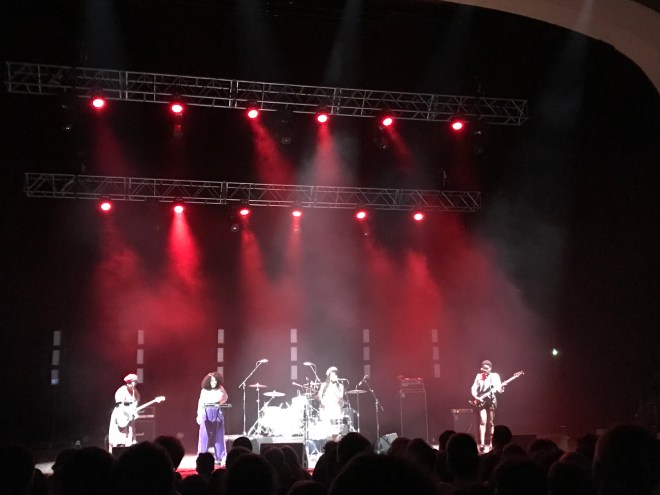
Anyways, ramble over. I had the pleasure of seeing Bikini Kill over in Brixton on Tuesday evening supported by the deeply cool Big Joannie and The Tuts.
Remarkable seeing how Bikini Kill’s significance as a band that meant something more than music has given them the ability to fill a venue of this size so many years later. My friend was disappointed there was no music from any of the participants’ later bands (Julie Ruin? Le Tigre?), but maybe that’ll come (perhaps accompanied by new music) if the band stays together – there’s surely only so many times Bikini Kill’s nineties catalogue can be reiterated. Musically, it’s very much of it’s time and there’s a fairly stable and relatively unvaried palette at the centre of it all – sounded great on a big stage though.
Kathleen Hanna is such a wicked front person: a whirl of movement, eye-catching body language and captivating anti-rock god posture. She’s also a voice of rationality taking the chance to share her observations on the state of modern politics, then/now comparison, positivity and forward motion. Definitely not a ‘holier than thou’ figure, what I heard was both someone committed to their beliefs but equally committed to be humane and celebrating common humanity too – to not lauding herself over anyone.
My friend was determined to head to the front so we ducked our way through gaps in the crowd until she was ensconced in the first/second row and I held myself a couple of rows back. It was really enlightening hearing her thoughts afterward: “this is the first time I’ve been to a show and felt safe at the front.” It was so notable that the girls were looking after one another even as the mosh-pit surged as heavily as at any other show. I really value being challenged in day-to-day life and I realised immediately that, as a bloke, I’ve never had to think twice before heading to the front. With my eyesight being less than brilliant I’ve always needed to be fairly close to feel that connection to a performance, plus I actually like seeing not just hearing the creation of music. It felt like a flash of the blindingly obvious to be reminded that it isn’t necessarily such a thoughtless decision for a woman to step in close. Great to attend a show where this was called out and people were asked to make an individual choice – some went forward, many stayed back.
It was funny to see that crowd-surfing has become a bit of an embarrassing relic indulged in only by a tiny number of people: I remember losing the appetite for it at a Feeder gig in 2000 or so when someone’s boot cracked down on a friend’s nose and she had to spend the majority of the show in the toilets trying to stem a substantial flow of blood before we took her home because her head was spinning. Part of me wishes the mosh-pit would follow, I’ve never had much interest in slamming other humans – I bounce, pogo, headbang and vibrate to my heart’s content but I just feel sheepish when my energy collides with someone else’s space.
For me, what was interesting was to be placed in a position of awkwardness, where I couldn’t relax or just be thoughtless – this was NOT a bad thing. A lot of the time, faced with discomfort, the most human reaction is to reassert one’s own righteousness and lash out – it’s worth resisting this and taking time to question oneself. Very quickly, just by virtue of following a friend, I felt I was too close to the front. I was never able to really let go during the show because I was trying my best to not let the mosh-pit crush the front rows, trying to keep my balance and not get hurled onto the people around, passing water back between songs, stepping alongside one girl’s male friend so she had a bit of cover while replacing a contact lens…But, in truth, one’s own perception of one’s gig etiquette isn’t really relevant: it’s all eye of the beholder – I could never be sure what I thought was good behaviour was being thought of that way, my friend’s assertion that “you’re not a dick,” really didn’t cover it.
It was a very positive gig, the spirit was wonderful, it was nice to see girls being able to get together and set the course…But beyond gender, beyond any group identity based on a shared ideology or belief, people are still people. Hanna made a point of stating that the left wing needs to stop spending so much time applying purity tests to fellow travelers, to accept diverse of practice and approach, that individuals needed to stop trumpeting their own righteousness over others. Amen! But still, in the audience, there were authoritarian personalities who were more interested in asserting this opportunity for power by policing those around them. A gentleman had accompanied his girlfriend to the front row – legit! He’s entitled to stand with his partner. One girl took issue with this and used “girls to the front!” to barrack him until he bluntly refused to move. Crazily someone thought it was alright to then punch him in the head. Agh…No, nothing as low stakes as a musical performance should ever justify physical violence and ‘girls to the front’, I’m pretty sure it was meant to be a positive encouragement not a statutory regulation or a club to thud over someone’s head. Certain girls in the moshpit were as keen as any bloke could ever be to hurl themselves, or other human beings, into one another – at one point the back of someone’s head connected with my nose and I saw stars for a bit. I spent a lot of the gig trying to brace so the surging bodies wouldn’t hit others on the outskirts of the pit – equality does mean the right for anyone to be as self-centred as anyone else – as I said earlier I’d still like to see mosh-pits vanish into history.
Another incident erupted close by me and, after the gig, my friend commented “he looked like a typical Incel…” which made me wince – judgment by appearance when, in truth, he just looked like a skinny punk kid. Whatever the argument that sparked it, it was notable how quickly a dozen people had lined up against this guy to force him out. I can’t comment particularly, I didn’t see what occurred so I have no opinion, but mobs make me uncomfortable – I don’t believe for a second that all those people had a clue what had happened or were acting on a thoroughly accurate perception. I took the opportunity to head right to the back and watch the rest from there. A small cluster of guys were definitely going for it in the mosh-pit and I’d been very nervous about being lumped in with them already. People often privilege their own perception over a more rational acceptance of uncertainty or a belief that other people aren’t to be lumped into friend/foe categories and dealt with accordingly.
The crucial thing for me is that none of this soured me on the righteousness of Bikini Kill or the assertion of female-friendly gigs! It was a privilege to, for once, be the person who had to question whether I was doing the right thing at a show; and the vast majority of people were a courteous and fun-seeking bunch. Like anything, there’s always that 5% who can’t or won’t be decent – ah well. There are people on the right who would likely claim that the behaviour of a tiny percentage of people says something about the wider cause of liberalism, humanitarianism, feminism – rubbish. Pointing out a few difficult people doesn’t say anything at all about a cause that transcends individuals (just as fiscal rectitude, respect for historical/cultural roots, etc. are not bad things at all and the bad behaviour of a few people on the right does not say anything about the wider intellectual currents.) People have great difficulty remembering that they are simultaneously (a) an individual and (b) part of numerous wider impersonal groupings.
I was honoured to be asked by Trebuchet Magazine (thank you Kailas and Naila!) to contribute a brief article to their website…And I totally failed them by contributing a lengthy rant instead! Luckily they’re kind people and found enough of substance in my growling that they were happy to publish it as a two part discussion piece.
In essence, have you noticed how inescapable ‘the beat’ is? In a world of infinite possibility how limited the possibilities used actually are? I’m not talking absolute rejection but I like the thought that my world might be limitless rather than limited by unconscious design.
For a couple of years now Vinyl Factory has been allowing me to come up with brief spotlights on ten releases by an artist – always an enjoyable experience siphoning down to a certain core and bound to cause disagreement given my ten worthies very likely don’t mesh with many other people’s own lists. But that’s the fun of any public opinion, it invites others to say “no,” or to suggest alternatives. The funniest two comments I’ve received? Number one was on a Nine Inch Nails focused piece where someone wrote that not including Pretty Hate Machine or Still was a “tragic mistake which discredits the whole of your so called ‘introduction to NIN'” (answer: I love Still but had to leave something out while Pretty Hate Machine just isn’t on my list of favourite NIN releases at all.) The other was on a piece focused on Coil where, having listed all the things they would have preferred I include the comment said “It seems like some of these choices were poorly made – a lot of compilation albums that all have ‘Amethyst Deceivers’ on them.” To be fair, I agreed that remakes of Amethyst Deceivers cropped up probably way too much in the latter years of Coil – but trying to choose Coil releases is like deciding which diamond is most sparkly.
My view is always I refuse to write about an artist I don’t respect or enjoy (the two don’t have to coexist – I respect Radiohead but only enjoy them in patches. I don’t want to spend my limited time focusing on anything that doesn’t enthrall me – there are enough such distractions in the world.
So this month I decided to swallow the whole of Public Image Ltd’s discography whole, with a couple of John Lydon sidebars added on for good measure.
The greatest enjoyment I took from it? Comparing Commercial Zone to This Is What You Want…This Is What You Get! The original piece was two, maybe three times as long – there was just so much to say about the comparison. For a start, Commercial Zone gets that extra ‘gloss’ that sometimes adheres to anything that can be described as lost, secret, unofficial – anything with that outlaw edge. I wanted to try to disregard that and consider how it really stands up. Truth is it’s a mixed bag: some of the songs gain an eerie and atmospheric vibe in early demo form – if you like horror/sci fi movie soundtracks, it’s great. Other tracks though are just blatant noodling and tossed off time-filling. Thing is, that’d be a pretty balanced description of the official album too: so it just becomes a Pepsi/Coke question – depends on your tastes because neither is significantly above the other.
The least enjoyable moment isn’t visible in the final post: having to listen through Happy? (1987), 9 (1989) and That What Is Not (1992) in search of something good to say about them. It killed me. I respect and enjoy John Lydon’s work deeply: most artists are hard pressed to wind up with one truly significant band let alone two; to make one album that people might claim as an all-time favourite let alone three or four (depending on your take on Flowers Of Romance.) There’s something about that late eighties-early nineties British guitar pop tone that never hooked me even as a cheery nine or ten year old. The jaggly drums, the over-production, the gleaming plastic vibe of so much of that time. I just can’t fathom what Lydon was singing about by then: the mansion liberal substituting CNN for any contact with life – harsh but I see little evidence on those albums of it being unfair. Still! To digest them in detail and in full was something I’d meant to do for ages. Two whole weeks working those albums round and round, giving them all the energy I could, then realising it was hurting to write about one of them let alone all three.
The most obvious moment, well, sheer truth, I love the first three PiL albums: such a distance travelled, so many different terrains explored, words and sounds that work, humour and seriousness in equal measure – glorious. And the two comeback reecords have been very pleasing.
I watch this and wonder if I’d be able to detect which song was being played purely from the drums without any further reference…Then I look at some of the isolated drum tracks present on YouTube and confess I often can’t see the overall track at all.
Caught this recently, the track ‘Salvation’ from Solar Twin’s new album Pink Noise. Lyrically there’s a lot going on, a musing on current state of music and world that’s worth following throughout. What hooked me the most, however, was the alliance of modern day pop music to the footage of Cobain in a heyday that passed some 29-to-23 years ago: genuinely an entire life time of separation. I couldn’t help but watch it and think when was the last time I saw a mainstream star genuinely acting out emotionally on stage to this extent? Sure, Cobain was aware of stage craft as anyone: seeing the impact smashing a guitar made in front of an audience in 1988 sparked a light bulb and so the reheated Who/Hendrix motif made it’s way through years of Nirvana’s live performances – but there was honesty shot through it at all times. Nirvana didn’t wreck their gear every night: it was a final ecstatic moment when happy or it was an expression of a pissed-off and rotten show – it could be both, it could be either, it was the emotion behind it that mattered. Something has definitely changed though because something so un-contrived, and that looks so right as oft-shaky handheld video footage, is rare at a time when every moment is made to be screened one way or another.
April is always holiday time. Birthday in March so always a good moment to pause, a third of the way into the year, see if there’s anything I need to remember for the next two-thirds… But plenty on.
A lonnnnnng Thurston Moore interview here: worth kicking in the background – around 1 hour, 47 he chats a bit about the book which is really sweet of him – while reading other things (there’s another piece here too: http://thequietus.com/articles/21673-thurston-moore-interview-2). I was lucky this past month to interview Arto Lindsay:
It’s not a ‘top ten’, it’s simply a declaration of ten Swans releases from the 1982-1998 period that I feel best represent the band in particular eras or that are particularly unique and rewarding. Certainly it’d be hard to ever claim Swans were a ‘nice’ band, their concerns were deeply metaphysical; flesh as an anchor forcing compromise and failure upon the soul and spirit, the voluntary subjugation of mind and soul beneath ideologies and social arrangements, the potential for oblivion as the only freedom, the eventual declarations of scorn upon those who ignored the band and blunt statements of the end of the project. Cheery stuff for a Wednesday but genuinely superlative and significant music.
Amazing how information connects up – the value of other views is that one simply doesn’t know what one has missed or forgotten at any point in time. Thus, as well as the two releases mentioned by John Moloney, other people have kindly pointed out items such as a split release from Thurston Moore, the Golden Calves Century Band and Dr. Gretchen’s Musical Weightlifting in 1999, Bark Haze (dang! Thank you Sergey Egorov! I felt a complete fool when I saw that!) plus his participation in the Velvet Monkeys (again…Doh!) Love it! This is how it should be – it’s how I learn, information added to information added to…Plus friends and charming new acquaintances surrounding and making it all good. All the best to John K here!
Thurston makes no secret that he’s a vast consumer of music – a lover of free jazz, patron of noise and experiment musics, that while retaining a foot in alternative rock he’s buried the other ankle-deep in improvisational terrain with jazz inflections. His patronage of events like Brighton’s always awesome Colour Out of Space Festival makes clear he’s plenty of time for these spaces now well-outside the mainstream. I also think it’s fair to say that usually a particular sound of interest has distracted Thurston for spells of two-three years at a time; his early time with the guitar symphonies, SY’s gothic phase in the mid-Eighties coinciding with his efforts with Lydia Lunch. SY and Thurston flirted with hip hop for a spell in the mid-Eighties and left a document in the form of “the Whitey Album” but his solo discography would abandon it unless a one-off live performance with Christian Marclay’s avant turntabilism and a collaboration with Beck – both in 2000 – count as a slight return. He referenced his eternal love of punk and hardcore via the Dim Stars project, by having Ian MacKaye join the band for the song “Youth Against Fascism” and with mid-Nineties SY covers of Youth Brigade’s hardcore anthemic “No Song II” (on the “TV Shit” collaboration with Boredoms’ Yamatsuka Eye and Dinosaur Jr’s J Mascis in 1994) and “Nic Fit” by DC Hardcore forerunners, the Untouchables (on 1992’s “Dirty”) – both song derived from Dischord Records’ releases – then returned to at least echoes of that scene with the much belated Chelsea Light Moving (2013.) 1998’s mixed media experiment “Root” saw Thurston pass recordings to a huge range of artists to reinterpret and remix with an art exhibition associated with it – remixes behind an arena SY and Thurston have had surprisingly little to do with despite it becoming a space-filling/gap-filling trend for many bands over the last two decades. He doesn’t go back to the world of substantial remixing projects though the occasional one-off track does exist here and there for other artists.
(Thurston Moore and Andy Pyne – January 2013 in Brighton, UK)
The mash-up combination of Christian Marclay, Thurston and Lee Ranaldo (2000) – an album named after an audience member’s shout of “fuck shit up!” that commences the hour long “Paix, Amour” – played live at the Festival International de Musique Actuelle de Victoriaville on May 24, 1999. Siren warnings underlie what sounds like musicians warming themselves, limbering up for what they’ll soon unleash. It’s, of course, impossible to distinguish Thurston from Lee when they’re engaged in work of this nature – both mount such expansive arrays of well-honed tricks into the atmosphere that really it’s best just to settle and admire two masters at work. What’s intriguing is how Marclay’s stunts often blend so seamlessly into what the other two are doing, three individuals used to using instruments in ways that escape the normal palette. It’s often the more regular noises that therefore surprise on something this ‘out’ – layering trumpet fanfares on top of one another with that alarm bell tension as guitars chitter like monkeys or hoot elephant calls. The diversity of sonic creation is striking; catching moments where a particular sound catches the ear or binds fast to another element on display. What’s most on display is the musicians’ willingness to use restraint, to focus on a particular approach and run it down to the end of its usefulness within the context of the others’ efforts – noise, as in sheer deployment of volume and device is a sparsely used respite from more subtle interrogation of the instrument. The responsiveness to one another runs deep – without ever tipping over into something as crass as a song there are spells in which a mood predominates and all reinforce it whether that’s the gothic horror vibe soon after the half hour or the percussive shuffle-step driven by Marclay around the fifty minute mark. The nine minute closer “Pour Diane Allaire” even finds time for knowing wit as Marclay mixes in the opening guitar riff of Sonic Youth’s “The Wonder” from “Daydream Nation.” From that point the furling and unfurling of Marclay’s samples dominates with the guitars contributing something close to the sound of early record scratching to match the back-forth wind-rewind of certain samples. That remarkably blending of the turntable and the guitar gives way half way through to a cascade of feedback as another instrument ping-pongs a tone over the top. That sense of hot spurts jumping from the top of a lava flow persists for the remainder of the track, there’s no particular direction, just a pile-up of diverting sounds emerging from the boiled morass. The ragtime jazz troupe that opens up is another pleasant surprise to bubble to the surface before the well-timed end snatch of what I think is a Sinatra doing the final bars of “Love Me Tender.”
I mentioned “Root” earlier and I clearly recall its purchase. I was in Parrot Records, a now defunct record store under a student accommodation block on Sidney Street in Cambridge – the vacuum bag packaging tickled me pink, likewise it was the first time I’d really paid attention to that “No. X-of-Y” mark on a release. My reaction to it was essentially down to me rather than the release. It isn’t Thurston’s responsibility at all – I’d only just discovered SWANS that Christmas, I didn’t own anything rooted in electronica, I hadn’t yet glanced at Throbbing Gristle let alone Coil, I’d barely even begun exploring Thurston’s non-SY career – there was almost nothing my 19 year old self was likely to have in common with this release. I spent my time wishing he’d simply released the 25 solo guitar pieces with which the whole exercise originated so I might understand what all this sounded like prior to a blizzard of names I didn’t yet know getting their grubby mittens on it. The eclecticism of the result still turns me off today unfortunately; jump-cutting from sound to sound, style to style in a pastiche where some change too much for me to relate result-to-original artist while others change so little what’s the point? Remix records fall into territory where the corruption of the original, while intellectually a perfectly valid and worthy exercise, rarely inspires me the way a good first hearing does. In a way the absence of an original with which to compare should perhaps be a positive but unfortunately that nagging realisation that there was something unseen, unreleased, absent, simply sparked my completist urges and left me frustrated. It was, however, a very valid engagement between art and music, between solo artist and other participants. The packaging was an offbeat comment, the posting of slivers of sound out to potential remixers in vacuum bags with pieces specifically selected for one or t’other performer, it all added a whimsical note to the manufacture of the eventual artefact. Concealment of the original was certainly partly the point given the choice of name for the release. I can’t imagine Thurston’s discography impressing me the way it does without this relinquishing of command and control to others – the breaching of another line in order to experiment with his work and experience the result.
As a sidebar, Thurston has since contributed various remixes to others – listing them out there’s the following of which I’m aware; a remix of Yoko Ono’s “Rising” on a 1996 release, a 2001 remix of Prick Decay’s “Original Soundtrack for AutoeROTic”, a remix of Blur’s “Essex Dogs” released in 1998 on “Bustin’ and Dronin’,” an unusual tribute record called “Atom Kids Remix: 21 Century Boys and Girls” which features Thurston apparently remixing the entire “Atom Kids” album (not a release I’ve ever heard of) which apparently came out around 2002 though I can’t find confirmation of that, a remix for an artist called Ilios in 2000 of a track called “Ktuir”, a 2008 remix for Swiss noise artist Sudden Infant of the song “Somniphobia”, for Jazzkamer there’s a remix entitled “Freemix Norwave” (2001), Thurston Moore contributed to a remix for a gentleman called Jean-Jacques Birgé of a song called “Un Drame Musical Instantané” in 19999, a 2010 remix of Crystal Castles’ “Celestia”, a remix of “Hitokui Papaya” by Shonen Knife in 2005… Again, his willingness to engage with recording technology in this way, to investigate the potential it possesses and to lend his name to others’ creations is an indication of both his artistic and his supportive approach.
A more satisfying release – for me – than the hands-off remix project was the 21 minutes of “TM/MF” released a year later in 2000. Again, there was a wider conceit at work which rather tickled me. This time, Thurston improvised ten guitar works live while the artist Marco Fusinato prepared ten paintings each one to be created within the time limit of one of Thurston’s songs. As an active event it certainly has validity given the musical choice forces the artist to create with a clear and obvious limitation – as a participant it sounds rather fun. There’s an obvious question I still have regarding whether there was any other connection between the music and the paint – did the sound influence the artist, was it meant to, did he use it as a guide or was he too busy getting something – anything – down during the brief couple of minutes most of these tracks last? I’m also a fan of inlay booklets being an active and full element of an album rather than just a collection of lyrics, or credits, or legal blurb, or seemingly random images intended to look cool. In this case the booklet consists of twenty images – one of Thurston creating that track number, next to one of Marco painting to that track. It’s a great little booklet bringing me closer to the event, giving me a little more insight than the aural material alone provides – a further page lists Thurston’s times, then on the opposite page lists what item Marco used to apply the paint in that particular piece. In terms of Thurston’s work nothing lasts long enough or is developed enough to be anything more than a dashed sketch but the concept under which he’s working seems to push Thurston to jump approach on every single song. The sheer range of sounds yielded by the guitar gives an impression of its boundless potential at the same time as it mirrors many of the techniques he uses on other releases we’re discussing here. Track 1 is a minute of jabbed and muted strings walking back and forth along a rudimentary scale; 2 is all dry guitar slides as if cleaning the strings turned into frenzied fret masturbation; 3 is a relatively warm set of hacked chords that one could imagine him playing in a bedroom one morning for later tidying and pruning into something more; 4 combines bends and long neck slides whether with hand or instrument to create oscillating revving; 5 is frantically strummed like the tightly-clenched peak of a mid-Eighties SY solo; 6 trampolines up-and-down with noisy feedback cut down and the strings pulled or hit over and again; 7’s rubbery plucking seems to be a recording of him scrunching strings with one hand then picking or popping strings randomly near or against the pick-ups; 8 goes for simple hollow feedback tones as if the guitar was being passed back and forth slowly in front of the amp; 9 is a bit of muddled strumming showing a liking for switching speed or jumping to a different note at no notice; 10 is a guttural roar, a nice finish, just an amplifier spewing something akin to the afterburner on an F14 Tomcat. I’m sure it was a hoot watching this in the making – not so much fun on record but a worthy distraction and a brief but effective documentation of a moment in time.
This merging of art and live event had to wait a while to reoccur. The 2013 release of “Comes Through in the Call Hold” was a further merging of Thurston’s interests – his most explicit engagement with lyricism as pure poetry. His partners for this release were Anne Waldman and Clark Coolidge and it all took place while on a summer writing program. Various combinations are attempted, each individual lends vocals on one track or another, Coolidge drums on all tracks with the exception of his own vocal turn, a piano is incorporated at one point. Strangely, amid the naked poetry, it’s quite an opportunity to appraise Thurston’s approach to rhythm given the relatively high fidelity of the environment and the sparse accompaniment. What makes his guitar work often sound so ‘foreign’ to conventional playing is that he doesn’t operate within the model of block-chording matched to a time signature with obvious stepped changes signposting equal obvious movements of chord position. What he does instead is more akin to soloing. Thurston strums continuously while making the switch with the result that the partial notes between positions are also captured – the slide is audible over and over again not due to sloppy technique but due to an avoidance of the time-obligated robot steps most rhythm playing involves. Thurston’s approach is a far more fluid entity and it’s understandable that he’s accused of ‘noise making’ given he rarely walks leadenly up-and-down scales – his approach is quite foreign to much of western guitar history. The way he slips from one location on the neck to another is supremely tactile – a conversational liquid in which notes, chords and any other form of contact with the instrument can be incorporated to create a sonic result. The avoidance of simple repetition – Sonic Youth songs often abandoned the verse/chorus/verse progression in favour of verses spliced via occasional bridging phrases – is a further trait, the tendency to move to a new sound or a new place rather than returning to a root takes place often. So, on the title track Thurston strums rolling lines of notes – a relatively comfy ceding of the foreground to Coolidge’s vocal. “Om Krim Kalyai Namah” continues this with Waldman on vocals while Thurston contributes jazzy strums and arpeggios that never stand still and rarely repeat. The release ends with a full half hour blow-out, “Turn Left at the Dog.” The full barrage of tactics is on display – I’m intrigued by how often Thurston is able to produce two layers of sound simultaneously – a second guitar or just incredible ability? The clock-speed and muscle memory he displays is remarkable – to make so many shifts, to incorporate so much ‘material’ while rarely letting a sound that seems undesirable or ‘wrong’…Time must slow down inside his mind to let him play this way.
Raymond Pettibon, Mike Watt and Thurston Moore live in 2013
While Thurston’s discography of collaborations is extensive, there isn’t quite such a wide variety of guest appearances. The most famous is, of course, R.E.M.’s “What’s the Frequency Kenneth?” (1994) off the only album by them I could ever stomach (namely “Monster”), in 1999 he lent guitar-work to poetry by Steve Dalachinsky on a collection entitled “Incomplete Directions” though I’m not sure whether to more than just the song “In the Book of Ice #5” which also features Tom Surgal, band Truman’s Water had Thurston along for the song “Asleep Sneeze” in 1995, a track called “In My Room” (2005) by Hanin Elias, he showed up on two songs by Black Pig Liberation Front in 2000 (namely “Thurstoned” with Anton Price and DJ Low and “Static Nomad Wave; Codex 7” with David Coulter and Palix), a couple of match-ups with DJ Spooky a full decade apart – “Dialectical Transformation II Peace in Rwanda” from 1999’s “Subliminally Minded” EP plus “Known Unknowns” from DJ Spooky’s 2009 album “The Secret Song”…There’s also one appearance on a Lee Ranaldo solo album, providing second guitar to the song “Non-Site #3 on the superb album “Amarillo Ramp (For Robert Smithson)” (1998). He’s also potentially on the SWANS compilation release “Body to Body, Job to Job” having performed a short stint with Michael Gira’s band as a second bassist at their earliest gigs in mid-1982. In 2010 he was roped in by Beck to cover Yanni’s “Santorini.”
What Thurston has indulged in several times, from 1994 onward, is in the orchestration of other musicians into pseudo-bands put together for specific events or actions. In early 1994 he brought together various people for a couple days straight recording. The line-up included Don Fleming and Dave Grohl and took place for the film “Backbeat” – a Beatles’ related excursion. This wouldn’t be his only dive into cinema-related collaborations, the film “Velvet Goldmine” (1998) featured Thurston with a line-up called Wylde Rattz alongside Mike Watt, Mark Arm, Steve Shelley, Don Fleming, Jim Dunbar and Ron Asheton of the Stooges who play a cover of “TV Eye” on the soundtrack with Ewan McGregor on vocals strangely enough. It’s not the only time Thurston has collaborated with a Stooge – in 2014 he covered Gun Club’s “Nobody’s City” in the company of Iggy Pop and Nick Cave for “Axels & Sockets: the Jeffrey Lee Pierce Sessions Project.”
Note made of the Wylde Rattz, of Dim Stars, it’s worth seeing how many full-named bands Thurston pursued outside of Sonic Youth (Twilight don’t count, they were a band before Thurston’s participation.) While treating such entities under a piece on Thurston Moore it’s worth mentioning that they are a breed apart from Thurston’s solo discography – there’s a point to applying a concocted name to one’s output rather than just one’s own given name and those of one’s collaborators. In a sea of so many collaborations it would indeed seem strange if the christening of certain entities was an entirely meaningless gesture. The Dim Stars line-up required a name given its line-up was a combination of three noteworthy acts; Richard Hell (and sometimes Robert Quine) of mid-Seventies New York punk fame, plus Thurston and Steve of Eighties-onward New York alternative fame, plus Don Fleming of Eighties New York rock fame – a full band’s worth of people, playing in a traditional band format, with no clear hierarchy of participants, required a band name to define them as an entity. Dim Stars, as a name, seems deliberately chosen as a description of the nature of indie fame; at this point of time these were all musicians who might be namechecked and referenced in commentary on scenes, eras, genres, other musicians’ records – at the same time as not selling overly many records themselves. The ‘Backbeat Band’, again, was an entity in which, despite Thurston’s guiding role as the man who brought them together, the ample participation of others and the resulting group product required acknowledgement. The song-form product is what differentiates these projects from the majority of Thurston’s collaborations, it’s a different form of group work as compared to studio or live improvisation.
The close relationship with Don Fleming continued throughout the decade with Thurston bringing Don in for the Backbeat project (1994), for a single in 1997 (Thurston Moore & Don Fleming “Sputnik”) for the Wylde Rattz (1998) and for the Foot improvisations (1998-1999.) Only the recent series of collaborations with Mats Gustafsson from 2000 to the present day exceeds the relationship with Don – with the only other contender to arise being John Moloney who’s relationship with Thurston now spans from a first one-off cameo on “Trees Outside the Academy” in 2007, through a chunkier flurry of work from 2012 onward with another release due in early 2015. These three relationships, together, span the whole of Thurston’s career as a solo entity. Don Fleming’s presence seems to anchor Thurston in ‘rock band’ territory until the Foot swansong shows the new direction to which Thurston was now committed. The work with Mats aligned Thurston firmly to the Avant Garde portion of the jazz scene for the next decade, while John seems capable of spanning both improvisational formats and more formal group recordings on Thurston’s trio of recent song-based releases plus the Chelsea Light Moving kick-off.
Giving a full name to non-song-based releases seems a rarer phenomenon. There’s Foot in 1998, then the flurry of Diskaholics Anonymous Trio releases in 2001 and 2006. The resurrection of the name on record, however, didn’t imply a revival of the band – the “Live in Japan” record was recorded in Japan in 2002 while the “Weapons of Ass Destruction” release was a recording of a concert at Ystads Teater, Sweden on October 6. 2002. The name in the case of Foot seems to have been representative of how Thurston and Don tended to work together – using their actual names was the exception. In the case of the DAT, Thurston has been open about the releases being a commemoration of the record-buying habits of his little gathering of friends and that it all came about while on a trip to Japan. There’s a touch of the Three Amigos to it really – a tongue in cheek and jokey (and blokey) approach, heck, the second release is named after a series of porn films. The band then morphs into, or is resurrected in the form of, Original Silence – with other members of Mats’ group, the Thing, for a 2005 tour commemorated by a recording of a show on September 30, 2005 in Reggio Emilia in Italy (the First Original Silence, 2007) then a further release a year later of a show on September 28 at Brancaleone, Rome (the Second Original Silence, 2008.) In a way it’s fair to refer to Thurston as a participant in Original Silence while being clear that the concept was not his, the band originated with Mats with Thurston acting as part of the supporting cast.
As I mentioned, as the discography explodes it becomes harder to focus on the change that’s occurring within it – my rambling today is specifically about trying to pin down what Thurston’s journey has been after 1995.
To commence the exploration, as discussed, Thurston is primarily a collaborator, an individual who thrives on working with or as a foil to another. Initially, across the Eighties, those opportunities are confined by being part of an underground band needing to work day jobs right through until the release of “Daydream Nation” and therefore limited in terms of where and when they can work with others. The collaborations are, therefore, solidly rooted in New York City. No points for stating that those initial colleagues are parent to SY’s style, Glenn Branca, then Lydia Lunch who acts as the binding figure between the gothic end of the underground in the mid-Eighties back to late Seventies No Wave. Borbetomagus and Wharton Tiers are part of the cluster within that one city. The geographic boundary doesn’t change much across the early-to-mid Nineties – Richard Hell and William Parker are both New York-centred musicians. What follows is that as 22 solo releases in the thirteen years from 1982 to end of 1995 becomes 23 solo releases in the five years from 1996 to end of 2000, the range of collaboration expands hugely.
There’s still a core during this spell. Loren Connors, Don Fleming, Christian Marclay and Tom Surgal – they’re all consistent performers within the New York artistic community. The latter is also Thurston’s most consistent collaborator in this late-Nineties phase, performing on four releases between 1995 and 1998 with a further collaboration in 2000 plus a performance with Surgal’s unit White Out released in 2009. This reinforces the sense of a musician in transition, exploring a new scene in familiar and known local company with forays out into the beyond. There’s also a physical logic to it – it costs money to tour, it costs money to travel and therefore multiple collaborations across a lengthy time period are more likely if musicians live in close proximity, a fair rule of thumb. There are two shifts, however. Firstly, the geography of collaboration expands to encompass the U.S. with musicians such as William Winant (California), Phil X. Milstein (Boston), Wally Shoup (Seattle), Nels Cline (California.) From the inauguration of Thurston’s ‘out’ phase on 1994’s “Shamballa” to the end of 2000, of 24 groups/individuals on releases with Thurston, 8 are NYC-based, 7 from further afield within the U.S. What’s potentially more surprising is the burgeoning work with artists from further afield; sure Yoshimi of the Boredoms is playing in Kim Gordon’s Free Kitten at the time but then there’s the addition of William Parker, Derek Bailey andAlex Ward’s XIII Ghosts plus Dylan Nyoukis’ Prick Decay all from Britain, then Italy’s (Cristiano) Deison, Walter Prati and Marco Fusinato, plus France’s Jean-Marc Montera and finally a very significant figure in Mats Gustafsson of Sweden.
After the year 2000 this globe-trotting aesthetic takes over completely with the New York root now something revisited but no longer solidly attached. The lengthy relationship between Gustafsson and Moore has been the most solid of the past decade and a half encompassing some eleven releases in various guides (named, Weapons of Ass Destruction, The Thing, Original Silence) but we’ll come to that. Surrounding that core has been a fairly even split between new U.S. comrades such as the Paul Flaherty and Chris Corsano duo, Bill Nace, John Moloney; old comrades such as various Sonic Youth members, Beck Hansen, Loren Connors; then one-off release with non-U.S. residents such as My Cat is an Alien (Italy), Gabriel Ferrandini, Pedro Sousa and Margarida Garcia, the New Blockaders…
The scale of unit in which Thurston works remains a curiosity to me. In his best-known ‘day job’, he was part of a four-piece and he starts off in massed guitar ranks under Branca. Yet his collaborative explorations outside of SY tend to remain focused on duos and trios – even a four piece isn’t that common though there’s a big exception in the form of the Original Silence tour where the Weapons of Ass Destruction trio paired up with Terrie Ex (ex of The Ex a glorious Dutch outfit), Massimo Pupillo (ex of Italian experimental group Zu) and Paal Nilssen-Love (a Norwegian-born performer.) As a live experience it was awesome, on disc it’s kinda cluttered – but then I don’t like much orchestral classical music either so I’m not best placed to comment. One consideration behind this fidelity to smaller units is simply cost. The big band era of jazz ended primarily because the money required to transport, set up and adequately compensate musicians was too great to make touring economical. It wasn’t possible to flex ticket prices sufficiently in relation to the scale of the musical unit performing therefore large ensembles tended to need alternative sources of funding other than ticket-buying audiences. The same went for recorded performances; a label wanted to play flat fees and percentages not wages or salaries per individual – the result? Smaller units become fashionable because they make economic sense with that imposed model. The ultimate end result is the solo artist who can buy the music in on a one-off basis via producers or session musicians – it isn’t just flexibility, it’s cost-effective too, hence why hip hop is the music of modern neocapitalism far more than the Rolling Stones ever was. As Thurston emerges from the rock idiom it’s not unreasonable that he’s used to the norm of three or four piece bands – despite the occasional number-busting no wave exercise like Mars’ “Don Gavanti” opera (check it on the Atavistic label if you ever get a chance.) Entering cash-strapped avant-garde jazz also serves to keep the units small-scale. Would it be interesting to hear Thurston test his mettle against vast orchestras of individuals? Maybe. Either way, in terms of his activities so far, Thurston has primarily been a man who’s collaborative works are with units of traditional rock band size – not unusual.
(Thurston Moore and Andy Moor – May 2013)
So, having tackled the sideshow of geographical reach and the non-show of unit scale, where next? The primary shift differentiating Thurston’s work in the rock-focused era prior to 1995 versus the succeeding twenty years (now over half Thurston’s time in music) is the shift in instrumental accompaniment. Only a limited amount of the work post-1995 involved fellow guitarists as the primary partner. The main continuation was the drummer. Thurston has worked with a succession of individuals in that role across the discography – Steve Shelley, William Winant, William Hooker, Tom Surgal, Toshi Makihara, Chris Corsano – and drums remain the most common accompaniment to Thurston’s solo work, it was even the predominant partner as Thurston found his feet as a live improviser. Very clearly, however, this is rarely the 4/4 beat approach at work. Thurston thoroughly escaped the tyranny of the beat (a phrase I stole from a Mute label compilation about a decade ago and that has always stuck with me as a beautiful expression of the cage formed by rhythm-uber alles.) It comes with its own challenges – a beat permits other players to rest easy knowing that there’s another instrument creating the progress or motion in a piece, all they need to do is illustrate over the top of it. But there’s a machine-like monotony to music set to the omnipresent beat – do you not get enough of it day-by-day? Listening to performances in which drums deviate from their traditional status as show-off metronome and become percussive sound generators, free agents, are quite enthralling for a time – if the players are able to incorporate the full range of possibilities present with a physical kit. Thurston seemed to desire a partner in his desire to derail the core instrumental line-up of rock ‘n’ roll both for it’s comforting familiarity as well as the perversity of dragging it onto fresh soil. There’s a similarity also in the instrumental technique of Thurston’s early improvisation to the work of a drummer – famous images from the Eighties of SY scraping or beating guitars come to mind at once. This was still the core of his tactics in the mid-Nineties so there was a dissolute harmony in working alongside an instrument being put to similar forms of percussive misuse.
From there Thurston began offering his guitar to other possible line-ups. In the mid-to-late Nineties the possibilities of electronica were being touted as the ‘next big thing’ with superstar DJs and celebrity remixers all the rage. No one was immune even if the result was very different indeed. 1996’s “Electricity vs. Insects” 7” commences a spell in which electronic effects play a relatively prominent role as a partner on recordings. This was the first real work in this realm since JG Thirwell’s manipulations back in 1987. Phil X. Milstein’s tape work features on a 1997 release (the Cramps referencing “Songs We Taught the Lord Vol.2”), then the Walter Prati-featuring works “The Promise” (1999) and “Opus” (2001) emerge, with “Root” (1998) and the Christian Marclay/Lee Ranaldo performance “Fuck Shit Up” (recorded live in 1999 and released in 2000) fitting into the gaps along with the split 7” releases with Deison (1999.) That means that every year from 1996 to 2001, at least one of Thurston’s three to six releases a year made substantial use of electronic effects – that’s a substantial presence within the discography. It doesn’t last, however. After that year, despite releasing vastly more material, the majority has been with more traditional instrumentalists as opposed to electronic manipulators. The experiment certainly made sense and was embraced with a certain gusto – “Root” was a fairly high profile release at the time with Thurston turning over his creations to a range of alumni for their manipulation. It also makes sense why it wasn’t necessarily a stellar move; ultimately Thurston had already converted his guitar from a traditional combination of sounds into a fairly unlimited sound generator with the entire loop between his hands and the amp output brought into play and with a vast range of physical and electronic effects deployed between those two points to warp the results. With Thurston’s guitar, essentially, already an electronic device creating noise, there was little electronica could bring that he wasn’t already. Similarly, the rhythm-based results of a majority (not all) electronic music of the modern era had little in common with the direction Thurston was taking. Finally, there’s a point regarding the nature of collaboration most satisfying to Thurston. On The Promise and Opus electronics were a third player in a trio, not the second in a duo; the same goes for the performance with Christian Marclay; Thurston wasn’t present in studio with Deison or with the guests on “Root.” Thurston’s discography has grown fat on live collaborations in the context of which far more interplay, exchange, response and counter takes place when the players aren’t hunched over wiring let alone a laptop. 2014 did see Pedro Sousa contribute electronics (as well as saxophone) to the “Live at ZDB” release of an October 2012 performance – likewise the earlier flurry of activity with noise scene artists like Aaron Dilloway (2006) and experimental/industrial stalwarts like Commissar Hjuler (2009-2010) or the New Blockaders (2007) mean electronics have never disappeared entirely from his line-ups. He’s a willing joiner in most situations.
(As a side-bar, it’s very visible that laptop artists are increasingly aware that live performance is both aural and visual – something they, crucially, lack. While a guitar, drums, sax allows a link between the sound being experienced and the motion and emotion of the person performing – a human connection between performer and those present – that link is crippled when the visual is gone. That’s why most laptop artists are confined to dances – where the audience provides the shared experience and physicality – as support to vocalists or other performers who can provide the human face and focus, or by deploying a battery of filmed visuals or on stage performance. The finest laptop artist I’ve witnessed is Leyland Kirby. As V/VM he supported Sonic Youth at a show where I still fondly recall animal masked friends of his tossing lettuce and cheese slices at the crowds, attacking one another dressed as animals and generally clowning as if this was a deranged pantomime (I kissed a pantomime horse in return for which they passed the CD someone had thrown into the space between stage and audience – the horse got it for me.) Over a decade later, as the Caretaker, I watched him take the same approach by first performing karaoke to a soft rock classic then rolling off the stage and through the audience, then setting the laptop going and simply sitting on the stage to watch the video diary along with us. I found it totally engaging, one of the best films I’ve seen accompany any onstage performance given it was blatantly personal and came with a personal message written on screen at the start, as well as absolutely showing how alienating the laptop ‘performer’ is from any recognisable human form of performance as an bringing together of observed and observer.)
To discuss and contrast two forms in which electronics can be witnessed in Thurston’s oeuvre, on December 4, 1996 Thurston shared the stage with Phil X. Milstein who might be better classified as a surrealist with an interest in dreams, sound poetry, experimental collages than a traditional musician. The resulting performance is remarkable for the way that Milstein provides the layer of chattering sounds that would normally be provided by an inattentive and disrespectful audience, it’s curious to contemplate my annoyance if faced with ‘conversational audience participation’ on a lo-fi bootleg versus how intrigued I am by the voices and mutterings Milstein entangles into the performance. Given the ubiquity of spoken word samples on the work of bands like Mogwai or Godspeed You Black Emperor (who received ample comparisons to SY’s work) around the time of this performance, it’s curious how little role such shenanigans have played in Thurston’s work. It emphasises that his interest lies in the world of sound creation and musical collaboration, not in the construction or orchestration of structured recordings, the arrangement of sound files on or over other work – he’s not someone desperate to work as an omnipotent music producer. That’s a commentary on his motivation as an explorer of sound – he’s put together bands, brought together collaborators, but seems to feel no desire to boss or manage them in furtherance of a restricted vision of his own dictatorial conception. Maybe that’s where my only real criticism of this release lies – ultimately Thurston does his own thing as a guitarist, while Milstein is off following his own muse. There’s not really any meeting of minds or sounds taking place – swap Thurston out and stick in Slash playing cod-rock moves of the old school and it’d work just as well; strip out Milstein and drop a record by Negativland and it’d rumble along comfortably. The challenge is perhaps one of format; on vinyl there’s no indication of where/when a gambit by one or t’other musician is a reaction to or compliment to the other’s thought process – you can’t see it. That’s a regular pause with an awful lot of improvisational music – one always wonders what is lost when the entire visual component of watching musicians at work is sliced away. The judgment instead must fall on whether the result is interesting as a sonic experience and it has to be said it is worth a listen, re-listen, flip, repeat. Voices submerge, other instruments crack Thurston’s surges, recorded sound is divebombed with guitar explosions while paused fingers are made to run by strafing fire from Milstein’s own guitar. The only point at which the sound placement (or at least the way the record has been cut) seems particularly precise comes at the close of Side B where the final sample states “…Turns the air conditioning OFF,” at which point the record ends. A neat last touch but a long time to wait to be sure deliberateness played any part here.
“The Promise” (1999) has always been a release I’ve felt ambivalent about but marks a crossing point in which the period of electronics peaks and the saxophone, likewise, becomes prominent. Thurston permits the other instruments to screen his contributions, he relegates himself to the background – ultimately letting Evan Parker lead the ensemble. Mea culpa – I’m not necessarily a lover of the saxophone, this undoubtedly influences my feelings here. Track 6, “Children” is the one that most stands out for me – Evan’s see-sawing constancy, the blanket background provided by Walter Prati’s rumbling thumbed bass, Thurston’s occasional interjections with soft runs of notes – it all combines to a satisfying close on track 7, “All Children” with cut up spoken word gradually buried as initial spikes become molten guitar and electronic slag. It’s the physicality of the playing – being able to hear the hand slides at one point – detectable human motion behind the otherwise unidentifiable wall of sound that at times is permitted to simply continue undisturbed, noise as peace. The final thirty seconds pulse like a stylus hitting the end of a song. Chopping a release like this up into passages does create manageable and digestible chunks, while also making it hard not to feel the artificiality of the format given the sounds and activities on display are so similar across the release. There’s something of the gypsy jazz approach to Thurston’s tightly tweeted up-down stroked notes – of course he ladles on the disharmony, the disconnection between notes even as he pulls fairly conventional hammers and trills. Five minutes in “Is” Thurston’s guitar sounds like bones rolled in a closed fist. It’s a release that feels more worthy of live presence – that one would benefit from watching the interaction between the three individuals to see clearly how they exchange ideas. It’s also rare for Thurston to resort to overt noise on “The Promise”, his noises are restrained, tactfully deployed – the gradually relaxed or released strings swooning behind “Our Future” is a case in point. These subdued murmurings feel like a polite chat between people wanting to negotiate a direction rather than anyone wanting to lead. “Opus” (2001) left me similarly uncertain but again that’s more down to my own limited appetite for saxophones.
(Thurston Moore, Ikue Mori and Okkyung Lee in April 2009)
That’s a difficult of course because the saxophone is probably the most prominent fresh accompaniment Thurston has welcomed completely into the fold. Sure, there was no wave sax on Lydia Lunch’s “In Limbo” but it was an expected part of the full band session in 1982, it’s only on “Barefoot in the Head” recorded six years later that Thurston links up for a sax(x2)/guitar duel. Perhaps it turned him off the instrument, made him nervous – it was his first attempt to enter the free jazz improvisation arena after all – but despite the burgeoning activity in the Nineties it’s not until 1999, over a decade later, that the instrument reappears in Thurston’s discography. While “The Promise”, a collaboration with saxophonist William Parker and multi-instrumentalist Walter Prati, was apparently recorded and realised all in that year there was actually a second recording – the “Hurricane Floyd” live set with Wally Shoup and percussionist Toshi Makihara – that same year though not released until 2000. Both collaborations have sequels – 2001’s “Opus” with Prati adding cello to the mix while Giancarlo Schiaffini introduces a trombone for apparently the only time in Thurston’s catalogue; 2003’s release of “Live at Tonic”, a 2002 performance with Shoup, plus Paul Flaherty on tenor and alto sax and percussion by Chris Corsano. From 1999 onward the sax is a regular instrumental foil to his guitar work; Mats Gustafsson makes his inaugural appearance on a release with Thurston in 2000 and there are sax-featuring releases in 2000, 2001, 2003, 2006, 2007, 2008, 2010, 2011 and 2013. That’s a big shift but perhaps inevitable when swimming in the jazz field. A discovery on eBay the other night that intrigues me, however, is a 1998 release, “III”, by an outfit called The Grassy Knoll. Thurston apparently contributes guitar to three songs by this full-on jazz outfit – I’d like to know more about it but it still presents a shift in the instrumental sound field against which Thurston matches his guitar, one taking place at the end of the Nineties.
The “Hurricane Floyd” release (2000) came with a top-notch back-story. Recorded on September 16, 1999 at the Old Cambridge Baptist Church, Harvard Square in Cambridge, Massachusetts as the titular hurricane blew itself out overheard somewhere. The track marked “Altar Boy, Church Basement” is of particular interest – it’s essentially an early solo acoustic version of “Turquoise Boy” from the 2006 Sonic Youth album “Rather Ripped.” Seeing how fully formed it was so many years prior to its use in the full band context makes one wonder about the roots and origins of many SY pieces. Here it has a close-micked clarity that is truly enviable – the recording quality across this whole release is of stellar quality. “Retribution of Sorts”, the final piece is gorgeous, a keening midnight saxophone meets Thurston’s steel-drum high notes in something that, for a couple minutes is full sentences before it reverts to conversational point/response or talking over one another. The drumming from Toshi Makihara is actually, in my view, one of the most enjoyable pieces of the release. Throughout he seems comfortable pausing, making his interventions precise and effective, his choices – 13.50 into the track he begins working the cymbals over as a perfect complement to Thurston’s gradually building train-motion and Wally Shoup’s controlled angles. As ever these things at some point have to resolve in a blow-out but the gently walking out end minute is a nice touch. Off to review by starting with the back-end of a record but the acoustic break before resuming does help appreciation of the last piece – even on an improv record the positioning of pieces can make a regal difference. The opening minutes of the first track is effective; the drums keep it together with moves that make me think of someone spinning a drum-stick in their hand but somehow hitting a dozen beats in the same movement. Initially the guitar and sax make exchanges – one instrument then the other with only mild overlaps. Then they slide in beneath one another though pauses seem well-nodded from one to other – 4.45 in or so a switch of vibe and mood. Often where the guitar/sax come closest to merging is in the blue notes of the finales – otherwise skronk and screech can be world’s apart. Track two is more effective in that respect, background rustling – a truly unusual product of the percussionist’s art, cable noise, brevity of breath…Shifty commencement taking a full seven minutes to crash down into volume competition.
The “Live at Tonic” (2003) release caught a four man line-up on the night of September 14, 2002 – again, Wally Shoup was involved, this time with Paul Flaherty and Chris Corsano, a regular duo at the time. The result is two sax deep with Thurston really submerged into a cataclysm of squalling honks, thumps, clatter and hoots. He reacts by creating a base-layer, a series of longer tones and drones that take a while to really notice – it’s like how bassists are always underestimated because the undercoat is never as brilliant as the gloss – but the gloss wouldn’t shine so flawlessly without it. I’m at a crucial disadvantage here in that I must confess to simply not really liking the saxophone as an instrument – how can I truly appreciate a recording that foregrounds an instrument that creates a sound that often curdles my ears in too high a dosage? No, that’s unfair, I simply prefer it when used with more subtlety; 14.45 into the second track (second set) the band, for the first time, quietens down. Thurston curbs metal hums in a wash across the backdrop, each saxophone drops in note runs that can actually be appreciated because they’re not consumed in a rush of sound, the drums dash and scatter across the soundfield – the next few minutes are the first time the instruments have separated, have become distinct voices as opposed to monolith blast. Then the one-upmanship recommences, a gradual rise in volume as one player outdoes the other and ups the ante which, unfortunately, tends to mean doing more, making more sound, when those past three minutes of discretion were far finer demonstrations of skill. That’s where I’d distinguish my bias; I like noise releases that allow my ears to catch a sound and follow it – to be taken a journey even in the most dense thicket of volume – I dislike hyperactivity where there’s no settling long enough to catch or appreciate. I can enjoy the sound of a bus engine throbbing while hating the chattering of an impolite crowd.
The “Flaherty/Nace/Moore” release of was another opportunity to study Thurston in saxophone company. Flaherty’s playing tends toward short yolts and yanked knots of sound, the presence of a second guitarist offering a more steady background. First track “Sex” is short, stubby, anxious…Jeez, feels familiar somehow. The saxophone rubs up against grinding metal for what is essentially an introductory track. The sense of instruments going in opposite directions is palpable; the saxophone rises as the guitar is torn slowly down the gears or vice versa. It’s a nice contest. “Drugs” commences with a gentler ringing of bell tones, a softer tone, before the saxophone once against spurts and whirlwinds over the top – by nine/ten minutes in the piece has disintegrated into strafing runs of guitar tone over a spluttering rhythm with ‘squirrel in fear and pain’ sax. Ugh. By twelve minutes in there’s an angle grider tone set against someone gasping for breath then back to the squeaking. At fifteen minutes the guitar is bobbly, bubbling against the crack of the second guitar – the sax is reduced to cine-tones. It’s a f***ing cacophony. It might seem strange in the context of this discussion to criticise something on that basis – what am I lacking? What’s my complaint? It’s hard to define…It’s the sense of noise to no end – the saxophone essentially. The sax has a conversational tone, a motion based on breathing, that the hand-motion required with a guitar just can’t keep up with. The problem is that there’s so little differentiation in the basic sound of the saxophone once the idea of playing a tune or melody has been abandoned and there’s so much movement in the sound that it’s a deluge of near identical moments with no direction longer than seconds. We’re into the terrain where something is more fun to play than to listen to. But then, just my tastes. I can’t complain.
(Thurston Moore, Joe McPhee and Bill Nace live in 2012)
A truly random excursion was Thurston’s contribution to My Cat is an Alien’s “From the Earth to the Spheres” split CD series (2004.) “American Coffin” consisted of Thurston working with a piano for some 10 minutes before he becomes far more comfortable manipulating the recording equipment. Simple truth is that, like with his guitar work, there’s a knowledge of the instrument at work in order to achieve the result – it isn’t a complete novice at work, his progress along the keyboard is too smooth, his combining of notes too seamless to be random – for the minute from 5.40 he displays a sudden burst of quick fingers that indicate he’s hiding a certain skill. What he seems to be doing is simplifying his performing style to evade the clichés of standard technique. In that respect there’s a definite similarity with his earliest guitar work in that notes are hammered over and over until they become an effective rhythm or mantra – then a switch takes place whether in tempo, rhythm, note while other characteristics are retained. Still, I’d have to say it’s a horrendous listening experience. The background microphone rumble is a neat feature but listening to high pitched piano tones pinging at one’s skull gets pretty unendurable after five minutes let alone ten. Ultimately there isn’t sufficient deviation in the sound – that brief burst around 5.40 of note-runs reoccurs around 8 minutes in with les surprise, every now and again he moves to focus on the low notes creating decaying clouds over which he sparks a few notes but always he reverts back to the jabbing of keys as the base from which he deviates, that stability is somewhat dull. The move into a second piece has a certain interest a drum machine moves in with a shifty rhythm, then a range of samples (perhaps just a radio?) starts to fire off keyboard tones, repetitive dance music, burping beats, all somewhere inside the continuous dulled tone of feedback. It’s a fair point being made, that the acceptance of noise as part of the everyday arsenal of electronic-based music makes a mockery of the resistance to its presence in guitar-based music. There’s a point being made about the death of rock and roll, the ‘American Coffin’ of the title, as the desire to keep repeating the same ‘authentic’ old moves led to an unwillingness to expand the palette or move onto new vistas in mainstream rock. The result was the handing of the baton to hip hop, R n’ B, dance – where a visible appetite existed. A sample – the final four minutes of the piece – were torn from here and inserted into the “Trees Outside the Academy” release. It’s certainly possible to note that the piano is a rare presence in Thurston’s discography in general – in some ways there’s been a settling into a set of standard partnership; drums, sax, guitar, various noisenik activities – line drawn.

 Nirvana Legacy