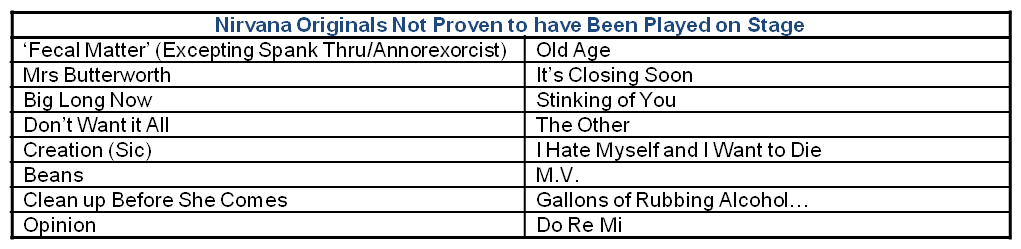
Someone in the comments at one point asked my thoughts on Do Re Mi – and certainly as the last known Cobain original it’s impossible to look at the song without considering the background circumstance of the time and what would come next…
In terms of the apparent facts about the song, it’s a wonderful end to the Cobain saga simply because so little is known about it. What’s it really called? It might be Do Re Mi (a fair guess given Cobain’s liking for children’s TV if its an echo of the Rodgers and Hammerstein musical number from the sound of music) or it might be Dough Ray Me (referring to a comic book series as described here; http://shutuplittleman.com/history.php?idd=19) or it might be Me & My IV (apparently scribbled on a napkin according to Courtney Love)…Basically there’s no definitive name so call it whatever you like.
Likewise, there’s no facts about what it was intended for; the rumoured Lollapalooza EP release is the only official upcoming outlet for it but there’s no information whatsoever if there was ever substance to that idea. That would leave Do Re Mi as one of those Nirvana’s that drifted until a purpose was found for them. Alternatively, there’s the rumours of intended collaboration with Michael Stipe of R.E.M. and some people point to the overall mellow style of the song and the deviation in vocal style to push that possibility. Again, it’s a moot point – there’s no answer.
Furthermore, arguments about Cobain’s next musical direction can continue uninterrupted forevermore given there’s no indication that Do Re Mi’s acoustic approach was the way the song was intended to stay. There’s plentiful evidence by now that even the most raucuous Cobain compositions (Sliver, Very Ape for example) often began life as muted sounding home acoustica. His own comments revealed a desire to go in a variety of direction and on the last known (but still unheard and unreleased) version of the song Cobain played drums instead of guitar which neatly keeps everyone guessing.
What is known is that as well as the bedroom demo found on With the Lights Out (and therefore recorded sometime in the twenty-two days in January 1994 during which Nirvana was not out on tour or Cobain was not definitely occupied) there’s a later version recorded during the fifteen unoccupied days in March with Pat Smear and Eric Erlandson. It’s a possibility that a third version may exist recorded during a March 25, 1994 basement jam with Pat Smear. It’s also clear that, given the comprehensiveness of With the Lights Out, Do Re Mi is one of only two songs Cobain definitely wrote between the end of the In Utero recording sessions and his demise a full year later.
That’s what I love the most about this song as a concluding entry in the Cobain catalogue; it’s an open-end, an uncertainty.
Vocally though, I’d argue its a disquieting support for the idea that there wasn’t much life left in Mr. Cobain. Many people like his falsetto vocal – I would agree with them – yet I’d also point to the broken and strained voice displayed, there’s very little power displayed, held notes break all over the place, it sounds like his voice isn’t warmed up or that he’s a man just risen from his bed. This has a charm all its own but there’s a sense of exhaustion carried in his voice. I’m not declaring that he was a vanquished force, I’m more a believer that this was a man who wasn’t doing much with his private time beyond shooting up and sleeping. It’s still a beautiful vocal performance and truly a different approach to the use of his beautiful voice – I can’t tell if that’s a reaction against yet another element of his musical persona that had devolved into a stereotype or a brief experiment. Again, the fact that this is the only identified or even claimed Cobain original mentioned in discussion of the March jams, and that he did choose to practice it, suggests to me that he wasn’t hiding material from Pat or Eric, this was simply all he had left to work out.
Musically, the song has some attractive melodies delivered with a forceful thwacking of the strings that makes me think there was already an electric ideal in mind – he’s really driving the strings and its aggressive build is disguised by the skeletal recording style and high-pitched vocals. Again and again there are lashed chords that crash through the song, whether on the bridge just before the 3 minute mark (and again in the outro) or in the lead into the chorus. It doesn’t, however, support the idea that he was able to pull away from the verse-chorus-verse mode of song-writing he took such issue with. He placed great emphasis on the tiredness of that song-writing model and on guitar music in general yet here he is still playing it out toward the end of his career. It had become his default setting for how he thought about songs and their structure.
Finally, lyrically, I’m going to cut here from one of the final chapters of the Dark Slivers: Seeing Nirvana in the Shards of Incesticide book which you can find under the About tab of this blog:
Listening to You Know You’re Right (acoustic) or Do Re Mi what’s striking are the prominent lyrics that focus on sleeping and dreaming; Kurt’s lyrical inspiration barely got these two songs out of bed. When it does though his themes went no further than opiates, medication, an emotional state that’s either numb or cold as ice next to a series of blanket refusals; “I will never,” “I could never,” “I won’t.” This isn’t a man with many ties left to a world outside his head or one looking forward positively.
That’s what strikes me most forcefully about what are, in each case, beautiful lyrics. In neither one is there a world existing outside the head of the narrator. This wasn’t uncommon in Kurt Cobain’s work, many of his lyrics were opinions or views rather than external features or landscapes, but usually in his prior work there are plentiful links to events that were occuring around him even if they were suitably veiled. I see no reason to believe that Cobain had deviated from the writing practice that had come to dominate since around 1990 (again, I talk about the three main modes in which he wrote – my theory – in the Dark Slivers book so I won’t recap) and therefore no reason to believe that these two songs aren’t showing what he saw around him in which case its one cold and barren landscape peppered with negatives, with resistance or (in the case of the full Nirvana version of You Know You’re Right) submission…It doesn’t lead me to believe there was more to the life of Kurt Cobain in 1994 than cocooned hiding. Do Re Mi is beautiful, a gorgeous song that wears it rough edges like a backwoods’ princess, but hardly a celebration of the joys of spring or a life filled with either humanity, fellowship or a lust for more.




 Nirvana Legacy