Kurt Cobain Conspiracy Theory Part 2

http://www.justiceforkurt.com/

The best existing summary for the camp arguing Kurt Cobain was murdered is found at the well-meaning Justice for Kurt site. Take a look. While I respect the efforts of the site’s creators who have effectively synthesised what was an increasingly sprawling online presence for this side of things what still strikes me is the updates made since 2001 to the site are predominantly hearsay (“so and so says…”) or marketing for commercial product based on the murder theory. I think that’s a fair summary of what I think there is to show for near on twenty years investigation. The site is at least good for drawing together a lot of the primary source material available.

Anyways, returning to Who Killed Kurt Cobain, the introduction of Tom Grant doesn’t help much. While setting him up as the skilled and intrepid seeker of truth with the detective background they have to admit that this was a gentleman who failed to last longer than seven years in professional policing and where, while they state he was a rising star detective the biggest quote they can find is he was a “very good patrol deputy.” My second disquiet is the first appearance of Mr. Grant involves the very deliberate scenes in which he turns down work and states “…I’m not much of a businessman…That’s illegal. I don’t work like that. A lot of P.I.s will do it, but not me.” The authors’ intent in writing this scene is to create a character, one who is above pure commercial motivations and whose integrity is without question; yet, this is exactly the kind of staging that he accuses Love of doing to him. Either the authors or Grant himself have decided to set up a tableau for the reader in which he turns down work for reasons that serve the book’s plot.

The finest example of simultaneously creating the hero image and simultaneously not permitting truth to get in the way of the accusations comes on page 264-265 where they state “Grant has refused countless financial offers to tell his stories” — impossible to prove — then on the next page go with the very provable reality that Grant has charged money and accepted donations since 1997 but it’s OK because if he didn’t then “Courtney wins.” So, the statement on page 264 is palpably untrue given the overall and very definite flow of money to Grant. The fact the authors of this book have made money off the murder theory is also true but there’s no discussion of their own financial benefit from the tale nor of whether the reporting of Grant’s claims and material via them is bringing benefit to him whether directly or in publicity. Also, just to check here, he’s been accepting contributions for sixteen years now and yet when I look at Mr. Grant’s website (http://www.cobaincase.com/) the evidence hasn’t changed since this book came out — that’s a stunning track record for all that money and such a lonnnng investigation.

The mercurial Mr. Grant claims he has evidence linking Courtney to her husband’s death but “he is saving it until the case is reopened by the FBI”. Twenty years later we’re still waiting for actual proof but it’s OK, because, yet again, it’s Courtney Love’s fault for refusing “to allow the police and the medical examiner’s office to release”. It’s circular argument; I have evidence that Courtney is guilty but I can’t show you it and anyway it’s not evidence until I have evidence that Courtney won’t let me see. So, if you’ll permit me to summarise, it’s NOT smoking gun evidence. Maybe the FBI might reopen a case if there was evidence and maybe a former detective might know that and choose to involve the authorities if there was something there.

Simultaneously, the authors are fine forgiving the fact that Mr. Grant continued to work for a woman he claims he believed was a murderer for several years. Again, the blame and responsibility is placed on Courtney Love — everything in this book is turned around, I’m left doubting if anything in the world happens without Love’s Illuminati style control. Another volte-face is written in which Mr. Grant refuses to take more money for his investigations of Cobain’s death, signalling what an honourable man he is, but is happy to continue taking her money for other investigations. Forgive me for not seeing the difference nor why it suggests he was being paid off or manipulated. As ever, Grant is allowed to make his own claims at face-value and with no deeper interrogation — the authors’ feel no responsibility to investigate the material.

Both Grant and the authors then engage in an ever-increasing avalanche of carefully couched accusations against Courtney Love. It’s a book of endless suspicions, of “isn’t it strange that so-and-so didn’t do X/say X” or “isn’t it strange that they did X/said X” — it’d be delightful to have a scrap of evidence so they could quit the use of rhetorical questions. For the record, trying to suggest that every action or word should, in a screen-scripted world, be other than what it is in messy reality does not constitute evidence of anything at all. If the authors drew together what they are seeking to show are contradictions in the actions of Courtney Love and others into a stronger argument I’d be more impressed, instead, due to the weakness of each statement they leave them hanging in mid-air with no elaboration, often with a post-hoc admission that what they’ve just written doesn’t mean anything. Look for the number of phrasings like “it is interesting to note” and you’ll find mystical statement after statement, each positing an alternative reality and each providing no evidence at all — they’re not even the kinds of strong divergences that would form a fair suspicion. The book is a litany of claims of significance all spilled out over things that have none. The result is wonderful, it’s possible for both readers and authors to discard details at will and to remain so buried in minutiae that it’s possible to forget the overall argument and the wider lack of evidence; it’s a key reason why the murder theories are so persistent — if any item proves weak (and all of them are) then the acolyte can just move onto the next in an endless loop while claiming that the mere existence of so many unsupported or poorly supported ideas gives them a greater significance.

The cast of characters just gets better. The claims of alcoholic, drug user, known crazy and controversy/publicity seeker El Duce are unbelievable right up until “there was an eyewitness”; who? Oh, just El Duce’s friend who says he was at the scene too and who takes El Duce’s messages for him. The conflict of interest is clear and that’s without having to mention the cartoonish nature of the image; Courtney Love drives up in a limousine. But that’s OK because El Duce’s taken a lie detector test ignoring the massive controversy around the effectiveness or otherwise of polygraphs — I’ll let you look up the Wikipedia entry but basically we’re back in the land of TV-based reality where every crime has a technological solution, a basket-load of usable forensic evidence that all points irrefutably to an answer.

Courtney Love’s father Hank Harrison ends up filling me with a genuine sympathy for a woman I otherwise find very difficult to empathise with. His book on Kurt Cobain is available online, various excerpts did make it out. While I’m on the topic of releases about the murder of Kurt Cobain, feel free to check this one out too:

Click to access kurt_cobain_-_murdered_first_edition_pdf.pdf

Mr. Harrison’s contributions are the best indicator of this book’s ultimate malice; he’s utterly untrustworthy, a man with a wondrous drug-addled aspect that makes the rest of the book’s contributors seem almost realistic. He is openly vindictive toward his daughter and constantly seems to be baiting her while making sure to retain the moral high-ground by claiming care and concern even as he damns her word after word. He certainly never takes any responsibility for what seems to have been one of the most confusing childhoods ever created. At least this time the authors admit that this individual has made attempts to benefit financially from his relationship with Courtney Love and, by default, the Cobain topic, whether to bolster his position in the community, or directly in cash. But, once again, like Mr. Grant’s grand evidence unveiling, Harrison’s law-suit to force the reopening of Cobain’s case has never happened.

My hopes for an impressive piece of investigative journalism went sorely undelivered in this case. A cast of no conviction, trial by innuendo, a range of con-tricks on the reader and worst of all a simple lack of proof all delivered by two guys who demonstrably did make money from stating all this and mainly on the back of an investigator who has been taking money and investigating for twenty years now without moving any further than he was right back when he started and with no record of what that money has been spent on — it took me a few days of breathing exercises to work up to Love & Death…

Note that this post is one of four linked articles on the topic:

Murdering Kurt Cobain: Finishing it all Off

A Bigger Better Brighter Conspiracy with Twenty-First Century Production Values

Kurt Cobain Conspiracy Theory Part 2

Love, Death, Drugs, Killing, Murder, Money, Conspiracies…

Love, Death, Drugs, Killing, Murder, Money, Conspiracies…

http://www.cobaincase.com/malw.htm

Just to commence, Tom Grant’s own book series regarding his investigations into the death of Kurt Cobain has entered publication and is available here. And yes, I must admit I’m intrigued, at twenty years distance the whole topic is infotainment and I’d very much like to read it even if I have severe doubts whether I agree with him.

After many years I finally decided to read the Max Wallace and Ian Halperin books on the basis of a gentleman called Brett Robinson who quite reasonably said to me back last year “my biggest qualm is that people aren’t open to the idea that the story as we have been told has been completely misrepresented.” I’ve always been a fan of the idea that one should be open-minded but not so much so that one’s brain falls out or one abandons any willingness to accept a consensual reality — yes, everything can be denied, but in reality everyone compromises. Anyways, I decided it was time I stopped doing my best Sid Vicious curled upper lip look at the mere mention of murder.

Just to be at least a little bit surprising, yes, I think those who have read a significant number of the two hundred plus articles on here might have noted I’ve little time for the murder theories. On the other hand, as a spoiler, I’d like to state from the start that I was surprised how much merit I found in certain elements of the murder theory. Permit me time to get to them in amidst the areas in which I simply thought “this is shockingly poor reportage, poor literature, poor evidence and gross profiteering.” I’ll admit to both reactions as we go and naturally I am very cool with the idea that many opinions have been spilt over this topic and mine is just one more addition with no greater answer.

Today I’m focusing on just one item; Max Wallace and Ian Halperin’s Who Killed Kurt Cobain book from 1998. I’ll then move onto Love & Death from 2004 — a book I was glad, having concluded the former, that they chose to take more time to put together.

The opening chapters of the book rapidly provoked my ire; anyone who relies on Christopher Sandford’s Kurt Cobain bio is immediately suspect to me given that book’s political agenda and many flaws. Intriguingly, Mr. Sandford’s agenda focused on a belief that Kurt Cobain’s suicide acted as a trigger for other teen suicides and therefore that rubbishing Cobain — calling him a rapist, a violent man who beat another into a coma and laughed about it, an active homosexual, an untalented songwriter and musician, a mummy’s boy… — was legitimate if it tarnished his image among young people. Intriguingly the Halperin/Wallace books have precisely the same underlying agenda; the first book is dedicated to “sixty eight lost souls”, the sixty-eight suicides supposedly sparked by Kurt Cobain’s death or influence. The book’s most clever sleight of hand is that, while Sandford attacked Cobain himself, Halperin/Wallace blame Courtney Love rather than Cobain; she “owes it to the families of sixty-eight dead teenagers…To thousands more who still suffer acute depression over the death of their hero.” By arguing that they are the friends of Cobain’s fans they’re able to target the same cause as Sandford but attract loyalty and partisanship rather than opposition.

This posture means they’re forgiven the toned down hatchet job on Cobain in the early chapters of their book — their reading is basically that whatever Kurt Cobain does for over two years is the fault of his puppeteer; Courtney Love. The core function of the first one hundred plus pages is to repeatedly tie Cobain’s actions to Love’s influence — they reduce Cobain to a drooling imbecile incapable of doing anything more than obey. Similarly, within pages he’s delighted to be famous or lying about how much he disliked it then making anti-commercial recording and touring moves with the contradiction never addressed — he’s not permitted to be real. Likewise, he’s an addict because of fights with Courtney and because of stomach problems — again, both might be true but the slinging of mud is never synthesised into a single argument, points add up without being pulled together coherently. Just believe the worst of Cobain and you’ll be fine.

The authors’ most regular trick is to distance themselves from their own work; the appearance of the detached observers when they, in fact, are not. The book claims, and the authors have claimed, that they’re an impartial summary of what’s been stated by others. Yet the actual work is a highly partisan and highly biased case for the prosecution – there’s no critical distance, no balance and the emphasis is very firmly on claiming that Kurt Cobain was murdered. Throughout the book they adopt an (im)plausible deniability where they can claim that they’re reporting claims, not judging sources, nor making any claim of their own despite the very clear and overt selection and emphasis placed on the statements that they want to put forward.

The result is a book where its authors’ create a chain of supposed evidence that they simultaneously point out is unprovable, fabricated, unlikely to be true — an overt compendium of lies by two people who claim they’re not pulling the strings. As an example, while wrapping the book up in a moral mission to save the youth from the Cobain legend they do take time to point that “obviously, nobody takes their own life just because of a dead rock star…There are always other factors involved…” Too darn right, but in which case why are they writing a book to deflate the Cobain suicide and stating it’s because of kids committing suicide if they believe there are far more significant factors? It’s OK, they revert quickly back to the claims that Kurt Cobain holds a semi-magical talismanic power over the young. I think it’s that lack of courage, that overt duplicity — the equivalent of the gossip who when confronted says they didn’t say anything, they merely repeated what they heard in a complete abdication of responsibility for the potential effects of their unwillingness to think or consider what they’re saying.

It’s a long book…There’s more. Part two tomorrow…

Note that this post is one of four linked articles on the topic:

Murdering Kurt Cobain: Finishing it all Off

A Bigger Better Brighter Conspiracy with Twenty-First Century Production Values

Kurt Cobain Conspiracy Theory Part 2

Love, Death, Drugs, Killing, Murder, Money, Conspiracies…

Album Dominance: Which Album did Nirvana Play the MOST?

How could I possibly let a week go by without taking time to play with a spreadsheet at some point or other? This would be a surprising, nay, shocking occurrence. Today’s question is rather a simple one; based on the data available at http://www.nirvanaguide.com which album did Nirvana play most on stage?

I’ve talked before about album dominance in terms of how long it took for the number of songs played from Bleach to decline (https://nirvana-legacy.com/2013/05/08/how-long-did-albums-dominate-on-stage/) and about the total dominance of side A of each of Nirvana’s albums on stage (https://nirvana-legacy.com/2013/03/28/live-set-lists-and-side-a-dominance-nevermind/). This time it’s a more detailed, yet also simpler comparison of the thirteen songs on the 1992 CD of Bleach, versus the thirteen songs on the 1991 CD issue of Nevermind, versus the thirteen songs on the 1993 (European) CD of In Utero — plus sidebars on Incesticide and non-album Nirvana originals while we’re on the topic:

Songs Played Live_By Album

I wish, to be honest, I’d had this data put-together when I wrote the Dark Slivers book last year regarding the Incesticide album — it’s a notable point that the songs making up the Incesticide album were a far more significant component of the live history of Nirvana than those on In Utero which, entirely due to its late positioning in the history of the band, ends up being a relative rarity. The overall trend, quite visibly, is one based on longevity; Bleach, the earliest album is played more than Nevermind, which is played more than the pieces that came together on Incesticide, which is played more than the final studio effort In Utero.

On the other hand, the lengthening set-lists of Nirvana’s later period does have an influence in that, despite being released a full two and a half years after Bleach, Nevermind’s songs make only forty fewer appearances than those of its predecessor. In Utero would have caught up, at least to Incesticide, relatively quickly given the 20+ set-lists of 1994 in which Incesticide was racking up only single appearances, Bleach only three at most per show.

I think of this less as data and more as a reason to cherish certain songs’ rare appearances.
And what of the non-album tracks…? It’s always been very clear that Nirvana’s live selections were substantially guided by their degree of satisfaction with the songs. The result is that those songs that never made a Nirvana album don’t even make significant appearances live:

Non-Album

In total, buoyed substantially by Spank Thru’s 31 appearances, the overall total is still a paltry 72; lose that one song and we’re down to 41 known appearances in seven years by the fifteen other Nirvana non-album original compositions. That’s how clear Kurt Cobain and Nirvana were about how strong or weak their material was — and also how professional they were — nothing that needed major work stayed outside of a studio rendering for long nor survived long if not up to scratch. Given the existing ratio of appearances — album tracks appeared twelve times for every one appearance by a non-album track (72 versus 927)— there’s little reason to expect many unseen performances of these songs. Cherish them.

Just as amusing, showing the relativism inherent in any game with data on the move, if Nirvana had kept touring, Bleach would have been superseded by Nevermind as the most played Nirvana album within just eight more performances given the fact that throughout 1994 Nirvana were playing nine songs from Nevermind per night in comparison to Bleach’s three:

Nevermind_Catches Up

The Key Category of Missing Kurt Cobain Songs: Love Collabos

Today’s thought was sparked by a gentleman from Canada called Greg, all thanks to him not only did he purchase a copy of Dark Slivers: Seeing Nirvana in the Shards of Incesticide today but he made me realise something blindingly obvious I’d been missing (I’m sure most of you spotted it.)

I’ve rambled endlessly about the chances of missing Kurt Cobain demos from 1993-1994 (re: don’t hold your breath for anything in 1994, see the early edition of the Dry as a Bone sample chapter contained in the About tab of this site and taken from the Dark Slivers book – https://nirvana-legacy.com/about/.) I’ve also stated that barring a few tweaked versions, a few alternative takes, the odd jam (Sappy ’91, Hairspray Queen ’89, January ’94) there’s very few hopes of much in the studio outtakes category – if the In Utero Deluxe does bring together the 1992 In Utero demos from Laundry Room Studios and Word of Mouth Productions then it’s done. That’s left me with the feeling that truly interesting material that hasn’t seen official release exists in two categories; Nirvana rehearsals and Kurt Cobain home demos.

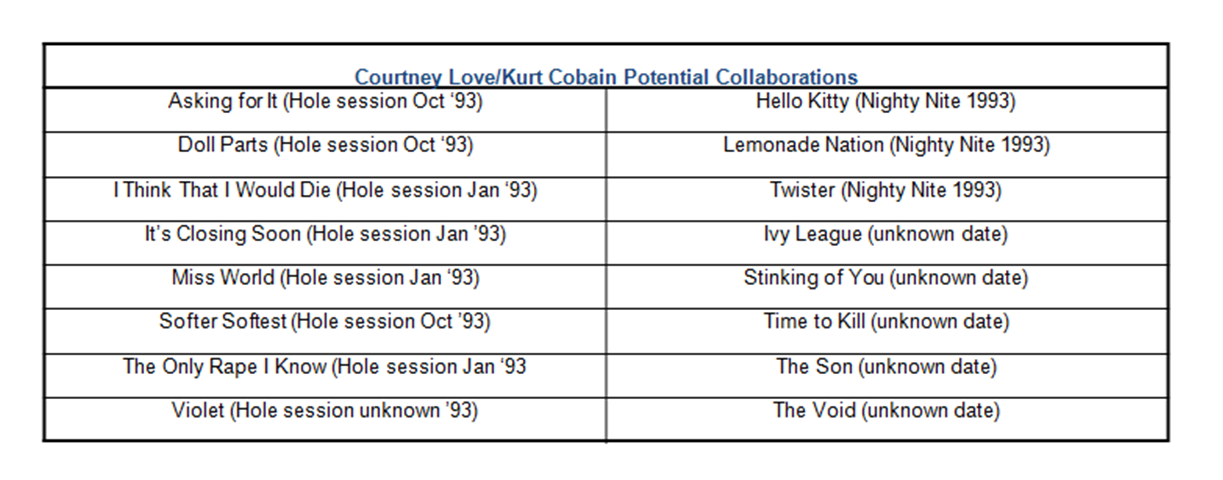
In the latter category I’ve accidentally always wrapped in an entire sub-category; Kurt Cobain collaborations with Courtney Love. Over the years Courtney has been a source for bootleggers of rare material, has played songs on radio shows a long while back, has mentioned unknown songs in interviews with names that aren’t known from other sources – with the exception of the increasingly easily available Fecal Matter demo, Courtney is the most likely source of something fresh. Gratitude to the LiveNirvana site which presently lists the following known or potential Kurt/Courtney tracks;

CourtneyLove-KurtCobain Potential Collaborations

While the quality of material that has become visible so far is of mixed standard to say the least – the Hole contributions from Cobain are as wasted and ephemeral as he may have ever sounded on record, Stinking of You isn’t a song it’s a shred of an idea – there’s still more material potentially from this source than any other. In total, on top of home work with just Cobain and Love together, there’s a total of five known practices (Hole in January ’93, Hole in October ’93, Cobain/Love/Erlandson sometime in ’93, Cobain/Love/Grey/Bjelland sometime in ’93, Cobain/Love/Schemel in early ’93) featuring Cobain with Courtney and others – more practices and jams than he engaged in with his Nirvana comrades during the 1993-1994 period. Heck, the much vaunted 1994 basement demos with Pat and Eric perhaps rightfully belong to this category also.

What’s striking is the absence of any acknowledgement of this work on the With the Lights Out box-set. It suggests a determination on the part of Krist Novoselic and Dave Grohl to ensure that the name Nirvana meant the true band, plus Kurt alone, with a refusal to accept his collaborations with their DGC sister band or its denizens as any part of the official tale. While that’s a fair approach to the Nirvana legacy it isn’t a full reflection of the Cobain legacy anymore than the absence of his pre-Nirvana work (all but one song) or his more experimental urges from the 1987-1989 period. Kurt’s final two years saw him retreat from Nirvana and it’s within that retreat that we’ll find whatever remained of his song writing urges.

Of course the big question becomes one of time. In the chapter from Dark Slivers mentioned above (https://nirvana-legacy.com/about/) I tried to indicate the limited time available in 1994 for writing and creation. Remember that Kurt Cobain seems to have been an ‘on paper’ creator of lyrics, not someone who improvised lines live, so he needed time to sit down and work on material. All descriptions of his working practice for music also seems to involve time spent alone – his fastest/biggest period of creations (mid-1990 to mid-1991) coincided with his greatest isolation. Therefore the question for everyone is to work out how much time he had from February 1992 onwards while staying in hotels and on drugs, then how much he had in 1993 after recording sessions for Nirvana, around being a father and husband, around being a big addict, and prior to heading back out touring later in the year. I’ll leave that open for the optimists and pessimists to debate.

Much on With Nirvana’s Legacy…? Do Re Mi as Dream Pop

CEffect_1

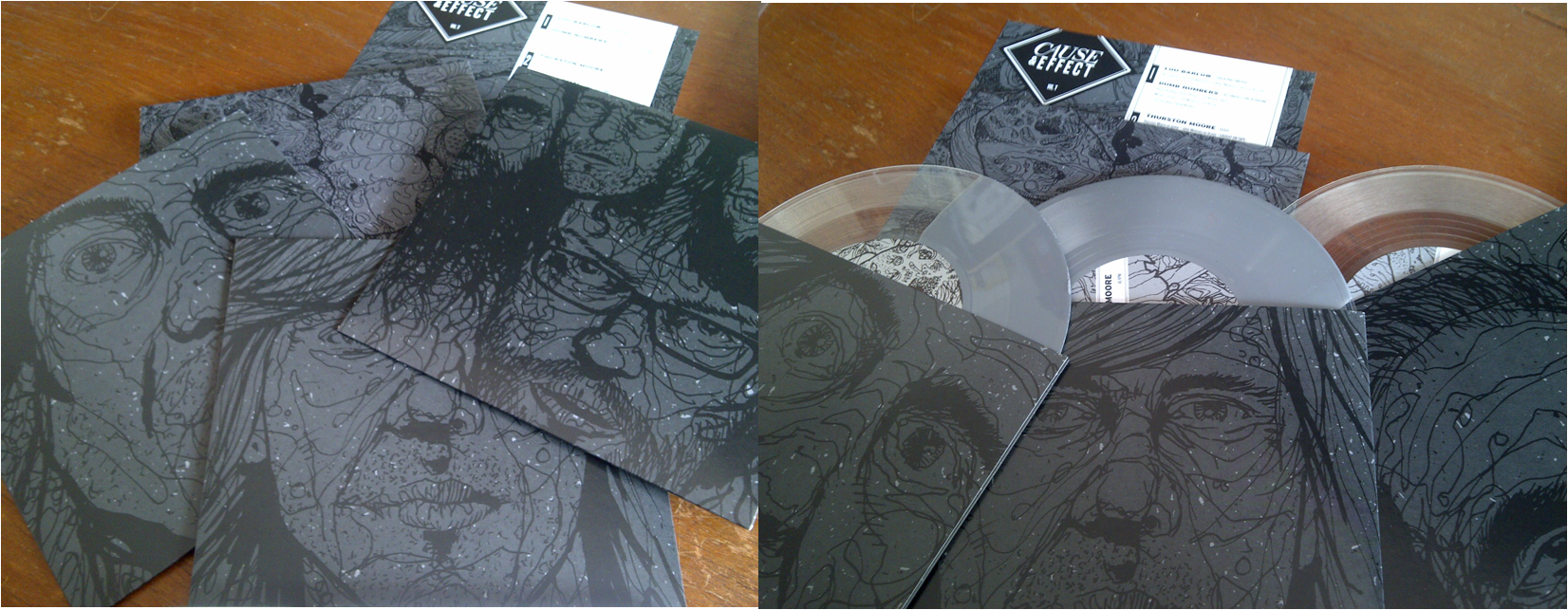
Just enjoying perusing my copy of the Cause & Effect Vol.1 triple 7″ set. I was made aware of the release, and of the Joyful Noise label, via Adam Harding of Dumb Numbers. This bloke has done a lot for my listening habits this year – a few months he even gifted me a link to this little beauty:

I admit I actually stated that I prefer it to the Cobain solo demo; it was such a surprising reconfiguration, the muscular backing rhythm giving some heft even as the vocals retain the fragility of the original effort, while still using backing vocals to give the song a gorgeous dreamy effect. It’s light and heavy all at the same time and I totally adore it.

As for the Cause & Effect set, heck what’s not to like? There’s something lush about vinyl and the packaging on this one is wonderfully intricate – outer package, inner sleeves decorated with images of the various artists, coloured vinyl on the inside… I don’t want to fetishise the object(s) but it did give me pleasure studying these this morning and seeing how much effort had gone into them. Buy it! Go buy it! You’ll also find the new LP from David Yow (former Scratch Acid, formerly The Jesus Lizard, definite vocal influence on early era Kurt Cobain) and the new EP from Sebadoh too. Goodies!

Meanwhile Duluth, Minnesota’s finest – Trampled by Turtles – are playing a batch of shows in the U.S. and have an entertaining new video up which made me chuckle:

http://trampledbyturtles.com/

And what of my 2012 meisterwerk, Dark Slivers: Seeing Nirvana in the Shards of Incesticide? Well, it rolls on alongside my efforts on the blog front, alongside fresh ideas germinating and generally sprouting in a way that makes it hard to find time around work to translate it all into full-blooded words on paper… I admit, on the topic of object-focused fetishism, a normal Saturday morning topic, that people often asked me last year whether I’d considered just doing it as an e-book. I was very firm that given I was writing, ultimately, out of pride and ego, that I wanted to hold the physical object in my hand, I wanted a book, not just data on a screen. It was the right choice. OK, it meant I worked hard to make the words what I wished of them, to make something I felt said new, interesting stuff about Nirvana, about Incesticide, about Kurt Cobain – but it felt great seeing the book. I’ve got about 20 copies of the second print run left now, not bad, not bad. Just drop me an email at nirvanadarkslivers@gmail.com if you want to inquire about it.

Inner and Vinyl

The Most Popular Nirvana Songs: Another Measure

Yesterday I pointed out the eighteen Nirvana songs that were played more than one hundred times, today, I want to cut the information a different way to illuminate a slightly different result.

I took the spreadsheet I’m working with — prepared my genius of a comrade Shrikant Kabule of Mumbai — and replaced the numbers recording how many times in each month each song was played between 1987-1994. Instead I inserted a 1, so that the total added up was simply a record of each month in which a song appeared at least once. The total live history of Nirvana extends for a total of 58 months so coming even close to that theoretical maximum is impressive; here’s the number of songs performed in more than twenty individual months:

Picture1

There’s an obvious similarity and coincidence with the list of the Nirvana songs played more than one hundred times — and, of course, my decision to draw the lines at one hundred plays and twenty months are arbitrary and worth baring in mind — but there are differences; the arrival of Sliver, Stain and Dive into the top fifteen means there’s now five non-album tracks on the list. The reason? Well, I believe it’s down to the long spell in 1989-1990 when Nirvana were working up new songs for a 1990 album that never happened. Nirvana may not have played as many shows as they did in 1990-1991, Nirvana set-lists may have been considerably and consistently shorter prior to reaching headliner status in 1992-1994, but certain songs had a relatively earlier start at a time when the shorter set-lists meant Nirvana were more selective about repeating songs and more likely to chop-and-change.

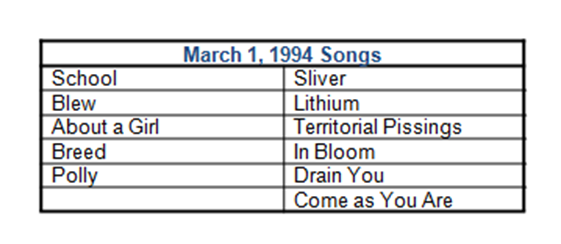
What we’re looking at here is the difference between quantity and longevity; some songs were of declining persistence and made way for the In Utero era songs, others seem to have been readily usable no matter how the set-lists changed and/or solidified over the years. The songs at the top of the list were played from the first month in which they made an appearance and almost within exception right until the end on March 1, 1994. To emphasise that point, here’s the list of songs from the list above that were on Nirvana’s final set-list:

Picture2

Eleven of the twenty most persistent songs made it all the way to the end.

Which Songs Did Nirvana Play the Most? The Top X

As mentioned last week, it was Sappy that received the most notice in studio with multiple takes across four separate sessions placing it in a class of its own when it comes to Nirvana songs. Meanwhile, in another category of records, I was curious which songs were the staple diet of the Nirvana set-list between 1987-1994. The result was that, thanks to my colleague Shrikant Kabule, we created the full table of how many known performances were made across the years. This selection is the list of those songs known to have been played more than one hundred times.

Examining set lists had already identified Blew, About a Girl and School as the three tracks that survived from Bleach right through until Nirvana’s 1994 shows. School is the most impressive performer after all only 241 of Nirvana’s 369 known gigs possess full and complete set-lists; essentially, from the time it was written School featured including on quite a few partial set-lists. Tales of how nervous Kurt Cobain was of playing About a Girl don’t stop it being a similarly highly featured and beloved song for the band.

In past months I ranted about the way Nirvana gave near complete primacy to Side A rather than Side B of their albums when playing them live. The table below of most played songs shows that pattern holds in relation to Bleach where, of the six songs from that album that are played more than one hundred times, all are from Side A. The picture with Nevermind is slightly more mixed but not unsurprisingly. Firstly, the popularity of Drain You in concert is absolutely clear, in fact it’s only just behind Smells Like Teen Spirit, secondly, Territorial Pissings surprised me a little more but still, there it is as the seventeenth most played song. Just as noticeable though, the whole of Side A of Nevermind features on the list — Polly, Breed, SLTS, Lithium, CAYA, In Bloom.

Songs Played More than 100 Times

To some extent it’s still true that age makes a difference — the Bleach era songs, written prior to the big gap in set-lists in early 1989, are the only ones with sufficient opportunity to feature 200+ times — Polly was written as far back as 1987 and played from May 1989, Breed came along later in 1989. Yet, the tangle of creativity, Kurt Cobain’s peak writing years in 1990-1991, coincided with an explosion of touring allowing the appearances of his other songs to evade mere chronology; preferences begin to play a role. This, for example, explains why SLTS and Drain You, relatively late productions, should appear more than Lithium or In Bloom which, though featuring on the same album, made their first appearances a full year earlier — April 1990 as opposed to April 1991.

The gradual increase in Nirvana’s average set-list length also influences the results; head-liner status meant that even while many older songs were squeezed out to accomodate the In Utero era songs, a lot of songs survived because the set-lists in 1993-1994 were more than half a dozen songs longer than in 1990. The shorter set-lists and lower expectations in the early era made it more likely for songs to be flipped in and out regularly. Despite the lower number of shows after 1991, the set-lists had a greater regularity (particularly on the In Utero tour) so a core set of songs were able to rack up large numbers of appearances.

The table also emphasises how firmly focused on their albums Nirvana were; Spank Thru and Been a Son are the only non-album tracks to enter the list of songs played more than one hundred times. The popularity of the relatively slight Been a Son remains a mild mystery to me; it’s a song with the most solid presence on Nirvana posthumous releases on top of its multiple releases during Nirvana’s lifespan.

Bad News: Jonathan Poneman…

http://seattletimes.com/html/nicolebrodeur/2021082565_nicole02xml.html

Some sad news affecting another of the crucial figures in the Nirvana/Sub Pop story.

It’s a reminder that, beyond the abnormal mortal end of Kurt Cobain, we’re entering the era where more and more regularly the people who lived through the age, who contributed some part of the tale, are going to leave us. Naturally first thoughts are a hope that Mr. Poneman is well looked after, comfortable and also feels a deep satisfaction with his life works so far.

Ultimately, while this blog is centred around Nirvana and the figure of Kurt Cobain it’s also intended to celebrate the many others who have some small piece of the story.

Branding and Marketing the Alternative Generation

One of the tragic findings of market research firms and sociologists is that when enough people are lined up under an overall guidance, personality makes surprisingly little difference. Individual morality and beliefs fade, not because the group imposes will on the individual, but because the individual and the group work together to find the point of agreement at which they can coexist while the central decision of the group remains unchanged. It’s simply a case that there are significant boundaries to how exceptional an individual can be – on multiple levels the choices available are constrained by social norms, educational structures, physical requirements, the need to exchange/interact. We’re only exceptional by comparison to a norm, the depth of our exceptionalism relies on what the norm is and can stretch to. It’s why a modern western society can be so accepting of a diversity of life choices and still pull toward an imaginary centre, even without laws mandating a set social reality, and simultaneously why most “alternative lifestyles” aren’t more than a few steps from the norm, they’re expressions of an accepted consensus. That doesn’t mean individuals disappear, it just means the overall significance of individuals fades within wider moments.

That’s where the purveyors of the idea of an ‘alternative nation’ and Kurt Cobain, with his oft-expressed annoyance at the nature of his audiences, both proved tragically deceived. What they were, in fact, doing was observing an overall cultural moment then trying to claim that the music should mean the audience was a specific and unified phenomenon. This meant attempting to place a box round an amorphous and ill-defined component of the whole of late Eighties-early Nineties youth then painting music over the top of them as if music was so clearly decisive in defining social values. Too much energy was invested in setting up an imaginary conflict between those listening to heavy metal, who as a consequence were supposedly macho and sexist; versus those who listened to the next fashion trend in music who were apparently purveyors of enlightenment. Essentially distinguishing aspects of the front-men, characteristics of the band identities, were observed and then assigned uncritically to the audience as if one was a standardised reflection of the other. It produced a simplistic vision in which you, individual music consumer, were not simply listening to Axl Rose or Kurt Cobain, you were a mere blank template on which the media-distorted and accentuated aspects of their personas were projected.

As an aside, the false nature of the ‘alternative nation’ hypothesis set up a moment in which Axl Rose, as a huge fan of Nirvana’s music and of up-and-coming currents of alternative music such as industrial, was fundamentally precisely the alternative consumer being tagged as the ‘alternative nation’ at the same time as being held up as the pantomime villain the ‘alternative nation’ was attempting to topple. The ‘alternative nation’ was a ragged tarpaulin hung over a very broad tent of people and saying nothing about those within its confines. Instead of seeing the gap with reality and then reacting by halting the lazy attempt to read the characteristics of the audience from the item hung over their heads, the challenge was resolved by an appeal to invisible enemies; the claim that some parts of the audience were illegitimate, unworthy, untrue. Of course, as usual with these kinds of witch-hunts, no one actually believed that they could possibly be the person being targeted. It would have been a lot more true to simply recognise that whatever comments could be made about the actions and beliefs of Kurt Cobain or Axl Rose, those actions and beliefs belonged to those individuals and were true or untrue of most of either audience because those two individuals were inherently just part of the generation making up the audience rather than superior to it.

The idea of an ‘alternative nation’ fundamentally undervalued the audiences. The bands tagged as the representative voices of a new generation didn’t arise and then create the audience; those bands arose because that audience was already in existence – the fact it took the means of music production, distribution and promotion time to recognise that there was a music consuming audience, with liberal social values, that would be interested in listening to something more than Genesis, is the crux of the issue. The audience itself was already there and consisted, like any audience, of those who can critically listen and distinguish between fact and fiction and who do think about the perspectives the bands are relaying; plus those who critically listen but primarily to the music rather than the lyrical philosophies and intent; plus those who could give a darn either way. The idea of ‘alternative nation’ was essentially an elitist view in which the masses slavishly follow the ‘great men of history’ and therefore are defined as a single bloc, with a single intent – rather than a temporary accretion of a range of individuals with a range of reasons for listening. It suggested that you, as a member of that audience, regardless of whether you were in a music venue or listening in a public or private location, were indistinguishable from someone in a completely different location.

To reemphasise, it relied on overrating the unified nature of music audiences; a few thousand people in a room pledged to deliver a particular social/political change is a movement, a few thousand people with nothing else to do on a Saturday night and a desire to pump fist/head is just a crowd. Consequently, whether that audience listened to Guns n’ Roses or to Nirvana was a foolish distinction to make; the audience listening to either band didn’t base their views on gender, race or sexual orientation wholesale on the politics of the band they were observing.

The belief that there was ever one single audience for grunge, or more specifically for the music of Nirvana/Pearl Jam/Alice in Chains et al., and that it wasn’t, at least from 1991 onward, primarily a mainstream rock audience, relied on an overestimation of the difference between rock music and this particular sub-category. The music had fed – just as Guns n’ Roses, Poison, Whitesnake did – on Led Zeppelin, on the Beatles, on Black Sabbath, on punk and emerged with a different sound but a vast range of shared characteristics that made them close brethren. If you wanted to state that those specifically pledged to the K Records DIY scene, or those ascribing to Riot Grrl principles, or who were living within one of the small local scenes of any music subgenre that defined itself not by sound but by a particular methodology or philosophy, therefore derived actions or behaviour or opinions from the music – you’d have a case. But within the melting pot of the mainstream, a non-‘scene’ with no core pledge or commitment, trying to distinguish the fans was ridiculous…

…Except it did serve a purpose. Kurt Cobain felt at times he had been rejected and spurned as a sell-out by those who remained in the K Records circle; to what extent this was true versus being representative of his own inner conflicts is hard to say but I’ve yet to see any comments attributed to any of the key figures in the underground scene doing anything other than celebrating Nirvana. From mid-1992 Nirvana’s sound was refocused, attempting to push away from the mainstream tone into which the band had dived. In the background, launching attacks on both Guns n’ Roses and Pearl Jam simultaneously set up a distinction between a supposed ‘past’ generation, represented by Guns n’ Roses who were busy selling seven million of each volume of Use Your Illusion at precisely the same time Nirvana was declaring them irrelevant, and a ‘false’ generation of fans who preferred Pearl Jam and therefore weren’t real fans. The fact that Nevermind (and In Utero) were selling to precisely the same hard rock audience as Use Your Illusion I and II or Ten or Vs was the background reality; the fact that listening to a record isn’t the same as endorsing all its views was reality; the fact that Kurt Cobain despised the sexist, homophobic, racist and macho element of his audience; none of these made the existence of a cohesive or coherent ‘alternative nation’ a reality.

It also makes explicit how silly it is to accept ‘music journalist reality’. That’s not meant to be derogatory, each group of commentators in society formulates a vision of life in which their particular priority is at the centre whether that places economic uber alles, or politics, etc. Kurt Cobain himself was someone for whom music was of vast importance and who explicitly seemed to define friend or foe through their musical choices and tastes. The result was he was extremely open to a vision of the world in which the young were not individual personalities with a vast range of drivers, motivations, views and visions but could instead be defined according to their music tastes.

Instead, that idea rests in the realms of utopia, like the Leninist idea that a bourgeois vanguard could spark the ‘natural proletariat’ to rise up and take over the revolution; or that anyone and everyone will become an entrepreneur if they’re simply encouraged by changes to the tax system; or that creating a monotone nation with a unifying strand of race, religion or creed will miraculously remove all social tension. Kurt Cobain’s demand in the original liner notes for fans to “leave us the fuck alone!” was always a hopeless request for people to deselect themselves and felt more like a sop to the conscience of the writer than a genuine avenue of progress. The myth of the ‘alternative nation’, unlocatable, hidden, impossible to distinguish from simply ‘the young’ laid a heavy burden on Kurt’s shoulders at the same time as fuelling a good many playground battles but it was always destined for disappointment as reality warmed the Earth and the idea evaporated.

Saturday Salute to True Originals: The Dwarves

The early Eighties saw the original punk confrontational edge taken to its (il)logical extreme. Stories abound of Michael Gira (Swans) punching a man in the audience for “having too much fun”, James Chance (The Cortortions) regularly ending up in fights — it echoed but barely expanded on Iggy Pop’s actions of a decade before. Simultaneously, however, confrontation within the music (both the aforementioned bands being fair examples) had exploded with punk-influenced bands wedging an ever increasing openness to avant-garde noise, no wave noise, industrial noise into the gears of their guitar playing. The one element that hadn’t been recalibrated for this new age was the theatre of horrors element represented, at his peak, by Alice Cooper and, to a certain degree, by KISS — it had perhaps become too much a part of the hair metal androgyny and make-up vibe to be immediately swallowed whole.

http://thedwarves.bandcamp.com/album/the-dwarves-must-die

But then it happened. The combination of punk rock, openness to new music, stage performance as truly a performance and not just a lo-fi rehash of songs that would end up polished definitively in studio, the aggressive, transgressive, often violent stage presence all came together with The Dwarves, alongside the notorious GG Allin, being a crucial purveyor. These acts deserve credit for creating something that, through its recombination of elements, was indeed something new, fresh and original.

That’s what has often been underappreciated when speaking of the bands that emphasised the performance element — every band that has found success in the live arena has required a degree of gimmick even if the gimmick has been a po-faced, minimal movement or a supposed ‘natural’ style. The examples are well-known; burning guitars, smashing guitars, windmill chords, matching outfits, extended solos, extended/intro/outro jams, set destruction, self-harm, stage diving, stage invasion — whatever, it’s all a form of performance. To make it crucial to the identity of a band then wrap that identity in grotesqueness was no more nor less a quality approach than the musical switches of a band like Nirvana.

The Dwarves, with their rabid on-stage quality tore a new and refreshing hole somewhere between the po-faced early Eighties hardcore scene and the drunken but surprisingly straight-edged North-West scene.
The Dwarves are an ongoing concern, still pushing forward, moving on — its nice seeing another long-term survivor alongside the Sonic Youth (R.I.P.), Mudhoney, Pearl Jam contingent; not just another reheated nostalgia trip, but then, The Dwarves never seem to have been about adhering to the norm or paying too much notice to peoples’ comfort levels. I mean this as an absolute compliment! Now enjoy the music…