Nirvana Live: Missing From Action Part One

There were clear gaps in the live record, songs that showed up far later than seems realistic or that simply don’t show up at all. This post is just a brief look at those two circumstances.

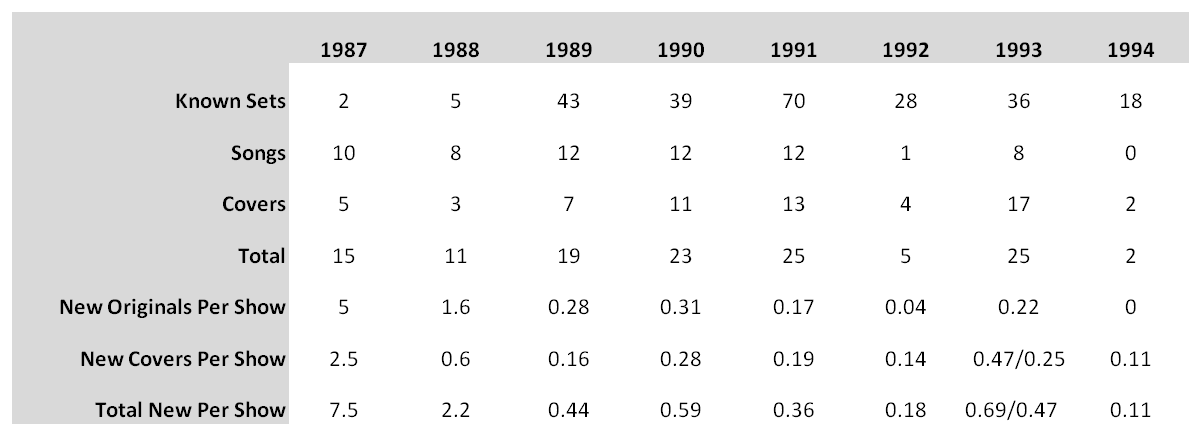
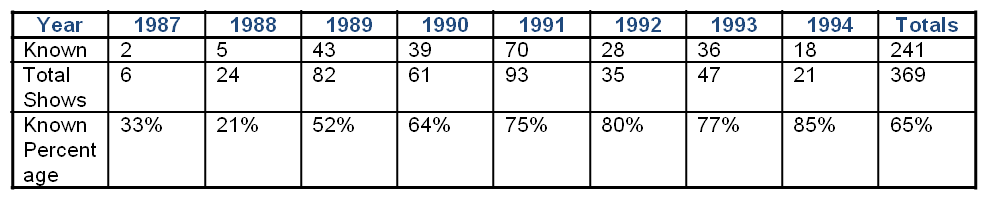
The early days of the band were deservedly the core of Gillian G. Gaar’s latest book Entertain Us. Beyond the reprised tale of rags to riches, the early days retain a mystery. The band’s rising status and ‘most likely crossover success’ status in 1990 owed a lot to Sub Pop’s success at shoving a low-selling strictly local scene onto a global stage — in 1987-1988 this was just one band in a field of thousands. The live stats support this with just 7 of 30 set-lists known:
Set Lists 1987-1994

Understandably this leads to a raft of suggestive stats. As a first example, the fact that Annorexorcist appears in the set-list in mid-1987 and then again six months later in January 1988 suggests it likely featured at two further intervening shows. Likewise, given it was a leftover from Fecal Matter, there’s a possibility it may have appeared at the two shows prior to its May 1987 appearances. Raunchola (A.K.A. Erectum) flops into the territory of God knows — a first appearance in January 1988, a last appearance in March with just one intermediate show, yet then a space of sixteen performances until the next fully revealed set. There’s simply no way of knowing when either song died out. There is, however, good reason to believe there was more live life to them than there strictly limited edition status. Pen Cap Chew and If You Must also have a chequered history; they appear at the start of 1987, are excluded from the May gig (though Pen Cap Chew did make the KAOS Radio performance), then reappear in January-March 1988. In conversation with Jack Endino early in 2012 he stated, with regard to If You Must “…at the time we recorded it (Jan 88), they were opening their set with it. Much later he decided he didn’t like it, who knows why.” There’s a good chance that he’s correct and that both songs featured in the final two gigs of 1987 but then hard to discern if the January 23, 1988 appearance was their final showing or if they made some brief resurrection later in the year.

We’re looking at the gap between reality and posthumous truth. Vendetagainst (A.K.A. Help Me, I’m Hungry) exists for a brief appearance in 1987…Then a gap of 83 shows and 29 months until it pops up twice; November 5 and 8 with a gap of one show. Blandest, only ever seen on June 11, 1988 in studio, likewise appears for two shows in July. Blandest may have been present at the eight ‘ghost’ shows between March and that date, or the show a week later in Ellensburg. It’s also hard to believe that the song wasn’t featured at all earlier.

On a related note, it isn’t a surprise Chad Channing knowing Blandest, but it’s unusual that he would be aware of Vendetagainst, a song recorded a full year before his arrival in the band. I’m speculating but, in the month pause between their show in August 1989 and the commencement of touring in late September, the band seems to have decided to take stock of the songs they had left in reserve and trained up on them. During this phase the band are varying elements of their set almost nightly, it’s as if they’re keeping material alive with new releases in mind. The set is knee-deep in, as yet, unreleased songs; Token Eastern Song, Dive, Polly, Even in His Youth, Breed, Vendetagainst, Sappy, even a jam on Hairspray Queen. Nirvana were a very smart unit, already one eye to the future and a range of possibilities.

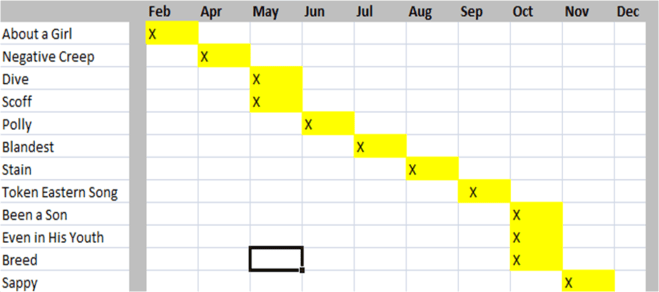
While unsurprising that the rarities are conspicuous by their relative absence from the live record, it’s fun to consider the fate of a certain portion of Bleach. Essentially the gaps in the known set-lists cast a veil over the likely presence of some songs. Blew, Mr. Moustache and Sifting were all given a first airing in June 1988 in studio, but eight set-lists are unknown meaning it’s October 30, 1988 before the songs are first seen. Likewise, it’s unlikely that Negative Creep and Scoff were first performed when they’re first ‘visible’ to us twenty years later, in April and May 1989 respectively given they were definitely finalised and recorded by the start of the year and there are ten shows leading up to the known displays.

The most remarkable disappearances from the Bleach sessions are Big Long Now (I dissect it’s likely performance in the Songs The Lord Taught Us chapter of the Dark Slivers book) and the way Swap Meet doesn’t appear at all until November 1990 — that gap for the latter just doesn’t ring true. A further curious feature is that, with the exception of Blew, the ‘late arrivals’ from Bleach into the Nirvana live record are all clustered toward the back-end of the album. Apparently Bruce Pavitt and Jonathan Poneman were involved in deciding how to sequence Bleach and it’s quite intriguing that those songs that were rushed into place to fill out the album, that weren’t ready for live performance until late 1988 or even later in 1989, were all shoved to the rear. The first side of Bleach places some of the band’s earlier recorded works (Floyd the Barber, Love Buzz, Paper Cuts) to the front of the album so it seems Sub Pop were aware at the time that certain songs were rush-jobs.
Nirvana Live and Live Covers: 1992-1994

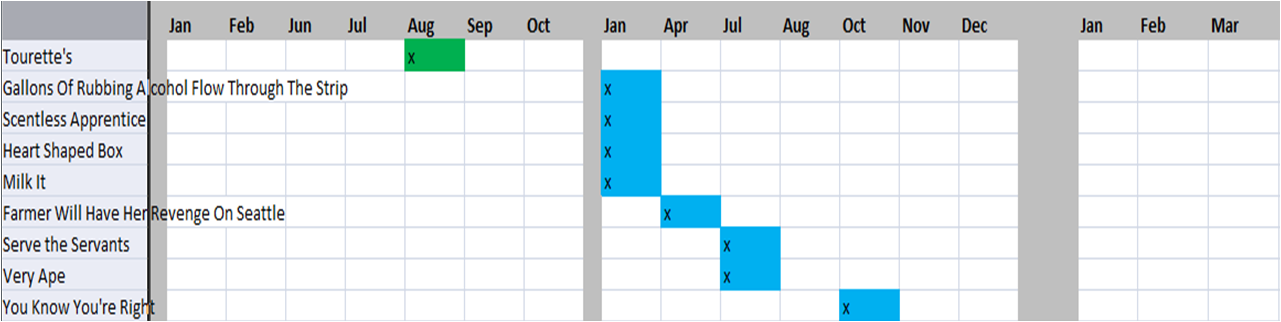
After the happy peak of 1990-1991, it feels sad to bring this little series crashing back down. The following graph shows the sum total of Nirvana originals appearing in set-lists for the final two and a half years of the band’s existence:

New Originals_1992-1994

As pointed out the other week in a blog comment, there’s a rumour that I Hate Myself and I Want to Die was played in 1993 — I’ve stuck to the Nirvana Live Guide as it stood in December 2012 for the time being. It’s intriguing really to see the band revert to a pattern most similar to 1987 or 1988 where they weren’t playing many shows…But the reduction in workload also seems to have reduced the amount of new works being creating. There’s a idiom my mum uses sometimes “the less you have to do, the less you do,” that sometimes pressure helps get results. Nirvana’s live shows derail the pattern of 1989-1991. 1992 gives the impression of a rabbit in headlights, too scared to move in any direction for fear of what might happen:

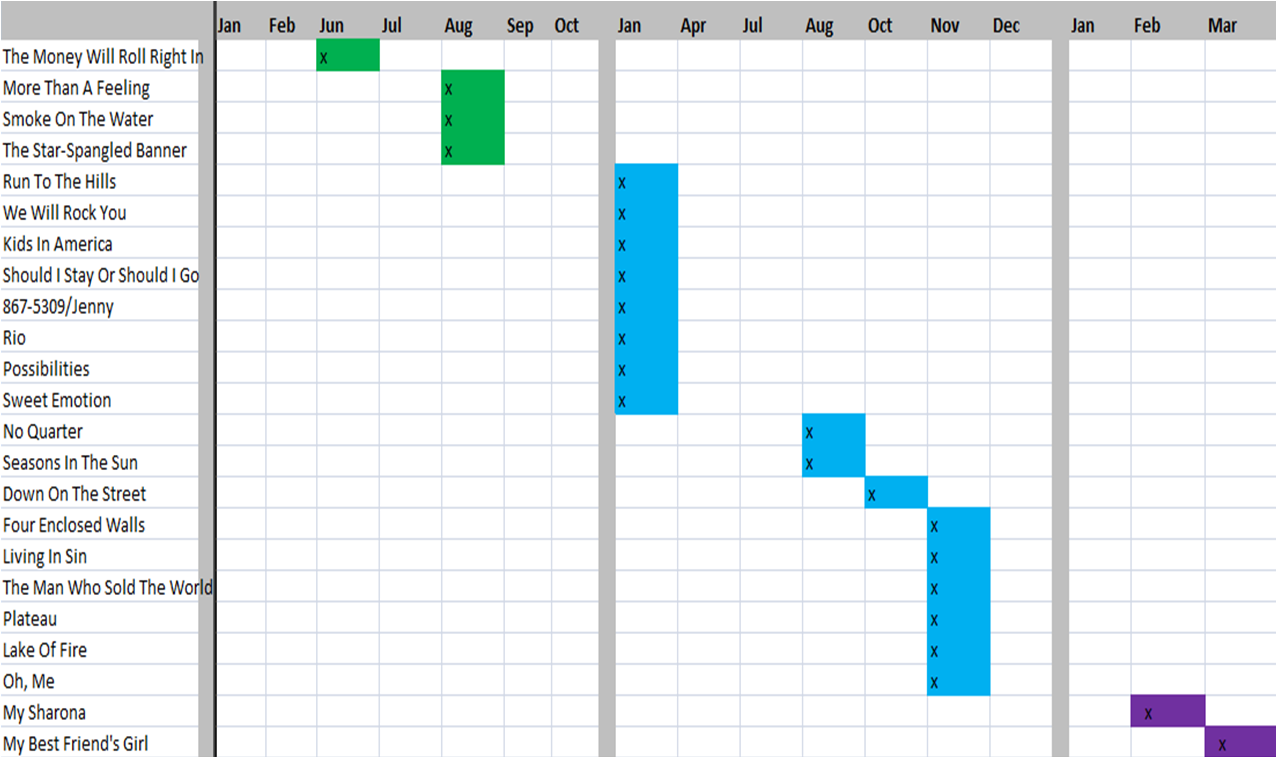
Cover Songs_1992-1994

The work rate of 1989-1991 required a band that were practising solidly, working up new covers and so used to playing together night-after-night that they could readily lock into each new selection seamlessly. The band could still pull out a solid cover if they’d practiced (Seasons in the Sun, The Money Will Roll Right In, The Man Who Sold the World) but most of these covers are bare skin n’ bone. The January 1993 deluge in Sao Paolo was the result of Kurt barely being willing to play; the band had to swap instruments, Kurt on drums, and plod through covers just to fill their contractually obliged stage time with Krist lobbing his bass at Kurt and storming off in sheer frustration at one point.

While 1989, 1990 and 1991 were so busy each year required its own screen shot, the full summary of 1992-1994 is as follows:

New Live 1992-1994

Each year from 1989-1991 the band had been knocking out twelve new original Nirvana songs a year on stage, in 1992, they manage one, in 1993 they rocket up to eight…Then nothing. 1992 is a write-off, 1993 relies on cover songs to maintain the stepped momentum, 1994…

No words.

Another way of looking at it is to examine how many new songs or covers Nirvana knocked out in how many shows:

Nirvana New Live Divided

Of course 1987 is irrelevant given how skewed it is by their first performance (all new!), also 1988 suffers from the extensive gaps in the set-list record. The pattern across the succeeding years are fairly solid, however, Nirvana were cranking out a new song ever two/three shows 1989-1991, even the large number of set-lists available for the extensive touring in 1991 can’t substantially dilute the result — this was one hard-working band. It does make 1993 look like a resurgence, heck, Nirvana are pulling fresh originals on stage at the same rate as they do in 1991, roughly one new song for every five shows. The cover number is buoyed up to a ridiculous level by Sao Paolo and MTV Unplugged in 1993. In fact, removing those two shows, each a special circumstance, from the equation and just looking at their ordinary gigs would bring the stat down to 0.14, a fresh cover appearance every ten shows or so, the same as 1992, the same as 1994.

As usual, it all depends how you look at things, how you want to see things…What the hey. It’s fun to play with the point of view.

Something Mellow for the Weekend…

http://www.rollingstone.com/music/videos/deervana-deer-tick-play-gripping-nirvana-set-20110611

With thanks to Paul Tripi, it’s time to relax, and you know what that means…

…Well, today it means checking a band playing full sets of Nirvana covers and indulging their inner fan boy. What’s neat is how well Nirvana’s songs sound in other hands, the simplicity of construction and sound make the instrumental attack easy to duplicate. The voice is the element representing the greatest difficulty, John McCauley does it well simply by leaving things unpolished, his voice fraying at the edges. The idea of an established band taking time out to play the songs of their heroes is certainly endearing (no pun intended) and pleasantly whimsical; the fact they do it well is pleasing. It enhanced it for me that the band don’t bother dressing up or trying to disguise themselves AS Nirvana, it’s better this way as they’re never anyone over than themselves. That honesty is welcome.

Just thought we’d go with something gentle today, conclude the ‘first appearance’ stats tomorrow, end of the first week of 2013…Breathe.

Nirvana Live and Live Covers 1990-1991

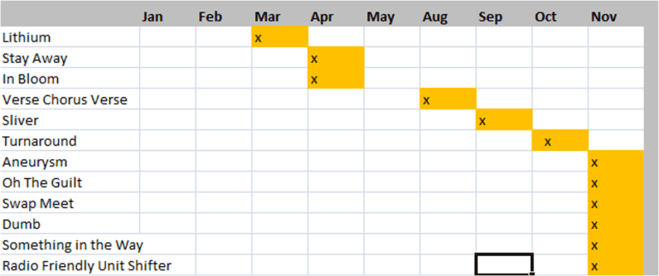
The live record shows the lengthy gestation period leading into what became Nevermind. Polly arrived first as part of Cobain’s acoustic ‘experiments’ from 1987-1988, then Breed as part of the fuzzy sounding punk tunes appearing in late 1989. The 1990 record shows two distinct phases, firstly, the flurry of Lithium, Stay Away and In Bloom in March-April, then the first appearance of Something in the Way later in the year.

 New Originals_1990

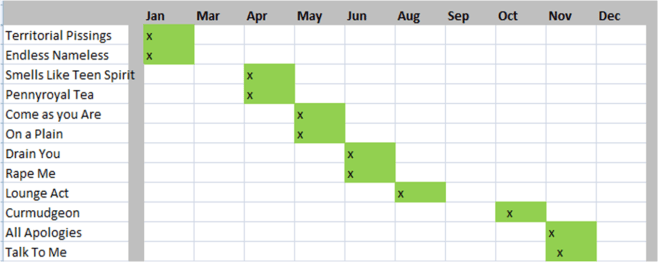
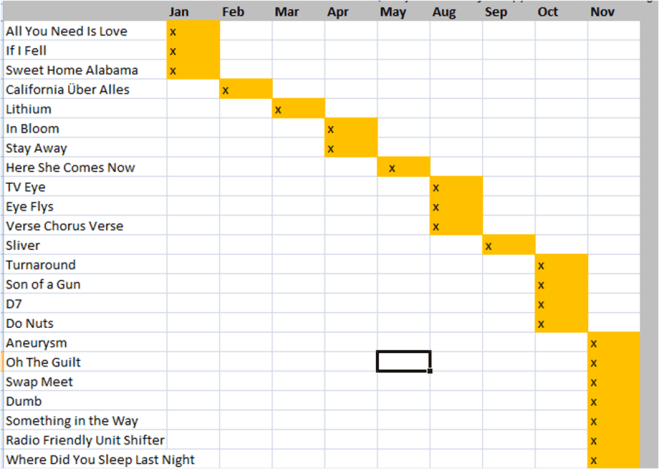
Seven of Nevermind’s thirteen songs were then drip-fed into the set between January and August 1991:

New Originals_1991

That single November 1990 show at The Off Ramp in Seattle tops LiveNirvana’s Overall Best Shows list for good reason given the cornucopia of thrills on offer. The show was a real statement from the band with new songs and rare old songs flung into the set with abandon. It looks like Nirvana’s victory lap; it must have really stretched and tested them performing so much material that was so rarely a part of their shows, or that had only just come into existence. With thirty-one songs performed in total it’s also the longest show the band ever performed barring the far less cheerful occasion of Sao Paolo in January 1993. This was their party and listening to it now, the enthusiasm, the “we’ve made it!” happiness is so audible.

The overall trend commenced in 1989 remains solid throughout 1990 and 1991; there’s a new Nirvana original entering the set every single month. Still accepting the limitations of the record (64% of 1990’s set-lists are known and 75% of 1991’s) the regular refreshing of the pool of songs is remarkable. These were the peak years of Kurt Cobain’s writing and each year 1989-1991 twelve new Nirvana songs can be proven to have entered Nirvana’s set.

Looking at the 1990-1991 live arrivals also shows the transition in Nirvana’s sound very clearly. In 1989 Bleach’s grunge dirge phase passes away to be replaced by a lighter tone, yet still the Nirvana ‘formula’ verse-chorus dynamic hasn’t yet clunked into place. The three tracks that appear in early 1990 inaugurate the spell during which the stereotype ‘Nirvana sound’ holds sway. Usually one thinks of Nevermind and In Utero as separate objects but listening to the songs appearing in the spell from March 1990 through November 1991 brings a lot of similarities into tighter focus. The furthest the band went from the norm in that time was going quiet (Something in the Way, Dumb) or going all out noisy (Radio Friendly Unit Shifter, Curmudgeon.)

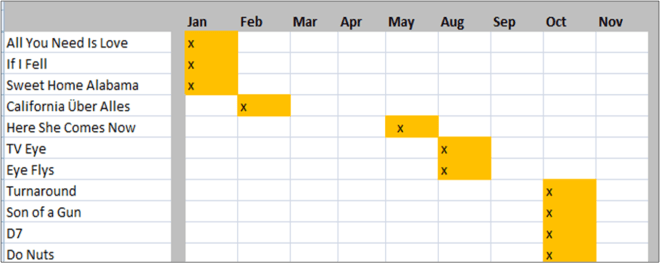
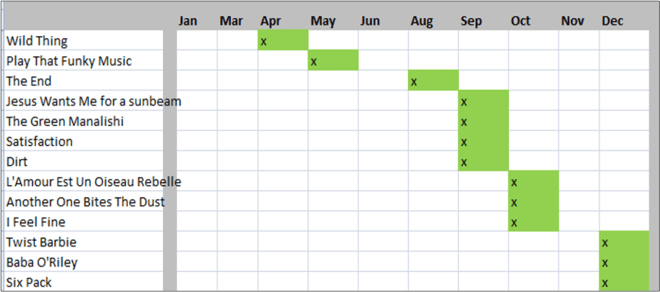
Cover Songs_1990

The record of covers being played over these two years continues to show the musically omnivorous nature of Nirvana —  they’re grabbing at songs from across the spectrum of rock; their punk tastes are a firm presence in 1990; they’re chucking brief snatches into the set-list spontaneously alongside more practiced and full renditions.

Cover Songs_1991

Despite the break in performance in late 1990-early 1991 the band continue almost as if this two year spell is all one long trek, there’s no change in the patterns. One intriguing decision is to start using either Jesus Wants Me for a Sunbeam or L’Amour Est Un Oiseau Rebelle as the set-openers. It seems to be a way to defuse the craziness in the moshpit, starting with mellow songs to calm everything down before ratcheting things back up as the performance proceeds.

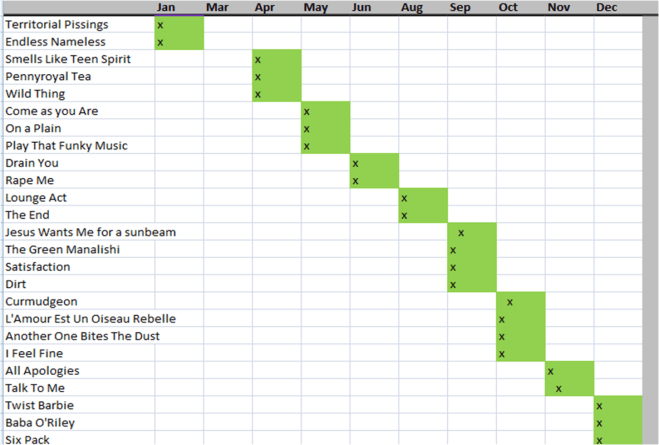
These years were the pinnacle of Nirvana as a live experience and as creative musicians. The sheer quantity and quality of what they were throwing on stage, this is a million miles from the bands that tour a single barely shifting set-list across a hundred shows. The band are showing such complete enthusiasm and love for performing and for music, it’s part of the buzz around Nirvana, the much-vaunted ‘energy’ that they were bringing to stages at this point in time. It also shows their self-assurance, that they were such skilled masters of the stage by this point that they could deviate from the script at will, could shift gears at a moment’s notice. It’s such a busy two years it takes me two screen shots to capture it:

New Live 1990 New Live 1991

This was a band that could do anything.


Nirvana Live: Covers 1987-1989

Cover Songs_1987-1988

The regular arrival of fresh covers reinforces the point made in yesterday’s blog that, particular in the early days, while new songs may not have arrived too swiftly in 1987, the set could still be spiced up a little. What is noticeable is that, though accepting that there are gaps in the record, there’s no evidence of the band displaying the punk side of its tastes — they stay solidly reliant on hard rock and pop despite the inclusion of quite a few late Sixties-early Seventies oddities. This seems in part a fair reflection of the band’s own taste and also a crowd-pleasing match for the Led Zeppelin worship prevalent in the Seattle scene of the day.

Cover Songs_1989

Nirvana’s work is full of wonderful symmetries, some coincidences, others not. One I particularly like is that Do You Love Me’s performance in June marks the passing of that early hard rock spell in Nirvana cover songs. November then marks the new life, Lead Belly arrives in the set-list, The Vaselines; the songs that would mark the alternative identity the band was happier to place on vinyl after that time. A second passing took place at the same time, however. In the early spell, with the exception of the tribute to Led Zeppelin’s Moby Dick, the band were playing mainly full, if ragged, covers. With certain key exceptions over the years to come (i.e., the songs that made it onto Incesticide or that were reprised for MTV Unplugged) an awful lot of Nirvana’s live covers became brief bass jams, or snippets covering up restringing, retuning, other on stage logistics and live administration.

Seeing the first two years, originals and covers altogether, emphasizes how hard-working this band was in their performances:

New Live 1987-1988

Similarly, 1989 — this was a band working exceedingly hard learning, practising and performing new songs month after month. It can’t have come easy, this was a triumph of will and the desire to excel in performance. They could have simply whacked out the same set-list over and again but instead there’s a visible striving to do more:

New Live 1989

Jack Endino Got His Copy of Dark Slivers

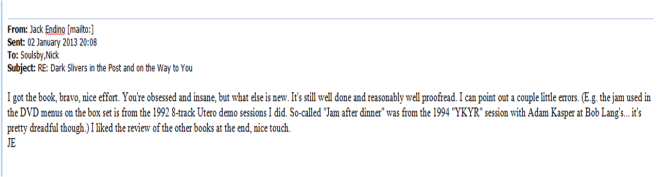
As a thank you for his decency and vastly appreciated willingness to help me out when I commenced working on Dark Slivers, I despatched a copy to Jack Endino over in Seattle. I arrived home late last night to find a quick message from him.

Jack Endino Email

Phew! Nice to know I didn’t make a complete mess of this from someone so thoroughly important to the subject. Was so chuffed I really wanted to share this on here.

Nirvana Live: 1987-1989

Tail end of last year we started looking at a chart showing the first appearances of Nirvana songs in concert as detailed at the Nirvana Live Guide — shall we continue?

New Originals_1987-1988

Naturally it’s worth disregarding the tranche of new songs in March — anything they played was by definition a new performance given it was Nirvana’s first show. What’s most noticeable really is how many of the songs emerging in 1987 and the first month of 1988 were simply discarded; Hairspray Queen, Aero Zeppelin (these two until 1992), Beeswax (until 1991), Downer, If You Must, Pen Cap Chew, Annorexorcist, Vendetagainst, Erectum/Raunchola — most of an album is thrown away by the end of January 1988. The speed with which new songs were appearing would be impressive were it not for the fact that the band wasn’t exactly overworked at the time so there was plenty of time to come up with new songs. The issue was perhaps one related to the nature of the songs being created — Nirvana’s 1987 identity lay in relatively complex new wave songs, with extremely long-winded lyrics, hardly conducive to fast preparation. To be fair, Kurt Cobain was honest in saying that he was hardly a constant or prolific writer, he relied on catching the moments of inspiration and getting them noted down, recorded, before they burnt out. 1987 still relied on three year old songs refreshed and reprised from their Fecal Matter form to flesh out the setlist. On the other hand, wow, almost every month Nirvana perform (and for which a set-list is available) there’s a new song featured. The band were moving at speed.

Of course, particularly in the early years, we’re looking at a record with gaps — a particularly low percentage of set-lists from 1987-1988 are present, even in 1989 only just over 50%. Given Mr. Moustache and Sifting were present in vestigial form back at the June 1988 recording sessions for the first Sub Pop single, it’s likely they made it onstage for the first time during the seven-eight shows seen between that recording session and the next full set-list on October 30. Likewise it seems unlikely that the apparent appearance of Blandest in July 1989 was the first or only time the song received an airing before its abandonment:

New Originals_1989

What’s also interesting is the ‘late’ arrival of a handful of the tracks from Bleach. A good portion of Bleach was written long before the album session, however, there was significant rewriting of Blew, Sifting and Mr. Moustache after their first appearance and as late as mid-December (evidenced by the footage captured on the With the Lights Out DVD.) Meanwhile, the fact Negative Creep and Scoff don’t make any showing of any sort until April-May 1989, though partially a consequence of the long gap in the record, also suggests that those two songs specifically were last minute hurried additions to Bleach; the brevity of their lyrics likewise.

The nearly uniform month by month drip of new songs is quite remarkable in 1989, December is the first month in which the band play that year (even if only a smattering of shows) in which they don’t chuck either a fresh original, or a rarity into the mix. It says a lot about their desire to keep the experience of playing entertaining that they vary their shows so much. It made sense in 1987 through early 1989 when the band were repeatedly replaying Washington State venues (take a look back at the maps on this blog) — they’d be seeing the same audiences quite regularly — yet, from mid-1989 they were setting off on their travels, the audiences were brand new to Nirvana’s performances, the knowledge and trade of Nirvana rarities was minimal, the only people who would know it was a new song, or an abandoned track, were the band. I feel that it was for the band’s own pleasure that they made these efforts to vary their performances.

Kurt Cobain: Hell (and a Happy New Year)

IMG-20121222-00040

Written by James Joyce while at college:

“…never to be free from those pains; ever to have the conscience upbraid one, the memory enrage…ever to curse and revile the foul demons who gloat fiendishly over the misery of the dupes, never to behold the shining raiment of the blessed spirits; ever to cry out of the abyss of fire to God for an instant, a single instant, of respite from such awful agony…”

Joyce was describing a visceral vision of Hell as a physical and simultaneously mental experience in which torture took place both upon the body and the mind.

Not that I’m becoming monomaniacal or anything — I’m starting to feel like a vicar on a Sunday morning beginning a sermon “…And THAT made me think of God/the Bible/blah blah blah…” in relation to any experience of life whatsoever — but I’d been trying for weeks to summarise how difficult Kurt Cobain’s life seems to have been. This quotation came closest.

Kurt’s life, by the end of 1993, involved physical pain (from an eternally undiagnosed stomach ailment) along with the damaging effects of persistent drug abuse including overdoses and what must have been regular (and uncomfortable) comedowns; he felt buffeted and lacking control over the persistent demands of music as a career — unable to find peace when called on by management, band, press, fans; he looked to the future with fears including whether his daughter would inherit his wounded nature, whether his marriage could survive, whether he had the money to avoid being flung back into penury and employment (he’d never enjoyed working for a living); as In Utero shows he was a very angry and frustrated man at this point, ferociously defending his family from the intrusions of muck-raking journalists, the authorities, in fact anyone who felt they could comment on his life — there’s a tiredness within In Utero, an exhaustion.

On top of this, his creative muse seems to have burnt itself out — this can’t have failed to escape his notice, that the crucial thing he had achieved in life had ceased to give him pleasure or to flow as naturally as it had until hitting age 25, he must have worried if he was done already. His friendship group, his social life, had shrunk away to nothing, core relationships (primarily with his band and wife) were troubled at best robbing him of a primary confidante and isolating him (semi-deliberately) from others.

A further issue with Kurt Cobain is the way he seems to have had a deeply active conscience ‘upbraiding him.’ His songs lavish nothing but blame and criticism upon his own shoulders; as the clearest cases he writes Lithium on Nevermind and All Apologies on In Utero calling down responsibility for his situation upon his own failings. His suicide note dwells on the same elements; he doesn’t lash out at the world, he simply cracks a sardonic half-smile and points out how useless he feels he is and how much of a danger to his daughter’s future happiness — that’s a phenomenally harsh thing to think of oneself, that one’s personality is so toxic it could pollute one’s child in such a way. There’s not much funny in his regular self-flagellation, no matter how sarcastically phrased — the same joke replayed year-after-year finding different ways to call himself a bad person; he doesn’t even blame anyone for it, not even his parents, he seems to feel that he was an unloved and unwanted child because he deserved it like the figure at the centre of Scentless Apprentice.

With all this going on, what aspects of Hell were not being visited upon him in his view? He had the physical pains, the conscience, the anger, the audiences he felt were gloating over his predicament, the absence of relief or visible hope. Whatever responsibility he bore for this perception of the world, it’s a brutal blend wrapped up in a slim frame and a lot for one being to carry day-after-day.