In Utero 20th Anniversary Track Listing: First Glance

A massive merci to Laurent Beck over at LiveNirvana (and a shoutout to the ever readable and engaging Mr. Adrian Karlson) for hunting down the post on Amazon.fr listing out what is likely to be (though not as yet confirmed to be) the track listing for the Nirvana In Utero Twentieth Anniversary Super-Deluxe. Here’s the link:

And here we go – note it doesn’t yet list the tracklisting of Live n’ Loud let alone the bonus DVD content – Disc One first:

Picture1

You’ll note that where it says All Apologies/Gallons of Rubbing Alcohol Flow Through the Strip twice over what I ‘think’ it means is track 12 All Apologies, track 13 Gallons… And now for Disc Two:

Picture2

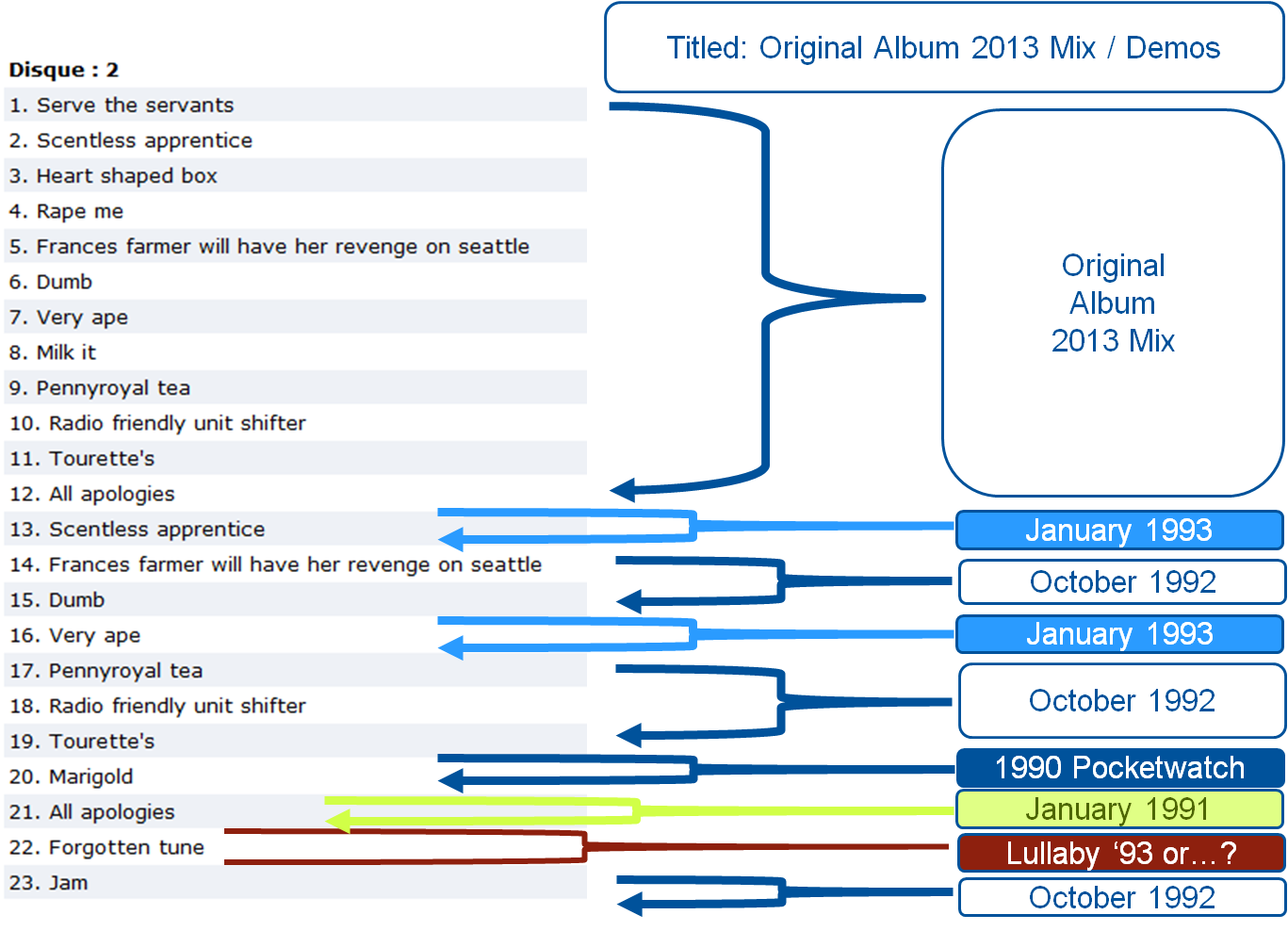
Now…You may notice a few oddities here, interesting huh? OK, All Apologies was not demo’ed in either October 1992 or January 1993 as far as is known thus making the January 1991 rendition the main known source…Though this does leave the door open to finding out that this is indeed the long rumoured ‘Song in D’ from the Nevermind sessions of 1991. We’ll see, I believe the former, I’d be fascinated by the latter.

Scentless Apprentice has been confirmed as coming from January 1993 while Very Ape wasn’t demo’ed until Rio in January making that a relatively easy judgment unless there’s an error in LiveNirvana’s so far flawless records. The five instrumentals from October 1992 were confirmed last week also so that’s an easy selection.

You’ll have noted that the slightly eccentric order in which the demos are positioned deliberately mimics the positioning of songs on the In Utero album thus ‘side A’ Scentless, Frances, Dumb then ‘side B’ Very Ape, Pennyroyal, RFUS, Tourette’s…Oh. Note the gap? Suddenly the listing diverts to Marigold then to All Apologies. This may be simply laziness or it may indicate that we’re looking at the early draft of All Apologies which is so different as to barely be recognisable as the same song, prior to the two oddities at the end.

Jam is, I’d assume, the jam from October 1992…But there’s no proof. Likewise, forgotten tune isn’t the same as ‘forgotten song’ so I’m not expecting a fully fledged You Know You’re Right moment, I’m expecting that either this is ‘The Other Improv’ again (much though I love it, God forbid) or this is Lullaby from February 1993…Or I’m completely clueless. It could also be that, remembering the attention to song order, we’re looking at Marigold (1990), All Apologies (Jan 1991), Song in D (mid-1991) then Jam (1992). Nice to know there’s some mystery left here…

Anyways, so, next count up:
Disc 1: 13 track original album, plus Marigold, MV, I Hate Myself & I Want to Die, Verse Chorus Verse (Sappy), plus different takes of Pennyroyal Tea, Heart Shaped Box and All Apologies – 20 tracks
Disc 2: 12 track original album, plus Scentless and Very Ape from Rio, 1990 Marigold, Word of Mouth instrumentals x 5, plus All Apologies (1991?) plus two unknowns = 23
Live n’ Loud: 17 tracks times two = 34, plus a clutch of bonus video footage
Total: a magisterial and impressive SEVENTY SEVEN
…And that’s even before we get to the bonus DVD footage. Time for plenty of smileys methinks. It’s getting better alllllll the time!

The Reformations

http://news.sciencemag.org/scientific-community/2011/07/scientists-play-worlds-oldest-commercial-record

In this age of endless reformations it’s easy to overlook the bands who survived as ongoing creative concerns. The indie superstar perennials (i.e., the only bands making enough money to continue to live on music) stand out — Sonic Youth, Mudhoney, Melvins — but most others are a rebooted and rehashed occurrence giving bands a chance to finally take the bows they never get first time around. It also somehow feels reasonable, bands that have gained significant posthumous popularity receiving the chance to earn the money they never had an opportunity to first time around — I’m strangely accepting of it.

What’s most interesting is that this is a genuinely new mass phenomenon in music akin to the BBC’s discovery a few decades ago that, contrary to their policy right through into the 1970s which saw them erase numerous tapes of their shows, people often do want to watch repeated content and that there was a market for video recordings of such material. Music, to an even greater extent than television, has been a market piling new trend on latest fashion on quick fad. We’re not much over one hundred years from the first commercially available sound recordings and still witnessing new deviations and adaptations of this cultural element.

The release of greatest hits recordings started fairly early and has never ceased being a critical source of sales. Live recordings soon followed and archive recordings got going by the late Sixties when Jimi Hendrix had appalling trouble with unscrupulous characters reissuing his pre-Experience material and when the first major bootleg releases (Bob Dylan’s Basement Tapes) commenced. Tribute records were more recent, the first came out only in 1981, and they’ve maintained a minor league existence ever since. The biggest shift though was the reissue of albums on CD from the mid-Eighties onwards — this gradually led to the desire to move beyond LP lengths and to fill space with bonuses and extras to encourage purchases.

Discovering that people were indeed willing to pay to buy material that, essentially, they already had was a crucial moment. Gradually reissues gained the same weight as new releases, magazines began reviewing them side-by-side, entire reissue sections entered magazines. The record company’s responded to this by placing more weight and effort into the reissues, ladling on the b-sides, the demos, the live shows until eventually the market diverged into straight reissues (usually with the pointless word Remastered emblazoned to try and claim some justification for the release as the reissued albums became CD-era) and the larger Deluxe edition for the fanatics. The arms-race didn’t cease there, however, soon Deluxe editions edged over into three disc versions until eventually the entire concept of the Super-Deluxe came about. Next the programme of reissues became a matter of packaging; the long established concept of the box-set (way back in the 1930s substantial 78 RPM vinyl sets used to come in boxes which was part of their elite cache) became a regular part of the armoury and still people were willing to buy in sufficient quantities to justify further box-sets and anniversary editions.

Somewhere in amidst it all, the same concepts became applied to live acts; if people were willing to pay to repurchase the music, there’s no reason they wouldn’t pay to see the bands essentially engage in high-quality karaoke. Reformations had always happened going right back to the Elvis ’68 Comeback Special, but usually a reformation involved new material being written and an attempt to resuscitate a career because of the feeling that progress had to be made. Other artists had never gone away, they’d simply been repackaged into Golden Oldies tours and smaller venues and package tours — but the last decade has seen a fresh development.

The idea of progress has come to a halt. A few decades of seeing that people were quite happy to pay an inflated price to see a band that they never caught in their heyday (i.e., Sex Pistols Filthy Lucre Tour of 1996), as well as the realisation that most long-term artists increasingly end up playing a greatest hits medley as a crucial and favourite component of a show (i.e., everyone from Elton John to Bon Jovi), led to the realisation that a band could be resuscitated and pushed, zombie-like, onto a stage without any need to do anything new at all. This was a cheap and easy way to make substantially more profit than a lot of new acts and ongoing artists would reap — the ticket prices can be higher, the band will take a lower cut to get the second chance, there’s no need to plan around album releases or recording commitments; just get ‘em up, on stage and done. And, of course, that’s a perfectly satisfying music product for the audience; there’s nothing wrong with one quick evening of nostalgia, or that one-off sight of the heroes you never caught working through the songs you never saw when they were still a natural entity.

One element may be that the pop world has degenerated into an endless remarketing of echoes whether in the form of the kareoke contests that fill primetime TV or the reappropriation of tunes wrapped into beat-heavy remixes and major league pop product that fill the charts. With audiences used to the small endorphin thrill of recognition even the most non-mainstream audiences are simply more used to hearing the past reiterated.

And that’s the truth…There’s nothing wrong with it. A few artists, still caught in their own desire for artistic authenticity and a sense of creative validity, take the chance to whack some new music out; but Swans are a rarity in that they’re currently doing phenomenally well by being one of the few outfits to genuinely go someplace new with the music even if I don’t enjoy either of their newest recordings anywhere near as much as I did Soundtracks for the Blind or Swans Are Dead.

Victory and the Damage Done Part 2: The End of the Rock Star

In a culture that venerates success, there’s a tendency to underrate the destruction it wreaks upon the victor. Similarly, the fact that a victory does not halt time at the pristine pinnacle of success — that life goes on — leads to disillusionment and disparagement when ongoing reality refuses to stay still. 1989-1991 was an era of victory and all the consequent worries, woes and uncertainties that comes with it — a powerful sense of “what next?”

The Sex Pistols had certainly dug a hole in the U.K.’s consensus — exposing and parodying its vile edge in which there’s nothing more than what you can grab from those who will buy — but only in the context of a wider economic malaise and the ongoing decline of Britain from an imperial peak which now made the U.S. the self-confident and true home of rock. While the U.S. embraced some fragments of punk squalor it was primarily theatrical and integrated well into the existing superhero template — Motley Crue, Ted Nugent, Guns n’ Roses; these were the nearest the mainstream came to punk until Nirvana.

The U.K. and Europe similarly possessed genuine socialist parties which acted as strong forces with an influence on the direction of national politics. In the U.S. this simply didn’t exist; open espousal of socialism let alone communism was a severely suppressed thread in politics. While in the U.K. and Europe feminism, gay rights, vegetarianism, anti-war protests and so forth were part of both the mainstream political mix and popular mass causes — in the U.S. these were viewed as left-wing, politically suspect and only of interest to non-mainstream activists and extremists.

The impact of this exclusion was to add these causes to the realm of deviance and non-mainstream interests in which U.S. punk fermented; all were minority activities focused around tiny self-defined communities of ‘outcasts’ and increasingly, as the Eighties went on, the punk scene fused with a strong political edge whether openly critical of the current political mainstream, or of law enforcement, or in favour of pro-gay rights, or of feminist politics. It was the same rooting around in the underground that led some to latch onto extreme racist nationalism, the other side of the coin to punk’s quest for rebel yells outside the vision presented by militaristic, flag-waving, ‘us uber alles’ supermen who infested the mainstream.

Nirvana’s rise didn’t take place in a vacuum; it coincided with the entire political order of the West shifting. Nirvana’s first European tour coincided with the collapse of the Warsaw Pact with the Berlin Wall commencing its fall on November 9, 1989 and Nirvana arriving in the city two days later as people continued tearing at the symbol of the entire post-war reality. Finally, following the attempted coup in August 1991, the Soviet Union itself ceased to exist on December 26, 1991 — just as Nirvana was exploding into mass consciousness.

The colossal weight of what was occurring was amplified and enhanced by the reality that this was the first global shift of the mass media era. The absence of the unifying enemy who had tethered U.S. culture for decades was a grave concern among governing circles after the collapse of the Soviet Union and with it the end of the last substantial external threat to capitalism. Francis Fukuyama’s book The End of History and The Last Man expanded was built on a 1989 article and essentially suggested that progress and time had now halted — that’s how deeply the narrative of Cold War had infected perceptions of reality and how hard it was to envisage a life without it. Fukuyama’s book has been long-criticised but its key point that the last fully functioning alternative to capitalism (in whatever gradation) had ceased and a single economic system now ruled almost the entire dialogue of world civilisation.

The shock of Nirvana’s emergence was so powerful within the U.S. not because of the music itself — debates over its originality and universal popularity are missing the point. Nirvana were the crest of a wave that had travelled far and was now breaking in so many directions. On the one hand, the extreme solipsism and air of defensiveness, indifference, negativity that many saw in Nirvana was an articulation of a new insecurity, a new vulnerability that arose because no one now knew who or where the enemy was. Simultaneously, the music acknowledged and empowered feelings that hadn’t been permitted under the old regime governed by the indestructible ‘rock star’; the need for the strong had gone away and Nirvana helped make it look ridiculous. Instead the marginalised could emerge blinking into daylight and with them all the causes that had been bred into the underground’s rising stars during the previous decade.

The switch in the music culture had been prefaced by an expanding roster of alternative bands on major labels prior to Nirvana’s emergence, there had been bands originating in the indie scene who had made the jump to major label record deals — but success was varied. Among the mainstream survivors, Metallica incorporated a touch more brooding into their major crossover success, Guns n’ Roses acknowledged the turn away from chest-thumping rock only in Axl Rose’s more solitary and sombre meditations, Nine Inch Nails were still to push the dial all the way to The Downward Spiral — while the move toward Cobain’s insularity had been foreshadowed by all this activity, there still wasn’t a superstar until his arrival who looked so firmly inward.

A similar explosion at that time was the twisted tale of the Black Metal scene in Scandinavia and particularly in Norway. Between 1991 and 1995, with a very young coterie of individuals egging each other on to ever more extreme and grim acts, the early scene erupted with over twenty churches burned, suicide, murder, general mayhem. In the book ‘Black Metal: Beyond the Darkness” there’s a quotation from one figure in the scene stating “it is interesting that Black Metal exploded in Norway immediately after the fall of the Soviet Union and the final demise of the idea that fighting against the bourgeoisie and capitalist conservatives, including Christianity, could be defeated by revolutionary socialism…It’s all part of an escape from reality.”

The Norwegian scene couldn’t follow the U.S. simply because Norway was never as fully integrated into the confrontational West versus East face-off. Socialism was a well-represented presence and a successful component of the governing mix within Norwegian politics bringing with it the kinds of policies that the U.S. alternative scene was then busy trying to articulate. The Black Metal scene was forced into a different reaction of similar extremity to the Nirvana effect. A core of individuals substituted a new overarching narrative and competition, one pitching Nordic (white) paganism against other races which were deemed to be diluting strong blood and simultaneously against Christianity on the basis that it had feminised national cultures, another reason why the scene was also homophobic, a further effeminate weakening influence.

Of course it was nonsense, but no more nonsensical than Ted Nugent, AC/DC or the trappings of cock rock that had achieved two decades of dominance in the U.S. It took the world to change for the rock star to die whether in Nirvana’s rain of sardonic laughter (“hi Axl! Hi Axl!”) or Norway’s reign of blood and fire.

Victory and the Damage Done: The Shift in U.S. Rock Music

“Is there a clean white shirt ready for the bomb?”

This film will make more sense to those who are aware of a film called The Snowman — it’s a Christmas tradition in U.K., a whimsical and nostalgic piece in which a young boy enters his garden on Christmas Eve to find his snowman has come to life. The piece is wordless, story conveyed in drawn figures and landscapes and a swooning soundtrack; a warm dream. The piece above is by the same author/artist, Raymond Briggs, very familiar drawing style, childhood associations…And naturally disturbing because of the sheer Englishness of the characters’ responses and discussion — the myth of ‘the last war’ circles through the entire piece. The serious point being that in 1983-1984 the Soviet leadership was genuinely of the view that NATO was preparing a strike against the Soviet Union. Rhetoric from the west was sparking a reaction and that, in turn, led to escalating responses. The Able Archer exercise in November 1983 (http://en.wikipedia.org/wiki/Able_Archer_83) was the closest the world had come to nuclear war since the Cuban Missile Crisis with the Russians genuinely believing the war games were our cover for a pre-emptive strike.

Direct cause-and-effect relationships are hard to find when tracing the interaction of the background scenarios that rule over the lives of entire societies and the cultural outbursts those societies then enact. Musical motion arises on the back of and in relation or reaction to previous music; technological shifts drive changes in instrumentation, sound, style and approach; musicians arise from familial, comradely, educational and psychological advantages, pressures or drivers; scenes arise supported by the emergence of supporting infrastructure whether broadcasting media, means of production, venues for dissemination. Music doesn’t, however, float free of the politics or economics that drive a society and that are so intimately intertwined.

In the glow of victory, and contrary to what one might expect, the crime rate in the U.K. and U.S. after World War Two increased — the Golden Age of Bank Robbery was over the next two decades as demobbed soldiers, trained in the use of weapons and explosives, lucratively deployed their talents. While prefabricated homes spread home ownership across the U.S. and suburbia became a new reality, war industry used to churning out metal was retooled to churning out cars. The massive organisation of society that had arisen as a consequence of war never went away, it shifted objectives, names changes but the new institutions and the accepted levels of their intrusion into the daily lives of people had simply become accepted.

(Threads — 1984)

Rock n’ Roll, then whatever it was that was started by The Beatles in the Sixties and evolved into hard rock, heavy metal, punk and so forth tended toward less emotionally revealing lyrics — artful phrasings or vagueness substituted for stark self-examination. This evolved throughout the seventies and eighties, until the heart of mainstream rock music was a macho, dominant, hyper-masculinity that matched the defiant sense of ‘them and us’ that ruled everyday reality — in the U.S. punk barely made a dent on the mainstream leaving the Seventies rock motif to live on. Remember this was a society living under the very real threat of genuine annihilation not by zombies (heh!) but by nuclear weaponry that would halt real life in its tracks with a four minute warning for the U.K. and not much more for the U.S. The renewal of the core rock image, the penis-centric God figure, fitted like tight blue jeans to the early Eighties when figures within the U.S. military scene, in concert with the conservative figures around Ronald Reagan began focusing not on the megadeath perspective of mutual destruction, but on a belief that even amidst the graves of hundreds of millions, there was such a thing as victory in a nuclear future. There was no reason to relinquish the externally directed aggression inherent in the rock star image when there was a vast existential enemy always present.

(The Day After — 1983)

Nirvana lived out their entire youth in a world where everything was about to be blown to smithereens at any moment. By 1987 when Nirvana became a reality, nothing had yet changed. The Pacific North-West was potentially one of the few places where at least some portion of the outlying population might have made it through — a survivalist community did exist in State of Washington — but the background reality of atomic decimation and the collapse of organised society walked in step with a music culture that leaned toward Superman with a pumped up and screaming wild edge that was simply a demonstration that the superheroes of rock music were meant to show we could survive any excess, any destructive act. The drugs, the sex, the lunacy of the mainstream rock scene was part of showing that America was indomitable, indestructible — its denizens did not die when famous, when centre stage, when flaunting their power before the world. This would change.

Update: Reading In Utero…

Evening all…Long day, much to do…

…So no Friday post. However, in the morning, a nice long weekend post.

In the meantime, I’d suggest, that if the Friday mood has set in, and you’re still longing for more In Utero…Just look at the left hand side of the screen, scroll down slightly until you can see the content categories for this blog…And click the one marked In Utero 1992-1993.

Have a good evening and back to normal service tomorrow.

The Next Wait is for the Full Nirvana In Utero Track Listing…Ho Hum…

IMG-20130801-00228

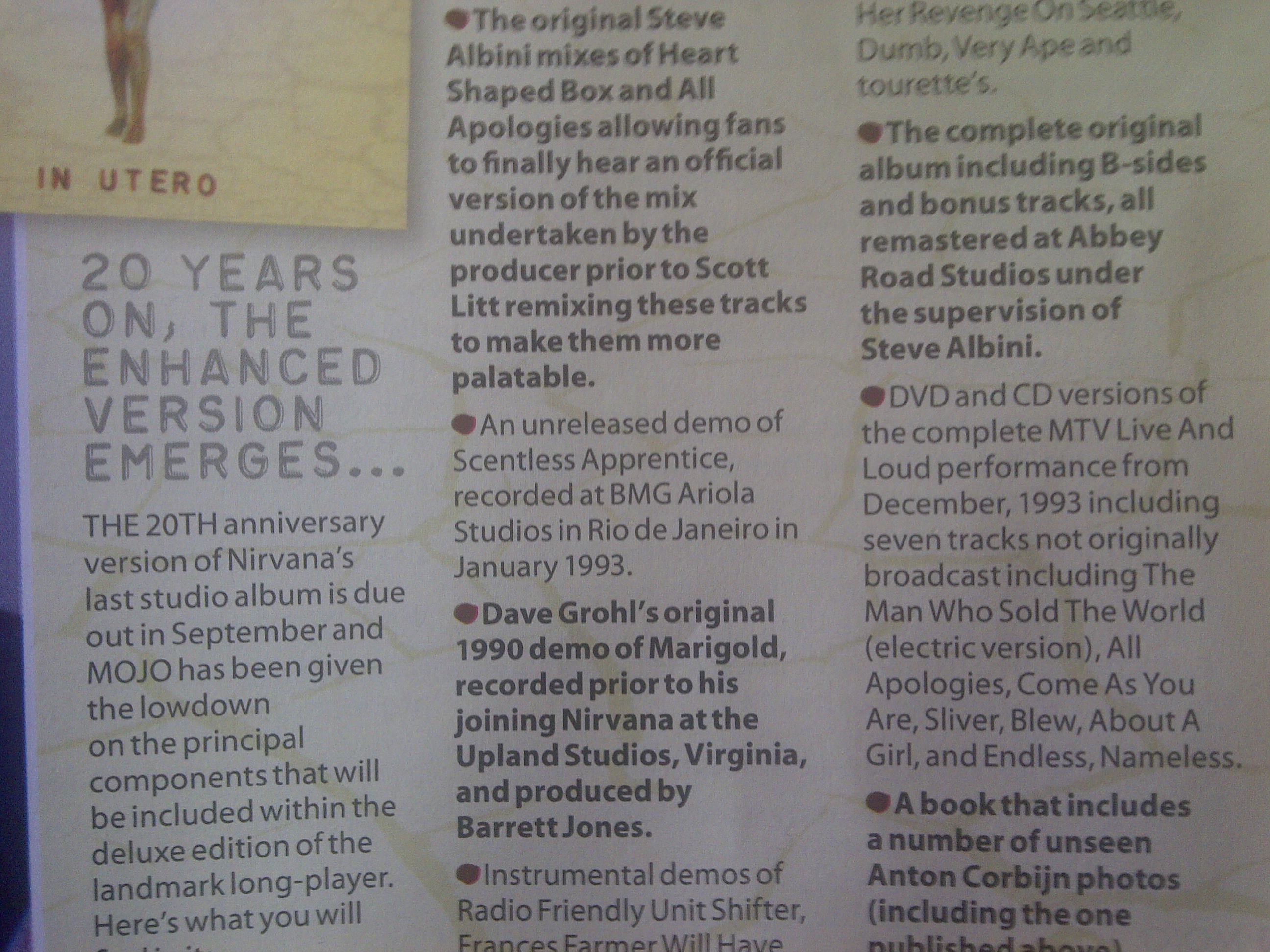
This is the actual summary from Mojo of the 20th Anniversary In Utero box-set (bought a copy at Waterloo Station last night). It actually lists five instrumentals, not the four believed the other day. That makes a tiny difference to the summary I suggested yesterday:

Disc 1: 13 track original album, plus Marigold, MV, I Hate Myself & I Want to Die, Verse Chorus Verse (Sappy) = 17
Disc 2: 13 track original album, plus SA from Rio, 1990 Marigold, Word of Mouth instrumentals x 4, plus Very Ape from…? = 20
Live n’ Loud: 17 tracks times two = 34, plus a clutch of bonus video footage
Total: 71 plus the bonus video material

That one addition reduces the chances even further of the January 1991 demos of All Apologies and Radio Friendly Unit Shifter, of Sound City Sappy (always a forelorn hope) or the missing and vaguely described Song in D, of the April 1993 Frances Farmer Will Have Her Revenge on Seattle, of the January 1993 covers of Seasons in the Sun and Onwards into Countless Battles and of either the full October 1992 jam or the February 1993 piece known as Lullaby.

Ah well! Still nice. Curious to see what the fresh mix of In Utero sounds like…I can’t get rid of my original CD of In Utero once I get this simply because it’s the second CD I ever owned (a gift from my aunt at Christmas), the first being the Nirvana Singles boxset I bought in November 1995 before I even had a CD player – God bless my parents for deciding to correct that.

In Utero: Further Confirmation…And Viewing The Parasite

Parasite

A first thank you, Mr. Marcus Gray was the individual who first shared the Mojo article over at LiveNirvana. Much appreciated! Next, further beautiful entries in Mr. Gray’s Parasite art project:

PARASITE laundry

I’ve commented on it before (https://nirvana-legacy.com/2013/03/02/art-on-the-end-a-fresh-cobain-artwork/) and still find so much to enjoy in these knowing glimpses of meaningfulness that rest on the bedrock of two decades of Nirvana/Cobain knowledge to gain their deeper associations. The brain flickers back through other images and photos when faced with Marcus’ work – a chain between past works and this present shot. The bridge with KURT etched into the paintwork stands out for me also. Digest and enjoy, there’s a fine mind at work here playing visual games with over-informed viewers.

Picture1

On the In Utero subject, for the best synthesis of information and options get over to LiveNirvana and enjoy the 69 pages (!) of the ‘Speculation Thread’ – I’m just summarising and giving my take here. Thank you to http://nirvananews.tumblr.com/image/56900709444, for the picture and, alas, unfortunately for rather knocking the wind out of everyone’s sails. In summary, the Live n’ Loud Audio/DVD components are confirmed, the debate remains around the precise contents of Disc 1 and Disc 2 which seems to be listing:

Remastered Original Album
B-Sides & Bonus Tracks

Original Album 2013 Mix
Demos

I’ve gone bug-eyed trying to zoom, refocus and discern the slightly obscured text on the picture of Disc One but it reads right to me. In summary, it looks like the Mojo article didn’t hide or veil any of the rarities on the release – I guess they somehow scooped the exclusive.

With the full album remastered plus the remix from Steve Albini the track count changes to:
Disc 1: 13 track original album, plus Marigold, MV, I Hate Myself & I Want to Die, Verse Chorus Verse (Sappy) = 17 definite
Disc 2: 13 track original album, plus SA from Rio, 1990 Marigold, Word of Mouth instrumentals x 4 = 19
Live n’ Loud: 17 tracks times two = 34, plus a clutch of bonus video footage
Total: 70 plus the bonus video material

I’m open to seeing this change a bit but not by much – if the bonus video footage and any unmentioned songs added up to ten, or even just to five further tracks I’d expect the release to say 75 or 80 tracks. So don’t hold your breath for more than the stated content is all I’m saying. I don’t foresee Universal withholding mention of other significant unheard material if it was to feature. Disappointed? A touch. It seems to suggest that Universal is run by audiophiles who appreciate a slight tweak to a song, or by dance/pop fans who haven’t quite realised that rock fans are far less impressed by remixes, something Cobain and co. never saw fit to indulge in during their lifespan as a band. Again, I’m open to reinterpretations and reconstructions but ultimately I’m happier with lower sound quality but more intriguing vestigial practice material showing songs coming together. But there’s no happy answer, I remember With the Lights Out getting flak for including Cobain’s acoustic home demos because of the low fidelity and whacked out style they displayed – what the hey, I loved them.

Oh, incidentally…This wins my ‘most misleading title’ award.
http://consequenceofsound.net/2013/07/nirvana-to-reissue-in-utero-with-70-bonus-tracks/

Live! Tonight! Sold Out! Cobain’s Video Composition

From the self-mocking double entendre in the title, its very clear that the finest of Nirvana’s video/DVD releases had the hands of Kurt Cobain all over it.

It’s never been clear precisely how much work was still required in the hands of Dave Grohl and Krist Novoselic but they certainly acted as fair stewards of their erstwhile comrade’s vision. So many of the elements of the video tie back to previous desires of his work. Cobain’s Journals contain brown sample pages from a ring-bound journal; there are several pages of description for each In Utero song including a future tense in the description of Radio Friendly Unit Shifter, “boy, this will really get the A&R man’s blood boiling” that seems to date these pages to somewhere between Pachyderm and In Utero’s release, mid 1993 efforts – there’s no proof this is accurate, however there’s no footage used from after January 1993 and barely any time in 1994 for this to have been a major focus. A page onward and there’s a letter to Kevin Kerslake describing a treatment of “the long form” listing footage he wants using. The mention of Kerslake also appears to mesh with his early role in preparing treatments for Heart Shaped Box in mid-1993 prior to leaving that project and subsequently suing the band.

Certainly the treatment described in the Journals differs from the final result; why would be a matter of speculation but it certainly avoids some royalty problems by not dipping back beyond the Grohl years (i.e., not using the Rhino Records in-store footage with Jason Everman and Chad Channing) and not featuring other musicians and their songs (the desire to have Molly’s Lips performed with Eugene Kelly of The Vaselines from Reading).

Certain ideas are already clearly in place, however. Firstly, the use of jumbled non-song footage is in place with his notes describing having Dave talking about bands, Kurt asking the director to “start my rant just as I say Black Flag, Flipper…” Likewise a demand for visual distractions is added at the foot of the page consisting of “the scene where I hand the guitar to the audience” and continuing by asking for the scene where he harassed the cameramen in Rio by spitting on cameras and waving his penis in front of the lens. He asks for the word ‘Bronchitis’ to be flashing on screen throughout Aneurysm but instead has to settle on the final rendering for a substantial quantity of foreign subtitling throughout the video that ultimately serves no function bar defacement.

The interest in slicing one performance into another is also in place and not a new Cobain technique. The Montage of Heck was built around such cuts between related and unrelated material and looking back at the Nirvana In Bloom video the visual drama is created by the break-away from the clean-cut image into the dress-wearing, stage-wrecking conclusion. Cobain links explicitly to the latter by asking for it to be included in this video and replaying the precise same cut by asking for the juxtaposition of the Top of the Pops (“equivalent of US’s American Bandstand”) performance with the In Bloom video which parodied American Bandstand. It went further in the precision of his vision; he asked for the Top of the Pops performance, the parodic ‘straight’ miming the band did that evening with Cobain virtually swallowing the mic, to replace the ‘straight’ half of the In Bloom video with only the back-half, the dresses and destruction piece, to feature. The curtailed and restricted real-life performance would replace the curtailed and restricted homage component.

The cutting between statements and musical realities seen on Montage of Heck is best exemplified by Come as You Are. In the Journals Cobain already notes “Rock Star Lesson: when your guitar is out of tune, sing out of tune along with it” – in the video his last statement in interview before they cut into the song reiterates “play whatever you want, as sloppy as you want, so long as its good and has passion.” The subsequent song rendition is snarled, roared, ruined…Beautifully so. One of Nirvana’s known ‘soft’ songs is turned into a feedback n’ scream fest.

The song cuts are apparently already planned if the “keep Amsterdam audio when first change happens” statement in Journals clearly refers to the movement between the intro of Reading ’92, then the performance in Amsterdam – with the statement ‘first change’ implying he’s already clear that there’ll be a further cut which fits the move to the Rio performance.

The undermining of Nirvana’s media image is a given throughout the video; the constant presence of the subtitles emphasises that all the interviews used are media productions and trustworthy/untrustworthy on that basis, they’re product, not necessarily honest conversation. Having emphasised the artificiality of the interview portions, Cobain and the band insist on using the most overt confrontation between camera and band with the spitting and flashing from Rio. The ‘blinding’ of the all-seeing cameras, the chasing of cameramen who are normally chasing him, the deliberate unveiling of that which the cameras will not show even though the media considers every other element of his life fair game…It’s a series of serious games each of which has a point. The band even wraps its other most flagrant media confrontation – the opening of Reading ’92 when the rumours about the band and Cobain’s health were at their worst and Nirvana responded with one of their longest and most impressive shows. The visual joke of Cobain shrouded in a wheelchair is the most obvious but alongside that he chose to sing a sliver of The Rose from the Bette Middler film of the same name which is about the self-destruction of a media star under the pressures of fame.

The video, therefore, continues Cobain’s fixation on the media, his long-held liking for wedging different elements together and the desire to evade and damage the rock star macho image by ensuring the footage of Nirvana in lingerie appears within five minutes of the start and reoccurs later. I have great difficulty believing that the insertion of the version of Love Buzz from Dallas, Texas that ends in a fight with a bouncer isn’t another case of Cobain pulling surprises and adding another uncomfortable moment to a brilliant video collage.

Song Survival: Nirvana’s Early Hits in the Late Age

Songs die, as is the way of all things. Playing a song year-in and year-out becomes stale, bands may have favourites and crowds may have favourites but performers tend to desire freshness until, that is, they reach the ‘greatest hits’ phase of their career where the artist’s music isn’t moving forward sufficiently and/or the audience becomes happy with a dose of nostalgia.

In the case of Nirvana, they never reached that era of their career — it ended barely six months after their latest album, barely two-and-a-half years after they’d be catapulted to fame. While the band were barely playing together outside of fulfilling their live obligations — making it very easy to see the near defunct level of creativity present behind the scenes — they had enough that audiences were still only just gaining familiarity with that it would have been quite a while before anyone not studying details of recording sessions, set-lists and practices would have noticed.

This means Nirvana, while certainly feeling an obligation to play chunks of Nevermind, didn’t have to prise songs from the pre-Geffen era into the set-list unless they felt like it. Yet certain songs kept showing up, specifically: School, Blew, About a Girl, Love Buzz, Floyd the Barber, Negative Creep and Spank Thru — even Sliver endured.

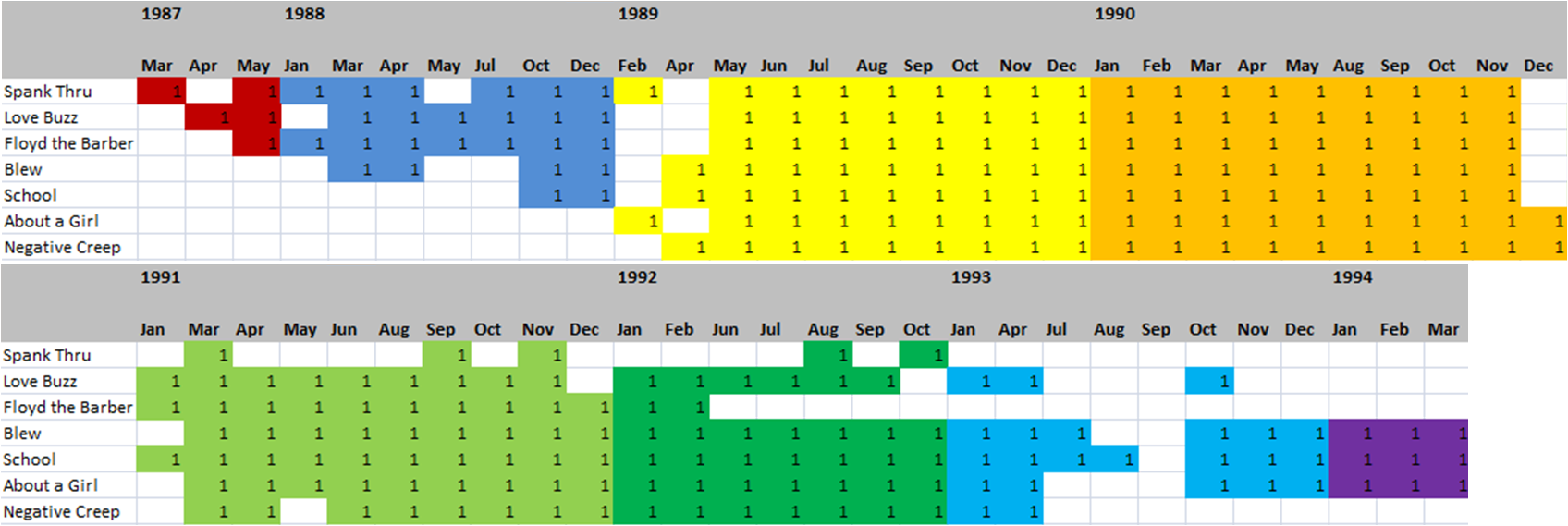
Just for amusement I simply want to look at their longevity today, when did they arrive in the set-list, when did these songs hit their peak, and when, finally, did they drop out. For starters, tragically for those of us who like poetic coincidences, there’s no song that is present from start-to-finish of Nirvana’s career; the nearest candidate is Blew with its first known appearance in March 1988 and its final appearance on March 1, 1994 some six years later — the song certainly deserves greater credit in the record of Nirvana’s songs. It also makes me think that the tale that Sub Pop told Nirvana to arrange the songs on Bleach by simple order of preference from favourite to least favourite may have some truth to it — Nirvana clearly love Blew.

Picture1

Spank Thru is also a great survivor. Already notable as the most significant composition to be ripped from the Easter 1986 Fecal Matter demo, Nirvana loved the song so much they made it their second original song to be released, they played it on radio both in 1987 and late 1989 and reissued a live version of it on the Sliver/Dive single in 1990 (U.S.) and 1991 (U.K.) In virtually every month in which Nirvana played (and for which we have evidence) the song is played only finally being relegated to the reserve at the end of 1990 with periodic returns. Love Buzz has an even more imperious (and deserved) run with appearances in the live catalogue all the way into 1993 — I’m more surprised that the band didn’t feature it often in the In Utero tour than that it lasts so long given its popularity, catchiness and fun vibe. This leaves Floyd the Barber as the last of the 1987 Nirvana songs to live out an extensive live life. Again, taking note of the Bleach running order and the apparently rigid thinking behind it, it’s an early track that, despite its wordy nature and story-telling style (something that died out relatively early in Cobain’s career) doesn’t vanish until the end of the Asia-Pacific tour. What’s sadder is that it stops flat with no known reprises at any time in the final two years of live performance — done. Listening to it at first I used to notice the lurching discomfort of the song and its relatively low pace…Since then, however, I’ve come to appreciate its bright guitar tone, the catchy guitar-drums interplay and the climbing bridge — it’s a truly great track and I can understand its survival.

For the In Utero tour Nirvana’s set-list became relatively stable compared to earlier years — songs tended to appear in the same positions, next to the same companions, the majority of shows featured the same songs in the same order from the start right through until somewhere close to the final songs (I believe that in posts examining the ’93-’94 live record I identified anything up to 14 songs in a row matching show-by-show). There’s a sense that on paper the band felt they needed to whip in a few Bleach songs to balance the set-list, not that they didn’t like the songs they chose, but there’s a feeling they needed something to leaven the Nevermind/In Utero heavy sets, that they didn’t have much new stuff to add in, or rare material that they liked enough to play (IHM&IWTD, MV, Gallons…) so had to reach back to songs that had been in the set-list forever. That isn’t dismissive of those songs quality; About a Girl, School and Blew are all top class.

Nirvana’s Biggest Live Month (Plus McCartney/Nirvana Footage Update)

Since Saturday morning the YouTube quality has improved significantly when it comes to the McCartney/Grohl/Novoselic/Smear material…All the songs are now up there…

I’ve always been of the opinion that Nirvana’s career as a live band reached its peak in 1991. 1989 had seen them play 82 shows, turning what had been a relatively stilted live band into a powerhouse — it was their education. The pace dropped slightly in 1990, to 62, then rocketed to 92 performances in 1991 with the majority being in the final spell of the year. This quantity of work as a unit bonded them to the point that they could pull any song out of the bag.

Having plotted the overall numbers for the songs Nirvana performed live I was curious whether one could see that peak in terms of the sheer range of songs Nirvana played. There were provisos; firstly, the increase in set lengths toward the end of their career potentially would influence the results — Nirvana needed only 10 to 12 songs a night in 1987-1988 rising to a norm of 23 to 25 by 1994. Also, as Nirvana wrote more songs it would perhaps be natural that they would (or at least ‘could’) play more — again, potentially this would blot out any indication of their variety as a live act. Finally, for some months, there simply isn’t much data on their shows meaning strange results appear. But what the hey, I thought I’d simply give it a try and see what emerged…

I had one spreadsheet showing every song Nirvana ever played live, which I’d converted to try to show the span of time rather than the overall totals per month (by converting each month in which a song was performed from a total number of performances to simply a ‘1’ meaning I could add a formula that added up how many months the song appeared in.) This made it pretty easy to calculate how many different songs were performed that month.

Nirvana_Most Songs Played in a Month

The influence of individual shows could immediately be seen, for example, the early peak in November 1990 is down to the show at The Off Ramp Café where Nirvana triumphantly pulled out numerous rarities and new songs; the growling response to the weight of negative press coverage in late 1992 was the triumphant stomp of Reading which nearly hit 30 songs; the January 1993 peak is a result of the desultory show at Sao Paolo where the only way to make it to the allotted stage time (and not get sued by the promoters) was for the band to switch instruments and whack through a few sarcastic covers. The tail-end of 1991 does stand as the most sustained period of rapid set-list revision though I’d underrated the sporadic weight and variety of the In Utero tour.

What I was curious about next was to see the impact of removing cover songs from consideration…

Nirvana_Most Songs in a Month Minus Covers

The result shows clearly that Nirvana’s set-lists only truly ‘blow up’ once the band are free to unleash Nevermind in its full glory upon the public. Similarly, the increase in set-list length really does contribute to the 1993-1994 In Utero tour being far more varied than I’d expected. While the band were whipping mystery songs or covers out of the hat each night, they were playing a solid core of Nirvana’s songs. Late 1991, however, when In Utero was still two years away as a coherent album (if half written) was still the finest period in terms of the flexibility of Nirvana.

I did one last scan of the results due a suspicion that the November peak in 1993 was clearly the consequence of MTV Unplugged — another example of a special event in Nirvana’s history leading to unusual and unique choices when it came to sets (Nirvana really knew how to throw a party on stage…) I simply identified the drop in songs if covers were removed:

Nirvana-Fall in Songs when Covers are Removed

The results make Sao Paolo in January 1993 and MTV Unplugged in November 1993 very starkly indeed. It also shows that, beyond the total figures it was that spell in late 1991 where Nirvana were performing long shows and simultaneously varying the set-lists significantly. The best month to follow Nirvana was November 1991 as the storm was breaking and the band could throw anything at a performance.