Embryonic, Proterozoic, Larval Damage: Nirvana Jams

http://music.thedigitalfix.com/content/feature/15412/nirvana-live-tonight-on-tape-.html

This neat article by Brett Anderson of band Eggs, Eggs dwells on remaining worthy moments in the increasingly stripped bare record of Nirvana. It’s a great selection — I headed off immediately and listened/re-listened to all of them — yet noticeably fleshed out with a number of live jams. I’m not saying those jams aren’t each of interest, but they do lay bare the increasing absence of interesting, and glossier, leftovers as well as the minimal evidence of Nirvana’s improvisations evolving into full songs.

The primary evidence of the band’s talent as improvisers rests on only a smattering of officially released studio efforts. Endless Nameless constitutes the core item; it’s a performance so powerful that it churns on for its seven minute running time (nine minutes on the equally genius radio version) with permanent drama and interest, never outstaying its welcome. Later In Utero’s bonus track, Gallons of Rubbing Alcohol Flow Through the Strip, alongside The Other Improv piece captured on With the Lights Out, both display an ability to pull together loose, but workable, pieces based around reasonably worked out Cobain monologues and screams.

Around those efforts the only other remains from Nirvana’s studio sessions are the longer slices, clipped from jams taking place on October 26, 1992 and January 30, 1994 respectively, featured on the With the Lights Out DVD’s title menus — and the first shot at Scentless Apprentice which we’ll mention in a moment. The jams are certainly energetic, fired up guitar-throttling but, though interesting, nothing really marks itself out as a product of genius. The only other notable studio piece lies in the bootleg domain with the track known variously as Horrified or Crisco (among other titles) from the VPRO Radio performance in November 1991. The band all changed instruments and it doesn’t exactly glisten with quality but it still shows the band pulling together something from nothing much, regardless of the fact that the end product still doesn’t add up to something much.

Sonic Youth’s deluxe reissues of Goo and Dirty (plus their rarities release The Destroyed Room) demonstrated the band’s extensive use of rehearsal jams to hone the structure of a song, to par multiple competing ideas down to core lines; a group of musicians working in unison to fashion the ideas each one brought to the table. With Nirvana, the rarest piece available is the demo take of Scentless Apprentice on With the Lights Out which shows Nirvana performing a similar process of familiarisation and then amendment. Unfortunately, as so little Nirvana rehearsal material is available, there’s no way of seeing how often this kind of group activity was enacted. That’s where the primary gap lies; while other bands have let their rehearsal space try-outs escape into the world, whatever remains of Nirvana’s are under lock-and-key.

There’s a reason, however, to believe that improvisation wasn’t the norm at all. The renegotiation of Nirvana’s publishing royalties in 1992 left Krist Novoselic, Dave Grohl and Chad Channing with a percentage interest in only a dozen songs — it suggests they had a minimal involvement in writing or introducing musical elements. Instead, if one wishes to observe Nirvana’s process of construction, it’s the acoustic demos that are the Ur-text of Nirvana’s songs. Essentially they show Kurt Cobain had already plotted, in ragged form, the structure he intended each song to have. There was room for an on-the-spot solo, for bass and drum flourishes, but essentially he knew what was wanted to the extent of instructing Dave and Chad on how he wanted the drums. I suspect that the reason not much rehearsal material showcasing recognisable Nirvana compositions has been released, bar that one song, is because there isn’t much that became a part of their more formal legacy.

Positively, however, having laid down a song in pretty solidly concluded form, the live arena saw the band occasionally taking a song and dismantling it, using its components within wider compositions. Readily available examples are a jam from on-stage in Australia in 1992 where the band shoved Hairspray Queen into the colander sound of a ten minute session, or alternatively the revised version of Vendetagainst that sometimes goes under the name of Come On Death taken from a late September 1991 gig in New York. The latter sounds like a late attempt to wring fresh life into the tune, to make something of a song he seemed unsure of; it’s a shame there’s not more evidence of this destructive creativity in relation to other neglected Nirvana songs; he clearly had a good knowledge of what was left in the archive given the long gaps between appearances by certain songs. On the other hand, to be fair, besides echoes in the half-visible vocals, it’s the bass rhythm that is most clearly cribbed from Vendetagainst so there’s a chance credit should go to Krist Novoselic not Kurt for its reintroduction.

Alas, checking the readily available selection of live jams present on YouTube, it seems clear that, in the live arena, the always engaging noise breaks and finales were off-the-cuff disposables. There’s no evidence this was a band that sat checking its live outtakes to see if there were neat accidents that could be reused…But. Very late in the day, there’s the intriguing case of the December 1993 jams. On both November 12 and December 29, 1993 Nirvana closed out the set with a typical round of destruction, but in the midst of it wedged a recurring piece, with lyrics, that seems to be at least the fledgling beginnings of a song. Similarly, on November 10, 1993 Kurt inserted the riff from You Know You’re Right. While the link from that song’s late October unveiling, through that single stolen jam-piece, to the January 1994 session is self-evident, an intriguing rumour states that the Nov/Dec unknown piece resurfaces in the tiny snippet of Nirvana’s January jams present on the With the Lights Out DVD. It’s at least pleasing, if accurate, to see a hint of further musical thoughts at that late stage, a piece of potential circling in the Cobain mind. It also appears to indicate that, far from heading in an acoustic direction, Nirvana was still roaring into the louder, harsher, nastier sound seen at the Rio sessions back in January 1993.

But it’s just a hint. Ultimately we’re still left feeling that more evidence of Nirvana’s rehearsal work, of the progress of songs from first thought to final concept, would be welcomed.

As a post-script, it was pointed out to me yesterday that Kurt actually jammed briefly on the Black & White Blues tune at a show in 1990 (February 14, 1990 – San Francisco, Kennel Club) as seen here – thanks to David Willhauk on LiveNirvana for this information:

Which can be compared to the demo outtake of Black & White Blues seen here:

On this Day; January 23, 1988 the Journey to Incesticide

Twenty five years ago today, Kurt Cobain, Krist Novoselic and Dale Crover entered the studio with Jack Endino and recorded five of the songs that would end up on Incesticide.

Back last year I asked Jack Endino if, when listening to the songs he worked on that made it onto Incesticide, whether there were any moments that gave him a particular pride and he replied: “No. None of them were recorded or mixed with any time spent (due to budget), plus I had only been working as a recording engineer for three years at that point. The songs with Dale drumming were all mixed in a total of two hours… ten songs on the original 1/23/88 demo, do the math. It would have been nice to remix them with some care taken.” It’s interesting to me that I’ve listened to these songs for some eighteen years now and never had any complaint regarding the sound quality or its features, yet, to the ear of a trained recording engineer, it felt less satisfactory – maybe sometimes less sonic knowledge is aural bliss.

The stories regarding this first studio session are well known; Nirvana recorded at speed, just six hours or so of work, instrumental versions done first, then Kurt’s vocals, mixing done within two hours, out the door. The session was paid for from Kurt’s wages as a janitor hence the fade-ending to the song Pen Cap Chew because “the multitrack master tape ran out just at the start of the second chorus, and the band didn’t want to buy another reel, so more correctly the song is “permanently incomplete”, not “unfinished”. You can’t finish it when a third of the song is missing. I did the fade ending for the hell of it, just so they could listen to what was there less jarringly.” That same night the band played all the songs from the studio session in the precise same order with two more songs tacked on the end.

This is what intrigues me, the guesses that can be made based on the band’s behaviour. LiveNirvana contains a ‘set-list’ for one practice session prior to the January 23, 1988 studio visit and suggests there were two more preparatory sessions. The band knew before they arrived in studio that they needed to move quick; the banged through the instrumentals then Kurt did his vocals one after the other in just one take; that evening, having driven umpteen miles to a performance, they then ran through all the songs in precisely the same order. It suggests to me that between the January 3 practice and the January 23 session, the band actually planned out a clear order of what they were going to play and practiced it ensuring they could act smoothly in studio and explaining why they duplicated the studio running order that evening. The extrapolation that can be made from this is that one of the preceding practice sessions, if a recording ever turns up, should have the same (or a close) order. As a touch of support to this, in March when Dave Foster joins the band, the set list has curious similarities:

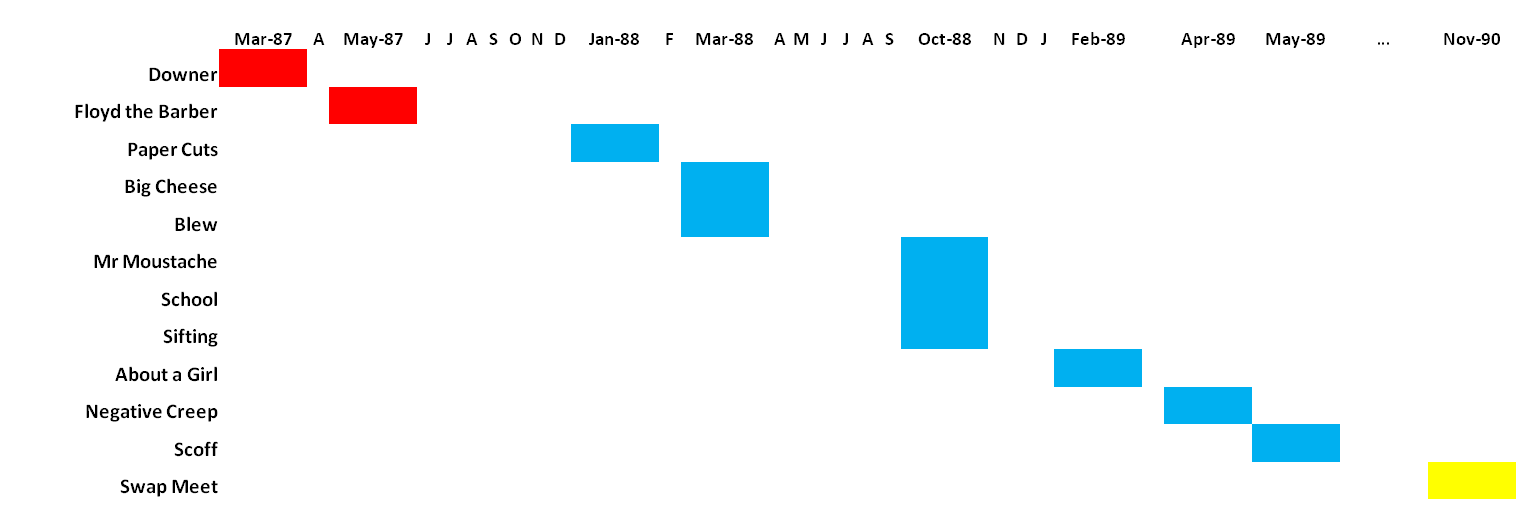
Set Lists Jan-Mar 1988

The top line is the January 23, 1988 performance – the bottom line and a bit is March 19, 1988. Note immediately that despite a change of drummer and a gap of three months the only changes to the opening five songs are Love Buzz has supplanted If You Must as the opener and Papercuts and Spank Thru swap fourth and fifth place. The next disconnect is interesting too; the next song in March was Hairspray Queen. On January 23, though the next full song played was Aero Zeppelin, in fact Nirvana attempted Hairspray Queen and stopped due to a broken string – if not for that accident of fate, the same song would have been in sixth place both nights. The next point of comparison is to look at Beeswax, Mexican Seafood, Aero Zeppelin and Pen Cap Chew as a unit – in January the broken string meant the band shunted that unit up by one song, in March they play those same four songs together, with Hairspray Queen back in place, with If You Must dropped in beforehand having been shoved out of its starting position. The only other change is that Beeswax and Aero Zeppelin have swapped positions. Now the band bring in the new songs; Big Cheese replaces Annorexorcist, Blew is squeezed into the longer set…But the ending is still pre-determined; Erectum is the big set closer with whatever jams and covers the band feel like shoved on the end (the band play Bad Moon Rising at the end in March.)

From the coincidences surrounding January 23, 1988 it’s therefore possible to extrapolate the decisions taken by the band before that date; to suggest a likely set-list for at least one practice prior to the session; to suggest that Kurt and Krist taught Dave Foster this specific set-list in practice after that date; and to suggest a likely set-list for the only other show the band played between January 23 and March 19.

As my tribute to Nirvana’s first studio session I thought I’d simply show how an event taking place so long ago could still inspire thought and consideration today. Happy twenty-fifth!

Dark Slivers: What do the Chapter Titles Mean?

I perhaps over-thought each element of this book…But at least I was thinking and I love the result too! I mentioned the front cover previously? It’s an echo of the incident in 1992 when Kurt Cobain returned from tour to discover all the stuff he was storing in his bathtub, including journals full of song ideas, had been destroyed by a sewage leak. This simple accident means we’ll never know if he had enough stored up in there for a few more quality songs, a few more lyrics that would have compared to his best, music turned to lost dreams. In a world full of generic Kurt Cobain/Nirvana covers I wanted to put a bit more work in and do something a little different to the (tedious) norm; that desire drove me throughout the writing too.

Now, the chapters…Again, taking a Nirvana song title as a chapter heading, it had been done. Sometime early in the process I had an album title stuck in my head, no clue why. A little later, as I was frantically scribbling notes as fast as they poured out my mind I kept using album titles to help me break them up — one of the first, and most obvious, was using The Hammer Party to head up a note suggesting comparing Nirvana’s drummers (eventually used in a post on this site rather than in the book: https://nirvana-legacy.com/2012/11/03/the-hammer-party-nirvanas-drummers/). I eventually realised that, given Incesticide was essentially a record of Eighties’ underground derived sounds and styles, using albums from that scene made absolute sense. Also, it felt good, to me, to be able to pay some small tribute (a tip of the hat) to a series of albums that I adore also and that Nirvana had led me to.

So, why each title? What do they mean…? Well, I’ve left Foreword, Acknowledgements and Reading Nirvana: A Bibliographical Note to one side…

Table_1

Table_2

Table_3

Table_4

Table_5

Kurt Cobain and Hip Hop Ubiquity

IMG-20130121-00080

When Public Enemy were nominated last year for the Rock and Roll Hall of Fame and Museum they explained that the band had “brought a new level of conceptual sophistication to the hip-hop album, and a new level of intensity and power to live hip-hop, inspiring fans from Jay-Z to Rage Against the Machine to Kurt Cobain.”

Beyond the desire to name-drop a still iconic superstar, the reference does display the one real indication that Kurt Cobain acknowledged the world outside guitar-based music. Public Enemy’s It Takes a Nation of Millions to Hold Us Back featured on the list of Top 50 albums in his Journals as a sole representative from hip hop. It’s an easy album for non-hip-hop punk rock-orientated music lovers to like given the extreme sonics, the densely layered sound and the talented polemical vocals on display; it even earned Chuck D a Sonic Youth cameo. Cobain went so far as to state that “rap music is the only vital form of music introduced since punk rock,” which acknowledged its impact accurately, yet there was no cross-pollination — Nirvana’s music existed in a solidly guitar-based milieu with nothing bar that nod of respect.

On the other hand, however, acknowledgement of Kurt Cobain has become a relative commonplace within hip hop. Previous articles and online discussions have documented his presence within lyrics, in the past twelve months I’ve noted “you a broke N****, kill yo’self Kurt Cobain” from Waka Flocka Flame on Gucci Mane’s Trap God mixtape; Kayne West opting for “rocking flannels all summer like Kurt Cobain,” on the song White Dress (from The Man With the Iron Fists soundtrack); while The Game opted for “so strange had to blow they mind, Cobain” on the title track of Jesus Piece; the up-to-the-minute burst of “Kurt Cobain even died because you scrutinise” from A$AP Rocky song Phoenix released earlier this year. What’s immediately obvious is that these aren’t precisely highly inspiring lines. Hip hop’s level of engagement with Kurt Cobain hasn’t moved on at all since Eminem rapped “my favourite colour is red, like the blood shed from Kurt Cobain’s head” a full decade ago (Cum on Everybody.)

The references are far wider than the lyrics too; Tyler the Creator, almost tragically, displayed the deepest Cobain knowledge on display for referencing Kurt Cobain’s baiting of Rolling Stone. Tinie Tempah shows he’s taken his view of the world from PR-puff-piece reporting with the following January 2013 facile comments:
http://www.contactmusic.com/news/tinie-tempah-waiting-for-new-kurt-cobain_3437647

While Jaz-Z barely rose above that level in November 2012 with this snippet:
http://www.stereoboard.com/content/view/175763/9

The other week, in a comment on Nirvana-Legacy.com someone asked about the impact death has on the ‘love’ for a person; the presence of Kurt Cobain as a meme with hip hop is one of the consequences. No other figure from the world of rock music has even a fraction of this pull. His death, a cultural news event that was inescapable anywhere in the United States, was large enough to cross the musical boundary in a way that the mere success of a band like Guns n’ Roses, or the outrageousness of their frontman Axl Rose, was unable to. Timing is also crucial; John Lennon was the previous music world event of this weight but it took place before most of the hip hop stars of the past ten years were even born; this leaves Cobain as the reference.

Yet, despite having been allowed to penetrate the world of quips and quick studies that constitutes modern hip hop lyricism, it’s very clear that there’s no point taking seriously the depth of consideration given within any of the songs discussed here. There’s no piece of art here that has spent more than blinking time on their Cobain reference. What we’re witnessing is a consequence of the commercial nature of present hip hop which values the ability to pump out product at high-speed and therefore favours those able to slap together endless rhyming couplets over song-long (or frankly even verse-long) meditations on a topic. It’s not worth wasting emotion being worried about the depth of these song references when none of them constitute more than single bar of punch-line thought on any theme.

What we’re witnessing though does have interest. Firstly, we’re witnessing the impact of death on an individual. What occurs, and this is not a characteristic specific only to hip hop, is that they’re reduced to snapshots in a process of reduction and simplification. A non-musical example would be the way that Winston Churchill (at least in Britain) is barely more than a gruff-voiced metaphor for stubbornness and patriotism. An individual becomes a short-hand reference, a meme that everyone knows even if they know nothing else about the person being referenced. In the case of Kurt Cobain, the lyrics quoted summarise him as, primarily, suicide via a gunshot wound to the head. There are some that dredge up drug references, not even, necessarily, heroin. Kurt has simply become another all-purpose image, likely to die out inside of a decade as a generation for whom Kurt Cobain is distant past take the pop mantle, but serving, for the time, being as an easy rhyme and a quick way of saying blood and mess.

Slightly more disturbing is the way in which PR stories substitute for any contact with reality at all. Kayne West’s grunge-wear reference (*shudder*) doesn’t make it any deeper than a scan of glossy women’s magazines circa-1992-1993. The connection between Kurt Cobain and flannel is…A load of old flannel. What Kayne has absorbed is the sillier manifestations of the grunge explosion with Cobain having to wear all its results given he was held to be its figurehead. Similarly, Tinie Tempah’s, quite charming, desire for an individual to ignite and unite the world of music has absolutely no basis in reality. Cobain never ‘spoke for a generation’, he was never the voice of an identifiable and unified group, let alone for the full diversity of youth c1991-94. Again, the desire at the time to explain Nirvana’s rise by a reference to some brand-new social grouping, was an oversimplification used by the media and that has now been repeated so often that a man who was a mere nine years old at the time of Cobain’s death has totally absorbed it.

Jaz-Z’s curtailed history of hip hop’s rise in the early nineties has, initially, an appeal. Yet it too, ultimately, has no substance. He’s unable to equate a broad culture with anything other than chart success and PR-presence in the pop world. He can’t see that hip hop didn’t ‘pause’ in the slightest just because a few rock bands took a large share of a declining rock audience. A$AP Rocky, unusually given he’s the youngest of all the individuals mentioned, is at least closer to the truth with his one-liner implying that the loss of privacy was a factor in Kurt’s death.

I’d love to point to Kurt Cobain’s ‘realness’ — his absence of career-motivated fakery, his unwillingness to bow to the demands of PR — and make a link to hip hop’s fetishisation of that concept as a reason why he should be so acceptable to hip hop’s stars such as Lil Wayne. And certainly the musically omnivorous nature of hip hop means it’s no surprise a few of its denizens appreciate the music of Nirvana. But there’s not much depth to the connection, no more than there was when pop music went through its brief spell of ‘rock star’ catchphrase worship a few years back. It’s good Kurt Cobain meant something to them, but in terms of it translating into a genuinely imbuing of his anti-commercial spirit into the modern pop world…No. Hip hop, in its mainstream manifestations, increasingly speaks for a triumphant few who wish to parade their wealth; misogyny; aggressive self-centredness. While enjoying some of the music I often feel I’m the equivalent of people buying books by the CEOs who have just put them out of work just to learn the awe-inspiring truth that those bosses see themselves as unique individual successes based wholly on their own genius. Kurt Cobain never led the indulgent lifestyle of conspicuous consumption; never willingly exposed his whole life for PR benefit; ensured his political values (anti-sexism, anti-racism, anti-homophobia) were declared loud n’ proud on multiple levels and never wrapped his arms around business.

IMG-20130121-00081

In Utero and the Second Age of Experimentation

In Dark Slivers I wrote a whole chapter, Post-Mersh, entirely about the golden age of Kurt Cobain’s musical experimentation basically centred between 1987-1989. I feel I overlooked a similar flourish in 1993, one I hadn’t even considered before.

While the earlier period saw Kurt Cobain probing and testing what could be done with sound while on a budget of bare pennies, 1993 afforded him, and Nirvana, the chance to buy in new sounds. Kurt’s increasing distain for continuing with what he was doing, the way he was doing it, had one positive consequence which is that it led to more space for the band to try new things.

A first new direction came via the addition of Dave Grohl as an active contributor of musical ideas. This began with Dave playing Kurt a demo of Alone + Easy Target recorded in 1991. Kurt responded enthusiastically reportedly saying “oh, finally, now I don’t have to be the only songwriter in the band!” The first tangible collaboration was the arrival of Dave’s ideas that became Scentless Apprentice at rehearsals in late 1992. This was a genuinely new development; Chad Channing has stated that he felt openly discouraged from having pretensions toward creative participation in Nirvana’s music. Now, in 1992-1993, Kurt even said in interview how pleased he was that some of the burden would be off his shoulders.

Of course this new potential didn’t last long. Rio de Janeiro in January 1993 saw Kurt allegedly supplying some backing vocals to the demo’ed cover of song Onward into Countless Battles, so some forward motion was being maintained. Then Dave’s song Marigold was used on the Heart Shaped Box single. The only problem there, however, was that when Dave recorded the song at the Pachyderm Studios sessions in February 1993, Kurt didn’t perform on the song at all. Rather than a fresh collaborative approach it’s more like using his band members for convenient filler at a time when he had far less to offer.

After that it’s hard to disentangle the general spiral of Kurt Cobain’s life from the specific issue of band collaboration. It’s certainly true that after the PR-friendly statements about this fresh creative input to Nirvana’s music, there was barely any studio play or rehearsals whatsoever. It’s possible the public statements were a reflection of Kurt’s famed inability to openly confront many things he was unhappy with. That would make the long absence of collaboration with his comrades in Nirvana a way of giving a hint at how welcome he found their desire to participate as equals rather than as faithful supporters of his vision. Or maybe it was simply a relief to opt-out of the music and focus on making collages and art works at home with which to decorate the music that was emerging.

A common pattern with many bands, once they’re in possession of the money and fame to get away with it, is that they seek out a wider array of musical options to toss at their recordings. As examples, think of Guns n’ Roses with the grand pianos and string quartets, or Radiohead with the wholesale move into beats and keyboards. Nirvana never went that far; it was a vestigial opening in their sound that notably shied away from electronics or from a zeitgeist-hunting dive into the latest sounds.

Instead Nirvana reprised ideas they had briefly nodded to in the past — it’s a curiously circular path, part of a wider span of evidence that I’ve pointed to in the sample chapter I placed on here in the November 18, 2012 post. The addition of a second guitar seemed a genuinely desired option with Nirvana trying Big John Duncan (formerly and most famously of punk band The Exploited) before settling on Pat Smear (formerly and most famously of punk band The Germs.) It’s intriguing that just a year after Incesticide had tied Nirvana to various strains of the underground (to be followed by the link up with The Jesus Lizard), Nirvana attempted to add such solid punk era credentials to their line-up.

Pat Smear genuinely did seem to add creative options for Kurt Cobain as well as relieving live burdens. The final known recording work by Kurt Cobain involved Pat, similarly Pat has spoken about abortive requests from Kurt to work together in hotel rooms on tour. Again, though it didn’t add to a broadening of the instrumental palette, a second guitar could potentially have added something new to Nirvana’s sound.

The Pachyderm sessions apparently saw a brief jam attempted, now known as Lullaby, utilising an organ located at the site. The three instruments listed in Gillian G. Gaar’s description of the piece are “organ, bass and drums” suggesting that, once again, Kurt Cobain had discarded his guitar and had ended up on another instrument, an increasingly common feature. The dual role of vocalist and lead guitarist always automatically made Kurt Cobain the front man and figurehead. Having a second guitarist, or these periodic switches to drums (Sao Paolo concert in January, one song in the Rio sessions, here at Pachyderm, the 1994 home demos) appear to be a way to step back into the shadows to some extent, to abdicate the central role.

Lori Goldston’s addition on cello was another repeated preference. Originally band friend Kirk Canning had added the instrument to Something in the Way back in 1991; Kera Schaley then took over and applied touches to Dumb and All Apologies in 1993. To then add Lori Goldston as a full addition to the touring ensemble was a fresh step but not an unprecedented addition to Nirvana’s music. It’s interesting that, while a perfect fit for the MTV Unplugged in New York format, Lori’s inclusion had already been decided on and had taken place earlier — happy coincidence. It was at that show also that the final new instrument, Krist Novoselic’s accordion detour on Jesus Don’t Want Me for a Sunbeam took place.

The acoustic direction has been suggested as one direction for Kurt Cobain; a few months back I suggested that the trend in his music seemed more toward the noisy with acoustic guitars remaining a feature for home practice only…Now there’s a new option, perhaps there could have been a fleshed out and fuller Nirvana, a more cluttered, yet also more orchestrated and mature sound. It’s a possibility.

…But I admit it. I’ve been trying to be positive yet the evidence amounts to scraps. The addition of such punk-originated second guitar options perhaps supports the idea that 1992-1994’s turn toward noisier songs would continue. Or the permanent concert residency for the cello may mean that the mooted acoustic direction could have also ushered in a wider arsenal of ‘organic’ instrumentation. Or in a continued Nirvana either Dave or Pat might have been the source of a dilution of the Cobain-centric band creating new directions for the music. 1993 deserves to be seen as a new age of experimentation for Nirvana, but one that simultaneously shows evidence of disinterest and/or a sense of confusion about what the future should be, or whether there was a future at all.

Kurt Cobain: Such a Precious Petal

Lillies

One of Kurt Cobain’s beauties was that he was simultaneously explicit about his reasons, but rarely simplistic. The matter of flowers is a case in point. I recall, back last month when I was suggesting that I didn’t find MTV Unplugged in New York a necessarily joyous occasion https://nirvana-legacy.com/2012/12/21/disquiet-mtv-unplugged-in-new-york), someone quite reasonably said “well, so what if Kurt asked for some flowers?”

Well, I feel there’s quite a big so-what. Kurt is absolutely clear that he doesn’t pick lilies as a key component of his decorative world because they’re merely ‘his favourite flower’ or because he finds them ‘pretty’. The request for MTV Unplugged in New York was very clear; lilies, black candles, crystal chandelier and as the all-knowing Oracle Wikipedia declares the show’s producer responded “you mean like a funeral?” to which Cobain replied “exactly. Like a funeral.”

But this isn’t the only reference to flowers. Within his Journals, in the sketched ideas for a video for the song Rape Me, he notes down “preferably lilies, orchids, ya know, vaginal flowers.” Wonderfully, however, this wasn’t the first time the vaginal flowers had been on his mind. Back in the spring of 1993 he had incorporated these same flowers into the artwork for In Utero with a piece explicitly entitled “Sex and Woman and In Utero and Vaginas and Birth and Death.” And again around the same time, for the Heart Shaped Box single cover, he was using the flowers again on a song that Courtney Love has stated is about her vagina. That charming comment from Courtney is backed up by the circling themes woven into the song; it was originally called Heart Shaped Coffin, it’s laced with ideas like the umbilical noose, a charming combination of woman and death all over again. And even this wasn’t the first time he’d gone with the flower angle, In Bloom in late 1992 had focused specifically on the stamen, the plant’s reproductive organs. It seems that for a period of somewhere over a year (at least) Kurt Cobain’s visual imagery was highly specific and focused. When it comes to covers and even stage decoration he loads the place with reproductive imagery and links it to death.

If we wanted to expand then it’d be easy at this point to comment on naked babies, pregnant women, seahorses too but instead I want to go in a different direction and refer to sex in the lyrics of Kurt Cobain — there isn’t much to be honest but let’s look. In total it amounts to four songs featuring rape — Floyd the Barber, Polly, Rape Me and the Fecal Matter demo track Laminated Effect — plus the song Moist Vagina, plus a mention on Gallons of Rubbing Alcohol Flowed Through the Strip. What I find intriguing is we’re looking here at songs involving sex and death (Floyd the Barber), an original title for M.V. which ended in “and then she blew him like he’d never been blown, brains stuck all over the wall”, rape and AIDS (Laminated Effect), oh, and Gallons of Rubbing Alcohol combines absence of sex with implied pregnancy and a missing period then has AIDS victim Perry Ellis guest-star.

I genuinely believe one of Kurt Cobain’s most unique qualities as an artist was his ability to work on multiple levels of meaning whether those combinations were humour and horror, delicacy and brutality, or in this case, the knowing use of flowers to represent sex and death, in public, uncensored, throughout that late period. Yet the association of sex and death (it’s the ol’ Doors vibe all over again) had more regular origins in his music with a long-standing issue returning to the fore in his married life. He doesn’t ask for flowers; he asks for a funeral and for vaginas – married, buried. Make of it what you will, I have.

Just as an aside, someone check me on this; Kurt chose the image of him in a Santa hat (partially obscured) for the inlay of In Utero, is it coincidence or self-parody that the frail old man in the Heart Shaped Box video (Christ pose, straggly hair, little beard, piercing blue eyes, thin, weary) also wears a Santa hat…?

Nirvana and I: A Personal Aside

I’ve been asked repeatedly – as work colleagues, friends and loved ones watched me lose a year of life to scribbling or tapping away furiously at Dark Slivers and the supporting data and notes – “why do you love Nirvana so much? Why do you care so much about Kurt Cobain?” My answer in essence is that the love of something has very little to do with the object of that love; love doesn’t float in the air to be inhaled and returned. I was ready to love music at that point in life and by chance, luck, whatever, Nirvana was the group discovered. For some people out there maybe it was NWA or Public Enemy, maybe it was the Summer of Love rave scene in the U.K. or some other manifestation of the surge in dance culture, for others perhaps Pearl Jam hooked them far more…Its all good. In my case it was Nirvana, there’s no qualitative judgement required, it just was.

I was on a school trip, shared a room with the older crew who were along as supervisors, ended up running a group after my supervisor decided that trying to strip out of his trousers to his cycling shorts was a great idea while still riding the bike. It was a bit of a growing up experience basically. On the boat home from France the guy opposite had tapes tucked in a hat on the chair, I fished through, found his Nirvana tape (Nevermind one side, Bleach the other) and was hooked. He was surprised I hadn’t heard of them but genuinely I’d never even heard of Nirvana.

Then came the coolest family holidays. My mum rocks at coming up with cryptic clues – so each year, at Christmas, there was always a treasure hunt in the afternoon and this particular year my parents had decided to really bust the bank and ship the whole lot of us to Florida while we were all still young enough to enjoy it (heck, I’d go now! Disneyworld is FUN and I don’t care who says otherwise!) We went in 1993 and they decided to do it one more time in 1994. So, Kurt Cobain’s demise came tied to this absolutely wonderful and happy time – it’s like in a genuine top-quality comedy where the laugh is greater because of a moment of sadness or vice versa, that a heightening of emotion in one direction makes the opposite emotion even more intense. It gave the timing a significance, last day in Florida equals day they announced Kurt Cobain was dead – coincidences matter because they bind things together, particularly in a young mind.

It was my first real experience of death. I had no memory of older relatives dying, so this was the first time I’d felt engaged by the loss of another person – maybe the first time I was old enough to comprehend the idea that someone had gone. The fact I’d bought, that very morning, the final Nirvana album I didn’t already possess – I can’t recall if it was Bleach or Incesticide but I genuinely do remember forcing my parents to stick Incesticide on the car stereo during that vacation, an odd choice given I never made them listen to Nevermind. Naturally, having no idea how to react, one just makes up an approach from observations of the world around – typical kid – so my reaction was to institute a daily Nirvana listening plus a fairly permanent layer of black clothing. I admit though I never bought or owned a Nirvana t-shirt, it seemed ostentatious and fake as if declaring my allegiance to other people was the important bit, it felt like trying to gain reflected glory. Hate the idea.

Shifting schools was another real upheaval – guess it was my turn to have a teenage blues phase. I snapped out of it eventually but music was a good way of gaining a touch of credibility with the already settled social cliques of school (no criticism of either school, schools are just like that.) It formed a good social glue and a declaration of taste before the audience wanting to figure out the new boy. Naturally Cobain’s disaffected ennui fitted the mood beautifully – I’m sure it had never even occurred to him that everyone feels a bit divorced from things sometimes and that he’d soundtracked and expressed it to perfection. I had a bit of a ritual of listening to a Nirvana song (at one point a whole side of an album) each night before bed – think it helped me get good sleep too, music before bedtime, a recommended relaxation technique. At university it didn’t work quite that way, it was more a differentiator than a unifier – but it did put me nicely in contact with my dear Norwegian punk musician friend who I’ve lost contact with but still retain a huge love for, that’s nice.

Behind all of that, Nirvana provided a starting point, a genuine Ground Zero when it came to my interest in music. I could draw you a graph showing how one discovery led to another, all leading back to Nirvana. Sonic Youth and Swans are the most important bands in terms of the connections I then made, but coming to love SY started via Nirvana and Swans came from SY in turn. I also spent years loving how special it felt tracking down and locating Nirvana rarities. It gave the music a value, a sense of miraculous discovery each time I hauled something off a shelf and got to consider whether I was looking at a new song or just a misnaming. To indicate how deep that enjoyment went I’d sadly like to confess to having a recurring dream where I’m at a record fair picking through a stack of Nirvana bootlegs riddled with unknown songs (yes, I even invent song titles in my head to fit the dream – each one coming with a subtitle explaining the song’s meaning or origin) and working out whether to buy one, or two – if they’re worth £10 each, whether I could swap something else back and get an extra one…This is seriously something I dream 5 or 6 times a year and have done for over a decade.

Are there other reasons I adore the band and Kurt Cobain? Hell yes. My preference, when it comes to ‘heroes and idols’ has never been for stereotypical perfection, it doesn’t inspire me at all. I’m inspired by conflicts, by individuals who achieve much despite flaws, or who were simultaneously great and flawed at the same time. That felt more human, less like admiring a marble statue and less of an unattainable propaganda image. Kurt Cobain fitted perfectly. People think of his life as a depressing one…I never did – his suicide made me appreciate how great and valuable my life was, how much luck I had been given in so many ways. It also made me appreciate the power I had, that if he could do all he did despite the burdens he carried then what excuse did I have? Plus the music was (and is) a comfort, like a well-worn and familiar jumper. Oh, and did I mention I really enjoy the music too? Plus I genuinely admire him, in a world where people seem less and less able to even imagine not wanting money, money, more money, that he stood on top of the world and said no. It’s still the rarest thing, someone who had won over the world to such a degree to hand it back despite all the pressure, the nay-sayers, the criticism he was bound to receive – he went his own way. That’s strength, that’s a true willingness to focus on what one genuinely believes. He told an industry that it was faking and lying and he didn’t want to take part. Brilliant.

The Path to an Album Part Two

With only three sets of comparable data trying to state a definitive and rigid prediction is simply impossible. What yesterday’s post and today’s post are presenting aren’t in anyway scientific measures — it’s just as easy to say Nirvana had releases in 1989, 1991 and 1993 so they’d obviously pump an album out for late 1995. Reemphasizing the difficulty in such a clumsy rule as the gap between first and last song played live from an album, if Talk to Me was to feature on a mythical fourth Nirvana album then taking its Nov 1991 appearance as the start date, Nirvana were overdue for an album as early as July 1994 — that’s the problem with limited data…

Let’s try it another way. In Dark Slivers I tried to pin down Kurt Cobain’s writing to likely periods of six months, it’s impossible to go further and naturally a few songs will shift period if new information appears. This meant working from known demos, live dates, likely evidence (i.e., the news story Polly was based on.) While not as precise as the live appearance data it’s still possible to attempt to measure the first and last songs being developed prior to an album to show how a Nirvana album evolved over time. Let’s start with Bleach:

Bleach Development_v2

Gillian G. Gaar argues convincingly for Fecal Matter having been recorded around March 1986 but still it’s unclear if Downer’s origins were in late 1985 or early 1986. I’m also shy of placing Downer here simply because it wasn’t Kurt Cobain’s choice to include it on Bleach, it was Sub Pop’s. Now Nevermind:

Nevermind Development_v2

Some of the first half 1991 songs may have already been sketched out in 1990, hard to say but the overall pattern is still clear. Again, note the one ‘early riser’ then the clicking into place over the two years prior to an album. Finally, In Utero:

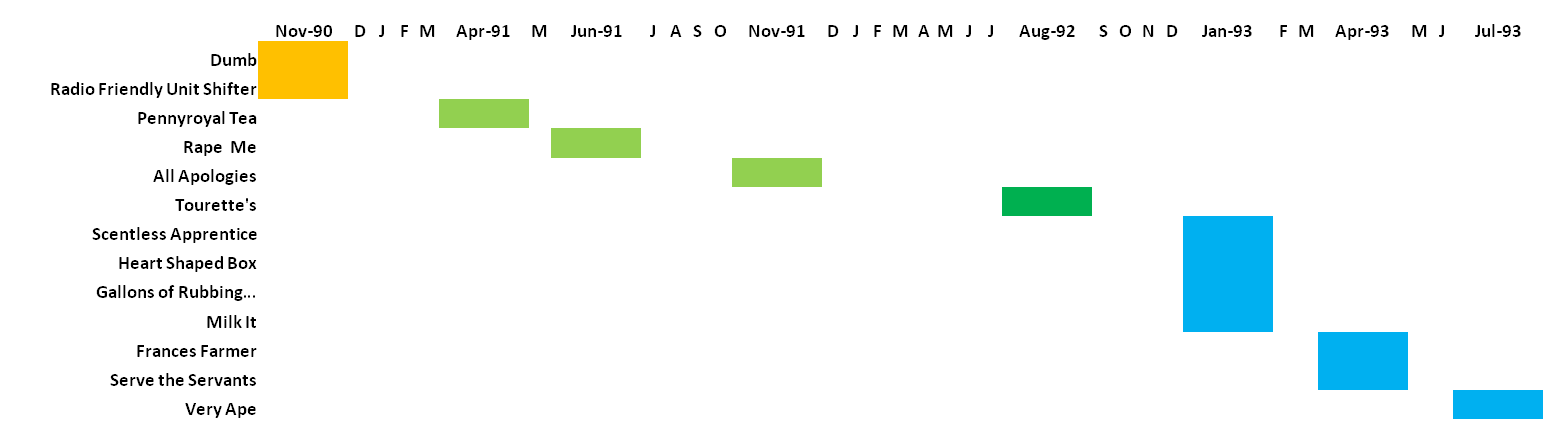
In Utero Development_v2

A far more ramshackle pattern and with a few provisos. Firstly, Krist Novoselic believes Tourette’s was first written in late 1989, but the earliest evidence for it is a ten second run-through of the main riff during soundcheck in November 1991 so either it stays where it is or it fills that gap between Rape Me and Heart Shaped Box. The consequence would be to shorten the album’s development down to three years.

As it stands, and compared to yesterday’s fairly sturdy pattern in the live performances, what we’re looking at is a greater span of potential. Eliminating Downer brings the development of Bleach down to a mere two years. Shifting Tourette’s into the 1991 slot makes In Utero a three year process. Nevermind, however, remains a four year project. Returning to the attempt to estimate when a fourth Nirvana studio album may have arrived, let’s take You Know You’re Right’s appearance in October 1993 as the de-facto starting point, seeing as we have so little else to work from. We’re hitting second half of 1995 all the way to first half of 1997 to finish writing meaning an album release anywhere between first half of 1996 to the last half of 1997.

There’s nothing unexpected here in predicting a wider gap between In Utero and the next Nirvana album. To get In Utero out just two years after Nevermind Kurt (and the record label) had needed a further year and a half, even leaning on the half-a-dozen songs already in place. By comparison, to create Nevermind, Nirvana had started from scratch with just one song dating before late 1989 and it had taken a full two years to get the rest done. Following In Utero we’re looking at a situation comparable to the latter example; there was next to nothing in the vault the band could kick off from, they were starting from scratch.

The only hope would have been scraping together Opinion, Talk to Me, Verse Chorus Verse, together with You Know You’re Right and Do Re Mi to make a bedrock of five songs up to first half 1994. Even then, however, staying true to form, Kurt Cobain would likely have needed a crucial year and a half to wring another seven songs out. He admitted himself he was never a prolific writer, he was neither a miracle worker, nor blessed with the equally divine ability to pull songs out of his ass — he would have needed free time and inspiration to get more out.

In conclusion, if we extrapolate from the gap between first and last song for an album to appear live, we’re talking an album sometime December 1995 to July 1996. If we look at the overall developmental path for Nirvana albums, the earliest date is still on track, first half 1996, but the potential late date is pushed out as far as second half 1997…

…But then again, it’s art, not science. Nirvana may have bucked the trends of their album development, and the trends of 1993-1994 in general. Rebirth and rejuvenation were possible. But there are quite a few ‘ifs’ involved. Either way, a longer wait was likely.

The Path to an Album Part One

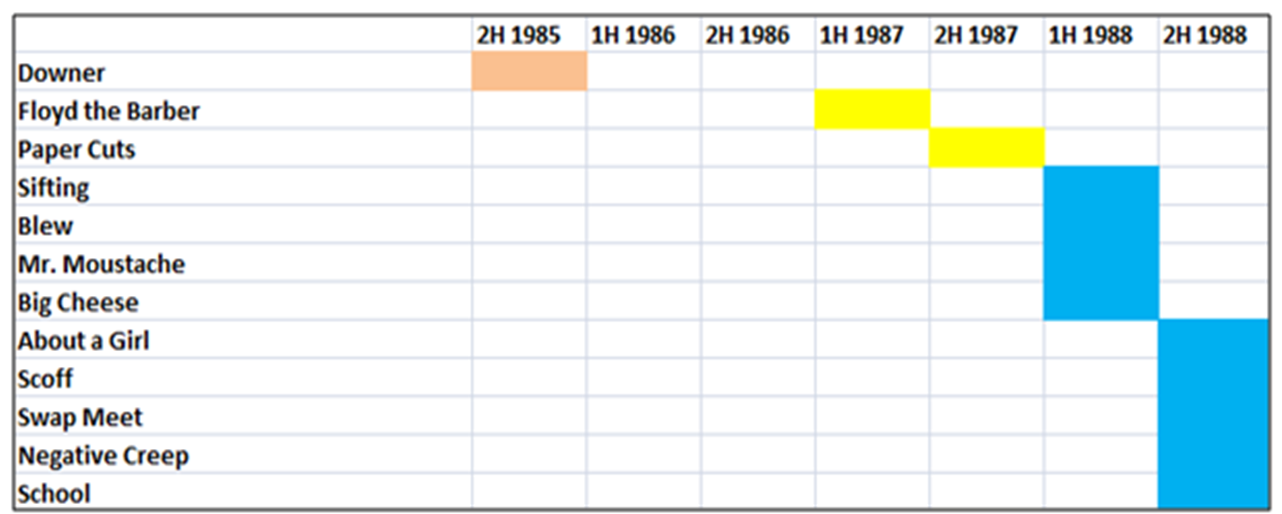
While examining the live sets over the past month, arranging data and seeing how it fell, one noticeable element was how strangely regular the development pattern toward each album was if judged according to the live record. For comparison, here’s when the songs on Bleach first appeared at a live show:

Bleach Development

Ignoring the weird outlier of Swap Meet (it’s unlikely this was its first performance), the span from the time the first track for Bleach appeared live to the last is 27 months. Then again, to be fair, Downer was Sub Pop’s inclusion in 1992 not Kurt Cobain’s, so perhaps we could start in May 1987 with Floyd the Barber as the first song for Bleach; 25 months. Now Nevermind:

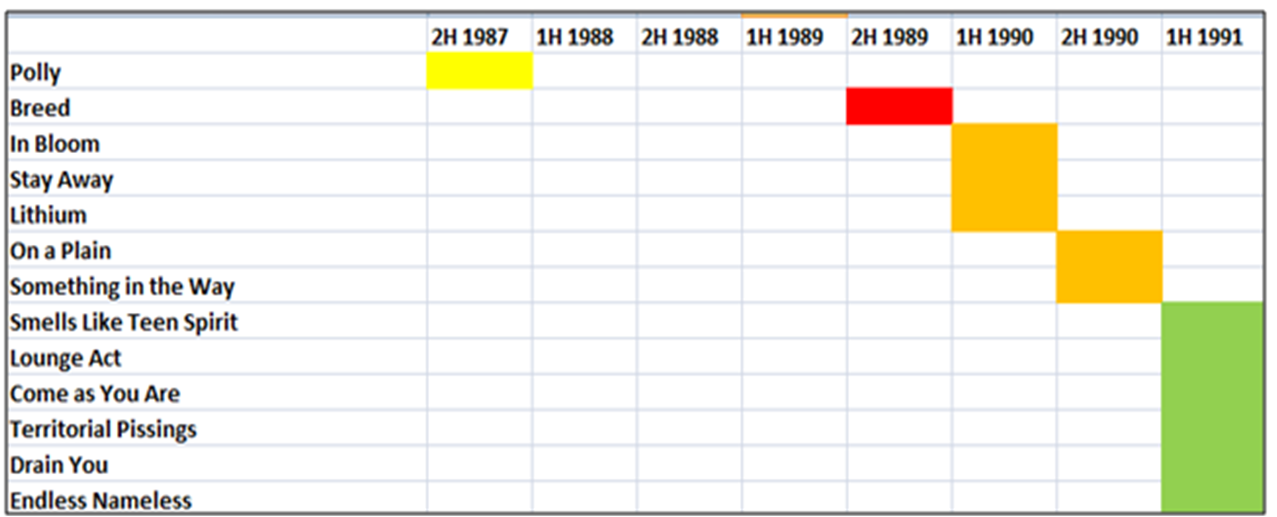
Nevermind Development

Nevermind is almost precisely the same, a grand total of 26 months from first song to last to appear in the live record. Finally, In Utero is a little different:

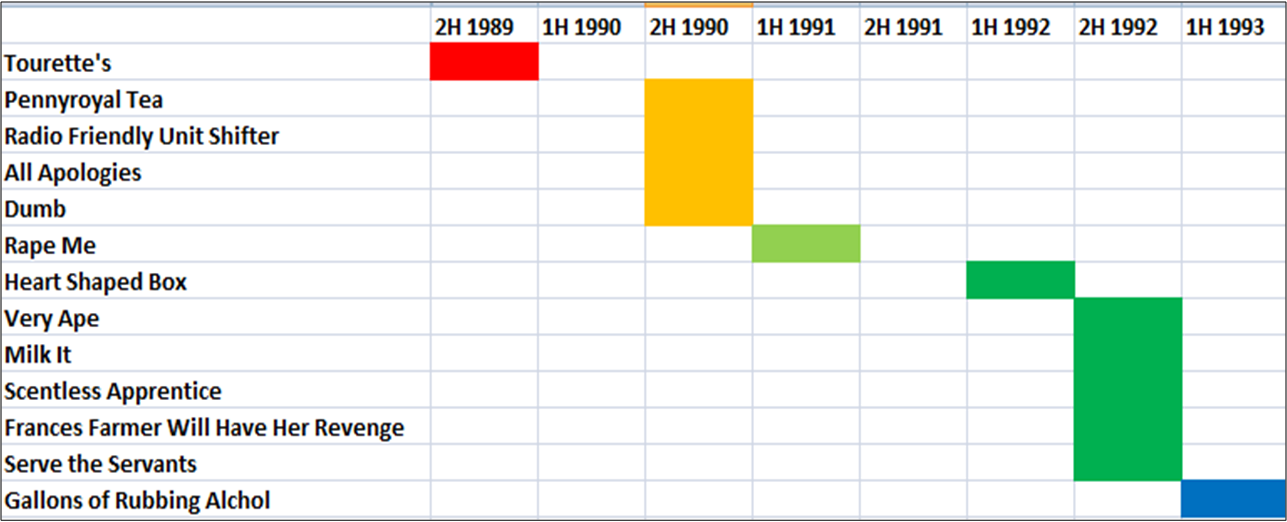
In Utero Development

A total of 33 months between the first live appearance of its first song and the last. The result is three albums, each whipped into shape over the course of two years, one month up to two years, nine months.
Prediction is the art of making oneself look a fool but at least it can act as a guide. In this case, if Nirvana had stuck to the norm, a new album would have been likely around two and a half years after its first song made a live appearance. The problem is, after each of Nirvana’s first two albums, the first songs attempted straight after were explicitly intended for stop-gap recordings and singles — it suggests perhaps You Know You’re Right would be for that same purpose.

On the other hand, as a counter-argument, during the Bleach sessions Nirvana didn’t record any leftovers for singles which is why there was the pressure around whacking songs out in 1989 (Do You Love Me, Dive, Been a Son, Stain). Similarly the Nevermind sessions didn’t yield any B-sides, Nirvana had to reach back and grab Aneurysm from the previous January, then further back to the BBC session that yielded Turnaround, Son of a Gun and Molly’s Lips, and then they ran out forcing them back into the studio to crank out some quick-fire material in April 1992. For In Utero the band, for the first time, deliberately made sure they had enough in reserve they wouldn’t need to come near a studio for a good length of time; February saw them record Sappy, I Hate Myself and I Want to Die, Moist Vagina as full band compositions, then Marigold without Kurt. So, maybe, for the first time, the band wouldn’t have been putting together throw-aways, perhaps the gap to the next album would have been shorter and You Know You’re Right may have had a place in a greater piece of work.

Taking You Know You’re Right as performed in Chicago on October 23, 1993 as the first live rendition of a song for the next Nirvana album, even then the trend would suggest the last song for the album wouldn’t have made it on stage until some point between Nov 1995-Jun 1996. Of course, that last song, in the case of Bleach, Nevermind and In Utero, had only made it on stage one-two months before the release of the related album suggesting an album, at the earliest, in December 1995 to July 1996.

But, of course, the data is flawed…Let’s talk more tomorrow because the pattern is worse not better than the live data would suggest.

Ownership of Nirvana Part Two

Kurt’s death set in motion the next spell of Nirvana as a legal entity rather than a living band; the Nirvana Limited Liability Company. Krist’s response to the law suit brought by Courtney Love in May 2001 stated that it took three years to negotiate the precise legal status of Nirvana L.L.C. and that Courtney retained full control over Kurt Cobain’s publishing share alongside use of his image and name. In amidst this, on July 2, 1996 an amendment to Nirvana’s contract with DGC came into effect requiring them to handover a Nirvana archive box set by June 2001.

June arrived…And with it, the infamous court case with Courtney asking that Nirvana L.L.C. be dissolved claiming that Dave and Krist were repeatedly block-voting against her in all matters related to Nirvana; that she’d been railroaded into the arrangement; and that You Know You’re Right shouldn’t be included on the planned box set. She received an injunction preventing that song’s release by the end of the month. A further effort in October to gain full control for the estate of Kurt Cobain of Nirvana’s masters led to Dave and Krist counter-suing in December — which led to Cobain’s mother weighing in on Courtney’s side of the debate. A ruling in April 2002 refused Krist and Dave’s request that Courtney undergo psychiatric evaluation and everything rolled toward the December court date…And was resolved in September.

On the record company side, the DGC label was folded into the reorganisation of Universal Music Group from 1999 with its autonomous status removed. Geffen and A&M became part of Interscope and its subsequent travails are beyond the scope of this chat. At the turn of the millennium though the status of the label was unclear, personnel were shifting so relationships were lost — Courtney Love’s legal case was fair in stating things were uncertain.

Nirvana’s story became increasingly entangled with larger wars. Courtney was involved in a case accusing Universal of corrupt business practices in tying artists to contracts longer than those signed by other employees. That was part of a wider effort known as the Recording Artists Coalition to try to overturn these kinds of contracts. She was simultaneously being sued by Universal from 2000 onward for failure to deliver the required five Hole albums and had countersued in March 2001 claiming that Universal had defrauded Hole. It concluded with the label agreeing to free Hole from their contract, to return rights to unreleased Hole music to her. In return she agreed to give Universal a cut of revenue from subsequent releases, removed restrictions on reissuing previously released Hole material…And let Universal release the subsequent Nirvana archive projects as part of the Nirvana L.L.C. settlement.

Since then, things have become ever more tangled and ever more arcane.

Courtney’s control over Kurt Cobain’s publishing rights meant she was entitled to go ahead, in April 2006, with the sale of 25% of those rights to Primary Wave Music Publishing, who would seek out potential uses of Kurt Cobain’s music (that figure subsequently seems to have hit 50% either through a further agreement or initial misreporting.) The deal also included complete rights to distribute Nirvana’s music. A court case in 2008 included a document stating the sale was for $19.5m not the wild estimates ranging up to $50m. The results weren’t great for Primary Wave with estimates in early 2009 being that use of Nirvana’s music had resulted in only $2.3m in royalties at that point in time. It doesn’t seem an entirely happy marriage given the 2012 spat over Courtney’s annoyance at Smells Like Teen Spirit being used in The Muppets’ new movie — something agreed by Primary Wave and approved by Dave and Krist. Courtney subsequently claimed she hadn’t signed over ‘synchronisation rights’ —money paid related to the combination of music with visual images (i.e., film, TV, computer games.)

Courtney received a substantial advance on the Nirvana greatest hits release in 2002 and also on the publication of Kurt Cobain’s Journals — then was subsequently sued by the law firm who had represented her to secure this. Hendricks & Lewis demanded $340K in unpaid fees on top of the cool $1.15m they’d earned representing Courtney throughout the earlier Nirvana disputes. This case was settled in Autumn of 2007. A further law suit was settled in late 2010 related to the rights to Cobain’s music. The accounting firm, London & Co. claimed at the start of their case in July 2008 Courtney had agreed to pay them 5% of any earnings from The End of Music LLC and therefore claimed a share of the sale to Primary Wave.

The next twist came this year as it turned out that from sometime in 2010 Courtney handed over control of her share of Kurt Cobain’s estate to Frances Bean Cobain in return for a loan from the money that had accrued in Frances’ trust fund; this came after a turbulent time in which Frances got a restraining order against her mum and had Kurt’s mother and sister named her legal guardians until she reached age eighteen. As far as can be told this hasn’t made any waves in terms of new releases or deviations from established anniversary plans.

Meanwhile, in late 2012, control over Virgin Music Publishing passed to BMG. Sony bought EMI Music Publishing but was made to sell various catalogues of songs as a condition of the sale. Again, it makes little difference beyond being another piece of the endless folding and unfurling of music companies, legal ownership, percentage shares and business obscurity building up around the band as it moves further and further away from a living breathing entity and deeper into the realm of paper concepts.