Sub Pop Album No.2 for Nirvana: What Would it have Looked Like?

I admit inspiration this time around came from a conversation in the forum at LiveNirvana initiated by Chris Hickman — all credit to him. He rightly pointed out that the April 1990 Smart Studios session was intended as the kick-off to album two, not just a rehearsal. With that in mind though, it’s clear that a significant chunk of the album known as Nevermind simply didn’t exist until late 1990 or even on into 1991, a year after this first shot for Sub Pop. Nirvana also hadn’t quite discovered the Pixie-fied formula that would drive a number of the songs on Nevermind, it simply wasn’t there yet. The dynamic of minimal guitar on verses then all-out choruses hadn’t evolved yet; most of the songs that had made it to the studio by spring 1990 were a step on in tone and brightness compared to Bleach, but the guitar’s presence still consisted of (a) constant or (b) the Sliver/Here She Comes Now (and later D7) model of building from quiet to loud across a whole song.

The record of what songs Nirvana had in existence and what songs appeared soon after the April 1990 session serves as a good guide to the likely shape of ‘Sheep’; the second Nirvana Sub Pop album. Often commentary on Nirvana simply wraps the 1989 to 1991 work altogether as if Nevermind was an inevitable product and only needed some tweaks prior to its mid-1991 recording. This simply isn’t true. A finalised album prior to the end of 1990 would have been a quite different beast. Let’s look firstly at what songs were in existence and unused by April 1990:

Songs Available in Mid-Late 1990

I’ve excluded the more or less abandoned songs that ended up on Incesticide; Blandest was gone though not forgotten given it had appeared in a set-list during the summer of 1989 (and also evidenced by the later inquiry as to its whereabouts made in 1992 of Jack Endino while Nirvana were preparing Incesticide); Vendetagainst had reappeared in late 1989 perhaps down to Nirvana’s knowledge of how few songs they had in reserve. In fact, down to the summer of 1990, Nirvana did have a dozen songs available, just a very different dozen to the DGC set.

So, half of Nevermind didn’t exist. Tourette’s was the only In Utero song likely to be in existence. Note that 1988’s entire output of new songs had been used up on Bleach just as almost all early 1991’s writing would be used up on Nevermind, same as the hurried writing in late 1992-early 1993 was swallowed whole by In Utero — Nirvana always reacted to the time pressure leading up to an album release to hammer some new material into shape. If an album was to be out before the end of 1990 then a further spell of work was needed.

And that’s where we diverge from reality. Those who believe it was preordained that Smells Like Teen Spirit and a number of other crucial Kurt Cobain compositions were written will suggest that a lot of lyrics, ideas for riffs and so forth, were probably floating around in his journals and in rehearsals for a while. I agree. Likewise, they would argue that the songs were a response to the circumstances of his life in mid-1990 to mid-1991 so a lot of the urges and desires that found expression in those songs would still have emerged. True.

Yet other crucial circumstances in mid-to-late 1990 were the commencement of business deals that funnelled a small but important sum of money into Nirvana’s pockets via publishing. That was all wrapped up in the preparation for a major label move and without it critical factors that allowed Kurt Cobain to write those songs would have changed. For a start, examine the record of how many shows Nirvana played from June 1990 to June 1991:

Gigs June 1990-June 1991

Late 1990 through early 1991 was indeed the greatest spell of writing Kurt Cobain would ever achieve but it relied thoroughly, not just on emotional traumas like the break-up with Tobi Vail, but on the availability of money so that the band didn’t need to be paid to play — heck, without that influx of cash it’s intriguing to wonder whether the conjunction of Tobi break-up and heroin love affair would have been kick-started either. Sub Pop wasn’t scribing the band many vast pay cheques so this long spell of minimal activity wouldn’t have occurred. Kurt Cobain’s songs would have had to have been churned out at speed — like the work done prior to the Blew EP the year before. Likewise, instead of being the product of a man who confessed later to having sunk into depression and near complete isolation at this time, they would have been the works of a guy spending a lot of nights plastered in sweat and whipping his body around a crowded stage in front of a posse of mouth-foaming punk rock fans.

The major label deal also allowed Kurt Cobain to commit to the more pop-orientated side of his vision. His music had already diverged from straight-forward grunge, but little in the spell up to summer 1990 showed the great leap toward the mainstream that would occur. The original of In Bloom was far grittier, Polly was a lone fully acoustic effort though Lithium was starting to show the band playing with loud-soft dynamics, Sappy was still a far rawer effort than its resurrection in 1993. The core of the songs the band had available would not have been jarringly out of place on Bleach; Breed, Tourette’s, Token Eastern Song, Even in his Youth, Stay Away, maybe even a revised Vendetagainst. These songs would have made the serviceable core of an album that sounded a lot closer to the pop-tinged but still overdriven roar of Dive, Been a Son and Stain. In that context Polly, or Lithium, or Sappy, would have served the role that About a Girl did on Bleach; the showcases for Kurt’s pop chops on an otherwise tough sounding record.

The change in circumstance, another indie record as opposed to a shot at pop stardom, needing to tour rather than sitting quietly writing up a heartbreak, pressure to write new songs in summer 1990 rather than spring 1991; these factors would all have changed the eventual results that emerged.

Note, however, that despite the April 1990 recording session, Nirvana didn’t immediately commence extensive writing in April-July 1990. In fact it’s unclear whether anything other than Verse Chorus Verse and Sliver came into being in those three months. The absence of any visible rush to do anything seems to indicate that there was no pressure on Nirvana to push a new album out, despite the ostensible purpose of the April session. It seems to hint that April was far more about getting a good sounding demo tape together at Sub Pop’s expense, testing out that ‘Top 40 drum sound’ in preparation for a REAL shot at the Top 40, than it was about kicking off a new album for Sub Pop.

Memory Lane: Record Shops and the Value of Scarcity

Record Stores

If you’ve seen the front cover of Oasis’ What’s the Story Morning Glory? Then you’ve seen my favourite record-shopping street in London; Berwick Street in Soho. I first started visiting London to buy music back in about 2000 when I was twenty years old; there was an exhibition on at the Hayward Gallery called The Art of Sound that had me, by the end of my visit, listening to the throaty growls of passing traffic with the same fascination I reserved for music purchases. I’d travel down and stay with my aunt then set out the next morning, early as she lived in High Barnet at the furthest end of the Northern Line so it was nearly an hour of rumbles and creaks on London Underground to get in. I’d be carrying around one hundred pounds in cash, I mean, I was twenty, one hundred pounds was a lot of money, it was money that meant something.

The route was planned out with military precision; hit Camden soon after 10am, there were two second-hand record places on the pedestrianised street opposite the market, then further up the main street was Record & Video Exchange, toward Camden Lock a new shop opened a couple years later and joined the route, then finally there was an electronica specialist in the upstairs room of a fashion boutique further toward Chalk Farm. I’d conclude by heading into The Camden Cantina usually dead on twelve (the staff knew me for actually hovering at their door until opening time) for Mexican lunch/breakfast.
Onwards to glory! The next step was to hop on at Chalk Farm and barrel down the Underground, out at Tottenham Court Rd, along Oxford St as far as the HMV and there it was, the next three hours plus of my life (and little did I know the same street I’d be browsing thirteen years later — my most recent Berwick St purchases were the unreleased soundtrack to Dawn of the Dead by the excellent Trunk Records label and Can The Lost Tapes two weeks ago.)

Berwick St was the Mecca as far as I was concerned; Selectadisc, Sister Ray, Record & Video Exchange, Sounds of the Universe (Soul Jazz Records), Mr. Bongo (hip hop specialist) one street away, plus two discount places that were always worth a look, and a slightly upmarket shop called Phonica down a side street onto Poland St that was underneath the office building I first worked in two years later when I got my first adult job (also where I met my first office-place psychopath but that’s another story — horrible office, horrible job, horrible people.)

I’d arrive in Berwick St around 1pm and I’d be stuck there until around 3.30pm. I had to leave around then if I stood any chance of making it down to Waterloo and onto a train to Croydon for the final step of the journey; Beanos, the largest second-hand record shop in Europe. This final step was always a case of taking a chance, for starters they were usually a tad more expensive than the others, meanwhile they also had an annoying habit of writing a code on the case of each CD which was hell to get off later. But it got me there around 4.30pm and there was always something. The crucial factor was that a quick rampage through Beanos would give me enough time to change my mind and go back to ONE, and one only, of the shops further back on my route, I could just make it as far as Camden in time to grab a previously discarded option.

It’s almost all gone of course, I think you could see that coming a mile off. All five of those shops in Camden are gone. In Soho, Berwick St still retains Sister Ray, Record & Video Exchange, Sounds of the Universe — I didn’t realise Phonica was still going, I don’t visit. Beanos closed too so the trip down to Croydon is redundant (“Croydon: a Symphony in Cement” — bloody ugly post-war British architecture, we forgot what pretty was for thirty years.) Around that the major stores are going now too; Tower Records at Piccadilly was sometimes worth a detour. It became Virgin Megastores, became Zavvi, became a clothing store. A friend of mine is in the main Oxford St HMV as we speak and says it just feels sad in there. Borders was always an oddity anyway, half way between a posh book shop and a posh record shop. The discount record shop at Clapham Junction swapped to a smaller premises then finally faded out. In the smaller towns and cities, same story; Parrot Records in Cambridge was a favourite, bought Dinosaur Jr Fossils there, my first Coil record. Barneys in St Neots had brilliant contacts for bootlegs and rarities until the front of the ancient building started to fall in; it’s a wine merchant now. Sam Goody’s in Boston went.

But that’s not really what I’m here to talk about. I’m talking about the bonds between my Nirvana experiences and these stores. In recent years the surprises and thrills became smaller and smaller which means I remember exactly where I was when I first heard Onward into Countless Battles on a bootleg; Sister Ray’s previous location on Berwick St. I refused to pay £15 for a single minute long shred of a song, this must have been 2008 or so. I bought the most expensive record I ever purchased, Sonic Youth Walls Have Ears, at Beanos in about 2003-4 then got a discount because the girl serving had been singing with a band (The Faint? Maybe) the previous night and she was chuffed at being recognised. I found a vinyl LP called Seventh Heaven, featuring Nirvana at the Bristol Bierkeller, in the Record & Video Exchange in Camden. I also bought a couple of execrable interview discs in Selectadisc at one point thus learning never to buy interview discs. Outcesticide VI was the last notable purchase in that series, Soho again, Sister Ray had it. Sam Goody’s was where I purchased my first ever compact discs — the Nirvana Singles box-set the very day it came out in 1995. Barneys was where I found the Nirvana Wired bootleg featuring the band in Newcastle.

The biggest connection is simply that feeling that, as I only had a hundred pounds to spend, whatever I chose to spend it on had to be special in some way; either a brand new discovery, a chance taken, or a collection advanced, or a bargain located. When hunting Nirvana music, what’s maintained the pleasure has been that sense of rarity, that there’s no telling when the next new discovery will be. Yes, there are huge reasons why online purchasing makes sense and carries vast advantages — that’s a conversation people have had many a time — I’m purely interested in what makes something feel golden. What made the romp through London special was that sense of ritual, the fact I could barely afford to be doing what I was doing so each purchase meant a small sacrifice somewhere (or another dollop of debt).

Those people who don’t particularly care about music — you know the type, their record collection stopped evolving when they hit 21 and started work, it’s full of tasteful club collections, they think a rock anthems compilation is wild, they’ll only ever own one, at most two, albums by the same band — they’re fine with the new ‘all you can eat’ diner that is online music; it’s great for limited attention spans, piling up files, musical wallpaper to colour a room and forget about. I know all the arguments why it has to go that way; all I’m saying is that the active pursuit of new musical experiences gained a vast energy as a consequence of my, then, limited budget, the confined time I had to look-select-revise-pay, the deliberate decision to make it a treasure hunt. Record shops are bound inextricably to a surprising quantity of my fondest and most blissfully carefree memories of my teens and twenties; even now, if I need to take a breath, relax, or pull out of a blue morning mood, I’ll often scrape together some stuff I’m not keen on then go trade it in at a record shop, taking the exchange price in shop vouchers, so I have that tightly-defined budget to go hunting round the store with — I’ve ended up dehydrated and busting for a bathroom after spending four hours in a record shop. Nirvana, however, retains that quality for me because I don’t go streaming vast files online, I look and patiently buy a disc here, a burnt-off CD-R there, a vinyl piece now and then. When something new pops up it’s a thrill.

Anyways, Saturday morning anecdote over. About ten years ago, while ordering some of Michael Gira’s writings from Young God Records, I asked him whether he’d ever write an autobiography given his life seemed populated with the kinds of experiences the majority of people who end up with autobiography could never even dream of. I’d just read his book The Consumer which is still among my favourite reads of all time given its focused solipsism and visceral detail — hints of Burroughs alongside the writing style of Beckett. I was also sick to death (now I’m just numb) of celebrity memoirs of third-rate nothings and, God forbid, footballers. He replied saying (I’m doing this from memory so apologies that it’s only a paraphrase) “writing an autobiography is the ultimate act of arrogant self-obsession predicated on the utter belief that one’s own life was of any interest whatsoever to others.” I try to stick to that rule when writing here on the blog.

What Have you got to be Sad About?

There’s always a divide in commentary on Kurt Cobain in which one side is sympathetic to the fact that his crisis had reached such extremes by early 1994 that he felt death was the only way out…And the other side where he’s simply another spoilt rich drug addict.

Speaking to a friend the other day, she pointed out that her periodic black moods had so little to do with the circumstance of her life, she complained that people regularly say to her; “you’re so beautiful, you’re rich, successful at your job…” then some variant on “we wish you were you” or “what have you got to be depressed about?”

I’m not stating that success, or lack thereof, in the various spheres of life (i.e., social, professional, creative, health/physical, spiritual) is unimportant. There’s a dividing line between handling the normal frustrations of life versus a genuine and deep episode of depression in which the entire perception of life has been skewed. The crucial point is that people tend to confuse the short-hand method by which we measure ourselves against others, with the actual substance of that other person’s existence. Ultimately success or failure isn’t an innate quality, it’s a comparative measure; if everyone has one million in any currency then they’re all millionaires but their buying power will therefore be comparable and only those who are super-wealthy will count as rich.

Confusing the observation “your life is great, you’re beautiful/rich/successful, etc.” with the genuine points of conflict within that person’s existence reduces everyone to a quick sketch, a paper-thin study of human nature. The opposite is true, of course, that examining a life and finding it wanting (i.e., “you’re poor/starving/oppressed/unhealthy, etc.) doesn’t automatically mean that life is devoid of smiles and pleasures — yes, we can find happiness in slavery. One of the ‘pop culture’ questions of history, applied to both U.S. slavery and to the Holocaust, was why these great tranches of humanity didn’t rebel against their enslavers. At the time, their oppressors stated that the absence of violent opposition meant their victims were sub-human, were passive/weak-minded/devoid of a ‘normal’ desire for freedom or dignity. In other words, Southern American slavers and Nazi guards, from their position of power, refused to gain a deeper understanding of their victims and instead reinforced their own sense of superiority by deciding that the fact they would hate being in their victims’ position.

In the case of Kurt Cobain, he had a very deep array of weaknesses and damaged circumstance lasting the vast majority of his twenty seven years. The expectation that two years of success tagged on the end of twenty five years of poverty, rejection and misery should be sufficient to solve everything — or that wealth and fame would remove obstacles — is a deeply unperceptive view of what makes and creates a fulfilled human being.

In fact, becoming famous added a vast array of new challenges to those already in existence. A very wounded adult was now beset by legal threats, by financial demands, by a vast sea of commentators, by management attempting to control his time and presentation, by the inability to have freedom given he was so recognizable… These were added to a man who had already experienced homeless, poverty, had ongoing health concerns, a major drug problem running from 1990 onward, a difficult marriage not helped by his own issues with family and intimacy. It’s no surprise that Kurt Cobain was an individual with a deeply set depression; and no surprise, sad though his choice was, that he didn’t necessarily see life as a positive outcome.

Judging the whole of a person by the shorthand categories we tend to use is the equivalent of relying on a 140 character Twitter statement to stand for our entire view of a film. The human experience of even the lives that appear either smallest or most blessed in these basic categories is in fact a deeper and broader tome requiring far more.

My Friends: Nirvana and Live Support 1987-1994 Part Two

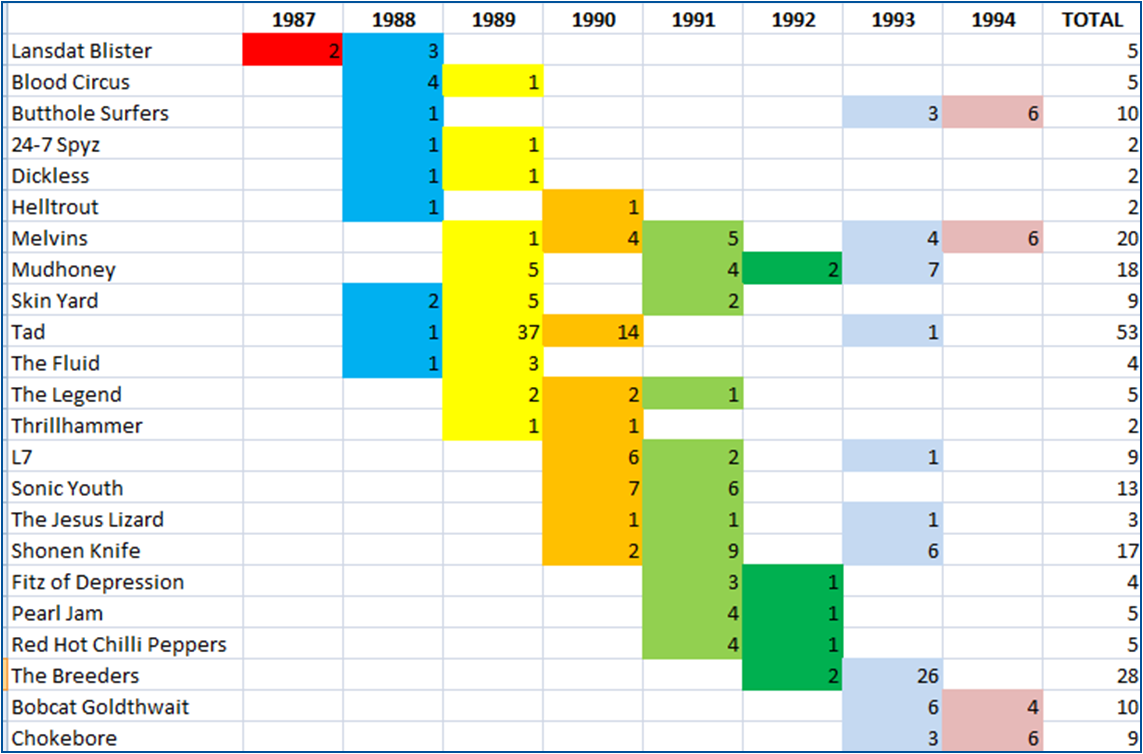
What was striking in yesterday’s headline figures on Nirvana and their live compadres was the loyalty Nirvana exhibited to old friends and favourites throughout their career. The table below shows the bands Nirvana played with over more than a single year:

Nirvana_Multi-Year_Support Bands 1987-1994

Now, this’ll probably come as no surprise, but Nirvana played with Melvins in five of the seven years in which the band was active; Mudhoney and Tad in four; Skin Yard, The Legend, Butthole Surfers, L7, Shonen Knife, The Jesus Lizard in three each. It’s that loyalty to old friends that sticks out for me — the band switched side-acts regularly, shared stages with 234 bands, yet the bands with whom they played the most regularly were the comrades from early days. Instead of prioritising ticket sales — there was no equivalent of the Guns n’ Roses/Metallica tag-team here — in 1994 comfort was the priority so of the seven bands played with that year, four had been toured with in previous years and eight of 20 in 1993. It’s always been noted how hard Nirvana worked to elevate their friends and the way they never dropped friends seems clear.

I’m also gratified to note that Nirvana’s protestations that they were a band solidly aligned to the underground — regardless of records sold, awards won and media glitz — is shown to be true by an examination of their live partners. Nirvana played with a phenomenal array of near unknowns from beginning to end of their career —it’s clear how grounded Nirvana were in their declared milieu, they weren’t a band surrounded by future superstars.

I graded bands on the basis of (a) reaching mainstream acceptance (b) remaining top-level indie/underground heroes (c) achieving a degree of recognition and respect in the underground. Very few of the bands with whom Nirvana shared a gig came anywhere close:

Nirvana Support_Stars-Indie Stars-Respected

This view is provided per year but note the overlaps; six mainstream stars, nineteen top-level indie bands, eighteen recognised and respected, but solidly underground, acts — just 43 of 234 unique acts; Nirvana played with 191 near complete unknowns over their seven calendar years.

Of course this view could be read another way; as percentages per year:

Superior Bands as Percentage per Year

Quite clearly the quality of bands Nirvana were playing with did indeed increase almost year-on-year right through to 1994; if I’d counted Cypress Hill, The Disposable Heroes of Hiphoprisy plus Bobcat Goldthwait too in the mainstream/indie/underground divide the figures would be higher. The blip in 1989 is noticeable and I actually wonder if that’s a reflection of the shift from what would soon be the hottest local scene on the planet (remember that my mainstream/indie/underground division is as much about media coverage as it is about sales) to touring nationwide where Nirvana were just one among many hopefuls; a surprising percentage of Nirvana’s North-western contemporaries went on to relatively successful careers.

The shift in 1993-1994 reflects a further reality; that Nirvana’s success had finally kicked the alternative into the mainstream – my rating of bands doesn’t just reflect those bands, it also reflects what Nirvana had helped create, the success and critical appreciation of their fellow bands was made easier by Nirvana acting as the figurehead and key representative to mainstream audiences.

My Friends: Nirvana and Live Support 1987-1994 Part One

Studying this much Nirvana data for so long, I keep seeing things I simply want to look at and digest in more detail — often what you’re seeing is me working it through in my own mind rather than simply a thoroughly digested entry, certainly I rarely know the conclusion before I start. What I wanted to do today was examine the bands with whom Nirvana played either as support or supported by. I was curious who Nirvana had spent most time with.

To conduct this survey, as ever, I owe a strong debt of gratitude to the work of the Nirvana Live Guide — the data they’ve made available to fans is incredible, I’m just enjoying myself manipulating the information to hopefully show neat little patterns, trends and facts. Today’s post came about because I was so amused by many of the band names I saw popping up on the Guide and wanted to look more closely and acknowledge the role of other bands in the Nirvana story. I know it’s always the same, we barely notice the band that comes on before the band we’ve come to see, but for an awful lot of their existence Nirvana weren’t even that second-string band; they were just another name on a list of unknown quantities.

As a proviso, I ignored the festivals, the sheer quantity of bands on different stages, not necessarily sharing contact and so forth, the festivals were impossible to deal with. Of course this does, for example, influence the statistics for appearances alongside Sonic Youth. I confined this study, with the exception of a benefit/festival or two with as many as five or six bands appearing, to occasions where it was just a normal gig, two-three bands altogether.

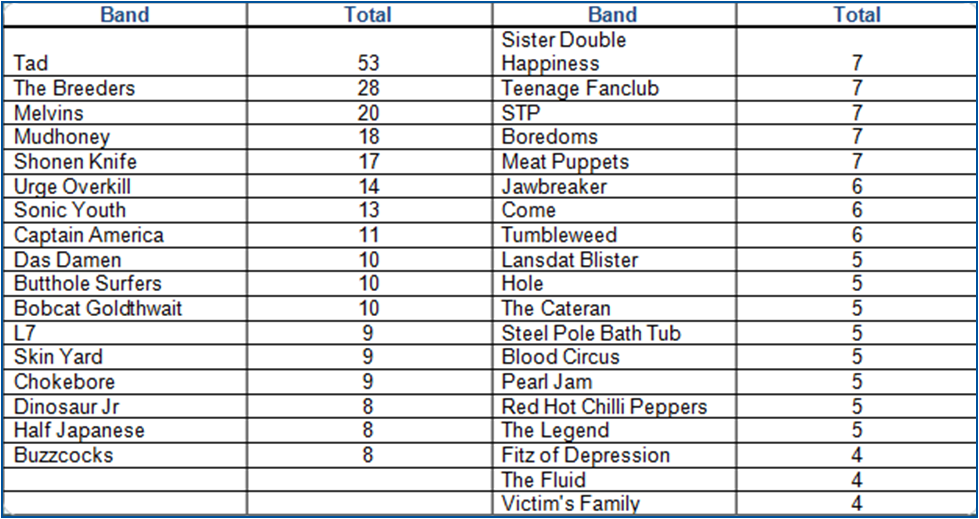
With regard to the absolute numbers, fact number one is the headline figure of 234 unique bands with whom Nirvana played over the course of their time in existence. What’s even more interesting is how few of those bands Nirvana played with more than once. In the table below I set the bar at four times even to allow entry to the list:

Bands Nirvana Played with Most 1987-1994

A mere 36 of those 234 bands are known to have played more than four shows with Nirvana; that’s a remarkable number of connections for Nirvana to be making, band after band, year after year with their peak as live performers coinciding with their peak of shared stages; ending up playing with 56-66 bands a year is quite phenomenal, massive turn-over in support. It emphasises how much of a minor presence Nirvana were until remarkably late in their career in that they clearly had little or no control over who they ended up on stage with, they took every chance, came on before or after absolutely anyone — this did change once fame hit.

The trend over time is unsurprising both because of the fall-off in Nirvana’s activity in later years and also the fact they were no longer playing band showcases or taking any chance to get on stage but were actively selecting the company they kept. It’s still notable, however, how thoroughly things changed; in 1992, 1993 and 1994 they play with so few other artists that one has to go all the way back to 1987 to find a year they forged so few on-stage connections. Notice also how, as the total number of bands declines, the number of bands with whom Nirvana played more than once in a year actually did increase suggesting it was deliberate commercial/contractual arrangements, the business in other words, rather than just ‘nature’ that created this pattern:

Individual Bands per Year 1987-1994

Michael Gira was quoted at one point, I’m doing this from memory, saying that the reason Sonic Youth succeeded while Swans remained a strictly underground flavour was that he went round the country making enemies while Sonic Youth made so many friends. In the case of Nirvana they seem to have spent time with anyone who was anyone in the North-west, on top of a whole batch of names elsewhere primarily American but with solid and persistent connections to international favourites. There are so many bands they’re on stage with. It can’t have hurt either that, with no disrespect intended, the fact the vast majority of bands on the list are either complete, or as near-as, unknowns would have emphasised Nirvana’s quality and superiority — it’s easy to stand out and draw attention when stood alongside more minor acts.

For those of you with a penchant for numerology and spookiness, by the way, note the total for 1992 then the sum of 1993-1994 — oooooo…Fear the nonsensical but eerie…

What’s Left? Wondering if…The 1993 Unknown Song

Shocking day, late post and sincere apologies, sorry peoples…

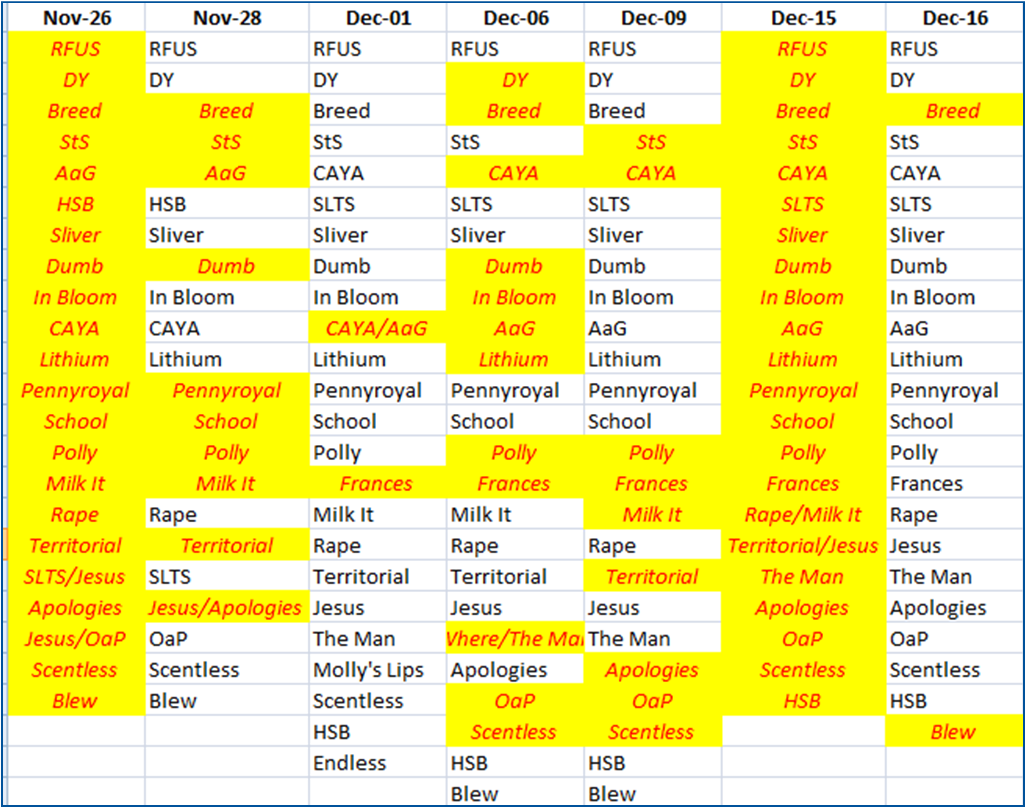
In total the October-December 1993 touring season contained only two completely unknown set-lists — November 26 and December 15 — plus seven partial incompletes; we dealt with October 19 and October 25, 1993 yesterday. The Fitchburg/San Diego unknown song’s appearances on November 12 and December 29 were separated by a full twenty shows, appearing to show that at least the kernel of an idea was persisting (thank you to the denizens of the LiveNirvana forum for the San Diego audio here):

I’ve tried to show, visually, what else we’re missing from late 1993; I know this is like a magic eye picture but take a glimpse at it:

Nov_Dec 1993

What we’re looking at are variations on a fairly rigid structure; as clear examples the Pennyroyal Tea line straight across the middle is beautiful, while the intro is firmly established and never flexes. By looking at the shows surrounding each of the gaps, accepting that once or twice the band swapped in/out songs or changed an occasional song position, it’s actually fairly easy to predict what was played. I feel that the gaps are all fairly obvious — this covers the missing shows on November 25 and December 15 too. I propose the set-lists we’re unable to see looked as follows — I’d put money on these bets happily:

Oct-Dec 1993_The Missing Shows

The only data we have to go on for these dates is the coincidences with shows preceding and succeeding them plus some shreds of information; for November 28 it’s reported that the band played 22 songs which fits perfectly. In relation to December 16, the report is 24 songs were played of which only 21 are known. As well as adding Breed, I’ve added Blew on the basis it was played in 6 of every 7 Oct-Dec complete set-lists; 29 in versus 4 out. That leaves one song I can’t bet on; my likely candidates are Territorial Pissings (it was a common feature preceding Jesus Wants Me for a Sunbeam), or Milk It which had been an on-off set-list fixture throughout.

So what of the ‘unknown’ jam witnessed on November 12 and December 29? Well, alas, once again, as the song was used as a closer, we’re still stuck though only December 15 and 16 seem likely given the known finales. Having projected last week that there’s potentially several thousand unknown Nirvana performances hidden in unseen set-lists it’s sad that there are few miracles likely. For completeness, let’s add on the October dates plus the 1994 dates and I think we’re looking at the following MAXIMUM renditions missing from the whole In Utero tour:

Numbers of Unknown Songs In Utero Tour

Clay Man/Sealed in Skin

Respect due to Michael Prodger writing in the Review section of The Mail on Sunday liberated from a local pub back at the weekend. I’d like to borrow his opening comparing Hamlet’s quotation “what a piece of work is a man”, to an earthy reality that “man is an amalgam of some 206 bones, 78 organs, about 640 muscles…assorted sinews, tendons and cartilages, all clothed in two square metres of skin…” This was in his review of Hugh Aldersey-Williams’ Anatomies.

In one of my personal favourite chapters of Dark Slivers I dwelt on Kurt Cobain’s liking for disease metaphors and his translating of emotional pain into physical symptoms. One item I hadn’t considered though was the relative absence of the human body as a tangible presence within his work. The review points out that Shakespeare was relatively fixated on the body “ ‘flesh’ appears 142 times in his work while there are 1,047 hearts, 82 brains and 44 stomachs.”

Within a piece of work I’ve not yet taken the time to pare down to manageable size, I analysed the verbs within Kurt Cobain’s songs and concluded there was an absence of physical action within his songs. Initially when studying for this article I was expecting to see a similar absence of human flesh within the songs but this proved untrue. What is fair to say, instead, is that the body occurs mainly in glimpses, the songs lack physicality and a result it’s rare for the body to be at the he…Centre of a song:

Lyrics_Bodies

In the case of this subject, I believe it’s a situation where the form Kurt Cobain’s songs took impacted on the subject matter; it’s hard to write about bodies, limbs, organs when most of one’s lyrics are thoughts, opinions, feelings and observations. Bodies are more usually visible in Nirvana’s music as glimpses, lyrical ghosts — someone’s eyes, a face — that appear then disappear; the preceding line, the next line, the physical being rarely persists or has a role or consequence. It isn’t that the songs are merely impressionistic daubs, it’s more that the body is irrelevant to the broader themes and points of the song — the songs are of an interior lived experience not the container surrounding that experience.

An intriguing shift, however, is that the presence/absence of the human body within the work of Kurt Cobain forms a series of peaks and troughs. Kurt’s early story song, Floyd the Barber, is arguably the most physically active song he ever wrote yet it’s still one in which the narrator’s body sits bound and still, acted upon not acting. Again, another song that long preceded Bleach, Paper Cuts, involved a physical action placing it neatly alongside Beeswax’s penile dwelling or Pen Cap Chew’s more observational “skin under a fingernail.” Nevermind barely manages more than a single corporeal element in a song, Sliver, Dive, Stain, Been a Son, Sappy, Even in His Youth, Aneurysm — flesh barely appears. Aneurysm is a great example of what occurs; Aneurysm translates each action into a physical symptom but into sensation on or within a body, the body remains imaginary. In Utero, surprisingly, is relatively low in physical presence…Unless one notes a different dividing line and looks instead for the songs most likely to have been written tight around the Rio De Janeiro sessions (MV, I Hate Myself and I Want to Die, Very Ape). The two outtakes/b-sides were the most focused physical musings Kurt Cobain had made in seven years and strangely that aspect simply vanished in his final recordings.

Mexican Seafood is the most perfect encapsulation of Kurt Cobain’s approach to the human body; it’s a song about being ill in which the body barely exists — what it recounts instead is the body’s ‘excretions’ not just in terms of the physical, but also primarily focused on the sensations. Think of the image of the transparent man gracing the front cover of the Dive/Sliver single (on the former song he appropriately sang “everyone is hollow”) , it’s a good metaphor for the body in Kurt’s lyrics — the body is a translucent object, it barely exists, what he’s sensitive to and most aware of is feelings.

What’s Left? Wondering if…You Know You’re Right

During this re-examination of Nirvana’s set-lists one of my fondest desires was the hope that perhaps the band had left more hints in the later years regarding ongoing work. The stimulation behind that hope was that Nirvana did indeed test a couple of new pieces on the In Utero tour; firstly You Know You’re Right on October 23, 1993 followed by an unknown song on November 12, 1993 in Fitchburg that surfaced again on December 29, 1993 in San Diego. While the 1994 set-lists seem too well-known, and too rigid, to offer hope that either song appeared, I wondered whether the Oct-Dec U.S. tour offered potential.

That phase of touring consisted of a total of 42 shows commencing in Phoenix, Arizona. You Know You’re Right was whipped out just five songs into the tour and in solid enough form that it suggests the September-October practices at the Universal City Soundstage in Los Angeles had involved decent time dedicated to the track. Certainly the song had been sufficiently rehearsed that when Dave Grohl announced “this is our last song, it’s called All Apologies,” only to be faced with Kurt kicking in the You Know You’re Right riff, he (and Krist and Pat) are able to lock step seamlessly without any sign of misfire or confusion.

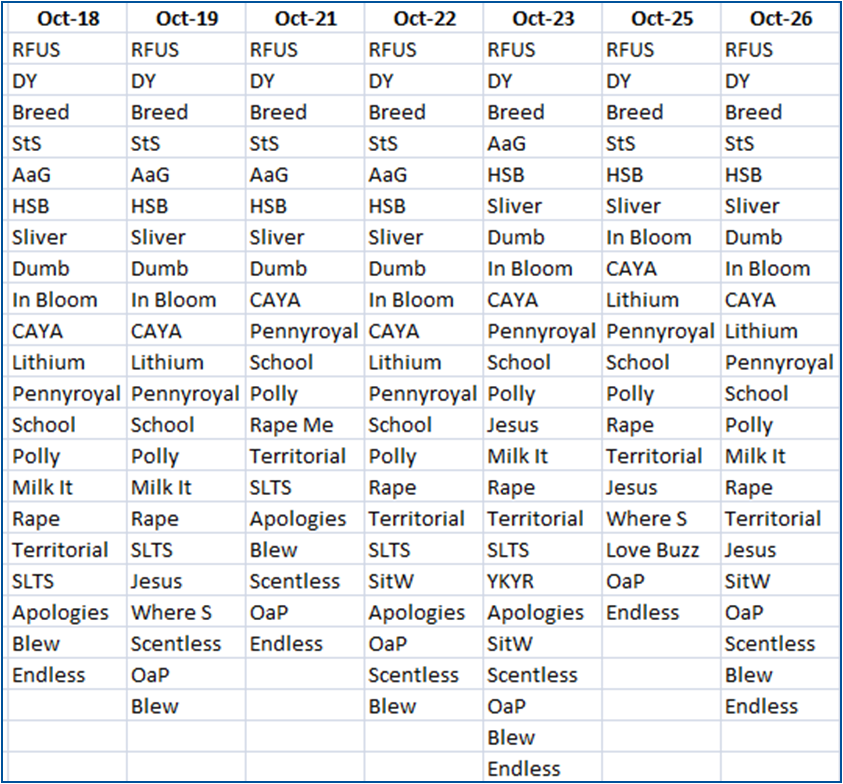
Alas, forecasting whether these two songs may have appeared again gets tricky. Firstly, we have to make the assumption that they were unveiled in the order they were thought of and choose whether we believe the first known appearances were indeed first. In the case of You Know You’re Right there is a partial set-list from four days previous. Comparing the October 19, 1993 set-list to those that come before and after, it’s identical to the previous day’s concert for sixteen songs in a row and to October 22 for fifteen. But it is visible that the set-lists are still flexing — the band skip or add in songs and are still unsure of the final order. If October 19 is indeed missing songs then it would make it as long as the Chicago show — how tantalising.

Most likely, however, the set-list is missing Endless Nameless and/or Territorial Pissings, maybe All Apologies, or there’s a chance of Something in the Way… And yes, there is a chance of You Know You’re Right but the set looks near complete to me; Scentless Apprentice, On a Plain and Blew were the regular finishers even if the order wasn’t settled.

What also dims my hope of seeing any further surprise appearances by You Know You’re Right is that there haven’t even been any rumours of the song making it on stage despite the second Chicago show missing a few songs; I can’t imagine the song’s arrival on record in 2002 wouldn’t have refreshed attendee memories from October 25 if it had been present. Again, it’s a show with multiple candidates to fill gaps (most likely Dumb, possibly Something in the Way):

Set_Oct 18-Oct 26 1993

The appearance of You Know You’re Right was so out of the ordinary, akin to the insertion of Love Buzz the next day, or Dive for one appearance on Halloween, or Sappy the next year, that there’s no way to use statistics to do anything other than show it was unlikely. The only nearby candidate where we’re missing a few songs is October 27 which is missing its conclusion, a supposedly “mostly acoustic encore”, which makes me think on that date we’re looking for Something in the Way, maybe Where did you Sleep Last Night plus some iteration of the Scentless Apprentice/Blew/On a Plain/Endless wrap up.

As an aside, looking at the rest of 1993, there’s an intriguing case on November 29, in a complete set-list, where the band derail a pretty solidly established set by not playing Smells Like Teen Spirit or Come as You Are; given Kurt stops the set just before they would normally be played, having already inserted About a Girl in a different location, it looks like punishing the audience for some of the behaviour that was seen that night.

Now then…How about the ‘unknown’ song…? Let’s see tomorrow.

Questioning the Naming of Incesticide

A month or so back Brett R. raised a point of which I confess I’d been utterly unaware; that the same year that Nirvana released Incesticide, JG Thirwell (A.K.A. Foetus) had curated a compilation called Mesomorph Enduros and contributed a song called…Incesticide.

Naturally, having written a book wrapped around the Incesticide album it was a jolt, in the most pleasant sense, to receive a question I hadn’t even known existed; did Kurt Cobain invent the title of Incesticide or was it a phrase fortuitously delivered into his hands? It’s a tricky question to find certainty on given Mr. Cobain’s absence, so I thought I’d take the direct path and simply try and ask Mr. Thirwell his thoughts. He very kindly responded:

JG Thirwell_7 Feb 2013_Incesticide

Sure you can read it but the core piece reads “I already had the title Incesticide before the Nirvana album came out — I just thought it up, but I think it isn’t so strange that two people would think of that play on the word. I didn’t assume that he stole it from me, I just thought it was a coincidence (despite the fact that our mutual pals the Melvins and Jesus Lizard are on the Mesomorph Enduros compilation, which I curated.) I don’t remember what month that album came out.” To summarise further therefore, yes, JG Thirwell had the word already…But though an intriguing coincidence there’s still no clue whether Kurt Cobain, or someone associated with the Nirvana release, appropriated the title or not.
Let’s make the case for it being Kurt Cobain’s own invention then argue the counter-factual. Firstly, the title is a very Cobainesque phrase, whimsical word play was a fairly regular amusement for the man concerned, check his Journals (i.e., “Billbored…Bowling Stoned…”) for other examples. Similarly hygiene/disinfectant imagery wasn’t uncommon (Bleach, Incesticide/Insecticide, “kept his body clean”, Stain, Beeswax) while the dysfunctional family vibe had a recurrent presence. On top of that, the title fitted perfectly as the title of Nirvana’s family of orphaned songs and as his sarcastic Christmas gift to the masses (See https://nirvana-legacy.com/2012/11/13/incesticide-kurt-cobain-gives-a-christmas-present/.) All these points support JG Thirwell’s surmising that it’s just one of life’s coincidences.

On the other hand, it’s an unusual coincidence, a very specific one too — two releases both given an obscure pun on Insecticide in the same six month period. JG Thirwell’s song was certainly out prior to the Nirvana release as he states clearly. Similarly, the fact that both Melvins and The Jesus Lizard were involved, at precisely the time that Nirvana were conversing with The Jesus Lizard about doing a split single, has a nagging quality yet, again, it doesn’t come with anything approaching proof of a connection. In some ways I’m pleased if Kurt Cobain did actively think “yes! That title is what I need here,” rather than just splurging something down onto paper on a whim one evening in a hotel suite. It would indicate a moment of inspiration, a word he deemed perfect and appealing for what he had in mind.

What makes it all most tricky is that Mesomorph Enduros was a U.K. release at the time — despite Nirvana’s brief visitation to the U.K. in August there’s no indication if record shopping played much part in the trip, there’s no indication at all Kurt had a copy. Similarly, tightening the noose, the compilation was dedicated in memory of Charlie Ondras, founder of and drummer with the band Unsane, who died on June 22, 1992 of a heroin overdose meaning the compilation couldn’t have been released until July/August at the earliest. Nirvana meanwhile sent out the initial press copies of Incesticide around November 11, 1992 (according to Carrie Borzillo-Vrenna’s rather excellent Kurt Cobain: The Nirvana Years) but there’s no indication if the release was still under its working titles (Filler, Throwaways.)
Plus, I get stuck on the point about open theft. Melody Maker’s report dated August 15, 1992 is readily available explaining Killing Joke had just decided to sue Nirvana for, allegedly, stealing part of their song Eighties for Come as you Are. Borrowing a name isn’t in the same category but I could still probably accept a subconscious theft more than a deliberate one; unless there was an element of tribute about it, a tipping of the hat in the same way as “daddy’s little girl ain’t a girl no more” is so blatant it seems more a cheeky wink than a steal from Mudhoney.

So, yes, I’ll stop speculating. Where we remain is that though Nirvana were looking up songs for what became Incesticide from summer 1992, there’s no way of knowing when they chose the title unless Dave or Krist are forthcoming on the subject. Similarly, there’s no way of seeing what made that title the final selection, or when. Isn’t it nice not have the world locked down and filed away neatly…?

Nirvana’s Legacy

The website name had stuck in the head in the couple days before I got round to having to pick one. There was something punchy about it and I can admit it might be a steal from the title of Mick Wall and Malcolm Dome’s book Nirvana: The Legacy. I found the idea of that book inspiring but the content barely moved me being little more than a rehash of band bios of the time, an insipid quick dash over the top of the musical landscape of 1994-1997. The question remains valid, however; what has been the legacy of Nirvana?

Many people argue that nothing changed, that many of the old names stuck around, that the indie revolution never happened as expected and the charts remained flooded with manufactured product. Certainly grunge was the last gasp of rock as simultaneously a mass market phenomenon and a vital creative force — just as jazz ceded its position to pop and rock, rock was succeeded by hip hop fuelled R n’ B. That doesn’t mean that there was no legacy for Nirvana, it simply means that the market and industry changed fundamentally and that legacy wasn’t the multi-million selling multi-band phenomenon/movement they were looking for.

There’s a legitimate argument to be made that the hype around ‘alternative’ music was a gamble made by major label record companies who, deceived by the success of a small coterie of bands, were under the mistaken impression that a substantial market existed for punk-inspired or derived bands and therefore plunged energy into promoting the idea of the ‘alternative nation’. What they’d overlooked was that the triumph of Nirvana, Hole, Soundgarden, Smashing Pumpkins and Pearl Jam was a victory for the bands possessing a sound close enough to existing mainstream rock to sell well. Most of the bands that made it onto majors simply weren’t even close to pop of the stadium-filling U2 et al. variety.

On the other hand, while acknowledging the points around the ‘death’ of rock, hype and compromise, I’d argue that the quest to find direct musical heirs has led to the tangible evidence of Nirvana’s influence being overlooked. Direct musical heirs are an exceedingly rare phenomenon; popular culture may echo but it rarely repeats. The greatest artists are so inimitable that those who do follow their template precisely are never anything more than pale copies; that’s the category into which the saleable but critically distained bands that followed the grunge ROCK template in the late nineties (i.e., Creed) fell into. The zeitgeist had moved on.

Usually what happens is a degree of inspiration, an element of the sound is taken. As an example, the successors to Jimi Hendrix were arguably the axe-worshipping legends Steve Vai and Joe Satriani — the fact that each of those artists moved in very different circles to Hendrix’s increasingly funk influenced last recordings and were more enamoured of his soloing side than his abilities with the brief quality pop mode, obscured the link. Guns n’ Roses meanwhile owed much to both the Rolling Stones and to Led Zeppelin while also tacking on aspects of punk. There are plenty of arguable relationships but in bands of top quality the relationship doesn’t mean cloning; even Oasis were never identical to their worn-on-sleeve influences.

So, when looking for the legacy of Nirvana, simply demanding a carbon copy is a quest bound only for disappointment. The influence of Nirvana is of a different quality. Firstly, the wave of which Nirvana was the foremost exponent, hard-wired punk into the DNA of every key rock band that has come since. The solo-worshipping, high-note-busting style of rock that dominated the Seventies and Eighties was wiped from the mainstream map. Instead the high-achieving rock bands have spanned from Green Day, to My Chemical Romance, through Limp Bizkit (yes), to Rage Against the Machine, Radiohead and even Muse. Unless you want to try and argue the case of novelty band The Darkness, there hasn’t been a truly successful band mimicking the hard rock sound in over two decades. What died altogether was hard rock, that combination of pop production and slickness with the metal-edged volume and bombast.
Secondly, Nirvana ushered in a new emotionally detailed vocabulary for mainstream rock stars; Nine Inch Nails and Smashing Pumpkins certainly showed that there was a trend toward focused depression at the time of which Nirvana, arguably, was a part. Now, in the form of (oft-maligned) Emo, and with significant credit going to Weezer and The Descendants, there’s a greater openness to expressions of male emotional pain, a broadening of expression. Again, it’s not that Nirvana deserve the sole-credit for this but they showed it had arrived.

Thirdly, the sexism departed from the guitar-led musical world. The leather trousers, groupies and uber-mensch look shuffled from centre stage — it’s now such an oddity it even receives a defined sub-genre label, Sleaze Rock, when in the Eighties the rock world was dominated by this form. While the punk world in general had an openness to counter-cultural currents — hence queercore, Riot Grrl, straightedge, outright Marxism and even Bad Brains’ spirituality could all coexist — it was Nirvana who stated openly, over and over again, how ridiculous and retarded the sexism of rock had become. Again, the alternative nation did birth something.

Fourth and finally, Nirvana showed that there was finally an infrastructure that could give underground bands a sustainable means of living. The much vaunted Eighties underground scene had died a death — a bare handful of bands lived through it intact simply because there weren’t enough venues, enough music sales, enough fans, enough coverage to sustain them. Sonic Youth have stated that one of the best things about Daydream Nation as an album was that it meant they could finally give up having day jobs.
The four shifts in rock music that occurred in the early-to-mid-nineties are underrated because they’re impossible to pin to a single instigator alone; it’s hard to say Nirvana were wholly responsible, of course they weren’t, they were simply a defining part and the most important figurehead signalling the shift. So, if one is looking for a musical legacy, one that isn’t a parody, or that wasn’t a broad social force, what’s left?

The answer struck me most forcibly over the past three months as I’ve corresponded with numerous individuals worldwide about the book, the blog, Nirvana, life in general. Kurt Cobain was pure punk in that he wasn’t a guitar-worshipper, the music was a way of channelling emotion, spirit, fire, energy — whatever you want to call it. Krist Novoselic said in his eulogy on April 10, 1994 “…if you’ve got a guitar and a lot of soul just bang something out and mean it. You’re the superstar. Plugged in the tones and rhythms that are uniquely and universally human: music. Heck… use your guitar as a drum, just catch the groove and let it flow out of your heart.” This could serve as a rallying cry for any part of the diversified rock-influenced world from the indie end of the spectrum out to the wildest noise or drone. There are a vast number of musicians working today, rarely the famous, who were simply inspired by Nirvana to try something new, different. They may not sound too much like Nirvana but how are they not the heirs to Nirvana when there’s such a joyful racket being made as a consequence of that band’s short fire?

Below is my copy of the Fuck Brett birthday LP courtesy of Feeding Tube Records — the eponymous Brett is a huge Nirvana fanatic and musical creator. On the shelf behind me is Nerd Table’s Chasing the Bronco CD, Adam Casto, leading light of the band, told me specifically that his way of creating something personally positive from the demise of Nirvana was to seek out every former member of Nirvana he could and try to collaborate with them; again, beautiful. A fellow called Adam Harding has shared a demo — you’ll have to wait and see — that wears his early Nineties alternative nation vibe loud and proud while taking it a step forward. There’s an artist I’m in touch with in Scotland, hi Marcus(!), with an intriguing Cobain-related project. I even heard from a member of Trampled by Turtles (http://trampledbyturtles.com/) the other day — so many Nirvana fans doing creative stuff, that’s the legacy. Heck, ever since Nirvana, and despite a complete lack of ability, I’ve always held up creative action as the highest form of human activity and life.

There’s a lot going on out there even if the media would prefer straight lines, clear quotes and family ties. Will there be another Nirvana? It’s hard to find likely candidates given the most crucial elements of Nirvana were unpredictability and a soul-deep amount of damage residing inside…But keep looking.

IMG-20130203-00092