Cobain’s Montage of Heck: the Home Recordings…Capital A Artist, not Major Label Act

DSC02651

This is 114 1/2 Pear Street. Kurt Cobain lived with Tracy Marander in one half of the house (the right as facing), then he moved into a small one room cabin at the rear.

Nirvana Tour Hits Olympia: Inside Kurt Cobain and Tracy Marander’s Former Home

Across the Montage of Heck soundtrack, Cobain strains his voice, never letting loose his full force or volume. Partly it’s because, over an acoustic rather than the roar of a full band practice, the sound would be too stark – it would overwhelm his playing. Yet also, in such a small living space, every sound could be heard and would be fully exposed. Instead, he marked later intentions, where his yells would go – a guide in place for when he could later let rip.

DSC02652

That’s where the brief intervention of ‘Scream’ stands as a neat juxtaposition. One of Cobain’s signature elements – his scream – is isolated and captured in this single, solitary moment, otherwise absent. And what a scream too. It further emphasizes the distinction between ‘domestic’ Cobain (non-screamer) and ‘public performance’ Cobain (screamer) which the Montage of Heck project has so neatly picked out. The differences between the persona of Cobain and the private individual.

The Kurt Cobain – Montage of Heck: the Home Recordings soundtrack ultimately felt no more intrusive or voyeuristic than scrabbling through a painter’s paint palette – the ‘voyeur’ comment is shown to be just another cliche tossed at every posthumous project, not just Cobain’s. These are all the elements of his songs, these are sound recordings with artistic intent behind them, they’re part of his art – they’re not chunks of CCTV footage recorded without Cobain’s awareness.

Cobain’s vocal work stands out on the record. Cobain said many a time that he came up with the music first – that extends to the vocals too. Something like ‘the Yodel Song’ shows him finding the sounds that fit the music long before he considers creating actual words. It’s like he’s writing a second song, first, the instrumental music, then the vocal melody – the rise-and-fall cadence showing where he might stretch for a note, where he might go from murmur to roar – then, finally, he converts those sounds into words/lines slaved to the initial tune. The music – meaning both the instrument and the vocal – is of far more significance than the words just as he always said.

The CD era did infinite harm to the coherence of albums with forty minute triumphs being replaced by forty minutes, plus filler, plus repetition, plus flabbiness – a seventy minute mainstream album is always at the limits of endurance. The soundtrack works for me because of the sheer variety therein; it neatly avoids the trap. Something still at the level of a first attempt or ad-lib, is replaced by a more developed instrumental, in turn passing to a song that’s reached the point of having a vocal line, then on to something that has made that next stage of having words too. The (brief) bursts of experiment are a neat contrast and, likewise, the spoken word pieces too maintain the uncertainty over “what comes next?” These interventions and deviations keep the surprise factor high throughout.

If they do come to do a Cobain ‘singer-songwriter’ record (which would seem a viable proposition) I hope they keep it down to 40-50 minutes. Anything over that consisting of song-follows-song-follows-song-follows-song would lack drama. The deviations within the soundtrack appeal and I can’t see how else one can really showcase the scale and variety of what Cobain was doing in a more polished record. Incidentally, whatever mixing was done, it sounds great – the sound is far crisper than I would have expected from cassette tapes originating in the damp north-west anywhere between 20-25 years ago.

The balancing act of ‘Rehash’ next to ‘You Can’t Change Me’ stands out for me. ‘Rehash’ features lines related to the typical bar band/cover band scene that dominated the Aberdeen/Grays Harbor area. What’s telling is that when Cobain barks “chorus!” it’s not a note for the future, it’s a deliberate lyric – he already has a chorus (i.e., “rehash!”) What he’s actually doing is parodying the local bands who just wanted to do impressions of Van Halen in a formulaic way hence ‘rehash’ and hence the lyrics “solo! Chorus!” – it’s the same point he made later with the title “verse chorus verse”, that there was a cookie-cutter song approach he felt was tedious.

On ‘You Can’t Change Me’ or ‘Been a Son’, by contrast, he really is making notes about the development of the song. Placing ‘Rehash’ and ‘You Can’t Change Me’ next to one another is a neat trick of arrangement as it calls out Cobain’s self-knowing comment on his way of creating songs. He’s using his approach to marking song structure to resolutely different effect.

‘Rehash’ fits into Cobain’s ’86-’88 spell of writing songs marking his disdain for aspects of his surroundings. This whole record is loaded with musical ‘ghosts’; they’re a real joy. A casual listener might wonder why Cobain kept all these random pieces, but the impression is reinforced that Cobain genuinely listened back to these pieces and cannibalised aspects that caught his ear and imagination. Again and again brief wisps of a later Nirvana song come through like hints at ‘Sliver’ and ‘Stay Away’ for instance. One can see that ‘She Only Lies’ acts as a potential origin point for the core riff in ‘Sappy’ while ‘Poison’s Gone’ bears markers that would later show up in the demos of ‘Old Age.’ It’s an indicator of Cobain’s deep listening, his ability to tease out a crucial motif and to turn off-the-cuff ideas into something deeper and more developed.

In other places a single line might point toward the future, for example in the way ‘You Can’t Change Me’ echoes the chorus of ‘Swap Meat’ or how the word ‘recess’ creeps in alongside ‘rehash’ and ‘rehearse’ before he explicitly smacks “smoke hash” down at the end of ‘Rehash’ to show he’s knowingly playing with the word and how it might sound in his mouth, working it over, chewing on it, trying it on for size. No wonder people thought he was mumbling or incoherent when sounds were so malleable to him.

There’s a further sense of him finding his voice by testing others in the way he did very explicitly on the ‘Fecal Matter’ demo. He’s regularly testing what he could do with his voice whether that’s through his story-telling tone, the voice he uses for poetry, the different singing styles he attempts. Behind the tale of the ‘lazy slacker’ there’s this deeply active guy working hard and thinking about where everything could go.

Outside of the overt tribute of ‘And I Love Her’, other points seem to show Cobain learning from songs that caught his eye. There’s an apparent snatch from Shocking Blue’s ‘Venus’ in the ‘Rehash’ riff for one (thank you Marcus.) The way snags from one or another place in Cobain’s work appear in fresh contexts also entertains, whether that means the “why is that so groovy?” line taken from ‘Spank Thru’; or the bullying scene from ‘Beans’ (on ‘With the Lights Out’) reappearing as a distinct (and extended) element here; or his fixation with using sped up tapes to create squeaky helium voices… For the first time I’ve realised this wasn’t just a one-off, this was an approach to creating new voices Cobain enjoyed – something fun and worth a smile.

Sub Pop refused to let Cobain break the mood of ‘Bleach’ by putting ‘Beans’ on. Yet that song meant enough to Cobain that he pushed them to include it – he didn’t fight for anything else to be a part of that record, he even let Sub Pop choose the order of songs. Similarly, Nirvana’s very first single ‘Love Buzz’/’Big Cheese’, a first chance that he absolutely needed not to screw up…But he insisted on splicing pieces of his ‘Montage of Heck’ into the recording. That’s how key these playful elements were to him – he wanted them slammed right into the art of his first releases.

Cobain vented dissatisfaction with ‘Bleach’, most overtly with ‘Nevermind’, with ‘In Utero’ too (he told Azerrad he felt the record was barely different from ‘Nevermind’) – he was never wholly pleased with any of them because, ultimately, there was always a gap between his desires and his politeness. ‘Montage of Heck’ demonstrates the other Cobain that was always there in the background agitating for squeaky toys to be added to songs, for randomness to replace the grind of regularity, responsibility and compromise. I think he’d have loved this release for boldly stepping away from the expected, the norm, the tedious professionalism that left him cold again and again. This was who Cobain was when he was alone and who, in his own telling, he would have liked to have had the bravery to be in public with no apologies, no politeness, no pulling his punches at the last minute as he often did.

I heard some f***tard say something about “if this was any old eighteen year old and not Cobain we wouldn’t care about this.” Well, any child under the age of six months looks pretty much like any other kid and has no massive distinguishing characteristics – but a parent/sibling is still entitled to love THEIR child more than that of a friend or random stranger. Yes, I care about this recording because it’s Kurt Cobain and because that’s someone, a music, a topic, I care about. There’s no apology to be made for that and the denigration is meaningless. Origin matters.

Krist Novoselic, in his eulogy to Cobain, stated “Kurt had an ethic towards his fans that was rooted in the punk rock way of thinking. No band is special, no player royalty. But if you’ve got a guitar and a lot of soul just bang something out and mean it. You’re the superstar.” I remembered those lines a lot while listening to this record.

Do you need another Eighties’ vintage hard rock/hair metal demi-god or 2000s commercial hip hop bling merchant lauding it over you? Do you want to believe that great achievement only comes from the mythical 1% of magic geniuses who we should feel lucky are willing to share their gifts with we lucky mortals? I don’t. When I look at Cobain I see a mortal with few chances in life who worked hard, took chances, made something happen. I had hoped he’d killed the rock star image dead but it was resurrected in new form to reinforce the divide between creators and consumers.

That’s another element missing from critiques of the record. I’ll talk later sometime about the obvious criticisms that can be made of the commercial approach of the record label to this release, but in essence this isn’t anyone else’s work, this is Cobain. We’ve had the rock star major label Cobain image; the martyr Cobain image; now here’s a Cobain previously unseen – and some people are uncomfortable realising that they don’t like the person they see. The whimsical, DIY, ad-libbed, in development, noise-addicted, poetic Cobain. It’s amazing it’s taken twenty years to finally meet this guy on record – “hello Kurt, nice to meet ya.”

If I heard an 18 year old who could put something this intricate together – I’d be impressed and I’d encourage them to keep going, to keep ignoring the haters and those with nothing but spite to share. Cobain took the base metals present on this release and shaped them into gold through persistence and experimentation. Anyone could do this – and that feels great. That’s alchemy – and it’s a magic open to anyone who wants it.
My Ever Long-Winded Thoughts on Kurt Cobain – Montage of Heck: the Home Recordings

Tape Me: Re-Considering Kurt Cobain’s Montage of Heck

I’ll have more to say next week but this is a starting point. I’ll confess I’ve found the snarky remarks of various music sites a true yawn populated with the endlessly repetitious cliches that always emerge when a posthumous recording is released. The simple truth, ultimately, is that there’s no way any post-death recording will live up to the hopes and dreams of fans; will compare to the finest moments in an artist’s back catalogue; will provide comfortable certainty over an artist’s intentions.

I would say two things; I think Brett Morgen has made a very valid audio accompaniment to the film. His thinking is clearly in visual/live action terms – that this is a day hanging out with Kurt Cobain in his apartment in Olympia somewhere between early 1987 and mid-1991 – and it’s that picture in one’s head that matters, not audio fidelity, not song development, not whether anything here should be part of one’s essential Cobain playlist. Most of what a musician or artist does on the road to a classic is inessential – if you just want the ‘finest’, then cool, go buy the greatest hits and skim the main albums then go listen to something else. This release is about an honest portrait of an unpressured day in the company of someone who created for the hell of it, constantly and regularly.

The second thing, however, is that Morgen has quite clearly been left to act as the fall-guy for decisions taken elsewhere. There’s no way this should have been promoted as ’31 tracks’ – even if strictly accurate – given most of the pieces here are interludes and mood-adding sound effects. I’ve never gone with the eternally tedious “oh everything a record label does is wrong!” position but on this occasion there have been clear failings.

The proliferation of approaches led to over-complexity which has disappointed and upset supporters of the release (including myself.) Some cities got to experience the (genuinely great) cinematic experience while many didn’t – OK, I could live with that, it happens. Then the U.S. TV showing meant that region has waited months for the DVD while Europe, on the other hand, got the DVD months ago but will have to pay again to get the extras which will now emerge on the U.S. edition – I’m less chuffed with that but, OK, whatever, I don’t watch extras more than once…

But the soundtrack announcements were abysmal. As recently as this week I received an email from a fan still confused over what music was available on which of the five formats emerging (double LP, cassette, deluxe CD, standard CD, digital download) and whether he could even buy the 31 track release in his country. A failure to simplify the global message, to ensure clarity, has spread confusion and made fans less willing to view the soundtrack kindly. For at least a fortnight I had no idea what I was going to have to do in order to ensure I got all the music. The communication was pathetic.

Similarly, there’s obviously been a kneejerk decision “it’s Kurt Cobain – that means Uber-Treatment!” An automatic decision to load up formats and approaches when there’s no way a collage of this nature requires or deserves it. What Morgen seems to have handed to the record label was a 31 track continuous experience, a sound collage mimicking Cobain’s own penchant for mashing up sounds and material, and what the record label has done is artificially slice it into a ‘non-deluxe’ release which makes no sense, has no artistic validity, has no rational reason for being – then a ‘super-deluxe’ that is hugely redundant, loaded with ephemera, provides nothing extra for its egregious price.

As an addendum; again, I’m not someone who sympathises much with whinging about price. Most music releases cost no more than a few cups of coffee. I believe the creativity of individuals is worth money – just as any individual’s daily labours lead to a wage. Musicians are among the people most likely to end up without medical coverage, without retirement funds, without savings and without stable employment – yet a world without their efforts would be a dreary, sad and feeble one. They deserve support far above ‘electronic tips’ or a demand that their efforts should only exist as a sideline to “a real job.” Musicians do far more than most jobs out there to make life better and more livable – that should be recognised.

…In this case though, the division of the record into three price points – standard, deluxe, super-deluxe – makes absolutely no sense. It’s the only time I’ve agreed with the view that exploitation is occurring in the Nirvana release schedule. It would also have helped if someone said “this is NOT a singer-songwriter album!” before all those who think ‘lo-fi’ means Ed Sheeran got involved.

Brett Morgen’s audio vision should have been allowed to exist as a single artistic vision – released months ago – and appreciated for it’s own whimsical pleasures. I think what’s he’s done is valid, is in line with Cobain’s visions and desires (look at the cut-up nature of Live! Tonight! Sold Out! as well as the ‘Montage of Heck’ collage for a sense of how much Cobain enjoyed splicing things together), is great fun…And I feel Morgen has been let down and left to swing.

No Evidence: The Ongoing Career of Kurt Cobain and Nirvana

Uncertainty is a beautiful thing. Legends are created not through predictability, but through blank white space into which a reader/viewer/fan can inject wish fulfillment, a gap in knowledge allowing fans to participate and have some degree of ownership over the question of ‘what might have been?’

It’s hard, after twenty years of sainthood, to rewind the clock to ’94 and realise that there’s nothing in the Nirvana story making Cobain’s ‘legend’ status inevitable. That isn’t to say that it wouldn’t/couldn’t have happened without his death – but there’s fair reason to suggest that untimely death was crucial.

Firstly, the commercial picture. Remember the premier bands of the early-to-mid-Nineties? Pearl Jam, while garnering more respect than they acquired back in the day, haven’t had a multi-platinum album in the U.S. since 1994’s Vitalogy. Soundgarden’s multi-platinum sales  for Badmotorfinger and Superunknown stalled in 1996. Stone Temple Pilots’ Purple (1994), Hole’s Live Through This (1994), Alice in Chains Jar of Flies (1994) Smashing Pumpkins Mellon Collie and the Infinite Sadness (1995) – the heyday of the grunge/alternative bands ended not long after Cobain’s death. The torch passed to a new generation, bands like Green Day – Red Hot Chili Peppers are the only other enduring success story.

The question is whether Cobain’s death played a role in the deflation of the enthusiasm around the ‘alternative nation’ or whether it would have ended anyway. That’s open to debate. Most musical movements, however, barely last half a decade before losing the masses. Tastes change. The ‘cult of the new’ demands something fresh.

Secondly, in terms of musical trends, Nirvana’s rise was the final act not only of punk but of the dominance of the guitar in popular music. Rock n’ Roll had overtaken Jazz as the world’s premier musical form sometime in the early Sixties just as Jazz had usurped Classical. The mid-Nineties saw Hip Hop become the world’s most crucial and effervescent creative form. In terms of commercial success, global presence, artistic influence – Hip Hop superseded rock music. Rock is now where Jazz was in 1970 – full of life, new twists and strains springing up, but no longer visible to mass audiences. Nirvana may have survived as one of the world’s biggest ROCK acts – but one of the world’s most important creative entities? Nope.

Thirdly, the rise of the Internet shattered the music industry. Numerous critically respected rock acts passed back to indie labels as part of a mass clear-out in the early 2000s. Most of the rest didn’t renew their contracts or weren’t given the choice of staying with a major label. That isn’t as important as it used to be but sales are no longer what they were for most artists. Measurements of ‘career longevity’ show that bands aren’t surviving as long, aren’t staying in the spotlight as long. Everyone is smaller even if the smothering of social media, Instagram, Twitter, whatever with certain attention seekers makes some characters seem bigger than they really are in terms of commercial power.

That brings us to Nirvana as an entity – there’s very little indication whether Nirvana would endure. The opposite is true also, there’s no indication that Nirvana was definitely over. Everything happened too fast in 1994 for any final conclusion to be drawn. In many ways ’94 was a repeat of ’92 with tour cancellations, overdoses, Cobain vanishing from the public eye, future plans in the calendar but no certainty, casual studio visits but no big intentions. With that in mind it’s impossible to say whether, with Cobain’s survival, there may have been a new Nirvana album in 1995, 1996, 1997 – or whether Nirvana were done and the era of Foo Fighters was about to begin.

In terms of Cobain’s album-ready material, by his own admission the cupboard was threadbare. Most finished studio works had been released or long abandoned. That doesn’t mean there might not have been some revivals – half of In Utero was filled with songs from before Nevermind – but there’s no indication of him feeling much affection or use for songs like ‘Old Age’ (given away), ‘Sappy’ (already released in ’93), ‘Clean Up Before She Comes’ (abandoned in the late Eighties and never attempted in studio.) His new material in ’93-’94, true songs as opposed to jams like ‘The Other Improv’, consisted of two tracks; ‘Do Re Mi’ and ‘You Know You’re Right’. It doesn’t mean he was done, Cobain was fully capable of writing songs at speed – but he would have been starting almost from scratch. Attempts to fill imaginary tracklistings with old leftovers are fun but fly in the face of the care and attention Cobain paid to the music he put out – who knows?

As for direction; it’s a mystery. Acoustic? Vague statements and a home demo of ‘Do Re Mi’ provide little support for that idea. The opportunity to work with members of R.E.M. also doesn’t suggest an acoustic route given R.E.M. were busy working on ‘Monster’ – one of their most amped-up records (heck, it even had room for Thurston Moore to bust electric on it.) Electric? Well, ‘You Know You’re Right’ was Nirvana-by-numbers (though cool!), messing around with new effects boxes earlier in ’93, all the jams and noisy tracks created in late ’92/early ’93 – it could all suggest Cobain’s sound heading back toward the heavier sounds of pre-pop Nirvana…Or it could be nothing. Preparation for a new album was already well behind:

The Path to an Album Part One

The Path to an Album Part Two

And that’s the reality of it all. A 48 year old Kurt Cobain would not be the zeitgeist owning figure of the mainstream that he was briefly in ’92-’93. That ground, in 2015, would still be owned by Kayne West, Young Thug, Nikki Minaj and others. The likelihood is the path of Nirvana would have followed that of all the other multi-million sellers of the early Nineties – there’s no reason for Nirvana to be the one band immune to the shifts in music culture and commerce. That doesn’t mean that a fully functioning Cobain wouldn’t have continued as an effective underground force…

…And that’s where the fun is. Anyone can choose whether they feel Cobain in 2000, 2000, 2015, would have been a strung-out yet occasionally great Johnny Thunders figure; or an eternally productive and collaborative Thurston Moore; or a forgotten death in a squalid room like Layne Staley; or just a respected circuit player like Mark Arm or Eddie Vedder.

Second Child, Nirvana, End of Tour Days and the Rock Scene in New Zealand 1992

Rather like this video – neat concept. I noticed that Damien Binder of Second Child is working on his next album – he’s a really nice bloke so wanted to share the crowd-sourcing link given the target is only $3,000 and he’s two-thirds of the way. It’d be great to smash it plus I fancy a copy of the record so this is entirely selfishly motivated(!)

http://www.pozible.com/project/198232

You’ve not heard of Second Child? Ah! Well, Nirvana’s support on February 9, 1992 at the Logan Campbell Centre in Auckland, New Zealand. I dug back into my transcripts from the “I Found My Friends” book to pull out some of the material from Damien about Second Child, the Nirvana show, his life n’ times…

“Chris Van de Geer and Luke Casey had the name Second Child originally when I joined in 1987. Luke and I were still at school at the time and one day he told me about some guys he was jamming with in Titirangi (outer western suburb of Auckland) and that they were looking for a singer. I turned up to meet some pretty serious Goths (Chris and his friend Paul who played bass) who were friendly enough. I couldn’t sing to save myself at the time but the rest of the band took me on because apparently I was into it and had the right attitude. I was lucky they were open to me given my skills but then again they were into the punk ethics of DIY with a ‘there are no rules/teach yourself/untrained is best’ mentality so I was in. I was bursting to perform and express myself and these guys were happy to let me do it. Besides one else wanted to be the front man so it worked out.

On reflection the name Second Child fit well though we thought of changing it a few times. Chris and I were both middle children in our families, and despite it not being a conscious thing, the concept of middle child/second child syndrome was something we evidently related to. It stuck and we grew into it I guess.

By 1990 we were a strong part of the punk/alternative scene in NZ but this scene was not large by any means and we often struggled to find places to play. Sometimes we would organise our own gigs with other bands at local community centres/halls. For a time I worked at a famous Auckland venue called the Gluepot and that connection helped us set up gigs for Second Child. Once for a short period, management paid us $300 dollars for a Thursday night provided we brought in an audience. This was amazing to us as we rarely if ever got paid. Around then a terrific guy called Kirk Gee started to manage us. He had been to a few of our shows and really liked what we did. He worked as a writer among other things at Rip it Up magazine, which was the local monthly rock bible in those days.

Murray Cammick ran the magazine and also had his own record label called Wildside. Murray was something of a local legend in the NZ music industry. He’s a more than slightly eccentric fellow, but a good guy and a real hardcore music fan. I remember he was always trying to get me to listen to Otis Redding at every opportunity. Kirk talked us up to Murray a lot and convinced him to sign us (though we never signed anything). I realise now how important it was to have someone like Kirk in our corner. True believers in what you do make a big difference especially if they are connected! I think he secretly financed a tour we did once, driving us in a van around the North Island of NZ. I guess we thought the label was paying for the tour (or more likely didn’t think about it at all) but when we found out this was not the case and confronted him he wouldn’t take a dollar from us. In 91 we ended up putting out our first album ‘Magnet” through Wildside.

There wasn’t any major radio behind the band at that time except for BFM (college radio equivalent). One of the DJ’s there, Simon Coffey helped get us gigs with other bands early on while Lisa Van de Arde, who hosted a NZ only content show on B called ‘Freak The Sheep’, was a fervent supporter and got us airplay and interviews which helped a lot.

Elsewhere there was self-released underground press like Stamp magazine. We had a fan in Stamp’s editor Jonathan King and also in John Russell who wrote for various underground music zines and later, for Rip it Up.  Both championed Second Child, through writing reviews and features. In the process, while being valuable allies they would also become good friends. Jonathan in particular was a strong force in our development. He would later go on to direct nearly all of the bands videos as well as videos for my solo records.

When “Magnet” (7 song EP) came out it was only on vinyl in a very limited pressing. We didn’t exactly set the charts on fire but we drew well live and we had some memorable shows around its release. Musically we changed quite a bit afterward. I think we had been a little uptight, as you are naturally when you are finding yourself, so gradually we loosened up a little. After it’s release we started listening to different music and inevitably different influences crept in. Our line up at the time of the Nirvana show was Chris (guitar), Theo Jackson (who had recently replaced Barbara Morgan on bass after she left), Jules Barnett on drums and me (vocals and guitar).

Later we would have a variety of drummers. Luke Casey even came back to play on a few recording sessions before we settled around 95 on Ben Lythberg who would play on our first full length album “Slinky.” Ben was a really laid-back relaxed guy and an unfussy yet powerful and tight drummer…Beside finding new members Chris and I had started to get into more melodic guitar music starting with Husker Du/Bob Mould and SST bands through to The Pixies, Sub Pop label bands, Afghan Whigs and early REM to name a few. I got turned on to Dylan in a big way (better late than never!) around this period too so our tastes changed and we became interested in more formal rock songs with choruses etc rather than the 8min-never-repeating-the-same-part-twice epics that we had become known for.

Looney Tours were the company who brought Nirvana out and the Logan Campbell Centre held about 2,000 people. We used to call it the Logan Concrete Centre because it sounded like shit in there — not exactly known for its warm acoustics. The Powerstation where I believe the gig was originally to be staged was a much better, more intimate venue. It could hold 800-1,000 at most.

At their sound check, which we were present for, I recall Kurt said, “I want cd quality sound” over the mic to the sound person. He seemed a little annoyed at what he was hearing back through the monitors. I don’t recall much, if any interaction with them. It lingered with with me that he/they seemed rather sullen and exhausted and played that way too. Their performance was workman-like but lacking any great enthusiasm. As I said they looked like they weren’t that thrilled to be there. Jules Barnett recalls “Nirvana opened with Negative Creep, Kurt walked out onto the stage, slung his guitar on and said “Hello…this is a song off our first album, which you can buy at Really Groovy Records “[sic]. Their set was okay enough, however not very energetic…Krist jumped around in his bare feet while Kurt was much more subdued. ‘Smells like Teen Spirit’ was right near the end — if not an encore- and got the most rapturous applause during the opening chords.”

I don’t remember even seeing them much before and definitely not after. They kept pretty much to themselves.

Chris (guitar) recalls ”We didn’t get to meet or hang out with them, we watched sound check and yeah, they were pretty subdued and exhausted I think the NZ show was on the tail end of their tour, they had basically just blown up in NZ with Teen Spirit crossing over to being number 1.”

We were possibly the last stop in nowheresville that they had to be before going home so I think they did 1 or 2 songs as an encore and got the hell out of there. Kurt especially looked tired and depleted. A friend told me he visited Real Groovy Records (a once famous Auckland record store) either the day prior or after the gig and bought a copy of a record by the NZ band The Axemen.

As far as our performance I thought we went down really well. It was the first time Second Child had played together on a stage of that size and it was slightly strange being that far away from each other compared to tiny stages that barely fit the drums, let alone the band that we were used to. We were accustomed to having the audience in our faces but after I met some people who said they were blown away by us. It was certainly a thrill however to be in front of that many people and I felt pretty at ease with it after a few songs.

I learned a valuable lesson that night. Don’t ever, if you are supporting a big band, say this is our last song! I think that got us the biggest cheer. I in turn promptly told the crowd the fuck off, serious young man that I was. I hadn’t yet developed my inimitable stage banter at that stage it seems!

A somber finale song, a track in support of the Red Cross Japan tsunami appeal:

A Chat with Buzz and Dale: Interviewing the Melvins

Scum Down Heavy: The Melvins interviewed

A straight-forward, to-the-point, pleasant pair of guys with whom to spend thirty minutes sat round a dictaphone.

Also wanted to share my review of Adam Golebiewski’s “Pool North” record, it’s what I’ve been listening to a lot recently.

Adam Golebiewski – Pool North

Cause for Celebration: Montage of Heck’s Trove of Unreleased Cobain

http://www.alternativenation.net/review-kurt-cobain-album-raw-hits/

Kudos and acknowledgment to Osty and to LiveNirvana for the early review AND for LN always being the best source of Nirvana news and information. A true legacy that site.

I think it’s fair to say that Montage of Heck has been a treasure trove for Nirvana fans. The film contained intriguing interviews with individuals who have rarely spoken extensively in public about Cobain, it contained substantial quantities of home movie footage either self-recorded or recorded by those around him, it gave a fresh experience of large amounts of Cobain art work, displayed a significant amount of Cobain audio recordings whether spoken word or musical – I mean, what a great year 2015 has been! The book, again, allowed an opportunity to read and consider the interviews from the film in greater depth and at leisure – it’s a valuable release – and the art work was worth looking at. As experiences, the cinema showing of Montage of Heck was really slamming – the volume, the sound quality, I loved it, it’s as close as I can imagine coming to seeing Nirvana in their heyday playing live, I found the sound that good. Similarly, being at home, watching Montage of Heck on DVD – brill, contemplative, varied, a full range of experiences at work. This is worth celebrating!

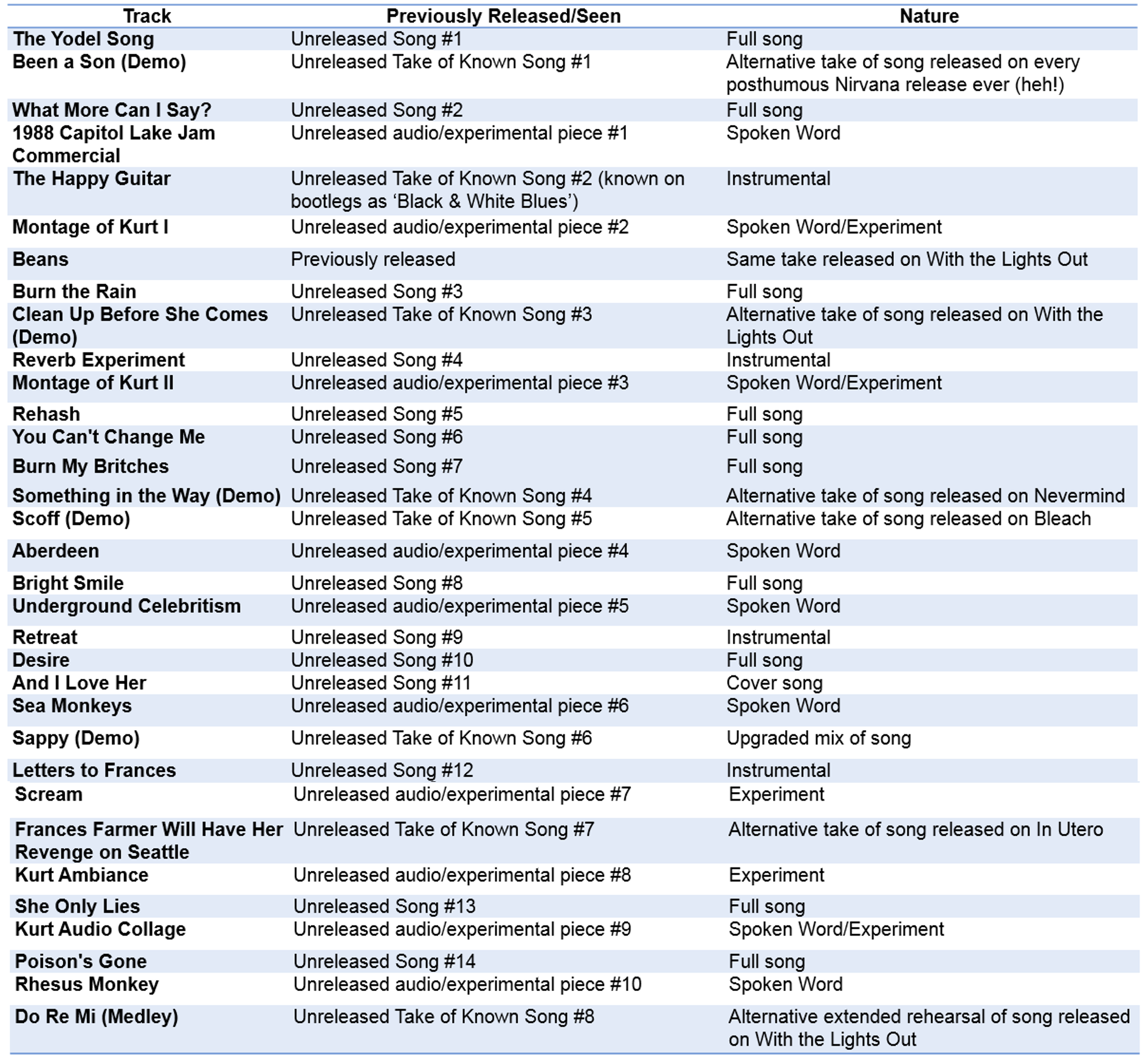
And now, in just a few weeks, we’ll be seeing the full Montage of Heck soundtrack release. S’ok if I just say “woohoo!!!” Leaving aside the not so super ‘Super Deluxe’ release which I think I griped about sufficiently last week, I think it’s fair to say that the soundtrack release is looking really great. Here’s the 31 tracks of Cobain compositions emerging:

Picture1

So, let’s do the numbers – because this is the biggest release of previously unknown Cobain originals since his death in 1994. That’s how significant this release is. With the Lights Out contained 25 songs that hadn’t previously been officially released in any other form of which 8 were covers (Heartbreaker, White Lace and Strange, Moby Dick, They Hung Him on a Cross, Grey Goose, Ain’t it a Shame, Immigrant Song, Seasons in the Sun) but – even more significantly, 13 had been seen on bootlegs (Anorexorcist, Help Me I’m Hungry, If You Must, Pen Cap Chew, Raunchola, Beans, Don’t Want it All, Clean Up Before She Comes, Blandest, Token Eastern Song, Opinion, Verse Chorus Verse, Talk to Me) leaving just 4 songs (Mrs Butterworth, Old Age, The Other Improv, Do Re Mi) that hadn’t previously emerged prior to the official release.

The Montage of Heck soundtrack contains no fewer than 14 unreleased songs of which only one – the Happy Guitar – has been previously bootlegged. This is awesome. We’re 21 years after the death of Kurt Cobain and there’s this kind of quantity of genuinely unheard material emerging? Brilliant. A massive result.

Also, it’s always been under-appreciated that Cobain wasn’t just a song-smith, the guy had a genuine interest in the potential for sound creation with the limited means available to him as a dirt-poor unemployed guy in the Northwest. The ‘experimental pieces’ see him manipulating and testing the limits of his guitar, his voice, the effects he could access, his enjoyment of seguing together audio clips and snippets. Cobain was more than a guy whacking chords together into pop song structures. Whimsical though his efforts may have been, at least in the late Eighties, he was playing around and experimenting and the soundtrack makes a genuine effort to account for that with a number of these efforts – I admit I’m pleased, as a bit of a noise freak I’ve always wished there was more official record of Cobain’s freak-out moments.

The presence of audio clips of Cobain speaking to tape is also intriguing. It’s often forgotten that Cobain had a literary side, that his lyric-writing was – in his eyes – often a by-product derived from his poetry writing rather than singing being the first priority. The ‘Aberdeen’ clip has raised controversy given the likelihood that it’s fictitious or massively exaggerated but, regardless, it shows Cobain practicing his story-telling abilities, his interest in telling a tale. He’s been notorious for a long while for his willful inventions during interviews – this is akin to that aspect of his character. There’s an unfortunate tendency to hammer singer-songwriters with the need to be ‘true’ in their words, rather than appreciating their right and ability to inhabit other characters, write through other eyes, tell tales just as thoroughly as Hollywood or the great American authors. These audio clips may not elevate Cobain into those ranks, but it does indicate his striving for artistic expression – an expansion of how Cobain should be considered. The 10 audio/experimental pieces really do deserve to be here.

And that’s what I love about the Montage of Heck soundtrack. In conception, yes, it hangs together as a collage of sound material – an obvious intention well-performed. Secondly, it’s a richly varied approach to Cobain’s works which does so much more than just demand he adhere to verse-chorus-verse songwriting – thank God! Finally an open-minded attempt to show Cobain as a guy with an expansive taste and creative muse encompassing a full range of different outputs. Thirdly, hoping for vast wealth remaining in the vault has been looking ever less likely year-by-year…To be suddenly shown that YES! There is something approximating the hopes of the early 2000s, it gives me enthusiasm for the future of Nirvana/Cobain releases, that there might be more to come over the next decade.

As for the eight ‘known songs’, let’s look again and remember that ‘the Happy Guitar’ and the version of ‘Sappy’ are nice to have in improved quality (and not just on bootleg), that ‘Do Re Mi’ and ‘Clean Up Before She Comes’ are rarities in and of themselves and great to see more of. When this project was first mooted all I imagined we’d see – and this is only a year ago, less in fact – was home demos of known Nirvana songs. That would have satisfied me. To see so much other material – wow, beyond my dreams. I’m looking forward to hearing the four demos of major songs (Been a Son, Scoff, Frances Farmer, Something in the Way). OK, I could do without Beans but it seems that part of Beans is used as a motif in another collage – plus the context, blending Cobain’s serious and humorous homework, makes some sense of the tracks inclusion and what the hey! It’s brief! I’m good with it.

(EDIT: 1am, Tuesday 20 October. Brett Morgen has confirmed that this is in fact an entirely different source of ‘Beans’ to that used on With the Lights Out. I’d like to acknowledge this and apologise to readers and to Mr. Morgen for the inaccuracy on my part.)

Finally, quality. All I can say is “what do you want to hear?” Cobain seems to have had a very shrewd understanding of his own works; it’s why the band were able to release three albums and one compilation in his lifetime with barely an ounce of filler – he knew what his best efforts were in the context of whatever he was trying to do at the time. If all you want to hear are studio-readied, mainstream-ready recordings…Then go listen to the albums released 1989-1993. If you want to hear his also-rans, then check the singles, check With the Lights Out for a fair summation of what Cobain deemed his ‘second string’ songs. If you want to hear the stuff he deemed incomplete or abandoned, then there’s a lot of that now floating about. Here we have a young guy sat at home trying things out, seeing how they feel. We have no way of knowing if he might ever have returned to any of this – just instincts and vibes and impressions of how complete or otherwise something sounds. I enjoy that space of imagining, where there’s no proof, we just see how we feel in absence of categorical truth.

31 tracks of Montage of Heck? Bring it on. Autumn is here and a few nights with this on the stereo sounds just fine with me.

Montage of Heck: Beginning to Skirt the Borders of Exploitation…?

Archive releases exist between two opposing poles. Firstly, by their nature, they’re not about quality.They’re leftovers and unfinished material – they’re never going to be what was intended to be released until an artist makes a later decision to monetise them. Secondly, unfortunately, sometimes a curatorial desire does seep in – suddenly, while raking through the material, someone decides to be more cautious, to pick material that can be deemed to have a certain degree of quality. The best of the leftovers, the most finished material, the most original material – other urges creep into an exercise in completism.

In the case of “Montage of Heck”, I’ve actually been a pretty big supporter of the work. Brett Morgen took the material that exists in Cobain’s archive and made a film about families. He ignored most footage of Nirvana playing or interviewing except for use in the rapid-fire montages, he made a good decision to consider the career of Nirvana known territory and therefore background to what he was doing. I also thought the ‘layered’ nature of the campaign – cinema experience, book, DVD, soundtrack release – made absolute sense with each format being a legitimate facet of the project.

So, why am I wincing a little? OK, you can buy the DVD or Blu-ray for $22.50 on Amazon.com. You can buy the book for $23.37. The vinyl is $29.99. The initial pricing of the Super-Deluxe package at $150 dollars for the whole lot isn’t wildly outside of the ballpark. But…Really? I’m not sure about you but I don’t buy Blu-ray because I don’t watch enough TV to bother with yet another format – especially to watch a film made up of 1970s home movie footage and talking heads. And if I did buy Blu-ray, then why would I also want the DVD if I’d deemed it an obsolete format? Getting both together doesn’t interest me so all that does is the music and the extras. Let’s focus on them.

Let’s be blunt, this isn’t about art. The idea of turning Cobain’s artwork into a puzzle isn’t illegitimate, but it’s a novelty item – and I try to avoid anything that reeks of novelty when it comes to Nirvana and Cobain whether that means drinks coasters, posters, dolls, a ‘collectible storage container’, postcards, bookmarks…Oh, in other words most everything coming with the boxset. No harm in any of it but I’m pretty sure this is still about the music so that’s what matters. I considered the magnet on the front of the ‘In Utero’ Super-Deluxe a waste of time too incidentally. Fun but very what the heck.

I’ve purchased the Super-Deluxe of both ‘Nevermind’ and ‘In Utero’ without the slightest quibble – why? Because I felt I was getting both music and content. The books accompanying each were interesting and well-done and upped what I was willing to pay slightly. But acquiring the CD and DVD of the respective live shows was the key factor for me, however. I don’t watch TV much as I said so the DVDs were once-a-year viewing, the CD a lot more. Here, there’s a DVD I’ve already seen.

But there are 48 minutes of extras…But the film is already too long. It’s the chief flaw, just my feeling, that even I was getting restless in my seat and I’m a fanatic – and who else is going to buy this other than fanatics? So they’re touching the right audience, but as I’m audio-orientated, book-orientated, not film-orientated or art-orientated, getting more of the film doesn’t enthrall me unless they mean its 48 minutes of Cobain recording himself playing music. In which case…

…In which case, my only issue with the ‘With the Lights Out’ box-set? I’m sad that the DVD component didn’t come with a matching CD. I’d like to have heard some of that material just as audio. It’s a minor complaint – it was a good box-set. So, in this case, if there’s musically interesting material amid the DVD extras then I already feel a degree of annoyance having to pick through whatever else is on there – and having to boot up DVD player and TV – just to find it.

Which brings everything back to the music. I am truly excited to hear the 31 track release – end of story. No quibbles. No doubts. No whining! I wanna hear it! I’ll buy it! I said right back months ago that I was all set to buy tickets for the film (done!), buy the DVD (done!), buy the book (done!) and buy the soundtrack (not yet!) I was very happy to exchange a rather insignificant quantity of money, over several months, to experience a range of settings. The film was worth seeing at a cinema – Morgen was right to set the volume levels as he did, it really added to the ferocity of it all. The film was worth seeing on DVD – the film does bear repeated viewing.

The book, to be honest, didn’t do much for me. It wasn’t a poor product, no issue there at all, if you don’t have it it IS worth checking out for the interviews with people who don’t normally speak – plus the focused nature of the book. Artistically, hate to say it, but though I think Morgen’s team did amazing work with the visuals in the film I’d have been slightly more interested in more of Cobain’s unseen artwork and so forth. But that’s a minor quibble – I’m not very visual anyway.

The suggestion that the Super-Deluxe would be the only place one could acquire the full 31 tracks was genuinely upsetting. The idea of forcing people to purchase the DVD – that they would most likely already possess – in order to get at it was very wrong. With the ‘Nevermind’ and ‘In Utero’ super-deluxe sets one was always getting more for one’s money but the most crucial new audio was available more conveniently. It seemed a guaranteed way to force people to download illegally. It seems that statement isn’t entirely true – which is positive.

The cassette. Ho hum. I buy cassettes. I’m buying a few things from Blank Editions at the moment (http://www.blankeditions.com/), when it comes to new music I find the cassette a very valid format. But if it’s available on CD or vinyl then I’ll just buy it that way. Having to get out my grandfather’s ol’ cassette player is pesky. I’d have bought the Super-Deluxe if the cassette contained anything not on the other formats – I’d have considered some kind of collage blending of elements from the film a legitimate ‘Super-Deluxe Only’ release that was both reasonable and worth finding.

So, ultimately, unlike the previous super-deluxe boxes, for the first time, I’m thinking I’ll only buy the 31 track edition of the music. I’ve got the DVD, I don’t want to buy it a second time. I don’t want a cassette that I’ll never play. The ‘Sappy/And I Love Her’ seven inch satisfies completists who are obsessed by format and it’s a very reasonable way of stirring additional interest and attention – great work! As a campaign this hangs together very nicely and I think it’s highly intelligent.

But, so far, with no additional component to justify the re-purchase of things I’ve already got, the super-deluxe is piled too high with ephemera, with irrelevance. Buy one visual format – get one you consider not worth it or already obsolete! Get the same music on cassette, vinyl, CD for no real reason! Get trinkets! I was ready to buy the box-set but this amassing of slightly purposeless mass-produced items, this repetition and recycling when it was a deliberate decision not to release all of this to the U.S. market already (and when I’m in the U.K. so already have everything bar the 31 tracks)…That’s why it feels exploitative. The true fans already got the book – they don’t need it again. The true fans saw the film and just want the DVD. The true fans wanna hear the music – f*** the jigsaw puzzle.

And, again, let me just say, I am hugely looking forward to the soundtrack. I am hugely impressed with the work Morgen and Universal have done this year to create a multi-platform, multi-format release that’s kept interest in Nirvana high for an entire year. I think the film is really good. I think the book is decent. I think rationing the music out rather than doing some ridiculous all-out thing (like that 18 disc Dylan set that’s coming) is precisely the way to keep the music alive and interesting.

People forget that if you get EVERYTHING, then the thing dies. Someone can die and their work lives on if there’s still something to discover and uncover. When one receives too much at once, stuff sits on the shelf, it becomes unimportant, it becomes boring to sift through and there’s no longer anything to look forward to. I’d rather wait. And every few years I’ll happily pay for someone to curate a selection for me. This isn’t exploitation, it’s what I pay a professional organisation for. Keep it coming!

…Just do me a favour and don’t make me pay for the same stuff twice over or more.

Fresh Nirvana Leaks from 1987

http://www.alternativenation.net/unreleased-1987-nirvana-songs-leak/

Courtesy of my friend and comrade JJ! A few shreds of Nirvana ’87 material apparently from the same session as Mrs Butterworth.

Apologies for absence of posts here this past month – been LOTS on!

Here’s a piece on Kim Gordon’s book I did for a new online culture mag just while I’m passing things on:

Kim Gordon – Girl In A Band

Kurt Cobain: Let’s Keep the Music Alive

Releasing Kurt Cobain’s rough drafts and outtakes does no disservice to his legacy.

http://time.com/4002000/kurt-cobain-legacy/

Jeff Burlingame wrote in Time on August 19, that the release of new material from or about Kurt Cobain should cease. His reason — that this is not what Cobain would have wanted — was a fair one which I respect…but don’t agree with.

What happens to dead musicians when there’s no more music and nothing new said of them? They’re forgotten. Their music dies. The lifeless repetition of greatest hits ultimately makes it impossible for existing fans to return to the music with fresh ears, or for new fans to feel excited discovering it. Their music becomes the audio equivalent of sun-bleached wallpaper; over-familiar background that we barely notice let alone view with any intensity.

In a beautiful eulogy at Cobain’s memorial, Krist Novoselic — Nirvana’s bassist and Cobain’s friend — spoke of Cobain’s ethos saying; “no band is special, no player royalty.” That’s why it’s so troubling when people take Cobain’s words as diktats to be obeyed two decades after his passing. Every time there’s a new Cobain release someone makes the claim that his image shouldn’t be taken in vain, or that his unreleased music should be kept locked away to maintain the sanctity of his back catalog. Creating a Gospel of Kurt, or converting his music and image into holy relics, reeks of a posthumous sainthood that’s as un-punk rock as it gets.

Asking “What Would Kurt Think?” only raises more questions. Do the views of Kurt Cobain the troubled teenager carry equal weight to those of Cobain the weary 27 year old? Is everything he said sacred? Is there nothing that can now be seen as immature, or only applicable within the context of his life? Dogmatizing his words then adopting them as our own means we pick-and-choose whatever we wish, illegitimately appropriating his status to justify our own personal wishes and intentions. It means we falsify Cobain; no one can truly know what such a contradictory and intriguing person would think of the world of 2015.

A further truth is you don’t have to care what Kurt Cobain might think — it’s your choice. When you first bought a Nirvana album you didn’t fill in an application form asking for his permission. Following an onstage breakdown in Rome in 1989, Cobain raved at one of the owners of Sub Pop, his record label, that his audiences were idiots. In 1992 he released a statement asking certain fans to “leave us the fuck alone!” Just as Cobain had every right to make such statements, fans had every right to ignore them. Buying someone’s music doesn’t provide them a veto over your personal morality or your enjoyment of said music.

No one expects an artist’s rough sketches to match their fully-realized works. Consider the slew of outtakes leaked in August 2015. The result, far from being a decline in respect for Cobain, was an outpouring of reaffirmed enthusiasm for the man and his work. One take of “Lithium” saw Cobain, voice near gone, barely able to croak the chorus. This humanized the man while revealing him as someone so titanically dedicated that even with half-a-voice he still pushed himself all the way in his desire to practice and perfect. This alternative version brought out idiosyncratically telling details invisible if all we had was the polished work on “Nevermind.”

Outtakes can reinvigorate well-worn songs. True, the Cobain of 1994 didn’t choose to release them. But back in 1992 he agreed to his record company’s request that Nirvana outtakes be stitched together to exploit Nirvana’s unexpected fame and the Christmas buying season. The high quality of the “Incesticide” compilation shouldn’t disguise that Cobain had no trouble with its commercially compromised purpose. He even named a 1992 song “Oh the Guilt,” a quotation taken from his “Journals” where he lamented the idea that he was meant to feel guilt for his success and burgeoning wealth.

It’s also unreasonable to expect that Cobain, who would now be in his late forties, would stand here in 2015, ignorant of and naïve about the commercial potential of outtakes — even the Beatles and Led Zeppelin have engaged in archive projects. The idea that Cobain was an austere purist who wouldn’t have joined with his bandmates in embracing the release of archive material if the opportunity arose seems illusionary.

The use of Cobain’s image and music is a matter worth vigilance. Cobain’s avatar chanting Bon Jovi songs in a game was disquieting — yet the result reenergized fans and reaffirmed their belief that Cobain remains more than just product. There’s a certain overwrought paternalism to claims that any use of Cobain’s music or image is predatory or that individuals need protecting from hearing music that isn’t ‘perfect.’ Such an argument underrates the general care that has been taken by his estate and over-privileges what is being consumed. It’s isn’t life-or-death, it’s just music, no matter how good. It’s hard to see the existential harm caused by letting those who wish to hear more exchange their cash to do so.

Ultimately I’m glad that posthumous sales of Cobain’s music have provided for his child, have helped fund Chad Channing’s excellent band Before Cars, have allowed Novoselic to pursue political interests. I’m more than happy to keep production plant workers, administrators, marketers and everyone else at a record label in work so they can feed their families.

And maybe it’s selfish, but it does thrill me whenever unheard recordings reignite that voice, that sound — it’s like encountering an old friend and finding the years haven’t dulled their energy. While Kurt Cobain chose to burn out, it would be our mistake if we let his last embers be buried in a record company vault and allowed to fade away in silent indifference.

Overdue Musings on the Nirvana “E-Coli” Leak and Others

Sure, if you’re a Nirvana fan then you’ll have caught this over the last few weeks. A nine minute long jam referred to as “E-Coli” leaked. I’ve been taking my time over this one, trying to soak it in and enjoy it gradually rather than rattling off something vast.

First though, did you catch the “Big Cheese” alternative take? Beautiful. It’s not particularly common to come across alternative takes of earlier Nirvana songs simply because the band didn’t have the cash to spend endless time in studio revising and tweaking. The take is from the Love Buzz/Big Cheese single sessions in mid-1988, it’s completely different to the first live version of Big Cheese from just a few months earlier, much closer to the final single version but retaining all sorts of curiosities and diversions. The structure isn’t quite as stripped down and simplified; the vocals incorporate all sorts of barks and wails (including one point which compares neatly to the squeal he makes on Blandest.) It reminds one that Cobain, in mid-1988, was only just coming out of a spell of writing the relatively twisted songs that had featured at the January 1988 session, that “Big Cheese” was one of the first songs to emerge after that spell and still – at first – was quite a rambling piece. The squealing and random vocal effects hark all the way back to what he did on Fecal Matter, to the helium-voice intro to “Beans”, to his apparent liking for the weirdo fringe of the Eighties’ punk scene like Butthole Surfers. This is a song in transition between the oddball side of his music and the slimmed down music he’d pour out on “Bleach” where the weirdness was confined mainly to his lyrics rather than to the muscular grunge tunes.

A slightly clearer version of “Do Re Mi” came out too, nothing much added or taken away – just nice to have a reason to listen to this great little song again in detail. Reviewing these outtakes always means I’m listening to a heightened degree but here it’s all pretty familiar and it – once again – stokes my curiosity regarding his decision to sing in this affected pitch. It has me looking back to the recent “Pennyroyal Tea” leak which was good evidence of Cobain’s love of making music, his desire to try things different ways until he had what he felt was best. Perhaps we’d have ended up with a “Do Re Mi” that sounded just like this, perhaps we’d have seen a more naturally toned version, perhaps there still are other experiments out there because it sounds too well-developed and too well-done for Cobain to have decided to attempt a falsetto in the moment. Ah, possibilities…

As for “E-Coli”, it’s a lurching song that sounds heavily improvised, very loosely structured at this point in time. It’s akin to some of Nirvana’s more jammed together tracks from around the time of Rio de Janeiro. The repetition of the central riff to such a heavy degree gives it a similarity to Scentless Apprentice and makes me think it’s very early stage – Cobain wasn’t much of one for mantra-like repetition for more than a curtailed four minutes. I was surprised when the tracks leaked earlier in August that “Gallons of Rubbing Alcohol…” so clearly had a second guitar track added to something that sounded so off-the-cuff. Same here, I keep feeling there’s a second guitar at work but, again, the backing guitar sounds fairly unconsidered – more a noise-making element than a counter-rhythm or melody. Cobain’s voice sounds beat-up which, again, makes me feel this is a late 1992 rehearsal or a January in Brazil piece. Cobain does his “I have no lyrics yet” wailing and ad-libbing effort which I always rather enjoy even if it does show this is something early stage at best. I’ve been trying to think if it’s comparable to the improvisation Nirvana perform on the radio in Holland years earlier – this sounds more like a work up of potential song ideas than that piece though, that had a uniformity and a one note approach that really didn’t make it look like a song.