1 1/2 Years Inside The Music Of Thurston Moore

An oral history of the ’70s downtown NYC scene that made Thurston Moore

An edit of the early portion of the “We Sing A New Language” book surveys the spell where Thurston Moore was embracing the opportunities to play in NYC and was invited to become a member of The Coachmen: their ‘official teenager’ as JD King, the band’s founder, calls him.

Biographies focused on Sonic Youth (an amazing band and worthy subject of study) underplay the extent to which Moore used his early years in the city, extending on into the first couple years of Sonic Youth, to experiment, learn, take part in whatever was going on at the time. He played in The Coachmen (art rock); Even Worse (art punk); in a variety of one-off combinations with artists like Stanton Miranda, Ann Demaranis, Elodie Lauten; as stand-in bassist for SWANS; as part of Lydia Lunch’s In Limbo band; as part of Glenn Branca’s symphonies and touring band; as part of Rhys Chatham’s Guitar Trio outings. It’s a fertile and intriguingly varied period of time that I couldn’t help but spend a lot of time focused on: life is fascinating when it hasn’t yet assumed a single shape.

…But that’s what’s most fascinating about Moore’s trajectory: the multifaceted and expansive nature of those early years, the embrace of music as a social experience and a creative pleasure, has never ceased. That’s why I’ve found myself such an avid follower of his works and why I actively wanted to spend nights and weekends for a year-and-a-half hearing people talk of their part in it. It wasn’t about ignoring Sonic Youth for aesthetic reasons: it was about providing an extended vision of Moore as a complete artist, assuming the reader knew Sonic Youth, then giving them a window into this wider world they might only have seen slim parts of.

The stereotypes are “oh he only plays noise”, or that it’s all improvisational: that’s a deeply reductionist vision of what emerges. In the early years (1978-1984) he’s mainly a part of other people’s musical visions, lending his own talents to what they want to hear, sometimes unrecognisable as the guitar player he would become. The mid-eighties are dominated by busy years for Sonic Youth leading up to Daydream Nation around which time, the four members having firmly established themselves as artists, each feels ever more able to step beyond the band, play in other contexts, bring ideas back to the fold.

The alternative explosion sees another curious spell in which Moore (and the other members of Sonic Youth) spend extraordinary energy on cover songs and tributes and drawing attention to the music of the underground that the mainstream utterly ignored: a lot of the world acted like ‘an alternative’ only came into existence with Nirvana’s Nevermind. The focus on U.S. hardcore is visible both in the solo discography and in Sonic Youth’s output around ’92-’93.

The improvisational urge, the fascination with free jazz had been percolating for years and – after Barefoot In The Head in 1988 – there’s an explosion from the mid-nineties. There’s a decisive moment where it would have possible to just go on chasing the mainstream zeitgeist; celebrity guests; MTV appearances…And instead the mature artist dives back into learning how to play in new ways and new forms.

Moore’s work trails vines all over the most exciting new sounds of the era. He’s engaging with remix culture in a full-on way few rock artists were quite ready for; he’s working within the illbient scene quite readily; the internet’s potential is embraced with DATs and files flying across the world; he’s playing in the Nemocore ‘scene’ in which the rules are no acoustic instruments, no drums or simulations of drums; his celebrity leads him to working on soundtrack material (and ends up with the resurrection of The Stooges amazingly enough); he’s working with visual artists and in gallery spaces at a time when that kind of cross-channel approach wasn’t yet an established norm in the art world let alone among musicians. The nineties may be when it became most difficult to keep up with Moore’s release schedule but it was one hell of a fertile growth for a guy formerly known only for working with the medium of rock.

The 2000s are when, increasingly, Moore works with artists who can – in some ways – be considered children of the scenes he’d been a part of in the eighties. The noise scene, the free folk/freak folk/whatever movement, the continuation of experimenting with the potential of the guitar as a solo sound source or as a component within other terrain – it’s all there. And, in an era where ever more talk was focused on the irrelevance of the physical and/or ‘place’ in music (nonsense by the way!) Moore (and Byron Coley, Chris Corsano and a variety of comrades) forge a music scene of their own in Western Massachusetts playing at local art spaces, creating venues (Yod), setting up record labels and record shops, staging mini-festivals and art happenings, inviting touring bands, funding releases by other musicians…

And what of now? Moore in the 2010s could be forgiven for slowing down or for it being a decade of ‘more of the same’. Instead it’s been a case of adding more to an already wide-ranging muse. The importance of Moore’s poetic works, writings and performance thereof cannot be understated: it’s been a significant part of his output both in the form of limited edition volumes, his time teaching at Naropa School of Disembodied Poetics, numerous live performances, musical backing for poets like Anne Waldman or Steve Dalachinsky, pieces published in magazines like Sensitive Skin magazine (https://sensitiveskinmagazine.com/rabo-de-peixe-thurston-moore/), numerous appearances documented on Fast Speaking Music (https://fastspeakingmusic.bandcamp.com/). Similarly, his long-held support of black metal led to the Twilight album (a new highlight), to a spoken word appearance with Krieg, to the Offerings 12″ of 2016 – long may it continue: the textural assault and twisted approach to rhythm and style embodied in black metal is a perfect new home for Moore.

There’s so much going on out there, never forgetting his continued enjoyment of playing in a full on rock band mode: Rock N Roll Consciousness (capital N tribute to Lou Reed’s Rock N Roll Animal), as a title, for me, evokes Moore’s nature: rock n roll was meant to be about rebellion, youth, making something anew – that relies on people who want it to go on growing, mutating, providing a home for the creative freaks and the charming madmen. Moore may have set his sights far beyond the confines of rock music but, in doing so, I can’t think of anything more rock n’ roll in its defiance of expectation.

 

Thurston Moore Video plus New Found Nirvana

Second track from Thurston Moore’s new album Rock N Roll Consciousness came out today – quite an atmospheric piece, poetry. Lots of echoes of past pieces therein.

Plus, if anyone didn’t see them, there are two new Nirvana live shows on YouTube courtesy of Mike Ziegler – the Tallahassee video is real good and Miami is pretty interesting:

On the book front, someone kindly pointed out to me there’s a site doing free book shipping worldwide – pretty convenient for those outside of the U.K. who might find the Thurston Moore book interesting:

https://www.bookdepository.com/We-Sing-New-Language-Nick-Soulsby/9781785581366?ref=grid-view


Thurston Moore Book at the London Book Fair

Picture2Picture1Picture3


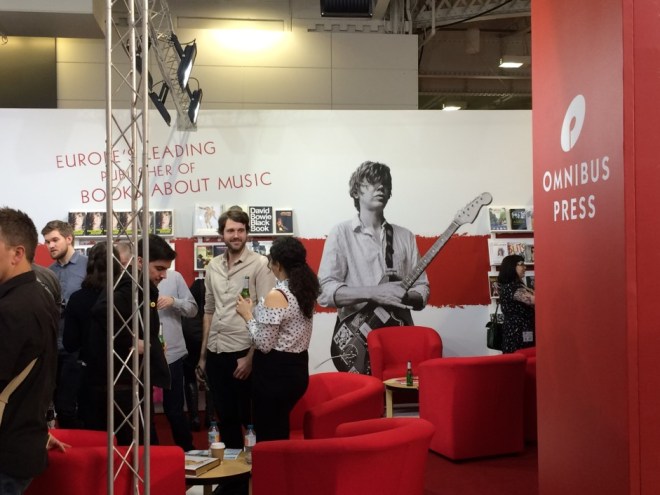
Entering the London Book Fair 2017 and realising that the Omnibus Press stand was dominated by a 9 foot tall Thurston Moore was pretty wicked.

The London Book Fair is, essentially, a giant trade fair for publishers, agents, print houses,  anyone involved in the logistics and execution of publishing books. It’s where publishers launch their major titles and so forth – so it was very pleasing, and deeply humbling, to arrive and see so many people at the publisher had worked hard and taken the time to put Thurston at the centre of it all. Nice to meet other authors, a lot of the team from Omnibus, to chat generally about mutual musical experiences – to snag a copy of other books I’ve been intrigued to read myself.

The book is out now in the U.K., curious to see how it does.


We Sing A New Language is Finally Out: The First Book Entirely Focused on Thurston Moore

IMG_9064

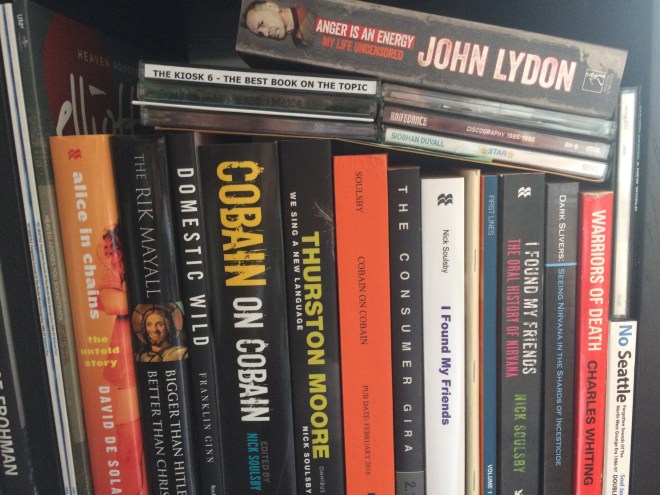
We Sing A New Language: The Oral Discography Of Thurston Moore came out yesterday in the U.K. – delighted. This is my ‘precious things’ shelf for want of a less silly name. That’s my friend Dr Franklin Ginn’s five years in the works volume that I was honoured to get a copy of; the ‘first lines’ volume contains the first translation work of my friend Emily Jones; my brother got Rik Mayall to sign a copy of his autobiography to me a few years ago (great read); Warriors Of Death was the first contact I ever had with an author – Charles Whiting/Leo Kessler when I was about 14 and he very kindly responded and sent me a signed copy. Around that, sure, it’s where I keep copies of neat things people have sent me: Siohbhan Duvall’s music, Damien Binder’s works, the Knifedance complete works, Sleeper Cell, Gravitons, Andrew MacGregor – even a copy of John Lydon’s second autobiography from the ‘evening with’ event at the 100 Club the other year.

London Book Fair tomorrow for the formal launch of the book in the afternoon – going to be fun! Interviews in the afternoon, drinks reception, evening out. Meeting a few people I’m very happy to spend time with.

Why did I think a book on Thurston made sense? Essentially because there’s this vast and expansive discography that has barely been touched by the mainstream; the vast majority of what he’s devoted his time to – and that has been documented – hasn’t ever been considered in depth. Plus, it’s the most detailed portrayal of the evolution of his performing and his musical interests – how they’ve influenced what he does, his own burgeoning confidence in areas where initially he’s tentative, how he is able to maintain this work rate and scale of achievement.


First Copy of “We Sing A New Language: The Oral Discography Of Thurston Moore”

IMG_9021

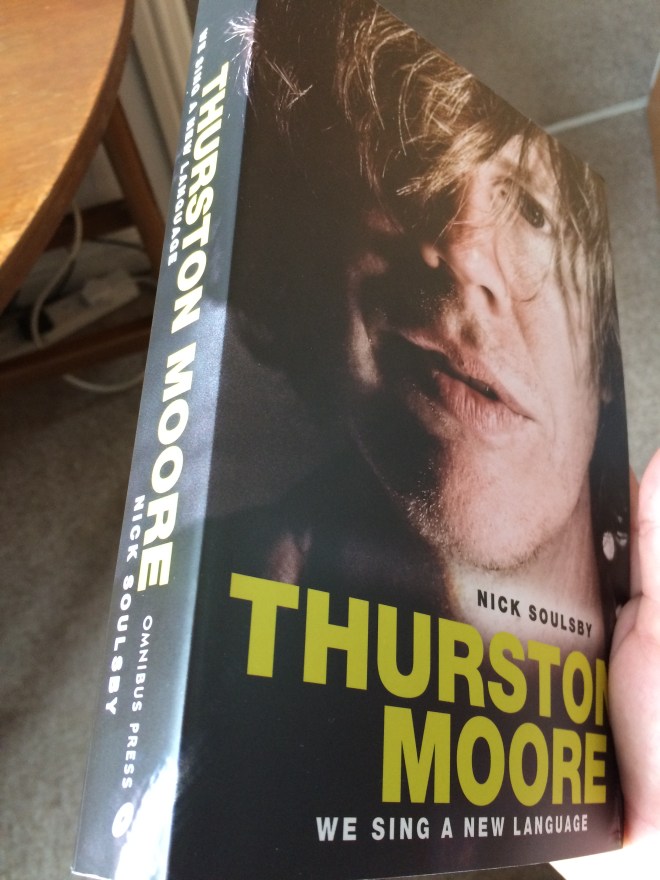
I always think I’ll just ‘be British’ about things when I finally receive the hardcopy of a book. I’m not one to jump up and down or pump my fist in the air – that kinda thing seems a bit ridiculous usually. But then the postman drops a copy of something I’ve committed a year and a half to through the door…And as soon as it’s open I can’t help but bound around like a dog that just found the perfect stick. It’s a genuine thrill.

IMG_9033

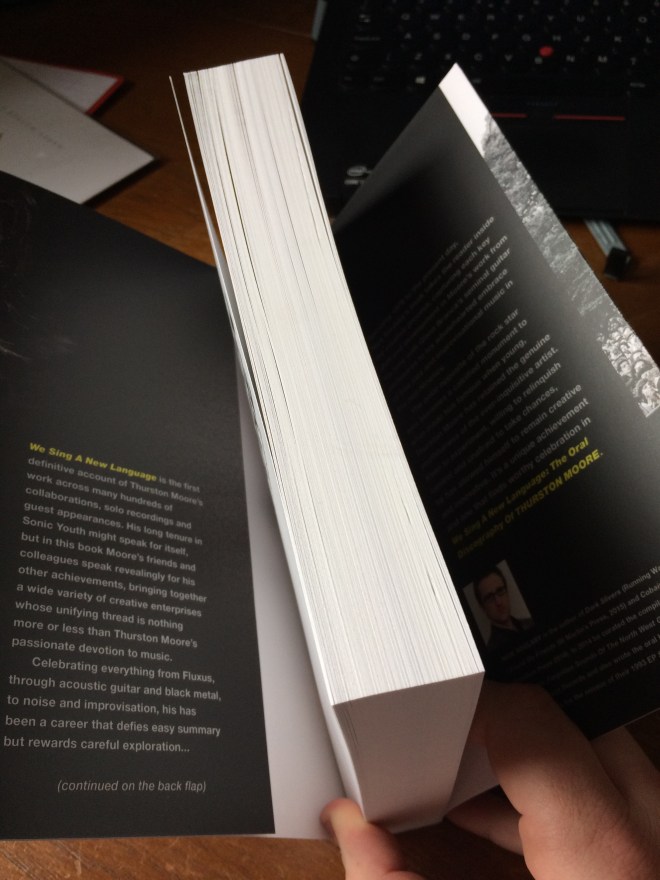
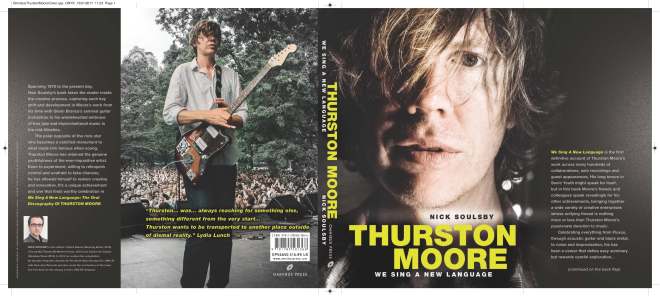
How does it look? Even the cover felt good in my hand – back flap and front flap giving a brief description of the contents, then delving in, viewing the photos, flipping through the entries. This is the moment of truth of course: when I read it in book form and notice things where I go “darn! How did I let that through?”

I’m already aware of two errors, both wholly my own: one is a reference on page 57 to Vicki Peterson of The Bangles – her brother is called Dave Peterson, I managed to drop the wrong name in during a re-edit. The other was deliberate: Radieux Radio spoke with me about working with Thurston recently and we agreed we wouldn’t mention other upcoming releases planned for after Rock N Roll Consciousness…But I didn’t want to lose the discussion of working with Thurston in Paris, so I kept it in the section on Rock N Roll Consciousness because I felt it was still an enjoyable image and description of the man at work in 2016. If those are the only errors I’ll get down on my knees and thank the gods though I was very sheepish and apologetic when Dave Markey pointed out the mistake with the name.

That’s the bittersweetness of this spell: it’s amazing to see the finished object, but after the tens of thousands of emails and messages; after whittling the 300,000 words of notes and interviews down into a coherent work; following the five or six rounds of editing and review by multiple people; after all the myriad small tasks needed to bring a book into the world…This is the time when I’ll hear what slipped through the net; those moments; the two words in 100,102 that aren’t right; or the necessary cut that someone in their heart of hearts would wish I’d left in…But it doesn’t rob the moment of pleasure. Never. In this era of virtual everything, nothing can beat physical reality. A book in hand is worth 12 on the web.

IMG_9034

Contributors to the Thurston Moore Book

book-full-cover_thurston-moore

For “We Sing A New Language: The Oral Discography Of Thurston Moore”, I wanted to use the experiences and perspectives of the people who have played on the numerous records he’s featured on outside of Sonic Youth, to paint a picture of his development and his interests in music across the years. It’s notable how much of his energies, very early on, were on gaining this wider experience while – since the mid-Nineties – there’s a veritable explosion of effort devoted to other scenes which then feeds back into Sonic Youth in the form of the SYR records, releases with Mats Gustafsson, the presence of Borbetomagus on the Murray Street album, their choices of support acts when touring. There’s even a specific character to Moore’s efforts during Sonic Youth’s peak of commercial success in the early-to-mid-Nineties with Moore evangelising and paying tribute to the underground bands who he felt was important – so much of that era is spend on covers and tributes. It’s that kind of pattern that speaking to the people involved was able to tease out.

The book includes a comprehensive Contributors section in which each of the 170 people involved summarises their personal creative urges and expressions – the hope being that it gives the reader a sense of who they’re speaking to and a starting point for further exploration. Frankly, if you enjoy the work of Thurston Moore then there are a lot of people in here worth finding!

In first name alphabetical order:

Aaron Dilloway, Adam Golebiewski, Adam Kriney, Alan Bloor, Alan Licht, Alan Read (Krayon Recordings), Alex Ward, Amanda Kramer, Ambrose Bye (Fast Speaking Music), Andrew Clare, Andrew Kesin, Andrew MacGregor, Andrya Ambro, Andy Moor, Anne Waldman, Anne-James Chaton

Balazs Pandi, Benoit Bel (Mikrokosm Studios), Benoît Bourreau (Film Maker), Bill Nace, Brett Robinson, Brian Kinsman (Deathbomb Arc), Britt Brown, Bryn Harris, Byron Coley, Byron Westbrook

Campbell Kneale, Carlos Giffoni, Carlos van Hijfte (Tour Manager), Chris Corsano, Chris Gollon (artist), Chris Pottinger, Christian Marclay, Colin Langenus, Cory Rayborn (Three Lobed Recordings), Cris Deison, Cristiano Nunes (ZDB Venue)

Dagobert Sondervan, Daniel Sandor (Producer), Dave Keay, David Markey, David Newgarden (Manager to Yoko Ono), David S. Blanco (Blank Editions), Deb Goodge, DJ Spooky, Don Dietrich, Don Fleming. Dylan Nyoukis

Evan Parker, Frank Rosaly, Frans de Waard, Gene Moore, Giancarlo Schiaffini, Glenn Branca, Greg Vegas, Hal Rammel, Hanin Elias, Heath Moerland (Fag Tapes)

J.D. King, Jim Thirlwell, Jack Rabid, James Nares (Artist), James Sedward, James Toth, Jane Scarpantoni, Jean-Marc Montera, Jef Whitehead, Jeff Hartford (Bonescraper Recordings), Jeremy Miller, Jim Dunbar, Jim Sauter, Jim Sclavunos, Joe McPhee, Joe Tunis (Carbon Recordings), Johannes Buff (Mikrokosm), John Clement, John Corbett, John Howard, John Moloney, John Olson, John Russell, John Tye (Lo Recordings), John Wiese, Jon Forss (Lo Recordings), Josh Baer (White Columns), Justin Pizzoferrato (Sonelab)

Karl Hofstetter (Joyful Noise), Keith Wood, Kevin Crump (Wintage), Kim Rancourt, Kommissar Hjuler

Lasse Marhaug, Lea Cummings, Lee Ranaldo, Leslie Keffer, Lin Culbertson, Loren Connors, Lydia Lunch

Mani Mazinani, Manuel Mota, Marc Urselli, Marco Cazzella (My Dance The King), Marco Fusinato, Margarida Garcia, Martin Bisi (Producer), Massimo Pupillo, Mat Rademan (Breathmint), Mats Gustafsson, Matthew Saint-Germain (Freedom From), Maurizio Opalio (My Cat is an Alien), Michael Chapman, Michael Gira, Mike Gangloff, Mykel Board

Nathaniel Howdeshell (Fast Weapons), Neill Jameson, Nels Cline, Nolan Green, Pascal Hector, Patrick Best, Paul Flaherty, Paul Smith (Blast First), Pete Nolan, Phil Blankenship (Troniks), Phil X. Milstein

Rafael Toral, Rat Bastard, Rhys Chatham, Richard Hell, Richard Kern (Film Maker), Rob Hayler, Robert Meijer (En/Of), Robert Poss, Roberto Opalio (My Cat is an Alien), Ron Lessard (RRRecords)

Samara Lubelski, Sanford Parker, Sarah Register, Sérgio Hydalgo (ZDB), Shayna Dulberger, Sonny Vincent, Stavros Giannopoulos, Steve Lowenthal (Vin Du Select Qualitite), Stuart Braithwaite, Susan Stenger

T. Mortigan (Destructive Industries), Terri Kapsalis, The New Blockaders, Thurston Moore, Tim Foljahn, Tom Moore, Tom Smith, Tom Surgal, Toshi Makihara, Trumans Water

Venec Miller, Vice Cooler, Virginia Genta, Wally Shoup, Walter Prati, Warren Defever, Wharton Tiers, William Hooker, William Winant, Yoko Ono

We Sing A New Language: Where did the Thurston Moore Book Begin?

“We Sing A New Language: The Oral Discography Of Thurston Moore” started, quite literally, right here on this blog. By early 2015, I’d been writing about Nirvana almost constantly, day-after-day, for three years: I needed a break. As an avid collector of the musical works of Sonic Youth and its individual members, I’d begun seeing interesting patterns, trends and connections within the 150+ Thurston Moore records I owed at the time (the collection has continued to swell since then) and so, as a diversion, as something different, as a chance to freshen up my mental landscape, I wrote a series of five lengthy posts gathering together and looking in depth at some of Moore’s works:

https://nirvana-legacy.com/2015/01/05/new-year-new-indulgence-the-solo-discography-of-thurston-moore-part-one/

https://nirvana-legacy.com/2015/01/07/thurston-moores-solo-work-part-2-the-big-rock-era-and-emergence/

https://nirvana-legacy.com/2015/01/15/thurston-moore-solo-part-three-breathing-out-in-studio/

https://nirvana-legacy.com/2015/01/17/thurston-moore-part-four-patterning-the-explosion/

https://nirvana-legacy.com/2015/01/21/thurston-part-five-artnoise-and-radiophonic-addiction/

I was intending to keep on writing these but the run up to the release of ‘Cobain On Cobain’ began to fill the time so, beyond the notes and sketches I’d already made, January 2015 was as far as I got. Checking blog stats one day I was a bit surprised (to say the least) to see that instead of the regular 3-400 hundred hits, the previous day had peaked at several thousand visitors. What tha…?! Luckily for me, a friend wrote saying “hey, did you see Thurston Moore shared your post on his Facebook?” I looked and was rather delighted to see someone had sent the first piece to him – he’d just said “wild!” or something like that.

Across the next month or so the kernel of an idea popped in my head: I was sure, that with a discography this broad and deep, it would be possible to trace the musical development not just of Moore, but of the scenes he’d weaved in and out of, the sounds he’d been a part of. It made such logical sense to me that with several hundred records outside of Sonic Youth – with some years where releases were emerging at more than a dozen-a-year – that it was entirely possible to tell a coherent and cohesive story entirely through oral history and entirely through the records. I bit the bullet; made the connections; contacted the right people and was delighted to be put in touch with Thurston’s PA, Penny, who – for the next year and a half – would be a near constant presence in my life and a thoroughgoing saint when it came to advice, wisdom, contacts, ideas.

Doing something like this, looking in depth at someone, without their knowledge…It wouldn’t have seemed right to me. I was ready to go but until I knew that Moore was cool for me to do it – I couldn’t have started. I had the lists ready of who I wanted to go after; I had an ever-evolving discography spreadsheet which had initially started as something I had been using for a few years when planning music-shopping expeditions and online-purchasing, then became the guiding text of my existence throughout 2015-2016. Every time I turned around during those years, I would find yet another song contributed to a compilation; another collaboration; another record Moore had chipped into on some obscure label out there in the world. It was a source of constant wonder – and sometimes made me feel I was chasing a moving target.

That’s, luckily, where the logic of writing a book took over: there needed to be boundaries, it needed to have pace and readability, it needed to have repeating themes but also shift focus often enough it would keep interest, and it needed to end before it became repetitious. It felt right to stop when it did; to not cover certain songs or releases; to finally halt while the excitement involved in its creation was still so powerful the long nights felt like a pleasure.

2017: We Sing a New Language – the Oral Discography of Thurston Moore

book-cover_small

From late 2016 onward I had the honour of receiving the permission of Thurston Moore to create an oral history detailing and describing his vast and extensive discography of collaborations, inspirations and creativity.

The book will be out on March 13 on Omnibus Press (with a U.S. specific edition released in August on Overlook in the U.S.)

The book is built on interviews with over 170 individuals who have recorded with or performed with Moore over the years – a story of the scenes and sounds he has been a part of, supported, forged and championed over the past three-and-a-half decades. The book is 336 pages including a comprehensive discography and a detailed section on the contributors also.

Over the next few weeks I’ll try to share what I can about the book, it’s content, the motivation behind it and so forth.

Dawn Anderson and Nirvana’s First Interview

https://www.gofundme.com/please-help-dawn-recover-from-cance

If you’re a Nirvana fan, you’ll know the name Dawn Anderson, you’ll recognise the line “Nirvana could become…Better than The Melvins!” Dawn was responsible for the article that appeared in Backlash magazine in the spring of 1988 marking the first interview with Kurt Cobain. If the piece – ‘It May Be The Devil And It May Be The Lord…But It Sure As Hell Ain’t Human’ – wasn’t already so well known it would have been my choice to open the Cobain On Cobain book last year (I wanted to use the word count for something else in the end.)

http://www.livenirvana.com/interviews/8804da/index.php

Dawn is currently in recovery from a run in with cancer. If you have spare change, a touch of cash, anything that might help her toward full health – the link is above and there’s some good to be done in the world.


Merry Christmas! The Evolution of Kurt Cobain’s Lyrics

In the literary world, it’s normal that a sophisticated writer’s output is dissected to indicate the structural, time-specific and/or constant features underpinning what they do. The world of popular music, however, often falls prey to anti-intellectualism: a common kneejerk reaction claiming that any deeper consideration either neuters the emotive force of music (answer: no, it doesn’t) is inappropriate to the form (answer: no, it isn’t) or is purely imaginary unless confirmed by an artist’s own statements (answer: entire industries are built on helping people understand themselves better – why should a zone as full of flakes, oddballs and exceptional cases as music is be the sole arena of human life where people are all-knowing with regard to their actions?) It’s a bizarre reaction in many ways: to be unable to accept music on a physical, emotional and intellectual level whether at separate times and locations, or intermingled.

In the case of Cobain, the 500 posts created from November 2012 to December 2016; over a million words; hundreds of tables/charts/graphics; indicate I feel there’s more to his work than just re-treading soap opera style biographical detail. The starkest example I can offer is the way in which is song-writing notably changes between 1986 and 1994. As a Christmas post I decided to enjoy showing why I think Cobain is such a good writer and sustains deeper assessment.

Think of any singer you wish: compare Beck to Axl Rose; compare Nineties Wu Tang Clan to the hashtag disorientation of mid-2000s Lil Wayne; whatever you wish. Every performer of words has a voice. There are a range of options: first person, third person, the story, interior monologues, direct address to an unknown audience, emotional sensation versus external reportage…Regardless of whether the individual concerned is a seasoned professional who readily and methodically selects different voices at different times, or a from-the-gut lyricist working on pure instinct rather than any formulated conception of their art, lyrics require a mode regardless of thought or forethought.

Cobain is an excellent subject to study in this regard: a concise selection of song lyrics to consider – well under one hundred – showing development across a tight eight year span. Some songs recorded for the Fecal Matter demo at Easter 1986 may have been around a long while but without further evidence it’s pure conjecture. In my opinion, given how fast Cobain wrote, used and discarded songs 1986-1990 I doubt he was re-using leftovers from his early-to-mid teens. I’m ignoring the material on Montage of Heck simply because there’s no data about when/where it was created and most of it didn’t come even close to any sense of complete form. Feel free to consider it in light of this discussion.

In essence, there are three clearly distinguishable threads to Cobain’s lyric writing – and they change significantly in terms of their presence and importance within his portfolio.

The first, is the ‘story’ – defined as a narrative scene/experience played out across an entire song. This approach takes a lot of work: essentially it means writing a short story, in a relatively limited number of words, while making it work as a vocal piece. ‘Paper Cuts’ from the Bleach album is a great example: “When I’m feeling tired / she pushed food through the door / and I crawl toward the crack of light / sometimes I can’t find my way / newspapers spread around / soaking all that they can / a cleaning is due again / a good hosing down.” The first evidence of Cobain using this mode of writing comes on Fecal Matter in 1988 with the track ‘Insurance’ (a court scene) and it’s very understandable why it never becomes a dominant component of his writing – it’s difficult and time-consuming! The next example is ready a year later by the time of Nirvana’s first show: ‘Mexican Seafood’, a slightly feverish sequence in which he winds up focusing on the state of the bathroom floor and the toilet bowl (I felt this song more deeply after a food poisoning episode.) 1987 is the big year for story songs: Cobain has the time and freedom to work on them so by the January 1988 studio session at Reciprocal he’s worked up ‘Floyd The Barber’ and ‘Paper Cuts’ with ‘Polly’ likely already in hand given the song is based on a 1987 news story.

This song form dies entirely. The final two examples are written in May-July of 1990 (‘Sliver’) and the autumn of that year (‘Something in the Way’.) Story songs, in summary, make up 6 of the 68 songs with lyrics released during Nirvana’s lifetime or on the Greatest Hits/With The Lights Out packages in 2002-2004. One is based on a news story (‘Polly’), one on an incident that happened to a local kid (‘Paper Cuts’), one is a fictitious grotesque based on a TV show (‘Floyd The Barber’), three are embellished autobiography (‘Mexican Seafood’, ‘Sliver’, ‘Something in the Way’.) The way in which, between 1988 and1990, he moves toward autobiography is reinforced by other trends in his writing.

The second form is even more prominent in Cobain early work: the ‘character sketch’. This differs from the story song in being a recitation of an individual’s static being, character or circumstance. The Fecal Matter demo is a point of origin in two respects: firstly, Cobain is still finding his own voice so it’s significant how often he speaks ‘as other people’ on the record – note the bizarre put-on voices throughout the demo (an affectation still prominent in the unusual voices on the January 1988 songs later seen on Incesticide.) Secondly, this seeking out of identities is also lyrical: ‘Laminated Effect’ is the only time Cobain sketches named characters (Johnny and Lucy respectively), while ‘Buffy’s Pregnant’ marries his vocal impersonations to stereotypical dialogue of the types of individual he’s representing. ‘Mrs. Butterworth’, in which he hashes out a would-be homemade folk-art entrepreneur’s future plans, continues this lyrical approach in which he visibly speaks ‘as’ another person. He gives up on vocal impersonations very swiftly and very soon it becomes less obvious he’s speaking as a character or autobiographically.

The b-side to Nirvana’s first single, ‘Big Cheese’, had started life as a tale of management at a fast food joint (see the early version played live in Spring 1988) then evolved into a comment on the management at Sub Pop; there’d also been ‘Hairspray Queen’ and ‘If You Must’ (the latter a quintessential ‘writing’ song) recorded that January; while ‘Sappy’ was demo’ed in 1988. The peak for the character sketch though was its dominance on Bleach which contained ‘About A Girl’, ‘School’, ‘Negative Creep’, ‘Scoff’, ‘Swap Meet’ and ‘Mr Moustache’. A division was emerging within this song form quick sketches of characters he observed around him – like the redneck or the couple making a living at garage/car-boot sales – or songs based around his own life and mood (i.e., pressures from management, pressures from girlfriend, his own negativity.)

Things had visibly changed by the time of Nevermind: just as the story song had dwindled to a single song (‘Something in the Way’), there were only two character sketches (‘Lithium’ and ‘Drain You’) both of which could be read as autobiographical.  That’s not to say, however, that Cobain hadn’t persisted with this mode of writing. ‘Stain’, ‘Been a Son’ and ‘Even in his Youth’ were all written in a flurry around summer-autumn 1989; then, in 1990, Cobain also created ‘Dumb’, ‘Pennyroyal Tea’ and ‘Oh The Guilt’ – early versions of ‘Rape Me’ were also far more extensive than what would ultimately emerge in 1993.

I’ve said it a lot of times, of course, that so few Cobain compositions are written after Nevermind that it’s hard to draw big conclusions but – by the end of his life, as far as we can see, the only additions to this form were ‘Curmudgeon’ (written sometime in 1991), then ‘Very Ape’ and ‘Scentless Apprentice.’ A form that had taken up over half of Nirvana’s first album remained as a full four songs on Nirvana’s final album, but made up only two of the dozen compositions he’s known to have written in the last two-and-a-half years of his life. Still, it’s a significant batch of Cobain’s productivity: 23 of the 68 songs taken into account in this assessment.

The curious part, however, is seeing the rise of the third song form Cobain used. Bleach was made up of one cover song, two story songs leftover from the January 1988 session, six character sketches, then just two songs in the mode for which Cobain would become best known and that would dominate his later writing. ‘Blew’ and ‘Sifting’ are forged from lines that sound good together, related words, brief images, lines addressed to an unknown audience – there’s no central narrative and no singular character here. I refer to these as the ‘abstract address’: detached images, opinions, feelings combined into songs (hence why looking for a single ‘meaning’ for this type of song has always been so silly.)

‘Downer’ s the nearest Fecal Matter came to this though there was a central theme at play. Note, by the way, that Downer starts with an anonymous narration then breaks into the first person. Cobain would do the same thing on Spank Thru, Mexican Seafood, Big Long Now, Dive, Smells Like Teen Spirit, Drain You, Scentless Apprentice and Radio Friendly Unit Shifter – opening lines in one mode, the rest in another. Oddly ‘Downer’, ‘Aero Zeppelin’ and ‘Sifting’ would be the last songs Cobain wrote that are entirely anonymous with no ‘I’, ‘he’, ‘she’ involved. Just another small evolution in his style.

‘Spank Thru’ was the next form in this mode, followed in early 1988 by ‘Blew’ and ‘Sifting’ which each evolved new lines and different parts across 1988. Increasingly this is how Cobain would come to write: lines taken from different journals, or scribbled out relatively close to the time of recording, tagged onto core lines and ideas he’d kept or mused on for a while, or words that stayed in his mind. If you look at something like ‘Smells Like Teen Spirit’, ideas barely linger longer than a couple of lines. Elsewhere, try ‘In Bloom’ with its chorus refrain existing entirely separately from the verse themes (which are themselves fairly diffuse – “Sell the kids for food / weather changes moods / spring is here again / reproductive glands”). On Nevermind, there were two story songs (‘Polly’ and ‘Something in the Way’), then two character sketches (‘Lithium’ and ‘Drain You’) then the rest of the album consisted of these abstracts. In Utero, again, would divide up relatively cleanly: no story songs, four character sketches, the rest abstract.

The abstract was, by its very nature, a highly adaptable form: note the change between Nevermind’s unspecific combination of broad statements of opinion and imagery versus In Utero’s targeted clusters of autobiographical reference. Cobain’s fixation on the media echoing through words and titles on In Utero in real contrast to the relative anonymity and veiled biography of Nirvana’s earlier songs: a stark turn toward self-reporting. It isn’t uncommon either for fame to impose a certain introversion on lyrics: essentially, once all an artist sees is hotel rooms, stages and business meetings it’s hard for them to say much about the world. Think of Axl Rose moving from the grime of Appetite For Destruction to the love songs and psychological dissections (and aggression) on Use Your Illusion I and II – or even more specifically compare that to Chinese Democracy after a decade stuck in a mansion. Recently The Weeknd’s new album was filled with the least interesting, specific and developed writing of his career.

In conversation the other week someone drew my eye to ‘Do Re Mi’ and pointed to it as a quintessential heroin song comparable to the narcotised drift of Lennon’s ‘Imagine’ or Lou Reed’s ‘Perfect Day’ – this air of blissed out warm nothingness to it all (and, having been hooked on the spirit and sung along a million times, people still shake their heads and wonder what heroin’s appeal is…) It reminded me, again, that there’s more than meets the eye inside the music of Kurt Cobain and so – at Christmas – I wanted to sign the blog off for a couple weeks with this remembrance of what an awesome musical force he was.