Live! Tonight! Sold Out! Cobain’s Video Composition

From the self-mocking double entendre in the title, its very clear that the finest of Nirvana’s video/DVD releases had the hands of Kurt Cobain all over it.

It’s never been clear precisely how much work was still required in the hands of Dave Grohl and Krist Novoselic but they certainly acted as fair stewards of their erstwhile comrade’s vision. So many of the elements of the video tie back to previous desires of his work. Cobain’s Journals contain brown sample pages from a ring-bound journal; there are several pages of description for each In Utero song including a future tense in the description of Radio Friendly Unit Shifter, “boy, this will really get the A&R man’s blood boiling” that seems to date these pages to somewhere between Pachyderm and In Utero’s release, mid 1993 efforts – there’s no proof this is accurate, however there’s no footage used from after January 1993 and barely any time in 1994 for this to have been a major focus. A page onward and there’s a letter to Kevin Kerslake describing a treatment of “the long form” listing footage he wants using. The mention of Kerslake also appears to mesh with his early role in preparing treatments for Heart Shaped Box in mid-1993 prior to leaving that project and subsequently suing the band.

Certainly the treatment described in the Journals differs from the final result; why would be a matter of speculation but it certainly avoids some royalty problems by not dipping back beyond the Grohl years (i.e., not using the Rhino Records in-store footage with Jason Everman and Chad Channing) and not featuring other musicians and their songs (the desire to have Molly’s Lips performed with Eugene Kelly of The Vaselines from Reading).

Certain ideas are already clearly in place, however. Firstly, the use of jumbled non-song footage is in place with his notes describing having Dave talking about bands, Kurt asking the director to “start my rant just as I say Black Flag, Flipper…” Likewise a demand for visual distractions is added at the foot of the page consisting of “the scene where I hand the guitar to the audience” and continuing by asking for the scene where he harassed the cameramen in Rio by spitting on cameras and waving his penis in front of the lens. He asks for the word ‘Bronchitis’ to be flashing on screen throughout Aneurysm but instead has to settle on the final rendering for a substantial quantity of foreign subtitling throughout the video that ultimately serves no function bar defacement.

The interest in slicing one performance into another is also in place and not a new Cobain technique. The Montage of Heck was built around such cuts between related and unrelated material and looking back at the Nirvana In Bloom video the visual drama is created by the break-away from the clean-cut image into the dress-wearing, stage-wrecking conclusion. Cobain links explicitly to the latter by asking for it to be included in this video and replaying the precise same cut by asking for the juxtaposition of the Top of the Pops (“equivalent of US’s American Bandstand”) performance with the In Bloom video which parodied American Bandstand. It went further in the precision of his vision; he asked for the Top of the Pops performance, the parodic ‘straight’ miming the band did that evening with Cobain virtually swallowing the mic, to replace the ‘straight’ half of the In Bloom video with only the back-half, the dresses and destruction piece, to feature. The curtailed and restricted real-life performance would replace the curtailed and restricted homage component.

The cutting between statements and musical realities seen on Montage of Heck is best exemplified by Come as You Are. In the Journals Cobain already notes “Rock Star Lesson: when your guitar is out of tune, sing out of tune along with it” – in the video his last statement in interview before they cut into the song reiterates “play whatever you want, as sloppy as you want, so long as its good and has passion.” The subsequent song rendition is snarled, roared, ruined…Beautifully so. One of Nirvana’s known ‘soft’ songs is turned into a feedback n’ scream fest.

The song cuts are apparently already planned if the “keep Amsterdam audio when first change happens” statement in Journals clearly refers to the movement between the intro of Reading ’92, then the performance in Amsterdam – with the statement ‘first change’ implying he’s already clear that there’ll be a further cut which fits the move to the Rio performance.

The undermining of Nirvana’s media image is a given throughout the video; the constant presence of the subtitles emphasises that all the interviews used are media productions and trustworthy/untrustworthy on that basis, they’re product, not necessarily honest conversation. Having emphasised the artificiality of the interview portions, Cobain and the band insist on using the most overt confrontation between camera and band with the spitting and flashing from Rio. The ‘blinding’ of the all-seeing cameras, the chasing of cameramen who are normally chasing him, the deliberate unveiling of that which the cameras will not show even though the media considers every other element of his life fair game…It’s a series of serious games each of which has a point. The band even wraps its other most flagrant media confrontation – the opening of Reading ’92 when the rumours about the band and Cobain’s health were at their worst and Nirvana responded with one of their longest and most impressive shows. The visual joke of Cobain shrouded in a wheelchair is the most obvious but alongside that he chose to sing a sliver of The Rose from the Bette Middler film of the same name which is about the self-destruction of a media star under the pressures of fame.

The video, therefore, continues Cobain’s fixation on the media, his long-held liking for wedging different elements together and the desire to evade and damage the rock star macho image by ensuring the footage of Nirvana in lingerie appears within five minutes of the start and reoccurs later. I have great difficulty believing that the insertion of the version of Love Buzz from Dallas, Texas that ends in a fight with a bouncer isn’t another case of Cobain pulling surprises and adding another uncomfortable moment to a brilliant video collage.
Song Survival: Nirvana’s Early Hits in the Late Age

Songs die, as is the way of all things. Playing a song year-in and year-out becomes stale, bands may have favourites and crowds may have favourites but performers tend to desire freshness until, that is, they reach the ‘greatest hits’ phase of their career where the artist’s music isn’t moving forward sufficiently and/or the audience becomes happy with a dose of nostalgia.

In the case of Nirvana, they never reached that era of their career — it ended barely six months after their latest album, barely two-and-a-half years after they’d be catapulted to fame. While the band were barely playing together outside of fulfilling their live obligations — making it very easy to see the near defunct level of creativity present behind the scenes — they had enough that audiences were still only just gaining familiarity with that it would have been quite a while before anyone not studying details of recording sessions, set-lists and practices would have noticed.

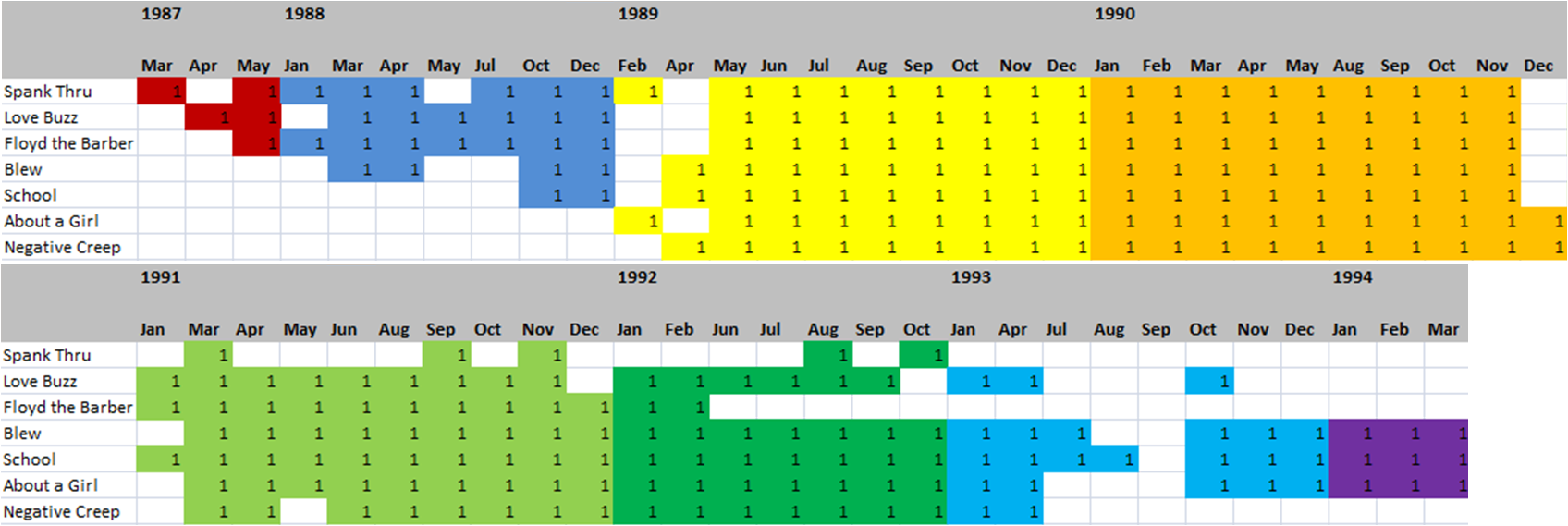
This means Nirvana, while certainly feeling an obligation to play chunks of Nevermind, didn’t have to prise songs from the pre-Geffen era into the set-list unless they felt like it. Yet certain songs kept showing up, specifically: School, Blew, About a Girl, Love Buzz, Floyd the Barber, Negative Creep and Spank Thru — even Sliver endured.

Just for amusement I simply want to look at their longevity today, when did they arrive in the set-list, when did these songs hit their peak, and when, finally, did they drop out. For starters, tragically for those of us who like poetic coincidences, there’s no song that is present from start-to-finish of Nirvana’s career; the nearest candidate is Blew with its first known appearance in March 1988 and its final appearance on March 1, 1994 some six years later — the song certainly deserves greater credit in the record of Nirvana’s songs. It also makes me think that the tale that Sub Pop told Nirvana to arrange the songs on Bleach by simple order of preference from favourite to least favourite may have some truth to it — Nirvana clearly love Blew.

Picture1

Spank Thru is also a great survivor. Already notable as the most significant composition to be ripped from the Easter 1986 Fecal Matter demo, Nirvana loved the song so much they made it their second original song to be released, they played it on radio both in 1987 and late 1989 and reissued a live version of it on the Sliver/Dive single in 1990 (U.S.) and 1991 (U.K.) In virtually every month in which Nirvana played (and for which we have evidence) the song is played only finally being relegated to the reserve at the end of 1990 with periodic returns. Love Buzz has an even more imperious (and deserved) run with appearances in the live catalogue all the way into 1993 — I’m more surprised that the band didn’t feature it often in the In Utero tour than that it lasts so long given its popularity, catchiness and fun vibe. This leaves Floyd the Barber as the last of the 1987 Nirvana songs to live out an extensive live life. Again, taking note of the Bleach running order and the apparently rigid thinking behind it, it’s an early track that, despite its wordy nature and story-telling style (something that died out relatively early in Cobain’s career) doesn’t vanish until the end of the Asia-Pacific tour. What’s sadder is that it stops flat with no known reprises at any time in the final two years of live performance — done. Listening to it at first I used to notice the lurching discomfort of the song and its relatively low pace…Since then, however, I’ve come to appreciate its bright guitar tone, the catchy guitar-drums interplay and the climbing bridge — it’s a truly great track and I can understand its survival.

For the In Utero tour Nirvana’s set-list became relatively stable compared to earlier years — songs tended to appear in the same positions, next to the same companions, the majority of shows featured the same songs in the same order from the start right through until somewhere close to the final songs (I believe that in posts examining the ’93-’94 live record I identified anything up to 14 songs in a row matching show-by-show). There’s a sense that on paper the band felt they needed to whip in a few Bleach songs to balance the set-list, not that they didn’t like the songs they chose, but there’s a feeling they needed something to leaven the Nevermind/In Utero heavy sets, that they didn’t have much new stuff to add in, or rare material that they liked enough to play (IHM&IWTD, MV, Gallons…) so had to reach back to songs that had been in the set-list forever. That isn’t dismissive of those songs quality; About a Girl, School and Blew are all top class.

Nirvana’s Biggest Live Month (Plus McCartney/Nirvana Footage Update)

Since Saturday morning the YouTube quality has improved significantly when it comes to the McCartney/Grohl/Novoselic/Smear material…All the songs are now up there…

I’ve always been of the opinion that Nirvana’s career as a live band reached its peak in 1991. 1989 had seen them play 82 shows, turning what had been a relatively stilted live band into a powerhouse — it was their education. The pace dropped slightly in 1990, to 62, then rocketed to 92 performances in 1991 with the majority being in the final spell of the year. This quantity of work as a unit bonded them to the point that they could pull any song out of the bag.

Having plotted the overall numbers for the songs Nirvana performed live I was curious whether one could see that peak in terms of the sheer range of songs Nirvana played. There were provisos; firstly, the increase in set lengths toward the end of their career potentially would influence the results — Nirvana needed only 10 to 12 songs a night in 1987-1988 rising to a norm of 23 to 25 by 1994. Also, as Nirvana wrote more songs it would perhaps be natural that they would (or at least ‘could’) play more — again, potentially this would blot out any indication of their variety as a live act. Finally, for some months, there simply isn’t much data on their shows meaning strange results appear. But what the hey, I thought I’d simply give it a try and see what emerged…

I had one spreadsheet showing every song Nirvana ever played live, which I’d converted to try to show the span of time rather than the overall totals per month (by converting each month in which a song was performed from a total number of performances to simply a ‘1’ meaning I could add a formula that added up how many months the song appeared in.) This made it pretty easy to calculate how many different songs were performed that month.

Nirvana_Most Songs Played in a Month

The influence of individual shows could immediately be seen, for example, the early peak in November 1990 is down to the show at The Off Ramp Café where Nirvana triumphantly pulled out numerous rarities and new songs; the growling response to the weight of negative press coverage in late 1992 was the triumphant stomp of Reading which nearly hit 30 songs; the January 1993 peak is a result of the desultory show at Sao Paolo where the only way to make it to the allotted stage time (and not get sued by the promoters) was for the band to switch instruments and whack through a few sarcastic covers. The tail-end of 1991 does stand as the most sustained period of rapid set-list revision though I’d underrated the sporadic weight and variety of the In Utero tour.

What I was curious about next was to see the impact of removing cover songs from consideration…

Nirvana_Most Songs in a Month Minus Covers

The result shows clearly that Nirvana’s set-lists only truly ‘blow up’ once the band are free to unleash Nevermind in its full glory upon the public. Similarly, the increase in set-list length really does contribute to the 1993-1994 In Utero tour being far more varied than I’d expected. While the band were whipping mystery songs or covers out of the hat each night, they were playing a solid core of Nirvana’s songs. Late 1991, however, when In Utero was still two years away as a coherent album (if half written) was still the finest period in terms of the flexibility of Nirvana.

I did one last scan of the results due a suspicion that the November peak in 1993 was clearly the consequence of MTV Unplugged — another example of a special event in Nirvana’s history leading to unusual and unique choices when it came to sets (Nirvana really knew how to throw a party on stage…) I simply identified the drop in songs if covers were removed:

Nirvana-Fall in Songs when Covers are Removed

The results make Sao Paolo in January 1993 and MTV Unplugged in November 1993 very starkly indeed. It also shows that, beyond the total figures it was that spell in late 1991 where Nirvana were performing long shows and simultaneously varying the set-lists significantly. The best month to follow Nirvana was November 1991 as the storm was breaking and the band could throw anything at a performance.

McCartney – ‘Nirvana’ Live, Last Night, Seattle

All credit to LiveNirvana for this one but how could I resist adding this to the blog…
…There’ll be better quality material upcoming I’m sure but 10am UK time these are the two clips I can find of last night’s performance by Paul McCartney accompanied by the Nirvana remnant:

The set-list was as follows:

Cut Me Some Slack
Get Back
Long Tall Sally
Helter Skelter
The End

I do respect their apparent determination to shy away from Nirvana material…
…Anyways, for more info, go to LiveNirvana over the next couple days, go to the Forum and read the updates. Enjoy…Enjoy…Now, if I can just figure out my own Categories system I’ll actually be able to post the bloody thing…Hmmm…

Have a good day. Best wishes from Leeds – a fine northern city. And HAPPY BIRTHDAY to Caroline, my sister. x

The Big 250: Nirvana’s Legacy Revamped

It’s surprising how time flies. Assessing the Word files related to this site the other week I noted that I’ve now loaded up 123MB of content amounting to somewhere just over 300,000 words. I hope the majority have not been worthless or unreadable over the past eight months.

…Or at least, today would mark the big 250 if I hadn’t just deleted a small number of long expired and superseded posts. So, just trust me, we hit 250 OK? If I can be so bold, if you like the material you find on here then I’d welcome you joining me on Facebook (https://www.facebook.com/NirvanaLegacy) and of course I’m always delighted to hear that people recommended what I do here to someone else.

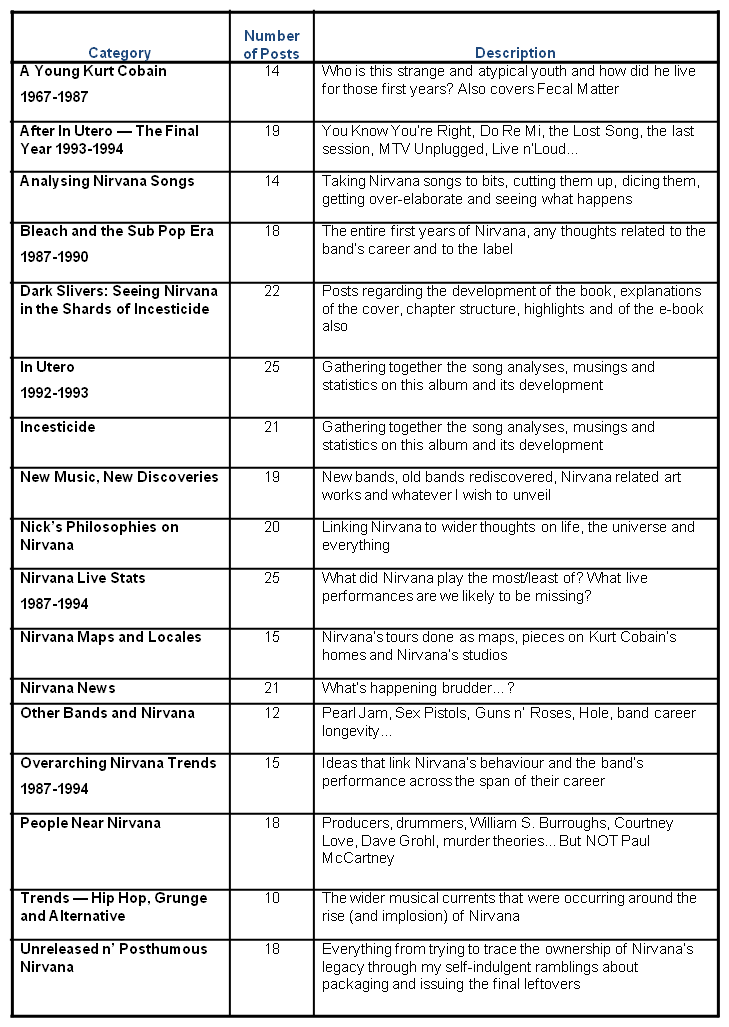
It also made me even more keenly aware that I needed to revamp the Categories structure. Nirvana Thoughts was bringing up 86 posts making it barely useful, while Nirvana Stats has hit 67 — heck, I wrote all these pieces and I sometimes couldn’t find material I was looking for! So, if you don’t know, in the column at the left-hand side of the screen, you’ll see a number of functionalities: a key-word search bar (tap in any phrase and it’ll see if it comes up in the blog), the most recent five posts, the blog divided month-by-month, and then Categories.

So! I had a go at reorganising the Categories at left-hand side of the page to mean, hopefully, that if you dear reader click on a Category, you’ll be faced with a maximum of 30 or so articles in any category, all with a link or central thread running through them, forming an overall discussion of a particular topic or theme…There are now 17 categories allowing you to look deeper into my ramblings on what I feel are the core themes I’ve been murmuring on about like the mad guy in the marketplace who taunts and bemuses passersby…That’s the theory, in practice, there are and always will be some posts that aren’t perfect matches for any category — I’ll live with that. The new categories are as follows:

Picture1

Usually on the regular blog summary updates (I did these for Christmas, for 100 and for 175 posts) I look back at the previous few dozen articles and make recommendations, so…What have I enjoyed the most? Hmmm…

Nirvana: Live! Tonight! In Your Lounge!

The idea of Nirvana has this tiny band that played wherever they could, for next to no money, for so much of their career appeals to me because it restores a degree of realism.

Nirvana: Lollapalooza Tour EP 1994

I’d never seen any real consideration of this mooted release — the Rolling Stone article suggests that it was a genuine idea with real meat behind it…Nice to find something unsaid.

The Key Category of Missing Kurt Cobain Songs: Love Collabos

Personally, I had never given proper consideration of how much work the couple did together in the last days or the fact that the majority of it is barely known to us.

On the statistics front, I’ve had some good fun in the past few months…

Album Dominance: Which Album did Nirvana Play the MOST?

A very simple analysis basically but interesting to see how Nirvana approached the albums released during their lifespan. There are related efforts around songs played the least.

And my favourite graphic efforts are the following:

Personal Responsibility and the Circle of Associates

Music Lovers and Musical Tastes

Song Dissected : Do Re Mi

Someone in the comments at one point asked my thoughts on Do Re Mi – and certainly as the last known Cobain original it’s impossible to look at the song without considering the background circumstance of the time and what would come next…

In terms of the apparent facts about the song, it’s a wonderful end to the Cobain saga simply because so little is known about it. What’s it really called? It might be Do Re Mi (a fair guess given Cobain’s liking for children’s TV if its an echo of the Rodgers and Hammerstein musical number from the sound of music) or it might be Dough Ray Me (referring to a comic book series as described here; http://shutuplittleman.com/history.php?idd=19) or it might be Me & My IV (apparently scribbled on a napkin according to Courtney Love)…Basically there’s no definitive name so call it whatever you like.

Likewise, there’s no facts about what it was intended for; the rumoured Lollapalooza EP release is the only official upcoming outlet for it but there’s no information whatsoever if there was ever substance to that idea. That would leave Do Re Mi as one of those Nirvana’s that drifted until a purpose was found for them. Alternatively, there’s the rumours of intended collaboration with Michael Stipe of R.E.M. and some people point to the overall mellow style of the song and the deviation in vocal style to push that possibility. Again, it’s a moot point – there’s no answer.

Furthermore, arguments about Cobain’s next musical direction can continue uninterrupted forevermore given there’s no indication that Do Re Mi’s acoustic approach was the way the song was intended to stay. There’s plentiful evidence by now that even the most raucuous Cobain compositions (Sliver, Very Ape for example) often began life as muted sounding home acoustica. His own comments revealed a desire to go in a variety of direction and on the last known (but still unheard and unreleased) version of the song Cobain played drums instead of guitar which neatly keeps everyone guessing.

What is known is that as well as the bedroom demo found on With the Lights Out (and therefore recorded sometime in the twenty-two days in January 1994 during which Nirvana was not out on tour or Cobain was not definitely occupied) there’s a later version recorded during the fifteen unoccupied days in March with Pat Smear and Eric Erlandson. It’s a possibility that a third version may exist recorded during a March 25, 1994 basement jam with Pat Smear. It’s also clear that, given the comprehensiveness of With the Lights Out, Do Re Mi is one of only two songs Cobain definitely wrote between the end of the In Utero recording sessions and his demise a full year later.

That’s what I love the most about this song as a concluding entry in the Cobain catalogue; it’s an open-end, an uncertainty.

Vocally though, I’d argue its a disquieting support for the idea that there wasn’t much life left in Mr. Cobain. Many people like his falsetto vocal – I would agree with them – yet I’d also point to the broken and strained voice displayed, there’s very little power displayed, held notes break all over the place, it sounds like his voice isn’t warmed up or that he’s a man just risen from his bed. This has a charm all its own but there’s a sense of exhaustion carried in his voice. I’m not declaring that he was a vanquished force, I’m more a believer that this was a man who wasn’t doing much with his private time beyond shooting up and sleeping. It’s still a beautiful vocal performance and truly a different approach to the use of his beautiful voice – I can’t tell if that’s a reaction against yet another element of his musical persona that had devolved into a stereotype or a brief experiment. Again, the fact that this is the only identified or even claimed Cobain original mentioned in discussion of the March jams, and that he did choose to practice it, suggests to me that he wasn’t hiding material from Pat or Eric, this was simply all he had left to work out.

Musically, the song has some attractive melodies delivered with a forceful thwacking of the strings that makes me think there was already an electric ideal in mind – he’s really driving the strings and its aggressive build is disguised by the skeletal recording style and high-pitched vocals. Again and again there are lashed chords that crash through the song, whether on the bridge just before the 3 minute mark (and again in the outro) or in the lead into the chorus. It doesn’t, however, support the idea that he was able to pull away from the verse-chorus-verse mode of song-writing he took such issue with. He placed great emphasis on the tiredness of that song-writing model and on guitar music in general yet here he is still playing it out toward the end of his career. It had become his default setting for how he thought about songs and their structure.

Finally, lyrically, I’m going to cut here from one of the final chapters of the Dark Slivers: Seeing Nirvana in the Shards of Incesticide book which you can find under the About tab of this blog:

Listening to You Know You’re Right (acoustic) or Do Re Mi what’s striking are the prominent lyrics that focus on sleeping and dreaming; Kurt’s lyrical inspiration barely got these two songs out of bed. When it does though his themes went no further than opiates, medication, an emotional state that’s either numb or cold as ice next to a series of blanket refusals; “I will never,” “I could never,” “I won’t.” This isn’t a man with many ties left to a world outside his head or one looking forward positively.

That’s what strikes me most forcefully about what are, in each case, beautiful lyrics. In neither one is there a world existing outside the head of the narrator. This wasn’t uncommon in Kurt Cobain’s work, many of his lyrics were opinions or views rather than external features or landscapes, but usually in his prior work there are plentiful links to events that were occuring around him even if they were suitably veiled. I see no reason to believe that Cobain had deviated from the writing practice that had come to dominate since around 1990 (again, I talk about the three main modes in which he wrote – my theory – in the Dark Slivers book so I won’t recap) and therefore no reason to believe that these two songs aren’t showing what he saw around him in which case its one cold and barren landscape peppered with negatives, with resistance or (in the case of the full Nirvana version of You Know You’re Right) submission…It doesn’t lead me to believe there was more to the life of Kurt Cobain in 1994 than cocooned hiding. Do Re Mi is beautiful, a gorgeous song that wears it rough edges like a backwoods’ princess, but hardly a celebration of the joys of spring or a life filled with either humanity, fellowship or a lust for more.

Not Everyone has to Love Nirvana for it to be Classic

A carrot is the nearest a rabbit will ever get to a diamond. The fact monkeys fall asleep easiest when listening to Metallica contains no value judgment on the monkey’s part. While music, or structured sound if you prefer, may be intrinsically human, relying as it does on the ability to make sound deliberately and then to edit, tweak and position that sound according to a background meta-narrative of internal deliberations, it doesn’t make it something ‘natural.’ No piece of music is bestowed with an intrinsic value decreed by nature; its value is defined and judged by human observation and criticism. The value of a piece of music can be altered by time, geography, culture in which consumed, purpose/functional context — the same data (i.e., the specific locations and relationships of the sound being listened to) takes on a different value along a sliding scale from priceless to worthless.

In the case of the music of Kurt Cobain, death at close to his peak of success essentially lent his music an exceptional quality; the creation of scarcity enhanced the value to the market. If the zeitgeist had been allowed to pass just another couple of years, the impact of Kurt Cobain’s passing would have been significantly lessened — look at Layne Staley. Similarly, if Nirvana had openly ceased to exist prior to the death of Kurt Cobain, or if it had been the drummer (no offence Dave!) who had died, then the band would be respected but, again, it’s less likely they’d be sainted.

A crucial factor is also age. The other week I pointed out that the five year age difference between Axl Rose and Kurt Cobain (1962 and 1967 babies respectively) meant one experienced his teenage musical renaissance in the peak of Elton John, Led Zeppelin and Queen, just prior to the rise of punk; while the other’s self-discovery coincided with the bizarre second wave of punk in the U.S. Music will never mean what it does at first listen, the unveiling of something fresh and new at the precise moment someone has no considered preconception to influence its reception. The passing from one generation to another tends to kill the momentum of a band or artist and their persistence and recognised greatness relies on them sticking around until there’s another generational shift — it’s good to wait ten years. The long gap between the first proper and worthy archive release in 1994 (MTV Unplugged) then the barely interrupted gap until 2002’s greatest hits and 2004’s With the Lights Out allowed the Nu-Metal generation to pass and a new tranche of fans to discover an acknowledged greats.

It was also a good time for a truly shocking rock death; Elvis, Lennon, Vicious — none of these had been artists at their peak and the memories had faded by the mid-nineties. Ian Curtis or Dead from Black Metal band Mayhem had been big figures but only in a relatively minor sub-culture and fan-base. Cobain rightly pointed to Freddie Mercury in his suicide note because Mercury was the only recent rock star death of any significant scale but, again, this was a band past its peak and into ‘institution’ territory while the manner of his death — complications from AIDS resulting from unprotected homosexual activity — hardly lent itself to deification.

Accidents and disease don’t really have any kind of glamour (for want of a better word). A juicy murder or an equally rare suicide — now that has an unnatural quality that lends itself to mystique and curiosity. It helped that Cobain was photogenic too and lent himself to those wide-eyed portraits that became so ubiquitous. The same occurred to Tupac Shakur, the hip hop generation, the non-rock audience, required its eternal image of tragic loss but Eazy-E’s death from AIDS didn’t match up — a dramatic shooting on a crowded main strip in Las Vegas did.

In terms of the music, however, the posthumous reputation of an artist doesn’t necessarily mean hearing genius bound intrinsically within its tune, melody, rhythm or riffs. The significance of music is as much about the listener, about the cultural moment, about what that music was a figurehead for or represented. Don’t expect to love every ‘classic’.

No Evidence: Nirvana Songs Never on Stage

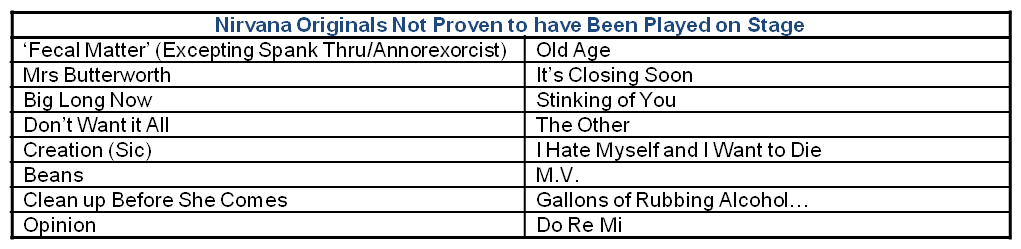
A couple weeks back I was examining the table of Nirvana songs showing the songs we can demonstrate were played the most/least. One category that I didn’t get to was the matter of songs for which we have no evidence at all that they were played — though I like to believe in miracles I genuinely believe there’s a number where there’s next to no chance of there being lost Nirvana shows where they were unveiled:

Picture1

One could also point to Beans and Escalator to Hell but realistically they are all tape/home studio experiments making little sense to even attempt live. The sliver of music known as The Landlord (or “The Landlord is a Piece of Sh** from Hell” to give it the full line) falls into the realm of Krist Novoselic fronted joke-songs so while, theoretically, it could have been worked up for a stage performance its unlikely to have had much time or commitment expended on it barring what might well have been an ad-libbed, improvised piece during an early practice session.

The most surprising songs on the list are slap-bang in the middle of it; Opinion and Old Age. In the case of the former, the song seemed well-evolved and well-worked by the time it appeared on Calvin Johnson’s radio show in September 1990 but this is belied by Cobain’s statement that “I just wrote most of the lyrics this evening.” While that may have been an exaggeration it’s unlikely to be too far from the truth given the utter absence of any sign of the song in any other form during the preceding months. Nirvana had barely been playing or practising given the temporary nature of their drummers since Chad Channing’s departure in a few months earlier; there was the short tour in August with Dale Crover, then the one-off show with Dan Peter’s three days before Calvin Johnson’s show but otherwise plenty of time for Cobain to prepare the music and tweak, re-tweak and re-write the lyrics. Old Age meanwhile seems to have been at a very early stage of gestation during the Nevermind studio sessions — another period with relatively few live shows taking place — then ignored during the craziness of the end-of-year tours and Nevermind’s explosion. What’s unusual about those two songs is that they’re they only songs between Big Long Now (January 1989) and the In Utero leftovers (Jan-Feb 1993) to not end up road-tested live at some point. Nirvana had reached their live peak, they were able to tweak set-lists and toss in songs in a wild fashion night-by-night, yet neither song seems to have been well-liked enough to be given an unveiling; a bit of a commentary on the status of each song and perhaps making it understandable why Cobain would give one of them away.

The Fecal Matter songs are a curiosity as it’s probable that at least some of them were played in amid the smattering of pre-Nirvana shows (three.) The discarding of identities in the early years of Nirvana was a crucial feature and, just as the new wave styling would hit the rubbish bin almost as soon as Sub Pop brought the band on board, so the garage punk version of Kurt Cobain’s music, the most overtly Melvins material he ever wrote, was a face he was fed up with in the two years before he properly took to the stage. Mrs Butterworth sits in the realms of “God Knows what happened” but if I was theorising the song belongs more to the Fecal Matter era than the Nirvana age. It’s quite similar to Downer in terms of the fairly ‘square’ structure, the relatively uncomplicated guitar riffs and the wordy approach — but, like a lot of the material recorded later in January 1988 it features experimental elements (most specifically the spoken-word interruption) so the song feels like a half-way house. The problem with it is that Cobain was already writing far more complex and interesting songs and it sounds more like a training exercise by comparison to Aero Zeppelin and such like.

Opinion should perhaps be considered primarily alongside Cobain’s experimental material from the 1988-1990 period. People forget that acoustic guitars were one form of experiment to a player who hadn’t spent much time with one and wouldn’t use one in a studio until the April 1990 version of Lithium, let alone on stage. In this category we can rank the song now known as Creation (still wrong but what the hey), Clean up Before She Comes, Opinion, Don’t Want it All and even Beans too (I’m ignoring Black and White Blues which sounds like a technical exercise or piece of whimsy) — Polly made it into the live arena because it was easily electrified as was Dumb (note first appearance in Nov 1990: http://www.youtube.com/watch?v=5_EQsUqlqno). Very few acoustic tracks made it into full Nirvana performances or onto albums — the MTV Unplugged performance has warped the view people have of Nirvana when really acoustic guitar was the realm of practices and messing about but rarely of ‘real’ songs.

This leaves the In Utero era foursome; is it strange that these four songs never made it onto the stage at any point? I think it says much about the way the songs were created. Again, like most of these songs we’re discussing, there’s very little evidence of extensive work on these tracks, at least two (Gallons and The Other) are an improvisation around pre-prepared slivers of lyrics, the other two sound like they were jammed together by Nirvana during or just before the January 1993 practice session with little more than riff and a few ideas from Cobain to work around. All four songs, despite their rough edged charm and original features, seem unloved fillers at best, songs that aren’t necessarily needed but might come in handy. Nirvana’s high standards are clear in the way that even some of the songs that made it onto In Utero itself didn’t receive many airings — with so many songs to choose from, and relatively static set-lists during the 1993-1994 touring, it was rare for any rarities to make it on let-alone these half-formed songs. Perhaps if there had been more touring then we might have seen something more but it’s unlikely. The rumours of a sound-check performance of Gallons of Rubbing Alcohol may be true (or maybe not) but I can’t imagine it being a word perfect rendition — more a loose jam around the theme perhaps?

1992: Incesticide’s Title Lettering, Nirvana and Sex Pistols Syndrome

In various sources people have pointed out that with one exception (the false ending provided to Pen Cap Chew so Nirvana didn’t have to pay for another reel of tape in January 1988) Nirvana songs didn’t end with fade outs – they all end dramatically on a final punched chord or a collapse into feedback. While this has often been said as if it had some mystical significance the same statement could be made of much output from the punk scene – I’m presently unable to think of a Sex Pistols song that fades…

As drug rumours circulated in 1992 Cobain took to making gallows humour comparisons recasting himself and Courtney as Sid and Nancy and even booking Nirvana into a recording session as The Simon Ritchie Bluegrass Ensemble in a reference to both the drug-addled collapse of the Sex Pistols’ number one fan and final bass player and to the general perception of Nancy Spungen as the woman who got Sid Vicious (A.K.A. Simon Ritchie) addicted to heroin just as Courtney was receiving blame for hooking Kurt on drugs (for the record, no, she didn’t.) This was as far as the connection seemed to go.

A deeper connection exists, however. I was questioned last year on whether I knew whether Kurt Cobain had made the decision regarding the lettering for Incesticide’s front cover and whether it existed on the initial painting he supplied to Geffen. I admit I didn’t, however, as Cobain was specifically granted complete artistic control it was, at the very least, approved by him. My belief at this point, however, has gone deeper.

Very early in Nirvana’s career the typography of their logo was set and remained relatively stable throughout their career – omnipotent during their major label spell with the exception of this one major release. The change to newspaper lettering was an echo of the Sex Pistols’ use of ransom-letter-style slicing of anonymous newspaper print. The original use of this in the 1970s was designed to be simultaneously a high-art concept indicating the way in which the influence of the media was integral to the success of the Sex Pistols to such an extend that it was integrated into the very way they presented themselves, as well as to exude pseudo-cheap n’ nasty qualities which were just as much a component of the identity.

The reuse of the concept by Kurt Cobain/Nirvana in 1992 came at a time when Cobain seems to have been well-aware of the points of comparison between his own band and their seventies’ precursor. By deviating from the band’s normal practice and adopting a Sex Pistols-esque text format for Nirvana’s name what was being pointed out was the way in whcih the band had suddenly become as much a construction of the over-the-top and ridiculous media frenzy as a real band. Nirvana in news-print was their primary existence in 1992, a year in which they barely toured and in which the majority of interaction with audiences and fans (and enemies) was conducted via newspaper and magazine pages. Similarly the trashy aspect of it fitted well with the nature of Incesticide, a leftovers collection, and with Cobain’s increasingly soured view on what was his main creative outlet.

A Musical Aside: Trunk Records and a Moment in British Music

MMsPackshot

While I’m whiling away the tail of the weekend spreading news of obscure music I’d like to draw attention to what I believe is the most bizarre record ever released. I’m referring to Trunk Records’ release of the buffet carriage announcements from the Midland Mainline train company’s London-to-Leicester route.

I’ve known of the release for years but never had the courage to order it. Basically, Trunk Records is an exqusitely eccentric outfit run by one Johnny Trunk. They seem to make many of their release decisions by going down the pub, drinking twelve pints of beer and waking up two days later to discover whether they unleashed a moment of genius or madness. I swear to you now, if you like downloads, take a look, if not, then make your life better by ordering one of their final copies of the “Now We Are Ten” sampler – it’s less than five pounds (as is the latest Lard sampler) and will make your life better.

http://www.trunkrecords.com/intro.shtml

At its most eccentric, Trunk has released recordings of his sister’s porn starlet fan mail set to music and other material that is funny for a listen or two but no more. At the other end of the spectrum, however, it has been an outlet for an entire era of British music that has been overlooked, minimised, dismissed and under-appreciated. The label specialises in rare film music (the finest are the soundtrack to Blood on Satan’s Claw and the Psychomania soundtrack), TV soundtracks with quite a few children’s shows (I own both the Fingerbobs music and The Clangers), old BBC electronics music (I recommend the Tristram Cary compilation, The John Baker tapes and an old school programme called The Seasons), plus a load of jazz-orientated material with other deviations into advert music and commercial music libraries.

Now, let’s be fair, I’m not expecting to be more than bemused by the MMS Bar Recording – I’m certainly going to wave a copy at my father and at my uncle (both train fans). The label, however, by its willingness to pursue a vision to the nth degree, to pause for playfulness, combined with the obvious effort put into finding much of this music and the extensive notes that help me make sense of their discoveries, have made a loyal fan.

The music I love from Trunk is that which captures a particular time in British music when the world was trying to come to terms with the arrival of new instruments – electronics – that offered a brief window when escape from the traditional structures of the western musical tradition seemed possible. its that sense that here i’m listening to a genuine moment of escape – to music that was trying forty-fifty years ago, in vastly more difficult technological circumstance, in a deeply conservative environment, to flee centuries of inherited musical systems. The window never opened too far, most music ever since has retreated to the rulebook with the new musical potential of electronics simply added to the palette alongside traditional acoustic instrumentation rather than acting as a way out into something truly new.

That doesn’t mean I think “modern life is rubbish”, not at all. The prominence of these experimental forms in primetime TV broadcasts helped create the vast appetite of today’s music for sounds and styles that are a world beyond what came before. Even in the most mainstream pop recordings we’re regularly hearing sounds that squelch, crackle, burr and quiver in ways that would never have been envisaged as any part of musical composition barely a single lifetime ago.

The other element that’s so potent (the Ghost Box label really delves into it), particularly on the Blood on Satan’s Claw soundtrack, is the brief openness to quite esoteric subject material. This was the height of British consideration of laylines, druidic rites, UFOs, mysterious big cats loose in the countryside – the merging of the ancient, wild and uncontrollable rammed directly into the ultramodern and similarly unknown potentials of new technology and new futures. It was a tantalising vision and a beautiful meshing of what seemed at first to be opposing interests. Musically the result was recordings that featured the latest in synthesiser technology, tape experimentation and early drum machines – while ghostly string and wind instruments played over the top or known forms would intrude.

On Psychomania,the link between past, present and future is made explicit. It follows the attempts by a young biker gang delinquent to use his mother’s talents as a witch to die and return as the undead. The soundtrack flares in all directions with modern funk and acoustic interjections sitting alongside slithers of uncomfortable conversation from the film and haunting electronic effects…

…What the hey. Go buy the samplers. I just fleshed out the collection a little and barely spent a tenner. Have a good Monday!