Reaction to Fame and the Name Game: 1992-1993

On a regular basis the lyrics and titles of Kurt Cobain’s songs often had only a loose connection – sometimes it was just a way of getting out phrases he liked at the time. Liked is perhaps an understatement; in the period from 1992 onwards he seemed to pay very specific attention to titles and to use them with weighty intent and as very direct commentaries on his circumstances and his particular grievances at the time.

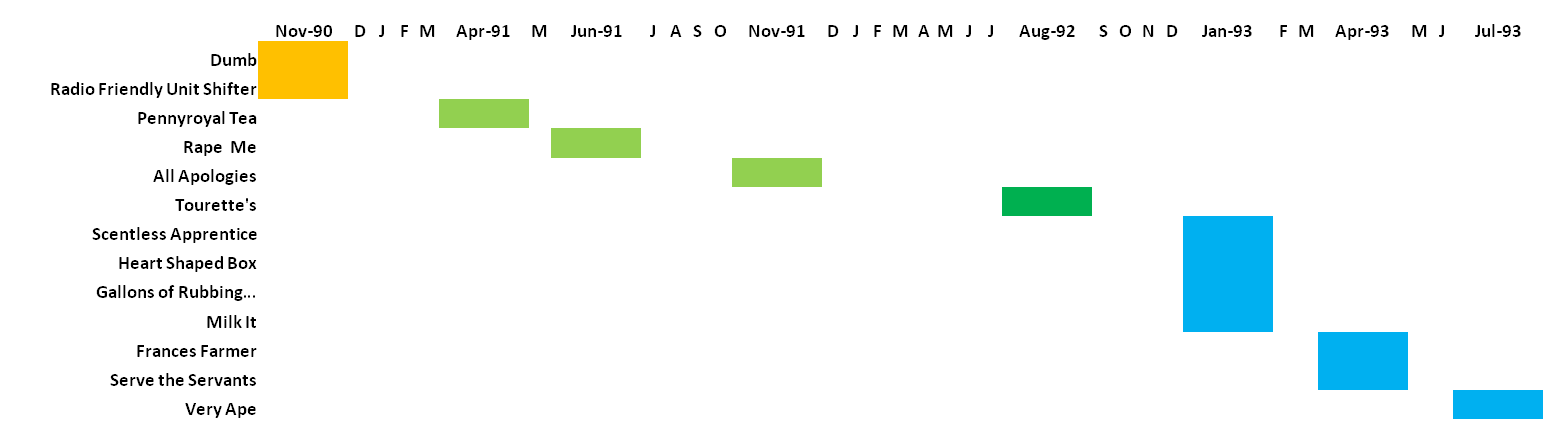
The examples are well known; Nine Month Media Blackout references the birth of his child and the cutting off of contact with what he deemed to be intrusive press — Radio Friendly Unit Shifter referring to commercially appealing single material (used for a song that was anything but — the inoffensive Sappy, a title with a five year heritage, being stripped and having Verse Chorus Verse grafted onto it making a point about the supposedly repetitious and tedious cookie-cutter music format he was trapped within — the In Utero album itself going through a few switches whether he wanted to reference sarcastic inquiries as to his state of mind (I Hate Myself and I Want to Die) or to reiterate the love of a particular title and the boredom motif (Verse Chorus Verse again) before settling on In Utero; back to baby references. This focus on the ‘in-your-face’ significance of titles, that these would be the repeated memes appearing in reviews and magazine articles, that these would be the first things seen and commented on even prior to the music and lyrics, was extensive. I’d also argue it was significant; the titles on Bleach and Nevermind were not devoid of meaning or connection to their subjects but they were not the jagged blades being deployed and aimed at enemies and irritations on In Utero and its surrounding single/compilation releases.

That stand-out messaging within titles continued with a number of other titles being equally literal and direct; Frances Farmer will Have her Revenge on Seattle linking to the much abused fallen star placed in an asylum by her mother and the court system — Serve the Servants referencing the Cobain family’s running around and subservience to court systems and parentage — Pennyroyal Tea’s abortion motif… What is less considered is how early, during this spell of fraught discontent, that the naming focus commences. I argued the significance of Incesticide in the Dark Slivers book (Christmastime jibe at happy family propaganda; reference to the discarded and neglected songs; killing the practice of damaging families…) but, beyond this, and preceding the In Utero sessions spell, there was a further outpouring; the April 1992 recording sessions.

The Journals make very clear that the two titles chosen and plastered onto Nirvana’s first post-Nevermind original recordings were related to one another. On page 185 a page long rant references, sarcastically, how he, Kurt Cobain, had betrayed the punk aesthetic with “oh the success! The guilt!” being a key half-smiling wail while “oh the guilt the guilt” forms the title. The same rant uses the word Curmudgeon to refer to rock critics in another phrase that would clearly stick with him mashing together “the self-appointed rock judge curmudgeon.” It’s a curious piece in that it also shows Kurt using the “I hope I die before I turn into Pete Townsend” line that he’s recording saying after a rendition of Baba O’Riley in Rennes, France on December 7, 1991; his retention of information is incredible, or alternatively the piece in the Journals dates to the December-January spell in which he was catapulted to worldwide, and unexpected, renown — to imagine him reacting against the press so early seems unusual, however, but still, possible.

The Journals take us further; page 260 shows both phrases being popular mantras he was using at the time — yet another dual reference to “pissy little self appointed judge curmudgeon oh the guilt! The guilt! The fame, the lights, the flash, the glitter, the guilt.” Again, Kurt Cobain seems to either read back his own diaries and hook out favoured expressions, or holds onto certain formulations. The latter suggestion is present in Cobain’s argument that he used “I hate myself and I want to die” as his standard rote answer to any inquiries about how he felt in late 1992 but whether that extends to this very precise Oh the Guilt/Curmudgeon expression it’s unclear. What is clear is that both expressions were clung to and were elements he wanted to broadcast to the world, slipping them out in Autumn of 1992 (Lithium single) and early 1993 (joint single with The Jesus Lizard) grafted onto the first new originals from Nirvana. The songs have been seen, traditionally, as an opening salvo prior to In Utero’s bile; this is indeed an accurate assessment. What is less appreciated is that they were revealing of a fresh approach to naming songs in which targeting his own annoyances and branding his enemies as directly as possible would be a priority.

These two songs are also a fair reminder that the traditional game of relating songs’ titles to the meaning of the song on which they are pasted, doesn’t always apply when it comes to Nirvana. Especially on b-side material, and particularly in this late phase, the words used to brand his songs didn’t bare much relation to the lyrical content of the songs even if it’s hard to think of them separately once the merging has been made.
Final Resistance: MTV Live n’ Loud, December 1993

Yesterday we mentioned the opportunity for the exceptional, the unexpected. Today I present to you the evidence that yes, reality can break its rhythmically predictable bounds. That evidence comes in the form of the MTV Live and Loud performance of December 13, 1993.

A single, barely fluctuating set-list persisted throughout December 1993 with only minimal changes right the way to the grand finale on March 1, 1994. The only time that a significant step away from the normal sequence occurred was for this single performance broadcast by MTV. In amid a tour consisting of a barely shifting choice of songs this performance freshened things up.

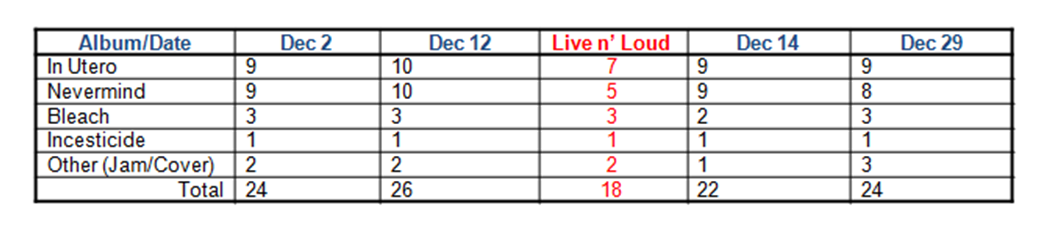
At first glance it seems a fair conclusion that Nirvana still felt TV appearances had significance, had more focus from senior management, and therefore had to be taken seriously — it can be seen in the fact that the band bothered having a proper rehearsal for it running through ten songs. The question follows whether the band needed to create a fresh one-off set-list to match the show time allotted and whether that show time was arbitrary or was set by MTV; the show featured just 18 songs compared to between 22 and 25 at every other show that month.

It’s clear that Nirvana used MTV Live and Loud as a showcase for In Utero. The band had to cut songs to match the time permitted. They cut between 3-5 songs off their normal set from Nevermind, but only 2-3 from In Utero; meanwhile they kept their three usual grabs from Bleach (Blew, About a Girl, School) and Incesticide’s usual sole representative (Sliver) — no cuts lost from the commercially lesser albums despite the sense that would have made at an event about promoting the band to the mainstream audience of MTV. A normal set list at the time featured the following breakdown divided by album (various dates for comparison):

Live n Loud Comparison

It made perfect sense to cut from their best known album if the priority was simple boredom, however, as with my commentary back in December regarding MTV Unplugged in New York) there appears to be a similar refusal to give MTV the favourites given an aversion to Nevermind doesn’t affect them at any other point in the tour. The most glaring case is that this is the one and only time in December that the band doesn’t play Smells Like Teen Spirit. In fact it’s one of only nine occasions on the whole Oct 1993-Mar 1994 In Utero tour that the band didn’t play it; the last time until Nirvana’s final gigs on Feb 27 and Mar 1, 1994. Also, it’s the only occasion throughout the whole tour when Nirvana simultaneously cut In Bloom — another crowd-pleaser.

Certain cuts make absolute sense in certain contexts; the removal of the mellow Polly, Jesus Don’t Want me for a Sunbeam and Dumb are understandable deletions — bringing Lori Golston’s participation on cello down to a barely audible part on two songs — if the desire is to maintain tempo uber alles just as surely as they were extremely reasonable additions for MTV Unplugged in New York where the contrasting desire was to the fore.

The opposite desire is also visible, the urge to increase volume and heaviness; according to the Nirvana Live Guide the MTV Live and Loud appearance was the final time Nirvana finished a gig with a rendition of Endless Nameless and one of only three appearances it made after October. On this occasion they spent a full fifteen minutes, a fifth of their time on stage simply making a glorious and utterly un-MTV friendly racket. It’s the most extensive destruction Nirvana staged at any point in the In Utero tour, a harking back to former stage-wrecking glories that had since been given up. I also suggest it served a function; it meant Nirvana could fulfil an allotted stage time while simultaneously cutting short the amount of usable material MTV had to work with. The band had simply walked out quarter of an hour early during a previous live appearance on MTV in 1992, this time the sense of time-wasting is tangible — look how much aimless yet calmly methodical activity Kurt persists with during that final spell; ramming the guitar into the speakers, ‘baseball batting’ the angel stage set, treating his guitar as a skateboard, a persistent effort to hit the ceiling with his guitar, lots of running directly at cameramen who back away nervously, or alternatively moving away as they try to shoot him.

It returns us to the question of running time — a Nirvana show in late 1993 consisted of well over twenty songs, perhaps with a jam on the end but usually not. On this one occasion the band played 16 full songs then fifteen minutes of noise — they could have fitted at least another four songs in but for whatever reason chose to resurrect the noise jam and destruction rather than play out another tranche of hits. It’s sad, however, that at this point in time, the urge to change meant cutting from the normal set-list rather than thoroughly revising what the band was capable of playing together. The absence of rehearsal time, of time together, was showing.

Throughout the audible antagonism toward MTV there’s quite a few element of further aggression. For starters he beckons the audience on stage, anathema to MTV directors who might prefer to look after their expensive cameras rather than face an stage invasion by adrenalized mosh-pit junkies. Around that Kurt amuses himself spitting on camera lens forcing a switch from camera to camera as they clean the previous one — he’d done something similar at the start of year, exposing himself to a camera on stage in Rio de Janeiro. The applause to the audience at the end is a sarcastic move taken direct from comedienne Joan Rivers who usually starts a gig (and ends it) insinuating the audience are performing seals.

MTV Live and Loud was the last significant deviation from script for Nirvana. It was a last defiant roar at the cameras, a refusal to play to or please the wider corporate audience (regardless of the desires of the audience in the room) and yet another reinforcement of Kurt Cobain’s highly uncooperative relationship with TV that ran all the way through Top of the Pops, The Word, Saturday Night Live and all the band’s MTV performances.

I reedited this at 22.00 UK time because the image that had stuck with me all day was exactly the kinda overloaded final thought that journalists usually end an article with – all the image consists of is Kurt Cobain, alone on the stage for the final five minutes of the show, menaced by or menacing the cameramen, trying to throw is guitar as far up and away as he can, completely divorced from the band and obsessively going through whatever internal processes that keep him there jerking from one act to the next in a whimsical and unhappy looking manner. Take a look, isn’t there something a bit scary about it in retrospect? Maybe. That’s the problem with final images, they never live up to billing.

Four Walls and What Was Made

Kurt Cobain's Homes_1967-1994

A pause to give credit where it’s due, http://www.shapedbox.blogspot.co.uk featured an excellent range of photos of the houses and I have used a number of them for the collage above. Credit for the Pear Street photo must go to Diamond Brooke and her Flickr feed – again, worth a look for Nirvana fans.

Over the past two days we’ve been dividing Kurt Cobain’s life down into time spent in specific ‘homes’. Naturally I accept that a lot of what I do on this site is simply aggregate existing data but I’m often stunned by the picture that results simply by loading data into a single view.

My reasons for compiling the data, initially, was that I wanted to attempt (as best as possible) to correlate Kurt Cobain’s song-writing to where he was while writing. In the kind of coincidence to gladden the heart of any data chimp (a friend once bought me a t-shirt reading “I love data” repeated over and over — thanks Shane!) the picture that emerges is remarkably clear.

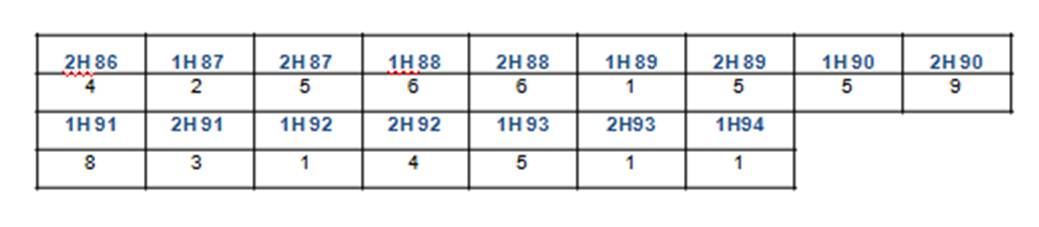
To the best of my ability, in the Over the Edge chapter of Dark Slivers: Seeing Nirvana in the Shards of Incesticide, I’ve tried to pin down, to periods of six months, roughly when Kurt Cobain wrote various songs. The approximate result is as follows:

Songs by Half Year

I’ve not included the Fecal Matter songs (e.g., Spank Thru or Downer), nor have I included Kurt Cobain’s solo experiments (i.e., Montage of Heck) simply because it’s hard to pin down when they were made with any degree of guesswork. The only changes I’ve made since the book are to include Opinion in 1H 1990 and shift Tourette’s to 2H 1989. When compared to Kurt Cobain’s living arrangements, however the results are emphatic:

Songs by Home_Figure

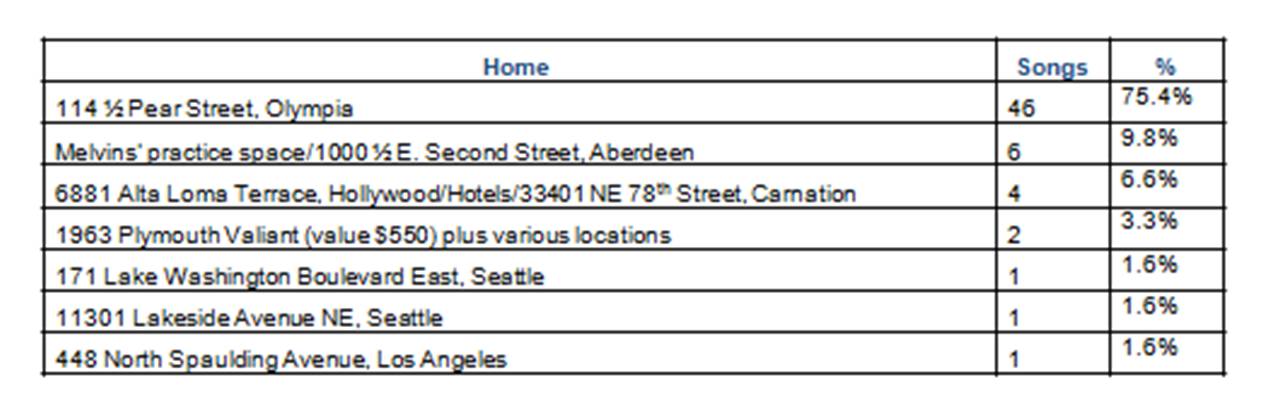
While money may still have been hard to come by during the years Kurt Cobain spent in Olympia, it truly was his artistic home. Given how long he spent in that location it’s no surprise that he wrote more songs there but the sheer quantity is overwhelming:

Songs by Home_%

Dividing the figures by time spent in the location doesn’t alter that picture of dominance:

Songs by Home_Per Month

While making clear that Kurt Cobain’s peak occurred in Olympia, there is some fudging involved that I can only acknowledge but do not have sufficient information to fix. If I could untangle Kurt Cobain’s living arrangements from January 1992 until January 1994, it wouldn’t erase the overall picture but it would make clearer whether, for example, the Carnation house permitted a real focus on writing or whether most of the work was done while running around hotels and temporary accommodation with Courtney. Similarly, the two songs written in the second half of 1992, I’ve noted as Curmudgeon and Talk to Me (based on live data) but Curmudgeon at least might more properly belong earlier in 1991, I can’t prove it. The dominance of the Olympia spell may be even more pronounced given Kurt moved there in April 1987 so my estimates, based on six month periods, don’t correspond perfectly — 114 ½ Pear Street may filch a song or two from the previous eight months spent in the Melvins’ practice space and at 1000 ½ E. Second Street.

The first spell of relative stability Kurt Cobain had enjoyed since he was a child seemed to allow him the space and time to write and create. Tracy’s willingness to support him also meant he didn’t have to divide his time quite so much between work and music — though she, very reasonably, came to resent him sponging off her it did have a beneficial effect on his core pursuit. Similarly it can’t be underestimated that Krist Novoselic provided Kurt a steady and dependable musical collaborator reducing the impact of changing drummers so often and ensuring ideas could be turned into full work relatively swiftly. Kurt was surrounded by beneficial circumstances thanks in large part to the individuals he could now rely on.

My ultimate thought on the ‘meaning’ of all this information is that the place of greatest veneration for any Nirvana fan shouldn’t be the house at 171 Lake Washington Boulevard East. The place where the majority of Nirvana’s music was created, where Kurt Cobain truly lived as a creative soul, was at the unassuming and unglamorous property at 114 ½ Pear Street, Olympia between April 1987 and July 1991. To my mind, celebrating the place that gave the safe cocoon needed to build something is of far more importance and significance than the barely lived in site where he chose to tear everything down.

Life Long Latchkey Kid: Kurt Cobain’s Homes Part 2

Yesterday we examined the record of Kurt Cobain’s childhood wanderings, how he was shunted from home to home throughout his teens. Finally relative stability arrived in the form of his first long-term relationship with Tracy Marander and a resulting departure from Aberdeen. That single residence on Pear Street in Olympia ended up being his home for just over four years, the longest he’d been in one place since he was nine years old though the couple did change flats within that building and Tracy did move out to be replaced as flatmate by Dave Grohl.

Returning home in the aftermath of the recording of Nevermind, the move to a major label, standing on the cusp of his true fame Kurt managed to get himself thrown out for not paying the rent. That was the end of the stable spell of life. It’s genuinely fascinating realising that the rock star who ruled planet Earth for that spell in the early nineties didn’t have a home from July 1991 until January 1992; imagine it, the biggest rock star on the planet as living in his car.

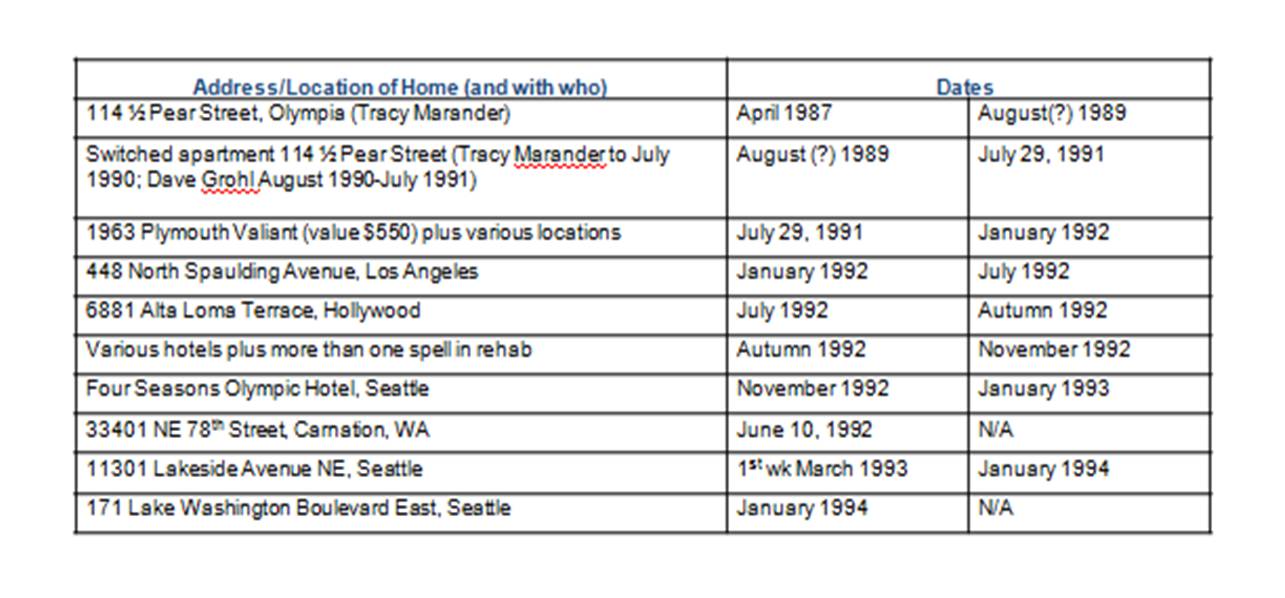
Even after that, there was still nothing close to a home. Kurt Cobain — now with wife in tow — bounced between rented apartments, tour hotels and hotels in LA and Seattle right through until spring of 1993. Even with all the money now floating around him, it doesn’t cease being the case that he was essentially homeless. At least this time there were comprehensible reasons, the Cobains were trying to purchase a home but there was little time in between tours, festivals, recording, battles with the authorities over custody of their child and major drug problems. In the chart below I haven’t calculated the spells spent in a number of rehab facilities:

KC_Homes_1987-1994

It’s curious, having arbitrarily made the start of Nirvana and of Kurt’s relationship with Tracy the dividing line between his youth and adulthood, that the pattern is much the same as his childhood with the stable period being superseded by yet another spell, this time of three years from age twenty four until his death, during which he lived in six definite locations and a slew of temporary accommodation.

One link (www.city-data.com/king-county/N/NE-78th-Street-1.html) has conveniently placed the sales record and other details of the Carnation home online:

Carnation

It’s an intriguing property because, despite the understandable attention paid to the site of Kurt Cobain’s death, it was the Carnation property that was the first home he owned and that was retained throughout the maelstrom of mid-1992 through 1993. It’s also mysterious because it’s impossible to tell how much time Kurt Cobain actually spent living at the house or why it seemed to be less than wholly beloved. For whatever reason retreating to a country village, one with a population of just 1,243 in the 1990 census, where Wikipedia lists the local activities available as “Harvold Berry Farm where you can pick your own berries in the summer”, doesn’t seem to have worked regardless of whether the idea was to evade drugs or intrusion in general. There is a rumour Kurt returned to the home sometime in early April having fled rehab.

Working out the estimated dates of accommodation also throw Cobain’s relationship with his place of death into the spotlight. The Cobains moved into the Lake Washington house in January 1994. Nirvana toured until January 8. Kurt joined the band for their final studio session on Jan 30 then they left on tour two days later. He was in Europe until March 12 when he was definitely home given the Police were called to a domestic incident that night and again on March 18. He headed into rehab on March 30 returned home around April 3. At most Kurt Cobain lived in that house for three weeks in January, then just over two weeks in March.

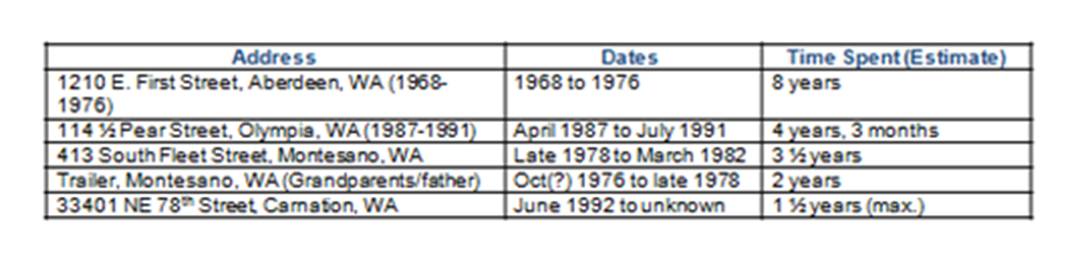
Observing his entire life, ranking locations, what emerges is as follows:

KC_Top Living Locations_1967-1994

Of the 25 ‘phases’ identified, only five added up to more than a single year. Worse, of the years spent in solid locations, 13 ½ of those years took place from the age of less than one to only just fifteen years old. The remaining half of Kurt Cobain’s life, his entire rise to young adulthood, involved only the briefest of respites in which he had something that could be called a home.

Life Long Latchkey Kid: Kurt Cobain’s Homes Part 1

Reading the various biographies of Kurt Cobain and Nirvana, the point is frequently made that Kurt had lived what could gently be described as an unsettled and nomadic existence pretty well from the time of his parents’ divorce in 1976. Ladled out on top of that is a patina of genuine poverty throughout his later teenhood leading to periods of homelessness stretched right through until he hit twenty in 1987. Relative stability arises from that point yet still there are tales of being slung out of rented homes even as late as the middle of 1991 when he was now 24. Linking together the references makes his later life seem a more moneyed return to drifting with hotels filling gaps even when he wasn’t on tour or fulfilling band duties. Purchasing a home for the first time in 1993 simply doesn’t stop that sense of a man floating free of physical locale — the final year of his life saw him buying one home, renting another, buying another, while simultaneously spending regular nights in motels and drug hangouts.

Sourcing the data, I ended up simply staring at it — adding up the regular moves brought home precisely how devoid of refuge the life of Kurt Cobain had been:

KC_Homes_1967-1987

This is the life of Kurt Cobain to age twenty. It was hardly a comfortable life in the early days given the combination of tight financial circumstances, mounting parental discord leading to the parents splitting in March 1976 before a final legal pronouncement of divorce in July, then the spell sharing a trailer with his father and grandparents, followed by the spell with his father and eventually his father’s new partner and her children. But it was from March 1982, once he had turned fifteen, in the aftermath of ever-increasing battles with his father, that Kurt’s living arrangements implode.

From the age of fifteen until the age of twenty he barely stayed a year at any address. There are nine definite homes in which he lived during that phase and one period where, at best, it could be said he was a ‘guest’ of various relatives and relations. During this crucial phase of life it’s easy to understand why the conclusion of formal schooling became challenging, likewise why, existing disaffection would be expanded into an all-encompassing sense that he was unloved and unwanted.

Further reinforcing the sad picture, in each of 1984, 1985 and 1986 he endured spells of homelessness. To be fair, none could have lasted longer than a couple months but still, for certain periods of his late teens Kurt Cobain barely knew from day-to-day where he was sleeping. He was even forced back in with his father despite the extreme tension between them — his dad found him living on a couch in a back-alley. Again, it makes it easier to understand why locating regular employment proved challenging given his disrupted living arrangements.

By 1987 he had lived through seventeen different locations or phases in his young life. The longest he had a home for was the eight years that corresponded with his infancy and the only time when he was part of a true family — the coincidence of family love and physical security reinforces why he would remember it as an idyll lost forever.

In Utero and the Second Age of Experimentation

In Dark Slivers I wrote a whole chapter, Post-Mersh, entirely about the golden age of Kurt Cobain’s musical experimentation basically centred between 1987-1989. I feel I overlooked a similar flourish in 1993, one I hadn’t even considered before.

While the earlier period saw Kurt Cobain probing and testing what could be done with sound while on a budget of bare pennies, 1993 afforded him, and Nirvana, the chance to buy in new sounds. Kurt’s increasing distain for continuing with what he was doing, the way he was doing it, had one positive consequence which is that it led to more space for the band to try new things.

A first new direction came via the addition of Dave Grohl as an active contributor of musical ideas. This began with Dave playing Kurt a demo of Alone + Easy Target recorded in 1991. Kurt responded enthusiastically reportedly saying “oh, finally, now I don’t have to be the only songwriter in the band!” The first tangible collaboration was the arrival of Dave’s ideas that became Scentless Apprentice at rehearsals in late 1992. This was a genuinely new development; Chad Channing has stated that he felt openly discouraged from having pretensions toward creative participation in Nirvana’s music. Now, in 1992-1993, Kurt even said in interview how pleased he was that some of the burden would be off his shoulders.

Of course this new potential didn’t last long. Rio de Janeiro in January 1993 saw Kurt allegedly supplying some backing vocals to the demo’ed cover of song Onward into Countless Battles, so some forward motion was being maintained. Then Dave’s song Marigold was used on the Heart Shaped Box single. The only problem there, however, was that when Dave recorded the song at the Pachyderm Studios sessions in February 1993, Kurt didn’t perform on the song at all. Rather than a fresh collaborative approach it’s more like using his band members for convenient filler at a time when he had far less to offer.

After that it’s hard to disentangle the general spiral of Kurt Cobain’s life from the specific issue of band collaboration. It’s certainly true that after the PR-friendly statements about this fresh creative input to Nirvana’s music, there was barely any studio play or rehearsals whatsoever. It’s possible the public statements were a reflection of Kurt’s famed inability to openly confront many things he was unhappy with. That would make the long absence of collaboration with his comrades in Nirvana a way of giving a hint at how welcome he found their desire to participate as equals rather than as faithful supporters of his vision. Or maybe it was simply a relief to opt-out of the music and focus on making collages and art works at home with which to decorate the music that was emerging.

A common pattern with many bands, once they’re in possession of the money and fame to get away with it, is that they seek out a wider array of musical options to toss at their recordings. As examples, think of Guns n’ Roses with the grand pianos and string quartets, or Radiohead with the wholesale move into beats and keyboards. Nirvana never went that far; it was a vestigial opening in their sound that notably shied away from electronics or from a zeitgeist-hunting dive into the latest sounds.

Instead Nirvana reprised ideas they had briefly nodded to in the past — it’s a curiously circular path, part of a wider span of evidence that I’ve pointed to in the sample chapter I placed on here in the November 18, 2012 post. The addition of a second guitar seemed a genuinely desired option with Nirvana trying Big John Duncan (formerly and most famously of punk band The Exploited) before settling on Pat Smear (formerly and most famously of punk band The Germs.) It’s intriguing that just a year after Incesticide had tied Nirvana to various strains of the underground (to be followed by the link up with The Jesus Lizard), Nirvana attempted to add such solid punk era credentials to their line-up.

Pat Smear genuinely did seem to add creative options for Kurt Cobain as well as relieving live burdens. The final known recording work by Kurt Cobain involved Pat, similarly Pat has spoken about abortive requests from Kurt to work together in hotel rooms on tour. Again, though it didn’t add to a broadening of the instrumental palette, a second guitar could potentially have added something new to Nirvana’s sound.

The Pachyderm sessions apparently saw a brief jam attempted, now known as Lullaby, utilising an organ located at the site. The three instruments listed in Gillian G. Gaar’s description of the piece are “organ, bass and drums” suggesting that, once again, Kurt Cobain had discarded his guitar and had ended up on another instrument, an increasingly common feature. The dual role of vocalist and lead guitarist always automatically made Kurt Cobain the front man and figurehead. Having a second guitarist, or these periodic switches to drums (Sao Paolo concert in January, one song in the Rio sessions, here at Pachyderm, the 1994 home demos) appear to be a way to step back into the shadows to some extent, to abdicate the central role.

Lori Goldston’s addition on cello was another repeated preference. Originally band friend Kirk Canning had added the instrument to Something in the Way back in 1991; Kera Schaley then took over and applied touches to Dumb and All Apologies in 1993. To then add Lori Goldston as a full addition to the touring ensemble was a fresh step but not an unprecedented addition to Nirvana’s music. It’s interesting that, while a perfect fit for the MTV Unplugged in New York format, Lori’s inclusion had already been decided on and had taken place earlier — happy coincidence. It was at that show also that the final new instrument, Krist Novoselic’s accordion detour on Jesus Don’t Want Me for a Sunbeam took place.

The acoustic direction has been suggested as one direction for Kurt Cobain; a few months back I suggested that the trend in his music seemed more toward the noisy with acoustic guitars remaining a feature for home practice only…Now there’s a new option, perhaps there could have been a fleshed out and fuller Nirvana, a more cluttered, yet also more orchestrated and mature sound. It’s a possibility.

…But I admit it. I’ve been trying to be positive yet the evidence amounts to scraps. The addition of such punk-originated second guitar options perhaps supports the idea that 1992-1994’s turn toward noisier songs would continue. Or the permanent concert residency for the cello may mean that the mooted acoustic direction could have also ushered in a wider arsenal of ‘organic’ instrumentation. Or in a continued Nirvana either Dave or Pat might have been the source of a dilution of the Cobain-centric band creating new directions for the music. 1993 deserves to be seen as a new age of experimentation for Nirvana, but one that simultaneously shows evidence of disinterest and/or a sense of confusion about what the future should be, or whether there was a future at all.

Kurt Cobain: Such a Precious Petal

Lillies

One of Kurt Cobain’s beauties was that he was simultaneously explicit about his reasons, but rarely simplistic. The matter of flowers is a case in point. I recall, back last month when I was suggesting that I didn’t find MTV Unplugged in New York a necessarily joyous occasion https://nirvana-legacy.com/2012/12/21/disquiet-mtv-unplugged-in-new-york), someone quite reasonably said “well, so what if Kurt asked for some flowers?”

Well, I feel there’s quite a big so-what. Kurt is absolutely clear that he doesn’t pick lilies as a key component of his decorative world because they’re merely ‘his favourite flower’ or because he finds them ‘pretty’. The request for MTV Unplugged in New York was very clear; lilies, black candles, crystal chandelier and as the all-knowing Oracle Wikipedia declares the show’s producer responded “you mean like a funeral?” to which Cobain replied “exactly. Like a funeral.”

But this isn’t the only reference to flowers. Within his Journals, in the sketched ideas for a video for the song Rape Me, he notes down “preferably lilies, orchids, ya know, vaginal flowers.” Wonderfully, however, this wasn’t the first time the vaginal flowers had been on his mind. Back in the spring of 1993 he had incorporated these same flowers into the artwork for In Utero with a piece explicitly entitled “Sex and Woman and In Utero and Vaginas and Birth and Death.” And again around the same time, for the Heart Shaped Box single cover, he was using the flowers again on a song that Courtney Love has stated is about her vagina. That charming comment from Courtney is backed up by the circling themes woven into the song; it was originally called Heart Shaped Coffin, it’s laced with ideas like the umbilical noose, a charming combination of woman and death all over again. And even this wasn’t the first time he’d gone with the flower angle, In Bloom in late 1992 had focused specifically on the stamen, the plant’s reproductive organs. It seems that for a period of somewhere over a year (at least) Kurt Cobain’s visual imagery was highly specific and focused. When it comes to covers and even stage decoration he loads the place with reproductive imagery and links it to death.

If we wanted to expand then it’d be easy at this point to comment on naked babies, pregnant women, seahorses too but instead I want to go in a different direction and refer to sex in the lyrics of Kurt Cobain — there isn’t much to be honest but let’s look. In total it amounts to four songs featuring rape — Floyd the Barber, Polly, Rape Me and the Fecal Matter demo track Laminated Effect — plus the song Moist Vagina, plus a mention on Gallons of Rubbing Alcohol Flowed Through the Strip. What I find intriguing is we’re looking here at songs involving sex and death (Floyd the Barber), an original title for M.V. which ended in “and then she blew him like he’d never been blown, brains stuck all over the wall”, rape and AIDS (Laminated Effect), oh, and Gallons of Rubbing Alcohol combines absence of sex with implied pregnancy and a missing period then has AIDS victim Perry Ellis guest-star.

I genuinely believe one of Kurt Cobain’s most unique qualities as an artist was his ability to work on multiple levels of meaning whether those combinations were humour and horror, delicacy and brutality, or in this case, the knowing use of flowers to represent sex and death, in public, uncensored, throughout that late period. Yet the association of sex and death (it’s the ol’ Doors vibe all over again) had more regular origins in his music with a long-standing issue returning to the fore in his married life. He doesn’t ask for flowers; he asks for a funeral and for vaginas – married, buried. Make of it what you will, I have.

Just as an aside, someone check me on this; Kurt chose the image of him in a Santa hat (partially obscured) for the inlay of In Utero, is it coincidence or self-parody that the frail old man in the Heart Shaped Box video (Christ pose, straggly hair, little beard, piercing blue eyes, thin, weary) also wears a Santa hat…?

The Path to an Album Part Two

With only three sets of comparable data trying to state a definitive and rigid prediction is simply impossible. What yesterday’s post and today’s post are presenting aren’t in anyway scientific measures — it’s just as easy to say Nirvana had releases in 1989, 1991 and 1993 so they’d obviously pump an album out for late 1995. Reemphasizing the difficulty in such a clumsy rule as the gap between first and last song played live from an album, if Talk to Me was to feature on a mythical fourth Nirvana album then taking its Nov 1991 appearance as the start date, Nirvana were overdue for an album as early as July 1994 — that’s the problem with limited data…

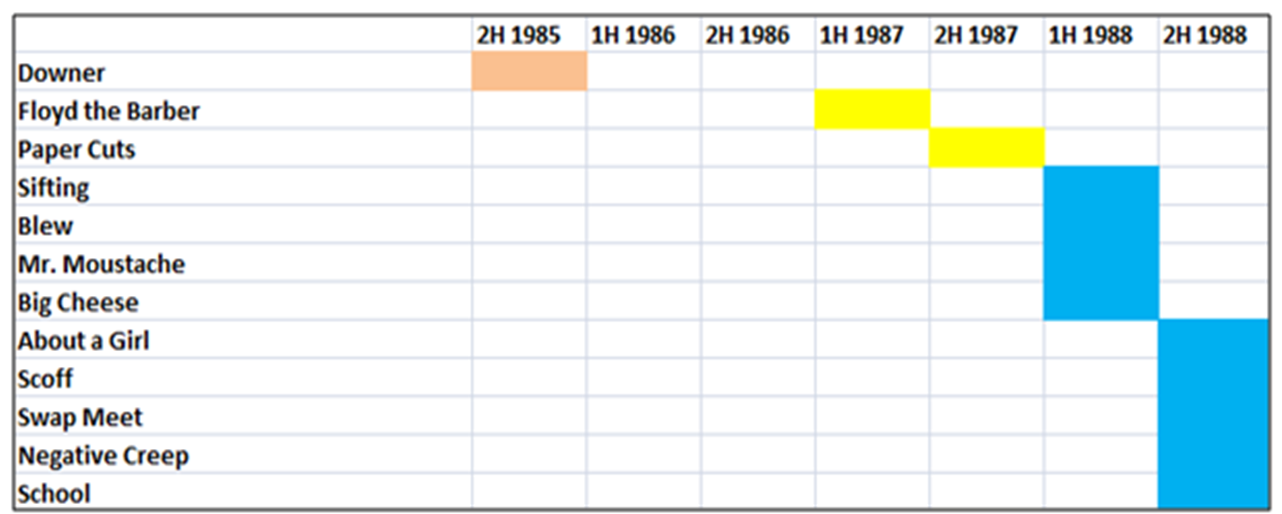
Let’s try it another way. In Dark Slivers I tried to pin down Kurt Cobain’s writing to likely periods of six months, it’s impossible to go further and naturally a few songs will shift period if new information appears. This meant working from known demos, live dates, likely evidence (i.e., the news story Polly was based on.) While not as precise as the live appearance data it’s still possible to attempt to measure the first and last songs being developed prior to an album to show how a Nirvana album evolved over time. Let’s start with Bleach:

Bleach Development_v2

Gillian G. Gaar argues convincingly for Fecal Matter having been recorded around March 1986 but still it’s unclear if Downer’s origins were in late 1985 or early 1986. I’m also shy of placing Downer here simply because it wasn’t Kurt Cobain’s choice to include it on Bleach, it was Sub Pop’s. Now Nevermind:

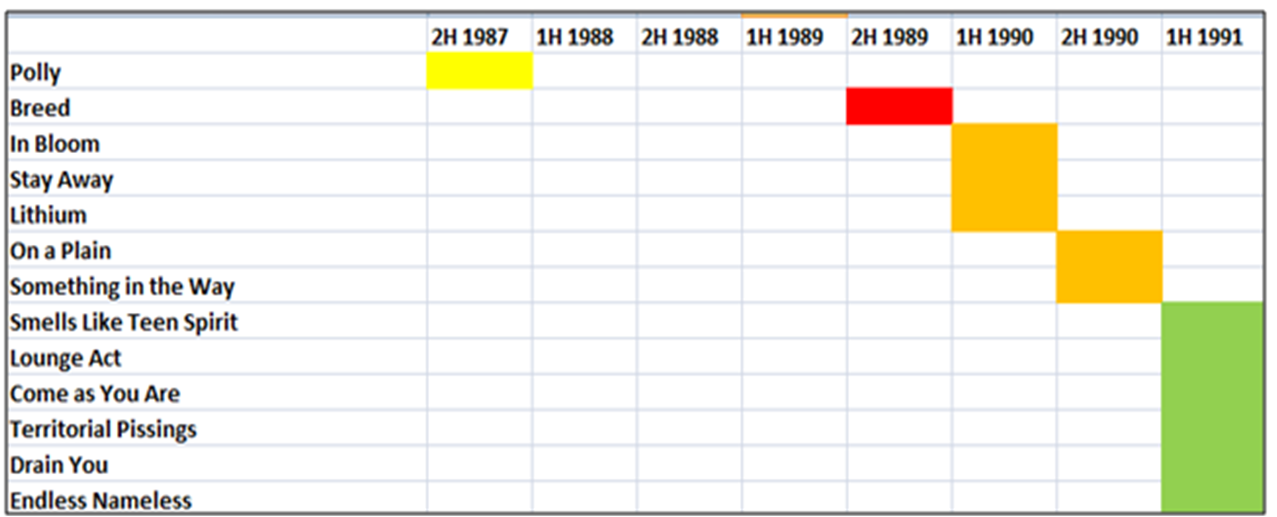
Nevermind Development_v2

Some of the first half 1991 songs may have already been sketched out in 1990, hard to say but the overall pattern is still clear. Again, note the one ‘early riser’ then the clicking into place over the two years prior to an album. Finally, In Utero:

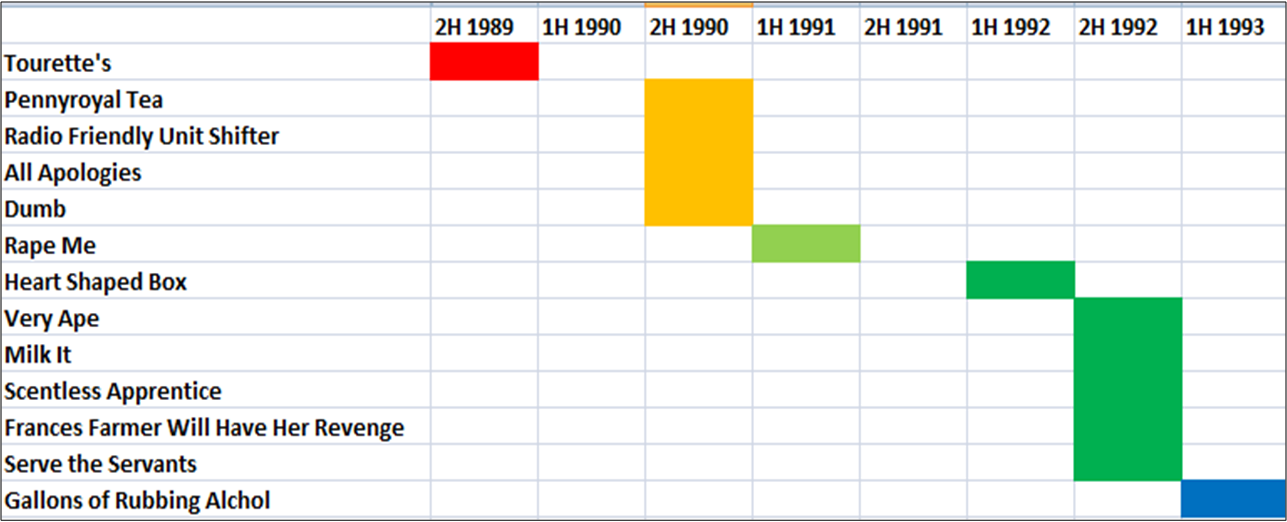
In Utero Development_v2

A far more ramshackle pattern and with a few provisos. Firstly, Krist Novoselic believes Tourette’s was first written in late 1989, but the earliest evidence for it is a ten second run-through of the main riff during soundcheck in November 1991 so either it stays where it is or it fills that gap between Rape Me and Heart Shaped Box. The consequence would be to shorten the album’s development down to three years.

As it stands, and compared to yesterday’s fairly sturdy pattern in the live performances, what we’re looking at is a greater span of potential. Eliminating Downer brings the development of Bleach down to a mere two years. Shifting Tourette’s into the 1991 slot makes In Utero a three year process. Nevermind, however, remains a four year project. Returning to the attempt to estimate when a fourth Nirvana studio album may have arrived, let’s take You Know You’re Right’s appearance in October 1993 as the de-facto starting point, seeing as we have so little else to work from. We’re hitting second half of 1995 all the way to first half of 1997 to finish writing meaning an album release anywhere between first half of 1996 to the last half of 1997.

There’s nothing unexpected here in predicting a wider gap between In Utero and the next Nirvana album. To get In Utero out just two years after Nevermind Kurt (and the record label) had needed a further year and a half, even leaning on the half-a-dozen songs already in place. By comparison, to create Nevermind, Nirvana had started from scratch with just one song dating before late 1989 and it had taken a full two years to get the rest done. Following In Utero we’re looking at a situation comparable to the latter example; there was next to nothing in the vault the band could kick off from, they were starting from scratch.

The only hope would have been scraping together Opinion, Talk to Me, Verse Chorus Verse, together with You Know You’re Right and Do Re Mi to make a bedrock of five songs up to first half 1994. Even then, however, staying true to form, Kurt Cobain would likely have needed a crucial year and a half to wring another seven songs out. He admitted himself he was never a prolific writer, he was neither a miracle worker, nor blessed with the equally divine ability to pull songs out of his ass — he would have needed free time and inspiration to get more out.

In conclusion, if we extrapolate from the gap between first and last song for an album to appear live, we’re talking an album sometime December 1995 to July 1996. If we look at the overall developmental path for Nirvana albums, the earliest date is still on track, first half 1996, but the potential late date is pushed out as far as second half 1997…

…But then again, it’s art, not science. Nirvana may have bucked the trends of their album development, and the trends of 1993-1994 in general. Rebirth and rejuvenation were possible. But there are quite a few ‘ifs’ involved. Either way, a longer wait was likely.

The Path to an Album Part One

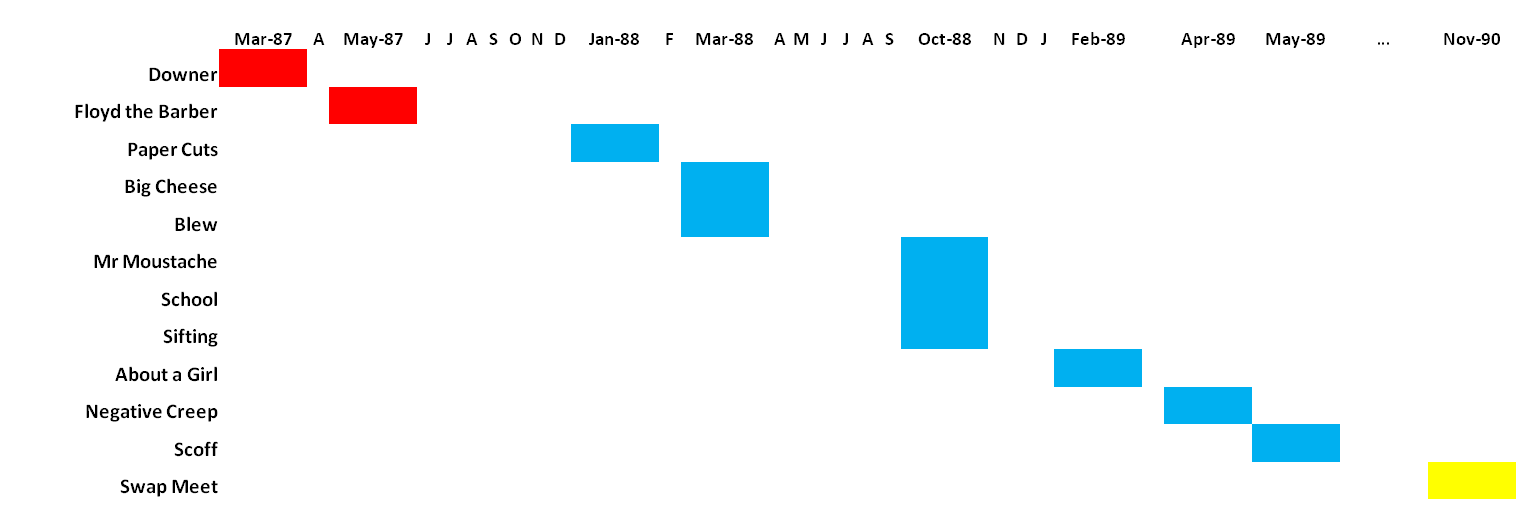
While examining the live sets over the past month, arranging data and seeing how it fell, one noticeable element was how strangely regular the development pattern toward each album was if judged according to the live record. For comparison, here’s when the songs on Bleach first appeared at a live show:

Bleach Development

Ignoring the weird outlier of Swap Meet (it’s unlikely this was its first performance), the span from the time the first track for Bleach appeared live to the last is 27 months. Then again, to be fair, Downer was Sub Pop’s inclusion in 1992 not Kurt Cobain’s, so perhaps we could start in May 1987 with Floyd the Barber as the first song for Bleach; 25 months. Now Nevermind:

Nevermind Development

Nevermind is almost precisely the same, a grand total of 26 months from first song to last to appear in the live record. Finally, In Utero is a little different:

In Utero Development

A total of 33 months between the first live appearance of its first song and the last. The result is three albums, each whipped into shape over the course of two years, one month up to two years, nine months.
Prediction is the art of making oneself look a fool but at least it can act as a guide. In this case, if Nirvana had stuck to the norm, a new album would have been likely around two and a half years after its first song made a live appearance. The problem is, after each of Nirvana’s first two albums, the first songs attempted straight after were explicitly intended for stop-gap recordings and singles — it suggests perhaps You Know You’re Right would be for that same purpose.

On the other hand, as a counter-argument, during the Bleach sessions Nirvana didn’t record any leftovers for singles which is why there was the pressure around whacking songs out in 1989 (Do You Love Me, Dive, Been a Son, Stain). Similarly the Nevermind sessions didn’t yield any B-sides, Nirvana had to reach back and grab Aneurysm from the previous January, then further back to the BBC session that yielded Turnaround, Son of a Gun and Molly’s Lips, and then they ran out forcing them back into the studio to crank out some quick-fire material in April 1992. For In Utero the band, for the first time, deliberately made sure they had enough in reserve they wouldn’t need to come near a studio for a good length of time; February saw them record Sappy, I Hate Myself and I Want to Die, Moist Vagina as full band compositions, then Marigold without Kurt. So, maybe, for the first time, the band wouldn’t have been putting together throw-aways, perhaps the gap to the next album would have been shorter and You Know You’re Right may have had a place in a greater piece of work.

Taking You Know You’re Right as performed in Chicago on October 23, 1993 as the first live rendition of a song for the next Nirvana album, even then the trend would suggest the last song for the album wouldn’t have made it on stage until some point between Nov 1995-Jun 1996. Of course, that last song, in the case of Bleach, Nevermind and In Utero, had only made it on stage one-two months before the release of the related album suggesting an album, at the earliest, in December 1995 to July 1996.

But, of course, the data is flawed…Let’s talk more tomorrow because the pattern is worse not better than the live data would suggest.

Nirvana Live: Missing From Action Part Two

It’ll be no surprise to learn that a lot of Incesticide’s early material suffers from the limitations of our vision at twenty years distance. Yet, what is noticeable is more the centrality of some songs to Nirvana’s live identity in the early days. Mexican Seafood is remarkable, it’s present in every fully known set-list from March 1987 when the band first perform, until February 1989 just days before the band departs for their first gigs in California. Hairspray Queen and Aero Zeppelin have a similar dependability which elevates these three songs above the rarities described in Part One of this piece, as well as above a number of the dashed off last-minute additions to Bleach. It certainly looks like these three songs were held in higher affection than the barely performed Scoff or Swap Meet.

As an aside on those two songs, it’s fascinating how deep Nirvana’s collective memory was; they seem never to banish a song from mind; Scoff and Swap Meet are reprised in September 1991 and June 1992 respectively as cases in point. It’s a fascinating working practice specifically related to the way they play their live performances; songs are stashed away, like Vendetagainst, then after a year, two years, out of favour, they’re given an airing. It suggests that, at least from 1987-1992, there was substantial practice going on behind the scene to keep a solid grip on the lesser songs. On the one hand, it gives credibility to the rumours about songs like Clean Up Before She Comes, Opinion and Talk to Me springing to life in the Cobain basement in 1994 — no song seems to have been forgotten if there was any use that could be made of it. On the other hand, it makes one wonder why Mrs. Butterworth, utterly unseen, invisible, unknown (and actually unnamed) until the With the Lights Out box-set was erased so thoroughly alongside, according to Gillian G. Gaar, two other 1987 compositions. The song stands alongside Big Long Now as a genuine ghost in the catalogue; a song with a murky past, a gossamer thin presence, and no future.

Similarly, Beeswax looks ever more like a lucky addition to the January 23, 1988 session and doubly-lucky to still merit a place on Incesticide. The song receives just two work-outs in 1988 with only one intervening show at which its presence is therefore likely. This is a no more impressive record than Annorexorcist or Rauchola, Downer, If You Must and Pen Cap Chew are all given more visible shots as part of the Nirvana live experience.

While all of Nevermind gets its day on stage, the higher percentage of available set-lists makes the rapid fall off in appearances from certain songs at least noteworthy. Lounge Act is the very last of the Nevermind tracks to make it on stage and the quickest to depart; after that one show in Ireland it crops up just once more that year, returning only in 1992 to make inconsistent appearances in sets throughout the year.

When it comes to In Utero, the drawn out nature of the album’s creation is the greatest point of note. The first appearances of Milk It in January, plus Gallons of Rubbing Alcohol’s only known appearance, is slightly misleading given it was only a soundcheck appearance, it’s April before the band really give it a full live shot. There’s still an ‘outlier’, however, on the album just as Scoff and Swap Meet were on Bleach, just as Lounge Act was on Nevermind. Very Ape doesn’t make an appearance until late July, it serves a purpose on the album but fades from the live set only to be brought back in to pep things up for 1994. It’s curious that the song should follow the exact same trajectory as Lounge Act, again, it’s a positive feature that even on the In Utero tour there was some apparent desire to add at least some freshness to playing, the reappearance of Sappy after a long absence also bearing this out.

There is a persistent tendency to trial songs live, for a month, two months, at a time then move on. Thus tracks like Curmudgeon, Sappy, Talk to Me, Oh The Guilt, Verse Chorus Verse receive brief flurries of activity then either vanish permanently, or vanish until the next time the band are considering the need for songs for future releases. This fits with Kurt Cobain’s method of writing; most lyrics seem to be written in a flurry of inspiration, tweaked for a short period, then concluded – potentially with later rewriting before a recording session. He never seems to have mused on a song for lengthy periods (six months, a year…) even if a song remained unused for that long. Thus the appearances and disappearances mark renewed enthusiasm, keeping a song in mind, then putting it away again. He doesn’t seem to have ever wholly forgotten many songs though, especially after 1989.

On the other hand, in the late spell, the enthusiasm for working songs over seems to vanish. As someone commented the other week, there’s a rumour that I Hate Myself and I Want to Die, but no definitive confirmed sighting in 1993-94. You Know You’re Right appears once in full form (plus its main riff appears in an on stage noise jam), M.V. doesn’t appear at all, Gallons of Rubbing Alcohol makes it into a soundcheck apparently but that’s it. These songs were functional items fulfilling a need for extra material to be used wherever. Their absence from setlists simply confirms there B-Side status.