Update: Reading In Utero…

Evening all…Long day, much to do…

…So no Friday post. However, in the morning, a nice long weekend post.

In the meantime, I’d suggest, that if the Friday mood has set in, and you’re still longing for more In Utero…Just look at the left hand side of the screen, scroll down slightly until you can see the content categories for this blog…And click the one marked In Utero 1992-1993.

Have a good evening and back to normal service tomorrow.

The Next Wait is for the Full Nirvana In Utero Track Listing…Ho Hum…

IMG-20130801-00228

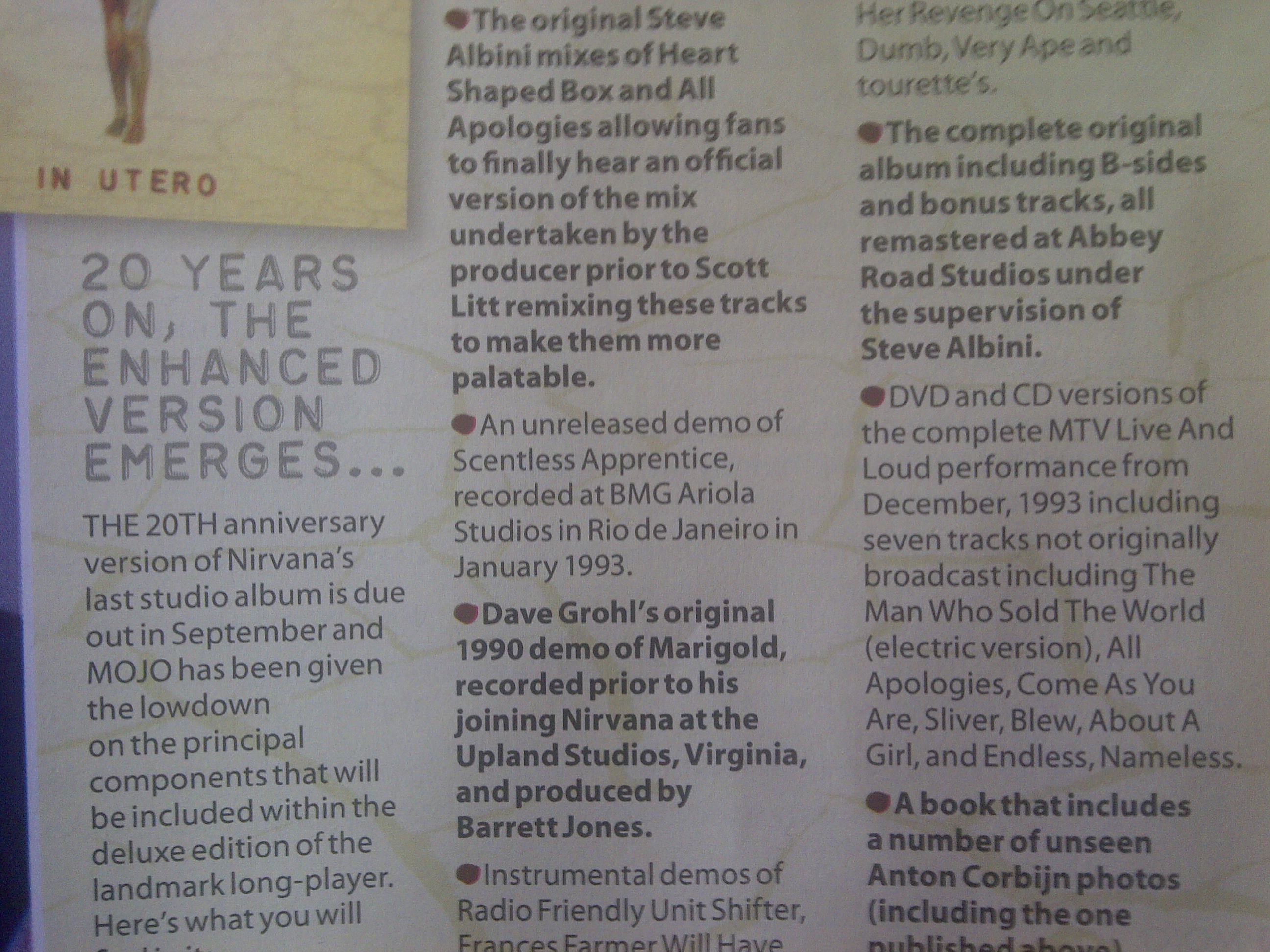
This is the actual summary from Mojo of the 20th Anniversary In Utero box-set (bought a copy at Waterloo Station last night). It actually lists five instrumentals, not the four believed the other day. That makes a tiny difference to the summary I suggested yesterday:

Disc 1: 13 track original album, plus Marigold, MV, I Hate Myself & I Want to Die, Verse Chorus Verse (Sappy) = 17
Disc 2: 13 track original album, plus SA from Rio, 1990 Marigold, Word of Mouth instrumentals x 4, plus Very Ape from…? = 20
Live n’ Loud: 17 tracks times two = 34, plus a clutch of bonus video footage
Total: 71 plus the bonus video material

That one addition reduces the chances even further of the January 1991 demos of All Apologies and Radio Friendly Unit Shifter, of Sound City Sappy (always a forelorn hope) or the missing and vaguely described Song in D, of the April 1993 Frances Farmer Will Have Her Revenge on Seattle, of the January 1993 covers of Seasons in the Sun and Onwards into Countless Battles and of either the full October 1992 jam or the February 1993 piece known as Lullaby.

Ah well! Still nice. Curious to see what the fresh mix of In Utero sounds like…I can’t get rid of my original CD of In Utero once I get this simply because it’s the second CD I ever owned (a gift from my aunt at Christmas), the first being the Nirvana Singles boxset I bought in November 1995 before I even had a CD player – God bless my parents for deciding to correct that.

In Utero: Further Confirmation…And Viewing The Parasite

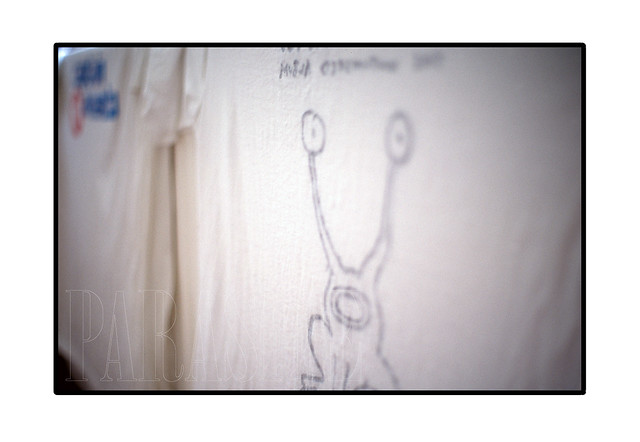
Parasite

A first thank you, Mr. Marcus Gray was the individual who first shared the Mojo article over at LiveNirvana. Much appreciated! Next, further beautiful entries in Mr. Gray’s Parasite art project:

PARASITE laundry

I’ve commented on it before (https://nirvana-legacy.com/2013/03/02/art-on-the-end-a-fresh-cobain-artwork/) and still find so much to enjoy in these knowing glimpses of meaningfulness that rest on the bedrock of two decades of Nirvana/Cobain knowledge to gain their deeper associations. The brain flickers back through other images and photos when faced with Marcus’ work – a chain between past works and this present shot. The bridge with KURT etched into the paintwork stands out for me also. Digest and enjoy, there’s a fine mind at work here playing visual games with over-informed viewers.

Picture1

On the In Utero subject, for the best synthesis of information and options get over to LiveNirvana and enjoy the 69 pages (!) of the ‘Speculation Thread’ – I’m just summarising and giving my take here. Thank you to http://nirvananews.tumblr.com/image/56900709444, for the picture and, alas, unfortunately for rather knocking the wind out of everyone’s sails. In summary, the Live n’ Loud Audio/DVD components are confirmed, the debate remains around the precise contents of Disc 1 and Disc 2 which seems to be listing:

Remastered Original Album
B-Sides & Bonus Tracks

Original Album 2013 Mix
Demos

I’ve gone bug-eyed trying to zoom, refocus and discern the slightly obscured text on the picture of Disc One but it reads right to me. In summary, it looks like the Mojo article didn’t hide or veil any of the rarities on the release – I guess they somehow scooped the exclusive.

With the full album remastered plus the remix from Steve Albini the track count changes to:
Disc 1: 13 track original album, plus Marigold, MV, I Hate Myself & I Want to Die, Verse Chorus Verse (Sappy) = 17 definite
Disc 2: 13 track original album, plus SA from Rio, 1990 Marigold, Word of Mouth instrumentals x 4 = 19
Live n’ Loud: 17 tracks times two = 34, plus a clutch of bonus video footage
Total: 70 plus the bonus video material

I’m open to seeing this change a bit but not by much – if the bonus video footage and any unmentioned songs added up to ten, or even just to five further tracks I’d expect the release to say 75 or 80 tracks. So don’t hold your breath for more than the stated content is all I’m saying. I don’t foresee Universal withholding mention of other significant unheard material if it was to feature. Disappointed? A touch. It seems to suggest that Universal is run by audiophiles who appreciate a slight tweak to a song, or by dance/pop fans who haven’t quite realised that rock fans are far less impressed by remixes, something Cobain and co. never saw fit to indulge in during their lifespan as a band. Again, I’m open to reinterpretations and reconstructions but ultimately I’m happier with lower sound quality but more intriguing vestigial practice material showing songs coming together. But there’s no happy answer, I remember With the Lights Out getting flak for including Cobain’s acoustic home demos because of the low fidelity and whacked out style they displayed – what the hey, I loved them.

Oh, incidentally…This wins my ‘most misleading title’ award.
http://consequenceofsound.net/2013/07/nirvana-to-reissue-in-utero-with-70-bonus-tracks/

First Advert for In Utero, September 2013 Anniversary Edition

It’s up online at the official Nirvana Facebook page. Nothing at http://www.nirvana.com as yet but it’ll be coming. Keep your eyes open for track listings and official info imminently I guess…

The LiveNirvana forum is the best place for staying up-to-date on this as it emerges plus some wicked speculation and discussion going on around what it might feature or include…

Album Dominance: Which Album did Nirvana Play the MOST?

How could I possibly let a week go by without taking time to play with a spreadsheet at some point or other? This would be a surprising, nay, shocking occurrence. Today’s question is rather a simple one; based on the data available at http://www.nirvanaguide.com which album did Nirvana play most on stage?

I’ve talked before about album dominance in terms of how long it took for the number of songs played from Bleach to decline (https://nirvana-legacy.com/2013/05/08/how-long-did-albums-dominate-on-stage/) and about the total dominance of side A of each of Nirvana’s albums on stage (https://nirvana-legacy.com/2013/03/28/live-set-lists-and-side-a-dominance-nevermind/). This time it’s a more detailed, yet also simpler comparison of the thirteen songs on the 1992 CD of Bleach, versus the thirteen songs on the 1991 CD issue of Nevermind, versus the thirteen songs on the 1993 (European) CD of In Utero — plus sidebars on Incesticide and non-album Nirvana originals while we’re on the topic:

Songs Played Live_By Album

I wish, to be honest, I’d had this data put-together when I wrote the Dark Slivers book last year regarding the Incesticide album — it’s a notable point that the songs making up the Incesticide album were a far more significant component of the live history of Nirvana than those on In Utero which, entirely due to its late positioning in the history of the band, ends up being a relative rarity. The overall trend, quite visibly, is one based on longevity; Bleach, the earliest album is played more than Nevermind, which is played more than the pieces that came together on Incesticide, which is played more than the final studio effort In Utero.

On the other hand, the lengthening set-lists of Nirvana’s later period does have an influence in that, despite being released a full two and a half years after Bleach, Nevermind’s songs make only forty fewer appearances than those of its predecessor. In Utero would have caught up, at least to Incesticide, relatively quickly given the 20+ set-lists of 1994 in which Incesticide was racking up only single appearances, Bleach only three at most per show.

I think of this less as data and more as a reason to cherish certain songs’ rare appearances.
And what of the non-album tracks…? It’s always been very clear that Nirvana’s live selections were substantially guided by their degree of satisfaction with the songs. The result is that those songs that never made a Nirvana album don’t even make significant appearances live:

Non-Album

In total, buoyed substantially by Spank Thru’s 31 appearances, the overall total is still a paltry 72; lose that one song and we’re down to 41 known appearances in seven years by the fifteen other Nirvana non-album original compositions. That’s how clear Kurt Cobain and Nirvana were about how strong or weak their material was — and also how professional they were — nothing that needed major work stayed outside of a studio rendering for long nor survived long if not up to scratch. Given the existing ratio of appearances — album tracks appeared twelve times for every one appearance by a non-album track (72 versus 927)— there’s little reason to expect many unseen performances of these songs. Cherish them.

Just as amusing, showing the relativism inherent in any game with data on the move, if Nirvana had kept touring, Bleach would have been superseded by Nevermind as the most played Nirvana album within just eight more performances given the fact that throughout 1994 Nirvana were playing nine songs from Nevermind per night in comparison to Bleach’s three:

Nevermind_Catches Up

Which Songs Did Nirvana Play the Most? The Top X

As mentioned last week, it was Sappy that received the most notice in studio with multiple takes across four separate sessions placing it in a class of its own when it comes to Nirvana songs. Meanwhile, in another category of records, I was curious which songs were the staple diet of the Nirvana set-list between 1987-1994. The result was that, thanks to my colleague Shrikant Kabule, we created the full table of how many known performances were made across the years. This selection is the list of those songs known to have been played more than one hundred times.

Examining set lists had already identified Blew, About a Girl and School as the three tracks that survived from Bleach right through until Nirvana’s 1994 shows. School is the most impressive performer after all only 241 of Nirvana’s 369 known gigs possess full and complete set-lists; essentially, from the time it was written School featured including on quite a few partial set-lists. Tales of how nervous Kurt Cobain was of playing About a Girl don’t stop it being a similarly highly featured and beloved song for the band.

In past months I ranted about the way Nirvana gave near complete primacy to Side A rather than Side B of their albums when playing them live. The table below of most played songs shows that pattern holds in relation to Bleach where, of the six songs from that album that are played more than one hundred times, all are from Side A. The picture with Nevermind is slightly more mixed but not unsurprisingly. Firstly, the popularity of Drain You in concert is absolutely clear, in fact it’s only just behind Smells Like Teen Spirit, secondly, Territorial Pissings surprised me a little more but still, there it is as the seventeenth most played song. Just as noticeable though, the whole of Side A of Nevermind features on the list — Polly, Breed, SLTS, Lithium, CAYA, In Bloom.

Songs Played More than 100 Times

To some extent it’s still true that age makes a difference — the Bleach era songs, written prior to the big gap in set-lists in early 1989, are the only ones with sufficient opportunity to feature 200+ times — Polly was written as far back as 1987 and played from May 1989, Breed came along later in 1989. Yet, the tangle of creativity, Kurt Cobain’s peak writing years in 1990-1991, coincided with an explosion of touring allowing the appearances of his other songs to evade mere chronology; preferences begin to play a role. This, for example, explains why SLTS and Drain You, relatively late productions, should appear more than Lithium or In Bloom which, though featuring on the same album, made their first appearances a full year earlier — April 1990 as opposed to April 1991.

The gradual increase in Nirvana’s average set-list length also influences the results; head-liner status meant that even while many older songs were squeezed out to accomodate the In Utero era songs, a lot of songs survived because the set-lists in 1993-1994 were more than half a dozen songs longer than in 1990. The shorter set-lists and lower expectations in the early era made it more likely for songs to be flipped in and out regularly. Despite the lower number of shows after 1991, the set-lists had a greater regularity (particularly on the In Utero tour) so a core set of songs were able to rack up large numbers of appearances.

The table also emphasises how firmly focused on their albums Nirvana were; Spank Thru and Been a Son are the only non-album tracks to enter the list of songs played more than one hundred times. The popularity of the relatively slight Been a Son remains a mild mystery to me; it’s a song with the most solid presence on Nirvana posthumous releases on top of its multiple releases during Nirvana’s lifespan.

Spendthrift Studio Hounds Versus Miserly Efficiency

Hands down the balance in Nirvana’s relationship was toward the latter by virtue of simple poverty. Books make much of Jack Endino’s shrugged remarks over the song Sappy and Nirvana’s lengthy time spent with it in January 1990 because it was such an exceptional event.

How exceptional? Well, Sappy received four takes, Radio Friendly Unit Shifter three takes, twenty-nine songs received two shots (list? Floyd the Barber, Spank Thru, Sifting, Mr. Moustache, Blew, Paper Cuts, Hairspray Queen, Dive, Polly, In Bloom, Lithium, Stay Away, On a Plain, Token Eastern Song, Even in his Youth, the whole of In Utero barring the aforementioned RFUS plus Serve the Servants, M.V. and I Hate Myself and I Want to Die.) In other words, Sappy is double the norm for a Nirvana song — one of only two songs Nirvana ever took more than two visits to pin down.

At first I did also think that, of the songs requiring two takes, songs that Nirvana ultimately used as b-sides (Spank Thru, Dive, Token Eastern Song, Even in his Youth, Sappy, M.V. and I Hate Myself and I Want to Die) were actually over-represented, that maybe there was a correlation between dissatisfaction with a piece and the number of tries the band had at it. That could be reinforced, as an argument, by suggesting that dissatisfaction with All Apologies and Radio Friendly Unit Shifter in January 1991 leads to them being ignored until long after the Nevermind sessions that spring/summer. It would suggest that Kurt Cobain’s preference was for songs that felt right in the moment, that having been honed in rehearsal came together rapidly in studio. Alternatively it would suggest that less practised songs were glued onto sessions as b-side fodder but often lead to frustrating underwhelming tracks needing a second shot regardless. Overall, however, I don’t think there’s enough to that as a suggestion.

What is visible is how few of Nirvana’s studio efforts required significant alteration or honing to give them their final shape. There are differences in attack and approach to pieces, lyrics shift lightly, some songs move tone but of those twenty-nine songs we’re looking at a bare handful that merit mention as substantially different takes.

The core are the shots at Sifting, Mr Moustache and Blew — all three were laid down in summer 1988 simply because the opportunity presented itself to whip up first shots at work in progress. Those three songs are radically different in lyrical approach as formulated on Bleach, Sifting moves from an extended instrumental to curtailed focused grunge song. Dive’s first take stands out for the video footage existing of the song being honed in studio, the band facing one another to take their cues as they’d not practised it so well it was yet together. The difference, however, is basically a minute of extra instrumental work partially accounted for by a slower approach. Lithium lost its acoustic vibe, Token Eastern Song gained added flourishes and jangly guitar in January 1991 while All Apologies was similarly buried in K Records pop territory. Is there much more to say about the duplicate takes? Not unless something revolutionary shows up on the In Utero Deluxe Edition this Autumn.

Again, look to Sappy for the big shifts in muscle and mood across Nirvana’s active years, it tracks the band’s motion so well. And, in terms of ‘missing material’, I think it suggests it’s the non-studio rehearsal sessions and the band’s ‘home work’ that hides any significant redevelopments and growth from first sketch to final piece.

Serve the Servants: What I did in my Summer Holidays by Kurt Cobain (aged 25 and a ½)

Kurt Cobain’s songs did not become more autobiographical, they always were. What increased was how explicit they were about the subjects and objects of his writing. His particular writing style — in which the choruses rarely tied directly to the verses, in which one verse didn’t necessarily tie to the next, in which one lyrical couplet didn’t always ally to those either side of it — had increasingly been adopted in his later lyric writing and was almost completely dominant by 1990-1991. All of which makes Serve the Servants an unusual Cobain entry.

There’s no evidence of the song, instrumentally or otherwise, prior to the February 1993 Pachyderm Studio session, and for a variety of reasons it’s exceedingly hard to pin down. It’s the only song that featured on In Utero not to have been demoed already either in October 1992 at Word of Mouth Productions, or in January 1993 at BMG Ariola Ltda in Brazil. Given how thoroughly Nirvana prepared their other songs prior to the album session it does make it stand out as a very late Nirvana song. In fact, unless other evidence presents itself, it’s the third to last known Cobain original composition; after Serve the Servants the only other two songs are You Know You’re Right and Do Re Mi.

Lyrically, there’s clear evidence of its context and era. The focus within the first verse on images of witchcraft trials, of media pressure, of the pay-off from his life’s work align perfectly with very late 1992 when the worst attentions struck Cobain and his family. It was mid-to-late August 1992 that the “Rock Star’s Baby is Born a Junkie” article emerged, in those same weeks the local authorities took Frances Bean Cobain into custody two days after her birth, while the Vanity Fair article didn’t hit the stands until September. Verse two, meanwhile, focuses on Cobain’s father and ties to an incident that took place on September 11, 1992 when Cobain’s father turned up unannounced at the band’s benefit show in Seattle — the first time they’d spoken in around a decade. The chorus meanwhile, well, it’s a blunt statement of being fed up hearing, in media coverage, that his parents’ divorce messed him up. But everyone knows that simply because its stated so baldly, there’s no disguise, no intuition needed.

The lyrics, therefore, can’t have been commenced until the final two weeks of September, more likely on into October, November, December of 1992. The dates on the With the Lights Out box-set are, at times, a matter of debate — if the demo of Serve the Servants was indeed from 1993 as it suggests then it’d indicate Kurt Cobain wrote then completely rewrote the lyrics inside of the first eight weeks of the year. It’s possible, the live recordings from just prior to Bleach’s recording indicate some songs going through major revisions or being written from scratch in not much over a month.

The vitriol of the eventual finalised lyrics makes me suspect that the demo is from an earlier date, a first shot in 1992, with the lyrical revisions taking place somewhere between November 1992’s two shots at the Incesticide liner notes and February (Kurt was made to erase a personal rant against Lynn Hirschberg, author of the Vanity Fair article — who, for the record, doesn’t seem to have done much more than report honestly on what she was seeing as a 2011 Courtney Love quotation makes clear with provisos; “”yes, it’s true, I used heroin in the first three weeks of my pregnancy — but so f–king what!? I didn’t even know I was pregnant at the time! I also took a few puffs on a cigarette when my belly was out to here, but most of those nine months, I walked around with nicotine patches all over my body. When you have a baby inside you, you’re not going to do drugs or something stupid.”)

The song, therefore stands out for a range of reasons; the third-to-last complete Kurt Cobain composition, the last song readied for In Utero, the most focused and unified song lyrics he had ever created, and the most explicit reportage on his life experience he ever laid to tape; its virtually a State of the Union address covering the bad months concluding 1992.

The Machine in Action: Preparation for the In Utero Super Deluxe 2013

Compliments to Jason Stessel over at LiveNirvana for bringing this to everyone’s attention – I’m just relaying the news today, no originality!

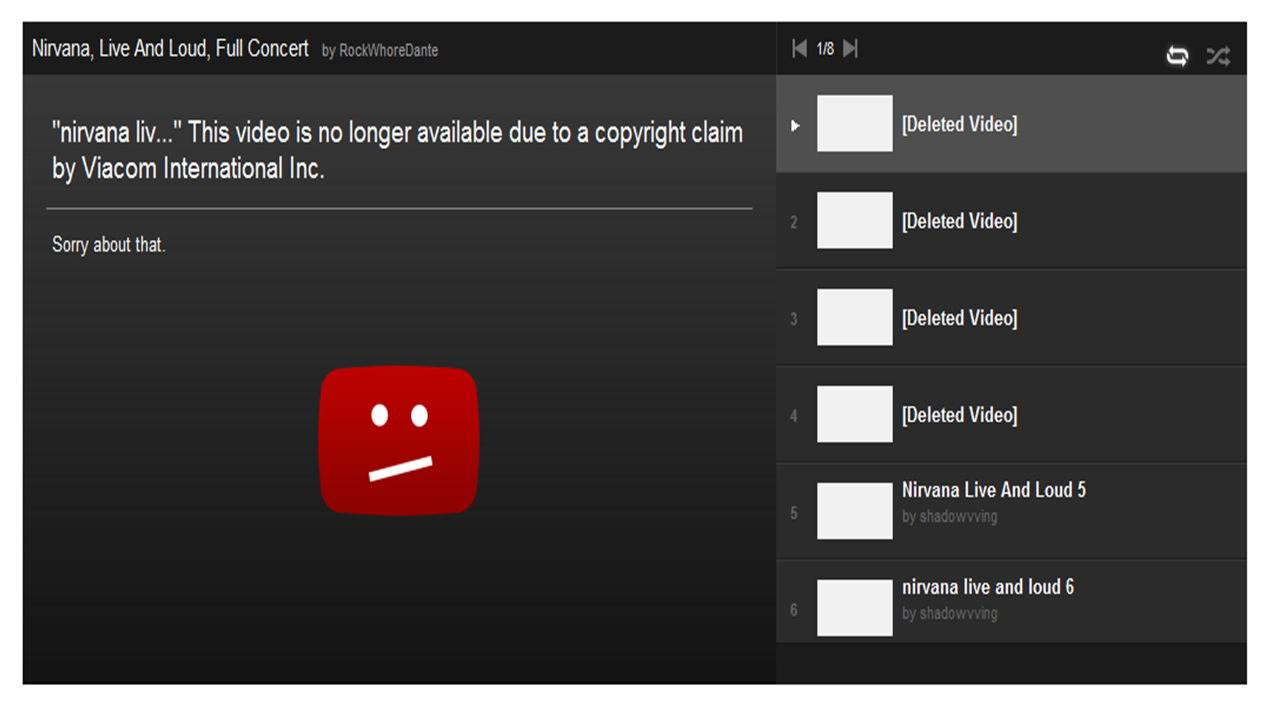
Over on YouTube, there’s been a bit of a clear out of one of the largest distributors of Nirvana live footage, similarly a few pieces related to Nirvana’s MTV Live n’ Loud performance have been taken down. It’s still possible to find clips but, compared to just a month or two ago, it’s near impossible to find a full recording of the Live n’ Loud broadcast. A search today on one of the few active links came back with this simple declaration:

Copyright

It’s hard to tell if this is just a regular stripping out of supposed infringements or a targetted attempt to remove competing sources for what everyone has predicted for a couple years will be the DVD component of a Super Deluxe edition of the In Utero album ready for the anniversary this year.

I think private trading of recordings is a legit exercise for the enthusiasts. Hand-to-hand propagation of music has kept interest alive in Nirvana’s music for years. Its the, often illicitly sated, appetite for unheard material that has plugged the gaps between official releases and allowed the major labels to reap such profits from the reissues, DVDs, boxsets and so forth. Plus, there’s very little damage done by people trading live recordings, demos and all the shreds the major labels are too snobby to release.

If there was a legitimate official source for all this material the fans would buy it. A fair example of the process would be the switchover from the dodgy ethics of Napster to the dodgy, controlling yet official order of iTunes. Once a legal channel of sufficient scale and diversity was available the market moved very rapidly away from what had been an illegal experiment. Most people don’t want to be acting illegally if there is an alternative. That’s why organised crime gains its most extensive profits from what cannot be acquired legally, people want to do good. I’ve no great affection for websites ripping DVDs and films. But then, I’ve never been that visual.

The whole tale of downloadable music and so forth interests me more in terms of the way it reinforces power in the hands of those who created the systems responsible. This roams toward conspiracy theory if taken the wrong way, take it more that I think similar people make similar decisions and that people in particular situations are equally likely to adopt the frame of reference arising from the social scenario, the group, in which they find themselves.

Essentially, teams of engineers created the forms via which music could be reproduced and distributed. Having control of the medium gave them power over what was contained therein whether overt or subconsciously adopted by the bands. A fair example is the way Nirvana’s albums, those released while Kurt Cobain was alive, are built around the idea of a vinyl LP record, even the bonus tracks on Nevermind and In Utero, by their very nature, are a reaction to the new medium of the CD.

The problem is, of course, that being able to do something doesn’t mean one should. The engineers discovered they could turn music into data, having done so, creating the MP3 format and others that allowed cheap and massive distribution via the Internet was a logical step. In doing so the people involved successfully extinguished the means of support for hundreds of thousands of musicians. Arguments about how “musicians used to survive performing live” are as spurious as pointing out that the entire financial industry was barely a glimmer until 1980s liberalisation opened the flood gates. Claims that its just a case of adapting are as viable as telling flood victims they just need to see it as an opportunity. As for people salving their consciences by saying it was rich millionaires they were taking from…Untrue. The long tail of bands who were living on the proceeds of their releases had to undergo a radical reduction in their income that sent many back into regular day jobs.

What the engineering graduates had done was define the products of liberal arts graduates as something that wasn’t worth paying for, something that was overpriced and therefore something they could rip. Meanwhile, the devices sold by the engineering graduates are sucking in small fortunes with minimal competition. The new reality is one in which musicians need an alternative source of income (same as authors) unless, by sheer chance, they become the one in a million everyone likes to point to when they claim it’s easy to make money from creativity. A lack of worth placed on the results of creative endeavour has led to a mass market that isn’t willing to pay for it and the tools to assist.

So, to say I have ambiguous feelings about the kinds of innovations, like YouTube, from which I have benefitted is an understatement. I don’t rule out some of the good these things do; but I like to be aware that there are two sides. In other words, I’m cool with Universal and whoever else taking down content that directly and knowingly competes with their official product – because the rule applies to the little people not just the big guys. Musicians now have been robbed of the chance to have a long-term career, one they can live off, in the field to which they are dedicated unless they conform to the mass tastes and fashions. More people than ever can make music, that’s a thrill, but it’s harder than ever for the devoted to live on it.
Live Set-Lists and Side A Dominance: In Utero

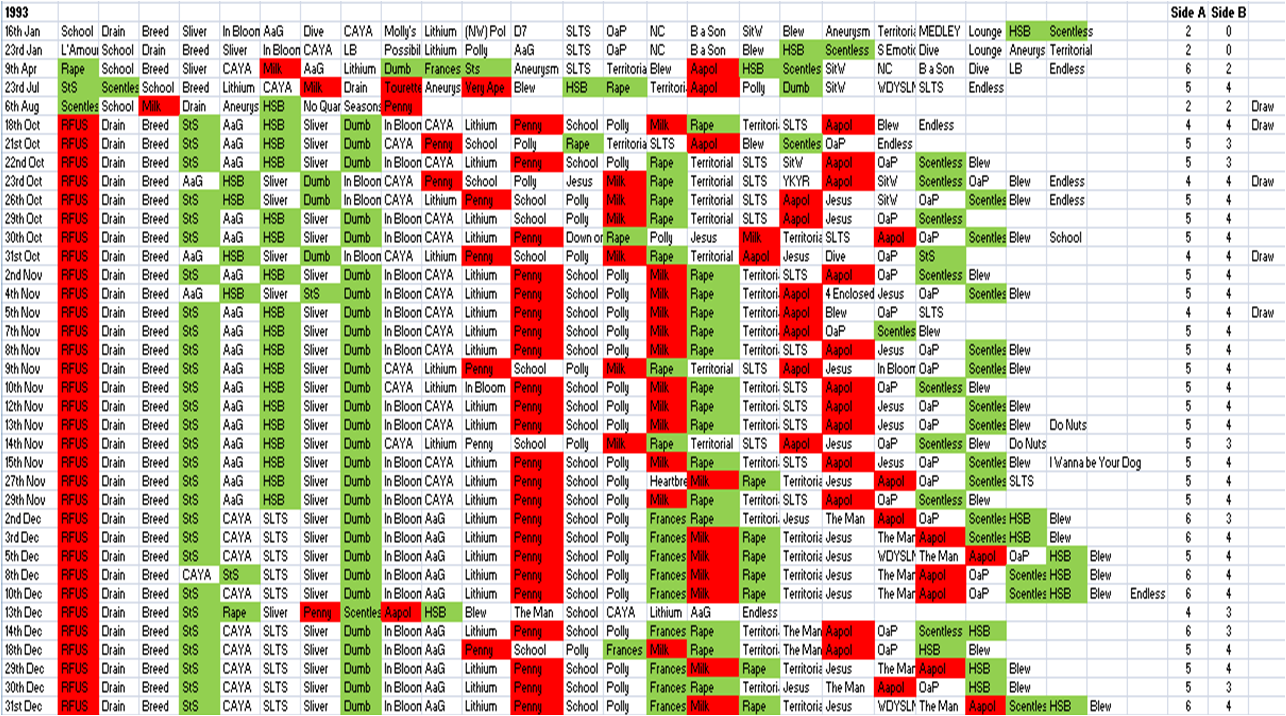
Those who are aware of my minor league fixation on the Incesticide compilation and its subsidiary status as a component of the Nirvana catalogue may be surprised I haven’t exercised my Excel fixation in relation to that particular release and this particular exercise. The reason is fairly simple; a chronologically organised release with all but one of its 1989-1991 songs on Side A and all its 1988 tracks (plus one 1989 outtake) on Side B has been arranged with chronology taken into account so, reasonably enough, Side B wins four early shows; Side B wins the remaining 230 complete set-lists of Nirvana’s entire career from 1989 onward. No surprise so I won’t count it.

In Utero is far more crucial; the final piece. In the case of Bleach, we could waive the Side A preference claiming that there were more songs (true!), in the case of Nevermind we could claim commerciality (arguable!) but In Utero was the definitive break away from commercial impulses, the attempt to recapture the underground spirit. Was Side A as important and if so, what can we conclude? Well, In Utero first pops up at the incredible show Nirvana performed on November 25, 1990 with Dumb and Radio Friendly Unit Shifter both appearing; a draw. 1991?

Side a_Side b Dominance 1991 In Utero

In Utero songs were played on 31 complete set-lists in 1991; six wins for Side B and seven draws…But still, that means Side A was played more on 18 occasions (58%) and won/drew even on 25 (80%.) It’s a full year of tit-for-tat, one song or another song; I admit I find it interesting that Nirvana were so consistent in ‘rationing’ the number of new songs they would shove into a set-list, it makes me wonder if Pennyroyal Tea, Rape Me, All Apologies and Dumb were already associated in Kurt Cobain’s mind; certainly Rape Me had its parody of Smells Like Teen Spirit while Dumb was derived from Polly so there is a connection at least between those two tracks. 1992 continues the easing up:

Side a_Side b Dominance 1992 In Utero

Songs from In Utero were played eight times across 28 complete set-lists — in a reversal of fortune it’s the one year ever when Side B of one of Nirvana’s three studio albums was played more than Side A and quite defiantly so. It doesn’t last, however:

Side a_Side b Dominance 1993 In Utero

Side a_Side b Dominance 1994_In Utero

From the very start of 1993, Side A dominance reasserts itself absolutely; 37 set-lists, Side A wins in 32 of them and draws in 5, Side B doesn’t win even once. In one of the few surprises ever thrown up in the history of Nirvana’s 1994 tour, there’s at least one single win for Side B, plus three draws, leaving 14 wins to Side A. As percentages we’re looking at an 86% win rate in 1993 for Side A, or 100% if we wrap in the draws; 78% in 1994 or 94% including draws.

So, here are the totals for In Utero:

Side a_Side b_In Utero Overall

Again, even though the pattern is weaker, we’re still dealing with very solid Side A dominance; 65 of 95 shows were Side A dominant (68%), 14 were Side B dominant (15%.)

What does this amount to overall? Well, tallying up the results, across the songs from three studio albums, across seven years, 513 of 571 shows were Side A dominant (90%), 551 shows (97%) were a Side A win and/or draw. Is that a sufficiently hefty trend to suggest something may have been inherent in the way Nirvana structured albums? Let me reverse the stats for full clarity; only 20 shows (6 for Nevermind, 14 for In Utero) ever featured more songs from Side B, that’s a mere 3% in total. Including draws, Side B won or achieved parity 58 times (10%).