Live in Carlisle: Nirvana, Cobain on Cobain, Conversation

http://www.cumbrialive.co.uk/Author-Nick-Soulsby-to-discuss-his-journey-in-search-of-Nirvana-0cd8655f-c92f-47e1-b930-da3647d8dbcb-ds

Friday 11th November at Cakes & Ale (Castle Street, Carlisle) – something a bit different for an autumn evening, I’m going to be sitting down with Doug Baptie (who runs the Words & Guitars magazine/site) and talking about Nirvana.

Sounds like my kind of venue, frankly, the idea of sitting with a group of enthusiasts, with a decent beer, trying to pour out more of the material I’ve learnt these past years. Sometimes I have trouble remembering it all: conversations with 230-odd of the people who played with, shared stage with, recorded with Cobain and Nirvana – conversations with well over 100 of the journalists, radio hosts, students who interviewed the members of the band over the years – that whole visit to the North West of the U.S…

I’ve moved on – just finished preparing “We Sing A New Language: The Oral Discography Of Thurston Moore” for release in the U.K. (Omnibus) next spring, then in the U.S. next summer; commencing work on other works; of course the interviews, reviews, brief articles I’ve contributed to Words & Guitars, The Vinyl Factory, Clash – so it’s nice for me to have had this time to sit and go back over my own words, to go back to the beginnings of the blog and look at what I was working on and the patterns I was seeing from all the data available about Nirvana and their activities.

I’m going to take an album of photographs with me focused on Aberdeen, WA – I think Cobain’s journey is amazing because of where it starts; I want to talk about the speed he’s working at and developing at during the late Eighties (a new album’s worth of material every year 1986-1990 showing off his mastery of different aspects of the U.S. underground); the coincidences/contacts that Nirvana benefited from and that helped them rise…Then, at some point, I guess we’ll talk about the path down.

I like the idea of just sitting discussing it with people who are curious about the subject, hearing what people have to say, knocking back and forth the topics on their minds…Is there a nicer way to spend a night than with fellow travellers?

Naturally, if you’re in the North West or feel like a trip over there (I’m intrigued to see Carlisle, never been myself) then everyone welcome. I’ve been told the bookshop hosting this is charming.

Totally separate topic: I had the good fortune to interview Adam Harding of Dumb Numbers, charming bloke, I’ve become a real follower of what he’s been expressing with the band…

In Conversation: Dumb Numbers’ Adam Harding


Exploiting Nirvana and Kurt Cobain: J’accuse…Moi.

http://www.theguardian.com/music/2014/jun/24/kurt-cobain-desperate-for-fame-says-courtney-love

I thought of this title a long while back when someone raised the point that they felt I was morally compromised because I had written a book about Nirvana and sold it rather than releasing my ideas for free. J’accuse was the title of a letter by Emile Zola – it’s become a fun cliche, note the release J’accuse Ted Hughes by Sonic Youth – it simply means, “I accuse.” Today’s piece is about the topic of compromise which, I feel, has always been a part of the Nirvana story.

Dealing first, in brief, with my opinion on Kurt Cobain; did he compromise for commercial reasons? Answer; of course he did. The issue is that people tend to read backward from the consequences to the initial decision as if he could foresee the future – the millionaire status, the trophy wife, the media attention, the $200K pay cheque for a single date in Buenos Aires, the ability to pick and choose video collaborators for short and long form efforts, the record label kowtowing to his demands, the ability to promote his friends and get them on MTV…

It’s unreasonable, it’s projecting clairvoyance onto an individual who couldn’t possibly foresee what was to come. One could add up Kurt Cobain’s decisions and claim he was always doing whatever was required to make money; copying the Melvins – the only local success he knew, changing the sound of Nirvana between the January 1988 effort and the more straight-forward grunge songs he wrote once Sub Pop were involved because that’s what Sub Pop had an audience for and would promote, letting Sub Pop choose the running order of the band’s first album, asking Steve Fisk for a “top 40” drum sound in the April 1990 recording session, writing verse-chorus-verse pop punk songs from mid-1990 onward with a strong debt owed to the Pixies who had recently achieved indie success, barely swearing on the Nevermind album, permitting an MTV-friendly corporate rock video to support his big hit, mellowing out a couple moments of In Utero, accepting MTV invitations left-right-and-centre…

…But, then again, you could also say that he stayed true to punk rock’s sound which in the mid-Eighties through the early Nineties was still an underground phenomenon in America with no commercial prospects at all, that Nirvana made almost no money from playing music until at least late 1989, that featuring a song on Sub Pop 200 made them no cash, that Love Buzz/Big Cheese being a limited edition meant the band received little money, that as late as early 1991 Cobain sat at a gig in Canada autographing lighters and sold them for a dollar each because he was so poor, that he was living in a car in mid/late 1991, that whether he ate or not on a day was a matter of chance, that he dumpster-dived for clothing…That it wasn’t a case of needless profit, it was just about surviving.

That context is vital because decisions that, in retrospect, enabled Nirvana to become a multi-million selling phenomenon were made by a guy with next to no money, no imaginable chance of becoming a star, making a type of music that had never hit it big even if it had gained notoriety. He did want to live off his music, he made decisions accordingly, but what he was hoping for wasn’t a ‘mansion in the hills’ and infinite fame, it was more like escaping “this piss-stained mattress I’ve been sleeping on.”

The desire for elevation, in a capitalist society, does tend to come down to money – it’s the chosen medium of exchange permitting the acquisition and access to most experiences and human requirements. Everyone is required to make a compromise with money – to earn a living. This doesn’t mean everyone is automatically innocent though. There is still the question of whether one’s monetary gains are being made at the expense of other human beings and through moral corruption – if so, sorry, yep, it does make you a bad person. It also raises the more pertinent question of intention – was a decision made for the primary reason of profit and is that profit motivation clear in the end result?

Nevermind remains the crux of the topic; it was a commercial sounding record, they wanted to sell and for it to sell well – the end product is clearly motivated by acquiescence to the profit-related desires of record company and band. Saying that the band only expected to sell tens of thousands or maybe a couple hundred thousand doesn’t void the nature of the decision being taken – it doesn’t make it innocent nor does it make it a non-profit driven decision even if the scale of the profit imagined was the merest fraction of what ended up occuring. This is inspite of acknowledging that Cobain wanted to indulge his pop-orientated instincts, the hard rock side of his tastes – it wasn’t just a personal artistic statement, it was a deliberate product. The kicker though is that it was a decision clearly about surviving not about making egregious profit for the sake of it – it wasn’t Dr Dre sitting on his millions then making yet more millions from a team up with Apple, it was a poor starving boy hoping for some small recognition and good reviews and a continued chance to play and record on a label that could afford to pay its artists. Sub Pop’s finances were a disaster area.

That’s why I don’t worry too much when I see these articles about Cobain’s commercial instincts; someone in lowly straits taking sensible decisions when opportunity was offered – I don’t expect utter purity, I’m too old to believe in it. The only uncompromised music is that which stays in the bottom drawer of a desk at home, never played for an audience, never placed in anyone’s hands – as a music consumer I’m clearly content to make the deal that someone’s work is worth my money. Complicit, yep – compromised, yep.

http://www.theguardian.com/books/2013/nov/04/ebooks-discounts-98-publishers-closure

This brings me to my own compromise. I’ll keep it brief. In essence, it was suggested that by writing and selling a book about Nirvana I was exploiting Nirvana and Kurt Cobain. Actually, it’s not an insult, it’s a perfectly valid hypothesis – pretty reasonable to suggest it or to believe it, it’s on an individual to define their terms and where they draw the lines, I can only explain and explore my own reasons for feeling that I’ve done no such thing.

Firstly, I did choose to write a book about Nirvana through any commercial motivation – I wrote a book about Nirvana because I love Nirvana, I’m a fan first, a writer second. I chose to write a book because writing is my only real talent or ability on the creative front – I’m not much of a musician, I’m no artist. So the decision to express my enjoyment of Nirvana in book form was similarly not a commercial choice.

Second, ah…But I did place a price on the book and sell it rather than giving it away for free or simply placing my thoughts on free fan forums – this is a far more solid criticism, for sure! The fact that I’ve placed 400,000 words, 350 articles here, a couple hundred graphics all on here for fans and for free doesn’t void or even mitigate the compromise. Just because someone does something good doesn’t impact on how bad the bad things they do are. Similarly, I work a full day job at a corporate organisation, I do 12-16 hours work and commute per day…And THEN, since February 2012, I’ve also done 4-5 hours of Nirvana writing, Nirvana spreadsheet work, Nirvana analysis night after night for a total of 20-30 hours a week for around 125+ weeks now. Still, all that work does not entitle me to be re-paid nor does it mitigate the fact I decided to make a commercial product. Both these points, hopefully, show my commitment to the subject, show that I’m certainly not “exploiting Nirvana for gain” as much as I am “showing my love for Nirvana and desire to share that love” – but it doesn’t remove the question mark, that I am indeed taking payment for a Nirvana-related product.

So, this leads to the next question, is it legitimate for anyone to do something that has the name of Nirvana on it and that someone might pay for? Well, on this point, if you believe the answer is “only Kurt Cobain plus the members of the band” – fair enough but it means defining all paid commentary, all biographies, all music criticism by journalists or writers as illegitimate. I’m not sure about you but I hate the idea of a world where self-serving PR pieces from musicians and their management were the only ways in which one understood or explored them – seems to be enough of that already. I’m happy with the idea that public topics can be explored publically by individuals observing but not participating in the subject of the discussion – someone else can make a different choice. What makes the difference, I feel, would be the difference between (a) putting the name Nirvana on something to make it sell more, versus (b) putting the name Nirvana on something because that’s the topic under discussion and the discussion is taking place for a non-commercial reason. I did not place the name Nirvana on the book, undertake the writing of the book, for any profit-related motive and I did not make the book about Nirvana because of any commercial reason – I did it because I love Nirvana.

But still…Compromised. So…I put a price on the book – I paid the production costs and hoped to re-coup them. I printed a first 100 copies and gave away twenty-five to various helpers and supporters. The maximum revenue was £750. The cost of production was £400 – thus a profit of around £350 was the maximum expectation. Did I expect to sell all the books? I had no idea. So was I doing it for profit? No, I wanted to write the book and did so anyway independent of what might then happen to it. Could I have given it away for free? Actually yes, I could have shouldered the £400 cost and it would have hurt but…Yes. I chose not to. This is where personal pride comes in – not profit, but pride.

I feel that free work is not regarded with the same respect as stuff one pays for – in a capitalist society, despite lipservice to the innate value of things, a price is deemed to be a mark of quality. I didn’t think twice about deciding that I felt my analysis of Nirvana in Dark Slivers was worth paying ten pounds for – my feeling was that if someone loved the topic of Nirvana but didn’t think my work was worth paying even £10 for…Then that was their choice but I felt that it was a good deal. I didn’t say to myself “I will charge a rate to recoup the hours spent on the book,” impossible – I spent far more time on the book than I could possibly make back. My feeling is that someone bought the book not just because it was about Nirvana but because of an interest in my thoughts and ideas and the work I had conducted. I did want to cover the production costs of a physical book – I wanted to hold a book in my hands, entirely selfishly I wanted to have a physical book as a result of my labours, not just some e-book whatever.

Those were my drives; to write a book, to write about something I loved, to hold the result in my hands and to feel darn good about it. I did!! And it was a bloody honour that a few hundred people felt the result was worth paying something for. Compromised? Yes. And it’s up to you, the reader, the viewer, to decide if the book was worth it or if you felt it wasn’t either (a) a valid discussion of Nirvana (b) decent writing and analysis. Worth ten pounds to find out? Definitely a choice I leave to you! 🙂

The topic came up when I criticised the “Who Killed Kurt Cobain?” / “Love and Death” authors for being motivated by profit. Actually, I should retract that criticism. As journalists they were motivated by a good story – a story worth exploring and it definitely was a good topic. Do I feel they did it for love of Kurt Cobain or a desire to “tell the truth”? Nope. Do I feel they did it because it was a good subject for a book? Yep. Do I think they knew in advance that they could get a book deal from the controversy? Yeah. The compromise doesn’t make them unworthy reads or bad books but I don’t think they were books written in support of Nirvana or Cobain.

I don’t believe in the nihilistic idea that everyone is guilty so it doesn’t matter what one does. I believe that everyone is compromised and it does matter what one does – one chooses the compromises; confess, own them, be honest about them. I’m compromised and I’m delighted that the end result was a work I was and am proud of! Yay!

Sunday Night…Buying Dark Slivers: Seeing Nirvana in the Shards of Incesticide

Well, perhaps go to the ‘About’ section first and check out the sample chapter. I moved it to there so those who weren’t sure whether my writing was worth taking a £10 chance on had a chance to see my way of thinking and exploring things…If you find it an entertaining read, maybe check more of the short pieces on the blog (there are over 100 articles now so plenty to choose from) and think “would a NEW BOOK ABOUT NIRVANA amuse and interest me…?”

There are two ways to get the book – first, go to Amazon, buy the ebook if you’re a Kindle fan.
If you like your reading experience ‘old school’ then simply email me at NirvanaDarkSlivers@gmail.com or nicksoulsby@hotmail.com. I’ve sold almost all of the first edition of 100 now and, so far (touch wood!), every copy has arrived safely with its new owner (phew!)

I’m going to use these anonymously (there’s a review on Amazon from one guy too – which was nice of him) but here are some of the other comments received so far – thank you to the individuals who took the time to write me their thoughts, I hope they’re not offended I used these – and YES, you all made me blush:

“I love the insightful approach and I definitely feel as though I am learning new content regarding my favorite band. The charts and such add to overall experience. I am very pleased and am absolutely blown away that you have tackled this often forgotten album. I have found myself listening to Incesticide quite frequently lately.”

“The book is a real gem, no doubt about it; I thoroughly enjoied it and managed to read it in week despite doing PhD work at the same time.
1. You’ve got this really interesting, almost statistical, approach when analysing the genesis of each song. This allows you to trace the ‘ontogenetic development’ of individual songs, compare them with each other and derive all sorts of interesting information on that basis (manner of song writing, etc.).
2. Portraying Kurt Cobain as more of an all-round artist, instead of purely as a musician.
3. Your take on what music meant for Kurt — being a person who’s compelled to create and at the same time someone who’s using music as a way to escape from…personal problems…probably reality in general.”

“i don’t really want to waste time talking about that cynical piece of crap internal memo for the in utero anniversary reissue, but i have to admit i thought of you when i read the line “If you must mention
Incesticide, be sure to call it a “stopgap” release”. it’s such a shame that this really is how incesticide is viewed but i guess that’s the whole point of why you decided to write your book. which i have almost finished by the way and enjoying very much!”

“Nirvana is verrrrrrrrrrrrrrrrrrrrrrrrry important to me. So whenever i have the opportunity to engage with like-minded and knowledgeable individuals, i try to do so. it’s a topic very personal and dear to my heart. So, i am just as grateful that someone such as yourself literally appeared out of the woodwork and had the motivation/desire to write an original work and keep the spirit alive so to speak!”

Dark Slivers: What do the Chapter Titles Mean?

I perhaps over-thought each element of this book…But at least I was thinking and I love the result too! I mentioned the front cover previously? It’s an echo of the incident in 1992 when Kurt Cobain returned from tour to discover all the stuff he was storing in his bathtub, including journals full of song ideas, had been destroyed by a sewage leak. This simple accident means we’ll never know if he had enough stored up in there for a few more quality songs, a few more lyrics that would have compared to his best, music turned to lost dreams. In a world full of generic Kurt Cobain/Nirvana covers I wanted to put a bit more work in and do something a little different to the (tedious) norm; that desire drove me throughout the writing too.

Now, the chapters…Again, taking a Nirvana song title as a chapter heading, it had been done. Sometime early in the process I had an album title stuck in my head, no clue why. A little later, as I was frantically scribbling notes as fast as they poured out my mind I kept using album titles to help me break them up — one of the first, and most obvious, was using The Hammer Party to head up a note suggesting comparing Nirvana’s drummers (eventually used in a post on this site rather than in the book: https://nirvana-legacy.com/2012/11/03/the-hammer-party-nirvanas-drummers/). I eventually realised that, given Incesticide was essentially a record of Eighties’ underground derived sounds and styles, using albums from that scene made absolute sense. Also, it felt good, to me, to be able to pay some small tribute (a tip of the hat) to a series of albums that I adore also and that Nirvana had led me to.

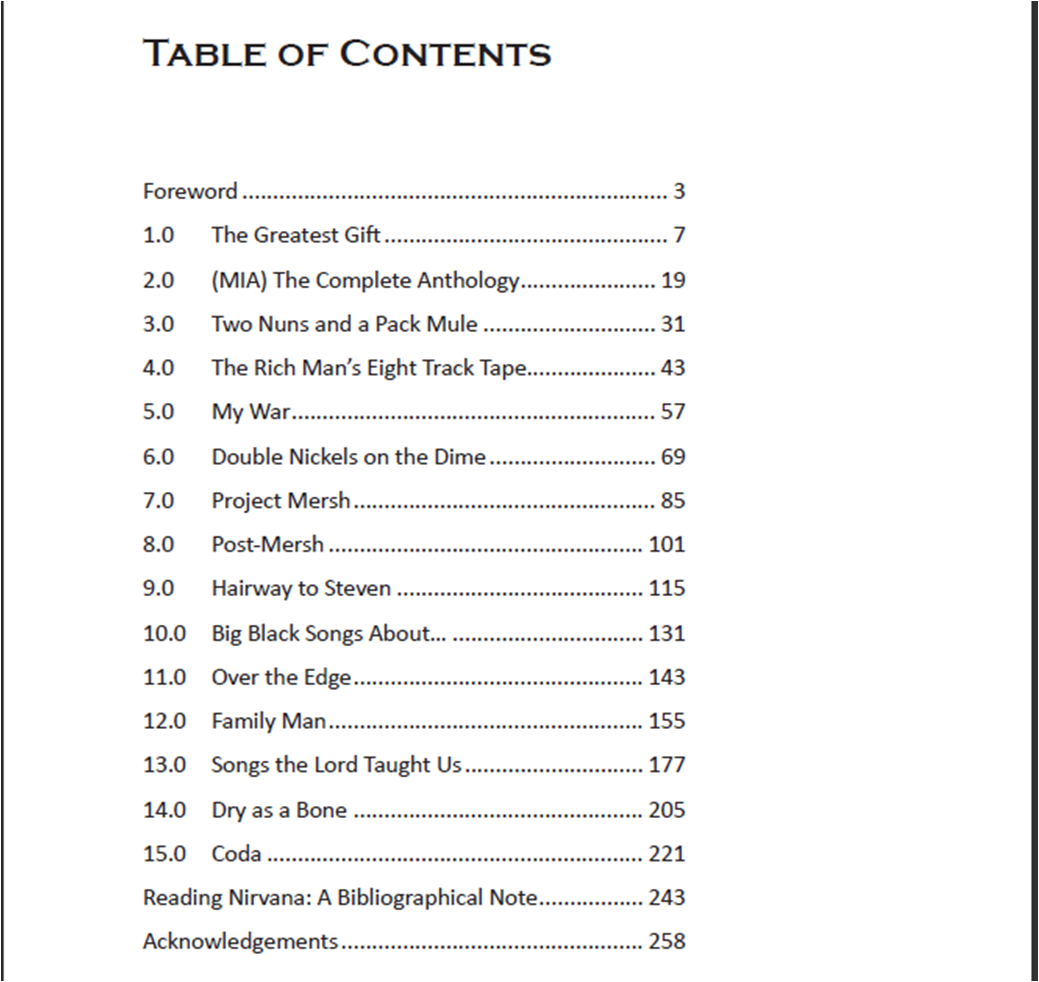
So, why each title? What do they mean…? Well, I’ve left Foreword, Acknowledgements and Reading Nirvana: A Bibliographical Note to one side…

Table_1

Table_2

Table_3

Table_4

Table_5

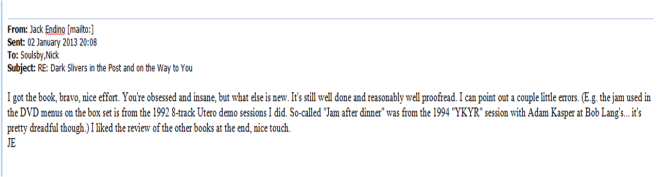
Jack Endino Got His Copy of Dark Slivers

As a thank you for his decency and vastly appreciated willingness to help me out when I commenced working on Dark Slivers, I despatched a copy to Jack Endino over in Seattle. I arrived home late last night to find a quick message from him.

Jack Endino Email

Phew! Nice to know I didn’t make a complete mess of this from someone so thoroughly important to the subject. Was so chuffed I really wanted to share this on here.

Monday 26th: Countdown to Dark Slivers Release

More stats and general musings on Nirvana to follow…But wow, things are getting busy. The book is due back from the printers this Friday – fingers crossed! In the meantime…This is an early summary of each chapter – just a set of snapshots rather than a full picture of what is covered in each one. Oh, and yes you’re right, each chapter is named after an album by a band Kurt expressed a liking of (The Minutemen, Scratch Acid, Big Black, etc.) the exception being Songs the Lord Taught Us, but it was too good a title to pass on:

Foreword

Months of total immersion in Nirvana has not always led me in healthy directions…You have been warned… J

1.0 The Greatest Gift

Incesticide sold more albums than any punk album in American history…Yet its qualities and pleasures have been roundly ignored. I set out the case for the album’s status in terms of the quality of what it contained, the care the band took over its creation, its artwork, its liner notes, its songs

2.0 (MIA) The Complete Anthology

Biographies of the band have stated that Nirvana’s first label Sub Pop teamed up with DGC to combine efforts and create Incesticide…They’re wrong

Fresh interviews with the key individuals at Sub Pop indicate that there never was a planned Sub Pop release. Incesticide was dreamt up and planned entirely at DGC and by Nirvana

3.0 Two Nuns and a Pack Mule

Even Incesticide’s back cover was a comedic image and with the selected cover songs, plus Sliver, on the album its always been the most fun of Nirvana’s albums

Yet Nirvana’s brand of humour was often caustic, aggressive and used as a form of attack — the band were at their funniest when taking sarcastic swipes at the scenes, bands and individuals they despised which can be seen in lyrics, in behaviour on stage and their approach to media and TV

4.0 The Rich Man’s Eight Track Tape

The chapter indicates the deep thought that Kurt Cobain put into structuring and sequencing the songs on the album — there’s a joke running through the entire album and likewise an attempt to mimic Nevermind, making this album its mirror

It’s now possible to see how many songs were refused for this album and to reconstruct the logical decisions that were being made in terms of what was included and why these fifteen songs were chosen

5.0 My War

Nirvana are portrayed as an apolitical band yet they were permanently committed to anti-sexism, anti-racism, anti-homophobia throughout their career which has been ignored because Nirvana’s approach was to have the conversation with their fans rather than to focus on ‘big banner’ causes aimed at attracting media comment

The liner notes within Incesticide are exceptional — a rock star deliberately driving away his audience by telling them to “leave us the fuck alone!” and doing so on the basis of their views on gender, sexuality and race

6.0 Double Nickels on the Dime

Nirvana were not an inevitability, despite the subsequent focus on jokes about ‘destiny’ and how they were going to be rock stars

Nirvana as a phenomenon occurred as a half dozen identifiable factors came together. Incesticide was part of the band’s attempt to resist and sabotage fame

7.0 Project Mersh

The literature simultaneously portraits Kurt Cobain as anti-commercial on a gut level and ruthlessly ambitious and commercial in his actions. I feel this schizophrenic portrayal arises from a misunderstanding of what music meant to him

In this chapter I focus on the desire for control and freedom as the driving motivations; whether an action was commercial/non-commercial simply wasn’t something that Kurt Cobain was primarily interested in hence the consequences of his actions could be either without it representing a ‘fracture’ within his personality

8.0 Post-Mersh

Incesticide showed Nirvana trying on different styles as they learned and evolved with a far more underground sound, with the sound of Kurt Cobain’s first recordings entirely abandoned then resurrected for Bleach

Alongside the album Kurt Cobain attempted numerous experiments with his vocals, with recording techniques and with guitar that ended as he headed mainstream

Incesticide represented the span of Nirvana’s experiments…But not necessarily of Kurt Cobain’s experimental urges

9.0 Hairway to Steven

Nirvana’s evolution can be followed by examining how they switched from covering metal songs to alternative rock tunes to more mainstream fare — Incesticide was their key statement not of the bands that did influence them but of those they wished to be seen to be influenced by, the album serving a ‘propaganda’ purpose that downgraded their rock roots in favour of emphasising their punk favourites

10.0 Big Black Songs About…

Like any writer Kurt Cobain had a personal style, one that evolved between the songs seen on Incesticide that originated in 1987 and those he became famous for. I suggest that he had three key song modes

Kurt Cobain wrote quite a number of ‘story’ songs between 1987-1990 then abandoned linear narrative altogether, similarly the character sketch was a regular trope of that period which he soon abandoned in favour of direct personal addresses announcing his mind-set and situation via song

11.0 Over the Edge

Having shown the forms in which Kurt Cobain created lyrics, we look here at exactly when his writing underwent changes and what may have events drove those changes

12.0 Family Man

As well as his writing style Kurt Cobain dwelt on specific themes and ideas that either evolved or remained constant all the way back to his first recordings in 1985 — the focus was regularly on issues arising from family, gender, sexuality

This chapter proposes a unifying concept that draws together material from as far back as 1985 and as late as 1993 — I posit that Kurt Cobain was the most psychologically motivated rock star the mainstream had ever seen

13.0 Songs the Lord Taught Us

A song by song dissection of the fifteen tracks on Incesticide seen in the light of the lyrical themes, musical patterns and Nirvana background described in this volume

The chapter synthesises the themes and ideas that have been expressed throughout this work and applies them to each of Incesticide’s tracks here ordered by the dates on which they were recorded/released keeping the songs in their chronological context and alongside their immediate ‘family’

14.0 Dry as a Bone

By 1992 Kurt Cobain was barely writing songs, yet there are still rumours of unreleased material. The paucity of truth in such rumours, the absence of truly impressive outtakes shows Incesticide was actually the cream of Nirvana’s leftovers

This entire work has been made possible by the depth of work done by bootleggers and unofficial releases over the past twenty years creating a situation in which the band and the record label have been supplanted in terms of knowledge

15.0 Coda

From 1992-1994, Nirvana barely existed as an actively creative unit. This chapter makes the case for seeing those years as the story of a band that was barely alive

Kurt Cobain’s suicide note was the third of just three written statements made to his public 1991-1994; the first was the Incesticide liner notes, the second his contribution to The Raincoats’ album release. What stands out is that the suicide note was a deliberate concealment, an attempt to avoid having to explain himself or his reasons

Reading Nirvana: A Bibliographical Note

In the case of Nirvana, fan-led initiatives online are actually the best source of raw data — whether on live shows, songs, sessions, past interviews and media reports — so this chapter begins with a brief tribute to LiveNirvana, the Nirvana Live Guide and the Internet Nirvana Fan Club

The chapter then summarises the various strands of the bibliography; biographies, cultural-historical studies of grunge as a phenomenon, song/album studies, then onward into photo books and other more unusual items covering English language publications on Nirvana through to October 2012


What is Dark Slivers About?

Wednesday lunchtime Dark Slivers: Seeing Nirvana in the Shards of Incesticide went to print. I’ve a list of pre-orders at present so if this sounds interesting then do drop me a line NirvanaDarkSlivers@gmail.com and I’ll add you to it. I’m not taking payment (£10 plus P&P) until I have the first hardcopies back from the printers and can give people an accurate Postage cost. I will, however, deliver anywhere in the world and the first one hundred will be signed, inscribed and numbered to those people personally. 

Of course, seems important I tell you what the book’s about…

Well, as it says in the Foreword, this isn’t another story book biography chronologically ticking off the events. After years of reading every last word emerging about Nirvana I felt there was more to say, a more argumentative approach had been lacking. The book tackles issues thematically, one subject at a time, driving each to a conclusion, hopefully convincingly enough. I’ve tried to ensure that all evidence is cited so the reader can examine it for themselves.

The original book concept was a 25-35,000 word volume on Incesticide. Four chapters — The Greatest Gift, (MIA) The Complete Anthology, The Rich Man’s Eight Track Tape and Songs the Lord Taught Us — focus exclusively on Incesticide arguing its importance as a compilation and as the best-selling album of pure Eighties alternative rock, the errors in the back story plus the decisions taken in selecting its tracks, the curiosities within its track listing and structure, then details of the songs themselves.

My interests expanded far beyond that remit. The final work is 72,000 words and 260 pages. What I wanted to do was show how Incesticide was deeply integral to Nirvana’s musical path in multiple ways, using those points to jump off into wider discussions. Three chapters — Big Black Songs About…, Over the Edge and Family Man — tackle the forms which Kurt Cobain used for writing, how his writing changed over time and finally the cohesive nature of his lyrical fixations. Two Nuns and a Pack Mule describes the massive humour within Nirvana’s music at the same time as pointing out that a lot of that humour was for private consumption and had a brutal edge; My War argues that Nirvana’s political side has been underestimated and under-explored; Hairway to Steven shows how Nirvana’s use of cover songs flexed across their career and that the band often ‘spoke’ through the songs they chose to play. Double Nickels on the Dime tackles the subject of commerciality and destiny in the story of Nirvana, then Post-Mersh is a lengthy chapter arguing that Incesticide may have been the pinnacle of Nirvana’s experiments but it was not the most avant-garde or wild expression of Kurt Cobain’s experimental urges, dissecting the various currents of his known private demos.

I admit the more controversial chapters are the ones I’m proudest of — Family Man is one such chapter, I think it draws together known threads of Kurt’s work but unifies them in an original and coherent way (you decide.) Two other chapters that thrill me whenever I reread them are Project Mersh and Coda. The impetus behind Project Mersh was that I was fed up of reading arguments that either tried to claim Kurt was a non-commercial pure artist OR a committed careerist. I argue that the question is wrong; that Kurt’s actions were motivated not by the avoidance or acquisition of a solid career but by a deep desire for control and freedom from the demands of employment and management starting right back in his teenhood. Coda forms the dive into darkness at the end of the book — I let it stretch and meander a bit focusing first on analysing and demonstrating how completely Kurt’s commitment to music collapsed from 1992 then taking an original look at the three occasions on which he wrote to his fans directly, the final one being his suicide note.

Over the weekend I’m going to release a sample chapter — Dry as a Bone — tackling the March-April 2012 rumours of extensive 1994 home demos. Its a standalone chapter so can be read in isolation from the rest of the book. It’ll give you a sense of my style and approach while hopefully providing an interesting and entertaining, though downbeat, take on an up-to-the-minute piece of the Nirvana story.

How I Came to Write Dark Slivers

The publishers of the book series 33 1/3 requested proposals for new, 25-35,000 word, volumes in their collection of album guides. For no reason I can discern I was seized by enthusiasm and went for it. There was no process of weeding out before I chose Incesticide; it popped into my head and it felt right. I justified it because (a) it’s barely discussed and has always been under-appreciated (b) the three studio albums are deeply covered and (c) the coincidence of the anniversary coming up on December 15, 2012 felt worth marking regardless of what Universal were doing. The first draft chapter submitted, and since revised, stated “Bleach’s anniversary was marked with a Sub Pop special edition; Nevermind’s saw several deluxe reissues; for Incesticide…So far nothing.” A liking for waifs and strays meant it appealed to me.

The year since has disappeared in an avalanche of notes, scrawled ideas on paper scraps at the gym, emails sent from work to home and back again, plus the main manuscript in the middle. My average day became six hours sleep, twelve hours at work or commuting, then six remaining hours (plus whatever was stolen from my sleep hours) for writing and the rest of life.

I was one of 473 proposals for 33 1/3 so didn’t get through. Their feedback helped drive me on; the factors were that I was up against people with years of music experience and also they couldn’t imagine publishing a second Nirvana study if it wasn’t on Nevermind. Very reasonable! By this time I’d pushed beyond the initial remit and knew my destination. The book is a bit of a hybrid; there are four chapters exclusively on Incesticide while the others weave the album into wider analysis showing how illuminating Incesticide is and how integral its songs are to Nirvana.

Eventually I’d moved far enough along, sought out and, by some miracle, secured a literary agent willing to support the book — she said she liked my writing style and that I seemed to know my subject incredibly well. Alas, times are hard for publishing and music publishing in particular is suffering. Ten rejections later all focused on (a) too much competition and/or (b) not general enough to appeal to an audience beyond Nirvana fans, we were done…

…NO. Approval from a publisher would have felt nice but frankly, by this point, I was working day in, day out on what is, at finish, a 15 chapter, 72,000 word study of 230 pages. I felt the book had things that might be of interest to lovers of Nirvana; to people like me. Again, good luck intervened and I located a small publishing imprint.

As a Nirvana fan, treating the topic, the people and the people who might read it (i.e., fans just like me) with scrupulous respect was crucially important. I didn’t even use a photo of Kurt Cobain on the cover because I felt it would be taking advantage of him (fanatical I know…) I have a shelf full of Nirvana books (27 at last count) and while some are great I’ve genuinely felt ripped off by a number of them — I knew what I wanted to avoid creating. As a fan first and a writer second I constantly tried to make sure I was creating something I might enjoy.

In terms of my style, my feeling was that the basic storyline had been rehashed many times over and that I didn’t want to just create another chronological biography stringing together anecdotes. I interviewed a small number of people on a specific number of questions and used them sparingly and as appropriate. My core focus was on using the music itself, backed up and supported by my bootleg collection, by online sources and YouTube to create a book where others could go and look up the evidence themselves if they wished.

My writing is definitely a result of my working career allied to my academic work (I have two degrees in history from Cambridge University and I work at a technology analysis firm.) What I created was a series of argumentative essays, analyzing and interpreting specific themes or topics. It does make for a harder read, but I hope a convincing one. I felt throughout that there were lots of works describing ‘what’ happened in Nirvana’s career but very little space dedicated to wondering about ‘why’, or ‘how’, or what significance the events held.

In a few days, the creative artwork and design will be concluded, the book will be in the hands of the printers. It’s the only book I have any intention of writing about Nirvana; I’ve said everything I have to say and my reasons for writing this book have never had anything to do with starting a music writing career; I don’t want to turn something I love into something I do purely to get paid and live, that would rob me of the pleasure I’ve had in creating this work.

My remaining thoughts, leftovers from the book, responses to news, ideas I never got to develop — I’ll put it all out on the blog, I genuinely just hope you enjoy reading it. If any of it means you feel motivated enough to see what I’ve written in the book then I’m certainly delighted — I loved writing it and if others like what I’m doing enough to want to read it then that’ll feel fantastic.

Why I Wrote Dark Slivers

This project has consumed evenings and weekends around my real life for so long…I’ve been sunk into Nirvana so deeply that I admit I can’t quite remember how I filled time before it. But I do remember doubts ganging up on me when I started. It would have been all too easy to say “write? I don’t have the right.”

I wrote this book because I was inspired by Nirvana in a literal sense. 1986-1990 they were just a cluster of poor boys in the back end of nowhere making barely a penny and with only the slimmest scraps of hope. The sour jokes they (and their associates at Sub Pop) made about impending success betrayed how few chances they saw, how little they could imagine what was going to happen. But, because they loved what they were doing, they kept on finding the time, the resources, the opportunities to keep music in their lives. Even with no hope beyond “maybe then I can get off this piss-stained mattress I’ve been sleeping on” they focused not on mythical end goals but on taking pleasure and triumph from their immediate actions; from doing something in the here and now.

My best day was realising that life will never slow down, will never wait for me or pause to let me package the day-to-day up neatly before I begin. I realised it was on me, regardless of what I had to do out of practical necessity, to focus myself on the people and on the things I love. It occured to me that these are the pieces that couldn’t be taken away; something you create then you hold it in your gut.

The story of Nirvana, for me, is a story about miracles occuring. The image stuck in my mind all year, the vision that drove me, was the picture of Kurt Cobain sat in a car, by a phone booth, refusing to move in case the radio lost its signal, waiting twenty minutes to hear the station play Nirvana’s first single having called in and requested it. He’s quoted saying something about it feeling like a bigger triumph than he had ever imagined. I love that idea of the future superstar, sat like an excited kid, stunned by his own creation and not caring at that moment whether he was the only person asking for it. There have been nights, after a moment of revelation while writing, that I’ve been too excited to sleep. It’s unlikely I’ll make back the money I’m investing in the preparation of the book, but what thrills me is the idea of holding something I created, the physical object, in my hands in a few weeks. Life’s little victories in bloom.
Nirvana taught me you need to start doing what you love before life gets so full that you can’t even remember what it was that made life feel good in the first place. While writing Dark Slivers, each time I’ve fulfilled my desire to write something I’m sure is original, new thinking on Nirvana, I’ve felt fire inside. That’s how it should feel when we do what we adore; the love buzz.

I think the important things in life are those we do, not because they’re what we have to do in order to live, but because they’re what we have to do in order to be alive. Everything else is barren necessity – the void.

Nirvana: Why More? Why Now?

Eighteen, nearly nineteen years ago rock music’s dominance ended. Nirvana sang it on its way by showing up the old poses and histrionics for the lame fakery they were. Since then the band’s archives have been gradually displayed for the legions of fans who still know that this was art not product. Journalists and professional writers have taken every chance to rehash the tales – you know the old stories by now. But in trying to recall the visceral fury of Nirvana there’s been insufficient energy set aside to think, consider and question.

Here, all I wish to do is present ideas, thoughts, theories on issues arising from the story of Nirvana. My reason? Because this wasn’t just another band, it wasn’t just entertainment. There was something deeper here and my curiosity has led me to demand more than just hearing what the band ate for breakfast.

As news arises regarding Nirvana and the various individuals who made that era special I’ll comment, I’ll consider and, if I have thoughts of my own, I’ll raise them. What I promise is that whatever I say may not be right but it’ll be what I honestly think. My second promise is that having told you my truth, I’ll welcome you showing me yours.