Killing Nirvana

The allocation of blame is a way of pretending that life is subject to human will rather than an unpredictable gut reaction to the clash of nature, circumstance, frailty and unforeseen consequence. But, if we were to play it, then the person with primary responsibility for halting Nirvana as an active and creative unit was Kurt Cobain.

The first piece on this blog a few weeks back was Trending Kurt Cobain’s Creativity which simply pointed out that between September 1991 and the end of his life Kurt wrote barely a dozen new songs. There are other ways of looking at Nirvana’s last two and a half years:

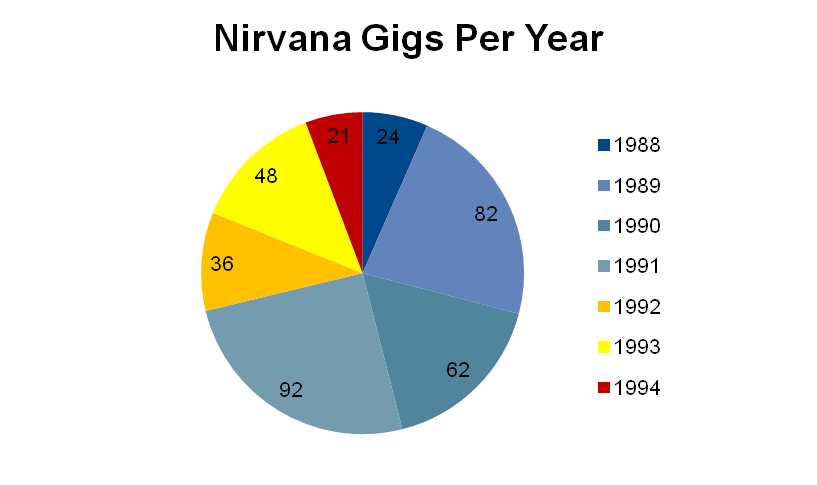
1992-1994 were Nirvana’s least productive years as live performers since 1988 when they were barely more than a part-time effort. In fact between the end of the Asia/Pacific tour in February 1992 to the commencement of the In Utero tour in October 1993 there were 21 shows in total.

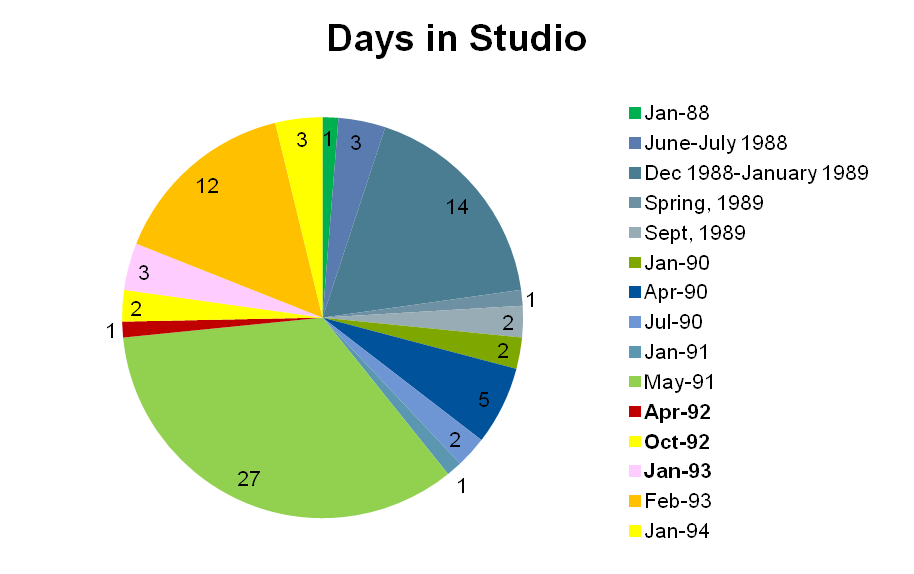
Let’s try it again, with the stats for Nirvana’s studio visits:

In summary, by the end of the Nevermind sessions Nirvana had spent 58 days in studios despite the budgetary limitations in the early days. After that date, even though they increasingly used the studio to substitute for practice sessions, they only spent 21 days in studio. And that 21 doesn’t include Kurt Cobain not showing up to day one of the October 1992 session and being distracted on day two. It doesn’t show that he wasn’t present for the whole three days in January 1993. It doesn’t show that he only turned up to one day of the January 1994 session. It also doesn’t show that the 12 days of the In Utero session in February 1993 included overdubbing and mixing with only around half the days consisting of the band actually playing. Kurt Cobain’s personal statistics would have shown barely 18 days in studio after June 1991.

We’ll continue later today…

Death & Garbage: If She Floats Part II

Diving to the most horrendous and sick claim; the rumors of murder make little sense given a far easier route (less expenditure, less chance of being found out) would have been for Courtney to leave Kurt on the floor of a Rome hotel room barely four weeks before he took his own life. She could have simply said “I woke up, he was there.” She didn’t. She called for help. That’s a core reality of the situation. Just over thirty days before Kurt’s death Courtney Love saved his life regardless of whether what he had been doing that night was suicide or an accident.

Those wishing to claim murder have to concoct a scenario in which, having gone to all the trouble of persuading Kurt to enter rehab, she waits until he’s on the loose and no one is positive where he is or where he’s going. Then, once he turns up, the killer stages a suicide scene. Frankly, if Courtney Love wanted Kurt Cobain dead then she (and the hired killer) would be no more or less likely to be found out whether he was gunned down inside the house, in the driveway, in the downstairs of the garage. She also, despite having a killer looking for him, hires a private detective, and has the Police looking for him — again, there’s no need to, he’s an adult after all. It would have been far easier to just hush things up then say “oh no! I thought he just needed some time and he’d come back” when the body turned up. She doesn’t. She acts like a scared lover and is frantic trying to find him.

The killer also, for some reason, goes to all the trouble of injecting Kurt as well as blasting him with the shotgun when just one would do. It’s unlikely the killer was too worried about Kurt’s pain levels and having got Kurt all the way up to the garage room there’s no need to subdue him in such a way with a whacking massive overdose, how did he even know Kurt had that much heroin around? Another lucky guess huh? That missing guy no one can find is found so easy and happens to have a load of heroin on him — how lovely. And, of course, we must remember we’re now looking for a double murderer because this killer, despite leaving everything here to chance, is such a perfectionist he decides to kill his victim twice. It’s brilliant to have a murderer so convenient he only does something to leave a nice clue!

The killer also takes the time to stick a pen through the note and leaves it in the dirt of a plant pot. There’s much made of the claim that the note was a resignation letter not a suicide note but the key point is why bother taking it at all? Someone would have either had to sit and watch Cobain write it out like this was some kinda school detention, or would have had to notice the freshly written page and decide to take it with them (as well as fetching Kurt’s own gun, fetching Kurt’s own drug paraphernalia, as well as the towels, a can of root beer…Did no one notice the removals van pulling up?) It’s an interesting idea, a killer taking the time to walk their victim round the house window-shopping for death scene paraphenalia. Or, hang on, was Kurt already up in the garage room with a suicide scene laid out and the killer decided it was unfair for Kurt to go before he’d had the chance to kill him?

It’s just very silly basically. Yeah, that mercenary killer left the $120 that no one knew Kurt had in his wallet to cover getting the garage steam-cleaned. That’s funny given the killer supposedly used Kurt’s credit card — he shuffled the easy money out of the way to take the card? And then, while still unsure if they’ve gotten away clean, the killer decides to wave a great big red flag at the authorities and use the card? I’m unsure why the idea that the killer bizarrely took Kurt’s credit card and then was dumb enough to use it should get more credit than the idea that it was just a delay in the bank’s systems or a technical glitch — errors happen. It all seems to rely on having a killer so incredibly cunning that he can get Kurt from house to garage undetected, with no struggle or attempts at resistance at any point, while carrying handfuls of stuff with them, stage an over-elaborate and unnecessary death scene…And who is simultaneously dumb enough to use a stolen card.

I’m fairly sure that, given her own band’s album was due out the same week, maybe Courtney Love had other things on her mind than killing the father of her child. She could, after all, have chosen any time she wished so choosing to coordinate an assassination at the same time as an album release seems unlikely. Rather than benefitting her career, Kurt’s death prevented her band capitalizing on the release of their album. Kurt’s death was also directly responsible for her erratic performances over the next year and left her a single mother caring for a very young child. Yet her issues across that next year have been considered more as signs of instability rather than as indications of grief. Again, I’m not saying Courtney helps herself but she deserves more credit.

The real problem here is that, as with the demise of The Beatles, there’s an apparent unwillingness to criticize or believe bad things of heroes. Instead the myth of the devil woman comes into play. Even the fact that Kurt and Courtney may have ended up divorced, the fact that they had fights, doesn’t make them any more exceptional than millions of other couples in their twenties — it happens. That my hero (your hero) could be a bit of an asshole in person, one with a severely depressive side, one with extensive and well-documented problems psychologically, physically, professionally, doesn’t detract from the beauty I find in his life and works. For some it seems to be too much to believe that Kurt Cobain wanted to die.

Given Kurt Cobain’s obvious adoration of Courtney Love I find it sad that people can simultaneously claim to be Kurt’s fans while refusing to respect either his choice of partner, his statements on the subject, or even the fact that his band’s final studio album dripped with anger at how poorly she’d been treated. The fact ‘fans’ would continue that vendetta beyond his death is a tragedy. I’ll give the ultimate word to Kurt Cobain himself. “A big ‘fuck you’ to those of you who have the audacity to claim that I’m so naive and stupid that I would allow myself to be taken advantage of and manipulated.”
If She Floats: In Defense of Courtney Love

Having excoriated comments made by an associate of one of their favorite wicked witches, the media’s retraction of the bad vibes aimed at Courtney Love is barely visible:

http://www.montrealgazette.com/entertainment/celebrity/Gossip+Nevermind+Nirvana+musical+Courtney+Love/7505417/story.html

Fairly typical really. Courtney can do no right in the eyes of many and a significant number of publications are happy to leap on her every misstep because they know there’s a ready audience prepared to hate her. For the sake of argument, I’m going to offer the opposing position that, to quote King Lear, she is “more sinn’d against than sinning.”

Courtney Love and Hole were responsible for three of the finest albums of the entire grunge era; 1992’s Pretty on the Inside, 1994’s Live Through This and 1998’s Celebrity Skin. Her band had already built a substantial underground following — yet the fact that Hole undoubtedly did benefit from her relationship with Kurt Cobain is deemed to be a Machiavellian scheme manipulating him for profit. That does mean ignoring her own history in music (she was in a number of punk bands prior to an early version of Babes in Toyland) and the fact that, in 1992-1993, her band were one of the few top-quality unsigned acts (Helmet?) A major was always going to sign them. And if she did benefit from a relationship with Kurt Cobain then hold on, Kurt gave far more visible and heavy support to other bands without there being accusations of cheating (The Vaselines’ reissues, The Raincoats’ reissues, opportunities for Shonen Knife…) Bands help loved ones, it happens, the entire grunge scene was built on mutual support.

Rumours and bitchy talk also held that Kurt wrote her music for her. The sum proof amounts to Kurt gifting her the song Old Age yet, comparing the three extant version (boom box demo, studio version, Kurt acoustic solo) it’s clear that Courtney heavily revised the words. Again, there’s nothing wrong with musical collaboration between married musicians. Courtney Love acted as an inspiration for a number of lyrics on In Utero while some of Kurt’s most amusing outbursts (The Word TV show; “we love you Courtney”; the Incesticide liner notes; Axl Rose at the 1992 MTV VMA’s…) wouldn’t have happened without her. We can thank her for parts of the story of Nirvana and for various lyrics from the artist we adore.

Courtney also gets no credit for her effect on Kurt. She didn’t get him hooked on heroin; he did that all himself. She made plentiful efforts in 1993 to get him into studios to try to restore his faded muse, she had him write playful efforts with her (the apocryphal Nighty Nite songs) — it was his own choice to evade studios and avoid his band, not her decision. She can also be thanked for helping persuade a frantic Kurt not to kill himself in the hospital at the time of their daughter’s birth. It’s difficult to imagine trying to raise a child and maintain one’s own creative interests with someone in tow who is chronically unable (and unwilling) to drop the drug habit. She also deserves credit for several occasions when he had to be rescued from overdoses. Like any responsible and loving partner it is well recorded that she put it all on the line with him at the drug intervention in 1994 just to try and get him back to rehab again; she was trying to get her husband off the drugs that were destroying him and seems to have had precious little help from numerous other individuals who could perhaps have been expected to offer more support.

Some part of the annoyance with Courtney focuses on her custodianship of the estate of Kurt Cobain. Yet, again, as the nonsense surrounding the rumours of a musical showed, there’s often little substance to the annoyance. The flow of fresh Nirvana material was interrupted by the legal spat between Courtney, Krist and Dave — unfortunately, though annoying, it’s fairly reasonable to seek a revision of terms if one feels misled. And legal matters take time regardless of the desires or otherwise of the people involved, it’s a process not a conversation. As soon as it was resolved the promised material appeared; there’s little evidence around that of Courtney doing anything untoward with Nirvana’s legacy, any weaknesses in post-millennium releases are as much down to Krist and Dave as to her and there have been few products or uses of Nirvana’s music that have stepped outside the bounds of taste.

Courtney’s reputation suffered in the Vanity Fair debacle, yet it’s clear Frances Bean Cobain was born a perfectly healthy baby and, as Courtney had always stated, she had stopped drugs as soon as she knew she was pregnant. Courtney certainly hasn’t helped herself by being more than happy to provoke journalists but predominantly her problem has been too much information and saying everything that comes into her head rather than fiendish secret evil. At the 1992 MTV VMAs Axl Rose’s then partner Stephanie Seymour asked Courtney “are you a model?” Courtney snapped back “are you a brain surgeon?” It sums it up really. There’s a comfy acceptance of rock stars going out with pretty models who know to keep their mouths shut. Yet, for Kurt Cobain, a star with a progressive attitude, to be attracted to a creative (and attractive) woman from a similar musical culture and background, one with a sharp sense of humour and no tolerance of fools — there’s no credit given. The gold-digger view gets more play than the idea that two young people felt a fierce attraction, loved one another and had plenty in common.

William S. Burroughs: Kurt’s Perfect Literary Idol Part. 2

Kurt’s key literary idol was William S. Burroughs and, as we began to explore in part one of this piece, there are clear reasons why the connection was made. Kurt’s teenage descriptions are of hanging out with a gay friend simply as a rebellion against the local rednecks; seeking out a fellow ‘reject’ to win freedom from their abuse and impositions.

William S. Burroughs had, by the Eighties, become the ultimate literary outlaw. Yet, increasingly downplayed was the importance of Burroughs’ homosexuality — even now, if you read his Wikipedia entry, it’s possible to see the drugs and guns and barely notice that he wrote book after book fixated on penises penetrated male anuses, it was gay fiction first and foremost. Most importantly, what Burroughs was attempting to write was the possibility of escape. Burroughs hated effeminate homosexuals and what he wanted to portray and elevate was the idea of the non-effeminate male homosexual; the result was, on the one hand, Burroughs’ own lifestyle with its guns, drugs, rock n’ roll and counter-culture vibe, and on the other hand a series of hero figures within his novels who were almost all explicitly gay while simultaneously being gun-toting, anti-authoritarian rebels, outlaws, gunslingers and warriors.

This was a surprisingly perfect fit to Kurt’s challenge. Kurt Cobain was seeking a concept, a belief, that would allow him to stop feeling un-manly and un-masculine without requiring him to be consumed by the traditional masculinity as emphasized by his father and by school bullies. William S. Burroughs was saying over and over again that a defiantly male identity was possible that didn’t need to rely ultimately on heterosexual coupling (Burroughs was a massive misogynist believing sex to be just another way society held back and retarded human potential.) He was also stating that the new male didn’t have to conform to the view prevalent in the mid-twentieth century that equated homosexuality with effeminacy and didn’t permit alternative visions of what a man could be.

Burroughs’ work therefore was surprisingly tightly linked to the conflicts portrayed in the music of Nirvana (Laminated Effect, Floyd the Barber, Even in his Youth, Stain, Been a Son, Rape Me’s first demo… Plus all the songs in which Kurt portrays himself as diseased or ‘wrong’) and was, most importantly, an escape route. To a young man with a wounded male identity, Burroughs showed that there didn’t have to be a direct tie between sexuality and identity, that identity was malleable and that Kurt’s artistic life was no more a preclusion to heterosexuality than Burroughs’ homosexuality precluded him from being a hard-living, gun-loving, aging redneck…Who happened to find sexual pleasure in other men. Sexuality didn’t dictate lifestyle.

Of course, the intellectual, spiritual escape didn’t wholly succeed. The nearest Kurt seems to have come to a resolution is in his very vocally expressed sexual adoration of Courtney Love; “the best fuck in the world.” The problem though is that his underlying psychological issue posited that the shedding of guilt and a move to ‘wholeness’ would result from his bonding with a woman. Discovering that even though it made him very happy, that expecting one’s partner to provide you absolute happiness is unrealistic; there are compromises involved in sharing a life with another human being and others can only help, they can’t ‘fix’ you entirely.

This makes Kurt’s desire to have Burroughs star in the Heart Shaped Box video an intriguing one. A song that was about his submission to his female love object, that explicitly uses imagery referring to her vagina, was going to feature a man who’s work was about freeing man from his enslavement to vaginal fixation, and from a sense of manliness reliant on acquisition and use of women. Far more than being simply a rich rock star trying to call in a personal idol, the participation of William S. Burroughs in the video would have lent even greater emphasis to the song’s entangled themes of love versus freedom, of the centrality of children whether as renewal (fetuses feeding the IV tubes of an old man) or as oppressor (KKK outfits) and the umbilical noose meaning one can’t escape one’s genetics.

William S. Burroughs: Kurt’s Perfect Literary Idol Part. 1

I’m instituting a week of more controversial topics I think…For argument’s sake.

Kurt Cobain’s musical career featured the work of, in essence, a nineteen to twenty-seven year old man. Yet, in a music industry that tends toward romance and excessive libido, these elements were almost absence from Kurt’s lyrics. On the other hand, there are multiple references to emasculation, numerous adoptions of the female role within a song, heck, there are more songs about rape than about consensual sex.

Kurt was not gay, there’s no evidence of that at all, but he did have a genuine challenge around gender identity. His father made clear to Kurt how disappointing his lack of interest in traditional signifiers of heterosexual masculinity was; a feeling of shame Kurt displayed in his songs years later. Being made to feel that he wasn’t a whole man seems a crucial factor in the emasculatory images used. Essentially his father’s staunchly ‘jock’ view of what being a man was left Kurt adrift once he rejected his father. The problem was that his father’s view of the world left Kurt with few alternatives; effeminacy or acceptance of homosexuality. The reinforcement given to this by school bullying, being labeled a “faggot”, led him to wear the identity just to be left alone.

The conflict is surprisingly undimmed years later in The Advocate interview; “I’m definitely gay in spirit, and I probably could be bisexual…I probably would have carried on with a bisexual life-style” he says. It’s a ludicrous but revealing quotation; Kurt Cobain was never bisexual, there’s evidence of a few girlfriends, of his heterosexual dalliances and experiments plus his head-over-heels passion for Courtney Love. There’s no evidence of a genuinely homosexual attraction to other men. By a bisexual lifestyle it’s unclear what he’s referring to bar his spells between girlfriends when he just seems to have been asexual and solitary. What it shows his how Kurt was unable to see that his creative, artistic, solitary tendencies were perfectly masculine — he’s still centred on the idea that as he wasn’t macho he therefore must be not fully heterosexual. He equates his lifestyle with non-heterosexuality by default not because it was bi-or-homosexual.

The song Laminated Effect from the Fecal Matter demo is a horrible indication of this conflict. The first verse shows the protagonist, Johnny, being raped by his father and as a consequence living an unhappy life that ends with him dying of AIDS in San Francisco. So, just to be clear, the only destiny for a male homosexual character was misery and death. The second verse meanwhile has a lesbian character being ‘cured’ as she finds out male-on-female vaginal penetration “it’s normal.” It’s not a nice song and on first reading could be taken as a simple, nasty, piece of teenage homophobia. As with most of Kurt’s lyrics, however, it’s far more about himself than any commentary on society or social groupings as a whole. It’s a song about the destruction set in motion by a father figure destroying the son and about life only being sustainable if tied to the female. It’s not a homophobic song, it’s not Kurt revealing an underlying hypocrisy in his later pro-homosexual leanings, it’s Kurt showing that he feels he’s doomed because his dad has robbed him of his manliness making him into something (“made not born” as the song’s outro claims) that can only mean a sad, unhealthy life and an undesirable end.

It’s the same conflict echoed in songs like Floyd the Barber, Been a Son, Stain, Even in his Youth, Beeswax, On a Plain (“neutered and spayed”), Radio Friendly Unit Shifter, the first demo of Rape Me…

Part Two Later Today.

What is Dark Slivers About?

Wednesday lunchtime Dark Slivers: Seeing Nirvana in the Shards of Incesticide went to print. I’ve a list of pre-orders at present so if this sounds interesting then do drop me a line NirvanaDarkSlivers@gmail.com and I’ll add you to it. I’m not taking payment (£10 plus P&P) until I have the first hardcopies back from the printers and can give people an accurate Postage cost. I will, however, deliver anywhere in the world and the first one hundred will be signed, inscribed and numbered to those people personally. 

Of course, seems important I tell you what the book’s about…

Well, as it says in the Foreword, this isn’t another story book biography chronologically ticking off the events. After years of reading every last word emerging about Nirvana I felt there was more to say, a more argumentative approach had been lacking. The book tackles issues thematically, one subject at a time, driving each to a conclusion, hopefully convincingly enough. I’ve tried to ensure that all evidence is cited so the reader can examine it for themselves.

The original book concept was a 25-35,000 word volume on Incesticide. Four chapters — The Greatest Gift, (MIA) The Complete Anthology, The Rich Man’s Eight Track Tape and Songs the Lord Taught Us — focus exclusively on Incesticide arguing its importance as a compilation and as the best-selling album of pure Eighties alternative rock, the errors in the back story plus the decisions taken in selecting its tracks, the curiosities within its track listing and structure, then details of the songs themselves.

My interests expanded far beyond that remit. The final work is 72,000 words and 260 pages. What I wanted to do was show how Incesticide was deeply integral to Nirvana’s musical path in multiple ways, using those points to jump off into wider discussions. Three chapters — Big Black Songs About…, Over the Edge and Family Man — tackle the forms which Kurt Cobain used for writing, how his writing changed over time and finally the cohesive nature of his lyrical fixations. Two Nuns and a Pack Mule describes the massive humour within Nirvana’s music at the same time as pointing out that a lot of that humour was for private consumption and had a brutal edge; My War argues that Nirvana’s political side has been underestimated and under-explored; Hairway to Steven shows how Nirvana’s use of cover songs flexed across their career and that the band often ‘spoke’ through the songs they chose to play. Double Nickels on the Dime tackles the subject of commerciality and destiny in the story of Nirvana, then Post-Mersh is a lengthy chapter arguing that Incesticide may have been the pinnacle of Nirvana’s experiments but it was not the most avant-garde or wild expression of Kurt Cobain’s experimental urges, dissecting the various currents of his known private demos.

I admit the more controversial chapters are the ones I’m proudest of — Family Man is one such chapter, I think it draws together known threads of Kurt’s work but unifies them in an original and coherent way (you decide.) Two other chapters that thrill me whenever I reread them are Project Mersh and Coda. The impetus behind Project Mersh was that I was fed up of reading arguments that either tried to claim Kurt was a non-commercial pure artist OR a committed careerist. I argue that the question is wrong; that Kurt’s actions were motivated not by the avoidance or acquisition of a solid career but by a deep desire for control and freedom from the demands of employment and management starting right back in his teenhood. Coda forms the dive into darkness at the end of the book — I let it stretch and meander a bit focusing first on analysing and demonstrating how completely Kurt’s commitment to music collapsed from 1992 then taking an original look at the three occasions on which he wrote to his fans directly, the final one being his suicide note.

Over the weekend I’m going to release a sample chapter — Dry as a Bone — tackling the March-April 2012 rumours of extensive 1994 home demos. Its a standalone chapter so can be read in isolation from the rest of the book. It’ll give you a sense of my style and approach while hopefully providing an interesting and entertaining, though downbeat, take on an up-to-the-minute piece of the Nirvana story.

Kurt Cobain Biopic: Perhaps it’s Time…

http://www.craveonline.com/music/articles/199967-kurt-cobain-biopic-courtney-love-chooses-brett-morgen-to-direct

It seems a Kurt Cobain biopic is genuinely in the works and we’ll see something at some point in the next couple years; I’ll take a wild stab in the dark and bet on April 2014…Any takers?

The book Cobain Unseen by Charles Cross was perhaps the first work to try and integrate Kurt’s work outside of music. While leaving aside, for the moment, commentary on the quality or otherwise of Kurt’s art works (whether videos, sound collages, paintings, installations, animation, etc.) what seems significant is the scale of ambition and the willingness to experiment in other arenas. I would argue that what distinguishes a true artist is that the priority is simply to create and to express the internal vision for its own sake regardless of audience or commercial gain.

The concept mentioned for the film in which Kurt Cobain’s own works will be incorporated to try and relay his story actually seems an intriguing one. The market has been flooded with semi-interesting interview discs, the artful but slow Last Days by Gus Van Sant, plenty of live footage but there genuinely is a gap for a comprehensive look at the life of Kurt Cobain. The choice of Brett Morgen as director doesn’t set off any alarm bells; he’s an experienced and serious documentary producer with some well-respected work in the back catalogue and if his willingness to experiment with the medium allows Kurt’s own dalliances with visual work to gain greater acknowledgement then that’s all to the good.

What intrigues me is that Kurt’s central ambition in life seems to have been not just music, but to make art, as a wider concept, an integral part of his way of living. It’s meaningful, in my view, that the only commercial or career vision he ever expressed in his songs was that of a folk artist making pictures from recovered debris as featured in Mrs. Butterworth and echoed in Swap Meet. He seems to have surrounded himself, as soon as he was renting a home, with his own creations, turning his living space into something akin to Kurt Schwitter’s Merzbau; a declaration that he wished to live cocooned by external manifestations of his internal creative drive.

The unity of his vision is also visible; observe the four paintings that were released for auction in April 2012 alongside the works shown in Cobain Unseen for a sense of Kurt’s ‘cosmology’ of images and elements. In March 1990 Kurt chooses to lead Nirvana into a TV studio to try and create their first video, an entirely self-motivated decision. That was followed by the Sub Pop In Bloom video that same year. Lack of funds and resource were irrelevant to the desire to incorporate other mediums around the music.

The way, after fame struck, that he seems to have retreated even more into other forms of art is noteable. While barely bothering to express himself in the form that gave him fame, music, his urge to articulate whatever was within him meant a continued sea of other works, only a fraction of which has so far been shared publically. In amidst what was a very turbulent life from 1992, he took time to personally involve himself in the art work related to a majority of Nirvana’s releases, despite the fact he could easily have left that role to others. He didn’t; he wanted to do it. So, while he can barely be persuaded to turn up to record with his band, he takes the time to prepare the Incesticide art-work, to conceptualize and prepare an installation/collage for In Utero, is fully engaged with the Heart Shaped Box video, plots the single art for that song and for All Apologies/Rape Me. It’s only the Pennyroyal Tea single where he relinquishes  that control; a disturbing sign simply because the art was the only element of Nirvana he seems to have clung to during his final years.

A film that can shed more life on Kurt’s life not just as songwriter and performer, but as a quintessential artist with an omnivorous desire to toy with any means of creation, can only be welcomed.  It’s awe-inspiring how total Kurt’s need to create was.

The Cupboard was Bare?

There have been ever thinner riches accompanying Nirvana releases since the 2004 With the Lights Out box set — fewer rarities, fewer alternative versions of interest. It’s possible now to understand what was left from Nirvana’s studio sessions thanks to the work done by LiveNirvana.com. The following list shows how little music hadn’t emerged by the time of Kurt Cobain’s death:

Anything in red has still not been made available on an official compilation. At this long remove it’s a surprise there’s anything at all that hasn’t seen release. There have been promises made of special releases in 2013 for the In Utero Twentieth Anniversary. If this follows the pattern set by the Nevermind releases then some considerable part of the April 1992-January 1993 material will emerge, perhaps even the January 1991 demos too.

Of course almost everything here has sneaked out into the realm of bootlegs (just go take a look at YouTube.) The exception, as far as I’m aware, may be the Bleach session attempt at Hairspray Queen. Depressing in a way, so few secrets to come unless…Unless there’s some truth in the rumors of substantial Kurt Cobain home demos.

Friday 16th Nov: Mia culpa! Its been pointed out that I skipped the 1991 edition of Sappy – true! Apologies. Similarly there’s a jam from the In Utero sessions known as Lullaby, the description over at LiveNirvana drawn from Gillian G. Gaar’s In Utero volume seems to be the only available information and it doesn’t seem to promise much beyond an instrumental free-for-all…Welcomed but…

Incesticide: Kurt Cobain Gives a Christmas Present

In Utero was not Nirvana’s response to sudden fame; its core narrative was a lashing out at media intrusion and perceived aggression toward Kurt Cobain’s family, the circumstances that made up his life in late 1992, not to the arrival of fame late the previous year.

Incesticide was Nirvana’s key comment on fame. People forget that as a visual artist as well as a musical one, Kurt Cobain communicated not just through lyrics. So, his record label want fresh product in the market to take advantage of the Christmas sales opportunity and Kurt Cobain responds…

…Think about the response. The season of family together and good cheer; Kurt Cobain calls the album Incesticide. Having selected a title unlikely to please the average parent, one specifically focused on destructive families, he then demands (and receives) control over the artwork. He seized the chance and created a cover picture of a damaged child trying to seek attention from a blank-eyed and neglectful parent figure. With a wonderfully dark humour he chose the vapid clichéd image of the rubber ducky to fill the back cover — a mass marketed product decorating a compilation put together primarily as commercial fodder. It’s little wonder the record’s working title was Filler — it was there to plug a gap between Nevermind and its successor without detracting from Nevermind’s stratospheric sales.

So far that year he had begun refusing to play any of the games demanded of him by success. Nirvana barely performed after February; he managed one proper day’s work in studio before late October (again another distracted one day of work); he did his best to not talk to the media; he even started a fight with MTV over his right to play a song they found offensive. Incesticide fits perfectly into that pattern as another statement of how much enjoyment he was taking from fame.

The liner notes were the next component of the album to receive focused attention. In it, Kurt swears repeatedly (“a big ‘fuck you’…” begins one sentence), tells any fan with views he finds offensive to “leave us the fuck alone“, cites annoying homophobes as a favourite moment of the year; and ends it with a mention of a horrendous rape and a quick line about “two wastes of sperm and eggs.” Again, this isn’t going to thrill anyone at his record label but he does it anyway.

The contents of the album were already uncompromising enough but, in mid-to-late 1992, all the elements that he could twist out of shape were used to create the least heart-warming Christmas gift imaginable. It’s intriguing that the album contained Sliver, Been a Son, Beeswax and Downer, all making direct (and negative) comments on families – but then, that’s not exactly an uncommon element of his music oeuvre.

So, in conclusion, Christmas 1992, a hearty fuck you from Kurt Cobain to all the families out there and to the demands of life on a record label — here’s the what your kid was going to want under the tree.

King of the Nirvana Producers

The other week we examined Nirvana’s drummers and their participation in the band’s career. This week we move on to Nirvana’s producers — who did the most work with Nirvana? Who contributed most to the music we know and love?

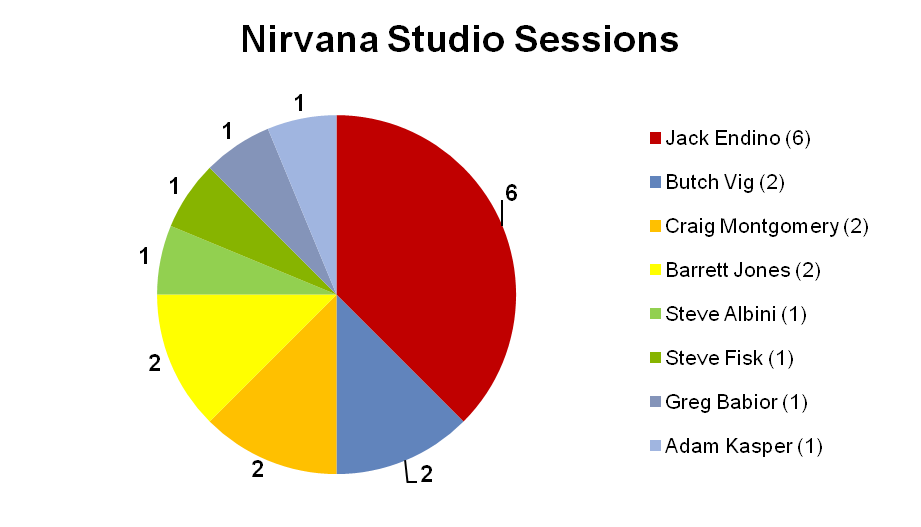
These aren’t quite the same questions of course. When we look at how many studio sessions the band engaged in the stats are as follows:

Jack Endino, as expected, was that daddy of Nirvana recording sessions shepherding them through their first demo, first single session, first album session, two one song sessions in 1990 and finally the first demo session for In Utero. Yet, does the same hold true in terms of the band’s productivity in those sessions?

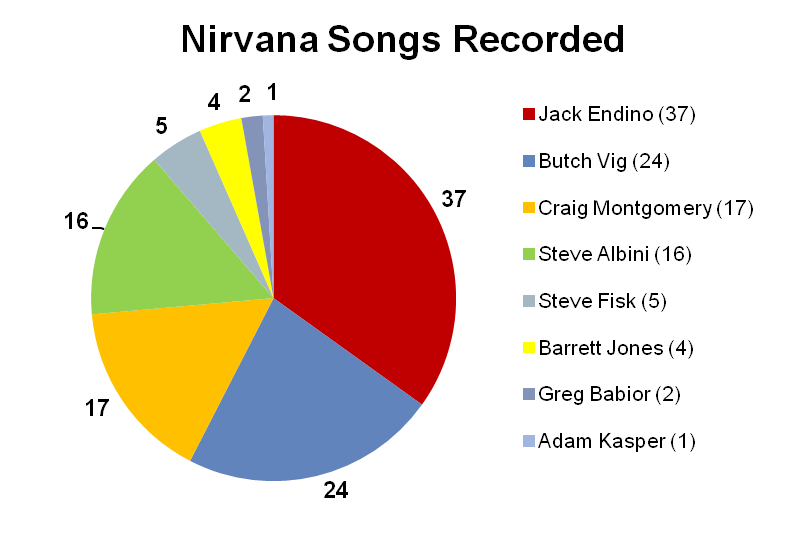
Again, Jack wins while Butch Vig’s two sessions with the band in April 1990 and May-June 1991 see him into second place. Nirvana’s soundman Craig Montgomery ends up in third place having recorded a range of material on January 1, 1991 and the Rio de Janeiro demos for In Utero. Its unusual thinking of Craig as the third most productive Nirvana collaborator when it came to production duties but understandable given the priority given to the albums:

It’s now that we can see the plaudits as they have been traditionally awarded with Jack, Butch and Steve Albini occupying the top ranks. Between 1988 and 1994 the ‘finished product’ emerged, primarily, at the hands of these three men making them the names most associated with Nirvana’s work despite the wealth of material since issued much of which was created with the support of others. It’s the focus on end product in the public domain, not necessarily overall work, that has been a key influence on the respect awarded producers…But it doesn’t erase the fact that Jack Endino is the uber-producer of Nirvana.