Mapping Nirvana in the U.S. 1987-1990

In yesterday’s posts I just rambled over the tables, today I’m doing the same via maps. I find it intriguing watching the band’s horizons widen and expand. In 1987 this was a band that barely made it more than a few hours from home, even a drive all the way from Tacoma to Raymond is barely 100 miles. Nirvana really was a band from the middle of nowhere; a lot of bands wouldn’t travel to Seattle because it was so far from the main strip of big audiences and gig locations yet this band wasn’t even a Seattle band at this point – here’s 1987:

The gathering momentum is visible, again, when 1988 is mapped:

There’s still a time lag, however, it isn’t like 1988 starts and the band have moved up a gear. Until that first April show in Seattle, over a year since their first gig, the band are still stuck trolling between Olympia and Tacoma.

It’s clear though that from April Seattle becomes the adopted live ‘home’ very swiftly. Between April 1988 and the end of the year those eleven Seattle shows immediately mean the band have played there more than anywhere else, Olympia may be important but it’s no longer where the future lies.


Mileage Part II

Just a brief evening component…


Again, looked at by country, I’m not sure we’re seeing any great surprises except how closely matched the U.K. is by Germany. In terms of their presence as a ‘live’, real-life experience rather than just a consumable video/audio product, the rest of Europe had as much claim to the band as we Brits did. The thorough criss-crossing of these countries is noticeable too, for example, this is Nirvana’s visits to Germany:


It’s a rash! They peppered the country with visits and took in most major cities at least once. The U.K. is even more thoroughly carpet bombed. Again, Canada stands out simply as an indicator of how centred Nirvana was in North America; quick jaunts across the border made sense over and over again hence Vancouver earning its six visits.

Mileage out of Nirvana

Firstly, a sincere thank you to Nirvana Live Guide, their guide to Nirvana shows sets an incredible bar and I haven’t seen anything of similar depth or knowledge for any other band. Amazing. I’m sure the next chart won’t show anything people aren’t already aware of — for me, cramming the data simply acted as a reemphasis of how true some statements are:

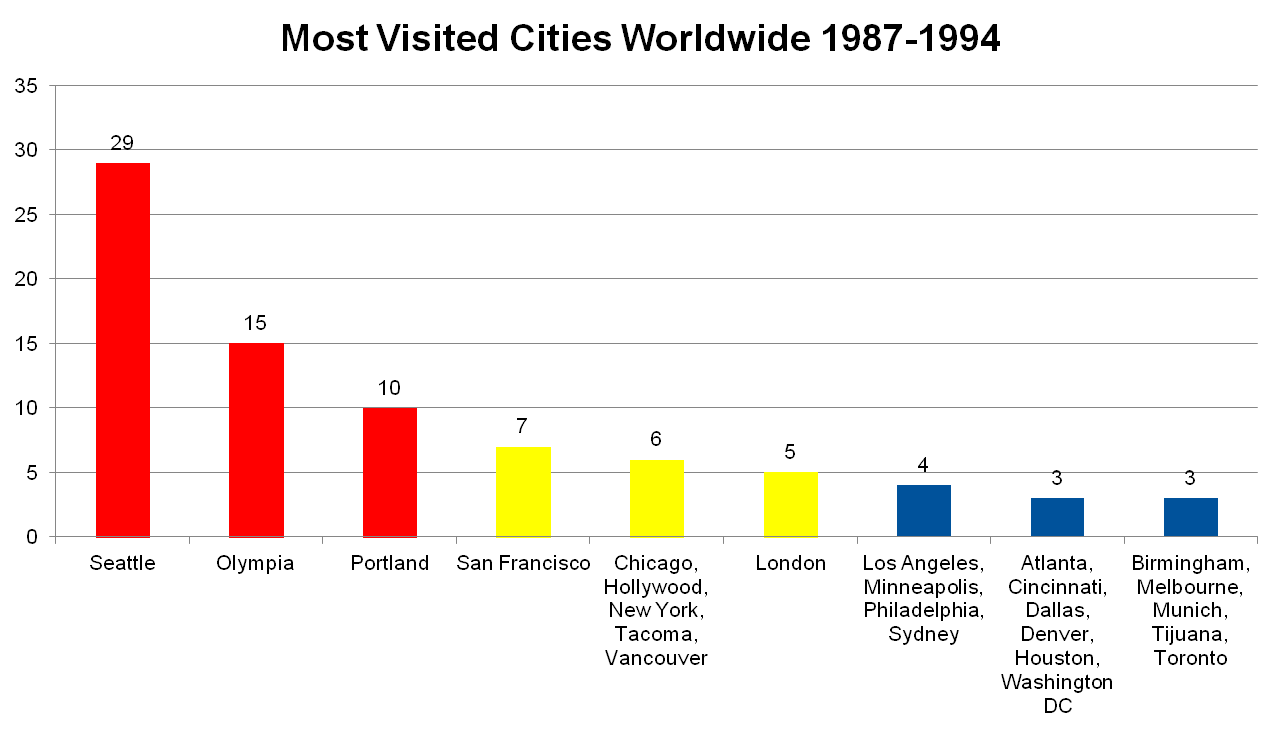
Yes, Nirvana truly are a Seattle band and yes, they really are a Pacific North-West band with an allegiance to Washington State. Just for emphasis…

I guess I simply hadn’t realised how dominant Washington State was in the history of Nirvana. The band visited Tacoma as much as New York. It also emphasises how U.S.-centric the band was; despite eight tours abroad (plus two one off foreign shows in 1992) only seven non-U.S. cities receive more than two visits, three of them still being in Canada or Mexico. It’s intriguing to me how much attention Reading 1991 or 1992 receive, or the Astoria Lamefest in 1989; what I think we’re seeing is how influential the U.K. based music press are in comparison to any other nation’s music media. Sub Pop were right in terms of their strategy; take the U.K. media and you won the world…So long as you toured like crazy in the U.S. to back it up. The story of Nirvana is dominated by foreign shows but I can’t tell at this range whether I’m seeing reality at the level of the fans, or whether I’ve adopted and assimilated a message written mostly by U.K. music journalists in which the U.K. shows look huge despite the low numbers. Seeing how much work Nirvana put in within U.S. borders I admit it makes me think that their fame was more down to that hard graft and less to self-regarding British journalists declaring XYZ U.K. based gig crucial…But as the majority of us never experienced the band live, as we only know them as an audio, video, photographic experience – does that then make the U.K. shows the winners?

This final graphic shows two elements; one, the fact that Nirvana were so heavily focused on Washington State and their West Coast U.S. neighbours that they performed over one hundred shows in just three states. To put that in context, Nirvana only played 121 shows abroad in their entire career — given how centred the U.S. entertainment business is in California, in some ways gaining a reputation in that region was as significant as all the work abroad.

This table also emphasises, to me, how much work Nirvana put in to their success; they visited 37 of 50 U.S. states — significant mileage into some backwood locations to spread the word. It makes Nirvana’s rise to fame less miraculous but far more impressive in many ways; the status they achieved was down to hard slog not just because moneyed powers plucked them from obscurity and set them atop the music industry.

We’ll play more with geography later today – its a neat diversion and I enjoyed crunching the information…

Monday 26th: Countdown to Dark Slivers Release

More stats and general musings on Nirvana to follow…But wow, things are getting busy. The book is due back from the printers this Friday – fingers crossed! In the meantime…This is an early summary of each chapter – just a set of snapshots rather than a full picture of what is covered in each one. Oh, and yes you’re right, each chapter is named after an album by a band Kurt expressed a liking of (The Minutemen, Scratch Acid, Big Black, etc.) the exception being Songs the Lord Taught Us, but it was too good a title to pass on:

Foreword

Months of total immersion in Nirvana has not always led me in healthy directions…You have been warned… J

1.0 The Greatest Gift

Incesticide sold more albums than any punk album in American history…Yet its qualities and pleasures have been roundly ignored. I set out the case for the album’s status in terms of the quality of what it contained, the care the band took over its creation, its artwork, its liner notes, its songs

2.0 (MIA) The Complete Anthology

Biographies of the band have stated that Nirvana’s first label Sub Pop teamed up with DGC to combine efforts and create Incesticide…They’re wrong

Fresh interviews with the key individuals at Sub Pop indicate that there never was a planned Sub Pop release. Incesticide was dreamt up and planned entirely at DGC and by Nirvana

3.0 Two Nuns and a Pack Mule

Even Incesticide’s back cover was a comedic image and with the selected cover songs, plus Sliver, on the album its always been the most fun of Nirvana’s albums

Yet Nirvana’s brand of humour was often caustic, aggressive and used as a form of attack — the band were at their funniest when taking sarcastic swipes at the scenes, bands and individuals they despised which can be seen in lyrics, in behaviour on stage and their approach to media and TV

4.0 The Rich Man’s Eight Track Tape

The chapter indicates the deep thought that Kurt Cobain put into structuring and sequencing the songs on the album — there’s a joke running through the entire album and likewise an attempt to mimic Nevermind, making this album its mirror

It’s now possible to see how many songs were refused for this album and to reconstruct the logical decisions that were being made in terms of what was included and why these fifteen songs were chosen

5.0 My War

Nirvana are portrayed as an apolitical band yet they were permanently committed to anti-sexism, anti-racism, anti-homophobia throughout their career which has been ignored because Nirvana’s approach was to have the conversation with their fans rather than to focus on ‘big banner’ causes aimed at attracting media comment

The liner notes within Incesticide are exceptional — a rock star deliberately driving away his audience by telling them to “leave us the fuck alone!” and doing so on the basis of their views on gender, sexuality and race

6.0 Double Nickels on the Dime

Nirvana were not an inevitability, despite the subsequent focus on jokes about ‘destiny’ and how they were going to be rock stars

Nirvana as a phenomenon occurred as a half dozen identifiable factors came together. Incesticide was part of the band’s attempt to resist and sabotage fame

7.0 Project Mersh

The literature simultaneously portraits Kurt Cobain as anti-commercial on a gut level and ruthlessly ambitious and commercial in his actions. I feel this schizophrenic portrayal arises from a misunderstanding of what music meant to him

In this chapter I focus on the desire for control and freedom as the driving motivations; whether an action was commercial/non-commercial simply wasn’t something that Kurt Cobain was primarily interested in hence the consequences of his actions could be either without it representing a ‘fracture’ within his personality

8.0 Post-Mersh

Incesticide showed Nirvana trying on different styles as they learned and evolved with a far more underground sound, with the sound of Kurt Cobain’s first recordings entirely abandoned then resurrected for Bleach

Alongside the album Kurt Cobain attempted numerous experiments with his vocals, with recording techniques and with guitar that ended as he headed mainstream

Incesticide represented the span of Nirvana’s experiments…But not necessarily of Kurt Cobain’s experimental urges

9.0 Hairway to Steven

Nirvana’s evolution can be followed by examining how they switched from covering metal songs to alternative rock tunes to more mainstream fare — Incesticide was their key statement not of the bands that did influence them but of those they wished to be seen to be influenced by, the album serving a ‘propaganda’ purpose that downgraded their rock roots in favour of emphasising their punk favourites

10.0 Big Black Songs About…

Like any writer Kurt Cobain had a personal style, one that evolved between the songs seen on Incesticide that originated in 1987 and those he became famous for. I suggest that he had three key song modes

Kurt Cobain wrote quite a number of ‘story’ songs between 1987-1990 then abandoned linear narrative altogether, similarly the character sketch was a regular trope of that period which he soon abandoned in favour of direct personal addresses announcing his mind-set and situation via song

11.0 Over the Edge

Having shown the forms in which Kurt Cobain created lyrics, we look here at exactly when his writing underwent changes and what may have events drove those changes

12.0 Family Man

As well as his writing style Kurt Cobain dwelt on specific themes and ideas that either evolved or remained constant all the way back to his first recordings in 1985 — the focus was regularly on issues arising from family, gender, sexuality

This chapter proposes a unifying concept that draws together material from as far back as 1985 and as late as 1993 — I posit that Kurt Cobain was the most psychologically motivated rock star the mainstream had ever seen

13.0 Songs the Lord Taught Us

A song by song dissection of the fifteen tracks on Incesticide seen in the light of the lyrical themes, musical patterns and Nirvana background described in this volume

The chapter synthesises the themes and ideas that have been expressed throughout this work and applies them to each of Incesticide’s tracks here ordered by the dates on which they were recorded/released keeping the songs in their chronological context and alongside their immediate ‘family’

14.0 Dry as a Bone

By 1992 Kurt Cobain was barely writing songs, yet there are still rumours of unreleased material. The paucity of truth in such rumours, the absence of truly impressive outtakes shows Incesticide was actually the cream of Nirvana’s leftovers

This entire work has been made possible by the depth of work done by bootleggers and unofficial releases over the past twenty years creating a situation in which the band and the record label have been supplanted in terms of knowledge

15.0 Coda

From 1992-1994, Nirvana barely existed as an actively creative unit. This chapter makes the case for seeing those years as the story of a band that was barely alive

Kurt Cobain’s suicide note was the third of just three written statements made to his public 1991-1994; the first was the Incesticide liner notes, the second his contribution to The Raincoats’ album release. What stands out is that the suicide note was a deliberate concealment, an attempt to avoid having to explain himself or his reasons

Reading Nirvana: A Bibliographical Note

In the case of Nirvana, fan-led initiatives online are actually the best source of raw data — whether on live shows, songs, sessions, past interviews and media reports — so this chapter begins with a brief tribute to LiveNirvana, the Nirvana Live Guide and the Internet Nirvana Fan Club

The chapter then summarises the various strands of the bibliography; biographies, cultural-historical studies of grunge as a phenomenon, song/album studies, then onward into photo books and other more unusual items covering English language publications on Nirvana through to October 2012


Bringing Hope for ’94

Sometimes Nirvana’s rise to glory is looked at as an inevitability. Rather it’s safe to say that as late as mid-1990 there was no guarantee the band was going to win a major label deal. Certainly the release of Bleach didn’t lead irrevocably to the triumph of Nevermind. Other steps intervened to make Nirvana into the band the world knows.

Similarly, however, there’s no inevitability to Kurt Cobain’s grim demise or the dwindling life left in Nirvana across the period 1992 to 1994. There could have been a resurgence, a resurrection. This inability to know what might have been, or what might still exist in the archives, allows those who wish to believe, to keep faith that in 1994 Kurt laid down worthwhile demos for future releases of some sort. Take a look at the following graph:

I’ve deliberately not shown the actual figures for how many songs were written because what I’m interested in is the lulls not the activity itself. While 1993 and 1994 seem to have been even worse than 1992 in terms of the number of songs written, the overall pattern was at least in line with the norm for his working practices with lulls after each album.

The lull in early 1989, during which Dive was the only song definitely written, is followed by a quiet spell throughout late 1991 and early 1992 during which Tourette’s, Talk to Me, Curmudgeon and Heart Shaped Box come together. The gap in late 1993 through early 1994, when only You Know You’re Right and Do-Re-Mi can be proven, isn’t exceptional when seen in these terms. It gives rise to two conclusions; firstly, that there’s a chance Eric Erlandson’s comments in March 2012 about unknown 1994 demos may carry weight. Secondly, that Kurt Cobain’s decline need not have been permanent barring his decision to make it so.

In early 1993, Kurt relied on a bedrock of earlier material he could cherry-pick to bulk up In Utero to the twelve songs (plus bonus) he seems to have felt was ideal. He carried a full seven songs onto In Utero era releases. If he was willing to use Do Re Mi, You Know You’re Right, Talk to Me PLUS Verse Chorus Verse and Vendetagainst (Help Me, I’m Hungry), he would still have needed an exceptional second half 1994 to have an album ready to record in early 1995.

At my estimate, the most Kurt wrote in a six month period was eight-nine songs ranging down to a norm of four or five. To get as far as an album recording in 1995 he would have needed to exceed his finest ever spells of writing which had been late 1990 and early 1991 (first and second best with nine and eight songs respectively.) It seems unlikely. Unless something extraordinary happened, or he’d pumped out a ten track album (which in Nirvana terms would have meant just a half hour or so of music) we wouldn’t have seen a new Nirvana/Kurt Cobain album until 1996 at the earliest.

On the positive side, this isn’t an uncommon occurrence. Many bands lean heavily on material written prior to the heavy touring, TV and media engagements of fame in order to sustain them past a second major release. Likewise, it isn’t unusual for performing artists to drain the well of inspiration and need lengthy periods to recover some measure of creative flow. A drug-free Kurt Cobain looking toward the future could have had one…if he had wished. If he had, we probably wouldn’t even be talking about the lull in productivity 1993-1994, it would just be an irrelevant blip on the graph with no more significance than the ones after Bleach or Nevermind.

No Sonic Youth = No Nirvana

Part credit for this post goes to a gentleman called Brett Robinson over on the LiveNirvana forum (if you’re interested in Nirvana I genuinely recommend the site and the forum — I’ve used the site for years but only recently engaged with the forum and the intelligence and knowledge present is awe-inspiring.) A discussion was started a couple weeks back asking people to suggest “The Top Five Most Important Concerts to Nirvana’s History.” Brett pointed to the show in Hoboken, New Jersey on July 13, 1989 on the basis that it’s the night Sonic Youth saw first saw Nirvana play live. I agree wholeheartedly.

Melvins acted as the role model to a young Kurt Cobain trying to seek a social setting for present-day teen survival and also looking for a longer-term means of escape from that setting. Melvins served wonderfully for those first few years, yet having discovered the limitations of the indie scene as it stood in 1989-1990 — living on the breadline, unenviable touring conditions, limited studio time and budget — the band needed something new.

The example of major label moves had been set by many recent underground bands; Mother Love Bone, The Posies, Soundgarden and Alice in Chains among others. But the foremost band in the Eighties underground was always Sonic Youth. If Nirvana could be considered ambitious it’s in reaching past all their other compatriots to make comparisons to the band that had, at that point, become the biggest alternative act without crossing over or compromising with mainstream tastes. Having left Melvins behind already, with the buzz building, Sonic Youth became the next critical role model.

It’s intriguing how others have either taken up the chant or saw the comparison too. There’s the well known quotation from 1988 that “Nirvana could become…. better than the Melvins!” yet the comparisons changed:

Keith Cameron: “’people were saying, you know, one day, they might be as big as Sonic Youth.”

Dave Grohl in 2011 on Nevermind: “Holy shit! We’re going to be as big as Sonic Youth!”

Everett True in Nirvana: The True Story: “’Yeah, as big as Sonic Youth at least, or the Pixies…”

Anton Brookes: “our idea of the ‘Top 10’ was being as big as Sonic Youth or the Pixies…”

Krist Novoselic in 1992: “‘We wanted to do as good as Sonic Youth…”

A lot of these quotations are post-event comparisons but they coincide absolutely with the vision available in 1990 of what success for a band that wasn’t soaked in mainstream glitz meant.

Nirvana followed Sonic Youth onto Gold Mountain for a very clear reason as described in 2011 by Danny Goldberg, “John and I signed Sonic Youth, who were very good at picking opening bands…They chose Nirvana to open for them on a European tour, and I recall John coming back and saying that we should manage Nirvana. Then Thurston called me and told me how great they were. I really trusted Sonic Youth. We met with Nirvana, and they trusted us because they trusted Sonic Youth.” Just like Dale Crover’s presence had persuaded Jack Endino to open his doors to Nirvana in 1988, Sonic Youth got Nirvana their management company thanks to firstly, taking Nirvana with them for seven shows in August 1990 (at that point the largest shows Nirvana had been a part of), then personally asking for it to happen.

Precisely the same thing happens again with Kim Gordon apparently responsible for persuading Nirvana that DGC was the label they should go with. It’s like Sonic Youth had adopted Nirvana. A year later Sonic Youth again take Nirvana with them for a month of touring in August including their first substantial festival appearances at the Reading Festival, Monsters of Spex, Pukkelpop, Überschall 91 and Ein Abend in Wien.

Nirvana continue, even after fame, to mimic the Sonic Youth mode of behaviour whether deliberately or through some shared underground heritage. The sponsorship of other bands — whether The Raincoats, The Vaselines, Melvins — was something Sonic Youth had been doing for years, bringing up other acts as tour support or barracking the industry to get them releases. Also Cobain’s diversion into production (with Melvins in 1992 and 1993) had been prefigured by Lee Ranaldo’s work for Babes in Toyland and Kim Gordon’s work for Hole.

So, while not as fundamental to Nirvana’s sound as Melvins were in the early days, Sonic Youth had an equally strong influence on pushing Nirvana into the limelight, onto the major label stage, and providing an aim, something to emulate. Later, reading interviews where one or other member of Sonic Youth states things like “I think anybody who knew Kurt fantasizes about some conversation that they could have had with him that might have saved this person from such a tragedy…” it still has that feel of the elders watching over their kid brother.

Anyways, this is a scrap from the April 1994 edition of Metal Hammer magazine which I bought for the Kurt Cobain tribute. It was also the first time I had come into contact with Sonic Youth. This single purchase thus bid farewell to Kurt at the same time as introducing me to the band that became the single most important influence on my music-consuming tastes and directions. I’d like to confess at this point to having seventy-seven Sonic Youth (and related) releases…

Curse you Metal Hammer, April 1994 for your impact on my budgets!!

Flowers of Romance and Bathroom Destruction

Brett (Beautiful Day) commented that Flowers of Romance would have been another good choice to include on the cover shot for the Dark Slivers book – Dan808 replied too pointing out how curious it was that “Cobain picked that as one of his favourite albums rather than PiL’s Metal Box or PiL’s debut.” I can see a connection to a topic I briefly comment on in relation to the song Beans in the Post Mersh chapter of the book.

This is a argumentative theory, not a fact. But Kurt Cobain wanted to include Beans on Bleach – it would have been there if not for others intervening. While reciting the reason for the exclusion, there’s not been much desire to ask ‘why would Kurt Cobain want to include this song?’ I think it’s similar to Axl Rose’s decision to wedge a similar scrap of dubious quality at the end of Use Your Illusion II, My World. In each case, sticking a solo track at the end of your band’s album is a declaration of ownership and authority over the album and therefore the band – everyone else is submerged in the group identity, you aren’t, you’re allowed to show your experiments and stand out as an individual. Flowers of Romance was a difficult album for PiL, until that point the music had been essentially the creation of Keith Levine and Jah Wobble with John Lydon confined to lyrics. On this album, Wobble had left, Levine contributed but was a heroin-induced wreck, so Lydon dominated the music too. To mark it even more thoroughly as HIS property he gave it a title that tied it to a very early Sex Pistols song (a jam track they used to use in various forms to open shows). So, if looked at as the singer’s declaration of independence and dominance, rather than simply as a musical composition, Flowers of Romance seems to be an album that would resonate with Mr. Cobain.

As an aside, the timing of that list of favourite albums is interesting. The final album on it is PJ Harvey’s Dry, released in June 1992. So, the famous list of fifty albums was created either in late 1992 or sometime in 1993. Given Kurt was very much off doing his own thing and divorcing himself from the band (see the piece from earlier this week on trends in press coverage) its a neat coincidence with the concept above – but I do think a coincidence. It’s also a nice coincidence with the whole issue of the bathtub filling with sewage and wrecking his stuff.

Also, I’m interested in the unknowing, the things that can never be truly known. What we do with them is we stitch a narrative over the top of the gap to connect known events and thus cover the absence in between.  I’ve talked a lot on this blog (see Killing Nirvana Pt. 1 and Pt. 2 plus Trending Kurt Cobain’s Creativity) about the nosedive in Nirvana’s activity post-fame. The incident that I took as the inspiration for the cover is of deep significance to that theme.

Kurt Cobain stated that he lost a number of notebooks with all their lyrical ideas. There’s little further comment on the incident in the nearly two years left to run so its impossible to tell how much was lost, how many potential lines or new song ideas went missing in that event. It creates an absence; Kurt Cobain never publically assesses the damage caused or the quantity of work he couldn’t recover. We therefore can’t see whether Kurt wrote more than he appears to have done in the first half of 1992. Its still unlikely there was much (given overall trends, tours, TV, press, marriage, heroin…) but the survival of those journals and notes could have meant a Nirvana that had twenty new songs left in them rather than the dozen or so they do come out with.

Anyways, just to show I’m paying attention to the comments. 🙂

And Dan808 – yes, if you want a copy of the book, drop me at email, NirvanaDarkSlivers@gmail.com and I’ll put you on the pre-order list. No payment needed until I can confirm postage back to you and you decide you’re cool with it. Stay good!

No Melvins = No Nirvana

On here’s the sample chapter from Dark Slivers again, I know its buried down in the blog now…

Dark Slivers Book-A5-chapter14

And apologies for the delay in the Saturday post – it all depends on what time I wake up on a Saturday AM.

It seems impossible to overstate the importance of Melvins to the story of Nirvana. In Kurt Cobain’s reminiscences, contained within Come as You Are: The Story of Nirvana and within his Journals, he defines the most positive aspects of his teenage identity in terms of music. His ‘Road to Damascus’ conversion is the discovery of punk music via Melvins, the role models he describes are Melvins, his first experience of the life of a gigging band (as a roadie) comes from the Melvins. As a formative experience only the divorce of his parents is more significant.

Musically the influence was also explicit. Kurt Cobain’s Fecal Matter demo sounds like early Melvins combining a sound emerging from the hardcore scene with a slower, narcotized vibe on many songs (the version of Downer lasts around a minute longer than the 1988 rendition would.) Kurt Cobain was following the most immediate model available to him which was this local band. It’s 1987 before Kurt Cobain truly begins to try on other sounds with his music from that year sounding far more edgy, far more new wave. Members of Melvins also provided Kurt with his first on stage music experience joining him both as Fecal Matter members and also in a short lived project known as Brown Towel (see Nirvana Live Guide/LiveNirvana for more info.)

The Melvins’ influence continues though. Jack Endino is clear that he only took the Nirvana studio booking because Dale Crover was on drums for the band — Dale’s presence assured Jack that this band must have something to them. Nirvana’s first media coverage specifically hinged on the band’s link to Melvins suggesting that practice might even make them “better than the Melvins!” This is quite a list of firsts owed to Melvins; intro to punk, roadie experience, first proper demo, first press, first live performance, first studio session.

Nirvana would share a split single with Melvins as each band struggled in late 1989-early 1990 to expand their audiences. The Here She Comes Now/Venus in Furs covers single was one of only three split singles Nirvana released, one with The Fluid being Sub Pop’s decision, the other, with The Jesus Lizard, being a fan-boy wish-fulfillment in 1992-93 giving Kurt the opportunity to show love to some of the remnants of Scratch Acid, a major early influence.

That loyalty to Melvins continued right through Nirvana’s career with Kurt Cobain being willing to have his name associated with Melvins’ major label debut Houdini. While the extent of his participation in the recording/production of the album is debatable, my assumption is that Kurt was sharp enough to know that his name on the album was enough to guarantee it extra media coverage and probably a certain quantity of sales thus benefitting his friends directly. This was the same thinking that led Cobain to write the liner-notes to the reissue of The Raincoats’ debut album and to put so much attention into The Vaselines or Shonen Knife. One of the few powers he enjoyed once famous was that it allowed him to support those he adored. He also had the band support Nirvana for a few dates in December 1993 and then throughout most of the band’s last shows in February 1994 onto March 1, 1994. Melvins played to some of the biggest audiences of their career, just at a time when they needed such support to ensure the success of Houdini — it’s safe to say Kurt Cobain knew precisely the commercial power he was putting at their disposal and took some satisfaction from it.

What really makes the difference in my eyes is that, by the end of his life, Kurt had repudiated his links to many formal friends and idols. He wrote dismissive letters (unsent) to Calvin Johnson and Krist Novoselic while publically criticizing Sub Pop, grunge, riot grrl…He never did this to Melvins. The best indication of the importance of Melvins to the Nirvana story is that he always supported them throughout his teenhood and his traumatic last decade.

Celebrating Incesticide at 20 Years’ Distance

I was asked the other day “Nick, is Incesticide your favourite Nirvana album?”

It was an easy one to answer, “no way. In Utero’s the favourite by a mile. But I think Incesticide is important.” In the sample chapter released tomorrow I’ll delve into it in more detail but in essence, Incesticide served three crucial purposes; firstly, as described in the blog post “Kurt Cobain Gives a Christmas Present” it was Kurt kicking back at commercial compromise; secondly, it was part of the reemphasis on Nirvana’s noisy punk-focused side after the ‘blip’ of Nevermind; thirdly, it was Nirvana’s attempt to indicate the abandoned paths on their road to fame — showing fans that there had been other sounds explored not just a march to victory.

The album essentially cuts Nevermind out of the picture and draws a straight line from Nirvana’s early era directly to the raucous material that emerged in 1992-1993 — D7, Return of the Rat, Curmudgeon, Oh the Guilt — and ultimately to In Utero and its raw sound. It’s impressive in a way, using past work to show where future work was going to go. Incesticide helped indicate the band’s immediate direction.

The record was utterly unfriendly to corporate pay-masters, to family-friendly record chains and, ultimately, to fair-weather pop fans. This wasn’t just a case of the music though, in itself, the music was a distillation of several key sounds of the Eighties alternative underground — Incesticide should be considered as the most-successful product of that scene. The front cover, the title, the liner notes, the absence of a video until well into 1993 (and hardly a radio-friendly video at that given the trashy punk vibe and aggressive treatment), the refusal to talk to the press. While described as a deliberate attempt not to shift focus from Nevermind there’s little more the band could have done to show an absence of commercial desire and a desire to cause a bit of offence along the way.

Side B of the album is essentially an EP-length release of what Nirvana sounded like before they became a grunge band. These are songs written 1985-late 1987 by all accounts and show a far more articulate lyrical style alongside a varied range of vocal and musical styles, plus a willingness to experiment with structure; for example with Aero Zeppelin commencing with almost two wordless minutes of music, very rare for a Nirvana song. Side A, by contrast, picks up the story in the aftermath of their most ‘Seattle sound’ era with the band genuinely emulating the demo-like feel of their then power-pop and lo-fi heroes. The story of Nirvana is often seen as a move straight from Bleach and grunge to Nevermind and pop-rock. Incesticide displays the intervening spell when the band were trying on a sound that, if they’d persisted with it, would have won them another indie deal, but wouldn’t have propelled them far as major label rock.

The focus on the three studio albums, and on the studio albums as discreet entities, has made it harder to see how unified Kurt Cobain’s lyrical themes were. Looked at as a single oeuvre it’s possible to see themes, ideas and images reiterated year-after-year from the start to end of his career. Incesticide is as much a part of this discussion as any of the albums and helps show the divisions and unities in the rest of the catalog. For a start, it makes it clear that Incesticide was Kurt Cobain’s response to fame (in form, art, words) while In Utero was only a response to the assaults on his family in late 1992.

Plus, the final argument for Incesticide is simply numbers; it gathers songs from a quarter of Nirvana’s radio sessions (two of eight); from seven of ten pre-Nevermind studio sessions; it includes a song first appearing on Kurt Cobain’s second ever demo recording; it captures Nirvana’s first studio session; it features four of their six drummers; it contains three of only eight cover songs Nirvana released officially prior to April 1994; four of its fifteen tracks were alternatives to versions already released; and it contained songs from each year of Nirvana’s development from the band’s formation to 1991. That’s quite a haul.

Incesticide, far more than the fragmented With the Lights Out or any other Nirvana archive project since, was the crème de la crème, the finest outtakes Nirvana had in the cupboard. The sheer quality of the release has been sorely underestimated when it can be seen, from twenty years distance, that the MTV Unplugged performance and You Know You’re Right are the only Nirvana outtakes that run Incesticide close.

Killing Nirvana Part 2

In yesterday’s piece we pointed out that, between 1992 and 1994, two of the major pieces of being a genuinely active band, performing and recording, were missing. In this blog’s first post we showed that another piece, writing songs, wasn’t figuring on the front-man’s agenda. What other pieces of being a band with a life exist…? Let’s talk about media relations.

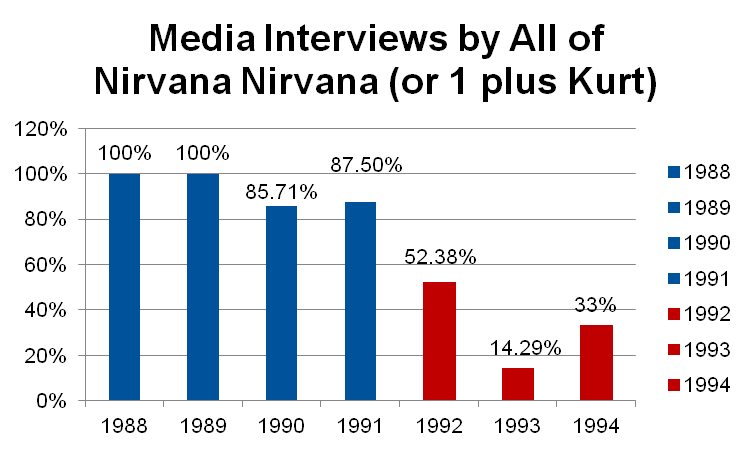
I’ve used the archive at the Internet Nirvana Fan Club and sifted it to find Nirvana’s interviews between 1988 and 1994 giving me a total sample of 64 to work with. The biggest phase of attention was naturally after Nevermind emerged, the first half of 1992 is swamped but it doesn’t ‘fall off a cliff’ after that, but given this is a band at their peak, they’re barely engaging more than they were in the years when they were just another unknown band.

And hold up… Take a look at the nature of the interviews conducted across the years:

That 33.33% in 1994 is earned via a single interview which seems to feature Kurt, Krist and Courtney altogether. There’s a clear trend toward the band no longer acting as a unit in front of the media; primarily Kurt conducts solo interviews, there are equal numbers for Krist solo interviews and Kurt interviewing with Courtney present.