Nirvana Interviewed on Studio Brussel – Ghent, Belgium November 23, 1991

http://www.stubru.be/programmas/intomusic/attentionthisiskurtfromnirvana

…Oh…And part way down the page, you see that gray tab? Click it if you’ve ever been curious to hear my actual voice. I really do sound like that – Studio Brussel kindly asked me if I’d like to come on air and discuss the interview with them. They’d forgotten they possessed it until I emailed a couple weeks back inquiring if they still had it.

This interview went missing in the station’s archives. A huge thank you to Manu, Eva and Sam for taking the time to locate it – really appreciated.

Krist Novoselic’s Post-Nirvana Releases: Worth An Eye…

I remember a friend handing me Sweet 75, Krist Novoselic’s post-Nirvana project back sometime late in my time at school. I also remember not thinking much of it –with age I begin to wonder whether I may have overlooked some essential quality within the album…So, given Novoselic’s post-Nirvana releases are so cheap on eBay I did some digging and decided it was time to revisit Sweet 75, the No WTO Combo and Eyes Adrift. What do Novoselic’s post-1994 releases demonstrate about Kurt Cobain’s chief lieutenant and are they worth time and energy in and of themselves?

Starting with Sweet 75, OK, it vanished without a trace at the time despite ongoing work right through into 2000 – curious to think of it as a five year project when Nirvana itself barely lasted seven. Of course it doesn’t seem to have been a band with great ambition behind it – a significant contrast to Nirvana’s 60-90 gigs a year heyday and regular recording and release schedule. That’s often the problem with something so casual – as a one-off, as a document of a specific moment in time, they can often be effective. But the idea that this album is a testament to efforts between 1995 and 1997 – the same length of time it took for Nirvana to go from Mrs Butterworth to the January 1988 sessions, through Love Buzz and all the way to Bleach…Of course, Wikipedia states that he met Yva Las Vegas at one of his birthdays – which would mean either the association began around May 1994 (which seems a bit swift and sudden perhaps?) or didn’t begin until May 1995…Oh well. What of the album?

This is going to come as a controversial statement, but the Sweet 75 album stands as a real testament regarding Krist’s hidden talent as a guitarist. Trying to focus down simply on his guitar-playing, it’s remarkable how adaptable he is. On Cantos de Pilon he contributes a beautifully finger-picked Spanish guitar backing. On Ode to Dolly, Dogs and Japan Trees you’ll hear a jazzy guitar vibe similar to Cobain’s Black & White Blues home demo. Lay Me Down, Six Years and Nothing all plumb the Americana vein. La Vida meanwhile is bloody crooner-jazz music more befitting Michael Buble…I admire that last piece of open-mindedness while still not wanting it on my stereo. The rest of the album has a firmer alt-rock feel but always with other touches emerging like Bite My Hand’s South American breakdown. He’s certainly a more traditional guitar player than Cobain – the moments of overdriven fuzz on the record are used sparingly while little here feels wildly out of control – he has a clear grip of technique and such a wide awareness of styles and techniques which he deploys with real precision. The song Six Years moves through several different feels and vibes in a relatively brisk four minutes.

The only slight issue one could point to is that across the album there’s a relatively limited tempo to all the songs. It’s like comparing top form Lil Wayne mixtapes to the walking pace approach on The Carter IV where he could barely break out of ‘talking speed’ for more than a song or two. The same affliction is present on Sweet 75 – it’s an album of half a dozen dominant styles, divided again by the diversions taken within each individual song, but all taken at the pace one might reserve for practising an instrument. Accuracy rules over heart n’ soul. Praising the openness to neat instrumental touches – like the really well placed mellotron interventions on Fetch, or the accordion on Oral Health – is genuine, the compositional talent on display is very clear but, again, it feels constructed in it’s precision while simultaneously lacking a unifying feel.

On Game’s The RED Album there’s a horrendous mid-album R n’ B segment which seems cynically planned to permit sales to the dominant music market and to open it up to the female demographic. It totally ruins the momentum of the overall album, destroys the flow – not to mention that the songs are appalling crap. There’s absolutely no sense of anything so strategically planned out (and strategically flawed) on the Sweet 75 album – it feels far more spontaneous, it is what it is…The problem being that there’s not much sense of a plan at all. Nevermind clearly has a plan – Cobain quite clearly is mapping out the flow of the LP and does so for quite a long time prior to the album’s finalisation. That album is also a very focused object – there’s no huge deviation into completely disparate territory and yet, simultaneously, it certainly doesn’t belabour a single sound nor outstay it’s welcome. The Sweet 75 album is of comparable length but flies off in so many directions there’s no flow or development to it – there’s no movement, no reason why a song should be in one place or another and as a listening experience it’s really audible. While the Game’s effort wants to be a gangsta rap revival AND a chart-bothering R n’ B EP all on the same overlong album, the Sweet 75 album doesn’t seem to have any determined identity, it simply flits between guises to the detriment of some good touches, good moments and details. It’s wrong to read too much into a single release but if it said anything about Novoselic it would be that he has an incredible amount of under-exposed and under-rated musical talent that went to waste in the dictatorship that was Nirvana – however, it suggests he functions better with a leader, with someone saying what will fly and what must die.

What more can I say? At its core Sweet 75 has a suite of really excellent alt. rock songs with Take Another Step and Red Dress being tracks I’ll happily listen to again – there’s something that reminds me of Babes in Toyland about the vocal delivery which is eminently listenable. Around those songs, however, are so many diversions it’s impossible to love it all. I’ve spoken to two journalists who say that after Cobain’s death they had to move away from working on rock music because Kurt, for them, had exposed all the gross consequences and endings of the clichés of rock n’ roll. I would understand Novoselic wanting to play something a world away from Nirvana – which he does here – but at some point this album needed someone to decide what it was, it doesn’t have that. Foo Fighters got it right; a punk rock/pop rock band – set the controls, go. It doesn’t mean I always loved them but it was clear what was being delivered. Sweet 75 is three EPs in 14 tracks – I still don’t know who they are.

Eyes Adrift is a firm correction of almost all those question marks. It further expands my appreciation of Novoselic as a musician too – Krist sings! And he does a good job of it too! His voice is surprisingly similar to Curt Kirkwood’s, maybe his voice is just something he had to grow into because it’s a world away from his 1987 take on Gypsies, Tramps and Thieves. I’m immediately fond of his gentle approach on Inquiring Minds – it’s a great lil’ song! And, this time around, Curt clearly provides the leadership and the focus lacking from Sweet 75 – the album has a defined identity, a solid core, a unity that lends coherence. But wait…Agh. OK, I like the Meat Puppets, I like Meat Puppets II, I like Up on the Sun…But the problem is there’s only so much southern hospitality rock I can take. The focused identity of the Eyes Adrift album is that particularly gentle country rock vibe Meat Puppets ended up with – it’s ultimately a Meat Puppets album with one Krist replacing one Cris, when what would be a neater thing would be a Nirvana-ish album with one Curt replacing the other Kurt. Instead it just feels a bit…Gentle, a bulbous summer warmth that never boils into sweaty motion or dries to frazzled crispness. It also shows Krist, on the Dottie Dawn & Julie Jewel track, again proving quite keen on the Leadbelly guitar influence a few decades too late. But maybe it’s just me. Middle-of-the-Road indie is as irksome as MOR rock always was.

Which brings me to the No WTO Combo – phew, Gods, it’s nice to hear some raw guitar and an impassioned vocalist at last! On Full Metal Jackoff Jello Biafra’s delivery recalls Johnny Rotten’s style on Pretty Vacant – a good sound to emulate. Again, there’s a clear leader here – the first fifteen minutes are Jello hyping the cowd, there’s a Dead Kennedys’ song, there’s a song from his 1989 collaboration with D.O.A., there’s two new songs he’s written. But what the hell, it means there’s a sound being aimed for and it works well. Plus it’s a focused recording – a single night, a specific point in time, a quality line-up including Kim Thayil who kills on guitar. When defending Sweet 75 or Eyes Adrift I can understand people saying that they’re unpretentious records, that they’re the sound of musicians enjoying themselves…Except I think the No WTO live show sounds a lot less pretentious, a lot more like musicians enjoying themselves – the albums are not people just cutting an album for the hell of it, they’ve made an album because they want to release some music and have formulated it as such. No WTO Combo is about highlighting a cause, getting attention, putting the word out there…But it kicks ass in a way the other two don’t. There’s a real feeling of being sat bobbing head up-and-down on the corner of a stage in a club so full everyone has an elbow in there gut one way or another – the production is somehow so clear and yet it also that slight mist over everything that makes it live – you can hear Jello breathe…Momentum matters, Jello spending a minute or two ranting doesn’t break the intensity at all thanks to his practised delivery, it just lends outrage in between the bursts of straight-forward punk.

I’m definitely aware that what I’m feeling is my preference for rock over indie – my assessment has to be judged on those terms, that I’m arguing from the perspective of someone who ‘feels’ the rough-edged punk guitar but feels no affinity for quite a lot of country-influenced music (there are exceptions! The Broken Family Band, early Meat Puppets, Herd of Turtles!) The drift toward stripped down acoustic music seems to be a simple part of the life progression of the average noisenik or ex-alt. rocker, even Thurston Moore has ended up there (thank God for Chelsea Lights Moving and Twilight) while Michael Gira has really owned it (thank God for the Swans revival but also for Gira being able to make even the most lite song sound menacing.) Being aware of it, that eventually turning down the volume is all anyone seems to be able to do doesn’t make me a vast supporter of it. The directness of the No WTO Combo, the absence of any attempt to create an album makes for a far stronger connection with the artists while Sweet 75 and Eyes Adrift…They don’t speak with me, I don’t feel someone communicating to anyone outside of the circle of players. Ah well.

Again, the inlay booklet presents Krist on articulate form – he wears his intelligence lightly, it’s been impossible for years to ever mistake the guy for a fool. He writes well, speaks well, makes points effectively and with a clear depth of knowledge and awareness. Again, reading the liner notes of the No WTO Combo gave me a further appreciation for Krist Novoselic. Really glad I spent the £6-7 it took to get hold of the three records even if they reminded me of what was lost when the stakes got too high. The result is that zone of comfort, of lack of consequence to music – when it’s just something nice to do rather than something one has to do, the millionaire rock star syndrome or just the aftermath of the horror?

Every Known Time Nirvana Performed a Song March 1987 to March 1994

Complete Nirvana Live Song Performances 1987-1994

I just posted this to LiveNirvana as I’d volunteered to help with a data initiative of theirs. I work with two incredibly cool blokes in India called Shrikant and Mohan who built the first version of this for me. It’s an attempt to take every single confirmed song performance listed in the Nirvana Live Guide and record it into a single spreadsheet page so you can see:

– What songs can be confirmed as having been performed
– The pattern in terms of when they were played/stopped being played
– How many times they were played in each month 1987-1994
– How many times they were played in each year 1987-1994
– How many times they were played overall

I’ve revised it a bit – it’ll look like a technicolour yawn at first sight I’m sure but basically, (this is just to help if peeps don’t use Excel, sorry for crash course speak) – Columns run across the page, Rows run down the page, each square is a Cell:

– Column A lists all the songs down the left
– Months and Years run across the top from first performance in March 1987 to last in March 1994
– At the end of each year you’ll see a column highlighted in grey adding up the total number of times a song was performed for each year. The formula is =SUM(Cell:Cell)
– In Column BQ it adds up those ‘totals per song per year’ to say how many times each song was performed in total 1987-1994 (School wins)
– Row 131 along the bottom adds up two things: (a) how many songs are known to have been played that month (b) how many songs are known to have been played that year
– If you want to look at a specific year only (i.e., just 1993) simply highlight all the months/years you don’t want to see (hold down left mouse button and drag mouse across the cells to be covered), then right-click, select ‘hide’

The nice thing is, if more data becomes available and you want to update it just click on the cell matching the song and the date (i.e., look for Pennyroyal Tea in Column A, then move along until you see February 1994) and add or subtract from the number in the relevant cell.

It matches what’s on Nirvana Live Guide up until about May 2013 – so it’s missing updates made after that date to that site. Thought I should just pass it out to everyone so people can use it as they wish, improve it, correct it, etc. Be a shame to lose the knowledge.

Hope everyone else enjoys playing with colourful spreadsheets as much as I do…
…Oh. And this is the 350th post on Nirvana-Legacy.com Nov 2012-July 2014. Yay!

Kurt Cobain and the Earth Sessions of October 1990

Cobain’s contributions to Earth’s October 1990 sessions in Portland were the last chance he would have to collaborate in studio with a musician outside of Nirvana for some two years. It was the conclusion of a spell in which I feel he was, to some extent, reacting to the collaborative environment of Olympia in which temporary line-ups were common practice – the norm. The re-issue “A Bureaucratic Desire for Extra-Capsular Extraction” features both A Bureaucratic Desire for Revenge – on which Cobain contributes backing vocals – as well as the stellar Divine and Bright – on which Cobain took the lead vocals. Having left the Olympia environment I’m not sure he ever recaptured this collaborative urge; the Melvins’ sessions were not exactly top quality work from Mr. Cobain, while Eric Erlandson is blunt about the unusable nature of Cobain’s contributions to Hole sessions in 1993. It seems to have only been it environments where he was clearly leading the work – in his basement in 1994 primarily – that he was able to wring out anything more than a few background moans and harmonies. In a way it seems that Cobain’s apparent yearning to work with other musicians and in other musical contexts circa 1993-1994 was a craving to go backwards to his days in Olympia where it was fine if he hooked up with Slim Moon’s changing cast in Witchypoo, or lent prominent guitar to his on-off-girlfriend Tobi Vail’s work with The Go Team, or took direction from Dylan Carlson on these recordings, or from Mark Lanegan on The Winding Sheet.

I’m in two minds whether the sign of a good collaborator is someone who blends seamlessly into an overall vision, or someone who stands out at all times from the melee of sound. In a typical middle-of-the-road fudge perhaps the answer is that the most talented collaborator is able to merge or emerge on a recording as the moment requires? Cobain at his peak certainly had this gift; he makes the rendition of Where Did You Sleep Last Night on Lanegan’s record, he’s the driving force turning it into a squalling storm of a song, he lends the gnarly edge to the Go Team songs he contributed to, he vanishes into the blend on Lanegan’s Down in the Dark but he fits well in each situation. The Earth songs are further support for Cobain’s adaptability in this regard.

I can’t it, I’m going to start with Divine and Bright because I think it’s a simply awesome song – massive kudos to Dylan Carlson for this track. The guitar part merges drone and pop by virtue of playing a wonderfully simple swaying tune…But doing so under a swamp of distortion. It’s pop in the same way chunks of Bleach were pop once one turned down the amps, took the foot off the pedals and saw the simplicity beneath the ferocious outer coating. The song is a mantra, a relatively simple piece with barely a handful of words – “Divine and bright, divine light, stretch/stretching”. I think such simplicity is to Cobain’s benefit; he can focus on delivery rather than on remembering words. Unusually for Earth the song is a bare three minutes – Cobain’s presence is even slighter coming in for barely twenty seconds somewhere over the minute mark, then reprising the lines at around two-and-a-half minutes to leave just enough space for the song to fade out on a roar of feedback.

Cobain intones the words in a voice I can’t work out is weary and resigned at the sight of ultimate annihilation, or is awed and breathy at the sight of immaculate and gorgeous light. That inability to place the emotion attracts me, a gap to be filled by thoughts of whether the moment is beyond any feeling – an observer numbed by amazement or surrender. Cobain’s tendency to announce apparent positives (“I’m so happy,” etc.) in a voice that speaks of an utter lack of excitement makes the few words of Divine and Bright a near perfect fit for him – “an atomic explosion, of raw and terrible violence and beauty!” “Oh yeah…? So…?” His voice rises across and draws out the word “divine” then plummets to pronounce “and bright” – “stretching” is more a sound than a word – it’s comparable to something like the “hello/how low” bridge on Smells Like Teen Spirit except taking over the totality of an avant-garde rock song. It certainly is toward the pop-end of Earth’s early discography and Cobain must have been comfortable with a guitar sound that spits and purrs like his own preferred approach prior to the on-set of 1990’s mainstream experiments.

A Bureaucratic Desire for Revenge meanwhile is more regular Earth-y fare; a roaring semi-instrumental in two parts (originally to be split across two sides of a vinyl disc), genuinely fantastic stuff with the slow march of the guitars, the repeating phrases, the gradually developments and diversions – love it. Cobain’s contribution comes in amidst a sudden eruption of tribal intoning (a little like the sound of a didgeridoo) supplied by Carlson himself. Kelly Canary meanwhile howls and barks to punctuate the regularity, she prevents the song from becoming a mantra, keeps it wild. Her contribution is far more visible than Cobain’s. Here, as on Lanegan’s Down on the Dark, he’s more of an emphasis or a mirror for the main vocalist to ‘rub up against’, I have trouble distinguishing more than the odd likely sound with a Cobain throat behind it. Not an issue, the song stands as a glorious achievement, the vocal element breaks the song and provides a contrasting source of raw sound to spark the ear, the song even shows Cobain as someone who – when asked – could be the subservient partner in a song which is not something that Nirvana had much ability to display. I’m not suggesting a career as everyone’s favourite sideman or session player was going to be an option immediately but, as I said near the beginning, this release shows him as both a deft provider of a specific sound and touch on a song as well as someone who could vanish into the mix and simply contribute to the overall group sound. Worthiness on all sides.

If I wished to push that further, Cobain is credited on a third song – Ouroboros is Broken – for having helped out somehow…Again, indistinguishable but definitely not an automatic negative. In a world of ego-tripping and superstars in a spotlight I rather like seeing a man who was so uncomfortable in the spotlight indicating that he could have still contributed and shared his gifts outside of it.

Kurt Cobain’s Contribution’s to Mark Lanegan’s “The Winding Sheet”

Back in the town of Boston, Lincolnshire (there’s a village called New York nearby – it’s where the pilgrim fathers came from for those with an interest in early American history. As an incidental my dad used to live in Washington, Tyne and Wear, up near Newcastle – also now the name of a town in the U.S.) there used to be a second-hand record shop who’s name now completely escapes me. For a time I got quite into grabbing vinyl there, dusty fingers and the smell of aging card sleeves. This was when I was seventeen or so – best acquisition was definitely Babes in Toyland “Fontanelle”, still SUCH a good album, cohesive without being repetitive, aggression heightened by the gentler touches. At some point I snatched up a copy of Mark Lanegan’s “The Winding Sheet” and just as rapidly discarded it given, at the time, my tastes were pushing further and further into the territory of Swans, Throbbing Gristle, Sonic Youth at their most caustic and had little space for Lanegan’s sparser and more country-influenced take on rock. If I wanted indie sounds then the U.K. was at the height of it’s Brit-pop spell and I could have just stuck with that but it wasn’t the direction I was heading so on with Babes in Toyland and “The Winding Sheet” was forgotten.

A while back I decided it was time to take another look at the album – lucky chance had brought a copy into the Music & Video Exchange at Notting Hill Gate (my favourite music shop in London) and I stood for a while pondering whether it was worth another shot some fifteen years down the line. It was. I had wrongfully dismissed it in my youthful excesses of volume and destruction.

Cobain’s initial contribution (recorded at a 1990 session) was to provide some backing vocals to the fifth track Down in the Dark. The background vocal approach of the next song, Wild Flowers, is extremely similar to that on Down in the Dark – a higher pitched accent or echo of the main guitar or vocal line. It makes clear that Lanegan wasn’t inviting collaboration; he was stating what he needed from those he brought in to deliver. While an experienced musician at this point with four full albums under his belt with Screaming Trees, this was still Lanegan’s first solo effort and it’s understandable there’s a simplicity to the record – it’s easier to strip down, make it easy, than to build something elaborate. The album mixes basic electric/acoustic indie rock songs similar to the lo-fi efforts bands like Sebadoh were coming out with. The relatively curtailed period of time in which the album was created may explain the similarity of approach taken on a number of tracks – the first session was December 10, 1989 and the last was concluded on January 1, 1990 meaning three weeks from beginning to end. Cobain’s contributions, like his work on Melvins’ Spread Eagle Beagle, could belong to anyone at all – whatever it may add to the song it presents little of note to Cobain’s oeuvre – it’s a good song with or without Cobain. How could it be otherwise when all he chips in are emphasises to the words “you will”?

The rendition of Where Did You Sleep Last Night?, however, is a far more intriguing work from a Nirvana perspective. It commences with Krist’s bass front n’ centre, then spills howling overdriven guitar all over the place. It has similarities to the BBC session version of Something in the Way where acoustic niceties are replaced with aggressive (and hugely effective) noise. I love it. The bass and drums carry the tune while the guitar ad-libs around the phrases of the original song. Often it’s simply a whine of feedback but such excellent deployment – Sonic Youth had a ‘standard template’ whereby the bass and one guitar would actually play a song while the second guitar would add noise effects and stunts as a drenched backdrop to a track.

Cobain harks back to the work on Bleach where his guitar work often came in with an initial spike of feedback prior to any attempt at playing. He was already moving away from that approach – perhaps it had more to do with Endino’s production choices and later producers simply erased the initial kick altogether? – but here it’s an effectively deployed choice rather than a default, it builds then the other instruments crash down altogether with Lanegan’s vocals kicking into the first verse. It’s also one of the first times that Cobain really cut loose on a record, he’d been very controlled and focused on defined song form throughout Bleach whereas this is closer to Big Long Now, or to The Priest They Called Him, or to a couple of Cobain’s home or live experiments. The guy was an expert manipulator of feedback and knew how to layer distortion onto a track. It’s a truly great moment on the record – the presence of Cobain and Novoselic is at the core of the song’s identity not just a guest presence; Pickerel’s pounding has been so well mic’ed that every beat shakes the room in this controlled plod.

This version really counts as the source for Cobain’s later rendition on MTV Unplugged, far more than the original Leadbelly song – the vocal delivery with the yearning note at the end of many lines has a greater similarity to Lanegan’s voicing. Wonderfully, of course, it’s nice to contrast Leadbelly’s vocal tone against Lanegan’s decision to rumble the song in his finest bassy voice – by three minutes in when he snarls “the whole night through” it’s become a real rock vocal – and then, again, judge it against Cobain’s crisp and cracked fragility at MTV Unplugged where Lanegan’s growl becomes Cobain’s hound-dog mourning on “whole night through.” The difference between finger-picking and plectrum playing is visible for sure – it contributes to the simplicity of the sound on Cobain’s rendering for MTV – but the version on “The Winding Sheet” is a whole other animal.

This is a nice clip actually…Give it a shot.

Musical Ability IS in the DNA: Darn…

http://www.economist.com/news/science-and-technology/21606259-musical-ability-dna-practice-may-not-make-perfect

A side bar topic really, research indicating that there is a genetic component involved in whether someone is able to master a musical instrument or not. In the tales of Kurt Cobain’s upbringing there’s much emphasis placed on the presence of musical relatives and his acquisition of instruments and ultimately on his meeting with the Melvins and other local punk fans which all leads him toward developing a particular style and approach as well as solidifying his musical direction. Actually, none of that emphasis is invalidated by saying that some of his abilities are innate and nothing to do with the environment in which he found himself. An inbuilt ability is nothing if there’s never an opportunity to exercise it (yes, that’s why the socio-economic divide in education matters; some kids would be just as good as the privileged few but are never given that chance – what a waste), likewise a gift for something will come to naught if not pursued and encouraged. Cobain’s family members encourage him to practice which means he gets better, his new friends point him toward a particular sound, his own self-motivation and satisfaction keep him putting in the hours that ensure his instrumental and vocal abilities are sufficient to get him noticed.

Where the genetic element makes a difference to his tale is simply in allowing him to be more responsive to practice and to musical stimulus. One of Cobain’s greatest traits was that he seems to be able to listen to other facets of the underground music scene and very rapidly cherrypick those styles to incorporate them into his own idiom. The Fecal Matter demo covers most of his nascent influences, the January 23, 1988 session is an entire new world of alternatives and options, he takes less than a year to create something tailored to Sub Pop’s specific sound, then between January and September leaves it behind and lets his power pop influences show for the Blew EP bonus tracks, by April 1990 only Lithium has the Pixies-ish dynamic going but by the end of the year he’s perfected it…His talent for hearing things and knowing how to use them within his own vision is what puts him above a lot of players who perhaps had a more singular sound throughout their career (perhaps altered only by changing the cast of collaborators) but couldn’t match Cobain’s very good ear for what made things new and different.

Just placed this one here because it intrigued me. Essentially the modern age in which money goes to technology firms not to publishers, agents or – god forbid – the majority of writers has its plus side (i.e., yes, the majority of people can now create and upload art, photography, music and writing in a form accessible by others) at the same time as it’s hugely reduced the opportunity for anyone to actually practice a creative skill as a full-time occupation outside of the designated corporate business outlets and career paths. An occasional one-off will rise to the top but basically, as those running technology firms and financial institutions can’t comprehend things that aren’t processes of manufacture with a pre-defined and near-guaranteed outcome, there’s an ongoing effort to convert it into something they do comprehend; delivery mechanisms that systematically undermine the power of any individual creator and derive profit from the agglomeration of a large number of micro-payments from which they take their cut with the majority seeing little fruit from their work…Until they re-enter the standard and approved path.

http://www.theguardian.com/books/2014/jul/08/authors-incomes-collapse-alcs-survey

Oh, and this one is just a glorious example of the wealth of random connections the world possesses – intricate ol’ place isn’t it?

http://www.forbes.com/sites/hannahelliott/2014/07/02/the-crazy-history-of-the-3-3-million-ferrari-tied-to-a-du-pont-heir-and-kurt-cobain/

Why Commemorate Kurt Cobain at All?

“…that part of town ( 2nd street ) has looked like that since i can remember and i’m old. also, why make cobain out to be such a ‘son.’ You talk of the positive effect his music has had or something like that, what about the negative effect that idolizing him has had. It has glamorzed drug addiction and and made it seem hip to do nothing but cling to someone who did not value his life. And I’m no angel. All the ugly signs and memorials should be taken down and laid to rest. One more thing, they have memorialized the location that he got loaded at …really?”

I’ve said it before, I like receiving contrary views because even if I disagree at least it makes me hold up for a second and think before barrelling on down my own lil’ path of self-righteousness. The other day the comment above was placed with one of the posts regarding my visit to Aberdeen, WA last September (gosh, is it coming up to nine months gone already?!) I admit I rather like it! There’s a lot going on in there so I’m hoping (fingers crossed) to both respectfully agree with some of it and respectfully disagree with some other bits of it. Let’s see how I do shall we?

There are a number of angles here; to clear up one of the easy ones post-haste, I’d suggest that there’s nothing in the story of Kurt Cobain that glamorizes drug addiction. The majority of onlookers see heroin addiction as the most crucial factor in his demise, the majority of fans feel they’d have seen far more glories, far more music, from him if heroin hadn’t hastened his demise. As a 14 year old at the time my main reaction was to immediately take on a pretty solid mantra of “injecting untrustworthy cocktails of heavily cut chemical byproducts is a really bad idea.” I can’t imagine many people watched the wasting away visible in 1992 photos of Cobain, the massive reduction in his writing and creativity (more than three quarters of his songs are written prior to the Nevermind album’s release), his disappearance from the public eye, the stories (untrue) of junky babies, the intervention and observation by social services (I’d say quite rightly until the situation was clearer despite the parental protestations of innocence), the general spiral…And coming away thinking that his drug addiction was in anyway positive. Cobain was a great antidote to the Eighties’ rock vibe in which one’s drug consumption was a sign of your superhuman endurance, of your masculine wildness and also to the yuppie drug takers either focused on the glamour of drugs or on the ‘mind expansion’ and ‘experimentation’ nonsense – Cobain made it look really unsexy, unglamorous and unwelcome.

It also showed the music industry doing its best to cover and conceal everything to try to keep that sexy druggy vibe alive – the PR teams were OK to admit his drug-taking to score ‘bad boy’ points but didn’t want to full squalor to be visible. Cobain did truth a big favour by his constant statements regarding how unwelcome an experience drug addiction was. It’s so saddening that he clearly didn’t enjoy what was occuring – at least five spells in rehab trying to clear the situation and unable to ‘win’. The degree of self-hatred welling up from his feeling of weakness, again, makes it look so unattractive – he wasn’t a man who revelled in his excesses or celebrated hedonism.

The point about Cobain as Aberdeen’s “son” is a really good one. It’s so understandable why there’s an ambivalence in the posthumous commemoration of Cobain – he was pretty overt about his distain for the town, he even protests too much to be honest, I think there’s a sense in which he overeggs how much he dislikes it in order to emphasise the “I had it tough” aspect of his youth (no, Kurt did not sleep rough under the bridge, no, Kurt was not beaten up by homophobes, no, Kurt did not spray ‘Homo Sex Rules’ on a building, no, Kurt did not do anything more under the bridge than hangout drink beers and maybe smoke pot, no, Kurt wasn’t anyone of real interest in Aberdeen.) I imagine he’d be more than happy to go un-memorialised.

Alas, on the other hand, why does anyone know or care that Aberdeen, WA exists? Kurt Cobain is the only figure from the town to achieve truly globe-spanning fame – he’s one of a bare handful of cultural figures who can occupy that Elvis, Michael Jackson, John Lennon realm (as a sidebar, each one an individual with personal flaws and chemical flaws, but also ALL amazing artists of global significance) – that’s an amazing achievement and it’s certainly a significant impact on Aberdeen. I would perhaps think of the activities done in his name in Aberdeen less as celebrations and more as commemorations – yesterday, June 28th 2014, commemorations were held for the moment when the Serbian revolutionary executed a representative of the Austro-Hungarian empire (and his wife) and set off the First World War. It isn’t a celebration, it’s a memorial, a chance to remember both the good that came – the heroism, the comradeship, the bravery – as well as the all-too-apparent awfulness. Remembrance is a valuable thing and Kurt Cobain is, without a shadow of a doubt, a significant part of the past of Aberdeen and one worth commemorating.

Having said that, I would definitely say that when commemoration becomes an application for sainthood I start feeling a bit sick. Kurt Cobain wasn’t a saint, he wasn’t just an unambiguous cardboard cutout of wholesomeness. He was an incredible artist, he was a man who worked extremely hard at his art, he was a man who inspired and comforted and excited and entertained millions the world over…But a memorial speech that didn’t recognise the sadness and the harsh side of his tale would make me uncomfortable – it would be a lie. An awful lot of Cobain’s art came from his pains and discomforts and his failings. The appropriation of his image to recognise the town’s past, acknowledge the town’s most famous son, encourage a warm welcome to the many people who will someday take a pilgrimage to the town, to bring a benefit to the town in terms of its image and potential dollars to support livelihoods and lives in the region – this is all good. I’d just be hoping it wasn’t one-dimensional praise because that wouldn’t be honest. Cobain deserves his status in the pantheon of music…And he was still a man destroyed by drugs and demons. What’s that cliche? ‘Love the sinner, hate the sin’? I’d go with that.

Tapping away on this blog has been a privilege – why? Because I’ve been introduced by person after person to their creative endeavours – inspired by Kurt Cobain. The effect of his death, of people’s admiration for him, has not been a fixation on doom – it’s been a desire to build and make things. I’ve heard from people who used his music at wedding celebrations, from people making music interpreting Cobain’s material or who started bands that are now completely unique but started just covering his songs, I’ve caught up with artists who created work built around Cobain as a source of inspiration, I’ve met other people as inclined to write as I am partially because Cobain led them in certain directions. I’ve heard from people living in every continent on this planet, all doing positive things with their lives and celebrating their lives AND all acknowledging that Kurt Cobain was a part of that. The sorrow of losing an idol, the thrill of hearing music that inspired them – it didn’t give them a death wish or a worthless shrine-building cult-forming death drive, it took them to new places.

I’m not sure that admiration for Kurt Cobain has had many negatives though I’m very sure some lazy ignorant kid somewhere did indeed skim-read Cobain’s life and take the message “die young, leave a good looking corpse” or “drugs are good, mmm-kay.” Unfortunately there’s no controlling the acts of the ignorant – one could wrap the world in cotton wool and some people would still find ways to hurt themselves and others. Does Kurt Cobain deserve the blame for that? You’re right, he can’t control who takes what inspiration from him or whether people choose him as a role model or idol, but the people venerating him certainly can receive a degree of blame…Except no one responsible for public celebrations of Kurt Cobain seems to have been celebrating drug usage, or self-destruction, or death. So, again, those who take that trinity of elements as the main messages of Cobain’s life and as elements to be emulated…Hmm. Worrisome. I don’t have an answer to the desire of some people to destroy themselves not because of great pain but simply because, nor an answer to the desire of some people to destroy others not because of great threat or need but simply because. But in a world of motivating factors I’m pretty sure Kurt Cobain is an extremely minor factor.

So…To head back to the title question, why commemorate Kurt Cobain? Firstly, he’s historically significant globally and more precisely a part of the history of Aberdeen, WA. Erasing things one doesn’t like from history heads into the realms of Stalin or of North Korea. Secondly, his status really is deserved – he’s the creator of a persistently admired bedrock of music and music did undergo a sea-change for which he was the figurehead as well as a core catalyst (though an unwitting one.) Thirdly, he’s one of a tiny number of musicians to die while still within reach of the peak of their career and to therefore leave this sense of incomplete work and a longing for more – most commentary on Kurt Cobain carries that silent “what if…?” within it which helps create and sustain the fascination and the curiosity. Fourthly, unwillingly, he’s become a modern morality tale and it’s worth speaking honestly of his life to recognise that he was a man trying to do good and with many admirable qualities who was brought low by his flaws – that isn’t a condemnation nor a hagiography, it’s just a shame. Fifth, he put Aberdeen on the map and has contributed economically through the publicity he brings to the area as well as the direct contributions made by visitors – there’s the potential for his name to do many lifetimes of good to the region and that’s worth shooting for. Sixth, he’s inspired people to create and to make something of their lives on a scale and with a breadth most people will never achieve – that’s a truly exceptional achievement.

Incesticide: Not Kurt Cobain’s Invention

r-498784-1192830150

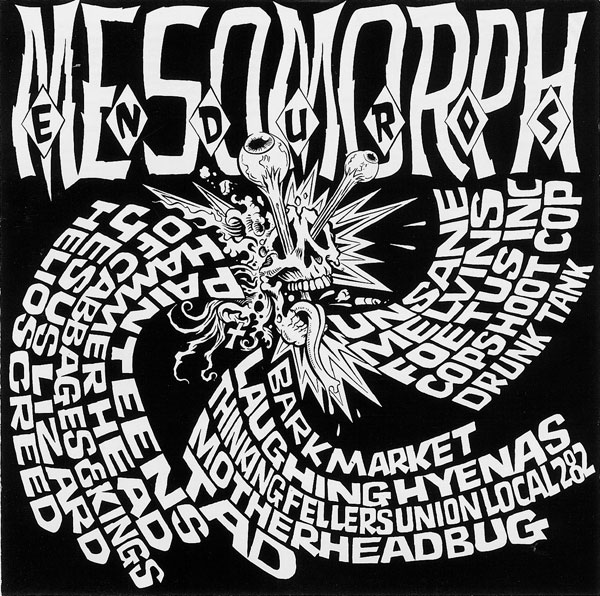
My favourite record shop really came through this week when I found a copy of an item that’s been of interest to me for quite a few years now; the Mesomorph Enduros compilation from 1992. Why of such interest? Well, take a look at this shot of the back cover of my copy – spot it?

Back Cover

Yep, that’s right, industrial star JG Thirwell – A.K.A. Foetus – uses the made-up word Incesticide for a song on this release. It certainly intrigued me a couple years back when I was preparing the Dark Slivers book – I actually seem to recall someone who read the first edition of the book (Brett perchance? Edit: Brett Renaud! For it was indeed he!) raised the question with me sending me scurrying off to investigate before adding a new footnote to the second edition. I actually spoke with JG Thirwell over email and he confirmed that he had made-up the word independently of Cobain and applied it to the song on this record. His view was that it was perfectly imaginable that he and Cobain had, independently, arrived at this invented word – it’s certainly one possibility and there’s definitely no clear statement from Cobain claiming to have appropriated the title from another source.

To eliminate the alternative, it’s at least certain that the Foetus use of the word came prior to Kurt’s usage. With Incesticide not released until mid-December 1992, with the names “Filler” or “Throwaways” being released to the press as late as mid-November, with JG Thirwell positive that the compilation was out in mid-1992 it would be highly unlikely (even impossible given the compilation is out in 1992 which would have meant less than a month of the year in which Foetus could switch the title and the record could still be printed and issued) that Cobain’s was the first use of Incesticide as a title. Here’s the song by the way with its prominent use of “Incesticide” as a chorus line:

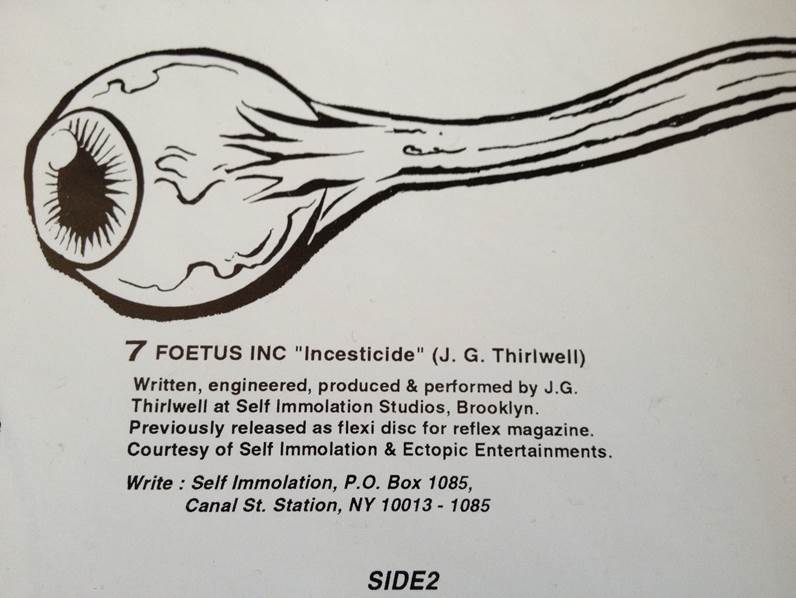
The actual physical record gave another lead also as shown in the picture below:

Inlay

The inlay included the intriguing tease that the song had been previously included in a give-away release from Reflex magazine – that opened up the possibility (for me at least a brand new avenue I was unaware of until Sunday) that Cobain had an even earlier opportunity to observe the song title prior to mid-1992. Unfortunately, alas, it’s a dead chain; it turns out that the song did indeed appear on a September 1990 compilation…

…But only under a different name – Somnambulumdrum (http://foetus.org/content/discography/releases/foetus-inc-somnambulumdrum) – therefore there is only the one opportunity for Cobain to observe the title “Incesticide” unless there’s yet another completely unknown source from which both artists were drawing. As an aside, the songs on the compilation, where it’s possible to date them, were all from 1991 releases such as Tad’s Jack Pepsi single and earlier releases from Melvins, Jesus Lizard, etc. – again seeming to date this record earlier in 1992 than Nirvana’s release.

Is there a possibility that Kurt Cobain saw the title on this compilation or heard the song then adopted the song title for his leftovers’ compilation? Well, beyond the dating, beyond the fact that the Incesticide title seems to suddenly jump up out of nowhere and onto the front cover of a Nirvana album in very very late 1992, there’s the various links between the artists on the compilation and Cobain. Nirvana had shared the Dallas, TX gig with Thinking Fellers Union Local 282 in late 1991, Tad were friends (of course), Cobain hadn’t physically met up with Jesus Lizard since a Denver show in 1991 but some contact was ongoing in 1992 in preparation for the planned split-single…Less significantly Nirvana had shared the stage with Barkmarket back in 1990 and with Cop Shoot Cop even further back in 1989 – still quite a range of casual or less casual connections between Nirvana and the bands present on this compilation but, of course, no solid proof that anyone gave a copy to Kurt Cobain sometime in mid-to-late 1992 much though I like the idea of an artist going through a fixation on baby-related medical imagery taking a song title by a performer called “Foetus.” Another excellent little tease from a guy who does seem to like jokes and word games and playing in this way.

Reinterpretation of Nirvana’s Aneurysm

This piece came to me via a gentleman called Shane Tutmarc – great-grandson of a gentleman who is both a significant part of music history AND of Seattle music history simultaneously, Paul Tutmarc (http://en.wikipedia.org/wiki/Paul_Tutmarc). It’s a quite dramatic reworking of Aneurysm on which he plays all the instruments. I think it’s a brilliant move the way the song commences with what sounds like an old school blues rhythm, the kinda thing Jessica Rabbit might croon over only to open it up rapidly to a far tenser and uncomfortable build made up first of just an omninous bass, then the minor key strings before eventually roaring into the Aneurysm chorus which, despite the lighter tone of the backing, is impossible to detach from the surrounding creepy elements. Stabbing piano keys and the rising strings give that sense that a climax is being reached, it’s the point where the axe might come through the door or the shadow is traced on the shower curtain.

The treated vocals continue this uncanniness. I wondered at first if it was a remix of Cobain’s own vocals but recognise now it isn’t. The uncanny, a core horror concept (http://en.wikipedia.org/wiki/Uncanny) is centred on the idea of things that are simultaneously familiar and unfamiliar which is why the subtle deviation from the original vocals is such an effective touch.

Aneurysm was built on rock and roll cliches (“come on over and do the twist,” “love you so much,” etc.) but the cleverest touch was the way it then warped each one (“…overdo it and have a fit,” “…it makes me sick…”) turning it into a joke, a refusal, a sardonic parody. The song’s other great strength (I think it’s one of Cobain’s finest lyrical efforts) is the way it turns every emotional statement into a physical symptom – whether love meaning he brings up his guts, keeps his heart pumping – and each act into a biological concept – dancing leads to a epileptic episode, even the use of the cliche “shoot the shit” looks deliberate given it ends with the human physical output – shit. For such a short, mantra like and repetitious song, it was clogged with cleverness. As has been pointed out a million times, yes, the ‘she’ of the song and an awful lot of the phrasing could be considered as heroin references. This kinda multi-layered composition, conducted in a song with really only six different lines to it, is a great case for Cobain was an astronomically good writer.

This revision of the song is remarkably true to the original in these respects. Stripping it even further to a smaller cluster of repetitions is effective. Altering the voice remains true to the sense of human physicality derailed. Also, while Cobain’s lyrics walked a careful line between rock n’ roll cliche and impassioned believer statements – this song does it musically. The musical choices shift between night club tunes and modern ecstasy while soundtracking an uncomfortable tale of heroin, physical collapse, love and discomfort. The video is crucial here, this isn’t just a film soundtrack, but the film and the interpretation are so well integrated – the film brings the physical concept to the fore, it brings the ‘horror’ element to the fore, it has a physicality that a cartoon or modern CGI effort couldn’t match – the jerky quality of this work benefits the overall unsettled emotion and bodies.

I think musically it’s managed the impressive feat of taking the song in an apparently fundamentally different direction while remaining surprisingly true to the original warping of potentially traditional themes; visually it’s hammered in the crucial kinetic element of the original; and Shane’s managed – overall – to combine the elements present in a remarkably strong way where each reinforces and is mutually dependent on the others to create the overall effect. Impressive.

Anyways, enough of my prattling. Shane kindly gave me some time to describe a little more of his work and what was done here so I’ll let him speak for himself:

“I come from a very musical family going back to my great-grandfather, Paul Tutmarc, who has been credited with inventing the electric guitar. His son, my grandfather Bud Tutmarc, was a well-known Hawaiian Steel Guitar player, and both my parents played music around the house growing up. My favorite movie in kindergarten was Amadeus, so music was always a big part of my life. I remember singing melodies to my mom around that age to have her notate on sheet music so she could play it back to me. I don’t remember a time when I wasn’t making some sort of music. After discovering Kurt Cobain and Nirvana, I immediately started a band. There was something about Kurt’s music and attitude that made me feel I could do it too. Looking back, I feel so lucky that I was able to grow up in Seattle during that pivotal time in music.

I’ve explored so many different avenues over the years, and each release becomes the “highlight” of each era. From 2001 – 2005, I released five experimental pop records under the moniker Dolour. After a short sabbatical from music, I dug into American roots, country and blues, with Shane Tutmarc & the Traveling Mercies, releasing two albums back-to-back. I went even further down that path with my first solo album, Shouting At A Silent Sky in 2009. Since moving to Nashville in 2010 I’ve worked on a number of projects, including last year’s trio of covers, which includes Aneurysm. I wanted to choose a song that was slightly off the beaten path. I’ve always loved the tongue-in-cheek humor in the lyrics, “Come on over and do the twist,” and the very-Cobain line, “I love you so much it makes me sick.” I started messing around with the arrangement using only midi sounds. There are no real instruments on the recording. The intro has a very Twin Peaks vibe. I was re-watching the show at the time, and the soundtrack definitely crept into the arrangement. And I went with a sort of Michael Jackson Thriller groove on the verses. I made the connection with the background vocals being “beat it, beat it.” Growing up in Seattle, people rarely covered Nirvana songs, it felt too sacred, or it carried too much baggage. But with this cover, it was a joy to take the song completely out of its original context, and reintroduce it in a fresh way.

I don’t remember how I first saw the short film, I used to work at a record store and was always taking home weird art DVDs, and that’s probably where I first came across it. In any case, I remembered it once I had the song finished, and I tracked it down again, and it was a perfect fit. It reminded me a lot of Kurt’s style of art, like the Incestiside album cover.

I sent the video to my brother, with extensive notes of where to make the cuts, and I’m really happy with what we ended up with. My brother Brandon and I have always collaborated. He’s been involved with my web and design projects since my early days with Dolour. He did the artwork for Dolour’s 3rd album, New Old Friends, and has had a hand in every project I’ve done since then. He’s just so fast and easy to work with. I’m sure it helps that we know each other so well, and know the same references. You can see more of his work at his website:

http://www.brandontutmarc.com

Living in such an active music city as Nashville, I’ve been able to get involved in so many different areas of music – from playing shows, co-writing, producing other artists, playing with other artists, etc. Currently I’m finishing up producing a record for Tanya Montana Coe, which should be released later this year. And I plan to start recording a new album of my own in the next month.
To keep up with me, check:

http://www.facebook.com/ShaneTutmarc

Home

Exploiting Nirvana and Kurt Cobain: J’accuse…Moi.

http://www.theguardian.com/music/2014/jun/24/kurt-cobain-desperate-for-fame-says-courtney-love

I thought of this title a long while back when someone raised the point that they felt I was morally compromised because I had written a book about Nirvana and sold it rather than releasing my ideas for free. J’accuse was the title of a letter by Emile Zola – it’s become a fun cliche, note the release J’accuse Ted Hughes by Sonic Youth – it simply means, “I accuse.” Today’s piece is about the topic of compromise which, I feel, has always been a part of the Nirvana story.

Dealing first, in brief, with my opinion on Kurt Cobain; did he compromise for commercial reasons? Answer; of course he did. The issue is that people tend to read backward from the consequences to the initial decision as if he could foresee the future – the millionaire status, the trophy wife, the media attention, the $200K pay cheque for a single date in Buenos Aires, the ability to pick and choose video collaborators for short and long form efforts, the record label kowtowing to his demands, the ability to promote his friends and get them on MTV…

It’s unreasonable, it’s projecting clairvoyance onto an individual who couldn’t possibly foresee what was to come. One could add up Kurt Cobain’s decisions and claim he was always doing whatever was required to make money; copying the Melvins – the only local success he knew, changing the sound of Nirvana between the January 1988 effort and the more straight-forward grunge songs he wrote once Sub Pop were involved because that’s what Sub Pop had an audience for and would promote, letting Sub Pop choose the running order of the band’s first album, asking Steve Fisk for a “top 40” drum sound in the April 1990 recording session, writing verse-chorus-verse pop punk songs from mid-1990 onward with a strong debt owed to the Pixies who had recently achieved indie success, barely swearing on the Nevermind album, permitting an MTV-friendly corporate rock video to support his big hit, mellowing out a couple moments of In Utero, accepting MTV invitations left-right-and-centre…

…But, then again, you could also say that he stayed true to punk rock’s sound which in the mid-Eighties through the early Nineties was still an underground phenomenon in America with no commercial prospects at all, that Nirvana made almost no money from playing music until at least late 1989, that featuring a song on Sub Pop 200 made them no cash, that Love Buzz/Big Cheese being a limited edition meant the band received little money, that as late as early 1991 Cobain sat at a gig in Canada autographing lighters and sold them for a dollar each because he was so poor, that he was living in a car in mid/late 1991, that whether he ate or not on a day was a matter of chance, that he dumpster-dived for clothing…That it wasn’t a case of needless profit, it was just about surviving.

That context is vital because decisions that, in retrospect, enabled Nirvana to become a multi-million selling phenomenon were made by a guy with next to no money, no imaginable chance of becoming a star, making a type of music that had never hit it big even if it had gained notoriety. He did want to live off his music, he made decisions accordingly, but what he was hoping for wasn’t a ‘mansion in the hills’ and infinite fame, it was more like escaping “this piss-stained mattress I’ve been sleeping on.”

The desire for elevation, in a capitalist society, does tend to come down to money – it’s the chosen medium of exchange permitting the acquisition and access to most experiences and human requirements. Everyone is required to make a compromise with money – to earn a living. This doesn’t mean everyone is automatically innocent though. There is still the question of whether one’s monetary gains are being made at the expense of other human beings and through moral corruption – if so, sorry, yep, it does make you a bad person. It also raises the more pertinent question of intention – was a decision made for the primary reason of profit and is that profit motivation clear in the end result?

Nevermind remains the crux of the topic; it was a commercial sounding record, they wanted to sell and for it to sell well – the end product is clearly motivated by acquiescence to the profit-related desires of record company and band. Saying that the band only expected to sell tens of thousands or maybe a couple hundred thousand doesn’t void the nature of the decision being taken – it doesn’t make it innocent nor does it make it a non-profit driven decision even if the scale of the profit imagined was the merest fraction of what ended up occuring. This is inspite of acknowledging that Cobain wanted to indulge his pop-orientated instincts, the hard rock side of his tastes – it wasn’t just a personal artistic statement, it was a deliberate product. The kicker though is that it was a decision clearly about surviving not about making egregious profit for the sake of it – it wasn’t Dr Dre sitting on his millions then making yet more millions from a team up with Apple, it was a poor starving boy hoping for some small recognition and good reviews and a continued chance to play and record on a label that could afford to pay its artists. Sub Pop’s finances were a disaster area.

That’s why I don’t worry too much when I see these articles about Cobain’s commercial instincts; someone in lowly straits taking sensible decisions when opportunity was offered – I don’t expect utter purity, I’m too old to believe in it. The only uncompromised music is that which stays in the bottom drawer of a desk at home, never played for an audience, never placed in anyone’s hands – as a music consumer I’m clearly content to make the deal that someone’s work is worth my money. Complicit, yep – compromised, yep.

http://www.theguardian.com/books/2013/nov/04/ebooks-discounts-98-publishers-closure

This brings me to my own compromise. I’ll keep it brief. In essence, it was suggested that by writing and selling a book about Nirvana I was exploiting Nirvana and Kurt Cobain. Actually, it’s not an insult, it’s a perfectly valid hypothesis – pretty reasonable to suggest it or to believe it, it’s on an individual to define their terms and where they draw the lines, I can only explain and explore my own reasons for feeling that I’ve done no such thing.

Firstly, I did choose to write a book about Nirvana through any commercial motivation – I wrote a book about Nirvana because I love Nirvana, I’m a fan first, a writer second. I chose to write a book because writing is my only real talent or ability on the creative front – I’m not much of a musician, I’m no artist. So the decision to express my enjoyment of Nirvana in book form was similarly not a commercial choice.

Second, ah…But I did place a price on the book and sell it rather than giving it away for free or simply placing my thoughts on free fan forums – this is a far more solid criticism, for sure! The fact that I’ve placed 400,000 words, 350 articles here, a couple hundred graphics all on here for fans and for free doesn’t void or even mitigate the compromise. Just because someone does something good doesn’t impact on how bad the bad things they do are. Similarly, I work a full day job at a corporate organisation, I do 12-16 hours work and commute per day…And THEN, since February 2012, I’ve also done 4-5 hours of Nirvana writing, Nirvana spreadsheet work, Nirvana analysis night after night for a total of 20-30 hours a week for around 125+ weeks now. Still, all that work does not entitle me to be re-paid nor does it mitigate the fact I decided to make a commercial product. Both these points, hopefully, show my commitment to the subject, show that I’m certainly not “exploiting Nirvana for gain” as much as I am “showing my love for Nirvana and desire to share that love” – but it doesn’t remove the question mark, that I am indeed taking payment for a Nirvana-related product.

So, this leads to the next question, is it legitimate for anyone to do something that has the name of Nirvana on it and that someone might pay for? Well, on this point, if you believe the answer is “only Kurt Cobain plus the members of the band” – fair enough but it means defining all paid commentary, all biographies, all music criticism by journalists or writers as illegitimate. I’m not sure about you but I hate the idea of a world where self-serving PR pieces from musicians and their management were the only ways in which one understood or explored them – seems to be enough of that already. I’m happy with the idea that public topics can be explored publically by individuals observing but not participating in the subject of the discussion – someone else can make a different choice. What makes the difference, I feel, would be the difference between (a) putting the name Nirvana on something to make it sell more, versus (b) putting the name Nirvana on something because that’s the topic under discussion and the discussion is taking place for a non-commercial reason. I did not place the name Nirvana on the book, undertake the writing of the book, for any profit-related motive and I did not make the book about Nirvana because of any commercial reason – I did it because I love Nirvana.

But still…Compromised. So…I put a price on the book – I paid the production costs and hoped to re-coup them. I printed a first 100 copies and gave away twenty-five to various helpers and supporters. The maximum revenue was £750. The cost of production was £400 – thus a profit of around £350 was the maximum expectation. Did I expect to sell all the books? I had no idea. So was I doing it for profit? No, I wanted to write the book and did so anyway independent of what might then happen to it. Could I have given it away for free? Actually yes, I could have shouldered the £400 cost and it would have hurt but…Yes. I chose not to. This is where personal pride comes in – not profit, but pride.

I feel that free work is not regarded with the same respect as stuff one pays for – in a capitalist society, despite lipservice to the innate value of things, a price is deemed to be a mark of quality. I didn’t think twice about deciding that I felt my analysis of Nirvana in Dark Slivers was worth paying ten pounds for – my feeling was that if someone loved the topic of Nirvana but didn’t think my work was worth paying even £10 for…Then that was their choice but I felt that it was a good deal. I didn’t say to myself “I will charge a rate to recoup the hours spent on the book,” impossible – I spent far more time on the book than I could possibly make back. My feeling is that someone bought the book not just because it was about Nirvana but because of an interest in my thoughts and ideas and the work I had conducted. I did want to cover the production costs of a physical book – I wanted to hold a book in my hands, entirely selfishly I wanted to have a physical book as a result of my labours, not just some e-book whatever.

Those were my drives; to write a book, to write about something I loved, to hold the result in my hands and to feel darn good about it. I did!! And it was a bloody honour that a few hundred people felt the result was worth paying something for. Compromised? Yes. And it’s up to you, the reader, the viewer, to decide if the book was worth it or if you felt it wasn’t either (a) a valid discussion of Nirvana (b) decent writing and analysis. Worth ten pounds to find out? Definitely a choice I leave to you! 🙂

The topic came up when I criticised the “Who Killed Kurt Cobain?” / “Love and Death” authors for being motivated by profit. Actually, I should retract that criticism. As journalists they were motivated by a good story – a story worth exploring and it definitely was a good topic. Do I feel they did it for love of Kurt Cobain or a desire to “tell the truth”? Nope. Do I feel they did it because it was a good subject for a book? Yep. Do I think they knew in advance that they could get a book deal from the controversy? Yeah. The compromise doesn’t make them unworthy reads or bad books but I don’t think they were books written in support of Nirvana or Cobain.

I don’t believe in the nihilistic idea that everyone is guilty so it doesn’t matter what one does. I believe that everyone is compromised and it does matter what one does – one chooses the compromises; confess, own them, be honest about them. I’m compromised and I’m delighted that the end result was a work I was and am proud of! Yay!