Something for the Weekend: Check out Raglans

An intriguing recommendation this week…I’d never heard of Raglans until Tuesday when in discussion with a gentleman from the much underappreciated Irish band Power of Dreams he revealed that http://www.nirvanaguide.com is inaccurate and the PoD didn’t play with Nirvana on August 21, 1991 (quotation from the band’s guitarist Keith Walker “We were on the bill for reading 92 (Nirvana’s infamous headline slot) but never got to play our scheduled mean fiddler tent set as proceedings were postponed due to heavy winds for about 3 hours that day/evening.”) Pete pointed out he was now involved with Raglans and just suggested I should give them a look…

…Well, I did. Much love to the farm vibed video intro, this brought back memories of living in Lincolnshire, and then the quality gym sequence…What to say? A hoot. And it just goes on Monty Python lumberjack vibe, a sinister fishing expedition…It’s a montage of good ideas with the band stoically maintaining their gangsta mean mugs throughout. Music wise, bright, active, I like the skittering guitar reminds me of both U2 and the Yeah Yeah Yeahs, the bass pauses and drops at well-judged moments (I like records where I can hear and appreciate the bass-playing, it’s often such an underrated element of a sound.) Combine that with the likeable vocals, the chant-able chorus and well-used cooing… I like!

Anyways, hope you like it too. There’s a free download of the song at http://www.diggingholes.net too which is helpful. Nice.

Anyways, apologies, no Saturday post, I’m going to be on a boat. If you’d like to see where then do check my friends’ very worthy blog at http://nbfelucca.wordpress.com/ A sweet couple each with a writing style that makes me chuckle and feel inspired all at once. And they’re right, Felucca does sound like an Italian football player or a foot infection. They were also right that taking advantage of a moment of freedom and taking off to float merrily around Britain for as long as they wish was a good idea, too many people saying “i’ll do it when I retire” in this world.

Cobain and Secular Idolatry

Simone Weill stated “one has only the choice between God and idolatry.” Strangely I actually agree with the statement; the absence of religious belief doesn’t lead to a void of central meaning, it replaces it with a different basis for belief within which people choose to venerate and devote their lives to things other than a religious entity. Naturally I feel equally happy to sneer at that quest for meaning within career, home, love, parenthood as I do at religion. The core point though is that it isn’t a choice between God and nothing.

The question has been asked many times whether Kurt Cobain’s teenage dalliances with religion, which went as far as Kurt accepting baptism, extended into a mature faith in God. I’m less concerned with that given, if he did possess such faith, then a significant sum of his actions as an adult won’t exactly get him much sympathy at the Last Judgment. What intrigues me more is that his life does possess a genuine quest to restore a central meaning to his activity — Weill would rephrase that as an idolatry.

The most obvious answer that could be given is that Cobain idolised music, but I would state it was a deeper urge. The component he emphasised was, firstly, his words rather than his instrumental expression — he strongly dismissed his skills as a guitarist, little of his music exists without the intention being to cloak it with lyrics. Likewise, even if his self-criticism was overstated he was no guitar worshipper, no untrammelled explorer of the instrument’s possibilities, nor a player overawed by its history — he was dismissive not just of his skills with it but also of the instrument and its tiredness. His words clearly took significant work with his crucial spells of song-writing all coinciding with significant time alone to draft on paper — more so, he was a committed journal-writer throughout his adulthood with his writing activity extending far beyond music. Added to this is his extensive artistic efforts, a further expressive medium he stretched in various directions out as far as video efforts same as he took his musical efforts beyond the guitar onto drums and across various tape experiments.

My argument would be that the expression of self was Cobain’s primary purpose and the form of idolatry was therefore the internal drives and wishes that demanded self-expression uber-alles. I see no evidence of a genuine religious belief in the actions of Cobain but, to be fair, I’m based in the basically non-religious U.K. where church attendance, formal church allegiance and formal belief have all given way to a more generic pick-n’-choose spirituality and a vague belief in ‘something out there’ unaccompanied by impositions on the physical individual in the here-and-now. There’s no specific evidence of Cobain’s genuine beliefs one way or the other beyond the adolescent ‘trying on’ of identities that might have helped him fit in with where he was at that time.

As a sidebar I saw this beautiful post in which the writer states “his suicide note states at the beginning ‘dear Buddha’”. Wonderful. And whether that’s accurate or not I do believe the world can always do with more laughing with, not at:

http://wiki.answers.com/Q/Does_Kurt_Cobain_believe_in_God

So, what’s your chosen idolatry? Mine appears to be information, constant consumption of information at the expense of financial wisdom, time to contemplate, social stuff, etc.

Stunning News: Cobain Sign to Stay

http://www.timescolonist.com/entertainment/after-hearing-from-kurt-cobain-nirvana-fans-aberdeen-keeping-come-as-you-are-welcome-sign-1.320640

I’d like to assure you that the ‘stunning news’ line was definitely a touch sarcastic. One thing I did take from the Halperin/Wallace Cobain conspiracy books was a reconfirmed sense that often the news is a manipulated object in which hard-working (indeed over-worked) people — with harsh deadlines and a need to pump a certain amount of news product per-day, per-week, per-month — take the easy route and occasionally take some non-news to bulk things out and fill space giving them time to focus on items that deserve and require more time and energy.

…I know this to be true because I think it’s fair to say I’ve occasionally done it myself here on http://www.nirvana-legacy.com — there have been weeks where the data work or background thinking for a piece has required substantial hours to grind out (and remember I have a proper job too so I leave the house at 7.20am, I return home at 6.30pm, I sometimes work much later, I generally maintain some kinda social life, I do exercise sometimes too all of which compresses and compacts the time available to prepare the blog posts for here; Allahu akbar, praise be to God for giving me a high typing speed.) When those times come around I’ll admit to dashing off quick thoughts, ramming an undigested idea out into the world always with the intention to return to it later. I even try to keep a lightweight piece or two tucked in my belt for emergencies.

In the case of this article regarding Aberdeen, State of Washington we’re greeted with the revelatory news that the town is going to keep the Cobain lyric adorning the town sign. On the positive side, 300 people can make a difference to a local situation — in a world where the might of little people acting locally is often underrated it’s nice to see more evidence of that truth. As an example local to me:

http://www.castlesupporters.org.uk/

This pub is just down my road. Not the finest looking building but there’s been a pub there since before the founding of the United States of America and it’s a real boon to the area. So far at least the motivation and mobilisation of local residents has kept its new owners from bulldozing it despite several attempts (ongoing) and the kicking out of the people running the pub. My fingers are crossed that the resistance keeps going.

I digress, in the case of the Aberdeen sign, I admit I read this article with a touch of cynicism; Aberdeen is famous for Kurt Cobain and Nirvana and…Yup, that’s the only reason most people will have ever heard of Aberdeen as anything more than a brief mention in a bio somewhere. I’m not convinced that the town would ever seriously consider removing the minor league tribute to their most famous resident. But, on the other hand, I am fairly sure that reporting they were considering doing it may have drawn some attention to the town.

I admit I was surprised they only received 300 messages but I’m wondering whether the supposed ‘threat’ was so local that only a tiny number of people were even aware such an idea was being discussed and the whole affair was drawn to a close before it could go further.

I have to thank Tom Grant too at this point for making the tape available of Courtney Love admitting to having planted stories in the media; the tapes he’s put up are worth a listen just to lend some colour to things. And hey, in things that meant something to me this week? I dropped a mention of the last few articles detailing my objections to the murder theories onto the Justice for Kurt page on Facebook, being respectful, and the individual running the site took the time to like the link and acknowledge me — now that really does mean something to me. We may be divided on one issue but we each enjoy and even adore the music of Nirvana and that’s enough. So, if I might be allowed a dedication, I’d like to dedicate today to decent Nirvana fans because, as the gentleman at Justice for Kurt says: “Hey I appreciate you taking interest in the subject and…even if we have different opinions, it’s nice to hear that people still care for Cobain.”

Murdering Kurt Cobain: Finishing it all Off

Time to finish off I think. Today I simply want to deep dive into the supposed evidence and leave the whole topic there. If you haven’t done so yet go listen to Tom Grant’s taped evidence at http://www.cobaincase.com and note that he’s only released tapes that support the more innocuous of the claims he makes in this book — most of those featuring Rosemary Carroll are Grant talking with Rosemary just agreeing that she’s doubtful and still shocked by it all. Barely any of the tapes are more than a matter of seconds, the topics are barely focused and the only interesting one is the minute and a half exchange over the existence of a letter in a bed. Enjoy!

The issue of the use of Kurt Cobain’s credit card after his death is often cited as an ‘ah-ha’ moment for the murder case but there’s no evidence whatsoever that the card was taken from the crime scene. Two reasonable arguments, firstly, technical error, secondly, theft or loss in the days prior to death, are available. A third option is supplied within Love & Death which is that, as the authors state they suspected, a member of what they call “Cobain’s entourage” could use the card number without the card being present — essentially there are three good alternatives rather than the killer being dopey enough to use their victim’s card. Frankly, having executed this murder cunningly concealing it as a suicide, it seems unlikely the killer would take the risk of stealing the credit card given even the merest idiot knows that would create an electronic record. Of course, if the (non)killer was Courtney’s agent she may have mentioned having cancelled the credit cards but that’s supposition so strike it from the record. Far more importantly, in the conspiratorial version of events this greedy killer took the credit card but left $120 sitting on the floor plus a further $63 in Cobain’s pocket — $183 dollars in untraceable hard cash that could never have been connected back to Cobain was abandoned but an easily noticeable credit card, that if used would create an electronic record, was taken.

The authors also dwell on the absence of fingerprints yet, again, there’s a sleight of hand taking place; they state clearly on page 222 “when the police dusted for fingerprints, they actually found four latent prints.” What they are really referring to is the absence of other prints. They disingenuously question why there are no prints from Dylan Carlson or the salesman from March 30 nine days before— I can understand a buyer giving the object a casual wipe on the way home and nine day old prints not being guaranteed. Kurt Cobain’s body lay for around three days in an unheated space with the moisture levels and so forth affected by the joyously wet world of the Pacific North-West. There’s no reason to believe that residual oil from fingertips would be unaffected. The book also describes that different conditions make it more or less likely for fingerprints to be left anyway. Again, it’s a non-evidential point.

The authors at least accept that the gun was wedged tight in Cobain’s hands. But they move into la-la-land again with a bitty and fragmented discussion of where the gun blast would leave the shotgun lying after firing. It’s quite remarkable, someone is genuinely trying to scientifically demonstrate the likely place a gun would fall without definite proof of body position when fired, of force of shot, of position of mouth on gun, of tightness of grip, of gun-butt position — they’ve no valid evidence at all with which to either cast doubt or make claims. It’s pure fantasy.

Next there’s the matter of the claim that Kurt Cobain’s note was in fact a statement that he was quitting Nirvana/music; they make it repeatedly yet this is palpable nonsense. The note rambles widely over comments around the personality of his daughter, of his wife, it doesn’t mention Nirvana by name, it dwells on personal feelings of fear, hatred, disappointment, sadness — one could read, at most, two paragraphs of it as part of a resignation statement but no more. The claim also rests on the bizarre idea that Cobain left the statement lying around so his killer (presumably while escorting Kurt and a shotgun from the house) scooped it up “ah, helpful! A note that just happens to read like a suicide note!” Perhaps the killer stood over Kurt like a school teacher and made him write it? It’s a poor claim and a deeply selective note reading.

The authors move on and claim that Tom Grant has evidence, that he never shows them, that Courtney was practising handwriting. The book deftly evades ever comparing the supposed sample to the Cobain note; that would have helped but it seems that either the samples didn’t match, or there’s no proof they even existed. It also relies on a fascinating set-up in which Courtney Love mailed or hand-delivered the chosen killer after Kurt’s unplanned leave from rehab to supply a note — it’s the only way this piece about handwriting is relevant, she’d have had to write and mail the note on the off-chance Cobain turned up in a killable scenario. Again, there’s only one man’s word for any of it but it posits that Courtney was already planning to somehow lure Cobain into a situation in which a suicide scenario could be set-up and arranged which seems bizarre given she doesn’t know where he is. Meanwhile, as I describe in Dark Slivers: Seeing Nirvana in the Shards of Incesticide, the note is entirely in line with Cobain’s use of images found elsewhere in his writing, its loaded with personal references and descriptions that match with his other writings and the tone, right down to the self-depreciation, fits his known work; there’s nothing at all to show the note isn’t the work of Kurt D. Cobain.

Failing to make a case for the note being a forgery the authors have such threadbare material they instead shoehorn in the claim that the final four lines were written by someone else. I can’t tell if they’re saying Courtney practiced two versions of Cobain’s handwriting just for the occasion, or that she somehow got to the scene to write them in before the Police got there, or that the cunning killer wrote them to leave a handwriting sample to be picked up at the scene — either way, Courtney couldn’t write the last four lines without having written the rest of the note (if delivered to the killer) which makes a nonsense of the ‘two forms of handwriting’ claim. Unless they’re arguing Courtney didn’t write it at all and that the killer appended the last four lines in which case their argument about her practising handwriting is shown to be irrelevant. Certainly the authors show Ms Love to be quite a woman, I mean, WOW, she’s permanently on the phone, she’s in prison, in hospital, on drugs, preparing to release an album, running round in a limousine arranging contract killings, mailing off notes, practising her handwriting, oh, and being a mother on top of it. It’s a jumble of nonsense.

Again, the topic shifts — that’s the crucial modus operandi of these books, given the absence of any deep or meaningful evidence for anything that is stated the authors simply have to tag together a wide enough variety of material to hide the gaping holes. The discussion moves to Rome in March; again, there’s claim and counter-claim that there was/wasn’t a note wedged in with doubt whether it was/wasn’t a suicide note — again, no proof. Over and over again what really bothers me is that entire arguments are made on the basis of nothing more than the statements of Tom Grant. He claims Courtney was attempting to mislead him, or told him things he found untrue yet, over and again, the only word available is that of Tom Grant.

The matter of the unlocked balcony door is brought up — the possibility that someone clambered over the balcony and dropped the nine-ten foot to the ground below having killed Cobain. They claim that the Police are being deceptive and that the door was not, in fact, barricaded therefore anyone could have been in the room. Again, it’s a disingenuous statement; there’s still a door with a chair with a pile of gardening supplies on it positioned closely enough to the door as to make it hard for anyone to slip out and to end up being reported as ‘wedged.’ More importantly, to me anyway, it’s simply unnecessary for the killer to have to leap spectacularly over a balcony railing and risk injury. The victim is dead, the scene is posed, the killer can simply stroll out the door the same way they and their victim walked in. If they fear observation or detection then a stunning dive off a balcony and crash-down is definitely not the way to go. Instead, let’s just say that Cobain had no reason to lock doors that didn’t lead to an exit — he wanted privacy so he locked the only true entrance. Superman wasn’t going to fly in.

The rest of the book’s 270 odd pages is basically made up of hearsay, discussion of unrelated matters, quotations of dubious relevance (no, sorry, the fact Leland Cobain things Kurt was murdered isn’t evidence — sorry.) Adding it all together, is it possible to say something odd was going on? I mean, think of it; massive heroin dose, unlocked door, no fingerprints, missing credit card, apparently unclear behaviour from wife and others, unopened drinks can at the scene, Allen Wrench — surely this is all weight for the murder claim?

Again, take it apart again; no proof that the heroin dose was so massive or of Cobain’s tolerance level, unlocked door still partially blocked and not leading to an exit, there were fingerprints, better arguments around the credit card, no proof bar Tom Grant’s word for most of what he claims about wife and others, no proven relevance of the drinks can, no proof whatsoever (and a public denial) from Mr Wrench. Having a load of unexplored avenues doesn’t mean there’s a case to be made. The weight of evidence is still far more on the side of suicide; very much so. Missing so hard to locate, killed by own gun found in own hand, only true entrance/exit locked, note in own handwriting, major drug addiction, estrangement from all except drug connections, marital breakdown, professional breakdown, apparent depressive tendencies and no antipathy to the idea of suicide.

I’ve now read the two books, the PDF link given the other day, the two main websites, chunks of the Harrison book and the end result is I see a batch of people making money and/or publicity off the idea that Kurt Cobain was murdered. I see no reason to accept that Tom Grant has been unfairly treated, or that the Seattle Police were negligent, or that any of the claims made for the murder theory stand up to any examination at all. But what the hey, it’s all kinda fun isn’t it? Maybe that’s all this is now, a twenty year old death only lives on as infotainment.

Note that this post is one of four linked articles on the topic:

Murdering Kurt Cobain: Finishing it all Off

A Bigger Better Brighter Conspiracy with Twenty-First Century Production Values

Kurt Cobain Conspiracy Theory Part 2

Love, Death, Drugs, Killing, Murder, Money, Conspiracies…

A Bigger Better Brighter Conspiracy with Twenty-First Century Production Values

As I stated the other day, I’m glad Wallace and Halperin took time to rehash their investigation in a second volume; if you want to read a distillation of the murder theory and the crucial evidence then Love and Death is ‘the one to read’. While Who Killed Kurt Cobain is barely coherent and poorly written, this volume is a far more readable summarisation, however, being a straight rewrite (and a fairly egregious bit of profiteering, two books with barely 10% difference) the book is still guilty of all the flaws of the first volume. At least it placed a few more clear cards on the table and finally spent more time on the evidence than on name-calling.

…But, to repeat, that doesn’t mean there aren’t issues. One of my issues with the entire murder subject is the way opinions are substituted for fact of any sort. For example, while Kurt Cobain’s hatred of the media is well-documented, this book is happy to credit that he had revealed to one writer, David Fricke , that in late 1993 Cobain was as happy as happy could be. There’s a raft of similar quotations in here to support the idea that Cobain wasn’t sad or depressed and/or that he feared for his life, yet it all adds up to the kinds of statements that surround the average murder event, the kinds of things people say about the neighbour with imprisoned children in the backyard or the child who shoots their classmates; “oh, he was such a quiet boy, I would never have thought they could do it…” It’s life run by external spectators believing they have an absolute insight into the inner world of an individual and that their brief personal experiences sum up the whole of what someone is or isn’t.

The schizophrenia in the Halperin/Wallace books is undimmed with them trying to simultaneously acknowledge Cobain was troubled, while saying he was untroubled, saying he was happy while admitting he was a major drug addict, saying he was positive about life while saying he was terrified for his life and of/for his wife — it all depends which page you’re on. The authors ignore clear statements from Dave Grohl, Krist Novoselic, Pat Smear and others in the year since Cobain’s death that they knew he was genuinely troubled at the time and focus on those saying he wasn’t. On one page they even quote Mark Lanegan saying “I never knew Kurt to be suicidal, I just knew that he was going through a really tough time” as if that doesn’t clearly refute their statements about how happy he supposedly was. The way they do it is to try and argue that it’s possible to see, in advance, that someone is suicidal; that there’s some dividing line between depressed, miserable, enduring a hard time versus about to kill oneself.

The authors compound previous literary tricks in this volume. A primary one all the way through is deviating from a subject where they’re on weak ground to a concrete quotation or statement about an unrelated topic — it provides the initial topic with an unwarranted gloss of credibility. Trying to be positive about what they’ve done here though, their volume does make a much more substantial case for the unsavoury and untrustworthy nature of Courtney Love — but no more than fair observance of her shape-shifting and odd behaviour over the years has yielded for most observers. There’s still no case for murder in the behaviour or evidence they provide. It’s a tale in which the only people given credence are those the authors feel are supporting their case; some individuals are only permitted credibility for that brief time. Mr. Grant, on the other hand, gets away with comments that at this distance look feeble such as “I can’t go into too many details about what I learned when I arrived that morning…Some of the details will be very important for the prosecutor who eventually tries this case and I don’t want to tip my hand too early.” Twenty years…Twenty years…Permit me to dub thee “liar.”

Remember also that this isn’t just the tale of one murder; by the end of the book the implication is that Love is involved in the deaths of El Duce, of a police officer and of Kristen Pfaff on top of her husband. Her accomplices are the medical examiner, to the investigating officers (the entire murder squad and chain of command are, its implied, also incompetent or corrupt and only one guy who stopped being a police officer at age 29 after he ‘burned out’ over twenty years before these events has the truth), to the Cobain’s nanny, to Eric Erlandson, to Dylan Carlson — it’s a full blown conspiracy hooking in all and sundry. Everyone is lying or hiding the truth including the Cobain’s attorney who is apparently hiding the mystical ‘truth’ whereas is seems more likely she might have worked out Mr. Grant was nuts and was the kind of untrustworthy and paranoid character who was taping every conversation with anyone he spoke to.

The selectiveness continues; only the evidence that supports their case is allowed to stand whether that regards the crime scene, the autopsy, the events surrounding the discovery of Cobain’s body — it’s a serve-yourself buffet in which they pick-and-choose which bits of what anyone says are fact and whether people are talking rubbish. For example, while claiming that the autopsy reports have been unavailable and crucially prevent Mr. Grant making his case, they simultaneously state that the autopsy reports were leaked. This is important because they credit this leak with revealing, definitively, Cobain’s blood morphine level then make an unfounded assumption that these results would have meant nothing to the medical examiner and a further assumption that not one of the professionals conducting the toxicology tests would say anything about what their tests meant. They hang their strongest evidence on several assumptions and a contradiction. That’s where the blood heroin piece falls; no matter how many opinions one gathers around a potentially fictitious number, the number is still unproven.

Let’s take it at face value though. This piece did give me pause; heroin, if injected direct into the blood stream should, in most cases, act almost immediately and in the quantity claimed is lethal. The difficulty is, however, that, beyond the absence of evidence that they had the correct amount, there’s also a lack of scientific evidence related to tolerance levels among heroin addicts — it’s pretty hard to measure dosages in a sufficient number of people and see if it kills them. A study is cited featuring only 189 fatal self-poisonings with opiates and yet the authors don’t recognise the oddity they create; they argue that one of those people had a level as high as Cobain’s which, contrary to their argument, is proof that someone could have a level that high and that levels do fluctuate between individuals. The book has already pointed out that quite a number of addicts have developed high tolerance and can continue functioning for quite a while after injecting — again, there’s no evidence revealing the tolerance levels of Kurt Cobain so the argument is only made by statements related to non-millionaire addicts.

The authors deviate from their central thread in a bamboozling array of pseudo-science that may/may not be relevant. They claim one study shows no one committed suicide with opiates in north-west London for twenty years which, again, doesn’t hinder the argument that Cobain did self-anaesthetise before shooting himself, the cited study in fact puts Kurt into the 20% who died of physical injury. They cite another study regarding likelihood of suicide among missing persons; again, the stat that only 1 in 2000 missing persons’ cases end in suicide isn’t particularly useful because it proves that a number do. Furthermore, showing that an event (suicide) that only happens to a tiny minority of people only happens to a tiny minority of people is irrelevant to this case. I can’t tell if this is a deliberate attempt to throw numbers at the audience because of a belief that the audience isn’t statistically literate or if it’s because the authors aren’t able to decipher the numbers themselves. The authors rapidly abandon the attempt to add science to disproving the suicide verdict and retreat back to unrelated comparisons and personal anecdote where they’re more comfy.

Pages 98 to 104 briefly describe the intriguing phenomenon of staged suicides; great stuff and genuinely the discussion fascinated me. In terms of the Kurt Cobain case though it simply proves to be further smoke and mirrors; the authors mash six separate sources together, citing not particularly relevant or connected information from two books, then, in contrast to the Cobain case, they dwell on cases where there was very clear evidence at crime scene to show that homicide was a strong possibility. They often slip entirely into being misleading, for example, the statement on page 100 “the typical homicide victim — a man between 25 and 34 killed at home with a gun — fits a profile eerily similar to Cobain’s” is utterly devoid of meaning; firstly, finding that he’s the right age to be killed doesn’t prove he was but also males in that age range are also more likely to commit suicide too. There’s no reward for soundly identifying Cobain as a 27 year old male. There’d be more reward if it supported or refuted that he killed himself but it doesn’t.

Note that this post is one of four linked articles on the topic:

Murdering Kurt Cobain: Finishing it all Off

A Bigger Better Brighter Conspiracy with Twenty-First Century Production Values

Kurt Cobain Conspiracy Theory Part 2

Love, Death, Drugs, Killing, Murder, Money, Conspiracies…

Music Lovers and Musical Tastes

Phew, one heck of a day…

Just a gentle muse for a mellow Friday afternoon…We’re all aware of the relatively tightly bound and specific tastes of Mr. Kurt Cobain. His music adopted and abandoned multiple styles over the years but all from a relatively limited range stretching across various modes of alternative rock music with a few token representatives from other genres (The Beatles, Lead Belly) standing out for actually being exceptional (though integral) to his taste. At the core of his professed taste in the latter years of his life stood the kinds of bands who, like his own music, were straddling the boundary between the alternative and the mainstream; The Breeders and PJ Harvey for example. He never abandoned his commitment, however, to the bands who had accompanied his rise – Melvins, Mudhoney, Sonic Youth – or the K Records style of ramshackle pop he had grown to love apparently in his Olympia years.

I’m fairly sensitive to the cliches of everyday life. One of my favourites is when people state “I’m a little bit crazy,” which is truly about the most ordinary, average and utterly typical statement ever made – I hear it at least once a month. All it reflects is that everyone, at some point, feels there’s a disconnect between some part of the massively diverse and intrusive reality around us and their personal beliefs, perceptions and desires. Anyone sane enough to claim the “I’m a bit crazy” tag is totally normal. Be more worried about the people who clearly don’t realise there’s something unusual about them.

A second cliche I enjoy, an equally common one, is the empty sentence “I have pretty wide taste in music.” Again, anyone making that claim in a public forum is presenting the idea that they are open-minded and willing to try new things. The problem being that the statement is a way of being non-confrontational, of avoiding pledging to a specific direction or style. It’s not actually a statement of taste, it’s a statement of social politeness – a subject Kurt Cobain took significant issue with and presented in songs such as Blew (“if you wouldn’t mind”/”if you wouldn’t care”) or Come as you Are (“come as you are, as you were”/”take your time, hurry up, the choice is yours, don’t be late”).

By making such a clear statement of lack of commitment and unwillingness to engage in anything that might be seen as a critical or thoughtful judgement on the topic, if someone says it to you then you can be sure that the person in front of you isn’t actually interested in music. The development of musical taste, the discovery of music new to the individual requires a deeper probing and a greater commitment to uncovering music. It’s rare I’ve met someone who would make such a facile comment as “I have wide taste in music” without discovering that what they mean is “my taste ranges between whatever’s in the top 40 and/or popular at the moment.” It’s a statement that they will listen to anything because everything they hear is just ‘musical wallpaper’, a shifting of tone, texture and hue that hangs in the background without intruding on them enough to make a choice or to focus in any direction.

While trying not to confuse personal experience with scientific fact, most music-lovers do have a core to their interests, a location from which they reach out to new places while staying grounded. In the case of Kurt Cobain, while his pre-teenage years were a typical child’s mash-up of rock, metal, pop, whatever; his teenage tastes solidified around the early 1980s evolutions of punk erupting out of small U.S. scenes and that formed the focus for the 13-14 years that followed. To use Metallica as an example, the bonding that led to the band was around the New Wave of British Heavy Metal bands – again, a core commitment was the driver.

To borrow a concept from work I’d suggest the T-shaped music lover; a deep focus in a particular area with a wide awareness and cherry-picking of other genres – lose one or the other and the result is either a stick or just a thin coating…Similarly, within each genre, I’d propose my favourite concentric ring model. At the core of each genre are those who create and define it, the rare geniuses who forged the path and made a particular sound into an identifiable genre – whether one likes the genre or not it’s usually possible to accept the talent of those individuals. If one likes that genre then there’s always a second wave of bands, talented, committed and popular without ever crashing over the barriers into the combination of mass acceptance AND critical reputation and recognition that defines the core bands – one might like one or other of these bands but only a fanatic will know and love all of them. Beyond that lies the outer ring of lesser lights, spin-offs, forgotten heroes, local favourites and post-hoc torch-carriers who might have worked for years or may linger forever without ever being more than a derivation of the core sound (therefore not receiving critical acclaim) and always too early, too late, or simply not good enough (thus not gaining the popular acclaim) to cross over into the inner circles. I’ve done it as a graphic for fun…

Genre Breakdown

Anyways…I digress. My tastes? Oh definitely cored. My pre-1993 tastes are a combination of Prince, Def Leppard, Bon Jovi, Vanilla Ice and The Transformers The Movie soundtrack with a chunk of Elvis plus my favourite song was Centerfold by the J. Geils Band (found it on a compilation from my aunt who was a key funnel for music.) Nirvana really did act as Ground Zero leading onto Sonic Youth and Swans and outward toward industrial, noise, experimental avant garde stuff while a separate strand (via Rage Against the Machine and Beck) was taking me over to hip hop and then recombined with Throbbing Gristle to open the door to various electronic avenues culminating in Coil and old British 1960s-70s TV electronica and library musics. The core is still there, however, the ramshackle, aggressive, loud, fast, hard (or even aggressively quiet) edge holds it all together neatly. I made small walks into jazz without ever enjoying much of it, I still can’t stand dance music or foregrounded electronic drums even if Burial is indeed wicked, pure blues really bores me, most old style rock n’ roll and most massed orchestral music leaves me cold. It’s hard to be diverse and a true music lover; if one walks too far dilettantism awaits. I’ll never love country n’ western music but most of the non-U.S. world is with me on that one.

Kurt Cobain Conspiracy Theory Part 2

http://www.justiceforkurt.com/

The best existing summary for the camp arguing Kurt Cobain was murdered is found at the well-meaning Justice for Kurt site. Take a look. While I respect the efforts of the site’s creators who have effectively synthesised what was an increasingly sprawling online presence for this side of things what still strikes me is the updates made since 2001 to the site are predominantly hearsay (“so and so says…”) or marketing for commercial product based on the murder theory. I think that’s a fair summary of what I think there is to show for near on twenty years investigation. The site is at least good for drawing together a lot of the primary source material available.

Anyways, returning to Who Killed Kurt Cobain, the introduction of Tom Grant doesn’t help much. While setting him up as the skilled and intrepid seeker of truth with the detective background they have to admit that this was a gentleman who failed to last longer than seven years in professional policing and where, while they state he was a rising star detective the biggest quote they can find is he was a “very good patrol deputy.” My second disquiet is the first appearance of Mr. Grant involves the very deliberate scenes in which he turns down work and states “…I’m not much of a businessman…That’s illegal. I don’t work like that. A lot of P.I.s will do it, but not me.” The authors’ intent in writing this scene is to create a character, one who is above pure commercial motivations and whose integrity is without question; yet, this is exactly the kind of staging that he accuses Love of doing to him. Either the authors or Grant himself have decided to set up a tableau for the reader in which he turns down work for reasons that serve the book’s plot.

The finest example of simultaneously creating the hero image and simultaneously not permitting truth to get in the way of the accusations comes on page 264-265 where they state “Grant has refused countless financial offers to tell his stories” — impossible to prove — then on the next page go with the very provable reality that Grant has charged money and accepted donations since 1997 but it’s OK because if he didn’t then “Courtney wins.” So, the statement on page 264 is palpably untrue given the overall and very definite flow of money to Grant. The fact the authors of this book have made money off the murder theory is also true but there’s no discussion of their own financial benefit from the tale nor of whether the reporting of Grant’s claims and material via them is bringing benefit to him whether directly or in publicity. Also, just to check here, he’s been accepting contributions for sixteen years now and yet when I look at Mr. Grant’s website (http://www.cobaincase.com/) the evidence hasn’t changed since this book came out — that’s a stunning track record for all that money and such a lonnnng investigation.

The mercurial Mr. Grant claims he has evidence linking Courtney to her husband’s death but “he is saving it until the case is reopened by the FBI”. Twenty years later we’re still waiting for actual proof but it’s OK, because, yet again, it’s Courtney Love’s fault for refusing “to allow the police and the medical examiner’s office to release”. It’s circular argument; I have evidence that Courtney is guilty but I can’t show you it and anyway it’s not evidence until I have evidence that Courtney won’t let me see. So, if you’ll permit me to summarise, it’s NOT smoking gun evidence. Maybe the FBI might reopen a case if there was evidence and maybe a former detective might know that and choose to involve the authorities if there was something there.

Simultaneously, the authors are fine forgiving the fact that Mr. Grant continued to work for a woman he claims he believed was a murderer for several years. Again, the blame and responsibility is placed on Courtney Love — everything in this book is turned around, I’m left doubting if anything in the world happens without Love’s Illuminati style control. Another volte-face is written in which Mr. Grant refuses to take more money for his investigations of Cobain’s death, signalling what an honourable man he is, but is happy to continue taking her money for other investigations. Forgive me for not seeing the difference nor why it suggests he was being paid off or manipulated. As ever, Grant is allowed to make his own claims at face-value and with no deeper interrogation — the authors’ feel no responsibility to investigate the material.

Both Grant and the authors then engage in an ever-increasing avalanche of carefully couched accusations against Courtney Love. It’s a book of endless suspicions, of “isn’t it strange that so-and-so didn’t do X/say X” or “isn’t it strange that they did X/said X” — it’d be delightful to have a scrap of evidence so they could quit the use of rhetorical questions. For the record, trying to suggest that every action or word should, in a screen-scripted world, be other than what it is in messy reality does not constitute evidence of anything at all. If the authors drew together what they are seeking to show are contradictions in the actions of Courtney Love and others into a stronger argument I’d be more impressed, instead, due to the weakness of each statement they leave them hanging in mid-air with no elaboration, often with a post-hoc admission that what they’ve just written doesn’t mean anything. Look for the number of phrasings like “it is interesting to note” and you’ll find mystical statement after statement, each positing an alternative reality and each providing no evidence at all — they’re not even the kinds of strong divergences that would form a fair suspicion. The book is a litany of claims of significance all spilled out over things that have none. The result is wonderful, it’s possible for both readers and authors to discard details at will and to remain so buried in minutiae that it’s possible to forget the overall argument and the wider lack of evidence; it’s a key reason why the murder theories are so persistent — if any item proves weak (and all of them are) then the acolyte can just move onto the next in an endless loop while claiming that the mere existence of so many unsupported or poorly supported ideas gives them a greater significance.

The cast of characters just gets better. The claims of alcoholic, drug user, known crazy and controversy/publicity seeker El Duce are unbelievable right up until “there was an eyewitness”; who? Oh, just El Duce’s friend who says he was at the scene too and who takes El Duce’s messages for him. The conflict of interest is clear and that’s without having to mention the cartoonish nature of the image; Courtney Love drives up in a limousine. But that’s OK because El Duce’s taken a lie detector test ignoring the massive controversy around the effectiveness or otherwise of polygraphs — I’ll let you look up the Wikipedia entry but basically we’re back in the land of TV-based reality where every crime has a technological solution, a basket-load of usable forensic evidence that all points irrefutably to an answer.

Courtney Love’s father Hank Harrison ends up filling me with a genuine sympathy for a woman I otherwise find very difficult to empathise with. His book on Kurt Cobain is available online, various excerpts did make it out. While I’m on the topic of releases about the murder of Kurt Cobain, feel free to check this one out too:

Click to access kurt_cobain_-_murdered_first_edition_pdf.pdf

Mr. Harrison’s contributions are the best indicator of this book’s ultimate malice; he’s utterly untrustworthy, a man with a wondrous drug-addled aspect that makes the rest of the book’s contributors seem almost realistic. He is openly vindictive toward his daughter and constantly seems to be baiting her while making sure to retain the moral high-ground by claiming care and concern even as he damns her word after word. He certainly never takes any responsibility for what seems to have been one of the most confusing childhoods ever created. At least this time the authors admit that this individual has made attempts to benefit financially from his relationship with Courtney Love and, by default, the Cobain topic, whether to bolster his position in the community, or directly in cash. But, once again, like Mr. Grant’s grand evidence unveiling, Harrison’s law-suit to force the reopening of Cobain’s case has never happened.

My hopes for an impressive piece of investigative journalism went sorely undelivered in this case. A cast of no conviction, trial by innuendo, a range of con-tricks on the reader and worst of all a simple lack of proof all delivered by two guys who demonstrably did make money from stating all this and mainly on the back of an investigator who has been taking money and investigating for twenty years now without moving any further than he was right back when he started and with no record of what that money has been spent on — it took me a few days of breathing exercises to work up to Love & Death…

Note that this post is one of four linked articles on the topic:

Murdering Kurt Cobain: Finishing it all Off

A Bigger Better Brighter Conspiracy with Twenty-First Century Production Values

Kurt Cobain Conspiracy Theory Part 2

Love, Death, Drugs, Killing, Murder, Money, Conspiracies…

Love, Death, Drugs, Killing, Murder, Money, Conspiracies…

http://www.cobaincase.com/malw.htm

Just to commence, Tom Grant’s own book series regarding his investigations into the death of Kurt Cobain has entered publication and is available here. And yes, I must admit I’m intrigued, at twenty years distance the whole topic is infotainment and I’d very much like to read it even if I have severe doubts whether I agree with him.

After many years I finally decided to read the Max Wallace and Ian Halperin books on the basis of a gentleman called Brett Robinson who quite reasonably said to me back last year “my biggest qualm is that people aren’t open to the idea that the story as we have been told has been completely misrepresented.” I’ve always been a fan of the idea that one should be open-minded but not so much so that one’s brain falls out or one abandons any willingness to accept a consensual reality — yes, everything can be denied, but in reality everyone compromises. Anyways, I decided it was time I stopped doing my best Sid Vicious curled upper lip look at the mere mention of murder.

Just to be at least a little bit surprising, yes, I think those who have read a significant number of the two hundred plus articles on here might have noted I’ve little time for the murder theories. On the other hand, as a spoiler, I’d like to state from the start that I was surprised how much merit I found in certain elements of the murder theory. Permit me time to get to them in amidst the areas in which I simply thought “this is shockingly poor reportage, poor literature, poor evidence and gross profiteering.” I’ll admit to both reactions as we go and naturally I am very cool with the idea that many opinions have been spilt over this topic and mine is just one more addition with no greater answer.

Today I’m focusing on just one item; Max Wallace and Ian Halperin’s Who Killed Kurt Cobain book from 1998. I’ll then move onto Love & Death from 2004 — a book I was glad, having concluded the former, that they chose to take more time to put together.

The opening chapters of the book rapidly provoked my ire; anyone who relies on Christopher Sandford’s Kurt Cobain bio is immediately suspect to me given that book’s political agenda and many flaws. Intriguingly, Mr. Sandford’s agenda focused on a belief that Kurt Cobain’s suicide acted as a trigger for other teen suicides and therefore that rubbishing Cobain — calling him a rapist, a violent man who beat another into a coma and laughed about it, an active homosexual, an untalented songwriter and musician, a mummy’s boy… — was legitimate if it tarnished his image among young people. Intriguingly the Halperin/Wallace books have precisely the same underlying agenda; the first book is dedicated to “sixty eight lost souls”, the sixty-eight suicides supposedly sparked by Kurt Cobain’s death or influence. The book’s most clever sleight of hand is that, while Sandford attacked Cobain himself, Halperin/Wallace blame Courtney Love rather than Cobain; she “owes it to the families of sixty-eight dead teenagers…To thousands more who still suffer acute depression over the death of their hero.” By arguing that they are the friends of Cobain’s fans they’re able to target the same cause as Sandford but attract loyalty and partisanship rather than opposition.

This posture means they’re forgiven the toned down hatchet job on Cobain in the early chapters of their book — their reading is basically that whatever Kurt Cobain does for over two years is the fault of his puppeteer; Courtney Love. The core function of the first one hundred plus pages is to repeatedly tie Cobain’s actions to Love’s influence — they reduce Cobain to a drooling imbecile incapable of doing anything more than obey. Similarly, within pages he’s delighted to be famous or lying about how much he disliked it then making anti-commercial recording and touring moves with the contradiction never addressed — he’s not permitted to be real. Likewise, he’s an addict because of fights with Courtney and because of stomach problems — again, both might be true but the slinging of mud is never synthesised into a single argument, points add up without being pulled together coherently. Just believe the worst of Cobain and you’ll be fine.

The authors’ most regular trick is to distance themselves from their own work; the appearance of the detached observers when they, in fact, are not. The book claims, and the authors have claimed, that they’re an impartial summary of what’s been stated by others. Yet the actual work is a highly partisan and highly biased case for the prosecution – there’s no critical distance, no balance and the emphasis is very firmly on claiming that Kurt Cobain was murdered. Throughout the book they adopt an (im)plausible deniability where they can claim that they’re reporting claims, not judging sources, nor making any claim of their own despite the very clear and overt selection and emphasis placed on the statements that they want to put forward.

The result is a book where its authors’ create a chain of supposed evidence that they simultaneously point out is unprovable, fabricated, unlikely to be true — an overt compendium of lies by two people who claim they’re not pulling the strings. As an example, while wrapping the book up in a moral mission to save the youth from the Cobain legend they do take time to point that “obviously, nobody takes their own life just because of a dead rock star…There are always other factors involved…” Too darn right, but in which case why are they writing a book to deflate the Cobain suicide and stating it’s because of kids committing suicide if they believe there are far more significant factors? It’s OK, they revert quickly back to the claims that Kurt Cobain holds a semi-magical talismanic power over the young. I think it’s that lack of courage, that overt duplicity — the equivalent of the gossip who when confronted says they didn’t say anything, they merely repeated what they heard in a complete abdication of responsibility for the potential effects of their unwillingness to think or consider what they’re saying.

It’s a long book…There’s more. Part two tomorrow…

Note that this post is one of four linked articles on the topic:

Murdering Kurt Cobain: Finishing it all Off

A Bigger Better Brighter Conspiracy with Twenty-First Century Production Values

Kurt Cobain Conspiracy Theory Part 2

Love, Death, Drugs, Killing, Murder, Money, Conspiracies…

Album Dominance: Which Album did Nirvana Play the MOST?

How could I possibly let a week go by without taking time to play with a spreadsheet at some point or other? This would be a surprising, nay, shocking occurrence. Today’s question is rather a simple one; based on the data available at http://www.nirvanaguide.com which album did Nirvana play most on stage?

I’ve talked before about album dominance in terms of how long it took for the number of songs played from Bleach to decline (https://nirvana-legacy.com/2013/05/08/how-long-did-albums-dominate-on-stage/) and about the total dominance of side A of each of Nirvana’s albums on stage (https://nirvana-legacy.com/2013/03/28/live-set-lists-and-side-a-dominance-nevermind/). This time it’s a more detailed, yet also simpler comparison of the thirteen songs on the 1992 CD of Bleach, versus the thirteen songs on the 1991 CD issue of Nevermind, versus the thirteen songs on the 1993 (European) CD of In Utero — plus sidebars on Incesticide and non-album Nirvana originals while we’re on the topic:

Songs Played Live_By Album

I wish, to be honest, I’d had this data put-together when I wrote the Dark Slivers book last year regarding the Incesticide album — it’s a notable point that the songs making up the Incesticide album were a far more significant component of the live history of Nirvana than those on In Utero which, entirely due to its late positioning in the history of the band, ends up being a relative rarity. The overall trend, quite visibly, is one based on longevity; Bleach, the earliest album is played more than Nevermind, which is played more than the pieces that came together on Incesticide, which is played more than the final studio effort In Utero.

On the other hand, the lengthening set-lists of Nirvana’s later period does have an influence in that, despite being released a full two and a half years after Bleach, Nevermind’s songs make only forty fewer appearances than those of its predecessor. In Utero would have caught up, at least to Incesticide, relatively quickly given the 20+ set-lists of 1994 in which Incesticide was racking up only single appearances, Bleach only three at most per show.

I think of this less as data and more as a reason to cherish certain songs’ rare appearances.
And what of the non-album tracks…? It’s always been very clear that Nirvana’s live selections were substantially guided by their degree of satisfaction with the songs. The result is that those songs that never made a Nirvana album don’t even make significant appearances live:

Non-Album

In total, buoyed substantially by Spank Thru’s 31 appearances, the overall total is still a paltry 72; lose that one song and we’re down to 41 known appearances in seven years by the fifteen other Nirvana non-album original compositions. That’s how clear Kurt Cobain and Nirvana were about how strong or weak their material was — and also how professional they were — nothing that needed major work stayed outside of a studio rendering for long nor survived long if not up to scratch. Given the existing ratio of appearances — album tracks appeared twelve times for every one appearance by a non-album track (72 versus 927)— there’s little reason to expect many unseen performances of these songs. Cherish them.

Just as amusing, showing the relativism inherent in any game with data on the move, if Nirvana had kept touring, Bleach would have been superseded by Nevermind as the most played Nirvana album within just eight more performances given the fact that throughout 1994 Nirvana were playing nine songs from Nevermind per night in comparison to Bleach’s three:

Nevermind_Catches Up

The Key Category of Missing Kurt Cobain Songs: Love Collabos

Today’s thought was sparked by a gentleman from Canada called Greg, all thanks to him not only did he purchase a copy of Dark Slivers: Seeing Nirvana in the Shards of Incesticide today but he made me realise something blindingly obvious I’d been missing (I’m sure most of you spotted it.)

I’ve rambled endlessly about the chances of missing Kurt Cobain demos from 1993-1994 (re: don’t hold your breath for anything in 1994, see the early edition of the Dry as a Bone sample chapter contained in the About tab of this site and taken from the Dark Slivers book – https://nirvana-legacy.com/about/.) I’ve also stated that barring a few tweaked versions, a few alternative takes, the odd jam (Sappy ’91, Hairspray Queen ’89, January ’94) there’s very few hopes of much in the studio outtakes category – if the In Utero Deluxe does bring together the 1992 In Utero demos from Laundry Room Studios and Word of Mouth Productions then it’s done. That’s left me with the feeling that truly interesting material that hasn’t seen official release exists in two categories; Nirvana rehearsals and Kurt Cobain home demos.

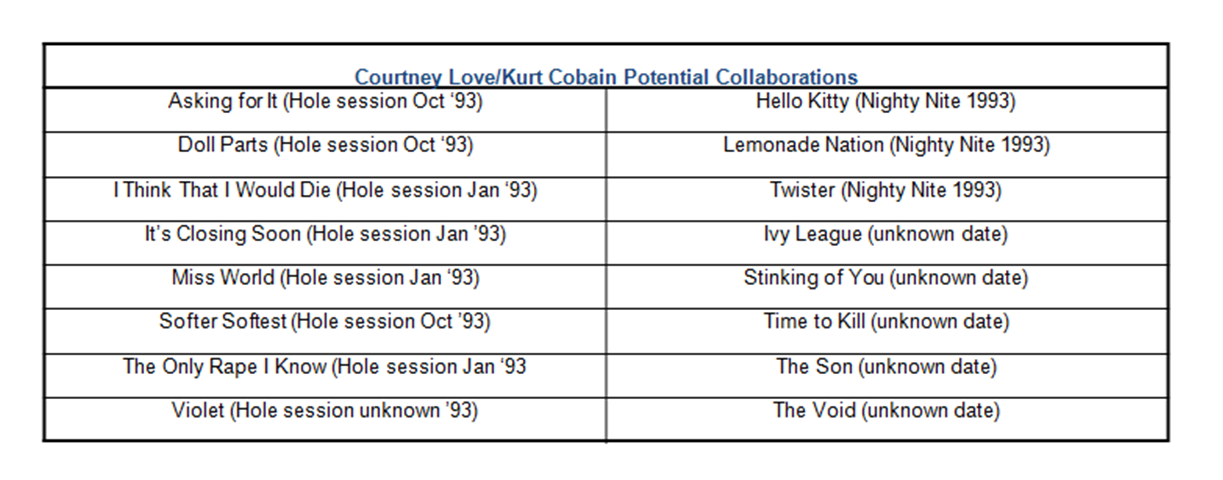
In the latter category I’ve accidentally always wrapped in an entire sub-category; Kurt Cobain collaborations with Courtney Love. Over the years Courtney has been a source for bootleggers of rare material, has played songs on radio shows a long while back, has mentioned unknown songs in interviews with names that aren’t known from other sources – with the exception of the increasingly easily available Fecal Matter demo, Courtney is the most likely source of something fresh. Gratitude to the LiveNirvana site which presently lists the following known or potential Kurt/Courtney tracks;

CourtneyLove-KurtCobain Potential Collaborations

While the quality of material that has become visible so far is of mixed standard to say the least – the Hole contributions from Cobain are as wasted and ephemeral as he may have ever sounded on record, Stinking of You isn’t a song it’s a shred of an idea – there’s still more material potentially from this source than any other. In total, on top of home work with just Cobain and Love together, there’s a total of five known practices (Hole in January ’93, Hole in October ’93, Cobain/Love/Erlandson sometime in ’93, Cobain/Love/Grey/Bjelland sometime in ’93, Cobain/Love/Schemel in early ’93) featuring Cobain with Courtney and others – more practices and jams than he engaged in with his Nirvana comrades during the 1993-1994 period. Heck, the much vaunted 1994 basement demos with Pat and Eric perhaps rightfully belong to this category also.

What’s striking is the absence of any acknowledgement of this work on the With the Lights Out box-set. It suggests a determination on the part of Krist Novoselic and Dave Grohl to ensure that the name Nirvana meant the true band, plus Kurt alone, with a refusal to accept his collaborations with their DGC sister band or its denizens as any part of the official tale. While that’s a fair approach to the Nirvana legacy it isn’t a full reflection of the Cobain legacy anymore than the absence of his pre-Nirvana work (all but one song) or his more experimental urges from the 1987-1989 period. Kurt’s final two years saw him retreat from Nirvana and it’s within that retreat that we’ll find whatever remained of his song writing urges.

Of course the big question becomes one of time. In the chapter from Dark Slivers mentioned above (https://nirvana-legacy.com/about/) I tried to indicate the limited time available in 1994 for writing and creation. Remember that Kurt Cobain seems to have been an ‘on paper’ creator of lyrics, not someone who improvised lines live, so he needed time to sit down and work on material. All descriptions of his working practice for music also seems to involve time spent alone – his fastest/biggest period of creations (mid-1990 to mid-1991) coincided with his greatest isolation. Therefore the question for everyone is to work out how much time he had from February 1992 onwards while staying in hotels and on drugs, then how much he had in 1993 after recording sessions for Nirvana, around being a father and husband, around being a big addict, and prior to heading back out touring later in the year. I’ll leave that open for the optimists and pessimists to debate.