The Most oft-Cited List of Cobain’s Top 50 Albums in the World…Ever! Part 2

If you look back across my two-part/three-part chats you’ll often see that I spend the second half cutting my own argument from part one to pieces. I’m not going so far today, given I successfully demonstrated Cobain’s completely normal musical taste yesterday, but I’ll still pick at a few stray threads.

Top 50

I pointed to Cobain’s peak spells of musical inspiration, in fact, I think there are three; 1976-79, 1981-1984, 1987-1990. The peaks simply coincide with the primary phases of inspiration and development in the genre Cobain was devoted to; punk rock. What’s interesting is how thoroughly Cobain ignores the deeper American lineage of mid-Seventies punk rock — the Ramones, Patti Smith, Television, Johnny Thunders, the whole No-Wave spell. Instead, the line goes the hard rock route via Iggy and the Stooges and the Aerosmith. This is understandable, American punk made hardly a dent on public consciousness. Cobain’s own journey picks up the tale in 1979 with, on the one hand, The Knack reinforcing his new wave tendency (i.e., watered down and more pop-orientated punk) while Greg Sage and the Wipers lead into the deeper pool of U.S. punk-influenced music of the 1980s.

The 1981-1984 spell, again, simply reinforces Cobain’s strong attachment to a specific facet of music. In those years U.S. punk morphed into hardcore and a dozen other inclinations and Cobain was well-aware of all of them whether Black Flag, Flipper, the critical Void/Faith split, Swans, Bad Brains, Butthole Surfers, M.D.C. or Scratch Acid — there are few key names he misses out. It’s clear though that Cobain’s interests remained in a fairly narrow channel. There’s no room here for any of the electronic-infused material coming out of what would come to be known as industrial; similarly that one Swans record is as avant-garde as he gets; there’s nothing until Public Enemy in 1988 from any genre that isn’t (white) Anglo-Saxon guitar music so no jazz, no funk, no soul, just that one old blues record long sanitised by Sixties white-boy blues guitarists — this isn’t a racial point, it’s a music culture point; he doesn’t delve too far into hardcore (a fairly shallow pool of inspiration); and he erases any hint of mainstream taste altogether.

The final spell he captures, 1987-1990, is actually two-fold. Firstly, these years did see a number of genuine classics which he could hardly fail to be aware of — R.E.M’s Green, Sonic Youth’s Daydream Nation, Mudhoney’s quintessential grunge album, Pixies and so forth. Cobain, really, was just showing his awareness of the albums that stood out and gained greatest acceptance as stand-out releases. On the other hand, however, he was demonstrating his allegiance to a very specific strand of indie music that was rising at that point. Beat Happening, Half Japanese, Mazzy Star, The Vaselines, Shonen Knife, Daniel Johnson — running back through the Eighties was a lineage of whimsical, playful music that Cobain adored and that reached its full flourishing in that late Eighties phase. The list captures both his more muscular punk taste and this separate, gentler side; both often equally in love with lo-fi fuzz and an embrace of amateurism as a defence against the sheen of corporate enslavement.

Separately, Cobain’s female-orientated side emerges and also seems to take over; the most recent three albums on his Top 50 — Mazzy Star, the Breeders and PJ Harvey — are all female-fronted bands. His choice of album by The Frogs is also a curious one; that album was a parody record pretending to be out-gay and caused wilful offence among conservative groups — again, it seems to be a push toward his interest in femininity. Other candidates more likely acquired in this late Eighties-early Nineties spell rather than at the time of their release are Kleenex, Slits, Marine Girls and The Raincoats (the Incesticide liner notes make clear he was running around in mid-1992 trying to find this album he cites — also, he met The Frogs sometime in 1993 which may or may not push back the date when he wrote this list if that meeting links to the acquisition of their album and the desire to include them.) It combines with the almost total absence of anything that could be deemed mainstream rock to present Cobain’s tastes as firmly on the side of progressive values and the underground which had a powerful openness to women long before Riot Grrl made it explicit.

That’s not to say that much of this list is overtly political. There’s nothing like Crass or the anarcho-punk scene; there’s nothing that foregrounded a political opinion. That suited Cobain’s belief that music should be music first and a gateway to wider socio-political thinking not something subsumed by a cause and a demand that someone listen.

Returning to a point made earlier, note the absence of anything truly mainstream other than Aerosmith’s Rocks; note the complete absence of anything even arguably mainstream until the very end of the Eighties. At first its fair enough given his oft-expressed hatred of most of what rock became in the Eighties. But then recall that Cobain was endlessly aware of audiences and not above tweaking reality to fit the right storyline. In the case of his musical tastes, it’s well-known that he was a big fan of Metallica — Metallica themselves remember meeting him sometime in the late Eighties and him explaining how much he loved Kill ‘Em All — similarly his inclusion of Iron Maiden’s Run to the Hills within the Montage of Heck suggests he knew a little of one of the most unavoidable rock bands of the Eighties (also note the depth of his Metallica knowledge given he plucked a hidden parody they performed of said Iron Maiden song from a not particularly easily found EP). He loved Aerosmith and Led Zeppelin enough to name a song after the two bands, played Led Zeppelin songs fairly regularly with Nirvana, but eliminated them from this list altogether.

The list, overall, is a neat document capturing a combination of personal taste, wavering life circumstances (for example, his well-publicized boredom with guitar-based music in the Nineties doesn’t leave him many places to go given all but one of his favourite albums is in that arena), independent trends in the music scene, and potentially a mild touch of deception. As usual with Kurt Cobain, there’s always more to be teased out.

The Most oft-Cited List of Cobain’s Top 50 Albums in the World…Ever! Part 1

I’ve gotten into a habit of just calling him ‘Cobain’ at the moment. When writing Dark Slivers I bounced appallingly between Kurt Cobain, Kurt and Cobain depending on topic, mood and inclination — it took hours during the review phase to try and make some kinda sense of it. Please bear with me as I work through my typing tics and foibles.

Hand’s in the air if you HAVEN’T seen the list of Kurt Cobain’s Top 50 Albums? Yep, as I suspected, it’s only those miners in Chile who were stuck underground. Alas, in this visual age, what I rarely see is any real discussion of it beyond using it as an excuse to link to pre-written reviews of some of the albums mentioned or to blurb about the bands on the list — it’s easy space-filling fodder.

What interests me about the list is two elements; the nature of the bands present and secondly the eras shown. To start with, here’s the original list of albums, with the years appended. Please note immediately that the list can be positively identified as having been written sometime after the release of PJ Harvey’s Dry in June 1992 making it a relatively good indicator of what Kurt viewed as his key albums looking back across his still-young life:

Top 50

Now, here’s the list rearranged chronologically from earliest to latest:

Top 50-Chronologically

There’s no way to definitively connect the year of an album’s release to the year Cobain first heard it, but there are definite peaks in the eras to which he looked for pleasure and felt worthy of note on his extensive list:

Top50_Years of Release(Graph)

Top50_Years of Release

It’s neatly poetic that the first phase of sustained musical interest commences the same year as Cobain’s parents divorced. I’m unsure, however and alas, whether I believe nine year old Kurt salved his woes in Aerosmith’s Rocks; it’s a possibility that the album marked a significant event, the Cobain family was certainly steeped in music as a mode of emotional expression, but it’s not definite.

Again, though it’s impossible to prove which years Cobain first listened to albums in, its notable that the peak of his preferences arise in the years immediately preceding and including 1983-84 when Buzz Osbourne was feeding Cobain the tapes of U.S. punk and underground music that Cobain describes as his epiphany. Even in 1992-1994, whenever he wrote this list, that period of music remains of critical importance to him with 1981-1984 yielding 19 of his favourite albums, well over a third of his entire list and matching precisely the most critical spell in the evolution of this teenager into a would be punk musician.

The lull from 1985 through 1987 could perhaps be put down to an absence of ground-breaking albums but it simply wouldn’t be true; numerous underground legends were kicking off in those years or burnishing their credentials so why the lull? To some extent I credit age and the inevitable aftermath of a revelation — after so many new discoveries its maybe inevitable that there might be a couple years where things felt a little ‘samey’ or more like reinforcement. Was 1986 really an off year for interesting music? All opinions welcomed on this point!

An alternative presents itself. I looked back to a previous piece from this site (https://nirvana-legacy.com/2013/01/28/life-long-latchkey-kid-kurt-cobains-homes-part-1/). Essentially, while preceded by a long spell of dislocation and movement between family members, from April 1984 onward, 17-year-old Cobain’s life enters a truly rough spell punctuated by three spells of temporary homelessness, a brief return to his father and an extended period as a guest of the Reed family. Cobain had left school, he was in paid employment for certain lengths of time, those few years simply weren’t suited to get to grips with music or absorbing new discoveries.

Finally, in April 1987, Cobain benefitted from the longest period of stable home-life he had experienced in many a year and, in fact, the final time in his life he would spend a year in a single location (https://nirvana-legacy.com/2013/01/29/life-long-latchkey-kid-kurt-cobains-homes-part-2/.) From that month, he moved in with girlfriend Tracy Marander, living in the same block, though two different apartments, and with Dave Grohl after Tracy moved out, right the way through until July 1991.
This coincides with and perhaps is a key factor in the second spell of new discoveries with the years 1987-1990 yielding twelve further albums from the Cobain Top 50, plus the Leadbelly record too. It’s easy to point to these years as ones in which Cobain was surrounded by fellow music-lovers and able to cherry-pick new discoveries and new moments…

…One thing I’ve underrated, however, is simply the matter of age. Really all I’ve shown is that Cobain’s years of maturity from age fourteen to age twenty four saw the majority of his musical favourites, in other words, that he was a perfectly normal young man in terms of the time in his life when music really meant something to him.

Nirvana Songs Played the Least: Across Time

Thank you to Brutus the Barber for pointing out the absence of MV and I Hate Myself and I Want to Die from the list of officially released, but never performed live, Nirvana songs. Amendments duly made. Today I’m just looking at the data another way, I was curious whether certain songs were played irregularly but persisted across a substantial number of months, and/or whether certain songs were resurrected after substantial gaps.

Fewest Months Performed

The month-by-month list reiterates and reinforces the lack of attention given to, primarily, songs that Nirvana deemed either b-sides only or not ready for release at all. The focused nature of Nirvana’s live trialling of songs is also a notable point — they would work a song deeply over a short period of time then haul it out of public sight to either work on it and fashion it into something worthwhile or never to be seen again.

There are twelve songs on the list that either emerged on a single or compilation during Nirvana’s lifetime or didn’t come out until the With the Lights Out box-set; of those twelve songs only one can be shown being played in more than three months.

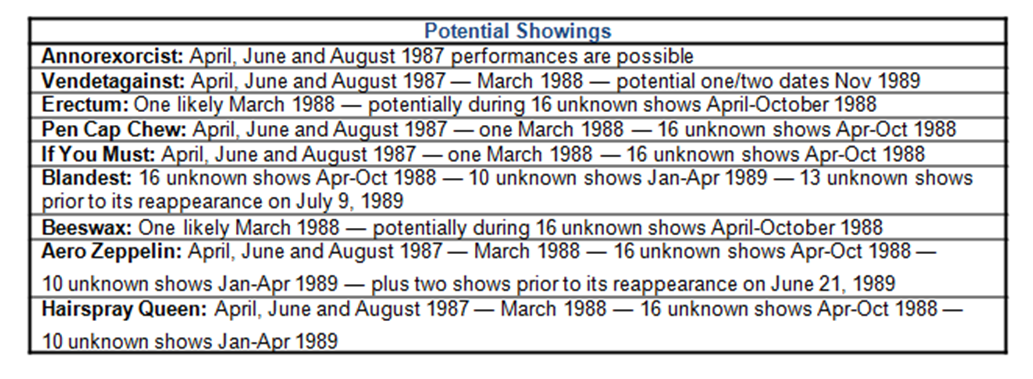
Now, it’s clear, given the majority of those songs belong to the early days of Nirvana, that we’re missing significant numbers of the set-lists that would reveal further cases when they were played — we only know complete set lists for two of six shows in 1987, five of 24 for 1988, 43 of 82 in 1989 with almost nothing for the first six months of the year. For some of these songs, however, I wouldn’t expect the pattern to change significantly:

Potential Showings

Strangely, it’s songs like Tourette’s where their throw-away nature is really clear; the majority of post-1991 set-lists are known but that song barely appears with few further opportunities for it to do so; the other In Utero era songs feature due to the curtailed nature of Nirvana’s touring in 1993-1994 but Tourette’s simply doesn’t seem to have been popular enough to bother with.

Scooby Doo Versus Kurt Cobain

http://jezebel.com/kurt-cobain-was-once-arrested-for-tagging-cartoon-chara-513289680

I’m personally conflicted by this news given my love of Scooby Doo is clearly now in conflict with my love of Nirvana and the works of Kurt Cobain. It’s typical of Kurt Cobain, however.

There’s a scene at the beginning of the film Blue Velvet (1986) in which the camera pans over an artificially pristine and drippingly gorgeous suburban scene before panning down into the grass, closer, closer, until eventually its buried in the dirt and scuttering bugs — a visual metaphor illustrating the film’s overall desire to show how much goes on behind the friendly stability and contented exteriors of both people and places. This is what I feel Cobain does a lot.

In his earlier story songs and his short sketches of character and place — primarily represented on Bleach and Incesticide — one element he dwells on is the discomfort dwelling beneath ordinary surfaces. He does this in two ways; either by warping comforting images by bonding them to uncomfortable elements, or by describing inner feeling buried. While his teenage doodles do contain a lot of simple gross-out imagery, something like the Mr. Moustache cartoon takes it a step further by wedging the simple desire of a parent to feel/hear the movements of their baby, to the emotional and violent vitriol of their wishes for what the child will be/not be, then the physical outcome of an internal forced ‘caesarean’ for want of a better word.

Floyd the Barber is the most famous example of this aesthetic, the most overt and vicious, but the duality is pulled repeatedly; Mrs Butterworth’s vision of advancement is undermined by “that piss stained mattress I’ve been sleeping on”;Montage of Heck welds cutesy samples to vomiting sounds and gushes of feedback or shredded metal; Swap Meet’s subsistence art-life goes hand in hand with frustrations held “close to the heart”; Scoff voices its accuser’s thoughts while denying them then undercuts the self-righteousness with the demand for alcohol; Sifting and Mr. Moustache undercut any positive vibes repeatedly; Sliver’s domesticity is spoilt by the narrator’s near hysterical distress; Sappy finds happiness in slavery…Most similarly to the film vision, Spank Thru surveys love, lights in the trees, happy birds…Then breaks into an ode to masturbation. Divergence between realities abound in these early songs of discontent.

Polly pulls the same stunt with a subtlety belying its relatively early writing (circa 1987.) The narrator’s attentiveness and soft-spoken calm is blown apart by the gradual hints that the object of his gaze is bound and abused. The change in Cobain’s writing style makes it one of the last clear-cut cases of this desire to undermine and show the lies in the ordinary and every-day. Aneurysm is the other with its merging of love song/rock n’ roll cliché to drugs and violence.

In terms of why there should be such an interest in things not being as they seem, there are several origins that could be theorised. For a start, Cobain’s own personality was one in which evading confrontation seems to have been a major element; the descriptions of him as a quiet and withdrawn presence suggest a defensiveness, a desire to figure out the environment before committing anything to it — there were far more thoughts, far more annoyances and aggravations that he let loose in music, in his journals, to other people. Secondly, and this may be related to the first point, the instability of Cobain’s own home-life, the fact that from age nine he went through numerous houses and, by his late teens, three spells of semi-homelessness, meant that the idea that a home might be a stable place, one of sanctuary, simply never occurred for him. Home was a place where he was welcomed in but in the background had to wonder if he was staying whether because the tension became too high for him or for those looking after him. Third, and finally, the fact that his relationship with the two people crucial to a child forming a feeling of trust in the world — his parents — had fractured, understandably damaged his ability to think of the world without seeing something ugly under the surface.

So, in the end, a juvenile doodling of Scooby Doo and Shaggy, nothing more than that — but a wrecking of a childhood image and a standard activity for Cobain expressed for years to come.

Nirvana: Hormoaning and its Place in the Discography

The straight history of the Hormoaning EP by Nirvana was that it was the second time Nirvana released an EP to support an international tour. The Blew EP of 1989 had been intended to support the band’s European tour but had been delayed — the Hormoaning EP landed right on time in February as Nirvana were criss-crossing Australia for 11 shows, prior to the one in New Zealand, the four in Japan and the pair in Hawaii.

In the case of Blew, Nirvana had been forced, because of a lack of serviceable leftovers, to retreat to the studio to prepare a few new songs; its notable that already, in mid-1989, Nirvana didn’t want to return to the songs of January 1988 nor to Big Long Now, the only leftover original from the Bleach sessions (barring the revised Hairspray Queen). By 1992 the band’s archive was more capacious, but it was still devoid of originals that were finished ready to be released, and so the result was a reliance on previously released B-sides and radio session recordings.

Unlike the later emptiness of mid-1993 when Nirvana really did have next to nothing left, it’s very clear how many relatively new songs Nirvana had in the back pocket in early 1992; Old Age, potentially Tourette’s, All Apologies, Dumb, Rape Me, Sappy, Verse Chorus Verse, Token Eastern Song — that’s without looking toward Opinion and others. What Nirvana lacked throughout winter 1991-spring 1992 was time. The success of Nevermind had taken everyone off-guard and so the band were out touring right through until just after New Year, then doing several days of TV appearances in New York until heading home on the 12th before a first show in Australia just 12 days later.

Similarly, Hormoaning wasn’t a priority — it was a ‘nice to have’ opportunity for added sales rather than a ‘need to have’ release. The official sum quoted on Wikipedia is an eventual complete run of 15,000 copies in Australia and an unknown number in Japan; it doesn’t state how many of these were pressed and ready to go by February 5, 1992 — far less undoubtedly. With an existing album flying off the shelves, unlike Bleach’s initially delayed and limited presence in Europe, there wasn’t the same impetus behind the release to be worth driving Nirvana back into the studio. The result is the cobbling together of the Smells Like Teen Spirit single B-Sides with the four BBC session tracks from October 1990 — a quick fix.

Today — given the ready availability of the SLTS single, given D7’s presence on With the Lights Out, given the Incesticide album — the Hormoaning EP is a bit of a nothing, I have it on my shelf but there’s no real reason ever to pick it off and load it up. What I’m interested in, however, is getting back to the mentality of the time; Incesticide wasn’t yet on the radar, it hadn’t been conceptualised let alone had a track-listing prepared — this release was the first time Cobain, Nirvana, and/or someone at Geffen had looked to this radio session of covers as a source, the December 1992 release simply reconfirmed a thought that someone came up with sometime in the last days of 1991. If you’ve read Dark Slivers you’ll know I point to various evidence that significant thought and effort went into the track listing of Incesticide — the transplanting of this previous effort into that compilation, rather than being an after-thought, is made to look ever more important to Kurt Cobain; sharing his good fortune with his favourite bands seemed so important to Cobain that he did it twice in one year.

Similarly, the Hormoaning EP, on import, was the only official way to get hold of those BBC songs for ten months, the best part of a year — for that brief spell it was a genuine rarity for Nirvana fanatics and their chief chance of hearing more ‘original’ Nirvana material barring the one fresh original on the Lithium single, the smattering of live tracks on the singles, the release of D7 on a special edition version of the Lithium single. For ten months the EP was genuinely something rare and fresh…Then it reached obsolescence, it’s vital life curtailed.

Nirvana: Lollapalooza Tour EP 1994

Someone on LiveNirvana (www.livenirvana.com) kindly shared the reference from Rolling Stone magazine (June 16, 1994) stating:

Despite increased demand for Nirvana songs in the wake of Kurt Cobain’s suicide, the band’s label, Geffen Records, recently chose propriety over profits. It scrapped two Nirvana projects in the works: a third single from In Utero, ‘Pennyroyal Tea,’ and a CD-5 to be released during this summer’s Lollapalooza tour, on which Nirvana were expected to perform. An album and a video documenting the band’s appearance on MTV Unplugged (the album reportedly including songs that never made the telecast) were under discussion, but Ray Farrell of Geffen’s sales department says it’s ‘too sensitive a time’ to consider releasing it. (A bootleg recording of the Unplugged telecast is already circulating.)”

The quotation confirms that there were indeed plans for Nirvana to capitalise on the Lollapalooza tour that was to take place that year from July 7 to September 5 with a new EP. The proposed tour EP would have been the third time Nirvana capitalised on a tour in such a way following the Blew EP of 1989 (intended for their first European tour) and the Hormoaning EP of 1992 (intended for their first Asia/Pacific tour).

The most significant difference, however, was that in 1994 the archive of potential songs for inclusion was threadbare. In 1989 the band had still had to return to the studio to kick-out a couple of new originals despite having a number of unreleased leftovers most of which would eventually appear on Incesticide in 1992. In 1992 meanwhile, for the Hormoaning EP, Nirvana had scraped together two previous released single tracks then appended material from a BBC radio session to flesh out the release. At the start of 1994, the band hadn’t been on radio since November 1991 and in terms of completely finished and polished originals had nothing that was less than a few years old.

The belief has, therefore, always been that the January 1994 sessions at Robert Lang Studios were about cobbling together a song or two ready for whatever further releases might be needed in 1994-1995 after the release of the Pennyroyal Tea single, with the EP the prime beneficiary. My issue, however, is that there’s never been any confirmation of that statement.

Examining the session leads to ambiguities. There was apparently no pressure at all in January to finish anything completely; You Know You’re Right being the only song to emerge in arguably complete form. An interview with Pat Smear found at the Nirvana Fan Club does feature Cobain telling Smear that he’d be able to overdub his guitar onto the recording but that still could suggest either that, yes, You Know You’re Right was finished and just needed mixing and the added track, or that Cobain was being polite to the new guitarist. The feeble results of the session are generally deemed to be a consequence of Cobain’s essential uncertainty whether to continue as part of Nirvana at all and that seems right but this session is still a rarity in that so little was accomplished; the equivalents would be the full session spent on Sappy in 1990 or the abandoned instrumental of Frances Farmer will have her Revenge on Seattle from 1992. Nirvana, if something was needed imminently, tended to turn up the goods.

Also, it’s unclear when Nirvana were first invited to perform at Lollapalooza and, therefore, when the EP idea started rolling around. Certainly it was on the agenda by March 1994 but were both the invitation and the EP idea mooted before the end of January? It’s unclear and, again, it seems a stretch to suggest that the Robert Lang Studios session, already booked in late 1993, was repurposed to prepare for a Lollapalooza EP so soon (potentially) after receiving the invite.

Instead, a more realistic view of the January 1994 studio session was that it was about getting the band playing again in a creative sense — actually trying new stuff rather than just repeating material on stage ad infinitum. In that case though, with no recent radio performances, with no more obvious and recent unreleased and complete original Nirvana songs, it would suggest that the Lollapalooza EP could only really be either a live CD or a rip from the MTV Unplugged show. Yet, on that last point, the Rolling Stone quotation seems to suggest the latter was under consideration as a totally separate project so what’s left that could have made up this EP?

The answer, I believe, lies in remembering the distribution of Nirvana’s singles. There had been no singles from In Utero released directly in the U.S. therefore only Verse Chorus Verse (Sappy) and I Hate Myself and I Want to Die on The Beavis and Butthead Experience had made it to U.S. audiences. Lollapalooza, as a U.S. only tour at that time was an opportunity to gather together the single tracks Marigold and M.V., plus I Hate Myself and I Want to Die (also a B-side on the Pennyroyal Tea single) and Verse Chorus Verse into a single release to an audience that had not previously had easy access to these songs. That would have annulled any pressure on Nirvana to re-enter the studio any time soon in 1994, would have meant they didn’t need to waste whatever new material they came up with (given they had so little and were doing so little together) on an EP and would have had a genuine value to a 1994 U.S. audience.

First New Pixies Song in Nine Years…

http://pitchfork.com/news/51356-watchlisten-pixies-bagboy-first-new-song-in-nine-years/

Merely a late on Sunday aside but Cobain favourite The Pixies (sans Kim Deal who has, once again, left to focus on the revival of The Breeders and the twentieth anniversary tour of their best known album) have just released their first new composition in many a year…

…Any thoughts from this side? I’m always unsure what I’m looking for in the sound of a reformed or long-translucent band; is it good if they sound precisely like they always did or is that a sign of stagnation and an absence of inspiration? Then again, if they sound significantly different, does that rob them of the qualities that made them pleasurable in the first place? Oh well…

In this instance, the song combines recognisable touches in the tone of the guitar, the chopped out chords leading into the buzzing held notes – alongside the refreshed drum sound. The backing chant initially grated during the very new wave intro section before fitting neatly into later sections. There’s something of the hectoring street preacher in Black Francis’ vocals before it returns to more familiar yelps in the long breakdown mid-song. It’s a neat combination of 25 year old motifs with fresher interests…Go see.

If I had a criticism I’d say a lot of sections go on longer than kept my interest; curtail the intro, chop the whole song down a minute, slice the outro off sooner…

Getting Back to When Nirvana was Just Another Band…

Picture1

A year ago I purchased The Beatles box-set, the complete discography…Admittedly I don’t entirely remember ordering it, I may have had one or two drinks more than was mature and sensible, however, I don’t regret it at all. I’ll admit completely that I find the very early albums unlistenable, there’s something so alien to me about the dominant musical style of the early Sixties (“the Sixties” as clichéd era didn’t commence until into the middle of the decade as a chronological measure) that I find it hard if not impossible to entertain what sounds so cloying to ears that have been solidly wrecked by fifty years of musical evolution since 1963.

A friend of mine, who I really need to get on and lend this to, defines the problem as how to forget all the echoes and extrapolations and duplications that have occurred as a direct result of The Beatles and their ilk — it’s near impossible to hear such a theoretical concept as ‘the original’ as an aural quality with ears used to heightened volume, ever greater emphasis on bass, etc. The original often sounds weak, tame, unimportant compared to the sounds one is more naturally used to. When I listen to the early albums of The Beatles I’m struck by the relatively tinny sound, the skeletal quality, the harmony vocals, chord sequences and musical approaches drawn from formal dances…

Similarly, it’s hard to appreciate the truth of Nirvana’s status in 1992. An intellectual understanding that many other until then unknown bands achieved multi-platinum sales that year, that a large number of alternative bands emerged as rising stars in 1990-1991 and others would follow, that ultimately musical genius is relative, that for older fans Nirvana’s onstage antics and sound were reminiscent of the bands they had considered, in their youth, geniuses — none of it overwhelms that sense that the band was special, exceptional and different. It’s similarly easy to understand that Kurt Cobain’s death — exceptionally taking place at the height of his fame (or at least within very easy touching distance); not a common occurrence — prevented the band having to endure a more prosaic break-up, made them immune to the passing of generations and therefore the switching of taste that tends to come with it.

What’s harder to do is to truly set aside twenty years of hagiography, of positions in the regular top tens and top whatevers of music criticism and/or discussion, anniversary releases, the increasing reduction of interest down to a hardcore of fellow fanatics who are bound to confirm and re-confirm importance, significance and relevance.

That’s where this cartoon pleases me, it’s taken from an old VIZ annual and, beyond poking fun at the transience of teenage/student/young tastes (it started with a reference to The Happy Mondays), it opens two avenues for me. Firstly there’s the matter of the geographic significance of Nirvana. While the band did have a strong following in the U.K. and while Top of the Pops, The Word, various BBC sessions and Reading ’92 have welded Britain into the Nirvana story the local aspect of British taste is visible — while confirming that Nirvana were hot in Britain the comparisons made are to relatively local favourites, The Happy Mondays — a relatively brief flash in the pan who seem bigger and more significant in hindsight than the extent of their reign demands — and Curve — a band I can’t even remember now but who apparently stuck around until the middle of the last decade — are the acts chosen to stand shoulder-to-shoulder with Nirvana. It simultaneously deems Nirvana to be no more than the equal of two bands that were barely known elsewhere and also robs Nirvana of the very American universe of comparisons in which they’re traditionally set; Guns n’ Roses, Pearl Jam, Soundgarden and so forth.

Secondly, it shrinks Nirvana down significantly from this near untouchable position of power to a condition where they stand alongside a band that charted one album in five in the U.S. (in position 89) and a band that, again, barely charted outside of the U.K. and saw its albums march backwards from 22 in the chart, to 23, 103 and nowhere across its releases. This isn’t to denigrate either band; it’s to point out that Nirvana’s position in 1992 was as a stunning success but with no indication whether there was a longer-term significance. They weren’t exceptional.

On the other hand, it emphasises Nirvana’s international ubiquity by wedging Nirvana in as the international representative in between two local successes with a distinctly British accent. The sound of Nirvana has been picked over and either criticised or praised for drawing on mainstream hard rock, on Beatlesesque qualities, on punk, on underground flavours of the late Eighties and early Nineties as well. The company in which this cartoon places Nirvana suggests that the simplicity of Nirvana’s sound, built on a very strong awareness and knowledge of Anglo-American music trends of the era, allowed Nirvana to slip into the playlists of multiple audiences.

It also wedges Nirvana into the various worldwide alternative currents — for example, British guitar music went through a spell in which it was firmly wedded to the dance music scene that had spiralled out of rave in the late Eighties — and voids the mainstream/alternative argument to some extent. Nirvana slipped right in alongside U.K. ‘baggy’ culture and so forth. It was only in America, where the charts had never been dominated by an alternative to hard rock before (remember even The Sex Pistols didn’t hit platinum in America until 1992), that there was difficulty in judging the sound of Nirvana and emphasis was placed on what they shared with the mainstream tradition rather than what they shared with the underground.

…So, in conclusion, can you tell I sometimes think too much if I extrapolate all of that from a 1992 Student Grant cartoon in Britain’s premier adult-orientated comic? Do go read VIZ, it’s good for the soul.

Which Songs Did Nirvana Play the Least?

The other week we looked at the songs Nirvana can be shown, on the existing evidence, to have played the most (https://nirvana-legacy.com/2013/06/05/which-songs-did-nirvana-play-the-most-the-top-x/), which songs they played most consistently over time (https://nirvana-legacy.com/2013/06/06/the-most-popular-nirvana-songs-another-measure/) and which album was most dominant (https://nirvana-legacy.com/2013/06/11/album-dominance-which-album-did-nirvana-play-the-most/). Today I want to head in the other direction, to the bottom of the table.

Picture1

As ever, the status of Big Long Now is a tragic situation — it’s an original and unusual song in the Nirvana catalogue and pure bad luck that we can only suspect it was played more. In fact Blandest falls into the same category; the likelihood is that both songs were played in the early spell of 1989 when the biggest gap in known set-lists for Nirvana exists. This would immediately reverse the situation and make two songs from the tail-end of Nirvana’s career (You Know You’re Right and Gallons of Rubbing Alcohol Flow Through the Strip) the lowest entries — the 1993-1994 tour was a spell when Nirvana’s formerly free-wheeling, varied and regularly advancing set-lists gave way to relatively static and unchanging repetition and this would fit.

What’s also noticeable is how the results reinforce how clear-sighted Kurt Cobain and Nirvana were about the status and condition of their songs. It’s absolutely visible that songs that were essentially discarded or served, at best, as b-side or bonus fodder, dominate the list. 17 of the bottom 20 songs are in that category which, given the relatively brief nature of Nirvana’s catalogue is significant; six of the songs made it out on Incesticide, three were b-sides or bonus songs, eight were never released in Cobain’s life time/Nirvana’s life-span.

The remaining three songs — Swap Meet, Sifting and Tourette’s — again reinforce that sense of clear decision in Nirvana’s music. Tourette’s, though fun, was always a filler on In Utero, a track with debatable lyrics and the listing “cufk, tish, sips” in the inlay — its real function lay in being another snipe at criticisms that Cobain mumbled lyrics or was some kind of idiot savant blurting involuntary sounds rather than a man who carefully considered, wrote and re-wrote his lyrics before committing them to a final recording. Swap Meet ties into the early songs on Incesticide in that they show Cobain’s early Nirvana songs to be relatively wordy (and non-repetitive) and, as a consequence, relatively hard to perform live hence the low number of performances. Sifting, meanwhile, was a late addition to Bleach and potentially the candidate for being the song written from scratch in the descriptions of frenzied writing around the time of Bleach; again, it was there to fill space and, remembering Sub Pop structured Bleach to begin with what they thought was Nirvana’s best songs through to their least favourite, of relatively low status — something reflected in it being equally ignored on stage.

Nirvana’s ‘growth spurt’ between 1987-1989 is equally clear. Kurt Cobain’s writing underwent significant changes in the early years as he tried on and discarded various identities. This, consequently, came with much trying on and throwing away of songs too. Fourteen of the songs on the least performed list are definitely pre-1990 compositions while one, Tourette’s, has been said by Krist Novoselic to have been first attempted at that time. It does indicate the linear nature of Cobain’s work, that he tended to move on from sounds and styles with few songs shifting out of or beyond their original time periods to appear on later recordings. That’s also a consequence of Nirvana’s fast recording style; they were highly efficient in studio (partially as a result of relative poverty until 1991) and songs were recorded and used very rapidly.

I’ve stated before, as recently as yesterday, that Incesticide’s Side B is essentially an unreleased 1987 Nirvana EP. The list of least played songs reinforces the fact that, prior to moving onto Sub Pop and beginning to write to fit the grunge audiences, Nirvana had a full album ready to go in January 1988; Erectum, If You Must, Pen Cap Chew, Annorexorcist, Aero Zeppelin, Hairspray Queen, Mexican Seafood, Beeswax and so forth. Nirvana barely performed in 1987 and didn’t have a taxing performance schedule in 1988 (or a stable drummer until after the middle of the year) and this list makes clear that an entire identity was discarded.

Why Nirvana Incesticide’s Importance was and is Sorely Underrated

As you’ll have noted at some point, particularly if you’ve been checking the blog for a while, the initial reason I kicked it off was I wanted to make use of some leftovers from a book I wrote on the subject of the Nirvana album Incesticide. Dark Slivers: Seeing Nirvana in the Shards of Incesticide took me most of last year, most evenings, notes written around daytime activities, scraps of paper from the gym, thoughts in the swimming pool, even a holiday at my parents spent doing extra hours long into the night. In summary though, why did I bother? Why is a half-forgotten compilation from twenty years ago worth another look?

Well, the book is my argument for it, but here’s the overall summary in ten quick n’ easy points:

(1) While rarities collections are increasingly common, in 1992 it was unusual for a band to showcase its abandoned material except posthumously and note the sheer focus on quality; no live cuts, no sketches or half-hearted demos of songs that weren’t finished pieces of work, the time taken to swap out versions that were disliked

(2) Except for the most fanatical Nirvana fans, the vast majority of the songs were unreleased or appeared in a different version from that already visible. It was an extremely generous release both to fans, given the depth of material present, and to friends given the exposure given to The Vaselines

(3) The release was Nirvana’s first major post-fame statement and was Cobain’s first real reaction to his discomfort; he gave it an un-family friendly title and stuck a well-publicised message inside attacking his enemies (the earlier draft having been refused for simply being a screed of personal abuse against certain individuals)

(4) It’s the best opportunity to glimpse Nirvana pre-Bleach/pre-Sub Pop/pre-Grunge. Side B is an EP length 1987 Nirvana showcasing what they sounded like prior to any substantial live experience, without any guidance from a label, simply playing the kind of music they enjoyed at that point; they wanted to channel Melvins, Scratch Acid and Butthole Surfers

(5) The release was the first time Cobain had received so much personal control over an album and he personalised it massively; he supplied the cover art (rather than making suggestions that an art director carried out), he made his first big written address to his fans and selected or discarded possible songs for it depending on his feelings about the songs, their state of completion or whether they were potentially for the next Nirvana release; songs only went onto Incesticide if they were ‘dead’

(6) I would argue, there are games and intentional moves going on with the structure of the entire album; a number of jokes implanted — for example, note how Nevermind Side A finishes with Polly, Incesticide Side A finishes with Polly and In Utero Side A finishes with Dumb which Cobain stated on MTV Unplugged was cribbed from Polly. This also emphasises the unity of Nirvana’s catalogue

(7) A further vendetta played out on Incesticide, outside of the liner notes, was the desire in 1992 to take control of Nirvana’s finances. The Incesticide release featured Downer that Sub Pop had tried to use in 1992 as an incentive for sales of Bleach and Dive, which Sub Pop had used for the same purpose in late 1991. By including those two songs so soon after Sub Pop’s use the opportunity for Sub Pop to profit from Nirvana’s success was reduced

(8) The release was a very specific part of Nirvana’s flight back to the underground post-Nevermind. It sits solidly within a lineage of uglier, less pop releases thus pointing the way to the future of Nirvana and forming part of the reaction against Nevermind’s polished perfection; it was a declaration of the past and of future intent

(9) It’s a vital testament to the way Nirvana abandoned two alternative paths; firstly the new wave orientation of 1987 and then the power-pop/K Records vibe of 1989-1990. Incesticide makes clear that Bleach’s grunge direction wasn’t inevitable, nor was Nevermind’s mainstream/Pixies-influenced rock take either. Incesticide shows what masters Nirvana were of styles prevalent in the alternative rock and indie underground and how they could make all those sounds their own while always moving on — it’s a great statement of Nirvana’s restlessness and how many styles they attempted

(10) It shows how literary Kurt Cobain was; his earliest songs are in fact among his most lyrically complicated and extensive. At one stage it used to be felt that Spank Thru couldn’t possibly have been on Fecal Matter because there’s no way Cobain could be that sophisticated that early; Incesticide shows him to have been a wordy, varied lyricist — one who learnt later to reduce and simplify and to write in pop modes. In terms of non-repeating lines, these were his longest songs

Did I say ten reasons? I could go on. For example, I’d argue that Incesticide is Nirvana’s tribute to Eighties underground music and as such is the best selling examples of a decade of music — the first top-selling true punk album in America. I’d say that With the Lights Out showed that Incesticide really was the cream of Nirvana’s outtakes — that Cobain et al. had cherry-picked the finest in 1992. I’d also point out that given how many songs Cobain wrote in total this is a substantial collection in simple numerical terms. It’s also a demonstration of the more experimental vibes of Nirvana at the same time as showing the contrast between the kinds of material Cobain brought to Nirvana versus the deeper experiments he played with in the late Eighties such as backwards recording, sound collage, voice effects and so forth.

In other words, I wrote about Incesticide because it’s a compilation with a hell of a lot going on. You should check it again and, if I may be so bold, I think my book might help – as it says at the top, order from me directly via NirvanaDarkSlivers@gmail.com or nicksoulsby@hotmail.com