Mourning Seattle

Grunge, as a coherent scene, peaked in the late Eighties and was long gone by the time Nevermind put the word into popular parlance. Most grunge bands barely sold, only the crossovers who had either left grunge behind or barely connected to it in the first place, so basically Nirvana, Soundgarden and Pearl Jam made it out. Even by 1991, Nirvana’s name was tied to a ghost and they have remained, in the popular view, the key exemplar of something that was already dead. It’s extraordinary in fact that such a minor scene should receive coverage at all.

The survivability of grunge as a form recognised and acknowledged in popular musical history was based on two, separate, but connected, events. The first was the power of the British music press and Sub Pop’s work in cracking open coverage thousands of kilometres away from the epicentre of the scene. With the best will in the world, alas, it’s reportage and repetition that creates perceived importance — in 1989-1990 the world was primed and waiting for something to come out of the Seattle scene thanks to the hammering of the topic by the music press. The second factor, the one that elevated grunge to a hallowed status, was its perceived role as the incubator for the band that breached the alternative/mainstream divide; Nirvana.

The two elements, grunge and Nirvana, are so intertwined that amidst the flurry of books on grunge that emerged between 2007-2011, virtually all featured Kurt Cobain on the cover. On Facebook there’s a similar sampling of the popular mind; dozens of memorial sites to grunge, hundreds to Nirvana, hundreds more to Kurt Cobain — the grunge sites are barely distinguishable from the Nirvana/Kurt Cobain tributes. Without Nirvana’s success pushing the origin myth of their emergence from grunge, without Nirvana’s success forcing the word grunge into every account of punk, alternative, rock, metal and post-1980 guitar music, grunge wouldn’t be mentioned as a scene anymore than a dozen other localised punk scenes of the 1980s. It’s similar to the way No-Wave has achieved some underground recognition on the back of the stature of Sonic Youth, Swans and, for a time, Lydia Lunch — a scene barely bigger than four bands is now a regular fixture in accounts of music.

The ‘icon’ mantle Kurt Cobain inherited has been hung over grunge also. The fact that grunge had disintegrated long before Nevermind made it out is barely registered; the arm’s length relationship between Nirvana and the grunge scene is only commented on among fanatics; the names and stories of the true grunge bands (Green River, Melvins, Soundgarden, Skin Yard, Mudhoney) something for music trivia fetishists. The immortal bonding between Kurt Cobain and grunge has created a mourning of the grunge scene. The difference was that while grunge was a very local, barely registering scene, Nirvana had a chance to connect in some way with the huge audiences who still exist for them whether on record or on MTV or as live event. Fans have been smothered ever since in memorabilia whether aural, literary, visual or tactile (*shudder* Kurt Cobain action figures…) The ‘big bang’ of Kurt Cobain’s suicide also created an emotional trauma of vast scale for fans setting a standard of significance that makes it impossible for another band to match.

Grunge, by contrast, melted away without any such mass audience, without MTV coverage, with records sold in such low amounts that Sub Pop was going to go bust before the Nirvana money flowed in; there was no mass connection. Grunge has gained its significance purely as a synonym for Nirvana. This means the harking back to a supposed golden age in Seattle is such an unusual mental phenomenon; it’s a desire to return to something that very few people saw, or heard, or had any part in — it’s completely divorced from any personal connection.

The amorphous identity of grunge also assists its assimilation into the music-based world views of fans the world over. It’s become a cliché of the Sixties generation to claim that you had to ‘be there’, a way of keeping out newcomers and preserving a sense of exclusivity around a set archetype to which followers must adhere despite lip-service to anti-authoritarianism; the result is that very few people hark back to the hippy era or ethos, few mimic or enthuse about it. The original wave of punk had a similarly strict mission statement and presentation, again, the rigidity of the identity created a limited life-span and shelf-life. Grunge, by contrast, had no vision for life, no projected purpose behind it. The result is that it can be used to cover a wide span of lifestyles and attitudes — it’s an appealingly broad church in which anyone can find what they wish. The pretence was that this fuzziness meant that Generation X had no commitment to anything at all, but that’s untrue. It was a generation that permitted individuals their own choice of ambition without imposing or demanding a single unified identity of its adherents.

The appeal of the grunge era only exists as a comparison, a longing for fresh possibilities that most of those who wish they had been there can never confirm even existed. The idea of the alternative nation, in reality little different from the pre or post-generations, appeals in the same way that the hippy or punk did — as something to hark back to when seeking something to put in opposition to whatever exists in the present day — without the weakness caused by a too uniform and defined presentation.

In actual fact, while the participants in the original scene wax lyrical about how enjoyable it was for them, the sense of open possibility and no responsibilities unburdened fun; it’s those components — youth in other words — not the scene itself that is being memorialised. Grunge consisted of extremely poor people, playing to limited appreciation, with limited futures visible, increasingly saturated with drug casualties and with a time-limit after which the usual college or steady job paths beckoned. What those people are eulogising and memorialising is the wild years of their youth when they didn’t know what they were doing perhaps but it felt good just doing it. What the fans of grunge are enthralled and inspired by is a wish that they had experienced their own mad years, or a wish that they could recapture that same directionless but ecstatic freedom.

Grunge, Seattle, the North-West scene…It’s so perfect because it’s no more real than the British tabloid vision of a mythical England of cricket, warm beer, social deferment, local employment, temperance — a world also, quietly, devoid of immigration, in which the working classes are invisible, where women keep their traps shut, where discomfort is locked away. It’s a different form of the golden era myth, the comforting kneejerk belief that “things were better” once upon a time whereas appreciating the beauties of the here-and-now, the conquered travesties of the past, or working/fighting to make this present era closer to what one wishes for — it’s all too much work. Easier to claim the fight is lost than to go for it.

Presence and absence are permanently intertwined. The appearance or discovery of a new shred of unheard Nirvana music, or a new piece of information, doesn’t salve the absence or make it go away, it emphasizes it — reminds one of the gap where something once lived. Grunge has a similar ghostly quality; it was absent long before 1991 but resurrected as, first, a genre label and explanation for Nirvana; secondly, as a tombstone for rock music or for the Eighties underground; thirdly, and presently, as a vision of dead desire, something that can’t be attained and therefore seems more appealing than what we actively possess.

The Age of Information Technology

Article in a previous week’s copy of The Economist (online at http://www.economist.com/news/international/21570679-cops-convicts-and-craftsmen-are-keeping-carbon-paper-alivejust-fade-black) mentioned that the last manufacturer of manual typewriters — a firm called Godrej & Boyce based in India — stopped production in 2009.

In relation to Nirvana, I’ve commented before on the amazing gulf between the world in which we’re living and that which Kurt Cobain departed in 1994. A phrase used in recent years is ‘the digital native’, the idea of a group within society who have lived their entire lives surrounded by electronic forms of interaction creating a new nature, as normal to them as the organic or mechanical ones onto which this new world has been grafted. There’s little if any technology in Kurt Cobain’s songs but, essentially, that’s because before 1994 society wasn’t as saturated in consumer electronics as it is now.

So, for example, if you wanted to phone Kurt Cobain, you called a landline. If he didn’t pick up, everyone was able to tell themselves he wasn’t in (he might not have been, there was no way to know). Nowadays, if you call someone’s mobile, they may forget to get back to you, something may happen that prevents them calling, but the technology is more firmly laced to the body of the individual — you’re calling a person not a home; an individual not an office, so it’s harder to hide from attention at twenty years’ distance. Kurt Cobain’s ability to vanish for periods of time post-fame was supported by the nature of the technology available.

His writing, likewise, remained a purely manual process. He never, as far as can be told, sent email, used a computer, tapped away on a typewriter even. There’s no written communication from Mr. Cobain that purports to come from a mechanical or electronic source — there’s a mass of handwritten paper, however. His inspiration was only as fast as his scribbling, there wasn’t a back-up online someplace — hence why the 1992 flooded bathroom was so catastrophic — and if he didn’t have paper to hand then it’s unlikely he was working in great detail or depth — which is why the long home between tour-spells seem to have been so crucial in the writing process.

Further reinforcing Kurt Cobain’s divorce from technology, there’s no indication in the various sources detailing the technical side of Nirvana’s recording sessions — see Endino.com, hunt down a copy of Charles Cross’ book on the Nevermind album, or read Gillian G. Gaar’s book on In Utero — that Kurt Cobain paid the slightest attention to the technology available in studio. He was clearly interested, for example, in seeing Steve Albini’s microphone set-up at Pachyderm Studios, not an unreasonable reaction given its apparent complexity, but not in learning the in depth details of the recording process. His role as a co-producer for Melvins’ Houdini album seems to have been name-only given the statements on LiveNirvana.com about the sessions. There’s no record of him involving himself in mixing, maybe choosing to record Something in the Way unplugged, or to plug Territorial Pissings direct were the biggest technology decisions he made in studio. He was essentially happy to ask for a “top 40 drum sound” or to comment on the tone and texture of the sound being produced, but he doesn’t seem to have wanted, during the short years of his life, to have wanted to learn how to do it for himself.

That isn’t a criticism though. I think that we’re simply looking at a normal human being in the late Eighties-early Nineties; particularly one from a lower socio-economic bracket, even today penetration of Internet, mobile phones, etc. is affected by wealth and isolation and Kurt Cobain pre-twenty years old was both poor and relatively isolated. I’m perhaps too used to people waving their phones and other devices at me now, or spouting technical specifications, in an annoying way, as if they’d made the darn things themselves or as if the device was a worthy substitute for their absence of personality or depth (not that I’m saying I’m sick of people waving tech at me, no, what gave you that impression…?)

Like most people, when Kurt Cobain needed or wanted to use technology he was totally willing and able to do so. The best example was his desire to use video technology to capture Nirvana at quite an early stage in their career. Krist Novoselic’s camcorder footage of the 1989 U.K. tour is readily available; Nirvana’s video made for the Sub Pop version of In Bloom is common knowledge; that he took the band into a video studio in March 1990 to try and kick-start preparation for a band video release. Even earlier than that Nirvana had tried, on January 24, 1988 straight after their first studio session, to record supporting videos for a few songs (including the later maligned If You Must). Kurt Cobain had a functional approach to video; his central issue was to express, the question was therefore how or who could do it — within that mix he was more than capable of getting out the video tech or waving cameras around.

His closest relationships with technology though were with the products of bygone decades; the television, the guitar, the microphone, the radio. Consumer electronics stretched as far as record players and boomboxes — maybe today Kurt Cobain would be a prime candidate to be one of the guys with big headphones and a sullen expression shutting the world out and keeping eyes low. What exists instead is a musical repertoire in which the lyrics barely feature technology — no driving anthems, no escalators, trains, TV shows but no TV, an organic, fleshy, feely set of songs. Of course, without the wattage being shoved through the speakers where would we be?

What’s Left? Re-examining the Live Record 1989 Final Part

Anyone else bored of 1989? I’m so bor-or-ored of the ‘eight-ty-nine’…Friday at last.

Having laid out the trends across the year, having filled a little of the early 1989 gap, the second half of the year gets far simpler. I’m willing to bet hard cash on the 133 of 143-187 for the spell up to November 15 — what about those last few? And what about the rest of the year?
Firstly, to reach my limit on the eleven missing/incomplete dates running up to November 15, 1989 — the set-list creates uncertainty. After October 6 it’s rare that a set-list was fewer than fourteen songs while prior to that a maximum of thirteen is the norm and most likely. That may put me out by a song or two but I feel save working to that limit given the rarity of them exceeding or underachieving those norms.

So, what do I think? I think Been a Son, Breed and Paper Cuts were all possible additions on October 7 and 23 based on surrounding comparisons. On October 13 only Been a Son and Breed that constitute the likely candidates given Paper Cuts was already on the set-list. November 4 is likely missing an appearance for Token Eastern Song and from Been a Son (given Been a Son and Stain had entered a spell of being played alongside one another prior to the Negative Creep/Blew cluster — we covered how common this foursome was last week.) That’s as far as I can see. The show played either on October 4 or 5 may have finished either with Paper Cuts, or the premier of Breed, or the premier of Been a Son — no clues. You’ll see my last additions and my last uncertainties below bringing us to a total of 133, plus a number I’ve highlighted in yellow where I’m just not sure but believe the songs mentioned are likeliest:

Whats Left_Aug-Nov 1989_Final

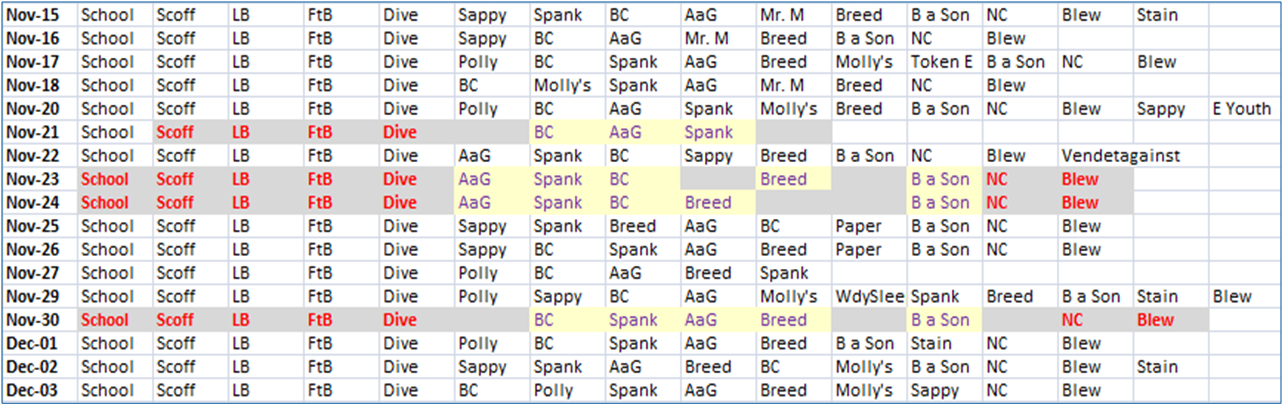
There are only four more missing dates in 1989; a show on November 21 that the band wrapped up in just over 30 minutes — about a third shorter than usual — then November 23-24 and 30. The set-lists, as mentioned, are flexing quite a bit at this point, essentially Nirvana had been playing hard for a couple months that Autumn-Winter and were demonstrating how good they were (and perhaps how bored) by dropping new things in and out. Remember, of course, that I’m leaving out cover songs if they were one-offs, likewise jams. Unless they were regulars their very nature makes them unpredictable — they wouldn’t be one-offs otherwise:

Whats Left_End of Year 1989_1

Those four dates are still going to yield somewhere around fifty performed Nirvana songs. What’s beautiful is I can start with something unprovable but possible — we can’t tell if Vendetagainst received another airing on November 23-24. There weren’t enough performances of it at the time to make it a trend, on the two occasions it made an appearance that year it was slotted in at the end as an optional extra so given we can’t predict the lengths of three of the Nirvana performances, we can’t say how likely it is. Tantalising timing though.

Strangely, though we’re only working with four performances, these four present us with a lot more difficulties than the previous eleven. OK, the opening five songs are totally predictable, likewise I think Negative Creep/Blew made the end of Nov 23-24, I can’t bet Negative Creep/Blew finished Nov 30 because of the flexing immediately before on Nov 29. Likewise, the fact that the triumvirate of Polly/Big Cheese/Spank Thru had also broken means I can’t be sure of those songs all being played together.

That doesn’t mean we’re blind, however. Spank and Breed remain solid presences, likewise the set-list may shift but there’s still a solid core to most performances — About a Girl, Big Cheese, Been a Son are all dead certainties; note the purple on yellow entries below are not predicting positions in the set:

Whats Left_End of Year 1989_2

So what of the ten or so gaps I’m sure exist? Well, add it up; the songs that could fill those spaces are Polly, Sappy, Molly’s Lips, M. Moustache and Stain — but where? No idea.

That’s what I take as a heartening experience from this exercise; unlike in 1993-1994, there’s a little more room for uncertainty, there’s space for rarities in the early part of the year — like Swap Meet or Big Long Now — and a little space in the latter half of the year — for Vendetagainst for instance. We’re at the heart of Nirvana here and there’s a little room for mystery to occur when the band had so much live chemistry they could flex as they wished.

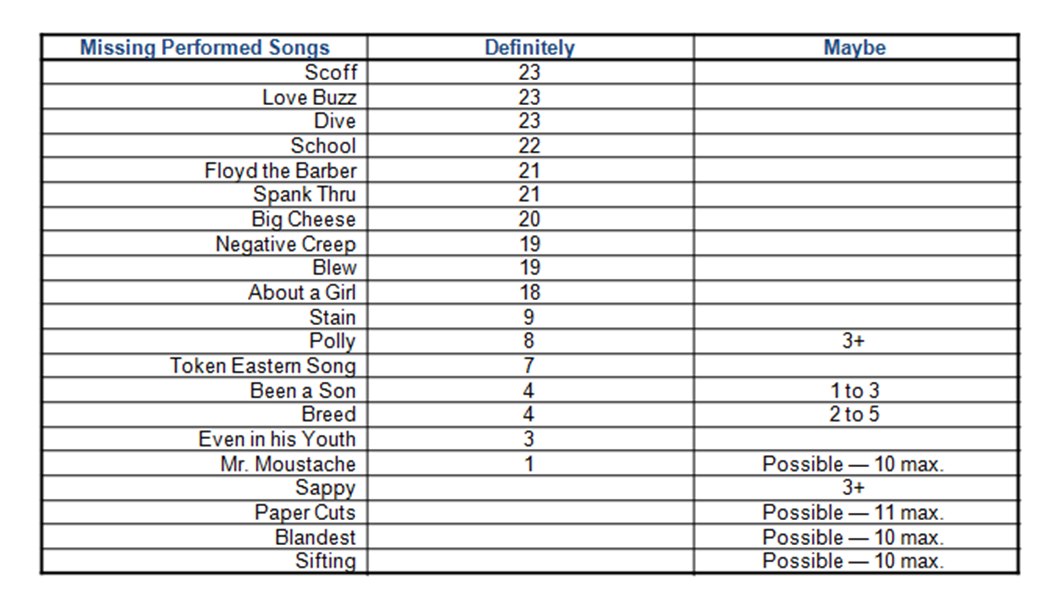
Why am I so confident about the predictions? Well, it’s a case of quantity erasing deviations; essentially, for these numbers to be substantially wrong, we’d have to believe that Nirvana rewrote their own script substantially several times in the incomplete/missing shows. Given that in 42 known performances from May-Dec 1989 there’s not a single show that differs by more than three songs from those on either side of it, given songs are rearranged sometimes but the most that happens is a few songs are tagged on the end of the existing set-list, there’s no reason to believe in revolutions. But let’s assume that for one night during that phase Nirvana did completely rewrite the template, suddenly played a set-list consisting of a batch of songs from the January 1988 session, plus Blandest, Annorexorcist, Sappy, Even in his Youth, Swap Meet, Big Long Now…Effect? Variation of the numbers below by one single digit — quantity of results minimizes effects of outlying data. Here’s the likely performances I predict we’re missing from 1989:

Whats Left_Totals_May-Dec 1989

What’s Left? Re-examining the Live Record 1989 Part Three

The hole extending through 1988 and early 1989 runs right up to the middle of the year:

Whats Left_End of the Gap_May-Jul 1989

Again, the size of the gap makes it impossible to guarantee specific results, however, the relative narrowness of the core set-list makes it easy to predict likely conclusions regarding the ten missing/incomplete shows between June 25 and July 8. Firstly the set list visible on June 23-24 is still recognizable in the set-lists of July 8-9; we’re likely looking at ten performances all beginning with School, Floyd the Barber and Love Buzz and ending with Negative Creep and Blew. Similarly, though the order is unclear, we’re likely to be seeing; Dive, Spank Thru, About a Girl, Scoff, Big Cheese. Where are the uncertainties? I’m unsure about the fate of Sifting and feel unsteady assuming it dropped out of the set-list, I feel better assuming the Mr. Moustache turn up on July 8 was a one-off given it didn’t become a trend until late October, if I was being optimistic I’d hope for Blandest managing a one-off.

The rest of the year becomes easier — the gaps are shorter — but the conclusions of each show are flexible providing a degree of doubt to each prediction. What we’re looking at are fifteen remaining partial/absent set-lists. The first seven songs are almost entirely static from August 26 until November 15 covering eleven of the missing dates and fitting perfectly into the fragments of set-lists known for the incomplete dates. Given the Negative Creep/Blew unit is broken precisely once in the known set-lists I’ve got no problem predicting it, in whatever order, for the missing eleven too.

Whats Left_Jul-Nov 1989

So, that means, that of eleven incomplete/missing dates, containing somewhere between 143 and 187 songs (based on blunt extrapolation from the shortest and longest known shows of this period) we can tell what 84 of those songs were already plus the 29 definitely sighted according to the Nirvana Live Guide; 103. We can predict a few more definite sightings, for example, Token Eastern Song appears in every known set-list in October, meanwhile Spank Thru appears at all but one show for the entire year — they’re easy additions. Similarly Breed is a consistent presence from November 1 throughout the rest of the year making me confident it was part of the November 4 missing set; that’s another fourteen spaces definitely filled; 117 of 143/187. What are we missing?

Well, matters of debate. Token Eastern Song appears to have been honed into shape definitely after touring ceased in July, probably after the single August date, certainly by the September 1989 recording session with Steve Fisk where it made its first appearance, so there’s a good chance it was in the opening set-lists of the September touring season. Stain is another new arrival and though skipped on October 3 and 25 it’s a good bet for each of the missing dates; that’s two showings of Token Eastern and nine of Stain; 128 of 143/187. We’re still missing at least 15 tracks even if all the missing shows only amounted to the shortest of that period.

Whats Left_Jul-Nov 1989_Pt.2

Well, for starters, the most likely candidates are as follows; Paper Cuts, Mr. Moustache, Even in his Youth, Been a Son — the unpredictable outliers are Sifting and Vendetagainst. Even in his Youth emerged for certain on October 6, its in all the set-lists surrounding the gaps we have on October 7, 13 and 23 leading me to predict with near certainty three more (welcomed) live renditions of the song still to be found. Likewise, for November 4, I’m confident in saying Been a Son will have made the set-list given surrounding examples unless the show was massively curtailed for some reason. On the same date Mr. Moustache is likely given its brief flowering from late October through November. 133. That leaves us only ten definite absences though up to a max. of around 44. We’ll continue tomorrow.

Incesticide Curios: Gentle Morning Post (Late…In Early Afternoon…)

There’s an undeniable appeal of the underdogs, the underrated, the overlooked — when everyone is saying “its brilliant” then joining in may be an aid to social bonding, may make one feel part of the ‘pack’, but it doesn’t salve the desire to separate and distinguish oneself. Certainly I’ll admit that played a part in my curiosity regarding Incesticide — everyone knows Bleach, knows Nevermind, knows In Utero pretty darn well. Talking about what was less spoken of seemed more interesting and valuable to me, as a fan and as someone who prefers not to regurgitate others’ work.

The result of writing Dark Slivers has been that an awful lot of very cool people have been in touch sharing stories, songs, new materials — it’s been a really good experience. One part of what they share has been unusual pieces of Incesticide memorabilia, my favourite two here:

Incesticide_poster

The poster above came up for sale on eBay, an original 1992 promo poster for the album — there can’t be many of them about. It’s crucial feature is of course the enhanced detail of the image, the lower flower I’ve rarely paid much eye to, the withered hand with the seaweed tendril fingers…Oh, and see that in the bottom corner? Kurt Cobain’s signature on the original artwork. That’s a feature not present on the album cover, cut out — this is the only time I’ve seen it restored to place and emphasises to me, once again, that Kurt Cobain took a personal interest in the ‘wrapping’ of the compilation.

The second piece is yet another promo poster, this time with a different angle:

Incesticide_ad

It’s hilarious that Kurt Cobain’s comments on these songs, often sarcastic, self-depreciating and rude about his own creations was chosen for an advertisement in support of the album. How many adverts do you see with the word “masturbatory” featured?

Art on the End: A Fresh Cobain Artwork

There’s some amazing work out there on the web, tributes to Kurt Cobain, copied images of the man, studies from photos and so forth. The only small disappointment I have is that the majority of images rarely extend beyond extensions of photography — there’s a fetishisation of his ‘prettiness’, the kind of beauty visible in the best Rolling Stone images of Kurt that voids the more grungy side of him. Also, I’ve argued that Kurt Cobain was a far more complete artist (of the self-taught variety) than he is given credit for; he worked not just with music but also with sound experiments, art installations, video work, paintings…Whatever allowed him to express. The relative absence of tributes in forms other than the musical and the hagiographic has been a little sad — the man was about far more, it’s a shame the memorialisation hasn’t moved beyond the form and imagery that would fit a standard-issue corporate magazine.

Which meant I was extremely delighted when a gentleman in Scotland got in touch and shared a piece he’d been working on — I asked his permission to share his work here; I feel safe saying that I have massive respect for the name Marcus Gray because he’s a rare individual doing something truly different in the art realm.

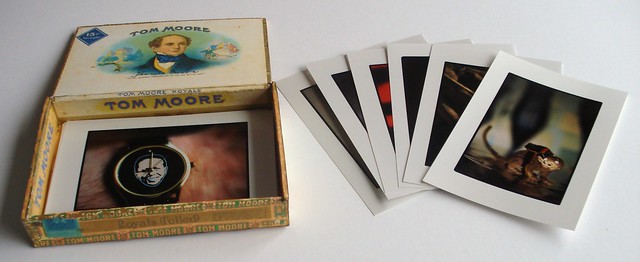
The PARASITE project has a cynicism I tend to believe the man himself would have appreciated; it reminds me of the kinds of self-depreciating statements Kurt Cobain used to make about how derivative he claimed Nirvana were. In precisely the same way the way the project is named and wrapped underplays the thoughtfulness on display (the link here shows up as a photo):

PARASITE deluxe boxset

The box itself is a wonderful comment on the picking over of Kurt Cobain’s legacy; if they’re going to authorise Kurt action dolls, endless product, mythologise his death ad infinitum then fine, why not sell replicas of his heroin box? There’s a clear depth of knowledge involved — the quip about Silver/Sliver is a neat reversal that made me chuckle — and that makes it very clear that this is a tribute made in love for the subject and individual concerned. The intelligent thought involved far outweighs the lazy reliance on standard-issue pretty eyed photos. The mimicking of the Sub Pop Single Club is a similarly clear reference — if its respectable to deliberately create scarcity to build exclusivity and desirability of music, then why not for art? It’s a fair question; what works or could work across genres of expression…? The combination of figurines, fabrics, printed word and so forth is far closer to the multi-material approach of KC.

The photos themselves are a neat set of close-ups that rely on a broad awareness of Kurt Cobain’s story and his existence as a visual phenomenon; a lot of the photos, the striped jumper shot for example, evoke a specific time and era of Kurt’s existence yet without that knowledge it’s simply a voided impressionistic pattern. A true favourite is definitely the close-up on the Vanity Fair article — it’s hard to underestimate the impact of that one magazine piece on Kurt, his family, public perceptions of the family, the change in media reportage so to focus in on the single couplet picked out is shrewd, ironic, sad all at once.

A secondary piece by Marcus, again an intriguing piece is also present buried later in the Parasite project. The artist traced each letter in Kurt Cobain’s suicide note onto individual sheets of paper creating these clouds of letters — I admit to liking the effect of having page after page side-by-side, the ripples in the paper, the different shading on the photos taken, the way letters gust across the page from one place to another, rigid lines or swirls. Mr. Gray has protested to me that he actually kicked it off in anger at the way arts funding is handed out in the U.K. to ‘stunt art’ (my term), art with a shock value or novelty but not necessarily of much depth, skill or true intelligence at work — this was his way of reacting to that. He’s totally right I’m only sorry that the Arts Council didn’t have a look at this! As usual something commenced with sarcastic intent can float free of its origins and end up as something with a genuine beauty:

Kurt Cobains Lettering_Marcus Gray

To allow the artist to speak for himself, he mentioned in an email “I think the “Number Nine…” is pretty poignant, given the way the first person “I” gets larger towards the bottom, where perhaps the heroin is perhaps taking hold, or Kurt’s rising sense of panic and awareness at what he’s about to do…” This point has deeper resonances for me; when listening to the Do Re Mi demo the most prominent feature is the constant focus on ‘I’, there’s almost nothing else in the song bar the narrator’s limited connection with the world (“I’m dreaming,”) and limited possibilities in which everything is a maybe (“wake me up”/”if I may, if I might, if I do, if I say”). The rising ‘I’ makes an awful sense.

His concept of how the piece could have been presented in multiple ways was also fascinating — the idea of this same single source being extrapolated in different ways including the following “I’ve also decided to do them as a series of 26 large Perspex sheets, which will be a simultaneous installation. They will be mounted, and you will be able to see each sheet through the other, as it were, so they’ll be in a long row of parallel sheets with say a foot or two in between, each being slightly larger than the one in front to account for perspective. On a quiet day in the gallery (and how likely is that!), you’ll be able to look straight through each sheet to see the entire suicide note made up of its composite letters.” That has a certain cool to it.

Anyways, I’ve enjoyed and respected the work going in here — someone doing something other than just retelling the known story, someone taking the materials of the Kurt Cobain/Nirvana tale and creating different frequencies of response. Mr. Gray, a respectful bow in your direction. Keep going fella.

What’s Left? Re-examining the Live Record 1989 Part Two

This exercise all started as an attempt to try and figure out as many gaps in the Nirvana set-list record as possible. To recall the statistic, there are 128 unknown or partially known Nirvana set-lists, roughly 1,500-2,500 missing songs. 39 of those shows are from 1989, the highest overall total representing half of the shows that year. It’s certainly a complex year given the band’s history at that time contained so many breakpoints; finishing Bleach, acquiring and discarding a second guitarist, first U.S. tour, first European tour…

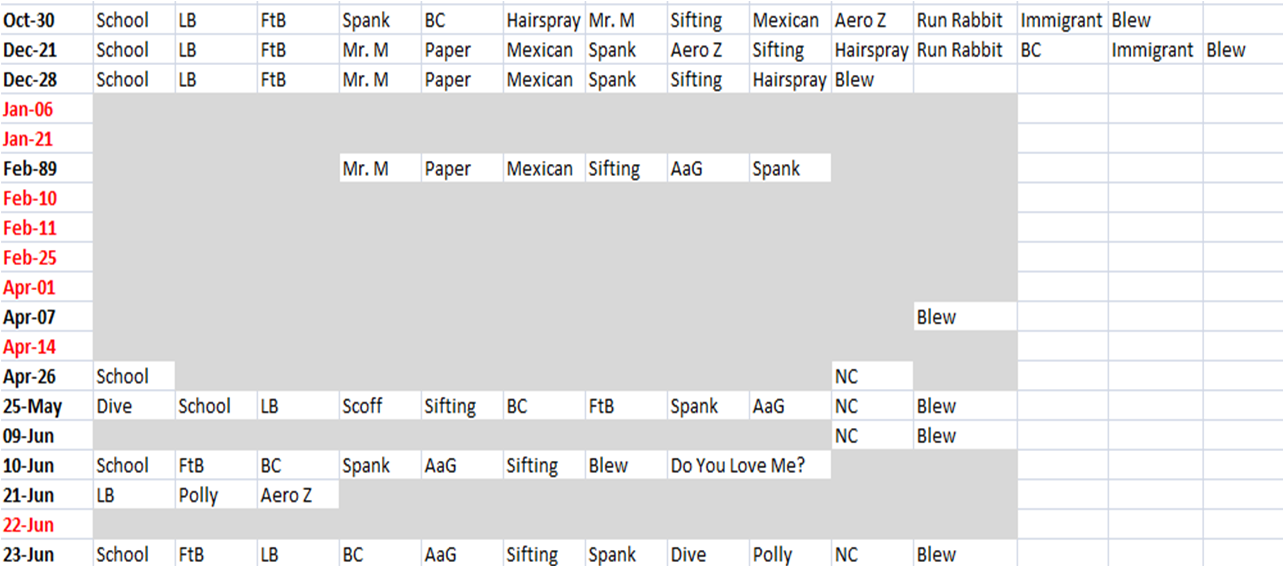
The most disappointing thing for me is the tight clustering of a lot of those absences; there’s no complete set-list for ten shows between December 28, 1988 and May 26, 1989 then a further four near blanks after that date until things flesh out from June 23, 1989. I’ve said before that I’m sure that those ten shows conceal the only live appearances of Big Long Now (I go into depth about my reasoning behind this in Dark Slivers) plus some of the final appearances of the early songs that later arrived on Incesticide. Take a look for yourselves, can we really make something of this mess?

Set-Lists_Late 1988-Early 1989_Gaps

Actually…There’s a good chance we can. For starters, note the coincidence of the Mr. Moustache, Paper Cuts, Mexican Seafood trio appearing at the two December dates and as late as the undated early show in February. I’d prefer more points of comparison but it’s a start. Similarly, it’s amusing to note that the School/Love Buzz/Floyd the Barber trio which formed a key feature of mid-to-late 1989 actually commenced right back in Oct-Dec 1988. Likewise Blew is already Nirvana’s favoured set closer, the impossibility is showing when Negative Creep became its crucial partner. What we can suggest is that on all the missing dates, Blew was the last song. Sifting, About a Girl and Spank Thru are also likely presences, as are the opening trio of School, Love Buzz and Floyd the Barber in some combination. That’s about all we can say.

In the comments section you’ll also note someone rightfully pointing out that Swap Meet is a likely appearance in this spell also. Complete agreement and a very relevant point to be made in this context. How often did it appear? Well, I have a suspicion, based on its non-appearance in the rest of 1989 that it was the equivalent of Lounge Act, or Frances Farmer Will Have Her Revenge on Seattle, one of those songs that never really caught on as a piece of the live set (self-evidently). Perhaps it did the appear-disappear trick, one of those songs that made a half dozen appearances and died.

Later in the year we’ll have more luck — let’s see next week in Part Three…

Songs Dissected: Laminated Effect

The songs on Fecal Matter were among the most overtly personal Kurt would ever write; the early songs ranged across the standard life of a teenager — masturbation, jibes at teenage girls who didn’t fancy him, poking fun at classmates and those who bullied him, TV inspirations, violent imagery. Then, suddenly, in amidst these songs, there’s the occasional burst of oddity. I’d be more surprised if there wasn’t anything unusual featured given Kurt Cobain’s later lyrics and also the reality of the life he was leading during his teenhood — this wasn’t a normal childhood, it was one with significant impediments to normal development.

There’s a ‘knot’ of unfortunate tendencies circulating round the Cobain family. To recount a small number, on his father’s side Kurt’s great uncle Burle committed suicide when Kurt was twelve and had supposedly been about to be charged with sexual molestation at the time of his death. Meanwhile his great-grandfather on his mother’s side not only stabbed himself but then proceeded to reopen his own wounds and bleed to death — Sheesh, it’s a bit much when Uncle Kenneth shooting himself and Uncle Ernest drinking himself into oblivion (despite medical warnings that he was killing himself) then dying of an aneurysm falling downstairs drunk are the more mellow tales. Most children don’t have four violent deaths among their immediate blood relations. The other week we talked about Kurt’s living arrangements (https://nirvana-legacy.com/2013/01/28/life-long-latchkey-kid-kurt-cobains-homes-part-1/), another unusual circumstance, then we can still add on the legendary divorce and related inter-parent viciousness. I’d be more surprised if Fecal Matter wore no stains as a consequence.

Laminated Effect stands out in that respect. It’s the one song in Kurt Cobain’s history that stands out as uncharacteristically ‘nasty’. In the first verse the male homosexual character is raped by his father then catches AIDS; in the second verse the female homosexual is ‘cured’ by heterosexual penetration. It’s disturbing to hear someone who grew to be as enlightened as Kurt Cobain was in later years laying out the myth that homosexuality is some kind of pose and that those born homosexual can be ‘cured’. It’s the equivalent of Eminem’s unreleased track in which he directed racial taunts at a former African-American girlfriend; it’s not so comparable to Axl Rose’s famed One in a Million track which was a deliberate release taking on the persona of a dumb hick from the country arriving in Los Angeles (an, at least, semi-autobiographical tale.)

I’ve been dwelling on this song for a year now, it’s been hard to know what to make of something so jarringly out of sync. My belief now is that there is a case to be made that the song was significant and should be considered as something more than a side-note to the career of Nirvana and Kurt Cobain. Nirvana were very frugal with their songs, almost everything they recorded found relatively rapid release, not many songs were repeatedly toyed with — Sappy received the most studio efforts (1989 studio, 1990 studio, 1991 studio, 1993 studio), the next was three shots at Radio Friendly Unit Shifter — nothing else popped up more than twice. This is a point about how songs ‘lingered’ in Kurt Cobain’s mind — answer; they rarely did.

In the case of Laminated Effect though, he recorded it in early 1986 (see Gillian G. Gaar’s Entertain Us) which suggests a late 1985-early 1986 writing. The song vanishes, yet in late 1989, a very rare thing occurs and he cannibalises a single line of lyrics from it. Firstly, this tells us how low on serviceable material Kurt Cobain was in mid-to-late 1989; Even in his Youth was recorded in studio in September that year before it ever made it near a live stage which seems to indicate hurried work to build up pieces for potential future use. It’s such an odd act, stripping a single line, one that to an external observer seems to have no particular significance or poetic quality that would make it memorable, and choosing to give it ‘life’ three and a half years later.

It’s a mark of the song’s significance that it’s one of the only times Kurt Cobain borrowed lyrics from an old track to use in a new one — “kept his body clean” was a specific reference to the homosexual male, it’s an image derived from Shakespeare’s Macbeth in which Lady Macbeth and also an image of guilt and shame — Lady Macbeth walks the castle attempting to wash imaginary spots of blood from her skin having murdered the king. It’s one of Kurt’s most articulate metaphors given he uses it, both in Laminated Effect and in Even in His Youth, in the original Shakespearian context (“told he was at fault, living life unhappy”/”Kept his body clean going nowhere/daddy was ashamed, he was nothing, smears the family name”). What’s also notable is that both songs share the issue of the father; in each case it’s the father who defines the context of the son’s entire existence; in one the rape is given as context to the later events of the son’s life, in the other the individual’s entire being is summarised by their father’s shame.

A second way in which this one song echoed on into the future is that the image of incestuous rape reoccurred in 1990 in the original demo of the song Rape Me. Again, the crucial point is that the person at the core of the event isn’t defined as a victim; they’re defined as being responsible with mention of “my embarrassment” and the invitational tone “rape me…Someone disgrace me.” That’s two further songs looped out of Laminated Effect.

It was easy, initially, to interpret all three songs as simply a recounting of Kurt Cobain’s own guilt, sense of male insecurity, the feeling that he’d embarrassed and disappointed his father. But the first song was on Fecal Matter which leads me, for once, to believe that there was a more literal source for the song — and there is a candidate.

In the book Heavier Than Heaven, Charles Cross recounts briefly the fate of one of Cobain’s relatives, his mum’s brother, Kurt’s uncle Patrick. Patrick died at age 46 of AIDS in the first days of January 1991. Patrick’s homosexuality was apparently a family secret, his parents refusing to believe he was gay, and likewise no one talking about Patrick’s insistence that he had been sexually abused by his own uncle Delbert. There are similarities in the tale being told on Laminated Effect. Kurt’s story focuses on rape by the father (not uncle), the parental shame associated with the son’s homosexuality which was indeed a crucial feature of the real-life case — Patrick’s parents initially refused to believe he was homosexual and Patrick was so furious about how he was ignored and shamed that he considered publically announcing what was happening to him. The next similarities are the move to the big city — Patrick indeed moved to California — and finally the catching of “a big disease”; the biggest disease of the Eighties, particularly in the gay community was AIDS. The fact the chief character is still alive at the end of the song again fits in that regard, Patrick was alive when Laminated Effect was written.

There is difficulty, of course, in establishing the timing (and there’s no extant statements from Kurt as to his intentions — sorry guys, I’m speculating again.) Patrick died on January 2, 1991, four and a half years after the Easter 1986 recording of Laminated Effect. A further intriguing coincidence, however, is that Kurt Cobain resurrected Even in his Youth, in its final released form, at a casual studio session on January 1, 1991. A song about incest, homosexuality, the man infected with the big disease — a memory of it inserted into a song that is then brought back to life one day before the family member who potentially suffered incest, who was homosexual, who was a victim of AIDS, who was a hushed family shame, before that man died. Another timing issue is that it is unknown if Patrick had still been living in State of Washington when he made his homosexuality known to his family, likewise it’s unknown when in the intervening years Patrick had made his accusation regarding Kurt’s great-uncle, or when AIDS was diagnosed.

In the context of ‘Illiteracy will Prevail’ a tape by a nineteen year old Kurt Cobain, on which personal circumstance and influences were worn on the sleeve, it would be more unusual if Laminated Effect was pure fantasy rather than an extrapolation from a known tale. Also, on that tape, there was a very rare feature which was Kurt made use of other voices and told stories through other people’s eyes (for example Buffy’s Pregnant). Rather than Laminated Effect being an unpleasant expression of Kurt’s own feelings, the song appears to be a recounting of the confused and intolerant reactions of his family to what was occurring; his family were genuinely unpleasant in their treatment of Patrick, unwilling to accept homosexuality as something natural. Kurt would go through these feelings again on Been a Son (written intriguingly at roughly the same time as Even in his Youth) which may have been discussing his parents’ response to Kurt’s sister’s lesbianism. Certainly I find it easier to believe that this wasn’t Kurt’s voice than that the sensitive teenager who already believed he was possibly gay, would write a song that was so spiteful toward homosexuals.

What’s a curious further thought leading from this is that Even in his Youth, potentially, may be a more sympathetic and introverted retelling of Patrick’s story; I’ll leave it here.

Behind Nirvana’s Rise: Hip Hop’s Rise and Rock’s Fall

This might seem an unusual topic but it does have a tangential relevance to Nirvana. Essentially music is motivated not just by twists in the tide of taste, nor only by specific outpourings of creativity, but by shifts in technology and economics. Examining music one hundred and fifty years ago, reproduction was purely via live performance meaning monetisation of music was channelled via the same route though printed scores and sheet music indeed turned a profit. The introduction of the means of recording and playing back music ushered in the modern age in two ways; firstly, the advance in technology created a different (and desirable) experience, secondly, it made music a different (and even more desirable) business opportunity. Instead of being bound by the limited capacity of a venue and by often, and where, an artist was willing to perform, the duplication and subsequent sale of a performance was a product limited by availability of raw materials, the outlets through which the product could be sold and the willingness of the public to pay. The move to digital in recent years has reduced (not eliminated) the importance of raw materials while expanding the accessibility of retail outlets, but also reduced the willingness of the public to pay — paying for a performance or paying for the recording medium possessed a tangible value beyond the music that digital reproduction doesn’t match.

Reproduction of classical performances, the sophisticated music of the elites, disguised and obscured the importance of self-taught musicians, amateur home performance or semi-professional/professional public performers in dancehalls, drinking establishments, street corners…Heck, Louis Armstrong started out in a brothel. Over the past hundred years the cost of recording music and reproducing it has declined significantly; its required significantly less complex equipment and manufacturing capacity; think of the shift from wax cylinder, to shellac, to vinyl, to eight tracks, cassettes and CDs — eight tracks were potentially a superior medium to cassettes in terms of lifespan and sound quality but they cost more and were less adaptable; eight tracks died, same as mini-discs which offered just as few advantages over a CD. This push has allowed more and more recordings of more and more artists, a vast democratisation. The simultaneous development allowing the capturing of performances in ever higher quality using ever less bulky and expensive equipment has run alongside the change in the recording medium.

Anyways, the previous paragraphs are almost a side-issue. At the core, music relies on the deliberate performance and labelling of sound. Two developments have taken place, one fairly linear, the other non-linear. Starting with the former, the cost of instruments declined as enterprising individuals found ways to manufacturer more of them at less cost. Trumpets, saxophones, drums, double-bass — these were dominant instruments for 30-40 years, essentially the jazz era’s peak was as long as that of rock and roll. The drive was still toward more, cheaper, easier; the guitar won out. In essence a guitar is a fairly simple instrument to get a tune from, to manipulate, easily electrified, readily replaceable, robust.

The other development has been generally a move toward smaller groupings of musicians. Remember the giant orchestras being the most respected form in classical music, then moving down to the big band era of swing jazz, then the standard guitar-led unit generally of three to five individuals. Solo artists have, of course, been woven in and out of that pattern.

Here’s the dilemma. Even in a stripped down format like a three piece rock band, there are still costs imposed by the format. These costs range from the transportation of equipment — the drum kit was possibly the most stable element of line-ups across the past hundred years — to the transportation of musicians, to the delays caused by health and personal matters increasing simply by the reality of dealing with three instead of one; it all adds up. When it comes to music as a business, the desire is to sell product; a group scenario requires the inspiration of three people to come together in a social musical setting — it doesn’t always happen and it does take time to create good group music, each element has to gel and there’s deeper criticism and disagreement with the positives and negatives that brings.

Hip hop was the obvious successor to rock because it chimed most fundamentally with the technological and the business trends of the past one hundred years. At its origins it featured the most simplistic instrumental set-up available; a record deck, drum machine and vocal. The equipment is low maintenance so long as it’s looked after, there’s no lengthy training required to create at least a basic arrangement. While synthesisers created new sounds, they also tried to mimic and reproduce old ones; drum machines developed similarly — in each case the desire with the technology was to package, as simply as possible, as many sounds and instruments and capabilities as possible. Suddenly the instrumental set-up didn’t rely on multiple people or coordination; the equipment existed to create without others. The guitar was already a compact robust instrument, the only place to go next was to merge many instruments into a single unit — a convergence made possible via technology. The move to computers has pushed this even further, ever more convenience at lowest cost required to produce the broadest range of sounds alongside other functions. For a commercial business this is a boon; ever more people able to do ever more things without being reliant on other people doing things — more product, more product.

Guitar music had already been following similar trajectories in terms of sound; the percussive qualities of the guitar won out over the variety offered by wind instruments, electrification deepened the sound that could be created, rhythm became the dominant element within music — guitar music moved ever more in tune with dance music. Hip hop took the trend to its logical conclusion but it wasn’t a vast step in terms of emphasis. The vocal performance mimicked that motion too; while usually far more densely worded, hip hop has a highly simplified mode of expression — this isn’t a criticism — far closer to spoken word, far more within the reach of the masses, reliant simply on a basic grasp of rhythm. Again, more people can master it, quicker, meaning there’s a deeper pool of talent from which to select — it’s a perfect commercial move.

The same motion occurred in terms of content too. Hip hop devolved into hash-tag rap in which entire songs are made up of thoughts lasting no longer than a line, an entire verse, let alone an entire song on a single theme or idea is increasingly hard to come by in the mainstream. The soul of pop music has always been about finding new ways of stating universals, hip hop is nothing but universal statements around a reduced set of topics — a trend accelerated by Southern hip hop and trap-rap in recent years. Again, it’s an efficiency measure within the means of production; it’s easier to write a lot of rhyming couplets that can be pieced together than a whole song, it’s easier to write variations on (a) sexual boasting (b) insults (c) financial/material boasting (d) brand names (e) empowerment slogans (f) realness (g) death wish — all highly sellable across demographics — than to weave an entire song as coherent (if not intelligent) as Lil Wayne’s Georgia Bush.

In the Eighties hip hop groups were a dominant force — Run-DMC, NWA, Public Enemy and so forth — while solo stars existed, a lot of attention still focused on the idea of a group. But, as the elements within a group like Public Enemy do not have such a high degree of synchronicity, unlike a guitar-drums-bass-vocals live rock band set-up, the music is more tolerant of error and the different individuals can be separated. That’s been the trend in hip hop, and in a very short space of time. The nineties saw the heyday of record label based identities — Death Row Records, Bad Boy Entertainment, No Limits — under which multiple artists shared a ‘stable’ of producers meaning that, so long as people were writing, the quantity of product that could be created was vast. It was an updating of the pop model developed by Motown or Phil Spektor in the Sixties and as a concept it still worked perfectly. Sub Pop had a similar ‘stable’ concept; shared tours, shared studio and producer, shared visual aesthetic — it worked for grunge same as it did for Motown or for gangsta rap.

The recording technology also meant that collaborations were simpler to arrange, the discreet elements could be brought together without the individuals involved needing to be there at the same time. This still meant there was a certain creativity co-dependency between those artists on the label though which could interrupt the flow of product to market. If a producer dropped out, relationships with colleagues collapsed, personal problems prevented an individual from performing, those around them on the label had to either do more work to continue to pump out manufactured articles, or the label simply released less, or had to rely more on archive material that was behind the cutting edge.

The result was readily found as the competition created by the mass availability of synthesisers and drum machines made reliance on an in-house provider of music unnecessary. As you no longer needed a group, you could retain the identity, shared credibility, shared audiences, resulting from some kind of united presence (Brick Squad, Young Money, Def Jux) without any artist on the label or within the scene being dependent on another. The price of producing music was now so low, the number of producers so high, that it was now relatively simple for artists to buy one another’s product — whether musical or vocal. The business change has been helped by the reality of a musical form that has become so reduced that, so long as there’s a beat, any artist can rap over a piece, or any producer can lay a song under a vocal; the elements share only the rhythmic component and that limitation increases the ease of reproduction.

The other piece that the new model provides is that the reduced investment needed to launch an artist or producer also translates to a reduced loss on investment if that artist or producer fails or declines. By comparison to the endless flogging of aging rock stars, hip hop drops stars all the time — the business model had made individuals increasingly expendable. Again, just like mass production made the role of individual artisans less and less significant when it came to the creation of product, the arrival of the equivalent of mass production in music makes the identity and talent of the creator less relevant within it. That means fans can develop an allegiance to a particular individual, no problem, follow their work, but the overall market can keep moving, finding new buzzes, the ‘cult of the new’ rolls on with the next novelty arising and then the consolidation phase, genre tag, then on.

By the time of Nirvana’s rise, the background wasn’t so much the decline of rock as it was the rising dominance of hip hop artists. The success of Nirvana relied on their merging the last fresh outburst in rock, punk, with the already accepted modes of mainstream rock. This had to occur because the wild activity occurring in the increasingly sub-divided and stratified rock community meant that despite a lot of creativity going on, rock was losing the mass audience. Jazz did the same thing; the acceptable core of jazz became fossilised while the creativity, fresh, new ideas were hard to incorporate into the original mass conceptualisation of what jazz was. Hip hop, however, has the virtue that it can change its sound to keep up with technology in a way that music dependent on particular instrumental tones cannot. As the only core feature of hip hop is rhythm, everything else can be altered while remaining acceptable — rock and jazz were both fixated on a particular set-up of instruments and specific sounds in a way that this new music is not.

The ability of hip hop to change faster, to incorporate more elements without losing its identity or becoming ‘something else’; these give it a survivability lacking in rock. Rock musicians can only incorporate so many other musical genres before becoming that genre or having to accept a change to the instrumental line-up that pushes the guitar off centre stage and morphs the music into another genre. Hip hop doesn’t do that. Hip hop has changed repeatedly; it adapted quickly to the emergence of indigestible 70 minute CD length albums, it was able to merge with modern R n’B to create a hybrid more marketable across genders with the result that most essential hip hop artists are now also dance artists, pop artists, gangstas, romantics, all at once — the individuals have fragmented their identities to match market niches…Or they stay on the margins and let the mainstream play.

The mixtape was the next level, prior to electronic distribution; an opportunity to build an audience without being reliant on physical performance — again, a business advantage over a rock band. Hip hop increasingly doesn’t ‘live’ in a corporeal, real world, sense; it was built initially on manipulation of the medium of reproduction and increasingly lives only within the modern media outside of the smallest micro-communities. Hip hop as a mass market phenomenon is a music of files, recordings, webcasts, downloads, CD-Rs, vinyl with only token gestures in the live touring arena. While rock artists are ever more dependent on live touring (live shows are the rock mixtape) hip hop artists are ever more dependent on building and then maintaining a core audience with an endless sea of downloaded or on disc product, free or otherwise, so there’s never a gap in service, unlike the few years that could elapse between rock band forays.

Mixtapes don’t really work in the world of rock; firstly street-level music distribution isn’t an accepted channel (for a comparison mixtapes never really took off in the U.K., there isn’t a big enough audience to make standing on a street corner or at a market justifiable), secondly the effort required to create the music is too heavy (the combined effort of X people working simultaneously) to sustain substantial give-aways, thirdly the ability to drag in up-and-coming performers to fill space cheaply is much lower. A band with an archive as deep as Sonic Youth can run short mixtapes via their website but they’re reliant on old demos and old live performances — the creation of high quality output cheaply at high speed isn’t an option.

Hip hop was, therefore, the end result of a thinning of performance ensembles across a lengthy period of time; the result of a musical reductionism that led to rhythm becoming the dominant feature which allowed a musical form to evolve that floated free of any particular instrumental line-up, tone or timbre with a vocal style that similarly devolved down to rhythm uber alles; the result of technological evolutions that created instruments ever more cheaply then merged the number of potential ‘instruments’ available into smaller, portable converged tools; the result of good quality recording technology and manufacturing technology being ever easier to access meaning more people could create quicker; an economic model in which people understandably wanted to sell more cheaper and easier; a market in which tastes do change rapidly therefore a music form in which investments can be more readily deleted is desirable. The world’s first million selling music release was Enrico Caruso’s Vesti La Giubba in 1907. In the one hundred years since, we’ve come a long way.

Rap is essentially musical capitalism, an omnivorous force able to ingest whatever it touches, incorporate it and churn it back out in a marketable form for whichever audience demographic they wish to target with it. A lot of capitalists like to claim that capitalism is a representation of nature, a Darwinian force ruined only by the interventions of outside forces that prevent it working smoothly and create the conditions under which corruption and inefficiency occurs. I’d argue that being a human being means imposing self-analysis and self-will on the Darwinian animal component of a person — that what distinguishes us from animals is standing above the pure force of nature. That’s my main objection to untrammelled capitalism; the economic system should serve the vision we have, we should reduce our vision and bring it down and down until it aligns with base functioning. What makes us human, higher beings, is choice and striving to rise above. Don’t mistake nature for a moral good or righteousness.

What’s Left? Re-examining the Live Record 1989 Part One

Like a lot of ever-so-slightly, teeny-tinily fixated Nirvana fans, I’ve listened to quite a few live concerts by this point. What I hadn’t noticed was how solidly constructed Nirvana set-lists were. I admit I expected to see that prior to the In Utero tour set-lists flexed and varied more often. Instead I’ve had to discard my expectation and observe what I’m actually seeing. What I like about data is that its primarily about pattern recognition; taking familiar information (like the set-lists on NirvanaGuide.com) and rearranging it thus bringing out new visions. I’d never placed list after list of Nirvana sets alongside one another before. Doing so is allowing me a fresh insight into what whole tours, entire years, entire spans of Nirvana’s existence looked like as live experiences and what is most likely missing from the live record.

1989, as a year, had one abiding feature; School. That song kicked off 41 of the fully known set-lists, interrupted only by Dive and Spank Thru early in the year then a brief jam toward the end. The abandonment of Nirvana’s earliest unreleased songs from January 23, 1988, later featured on Incesticide, was absolute. The sense is of a band reinforcing existing recognition — Spank Thru, Love Buzz, Bleach — taking time to refresh viable spares — Vendetagainst and Blandest — and to work up fresh material — Stain, Sappy, Been a Son, Polly.

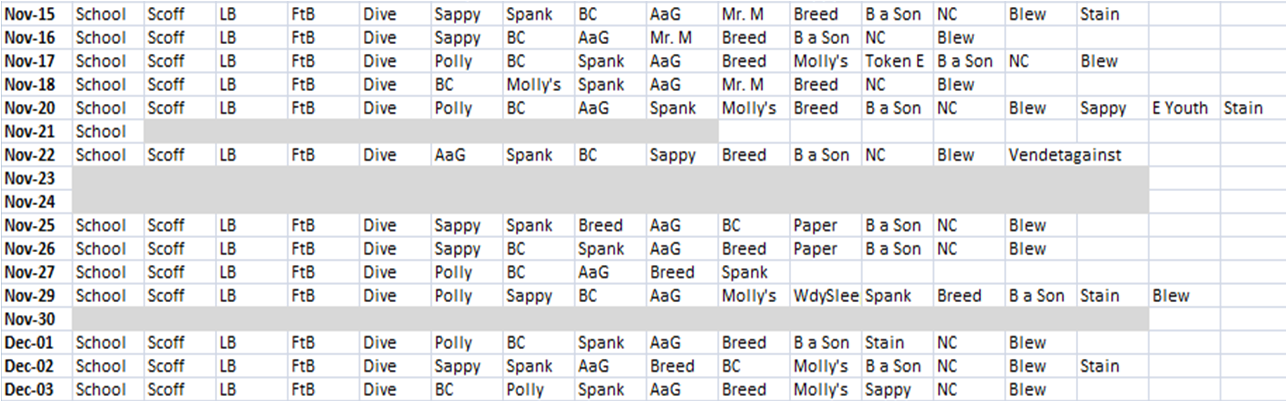
Like when we examined 1993-1994, it’s clear that Nirvana knew how to kick-off a show, the greatest rigidity in set-lists is in the openers. It seems to have been a way of ratcheting up the crowd’s excitement, or of geeing up the band, getting them loose, relaxed, over any nerves. In the full set-lists available, from June 23 until July 18, Jason Everman’s final gig, the opening trio is School, Floyd the Barber, Love Buzz for eight shows. The resumption of live shows on August 26 inaugurates what would, with one last change (Spank Thru, for the only time, was the opener on this show), be the core unit in 33 set-lists; School, Scoff, Love Buzz, Floyd the Barber, Dive — Sept 30 until Dec 3 this is the running order of Nirvana originals.

During that two month spell, following Dive, there seems to have been a desire to stage a mid-set break, a breather after what is a fairly intense opening barrage. Polly, and briefly Sappy or About a Girl, gentler songs all, are regularly song six through from August 26 in Seattle right the way until November 15 in Germany. It’s clear, however, that after the opening salvoes with which each concert began, it was rare that a set-list solidified for more than a few shows in a row. As an example, for five shows between October 25 to 30, the first ten songs are in identical order. This corresponds to the final shows of the U.K. tour prior to the move into Europe. This initiated some shifting of orders, a little more diversity; the first seven songs are unchanged until November 15, song eight and song nine meanwhile shift between some combination About a Girl, Spank Thru and Mr. Moustache.

Other ‘units’ of songs existed even in the far shorter set-lists of 1989 (as compared to the twenty plus song 1993-94 extravaganzas.) Negative Creep was followed directly by Blew on thirty-eight occasions, separated by one song on a further two occasions. Those two songs also formed the closing couplet on two-thirds of those occasions. Another unit worthy of mention is the About a Girl/Spank Thru pairing, in one order or the other; they appeared alongside one another 22 times, in fact there’s only one occasion in any of the 43 full set-lists where About a Girl features but Spank Thru doesn’t. On 29 occasions Polly and Big Cheese appeared together, from Polly’s second appearance right the way until end of December.

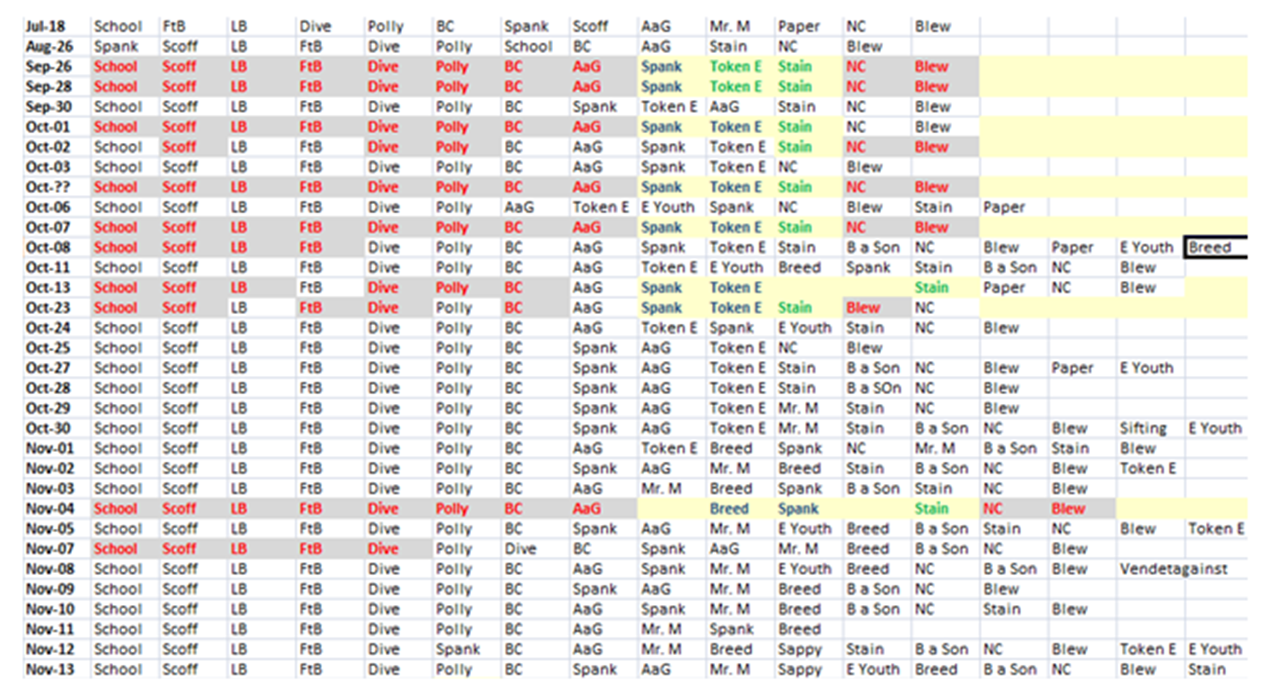
What’s clearest is Nirvana’s professional stagecraft at work. They worked, throughout the extant record of 1989, to rev up the crowds before breaking into unreleased, just released, whatever took their fancy. That’s where the talent and quality of the band becomes visible, in their ability not just to hone a set-list but then to have the confidence and swagger to simply change the sets over and over again. Basically, while the first part of a set was rigid, the second half was utterly diverse. With sincere apologies for my shorthand, take a look at the next graphic:

Set-Lists May-Dec 1989

The first eight songs of each set were, with exceptions, predictable. The songs after that…Well, in 34 shows the band only manages to finish three consecutive shows in the same number of songs. I’ve scoured these set-lists and the concluding spells of each of these gigs always shift. Oct 27 and 28 are the only two dates where the set list stays the same — but Nirvana still whacked a couple of extras on the end of the latter date.

If you want to know how I spend a lot of nights, well, perhaps you can tell from these obsessively resorted set-lists — a tragic tale I think you’ll agree. But, having noted the Negative Creep/Blew pairing, that led me to a further clustering effect present almost throughout the extant set-lists for 1989; in 28 of 34 shows those songs appeared with Been a Son and/or Stain but, again, this didn’t guarantee it would definitely be one, or the other, or in a specific order:

Set-List_Conclusions_Aug-Dec 1989

That’s where Nirvana were at in late 1989, so well drilled they could flip and switch as they wished.