Unlistenable, Unreleasable, Uncommercial: What can Nirvana NOT Release?

A prime concern of mine at the moment is the idea of what can and can’t be released officially.
Well, in 1999 Rhino Handmade, under license from Arista released the ultimate testament to one of the rare albums that stands as peer to Nevermind.

Complete Funhouse

On the table before me is the seven disc boxset of The Stooges Funhouse: The Complete Sessions. And they do mean complete. This is eight hours worth of session recordings, there are over well over thirty takes of some songs, it’s literally everything they could find; Funhouse’s seven songs played out to infinity across 140 tracks with the addition of a minute and a bit shred called Sliding the Blues and one unreleased track called Lost in the Future.

What stands out for me though is that they could do this and it hasn’t in anyway harmed the band’s reputation; this limited edition box-set is now a hallowed release among the kind of deep fans who give a toss whether a band releases its rarities and outtakes. Instead of wasting time worrying about the tastes of the dilettante fans who just want the greatest hits album, Arista released that all re-releases are ultimately unnecessary and simply went ahead and pleased the true fans who were still writing, reviving and appreciating The Stooges after all these years. It’s a very digestible release too; it emphasises the hard work the band put into trying tweaks and alternative ways to get these songs into best shape, there’s a snippet of dialogue in which Iggy Pop’s sensitive ears note a string ringing on one of the instruments and makes the retake totally belying the band’s reputation as slackers, damn they work hard.

The Stooges and Nirvana are two of the only bands whose outtakes really fascinate me; the comparison also appeals because the lo-fi nature of live recording technology in the early seventies means it’s a challenge to find polished material. It leads me to question what is/isn’t capable of being released. Take a look at the release below:

You Want my Action

The booklet on top is the You Don’t Want My Name, You Want My Action box-set gathering up recently discovered recordings of The Stooges with a short-lived two guitar live line-up. The sound quality declines from front to back going from reasonable (if one is tolerant of pops and clicks) to severely degraded. The crucial point is that it doesn’t matter. The expectation and direction is set, it’s acknowledged, one buys in the knowledge of what this is — it’s exceedingly rare material and if one is the kind of fan who wants to hear multiple versions of songs then you’ll love it anyway.

The two CD version of Metallic K.O. wedged there is also an argument against audio quality being the defining reason for or against a release. It’s a famed album, it’s achieved a cult status in spite of and partly because of the low audio fidelity. It basically records a now stoned-to-the-eyeballs Iggy Pop, fronting a band about to break-up, for an audience that wants to hit him with the various glasses flying overhead. And still, with a great band, even releasing this simply reinforced the iconic value, the underground heroism and the position of The Stooges as forefathers of punk confrontation and one of the finest rock outfits ever unleashed.

Nirvana needs to decide, or already has decided, how they want to be remembered. The choice is between the overground success with feet and souls planted in the underground or as a slick well tuned, corporate rock behemoth that left the underground behind. There was criticism of the With the Lights Out box-set for the sound quality on certain tracks, but then there’s been criticism of the Nevermind anniversary release on the same topic but for having been excessively pumped up and compressed; oh and of the boombox demos of Nevermind back on the audio quality issue. There’s no happy medium. Releasing lo-fi material is fine so long as people know what to expect — only the fanatics buy regardless.

The final item is the Heavy Liquid box-set. To distinguish The Stooges from Nirvana, it must be recognised that the depth of outtakes and leftovers The Stooges left behind is vast compared to the relatively shallow pool of genuinely unheard Nirvana/Kurt Cobain originals. The Stooges poured out material and, in the absence of solid relations with record labels for a lot of their time as a band, a lot of it poured into the unofficial realm. This box, again going from highest to lowest fidelity, brings together a ton of non-album tracks plus such curios as a full disc of the band experimenting with the song I Got a Right across thirteen takes — different lyrics, instrumental, no solo, different effects, and so on. The rest is everything from soundchecks to off the cuff studio sessions at various locations. Tragically Nirvana could never compete with this, With the Lights Out is the nearest they’ll ever come; there simply isn’t enough left in the vaults of true originality. But that doesn’t mean a specialised box-set of this nature wouldn’t appeal to fans, wouldn’t be worth listening to and wouldn’t tantalise.

Heavy Liquid

The Machine in Action: Preparation for the In Utero Super Deluxe 2013

Compliments to Jason Stessel over at LiveNirvana for bringing this to everyone’s attention – I’m just relaying the news today, no originality!

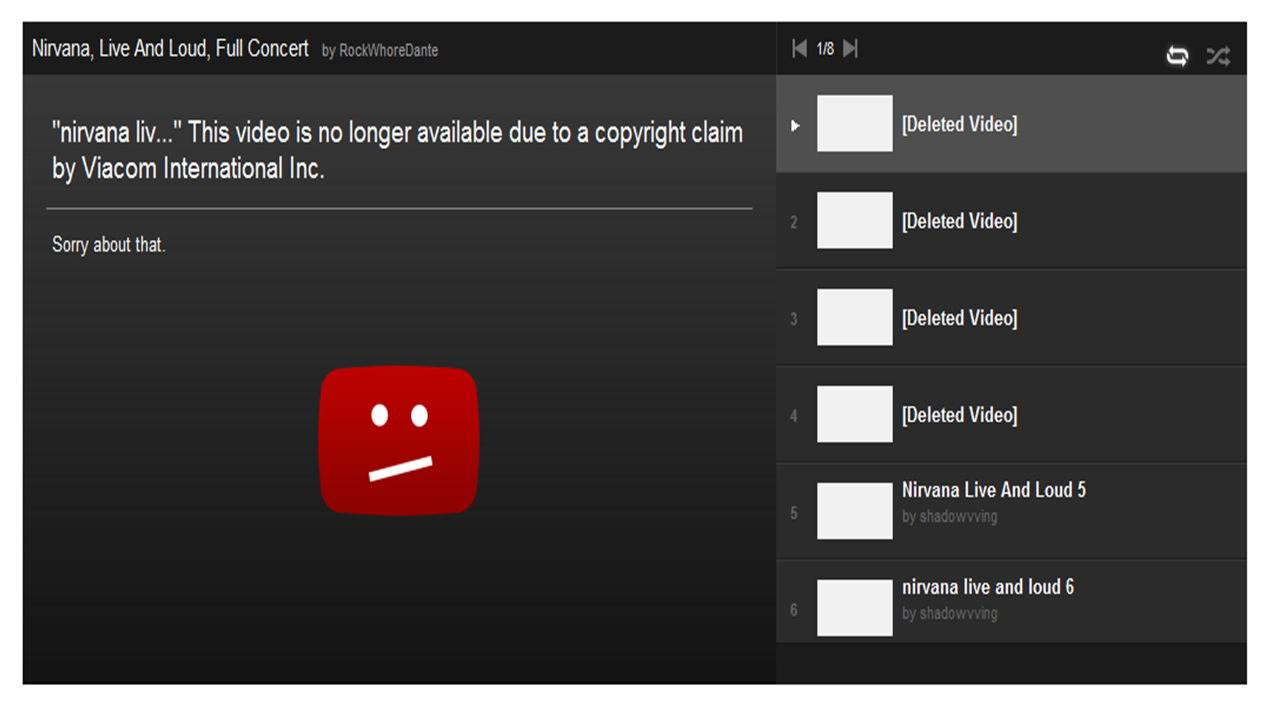
Over on YouTube, there’s been a bit of a clear out of one of the largest distributors of Nirvana live footage, similarly a few pieces related to Nirvana’s MTV Live n’ Loud performance have been taken down. It’s still possible to find clips but, compared to just a month or two ago, it’s near impossible to find a full recording of the Live n’ Loud broadcast. A search today on one of the few active links came back with this simple declaration:

Copyright

It’s hard to tell if this is just a regular stripping out of supposed infringements or a targetted attempt to remove competing sources for what everyone has predicted for a couple years will be the DVD component of a Super Deluxe edition of the In Utero album ready for the anniversary this year.

I think private trading of recordings is a legit exercise for the enthusiasts. Hand-to-hand propagation of music has kept interest alive in Nirvana’s music for years. Its the, often illicitly sated, appetite for unheard material that has plugged the gaps between official releases and allowed the major labels to reap such profits from the reissues, DVDs, boxsets and so forth. Plus, there’s very little damage done by people trading live recordings, demos and all the shreds the major labels are too snobby to release.

If there was a legitimate official source for all this material the fans would buy it. A fair example of the process would be the switchover from the dodgy ethics of Napster to the dodgy, controlling yet official order of iTunes. Once a legal channel of sufficient scale and diversity was available the market moved very rapidly away from what had been an illegal experiment. Most people don’t want to be acting illegally if there is an alternative. That’s why organised crime gains its most extensive profits from what cannot be acquired legally, people want to do good. I’ve no great affection for websites ripping DVDs and films. But then, I’ve never been that visual.

The whole tale of downloadable music and so forth interests me more in terms of the way it reinforces power in the hands of those who created the systems responsible. This roams toward conspiracy theory if taken the wrong way, take it more that I think similar people make similar decisions and that people in particular situations are equally likely to adopt the frame of reference arising from the social scenario, the group, in which they find themselves.

Essentially, teams of engineers created the forms via which music could be reproduced and distributed. Having control of the medium gave them power over what was contained therein whether overt or subconsciously adopted by the bands. A fair example is the way Nirvana’s albums, those released while Kurt Cobain was alive, are built around the idea of a vinyl LP record, even the bonus tracks on Nevermind and In Utero, by their very nature, are a reaction to the new medium of the CD.

The problem is, of course, that being able to do something doesn’t mean one should. The engineers discovered they could turn music into data, having done so, creating the MP3 format and others that allowed cheap and massive distribution via the Internet was a logical step. In doing so the people involved successfully extinguished the means of support for hundreds of thousands of musicians. Arguments about how “musicians used to survive performing live” are as spurious as pointing out that the entire financial industry was barely a glimmer until 1980s liberalisation opened the flood gates. Claims that its just a case of adapting are as viable as telling flood victims they just need to see it as an opportunity. As for people salving their consciences by saying it was rich millionaires they were taking from…Untrue. The long tail of bands who were living on the proceeds of their releases had to undergo a radical reduction in their income that sent many back into regular day jobs.

What the engineering graduates had done was define the products of liberal arts graduates as something that wasn’t worth paying for, something that was overpriced and therefore something they could rip. Meanwhile, the devices sold by the engineering graduates are sucking in small fortunes with minimal competition. The new reality is one in which musicians need an alternative source of income (same as authors) unless, by sheer chance, they become the one in a million everyone likes to point to when they claim it’s easy to make money from creativity. A lack of worth placed on the results of creative endeavour has led to a mass market that isn’t willing to pay for it and the tools to assist.

So, to say I have ambiguous feelings about the kinds of innovations, like YouTube, from which I have benefitted is an understatement. I don’t rule out some of the good these things do; but I like to be aware that there are two sides. In other words, I’m cool with Universal and whoever else taking down content that directly and knowingly competes with their official product – because the rule applies to the little people not just the big guys. Musicians now have been robbed of the chance to have a long-term career, one they can live off, in the field to which they are dedicated unless they conform to the mass tastes and fashions. More people than ever can make music, that’s a thrill, but it’s harder than ever for the devoted to live on it.

Archiving: Nirvana’s Leftovers Versus Mine

Just a whimsical post for a quiet kinda day…I found it interesting to think of the fact that a completely different standard applies to audio works as compared to literature; I mean, an academic archive might be keen on having my scrap notes someday if I do something that gains weighty note beyond my limited realm of interest and attention. But I can’t imagine any one reading this article being keen on having the rough notes that came to make it — do you want the piece of gym scrap paper I started this on? It’s unreadable. Yet I better keep it just in case given the kinds of trends that have been witnessed in prices for author’s archives:

http://www.guardian.co.uk/books/booksblog/2007/dec/12/doesthenationneedauthorsa

Yet, what we’re looking at here, is not something that anyone except a fanatical researcher would sit down and read for pleasure. The blend of humdrum notes, rough one-liners that might one day become significant when allied to other words in an overall narrative or structure, letters and stubby thoughts, there’s no way to experience them in any coherent or enjoyable fashion. As far as public consumption goes, we may see sifted fragments in a well choreographed tome.

In the case of music, however, the rough workings of a musician possess a far more immediate impact and enjoyment. Of course that doesn’t mean every shred of tuning up, between take banter, butterfingered miscues or cack-handed lumpen error would or should emerge — I can live without a tape of Kurt Cobain practising the pentatonic scale repetitively. What I’m referring to is both rough takes yet to be honed into their final song form, to solo run-throughs of ideas or even stray riffs if sufficiently polished, full group improvisations and jams around an idea or theme — these all have an interest that an author’s fag-packet-musings rarely possess.

Part of the reason is the relative length of the experience. A draft of a song is comparable to a full page or two of written material — each is a substantial outpouring that one can engage with. Just as the rough copies of a full chapter might prove intriguing, a lengthier jam has a thread that can be followed whether that interest is formed by its unity or by its breaks and diversions.

The further difference between reading text versus listening to music, as mental processes plays a role also. The body and mind can feed on even random noise as an experience in a manner more akin to how it can detect shapes and patterns in paint splatters and ink blots. In each case what is being engaged is the brain’s capability as a pattern-finding engine; this isn’t what occurs when sifting page after page of short thoughts and ideas, the immediacy is lacking. Similarly music can be felt and experienced as a physical sensation, a further level of experience that is lacking from an author’s archive and a further reason why something like the rehearsal tapes and home demos of Kurt Cobain and Nirvana have a deeper interest and aren’t the equivalent of an author’s stockpile of abbreviations, shorthand, on-the-spot thoughts or observations.

I was reminded of this old thought of mine when going through material related to the Nirvana LLC court battle between Courtney Love and the duo of Krist Novoselic and Dave Grohl. In response to a statement from Courtney stating that Krist had threatened to toss Nirvana tapes off of a bridge, Krist/the lawyers replied:

“After listening to hours and hours of recordings for the box set project, I determined that there were some outtakes that sounded really bad. In this day and age of limited copyright protection in cyberspace, I was afraid that these recordings could leak out of our organization and hit the World Wide Web. I told Courtney that I felt we should erase some of these tapes because they are redundant and a poor representation of the group. Having worked so closely with Kurt Cobain, I know that he would feel the same as we occasionally practiced this while he was alive. Kurt had a very high level of discretion in regards to art. Artists do this, it’s no big deal.”

Certainly it means Courtney was correct and Krist probably had threatened to do some chucking out — a first thought that comes to mind is whether he has done something of this nature in the years since, there’s no information either way. He certainly seems convinced it was the right thing to do and gives four reasons (a) they’re bad (b) they’re not needed (c) they make Nirvana look bad (d) Kurt wouldn’t want them to emerge.

The ins-and-outs of my feelings about this quotation are essentially focused on the first of those points. The other three I can summarise my thoughts on fairly rapidly; (b) is any music truly needed? Why is a poor rendition or an early effort any less valid to those who would love to hear it? (c) the fan community is used to lo-fi renditions and sluggish live material but it humanises the increasingly sainted band (d) channelling the voice of a dead man to justify an action in a future they never reached is a poor way to make any choice.

But that point that they “sounded really bad” is what intrigues me. There’s no indication if it’s a reference to low-fidelity sound that may be beyond salvageable; if so it’d have to be pretty awful given the state of the Boombox Demos from 1991 that secured an official release — it can’t be worse than some of the snippets on various bootlegs which were interesting partly because they retained a sense of mystery in amidst the tape hiss.

The quotation doesn’t say if it’s a reference to bad playing on the part of the band; on this matter, if we’re talking tapes of retuning or twenty minutely distinguishable renditions of About a Son then maybe he has a point. On the other hand, the Heavy Liquid bootleg from The Stooges contains a disc featuring thirteen renditions of I Got a Right in various conditions (i.e. “no gtr solo”, “false start”, “instrumental”, “+ gtr solo”, “too slow”, “two false starts”, “different lyrics Outro”, “not Leslied”, “diff drums”). I’m not saying I’m listening to the disc every day but it’s a perfectly enjoyable experience and lends a real appreciation of how hard a supposedly messed up and wild band actually practised on getting their sound. Plus it’s a cool song so it’s no different to hitting the ‘repeat’ button, fine.

The quotation doesn’t state if the tapes contained jams that never went anywhere; improvisations that eventually broke down; snippets that might have become true songs if anyone had remembered them or taken a second shot — now, as a bona fide fanatic, these really would be of interest. I’ve said before that there’s insufficient on disc evidence of Nirvana’s talents as improvisers, certainly a feeble minimum that wasn’t on stage. This would have some virtue if properly curated.

Anyways, that’s where my curiosity hinges. What was so bad that it must be destroyed?

27 Ad Infinitum: The Death Club?

Kurt Cobain_27

I admit to finding coincidences intriguing. A coincidence, the admission of the hand of chance on a seemingly repetitive basis, sparks my curiosity regarding whether what we’re seeing is an actual trend that can be shown with data, or merely a deceptive slice of cherry-picked data points, or a case that the belief that one should see a particular something leading the mind to filter out contradictory information and home in on reinforcement for what one believes.

Luckily, other people look at something like the well-known coincidence of rock star deaths at age 27 and use it as a point for creating art and items of deep and less geeky engagement.

Jack Dowd – 27: When the Music Died

I’ve known of this exhibition for months courtesy of a fellow rock enthusiast at work, the VP of Corporate Communications to be exact; I just didn’t get round to sharing it. I’m not sure I have much feeling for the images, they’re a little too photographic to inspire but I recognize the difference between being in a gallery studying the paintwork up close versus a flat Internet image; it’s like the comparison between being at a live show versus the YouTube clip.

The overall concept engages me more but brings me back to my reasons in the first paragraph, that I enjoy coincidences because they make me want to look more closely. A few months back a major study concluded that music stars did indeed have higher mortality than the average population until they reached their forties and fifties at which point mortality was no different (https://nirvana-legacy.com/2013/02/01/the-effect-of-childhood-trauma/). The combination of a relatively volatile grouping of individuals, in risky and unstable circumstances, with an excess of opportunities to engage in risk-increasing behaviours was what was, apparently, responsible for the trend. The data-set is good, it’s sheer size giving it authority, the source authority is excellent. They didn’t dwell on the 27 issue at all…

…But in the same Journal another article a year before did:

http://www.bmj.com/content/343/bmj.d7799

The study limited itself to just the U.K. and noted no stand-out number of deaths associated with the age 27 though it confirmed the overall heightened chances of dying among musicians. Does that kill the myth?

Not at all. Like all good stories no amount of data can eliminate the enjoyment of an ominous portent, tales of the grim reaper will always remain something to relish…Or to paint.

How Long Did Albums Dominate on Stage?

I was simply curious on this occasion how long, in Nirvana’s live sets, they persisted in playing more songs from a previous album than they did from the next. In my initial naivety I made the simple assumption that a band would simply move on from each album at some point and, through sheer boredom, substitute newer songs that hadn’t been as well-thrashed on stage. Of course this simply isn’t true. Later in life many bands end up retreating to greatest hits’ medleys as their audiences come to focus more on reminiscing rather than on a band’s new material. And sometimes certain songs are more amendable to a live arena than others; Led Zeppelin never let go of Whole Lotta Love.

In the case of Nirvana though, a band in motion and still somewhere amidst a creative and popular peak in the 1989-1993 era between album releases, I wonder if anything altered. The difficulty, of course, is that songs from Bleach had been played right from the band’s earliest days meaning, by 1993-1994, they’d flogged some tracks for 7 years; neither Nevermind nor In Utero had received anything like that workout with the earliest Nevermind song appearing live in mid-1989 and the earliest In Utero song in mid/late-1990.

Also, Nirvana’s live-sets gradually got longer by, on average, one/two songs each year from 1987 to 1994 so more songs were needed to fill the sets resulting in a lot of material from Nevermind and In Utero throughout those latter years. What we’re really looking at therefore is how long it took for Bleach to be overtaken as the key source in Nirvana set-lists.

The first notable element is the switch evolving across the course of Nirvana’s, admittedly short, set-lists in 1988. On January 23, 1988 the songs that later featured on Incesticide were still making up five of the set while Bleach was only two; Spank Thru, If You Must, Pen Cap Chew and Erectum also featured with a couple of covers tagged on the end. By March 19, 1988 Bleach and Incesticide are on even-pegging with the aforementioned four randoms still attached. Basically it shows that from kick-off in early 1987 right through until sometime in summer 1988 the focus was on this alternative vision of Nirvana in which the songs recorded in January 1988 still formed the crucial spine of Nirvana’s identity as a live band.

From October 30, 1988 onward it’s Bleach that rules. The switchover will have come in the sixteen shows between March 19, 1988 and then. As could be expected this dominance only begins to draw to a close with Nevermind hoving into view. Yet the expected takeover is significantly forestalled. There’s one show on May 29, 1991 where Nevermind predominates, after which its late August 27, 1991 before Nevermind again comes to establish control but even then it’s more of an unsteady parity with numerous shows where Nirvana returns to playing more from Bleach.

I wondered if this indicated Nirvana trying to maintain some secrecy around their newest material — like Krist Novoselic claimed they had to do in 1992 to avoid bootlegging. There’s a simpler reason though; while in retrospect, looking backwards, hearing early versions of Nirvana songs prior to their canonisation on an alum is great — it relies on knowing the songs already for them to have significance. Usually at a gig, when the band show off some new material, it’s a bit of a momentum killer, people don’t know the tune, they can’t sing along, they can’t anticipate moves and motion. So, until Nevermind was out, there’s a very ordinary reason not to overpopulate a set-list with it; the crowd would tire of hearing mystery songs, so it’s a crowd-pleasing behaviour. The showcasing comes only in the run-up to Nevermind’s release, then the dominance commences after that.

Finally in the last days of October Nirvana ease up and Nevermind takes its place as the provider of some eight songs a night with Bleach throttled back to four, sometimes five. Bleach’s dominance lasted a minimum of 36 months, October 1988 to October 1991, probably slightly more somewhere in those obscure mid-1988 months. Yet, given set-list lengths, Nevermind shares the limelight with Nirvana playing anything up to seven songs from Bleach on a number of occasions throughout 1992. It’s only in 1993 that Bleach fades out leaving Nevermind and In Utero on level begging…

What would it mean for the future? Well, there we’re into the realms of what probably can’t be told. Nevermind would have faded slightly perhaps but could Nirvana resist the pressure to play what would still have been their top hits? And given headliner status and longer set-lists it was hard for any album to slip away…

That Voice…The Cobain Voice…

Apologies, was a public holiday in UK yesterday and I was at my grandfather’s… Now! Awful lot written about the Cobain roar, his particular skill for being able to hold a single note while screaming, to be able to twist a scream up, down, wherever he wished it — that’s a genuine technical ability on display, not just an unpractised gut talent. And that’s what has made the various vocal-only/acapella versions of Nirvana’s songs so interested. None have been officially released (as far as I know) and I can’t imagine they ever will be although voice only versions of hip hop albums are not an uncommon phenomenon given the desire of remix artists to get working with individual voices. Given the rather unlovely nature of a hip hop vocal, those releases are usually best for the appreciation of lyrics, for the dexterity with which an individual plays with syllables and their control over speed and breathing.

In the case of Kurt Cobain’s voice, isolated from the instruments, there’s a wide range of material to choose from stretching from early efforts — the very gruff, paint-stripping growl on Negative Creep or thick tone of Blew — to the frailty that has crept in on a song like Very Ape or All Apologies. Of course I’m sure that what we’re hearing is not necessarily the development of a voice but deliberate decisions regarding what to emphasise or discard — we’re hearing control, an expanding and experienced talent.

One major contrast is being able to hear so clearly the work done to the vocals on Nevermind. The slight echo on a track like Drain You softens the edges; check the almost syrupy effect added to In Bloom alongside the more extreme doubling of Kurt’s voice on the chorus; the demo like quality of Something in the Way is a welcome release with the visibility of each vocal tic and slur now starkly present. There are plenty of sources and certainly their availability is well-known across the fan community:

The additional touches aren’t as visible on the other albums, they’re there, of course, but the nakedness of the voice is plainer. This is my particular favourite. The gulf between the downbeat verses, the ability to let the voice break over a note — I’m very sure it’s deliberate, he did it so perfectly during Where Did You Sleep Last Night from MTV Unplugged — the building snarl of the bridge then the sustained chorus…And yes, there’s plenty of doubling going on at the end there but still…What a song and what a voice.

MV (*cough*) is also available in this form showing him stretching his voice from the initial croak to the dredged up choruses…Another late era experiment with the voice.

Friday January 31, 1992: The Guttersnipes

God Bless Australia. While I’d never wear an England sports shirt and God forbid I ever wear a football shirt from the egregious business venture (as opposed to a sport) that is the English Premier League, I’m presently endeavouring to buy an Aussie Wallabies shirt — it’s justifiable because I have no idea what sport they play nor have I ever seen them so it’s not a tribal thing. What snobbery!

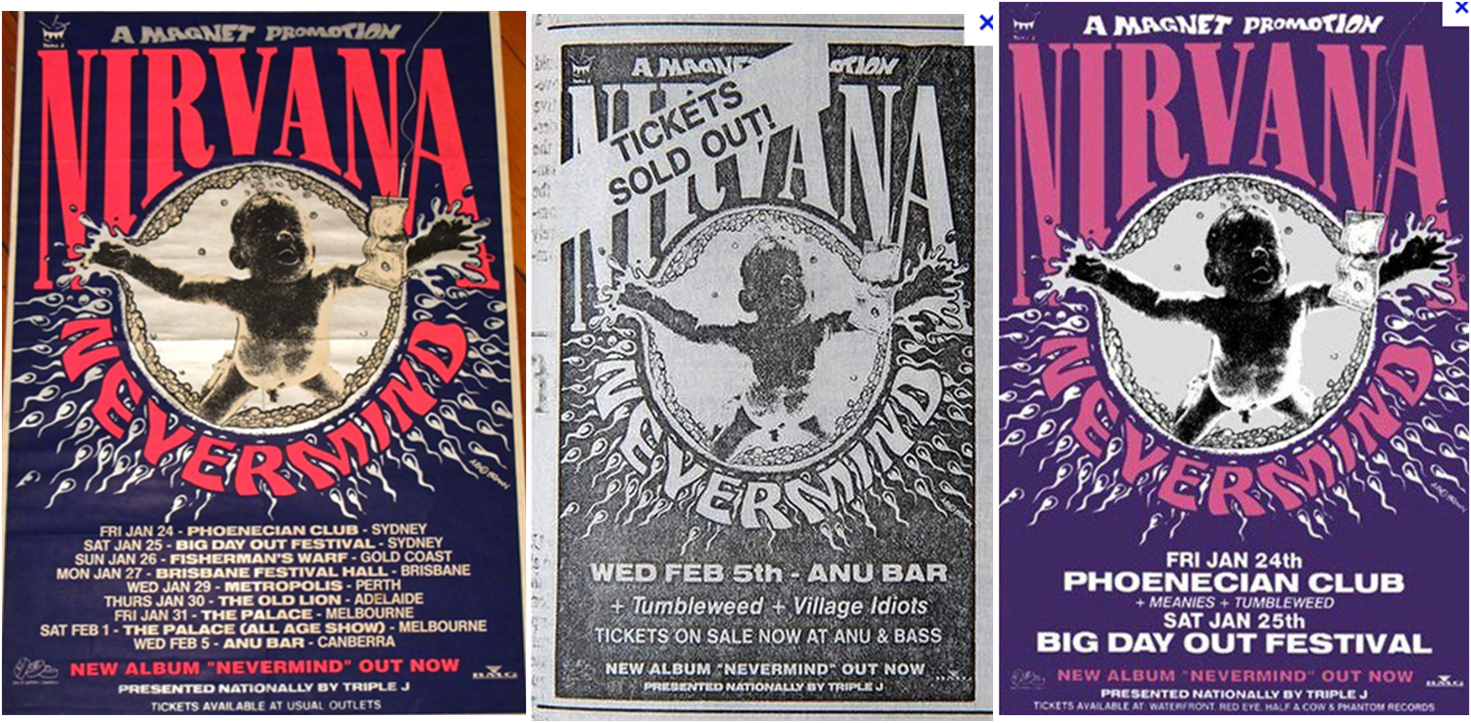
In other things I’m grateful to Australia for, my favourite Aussie Josephine receives a respectful bow firstly as ever, then I’m pointing specifically to The Guttersnipes today. Michael, Paul, Mark and Andrew have been a pleasure to speak to recently and kindly furnished me with this:

nirvana_palace

I double-checked as much as I could and as far as I can tell this is the only copy I’ve ever seen of this particular Australia tour poster featuring the late addition of Sunday February 2, 1992.

They’re certainly my music pick of the present week so I’ve ripped the OFFICIAL Guttersnipes Live at the Great Britain in 1992 YouTube set from their Facebook page and would like to present it to you as a fun and healthy way to add some Antipodean colour to your day:

If that doesn’t please your ears, well try a slice of the Southernhemisphereplayaistic studio version of Face the Day:

The gritty vocals are given me a good feel (like Rancid at their peak), the willingness to let the music soar in a jumble of indie sunshine, hammer-on-off rock riffs and a wicked outro well-worth waiting for; a nice touch. Interesting hearing a bit of their story too, peoples, look around you, some of these people you’re going to take with you for decades to come:

“(Paul) We four had fairly similar backgrounds, we all met at uni and lived at the same residential college. Musically the tastes were pretty diverse…One guy was into Depression, Misfits, Butthole Surfers, Mass Appeal and others. Another guy was into Minor Threat, Fugazi, Pixies and Steve Albini. Another was into more folk-pop oriented, (The Saints, The Church) and me, I had a bit of everything (Deep Purple, Kate Bush, The Damned, Einsturzende Nuebaten, Ozark Mountain Daredevils, Swervedriver). We all had a bit of crossover with each others tastes. Husker Du, Black Sabbath, etc. Musically, it was an interesting mix and our priority was staying friends believe it or not. Our matrix was the fun factor. We played good songs, and we had plenty of mates who drank a lot of beer. A rent a crowd as it were, which made us instantly popular with the venues.”

“(Michael) I’d add Dinosaur Jr and the Pixies to the list Paul had, and possibly some other Australian bands like God, Bored, The Throwaways and Venom P. Stinger. We were all aware of Bleach around the time we formed too, and a lot of other post hardcore stuff from 88/89.”

“(Mark) There were a lot of very good bands around Melbourne at that time, and a lot of places to play. It was a very unpretentious scene, there was not a lot of fashion bullshit. If you were good people came to see you. I have no doubt the best live music on the planet at that time was in Melbourne, not that we realised it then. You could go see the Powder Monkeys in a small pub then cross the road and see Damaged, two of the best live bands that ever existed.”

Intriguingly, the band state they’ve still got material from their final studio sessions they never got around to releasing…Curious…The unknowns of music past; watch this space and check out The Guttersnipes over on Facebook; there’s a lot going on in Melbourne.

For the record, here are the other three Australia tour posters I could locate:

Nirvana_Australia_Grouped

Straight to Hell: Hole and the Dominant Storyline

This week I’ve been thinking about the bands who triumphed in the grunge wave. Essentially it was Nirvana, Pearl Jam, Soundgarden and Hole who made it through before the door closed but the latter three bands have all had to deal in some way with the primacy and power of the first. It was only Hole, however, who deliberately and/or naively bonded their own efforts to that of Nirvana, the other two carved their own path and were unwillingly subjugated to the storyline of Nirvana as the uber-grunge band and the unwilling mainstream rockers.

The issue with Hole was always the same; Hole were whatever the underground zeitgeist said they should be but never at the right time. Their early recordings positioned them in the lineage of avant-rock/noise-rock bands with prominent female members (think Lydia Lunch, think Kim Gordon), but their high point, Live Through This, moved them into the alternative rock domain shared by their lead singer’s husband’s band, while their post-grunge album sidled ever closer to straight ahead shiny hard rock. The real flaw, however, was that they were permanently poor at hitting that zeitgeist at its peak potential. In their first incarnation they were too late for the Eighties noise-rock scene, the next wave of bands on the up were more closely embracing hard rock and the mainstream; Hole learnt and shifted focus but their 1994 identity (and the genuinely near perfect album they released in that guise) only hit at the moment when the grunge balloon was deflating; then in 1998 they went to the trouble of enlisting Smashing Pumpkins style rock just at the point where the Smashing Pumpkins were about to fall off into irrelevance – Hole were always one step too late.

Leaving aside questions around how much a role Nirvana/Kurt Cobain played in getting Hole signed to DGC, the more crucial component for this week’s discussion is that by becoming such a visible (and vocal) presence alongside Kurt Cobain, there was no way of separating from his achievements, from comparison to him and from a constant sharing of whatever limelight strayed their way. It’s another fair point of comparison that in the case of John Lennon and Yoko Ono, involvement with John totally obscured the fact that Yoko was a long established and significant presence in her own right within the avant garde art and music scenes. In the case of Courtney Love, she had paid her dues in various bands, learnt well, formed a quality band…And couldn’t ever speak of it without talk of ‘him.’

The merging of Kurt/Courtney/Hole was certainly something encouraged at the time; Courtney’s presence at Nirvana’s October 1992 Word of Mouth sessions, the partial-Hole presence at the January 1993 Brazil sessions, Courtney’s brief appearance at Pachyderm Studios in February 1993, Kurt joining Hole during their October 1993 recording sessions for Live Through This, Courtney’s presence at the MTV Unplugged show…They may have shared stages on only a few occasions but in terms of recording and making music it was Hole/Courtney all the way. Media appearances too changed, the Kurt/Courtney pairing was, from 1992, just as likely to appear in interview as any other combination of Nirvana (https://nirvana-legacy.com/2012/11/22/killing-nirvana-part-2/). It was this piece, speaking as a couple to those who broadcast and decide on the story, that turned Kurt and Courtney into a clichéd phrase and bonded them irrevocably in the public eye.

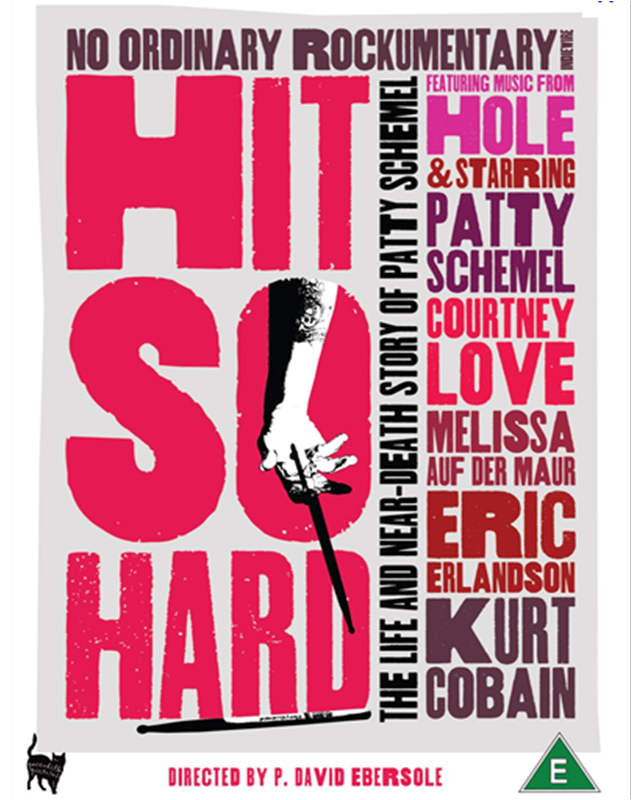
The years since the initial collapse of Hole have helped to reinforce this because Courtney’s musical inactivity led to her being known simply for being Courtney Love – the name always coming with the prefix/suffix “widow of Kurt Cobain/former wife of Kurt Cobain”. She’s lived her life since her late twenties as an appendage to a dead rock star. Just as Nirvana was, at its core, Kurt Cobain’s vehicle, Hole was Courtney’s and therefore, when she linked herself personally to him, it was impossible not to irrevocably tie the band to him too. It’s visible in the way the front cover of Hit So Hard, a documentary about Hole’s drummer, has a front cover where ‘Hole’ at the top and ‘Kurt Cobain’ at the bottom top and tail the list of key participants and where his name takes the most visible bottom-right corner position in huge letters.

While the bonding with Nirvana brought benefits – a lot of publicity and visibility that undoubtedly did play a role in influencing the bidding wars and high advances for Hole to join a major label – it meant ceding a degree of independence and it is that loss of freedom that is the ongoing fate of Hole; they’ll never be appreciated without reference to Nirvana, they’ll never be examined or remembered without a mention of Kurt Cobain, there’s no legacy of the band or place they’ve earned in rock history in which they’re not part of someone else’s story. That’s independent of having released three excellent albums one after the other.

It was remarkably indicative of the tight bond between Hole’s status circa 1994 and Kurt Cobain that Live Through This, an album that really did deserve its platinum sales and should be remembered as a triumph, came out on April 12, 1994. It therefore remains smudged in an indelible pall of crematoria smoke and psychic discomfort arising from his absent body. It’s how it should be, the band was bound to the fate of Kurt Cobain so the album by necessity should be stamped with his presence/absence. But for a band wanting to be recognised on its own merits this is the danger that results from riding the dominant storyline of an era; when it falls, so do you. Hole had sacrificed their own momentum to get a ride on the rocket to the top and it crashed down into the dirt before they had a chance to climb off and find their own way to stay aloft.

Hit so Hard

Pearl Jam Versus Nirvana: Nevermind, What was it Anyway?

Tuesday we discussed Soundgarden, a band that was extracted from Seattle and inserted itself into the Californian alternative scene. Today we’re talking about Pearl Jam, a band that transplanted a California scene vocalist into a solidly Seattle band. In both cases, it wasn’t just Nirvana’s commercial success that impacted the trajectory and achievement of each band, it was the way Nirvana came to own a substantial part of the storyline of grunge and the North-West scene. With Soundgarden it was simply that the history of grunge became synonymous with the story of Nirvana so there was less space for a band that had left the grunge scene behind before Nirvana began their rise. With Pearl Jam their position became partly defined by the storyline announced by Nirvana’s leader himself.

The first time I listened to Pearl Jam must have been prior to July 1994 when I moved to Lincolnshire. A school friend, whose name quite escapes me now, was determined in his belief that Pearl Jam were Nirvana’s superior and lent me a double cassette bootleg of them live, I believe somewhere in Britain, sometime in the year/two years beforehand. I can still recall Even Flow making an impact, Jeremy, Alive…I remember nothing else; I stayed Nirvana side and we had an occasional play fight over the issue. Sometime between 1994 and 1998 someone lent me that collaboration with Neil Young the band did; I couldn’t take it. About ten years later I took a shot on the Rear View Mirror two CD greatest hits collection and traded it in having realised I liked the three songs mentioned earlier plus Spin the Black Circle. Yet this is a band I innately respect. They’ve walked a path away from fame and back into the underground, wilfully so and without regret. They’ve never let the twists of popular taste impact their specific musical inclination, a quality also present in Mudhoney. But, like Radiohead, they’re a band I can’t love, I can’t fall for.

Despite my personal tastes, however, and despite the plain (and well-attested) truth that Kurt Cobain didn’t like Pearl Jam, neither of those issues translates into genuinely believing Kurt’s more cruel statements about his rivals. Pearl Jam, again like Soundgarden, had extremely solid roots within grunge, far exceeding Kurt Cobain’s distant involvement; members of the band had helped initiate grunge via Green River, had been on the Deep Six compilation in 1986, on Sub Pop 200, were part of Mother Love Bone then the Temple of the Dog side-project – their credentials within grunge are impeccable and the primary influence they always claimed was fully paid-up awkward rocker Neil Young. Yet the way Kurt Cobain positioned them was as sell-outs, phoneys and fakes. Heck, according to Jeff Ament, a lover of basketball, “Kurt Cobain and Courtney Love talked trash about the fact that I hooped” – the guy couldn’t even play sport without being seen as the enemy.

It’s certainly true that the breach in Green River emerged due to the desire of the future Pearl Jammers to pursue a major label deal and Pearl Jam dived onto Epic at the end of 1990 with unseemly haste – but being caught up in the wave of alternative rock signings that commenced in 1988-1989 and became a flood in 1990-1991 doesn’t make Pearl Jam any different from numerous others…Including Nirvana. It’s that single point of comparison that seems most crucial.

The bands Kurt Cobain took issue with, Pearl Jam and Guns n’ Roses, were used as the representatives of two specific types of enemy; the macho opposition (i.e., sexist, racist, homophobic hair metal rock dudes) and the internal traitor (i.e., those who would sell out or mimic alternative rock sounds or styles for profit.) It’s a duality that clearly stuck in his mind because in the liner notes to Incesticide it’s the same combination he uses when he vents at “ the threatened man…traitor women”. In the case of Pearl Jam, however, without particularly enjoying their music I can’t see any great sign of the individuals concerned having committed any greater compromise with the corporate rock behemoths than Nirvana themselves though I can certainly acknowledge that Cobain associated sport with the macho jock types he hated also and that some of that personal dislike bled over into his attitude to Pearl Jam. In fact, what’s most plain about the comparison is that both accusations, that Pearl Jam were just traditional mainstream rock and/or that they’d sold out or taken advantage of an indie movement, were accusations that could be levelled at Nirvana.

Kurt Cobain, on a regular basis, tended to state the negatives about his own work, about his band and so forth as a defensive mechanism so that no one could voice a criticism without him being able to shrug and say “I already said that.” Being fair though, he was in an exceptional situation, one he had reached it within an unbelievably short space of time in terms of the rise from borderline-poverty to superstardom. It’s understandable that he required defences and ways of protecting himself – most of us aren’t asked, having compromised ourselves knowingly or unknowingly, to then speak to representatives of the media every few days or to then have our contradictions repeated back to us for analysis.

His reaction was certainly exceptional, for all his negativity about individuals who had harmed him personally – ranging from parents, to schoolmates and onwards – picking verbal battles with other musicians wasn’t a common move for Cobain. What I believe we’re seeing in his treatment of Pearl Jam in particular (as well as Guns n’Roses) is Kurt displaying a very ordinary rhetorical trick used by people to shield themselves from damage. Regularly, when people wish to deny the moral ambiguities they themselves recognise in their day-to-day living, will construct a sentence along the lines of “well it’s not like I’m/we’re dealing drugs/murdering people/abusing kids…” By setting up an absurd comparison while turning the gaze outward toward someone or something else, they nullify the chance to intellectually engage with the accusation they feel is being made and also escape having to make any honest and revealing commentary on their actions – the irrelevance of that other entity’s actions to discussion of their own (commenting on someone else’s sin doesn’t make one’s own sin lesser) doesn’t stop people needing the protection it affords to their sense of self.

This decision to avoid questions about his own band’s decision to play the corporate rock game, the choice to point accusingly at another band and state that they weren’t playing it honestly or with respectable intentions, dragged in fans and media creating a low key inquisition in which allegiances had to be pledged and Pearl Jam’s success became open to questions about its legitimacy, questions that were rarely asked of bands outside of the Milli Vanilli/Vanilla Ice categories of musician. Kurt Cobain’s access to the media and ability to make a story was so powerful that even in Pearl Jam’s twentieth anniversary celebration releases there was a need to address the controversy, it had become so major a piece of Pearl Jam’s history – all thanks to the word of one man.

Did he come to recognise that he had illegitimately harmed others for selfish reasons? Possibly. The Pearl Jam 20 material does focus on the happy endings, on Kurt and Eddie Vedder slow-dancing at the 1992 MTV Video Music Awards, on Kurt and Eddie in interviews declaring their respect for one another, on Eddie’s April 8, 1994 statement about how crucial Kurt Cobain had been to the new generation of musicians and their fans – in another source Kurt stated plainly “I’m not going to do that anymore…It hurts Eddie and he’s a good guy…He didn’t ask for this.” At the least he did manage to separate his disdain for the band’s music from personal attacks on the individuals involved but, again, as in the case of Soundgarden, the importance of Nirvana and/or the word of Nirvana influenced another band and how they are remembered. Such power…

Nirvana Book Extract from the Andy Bollen Tour Diaries

Just a brief mention, a very readable extract from the new Nirvana book recently out consisting of journalist Andy Bollen’s memories of associating with Nirvana across a tour:

http://www.dailyrecord.co.uk/entertainment/music/music-news/nirvana-revealed-backstage-diaries-tell-1844620

I think it might be the first and only time I’ve ever read something from the Daily Record — from memory it’s pretty well a Scotland-only newspaper, not a topic I’m well-versed in though I will confess to owning every Oor Wullie / The Broons annual going back to 1985 thanks to very early parental introduction, they’re comic strips that appear in The Sunday Post, a Sunday paper published up there.
Anyways, here’s the U.K. Amazon link and I’m sure I saw people discussing the book over at LiveNirvana, always a solid source for Nirvana fan commentary and knowledge:

I haven’t ordered a copy yet but, reading the extract, I immediately prefer it to the, at times, self-aggrandisement of the Everett True volume which was certainly worth a deep read. This is the third tour volume on Nirvana if Route 666: On the Road to Nirvana. Alternatively, if the Eric Erlandson and Krist Novoselic volumes are included then it’s the fifth memoir…Oh, heck, forgot that one The Chosen Rejects, sixth in that case. More…?