What is Dark Slivers About?

Wednesday lunchtime Dark Slivers: Seeing Nirvana in the Shards of Incesticide went to print. I’ve a list of pre-orders at present so if this sounds interesting then do drop me a line NirvanaDarkSlivers@gmail.com and I’ll add you to it. I’m not taking payment (£10 plus P&P) until I have the first hardcopies back from the printers and can give people an accurate Postage cost. I will, however, deliver anywhere in the world and the first one hundred will be signed, inscribed and numbered to those people personally. 

Of course, seems important I tell you what the book’s about…

Well, as it says in the Foreword, this isn’t another story book biography chronologically ticking off the events. After years of reading every last word emerging about Nirvana I felt there was more to say, a more argumentative approach had been lacking. The book tackles issues thematically, one subject at a time, driving each to a conclusion, hopefully convincingly enough. I’ve tried to ensure that all evidence is cited so the reader can examine it for themselves.

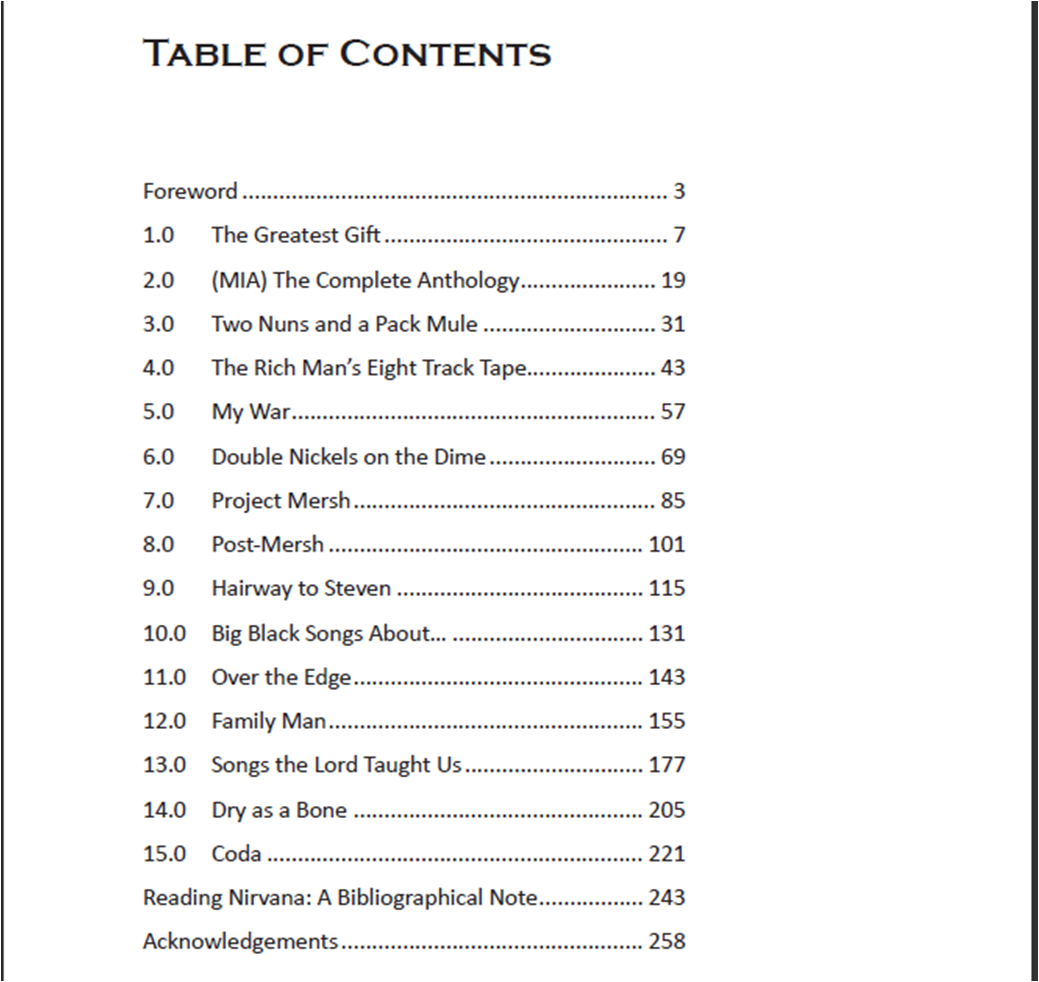
The original book concept was a 25-35,000 word volume on Incesticide. Four chapters — The Greatest Gift, (MIA) The Complete Anthology, The Rich Man’s Eight Track Tape and Songs the Lord Taught Us — focus exclusively on Incesticide arguing its importance as a compilation and as the best-selling album of pure Eighties alternative rock, the errors in the back story plus the decisions taken in selecting its tracks, the curiosities within its track listing and structure, then details of the songs themselves.

My interests expanded far beyond that remit. The final work is 72,000 words and 260 pages. What I wanted to do was show how Incesticide was deeply integral to Nirvana’s musical path in multiple ways, using those points to jump off into wider discussions. Three chapters — Big Black Songs About…, Over the Edge and Family Man — tackle the forms which Kurt Cobain used for writing, how his writing changed over time and finally the cohesive nature of his lyrical fixations. Two Nuns and a Pack Mule describes the massive humour within Nirvana’s music at the same time as pointing out that a lot of that humour was for private consumption and had a brutal edge; My War argues that Nirvana’s political side has been underestimated and under-explored; Hairway to Steven shows how Nirvana’s use of cover songs flexed across their career and that the band often ‘spoke’ through the songs they chose to play. Double Nickels on the Dime tackles the subject of commerciality and destiny in the story of Nirvana, then Post-Mersh is a lengthy chapter arguing that Incesticide may have been the pinnacle of Nirvana’s experiments but it was not the most avant-garde or wild expression of Kurt Cobain’s experimental urges, dissecting the various currents of his known private demos.

I admit the more controversial chapters are the ones I’m proudest of — Family Man is one such chapter, I think it draws together known threads of Kurt’s work but unifies them in an original and coherent way (you decide.) Two other chapters that thrill me whenever I reread them are Project Mersh and Coda. The impetus behind Project Mersh was that I was fed up of reading arguments that either tried to claim Kurt was a non-commercial pure artist OR a committed careerist. I argue that the question is wrong; that Kurt’s actions were motivated not by the avoidance or acquisition of a solid career but by a deep desire for control and freedom from the demands of employment and management starting right back in his teenhood. Coda forms the dive into darkness at the end of the book — I let it stretch and meander a bit focusing first on analysing and demonstrating how completely Kurt’s commitment to music collapsed from 1992 then taking an original look at the three occasions on which he wrote to his fans directly, the final one being his suicide note.

Over the weekend I’m going to release a sample chapter — Dry as a Bone — tackling the March-April 2012 rumours of extensive 1994 home demos. Its a standalone chapter so can be read in isolation from the rest of the book. It’ll give you a sense of my style and approach while hopefully providing an interesting and entertaining, though downbeat, take on an up-to-the-minute piece of the Nirvana story.
Kurt Cobain Biopic: Perhaps it’s Time…

http://www.craveonline.com/music/articles/199967-kurt-cobain-biopic-courtney-love-chooses-brett-morgen-to-direct

It seems a Kurt Cobain biopic is genuinely in the works and we’ll see something at some point in the next couple years; I’ll take a wild stab in the dark and bet on April 2014…Any takers?

The book Cobain Unseen by Charles Cross was perhaps the first work to try and integrate Kurt’s work outside of music. While leaving aside, for the moment, commentary on the quality or otherwise of Kurt’s art works (whether videos, sound collages, paintings, installations, animation, etc.) what seems significant is the scale of ambition and the willingness to experiment in other arenas. I would argue that what distinguishes a true artist is that the priority is simply to create and to express the internal vision for its own sake regardless of audience or commercial gain.

The concept mentioned for the film in which Kurt Cobain’s own works will be incorporated to try and relay his story actually seems an intriguing one. The market has been flooded with semi-interesting interview discs, the artful but slow Last Days by Gus Van Sant, plenty of live footage but there genuinely is a gap for a comprehensive look at the life of Kurt Cobain. The choice of Brett Morgen as director doesn’t set off any alarm bells; he’s an experienced and serious documentary producer with some well-respected work in the back catalogue and if his willingness to experiment with the medium allows Kurt’s own dalliances with visual work to gain greater acknowledgement then that’s all to the good.

What intrigues me is that Kurt’s central ambition in life seems to have been not just music, but to make art, as a wider concept, an integral part of his way of living. It’s meaningful, in my view, that the only commercial or career vision he ever expressed in his songs was that of a folk artist making pictures from recovered debris as featured in Mrs. Butterworth and echoed in Swap Meet. He seems to have surrounded himself, as soon as he was renting a home, with his own creations, turning his living space into something akin to Kurt Schwitter’s Merzbau; a declaration that he wished to live cocooned by external manifestations of his internal creative drive.

The unity of his vision is also visible; observe the four paintings that were released for auction in April 2012 alongside the works shown in Cobain Unseen for a sense of Kurt’s ‘cosmology’ of images and elements. In March 1990 Kurt chooses to lead Nirvana into a TV studio to try and create their first video, an entirely self-motivated decision. That was followed by the Sub Pop In Bloom video that same year. Lack of funds and resource were irrelevant to the desire to incorporate other mediums around the music.

The way, after fame struck, that he seems to have retreated even more into other forms of art is noteable. While barely bothering to express himself in the form that gave him fame, music, his urge to articulate whatever was within him meant a continued sea of other works, only a fraction of which has so far been shared publically. In amidst what was a very turbulent life from 1992, he took time to personally involve himself in the art work related to a majority of Nirvana’s releases, despite the fact he could easily have left that role to others. He didn’t; he wanted to do it. So, while he can barely be persuaded to turn up to record with his band, he takes the time to prepare the Incesticide art-work, to conceptualize and prepare an installation/collage for In Utero, is fully engaged with the Heart Shaped Box video, plots the single art for that song and for All Apologies/Rape Me. It’s only the Pennyroyal Tea single where he relinquishes  that control; a disturbing sign simply because the art was the only element of Nirvana he seems to have clung to during his final years.

A film that can shed more life on Kurt’s life not just as songwriter and performer, but as a quintessential artist with an omnivorous desire to toy with any means of creation, can only be welcomed.  It’s awe-inspiring how total Kurt’s need to create was.

The Cupboard was Bare?

There have been ever thinner riches accompanying Nirvana releases since the 2004 With the Lights Out box set — fewer rarities, fewer alternative versions of interest. It’s possible now to understand what was left from Nirvana’s studio sessions thanks to the work done by LiveNirvana.com. The following list shows how little music hadn’t emerged by the time of Kurt Cobain’s death:

Anything in red has still not been made available on an official compilation. At this long remove it’s a surprise there’s anything at all that hasn’t seen release. There have been promises made of special releases in 2013 for the In Utero Twentieth Anniversary. If this follows the pattern set by the Nevermind releases then some considerable part of the April 1992-January 1993 material will emerge, perhaps even the January 1991 demos too.

Of course almost everything here has sneaked out into the realm of bootlegs (just go take a look at YouTube.) The exception, as far as I’m aware, may be the Bleach session attempt at Hairspray Queen. Depressing in a way, so few secrets to come unless…Unless there’s some truth in the rumors of substantial Kurt Cobain home demos.

Friday 16th Nov: Mia culpa! Its been pointed out that I skipped the 1991 edition of Sappy – true! Apologies. Similarly there’s a jam from the In Utero sessions known as Lullaby, the description over at LiveNirvana drawn from Gillian G. Gaar’s In Utero volume seems to be the only available information and it doesn’t seem to promise much beyond an instrumental free-for-all…Welcomed but…

Incesticide: Kurt Cobain Gives a Christmas Present

In Utero was not Nirvana’s response to sudden fame; its core narrative was a lashing out at media intrusion and perceived aggression toward Kurt Cobain’s family, the circumstances that made up his life in late 1992, not to the arrival of fame late the previous year.

Incesticide was Nirvana’s key comment on fame. People forget that as a visual artist as well as a musical one, Kurt Cobain communicated not just through lyrics. So, his record label want fresh product in the market to take advantage of the Christmas sales opportunity and Kurt Cobain responds…

…Think about the response. The season of family together and good cheer; Kurt Cobain calls the album Incesticide. Having selected a title unlikely to please the average parent, one specifically focused on destructive families, he then demands (and receives) control over the artwork. He seized the chance and created a cover picture of a damaged child trying to seek attention from a blank-eyed and neglectful parent figure. With a wonderfully dark humour he chose the vapid clichéd image of the rubber ducky to fill the back cover — a mass marketed product decorating a compilation put together primarily as commercial fodder. It’s little wonder the record’s working title was Filler — it was there to plug a gap between Nevermind and its successor without detracting from Nevermind’s stratospheric sales.

So far that year he had begun refusing to play any of the games demanded of him by success. Nirvana barely performed after February; he managed one proper day’s work in studio before late October (again another distracted one day of work); he did his best to not talk to the media; he even started a fight with MTV over his right to play a song they found offensive. Incesticide fits perfectly into that pattern as another statement of how much enjoyment he was taking from fame.

The liner notes were the next component of the album to receive focused attention. In it, Kurt swears repeatedly (“a big ‘fuck you’…” begins one sentence), tells any fan with views he finds offensive to “leave us the fuck alone“, cites annoying homophobes as a favourite moment of the year; and ends it with a mention of a horrendous rape and a quick line about “two wastes of sperm and eggs.” Again, this isn’t going to thrill anyone at his record label but he does it anyway.

The contents of the album were already uncompromising enough but, in mid-to-late 1992, all the elements that he could twist out of shape were used to create the least heart-warming Christmas gift imaginable. It’s intriguing that the album contained Sliver, Been a Son, Beeswax and Downer, all making direct (and negative) comments on families – but then, that’s not exactly an uncommon element of his music oeuvre.

So, in conclusion, Christmas 1992, a hearty fuck you from Kurt Cobain to all the families out there and to the demands of life on a record label — here’s the what your kid was going to want under the tree.

King of the Nirvana Producers

The other week we examined Nirvana’s drummers and their participation in the band’s career. This week we move on to Nirvana’s producers — who did the most work with Nirvana? Who contributed most to the music we know and love?

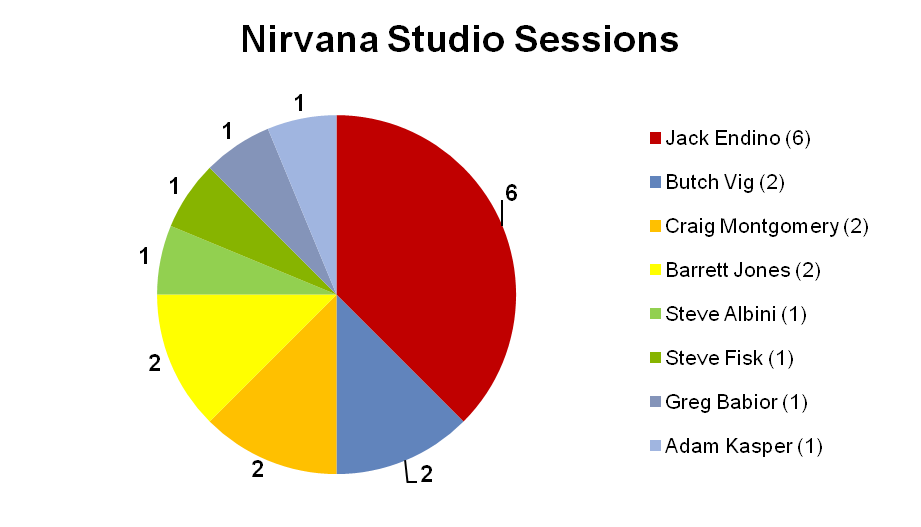
These aren’t quite the same questions of course. When we look at how many studio sessions the band engaged in the stats are as follows:

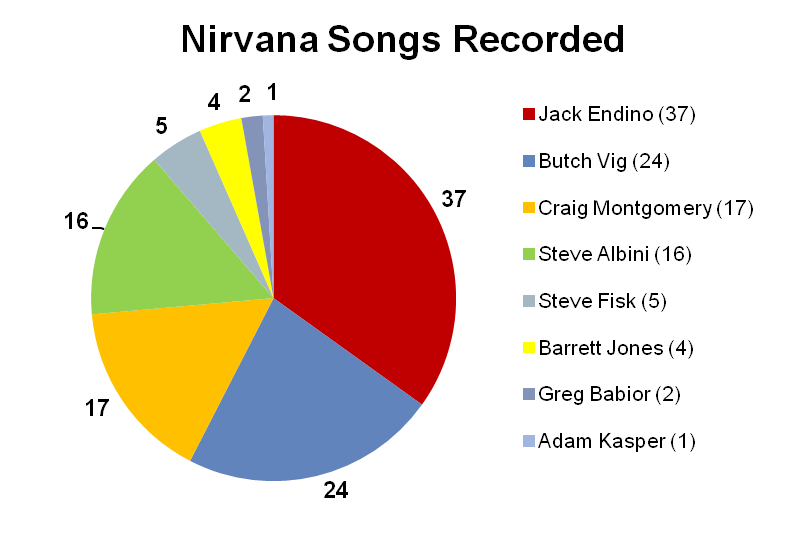
Jack Endino, as expected, was that daddy of Nirvana recording sessions shepherding them through their first demo, first single session, first album session, two one song sessions in 1990 and finally the first demo session for In Utero. Yet, does the same hold true in terms of the band’s productivity in those sessions?

Again, Jack wins while Butch Vig’s two sessions with the band in April 1990 and May-June 1991 see him into second place. Nirvana’s soundman Craig Montgomery ends up in third place having recorded a range of material on January 1, 1991 and the Rio de Janeiro demos for In Utero. Its unusual thinking of Craig as the third most productive Nirvana collaborator when it came to production duties but understandable given the priority given to the albums:

It’s now that we can see the plaudits as they have been traditionally awarded with Jack, Butch and Steve Albini occupying the top ranks. Between 1988 and 1994 the ‘finished product’ emerged, primarily, at the hands of these three men making them the names most associated with Nirvana’s work despite the wealth of material since issued much of which was created with the support of others. It’s the focus on end product in the public domain, not necessarily overall work, that has been a key influence on the respect awarded producers…But it doesn’t erase the fact that Jack Endino is the uber-producer of Nirvana.

The Most Popular Kurt Cobain Photos

This is a light-hearted inquiry for a Sunday AM. I was wondering what people felt was their favourite Kurt Cobain/Nirvana photo. I decided to use Twitter and Facebook as sample groups; I studied 377 profiles on the former, 275 on the latter — that seemed a more than ample number. I was expecting more of the ‘Vandalism: Beautiful as Rock in a Cop’s Face’ (credit for that line goes to The Feederz a band I recommend), a few of the Charles Peterson shots from the Sept 1990 show at the Motor Sports International Garage, the Niels Van Iperen shots from Nov 1991…

My immediate realization was that the desire to differentiate and distinguish their pages meant people were using an astounding variety of photos. It was clear that, even when paying homage and pledging allegiance to the memory of Nirvana, the desire to stand out as an individual drove even something so simple as the chosen profile picture.

What really stood out is that the period of photos used most rarely were those from the 1992 spell of Kurt with short hair when (frankly) he looked extremely ill indeed. Perhaps that explained the scarcity of the Martyn Goodacre Oct 1990 NME shot — you know the one, eye make-up, saddest expression in the world, big open eyes straight to camera. There seemed to be a desire to avoid the mournful images in favour of photos that still possessed either stolid handsomeness or a certain dreamy-eyed wistfulness.

So, the number one and number two respectively were:

They’re both from a late 1993 shoot with Mark Seliger for Rolling Stone. Variations on both of them abound in the sample group and I counted them as one entry. I was surprised how often the actual Rolling Stone magazine cover itself was used — this exact shot. There was genuinely a greater uniformity among non-English language sites. It occurred to me that outside of the U.S./U.K. markets that Rolling Stone is still one of the key music magazines distributed — when I’ve been abroad it’s a near guaranteed presence on the news-stands. This familiarity maybe accounts for how common it is. It also seems likely that the photos people selected were bonded to their own early memories of the band; hence the preponderance of these shots and of, as we’ll see, MTV photos. This isn’t to underestimate the fact that the Seliger photos captured Kurt at possibly a peak of sheer beauty; this is a very photogenic young man:

This is the rest of the top ten. I was surprised by the prevalence of the With the Lights Out cover but, again, access and familiarity seem to be crucial factors in the popularity of a photo; this was a rare Nirvana release in the sense of having a very clear photo of the band on the cover, plus as the last highly-anticipated, genuinely exciting Nirvana release it formed the high point of many people’s musical-engagement with the band.

What was far rarer were casual early or amateur photos. People seem to prefer the more formal photo shoots presumably for the crispness of the images. Likewise, I didn’t see one photo of Kurt with Frances Bean anywhere in the 600+ sample. The degree to which the Nirvana cult is actually a Kurt Cobain cult was very clear — even band photos were a rarity, let alone letting Courtney into a shot. The preference was also for shots from after Nirvana achieved fame; the oldest photos here are precisely Oct-Nov 1991; right after Nevermind. Again, I’m simply guessing that it’s a combination of being the closest match to people’s memories, the best quality, the greatest access. To be fair, Kurt Cobain was certainly a man who ‘grew into one’s looks’; his gawky teenhood and early twenties aren’t the hallowed images of a latter-day saint.

I’m unsure of where the photo at top left comes from, the next (plus the one at the end of top row) are from a Michael Lavine shoot for Sassy magazine, the next is from MTV’s Live and Loud performance. On the bottom row, A.J. Barratt’s shoot for NME in November 1991; MTV Unplugged in New York; the Hilversum radio session in November 1991.

A final comment would be to note the focus on eyes open to camera photos. It seems a bolt of the blindingly obvious to say one doesn’t remember people through photos of their forearms or their ankles. As human beings we’re conditioned to seek out connection, emotion, a sense of a person — photos as memorials are precisely that. If it was simply an attempt to preserve the physical person then a photo of any part of their body would be equally satisfactory. The simple fact that in a sample of over 600 chosen photos it was always the face to which people felt the connection indicates that it’s that attempt to meet the personality, the mind and soul that drives people when handling and observing photos.

In Kurt Cobain’s case, people didn’t choose smiles but they didn’t choose unhappiness. What was chosen was the inscrutable expressions, the apparent openness found in the eyes balanced against the closed mouth. It’s far rarer to find photos of Kurt smiling in general but it seems the ‘unknowingness’ of these images appealed — the man we’ll never know deeper.

How I Came to Write Dark Slivers

The publishers of the book series 33 1/3 requested proposals for new, 25-35,000 word, volumes in their collection of album guides. For no reason I can discern I was seized by enthusiasm and went for it. There was no process of weeding out before I chose Incesticide; it popped into my head and it felt right. I justified it because (a) it’s barely discussed and has always been under-appreciated (b) the three studio albums are deeply covered and (c) the coincidence of the anniversary coming up on December 15, 2012 felt worth marking regardless of what Universal were doing. The first draft chapter submitted, and since revised, stated “Bleach’s anniversary was marked with a Sub Pop special edition; Nevermind’s saw several deluxe reissues; for Incesticide…So far nothing.” A liking for waifs and strays meant it appealed to me.

The year since has disappeared in an avalanche of notes, scrawled ideas on paper scraps at the gym, emails sent from work to home and back again, plus the main manuscript in the middle. My average day became six hours sleep, twelve hours at work or commuting, then six remaining hours (plus whatever was stolen from my sleep hours) for writing and the rest of life.

I was one of 473 proposals for 33 1/3 so didn’t get through. Their feedback helped drive me on; the factors were that I was up against people with years of music experience and also they couldn’t imagine publishing a second Nirvana study if it wasn’t on Nevermind. Very reasonable! By this time I’d pushed beyond the initial remit and knew my destination. The book is a bit of a hybrid; there are four chapters exclusively on Incesticide while the others weave the album into wider analysis showing how illuminating Incesticide is and how integral its songs are to Nirvana.

Eventually I’d moved far enough along, sought out and, by some miracle, secured a literary agent willing to support the book — she said she liked my writing style and that I seemed to know my subject incredibly well. Alas, times are hard for publishing and music publishing in particular is suffering. Ten rejections later all focused on (a) too much competition and/or (b) not general enough to appeal to an audience beyond Nirvana fans, we were done…

…NO. Approval from a publisher would have felt nice but frankly, by this point, I was working day in, day out on what is, at finish, a 15 chapter, 72,000 word study of 230 pages. I felt the book had things that might be of interest to lovers of Nirvana; to people like me. Again, good luck intervened and I located a small publishing imprint.

As a Nirvana fan, treating the topic, the people and the people who might read it (i.e., fans just like me) with scrupulous respect was crucially important. I didn’t even use a photo of Kurt Cobain on the cover because I felt it would be taking advantage of him (fanatical I know…) I have a shelf full of Nirvana books (27 at last count) and while some are great I’ve genuinely felt ripped off by a number of them — I knew what I wanted to avoid creating. As a fan first and a writer second I constantly tried to make sure I was creating something I might enjoy.

In terms of my style, my feeling was that the basic storyline had been rehashed many times over and that I didn’t want to just create another chronological biography stringing together anecdotes. I interviewed a small number of people on a specific number of questions and used them sparingly and as appropriate. My core focus was on using the music itself, backed up and supported by my bootleg collection, by online sources and YouTube to create a book where others could go and look up the evidence themselves if they wished.

My writing is definitely a result of my working career allied to my academic work (I have two degrees in history from Cambridge University and I work at a technology analysis firm.) What I created was a series of argumentative essays, analyzing and interpreting specific themes or topics. It does make for a harder read, but I hope a convincing one. I felt throughout that there were lots of works describing ‘what’ happened in Nirvana’s career but very little space dedicated to wondering about ‘why’, or ‘how’, or what significance the events held.

In a few days, the creative artwork and design will be concluded, the book will be in the hands of the printers. It’s the only book I have any intention of writing about Nirvana; I’ve said everything I have to say and my reasons for writing this book have never had anything to do with starting a music writing career; I don’t want to turn something I love into something I do purely to get paid and live, that would rob me of the pleasure I’ve had in creating this work.

My remaining thoughts, leftovers from the book, responses to news, ideas I never got to develop — I’ll put it all out on the blog, I genuinely just hope you enjoy reading it. If any of it means you feel motivated enough to see what I’ve written in the book then I’m certainly delighted — I loved writing it and if others like what I’m doing enough to want to read it then that’ll feel fantastic.

Memory Lane: Nirvana Exhibition London 2011

A year ago Brick Lane, London hosted a really neatly done exhibition consisting of relics from the sainted Kurt Cobain, photographs, a showing of the (then) not-quite-released Live at the Paramount film and even an anorak/hoody that used to belong to the man.

I made a special trip across town to catch it (and foolishly ended up sinking cash in the record shop across the street too) and strolled a while. It was a moderate sized gallery space with an upper mezzanine floor. Very classy, typical Brick Lane combination of trash/flash.

http://www.nirvanaexhibition.com/?page_id=62

My major problem was knowing how to react to it all. Standing in front of Kurt Cobain’s hoody I wondered if I was meant to feel a proximity to the man himself, or to appreciate his ordinariness, or take it as a clear statement that he was gone and these remnants were in some way feeble. A shard from a guitar made me think of medieval pilgrims travelling miles to touch alleged chunks of Christ’s cross. The organizers had done a great job, the back room was packed with people watching the concert on a big screen, people meandered studying the photos…

…And I left. The problem was me. I admired the photography, it was nice to see the posters and other pieces…I still felt like I often do at art exhibitions, slightly blank. I seem to need a story line presented, a context given underneath/alongside an image or sculpted item before I can connect.

Rape Me

I’m intrigued by ghosts, by what is present through known absence — the building that once was, the house sparrows gone from London skies. Kurt Cobain’s music contains quite a number of haunting presences and Rape Me particularly intrigues me.

The song endured an unusual trajectory in terms of its writing. The solo acoustic is quite a lengthy initial effort (admittedly degenerating into scratch lyrics.) Yet it is almost all stripped away leaving just a skeletal refrain when performed live in June 1991. That form is then retained all the way to its showing in Seattle on September 11, 1992. The ultimate second verse and bridge are then created in the fifty or so days leading up to an October 26, 1992 demo session. It’s very common for Kurt to retain the core of a song and shift the elements around that ‘spine.’ But it’s unusual to find three distinct iterations of a song. While some initially pointed out cosmetic similarities to suggest Rape Me was a response to Smells Like Teen Spirit, it was mainly reinterpreted as the female rape victim in Polly’s internal fury toward her attacker.

I’d first point to the fact that the time of the rewrite makes this song not an assault on the discomfort of fame as felt in late-1991/early-1992 but a comment on betrayal and external judgment which was his situation right then-and-there in late 1992. But then what I’d suggest is that, rather than Polly or Smells Like Teen Spirit, the real family ties for this song lie elsewhere in Kurt Cobain’s catalogue.

In its solo acoustic rendition, Rape Me’s true lineage stretches back through Even in His Youth, all the way to Laminated Effect on the Fecal Matter demo. In Laminated Effect, the first verse dwells on a key character who, “raped by his daddy” ends up dying of AIDS with the song ending with the refrain of “made not born” to suggest that his fate was the creation of the father. Rape Me begins not as an anti-rape song but as a song in which the father rapes his son. In the case of the former, the very next line is “told he was at fault” while, in Rape Me, the next line’s motif is “my embarrassment.” It’s an intriguing combination that it’s the victim not the perpetrator who is left with the guilt and negativity. It’s a connection he made again in Floyd the Barber with the raped victim responding with the chorus “I was shaved, I was shamed.”

Even in his Youth is overtly and knowingly bonded to Laminated Effect by the insertion of the line “kept his body clean” taken wholesale from the latter song. This ties the disappointing and shameful son in Even in his Youth directly to the unsympathetically treated and ultimately doomed son in Laminated Effect. While lacking the rape motif of Rape Me and Laminated Effect the crucial connection is the association of the father in all three cases with the main character’s guilt and shouldering of the responsibility for perceived failings.

The first ghost of this song lived within Kurt; in his retention of the memory of what this song’s inspiration and scenario had initially been, even long after all visible male-on-male rape motifs were erased. This can be seen in the way his Journals propose two video treatments for the song; one dwelling on the forced feminization of men in prison; the second in which a man takes on the female role and is examined in stirrups in a gynecologists’ office. Whenever these entries were written (late 1993?) it’s still about the feminization and abuse of a man, not a woman. He reinforced this once again by using the image of a seahorse on the cover of the single specifically because with seahorses it’s the father who rears the young.

So, the song morphed from a song about incestuous rape of a male child, into an anonymous refrain, into the ultimate version in which the refrain was harnessed to a commentary on the media’s treatment of his family. This same bonding of past family and present family seems to have haunted Kurt given it’s precisely the same sandwich he made on Serve the Servants.

On the October 26, 1992 demo of Rape Me it was creepy that Kurt should insist on inserting the cries of his two month old child into a song with this theme. Yet — as with the image of the male seahorse that rears the baby, as with the refrain “made not born”, as with the son accepting that his father’s shame was the son’s own fault — there’s a genuine point to it. The image of the seahorse fulfills a deeper purpose in that it is there not just as an inversion of roles but also because it shows the father influencing the fate of a child at the earliest phase of existence.

This was a song about family and specifically about what a father bequeaths genetically to his child — the guilt and self-critical negativity is the crux of the issue, not the rape itself. In the initial demo of Rape Me and in Laminated Effect what takes place is not a literal rape, it’s the father imposing, against the child’s will, a fate and an identity upon them via the sex act that created them. The line about “our favourite inside source” therefore possesses a double-meaning; the supposed traitor in the Cobain camp in late 1992 but also the internal source of his inspiration. Again, it’s the same trick as used in Serve the Servants where “that legendary divorce”, despite its sarcastic phrasing, is indeed a crucial event for Kurt — the fact he’s fed up of hearing it doesn’t erase its importance. The wry line about the “inside source” refers back to whatever it is that his father has placed within him that makes him who he is.

In each case, and in Even in his Youth, the child’s negative feelings about himself leads within the lyrics to a line holding destruction as the son’s ultimate destiny. The end result of the father’s presence in each song is that the son has no alternative fate other than the release of death. Placing Frances Bean Cobain in a rendition of Rape Me wasn’t just about being ghoulish; it was symbolic of the relationship between a father and their child. It was a statement of Kurt’s fear of what bad things he had willed to his baby made by placing his child inside a song originally about being raped by his father.

These are the ghosts within Rape Me. The first is Kurt Cobain the enraged husband railing against the media. The second is Kurt Cobain, the shameful and un-masculine son. The third is his father, the source of Kurt’s feelings of inadequacy. The fourth is Kurt Cobain, the fearful parent unsure of his influence on the child. Emphasize this by rereading his suicide note and the context in which he refers to the potential for his child to follow him and to become him.

 Thank you. Now, if someone could pass me a torch? I just crawled up my own ass and it’d take a lot of work to clamber back out of here in the dark.

Something in the Way

Hands in the air if the sight of Kurt Cobain on an acoustic guitar in a New York studio full of flowers is an image that’s been solidly lodged in your mind for years?

It’s a curious way to remember the man given the key releases during his life time barely featured acoustic guitars at all. The nearest Bleach came to acoustic strumming was turning the amps down for About a Girl, Nevermind spared time for Polly and Something in the Way but Incesticide had nary a one while In Utero made way for Dumb and that was basically it.

Something in the Way was, therefore, something of a rarity. It was also the last brief story Kurt Cobain told in song form describing an exaggerated version of his brief experience of semi-homelessness. It’s a rare example of Kurt Cobain describing on record his relationship with the animal kingdom. His attitude is intriguing, the idea that he can’t bring himself to kill animals except an occasional fish.

It links to two songs; the first being Smells Like Teen Spirit. It’s funny that the Nevermind album commences with an image “load up on guns, bring your friends” that suggests a hunting party outing then ends the album by pointing out that the gun-toting redneck was the last thing he could be described as given even hunger can’t drive him to kill what he catches. The second song is Sappy, a song inspired by his pets and how sorry for them he felt. The song describes efforts made to make them happy and keep them happy yet ultimately his knowledge that they were still prisoners trapped in a laundry room. It’s typical Kurt Cobain that his narrator self-identifies with the captives, those without an escape.

The song is a perfect example of the band’s ability to strip a song down to simple unpretentious elements (the guitar chords are almost autistic in their simplicity) and build something that expresses an emotional depth. The starkness of the presentation coupled with the downbeat tone of Kurt Cobain’s voice, the pauses between lines as if it’s taking all he has to dredge up the memories and tell them.

There’s a hidden point to the song, however. With Kurt Cobain it’s worth remembering that he was able to address private jokes, snipes and comments to his circle of intimates in songs that appeared to have a universal tale. In this case his family knew he had always had the option of a room, his friends knew they’d given him somewhere to crash. So to place a song on the album that claims he’d been so neglected in his late teens he’d been living under a bridge like a derelict is quite a stinging snipe at his family.