Break In at Frances Bean Cobain’s Home

Kurt Cobain and Nirvana used their fame to fight sexism, racism and homophobia. They berated audience members who would grope girls in concert; they kissed live on one of America’s biggest TV shows; they gave performances in support of these causes; he gave an exclusive interview to The Advocate magazine and was delighted by Pansy Division’s affectionate cover Smells Like Queer Spirit. This was a band determined to tell people that no one has the right to invade another’s right to privacy or to use fear and intimidation to impose one’s will upon them.

Which is why the news of a break-in at the home of Frances Bean Cobain is so disturbing:

http://audioinkradio.com/2012/10/frances-bean-cobain-rabid-nirvana-fan-broke-home-had-murder-objective/

It’s a horrendous incident; the invasion of one’s home, of one’s place of safety is deeply traumatic for anyone. The added elements, the potential murder plot plus the link to a father one last seen when not even aged two, makes it worse.

Yet one thing that is clear, no one who had absorbed the music of Nirvana and had any respect for the band’s social/political opinions would believe they had the right to commit such an act. This man was sick, psychologically disturbed, dangerous…But not a Nirvana fan. The definition of a fan is (variously) “a devotee”, “a supporter”, “an admirer” — for someone to claim an identification with Kurt Cobain or Nirvana and then to act so much against the spirit of the individuals concerned refuses him entry to the community of fans.

As a wider question, there’s always an unsettling relationship between bands and their audiences. The (excellent) Nirvana Live Guide website records numerous incidents during the 1993 In Utero tour of Nirvana stopping shows to prevent male audience members groping unwilling girls in the crowd. Nirvana were certainly sensitive to this issue, look at the liner notes from Incesticide in which Kurt Cobain demands that anyone homophobic, sexist or racist “leave us the fuck alone! Don’t come to our shows and don’t buy our records.”

But a band doesn’t get to dictate who likes its music. An audience does get to declare a band’s behavior beyond the pale via its power to give or withhold support. It’s also good that fans don’t slavishly follow the often dim-witted and thoughtless behavior of artists. Maybe the answer is to separate being a fan of a band or an individual from being a fan of their music? Declaring oneself a fan of Nirvana’s music means one likes the music. Declaring oneself a fan of Kurt Cobain and Nirvana means one shares many of their views and identifies with their positions. If one wants to be a true fan of Nirvana, not just a consumer of their catchy tunes, then there must be actions to back it up. Words are not enough.

As a final comment on the incident at Frances Bean Cobain’s home I’ll turn to an old Calvin n’ Hobbes cartoon: “a man’s home is his castle, it shouldn’t have to be a fortress.” The same goes for the home of any woman.

Why I Wrote Dark Slivers

This project has consumed evenings and weekends around my real life for so long…I’ve been sunk into Nirvana so deeply that I admit I can’t quite remember how I filled time before it. But I do remember doubts ganging up on me when I started. It would have been all too easy to say “write? I don’t have the right.”

I wrote this book because I was inspired by Nirvana in a literal sense. 1986-1990 they were just a cluster of poor boys in the back end of nowhere making barely a penny and with only the slimmest scraps of hope. The sour jokes they (and their associates at Sub Pop) made about impending success betrayed how few chances they saw, how little they could imagine what was going to happen. But, because they loved what they were doing, they kept on finding the time, the resources, the opportunities to keep music in their lives. Even with no hope beyond “maybe then I can get off this piss-stained mattress I’ve been sleeping on” they focused not on mythical end goals but on taking pleasure and triumph from their immediate actions; from doing something in the here and now.

My best day was realising that life will never slow down, will never wait for me or pause to let me package the day-to-day up neatly before I begin. I realised it was on me, regardless of what I had to do out of practical necessity, to focus myself on the people and on the things I love. It occured to me that these are the pieces that couldn’t be taken away; something you create then you hold it in your gut.

The story of Nirvana, for me, is a story about miracles occuring. The image stuck in my mind all year, the vision that drove me, was the picture of Kurt Cobain sat in a car, by a phone booth, refusing to move in case the radio lost its signal, waiting twenty minutes to hear the station play Nirvana’s first single having called in and requested it. He’s quoted saying something about it feeling like a bigger triumph than he had ever imagined. I love that idea of the future superstar, sat like an excited kid, stunned by his own creation and not caring at that moment whether he was the only person asking for it. There have been nights, after a moment of revelation while writing, that I’ve been too excited to sleep. It’s unlikely I’ll make back the money I’m investing in the preparation of the book, but what thrills me is the idea of holding something I created, the physical object, in my hands in a few weeks. Life’s little victories in bloom.
Nirvana taught me you need to start doing what you love before life gets so full that you can’t even remember what it was that made life feel good in the first place. While writing Dark Slivers, each time I’ve fulfilled my desire to write something I’m sure is original, new thinking on Nirvana, I’ve felt fire inside. That’s how it should feel when we do what we adore; the love buzz.

I think the important things in life are those we do, not because they’re what we have to do in order to live, but because they’re what we have to do in order to be alive. Everything else is barren necessity – the void.

Nirvana Reunion?

It’s always been a pleasure noting that the end of Nirvana didn’t sever the friendship between its surviving members. Over recent years Krist Novoselic and Dave Grohl have been spending musical time in one another’s company while Pat Smear (Nirvana’s second guitarist during the In Utero tours) rejoined Foo Fighters on a permanent basis.

http://loudwire.com/nirvana-bassist-krist-novoselic-secretive-musical-project-dave-grohl/

Things like this have led to rumors of, and calls for, a ‘reunion’ of Nirvana. I use the quote marks deliberately because with a project so centered around the output of a single individual there’s no way some kind of performance could qualify as a reunion.

I’d be perfectly happy to hear the band back together pumping out the music — for two generations of fans it’d be the closest we could come to experiencing Nirvana and the appeal is obvious. But I’m not sure I can see anyone taking over Cobain’s vocals. It isn’t that there aren’t candidates who could mimic the style; and it isn’t that there aren’t individuals who would have a certain legitimacy in the role…

…But that’s the point. It’d be a role, theatre not authenticity. To take songs as loaded with personal pain and experience as the catalogue of Nirvana and replay them as pantomime, no matter how skilled the performer, would be hard to swallow. Kurt Cobain was a singer who used to shred his voice on stage as he tried to push as much power and emotion out as he could. For anyone else to take his words, even if willing to put in that same all-out spirit, it’d only be mimicry. Losing your voice for someone else’s song would make it a quality rendition, a heartfelt effort at showing respect, but still just a good cover of the original. In the context of a performance draped in the identity of a long dead band no amount of effort would allow the performer to truly possess the song — it’d always be a tribute and a facsimile and nothing more.

Foo Fighters performing Nirvana songs or some regrouping of Nirvana’s survivors would be worth a watch. Also these guys — consummate performers one and all — have a legitimate right to perform the songs they helped create and bring to the world. But a piece is missing. It’d still lose the earnest emotion at its centre. Best to adopt a different name, make it something independent and different, to be enjoyed without the feeling that it’s a cash in on an identity. It would also clear up any questions if they could simply say “we’re not Nirvana, we’ll never be Nirvana again…But we love these songs, they’re a part of us and we wanted to perform them again.” That’s not unreasonable and it’d be a pleasure to listen.

The Return of Grunge?

History doesn’t repeat itself but the world of music certainly seems to. British newspaper The Independent featured an article on Saturday October 27, describing bands like Yuck, Splashh, Big Deal, Scott & Charlene’s Wedding and Cloud Nothings as the successors to grunge.

It seems about time. Music is generational and seems to work at a twenty year distance. With a lot of music so far this millennium harking back to the Eighties perhaps it’s time the Nineties got its say as the young children of the 1990s get to try and recapture the sounds of their first musical memories. One thing I’d point to is that publications related to grunge and its history exploded between 2007 and 2011; I count six different volumes about the history of grunge after a decade and a half gap in which no such treatments had existed or been attempted.

The article correctly points out the nostalgia trip going on in the music scene at present as a factor. Again, this isn’t uncommon. The existence of working musicians is, despite the stereotypes, rarely one in which money rains from the skies. Many bands find themselves back out on the road in their forties as the chance to capture new fans offers a last, oft overdue, payday. With so many bands from the late Eighties and early Nineties reemerging it’s understandable that attention is refocused on the musical period in which they worked.

I’d argue that the Nirvana anniversaries have been a factor too. The release of You Know You’re Right in 2002, then With the Lights Out in 2004 (the biggest selling box set of all time) showed everyone that fans still existed and there was still a market for alternative rock. Those bands who went away long enough for people to miss them had a second chance, those who wished they’d seen them got the answer to their wishes and that includes label heads who were able to resurrect their old favorites.

Perhaps its equivalent to the success of the two Expendables’ films. As there hasn’t been any major successor to the Eighties/early Nineties style action hero personified by Sylvester Stallone or Arnold Schwarzenegger there was an easy space to be filled. In the case of grunge, there hasn’t really been an equivalent arising to replace it.

Will new talent channeling the grunge period benefit from all this attention? It’s a question of whether old fans are looking for new thrills or just the old safe ones repackaged and reissued. Audiences are smaller these days though (while more global than ever) so it’s unlikely there’ll be another explosion. Similarly it’s hard to spark a revolution on repetition — nostalgia doesn’t lend itself to ‘great leaps forward’ but if the twist these new bands give to their sound makes it something new altogether…Well then there’s a chance.

Anyways, here’s the article link (working as of November 2012):

http://www.independent.co.uk/arts-entertainment/music/features/smells-like-teen-spirit-all-over-again-8226824.html

Drums, Drums, Drums – Part Three

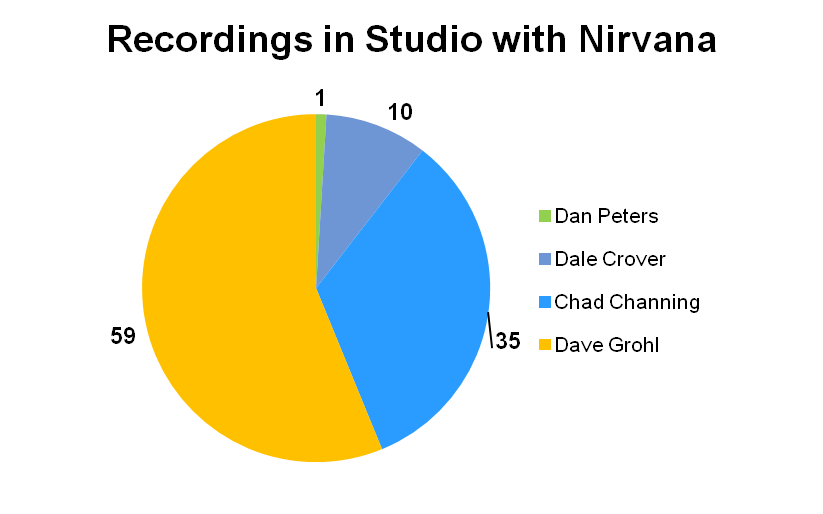
How about performances on record? Again, there are a few ways of examining it. Looking first at the record of Nirvana studio recording sessions:

Aaron Burckhard and Dave Foster simply didn’t appear on any studio sessions with the band. Again, Dave Grohl comes out as the leader appearing on 59 songs across seven recording sessions. Chad Channing, however, isn’t far behind having recorded 35 songs in six sessions. Dale Crover drummed on the ten songs recorded at Nirvana’s first session while Dan Peters was the man with the magic sticks for Sliver.

If one considered Nirvana’s TV and radio appearances only three drummers appeared; Dave Grohl drummed on four of seven radio sessions, Chad on two then Aaron on Nirvana’s first ever radio performance in May 1987. Dave, of course, performed all the band’s TV engagements.

In terms of songs released during the band’s lifespan, once again, the stats assert Mr. Grohl’s absolute dominance of Nirvana — 35 songs released compared to 26 by all Nirvana’s other drummers put together:

In summary then, Dave Grohl; the uber-drummer of Nirvana with 35 songs released of 59 recorded, 207 live shows and 42 months in the band. A comprehensive win over his rivals:

Tale of Six Drummers: Part Two

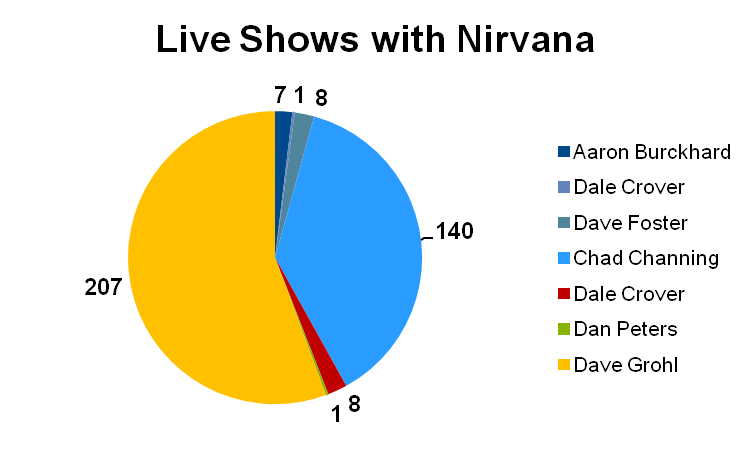
In terms of live shows, however, the picture changes even further in Dave Grohl’s favour. Dave put in a massive 207 shows compared to 165 in total for all Nirvana’s other drummers put together. Again, Chad Channing is second with 140 shows but then Dale Crover is in third with nine shows (one in 1988, eight in 1990) followed by Dave Foster with eight shows (a busy period belying his short tenure in the band.) Aaron only played seven shows in what was a very quiet 1987 while Dan Peters only played one:

The Hammer Party: Nirvana’s Drummers

Ask most people to name Nirvana’s drummer and they’ll come back with an enthusiastic “Dave Grohl!” (A.K.A. The Nicest Rock Star in the World.) As the band’s drummer on their two most popular studio albums (and on MTV Unplugged in New York) and the band member who has subsequently gone on to independent success in the music world, it’s understandable.

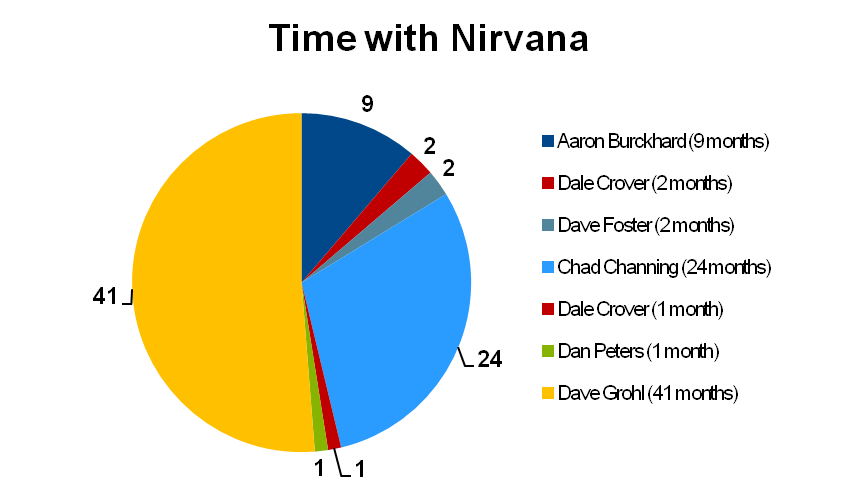
It’s interesting though to examine Nirvana’s drummers statistically, to understand further the contribution they made to the band’s career. The ‘Time in Band’ chart indicates length of tenure in the band commencing at the top in February 1987 then proceeding clockwise until April 1994.

Dave Grohl emerges the clear victor serving slightly longer than all Nirvana’s other drummers put together and the single longest tenure. Chad Channing, unsurprisingly is in second place but intriguingly it’s the overlooked figure of Aaron Burckhard in third.

Song Reconsidered: Sliver

Sliver was banged out in mid-1990 with a single one hour studio session plus one more session for rerecording the vocals. It was invented in a rehearsal session bare weeks before so it’s a remarkable product of a very specific period of time.

In terms of Nirvana’s musical direction, Sliver represents either the start of the Pixies influenced mode  (guitar quiet, voice lead verses, then all out roaring choruses) or, alternatively, an abandoned direction the band was experimenting with.

Slilver was something different. As discussed in the book Dark Slivers: Seeing Nirvana in the Shards of Incesticide, the song was a penultimate effort at a lyrical writing mode soon abandoned. Musically its approach was to start with no guitar, roar in for the first chorus, then keep the peddle to the floor right through to the end of the song. This was unusual. It doesn’t have a stereotypical Nirvana verse/chorus/verse approach. Instead the amplification comes on and stays on.

There are two songs to which it should be compared; Here She Comes Now, recorded shortly before Sliver, and the cover of D7 recorded soon after.

In all three cases the approach is the same, the song reaches a chorus, stamps the effects pedal and never takes the foot off. Kurt had long been a fan of the Wipers so it’s no surprise he would cover one of their songs. The Velvet Underground cover though came about only the request of a record label that Nirvana didn’t want to turn down – potential publicity and new fans not being so common at that time. Nirvana weren’t ruling the world just yet, they barely made any money.

Nirvana didn’t perform D7 in concert until late 1990, prior to its recording for the BBC. Here She Comes Now, however, was performed in concert in May 1990 making it the last NEW song to appear before Sliver was created. It seems possible therefore that Here She Comes Now influenced the creation of Sliver. Curiously, following Sliver, there aren’t many other songs that sound much like it. It would imply that Sliver’s place on Incesticide, a compilation showcasing abandoned approaches, was partly because it really was an experiment the band never followed up on.

Heart Shaped Box: The Musical Kurt and Courtney

This week Courtney Love’s co-manager revealed, under oath during a lawsuit, that Courtney is considering a musical of her life with Kurt Cobain. The immediate reaction from the world media was a combination of disbelief and yet more commentary on Courtney’s eccentricity. In the interests of playing Devil’s advocate, perhaps it wouldn’t be so bad?
Taking their tale apart there’s certainly a substantial quantity of drama that could be woven into a stage production — first meetings, drug bonding, beach wedding, Vanity Fair controversy, Kurt Cobain’s suicide threat at the time of Frances Bean’s birth, fights in Rio, all the way to Rome, Police attending the couple in Seattle, the drug intervention, last call and curtain close. A writer of quality would need to work out how to organize this into a properly structured plot but that’s a minor item to overcome. Likewise perhaps it wouldn’t be so hard to soundtrack each spell of their existence to a Nirvana tune — so long as one didn’t rely on lyrics matching on-stage action. Perhaps this combination of music and events could work?
Ugh…Who am I kidding? Yes, something could be done, but only in the sense that any idea could theoretically happen with money and will behind it. That still doesn’t make the idea of Kurt n’ Courtney: The Musical (A.K.A. Heart Shaped Box: The Musical) one that appeals. Green Day’s musical production of American Idiot gained credibility due to the band’s direct involvement. It also helped that it wasn’t tackling a true-life event that still carries emotional weight. Green Day have a playful, non-serious reputation also that meant critics and fans alike gave them the benefit of the doubt when the idea first emerged — it sounded like fun.
The musical life and death of the Cobain marriage really doesn’t appeal. It’s a plot arc retold only as a tragedy, one not lending itself to the fluffy uplifting style of a musical. The intended audience also seems unclear; if aimed at serious Nirvana fans then it fails to account for how horrified most Nirvana fans will be to see the band taken so lightly; if aimed at the average lover of musicals then is the unpretentious, un-melodramatic and unglamorous music of Kurt Cobain really what they would want to see? It seems a risky commercial proposition.
To emphasize, the only audience that would care about the life of Kurt and Courtney are precisely the audience who would find the topic far too sensitive a subject to be treated as a musical. I admire originality, of course, there’s not been a musical rendition of Elvis, Jim Morrison, Jimi Hendrix — but sometimes maybe the reason something hasn’t happened is for very good reasons.
I would happily read a Courtney Love memoir, her interviews and public statements have always been entertaining, intelligent, edgy and sharp. I can’t conceive of feeling the same sympathy if the tale was presented as a grunge Grease. A simple play, rather than a musical, might feel a little more appropriate — perhaps that’s all that’s meant by ‘a musical’? The music of Kurt Cobain would drift in the background as the story played out; no need for the cast to batter anyone with lung power.
There’s no denying there’s a story worth telling; it’s all a question of how. I don’t see evidence of Courtney having committed many sins against the memory of Nirvana. As a result I have faith that this will all turn out to be a lot of media foaming concealing a far less egregious truth.

Trends Continued.

Reinforcing yesterday’s post, let’s consider the circumstances in which the new songs on In Utero were created. There were few practices in 1992, very few live concerts (just sixteen shows after the Asia tour concluded in February, even altogether it was still Nirvana’s quietest year since 1988.) The October 25-26, 1992 demo session resulted in recordings of five of the pre-Nevermind songs that ended up on In Utero plus one new song (Frances Farmer Will Have Her Revenge on Seattle which had also been attempted at a session in April.) It seems likely that the disrupted nature of the October session meant only this number of songs could be demo’ed. All Apologies and Heart Shaped Box were certainly already in existence.

The January Rio de Janeiro session, again, seems to indicate a stuttering, halting machine. The Other Improv and Gallons of Rubbing Alcohol Flow Through the Strip are little more than scratch lyrics over meandering on-the-spot tunes (not a comment on how fun they are to listen to.) M.V. has barely twenty-five words and is little more than a doodle. I Hate Myself and I Want to Die has a sketchy demo feel. It leaves a feeling that they’re jamming these songs together on the spot rather than any deeper or more extensive process of creation taking place.

From February Nirvana is basically all over. One more song has so far emerged, You Know You’re Right plus the charming solo scrap Do Re Mi. There was always a lull after an album release (it happened in early 1989 and again in late 1991) but twice in a row now the lulls lasted at least a year. It doesn’t suggest a band that wants to spend time together, creating together. It feels rushed, like they’re getting back to their real lives after a brief distraction.