
Was delighted to see this review in the July issue of Record Collector magazine.
Was delighted to see this review in the July issue of Record Collector magazine.
Michael Gira: “Jarboe’s version of ‘Your Property’ on Swans Are Dead and Soundtracks For The Blind is awesome: there’s no effects on her voice, she goes down however many tens of octaves and sings those low notes by reaching into her belly and emitting these notes — she was fantastic in that way.”
During the interviews that led to the creation of the book “SWANS: Sacrifice And Transcendence – The Oral History”, there was one conversation, focused on his song-writing at the time of Cop/Young God (1983-1985 era) that truly enthralled me. I had to cut the tale down for the book but the original transcript reads:
“I remember reading Wilhelm Reich’s The Mass Psychology Of Fascism in ’83-’84 and it had a particular influence on the song ‘I Crawled’ from the Young God EP. In that book, if I can summarise it in a very plebeian manner, he draws the parallel between the typical model of the family with a strong father as a microcosm of the state. He talks about how that shapes behaviour and identity and helps to inculcate a kind of obeisance to authority very early on. It was written pre-World War Two, and he talks about the parallels between Hitler and Stalin, which was pretty prescient of him: he notes how both men reached back to this mythic atavistic past when everything was great in the country and their goal was to bring it back — they were like avuncular, paternal figures for the nation.
At that time, Ronald Reagan was being re-elected and I thought the parallels — though less overtly deadly and destructive — were very apposite. I wrote that song — “you’re my father, my father, I obey you,” and took it a step further. I had read this essay by J.G. Ballard Why I Want To Fuck Ronald Reagan and thought the image of Reagan fucking and choking me was an apt image for the times.
I had been obsessed with the media’s — not that the media is one entity or one conspiracy — colonisation of our consciousness, particularly in the west and capitalist corporate countries, its shaping of our identities and its formulation of the anxieties that compel one to consume: a recent phenomenon that didn’t begin until the end of the Second World War when advertising and production amped up and corporations had to create need. It had a lot to do with having all these factories after the war that needed to do something, so they began manufacturing anxiety in people so they would consume products. Nowadays that equation is rampantly out of control, culminating in the probable destruction of the planet and the species — all the horrible social effects from mass media on our consciousness and our sense of who we are on the planet.
I felt this whole process, along with working as a low-level wage slave for most of my life, was akin to being raped: being invaded against your will by stimuli over which you have no control and where you’re helpless as it impinges on your consciousness. That’s another reason I used the word ‘rape’, I felt it was what modern existence was. I carried that sort of imagery on for some time and then grew weary of it because it became a cliché in its own right to harp on such things. That was the kind of thing that I was obsessed with in those early days. The song ‘Your Property’ from Cop was probably another way in which I dealt with it, and Time is Money (Bastard), of course… that way of thinking about media, mind control, work as slavery, and consumerism was very much on my mind in those days.”
I’ve interviewed around 600 people in my spare time after/around work since 2012 and I’d not encountered an artist or musician who was able to articulate the imaginative process behind their writing in this way. Sure, I’d heard people ‘tell me the story’ of a song or what it’s lyrics related to – this was something else. This wasn’t just an emotional response. This was hundreds of pages of reading, clearly much independent thinking, intellectual and conceptual influences being woven together into a succinct, concise and tangible result.
The nearest comparison I had was a conversation with the painter Chris Gollon describing the painting he contributed to Thurston Moore’s ROOT remix/art project. He had received a 52 second composition from Thurston and it called to mind Native American burial grounds; a film called Jeremiah Johnson starring Robert Redford where the lead rides his horse through a burial ground; Chris’ studio on an island in the Thames formerly used for WW1 aircraft hangars and where the spice girls would rehearse; the studio next door which created prosthetic limbs which would hang from a washing line; Toledo Cathedral where cardinals’ hats are hung from the ceiling and left to decay; an art exchange between Mexico and the Glasgow Print Studio so he included a death mask; the title coming from Morpheus, the god of dreams, and the House of Sleep/Kingdom of Sleep…
To me, Gira possessed that same artistic intensity: the drawing together of disparate ideas into a composition as sharp, honed and visceral as ‘I Crawled’. I was stunned to really understand that behind the stark lyrics there was this depth: factories, fascism, Reich, Reagan, parents, working, media, the mind, consumerism…
…And Gira was able to grind that down to
You’re my father/I obey you/I want you to be my father/Eliminate my freedom/I know what I am/You know what I am/I’m weak/Take what’s mine/Come into my room/Put your hands on my throat/Now choke me, choke me/Make me feel good/Be my father/Make it right/Think for me/Choke me
You can see all the associations and wider connections flowing from fewer than a hundred words. My feeling is that it’s what makes Gira an excellent writer: that each word is precisely what is needed, but each word opens up an entire universe of ideas.
For a couple of years now Vinyl Factory has been allowing me to come up with brief spotlights on ten releases by an artist – always an enjoyable experience siphoning down to a certain core and bound to cause disagreement given my ten worthies very likely don’t mesh with many other people’s own lists. But that’s the fun of any public opinion, it invites others to say “no,” or to suggest alternatives. The funniest two comments I’ve received? Number one was on a Nine Inch Nails focused piece where someone wrote that not including Pretty Hate Machine or Still was a “tragic mistake which discredits the whole of your so called ‘introduction to NIN'” (answer: I love Still but had to leave something out while Pretty Hate Machine just isn’t on my list of favourite NIN releases at all.) The other was on a piece focused on Coil where, having listed all the things they would have preferred I include the comment said “It seems like some of these choices were poorly made – a lot of compilation albums that all have ‘Amethyst Deceivers’ on them.” To be fair, I agreed that remakes of Amethyst Deceivers cropped up probably way too much in the latter years of Coil – but trying to choose Coil releases is like deciding which diamond is most sparkly.
My view is always I refuse to write about an artist I don’t respect or enjoy (the two don’t have to coexist – I respect Radiohead but only enjoy them in patches. I don’t want to spend my limited time focusing on anything that doesn’t enthrall me – there are enough such distractions in the world.
So this month I decided to swallow the whole of Public Image Ltd’s discography whole, with a couple of John Lydon sidebars added on for good measure.
The greatest enjoyment I took from it? Comparing Commercial Zone to This Is What You Want…This Is What You Get! The original piece was two, maybe three times as long – there was just so much to say about the comparison. For a start, Commercial Zone gets that extra ‘gloss’ that sometimes adheres to anything that can be described as lost, secret, unofficial – anything with that outlaw edge. I wanted to try to disregard that and consider how it really stands up. Truth is it’s a mixed bag: some of the songs gain an eerie and atmospheric vibe in early demo form – if you like horror/sci fi movie soundtracks, it’s great. Other tracks though are just blatant noodling and tossed off time-filling. Thing is, that’d be a pretty balanced description of the official album too: so it just becomes a Pepsi/Coke question – depends on your tastes because neither is significantly above the other.
The least enjoyable moment isn’t visible in the final post: having to listen through Happy? (1987), 9 (1989) and That What Is Not (1992) in search of something good to say about them. It killed me. I respect and enjoy John Lydon’s work deeply: most artists are hard pressed to wind up with one truly significant band let alone two; to make one album that people might claim as an all-time favourite let alone three or four (depending on your take on Flowers Of Romance.) There’s something about that late eighties-early nineties British guitar pop tone that never hooked me even as a cheery nine or ten year old. The jaggly drums, the over-production, the gleaming plastic vibe of so much of that time. I just can’t fathom what Lydon was singing about by then: the mansion liberal substituting CNN for any contact with life – harsh but I see little evidence on those albums of it being unfair. Still! To digest them in detail and in full was something I’d meant to do for ages. Two whole weeks working those albums round and round, giving them all the energy I could, then realising it was hurting to write about one of them let alone all three.
The most obvious moment, well, sheer truth, I love the first three PiL albums: such a distance travelled, so many different terrains explored, words and sounds that work, humour and seriousness in equal measure – glorious. And the two comeback reecords have been very pleasing.
There was much made in the late eighties and early nineties of the influence of Jarboe over the turn in Swans music, then much comment on her absence from the return of Swans in 2010. My belief is two-fold: firstly, that Swans couldn’t continue without her by 1996-1997 and, secondly, that the present iteration of Swans would be impossible without the influence she had Michael Gira and the nature of Swans between 1984 and 1997.
The former seems inarguable. During interviews for SWANS: Sacrifice And Transcendence (http://smarturl.it/swansbook), both Gira and Jarboe made clear something curious: that the traditional understanding is that their relationship bled over into and affected the band while, in their view, it was the other way around. It makes sense: the ethos of Swans was so absolutist – so focused on making every show, every recording and every performance the zenith of what could exist in that moment – that each would leave their mutual love and affection at the door and show barely a hint of mercy to one another’s feelings. Swans had to be everything. Each would argue, critique, dissect and demand whatever it was felt a song might require to reach the heights. Jarboe had become increasingly prominent as a vocalist – by the time of The Great Annihilator in 1995 she sang fully five of the songs on the record – but also was contributing lyrics, working up music with Lary 7 and others then introducing it to the context of Swans (‘Volcano’, from Soundtracks For The Blind for instance was apparently intended as a Jarboe solo work with Lary 7 to appear on a compilation or a release outside of Swans), adding her instrumental textures to near every song performed. Swans would have been sorely lacking in contrast and surprise in her absence. More so, in terms of the functioning of the band, Jarboe and Gira were the ‘officer class’ and, to some degree, seem to have occupied good cop/bad cop roles with Gira kicking people’s ass while Jarboe rallied, mollified, persuaded and encouraged. Having the two poles can be extremely beneficial in any working environment (I’ve seen it fairly regularly in offices) because each pulls different positive responses from those they work with – it certainly has an effect when it comes to a music like Swans with its reliance on tension. At times, during the later tours, it seems the band would have quit if not for Jarboe’s persuasion and ability to raise spirits. Gira couldn’t envisage, in 1996, Swans continuing without Jarboe and he clearly couldn’t imagine making it work in the aftermath of their romantic relationship: their symbiosis had become the core of Swans.
The latter is a more nuanced point. Swans, in 1984, was at a turning point: when Roli Mosimann and Harry Crosby left, Swans consisted solely of Gira and Westberg – Gira considered abandoning music. Jarboe persuaded him to continue and was subsequently recruited to the line-up – Swans continued, in part, because of her. With Cop, Swans early template reached its fullest expression: the sound itself needed to change if the band was not to tread over old ground. Greed and Holy Money, for all their claustrophobic bludgeoning vibe, contained significant space – loud quiets so to speak – as well as Jarboe’s vocal contributions, even a piano. Gira would speak of his increasing disquiet at the component of the band’s audience who saw the music as nothing more intelligent than some kind of arcane heavy metal, loudness and heaviness just for the sake of it – that kind of predictability was unsatisfying. Jarboe possessed the musical education and knowledge that would offer Gira the new possibilities he craved – as well as the confidence and encouragement to learn and to try. Gira’s evolution into a genuine singer was the open door to Swans’ future and began with Jarboe teaching him rudimentary vocal techniques to build on and practice and develop. The Skin project, meanwhile, was an opportunity – paid for by Product Inc (Mute) – to gain experience and comfort working with acoustic instrumentation in combination with the possibilities of the studio. Again, everything learnt in Skin would bleed back into Swans making possible the flourishes present on Children Of God and the full-blown Americana of The Burning World – by the time of White Light and Love Of Life Swans’ sonic expansiveness was the new norm with guest performers, session musicians and other specialist musicians making regular appearances. Jarboe was no passenger, any more than Gira was a puppet: increasingly they were equals allowing one another the room and comfort to experiment and go further.
A significant side-bar would be Jarboe’s tireless work as Swans main correspondent with the fan community. Today it’s simply accepted that underground artists need to develop a bond with their audience in order to allow creative art to continue. In the case of Swans I’ve been amazed with the dedication and fanatical faith of the fans I’ve encountered: that relationship built over decades to become what it is today. In the eighties it wasn’t unusual for bands to write back personally, Swans simply took it a lot more seriously than some. Through fan mail, Jarboe made connections to artists like Deryk Thomas and corresponded with future band member Bill Bronson among others. She would also create Swans first website and messageboard offering an entirely new level of contact – very much one of the frontrunners in the independent music scene in that regard. The website was central to the continuation of Swans legend, legacy and reputation as the band itself exited. Via the site substantial quantities of interviews, CD-R live shows and other information were archived for discovery. Jarboe also made a point of using rare records and other Swans-related materials accumulated over the years as talismanic art objects, one of a kind objects of desire, meaning further weight accreted to Swans as an entity of ongoing significance. I specifically recall printing out and reading interviews at age 17-18 – few bands had an online site of such scale or depth pre-millennium (many still don’t today.) I remember considering whether I could afford a $100 dollar test pressing or to buy multiple shows from the 1996-1997 tour to observe the evolution of the music – I was sucked in and enthralled. This was one of the springboards that kept Swans present and enticing to new generations – they were relatively easy to learn of compared to many acts of the eighties and nineties who required substantial digging.
The connection between what Swans had become by 1996-97 – an omnivorous sonic palette encompassing whatever instrumentation, approach and delivery would yield the intensity of emotion and experience desired – and what it has been between 2010 and 2017 is very clear. The dynamism of the modern band, and recognising that its studio and live incarnations are quite different in many respects, has been what allows it to evolve and develop and continue to connect with an audience. That expansiveness arose out of the dead-end reached by the mid-eighties; out of the opportunities offered by Jarboe’s presence and the trust Gira had in her; out of the experiments she brought to the table. To this day Swans contains significant space for the contrast afforded by a female vocal or for found sounds and other interventions while the lavish instrumentation of the most recent albums has grown from the seeds planted in the mid-to-late eighties. At the time, some fans disparaged Swans turn to the esoteric – accusations of Gothicism were made – but it meant open-eared elements of the old audience, those who understood that true intensity didn’t just mean ‘loud’, stuck with the band while a new audience evolved who appreciated what it had become. Spanning generations and allowing for growth is vital if a band isn’t to become typecast, categorised, static and stale. Present-day Swans is very much the child of what Swans became after Jarboe’s influence and involvement.
One of those great lost hopes of the music scene, The Gits were on the cusp of breaking through to wider awareness and onward hope at the time the band came to an unceremonious and unfortunate end. A few years ago I had the good fortune to be in touch with Steve Moriarty of the band and I was delighted when I heard he was going to be creating a deep dive volume about the band and Mia Zapata – their iconic (and bloody awesome) lead singer.
One of Nirvana’s precious few shows in the first half of 1993 came about after the death of Zapata. Courtney Love persuaded Cobain to call the organisers of a benefit concert to raise money to investigate her death and to suggest Nirvana take part. The condition was there’d be no official mention of Nirvana’s involvement until the day itself – word of mouth only. The Gits were part of the new generation of bands emerging in the north-west (though the band originated elsewhere in the country) in the aftermath of Sub Pop’s initial success and the relative popularity and fame of the first wave of bands associated with grunge. This was the post-grunge phase rubbing alongside Riot Grrrl and such scenes.
https://www.revolvermag.com/music/swans-talk-pushing-their-bodies-live-performances-dangerous-limits
I personally created this excerpt for Revolver Magazine as the first brief public snippet from the book. I used the relevant section of the book, combined with other materials including a few elements there weren’t room for in the book itself to try and make something that really got inside what its been like on stage for Swans during the 2010-2017 run.
Why this piece? Frankly there was something horribly exciting in the way so many of the band and the people associated with it recall that night in New York City. This is a band that has played 600+ shows inside seven years and they still remember this night. There’s no exaggeration involved: everyone I asked recalled feeling like they would die – but this is NYC, this is their home town, they couldn’t help but give everything to the moment.
It captures something for me about the nature of Swans: this is the most HUMAN of music. What do I mean by that? I mean the music of Swans changes fundamentally based on who is playing it, the conditions on that night, the demands of the moment. While most bands hack through a known song in a known way, Swans twist and warp night-to-night, wanting the same thing in the same way, but better, higher, more intense. Everything is pushed to an extreme because the band know, for a fact, that playing music on stage isn’t just a reproduction of recorded sound, it’s a communication of energy between performers, space and audience. Live performance, at its finest, is a psychic moment never to be reproduced in which those watching can feel the drama, the tension, the euphoria and the pain being lived on stage. It ceases to be two domains – audience and stage – and becomes one space where everyone is a part of a feeling.
It always made me smile too that this was the night Michael met his future wife Jennifer. Beauty in defiance of death and pain? Is there anything more Swans-ian than that? It’s a very brief excerpt but there’s a momentum and a power to the shared memory that I felt was right to be the first piece given to the world.

Who doesn’t love a mystery? In 1982, after a frustrating few months auditioning potential members, Michael Gira and Jonathan Kane recruited Sue Hanel: “the most ferocious noise guitarist in the city” (Jonathan Kane). After several months of rehearsals, she took the stage with Swans at their first gig sometime in early summer ’82. Sue would perform with Swans for the next six-to-eight months, including the ten dates of the Savage Blunder tour with Sonic Youth in Nov/Dec, before departing after a final show at The Kitchen on December 27, 1982.
“There was an incredibly gifted, though also unstable and unpredictable, guitarist by the name of Sue Hanel who created a tremendous wailing sound but the problem was she could never replicate what she did from one night to the next…She was a very nice person, kind of troubled, but very down-to-earth. It just didn’t work out artistically because she just wasn’t interested in repeating anything: her sound would be different, her chords would be different, we could never pin it down — but when she hit the sweet spot it was tremendous.” (Michael Gira)
I’d seen the name about over the years and noted Thurston Moore’s Facebook post in early 2016 listing her as “One of the Best Guitarists Ever”. Underneath the post Wharton Tiers (engineer, producer, performer, gentle soul) had asked if anyone had any idea where Sue was now. Bob Bert (Pussy Galore, Lydia Lunch Retrovirus, Sonic Youth…) responded “I’ve been asking around for years, no one has a clue, she literally disappeared off the planet! I wonder if she’s alive! Hope so!”
Working on “Sacrifice And Transcendence”, naturally I asked about her: Swans first permanent guitarist. The compliments flew thick and fast:
“Sue Hanel blew me away—what a beast! Her energy reminded me a lot of Patti Smith at her most intense.” (Ivan Nahem – Ritual Tension, Carnival Crash, Swans)
“Sue is a legend to all of us who were part of that scene. She was this young lesbian girl who played the most incredible loud splaying guitar. It’s such a great mystery, how she vanished.” (Thurston Moore)
“It’s a real shame there aren’t any real recordings of her playing because she had this amazing guitar sound. Lee Ranaldo used to compare her guitar sound to brontosauruses fucking.” (Bob Bert)
Where did she come from? Bob Bert recalled “my wife — she wasn’t my wife then — she had this job as a photo retoucher and there was this girl that arrived from the mid-west, all wide-eyed and kinda preppy looking: her name was Sue Hanel. She said she was playing with this band Swans so I went to those two shows and, holy shit, she was!” I never asked but now I wish I’d inquired whether anyone even knew if her name really was Sue, or was it Susan, Susanna – was Sue a second name or a nickname?
She’s a presence on a smattering of recordings. On November 30, 1981 she performed at Radio City Studios for Glenn Branca’s Indeterminate Activity of Resultant Masses (Music For Ten Guitars And Drums), the recording of which didn’t emerge until 2006. May 14, 1982 she was at St Mark’s Church participating in Branca’s Symphony No.2 The Peak Of The Sacred (released in 1992). Sometime that summer she would contribute guitar to one track on the only LP by the band Interference with David Linton, Anne DeMarinis, Joe Dizney and Michael Brown – again, it went unreleased until more recently.
Though I’d be curious to learn more about her early years in NYC, she’d established sufficient reputation that she was able to contribute a minute-long solo track called ‘Agenda’ to the State Of The Union compilation in 1982. She also performed on the Peripheral Vision compilation for two tracks (‘Roughage’ and ‘Jargon’) with a drums-sax-guitar three piece called The State with Charles K. Noyse and Dave Sewelson.
Then that’s virtually it. Her live performances with Swans are on the Body To Body, Job To Job compilation and maybe she plays on the live performance added to the recent Filth reissue. There are three (?) CD-Rs available from TheLivingJarboe.com of a number of Swans’ 1982 shows. Where did she go after Swans?
There’s a brief reference online from New York Magazine listing a performance on Monday February 21, 1983 with Ann Caroline Chubb of the band Mofungo:

Jonathan Kane also states that he proposed bringing Sue in to play during the recording sessions for Swans’ first album Filth in April 1983 but the idea was rejected.
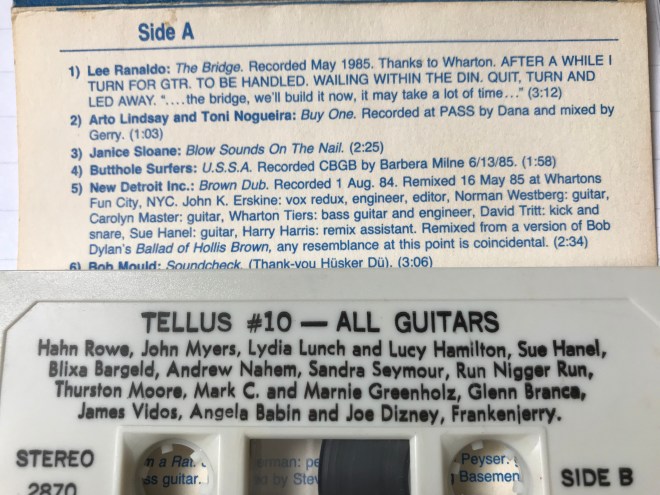
On my shelf I have the Tellus #10 All Guitars cassette and Hanel makes two final, fleeting, appearances. ‘Dupe’ is another minute-long solo track, undated and with no further details provided. How does it sound? A fidget of strings surging out of the speaker then retreating, volume pedal manipulation creating a wave effect, a held tone…Then it’s done. But I never expect a studio recording, let alone a solo guitar recording, to match the kind of power someone can rip live.
The other track at least sheds potential light on her place of origin: Sue performs as part of New Detroit Inc. with a batch of former natives of that area – Norman Westberg, Carolyn Master (who moved to NYC as part of Bag People with Al Kizys), then David Tritt of Rat At Rat R and Wharton Tiers. The performance, ‘Brown Dub’ is dated August 1, 1984: the last formal recording of Sue. It’s a strange track, is that Norman or Sue roaring over the top?
After that there’s a void. Bob Bert mentioned “in 1986 or 1987 I had this side-project called Bewitched and got asked to play a benefit show for a fanzine: so I asked Sue Hanel if she would do it. We got together to rehearse, I was doing something on drums and she was just going nuts on guitar then she invited me over to her place on 2nd Avenue. She’d been living there seven or eight years and I’ve never seen anything so bizarre: she had not a stick of furniture, no bedding, nothing — there was one folding metal chair, a boombox and a poster of Motörhead on the wall, otherwise it was barren. I asked her, “Sue, where do you sleep?” and she opened a closet and showed me a sleeping bag. Even when we did the gig, I’ve no idea what drugs she was into but she was drinking cough syrup. She got really skinny; she only ever wore black pants and a black cut-off t-shirt; black make-up circles under her eyes; and she was a bike messenger so I’d see her haring round the streets at a hundred miles an hour — then all of a sudden she disappeared and no one ever heard another word about her.”
Meanwhile Catherine and Nicolas Ceresole, who amid their other artistic endeavours provided a social hub for musicians in the NYC scene, recall “Sue Hanel was a crazy guitarist but a very nice girl too — she was also doing painting and I still have one from her. Then she disappeared. The last time we saw her was in New York City in ’89-’90: she got really sick and went to the hospital, then got even sicker because they gave her good food and she was used to eating junk.”
That’s it. Pre-Internet era so there’s nothing more to find. Did she leave town? Change name? Die? How old would she be? Who knows? Did she have family? There are Sue Hanels on the web but it seems unlikely they’re THIS Sue Hanel: born Oberlin (KS) and died age 57 in 2005; born in Aransas Pass (TX) died aged 55 in 2010 in Belleville (KS) having married an Alan Hanel in 1982; a Sue Hanel in Oklahoma who worked for a law firm but died sometime around 2011…Germany meanwhile is full of Susanne/ Suzanne/ Suzan Hanels. But there’s nothing suggesting NYC/midwest Sue Hanel had anything to do with Germany.
Asking around, the clearest response I received was “she was a junkie and I heard via the grapevine years ago that she was dead.” Blunt though it might be, and with no special insight, there are some fairly familiar elements at work in the story: the long absences, the way only one person I’ve encountered used the word ‘friend’ or discussed her in a way that seemed personal or up close, the cough medicine on stage, the talk of ‘troubles’, the ultimate disappearance…But, then again – even in the absence of our always-on, always-connected technological accoutrements and despite the sense that this isn’t someone who wrote letters or had a phone number – it would seem surprising if she’d died sometime in the late eighties, when she was still known to at least some on the scene, without someone noticing. The only thing I can think – macabre though it is – is a trawl of death records for New York City, an inquiry to the NYPD and a request they search their Jane Does…
…But then, there’s the truth: she’s gone. One way or another. A guitarist remembered as fearsome by all who saw her perform but one the rest of us will likely never know. I’m hoping I can gather more information about her and flesh out this picture and I know there’s a lot of people out there who hope she’s alive and well out there somewhere.
I had such good intentions to write up my Kurt Cobain/Michael Gira comparison (bear with me on this) but totally didn’t make it…
…So what am I doing that might amuse you? Well, I spent some time absorbing some intriguing work on YouTube: always kinda awesome what people get up to!
What I like about these is the construction of a fictional scenario to explain the context surrounding the making of each record in an imaginary world where Cobain lived. Then there’s the music: full band mockups built on top of shreds never taken to conclusion, revised mixes of work that it always would have been nice to hear without demo hiss, songs placed next to each other creating intriguing resonances and comparisons…The sheer workload that must have gone in impresses me – and what the hey, it makes for a good accompaniment to work on a Friday.
Covers of Nirvana have always left me a bit cold but the cheapness of modern technology has opened up this new avenue of exploration – hearing original Nirvana works tweaked and altered in different ways is intriguing. It’s also valid: Cobain’s death in ’94 leaves an utter void in terms of understanding any musical intentions. There’s simply such limited data that one guess is as good as another – it’s not something worth getting uptight about. Seeing the above in that context I just think, “why not?” and dig through the results to find moments I enjoy.
Also listening to Jpegmafia. The Sonologyst record that just came out on Cold Spring (I’m ALWAYS finding something of interest on Cold Spring: the Bleiburg 2 disc record was five quid well spent) http://coldspring.co.uk/2018/03/sonologyst-silencers-cd/#.Wxp4q4pKhPY
Best gig of the past month was catching Aidan Moffat (Arab Strap) and RM Hubbert at Rough Trade Bristol (really neat performance space they have – even if no one can open the bloody door to get in n’ out!) They were promoting their new record Here Lies The Body which sounds like prime-era Arab Strap (that’s a compliment) with renewed warmth and gentility. http://www.hereliesthebody.com/
Currently putting together a playlist related to the SWANS: Sacrifice And Transcendence. Music books always deserve a soundtrack!
I’m waiting now for the first hardcopy of “Sacrifice And Transcendence” to arrive in my hands. Swans are one of my ‘holy trinity’, the ur-texts where my taste really began: Nirvana, Sonic Youth, Swans. What spans my interests from age 18 to now, age 38, is the appeal – to me – of outsider artists, of people who chose to do something with no real hint that there was a reward beyond the experience and the self-expression. Of course, what now fascinates me is the individuals who manage to sustain their level of creativity and wide-ranging curiosity way beyond the point when most humans have given up on ‘the shock of the new’ and are, instead, mostly administering lives already set in stone.
For music famed for its use of mantras and cycles of sound, the lack of repetition across Swans’ albums draws me back to the music across all these years. From 1982-1997 – the original run of Swans prior to disbandment – the band’s sound would shift on nearly every release. EP-Filth-Young God-Cop-Greed-Holy Money-Children Of God-The Burning World-White Light From The Mouth Of Infinity-Love Of Life-The Great Annihilator-Soundtracks For The Blind: the level of evolution and growth displayed is extraordinary. More importantly, few other artists have managed to extend such a lengthy spell without going over old ground, making changes that sound gimmicky or ‘put on’, losing the sense that it truly matter in a “bet your life?” way. Even after all these years every one of their releases stands up to scrutiny.
It’s impossible to speak of ‘the Swans sound’ in many ways given that sheer variety: you might love the early Swans grind, or maybe the cinematic expanses of the early nineties is your Swans. Perhaps the in-the-room Americana of The Burning World hooks you, or you could prefer the ambient wash of Soundtracks For The Blind. Whatever. They’re all amazing albums. And what it took to bring them into this world: the era of indie labels meant no money for anyone ever – it was hard enough to get music out there in the first place and to claw one’s way up onto a respected indie…But Swans wound up fully independent: owning and paying for every aspect of the band’s music whether live or recorded. That’s no small feat: to not just stay afloat or continue to make music, but to continue to push forward, make advances, retain the level of acclaim and devotion that Swans earned.

The return of Swans in 2010 could have been a disaster – no doubt. But whatever strange alchemy exists within this entity remained. The first album, My Father Will Guide Me Up A Rope To The Sky, was masterful and – from any other band – would have been a career high. For Swans it feels, in retrospect, like a throat clearing (albeit an impressive one) prior to the absolute statement that was The Seer and the subsequent two volumes – To Be Kind and The Glowing Man – that make up an unofficial but acknowledged trilogy. It’s the first period of Swans’ entire career where a certain unified sound stuck around long enough to be honed, perfected and taken to it’s limits.
I’m simply stunned no one chose to wrote about this band before. Music that stands the test of time. A commitment to the art that goes far beyond normal drive and determination. A sound that has influenced or ignited numerous sub-genres of rock and metal that we take for granted today – while remaining a singular and solitary entity, never part of a scene. To even be one of the few bands that returned in the mid-to-late-2000s without milking nostalgia and/or disappointing on record would have been exceptional enough – but Swans went to create music that stands shoulder to shoulder with earlier peaks. I wouldn’t want to devote nights and weekends to work without passion…It requires a subject worth being passionate about. Swans is a unique concept and a singular entity in the world of music. How could I not want the people who were part of the band to tell me how it all came about and how it felt to make it?
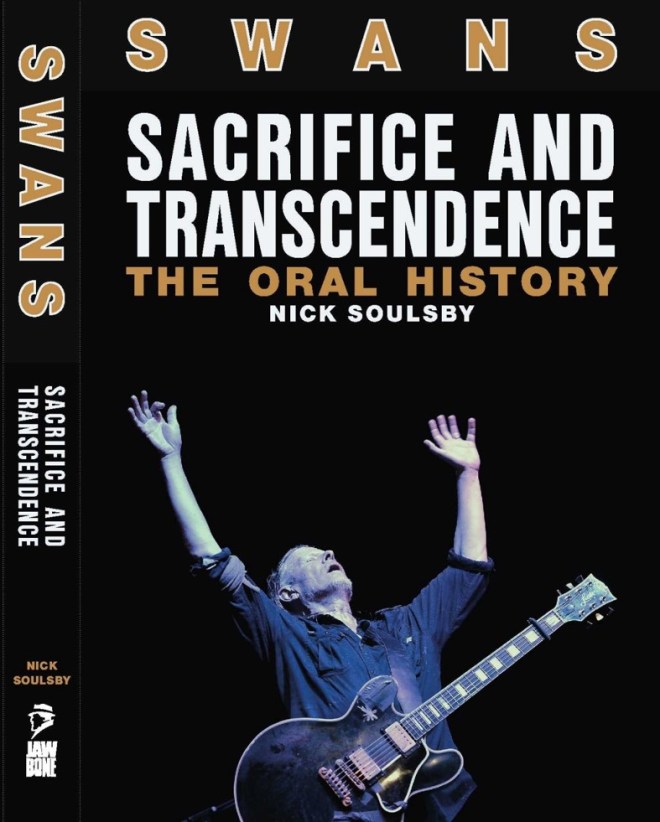
2017 was a full year here in Bristol. Around work and living, I conducted 140 interviews, with 125 individuals to create what I hope is a fitting testimony to one of the three bands I consider the ur-text and Holy Trinity at the root of my current tastes and musical interests: SWANS.
The book comes out on Jawbone Press on June 26 in U.S./U.K. (though, of course, can be ordered internationally from any decent bookseller.)
I think it often looks like an odd hobby to possess. One way to describe it is that I find it genuinely enthralling hearing other people’s stories and I enjoy conversation – so spending my nights/weekends listening…It’s fun! The challenge comes more from transcription: one hour interview equals two hours transcription, two hours interview equals four hours transcription – at one point Jarboe joined me on the phone for a gloriously enjoyable five hours, awesome (ordinarily I would rein things in at two hours out of simple courtesy: a desire not to treat people like fruit in a vice.) The usual desk-bound challenges arise: persistent back issues (six months of visiting an osteopath in amidst it all), repetitive strains in wrists and hands from typing, sore eyes from staring into laptops until well into the night, sore head and dietary over-consumption from simple tiredness…What makes up for it is the human communication of energy: there’s something transferred – excitement, enthusiasm, enlightenment – when an individual grants you an insight into their world and times. I would come off the phone line buzzed. I’m hoping that enthusiasm comes through in the final work and words.
 Nirvana Legacy