What’s Left? Wondering if…You Know You’re Right

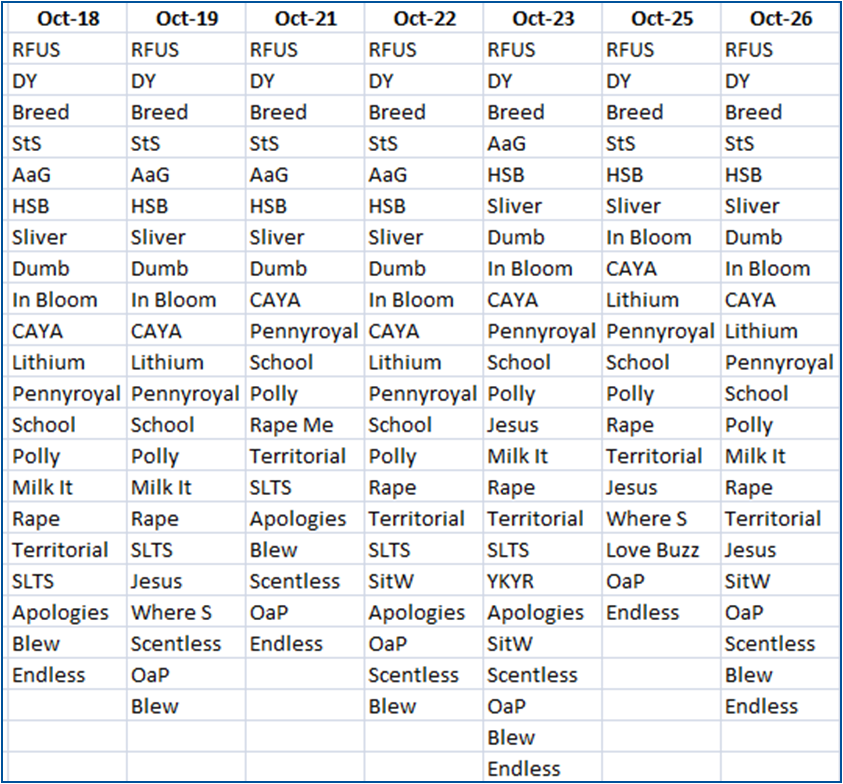
During this re-examination of Nirvana’s set-lists one of my fondest desires was the hope that perhaps the band had left more hints in the later years regarding ongoing work. The stimulation behind that hope was that Nirvana did indeed test a couple of new pieces on the In Utero tour; firstly You Know You’re Right on October 23, 1993 followed by an unknown song on November 12, 1993 in Fitchburg that surfaced again on December 29, 1993 in San Diego. While the 1994 set-lists seem too well-known, and too rigid, to offer hope that either song appeared, I wondered whether the Oct-Dec U.S. tour offered potential.

That phase of touring consisted of a total of 42 shows commencing in Phoenix, Arizona. You Know You’re Right was whipped out just five songs into the tour and in solid enough form that it suggests the September-October practices at the Universal City Soundstage in Los Angeles had involved decent time dedicated to the track. Certainly the song had been sufficiently rehearsed that when Dave Grohl announced “this is our last song, it’s called All Apologies,” only to be faced with Kurt kicking in the You Know You’re Right riff, he (and Krist and Pat) are able to lock step seamlessly without any sign of misfire or confusion.

Alas, forecasting whether these two songs may have appeared again gets tricky. Firstly, we have to make the assumption that they were unveiled in the order they were thought of and choose whether we believe the first known appearances were indeed first. In the case of You Know You’re Right there is a partial set-list from four days previous. Comparing the October 19, 1993 set-list to those that come before and after, it’s identical to the previous day’s concert for sixteen songs in a row and to October 22 for fifteen. But it is visible that the set-lists are still flexing — the band skip or add in songs and are still unsure of the final order. If October 19 is indeed missing songs then it would make it as long as the Chicago show — how tantalising.

Most likely, however, the set-list is missing Endless Nameless and/or Territorial Pissings, maybe All Apologies, or there’s a chance of Something in the Way… And yes, there is a chance of You Know You’re Right but the set looks near complete to me; Scentless Apprentice, On a Plain and Blew were the regular finishers even if the order wasn’t settled.

What also dims my hope of seeing any further surprise appearances by You Know You’re Right is that there haven’t even been any rumours of the song making it on stage despite the second Chicago show missing a few songs; I can’t imagine the song’s arrival on record in 2002 wouldn’t have refreshed attendee memories from October 25 if it had been present. Again, it’s a show with multiple candidates to fill gaps (most likely Dumb, possibly Something in the Way):

Set_Oct 18-Oct 26 1993

The appearance of You Know You’re Right was so out of the ordinary, akin to the insertion of Love Buzz the next day, or Dive for one appearance on Halloween, or Sappy the next year, that there’s no way to use statistics to do anything other than show it was unlikely. The only nearby candidate where we’re missing a few songs is October 27 which is missing its conclusion, a supposedly “mostly acoustic encore”, which makes me think on that date we’re looking for Something in the Way, maybe Where did you Sleep Last Night plus some iteration of the Scentless Apprentice/Blew/On a Plain/Endless wrap up.

As an aside, looking at the rest of 1993, there’s an intriguing case on November 29, in a complete set-list, where the band derail a pretty solidly established set by not playing Smells Like Teen Spirit or Come as You Are; given Kurt stops the set just before they would normally be played, having already inserted About a Girl in a different location, it looks like punishing the audience for some of the behaviour that was seen that night.

Now then…How about the ‘unknown’ song…? Let’s see tomorrow.

Questioning the Naming of Incesticide

A month or so back Brett R. raised a point of which I confess I’d been utterly unaware; that the same year that Nirvana released Incesticide, JG Thirwell (A.K.A. Foetus) had curated a compilation called Mesomorph Enduros and contributed a song called…Incesticide.

Naturally, having written a book wrapped around the Incesticide album it was a jolt, in the most pleasant sense, to receive a question I hadn’t even known existed; did Kurt Cobain invent the title of Incesticide or was it a phrase fortuitously delivered into his hands? It’s a tricky question to find certainty on given Mr. Cobain’s absence, so I thought I’d take the direct path and simply try and ask Mr. Thirwell his thoughts. He very kindly responded:

JG Thirwell_7 Feb 2013_Incesticide

Sure you can read it but the core piece reads “I already had the title Incesticide before the Nirvana album came out — I just thought it up, but I think it isn’t so strange that two people would think of that play on the word. I didn’t assume that he stole it from me, I just thought it was a coincidence (despite the fact that our mutual pals the Melvins and Jesus Lizard are on the Mesomorph Enduros compilation, which I curated.) I don’t remember what month that album came out.” To summarise further therefore, yes, JG Thirwell had the word already…But though an intriguing coincidence there’s still no clue whether Kurt Cobain, or someone associated with the Nirvana release, appropriated the title or not.
Let’s make the case for it being Kurt Cobain’s own invention then argue the counter-factual. Firstly, the title is a very Cobainesque phrase, whimsical word play was a fairly regular amusement for the man concerned, check his Journals (i.e., “Billbored…Bowling Stoned…”) for other examples. Similarly hygiene/disinfectant imagery wasn’t uncommon (Bleach, Incesticide/Insecticide, “kept his body clean”, Stain, Beeswax) while the dysfunctional family vibe had a recurrent presence. On top of that, the title fitted perfectly as the title of Nirvana’s family of orphaned songs and as his sarcastic Christmas gift to the masses (See https://nirvana-legacy.com/2012/11/13/incesticide-kurt-cobain-gives-a-christmas-present/.) All these points support JG Thirwell’s surmising that it’s just one of life’s coincidences.

On the other hand, it’s an unusual coincidence, a very specific one too — two releases both given an obscure pun on Insecticide in the same six month period. JG Thirwell’s song was certainly out prior to the Nirvana release as he states clearly. Similarly, the fact that both Melvins and The Jesus Lizard were involved, at precisely the time that Nirvana were conversing with The Jesus Lizard about doing a split single, has a nagging quality yet, again, it doesn’t come with anything approaching proof of a connection. In some ways I’m pleased if Kurt Cobain did actively think “yes! That title is what I need here,” rather than just splurging something down onto paper on a whim one evening in a hotel suite. It would indicate a moment of inspiration, a word he deemed perfect and appealing for what he had in mind.

What makes it all most tricky is that Mesomorph Enduros was a U.K. release at the time — despite Nirvana’s brief visitation to the U.K. in August there’s no indication if record shopping played much part in the trip, there’s no indication at all Kurt had a copy. Similarly, tightening the noose, the compilation was dedicated in memory of Charlie Ondras, founder of and drummer with the band Unsane, who died on June 22, 1992 of a heroin overdose meaning the compilation couldn’t have been released until July/August at the earliest. Nirvana meanwhile sent out the initial press copies of Incesticide around November 11, 1992 (according to Carrie Borzillo-Vrenna’s rather excellent Kurt Cobain: The Nirvana Years) but there’s no indication if the release was still under its working titles (Filler, Throwaways.)
Plus, I get stuck on the point about open theft. Melody Maker’s report dated August 15, 1992 is readily available explaining Killing Joke had just decided to sue Nirvana for, allegedly, stealing part of their song Eighties for Come as you Are. Borrowing a name isn’t in the same category but I could still probably accept a subconscious theft more than a deliberate one; unless there was an element of tribute about it, a tipping of the hat in the same way as “daddy’s little girl ain’t a girl no more” is so blatant it seems more a cheeky wink than a steal from Mudhoney.

So, yes, I’ll stop speculating. Where we remain is that though Nirvana were looking up songs for what became Incesticide from summer 1992, there’s no way of knowing when they chose the title unless Dave or Krist are forthcoming on the subject. Similarly, there’s no way of seeing what made that title the final selection, or when. Isn’t it nice not have the world locked down and filed away neatly…?

Nirvana’s Legacy

The website name had stuck in the head in the couple days before I got round to having to pick one. There was something punchy about it and I can admit it might be a steal from the title of Mick Wall and Malcolm Dome’s book Nirvana: The Legacy. I found the idea of that book inspiring but the content barely moved me being little more than a rehash of band bios of the time, an insipid quick dash over the top of the musical landscape of 1994-1997. The question remains valid, however; what has been the legacy of Nirvana?

Many people argue that nothing changed, that many of the old names stuck around, that the indie revolution never happened as expected and the charts remained flooded with manufactured product. Certainly grunge was the last gasp of rock as simultaneously a mass market phenomenon and a vital creative force — just as jazz ceded its position to pop and rock, rock was succeeded by hip hop fuelled R n’ B. That doesn’t mean that there was no legacy for Nirvana, it simply means that the market and industry changed fundamentally and that legacy wasn’t the multi-million selling multi-band phenomenon/movement they were looking for.

There’s a legitimate argument to be made that the hype around ‘alternative’ music was a gamble made by major label record companies who, deceived by the success of a small coterie of bands, were under the mistaken impression that a substantial market existed for punk-inspired or derived bands and therefore plunged energy into promoting the idea of the ‘alternative nation’. What they’d overlooked was that the triumph of Nirvana, Hole, Soundgarden, Smashing Pumpkins and Pearl Jam was a victory for the bands possessing a sound close enough to existing mainstream rock to sell well. Most of the bands that made it onto majors simply weren’t even close to pop of the stadium-filling U2 et al. variety.

On the other hand, while acknowledging the points around the ‘death’ of rock, hype and compromise, I’d argue that the quest to find direct musical heirs has led to the tangible evidence of Nirvana’s influence being overlooked. Direct musical heirs are an exceedingly rare phenomenon; popular culture may echo but it rarely repeats. The greatest artists are so inimitable that those who do follow their template precisely are never anything more than pale copies; that’s the category into which the saleable but critically distained bands that followed the grunge ROCK template in the late nineties (i.e., Creed) fell into. The zeitgeist had moved on.

Usually what happens is a degree of inspiration, an element of the sound is taken. As an example, the successors to Jimi Hendrix were arguably the axe-worshipping legends Steve Vai and Joe Satriani — the fact that each of those artists moved in very different circles to Hendrix’s increasingly funk influenced last recordings and were more enamoured of his soloing side than his abilities with the brief quality pop mode, obscured the link. Guns n’ Roses meanwhile owed much to both the Rolling Stones and to Led Zeppelin while also tacking on aspects of punk. There are plenty of arguable relationships but in bands of top quality the relationship doesn’t mean cloning; even Oasis were never identical to their worn-on-sleeve influences.

So, when looking for the legacy of Nirvana, simply demanding a carbon copy is a quest bound only for disappointment. The influence of Nirvana is of a different quality. Firstly, the wave of which Nirvana was the foremost exponent, hard-wired punk into the DNA of every key rock band that has come since. The solo-worshipping, high-note-busting style of rock that dominated the Seventies and Eighties was wiped from the mainstream map. Instead the high-achieving rock bands have spanned from Green Day, to My Chemical Romance, through Limp Bizkit (yes), to Rage Against the Machine, Radiohead and even Muse. Unless you want to try and argue the case of novelty band The Darkness, there hasn’t been a truly successful band mimicking the hard rock sound in over two decades. What died altogether was hard rock, that combination of pop production and slickness with the metal-edged volume and bombast.
Secondly, Nirvana ushered in a new emotionally detailed vocabulary for mainstream rock stars; Nine Inch Nails and Smashing Pumpkins certainly showed that there was a trend toward focused depression at the time of which Nirvana, arguably, was a part. Now, in the form of (oft-maligned) Emo, and with significant credit going to Weezer and The Descendants, there’s a greater openness to expressions of male emotional pain, a broadening of expression. Again, it’s not that Nirvana deserve the sole-credit for this but they showed it had arrived.

Thirdly, the sexism departed from the guitar-led musical world. The leather trousers, groupies and uber-mensch look shuffled from centre stage — it’s now such an oddity it even receives a defined sub-genre label, Sleaze Rock, when in the Eighties the rock world was dominated by this form. While the punk world in general had an openness to counter-cultural currents — hence queercore, Riot Grrl, straightedge, outright Marxism and even Bad Brains’ spirituality could all coexist — it was Nirvana who stated openly, over and over again, how ridiculous and retarded the sexism of rock had become. Again, the alternative nation did birth something.

Fourth and finally, Nirvana showed that there was finally an infrastructure that could give underground bands a sustainable means of living. The much vaunted Eighties underground scene had died a death — a bare handful of bands lived through it intact simply because there weren’t enough venues, enough music sales, enough fans, enough coverage to sustain them. Sonic Youth have stated that one of the best things about Daydream Nation as an album was that it meant they could finally give up having day jobs.
The four shifts in rock music that occurred in the early-to-mid-nineties are underrated because they’re impossible to pin to a single instigator alone; it’s hard to say Nirvana were wholly responsible, of course they weren’t, they were simply a defining part and the most important figurehead signalling the shift. So, if one is looking for a musical legacy, one that isn’t a parody, or that wasn’t a broad social force, what’s left?

The answer struck me most forcibly over the past three months as I’ve corresponded with numerous individuals worldwide about the book, the blog, Nirvana, life in general. Kurt Cobain was pure punk in that he wasn’t a guitar-worshipper, the music was a way of channelling emotion, spirit, fire, energy — whatever you want to call it. Krist Novoselic said in his eulogy on April 10, 1994 “…if you’ve got a guitar and a lot of soul just bang something out and mean it. You’re the superstar. Plugged in the tones and rhythms that are uniquely and universally human: music. Heck… use your guitar as a drum, just catch the groove and let it flow out of your heart.” This could serve as a rallying cry for any part of the diversified rock-influenced world from the indie end of the spectrum out to the wildest noise or drone. There are a vast number of musicians working today, rarely the famous, who were simply inspired by Nirvana to try something new, different. They may not sound too much like Nirvana but how are they not the heirs to Nirvana when there’s such a joyful racket being made as a consequence of that band’s short fire?

Below is my copy of the Fuck Brett birthday LP courtesy of Feeding Tube Records — the eponymous Brett is a huge Nirvana fanatic and musical creator. On the shelf behind me is Nerd Table’s Chasing the Bronco CD, Adam Casto, leading light of the band, told me specifically that his way of creating something personally positive from the demise of Nirvana was to seek out every former member of Nirvana he could and try to collaborate with them; again, beautiful. A fellow called Adam Harding has shared a demo — you’ll have to wait and see — that wears his early Nineties alternative nation vibe loud and proud while taking it a step forward. There’s an artist I’m in touch with in Scotland, hi Marcus(!), with an intriguing Cobain-related project. I even heard from a member of Trampled by Turtles (http://trampledbyturtles.com/) the other day — so many Nirvana fans doing creative stuff, that’s the legacy. Heck, ever since Nirvana, and despite a complete lack of ability, I’ve always held up creative action as the highest form of human activity and life.

There’s a lot going on out there even if the media would prefer straight lines, clear quotes and family ties. Will there be another Nirvana? It’s hard to find likely candidates given the most crucial elements of Nirvana were unpredictability and a soul-deep amount of damage residing inside…But keep looking.

IMG-20130203-00092

Final Resistance: MTV Live n’ Loud, December 1993

Yesterday we mentioned the opportunity for the exceptional, the unexpected. Today I present to you the evidence that yes, reality can break its rhythmically predictable bounds. That evidence comes in the form of the MTV Live and Loud performance of December 13, 1993.

A single, barely fluctuating set-list persisted throughout December 1993 with only minimal changes right the way to the grand finale on March 1, 1994. The only time that a significant step away from the normal sequence occurred was for this single performance broadcast by MTV. In amid a tour consisting of a barely shifting choice of songs this performance freshened things up.

At first glance it seems a fair conclusion that Nirvana still felt TV appearances had significance, had more focus from senior management, and therefore had to be taken seriously — it can be seen in the fact that the band bothered having a proper rehearsal for it running through ten songs. The question follows whether the band needed to create a fresh one-off set-list to match the show time allotted and whether that show time was arbitrary or was set by MTV; the show featured just 18 songs compared to between 22 and 25 at every other show that month.

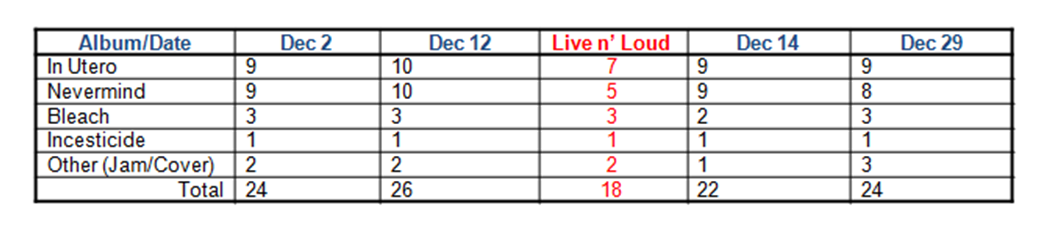
It’s clear that Nirvana used MTV Live and Loud as a showcase for In Utero. The band had to cut songs to match the time permitted. They cut between 3-5 songs off their normal set from Nevermind, but only 2-3 from In Utero; meanwhile they kept their three usual grabs from Bleach (Blew, About a Girl, School) and Incesticide’s usual sole representative (Sliver) — no cuts lost from the commercially lesser albums despite the sense that would have made at an event about promoting the band to the mainstream audience of MTV. A normal set list at the time featured the following breakdown divided by album (various dates for comparison):

Live n Loud Comparison

It made perfect sense to cut from their best known album if the priority was simple boredom, however, as with my commentary back in December regarding MTV Unplugged in New York) there appears to be a similar refusal to give MTV the favourites given an aversion to Nevermind doesn’t affect them at any other point in the tour. The most glaring case is that this is the one and only time in December that the band doesn’t play Smells Like Teen Spirit. In fact it’s one of only nine occasions on the whole Oct 1993-Mar 1994 In Utero tour that the band didn’t play it; the last time until Nirvana’s final gigs on Feb 27 and Mar 1, 1994. Also, it’s the only occasion throughout the whole tour when Nirvana simultaneously cut In Bloom — another crowd-pleaser.

Certain cuts make absolute sense in certain contexts; the removal of the mellow Polly, Jesus Don’t Want me for a Sunbeam and Dumb are understandable deletions — bringing Lori Golston’s participation on cello down to a barely audible part on two songs — if the desire is to maintain tempo uber alles just as surely as they were extremely reasonable additions for MTV Unplugged in New York where the contrasting desire was to the fore.

The opposite desire is also visible, the urge to increase volume and heaviness; according to the Nirvana Live Guide the MTV Live and Loud appearance was the final time Nirvana finished a gig with a rendition of Endless Nameless and one of only three appearances it made after October. On this occasion they spent a full fifteen minutes, a fifth of their time on stage simply making a glorious and utterly un-MTV friendly racket. It’s the most extensive destruction Nirvana staged at any point in the In Utero tour, a harking back to former stage-wrecking glories that had since been given up. I also suggest it served a function; it meant Nirvana could fulfil an allotted stage time while simultaneously cutting short the amount of usable material MTV had to work with. The band had simply walked out quarter of an hour early during a previous live appearance on MTV in 1992, this time the sense of time-wasting is tangible — look how much aimless yet calmly methodical activity Kurt persists with during that final spell; ramming the guitar into the speakers, ‘baseball batting’ the angel stage set, treating his guitar as a skateboard, a persistent effort to hit the ceiling with his guitar, lots of running directly at cameramen who back away nervously, or alternatively moving away as they try to shoot him.

It returns us to the question of running time — a Nirvana show in late 1993 consisted of well over twenty songs, perhaps with a jam on the end but usually not. On this one occasion the band played 16 full songs then fifteen minutes of noise — they could have fitted at least another four songs in but for whatever reason chose to resurrect the noise jam and destruction rather than play out another tranche of hits. It’s sad, however, that at this point in time, the urge to change meant cutting from the normal set-list rather than thoroughly revising what the band was capable of playing together. The absence of rehearsal time, of time together, was showing.

Throughout the audible antagonism toward MTV there’s quite a few element of further aggression. For starters he beckons the audience on stage, anathema to MTV directors who might prefer to look after their expensive cameras rather than face an stage invasion by adrenalized mosh-pit junkies. Around that Kurt amuses himself spitting on camera lens forcing a switch from camera to camera as they clean the previous one — he’d done something similar at the start of year, exposing himself to a camera on stage in Rio de Janeiro. The applause to the audience at the end is a sarcastic move taken direct from comedienne Joan Rivers who usually starts a gig (and ends it) insinuating the audience are performing seals.

MTV Live and Loud was the last significant deviation from script for Nirvana. It was a last defiant roar at the cameras, a refusal to play to or please the wider corporate audience (regardless of the desires of the audience in the room) and yet another reinforcement of Kurt Cobain’s highly uncooperative relationship with TV that ran all the way through Top of the Pops, The Word, Saturday Night Live and all the band’s MTV performances.

I reedited this at 22.00 UK time because the image that had stuck with me all day was exactly the kinda overloaded final thought that journalists usually end an article with – all the image consists of is Kurt Cobain, alone on the stage for the final five minutes of the show, menaced by or menacing the cameramen, trying to throw is guitar as far up and away as he can, completely divorced from the band and obsessively going through whatever internal processes that keep him there jerking from one act to the next in a whimsical and unhappy looking manner. Take a look, isn’t there something a bit scary about it in retrospect? Maybe. That’s the problem with final images, they never live up to billing.

What’s Left? Re-examining the Live Record 1993-1994

Working from yesterday’s material regarding the scale of the gaps in the live record of Nirvana, I want to lay some hostages to fortune, a few gambles on what I feel may still be there.

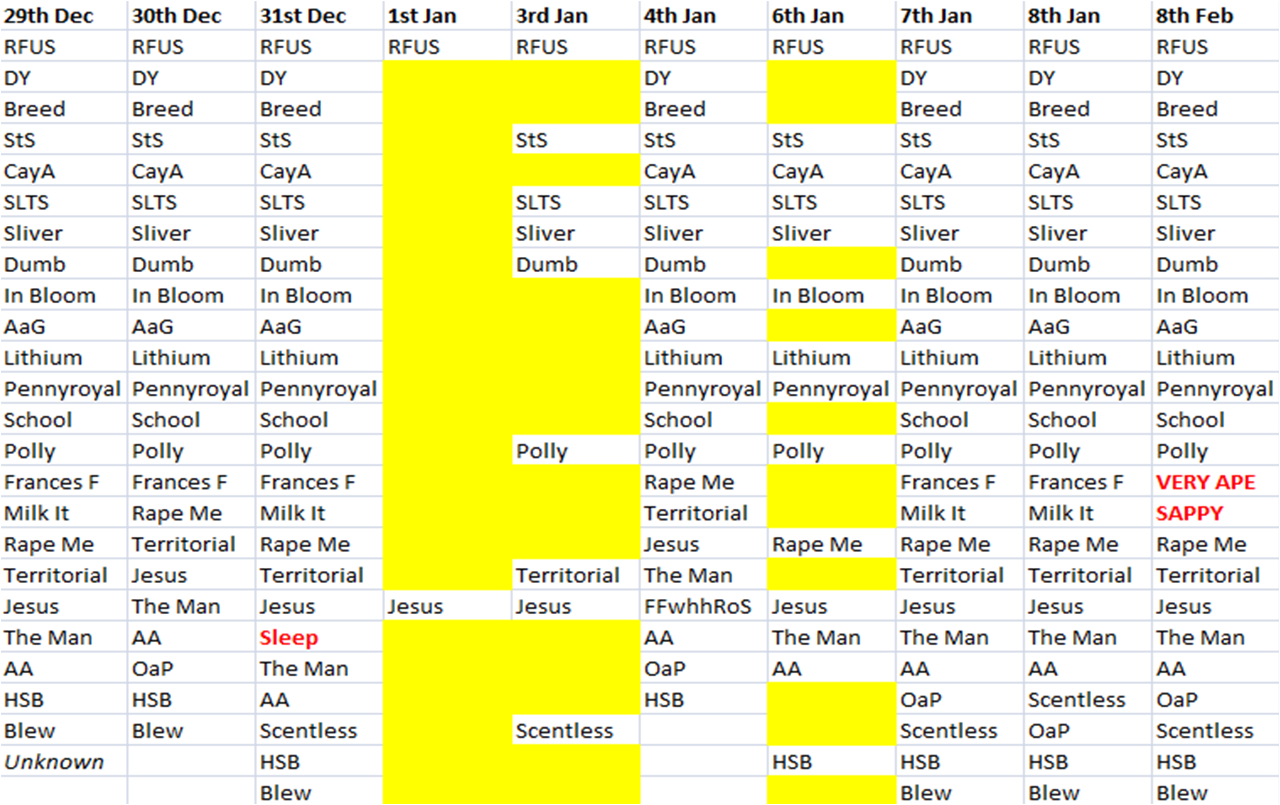
Firstly, an easy one, 1994 — there’s not much left to see. There are three incomplete set-lists but no unknowns. I’ve kept the songs in the order they appear in the Nirvana Live Guide — the guide makes a real point of keeping songs in the order of performance — but the spacing added to January 1, 3 and 6, 1994, the three incomplete sets, is my own. It’s fairly easy, in my opinion, to work out the missing songs:

29Dec1993-8Feb1994 Set-Lists

We’re looking for common patterns and regular ‘units’, by which I mean sequences of songs that are almost always played together in a particular order. There are quite a few to observe. Firstly, the opening salvo of fourteen straight songs on the seven surrounding dates we’re using for comparison here are identical. We can go further to reinforce our case, that sequence of fourteen songs varied only three times during the 14 remaining shows in 1994; Rennes in France (a minute and a bit riff on My Sharona then a brief noise jam), Marino in Italy (a brief jam on Run to the Hills by Iron Maiden) and Nirvana’s final gig in Munich (inserting The Cars’ My Best Friend’s Girl as the opener). In each case, the interruption or insertion ended then the normal pattern resumed. Looking in the other direction the shift is just as minimal; Nirvana play the exact same sequence right the way back through December 1993 with the only changes being they skip Lithium on one occasion, they skip About a Girl on another. There’s one other notable exception we’ll return to tomorrow.

It’s the ‘back end’ of any gig where we see the set-lists still flexing a little but there are still discreet units that we can see in the dates around the partially known set-lists. Firstly, the Rape Me/Territorial Pissings/Jesus Don’t Want me for a Sunbeam trio is a rigid feature fitting perfectly into the known details of January 3 and 6 — there’s nothing suggesting that unit would have changed. Likewise, the songs making up the ending are consistent, a combination of All Apologies, On a Plain, Scentless Apprentice, Heart Shaped Box and Blew. These songs do drop in and out — for example, the Nirvana Live Guide states that an attendee reports Scentless Apprentice wasn’t played on January 1, 1994 which would still be consistent with both December 30 and January 4. We have no way of knowing what combination was used but I’d put money on it being an iteration of these five songs on those three unknown dates.

The only unusual feature I’d be willing to gamble on seeing would be the possibility of a single song; we might see Where did you Sleep Last Night. The song was played only once in 1994, in Paris on February 14. That makes the December 31, 1993 performance the penultimate live rendition, unless, on January 1 or 3, that song makes its last but one appearance. That’s what might be hidden here if the available, comparable data indicates realistic possibilities.

Of course…There’s always room for unrealistic possibilities, for wish fulfilment and dreams. Maybe something unpredictable did happen, maybe one of these three shows saw the equivalent of the Off Ramp performance of 1990 where Nirvana hauled out every rarity they could think of; or maybe there was a single rarity or last hurrah (like the one-off appearances Sappy made at the start and end of February); or maybe the band, on a whim, decided to rewrite the entire set-list for one show only — we’ll talk about that tomorrow — but this puts us into the realms of fantasy. Cold weighing up suggests we know exactly which songs were played on those three nights; the first fourteen songs, in order, then the aforementioned trio, then some combination of the closing five possibly with a Where Did You Sleep Last Night.

What’s Left? Re-examining the Live Record

I hold out little hope of many genuine Nirvana originals remaining unreleased, though it’d be nice to draw together more polished versions via an official channel of the remaining pieces left from the studio record and to expand the rehearsal and home demo pool. I feel, however, that I’ve underestimated the live arena as a potential source of intrigue…

Firstly, a thank you to my comrade Shrikant for doing so much good work for me — the inspiration for this exercise and the data work required to visualise it and express it. The completeness of the record of Nirvana set-lists and performances is remarkable as demonstrated by a glance at the Nirvana Live Guide. It is not complete though. It’s the gaps between knowing that are of most interest here. The table below inverts one that I’ve used regularly and instead of showing how many performances are known it shows how many aren’t:

Unknown Shows_Number-Percentage_1987-1994

That’s a curious thought, that the two-thirds of known shows have exposed a wealth of unusual jams, covers, a few alternative versions — but that there’s a third of Nirvana’s shows, 128 gigs, that could, theoretically, still be found.

We can go further and actually suggest how many songs there are lost within that realm to at least a moderate range of possibility. The fully known set lists allow us to define an ‘average’ number of songs played per gig throughout the band’s career — of course the range from peak to trough is wider so an alternative is to look at the normal range to try and give a more stable indicator of what might be possible here. Discounting 1987 (the average is nine given the two known live gigs, not counting the radio performance, featured eight songs and ten songs respectively) we can work out roughly how many more Nirvana live songs are out there:

Average No of Songs_Range_1987-1994

So. If, by a miracle, it turned out that Nirvana had been scrupulous at retaining tapes of their own live shows or set-list records, and the Nirvana camp were willing to open up that archive to fans, there are three figures that we could consider to stoke or temper our fervour. If things stayed tight to the average we’d be looking at 1,971 as yet unknown song performances. If the remaining shows strayed toward the lower end of the range, then we’d only be dropping down to 1,506 songs, but if our dreams were realised and the treasure trove hit the higher end of the normal range then there could be the amazing sum of 2,445 unheard Nirvana performances waiting to be savoured.

It’s a comforting thought. It’s lovely knowing that whatever dissection and parsing I conduct here, there are still somewhere between 1,500 and 2,500 ways my more gloomy conclusions could be proven badly wrong. Brilliant! In the meantime I’ll keep an eye on the Nirvana Live Guide and keep hoping for ever more people to come forward filling in the gaps.

The Effect of Childhood Trauma

A lot of years ago a girlfriend told me to think of the mind as a mould being filled layer-by-layer. In this vision, what happens as a child sets deepest in the mind, the layers that come after lie on top of that underlying shape and either fill or follow its kinks and defects. Quickly the mind fills, the fundamental nature of the mature mind is built on either the solid foundations or the rubble of what has happened to that young head. I’ve never seen reason to disagree with this vision.

http://bmjopen.bmj.com/content/2/6/e002089.full

The above report was published just before Christmas on BMJ Open, a well-respected and important online medical journal, and ties in neatly with the material on Kurt Cobain’s living arrangements pre-adulthood. It comes to various conclusions but the essential one is that childhood trauma and adversity is a key factor in premature adult mortality. Essentially, while people would recognise the limitations of a child missing a limb or having a physically limiting characteristic as an acceptable reason (not excuse) for later limitations, people still find it extremely difficult to understand something in the head as a mental wound or injury that can create similar limitations. One would recognise the relative futility of saying “just get over it,” to someone who was visibly disabled; by contrast, unless someone is notably mentally incompetent, the illusion of ‘normality’ leads to frustration among observers in the situations that expose that mental disability to full view. Instead of realising that someone basically can’t act normally we observe their unremarkable physical appearance, verbal communication, basic functioning and decide they’re just like us, capable of making the desired decision, doing the desired act, if only they would try or choose to. It’s hard to recognise the indents in our own ‘mould’ that predispose us to refuse certain ways of living — unless a mental dysfunction steps over the bounds into what is deemed socially unacceptable, we consider it normal, rather than the injury (minor or otherwise) that it is.

In the case of Kurt Cobain, it’s remarkable he functioned as well as he did. Many people get over a parental divorce with no adverse effects; it’s unreasonable to demand though that the event mean nothing to anyone — Kurt Cobain was one of the ones for whom it did have meaning. Similarly many families move around (I lived in six homes as a child) but his was an extreme case — a direct consequence of the divorce and one that brought with it additional challenges in terms of shared accommodation and temporary living. From the time of his parents’ divorce to when he was fifteen he went through three homes, by age seventeen he was temporarily homeless and had been dumped from home-to-home like package. His puberty, a crucial period of development, was heavily insecure, loveless, abandoned.

This isn’t a plea or an excuse; don’t confuse a reason (i.e., why someone does something) with an excuse (why someone does something and therefore they’re not responsible or it doesn’t matter). In the case of Kurt Cobain there were good reasons for him to grow up a less than secure adult. His family history (multiple suicides of close blood relations, etc.) suggests there may have been a genetic factor predisposing him toward depression also. The study used a standard and approved questionnaire for measuring adverse childhood experiences (ACE) — Kurt Cobain would have ticked boxes for four of eight markers; substantive verbal abuse, living with a depressed person, a separated family, domestic violence.

Under a third of deceased stars possessing no ACEs died through substance use or risky behaviour, this increased to 41.9% for those with one ACE…Then 80% of those with two more more. Kurt Cobain fit firmly into the latter category. Combine that with the overall pattern identified — that music stardom does increase mortality above that of the general population — and in the specific case of Kurt Cobain there’s an individual with substantial indicators of likely risks as an adult, who goes into a profession that increases the risk further.

Later in the report a separate study is cited, one looking at the general populace and which concluded that adults with four or more ACEs were at “7.4 times greater risk of alcohol addiction, 4.7 times greater risk of illicit drug use and 12.2 times greater risk of attempted suicide.” Again, all we’re seeing is that childhood trauma embeds tendencies in the mind that are hard to overcome or simply ‘shake off.’

We are not dictated by our past, our reactions are not preordained — this is a positive, we do have choices. The majority of people, however, do not live lives that are the exception to the patterns set by socio-economic circumstance, parental income and situation, or the traumas that burrow deep into the clay of the mind with successive years flooding but never erasing the hole. I take it as an inspirational example that Kurt Cobain achieved world-bestriding accomplishments during his brief time on the planet, in spite of the recognisable and clear reasons (multiple childhood traumas, homelessness, medical issues, dietary issues, poverty for all but the last two years of his life, escalating drug use, the stresses of unstable living conditions) why he could have simply disappeared into the places society reserves for our injured; a combination of jail, living on the streets or simply being forgotten all life-long. He was an exceptional human being, who made something of himself on top of and in spite of and because of what had hurt him…It didn’t mean he had the means or the opportunity to survive the injuries he carried with him.

Battle of the Birds: Kurt Cobain’s Girlfriends

An immediate apology for flippantly using the term ‘birds’ just to come up with a slightly more catchy title to what is a relatively flippant bit of data-play. As a proviso it’s safe to say that this post isn’t entirely serious — it’s merely a tumescent growth that arose from the work done this week on Kurt Cobain and the subject of his living arrangements. There’s a risk in the title, of course, of suggesting that one or another individual could be held ‘responsible’ for whatever peak or fall occurred in Kurt’s creativity — as I’ve made clear before (see the “www.nirvana-legacy.com/2012/11/20/if-she-floats-in-defense-of-courtney-love” post) I genuinely don’t believe anyone other Kurt Cobain was responsible for these trends.

Having looked at the matter of where Kurt was when he wrote the majority of his songs, I wanted to examine who was his key, official, partner during these periods of time. As a second disclaimer, I’m doing this because I’m feeling playful; as an exercise it’s a perfect example of how any data can be compared to any other data whatsoever without leading to enlightenment or meaning — why do it then? Sheer curiosity. Not everything has to lead somewhere or mean something to be worth taking a crack at.

Discounting Mary Lou Lord who apparently backed up Kurt’s statements that they had never been romantically involved, Kurt Cobain was attached to three individuals between early 1987 and his death; Tracy Marander, Tobi Vail and Courtney Love. In each case, the relationships have been reduced in the retelling — to dependence, one-way head-over-heels, to mutually destructive passion — which probably has nullified any sense of the enjoyment and pleasure taken from all three. That’s not uncommon, question most people about their ex-partners or judge the relationship in the rear-view mirror and they end up being judged by the outcome not the time-specific experience, which is a shame.

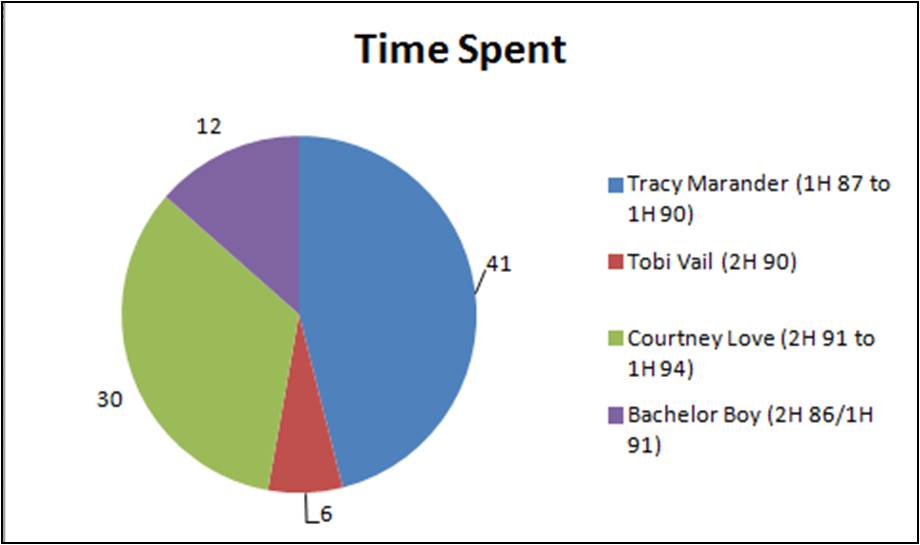
Tracy was Kurt’s first real girlfriend and lasted from around January 1987 until May 1990 — 41 months. Tobi was the whirlwind in the middle making it less than six months from May to November 1990. Courtney arrived as a permanent fixture in October 1991 — 30 months:

KC_Girlfriends_Time Spent

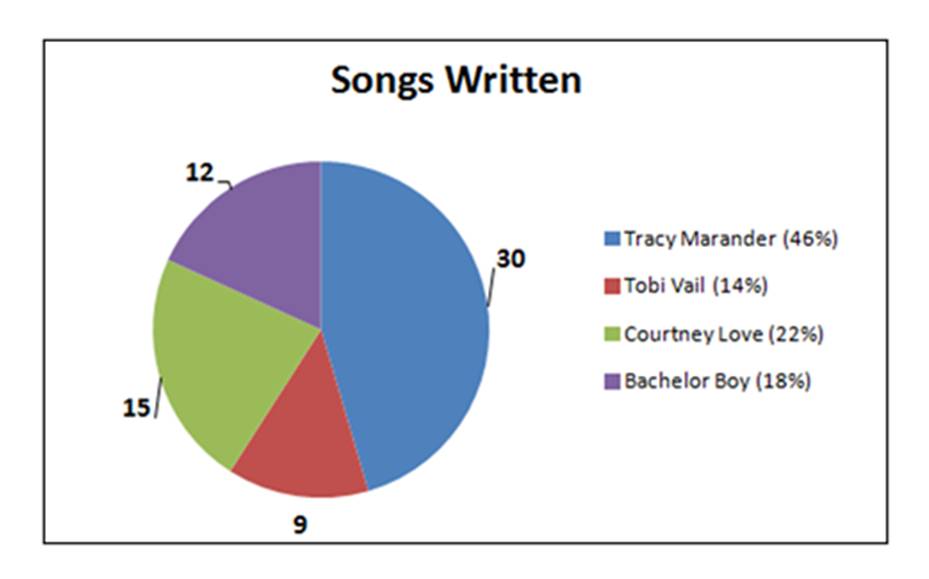
Now…What did Kurt Cobain do during those periods of time?

KC_Girlfriends_Songs Written

A solid victory for the time spent in Olympia with Tracy Marander but, as usual, fun to look at the percentages also:

KC_Girlfriends_Songs Per Month

Told you it was fun to look. Suddenly it seems that the periods of domestic stability didn’t come close to the rough n’ tumble of Tobi and her loss. So, if I felt like being cynical I’d say “guys, if you want to make things happen in life — ditch the comfy woman!” But I’m only teasing. The coincidence of Kurt Cobain’s freedom, solitude, non-drug addiction, favourite drummer, major label shot and so forth all made late 1990-early 1991 a massive time for Kurt Cobain. What we’re looking at is a flaw in the data; it’s unclear how many of the songs I’ve placed in the second half of 1990 were in fact created prior to Kurt being dumped by Tobi, just as it’s unclear how many of the songs written in the first half of 1991 were finalised before Courtney’s arrival.

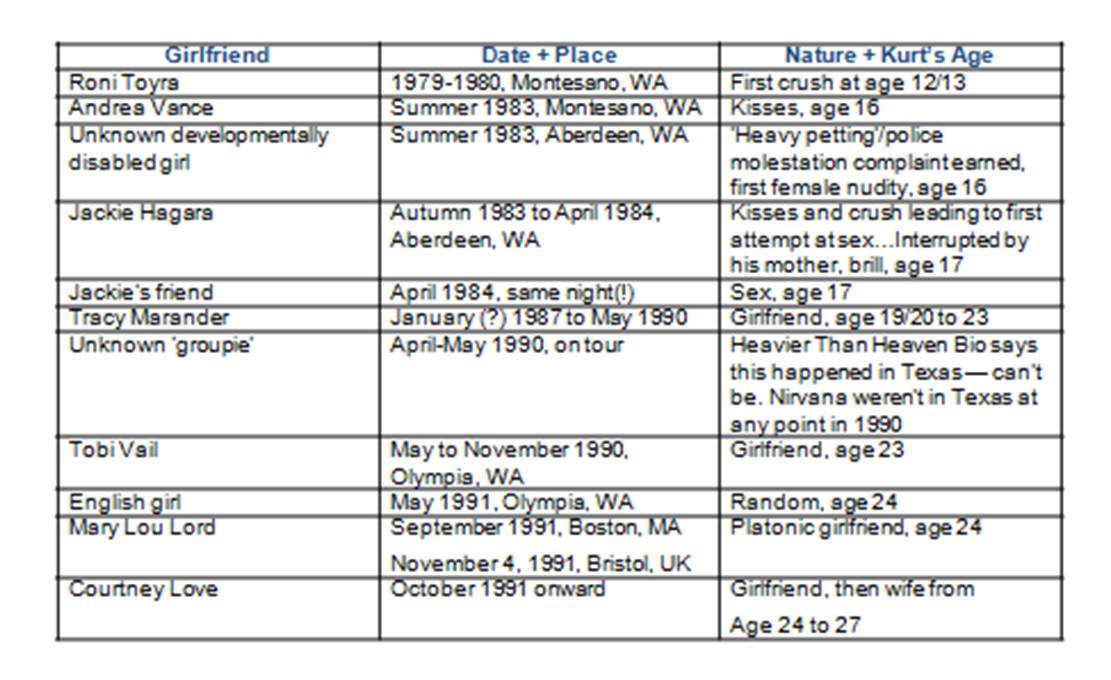
Sighhhhh…All this work just to conclude that not everything gives a meaningful correlation and that statistics are indeed the playthings of the data devil. Oh, because my friend asked (thank you Josephine! This one’s for you!), here’s the full record of Kurt Cobain’s known dalliances with the female of the species, as noted in the book Heavier Than Heaven, just for her. And yes, it feels voyeuristic and intrusive listing all this but for the sake of completism:

KC_All Girlfriends and Female Encounters_Table

Addendum: Cheers to Selena for raising this. The summer 1983 incident is controversial. Buzz Osborne has suggested its completely untrue – meanwhile it’s been cited twice including a full audio recording of Cobain seen in Montage Of Heck. Unfortunately, despite the ‘story telling format’ of the audio recording, despite Buzz’s reservations regarding whether public shaming in school happened at all, it’s impossible to say to what extent it was just a bizarre fantasy by Cobain – or, alternately, based on some personal experience. There’s no evidence determining that Buzz’s word should be credited over and above Cobain’s voice. Either way it’s one heck of story and pretty disturbing if it’s an invented tale of sexual discomfort, manipulation, inability to perform, shame, etc.

Anyways, context: this was a throwaway post written in December 2013. It’s neither scientific nor particularly interesting. The core of this blog is about the music of Nirvana and that’s where the heart is.

Four Walls and What Was Made

Kurt Cobain's Homes_1967-1994

A pause to give credit where it’s due, http://www.shapedbox.blogspot.co.uk featured an excellent range of photos of the houses and I have used a number of them for the collage above. Credit for the Pear Street photo must go to Diamond Brooke and her Flickr feed – again, worth a look for Nirvana fans.

Over the past two days we’ve been dividing Kurt Cobain’s life down into time spent in specific ‘homes’. Naturally I accept that a lot of what I do on this site is simply aggregate existing data but I’m often stunned by the picture that results simply by loading data into a single view.

My reasons for compiling the data, initially, was that I wanted to attempt (as best as possible) to correlate Kurt Cobain’s song-writing to where he was while writing. In the kind of coincidence to gladden the heart of any data chimp (a friend once bought me a t-shirt reading “I love data” repeated over and over — thanks Shane!) the picture that emerges is remarkably clear.

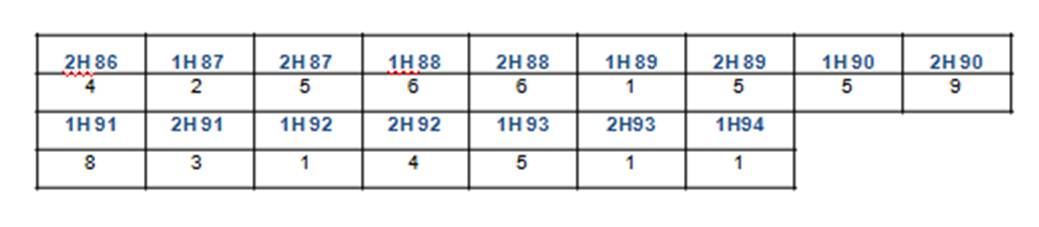
To the best of my ability, in the Over the Edge chapter of Dark Slivers: Seeing Nirvana in the Shards of Incesticide, I’ve tried to pin down, to periods of six months, roughly when Kurt Cobain wrote various songs. The approximate result is as follows:

Songs by Half Year

I’ve not included the Fecal Matter songs (e.g., Spank Thru or Downer), nor have I included Kurt Cobain’s solo experiments (i.e., Montage of Heck) simply because it’s hard to pin down when they were made with any degree of guesswork. The only changes I’ve made since the book are to include Opinion in 1H 1990 and shift Tourette’s to 2H 1989. When compared to Kurt Cobain’s living arrangements, however the results are emphatic:

Songs by Home_Figure

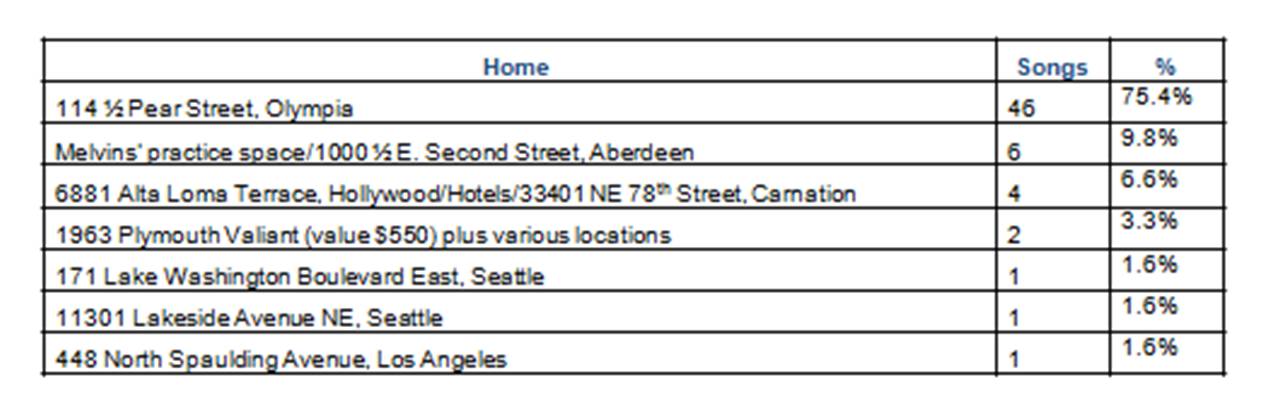
While money may still have been hard to come by during the years Kurt Cobain spent in Olympia, it truly was his artistic home. Given how long he spent in that location it’s no surprise that he wrote more songs there but the sheer quantity is overwhelming:

Songs by Home_%

Dividing the figures by time spent in the location doesn’t alter that picture of dominance:

Songs by Home_Per Month

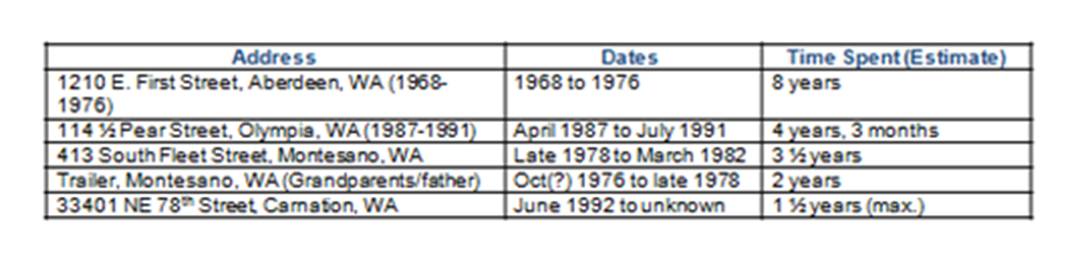
While making clear that Kurt Cobain’s peak occurred in Olympia, there is some fudging involved that I can only acknowledge but do not have sufficient information to fix. If I could untangle Kurt Cobain’s living arrangements from January 1992 until January 1994, it wouldn’t erase the overall picture but it would make clearer whether, for example, the Carnation house permitted a real focus on writing or whether most of the work was done while running around hotels and temporary accommodation with Courtney. Similarly, the two songs written in the second half of 1992, I’ve noted as Curmudgeon and Talk to Me (based on live data) but Curmudgeon at least might more properly belong earlier in 1991, I can’t prove it. The dominance of the Olympia spell may be even more pronounced given Kurt moved there in April 1987 so my estimates, based on six month periods, don’t correspond perfectly — 114 ½ Pear Street may filch a song or two from the previous eight months spent in the Melvins’ practice space and at 1000 ½ E. Second Street.

The first spell of relative stability Kurt Cobain had enjoyed since he was a child seemed to allow him the space and time to write and create. Tracy’s willingness to support him also meant he didn’t have to divide his time quite so much between work and music — though she, very reasonably, came to resent him sponging off her it did have a beneficial effect on his core pursuit. Similarly it can’t be underestimated that Krist Novoselic provided Kurt a steady and dependable musical collaborator reducing the impact of changing drummers so often and ensuring ideas could be turned into full work relatively swiftly. Kurt was surrounded by beneficial circumstances thanks in large part to the individuals he could now rely on.

My ultimate thought on the ‘meaning’ of all this information is that the place of greatest veneration for any Nirvana fan shouldn’t be the house at 171 Lake Washington Boulevard East. The place where the majority of Nirvana’s music was created, where Kurt Cobain truly lived as a creative soul, was at the unassuming and unglamorous property at 114 ½ Pear Street, Olympia between April 1987 and July 1991. To my mind, celebrating the place that gave the safe cocoon needed to build something is of far more importance and significance than the barely lived in site where he chose to tear everything down.

Life Long Latchkey Kid: Kurt Cobain’s Homes Part 2

Yesterday we examined the record of Kurt Cobain’s childhood wanderings, how he was shunted from home to home throughout his teens. Finally relative stability arrived in the form of his first long-term relationship with Tracy Marander and a resulting departure from Aberdeen. That single residence on Pear Street in Olympia ended up being his home for just over four years, the longest he’d been in one place since he was nine years old though the couple did change flats within that building and Tracy did move out to be replaced as flatmate by Dave Grohl.

Returning home in the aftermath of the recording of Nevermind, the move to a major label, standing on the cusp of his true fame Kurt managed to get himself thrown out for not paying the rent. That was the end of the stable spell of life. It’s genuinely fascinating realising that the rock star who ruled planet Earth for that spell in the early nineties didn’t have a home from July 1991 until January 1992; imagine it, the biggest rock star on the planet as living in his car.

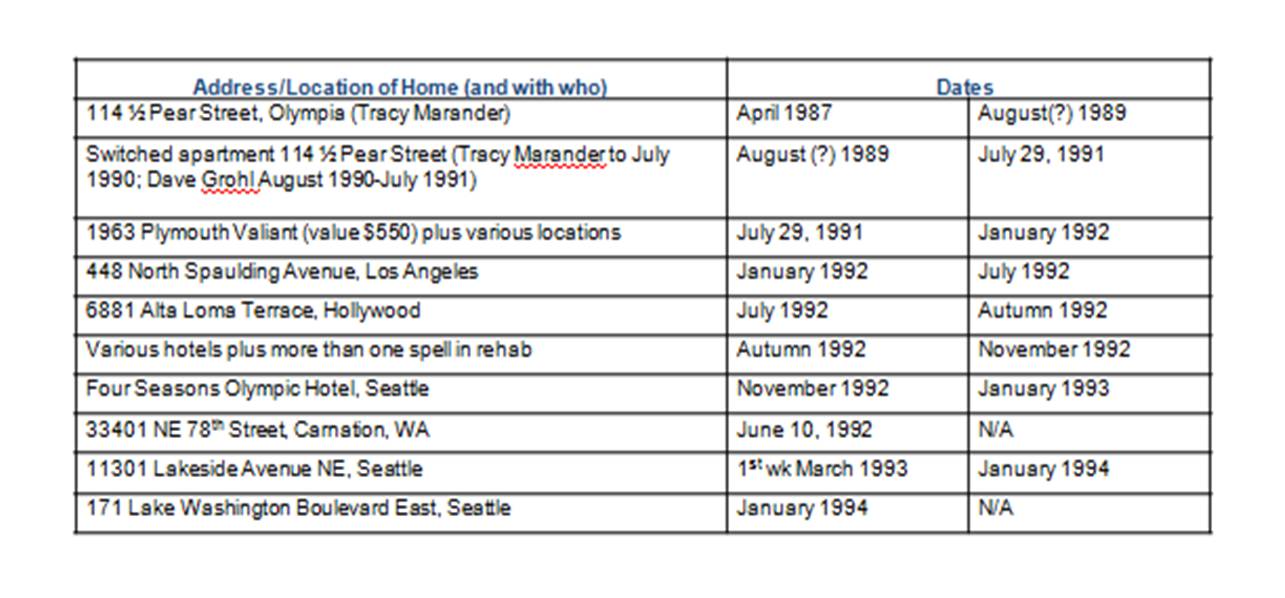
Even after that, there was still nothing close to a home. Kurt Cobain — now with wife in tow — bounced between rented apartments, tour hotels and hotels in LA and Seattle right through until spring of 1993. Even with all the money now floating around him, it doesn’t cease being the case that he was essentially homeless. At least this time there were comprehensible reasons, the Cobains were trying to purchase a home but there was little time in between tours, festivals, recording, battles with the authorities over custody of their child and major drug problems. In the chart below I haven’t calculated the spells spent in a number of rehab facilities:

KC_Homes_1987-1994

It’s curious, having arbitrarily made the start of Nirvana and of Kurt’s relationship with Tracy the dividing line between his youth and adulthood, that the pattern is much the same as his childhood with the stable period being superseded by yet another spell, this time of three years from age twenty four until his death, during which he lived in six definite locations and a slew of temporary accommodation.

One link (www.city-data.com/king-county/N/NE-78th-Street-1.html) has conveniently placed the sales record and other details of the Carnation home online:

Carnation

It’s an intriguing property because, despite the understandable attention paid to the site of Kurt Cobain’s death, it was the Carnation property that was the first home he owned and that was retained throughout the maelstrom of mid-1992 through 1993. It’s also mysterious because it’s impossible to tell how much time Kurt Cobain actually spent living at the house or why it seemed to be less than wholly beloved. For whatever reason retreating to a country village, one with a population of just 1,243 in the 1990 census, where Wikipedia lists the local activities available as “Harvold Berry Farm where you can pick your own berries in the summer”, doesn’t seem to have worked regardless of whether the idea was to evade drugs or intrusion in general. There is a rumour Kurt returned to the home sometime in early April having fled rehab.

Working out the estimated dates of accommodation also throw Cobain’s relationship with his place of death into the spotlight. The Cobains moved into the Lake Washington house in January 1994. Nirvana toured until January 8. Kurt joined the band for their final studio session on Jan 30 then they left on tour two days later. He was in Europe until March 12 when he was definitely home given the Police were called to a domestic incident that night and again on March 18. He headed into rehab on March 30 returned home around April 3. At most Kurt Cobain lived in that house for three weeks in January, then just over two weeks in March.

Observing his entire life, ranking locations, what emerges is as follows:

KC_Top Living Locations_1967-1994

Of the 25 ‘phases’ identified, only five added up to more than a single year. Worse, of the years spent in solid locations, 13 ½ of those years took place from the age of less than one to only just fifteen years old. The remaining half of Kurt Cobain’s life, his entire rise to young adulthood, involved only the briefest of respites in which he had something that could be called a home.