Evolution — Circling Part Two

The history of popular music has not been written by musicologists, it has been written by English literature students. This has, on the one hand, gifted the world beautifully descriptive and emotive articles and musings on music — but it also means that reading about music is essentially a biographical and story-led experience, not one involving a deep knowledge or understanding of the mechanics and structures underlying the subject. It’s a bit like learning your history from Hollywood or your politics from the tabloid press; articulate and/or combustible commentary trumps detailed and learned knowledge.

Among the negative consequences is that most writing on music is written in the mode of literature. By this I mean that discussions of music are given a linear progression, a plot, in the same way that fiction would be. While this results in a smoother reading experience, what I take issue with is the idea of an artist ‘evolving’. Each musician is given an origin (setting the scene for the story about to ensue), then early flowerings (the discovery of the plot or dramatic scenario), next a triumphant realisation of their ambitions (the plot revealed awaiting resolution), followed by a development toward new desires (the wrapping up of the plot and tidying away of loose ends.) This linear evolution implies an accreting process with a forward momentum in which elements are built on top of one another to create something that is a descendent of what came before; it suggests something ‘more’ and potentially better in some sense.

I feel that the idea of evolution is a poor one through which to understand musicians. Creative musicians are not engaged in such a linear journey; they are not piling brick on brick to create a single unified product. Nor are they pressing toward a solution in which a musical choice can be seen as the logical end-point; there’s no such tidy resolution of creativity. Instead individuals motivated to create choose between different ways of satisfying the same base urge to express; the means used are incidental to the unvarying nature of the desire at work and therefore it’s the equivalent of, when writing, using a pen one day, a pencil the next, joined up hand writing one day, capitals the next, a laptop here, a text function on the phone there — it’s not a single journey toward “better writing”, it’s a range of options deployed as appropriate and by whim.

Those initial impulses guiding an individual to create are immutable even if what they wish to express does change; instead of a person on a journey imagine instead a person sat unmoving as different tools are placed around them in a circle — the individual selects a tool but the individual remains unchanged even if the modes of expression alter. By that same token, instead of seeing, for example, the switch from one sound or style of music to another, or from one grouping of collaborators to another, as a case of improving upon a prior approach or reaching some kind of higher level or more greatly desired condition — simply see them for what they are; an arbitrary choice, a hand outstretched to some new way of fulfilling a static drive. It relegates questions of better/worse to the realm of individual taste where they belong.

In the case of Nirvana, did Cobain’s music truly evolve between 1986 and 1994? I’m not saying that it did not change; I’m a great believer in Kurt’s impressive ability to adopt new models from within the punk milieu in which he was ‘birthed’ — what I’m suggesting is that the fact it changed did not necessarily mean it improved, advanced, moved forward. Erase the positivist conceptions and simply see change; an arbitrary process in which motion alters what was there before but does not necessarily create a more beneficial, desirable or higher state. The band Devo chose their name to acknowledge one variant of this line of thought; Devo were named for the concept of Devolution, that something can evolve into a less complex, less advanced entity.

As an early example, a long while back now there was scepticism that Spank Thru had indeed been a song on Kurt Cobain’s 1986 Fecal Matter demo. The song was believed to be too advanced for a young and inexperienced musician to have written and therefore it led to doubts whether it could ever have featured at so early a stage. This view has been proven incorrect. What was getting in the way was that people were acting on a gut belief in progress; despite having no evidence they instinctively felt Kurt Cobain must have become ‘better’ over time so he couldn’t possibly have emerged early on with relatively honed writing skills. In truth, and firstly, Kurt’s ‘learning’ is unavailable to us — Fecal Matter is the first available recording but the failings of the archive, the inability to see practices earlier than 1986, led many to position Fecal Matter as the ‘learning’ when in actual fact it was the end product resulting from a lengthier teenage striving to express musically.

As a second crucial falsehood, the kneejerk reaction was to believe that Fecal Matter could only be understood in relation to future music — that the record was incomplete in and of itself and so only had (and has) importance as a signpost on a journey to a supposedly superior future product. Instead, it’s better to think of Kurt Cobain creating precisely the music he was capable of and that suited the urge of the moment; what he wanted to write was relatively aggressive slowed down hardcore, grunge in essence, with lyrical snipes at the world around him. Instead of the shift to more new wave-orientated music and obscurist lyrics in 1987-1988, as seen on Side B of Incesticide, being an improvement, it was merely an alternative. This fact can be seen in the way that Nirvana’s sound in 1988 failed to develop further along that route and instead devolved back toward a sound on the Bleach LP of 1989 that was far closer to Fecal Matter than to the songs created in the gap in between (Polly, Beeswax, Mexican Seafood, etc.)

A similar unwillingness to see each creation in isolation and without the mental structure of ‘steps’ and progression has also damaged the reputation of Bleach. Kurt’s own words, that it was basically a grunge-by-numbers album, are used to legitimise the idea that it was a failed experiment when, in actual fact, it served Kurt’s then desires — to be recorded and have a music career of some form — perfectly acceptably. Commentators tend to highlight and praise two songs specifically because they were linear forbearers of future music; Love Buzz and About a Girl. This means ignoring the fact that Blew was the song from Bleach that appeared at the most concerts and persisted from 1988 until 1994.

Much nonsense is written about how About a Girl foreshadowed a Beatlesesque dimension, the pop aspect to Nirvana’s sound. I’d argue that About a Girl — written after Polly, after Don’t Want it All and Creation and the early version of Sappy — let the way to only two more songs with an acoustic vibe, Dumb (an extrapolation from Polly) and the minimalistic Something in the Way. By that reckoning there was far more to come from the pop punk vibe of Bleach than from the one-off About a Girl. Love Buzz does have a greater claim, it has the loud-soft Nirvana would eventually settle on briefly but again, claiming a direct connection from Love Buzz to Smells Like Teen Spirit et al. means skipping the musical explorations that took place in 1989-1990 in which songs continued to roar from beginning to end (Dive, early In Bloom, Breed, Stay Away) or in one or two cases started quiet then got louder (Sliver primarily plus the cover approaches to D7 and to Here She Comes Now.)

The entire intermediate period after Bleach, gathered up on Side A of Incesticide and on the Nevermind Deluxe Edition primarily, is written of as if there was a step-by-step motion connecting Bleach and Nevermind, as if a full two and a half years were simply a ‘warm up’ and practice session with Nevermind as an inevitable outcome; a force of nature that was bound to sweep though Nirvana’s music. This ignores Nirvana’s garage pop dalliances, doesn’t admit that there might have been any alternatives to the band being swept up on DGC and pumping out a commercial punk rock/pop rock album. This doesn’t permit Nevermind’s predominant styling to receive the credit it deserves as a relatively recent experiment for Nirvana.

Talk of evolution halts after Nevermind, instead the chosen narrative is the fall of the hero — In Utero is viewed only as a reaction to and consequence of Nevermind’s success, in plot terms it’s a fairly traditional ‘pride before a fall’, hubristic storyline in which someone is destroyed by their greatest achievement. Again, this coating of inevitability glosses over the extent to which a lot of In Utero had already been written and therefore was coterminous with, rather than a development from Nevermind. Similarly it doesn’t give Kurt Cobain a choice in his fate, nor does it give sufficient emphasis to the longer term reasons for his lack of desire for life. In Utero, in terms of the song forms on display, doesn’t fit any kind of evolution; the addition of more naturalistic recording techniques and rougher sound may be a change but it isn’t a progression or a development — it’s an alternative.

My point would simply be that the music of Nirvana deserves to be viewed more in terms of its overall coherence and unities, disunites and differences rather than as a set of distinct stages pasted over the top of events and tombstoned with an album in a way that doesn’t ever speak for the full range of songs that are meant to ‘fit’ in each component of that narrative. Kurt Cobain used a variety of styles — punk, grunge, hard rock, new wave, alt. rock, garage pop, electric blues, whatever you want to call them — depending on his collaborators at that point in time, or his instincts, or the technology and/or business surroundings acting upon him. A graph showing a simple rise then slight decline would be fine if discussing his commercial prospects but fits poorly to his musical activities.

Selling History

Left me in two minds this article — always enjoyable to have to debate something internally before deciding where one stands, far too many kneejerk positions floating around in my head.

http://northhollywood.patch.com/articles/meet-the-newest-real-estate-marketing-strategy-kurt-cobain#comment_6656042

So, a few months back we covered the tale of recording studios and Nirvana (https://nirvana-legacy.com/2012/12/06/studio-life/) — I admit I forgot about Devonshire Sound Studios, another one to vanish into history, still going but not a name deemed worth preserving. Here’s a few photos of it as it stands:

Salami Studios-AKA Devonshire

Anyways, the lady in question flagged (and, honestly speaking, overegged) the link to Nirvana and the phantom presence of Kurt Cobain to draw attention to the property being sold. My first reaction was a weary sigh at Kurt being used to sell something but then I paused and revised.

As far as I can see the advertisement is entirely honest in stating the ‘not quite’ nature of the connection, both fair and reasonable in the ‘made you look’ vibe, essentially is doing very little beyond citing the limited history of the property. It’s reasonable that mentioning the fairly recently (and tragically) dead as a talking point gives a ghoulish air to events but I can’t think of a reason why that vague discomfort has a more noble claim over how we should feel.

I’ve walked the streets of London, stood where Guy Fawkes’ co-conspirators were hung, drawn and quartered (as an aside, beautiful procedure; hung until almost dead, cut down, revived, then sliced from throat to crotch with a white-hot knife allowing the executioner to haul your inside out with the crucial point being to hold your heart before your eyes so you saw it before you died. Then, next, hacked into four quarters and despatched to various points in this reserved and charming isle to give others second thoughts about any plans they might be hatching.) I’ve been up to the Tower of London and seen the burial place of Anne Boleyn. I’ve scoured the Internet for a few shots of the house in which Kurt Cobain died…It’s all voyeuristic in some way, a proximity to a thrill of some sort, just coated in a curious legitimacy in some cases.

Then again, potentially I’m just discussing one of my own moral quandaries; am I profiteering from the death of Kurt Cobain? If, by some miracle, Dark Slivers: Seeing Nirvana in the Shards of Incesticide exploded and I sold…4,000 copies, let’s say, that’d mean a profit would occur. Is it my goal or ambition to make a profit? No. Am I content if I make a loss? Yes. Would I like to avoid that if I can? Heck yes. Would I like as many people as I can interest to read the book? Of course. So have I taken advantage of the good name of Nirvana (and Kurt Cobain) for ulterior motives? No, I genuinely feel I’ve written a book that’s worth reading, I truly believe I’ve uncovered a certain quantity of new information and my ambition is to convince someone to change the entry on LiveNirvana:
http://www.livenirvana.com/official/incesticide.html

As for the advertisement…Sheesh, there’s too much defence of orthodoxy, guarding the sacred flame when really lambasting people for things is far less creative or constructive than getting on with building something fresh.

I’m still unsure I’m totally comfortable with what has been done here but I don’t oppose it either — there have been far more egregious frauds perpetrated on the Cobain name, by sources and organizations who could have done far better, far too much rubbish printed or released for me to sweat over one successful house sale. Kudos to taking the time to uncover the history of the area — in one hundred years who’ll know or even remember?

Selling History

Songs Dissected: Low Rider — Circling Part One

You’ve undoubtedly heard this; it’s a shred of a home demo Kurt Cobain recorded, it’s assumed, sometime in 1992. It’s a pleasant enough diversion, sweetly brief, and also enjoyable to hear Kurt seeming to have a little fun in music — akin to the chuckled adlibs in Gallons of Rubbing Alcohol Flow Through the Strip. Kurt Cobain’s percussive abilities are likewise a nice touch — that’s some effective hand drumming going on. The other significance that can be attached to this song is that while between 1987-1989 there is substantial evidence of Kurt experimenting with music at home, after that date the only visible home demos simply show him running through ‘shovel-ready’ Nirvana songs in standard pop format. This 25 second clip is the only hint that he was doing anything out of the ordinary, anything way out to leftfield of Nirvana.

Referring back to the musical vibe of the piece, for contrast, here’s the deeply cool original:

Note the Caribbean drums, the funk styling, the jazzy finale — this is one musically expansive track. Kurt Cobain is mimicking the final twenty seconds or so of the track “take a lil’ trip, take a lil’ trip with me…” Low Rider’s significance isn’t just that it’s a giggle, it is that it’s pretty well the only evidence of Kurt Cobain reaching out to musical heritages beyond an extremely narrow continuum. This is not a criticism; it’s simply a factual comment — what I’m not seeking to do is criticise Kurt Cobain’s music for being something it never set out to be.

Yet, as fame enveloped him, Kurt Cobain increasingly dwelt on the perceived limitations of the guitar as an instrument (“12 notes 6 strings and 30 years”); on his own frustration with what he began claiming was a repetitive structure and style to Nirvana’s music (“I don’t want to keep rewriting this style of music”). In his suicide note he even took the time to claim that music had become boring to him (“I haven’t felt the excitement of listening to as well as creating music along with reading and writing for too many years now.”) What we’re examining here, in detail, is the nature of Kurt Cobain’s writer’s block.

He took it further. He identified this not just as a personal crisis, but as a fundamental collapse in rock music as an entity (“it’s already so rehashed and so plagiarized that it’s barely alive now. It’s disgusting.”) But hold on — let’s question that. This is the early Nineties. Sonic Youth have just rejuvenated the guitar. My Bloody Valentine have kicked out Loveless. Swans had torn ground-shaking tones from it. His own friends in Earth were about to create an entire new sub-genre based around the drone. It’s disingenuous that a guy saturated in the new angles that had been ripped from the guitar in the Eighties should claim the death of rock.

The wider context of the rock world makes clear that this was another case of Kurt Cobain defending himself from pain by going on the attack, the same way he publically denigrated his own music so no one could say anything hurtful that he hadn’t said first. At the root of what was occurring, beyond the drugs n’ drama, was a difficult combination of (I’ve used this compliment before) a highly talented musical magpie, running headlong into an deeply restless and easily bored musical spirit. Kurt Cobain had run through rock styles at a furious pace; Fecal Matter’s proto-grunge, January 1988’s new wave, Bleach’s straight up grunge, the garage pop/lo-fi spell of 1989-1990, electric blues with The Jury covering, a smattering of acoustic pop songs, on into the Pixies-tinged dynamics that met mainstream rock on Nevermind — he devoured them all. He needed something new to retain the avid enthusiasm he had felt for learning punk rock.

The musical universe in which Nirvana played was, unfortunately, extremely limited. Essentially the band regurgitated styles prevalent within a very specific scene; they were a Seattle band not just in root, but in the vocabulary with which they played. What the band didn’t do was reach beyond that specific background, the one they’d grown up with, to explore other sources; there wasn’t even the vestigial beginnings of a Johnny Rotten-esque shift from Sex Pistols to dub reggae infused Public Image Limited; there wasn’t anything like Led Zeppelin’s Kashmir wearing their world-walking on its sleeve; there was no toying with jazz, with funk, with any other genre; even Nirvana’s alternative tuning on Blew was an accident; Nirvana’s live playfulness with noise and feedback didn’t make it too far in studio (The Priest They Called Him stands out.)

Love Buzz is a good comparative; an Eastern-tinged track recorded by a Dutch band during the late Sixties’ flirtation with Indian musical styles…Which Nirvana sliced the quirk out of in order to turn it into a straight forward grunge/punk/rock song (this is not to say I don’t love it! It’s a specific point about the musical expansiveness of Kurt Cobain.) A further case in point would be the conversion of Lead Belly’s African-American segregation era blues and folk into unaccented, uninflected acoustic pop — there’s not an ounce of original colour left in the tune even if Kurt, while performing solo at Castaic Lake in California in September 1992 did announce “this is a song by Huddie Ledbetter — he was a slave in the South.” Kurt Cobain’s music was quintessentially drawn from a highly specific American rock tradition in which the diversions artists like Jimi Hendrix had made into funk and soul; or Led Zeppelin made into whatever they could find; were left to artists like Prince while Nirvana — and Metallica too as an aside — honed the music down to an unfunky, straight ahead suburban white boy rock; no Clash style reggae moments, no Bad Brains styling, no Minutemen style jazz chords. Nirvana were indeed an all-American phenomenon, but musically speaking (I fully acknowledge the band’s support for equal rights and racial harmony) they were only one part of America.

In Kurt Cobain’s lyrics, the only real-world geographic locations that were ever mentioned were all in the State of Washington, all within a couple of hundred kilometres of his birthplace (Puget Sound; Seattle). Essentially, as we’ve mentioned before, the vast majority of his music was already written by mid-1991, by the time he was 24 years old. It’s not a surprise in a lot of ways that his lyrical inspiration never moved far from the area that was his home for most of his life. Similarly, in the seven-plus years of Nirvana’s existence, his instrumental inclinations never strayed from the punk/rock/pop sounds that gave him his initial impulses and enthusiasms back as a teenager.

I respect Kurt Cobain even more for having such a sharp eye that he recognised that his writer’s block was a combination of an instrument he didn’t have the time to find new worlds for; of musical approaches he’d run-through so fast (and mastered so thoroughly) he hadn’t left himself new turf to explore; and for recognising that, for his own enjoyment, he needed to start moving further than the narrow confines of the corner of the rock world he had picked clean for over ten years. Low Rider, recorded in 1991-1992, is a too-brief time-capsule showing a man stepping ever so briefly out of his comfort zone, trying ever so tentatively to find something fresh that could perhaps give him the long run of inspiration he’d wrenched from punk a decade before.

Plus…It’s fun. Twenty seconds well spent on a tape machine somewhere in the maelstrom.

Mourning Seattle

Grunge, as a coherent scene, peaked in the late Eighties and was long gone by the time Nevermind put the word into popular parlance. Most grunge bands barely sold, only the crossovers who had either left grunge behind or barely connected to it in the first place, so basically Nirvana, Soundgarden and Pearl Jam made it out. Even by 1991, Nirvana’s name was tied to a ghost and they have remained, in the popular view, the key exemplar of something that was already dead. It’s extraordinary in fact that such a minor scene should receive coverage at all.

The survivability of grunge as a form recognised and acknowledged in popular musical history was based on two, separate, but connected, events. The first was the power of the British music press and Sub Pop’s work in cracking open coverage thousands of kilometres away from the epicentre of the scene. With the best will in the world, alas, it’s reportage and repetition that creates perceived importance — in 1989-1990 the world was primed and waiting for something to come out of the Seattle scene thanks to the hammering of the topic by the music press. The second factor, the one that elevated grunge to a hallowed status, was its perceived role as the incubator for the band that breached the alternative/mainstream divide; Nirvana.

The two elements, grunge and Nirvana, are so intertwined that amidst the flurry of books on grunge that emerged between 2007-2011, virtually all featured Kurt Cobain on the cover. On Facebook there’s a similar sampling of the popular mind; dozens of memorial sites to grunge, hundreds to Nirvana, hundreds more to Kurt Cobain — the grunge sites are barely distinguishable from the Nirvana/Kurt Cobain tributes. Without Nirvana’s success pushing the origin myth of their emergence from grunge, without Nirvana’s success forcing the word grunge into every account of punk, alternative, rock, metal and post-1980 guitar music, grunge wouldn’t be mentioned as a scene anymore than a dozen other localised punk scenes of the 1980s. It’s similar to the way No-Wave has achieved some underground recognition on the back of the stature of Sonic Youth, Swans and, for a time, Lydia Lunch — a scene barely bigger than four bands is now a regular fixture in accounts of music.

The ‘icon’ mantle Kurt Cobain inherited has been hung over grunge also. The fact that grunge had disintegrated long before Nevermind made it out is barely registered; the arm’s length relationship between Nirvana and the grunge scene is only commented on among fanatics; the names and stories of the true grunge bands (Green River, Melvins, Soundgarden, Skin Yard, Mudhoney) something for music trivia fetishists. The immortal bonding between Kurt Cobain and grunge has created a mourning of the grunge scene. The difference was that while grunge was a very local, barely registering scene, Nirvana had a chance to connect in some way with the huge audiences who still exist for them whether on record or on MTV or as live event. Fans have been smothered ever since in memorabilia whether aural, literary, visual or tactile (*shudder* Kurt Cobain action figures…) The ‘big bang’ of Kurt Cobain’s suicide also created an emotional trauma of vast scale for fans setting a standard of significance that makes it impossible for another band to match.

Grunge, by contrast, melted away without any such mass audience, without MTV coverage, with records sold in such low amounts that Sub Pop was going to go bust before the Nirvana money flowed in; there was no mass connection. Grunge has gained its significance purely as a synonym for Nirvana. This means the harking back to a supposed golden age in Seattle is such an unusual mental phenomenon; it’s a desire to return to something that very few people saw, or heard, or had any part in — it’s completely divorced from any personal connection.

The amorphous identity of grunge also assists its assimilation into the music-based world views of fans the world over. It’s become a cliché of the Sixties generation to claim that you had to ‘be there’, a way of keeping out newcomers and preserving a sense of exclusivity around a set archetype to which followers must adhere despite lip-service to anti-authoritarianism; the result is that very few people hark back to the hippy era or ethos, few mimic or enthuse about it. The original wave of punk had a similarly strict mission statement and presentation, again, the rigidity of the identity created a limited life-span and shelf-life. Grunge, by contrast, had no vision for life, no projected purpose behind it. The result is that it can be used to cover a wide span of lifestyles and attitudes — it’s an appealingly broad church in which anyone can find what they wish. The pretence was that this fuzziness meant that Generation X had no commitment to anything at all, but that’s untrue. It was a generation that permitted individuals their own choice of ambition without imposing or demanding a single unified identity of its adherents.

The appeal of the grunge era only exists as a comparison, a longing for fresh possibilities that most of those who wish they had been there can never confirm even existed. The idea of the alternative nation, in reality little different from the pre or post-generations, appeals in the same way that the hippy or punk did — as something to hark back to when seeking something to put in opposition to whatever exists in the present day — without the weakness caused by a too uniform and defined presentation.

In actual fact, while the participants in the original scene wax lyrical about how enjoyable it was for them, the sense of open possibility and no responsibilities unburdened fun; it’s those components — youth in other words — not the scene itself that is being memorialised. Grunge consisted of extremely poor people, playing to limited appreciation, with limited futures visible, increasingly saturated with drug casualties and with a time-limit after which the usual college or steady job paths beckoned. What those people are eulogising and memorialising is the wild years of their youth when they didn’t know what they were doing perhaps but it felt good just doing it. What the fans of grunge are enthralled and inspired by is a wish that they had experienced their own mad years, or a wish that they could recapture that same directionless but ecstatic freedom.

Grunge, Seattle, the North-West scene…It’s so perfect because it’s no more real than the British tabloid vision of a mythical England of cricket, warm beer, social deferment, local employment, temperance — a world also, quietly, devoid of immigration, in which the working classes are invisible, where women keep their traps shut, where discomfort is locked away. It’s a different form of the golden era myth, the comforting kneejerk belief that “things were better” once upon a time whereas appreciating the beauties of the here-and-now, the conquered travesties of the past, or working/fighting to make this present era closer to what one wishes for — it’s all too much work. Easier to claim the fight is lost than to go for it.

Presence and absence are permanently intertwined. The appearance or discovery of a new shred of unheard Nirvana music, or a new piece of information, doesn’t salve the absence or make it go away, it emphasizes it — reminds one of the gap where something once lived. Grunge has a similar ghostly quality; it was absent long before 1991 but resurrected as, first, a genre label and explanation for Nirvana; secondly, as a tombstone for rock music or for the Eighties underground; thirdly, and presently, as a vision of dead desire, something that can’t be attained and therefore seems more appealing than what we actively possess.

The Age of Information Technology

Article in a previous week’s copy of The Economist (online at http://www.economist.com/news/international/21570679-cops-convicts-and-craftsmen-are-keeping-carbon-paper-alivejust-fade-black) mentioned that the last manufacturer of manual typewriters — a firm called Godrej & Boyce based in India — stopped production in 2009.

In relation to Nirvana, I’ve commented before on the amazing gulf between the world in which we’re living and that which Kurt Cobain departed in 1994. A phrase used in recent years is ‘the digital native’, the idea of a group within society who have lived their entire lives surrounded by electronic forms of interaction creating a new nature, as normal to them as the organic or mechanical ones onto which this new world has been grafted. There’s little if any technology in Kurt Cobain’s songs but, essentially, that’s because before 1994 society wasn’t as saturated in consumer electronics as it is now.

So, for example, if you wanted to phone Kurt Cobain, you called a landline. If he didn’t pick up, everyone was able to tell themselves he wasn’t in (he might not have been, there was no way to know). Nowadays, if you call someone’s mobile, they may forget to get back to you, something may happen that prevents them calling, but the technology is more firmly laced to the body of the individual — you’re calling a person not a home; an individual not an office, so it’s harder to hide from attention at twenty years’ distance. Kurt Cobain’s ability to vanish for periods of time post-fame was supported by the nature of the technology available.

His writing, likewise, remained a purely manual process. He never, as far as can be told, sent email, used a computer, tapped away on a typewriter even. There’s no written communication from Mr. Cobain that purports to come from a mechanical or electronic source — there’s a mass of handwritten paper, however. His inspiration was only as fast as his scribbling, there wasn’t a back-up online someplace — hence why the 1992 flooded bathroom was so catastrophic — and if he didn’t have paper to hand then it’s unlikely he was working in great detail or depth — which is why the long home between tour-spells seem to have been so crucial in the writing process.

Further reinforcing Kurt Cobain’s divorce from technology, there’s no indication in the various sources detailing the technical side of Nirvana’s recording sessions — see Endino.com, hunt down a copy of Charles Cross’ book on the Nevermind album, or read Gillian G. Gaar’s book on In Utero — that Kurt Cobain paid the slightest attention to the technology available in studio. He was clearly interested, for example, in seeing Steve Albini’s microphone set-up at Pachyderm Studios, not an unreasonable reaction given its apparent complexity, but not in learning the in depth details of the recording process. His role as a co-producer for Melvins’ Houdini album seems to have been name-only given the statements on LiveNirvana.com about the sessions. There’s no record of him involving himself in mixing, maybe choosing to record Something in the Way unplugged, or to plug Territorial Pissings direct were the biggest technology decisions he made in studio. He was essentially happy to ask for a “top 40 drum sound” or to comment on the tone and texture of the sound being produced, but he doesn’t seem to have wanted, during the short years of his life, to have wanted to learn how to do it for himself.

That isn’t a criticism though. I think that we’re simply looking at a normal human being in the late Eighties-early Nineties; particularly one from a lower socio-economic bracket, even today penetration of Internet, mobile phones, etc. is affected by wealth and isolation and Kurt Cobain pre-twenty years old was both poor and relatively isolated. I’m perhaps too used to people waving their phones and other devices at me now, or spouting technical specifications, in an annoying way, as if they’d made the darn things themselves or as if the device was a worthy substitute for their absence of personality or depth (not that I’m saying I’m sick of people waving tech at me, no, what gave you that impression…?)

Like most people, when Kurt Cobain needed or wanted to use technology he was totally willing and able to do so. The best example was his desire to use video technology to capture Nirvana at quite an early stage in their career. Krist Novoselic’s camcorder footage of the 1989 U.K. tour is readily available; Nirvana’s video made for the Sub Pop version of In Bloom is common knowledge; that he took the band into a video studio in March 1990 to try and kick-start preparation for a band video release. Even earlier than that Nirvana had tried, on January 24, 1988 straight after their first studio session, to record supporting videos for a few songs (including the later maligned If You Must). Kurt Cobain had a functional approach to video; his central issue was to express, the question was therefore how or who could do it — within that mix he was more than capable of getting out the video tech or waving cameras around.

His closest relationships with technology though were with the products of bygone decades; the television, the guitar, the microphone, the radio. Consumer electronics stretched as far as record players and boomboxes — maybe today Kurt Cobain would be a prime candidate to be one of the guys with big headphones and a sullen expression shutting the world out and keeping eyes low. What exists instead is a musical repertoire in which the lyrics barely feature technology — no driving anthems, no escalators, trains, TV shows but no TV, an organic, fleshy, feely set of songs. Of course, without the wattage being shoved through the speakers where would we be?

What’s Left? Re-examining the Live Record 1989 Final Part

Anyone else bored of 1989? I’m so bor-or-ored of the ‘eight-ty-nine’…Friday at last.

Having laid out the trends across the year, having filled a little of the early 1989 gap, the second half of the year gets far simpler. I’m willing to bet hard cash on the 133 of 143-187 for the spell up to November 15 — what about those last few? And what about the rest of the year?
Firstly, to reach my limit on the eleven missing/incomplete dates running up to November 15, 1989 — the set-list creates uncertainty. After October 6 it’s rare that a set-list was fewer than fourteen songs while prior to that a maximum of thirteen is the norm and most likely. That may put me out by a song or two but I feel save working to that limit given the rarity of them exceeding or underachieving those norms.

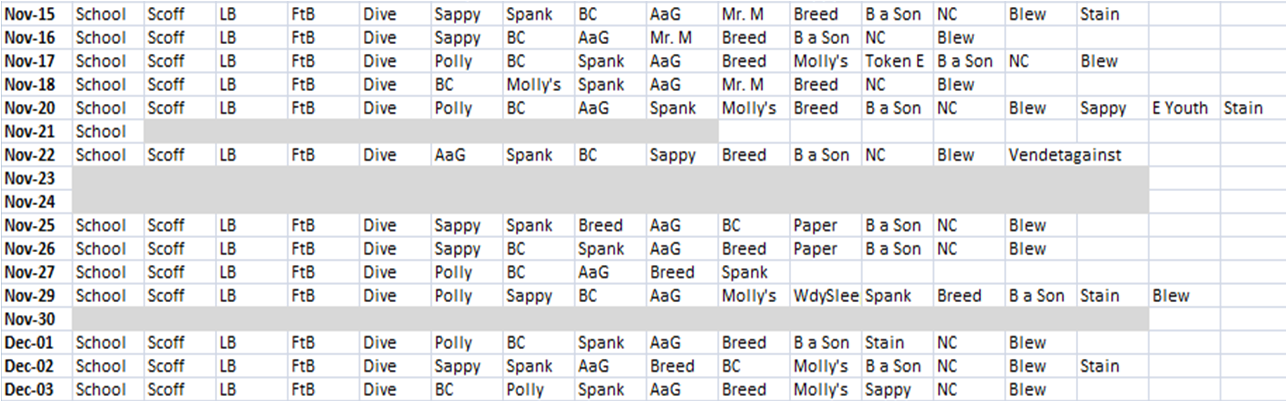
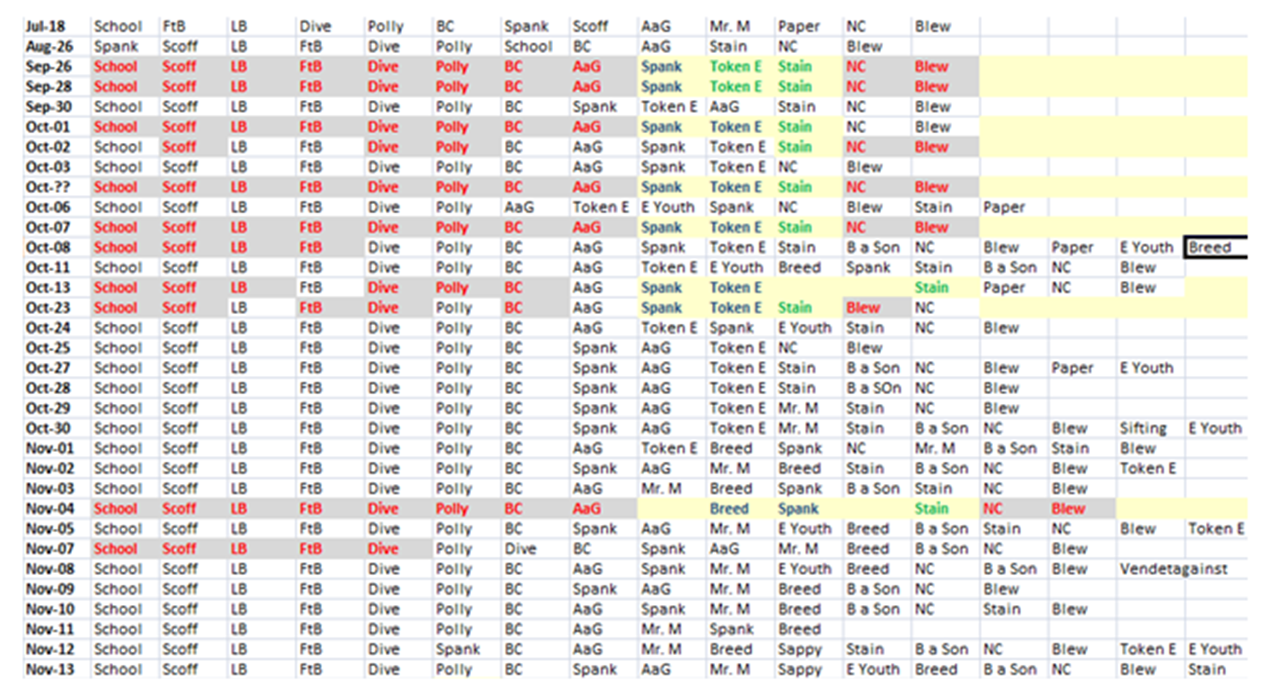
So, what do I think? I think Been a Son, Breed and Paper Cuts were all possible additions on October 7 and 23 based on surrounding comparisons. On October 13 only Been a Son and Breed that constitute the likely candidates given Paper Cuts was already on the set-list. November 4 is likely missing an appearance for Token Eastern Song and from Been a Son (given Been a Son and Stain had entered a spell of being played alongside one another prior to the Negative Creep/Blew cluster — we covered how common this foursome was last week.) That’s as far as I can see. The show played either on October 4 or 5 may have finished either with Paper Cuts, or the premier of Breed, or the premier of Been a Son — no clues. You’ll see my last additions and my last uncertainties below bringing us to a total of 133, plus a number I’ve highlighted in yellow where I’m just not sure but believe the songs mentioned are likeliest:

Whats Left_Aug-Nov 1989_Final

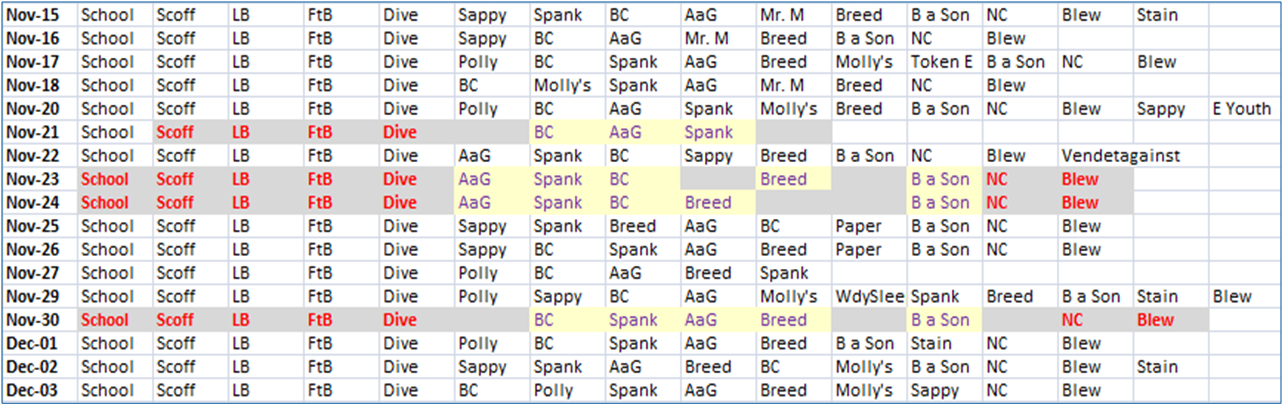
There are only four more missing dates in 1989; a show on November 21 that the band wrapped up in just over 30 minutes — about a third shorter than usual — then November 23-24 and 30. The set-lists, as mentioned, are flexing quite a bit at this point, essentially Nirvana had been playing hard for a couple months that Autumn-Winter and were demonstrating how good they were (and perhaps how bored) by dropping new things in and out. Remember, of course, that I’m leaving out cover songs if they were one-offs, likewise jams. Unless they were regulars their very nature makes them unpredictable — they wouldn’t be one-offs otherwise:

Whats Left_End of Year 1989_1

Those four dates are still going to yield somewhere around fifty performed Nirvana songs. What’s beautiful is I can start with something unprovable but possible — we can’t tell if Vendetagainst received another airing on November 23-24. There weren’t enough performances of it at the time to make it a trend, on the two occasions it made an appearance that year it was slotted in at the end as an optional extra so given we can’t predict the lengths of three of the Nirvana performances, we can’t say how likely it is. Tantalising timing though.

Strangely, though we’re only working with four performances, these four present us with a lot more difficulties than the previous eleven. OK, the opening five songs are totally predictable, likewise I think Negative Creep/Blew made the end of Nov 23-24, I can’t bet Negative Creep/Blew finished Nov 30 because of the flexing immediately before on Nov 29. Likewise, the fact that the triumvirate of Polly/Big Cheese/Spank Thru had also broken means I can’t be sure of those songs all being played together.

That doesn’t mean we’re blind, however. Spank and Breed remain solid presences, likewise the set-list may shift but there’s still a solid core to most performances — About a Girl, Big Cheese, Been a Son are all dead certainties; note the purple on yellow entries below are not predicting positions in the set:

Whats Left_End of Year 1989_2

So what of the ten or so gaps I’m sure exist? Well, add it up; the songs that could fill those spaces are Polly, Sappy, Molly’s Lips, M. Moustache and Stain — but where? No idea.

That’s what I take as a heartening experience from this exercise; unlike in 1993-1994, there’s a little more room for uncertainty, there’s space for rarities in the early part of the year — like Swap Meet or Big Long Now — and a little space in the latter half of the year — for Vendetagainst for instance. We’re at the heart of Nirvana here and there’s a little room for mystery to occur when the band had so much live chemistry they could flex as they wished.

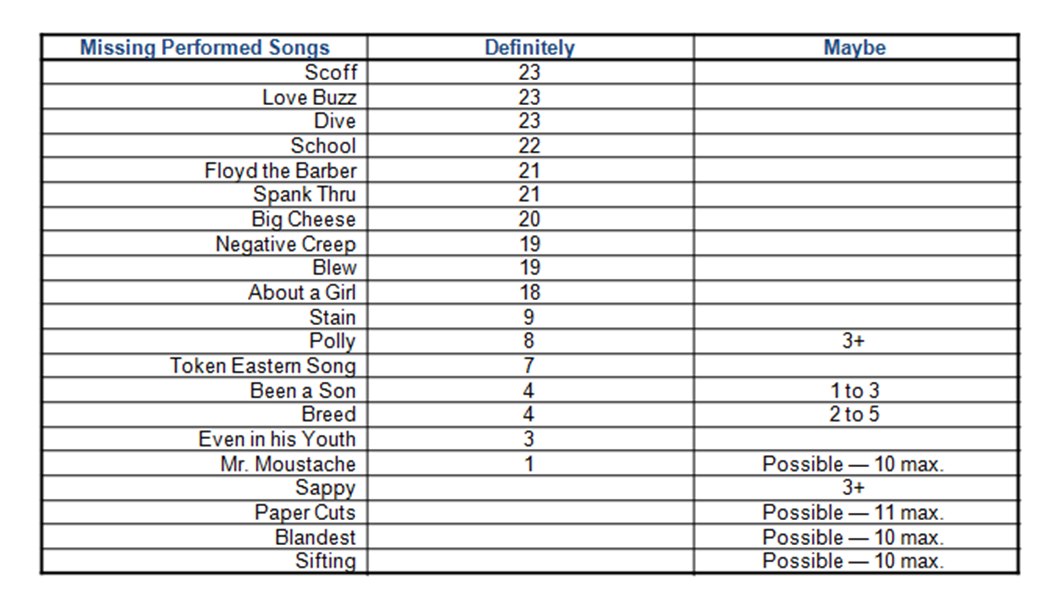
Why am I so confident about the predictions? Well, it’s a case of quantity erasing deviations; essentially, for these numbers to be substantially wrong, we’d have to believe that Nirvana rewrote their own script substantially several times in the incomplete/missing shows. Given that in 42 known performances from May-Dec 1989 there’s not a single show that differs by more than three songs from those on either side of it, given songs are rearranged sometimes but the most that happens is a few songs are tagged on the end of the existing set-list, there’s no reason to believe in revolutions. But let’s assume that for one night during that phase Nirvana did completely rewrite the template, suddenly played a set-list consisting of a batch of songs from the January 1988 session, plus Blandest, Annorexorcist, Sappy, Even in his Youth, Swap Meet, Big Long Now…Effect? Variation of the numbers below by one single digit — quantity of results minimizes effects of outlying data. Here’s the likely performances I predict we’re missing from 1989:

Whats Left_Totals_May-Dec 1989

What’s Left? Re-examining the Live Record 1989 Part Three

The hole extending through 1988 and early 1989 runs right up to the middle of the year:

Whats Left_End of the Gap_May-Jul 1989

Again, the size of the gap makes it impossible to guarantee specific results, however, the relative narrowness of the core set-list makes it easy to predict likely conclusions regarding the ten missing/incomplete shows between June 25 and July 8. Firstly the set list visible on June 23-24 is still recognizable in the set-lists of July 8-9; we’re likely looking at ten performances all beginning with School, Floyd the Barber and Love Buzz and ending with Negative Creep and Blew. Similarly, though the order is unclear, we’re likely to be seeing; Dive, Spank Thru, About a Girl, Scoff, Big Cheese. Where are the uncertainties? I’m unsure about the fate of Sifting and feel unsteady assuming it dropped out of the set-list, I feel better assuming the Mr. Moustache turn up on July 8 was a one-off given it didn’t become a trend until late October, if I was being optimistic I’d hope for Blandest managing a one-off.

The rest of the year becomes easier — the gaps are shorter — but the conclusions of each show are flexible providing a degree of doubt to each prediction. What we’re looking at are fifteen remaining partial/absent set-lists. The first seven songs are almost entirely static from August 26 until November 15 covering eleven of the missing dates and fitting perfectly into the fragments of set-lists known for the incomplete dates. Given the Negative Creep/Blew unit is broken precisely once in the known set-lists I’ve got no problem predicting it, in whatever order, for the missing eleven too.

Whats Left_Jul-Nov 1989

So, that means, that of eleven incomplete/missing dates, containing somewhere between 143 and 187 songs (based on blunt extrapolation from the shortest and longest known shows of this period) we can tell what 84 of those songs were already plus the 29 definitely sighted according to the Nirvana Live Guide; 103. We can predict a few more definite sightings, for example, Token Eastern Song appears in every known set-list in October, meanwhile Spank Thru appears at all but one show for the entire year — they’re easy additions. Similarly Breed is a consistent presence from November 1 throughout the rest of the year making me confident it was part of the November 4 missing set; that’s another fourteen spaces definitely filled; 117 of 143/187. What are we missing?

Well, matters of debate. Token Eastern Song appears to have been honed into shape definitely after touring ceased in July, probably after the single August date, certainly by the September 1989 recording session with Steve Fisk where it made its first appearance, so there’s a good chance it was in the opening set-lists of the September touring season. Stain is another new arrival and though skipped on October 3 and 25 it’s a good bet for each of the missing dates; that’s two showings of Token Eastern and nine of Stain; 128 of 143/187. We’re still missing at least 15 tracks even if all the missing shows only amounted to the shortest of that period.

Whats Left_Jul-Nov 1989_Pt.2

Well, for starters, the most likely candidates are as follows; Paper Cuts, Mr. Moustache, Even in his Youth, Been a Son — the unpredictable outliers are Sifting and Vendetagainst. Even in his Youth emerged for certain on October 6, its in all the set-lists surrounding the gaps we have on October 7, 13 and 23 leading me to predict with near certainty three more (welcomed) live renditions of the song still to be found. Likewise, for November 4, I’m confident in saying Been a Son will have made the set-list given surrounding examples unless the show was massively curtailed for some reason. On the same date Mr. Moustache is likely given its brief flowering from late October through November. 133. That leaves us only ten definite absences though up to a max. of around 44. We’ll continue tomorrow.

Incesticide Curios: Gentle Morning Post (Late…In Early Afternoon…)

There’s an undeniable appeal of the underdogs, the underrated, the overlooked — when everyone is saying “its brilliant” then joining in may be an aid to social bonding, may make one feel part of the ‘pack’, but it doesn’t salve the desire to separate and distinguish oneself. Certainly I’ll admit that played a part in my curiosity regarding Incesticide — everyone knows Bleach, knows Nevermind, knows In Utero pretty darn well. Talking about what was less spoken of seemed more interesting and valuable to me, as a fan and as someone who prefers not to regurgitate others’ work.

The result of writing Dark Slivers has been that an awful lot of very cool people have been in touch sharing stories, songs, new materials — it’s been a really good experience. One part of what they share has been unusual pieces of Incesticide memorabilia, my favourite two here:

Incesticide_poster

The poster above came up for sale on eBay, an original 1992 promo poster for the album — there can’t be many of them about. It’s crucial feature is of course the enhanced detail of the image, the lower flower I’ve rarely paid much eye to, the withered hand with the seaweed tendril fingers…Oh, and see that in the bottom corner? Kurt Cobain’s signature on the original artwork. That’s a feature not present on the album cover, cut out — this is the only time I’ve seen it restored to place and emphasises to me, once again, that Kurt Cobain took a personal interest in the ‘wrapping’ of the compilation.

The second piece is yet another promo poster, this time with a different angle:

Incesticide_ad

It’s hilarious that Kurt Cobain’s comments on these songs, often sarcastic, self-depreciating and rude about his own creations was chosen for an advertisement in support of the album. How many adverts do you see with the word “masturbatory” featured?

Art on the End: A Fresh Cobain Artwork

There’s some amazing work out there on the web, tributes to Kurt Cobain, copied images of the man, studies from photos and so forth. The only small disappointment I have is that the majority of images rarely extend beyond extensions of photography — there’s a fetishisation of his ‘prettiness’, the kind of beauty visible in the best Rolling Stone images of Kurt that voids the more grungy side of him. Also, I’ve argued that Kurt Cobain was a far more complete artist (of the self-taught variety) than he is given credit for; he worked not just with music but also with sound experiments, art installations, video work, paintings…Whatever allowed him to express. The relative absence of tributes in forms other than the musical and the hagiographic has been a little sad — the man was about far more, it’s a shame the memorialisation hasn’t moved beyond the form and imagery that would fit a standard-issue corporate magazine.

Which meant I was extremely delighted when a gentleman in Scotland got in touch and shared a piece he’d been working on — I asked his permission to share his work here; I feel safe saying that I have massive respect for the name Marcus Gray because he’s a rare individual doing something truly different in the art realm.

The PARASITE project has a cynicism I tend to believe the man himself would have appreciated; it reminds me of the kinds of self-depreciating statements Kurt Cobain used to make about how derivative he claimed Nirvana were. In precisely the same way the way the project is named and wrapped underplays the thoughtfulness on display (the link here shows up as a photo):

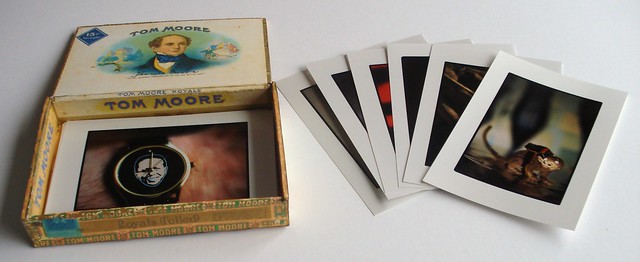
PARASITE deluxe boxset

The box itself is a wonderful comment on the picking over of Kurt Cobain’s legacy; if they’re going to authorise Kurt action dolls, endless product, mythologise his death ad infinitum then fine, why not sell replicas of his heroin box? There’s a clear depth of knowledge involved — the quip about Silver/Sliver is a neat reversal that made me chuckle — and that makes it very clear that this is a tribute made in love for the subject and individual concerned. The intelligent thought involved far outweighs the lazy reliance on standard-issue pretty eyed photos. The mimicking of the Sub Pop Single Club is a similarly clear reference — if its respectable to deliberately create scarcity to build exclusivity and desirability of music, then why not for art? It’s a fair question; what works or could work across genres of expression…? The combination of figurines, fabrics, printed word and so forth is far closer to the multi-material approach of KC.

The photos themselves are a neat set of close-ups that rely on a broad awareness of Kurt Cobain’s story and his existence as a visual phenomenon; a lot of the photos, the striped jumper shot for example, evoke a specific time and era of Kurt’s existence yet without that knowledge it’s simply a voided impressionistic pattern. A true favourite is definitely the close-up on the Vanity Fair article — it’s hard to underestimate the impact of that one magazine piece on Kurt, his family, public perceptions of the family, the change in media reportage so to focus in on the single couplet picked out is shrewd, ironic, sad all at once.

A secondary piece by Marcus, again an intriguing piece is also present buried later in the Parasite project. The artist traced each letter in Kurt Cobain’s suicide note onto individual sheets of paper creating these clouds of letters — I admit to liking the effect of having page after page side-by-side, the ripples in the paper, the different shading on the photos taken, the way letters gust across the page from one place to another, rigid lines or swirls. Mr. Gray has protested to me that he actually kicked it off in anger at the way arts funding is handed out in the U.K. to ‘stunt art’ (my term), art with a shock value or novelty but not necessarily of much depth, skill or true intelligence at work — this was his way of reacting to that. He’s totally right I’m only sorry that the Arts Council didn’t have a look at this! As usual something commenced with sarcastic intent can float free of its origins and end up as something with a genuine beauty:

Kurt Cobains Lettering_Marcus Gray

To allow the artist to speak for himself, he mentioned in an email “I think the “Number Nine…” is pretty poignant, given the way the first person “I” gets larger towards the bottom, where perhaps the heroin is perhaps taking hold, or Kurt’s rising sense of panic and awareness at what he’s about to do…” This point has deeper resonances for me; when listening to the Do Re Mi demo the most prominent feature is the constant focus on ‘I’, there’s almost nothing else in the song bar the narrator’s limited connection with the world (“I’m dreaming,”) and limited possibilities in which everything is a maybe (“wake me up”/”if I may, if I might, if I do, if I say”). The rising ‘I’ makes an awful sense.

His concept of how the piece could have been presented in multiple ways was also fascinating — the idea of this same single source being extrapolated in different ways including the following “I’ve also decided to do them as a series of 26 large Perspex sheets, which will be a simultaneous installation. They will be mounted, and you will be able to see each sheet through the other, as it were, so they’ll be in a long row of parallel sheets with say a foot or two in between, each being slightly larger than the one in front to account for perspective. On a quiet day in the gallery (and how likely is that!), you’ll be able to look straight through each sheet to see the entire suicide note made up of its composite letters.” That has a certain cool to it.

Anyways, I’ve enjoyed and respected the work going in here — someone doing something other than just retelling the known story, someone taking the materials of the Kurt Cobain/Nirvana tale and creating different frequencies of response. Mr. Gray, a respectful bow in your direction. Keep going fella.

What’s Left? Re-examining the Live Record 1989 Part Two

This exercise all started as an attempt to try and figure out as many gaps in the Nirvana set-list record as possible. To recall the statistic, there are 128 unknown or partially known Nirvana set-lists, roughly 1,500-2,500 missing songs. 39 of those shows are from 1989, the highest overall total representing half of the shows that year. It’s certainly a complex year given the band’s history at that time contained so many breakpoints; finishing Bleach, acquiring and discarding a second guitarist, first U.S. tour, first European tour…

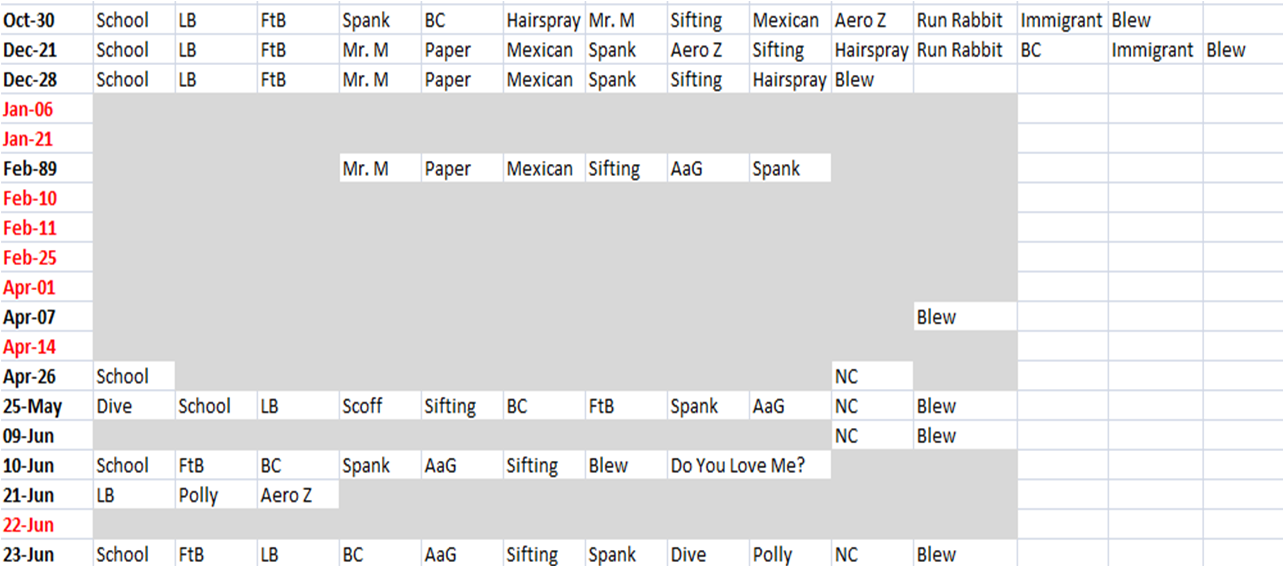
The most disappointing thing for me is the tight clustering of a lot of those absences; there’s no complete set-list for ten shows between December 28, 1988 and May 26, 1989 then a further four near blanks after that date until things flesh out from June 23, 1989. I’ve said before that I’m sure that those ten shows conceal the only live appearances of Big Long Now (I go into depth about my reasoning behind this in Dark Slivers) plus some of the final appearances of the early songs that later arrived on Incesticide. Take a look for yourselves, can we really make something of this mess?

Set-Lists_Late 1988-Early 1989_Gaps

Actually…There’s a good chance we can. For starters, note the coincidence of the Mr. Moustache, Paper Cuts, Mexican Seafood trio appearing at the two December dates and as late as the undated early show in February. I’d prefer more points of comparison but it’s a start. Similarly, it’s amusing to note that the School/Love Buzz/Floyd the Barber trio which formed a key feature of mid-to-late 1989 actually commenced right back in Oct-Dec 1988. Likewise Blew is already Nirvana’s favoured set closer, the impossibility is showing when Negative Creep became its crucial partner. What we can suggest is that on all the missing dates, Blew was the last song. Sifting, About a Girl and Spank Thru are also likely presences, as are the opening trio of School, Love Buzz and Floyd the Barber in some combination. That’s about all we can say.

In the comments section you’ll also note someone rightfully pointing out that Swap Meet is a likely appearance in this spell also. Complete agreement and a very relevant point to be made in this context. How often did it appear? Well, I have a suspicion, based on its non-appearance in the rest of 1989 that it was the equivalent of Lounge Act, or Frances Farmer Will Have Her Revenge on Seattle, one of those songs that never really caught on as a piece of the live set (self-evidently). Perhaps it did the appear-disappear trick, one of those songs that made a half dozen appearances and died.

Later in the year we’ll have more luck — let’s see next week in Part Three…