Axl Rose: The Alternative Way ‘Out’

I finally, at long last, finished reading the “Whatever Happened to the Alternative Nation?” articles yesterday:

http://www.avclub.com/articles/part-2-1991-whats-so-civil-about-war-anyway,46507/

In one piece, the very reasonable comparison is made between Axl Rose and Kurt Cobain. The obvious comparisons – small town misfits, serious parental issues, physical similarities which is why they could both fit the required rock star mould of 1991-1992 – are made but the most crucial one is the yearning of each individual for control over their own creativity, a desire to be free of the constraints either of poverty or of management, fans, press and so forth. The crucial realisation, of course, is that a human personality is such a complex accretion of memories, moments and impulses that despite the similarities between the two individuals, an identical outcome couldn’t be guaranteed.

In the case of Axl Rose, aggression was always launched outward; violence toward girlfriends, trash-talking in the media, pointed and explicit lyrical tirades, a refusal to ever take public responsibility for anything that has ever been less than ideal at any point in a twenty-five year musical career. In the case of Kurt Cobain, the aggressive impulses within him were, near constantly, aimed inward; he would commence criticising his own music in public almost as soon as it arrived in the hands of the public, his lyrics dripped in disdain for his various supposed failings, he talked about himself in a persistently downbeat manner in interviews and in private with the hangdog style drawing understandable sympathy. Yet Kurt’s own record wasn’t devoid of violence or threats thereof; he readily admitted to the voicemails left for the two authors attempting to write a book on Nirvana in 1992; he cheerfully made threats related to the Vanity Fair article; domestic disputes did lead to police call-outs… Neither artist was devoid of minor sins; Axl was far more persistently hubristic about it all – Kurt was a sweeter creature when he wished.

Yet there are similarities in their reaction to audiences and the other demands of fame. Axl Rose’s crimes against courteous concert-hosting are well-known ranging from provoking a riot at the St Louis show, to more recently slow-clapping a fan out of the venue, to massive delays in shows, walk-offs and so forth – if it wasn’t Axl Rose involved some would consider it reasonable to walk off stage if things were thrown at a band. Kurt Cobain, on the other hand, had his own sins such as significant numbers of cancelled shows, responding to on-stage provocations by walking off (or in the case of one show peeing into a shoe that was thrown at him), more positively (in some ways) perceived acts of sexism by audience members were responded to with Nirvana halting shows and having a go at audience members. In each case, the band took it as their role to police the audience and react to what they didn’t like.

Yet Axl Rose represents something else within the Nirvana story; the way out. Axl Rose’s willingness to ignore the wishes, hopes and desires of all other individuals made him supremely able when it came to building a life outside of the spotlight. His sobriety, compared to the persistent drunkenness or drug issues of his band members, made him the only able to play dictator. Kurt, by contrast, was dictator of Nirvana yet increasingly was unable to steer the ship. Both men increasingly rejected contact with the press if they couldn’t control the nature of the dialogue, similarly time in the studio became a scarce commodity for each band; Kurt barely showed up for band sessions after Nevermind, Axl meanwhile did much of his work for Use Your Illusion separate to the band, then didn’t even appear in studio alongside them for the recording of The Spaghetti Incident? album. A significant area of contrast, at first glance, would be the difference between Nirvana’s relative retreat from live performance versus Guns n’ Roses embarking on mammoth world touring throughout 1992-1993. Yet looking a little further back, Guns n’ Roses gave only 21 concerts in 1989-1990, a wonderfully comparable situation to the 21 shows Nirvana managed between March 1992 until October 1993.

While Kurt Cobain’s control over his environment increasingly fell apart, Axl’s increased as he purchased the Guns n’ Roses brand, shed recalcitrant band members, dispensed with managers and girlfriends until eventually all that was left was Axl and his loyalists. Kurt went through a similar distancing from his former comrades, yet his retreat was toward the companionship of his wife and child on the one hand, and drug buddies on the other. The contrast between the chaos around Kurt and the increasing stillness around Axl is noteable. Axl’s decision was one Kurt Cobain would have envied. Axl never stopped his creative endeavours, this was a man who taught himself rhythm guitar in the early nineties purely to allow himself to more fully realise his own visions and to dictate directions to his band, yet one who simultaneously was willing and able to hook in a large number of collaborators to be spliced into the ever more gargantuan constructions he was trying to fashion. Axl simply stopped participating in the business of music; no press, no live performance, “no” to whatever management ever asked of him (including one alleged incident when apparently, having been pressured to finish some recordings, Axl drove an SUV over the CDs sent to him by his manager) – he refused to be made to treat his music as just a job, or to kowtow to any expectations.

It relied on a very visible rudeness and an unwillingness to please anyone except himself, it needed him to be free of any need to earn money – which was something Guns n’ Roses’ success had already earned him – but Axl Rose did make the great escape. It led to him being criticised rather than praised given he wasn’t playing the game, the music industry machine had been cheated of one of its biggest stars, but Axl Rose survived and made music the way he wanted to regardless of external pressures and now tours, pretty well, as and when he wants. Kurt Cobain rejected the performing, recording and talking aspects of his role, was towed back into it for the In Utero tour and once again ran from it. Yet he didn’t have the same cocoon ready to receive him; and his music hadn’t yet opened up to significant quantities of collaboration; the expression of his visions rested firmly in his own hands and he wasn’t used to letting others craft the sounds around his words or vice versa. He was early in a journey it took Axl Rose from 1987 until 1995 to execute; Kurt Cobain was barely two and a half years into his flight from the music industry.

That’s often how I look at the aged Axl Rose, not as a has-been or a man out of touch with the music world and begging to be let in. Axl Rose shows no interest in whether his record company makes money, there’s not been much mellowing in his refusenik attitude to the media, he still comes out to play as and when he darn well feels he’ll perform his best – it’s very easy to dislike his way of doing things but I think he’s a man who rose to the peak of the industry with all its necessary compromises and pressures, then found the strength and stubbornness to walk away. Kurt Cobain would have loved to take that same walk but had a conflicted desire to be decent to people and to fulfil his responsibilities that meant he couldn’t leave but nor could he stay.

Anyways, here’s Axl Rose on Jimmy Kimmel. Funny, and I want a Halloween tree:

http://www.youtube.com/watch?v=EazpwUNaUAE

I Admit It…

No excuses, no explanations of long-winded absence of significance…I simply ran out of time and that was the end of that today…Sheesh. 18.00 and still nothing? I think it’s clear I’m ready for holidays to commence next week…Back to normal tomorrow. Slipping! Slipping…

In the meantime, here’s something I saw back at the weekend. I confess I rather like jigsaws at the moment, I enjoy the patience. This one, I think you’ll agree, is either the triumph of capitalism in a comfy box or just quite fun.

Nirvana_Jigsaw

The Myth of the ‘Alternative Nation’

One of the tragic findings of market research firms and sociologists is that when enough people are lined up under an overall guidance, personality makes surprisingly little difference. Individual morality and beliefs fade, not because the group imposes will on the individual, but because the individual and the group work together to find the point of agreement at which they can coexist while the central decision of the group remains unchanged. It’s simply a case that there are significant boundaries to how exceptional an individual can be – on multiple levels the choices available are constrained by social norms, educational structures, physical requirements, the need to exchange/interact. We’re only exceptional by comparison to a norm, the depth of our exceptionalism relies on what the norm is and can stretch to. It’s why a modern western society can be so accepting of a diversity of life choices and still pull toward an imaginary centre, even without laws mandating a set social reality, and simultaneously why most “alternative lifestyles” aren’t more than a few steps from the norm, they’re expressions of an accepted consensus. That doesn’t mean individuals disappear, it just means the overall movement continues regardless.

That’s where the purveyors of the idea of an ‘alternative nation’ and Kurt Cobain, with his oft-expressed annoyance at the nature of his audiences, both proved tragically deceived. What they were, in fact, doing was observing an overall cultural moment then trying to claim that the music should mean the audience was a specific and unified phenomenon. This meant attempting to place a box round an amorphous and ill-defined component of the whole of late Eighties-early Nineties youth then painting music over the top of them as if music was so clearly decisive in defining social values. Too much energy was invested in setting up an imaginary conflict between those listening to heavy metal, who as a consequence were supposedly macho and sexist; versus those who listened to the next fashion trend in music who were apparently purveyors of enlightenment. Essentially distinguishing aspects of the front-men, characteristics of the band identities, were observed and then assigned uncritically to the audience as if one was a simple reflection of the other. It produced a simplistic vision in which you, individual music consumer, were not simply listening to Axl Rose or Kurt Cobain, you were merely a blank template through which the media-distorted and accentuated aspects of their personas were projected.

As an aside, the false nature of the ‘alternative nation’ hypothesis set up a moment in which Axl Rose, as a huge fan of Nirvana’s music and of up-and-coming currents of alternative music such as industrial, was fundamentally precisely the alternative consumer being tagged as the ‘alternative nation’ at the same time as being held up as the pantomime villain the ‘alternative nation’ was attempting to topple. The ‘alternative nation’ was a ragged tarpaulin hung over a very broad tent of people and saying nothing about those within its confines. Instead of seeing the gap with reality and then reacting by halting the lazy attempt to read the characteristics of the audience from the item hung over their heads, the challenge was resolved by an appeal to invisible enemies; the claim that some parts of the audience were illegitimate, unworthy, untrue. Of course, as usual with these kinds of witch-hunts, no one actually believed that they could possibly be the person being targeted. It would have been a lot more true to simply recognise that whatever comments could be made about the actions and beliefs of Kurt Cobain or Axl Rose, those actions and beliefs belonged to those individuals and were true or untrue of most of either audience because those two individuals were inherently just part of the generation making up the audience rather than superior to it.

The idea of an ‘alternative nation’ fundamentally undervalued the audiences. The bands tagged as the representative voices of a new generation didn’t arise and then create the audience; those bands arose because that audience was already in existence – the fact it took the means of music production, distribution and promotion time to recognise that there was a music consuming audience, with liberal social values, that would be interested in listening to something more than Genesis, is the crux of the issue. The audience itself was already there and consisted, like any audience, of those who can critically listen and distinguish between fact and fiction and who do think about the perspectives the bands are relaying; plus those who critically listen but primarily to the music rather than the lyrical philosophies and intent; plus those who could give a darn either way. The idea of ‘alternative nation’ was essentially an elitist view in which the masses slavishly follow the ‘great men of history’ and therefore are defined as a single bloc, with a single intent – rather than a temporary accretion of range of individuals with a range of reasons for listening. It suggested that you, as a member of that audience, regardless of whether you were in a music venue or listening in a public or private location, were indistinguishable from someone in a completely different location.

To reemphasise, it relied on overrating the unified nature of music audiences; a few thousand people in a room pledged to deliver a particular social/political change is a movement, a few thousand people with nothing else to do on a Saturday night and a desire to pump fist/head is just a crowd. Consequently, whether that audience listened to Guns n’ Roses or to Nirvana was a foolish distinction to make; the audience listening to either band didn’t base their views on gender, race or sexual orientation wholesale on the politics of the band they were observing.

The belief that there was ever one single audience for grunge, or more specifically for the music of Nirvana/Pearl Jam/Alice in Chains et al., and that it wasn’t, at least from 1991 onward, primarily a mainstream rock audience, relied on an overestimation of the difference between rock music and this particular sub-category. The music had fed – just as Guns n’ Roses, Poison, Whitesnake did – on Led Zeppelin, on the Beatles, on Black Sabbath, on punk and emerged with a different sound but a vast range of shared characteristics that made them close brethren. If you wanted to state that those specifically pledged to the K Records DIY scene, or those ascribing to Riot Grrl, or a living within one of the small local scenes of any music subgenre that defined itself not be sound but by a particular methodology or philosophy, therefore derived actions or behaviour or opinions from the music – you’d have a case. But within the melting pot of the mainstream, a non-‘scene’ with no core pledge or commitment, trying to distinguish the fans was ridiculous…

…Except it did serve a purpose. Kurt Cobain felt at times he had been rejected and spurned as a sell-out by those who remained in the K Records circle; to what extent this was true versus being representative of his own inner conflicts is hard to say but I’ve yet to see any comments attributed to any of the key figures in the underground scene doing anything other than celebrating Nirvana. From mid-1992 Nirvana’s sound was refocused, attempting to push away from the mainstream tone into which the band had dived. In the background, launching attacks on both Guns n’ Roses and Pearl Jam simultaneously set up a distinction between a supposed ‘past’ generation, represented by Guns n’ Roses who were busy selling seven million of each volume of Use Your Illusion at precisely the same time Nirvana was declaring them irrelevant, and a ‘false’ generation of fans who preferred Pearl Jam and therefore weren’t real fans. The fact that Nevermind (and In Utero) were selling to precisely the same hard rock audience as Use Your Illusion I and II or Ten or Vs was the background reality; the fact that listening to a record isn’t the same as endorsing all its views was reality; the fact that Kurt Cobain despised the sexist, homophobic, racist and macho element of his audience; none of these made the existence of a cohesive or coherent ‘alternative nation’ a reality.

Instead, that idea rests in the realms of utopia, like the Leninist idea that a bourgeois vanguard could spark the ‘natural proletariat’ to rise up and take over the revolution; or that anyone and everyone will become an entrepreneur if they’re simply encouraged by changes to the tax system; or that creating a monotone nation with a unifying strand of race, religion or creed will miraculously remove all social tension. Kurt Cobain’s demand in the original liner notes for fans to “leave us the fuck alone!” was always a hopeless request for people to deselect themselves and felt more like a sop to the conscience of the writer than a genuine avenue of progress. The myth of the ‘alternative nation’, unlocatable, hidden, impossible to distinguish from simply ‘the young’ laid a heavy burden on Kurt’s shoulders at the same time as fuelling a good many playground battles but it was always destined for disappointment as reality warmed the Earth and the idea evaporated.

Collectivism Part 2: Binge and Purge

At some stage when collecting anything, a dilemma takes places; does one expand the storage space, cease collecting or eliminate elements of the collection to restore freedom of movement? I’ll admit to adopting what the German army in World War Two referred to as an Elastic Defence. The concept was simply that one retreated in order to shorten the line being defended (while simultaneously extending the opponent’s supply lines and tiring them) meaning you had more troops available and could therefore counter-attack as early as advantageous and restore the original position. In my case, I regularly examine the shelves and choose what is going to be sliced in order to win back a few feet, or even just mere inches of space, which I’ll subsequently refill.

There’s a quotation someplace about “some people are meant for just a moment, others for a season, some for a lifetime” – I always add the proviso that we should be glad for whatever time that is and when it ends feel nothing but the happy memory, no regret. I feel the same about books and music; sometimes an item barely received a listen, or never clicked – other times it did for a short while then I returned less and less. Other items I can’t imagine extinguishing anytime ever as they speak to a time, a place…Or I simply think they’re bloody good.

Books_Apr 2013

Which brings me to the Nirvana book selection…There’s a photo on here somewhere, back in November I think, of some of my collection. No Courtney Love bios, no Dave Grohl bios, just a sheer fixation on Nirvana and Kurt Cobain. But look at it…Naming no names but I think there’s a core here that we all know is essential stuff (Azerrad, Gaar, Cross); then the likeable additions (True, Borzillo-Vrenna, Arnold, heck even Rolling Stone); then the stuff that’s all very…Whatever. There’s stuff here I’ve read through inside an hour and it’s added little beyond a few fanatical heart palpitations…

…I think it’s time to purge. So, my question is; would anyone like to receive the section of the collection I give away? If you’re fine paying the postage then it’s all yours. The items I’m referring to? OK, here we go…

Nirvana Bleach by James Adler
Nirvana Nevermind by James Adler
They Died too Young: Kurt Cobain
Never Fade Away: The Kurt Cobain Story by Dave Thompson
Nirvana and the Sound of Seattle by Brad Morrell
Nirvana: Tribute by Suzi Black
Nirvana: Winterlong by Steve Gullick/Stephen Sweet
Nirvana Nevermind by Suzi Black
Nirvana by Paul Haus
Nirvana: The Legacy by Mick Wall
Nirvana by Jeremy Dean
Nirvana (the guitar tab to the greatest hits book)

Genuine offer, all yours if you want it. None of these are particularly hefty tombs so I’m not expecting it to be a massive postage. Just drop me a line if you’d like them; NirvanaDarkSlivers@gmail.com

The Nirvana publishing bonanza in the mid-to-late Nineties was a fascinating phenomenon in itself. Essentially books come complete with this feeling of authority, calm intellectualism, respectability…And yet the publishing industry is relatively unregulated. So long as one isn’t libelling an individual or committing a crime according to the laws of whatever jurisdictions the book is available in, then one can write and print whatever one wishes. That’s freedom and a good thing too… But like any industry under pressure, bandwagons are firmly jumped on with exactly the same rapacious attitude of any less reputable type of company. The result in the late Nineties was an awful lot of material written using the vast, and readily accessible, reservoir of copy found in the various magazines about Nirvana. All it needed was some photos to wrap the copy around plus some quick puffpieces of the ‘voice of a generation’ ilk. Essentially the Nirvana phenomenon in publishing would be of interest to someone studying the history of writing given the speed and the sheer quantity of the effort which has, unfortunately, stained attitudes toward writing on the band forever more. New books evoke a fair amount of suspicion and weariness.

Collectivism: The Cult of the Object

I make a real point of replying when people post comments here. My reason is that I always want to acknowledge that you’ve taken the time to share your thoughts and I enjoy reading them – least I can do is show that I try to listen as much as I blether. Just don’t want it ever coming across as me setting myself up as the arbiter of right/wrong – everyone has as much right as me and me replying…I’m just one of you.

Nowwwwww…Take a look at this pretty lil’ item…

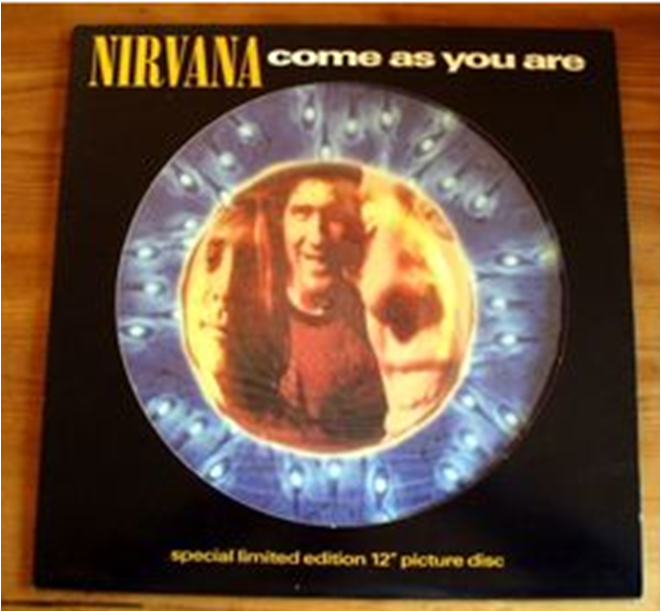
Collectivism_Come as you Are

This 12”, and the Smells Like Teen Spirit one, started my flight away from collecting records for the sake of it. Essentially I didn’t have the space to display this likeable vinyl oddity, and all the songs on it were available more conveniently…So after three or four years I decided there was more music in the world I wanted, that something that I never looked at, listened to, or imagined ever listening to had no purpose.

The point though is that collecting, as an activity, rarely has a fundamental purpose. My starting point, always, is a completist desire; I purchased every Swans release, I read all the Sven Hassel books. On a more sophisticated level I own thirteen books about Mike Tyson which allows the tracing from the early days when he was the great hope of heavyweight boxing and being held up as a rags to riches, all-American dream and credit to the community; to the first rising disquiet; through his defeat, imprisonment and return whereupon the books become more focused on the business machinations of boxing; onward to the present vision of him as a fairly dark individual with a fairly awful reputation. I can understand that desire; it’s a trust thing — when one knows one enjoys a particular author, artist, musician, it’s an easy fulfilment.

The next level, increasingly open to fans, is to support a particular individual or group thereof. I purchase all Swans’ releases direct from Michael Gira’s Young God Records and they all come signed. Whatever The Caretaker (James Kirby) is up to, I’ll buy it — I despatched money to fund the pressing and release of the six disc Theoretically Pure Anterograde Amnesia release, two copies, one of which one of my best friends successfully lost; genius move Franklin. Loyalty and connection are powerful motivations in their own right.

In addition to that, I suffer a dreadful desire to know, to understand. It’s a form of control in a sense, projected outwards into the world — a desire to fully grasp an individual’s work or vision. I do the same thing with genres, delve into them, cover the bases, get to the point that I can say “yep, I know grunge/Dischord Records/Williams S. Burroughs”. But it’s a hole that can never be filled. In the early days I used to buy all but one of any collection; 13 of 14 Sven Hassel books, every Swans album except The Great Annihilator, every official Sonic Youth release (this one took some work) bar their very first album (now rectified.) It’s a controlling urge, a subconscious attempt to possess so much knowledge and data on something that somehow you ‘get it’ or at least can argue or demonstrate it — I’m unsure if collecting at this level is about trying to win.

There’s also the desire to recapture the thrill, that first good feeling when something felt like magic. It’s related to that first point; a dependable source of pleasure as opposed to the uncertainty of having to locate a new one that’s equal to what has gone before. Nirvana are certainly one of my personal origin myths, the ur-text for much of my music taste to come. Also, like a lot of the people I’ve spoken to during this book/blog trip, the discovery of Nirvana was a turning point — these feel more intense in our teens when we’re still pouring structure into the mixing bowl of content already within us; there are fewer of them as the mould sets.

A good consequence of collecting so much is that it creates scarcity; there’s a point reached where each release one doesn’t have is part of a shrinking pool into which one can delve thus providing each new piece a significance and importance that isn’t possessed when the world is simply a mountain of consumable media never-ending. Eking out those remnants becomes as important as the item itself; it’s rare, valuable by default.

Of course, on the downside, collecting so much can lead to exhaustion. With any genre there’s a point where one has whipped through all the bands who were true innovators and then burrowed into the bands who were just tweaking the template now established. If one is content hearing ever more minor digressions within a single orbit of sound then that can be fine; one can dig a bottomless pit of similar sounding bands. This does, of course, lead to an ever greater recognition of the differences; one can hear ever more finely what distinguishes the releases in a way that casual listeners can’t; it’s why those who haven’t dug deep into a genre can make claims about the similarities between bands as diverse as The Who and Nirvana.

But then, as I said, given it’s the quest, the search, the new finding that seems to motivate me, possession gradually loses its excitement. Sonic Youth are a good case; I’ve shed a number of their live releases and most of the singles — I didn’t need their cover of Nirvana’s M.V. for instance, the original fills whatever space that song needs to occupy. By the same virtue, I didn’t need the picture discs sitting on a shelf gathering dust, they had to go. I’m not saying that’s right or wrong, it was simply my mode of collecting. The fact it was a Nirvana item, a relatively rare one, made no odds — an unheard fragment of Nirvana I’ll cling to with furious tenacity, I’ll rampage out into the cosmos to hunt them down, but retaining objects that differ only in their physical qualities…Somehow it doesn’t spark for me. I’m a content junky not an object one. Again this isn’t a statement of any moral or otherwise intrinsic right/wrong; some people collect houses, some collect savings, others collect memories, some gather mementoes. All of these are possibilities, all are devoid of a right/wrong. It just so happens most of my memories are encoded in the possession of a book or the presence of a CD or song.

Smells Like Teen Spirit: Live n’ Left Out?

You may have noticed, but I have a particular fascination with using information to show that certain views and approaches may not be as cut-and-dried as they initially appear. To some extent we are all what we are trained to be and, in my case, I was taught to sift information, present a hypothesis then to test; then, at work, I saw increasingly that getting things moving effectively relied upon, firstly, having the information to back-up a course of action and, secondly, being able to present it in such a way that it could be readily digested. What has always stunned me, however, is the extent to which entire realms of decision-making were based on statements that had never truly been tested, could be shown to be untrue, and led to large-scale activity that ultimately was to no purpose.

As an example, one organisation I worked with argued that delegates tended to come to a conference every two years rather than annually, so we should be trying to persuade them to alternate with colleagues, then deploy sales and marketing contact with the former delegate when the second year arrived. The answer? Like Hell were they. Sitting down with the data from all the events going back five years meant it was possible to show annual attendance vastly outweighed the one percent or so who would skip years. The entire approach was wrong yet it governed almost a year of organisational activity and was very hard to batter down.

That’s where my approach to Nirvana coincides with my professional and my academic past; I enjoy finding the ‘chinks’ in the existing tale whether that means showing that Nirvana’s live shows are remarkably predictable entities, or that maybe there’s more to a particular statement or event than acknowledged, for example, that MTV Unplugged in New York wasn’t just a triumphant and beautiful and wondrous show.
In the case of Smells Like Teen Spirit, Kurt Cobain was certainly irritated by the feeling that a single song was expected of him and that he couldn’t take a stage without parading it. What I was curious about was whether that annoyance translated into any actual action. That Nirvana did react against the expectations that came with fame is clear from the refusal to play any Nevermind songs at their final radio session (The Netherlands in November 1991), the fact they had to be persuaded to play anything from Nevermind in the one before that (my discussion with BBC producer Miti Adhikari: “…they didn’t want to play anything from Nevermind, but they were persuaded by either their management or by me to do different versions of Nevermind tracks …”) and their attempts to avoid Smells Like Teen Spirit at TV performances. What happened on stage between 1991 and 1994?

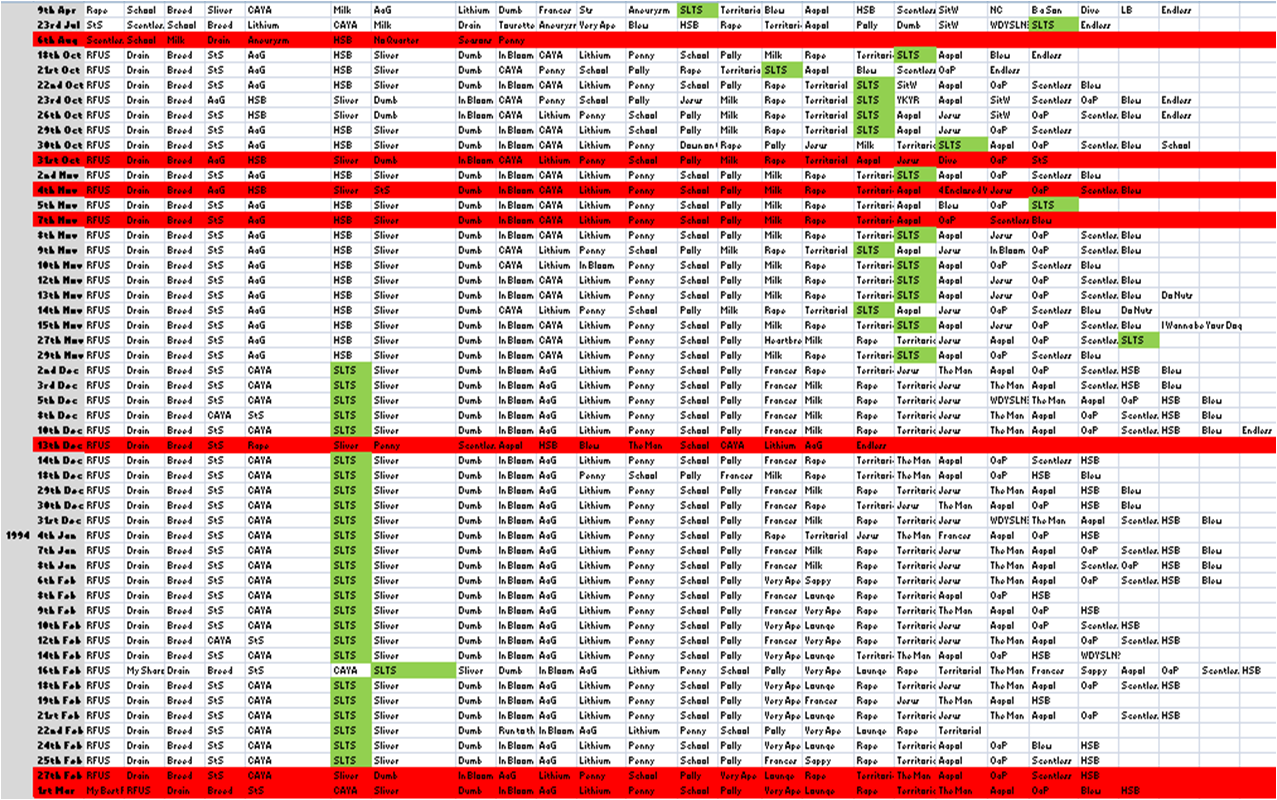
The answer, in a broad-brush way, is “nothing.” Reusing the spreadsheets of complete set-lists (from Nirvana Live Guide) that I used for the Side A/Side B analysis its visible that Smells Like Teen Spirit was played 141 times out of 150 occasions available for us to observe from its debut on April 17, 1991 until the band’s denouement on March 1, 1994. I hadn’t expected any change to occur at first because the song hadn’t yet become the albatross hanging around Cobain’s neck. But there’s never, essentially, a spell when the song is ignored or neglected. The band skip it once on August 25, 1991; they skip it once in 1992 at the notorious October 30 show in Buenos Aires; they skip it five times out of 37 set-lists for 1993; then twice in 1994. That’s it.

What that immediately suggested was that Kurt Cobain’s protestations regarding the song never spilt over into refusing to generally please the crowds, play the hits and do what was expected. The degree to which is distain for doing so was a pose or a deeply held sadness and annoyance is a matter of debate — make your own minds up — but the song was rarely sliced.

If you look at the figure below you’ll note that the song goes from being part of the build-up of the set, to being part of the close, to being a mid-set number, but it switches positions so many times what it actually says to me is that though the song was certainly not despised by its creator, it didn’t build up the usefulness of say Drain You or Aneurysm (consistent and persistent components of the set opening) or of Blew (an equally persistent part of closing.) All it says is the song wasn’t cared about so much that it had to belong anywhere while others were.

Looking closely, however, at the occasions on which Nirvana didn’t play the song, there were occasions which seem deliberate. October 30, 1992 in Buenos Aires is the best known example. The sexist treatment of the opening band Calamity Jane led to Nirvana devoting an entire show to frustrating and being combative to the audience — but in a particular way. The band did so through music; they teased the audience with the Smells Like Teen Spirit introduction but never played it, Kurt fluffed the intros to most songs to burn stage time, he barely bothered with the lyrics to Come as you Are, he abandoned the stage leaving Krist and Dave to jam for spells. It was a quiet guerrilla war on an audience that didn’t deserve catharsis.

Strangely, there are two shows that coincide; Nirvana weren’t meant to be the opener for the August 25, 1991 Pukkelpop Festival, they were just a fill-in, meanwhile, the August 6, 1993 show was the Mia Zapata benefit event with Nirvana as unannounced special guests. With the pressure off in each case there’s a case to be made that maybe Nirvana felt less expectation. Supporting this, partially, Nirvana were unannounced guests at two shows in October 1992, a far more heavily weighted time in the band’s life, and in each case the parts of the set-lists that are known suggest Smells Like Teen Spirit wasn’t played. If people hadn’t come specifically to see them it seems Nirvana potentially weren’t as bothered about ‘pleasing’ the ticket-holders.

December 13, 1993 was akin to the two radio shows, wrecking Top of the Pops, switching on Jonathan Ross, refusing to play Teen Spirit then faking out MTV producers with the opening to Rape Me at the MTV Video Music Awards and the refusal to play more known hits for MTV Unplugged in New York. As described the other month (https://nirvana-legacy.com/2013/02/07/final-resistance-mtv-live-n-loud-december-1993/) Nirvana’s MTV Live n’ Loud appearance set-list was entirely revamped for one night only. As part of that revamping it stands out quite strongly that Smells Like Teen Spirit was eliminated; Nirvana simply wouldn’t play it to please the MTV administration.

And the other three occasions in 1993? My hypothesis was that perhaps Nirvana eliminated Smells Like Teen Spirit as a way to punish audiences — a continuation of the Buenos Aires approach and the antagonism toward MTV. Certainly the Halloween show on October 31, 1993 has a potential echo of it given an exchange involving someone throwing a shoe at Kurt into which he then urinated in retaliation — but it’s only a suggestion not proven. The November 4 and November 7 shows are united by one event which was that on November 5, the intervening show, the rendition of Smells Like Teen Spirit involved dragging the support bands on to help trash it, a clip of it is found here:

It’s hard to tell if it was just coincidental that for those three shows, the conclusion of the tour phase during which The Boredoms and The Meat Puppets were on board, Smells Like Teen Spirit either didn’t appear or wasn’t fully realised; it’s just a short spell. One consideration is that the agreement to book Nirvana for MTV Unplugged in New York took place sometime in late October-early November and coincides with the October 27-November 5 spell during which Nirvana were accompanied by The Meat Puppets. What I’m suggesting is that being in conversation with MTV again provoked a small outburst and therefore Smells Like Teen Spirit’s elimination. An alternative is the way that Kurt retreated to drums on November 4, sometimes a sign of his annoyance or desire to escape the front-man role and also, at the same show, the fact the NLG lists him as ‘playing’ the In Bloom solo with his foot with the guitar dumped on the floor.

http://www.youtube.com/watch?v=z8oLFwgKG_0

Again, it maybe points to a burst of annoyance and a resultant sarcastic response. Anyways, here’s the full show if you feel like analysing the performance:

http://www.youtube.com/watch?v=b2J8YGfDs3s

Anyways, it’s clear that, of the nine shows at which Smells Like Teen Spirit wasn’t played, two were definite acts of aggression (Oct 30 and Live n’ Loud); two were because the band didn’t have to please an audience (Aug’ 25, 1991 an Aug’ 5, 1993); two took place within a single week of November with an intervening show at which the song also suffered chaotic attention even though the interpretation of what was afoot at that point is hard to figure out. This all lands us in 1994, the finale. And, in one of those coincidences that look absolutely wonderful in literary writing or media pieces looking for ominous conclusions, the two shows where Smells Like Teen Spirit was not played, were the final two shows of the tour when Kurt Cobain was tired, getting sick, was inquiring about cancelling. There wasn’t much spirit left in him, mirrored in the absence of Spirit on stage. Looks great ending these graphics with a double red underlining…

a-SLTS_Apr 91-Nov 6 1991

B - SLTS_Nov 10 1991-Jan 23 1993

C- SLTS_Apr 93-Mar 94

Quick Study of the Song D7 and Rare Nirvana Set-list Or…?

I admit this is a rapid fire post simply recording something I did out of curiosity over an item appearing on a thread at LiveNirvana (with all credit and kudos to LiveNirvana and specifically to Mike Jenkins for spotting this.) Now, this item is on sale on eBay:

Set-List_Maybe

The item has, according to the seller, been seen and signed by Krist Novoselic, and seen by Chad Channing — the two individuals suggested it was a set-list from an ‘older show’ or from 1991-1992 given it features Smells Like Teen Spirit. It also, intriguingly, features the word Bonefire/Bona fide and what looks at first glance like Ah but, I suspect, is a reference to About a Girl. Certainly there’s a chunk of the page missing, there should be a further half dozen or so songs given the averages Nirvana were playing at that point. You’ll note the asking price.

Well, it seemed a fairly easy item to check against the Nirvana Live Guide so I had a go; D7 isn’t exactly a hard song to find given there are only 22 known appearances for that song commencing with Dave Grohl’s first show on October 11, 1990 and concluding with the wreckage that was January 16, 1993 at the Hollywood Rock Festival in Sao Paolo. Even better, only two of those set-lists aren’t fully known and complete. I simply wanted to know whether it was clear when this show took place?

So, eliminate the eight known shows at which D7 was performed in 1990; Smells Like Teen Spirit didn’t appear until the spring of 1991. Problem is, there are only three of the remaining known shows at which Aneurysm was the first song, two of those are the incomplete set-lists from October 3-4, 1992 and neither features Smells Like Teen Spirit. This leaves one show at which Aneurysm was the opener, and where D7 and Smells Like Teen Spirit definitely appeared; January 31, 1992…But the song order doesn’t match.

OK, could it be a set-list from another show and the band spontaneously altered the song order? That can be checked easily enough:

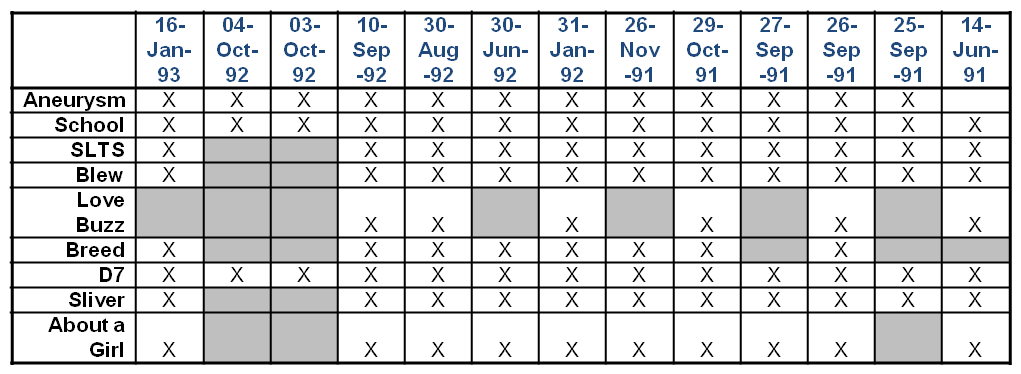
D7 Missing

OK, so long as we accept Nirvana were playing songs out of the order displayed on the set-list, then there are five candidate shows stretching from late September 1991 to September 1992 at which all the songs did feature – so it IS possible. It certainly supports the document’s authenticity given it’s such a specific selection accompanying the handwriting, the nature of the document, etc.

Could the set-list, therefore, be showing us what Nirvana played at one of the missing shows during that time period? Possible, there are fourteen missing/incomplete shows within that time period September-to-September. Anyway of pinning it down? Alas, nothing precise. The duo of Aneurysm/School does occur in late 1991, roughly from start of November until end of year but more usually with Drain You, in particular, or another song introducing the set or in between those two songs. Blew meanwhile isn’t ever a feature of the opening half of a set except for April-June 1991 or a spell in February 1992. Only twice in the whole of 1991-1992 are Love Buzz and Breed played together as a pair (November 1991)…But in the opposite order. Similarly, Sliver/About a Girl are played as a pairing twice in June 1991 (but in the opposite order) and three times in February 1992 — heck, with all these twisted orders I did examine if I was reading the set-list the wrong way round, that maybe it was meant to be read bottom-to-top…Nah, Aneurysm and School are solid early set songs. There’s essentially no comparable set-list featuring all the units (duos/trios) of songs in the orders shown on that sheet and though there are quite a few shows with almost all those songs, they’re missing D7.

So. In essence, your guess is as good as mine. What you’re looking at is a set-list that conforms to no known set, that does feature a reasonable selection from 1991-1992 but not visibly comparable to any existing habits or phases of Nirvana’s set-list development. That would mean it’s one of the rare set-lists where Nirvana tossed the rulebook out the window. So, it’s a real rarity or…

A Man Who Made a Difference: March 29, 1984 – January 4, 2011

I admit I wondered about a simple memorial post for today; it’s April 5, 2013 and we’ve just hit the nineteenth anniversary of the death of Kurt Cobain. But then, browsing Twitter briefly, rolling across Facebook pages…It seems near everyone is already marking their public allegiance and fealty. It’s a pretty thing to see; people pausing and saying “someone mattered to me and still does.” I’m going to get on and do a post later today pursuing a statistical angle on Smells Like Teen Spirit instead.

I don’t mark the deaths of many public figures…But on March 29 I took a moment for a gentleman called Mohamed Bouazizi – again, as with Kurt Cobain I like to mark the birth as well as death. We live in a world where the power of individuals is cited usually as a way of claiming the powerful deserve it all or that the poor, weak and dispossessed created their own fate; it’s the myth of entrepreneurs controlling the world, the superman tale that infests the financial markets and blames people who strived for something more, who aspired to something greater for failing.

Mohamed was a poor man, a boy who by his late teens was already helping support his mother and his siblings by selling fruit and vegetables on the streets of his town; there’s no room here for an existential crisis, or an artistic one, this was a meaty reality. At 11.30am on December 17, 2011 in an act of desperation he shouted “how do you expect me to make a living?” and set himself on fire in the street in Sidi Bouzid, Tunisia. This, until then, unknown, overlooked and essentially irrelevant 26 year old man died some two weeks later. From this ridiculously sad action, an act of true hopelessness, something good was born. Dictators fell. Regimes that had oppressed and robbed their populations for decades came apart at the seams; there was, however briefly, a chink of light.

That doesn’t mean the world is predictable, nor that consequences are controllable; it doesn’t mean the world created is going to only contain happy things, or desirable things, nor that utopia will be born at the flick of a match. All it means is that individuals can choose to act, to protest, to fight for what they feel is right – too much of the time people judge by the result when it’s the act itself which is what should be focused upon. One man changed the world entire; did anyone still truly believe that was possible? Here’s proof.

Across six months now I’ve spoken to dozens of Nirvana fans all choosing to make something positive from their love of a band and its music. Again, the act with which all this creativity and positive energy commenced was not a positive one – but something was born from sadness. That’s our choice day-by-day, what good do we build from the bad that will inevitably occur in any life? In my own life, today marks the commencement of a journey two of my friends have decided to embark on; they’ve purchased a canal boat, they’ve left London and their jobs behind and they’re going to spend the next year floating through this country seizing back life and time for themselves. I find that positive, beautiful. I wish them the best.

“No band is special, no player royalty” – true. But the least of us can do something special if we choose. Rest in Peace Kurt Cobain…And Mohamed Bouazizi. You each accidentally changed the world and it’s only a shame you won’t get to see all the good that has and will come from it.

I Hate Myself and I Want to Die — I Love Myself and I Want to Live

The former Cobain line is extremely well known. Just like the famous “here we are now, entertain us” from Smells Like Teen Spirit it’s a flippant statement Kurt Cobain claims to have used regularly as a default — “I hate myself and I want to die” in response to inquiries about how he was feeling in 1992, “here we are now, entertain us” when arriving at parties. In each case he liked the line so much he incorporated it musically; one as a song title, the other as a stand-out chorus line. Despite his claims that lyrics were irrelevant or unrevealing, the truth is a significant number of the words, phrases and ideas he incorporated were very personal even if unanchored from any overall narrative or theme — the Curmudgeon/Oh the Guilt examples being another case (https://nirvana-legacy.com/2013/03/25/reaction-to-fame-and-the-name-game-1992-1993/). I believe that there’s one more example that has been thoroughly overlooked.

I Hate Myself and I Want to Die was a response specific to 1992 though Cobain was unclear whether he was simply taking aim at the social expectation of having to say “fine” in response to the pleasantry “how are you?” (a topic he’d already taken on in Blew and Come as you Are); whether it was a consequence of his much-vaunted stomach pain; a reaction to his lack of enjoyment of fame and the demands of high-level professional musicianship; or just him being snot-nosed and bratty with those he didn’t feel like being nice to.

The response flipped, however, in 1993 to assurances to all-and-sundry about his pride in being a father, to the cessation of his stomach problems (Rolling Stone, January 1994: “my stomach isn’t bothering me anymore…I’m eating…It just raises my spirits”), to the kinds of positive forward-looking plans with which he ended the band’s official biography, Come as you Are by Michael Azerrad. He told writer David Fricke in early 1994 “I’ve never been happier in my life” and a year earlier explained to the L.A. Times “I knew that when I had a child I’d be overwhelmed and it’s true…I can’t tell you how much my attitude has changed since we’ve got Frances. Holding my baby is the best drug in the world.” Surrounding that with the resumption of touring in October 1993 (having played only 21 shows in eighteen months since March 1992) and with the constant barrage of declarations of love toward his wife, it’s almost possible to believe that the sarcasm-infused aggression of 1992 was over and done.

The problem is that the ‘flip’ initially arose from the deepest calamity the new Cobain family were to experience in their early days; the danger that their drug abuse was going to lose them their baby. The PR-exercise that took place in late-1992 through mid-1993 is well-known with Kurt roped into talking to the media to assure them all was well, issuing statements claiming the negative tales circulating were false, agreeing to let Michael Azerrad interview him extensively for the official biography. Both Kurt and Courtney owned up to past drug abuse while each assuring anyone who would listen that they had only dabbled and it was over and…Fairly demonstrably untrue in each case.

At this point Kurt claimed that the potential title for what became In Utero, I Hate Myself and I Want to Die, was just a joke that no one had caught — he dismissed it. The only difficulty being that he still thought enough of the line to keep it as one of his song titles. He was in a strong cycle of using titles as slurs upon his enemies; until the Journals emerged it wasn’t clear that Curmudgeon was another attack on the press; calling Nirvana’s Christmas release Incesticide was vicious; Oh the Guilt was an attack on the idea that he had to apologise for success; meanwhile In Utero switched Nine Month Media Blackout for the only slightly less overtly press-baiting Radio Friendly Unit Shifter and started the album with Serve the Servants, a statement on how he was expected to bow to the demands of the “self appointed judges” — a phrase that, in his Journals, is expressly used to refer to the press as part of his line about curmudgeons.

Very rapidly, in 1994, the entire set-up fell apart. Turning up to the band’s only studio session in a year proved too much for Cobain — he showed for one day. Touring proved too much — he cancelled most of the European tour. Nirvana had become an imposition, despite having forced a financial settlement on the band in 1992 that meant they were ever more dependent on live fees, he refused to do Lollapalooza therefore more or less signifying the end of Nirvana. Meanwhile the relationship with Courtney Love was…Tempestuous at the least, in a state of collapse at worst. Yet still Kurt Cobain was walking around saying things were good, he was fine, it was all great.

And then, right there in the middle of the last ‘great lost Nirvana song’, You Know You’re Right, he said it “things have never been so swell…” Just like those other throw-away titles and lines it was a one-off statement slotted into a track, repeated over, not particularly attached to an overall theme or idea but very explicit. ‘Things have never been better’, it’s said with a snarl, it’s patently a lie, there’s a sarcasm inherent in positioning it within the downbeat and defeated retreat expressed within that particular song.

What Kurt Cobain had been taught, in late 1992, was that he couldn’t hide or refuse media attention; he had to serve the public’s appetite for information and the commercial pressure for content from or, regardless, about him. He had also seen firsthand the danger of disregarding public image; he was willing to do anything to defend his privacy so was happy to engage the press and repeatedly lied to feed the media — it was the only thing that worked.

Within this last song he can’t help but parrot the PR line, scornfully, that he was having to reel out day-by-day to please whoever was asking him at that point. Looking at the song in that context, cohesion can be spotted in the fact that, like Blew or Come as You Are, it’s a subservient song, a bow to the needs of another individual. It’s a whole song agreeing to do whatever the unknown other wants and stuck within it, the lead in to the simple submissive chorus agreement “you know you’re right”, is the faked smile he was being asked to adopt against his will if he was to have a chance of evading punishment.

It’s beautifully ironic that the video constructed to accompany the release of You Know You’re Right was made so that it appears, at points, that Kurt is saying the words of the song. For a song about other people making him say things and having to serve the needs of image and of others, a video is made in which Kurt Cobain’s image is manipulated to pretend he’s saying words he really isn’t.

Nineteen Years and Counting: Anniversaries

The room smells like an accident at a chemical factory; a blend of Tiger Balm, Deep Freeze spray, Vicks…It’s been a pesky few days between the stomach bug, the cold and my neck locking completely…Ah well! On we go!

IMG-20130402-00050

Last week was my thirty-third birthday therefore marking the nineteenth anniversary of receiving the Nevermind album on cassette. A process of extrapolation means I know that yesterday/today is therefore the nineteenth anniversary of me buying either Bleach or Incesticide, which makes Friday April 5, 2013 the nineteenth anniversary of the other one of that pair. Why so precise? A wonderful family holiday to Florida coincided with the Nirvana endgame and gave me a chance to switch from my taped off copies of everything to the official cassettes. Oh, that means Christmas was the anniversary for In Utero.

In some ways the journey of that one album indicates the power of commercial music sales; taped off copy a year before sometime in the summer, leading to the cassette that still sits on top of my record player, to the CD copy sometime in 1996 following the Singles box-set in November 1995 (my first CD purchase – note that as late as Unplugged in New York I was still focused on cassettes, gosh…), then all the way up to both the Super-Deluxe and the Deluxe reissue (yeah, odd I know but it was easier to carry the Deluxe to work y’see? Plus I bought the Deluxe at a second hand store making it a far less mental purchase than it otherwise looks…) Surrounding those purchases I’ve invested money in the Charles Cross Nevermind book (a really good read), in James Adler’s Nevermind book (a really not good read), plus Susan Wilson’s Nirvana Nevermind book, I’ve heard dozens (at least!) of live copies of every song on the album, I’ve watched shaky hand-held cam footage or top notch official footage — it’s amazing how it’s been possible to consume and, more intriguingly, to re-consume the same set of songs over and over again.

And it’s nice knowing that isn’t just my trip — I’ve spoken to dozens of Nirvana fans these past months all of whom have similar tales of finding the music, different routes but a lot of shared characteristics. In general it looks like the core of people who still make up the fanatics are in that 31 to 36 year old age group now, were in their early-to-mid teens when Nirvana hit. I think that timing makes a significant difference; the human ego doesn’t fully evolve until around age ten meaning we’re not whole personalities, fully self-aware until relatively late in our youth — I think the discovery of one’s tastes and preferences, learning to ‘care’ for music, or authors, or activities, I think it’s all part of that void-filling spell of life, the quest to become someone. It’s why the music retains such importance for ‘us’; the music is great but musical obsession is about far more than the intrinsic qualities of a piece of music, there’s nothing about any single piece of music that denotes it must be loved — it’s about the listener and about catching them at the right moment. In the case of the Nirvana fans, the band hit at just the right moment; a few years later we’d be talking Smashing Pumpkins, or Green Day; a few years after that we’d be hip hop fans or sharing memories of post-rock appearing or *shudder* Limp Bizkit.

Alas, I’d have to say that the emphatic nature of the end of Nirvana’s career does matter in this regard; it’s a huge act that occurred — very few musicians commit suicide, even fewer at the peak of fame when they’re among the biggest musicians in the world. Someone dying does matter, it does invest the memory with importance, it does mark the music indelibly — for a bunch of teenagers commencing the quest to learn how to live, how to be a life, to be brought into such immediate contact with ‘the end’ isn’t necessarily damaging, but it is significant.

As a personal journey it has always felt great combining my own birthday ‘season’ with a spell of significance in the Nirvana story. For the first time ever I’ll actually be at work on April 5. But come evening I’ll still be pausing to play the tunes yet again; for all the debates around the commerciality of music it feels good to still feel something for the tunes at the centre.