A Pledge of Allegiance: My Most Desired Piece of Music Memorabilia

This piece was suggested to me by the team at http://www.invaluable.com so credit to them for providing me with a fun idea and hopefully the result is a quality read.

DSC02587

A home isn’t a shell of wood, cement and brick. That’s just a house. Amid the functional blankness of unavoidable purchases — dead sofas, cutlery, toiletries — people cocoon themselves in treasured memories; that’s what makes a home. Mementoes record where we’ve been, certificates and trophies of one form or another capture what we’ve done, photos nod respectfully to the people with whom we’ve done it. We curate museums of self. What we value most will be hung on walls and placed atop units telling who we are, who we have been.

It’s more than a declaration of self. A home binds us to our tribes. The living and the dead comingle in our belongings, we preserve them, give life to them, honor them. We open that door not just to friends, family, acquaintances. Memorabilia is a mark of gratitude thanking those we might never have met but who — through their works — gave us comfort, color, inspiration. We pledge allegiance by adding physical markers of their lives to ours so no one can tell our stories without acknowledging theirs. Memorabilia says someone or something mattered.

Though I’m not a rich man, I’m tempted. A friend of mine says he’ll accept $7,500 to $10,000 dollars for it. Plastic casing at least twenty-seven years old, not too battered for being not much shy of my age and twenty-seven is a sacred number in this context . A handwritten chunk of card roughly twelve centimeters wide and maybe a little longer. I imagine the cassette weighs a hundred grams. I used to patiently re-spool cassettes just as unremarkable as this using a pencil to feed the magnetic tape and the tip of a finger to screw-drive the reel one turn at a time.

I’ve never valued picture discs, limited editions, numbered copies, or any of the other sleights of hand used by canny businesses to confer preciousness on industrial end-products. If the music isn’t worth it, I don’t want it. I clear out records that leave me cold or that I never feel like playing. But downloads are too slight a thing to be satisfying. They strip sound of worth, reduce it to anonymity, to musical wallpaper and corporate filename formats. I want the commitment that comes with an object given shelf space even if I don’t fetishize plastic, paper, vinyl.

Human connection invigorated these objects; handicraft kindles value for me in extinguished substances. A CD-R with a Xeroxed cover bought from Dylan Nyoukis at a gig in Brighton. John Lydon’s memoir hand-signed then embossed at the 100 Club. Woodblock covers for Michael Gira’s home recordings. The Fire Ants’ only single sent as a thank you from Ed Dekema for writing the band’s oral history for their new reissue. A polaroid from Marcus Gray’s Parasite project. The Blood Circus t-shirt Geoff Robinson sent. A lathe-cut 7” of a Dumb Numbers’ song.

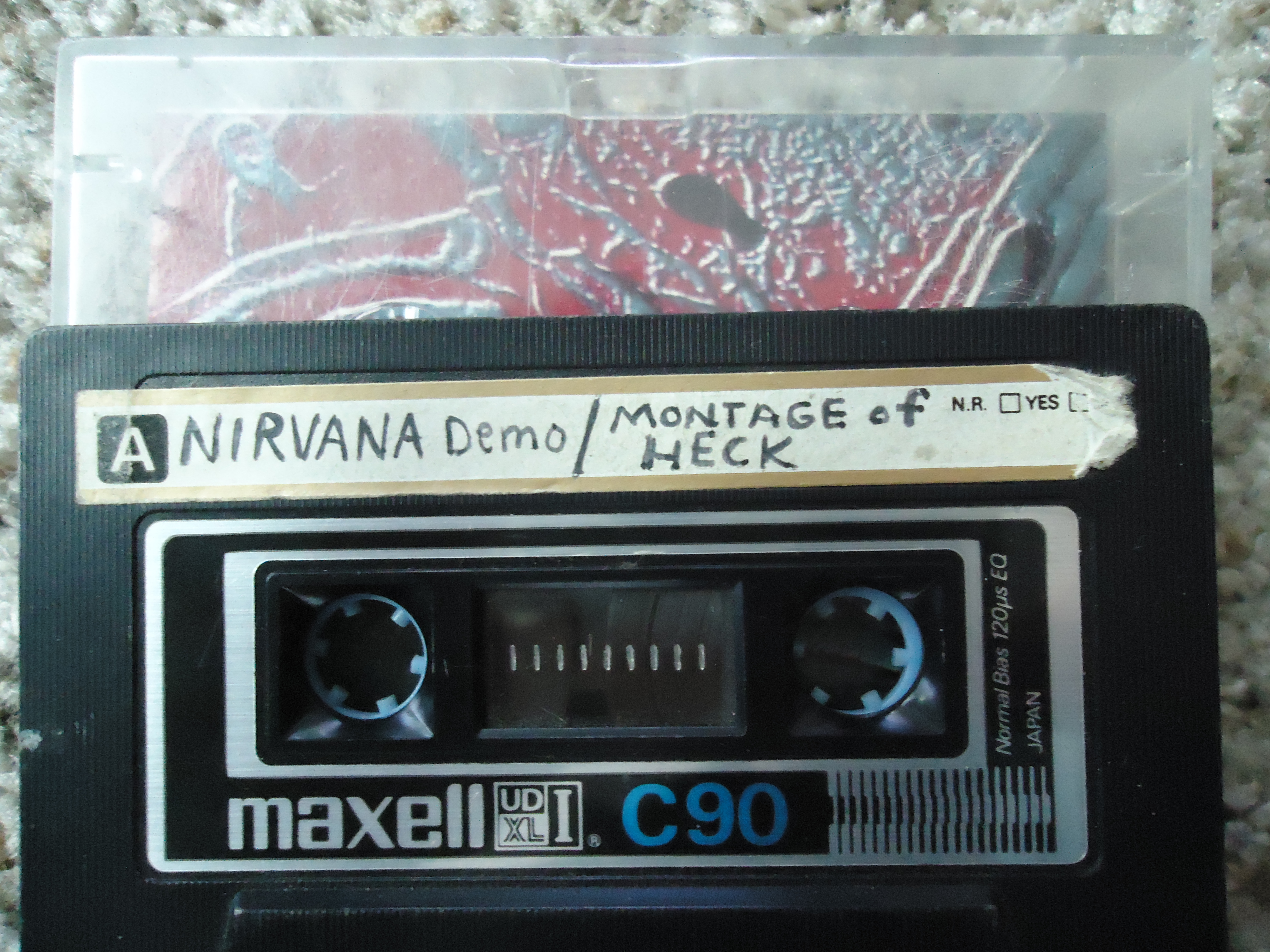
And this tape…I’ll play it two times and the second someone else will have to do it for me. It’s Nirvana’s first studio session on a cassette Kurt Cobain dubbed off by hand in early 1988 as a gift for a friend of his I’m now happy to call a friend of mine. It’s the only item of music memorabilia I’ve ever thought of owning. A tape a twenty-one year old pauper boy copied back before his band meant anything at all to the world. I’d be too afraid to play it more than twice.

I’ll never have been so scared as on that first occasion. I’ll be praying; “Allah, please, don’t let my grandfather’s old tape-deck fuck it all to hell.” Electric skin and cold sweats expecting to hear the tinfoil crinkling of a mashed tape at any moment. If it breaks there’s no replacement; Cobain handed out other tapes but I’ll never come near another one. It’s handmade aspects mean another one still wouldn’t be this one. From beginning-to-end, though I know ever note, every nerve in my body will be set shaking like crystal, a never-felt intensity arising from pure fear that this might all go wrong at any moment and it might become just a hundred grams of trash.

The second time, I’ll be in a hospital or, if I’m lucky, my own home. It’s the best any of us can hope for; that we have a chance to pause and say goodbye when the end is coming on strong. I hope I’m not alone. I’ll ask someone to take the cassette out of the transparent reinforced fireproof security box I’ve had welded to the floor. I’ll ask them to put it on for me. And I’ll smile because it’s so silly — who the hell else’ll care about a guy who died some sixty years back in another century? Do you cry for the music-hall stars of the 1890s? But I’ll welcome the comfort of music I’ve lived with since age thirteen played on a tape that’s as close as I’ll ever come to shaking the man’s hand and thanking him for making music that made my life better.

I don’t think it’s too much money. If I can scrape it together I’ll be delighted to make that much of a difference to my friend’s life. The tape’ll look so incongruous sat in the middle of my home, so nondescript, a monumental nothing appealing to my sense of humor. I’ll rest it on the rare Nirvana CD single kind people in Tacoma gave to me and signed their names on. Cobain’s tape’ll be surrounded by memory of one friend, the names of half-a-dozen others — I like the idea of their writing being as precious as his, a gathering of people he knew or would have liked.

There’ll be no re-sale value once memory of Cobain fades. There’ll be an ever-shrinking cluster of aging collectors I’ll find it too much trouble to track down and I can’t imagine museums shelling out for a 1988 tape in 2050. There’s the absurdity of buying something just because it passed through the hands of someone I admire; something I can’t play or use, that’ll I’ll need to buy protection for. If I don’t take pleasure in the ridiculousness of it I’ll talk myself out of it.

I know already the day after the purchase it’ll feel too small a thing and I’ll wonder at all the things I could have done with that kind of money. I’ll have overpaid because I’m buying from a friend and turning it over in my hands I’ll feel a bit silly. It’s a just a thing I’ll tell myself. It’s just a possession…But that word will make the difference. Someday when my body has turned traitor I’ll draw strength from the ghosts inhabiting the things around me because that’s what they’re there for. They’re spirit totems stored up to carry us through dark times…

…And I’ll remember that the money and the silliness don’t matter; they’re just cause to smile. I’ll recall the one hour I sat, face pale, composure like porcelain balanced precariously on a table edge — that time when I never listened to music so intensely. And I’ll know this tape will play me out of the world paying my respects to an epiphany at age thirteen; to personal glories in my mid-thirties; to friends and memories and all my ghosts. And I’ll hold the hand of someone I love and the tape won’t matter anymore, it’ll just be people. And love. And it all won’t matter.

On it Goes…More of Kurt Cobain’s Home Demos Leaked on Tues/Weds

I’m pausing to take in the breadth of what’s just happened. “(Sound City) Sappy”, one of those holy grail songs fans have wondered about for years and likely the last real rarity from the Nevermind sessions out. Unheard material from four Nirvana studio sessions in 1990, 1991 and 1993 out. Home demos from 1990 out. The complete Easter 1986 Fecal Matter tape out…

Discovering that the remaining studio pieces by ‘Nirvana’ are curios but not substantially different from known renditions is unsurprising. The Nevermind material had been heavily worked up and practiced before hitting the studio. The big surprises have been the two versions of the underexposed “Old Age”, plus “Sappy.” I’d be curious to hear if Nevermind songs currently unseen prior to 1991 went through in-studio changes too. The In Utero album consisted of a lot of very old and well-worked material, a bunch of material worked up over several months, then some semi-ad-libbed newer ideas kicked out in Rio. It surprised me, frankly, that the “Heart Shaped Box” instrumental should be among the most intriguing which potentially shows it was still a ‘young’ song in many ways, one that was still evolving in small ways. I’d love to hear more of the evolution of “Serve the Servants” because as far as can be told it’s one of the strongest late-era Cobain compositions.

Filling in the gaps on Fecal Matter gave me a far greater appreciation of it as a complete work. There’s so much going on! Cobain, in 1986, had pent-up ideas flying in all directions it seems. Being with Dale Crover definitely helped him let loose the inner freak. Hearing the clean riffs at the end aided my appreciation of what he’s playing. Hearing improved/tweaked versions of what I’ve already heard is neat but fundamentally altered material of this nature is far more revelatory and enjoyable.

Which brings me to the home demos. Some of this matches what we heard earlier this year on the “Montage of Heck” film…Great! This stuff is quality. I’ve been dampening my expectations of what a mass of Cobain home demo material might truly mean in terms of quality and interest but this is glorious stuff. There’s are a variety of vocal and instrumental approaches which vary significantly from official releases. The presence of background noises and sound effects as intentional additions to songs elevate this beyond being just a clot of acoustic meandering. The sound quality is exceptionally good compared to what might be expected, there’s real clarity to his voice and playing. There are unseen lyrics and rarely seen songs here which keeps the interest level high…It’s totally whetted my appetite for whatever emerges from Universal in November (oh yeah, forgot, it’s been confirmed that the Cobain release will be in November.)

A further point, these leftovers help make the case for Cobain as a true artist. They’re not revealing a guy just hammering out identikit songs to churn onto albums. What they show is a guy who would have an idea and genuinely play with all its elements to see if a different vocal inflection or delivery might create something fresh, who wanted to hear the sounds in his head in different ways before selecting what the definitive statement would be. That depth of intuitive and intelligent work is, I feel, underappreciated in discussion of Cobain.

Song by song thoughts?

“Frances Farmer Will Have Her Revenge on Seattle” Completely different lyrics it seems! The riff is instantly recognisable and unchanged from what you’ll already know.

“Opinion” Though brief at only 13 seconds, this is a far fuller-voiced and brighter rendition than the solitary radio take – the home demo treatment actually improving fidelity for once. There are nuances in Cobain’s delivery – note the stresses he adds within the word ‘congratulations’ – plus he seems to speed up quite quickly which might be an error but it gives the song more force. “Opinion” is interesting because it’s one of the final known and seemingly fully formed Cobain compositions from 1990-1992 that doesn’t end up being released during his life time. I love the song, it’s really easy to sing. The background sound of a storm sounds artificially inserted rather than a suggestion that he was recording during an actual event.

“Pennyroyal Tea” is a full 2.34 rendition featuring the glorious line “I receive crazy moneyyyyyy…” as part of the second chorus – sheesh, a truly bad Cobain line? That’s kinda rare! The guy is usually so lyrically sharp when it comes to make lines sound intelligent, purposeful and intended. The vocal delivery in a lower octave isn’t necessarily superior to what he chooses to do at Pachyderm or on MTV Unplugged, but it’s a legitimate artistic deviation that creates a pleasantly somnolent vibe. It appears to feature someone else on rudimentary drumming, it may be Dave Grohl’s voice early on. What sounds like a click track seems more likely to be an improvised drum stick of some kind. Cobain uses his breathing to create the ‘finale’ to the track.

“Sappy” this is clearly from Montage of Heck, the atmospheric repetition of the guitar line over something approaching a John Carpenter-eerie selection of sound effects. Maybe someday we’ll hear more of Cobain’s experimental urges which were extensive and are still underappreciated even with the Montage of Heck collage and Fecal Matter now on display.

“Verse Chorus Verse” is a full three and a half minute rendition with a combination of known and unknown lines – it’s intriguing seeing them evolve actually. “See the…In his hands…Keep the sunbeam in his room…Keep it in him…Seeds…What it means…” This has always been an intriguing song because extant versions on the early Outcesticide bootlegs were noisy enough to leave the lyrics in doubt. This continues that picture of a song undergoing a lot of changes. The structure seems solid if not exactly the most inspired and wild approach, it’s like this is one of the songs where Cobain was getting used to making peace with the simplest of pop song methodologies, it truly earns its name.

“Been a Son” this, is the copy from Montage of Heck where he stops to answer the phone to someone apparently asking after Tracy. Intriguingly, this is the most altered the lyrics have ever been but that core “she said” refrain is already there even with a song sounding this frayed. I love hearing him lay out the bass part – I was aware Cobain did come up with ideas for the other instruments on his songs, actually played thoughts to his bandmates for them to run with, but it’s uncommon to hear him do it on a recording. I think this is the only time I’ve heard Cobain laying down an intended bass part.

“Breed”, another 15 second scrap from Montage of Heck, with the same breathiness as the “Been a Son” take above which gives the distinct impression these two songs at least are recorded at the same time and place. The absence of any substantial shift in sound is curious, makes one imagine he simply sat and filled a tape with one idea after another…I wonder if there was more, a fuller rendition of gasped Cobain homework. It’s like even on acoustic he’s finding a way, by manipulating his voice, to indicate where he’d be screamed in a full rock electric rendition of this song and “Been a Son”, that it isn’t just an odd vocal choice, it’s almost a ‘note to self’ about what he intends to do with those lines or parts.

Oh! Forgot again… A new demo of “Very Ape” with totally sketchy lyrics! Nirvana are so tight instrumentally they make this stuff sound like it’s exactly as it’s meant to be. Cobain is indistinctly murmuring in places of verses and there’s no vocal at all on the choruses. “There’s a ____ (God / Girl?) I dare to _____, there’s a ____ (God / Girl?) I dare to know…”

So, summarising this week, we’ve heard:

Acoustic demos of Been a Son, Breed, Frances Farmer, Opinion, Pennyroyal Tea, Verse Chorus Verse plus a Sappy electric demo

Studio demos of Very Ape, Heart Shaped Box, Lithium, Milk It, Old Age (x2), Gallons, Onwards into Countless Battles, Polly, Sappy, Scentless Apprentice, Seasons in the Sun, Tourette’s, Verse Chorus Verse, I Hate Myself and I Want to Die, Here She Comes Now plus I’ve heard tell there are renditions of Come as You Are and MV floating around

Then, from Fecal Matter, Sound of Dentage, Bambi Slaughter, Laminated Effect, Anorexorcist, Spank Thru, Blathers Log, Class of ’86, Downer, Instramental, the riffs, plus unknown songs 1 to 5.

Jeez…Even if the brevity of today’s acoustic leaks indicated that this week’s source is drying up it’s still been one hell of a week. The huge presence of lesser known Nirvana/Cobain songs is really welcome. Noticeable that there were no utterly unknown acoustic demos – more in the can still to be detected? Or not much from 1990-1992 that Cobain didn’t use around Nevermind or have to press into service to cover his paucity of writing after fame hit?

Hard to Keep Up! Cobain’s Fecal Matter Tape Apparently Leaked in Full Today

Sheesh, did someone blow the doors clean off the Universal/Nirvana vault?

For those who want a new ‘holy grail’ to hope for, remember that Fecal Matter rehearsed with Greg Hokanson on drums before this tape of Cobain and Dale Crover was made, then there was a project with Mike Dillard and Buzz Osborne. There’s no known recording of any of this. Plus, there’s Cobain’s 1982 solo recordings to keep wishing for too. Ah, does it ever end? Thank God Cobain was a good self-archivist and kept all this material! It’s remarkable in a way, that someone with such insecure living arrangements, self-esteem and life prospects held onto all of this no matter what. It gives me the impression that music really was an anchor, a safe harbor, something to cling to – he didn’t dispose of tapes or chuck away the fruits of his creativity, he treasured them.

So, again, this’ll be hard to keep the door on, even when its pulled down from YouTube you’ll find it. A full hour tape. Makes me wonder, if they filled this cassette, did they start in on another tape? Is there more? Nah, unlikely, the final section is a repeated instrumental then stray leftovers. Thanks to DB for sorting me with this, hugely appreciated.

Most of the key named songs you’ll have heard. Around that though…

‘Unknown #1’ is a real ripper, one of the fastest most hardcore Cobain songs I think. Hammered through. Then that surviving line about “my asylum”, the chorus vocal melody survives to become part of “If You Must” in the Nirvana era. Nice effects in the outro.

‘Unknown #2’ has a nice drive, entirely new to me, excellent! Love how much Cobain experiments with his voice on this early tape, he goes in so many directions. Here he sounds alternately sick and snotty – real teen high pitch on that “I’m a punk rocker!” line. The words ‘anti-solo’ don’t cover what he does with his guitar here but it’s a really effective finish to a song, instead of it flailing back into another verse or fading out or any trad. trick the guitar goes haywire then the bass follows and the song falls apart. Great!

‘Unknown #3′ another joke voice song. There’s a doubled vocal at one point which sounded more like Dale added on. Those little touches are kinda impressive – there’s real thought going on about how to put together sounds for emphasis and impact, they’re not just splattering songs onto cassette rough n’ ready. “No you’re not mine” becomes the outro refrain. Cobain loves coughing sounds, choking, it’s like my nephew blowing raspberries through his entire christening the other day – a certain glee in making the throat do odd things.

‘Unknown #4’ yeah, again, Cobain sounds like he’s going to puke in this first verse. I remember hearing how Chris Cornell’s early work with Soundgarden was always like listening to an air raid siren because he’d not yet learned to moderate and carefully deploy his wail. That’s true of Cobain here, he’s aiming for those high notes, screams and screeches over and again. This track repeats elements of “Love my Family” and other lines or motifs I know from existing sources of Fecal Matter. Notable how ‘metal’ the bass work on these songs is, back before grunge brought hard rock back into repute, just after ‘da yoof’ were getting sick of straight punk. This is a very long song, potentially more of an improvisation which would explain why it seems to loop in elements of other tracks – it’s roughly ten minutes long with a long slow ‘doomy’ section.

‘Unknown #5’ kicks off with something kinda new wavey – guitar even sounds like an early keyboard, then vocals like an early rendition of “Beans” (it’s not but Cobain’s thing for helium voices apparently kept him happy for quite a few years.) Then the dynamic kicks in, like a hugely slowed down “Big Cheese” riff. The time changes are pretty great, the song rips up to full hardcore stomp after a minute or so. “I’m not a Russian, not a spy…Somebody said, should have been dead…Accusation…”

I’ll never get tired of “Spank Thru”, it’s a great early Nirvana song and, viewing the material they had available to them in early 1988 I can understand why they decided to get it out there on Sub Pop 200. I used to think it was a showcase for the ‘Nevermind’ era dynamic of songs, loud-soft etc. I was wrong. The guitar intro is wicked, always was.

‘Blather’s Log’ is a great story-telling song in the Cobain fashion, more stray images than a full narrative. There’s a court scene being laid out here, various aspects of the tale weaving in and out and all done in this forced croak. I’ve heard this before but still an impressive early work. Cobain really hasn’t found his voice yet, sure, from the start of the Nirvana era he has a lot of control over his voice, he can do a lot with it, but it’s always recognisably Cobain. On these early songs he’s working it in all kinds of directions, a lot of which don’t have any later markers in his calendar. The amount of work the guy put into finding his place in music, his desired identity, ‘himself’, it’s underappreciated. He’s not just been writing songs he’s been speaking in tongues – that must be hard, adopting a voice appropriate to a song or a mood or a vibe.

‘Class of 86’ heads down that same road, he impersonates made-up classmates, comes close to spoken word, snarls the chorus, screams “clone!” It’s a welter of different voices, far more than a two and a half minute pop song would usually incorporate. Some stray noise on the outro I hadn’t noticed including a background sound that runs straight into the start of ‘Unknown #6’, did they just take a breather than carry straight on into the next song?

‘Downer’, another great survivor from Easter 1986 through to January 1988. I’m not sure I ever got Cobain’s Black Flag comparison for this one. But I love the whistling solo. Cobain moved so fast through musical styles in the mid-to-late Eighties. There’s these hardcore/metal/punk hybrid tunes, then the new wavey oddness he’s reaching by the Jan ’88 sessions, then the grunge vibe mid-to-late ’88 which comes out on “Bleach” (which couldn’t sound more like a Sub Pop album if it tried), then the pop-punk vibe that barely lasts longer than the time it takes to hammer out Been a Son – Stain – Even in His Youth – Token Easter Song, the acoustic work in the background, then the big switches in 1990-1991. Cobain had a real gift for incorporating other influences into his work, for learning quick, for moving between styles. Some bands might take years of work just to create another album sounding just like what they’ve done before. This guy has left us with recordings from ’86, ’88, late ’88-early ’89, late ’89, early ’90, early-mid ’91 each with a different air.

‘Instramental’ is marked as a version of ‘Unknown #3’, again, there’s quite a few differences. It’s like comparing “Sifting” from “Bleach” to the instrumental version from the summer of 1988 – general vibes, riffs, reworked in substantially different ways. It doesn’t seem too defined, just playing around with ideas until they fall apart.

After that the tape features “Turnaround” by Devo – ye gods! Cobain’s love of early influences, his fidelity when it comes to his favourites. The idea that we get a tape here of that song then four years later he pulls that track out for BBC Radio and two years beyond that we get it on “Incesticide.” The guy knew what he liked…

You get near three minutes of “Turnaround” before the tape returns to Cobain working over riffs. This is actually a lot better than you’d imagine, hearing the riffs in isolation gives an opportunity to appreciate some of his guitar work without the rather muddy bass and cardboard drums clogging the sound (heck, without Cobain’s still thin voice over the top.) You’ll recognise most of these riffs from elsewhere on the tape. I swear that’s the “Big Cheese” riff coming in again!

I can see why, if this is the tape that Krist heard back in ’86, why it would make him want to team up with Cobain. There are so many ideas going on. That’s my biggest impression, often a single song goes in so many directions, sure, there may be a core riff, or a vestigial verse/chorus structure but usually there are off-kilter bridges, breaks, outros, intros, deviations going on. He’s not starting with something utterly basic, he appears to be past that already. I recall talk of how people found it surprising that Cobain could write something as sophisticated as “Spank Thru” so early in his career but it makes so much more sense in the context of these other early efforts where there’s a visible chomping at the bit, a desire to try different things. So much variety crammed into a single tape, it’s intriguing in a way that the progress from here to Nirvana was about paring back, simplifying, reducing the pebbledashing of ideas onto tape.

Gods it’ll be nice to hear a properly polished up (as best as possible) release some day. I’m sure Universal will get to it sometime. Why’s it coming out now? Intriguing…Is this someone linked to ‘Montage of Heck’ or to the release apparently coming later this year. If so, wow, could be we hear that official version sooner rather than later.

1991/1993 Nirvana Demo Leak – Part Two Impressions

Going through what I’ve seen so far, just wanted to continue…

“Heart Shaped Box” An interesting instrumental take indeed, while the introduction/verse sounds more spindly and repetitious than the final take, the chorus – by contrast – sounds more muscular with the bass further forward, the guitar pushed that little further. In terms of differences, at 1.35 in there’s a slight tweak (or mistake) but the real interest is from 2 minutes in where the guitar (what I’d call the “heyyyy…Waiiiitttt…” notes) are really slammed. The entire solo is different, not as kicking or as well-poised as the final, but an interesting deviation. From 3.30 it sounds like Cobain is humming the vocal melody in the background.

“Here She Comes Now” from Smart Studios starts with a nice flubb and ‘whoops’ from Cobain. I’ve always loved the rich guitar tone on this cover even if it isn’t the most original cover version ever. The bass mix doesn’t have quite the grandeur of Krist’s work on the With the Lights Out version (that intro note he strikes and the post-verse re-starts…Lush.) I thought it might be a different vocal take but re-listening to 3.00 to 3.40, nah, it’s the same take as With the Lights Out. I had similar thoughts on the guitar, also unfounded as far as I can tell.  The last few seconds are taken up seemingly by an attempt to go right back to the intro and to begin again – cut off abruptly.

“Lithium”, an alternative take with the intro taken beautifully, really perky start but wow, Cobain sounds breathless. He can’t do the choruses so he just hummms then – it’s like listening to a kazoo or a paper-comb rendition of the choruses. I quite like the mumbled verses, they sound even more numbed and narcotic than the final resigned rendition. It’s a shame because instrumentally the choruses really rumble – bit of a contrast to Cobain sounding like he’s going through puberty. This is the funniest thing to listen to – all those genuflecting tedious articles plagiarizing each other with talk of his powerful voice then hearing this take. Amusing.

“Milk It”, you’ve heard this one before but the mix is extremely clean, a very live sound which adds something. As with “Scentless Apprentice” from Rio, hearing Cobain use sounds and stray words to sketch a lyrical form is always intriguing, seeing that he has the flow in place, the rise-and-fall, the emphases are often there first. Also the way he doesn’t just follow the guitar line in the way, for example, Ozzy Osbourne used to on Black Sabbath stuff.

“Seasons in the Sun” starts with Cobain saying “go Krist!” again, just bits previously edited out. Proper stereo sound too. I’ve always enjoyed this rendition, it’s a song that could be so cheesy (let’s be honest, it IS!) but Cobain’s delivery, the band seemingly having fun with it…It works. Nothing else to add really. Same take, fuller sound.

“Verse Chorus Verse” sounds like the same edition as featured on “With the Lights Out”, maybe a different vocal take – I’m not sure if I’m hearing different features at 1.30 to 1.40, similarly his voice seems to rise less on the choruses than on that other edition. I think the WTLO version is superior vocal-wise and there’s nothing really different instrumentally.

“Polly” …An alternative mix of Polly? Sheesh, a different mix of a song that barely seemed to have much mixing involved in the first place? I’d be lying if I said I heard anything. Just nice to have a reason to listen this intently…Usual unedited ending as is common on most of these pieces.

“Onwards into Countless Battles” Heh! New versions of rarities are always fun. A song that ends up on an album or official release is usually a closed door – it’s the artist’s choice of what the track SHOULD be. Alternative versions of unreleased/rare songs are still possibilities and potentials in the making – they’re undecided and there’s no way of privileging one over another. The mix is really clean, a good source, sounds great for a throwaway joke! Even the funky voices tweeting in the background and the “take it back” line are in place so it’s definitely not an alternative rendition.

“Old Age” (mix 1) a very full sounding tone instrumentally, let down by a second guitar that doesn’t seem to have been totally worked out yet, it drops out at seemingly random points in the first thirty seconds, returns to punctuate the song at around 00.50 and 01.10 for no apparent reason, it’s like someone is tuning up in the background. Otherwise the rhythm track seems complete, the main guitar line is in place, the band switch seamlessly through each part so they’re very familiar with it. Around 2.45 the second guitar comes in with what could be a neat counter-melody but, again, it’s not been properly worked out so drops away, changes direction, a practice or test-run. Vocally, there are lines in place but this is an awful lot of moaning and muttering.

“Old Age” (mix 2) has a cleaner introduction, mix 1 sees guitars in both left and right of the stereo chiming in, this just has guitar on the left and it sounds purer – there’s no interruption from the second guitar that muddied mix 1. The vocals on the With the Lights Out version are different to these two mixes – the whole rendition on WTLO is more definite especially on first verse (even if the WTLO version is still sketchy at points, check around two minutes in where he’s straining for effect and saying nowt – wish the bloody bloke would just pronounce “old age” properly in the choruses because the groan doesn’t do it for me). I’m not catching significant differences in the bass/drums, the chiming notes on the guitar seem more to the foreground which is welcomed. A tell tale regarding the vocal track is at 2.30 Cobain chokes on a word in both these new mixes – it’s the same vocal track.

“I Hate Myself and I Want to Die” Ouch! Loud enough to make my ears hurt. Love the noise. You’ve heard this demo version already but it seems to have a bigger kick here. The mix does make a difference, the jagged sounds all stand out in more detail. Interesting considering Cobain creating this first minute of noise, then going back and overdubbing a second guitar of even more noise to make it uber-nasty. The guy knew how to pull sound out of a guitar. Different vocal take? Or maybe just greater clarity. Again, words not fully in place, fun to hear him improvisation – Cobain would have made a good scat-singer.

I’m going to have to come back to “Sappy” again…But, maybe it’s weariness, I’ve been listening to this song since I found the Pachyderm rendition on a bootleg back in 1995, it’s probably still my favourite posthumous Nirvana track with the exception of “You Know You’re Right” and this isn’t sufficiently different or lively to replace my love of the deep deviations visible on the existing versions. It does sound more like more akin to “Nevermind” than the others, but it still sounds like a warm up rather than something where the band are pushing for a good take. Still (Sound City) Sappy, the last known jewel in the Nirvana vault (as opposed to the Cobain home tapes)…Fascinating! A good day!

These’ll all end up on an official release someday and I’ll certainly buy it. Why wouldn’t I? I actually DO want to buy official releases from bands, to support artists and indicate an appreciation of their work, I’m cool that a percentage goes to record labels to pay for the support services required to get music recorded, produced and out there… So whether I’ve heard these illicitly or not I’ll buy when Universal feel it’s time. Tiring sometimes that it can be so hard to get the studio works of a band all in one place but it’d deaden the excitement if I was hearing three takes of “Old Age” one after the other. I’d rather wait, anticipate, savor not knowing and not just being able to grab stuff.

1991 and 1993 Nirvana Demos Leak

Well gosh…I’m not sure there’s much I’d like to add except to thank my friend Diego C for bringing this to my attention and to the tireless denizens of LiveNirvana for the existing depth of their thoughts and analysis on this one.

Basic summary, over the weekend a number of unreleased demos – alternative takes and/or mixes from a number of sessions across 1991 to 1993 leaked. They consist of:

Smart Studios (April 1990)

Polly (alt. mix)

Here She Comes Now (alt. mix)

Sound City (May-June 1991)

Sappy (unreleased)

Old Age (alt. mix v1)

Old Age (alt. mix v2)

Verse Chorus Verse (alt. mix)

BMG Ariola, Rio de Janeiro (January 1993)

Scentless Apprentice (alt. mix)

I Hate Myself and I Want to Die (alt. mix)

Milk It (alt mix)

Onwards into Countless Battles (alt. mix)

Gallons of Rubbing Alcohol Flow Through the Strip (alt. mix)

Seasons in the Sun (alt. mix)

Pachyderm (February 1993)

Heart-Shaped Box (instrumental)

Tourette’s (alt. mix) – thanks Raffaele!

I won’t post links simply because the YouTube links seem to being pulled down at a rate of knots so basically just hunt around, you’ll find them pretty easily. They seem to have been posted as audio files on Zomb Torrents first and, like anything in e-format, they’ve flowed from there.

So, personally, I had a rough weekend. A major bout of food poisoning had me inspecting my brother’s bathroom floors and facilities in more detail than I’d ever wish, I’m weak today, sleepy, a touch brain-dead…And this cheered me no end.

Any notes, not much, if you’re a Nirvana fan then you know these songs by now, you’ll notice inflections and alterations that revive and refresh old memories – its how outtakes work really, something known so well you’re not really listening suddenly tweaked in some small way to wake you briefly from autopilot. Why would anyone listen in this detail to something they’ve been listening to twenty plus years? But listening to a slightly new version? Ah, that’s different.

Sad though it is to reduce thoughts to impressions I just thought I’d listen through and note elements – naturally my ears aren’t the be-all-end-all, musicians among you will note more than I do. Just things I enjoyed…

“Gallons of Rubbing Alcohol…” A touch of extra noise in the first couple seconds, from 2.45 there’s another guitar track given more prominence returning to lend weight from about 4.45, cymbal work more prominent from 5.30 onward, 6.30 onward the bass is really up in the mix. Annnnd a nice extra minute and twenty of indulgent guitar improv from Cobain.

“Tourette’s” Double-tracked or additional vocals joining in on the “heys!” They do actually add something I’d have to say…

“I Hate Myself and I Want to Die” A few stray sounds noted compared to the With the Lights Out edition but otherwise nothing much to see here. A general lightness and freshness to it. Cobain goes crazy at 3 minutes in, neat. Gives a deeper impression of his spontaneity on this track, either that or his ability to make pre-planning sound wild.

“Sappy” Well was it ever going to be more than a light diversion? It’s nice to hear the roar of the 1990 version stripped back but it definitely lacks a certain spark, there’s a sketchiness to it (and to Cobain’s vocal) that is either appealing or a bit ‘meh’. It’s fine though, such a likable song is impossible to ruin and it’s fun watching Cobain haul through another quite significant variation on this song that he could never get just right. I wish there were as many versions of this out there as there have been ‘Been a Son’.

“Scentless Apprentice” Gains a few stray opening sounds and amp noise at the end edited out of subsequent release but heck, I’ve always enjoyed Cobain’s lyrical approach to this one!

Go forth, enjoy the rest as you will.

Not Nirvana: The Most Important Book I’ve Read in Years

I just closed Nick Davies’ “Hack Attack.” If you’re in the U.S. the Kindle edition is $9, the hardback is out at $16. In the U.K., the book is on ‘buy one get one half price’ at Waterstones or is £7.49 on Amazon. It’s money very well spent.

It’s the account of the ten year battle to finally bring to light the role of Rupert Murdoch’s News International organisation in using illegal means to acquire information; the way the organisation deliberately attacked individuals and their families if an individual dared to protest their behaviour; how News International created a climate in which neither police, regulators nor politicians dared tackle their corruption because the consequences would be massive assaults and vilification by a news organisation that owned a vast percentage of news coverage online, on paper and on TV in the U.K. and internationally. It’s about how that organisation explicitly and knowingly lied over the course of a decade to the police, to the regulator, to the courts, to all the democratically elected representatives of the British people. Andy Coulson even sees fit to lie directly to the Prime Minister’s face for months on end.

Here are a few numbers. In the court trials that took place over the last few years, the representatives of our democracy, the Crown Prosecution Service, were able to muster £1.7 million, one full time solicitor and one administrative assistant to make the case. News International spent £30-40 million aggressively defending its representatives and deployed an army of legal representatives and support staff. Why does it matter? It’s an example of what happens when greater powers are invested in private corporations than in our public services. The corporation is able to devastate any attempt to make them take responsibility for the harm they’ve done to the public good. The government that the people have elected to represent, as best as possible, their collective interests and to protect them from harm is no longer able to wield true power in the face of the buying power possessed by the corporations. There is nothing defending the lives and well-being of the public; we are all at risk.

It goes deeper. News International is an organisation that recognises that governments are the only bodies able to exercise any control over their behaviour. Therefore News International deliberately advocates the shrinking of governments, the reduction of their revenue, the weakening of their regulatory powers, the most stringent controls over their spending. News International does so in order to ensure that it possesses a competitive advantage over the only organisation able to exercise any restraint upon their corruption. It attacks tax levels, attacks public service in general, in order to reduce the expertise and skills available to the judiciary, to the police force, to the tax authorities, to all levels of our political establishment making it less likely wrong-doing will be detected, prevented or punished.

The hacking scandal was not a case of a few celebrities getting their fingers burned. Of the hackers exposed after all those years, one had hacked a minimum of 5,500 people, another had hacked a further 1,600. Those people included the family and friends of a couple who’s child was abducted. It included the family and friends of a murdered school girl – the newspaper’s representatives went further and didn’t hand over evidence that at the time they believed indicated where the girl was, they wanted to claim credit themselves and to sell more papers so didn’t give it to the police. News International went after the family and friends of two girls murdered in the town of Soham. In other words, if you, your family, your parents, your children, your friends – anyone you know – gets caught up in a tragedy, all their conversations and information (medical records, police records, bank records, employment records, diaries, etc.) and yours too would immediately have become something News International stole and used to make profit for their company.

News International destroyed 210 million emails during the course of the investigations. The leaders within the police service who led the early investigations were being wined and dined by, and were friends with, the people they were meant to investigate – the police deliberately misled parliament, the public, the courts and the inquiries. The Press Complaints Commission which was meant to ensure that newspapers respected the laws of this country saw its role as being to deflect criticism away from its richest benefactors and was too scared to speak out against them because it would mean News International (the Sun, the Times, the News of the World, Sky News) would send teams out to attack and slur them. The governments, both Labour and Conservative, were too busy trying to ensure good coverage and to avoid attempts to undermine them with sleaze stories, critical coverage and attacks that they were unwilling to speak out and decided instead to give jobs to people who had broken the law, to attend their parties, call them friends, privilege their views. News International was allowed to tell your government and my government what their policies should be. Surely that’s meant to be the right of the people?

At root, in amidst the sheer scale of it all, there’s a simpler story of bullies and damaged people who gain satisfaction from the exercise of power over ‘the little people’; it’s a tale of people who grew up as we all did on the bible tales of doing unto others as you would have done unto yourself…Then abandoned that in favour of personal profit over any moral consideration. Rebekah Brooks, having acquired information indicating that people she called friends, Sarah and Gordon Brown, had just learnt their six month old baby had cystic fibrosis – an incurable condition that would lead to life-long health problems and a life expectancy of between 37 and 50 years – called them and reduced them to tears by refusing to allow them time to reveal the information themselves because Mrs Brooks wanted to sell newspapers by using their pain as an exclusive front page story.

It’s an amazing book. Well written, lengthy but with so many moments of stunning revelation that you’ll barely be able to close your mouth at times for sheer fury. I found myself punching the air through sheer frustration as the suit-wearing white-collar criminals slipped through the net (while setting themselves up as judge and jury over everyone else.) Amazing. Nick Davies’ “Hack Attack”. An amazing book and I’d like to bow respectfully to the author for what sounds like a harrowing experience over more than a decade.

Looking Forward to a New Nirvana (i.e., Kurt Cobain) Album?

I admit I am. I’m long past any kinda rationality when it comes to the leftovers of Nirvana, I’ll listen to anything out of sheer curiosity even if it doesn’t necessarily sustain lengthy re-listening. So, I confess I’ve been listening repeatedly to illicit YouTube dubs of soundtrack material from Montage of Heck. What to make of it?

There are a few different ‘spliced’ editions of the previously unheard material up there now. Now, to be fair, I enjoy listening to it, very much so. But trying to be cold-eyed about it, what are we faced with amid this ten minutes of material?

OK, ignore the ‘band rehearsal’ shreds, they’re just chatter basically. That’s followed by what the text below the video states has been referred to as the ‘Cry Baby Jenkins’ riff – I confess to being ignorant of the reasons why this brief electric clatter and band joke links to the ‘Cry Baby Jenkins’ tale found in the earlier YouTube link here but perhaps that’ll become clear elsewhere. Again, it’s kind of a nothing, it’s very visible he’s just made it up on the spot without a thought.

Then we’re on into vestigial renditions of future Nirvana songs which, though welcomed, from a completist perspective aren’t exactly stunning reinventions. Really what we’re looking at is half formed, very early attempts which are interesting from the perspective of seeing how Cobain would work around riffs and ideas and gradually flesh them out and fill them in.

Then we get into an intriguing element for those of us who thirst for Cobain/Nirvana leftovers – a run of unknown tracks lasting 2 minutes and 5 seconds. The four pieces featured don’t offer too much food for thought I’d have to say. The first two pieces are barely 15 seconds between them, the acoustic riff is nondescript and the vocal is barely more than playtime. The ‘Change Me’ electric shred is neatly metal-tinted, chunky, but there’s nothing there beyond one line of lyrics repeated over in a gasping, short of breath screech. There’d have to be a lot more to the song to make it more than an example of Cobain roaming widely over musical territory when experimenting at home (a bit like ‘Black and White Blues’ or whatever that jazzy finger-picked effort is called these days…)

Then we’re onto the most meaty of the new material seen so far, the 36 second long ‘rainfall song’ (it’s what I call it, maybe I should become a bootlegger and make up song titles as a hobby.) I love the use of the field recording – i’m going on trust that it was Cobain working with field sound and playing over the top. It’s a wonderful combination, atmospheric, moody, neat. The guitar riff tumbles down in a steady cycle – there’s something like a chain rattling at one point…It works well for a song with no words, with little beyond an overall tone and style holding it together. It’s a great example of Cobain’s ability to focus on creating an emotional colour first, then any technical structure or actual words second. It’s why his music is so affecting, he had the emotion down first then everything else after.

Next up is the longest piece here and exhibits Cobain’s tendency to moan sounds when he hasn’t yet worked out the words, it’s not unpleasant, there’s a drift to it that’s quite appealing, a relaxed sway. But let’s be under no illusions, it’s another piece where it’s unclear if he’s even awake, it’s like he’s on automatic just trailing this pattern over and over while thinking of something else. It’s hard not to want these interludes and curios in some form because they are interesting, diverting, distracting…But there’s a distinct lack of anything substantial anywhere in this track or in the preceding two minutes. The later piece marked ‘Come on Death’ in the credits has a similar absence of anything marking it out as noteworthy. There’s a useful reiteration of Cobain’s desire to play with sound and with sound effects which is already well-known to anyone playing around in the bootleg field…That’s it.

So, there’s one cover song too, the much commented on rendition of “And I Love Her.” There’s not much to add really. It isn’t the best guitar work from Cobain, there’s nothing here bar sophomoric practice strumming, no fresh touches, nothing to mark out a superstar versus anyone else in their bedroom. The vocal too, quavering notes, a gravel-throated aspect, no real difference in tone or anything heroic. It’s ‘nice’ but that’s it. A fairly dead work.

The best of what’s here is the segued versions of Sappy with the acoustic and electric neatly cutting from one to t’other. The acoustic vocal benefits from the additional echo, the added sounds in the background, the ‘sea monkeys’ muttering at the start – it’s these additional touches and inflections around a known riff that make it intriguing. The electric meanwhile sounds so menacing – was there anything that couldn’t be done with this song? It’s so adaptable! And he clearly worked so hard on it given the number of extant studio versions and home versions already in existence and now an additional two versions with neat differences that make a genuine difference in the feel created. I think this song is amazing. Sappy is the great survivor of the Nirvana era, the song he tries over and over again, devotes more time to than any other on tape…

So, if this is all that was deemed worth inclusion in the soundtrack that kinda worries me, was there really so little that was worth trailing in the film? And leaving such a long gap between the film and the actual soundtrack release seems silly on the part of Universal though I can understand they’re digging for the Christmas nostalgia market. Building all that buzz then letting it drop away again… As ever, I live in hope of surprises and being proven wrong and discovering my own error and that there’s a full set of intriguing demos just around the corner. Fingers crossed!

Kurt Cobain, Malcolm X, the Nazis and the Confederate Flag

Reading the comments below any piece on Kurt Cobain or Nirvana it’s stunning how rapidly someone pops up and blurts “Kurt was murdered.” No matter what the topic, what aspect of the band or the individual is under discussion, someone’ll slap the statement down making clear they see nothing as important to the band’s story as the lead singer’s exit. The reduction to a singularity is understandable; musical tales that transcend and become part of wider cultural conversation stop being about music and become part of wider threads speaking to ambition, comedy, tragedy, sex, death – often all at once. Thus John Lennon is reduced to ‘Imagine’ or to quotes about being ‘Bigger than Jesus;’ Elvis becomes Vegas judo moves and bathroom death; Sid Vicious is a safety pin and a swastika; Michael Jackson becomes white skin and odd squeals. I saw a beautiful Kim Gordon quotation the other day stating that pop culture is all about how “people pay money to see others believe in themselves.” Musicians don’t need to overtly stand for a cause, or a declared meaning, to be bound into the desires, wants, needs, fears and wishes people project onto them. What intrigues me in the case of Cobain is how impossible it’s become to speak of him, without speaking of the conspiracy theories surrounding his death.

This isn’t about my views on the theories themselves, it’s about the conversion of a perspective harboured by a small minority of individuals in early 1994, becoming a far more widely held belief among audiences who don’t necessarily have a dedicated adoration for Kurt Cobain’s music. It’s a wider cultural theme in line with popular threads of commentary and discussion rather than a topic rooted in music or Nirvana’s actual existence as a band. Why should a topic so unrelated to Nirvana’s life become so unavoidable after the lead singer’s death?

Firstly, stand-out events in the popular imagination are never the ordinary, the everyday, the common experience. Quite regularly recently people have mentioned to me how worried they are by events like the murder of several dozen tourists on the beaches of Tunisia, that they believe ISIS will undoubtedly attack in the west soon, that terrorism is a major fear for them. I’ve grown an unhelpful tendency to respond with the latest death statistics to explain why I’m totally unconcerned; in the U.K. in 2013 there were 17.8 deaths per 1,000 people – a grand total of 506,790 dead in a single year with barely a tremor of disruption to reality. Death is everywhere – we lose Britain’s fifth largest city every single year with barely a murmur. The U.S. lost 2,600,000 in 2013 – that’s Chicago or Houston wiped out annually. I’ll next point out to them that the U.K. murder rate dropped to 526 in 2014 (http://www.ons.gov.uk/ons/rel/crime-stats/crime-statistics/focus-on-violent-crime-and-sexual-offences–2013-14/rpt-chapter-2.html) which, given a population of 64,800,000 means a miniscule chance. Now compare that to the presence of violent death on your TV, newspaper, comic book, latest record… There’s a massive disproportion between the amount of time people spend thinking about or learning of violent death versus its actual presence. Near all of us are going to die of petty injuries or disease peoples.

(Here’s a beautiful visualisation of the 2009 death totals – http://image.guardian.co.uk/sys-files/Guardian/documents/2011/01/14/Factfile_deaths_v2_2011.pdf – showing the death rate hovering merrily around the half a million a year mark. For the U.S., here’s a quality historical review of death from 1935-to-2010 from the Centers for Disease Control; http://www.cdc.gov/nchs/data/databriefs/db88.htm#x2013;2010</a>).

The commonplace nature of death is what elevates certain deaths to a higher level; society needs ‘spectaculars.’ The deaths that become part of wider discussion and popular memory need to happen to someone of ‘significance’ on the public stage; need to be outside the everyday experience; need to come wrapped in a wider story worth retelling. Other aspects might put some deaths ahead of others in the popular imagination, as an example, Dr. Harold Shipman committed a series of quite boringly ordinary murders – injection of drugs, people slipped away. The deaths on their own were so ordinary they were barely worth of note and beyond friends and family the names go unrecalled – the elevating factor is that Shipman is likely to have committed 250 such murders making him one of the world’s biggest serial killers. The scale of the exercise makes Shipman the significant figure while the deaths become anonymous. Think of a stamp collection; one Canadian stamp might be more or less interesting – but a complete collection of every Canadian stamp ever issued, now that’s significant. Size, timing, method of exit – they all make a difference to what’s recalled and repeated across the media and among circles of people. As another example; Eazy E, rap impresario, major figure in the formulation of gangsta rap, multi-platinum selling artist…His death is barely mentioned because dying of AIDS in a hospital bed was neither photogenic nor even particularly exceptional. Tupac Shakur, multi-platinum artist, one of the most diverse rappers ever, dies at peak of career in a gloriously dramatic manner – tie the Notorious B.I.G.’s death just before releasing an album called ‘Life After Death’ and with the East/West media thread, gang connections, the fall of Death Row Records – it’s Hollywood baby!

Cobain easily passes the test for a spectacular; dies young, dies close to peak of fame, plenty of controversy keeping him in the papers 1992-1994 and reaching a peak after the Rome incident so lots of eyes already waiting to see what would come… But why should the conspiracy theories have become so loud? Well, it’s about cultural production. A concluded story can only be re-told so many times, that’s why articles on Nirvana constantly need to have a new angle, new pitch, new info – some claim to being NEW. That’s simple logic; why buy precisely the same information one already possesses? The human desire for culture is for novelty. Retelling requires there to be a gap between known and new in order to create tension – so, Dave Grohl has been asked about Nirvana several thousand times over twenty years, he’s told and retold every tale – but he might emphasise different details, will usually use different words, tell it a different way – this grants a degree of longevity to known material as it’s new to those who haven’t heard it and there’s a nugget of freshness for those who do. The same impulse is at play in the collection of bootleg renditions of Nirvana material; will the quality of what’s found live up to the power of what’s on the official records? Rarely, but it might. Will something truly new occur? Rarely, but it might. That potential, that deviation from the known, that slight tweak is vital to keeping a cultural object – whether a memory, a song, a story – alive.

This is the terrain where the conspiracy theories work perfectly. They overwrite the closed and complete story with one where there’s still an open potential and where the tension that makes it interesting exists in the gap between the known (i.e., listening to Smells Like Teen Spirit for the thousandth time doesn’t create the same kick as first hearings) and the unknown (i.e., a ragged bootleg rendition providing the unexpected and the potential to give something new.) It’s why there’s a far greater market for Nazi memorabilia than other World War Two ephemera, why playing the Nazis in a computer game for the umpteenth time, or films about Nazis on the moon, documentaries about secret weapons and research all get a listen because the tale of what might have but didn’t is an open space into which imagination can be poured and excitement found when re-reading what actually did happen and what the victors actually did do is already closed down and clear. You don’t see books around proposing counterfactual tales of what if the Allies had won the war a different way – there are quite a few re-fighting the battle from the German side. Secret histories turn dead stories into repeatable, re-playable experiences that the present-day consumer can explore.

Similarly, the interest in what didn’t happen is a reaction against the everyday quality of what did; again, it’s about the spectacular versus the lived experience of the average person. Malcolm X became the poster boy of the hip hop generation despite having contributed little beyond thought to the civil rights struggle because he was a figure who was unsullied by reality. Martin Luther King Jr. personally engaged with the Presidents of the era, staged the greatest march in the nation’s history to that point, was present at numerous flashpoints of the struggle while acting as talisman, figurehead and voice of what was occurring. He’s become an accepted ‘hero’ figure of the establishment however, identified with the reality of what did and did not happen for the racially oppressed in the U.S., his views are deemed to have been played out and the results seen which makes him a harder figure to rally excitement around. Malcolm X, by contrast, died at the start of a new journey into greater engagement with the wider civil rights cause, a different vision and set of beliefs – an untapped future potential. His views – simplistically reduced to an openness to self-defence and the application of revolutionary violence – never had the chance to play out across society, they remain an unrealised potential possessing the excitement of the unknown. On top of that he retains the allure of the rebel, he hasn’t become part of the dominant culture so there’s space for the marginalised, those believing in themselves as outsiders, to tag onto him. The fact his views can never be truly tested, his methods and ideas never fully explored or known makes him invulnerable to the boredom inherent to society’s winners.

To move to a symbol, why does the confederate flag persist? It’s the symbol of traitors to the current United States of America, of a group of people who chose to stand for racist exploitation of slave labour against what we would consider modern quality – so why fly their flag? The reason is that it stands for an independent identity against a central, dominant identity – the United States of America, the Union, Washington, is the being against which the flag declares independence, resistance, rebel status. Those who fly it once upon a time were holding on to a vision of society that they felt would be better than what came to exist – the disappointment of the everyday had set in, they had an untested alternative they could hark to. There are few now who wave the confederate flag in support of the 1860s vision of what the south was or could be. It’s become a wider rejection of the everyday standing in for whatever the individual wishes it to – a blend of those who are and are not deliberately raising one part or another of its actual historical meaning. The same process has happened to Cobain – as it does most historical figures – he’s now a symbol of ‘live fast, die young,’ of the outsider, of the person wanting to claim readymade rebel status with a t-shirt or a bedroom poster.

In the case of Cobain, he never had the chance to reach the disappointment that every musical figure eventually creates when they get old and no longer align to the latest thrill of the new zeitgeist. While every other musical figure of note – from Dylan to McCartney to Bowie to Pop to Rotten – has had to endure a period of dismissal before being admitted to the lexicon of ‘all time greats’, Cobain was never dismissed, hadn’t done enough to disappointment critical opinion as yet. That opens up a huge space for imagination, to ponder the hints of what might have come next, to tease out what avenues weren’t pursued – to draw one’s own designs (however logical or well-reasoned) on blank white space. Living musicians of that era – Eddie Vedder, Courtney Love, Thurston Moore, Dave Grohl – are a closed space, there are few surprises left after a further twenty years in which to perform them. Cobain is still open because the question can never be closed; what would he have done next?

Suggesting Cobain’s murder opens that space up even further, adds a fresh ‘what if’ to a known tale. There isn’t much interest in asking ‘what if Nirvana recorded Nevermind for Sub Pop not Geffen?’ because that’s a point about music – Cobain’s murder or otherwise resonates with the wider cultural interest in violent death, in themes of justice, redemption, tragedy…It’s Hollywood. It also permits individuals to retell a closed incident in as many ways as they wish – it creates ‘new’ where it didn’t previously exist. Into a space with “Cobain commits suicide,” one can write ‘accidental overdose and cover-up by multiple suspects,’ ‘deliberate assassination by one or more of a variety of suspects,’ ‘earlier discovery by a variety of individuals subsequently covered up,’ ‘death at location other than where he was found,’ ‘CIA MK-ULTRA campaign against seditious cultural figures,’ ‘improper investigation by incompetent or complicit officials,’ it’s a universe of new stories opened up for consideration. This allows the tale to be remoulded across time and space, to be fitted to individual views and experiences, in a way that an official, established and documented story cannot.

It also comes stamped with the spirit of the rebel, the idea that this is a counter-view to that of an amorphous ‘powers that be’. Cobain’s rebel status – the Nineties repetition of the archetype – is reinforced by pledging allegiance to the idea that even his death wasn’t what the squares in the media, government, police say it is. That call may only get stronger among newer Nirvana fans given the reality of Nirvana’s career has long since faded into imagination which makes written versions of the tale all seem equally valid but increasingly it’ll be a way to resist the view of elders and parents; a neat generational gap. The individual can own their own vision of what happened to Cobain and no one can take that away from them. The paucity of evidence is indeed a large part of the appeal of the conspiracy theories, the sense that there’s the potential for something new to occur or appear, that the story isn’t closed and might be radically revised, that there’s the possibility of discovery rather than just a dead certainty. The sense of being part of a community resisting a central view or vision, a lone warrior, seeker after truth, open-minded, is a neatly self-justifying addition to an individual’s identity and view of themselves.

Cobain’s death is therefore, understandably, a perfect candidate for posthumous revisionism. It had the ‘spectacular’ nature that propelled Cobain from being solely a piece of music history, to being a wider cultural cypher and figure. That moved him from conversations about music into conversations about larger societal themes – drugs, love, suicide, divorce, sickness, capitalism, conformity, submission, hypocrisy. There’s the reality that Cobain’s full potential can never be answered so he possesses a permanent appeal that the majority of artists can’t match. The need for novelty and newness made counterfactuals, alternative histories, more appealing. The existing ‘what if’ of Cobain’s tale laid open imaginative space into which people could project their own theories and imaginings – claims of murder push that even wider. The rebel status accruing to Cobain and adopted by those adopting him as an idol is reinforced and made more current, individual and personal by claiming his death as a resistance to the official history.
Courtney Love Asks “Soaked in Bleach” to Cease and Desist

http://pitchfork.com/news/60004-courtney-love-sends-cease-and-desist-to-kurt-cobain-documentary-soaked-in-bleach/

Ah, the fun, the entertainment…

So, one of the many arguments I’ve heard shared over the years is the one stating “if the conspiracy theorists aren’t on to something…Why doesn’t Courtney take legal action against them? She must be scared of opening up a can of worms.” Well, here we go then. Ultimately I can understand why such an attempt has never been made; the only official releases have been the half-hearted pulled-punch ‘Kurt and Courtney’, the first book by Halperin and Wallace (then the reprise, rewrite in 2004), plus Tom Grant’s self-published efforts. There’ve been no big targets to take aim at until now. “Soaked in Bleach” is a worthy target and it’s in some ways a mark of respect, an indication of the scale of the effort, that it’s worth responding to.

Here’s the redacted letter from Courtney’s lawyers:

Click to access soaked-in-bleach-letter-redacted-2_redacted.pdf

The letter very usefully references the link to the outcome of the recent Seattle police investigation:

file:///C:/Users/nsoulsby/Downloads/SPD_policefile_27df.pdf

The film makers have responded by claiming they’re being threatened and that their right to free speech is being infringed if Courtney takes a civil action against them. Actually, my understanding of freedom of speech means they have a point. The First Amendment protects the individual from an attempt by the government to prevent them giving an opinion – it has since been taken as the basis for wider protections for the individual against entities other than the government.

On the other hand, Courtney is perfectly entitled to take action against the film makers for libel and/or slander. It’s complicated, however. While the Supreme Court states that labeling something as ‘opinion’ doesn’t give any first amendment protection against being judged to be libel/slander, some states do have laws that protect opinion to a greater degree. In cases between private individuals (which is what a case between Courtney and the film makers would be) the first amendment doesn’t infringe on common law definitions of libel/slander. The burden would be on Courtney’s lawyers to indicate that the film makers had malicious intent toward her and/or intended to cause her emotional distress and that according to existing verifiable evidence they’d made false statements in the film. She’s certainly correct in viewing a film that accuses her of murder as  being potentially guilty of libel/slander and she’d have a fair chance of winning.

So, far as I can see, it’s entirely reasonable of Courtney to take action against a film that calls her a murderer. If someone called me a murderer I’d do the same thing. It’s reasonable of the film makers to defend themselves. What would happen in an actual court case? Feel free to discuss among yourselves… 😉

Cobain Film Soaked in Bleach Sees Release — Respect Due

http://soakedinbleachthemovie.com/

Wanted to share the link to the film site and trailer, likewise, worth keeping an eye on Facebook to see what’s on:

https://goo.gl/51nLnY

Genuinely sad to hear people have been taking potshots at the film’s rating on IMDB before it’s even out — seems illegitimate to judge someone’s work, not on the quality of execution, not on it’s merits as a cinematic experience, but on pre-established like/dislike of the film’s chosen perspective. I mean, sure, if the film comes out and it’s poorly executed then have at it! If it’s treatment of facts is selective and/or manipulative, then it deserves calling out…But be nice for the film to be out in the world before assessment is made of it. As someone said to me, “if you can’t take people raising criticism and issues of your work then just don’t put it out into the world,” it’s unreasonable to expect people to say nothing, stay quiet, not do their jobs as critics, not exercise their right to an opinion if one chooses to put out a commercial product exchanging your energy and effort for their money, time and energy…But that’s not the same as running a concerted campaign to hammer a cultural product sight-unseen. Criticism is legit but the film might just as well be seen as giving opponents of the murder theory another chance to point out that Tom Grant has refused to release all his evidence, has made no attempt in 21 years to find a judicial/law enforcement authority to review his evidence and was the man who failed to search the Cobain residence properly thus failing to secure his place in history as the guy who found Cobain.

That’s the reason I’m a supporter of this film’s emergence, it represents people pouring energy into something they believe in; it’s a catalyst for conversation; it’s a chance to see where the believers’ case stands in 2015; it’s a neat distraction and entertainment for a couple of hours  — respect due!

There’s a tendency for the media to prefer conflict to discussion; the former is us vs. them only one can prevail territory, the latter is “we differ but let’s see if we can feed into one another’s thoughts, views and perspectives.” The latter is boring of course and heck, I love a good argument as much as anyone. In the case of this film, however, OK, I hope they’ve made a good job of it. I’m no more bothered by the content than I am by “the Americans capturing an Enigma machine on a U-Boat in the mid-Atlantic and thus saving the planet from Fascism in World War Two!” I’m pretty sure people are smart enough to enjoy it as a film, for some people to want to examine things more deeply, and for everyone to come to their own conclusions none of which make a scrap of difference to the world bar providing good fodder for conversations at the pub.

Ultimately, it’s only entertainment – if it was a film denigrating the case for climate change then I’d argue against it, if it was a pro-fascist film I’d oppose it, but this is just one man and one tale. What the hey. I do wish more supporters of ‘Justice for Cobain’ were members of Amnesty so they could work on miscarriages of justice in the here-and-now but…

What’s the film about? Well, thank you IMDB:

“SOAKED IN BLEACH reveals the events behind Kurt Cobain’s death as seen through the eyes of Tom Grant, the private investigator that was hired by Courtney Love in 1994 to track down her missing husband (Kurt Cobain) only days before his deceased body was found at their Seattle home. Cobain’s death was ruled a suicide by the police (a reported self-inflicted gunshot wound), but doubts have circulated for twenty years as to the legitimacy of this ruling, especially due to the work of Mr. Grant, a former L.A. County Sheriff’s detective, who did his own investigation and determined there was significant empirical and circumstantial evidence to conclude that foul play could very well have occurred. The film develops as a narrative mystery with cinematic re-creations, interviews with key experts and witnesses and the examination of official artifacts from the 1994 case.”

As a side-bar, with absolute credit to P Leroy from whom I’ve cribbed merrily, just wanted to tackle the “Cobain couldn’t have taken so much heroin and still fired the gun” point…Here’s the 12 page 2006 study; “Pharmacokinetics and Pharmacodynamics of High Doses of Pharmaceutically Prepared Heroin, by Intravenous or by Inhalation Route in Opioid-Dependent Patients”:

http://onlinelibrary.wiley.com/doi/10.1111/j.1742-7843.2006.pto_233.x/pdf

Conspiracy theorists quote Cobain’s levels as “1.52 mg/L” and that such an amount would require an injection of 225mg which they state is “X times THE lethal dose.” Yet, this study makes clear that the maximum dose recorded by the addicts who took part in the study was “450 mg” while the median was “287.7 mg” and that “no serious adverse events occurred during the study.”

This report – “Morphine Disposition in Opiate-Intoxicated Patients” – discusses patients brought to hospital; “five of these patients were IV heroin overdose (OD) cases, four were dealers who had swallowed packets of heroin at the time of arrest, two were bodypackers in the course of spontaneously eliminating balls of heroin, and two had ingested Paregoric elixir.” The individuals possessed heroin levels ranging from “144 ng/ml” (roughly the same as Cobain’s) up to “891 ng/mL” (six times more than Cobain’s.)

http://jat.oxfordjournals.org/content/18/4/189.long

Why were they able to exceed ‘the lethal dose’? Because there’s no simple exact figure for a ‘lethal dose’ – there’s ultimately no such thing, there are many different lethal doses depending on the individual situation. Ultimately there’s not even a way to tell what a ‘lethal dose’ for Cobain would have been because he died of a gunshot wound not of a heroin overdose. The variability of ‘the lethal dose’ in cases of heroin overdoses is caused by the combination of an individual’s physical constitution and condition (weight, height, body composition, muscle mass, how recently they ate, hydration level, status of addiction, etc.) and the physical constitution of what was injected (size of dose, composition of chemicals cut into the dose, presence/absence of moisture, etc.)

Next, the figure for Cobain – 225mg – was created by assuming that 75-80mg of heroin provided a blood level of 0.5mg/L. It doesn’t. The level of heroin in the blood varies over time and is almost undetectable after 30 minutes. In the first study an injection of 70mg created a blood level of 1.52mg/L after five minutes, twenty minutes later that level was 10 times lower – that’s how rapidly it fades. So, in the test case, it took five minutes for an addict to reach the famed “1.52mg/L.” The total doesn’t take time into account – it’s a measurement of Cobain’s perfectly tolerable blood level at some point between the injection and 5-10-15 minutes afterwards. Plenty of time for a shotgun.

Tolerance is always raised but to define it more clearly; an addict needs to inject larger amounts to create the same physiological response in the body – this includes the responses that lead to death from heroin overdose which are respiratory distress, arrhythmia and acute endocarditis (issues with the heart or with breathing.) None of those responses are instantaneous and their onset depends on the addict – I would need a far smaller dose to kill me than Cobain would require to kill himself. There’s nothing about the figure for Cobain’s blood level that means death is the conclusion.