McCartney – ‘Nirvana’ Live, Last Night, Seattle

All credit to LiveNirvana for this one but how could I resist adding this to the blog…
…There’ll be better quality material upcoming I’m sure but 10am UK time these are the two clips I can find of last night’s performance by Paul McCartney accompanied by the Nirvana remnant:

The set-list was as follows:

Cut Me Some Slack
Get Back
Long Tall Sally
Helter Skelter
The End

I do respect their apparent determination to shy away from Nirvana material…
…Anyways, for more info, go to LiveNirvana over the next couple days, go to the Forum and read the updates. Enjoy…Enjoy…Now, if I can just figure out my own Categories system I’ll actually be able to post the bloody thing…Hmmm…

Have a good day. Best wishes from Leeds – a fine northern city. And HAPPY BIRTHDAY to Caroline, my sister. x

The Key Category of Missing Kurt Cobain Songs: Love Collabos

Today’s thought was sparked by a gentleman from Canada called Greg, all thanks to him not only did he purchase a copy of Dark Slivers: Seeing Nirvana in the Shards of Incesticide today but he made me realise something blindingly obvious I’d been missing (I’m sure most of you spotted it.)

I’ve rambled endlessly about the chances of missing Kurt Cobain demos from 1993-1994 (re: don’t hold your breath for anything in 1994, see the early edition of the Dry as a Bone sample chapter contained in the About tab of this site and taken from the Dark Slivers book – https://nirvana-legacy.com/about/.) I’ve also stated that barring a few tweaked versions, a few alternative takes, the odd jam (Sappy ’91, Hairspray Queen ’89, January ’94) there’s very few hopes of much in the studio outtakes category – if the In Utero Deluxe does bring together the 1992 In Utero demos from Laundry Room Studios and Word of Mouth Productions then it’s done. That’s left me with the feeling that truly interesting material that hasn’t seen official release exists in two categories; Nirvana rehearsals and Kurt Cobain home demos.

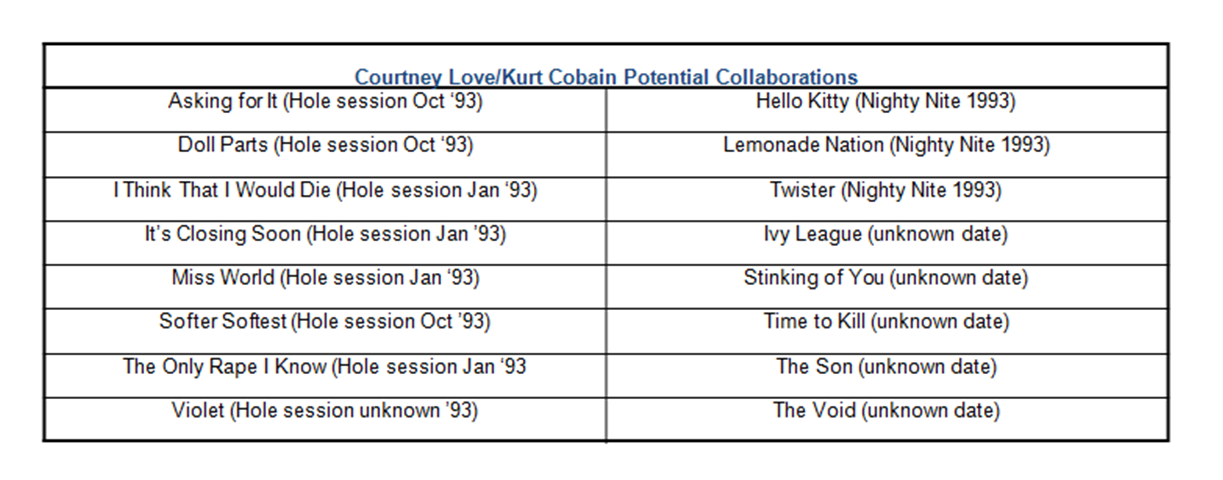
In the latter category I’ve accidentally always wrapped in an entire sub-category; Kurt Cobain collaborations with Courtney Love. Over the years Courtney has been a source for bootleggers of rare material, has played songs on radio shows a long while back, has mentioned unknown songs in interviews with names that aren’t known from other sources – with the exception of the increasingly easily available Fecal Matter demo, Courtney is the most likely source of something fresh. Gratitude to the LiveNirvana site which presently lists the following known or potential Kurt/Courtney tracks;

CourtneyLove-KurtCobain Potential Collaborations

While the quality of material that has become visible so far is of mixed standard to say the least – the Hole contributions from Cobain are as wasted and ephemeral as he may have ever sounded on record, Stinking of You isn’t a song it’s a shred of an idea – there’s still more material potentially from this source than any other. In total, on top of home work with just Cobain and Love together, there’s a total of five known practices (Hole in January ’93, Hole in October ’93, Cobain/Love/Erlandson sometime in ’93, Cobain/Love/Grey/Bjelland sometime in ’93, Cobain/Love/Schemel in early ’93) featuring Cobain with Courtney and others – more practices and jams than he engaged in with his Nirvana comrades during the 1993-1994 period. Heck, the much vaunted 1994 basement demos with Pat and Eric perhaps rightfully belong to this category also.

What’s striking is the absence of any acknowledgement of this work on the With the Lights Out box-set. It suggests a determination on the part of Krist Novoselic and Dave Grohl to ensure that the name Nirvana meant the true band, plus Kurt alone, with a refusal to accept his collaborations with their DGC sister band or its denizens as any part of the official tale. While that’s a fair approach to the Nirvana legacy it isn’t a full reflection of the Cobain legacy anymore than the absence of his pre-Nirvana work (all but one song) or his more experimental urges from the 1987-1989 period. Kurt’s final two years saw him retreat from Nirvana and it’s within that retreat that we’ll find whatever remained of his song writing urges.

Of course the big question becomes one of time. In the chapter from Dark Slivers mentioned above (https://nirvana-legacy.com/about/) I tried to indicate the limited time available in 1994 for writing and creation. Remember that Kurt Cobain seems to have been an ‘on paper’ creator of lyrics, not someone who improvised lines live, so he needed time to sit down and work on material. All descriptions of his working practice for music also seems to involve time spent alone – his fastest/biggest period of creations (mid-1990 to mid-1991) coincided with his greatest isolation. Therefore the question for everyone is to work out how much time he had from February 1992 onwards while staying in hotels and on drugs, then how much he had in 1993 after recording sessions for Nirvana, around being a father and husband, around being a big addict, and prior to heading back out touring later in the year. I’ll leave that open for the optimists and pessimists to debate.

With the Lights Out 2: What Would a Sequel Include?

Sat listening to what will apparently be the last compilation of Jimi Hendrix studio outtakes; People, Hell and Angels. In terms of its coherence, it’s unity, it’s actually a fairly faultless posthumous compilation, the core of it is from recording sessions in March to December 1969 with two holdovers from March and June 1968 respectively. Of course, it’s immediately telling that there are twelve songs here drawn from eight studio sessions; Mar ’68, June ’68, Mar ’69, Apr ’69, May, June, a separate June session, Aug, December. It’s simply obvious that there’s no way the full resources remaining to the bearers of Nirvana’s archive could compete.

What a fresh Nirvana compilation could do best would be to simply give the fans what they’ve been wanting for a long time; essentially, not Nirvana, but Kurt Cobain. It’s unclear whether this presents issues around copyright or around who gets the cash — God knows what the legal front looks like — but it doesn’t feel insurmountable. So, what would it look like?

Disc one: Fecal Matter — what else? There’s a few versions of this material floating round online and the biggest surprise is always how decent the sound quality is. There’s no way, until an official source decides to kick this out, of knowing precisely how much material, how many alternative takes, how many versions of the track listing there were. A single compendium pulling it all together and closing the chapter on this one would be welcomed. Heck, while I’m in wish fulfilment mood, maybe there really is a copy of the 1982 Organised Confusion tape…

Disc two: Certain quantities of Kurt Cobain’s more experimental urges from the early years of Nirvana have long since made it out onto the bootleg market and trading circles. Again, an official survey of this neglected terrain would be welcomed. Cobain is essentially portrayed as a musician finding his way gropingly, over several years, toward pop-punk which utterly underrates the variety of his sonic experiments and less musically-inclined directions. The core of such a disc is well known; Montage of Heck, Escalator to Hell, perhaps whatever full source exists of The Landlord is a Piece of Shit from Hell. It’s hard to believe that the only addition to his avant-garde test runs was Beans or the minute or so acoustic Black and White Blues. If not then I’d be happy to take the full recording Cobain made to be edited down for the collaboration with William S. Burroughs — if the original still exists that is.

Disc three: What else could people possibly desire more than, firstly, the full Nirvana jams from January 1994, plus whatever practice take of You Know You’re Right exists, with the rumoured basement demos from March tacked on? The only way to make it better would be if there were further home demo efforts recorded post-In Utero. If not, well, Nirvana’s attempts from July 1993 at working up an acoustic set could yield interest. If Courtney Love was able to yield up the Nighty-Nite joke songs, perhaps a more developed version of Stinking of You, maybe a couple more duets, that’d feel complete.

After that, realistically, I’m not sure there’s a lot to say though the urge to hear everything continues to egg me on. Yes, the 1991 take of Sappy, the January 1991 studio session, and, if they don’t do it on the In Utero anniversary edition, that Lullaby shred from February 1993. The studio take of Seasons in the Sun from January 1993, would be nice to have also — maybe the alleged radio show duet with Calvin Johnson on D7. I’d love to hear more of the untidy rehearsal versions of tracks, the unhoned versions as they developed and of course the acoustic homework — but I can’t point to a specific track or era that would appeal most deeply.

The only issue I can see? If this lot got out I’m not sure anyone would believe there wasn’t something else hidden. Belief is a powerful thing.

Dave Grohl and Songs for Nirvana

Much gratitude to the individual who posted this video, two very listenable interviews with Dave Grohl in which he comments on having shared music with Kurt Cobain, then later mentions the state of estrangement within Nirvana. If you can tolerate the tedium.

Dealing with the latter first, he’s fairly plain-speaking about the division in the band; “I don’t do drugs…There was, like, the people who did the drugs, then the people who didn’t do the drugs. I didn’t do the drugs so I was just out of that world you know? And if you’re in it, you’re in it, if you’re not, you’re out.” He then moves onto say, in response to a direct question about whether the band was breaking up, “it was important that we take a break. I think everyone felt that way, it was time to take a break.”

Certainly no criticism of Dave Grohl, but I admit I see this last comment as rather a salve for the soul rather than a fair representation of the position of Nirvana in early 1994. Why so? Well, Nirvana had already staged their break — Nirvana played not a single show for five months of 1992, a total of sixteen shows June-October but most of that in the June-July spell in Europe. 1993 was even more barren; five shows in nine months, only three after the duo in Brazil in January. And it wasn’t like the band were studiously practising either, Kurt joined them for a maximum of 21 days in studio for the entire two and a half years after Nevermind — and remember, at best estimate, the band played for six days at most of the twelve days at Pachyderm. I’ve already commented numerous times on the trend in Kurt Cobain’s song-writing also, in each previous year of Nirvana’s existence he’d brought six-twelve songs forward to the band; in the final year…Well, you all know the answer there.

Given the broken state of the band long before April 1994, it’s hard to see how anything other than the total dissolution of Nirvana would have solved whatever issue Kurt Cobain had with being part of the band as a business entity, as a musical vehicle, let alone as a functioning community of creative companions. I’ll admit that Dave Grohl’s comments here do remind me to place more emphasis than I sometimes do on the influence of the drug factor as a divider between Kurt Cobain’s cocoon and his band mates. Note made.

With regard to the initial comments, Dave’s comments are very clear indeed; Kurt was aware of two songs — Alone+Easy Target and Exhausted. This conforms to the best sources (basically check LiveNirvana, it rocks) but what interests me is the nature of his reaction to the songs. He loves the music for Exhausted but wants to use the music while remaining in control of the lyrical aspect of Nirvana. While he’s the known voice of Nirvana, while he’s rightly recognised as the key creative force, it makes it clear how much the band was a vehicle for his self-expression and, within that, how much emphasis he placed upon the words. Even with his own writer’s block in latter years it seems that sharing writing duties simply wasn’t going to happen. As an aside, for Alone+Easy Target it seems he wanted to snatch the chorus though whether that refers to the chorus line or the backing riff it’s unclear.

Kurt Cobain’s literary nature is underrated. His lyrics were not ad-libbed live, he wasn’t an improviser. Dave Grohl explains “he’d stay up late at night, for hours, with a notebook just writing and writing and writing…He enjoyed writing a lot.” Cobain’s closest connection to the blues came from the way the guitar was a way of accompanying words, not a raison d’être all its own. Cobain was brutally critical of his own guitar-playing skills and he was increasingly disparaging of the limitations of the instrument and its clichéd nature by the early Nineties. On top of that, in all the years the band was in existence, all the time they shared with true innovators of the guitar, like Sonic Youth, there’s no indication he ever actively sought to expand or advance his guitar vocabulary or to learn more about his instrument. The guitar was a functional object serving the song form and, in turn, the words.

The switch in Kurt Cobain’s lyric-writing, from early story songs and character sketches, toward a more impressionistic grab-bag sourced from his Journals, can be seen as a reaction to the increasingly hectic schedule of Nirvana as the time to whittle away at a single piece of WRITING (not just a song, true writing) fell away. Its notable that his most extensive phase of writing — winter 1990 through spring 1991 — coincided with a long period of relative quiet for Nirvana.

The Bright Side

Kurt rested back in the teak wood porch chair and cracked a smile recalling the previous night’s shenanigans. Krist had been kicking the phone some four weeks to get him to go, he only really went to please him. The night had passed glad-handing balding ex-somethings and joking how that was the same thing they thought of him. He’d given the thank you speech hunched in behind the podium like it might hide him from view. He was sure the stage lights would pick out the wrinkles setting in and pre-empted with a joke about getting ready to play Iggy in a biopic someday. He wasn’t going to say he still couldn’t stomach much beyond macaroni cheese and strawberry milkshakes. Out front on leaving, a few cameras still hanging around sparkling, some wise-cracking fan had hollered “Kurt! Hey Kurt! What keeps you rocking out?” He was proud of rustling up the answer; “a healthy lifestyle,” before ducking his head under the lintel of the SUV and getting well gone of the whole scene.

His arm had pinpricks of heat like a kid was snatching the sun through a magnifying glass. He knew where each ray landed, he’d long since studied the precise dots of scarring. At least he’d stopped shooting before he hit his early thirties and grew those Keith Richard folds, he’d upset the Universal PR team with some line about “Keith’s been modelling his own Keith Richard’s Halloween masks for thirty years.” They’d already lost it seeing he’d hacked his hair short again — they’d been handing out glossies of the trademark shoulder-length blonde, the photographer had only been out a week back. They should have been grateful he hadn’t dyed it for spite.

They tolerated each other; Kurt and Universal. The rumours would circle the house every few years — that he had crated tapes mounted up in the bathroom, in the basement. The money still flowed, anniversary releases, a live disc or two, the greatest hits that was their way of telling him they didn’t see any difference between inactive and broken up — either way he was on their list of missing in action, presumed near dead. He was quietly proud that his artwork was selling steadily even as his other voices told him it was on name alone. He tended not to invite anyone to the openings if he knew they were the sort to gush at him how great it all was. The songs had more or less dried up but each year brought a little fresh material letting him replay expressions of the same old vocabulary and keep enough pieces out there people knew he existed.

He kept the guns around mostly from habit. The nearby range frightened him if only because it reminded him some of his neighbours were those back-to-nature-weekenders on break to cook barbecue food, pose rugged and blast off guns with ear protectors on before fleeing back to the city. Fright of his life two summers back; a meaty carcass he’d hauled up into the woods and strung from the branches, he’d been lining up a shot on it, had kept back-stepping until his confidence of a hit was stretched taunt, necessary to give some challenge. The gentle twirl and swing of the flesh — elbow against the ground, barrel balanced and breathing steadied — he was near mesmerised by the swaying pink lump. A split second more he would have fired. Instead some nervous fawn of a sixteen year old pushed out through shaking branches and gave the meat a tentative poke with the end of a thick hunk of wood, then a more determined thwack that set it jiggling on the rope. He’d shouted over and the kid took off, still every time he got back down to take the shot he couldn’t clear that image of another timid victim sitting hidden beyond the crosshairs. He gave up and stashed the gun back in its beige nylon bag, wedged it in the cubbyhole in the closet for another day that hadn’t yet come round to dawning.

The view from the porch went only so far, out into a riot of border vegetation marking the fence round the Carnation property. Frances might visit this weekend. Then again, she had a habit of not showing — he couldn’t resent the selfishness, it maybe was his own fault. He couldn’t see himself playing the disciplinarian, she was too used to playing her parents against one another and all he could do was tell her over and again he wished it all wasn’t so. The last time he’d tried refusing her she’d stuck the knife in by calling him Don all day. He screwed his eyes up at the sun and just wished she’d show up and play nice that weekend, stop playing with her make-up long enough to say a few words to him. It wasn’t her fault. She blamed both of them for taking her happy childhood — he assumed she wanted even or…He should get round to moving that dead tree, it’d been there as long as he had, blotting the view. He shielded his eyes and peered at it. Far too familiar a sight, such a bore.

The TV had replayed some backstage interview during the footage of the other night’s ceremony. Mic crackling with crowd noise and venue buzz of crew motion and post-gig adrenalin, he still winced at some of what he came out with. He told himself he hadn’t been that bad, it didn’t matter, but still that needling sense that he was letting himself off easy. The darkness was a memory of someone else. For the moment he rested his sun-closed eyes, set his bare feet up on the porch railing while remembering boys funning around igniting cigarettes between one another’s toes.

Unlistenable, Unreleasable, Uncommercial: What can Nirvana NOT Release?

A prime concern of mine at the moment is the idea of what can and can’t be released officially.
Well, in 1999 Rhino Handmade, under license from Arista released the ultimate testament to one of the rare albums that stands as peer to Nevermind.

Complete Funhouse

On the table before me is the seven disc boxset of The Stooges Funhouse: The Complete Sessions. And they do mean complete. This is eight hours worth of session recordings, there are over well over thirty takes of some songs, it’s literally everything they could find; Funhouse’s seven songs played out to infinity across 140 tracks with the addition of a minute and a bit shred called Sliding the Blues and one unreleased track called Lost in the Future.

What stands out for me though is that they could do this and it hasn’t in anyway harmed the band’s reputation; this limited edition box-set is now a hallowed release among the kind of deep fans who give a toss whether a band releases its rarities and outtakes. Instead of wasting time worrying about the tastes of the dilettante fans who just want the greatest hits album, Arista released that all re-releases are ultimately unnecessary and simply went ahead and pleased the true fans who were still writing, reviving and appreciating The Stooges after all these years. It’s a very digestible release too; it emphasises the hard work the band put into trying tweaks and alternative ways to get these songs into best shape, there’s a snippet of dialogue in which Iggy Pop’s sensitive ears note a string ringing on one of the instruments and makes the retake totally belying the band’s reputation as slackers, damn they work hard.

The Stooges and Nirvana are two of the only bands whose outtakes really fascinate me; the comparison also appeals because the lo-fi nature of live recording technology in the early seventies means it’s a challenge to find polished material. It leads me to question what is/isn’t capable of being released. Take a look at the release below:

You Want my Action

The booklet on top is the You Don’t Want My Name, You Want My Action box-set gathering up recently discovered recordings of The Stooges with a short-lived two guitar live line-up. The sound quality declines from front to back going from reasonable (if one is tolerant of pops and clicks) to severely degraded. The crucial point is that it doesn’t matter. The expectation and direction is set, it’s acknowledged, one buys in the knowledge of what this is — it’s exceedingly rare material and if one is the kind of fan who wants to hear multiple versions of songs then you’ll love it anyway.

The two CD version of Metallic K.O. wedged there is also an argument against audio quality being the defining reason for or against a release. It’s a famed album, it’s achieved a cult status in spite of and partly because of the low audio fidelity. It basically records a now stoned-to-the-eyeballs Iggy Pop, fronting a band about to break-up, for an audience that wants to hit him with the various glasses flying overhead. And still, with a great band, even releasing this simply reinforced the iconic value, the underground heroism and the position of The Stooges as forefathers of punk confrontation and one of the finest rock outfits ever unleashed.

Nirvana needs to decide, or already has decided, how they want to be remembered. The choice is between the overground success with feet and souls planted in the underground or as a slick well tuned, corporate rock behemoth that left the underground behind. There was criticism of the With the Lights Out box-set for the sound quality on certain tracks, but then there’s been criticism of the Nevermind anniversary release on the same topic but for having been excessively pumped up and compressed; oh and of the boombox demos of Nevermind back on the audio quality issue. There’s no happy medium. Releasing lo-fi material is fine so long as people know what to expect — only the fanatics buy regardless.

The final item is the Heavy Liquid box-set. To distinguish The Stooges from Nirvana, it must be recognised that the depth of outtakes and leftovers The Stooges left behind is vast compared to the relatively shallow pool of genuinely unheard Nirvana/Kurt Cobain originals. The Stooges poured out material and, in the absence of solid relations with record labels for a lot of their time as a band, a lot of it poured into the unofficial realm. This box, again going from highest to lowest fidelity, brings together a ton of non-album tracks plus such curios as a full disc of the band experimenting with the song I Got a Right across thirteen takes — different lyrics, instrumental, no solo, different effects, and so on. The rest is everything from soundchecks to off the cuff studio sessions at various locations. Tragically Nirvana could never compete with this, With the Lights Out is the nearest they’ll ever come; there simply isn’t enough left in the vaults of true originality. But that doesn’t mean a specialised box-set of this nature wouldn’t appeal to fans, wouldn’t be worth listening to and wouldn’t tantalise.

Heavy Liquid

Archiving: Nirvana’s Leftovers Versus Mine

Just a whimsical post for a quiet kinda day…I found it interesting to think of the fact that a completely different standard applies to audio works as compared to literature; I mean, an academic archive might be keen on having my scrap notes someday if I do something that gains weighty note beyond my limited realm of interest and attention. But I can’t imagine any one reading this article being keen on having the rough notes that came to make it — do you want the piece of gym scrap paper I started this on? It’s unreadable. Yet I better keep it just in case given the kinds of trends that have been witnessed in prices for author’s archives:

http://www.guardian.co.uk/books/booksblog/2007/dec/12/doesthenationneedauthorsa

Yet, what we’re looking at here, is not something that anyone except a fanatical researcher would sit down and read for pleasure. The blend of humdrum notes, rough one-liners that might one day become significant when allied to other words in an overall narrative or structure, letters and stubby thoughts, there’s no way to experience them in any coherent or enjoyable fashion. As far as public consumption goes, we may see sifted fragments in a well choreographed tome.

In the case of music, however, the rough workings of a musician possess a far more immediate impact and enjoyment. Of course that doesn’t mean every shred of tuning up, between take banter, butterfingered miscues or cack-handed lumpen error would or should emerge — I can live without a tape of Kurt Cobain practising the pentatonic scale repetitively. What I’m referring to is both rough takes yet to be honed into their final song form, to solo run-throughs of ideas or even stray riffs if sufficiently polished, full group improvisations and jams around an idea or theme — these all have an interest that an author’s fag-packet-musings rarely possess.

Part of the reason is the relative length of the experience. A draft of a song is comparable to a full page or two of written material — each is a substantial outpouring that one can engage with. Just as the rough copies of a full chapter might prove intriguing, a lengthier jam has a thread that can be followed whether that interest is formed by its unity or by its breaks and diversions.

The further difference between reading text versus listening to music, as mental processes plays a role also. The body and mind can feed on even random noise as an experience in a manner more akin to how it can detect shapes and patterns in paint splatters and ink blots. In each case what is being engaged is the brain’s capability as a pattern-finding engine; this isn’t what occurs when sifting page after page of short thoughts and ideas, the immediacy is lacking. Similarly music can be felt and experienced as a physical sensation, a further level of experience that is lacking from an author’s archive and a further reason why something like the rehearsal tapes and home demos of Kurt Cobain and Nirvana have a deeper interest and aren’t the equivalent of an author’s stockpile of abbreviations, shorthand, on-the-spot thoughts or observations.

I was reminded of this old thought of mine when going through material related to the Nirvana LLC court battle between Courtney Love and the duo of Krist Novoselic and Dave Grohl. In response to a statement from Courtney stating that Krist had threatened to toss Nirvana tapes off of a bridge, Krist/the lawyers replied:

“After listening to hours and hours of recordings for the box set project, I determined that there were some outtakes that sounded really bad. In this day and age of limited copyright protection in cyberspace, I was afraid that these recordings could leak out of our organization and hit the World Wide Web. I told Courtney that I felt we should erase some of these tapes because they are redundant and a poor representation of the group. Having worked so closely with Kurt Cobain, I know that he would feel the same as we occasionally practiced this while he was alive. Kurt had a very high level of discretion in regards to art. Artists do this, it’s no big deal.”

Certainly it means Courtney was correct and Krist probably had threatened to do some chucking out — a first thought that comes to mind is whether he has done something of this nature in the years since, there’s no information either way. He certainly seems convinced it was the right thing to do and gives four reasons (a) they’re bad (b) they’re not needed (c) they make Nirvana look bad (d) Kurt wouldn’t want them to emerge.

The ins-and-outs of my feelings about this quotation are essentially focused on the first of those points. The other three I can summarise my thoughts on fairly rapidly; (b) is any music truly needed? Why is a poor rendition or an early effort any less valid to those who would love to hear it? (c) the fan community is used to lo-fi renditions and sluggish live material but it humanises the increasingly sainted band (d) channelling the voice of a dead man to justify an action in a future they never reached is a poor way to make any choice.

But that point that they “sounded really bad” is what intrigues me. There’s no indication if it’s a reference to low-fidelity sound that may be beyond salvageable; if so it’d have to be pretty awful given the state of the Boombox Demos from 1991 that secured an official release — it can’t be worse than some of the snippets on various bootlegs which were interesting partly because they retained a sense of mystery in amidst the tape hiss.

The quotation doesn’t say if it’s a reference to bad playing on the part of the band; on this matter, if we’re talking tapes of retuning or twenty minutely distinguishable renditions of About a Son then maybe he has a point. On the other hand, the Heavy Liquid bootleg from The Stooges contains a disc featuring thirteen renditions of I Got a Right in various conditions (i.e. “no gtr solo”, “false start”, “instrumental”, “+ gtr solo”, “too slow”, “two false starts”, “different lyrics Outro”, “not Leslied”, “diff drums”). I’m not saying I’m listening to the disc every day but it’s a perfectly enjoyable experience and lends a real appreciation of how hard a supposedly messed up and wild band actually practised on getting their sound. Plus it’s a cool song so it’s no different to hitting the ‘repeat’ button, fine.

The quotation doesn’t state if the tapes contained jams that never went anywhere; improvisations that eventually broke down; snippets that might have become true songs if anyone had remembered them or taken a second shot — now, as a bona fide fanatic, these really would be of interest. I’ve said before that there’s insufficient on disc evidence of Nirvana’s talents as improvisers, certainly a feeble minimum that wasn’t on stage. This would have some virtue if properly curated.

Anyways, that’s where my curiosity hinges. What was so bad that it must be destroyed?

Questions: Brown Cow/Brown Towel

You’ll have to forgive me today, I’m on holiday but normal service will be resumed on Monday.

Tonight, myself and a friend are off to the Scottish Storytelling Centre (www.scottishstorytellingcentre.co.uk) to see the Annual Scottish Tall Tales Storytelling Competition which promises the “hilarious, mysterious or just plain ridiculous – ferocious fibs and fables performed live on stage by Scotland’s finest tellers, then you decide who wins the lucrative accolade of Oscar the Leprechaun!” I mean…Wha? It’s perfect, I love a good storyteller and every good story deserves a little exaggeration.

Now, very tangentially, reading through the lists of minor league bands and performances taking place in Edinburgh and Glasgow this evening, and noting the storytelling event made me recall reading the Nirvana Live Guide and loving all the random bands who filled Nirvana’s early days. Similarly, it made me wonder about the Brown Cow/Brown Towel performance – if you want to feel what that early show, the second time Kurt Cobain had apparently been on a venue stage, felt like, just look in your local paper, check the local listings. There’ll be a handful of hopefuls making a “joyous noise unto the lord” night after night with no precise clue what they’re doing, hyped up and nervous, just going for it without letting the fear of embarrassment hold them back.

The questions I have about the performance in question revolve around the words; Kurt Cobain recited poetry over background noise, I wonder how much of this ‘poetry’ was stripped from songs we already know of on the Fecal Matter demo? I wonder how much went onto reuse in the early Nirvana recordings where storytelling songs, songs with a longer coherent narrative thread (Polly, Floyd the Barber, Paper Cuts) were relatively plentiful? I also assume that his recitation was less a case of spoken word seriousness and instead revealed the attempts to speak in the tongues of others that had been revealed on Fecal Matter where he, for the last time, noteably spoke in a character’s voice, or the continued vocal experimentation that was still alive a year and a half later on the January 23, 1988 recordings.

Anyways, questions…Always more questions…No answers here but I thought I’d share what runs through my head and the kind of pondering that leads to some of the posts I end up whacking up here.

Songs Dissected: Low Rider — Circling Part One

You’ve undoubtedly heard this; it’s a shred of a home demo Kurt Cobain recorded, it’s assumed, sometime in 1992. It’s a pleasant enough diversion, sweetly brief, and also enjoyable to hear Kurt seeming to have a little fun in music — akin to the chuckled adlibs in Gallons of Rubbing Alcohol Flow Through the Strip. Kurt Cobain’s percussive abilities are likewise a nice touch — that’s some effective hand drumming going on. The other significance that can be attached to this song is that while between 1987-1989 there is substantial evidence of Kurt experimenting with music at home, after that date the only visible home demos simply show him running through ‘shovel-ready’ Nirvana songs in standard pop format. This 25 second clip is the only hint that he was doing anything out of the ordinary, anything way out to leftfield of Nirvana.

Referring back to the musical vibe of the piece, for contrast, here’s the deeply cool original:

Note the Caribbean drums, the funk styling, the jazzy finale — this is one musically expansive track. Kurt Cobain is mimicking the final twenty seconds or so of the track “take a lil’ trip, take a lil’ trip with me…” Low Rider’s significance isn’t just that it’s a giggle, it is that it’s pretty well the only evidence of Kurt Cobain reaching out to musical heritages beyond an extremely narrow continuum. This is not a criticism; it’s simply a factual comment — what I’m not seeking to do is criticise Kurt Cobain’s music for being something it never set out to be.

Yet, as fame enveloped him, Kurt Cobain increasingly dwelt on the perceived limitations of the guitar as an instrument (“12 notes 6 strings and 30 years”); on his own frustration with what he began claiming was a repetitive structure and style to Nirvana’s music (“I don’t want to keep rewriting this style of music”). In his suicide note he even took the time to claim that music had become boring to him (“I haven’t felt the excitement of listening to as well as creating music along with reading and writing for too many years now.”) What we’re examining here, in detail, is the nature of Kurt Cobain’s writer’s block.

He took it further. He identified this not just as a personal crisis, but as a fundamental collapse in rock music as an entity (“it’s already so rehashed and so plagiarized that it’s barely alive now. It’s disgusting.”) But hold on — let’s question that. This is the early Nineties. Sonic Youth have just rejuvenated the guitar. My Bloody Valentine have kicked out Loveless. Swans had torn ground-shaking tones from it. His own friends in Earth were about to create an entire new sub-genre based around the drone. It’s disingenuous that a guy saturated in the new angles that had been ripped from the guitar in the Eighties should claim the death of rock.

The wider context of the rock world makes clear that this was another case of Kurt Cobain defending himself from pain by going on the attack, the same way he publically denigrated his own music so no one could say anything hurtful that he hadn’t said first. At the root of what was occurring, beyond the drugs n’ drama, was a difficult combination of (I’ve used this compliment before) a highly talented musical magpie, running headlong into an deeply restless and easily bored musical spirit. Kurt Cobain had run through rock styles at a furious pace; Fecal Matter’s proto-grunge, January 1988’s new wave, Bleach’s straight up grunge, the garage pop/lo-fi spell of 1989-1990, electric blues with The Jury covering, a smattering of acoustic pop songs, on into the Pixies-tinged dynamics that met mainstream rock on Nevermind — he devoured them all. He needed something new to retain the avid enthusiasm he had felt for learning punk rock.

The musical universe in which Nirvana played was, unfortunately, extremely limited. Essentially the band regurgitated styles prevalent within a very specific scene; they were a Seattle band not just in root, but in the vocabulary with which they played. What the band didn’t do was reach beyond that specific background, the one they’d grown up with, to explore other sources; there wasn’t even the vestigial beginnings of a Johnny Rotten-esque shift from Sex Pistols to dub reggae infused Public Image Limited; there wasn’t anything like Led Zeppelin’s Kashmir wearing their world-walking on its sleeve; there was no toying with jazz, with funk, with any other genre; even Nirvana’s alternative tuning on Blew was an accident; Nirvana’s live playfulness with noise and feedback didn’t make it too far in studio (The Priest They Called Him stands out.)

Love Buzz is a good comparative; an Eastern-tinged track recorded by a Dutch band during the late Sixties’ flirtation with Indian musical styles…Which Nirvana sliced the quirk out of in order to turn it into a straight forward grunge/punk/rock song (this is not to say I don’t love it! It’s a specific point about the musical expansiveness of Kurt Cobain.) A further case in point would be the conversion of Lead Belly’s African-American segregation era blues and folk into unaccented, uninflected acoustic pop — there’s not an ounce of original colour left in the tune even if Kurt, while performing solo at Castaic Lake in California in September 1992 did announce “this is a song by Huddie Ledbetter — he was a slave in the South.” Kurt Cobain’s music was quintessentially drawn from a highly specific American rock tradition in which the diversions artists like Jimi Hendrix had made into funk and soul; or Led Zeppelin made into whatever they could find; were left to artists like Prince while Nirvana — and Metallica too as an aside — honed the music down to an unfunky, straight ahead suburban white boy rock; no Clash style reggae moments, no Bad Brains styling, no Minutemen style jazz chords. Nirvana were indeed an all-American phenomenon, but musically speaking (I fully acknowledge the band’s support for equal rights and racial harmony) they were only one part of America.

In Kurt Cobain’s lyrics, the only real-world geographic locations that were ever mentioned were all in the State of Washington, all within a couple of hundred kilometres of his birthplace (Puget Sound; Seattle). Essentially, as we’ve mentioned before, the vast majority of his music was already written by mid-1991, by the time he was 24 years old. It’s not a surprise in a lot of ways that his lyrical inspiration never moved far from the area that was his home for most of his life. Similarly, in the seven-plus years of Nirvana’s existence, his instrumental inclinations never strayed from the punk/rock/pop sounds that gave him his initial impulses and enthusiasms back as a teenager.

I respect Kurt Cobain even more for having such a sharp eye that he recognised that his writer’s block was a combination of an instrument he didn’t have the time to find new worlds for; of musical approaches he’d run-through so fast (and mastered so thoroughly) he hadn’t left himself new turf to explore; and for recognising that, for his own enjoyment, he needed to start moving further than the narrow confines of the corner of the rock world he had picked clean for over ten years. Low Rider, recorded in 1991-1992, is a too-brief time-capsule showing a man stepping ever so briefly out of his comfort zone, trying ever so tentatively to find something fresh that could perhaps give him the long run of inspiration he’d wrenched from punk a decade before.

Plus…It’s fun. Twenty seconds well spent on a tape machine somewhere in the maelstrom.

Nirvana’s Legacy

The website name had stuck in the head in the couple days before I got round to having to pick one. There was something punchy about it and I can admit it might be a steal from the title of Mick Wall and Malcolm Dome’s book Nirvana: The Legacy. I found the idea of that book inspiring but the content barely moved me being little more than a rehash of band bios of the time, an insipid quick dash over the top of the musical landscape of 1994-1997. The question remains valid, however; what has been the legacy of Nirvana?

Many people argue that nothing changed, that many of the old names stuck around, that the indie revolution never happened as expected and the charts remained flooded with manufactured product. Certainly grunge was the last gasp of rock as simultaneously a mass market phenomenon and a vital creative force — just as jazz ceded its position to pop and rock, rock was succeeded by hip hop fuelled R n’ B. That doesn’t mean that there was no legacy for Nirvana, it simply means that the market and industry changed fundamentally and that legacy wasn’t the multi-million selling multi-band phenomenon/movement they were looking for.

There’s a legitimate argument to be made that the hype around ‘alternative’ music was a gamble made by major label record companies who, deceived by the success of a small coterie of bands, were under the mistaken impression that a substantial market existed for punk-inspired or derived bands and therefore plunged energy into promoting the idea of the ‘alternative nation’. What they’d overlooked was that the triumph of Nirvana, Hole, Soundgarden, Smashing Pumpkins and Pearl Jam was a victory for the bands possessing a sound close enough to existing mainstream rock to sell well. Most of the bands that made it onto majors simply weren’t even close to pop of the stadium-filling U2 et al. variety.

On the other hand, while acknowledging the points around the ‘death’ of rock, hype and compromise, I’d argue that the quest to find direct musical heirs has led to the tangible evidence of Nirvana’s influence being overlooked. Direct musical heirs are an exceedingly rare phenomenon; popular culture may echo but it rarely repeats. The greatest artists are so inimitable that those who do follow their template precisely are never anything more than pale copies; that’s the category into which the saleable but critically distained bands that followed the grunge ROCK template in the late nineties (i.e., Creed) fell into. The zeitgeist had moved on.

Usually what happens is a degree of inspiration, an element of the sound is taken. As an example, the successors to Jimi Hendrix were arguably the axe-worshipping legends Steve Vai and Joe Satriani — the fact that each of those artists moved in very different circles to Hendrix’s increasingly funk influenced last recordings and were more enamoured of his soloing side than his abilities with the brief quality pop mode, obscured the link. Guns n’ Roses meanwhile owed much to both the Rolling Stones and to Led Zeppelin while also tacking on aspects of punk. There are plenty of arguable relationships but in bands of top quality the relationship doesn’t mean cloning; even Oasis were never identical to their worn-on-sleeve influences.

So, when looking for the legacy of Nirvana, simply demanding a carbon copy is a quest bound only for disappointment. The influence of Nirvana is of a different quality. Firstly, the wave of which Nirvana was the foremost exponent, hard-wired punk into the DNA of every key rock band that has come since. The solo-worshipping, high-note-busting style of rock that dominated the Seventies and Eighties was wiped from the mainstream map. Instead the high-achieving rock bands have spanned from Green Day, to My Chemical Romance, through Limp Bizkit (yes), to Rage Against the Machine, Radiohead and even Muse. Unless you want to try and argue the case of novelty band The Darkness, there hasn’t been a truly successful band mimicking the hard rock sound in over two decades. What died altogether was hard rock, that combination of pop production and slickness with the metal-edged volume and bombast.
Secondly, Nirvana ushered in a new emotionally detailed vocabulary for mainstream rock stars; Nine Inch Nails and Smashing Pumpkins certainly showed that there was a trend toward focused depression at the time of which Nirvana, arguably, was a part. Now, in the form of (oft-maligned) Emo, and with significant credit going to Weezer and The Descendants, there’s a greater openness to expressions of male emotional pain, a broadening of expression. Again, it’s not that Nirvana deserve the sole-credit for this but they showed it had arrived.

Thirdly, the sexism departed from the guitar-led musical world. The leather trousers, groupies and uber-mensch look shuffled from centre stage — it’s now such an oddity it even receives a defined sub-genre label, Sleaze Rock, when in the Eighties the rock world was dominated by this form. While the punk world in general had an openness to counter-cultural currents — hence queercore, Riot Grrl, straightedge, outright Marxism and even Bad Brains’ spirituality could all coexist — it was Nirvana who stated openly, over and over again, how ridiculous and retarded the sexism of rock had become. Again, the alternative nation did birth something.

Fourth and finally, Nirvana showed that there was finally an infrastructure that could give underground bands a sustainable means of living. The much vaunted Eighties underground scene had died a death — a bare handful of bands lived through it intact simply because there weren’t enough venues, enough music sales, enough fans, enough coverage to sustain them. Sonic Youth have stated that one of the best things about Daydream Nation as an album was that it meant they could finally give up having day jobs.
The four shifts in rock music that occurred in the early-to-mid-nineties are underrated because they’re impossible to pin to a single instigator alone; it’s hard to say Nirvana were wholly responsible, of course they weren’t, they were simply a defining part and the most important figurehead signalling the shift. So, if one is looking for a musical legacy, one that isn’t a parody, or that wasn’t a broad social force, what’s left?

The answer struck me most forcibly over the past three months as I’ve corresponded with numerous individuals worldwide about the book, the blog, Nirvana, life in general. Kurt Cobain was pure punk in that he wasn’t a guitar-worshipper, the music was a way of channelling emotion, spirit, fire, energy — whatever you want to call it. Krist Novoselic said in his eulogy on April 10, 1994 “…if you’ve got a guitar and a lot of soul just bang something out and mean it. You’re the superstar. Plugged in the tones and rhythms that are uniquely and universally human: music. Heck… use your guitar as a drum, just catch the groove and let it flow out of your heart.” This could serve as a rallying cry for any part of the diversified rock-influenced world from the indie end of the spectrum out to the wildest noise or drone. There are a vast number of musicians working today, rarely the famous, who were simply inspired by Nirvana to try something new, different. They may not sound too much like Nirvana but how are they not the heirs to Nirvana when there’s such a joyful racket being made as a consequence of that band’s short fire?

Below is my copy of the Fuck Brett birthday LP courtesy of Feeding Tube Records — the eponymous Brett is a huge Nirvana fanatic and musical creator. On the shelf behind me is Nerd Table’s Chasing the Bronco CD, Adam Casto, leading light of the band, told me specifically that his way of creating something personally positive from the demise of Nirvana was to seek out every former member of Nirvana he could and try to collaborate with them; again, beautiful. A fellow called Adam Harding has shared a demo — you’ll have to wait and see — that wears his early Nineties alternative nation vibe loud and proud while taking it a step forward. There’s an artist I’m in touch with in Scotland, hi Marcus(!), with an intriguing Cobain-related project. I even heard from a member of Trampled by Turtles (http://trampledbyturtles.com/) the other day — so many Nirvana fans doing creative stuff, that’s the legacy. Heck, ever since Nirvana, and despite a complete lack of ability, I’ve always held up creative action as the highest form of human activity and life.

There’s a lot going on out there even if the media would prefer straight lines, clear quotes and family ties. Will there be another Nirvana? It’s hard to find likely candidates given the most crucial elements of Nirvana were unpredictability and a soul-deep amount of damage residing inside…But keep looking.

IMG-20130203-00092