My Friends: Nirvana and Live Support 1987-1994 Part One

Studying this much Nirvana data for so long, I keep seeing things I simply want to look at and digest in more detail — often what you’re seeing is me working it through in my own mind rather than simply a thoroughly digested entry, certainly I rarely know the conclusion before I start. What I wanted to do today was examine the bands with whom Nirvana played either as support or supported by. I was curious who Nirvana had spent most time with.

To conduct this survey, as ever, I owe a strong debt of gratitude to the work of the Nirvana Live Guide — the data they’ve made available to fans is incredible, I’m just enjoying myself manipulating the information to hopefully show neat little patterns, trends and facts. Today’s post came about because I was so amused by many of the band names I saw popping up on the Guide and wanted to look more closely and acknowledge the role of other bands in the Nirvana story. I know it’s always the same, we barely notice the band that comes on before the band we’ve come to see, but for an awful lot of their existence Nirvana weren’t even that second-string band; they were just another name on a list of unknown quantities.

As a proviso, I ignored the festivals, the sheer quantity of bands on different stages, not necessarily sharing contact and so forth, the festivals were impossible to deal with. Of course this does, for example, influence the statistics for appearances alongside Sonic Youth. I confined this study, with the exception of a benefit/festival or two with as many as five or six bands appearing, to occasions where it was just a normal gig, two-three bands altogether.

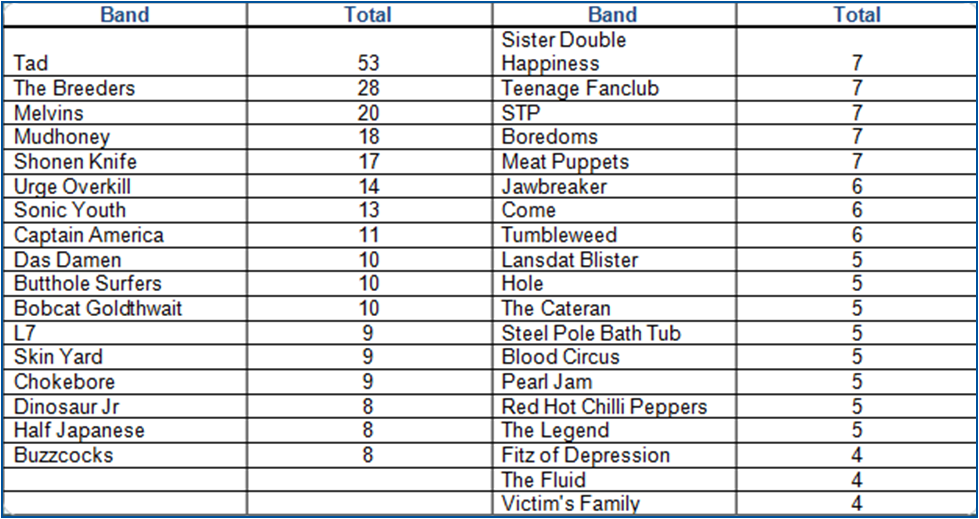
With regard to the absolute numbers, fact number one is the headline figure of 234 unique bands with whom Nirvana played over the course of their time in existence. What’s even more interesting is how few of those bands Nirvana played with more than once. In the table below I set the bar at four times even to allow entry to the list:

Bands Nirvana Played with Most 1987-1994

A mere 36 of those 234 bands are known to have played more than four shows with Nirvana; that’s a remarkable number of connections for Nirvana to be making, band after band, year after year with their peak as live performers coinciding with their peak of shared stages; ending up playing with 56-66 bands a year is quite phenomenal, massive turn-over in support. It emphasises how much of a minor presence Nirvana were until remarkably late in their career in that they clearly had little or no control over who they ended up on stage with, they took every chance, came on before or after absolutely anyone — this did change once fame hit.

The trend over time is unsurprising both because of the fall-off in Nirvana’s activity in later years and also the fact they were no longer playing band showcases or taking any chance to get on stage but were actively selecting the company they kept. It’s still notable, however, how thoroughly things changed; in 1992, 1993 and 1994 they play with so few other artists that one has to go all the way back to 1987 to find a year they forged so few on-stage connections. Notice also how, as the total number of bands declines, the number of bands with whom Nirvana played more than once in a year actually did increase suggesting it was deliberate commercial/contractual arrangements, the business in other words, rather than just ‘nature’ that created this pattern:

Individual Bands per Year 1987-1994

Michael Gira was quoted at one point, I’m doing this from memory, saying that the reason Sonic Youth succeeded while Swans remained a strictly underground flavour was that he went round the country making enemies while Sonic Youth made so many friends. In the case of Nirvana they seem to have spent time with anyone who was anyone in the North-west, on top of a whole batch of names elsewhere primarily American but with solid and persistent connections to international favourites. There are so many bands they’re on stage with. It can’t have hurt either that, with no disrespect intended, the fact the vast majority of bands on the list are either complete, or as near-as, unknowns would have emphasised Nirvana’s quality and superiority — it’s easy to stand out and draw attention when stood alongside more minor acts.

For those of you with a penchant for numerology and spookiness, by the way, note the total for 1992 then the sum of 1993-1994 — oooooo…Fear the nonsensical but eerie…

Nirvana’s Legacy

The website name had stuck in the head in the couple days before I got round to having to pick one. There was something punchy about it and I can admit it might be a steal from the title of Mick Wall and Malcolm Dome’s book Nirvana: The Legacy. I found the idea of that book inspiring but the content barely moved me being little more than a rehash of band bios of the time, an insipid quick dash over the top of the musical landscape of 1994-1997. The question remains valid, however; what has been the legacy of Nirvana?

Many people argue that nothing changed, that many of the old names stuck around, that the indie revolution never happened as expected and the charts remained flooded with manufactured product. Certainly grunge was the last gasp of rock as simultaneously a mass market phenomenon and a vital creative force — just as jazz ceded its position to pop and rock, rock was succeeded by hip hop fuelled R n’ B. That doesn’t mean that there was no legacy for Nirvana, it simply means that the market and industry changed fundamentally and that legacy wasn’t the multi-million selling multi-band phenomenon/movement they were looking for.

There’s a legitimate argument to be made that the hype around ‘alternative’ music was a gamble made by major label record companies who, deceived by the success of a small coterie of bands, were under the mistaken impression that a substantial market existed for punk-inspired or derived bands and therefore plunged energy into promoting the idea of the ‘alternative nation’. What they’d overlooked was that the triumph of Nirvana, Hole, Soundgarden, Smashing Pumpkins and Pearl Jam was a victory for the bands possessing a sound close enough to existing mainstream rock to sell well. Most of the bands that made it onto majors simply weren’t even close to pop of the stadium-filling U2 et al. variety.

On the other hand, while acknowledging the points around the ‘death’ of rock, hype and compromise, I’d argue that the quest to find direct musical heirs has led to the tangible evidence of Nirvana’s influence being overlooked. Direct musical heirs are an exceedingly rare phenomenon; popular culture may echo but it rarely repeats. The greatest artists are so inimitable that those who do follow their template precisely are never anything more than pale copies; that’s the category into which the saleable but critically distained bands that followed the grunge ROCK template in the late nineties (i.e., Creed) fell into. The zeitgeist had moved on.

Usually what happens is a degree of inspiration, an element of the sound is taken. As an example, the successors to Jimi Hendrix were arguably the axe-worshipping legends Steve Vai and Joe Satriani — the fact that each of those artists moved in very different circles to Hendrix’s increasingly funk influenced last recordings and were more enamoured of his soloing side than his abilities with the brief quality pop mode, obscured the link. Guns n’ Roses meanwhile owed much to both the Rolling Stones and to Led Zeppelin while also tacking on aspects of punk. There are plenty of arguable relationships but in bands of top quality the relationship doesn’t mean cloning; even Oasis were never identical to their worn-on-sleeve influences.

So, when looking for the legacy of Nirvana, simply demanding a carbon copy is a quest bound only for disappointment. The influence of Nirvana is of a different quality. Firstly, the wave of which Nirvana was the foremost exponent, hard-wired punk into the DNA of every key rock band that has come since. The solo-worshipping, high-note-busting style of rock that dominated the Seventies and Eighties was wiped from the mainstream map. Instead the high-achieving rock bands have spanned from Green Day, to My Chemical Romance, through Limp Bizkit (yes), to Rage Against the Machine, Radiohead and even Muse. Unless you want to try and argue the case of novelty band The Darkness, there hasn’t been a truly successful band mimicking the hard rock sound in over two decades. What died altogether was hard rock, that combination of pop production and slickness with the metal-edged volume and bombast.
Secondly, Nirvana ushered in a new emotionally detailed vocabulary for mainstream rock stars; Nine Inch Nails and Smashing Pumpkins certainly showed that there was a trend toward focused depression at the time of which Nirvana, arguably, was a part. Now, in the form of (oft-maligned) Emo, and with significant credit going to Weezer and The Descendants, there’s a greater openness to expressions of male emotional pain, a broadening of expression. Again, it’s not that Nirvana deserve the sole-credit for this but they showed it had arrived.

Thirdly, the sexism departed from the guitar-led musical world. The leather trousers, groupies and uber-mensch look shuffled from centre stage — it’s now such an oddity it even receives a defined sub-genre label, Sleaze Rock, when in the Eighties the rock world was dominated by this form. While the punk world in general had an openness to counter-cultural currents — hence queercore, Riot Grrl, straightedge, outright Marxism and even Bad Brains’ spirituality could all coexist — it was Nirvana who stated openly, over and over again, how ridiculous and retarded the sexism of rock had become. Again, the alternative nation did birth something.

Fourth and finally, Nirvana showed that there was finally an infrastructure that could give underground bands a sustainable means of living. The much vaunted Eighties underground scene had died a death — a bare handful of bands lived through it intact simply because there weren’t enough venues, enough music sales, enough fans, enough coverage to sustain them. Sonic Youth have stated that one of the best things about Daydream Nation as an album was that it meant they could finally give up having day jobs.
The four shifts in rock music that occurred in the early-to-mid-nineties are underrated because they’re impossible to pin to a single instigator alone; it’s hard to say Nirvana were wholly responsible, of course they weren’t, they were simply a defining part and the most important figurehead signalling the shift. So, if one is looking for a musical legacy, one that isn’t a parody, or that wasn’t a broad social force, what’s left?

The answer struck me most forcibly over the past three months as I’ve corresponded with numerous individuals worldwide about the book, the blog, Nirvana, life in general. Kurt Cobain was pure punk in that he wasn’t a guitar-worshipper, the music was a way of channelling emotion, spirit, fire, energy — whatever you want to call it. Krist Novoselic said in his eulogy on April 10, 1994 “…if you’ve got a guitar and a lot of soul just bang something out and mean it. You’re the superstar. Plugged in the tones and rhythms that are uniquely and universally human: music. Heck… use your guitar as a drum, just catch the groove and let it flow out of your heart.” This could serve as a rallying cry for any part of the diversified rock-influenced world from the indie end of the spectrum out to the wildest noise or drone. There are a vast number of musicians working today, rarely the famous, who were simply inspired by Nirvana to try something new, different. They may not sound too much like Nirvana but how are they not the heirs to Nirvana when there’s such a joyful racket being made as a consequence of that band’s short fire?

Below is my copy of the Fuck Brett birthday LP courtesy of Feeding Tube Records — the eponymous Brett is a huge Nirvana fanatic and musical creator. On the shelf behind me is Nerd Table’s Chasing the Bronco CD, Adam Casto, leading light of the band, told me specifically that his way of creating something personally positive from the demise of Nirvana was to seek out every former member of Nirvana he could and try to collaborate with them; again, beautiful. A fellow called Adam Harding has shared a demo — you’ll have to wait and see — that wears his early Nineties alternative nation vibe loud and proud while taking it a step forward. There’s an artist I’m in touch with in Scotland, hi Marcus(!), with an intriguing Cobain-related project. I even heard from a member of Trampled by Turtles (http://trampledbyturtles.com/) the other day — so many Nirvana fans doing creative stuff, that’s the legacy. Heck, ever since Nirvana, and despite a complete lack of ability, I’ve always held up creative action as the highest form of human activity and life.

There’s a lot going on out there even if the media would prefer straight lines, clear quotes and family ties. Will there be another Nirvana? It’s hard to find likely candidates given the most crucial elements of Nirvana were unpredictability and a soul-deep amount of damage residing inside…But keep looking.

IMG-20130203-00092

No Sonic Youth = No Nirvana

Part credit for this post goes to a gentleman called Brett Robinson over on the LiveNirvana forum (if you’re interested in Nirvana I genuinely recommend the site and the forum — I’ve used the site for years but only recently engaged with the forum and the intelligence and knowledge present is awe-inspiring.) A discussion was started a couple weeks back asking people to suggest “The Top Five Most Important Concerts to Nirvana’s History.” Brett pointed to the show in Hoboken, New Jersey on July 13, 1989 on the basis that it’s the night Sonic Youth saw first saw Nirvana play live. I agree wholeheartedly.

Melvins acted as the role model to a young Kurt Cobain trying to seek a social setting for present-day teen survival and also looking for a longer-term means of escape from that setting. Melvins served wonderfully for those first few years, yet having discovered the limitations of the indie scene as it stood in 1989-1990 — living on the breadline, unenviable touring conditions, limited studio time and budget — the band needed something new.

The example of major label moves had been set by many recent underground bands; Mother Love Bone, The Posies, Soundgarden and Alice in Chains among others. But the foremost band in the Eighties underground was always Sonic Youth. If Nirvana could be considered ambitious it’s in reaching past all their other compatriots to make comparisons to the band that had, at that point, become the biggest alternative act without crossing over or compromising with mainstream tastes. Having left Melvins behind already, with the buzz building, Sonic Youth became the next critical role model.

It’s intriguing how others have either taken up the chant or saw the comparison too. There’s the well known quotation from 1988 that “Nirvana could become…. better than the Melvins!” yet the comparisons changed:

Keith Cameron: “’people were saying, you know, one day, they might be as big as Sonic Youth.”

Dave Grohl in 2011 on Nevermind: “Holy shit! We’re going to be as big as Sonic Youth!”

Everett True in Nirvana: The True Story: “’Yeah, as big as Sonic Youth at least, or the Pixies…”

Anton Brookes: “our idea of the ‘Top 10’ was being as big as Sonic Youth or the Pixies…”

Krist Novoselic in 1992: “‘We wanted to do as good as Sonic Youth…”

A lot of these quotations are post-event comparisons but they coincide absolutely with the vision available in 1990 of what success for a band that wasn’t soaked in mainstream glitz meant.

Nirvana followed Sonic Youth onto Gold Mountain for a very clear reason as described in 2011 by Danny Goldberg, “John and I signed Sonic Youth, who were very good at picking opening bands…They chose Nirvana to open for them on a European tour, and I recall John coming back and saying that we should manage Nirvana. Then Thurston called me and told me how great they were. I really trusted Sonic Youth. We met with Nirvana, and they trusted us because they trusted Sonic Youth.” Just like Dale Crover’s presence had persuaded Jack Endino to open his doors to Nirvana in 1988, Sonic Youth got Nirvana their management company thanks to firstly, taking Nirvana with them for seven shows in August 1990 (at that point the largest shows Nirvana had been a part of), then personally asking for it to happen.

Precisely the same thing happens again with Kim Gordon apparently responsible for persuading Nirvana that DGC was the label they should go with. It’s like Sonic Youth had adopted Nirvana. A year later Sonic Youth again take Nirvana with them for a month of touring in August including their first substantial festival appearances at the Reading Festival, Monsters of Spex, Pukkelpop, Überschall 91 and Ein Abend in Wien.

Nirvana continue, even after fame, to mimic the Sonic Youth mode of behaviour whether deliberately or through some shared underground heritage. The sponsorship of other bands — whether The Raincoats, The Vaselines, Melvins — was something Sonic Youth had been doing for years, bringing up other acts as tour support or barracking the industry to get them releases. Also Cobain’s diversion into production (with Melvins in 1992 and 1993) had been prefigured by Lee Ranaldo’s work for Babes in Toyland and Kim Gordon’s work for Hole.

So, while not as fundamental to Nirvana’s sound as Melvins were in the early days, Sonic Youth had an equally strong influence on pushing Nirvana into the limelight, onto the major label stage, and providing an aim, something to emulate. Later, reading interviews where one or other member of Sonic Youth states things like “I think anybody who knew Kurt fantasizes about some conversation that they could have had with him that might have saved this person from such a tragedy…” it still has that feel of the elders watching over their kid brother.

Anyways, this is a scrap from the April 1994 edition of Metal Hammer magazine which I bought for the Kurt Cobain tribute. It was also the first time I had come into contact with Sonic Youth. This single purchase thus bid farewell to Kurt at the same time as introducing me to the band that became the single most important influence on my music-consuming tastes and directions. I’d like to confess at this point to having seventy-seven Sonic Youth (and related) releases…

Curse you Metal Hammer, April 1994 for your impact on my budgets!!

No Melvins = No Nirvana

On here’s the sample chapter from Dark Slivers again, I know its buried down in the blog now…

Dark Slivers Book-A5-chapter14

And apologies for the delay in the Saturday post – it all depends on what time I wake up on a Saturday AM.

It seems impossible to overstate the importance of Melvins to the story of Nirvana. In Kurt Cobain’s reminiscences, contained within Come as You Are: The Story of Nirvana and within his Journals, he defines the most positive aspects of his teenage identity in terms of music. His ‘Road to Damascus’ conversion is the discovery of punk music via Melvins, the role models he describes are Melvins, his first experience of the life of a gigging band (as a roadie) comes from the Melvins. As a formative experience only the divorce of his parents is more significant.

Musically the influence was also explicit. Kurt Cobain’s Fecal Matter demo sounds like early Melvins combining a sound emerging from the hardcore scene with a slower, narcotized vibe on many songs (the version of Downer lasts around a minute longer than the 1988 rendition would.) Kurt Cobain was following the most immediate model available to him which was this local band. It’s 1987 before Kurt Cobain truly begins to try on other sounds with his music from that year sounding far more edgy, far more new wave. Members of Melvins also provided Kurt with his first on stage music experience joining him both as Fecal Matter members and also in a short lived project known as Brown Towel (see Nirvana Live Guide/LiveNirvana for more info.)

The Melvins’ influence continues though. Jack Endino is clear that he only took the Nirvana studio booking because Dale Crover was on drums for the band — Dale’s presence assured Jack that this band must have something to them. Nirvana’s first media coverage specifically hinged on the band’s link to Melvins suggesting that practice might even make them “better than the Melvins!” This is quite a list of firsts owed to Melvins; intro to punk, roadie experience, first proper demo, first press, first live performance, first studio session.

Nirvana would share a split single with Melvins as each band struggled in late 1989-early 1990 to expand their audiences. The Here She Comes Now/Venus in Furs covers single was one of only three split singles Nirvana released, one with The Fluid being Sub Pop’s decision, the other, with The Jesus Lizard, being a fan-boy wish-fulfillment in 1992-93 giving Kurt the opportunity to show love to some of the remnants of Scratch Acid, a major early influence.

That loyalty to Melvins continued right through Nirvana’s career with Kurt Cobain being willing to have his name associated with Melvins’ major label debut Houdini. While the extent of his participation in the recording/production of the album is debatable, my assumption is that Kurt was sharp enough to know that his name on the album was enough to guarantee it extra media coverage and probably a certain quantity of sales thus benefitting his friends directly. This was the same thinking that led Cobain to write the liner-notes to the reissue of The Raincoats’ debut album and to put so much attention into The Vaselines or Shonen Knife. One of the few powers he enjoyed once famous was that it allowed him to support those he adored. He also had the band support Nirvana for a few dates in December 1993 and then throughout most of the band’s last shows in February 1994 onto March 1, 1994. Melvins played to some of the biggest audiences of their career, just at a time when they needed such support to ensure the success of Houdini — it’s safe to say Kurt Cobain knew precisely the commercial power he was putting at their disposal and took some satisfaction from it.

What really makes the difference in my eyes is that, by the end of his life, Kurt had repudiated his links to many formal friends and idols. He wrote dismissive letters (unsent) to Calvin Johnson and Krist Novoselic while publically criticizing Sub Pop, grunge, riot grrl…He never did this to Melvins. The best indication of the importance of Melvins to the Nirvana story is that he always supported them throughout his teenhood and his traumatic last decade.

How Long Does a Band Stay at ‘The Top’?

Fame is unpredictable so an absolute answer is impossible. But we can indicate what the norm is. We all want our heroes to go on forever and as a fanatic the idea of Nirvana ‘falling off’ is hard to imagine. But, in reality, popular taste moves on, fans are fickle, commercial and creative peaks are short; the zeitgeist doesn’t walk, it runs.

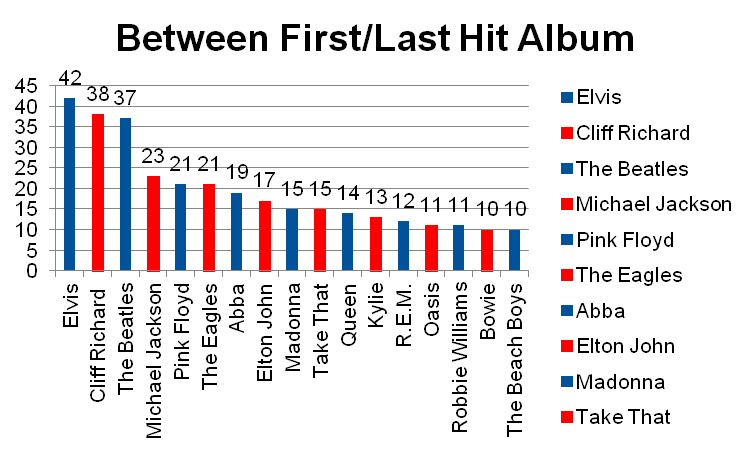
Just as an indication I’ve used the stats from EveryHit.com to examine the top ten best selling albums each year from 1960 to 2009 in the U.K. This gives a sample of 500 albums. What I’m looking for is the span of time over which artists had album sales in the top ten; how long does dominance tend to last? 75 artists had more than one unique album featured but 15 of those only managed one hit album then their greatest hits.

Of the 60 remaining artists only 17 had hit albums over a period of more than 10 years. So from our starting number we’re down to a fifth. The spans were as follows:

These are the most popular artists in the U.K., bands and artists with a cushion of support that should have sustained them, to some extent, through any fall off in quality and/or popularity. Yet, even with the support each commanded, only 17 managed to stay at the peak for long than ten years. Remember also that the last album for Elvis, Cliff Richard, The Beatles, Michael Jackson, Elton John, R.E.M., Oasis and The Beach Boys was a greatest hits or singles collection — not a brand new album. Without those collections their creative careers fall as follows:

The result is just ten artists still operating at a peak of popularity over a period longer than ten years and in most cases the career trajectory involved taking a hiatus to allow scarcity to restore interest. That’s essentially the benefit that was reaped by the sizeable gap between The Muddy Banks of the Wishkah and then Nirvana’s greatest hits followed by With the Lights Out; time enough that saturation didn’t set in.

I’m not saying Nirvana wouldn’t have had a career. In fact I dare say it might have been a career that was more comfortable to their troubled front man. What I am saying is that even the biggest artists rarely retain world-beater status for more than a short spell and that level of persistent fame and success tends to be retained (by definition) only by artists firmly in the field of pop. Lots of bands break up, move onto new groups or solo performance — not many end up with a Sonic Youth-esque thirty year career at a comfortable mid-level of support.

Pearl Jam are a fair indication of the fate of the alternative rock demi-Gods. Despite staying together, despite continuing to create music of interest, and despite clearly enjoying themselves, they’re not the multi-million mega-stars anymore. Maybe Nirvana, as the figurehead of an entire spell of music, would have bucked the trend but it’s unlikely.

I’d like to run this same thought experiment using American album sales but I need to find appropriate data first.