I Admit It…

No excuses, no explanations of long-winded absence of significance…I simply ran out of time and that was the end of that today…Sheesh. 18.00 and still nothing? I think it’s clear I’m ready for holidays to commence next week…Back to normal tomorrow. Slipping! Slipping…

In the meantime, here’s something I saw back at the weekend. I confess I rather like jigsaws at the moment, I enjoy the patience. This one, I think you’ll agree, is either the triumph of capitalism in a comfy box or just quite fun.

Nirvana_Jigsaw

Collectivism Part 2: Binge and Purge

At some stage when collecting anything, a dilemma takes places; does one expand the storage space, cease collecting or eliminate elements of the collection to restore freedom of movement? I’ll admit to adopting what the German army in World War Two referred to as an Elastic Defence. The concept was simply that one retreated in order to shorten the line being defended (while simultaneously extending the opponent’s supply lines and tiring them) meaning you had more troops available and could therefore counter-attack as early as advantageous and restore the original position. In my case, I regularly examine the shelves and choose what is going to be sliced in order to win back a few feet, or even just mere inches of space, which I’ll subsequently refill.

There’s a quotation someplace about “some people are meant for just a moment, others for a season, some for a lifetime” – I always add the proviso that we should be glad for whatever time that is and when it ends feel nothing but the happy memory, no regret. I feel the same about books and music; sometimes an item barely received a listen, or never clicked – other times it did for a short while then I returned less and less. Other items I can’t imagine extinguishing anytime ever as they speak to a time, a place…Or I simply think they’re bloody good.

Books_Apr 2013

Which brings me to the Nirvana book selection…There’s a photo on here somewhere, back in November I think, of some of my collection. No Courtney Love bios, no Dave Grohl bios, just a sheer fixation on Nirvana and Kurt Cobain. But look at it…Naming no names but I think there’s a core here that we all know is essential stuff (Azerrad, Gaar, Cross); then the likeable additions (True, Borzillo-Vrenna, Arnold, heck even Rolling Stone); then the stuff that’s all very…Whatever. There’s stuff here I’ve read through inside an hour and it’s added little beyond a few fanatical heart palpitations…

…I think it’s time to purge. So, my question is; would anyone like to receive the section of the collection I give away? If you’re fine paying the postage then it’s all yours. The items I’m referring to? OK, here we go…

Nirvana Bleach by James Adler
Nirvana Nevermind by James Adler
They Died too Young: Kurt Cobain
Never Fade Away: The Kurt Cobain Story by Dave Thompson
Nirvana and the Sound of Seattle by Brad Morrell
Nirvana: Tribute by Suzi Black
Nirvana: Winterlong by Steve Gullick/Stephen Sweet
Nirvana Nevermind by Suzi Black
Nirvana by Paul Haus
Nirvana: The Legacy by Mick Wall
Nirvana by Jeremy Dean
Nirvana (the guitar tab to the greatest hits book)

Genuine offer, all yours if you want it. None of these are particularly hefty tombs so I’m not expecting it to be a massive postage. Just drop me a line if you’d like them; NirvanaDarkSlivers@gmail.com

The Nirvana publishing bonanza in the mid-to-late Nineties was a fascinating phenomenon in itself. Essentially books come complete with this feeling of authority, calm intellectualism, respectability…And yet the publishing industry is relatively unregulated. So long as one isn’t libelling an individual or committing a crime according to the laws of whatever jurisdictions the book is available in, then one can write and print whatever one wishes. That’s freedom and a good thing too… But like any industry under pressure, bandwagons are firmly jumped on with exactly the same rapacious attitude of any less reputable type of company. The result in the late Nineties was an awful lot of material written using the vast, and readily accessible, reservoir of copy found in the various magazines about Nirvana. All it needed was some photos to wrap the copy around plus some quick puffpieces of the ‘voice of a generation’ ilk. Essentially the Nirvana phenomenon in publishing would be of interest to someone studying the history of writing given the speed and the sheer quantity of the effort which has, unfortunately, stained attitudes toward writing on the band forever more. New books evoke a fair amount of suspicion and weariness.

Collectivism: The Cult of the Object

I make a real point of replying when people post comments here. My reason is that I always want to acknowledge that you’ve taken the time to share your thoughts and I enjoy reading them – least I can do is show that I try to listen as much as I blether. Just don’t want it ever coming across as me setting myself up as the arbiter of right/wrong – everyone has as much right as me and me replying…I’m just one of you.

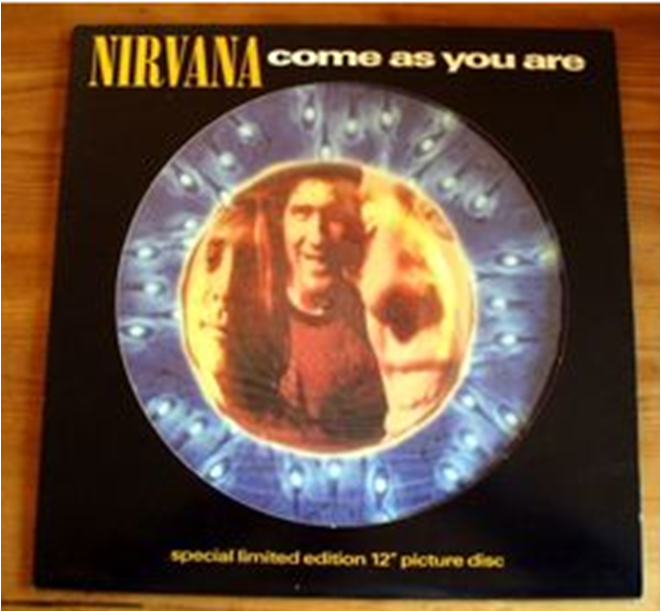
Nowwwwww…Take a look at this pretty lil’ item…

Collectivism_Come as you Are

This 12”, and the Smells Like Teen Spirit one, started my flight away from collecting records for the sake of it. Essentially I didn’t have the space to display this likeable vinyl oddity, and all the songs on it were available more conveniently…So after three or four years I decided there was more music in the world I wanted, that something that I never looked at, listened to, or imagined ever listening to had no purpose.

The point though is that collecting, as an activity, rarely has a fundamental purpose. My starting point, always, is a completist desire; I purchased every Swans release, I read all the Sven Hassel books. On a more sophisticated level I own thirteen books about Mike Tyson which allows the tracing from the early days when he was the great hope of heavyweight boxing and being held up as a rags to riches, all-American dream and credit to the community; to the first rising disquiet; through his defeat, imprisonment and return whereupon the books become more focused on the business machinations of boxing; onward to the present vision of him as a fairly dark individual with a fairly awful reputation. I can understand that desire; it’s a trust thing — when one knows one enjoys a particular author, artist, musician, it’s an easy fulfilment.

The next level, increasingly open to fans, is to support a particular individual or group thereof. I purchase all Swans’ releases direct from Michael Gira’s Young God Records and they all come signed. Whatever The Caretaker (James Kirby) is up to, I’ll buy it — I despatched money to fund the pressing and release of the six disc Theoretically Pure Anterograde Amnesia release, two copies, one of which one of my best friends successfully lost; genius move Franklin. Loyalty and connection are powerful motivations in their own right.

In addition to that, I suffer a dreadful desire to know, to understand. It’s a form of control in a sense, projected outwards into the world — a desire to fully grasp an individual’s work or vision. I do the same thing with genres, delve into them, cover the bases, get to the point that I can say “yep, I know grunge/Dischord Records/Williams S. Burroughs”. But it’s a hole that can never be filled. In the early days I used to buy all but one of any collection; 13 of 14 Sven Hassel books, every Swans album except The Great Annihilator, every official Sonic Youth release (this one took some work) bar their very first album (now rectified.) It’s a controlling urge, a subconscious attempt to possess so much knowledge and data on something that somehow you ‘get it’ or at least can argue or demonstrate it — I’m unsure if collecting at this level is about trying to win.

There’s also the desire to recapture the thrill, that first good feeling when something felt like magic. It’s related to that first point; a dependable source of pleasure as opposed to the uncertainty of having to locate a new one that’s equal to what has gone before. Nirvana are certainly one of my personal origin myths, the ur-text for much of my music taste to come. Also, like a lot of the people I’ve spoken to during this book/blog trip, the discovery of Nirvana was a turning point — these feel more intense in our teens when we’re still pouring structure into the mixing bowl of content already within us; there are fewer of them as the mould sets.

A good consequence of collecting so much is that it creates scarcity; there’s a point reached where each release one doesn’t have is part of a shrinking pool into which one can delve thus providing each new piece a significance and importance that isn’t possessed when the world is simply a mountain of consumable media never-ending. Eking out those remnants becomes as important as the item itself; it’s rare, valuable by default.

Of course, on the downside, collecting so much can lead to exhaustion. With any genre there’s a point where one has whipped through all the bands who were true innovators and then burrowed into the bands who were just tweaking the template now established. If one is content hearing ever more minor digressions within a single orbit of sound then that can be fine; one can dig a bottomless pit of similar sounding bands. This does, of course, lead to an ever greater recognition of the differences; one can hear ever more finely what distinguishes the releases in a way that casual listeners can’t; it’s why those who haven’t dug deep into a genre can make claims about the similarities between bands as diverse as The Who and Nirvana.

But then, as I said, given it’s the quest, the search, the new finding that seems to motivate me, possession gradually loses its excitement. Sonic Youth are a good case; I’ve shed a number of their live releases and most of the singles — I didn’t need their cover of Nirvana’s M.V. for instance, the original fills whatever space that song needs to occupy. By the same virtue, I didn’t need the picture discs sitting on a shelf gathering dust, they had to go. I’m not saying that’s right or wrong, it was simply my mode of collecting. The fact it was a Nirvana item, a relatively rare one, made no odds — an unheard fragment of Nirvana I’ll cling to with furious tenacity, I’ll rampage out into the cosmos to hunt them down, but retaining objects that differ only in their physical qualities…Somehow it doesn’t spark for me. I’m a content junky not an object one. Again this isn’t a statement of any moral or otherwise intrinsic right/wrong; some people collect houses, some collect savings, others collect memories, some gather mementoes. All of these are possibilities, all are devoid of a right/wrong. It just so happens most of my memories are encoded in the possession of a book or the presence of a CD or song.

A Man Who Made a Difference: March 29, 1984 – January 4, 2011

I admit I wondered about a simple memorial post for today; it’s April 5, 2013 and we’ve just hit the nineteenth anniversary of the death of Kurt Cobain. But then, browsing Twitter briefly, rolling across Facebook pages…It seems near everyone is already marking their public allegiance and fealty. It’s a pretty thing to see; people pausing and saying “someone mattered to me and still does.” I’m going to get on and do a post later today pursuing a statistical angle on Smells Like Teen Spirit instead.

I don’t mark the deaths of many public figures…But on March 29 I took a moment for a gentleman called Mohamed Bouazizi – again, as with Kurt Cobain I like to mark the birth as well as death. We live in a world where the power of individuals is cited usually as a way of claiming the powerful deserve it all or that the poor, weak and dispossessed created their own fate; it’s the myth of entrepreneurs controlling the world, the superman tale that infests the financial markets and blames people who strived for something more, who aspired to something greater for failing.

Mohamed was a poor man, a boy who by his late teens was already helping support his mother and his siblings by selling fruit and vegetables on the streets of his town; there’s no room here for an existential crisis, or an artistic one, this was a meaty reality. At 11.30am on December 17, 2011 in an act of desperation he shouted “how do you expect me to make a living?” and set himself on fire in the street in Sidi Bouzid, Tunisia. This, until then, unknown, overlooked and essentially irrelevant 26 year old man died some two weeks later. From this ridiculously sad action, an act of true hopelessness, something good was born. Dictators fell. Regimes that had oppressed and robbed their populations for decades came apart at the seams; there was, however briefly, a chink of light.

That doesn’t mean the world is predictable, nor that consequences are controllable; it doesn’t mean the world created is going to only contain happy things, or desirable things, nor that utopia will be born at the flick of a match. All it means is that individuals can choose to act, to protest, to fight for what they feel is right – too much of the time people judge by the result when it’s the act itself which is what should be focused upon. One man changed the world entire; did anyone still truly believe that was possible? Here’s proof.

Across six months now I’ve spoken to dozens of Nirvana fans all choosing to make something positive from their love of a band and its music. Again, the act with which all this creativity and positive energy commenced was not a positive one – but something was born from sadness. That’s our choice day-by-day, what good do we build from the bad that will inevitably occur in any life? In my own life, today marks the commencement of a journey two of my friends have decided to embark on; they’ve purchased a canal boat, they’ve left London and their jobs behind and they’re going to spend the next year floating through this country seizing back life and time for themselves. I find that positive, beautiful. I wish them the best.

“No band is special, no player royalty” – true. But the least of us can do something special if we choose. Rest in Peace Kurt Cobain…And Mohamed Bouazizi. You each accidentally changed the world and it’s only a shame you won’t get to see all the good that has and will come from it.

Nineteen Years and Counting: Anniversaries

The room smells like an accident at a chemical factory; a blend of Tiger Balm, Deep Freeze spray, Vicks…It’s been a pesky few days between the stomach bug, the cold and my neck locking completely…Ah well! On we go!

IMG-20130402-00050

Last week was my thirty-third birthday therefore marking the nineteenth anniversary of receiving the Nevermind album on cassette. A process of extrapolation means I know that yesterday/today is therefore the nineteenth anniversary of me buying either Bleach or Incesticide, which makes Friday April 5, 2013 the nineteenth anniversary of the other one of that pair. Why so precise? A wonderful family holiday to Florida coincided with the Nirvana endgame and gave me a chance to switch from my taped off copies of everything to the official cassettes. Oh, that means Christmas was the anniversary for In Utero.

In some ways the journey of that one album indicates the power of commercial music sales; taped off copy a year before sometime in the summer, leading to the cassette that still sits on top of my record player, to the CD copy sometime in 1996 following the Singles box-set in November 1995 (my first CD purchase – note that as late as Unplugged in New York I was still focused on cassettes, gosh…), then all the way up to both the Super-Deluxe and the Deluxe reissue (yeah, odd I know but it was easier to carry the Deluxe to work y’see? Plus I bought the Deluxe at a second hand store making it a far less mental purchase than it otherwise looks…) Surrounding those purchases I’ve invested money in the Charles Cross Nevermind book (a really good read), in James Adler’s Nevermind book (a really not good read), plus Susan Wilson’s Nirvana Nevermind book, I’ve heard dozens (at least!) of live copies of every song on the album, I’ve watched shaky hand-held cam footage or top notch official footage — it’s amazing how it’s been possible to consume and, more intriguingly, to re-consume the same set of songs over and over again.

And it’s nice knowing that isn’t just my trip — I’ve spoken to dozens of Nirvana fans these past months all of whom have similar tales of finding the music, different routes but a lot of shared characteristics. In general it looks like the core of people who still make up the fanatics are in that 31 to 36 year old age group now, were in their early-to-mid teens when Nirvana hit. I think that timing makes a significant difference; the human ego doesn’t fully evolve until around age ten meaning we’re not whole personalities, fully self-aware until relatively late in our youth — I think the discovery of one’s tastes and preferences, learning to ‘care’ for music, or authors, or activities, I think it’s all part of that void-filling spell of life, the quest to become someone. It’s why the music retains such importance for ‘us’; the music is great but musical obsession is about far more than the intrinsic qualities of a piece of music, there’s nothing about any single piece of music that denotes it must be loved — it’s about the listener and about catching them at the right moment. In the case of the Nirvana fans, the band hit at just the right moment; a few years later we’d be talking Smashing Pumpkins, or Green Day; a few years after that we’d be hip hop fans or sharing memories of post-rock appearing or *shudder* Limp Bizkit.

Alas, I’d have to say that the emphatic nature of the end of Nirvana’s career does matter in this regard; it’s a huge act that occurred — very few musicians commit suicide, even fewer at the peak of fame when they’re among the biggest musicians in the world. Someone dying does matter, it does invest the memory with importance, it does mark the music indelibly — for a bunch of teenagers commencing the quest to learn how to live, how to be a life, to be brought into such immediate contact with ‘the end’ isn’t necessarily damaging, but it is significant.

As a personal journey it has always felt great combining my own birthday ‘season’ with a spell of significance in the Nirvana story. For the first time ever I’ll actually be at work on April 5. But come evening I’ll still be pausing to play the tunes yet again; for all the debates around the commerciality of music it feels good to still feel something for the tunes at the centre.

Memory Lane: Record Shops and the Value of Scarcity

Record Stores

If you’ve seen the front cover of Oasis’ What’s the Story Morning Glory? Then you’ve seen my favourite record-shopping street in London; Berwick Street in Soho. I first started visiting London to buy music back in about 2000 when I was twenty years old; there was an exhibition on at the Hayward Gallery called The Art of Sound that had me, by the end of my visit, listening to the throaty growls of passing traffic with the same fascination I reserved for music purchases. I’d travel down and stay with my aunt then set out the next morning, early as she lived in High Barnet at the furthest end of the Northern Line so it was nearly an hour of rumbles and creaks on London Underground to get in. I’d be carrying around one hundred pounds in cash, I mean, I was twenty, one hundred pounds was a lot of money, it was money that meant something.

The route was planned out with military precision; hit Camden soon after 10am, there were two second-hand record places on the pedestrianised street opposite the market, then further up the main street was Record & Video Exchange, toward Camden Lock a new shop opened a couple years later and joined the route, then finally there was an electronica specialist in the upstairs room of a fashion boutique further toward Chalk Farm. I’d conclude by heading into The Camden Cantina usually dead on twelve (the staff knew me for actually hovering at their door until opening time) for Mexican lunch/breakfast.
Onwards to glory! The next step was to hop on at Chalk Farm and barrel down the Underground, out at Tottenham Court Rd, along Oxford St as far as the HMV and there it was, the next three hours plus of my life (and little did I know the same street I’d be browsing thirteen years later — my most recent Berwick St purchases were the unreleased soundtrack to Dawn of the Dead by the excellent Trunk Records label and Can The Lost Tapes two weeks ago.)

Berwick St was the Mecca as far as I was concerned; Selectadisc, Sister Ray, Record & Video Exchange, Sounds of the Universe (Soul Jazz Records), Mr. Bongo (hip hop specialist) one street away, plus two discount places that were always worth a look, and a slightly upmarket shop called Phonica down a side street onto Poland St that was underneath the office building I first worked in two years later when I got my first adult job (also where I met my first office-place psychopath but that’s another story — horrible office, horrible job, horrible people.)

I’d arrive in Berwick St around 1pm and I’d be stuck there until around 3.30pm. I had to leave around then if I stood any chance of making it down to Waterloo and onto a train to Croydon for the final step of the journey; Beanos, the largest second-hand record shop in Europe. This final step was always a case of taking a chance, for starters they were usually a tad more expensive than the others, meanwhile they also had an annoying habit of writing a code on the case of each CD which was hell to get off later. But it got me there around 4.30pm and there was always something. The crucial factor was that a quick rampage through Beanos would give me enough time to change my mind and go back to ONE, and one only, of the shops further back on my route, I could just make it as far as Camden in time to grab a previously discarded option.

It’s almost all gone of course, I think you could see that coming a mile off. All five of those shops in Camden are gone. In Soho, Berwick St still retains Sister Ray, Record & Video Exchange, Sounds of the Universe — I didn’t realise Phonica was still going, I don’t visit. Beanos closed too so the trip down to Croydon is redundant (“Croydon: a Symphony in Cement” — bloody ugly post-war British architecture, we forgot what pretty was for thirty years.) Around that the major stores are going now too; Tower Records at Piccadilly was sometimes worth a detour. It became Virgin Megastores, became Zavvi, became a clothing store. A friend of mine is in the main Oxford St HMV as we speak and says it just feels sad in there. Borders was always an oddity anyway, half way between a posh book shop and a posh record shop. The discount record shop at Clapham Junction swapped to a smaller premises then finally faded out. In the smaller towns and cities, same story; Parrot Records in Cambridge was a favourite, bought Dinosaur Jr Fossils there, my first Coil record. Barneys in St Neots had brilliant contacts for bootlegs and rarities until the front of the ancient building started to fall in; it’s a wine merchant now. Sam Goody’s in Boston went.

But that’s not really what I’m here to talk about. I’m talking about the bonds between my Nirvana experiences and these stores. In recent years the surprises and thrills became smaller and smaller which means I remember exactly where I was when I first heard Onward into Countless Battles on a bootleg; Sister Ray’s previous location on Berwick St. I refused to pay £15 for a single minute long shred of a song, this must have been 2008 or so. I bought the most expensive record I ever purchased, Sonic Youth Walls Have Ears, at Beanos in about 2003-4 then got a discount because the girl serving had been singing with a band (The Faint? Maybe) the previous night and she was chuffed at being recognised. I found a vinyl LP called Seventh Heaven, featuring Nirvana at the Bristol Bierkeller, in the Record & Video Exchange in Camden. I also bought a couple of execrable interview discs in Selectadisc at one point thus learning never to buy interview discs. Outcesticide VI was the last notable purchase in that series, Soho again, Sister Ray had it. Sam Goody’s was where I purchased my first ever compact discs — the Nirvana Singles box-set the very day it came out in 1995. Barneys was where I found the Nirvana Wired bootleg featuring the band in Newcastle.

The biggest connection is simply that feeling that, as I only had a hundred pounds to spend, whatever I chose to spend it on had to be special in some way; either a brand new discovery, a chance taken, or a collection advanced, or a bargain located. When hunting Nirvana music, what’s maintained the pleasure has been that sense of rarity, that there’s no telling when the next new discovery will be. Yes, there are huge reasons why online purchasing makes sense and carries vast advantages — that’s a conversation people have had many a time — I’m purely interested in what makes something feel golden. What made the romp through London special was that sense of ritual, the fact I could barely afford to be doing what I was doing so each purchase meant a small sacrifice somewhere (or another dollop of debt).

Those people who don’t particularly care about music — you know the type, their record collection stopped evolving when they hit 21 and started work, it’s full of tasteful club collections, they think a rock anthems compilation is wild, they’ll only ever own one, at most two, albums by the same band — they’re fine with the new ‘all you can eat’ diner that is online music; it’s great for limited attention spans, piling up files, musical wallpaper to colour a room and forget about. I know all the arguments why it has to go that way; all I’m saying is that the active pursuit of new musical experiences gained a vast energy as a consequence of my, then, limited budget, the confined time I had to look-select-revise-pay, the deliberate decision to make it a treasure hunt. Record shops are bound inextricably to a surprising quantity of my fondest and most blissfully carefree memories of my teens and twenties; even now, if I need to take a breath, relax, or pull out of a blue morning mood, I’ll often scrape together some stuff I’m not keen on then go trade it in at a record shop, taking the exchange price in shop vouchers, so I have that tightly-defined budget to go hunting round the store with — I’ve ended up dehydrated and busting for a bathroom after spending four hours in a record shop. Nirvana, however, retains that quality for me because I don’t go streaming vast files online, I look and patiently buy a disc here, a burnt-off CD-R there, a vinyl piece now and then. When something new pops up it’s a thrill.

Anyways, Saturday morning anecdote over. About ten years ago, while ordering some of Michael Gira’s writings from Young God Records, I asked him whether he’d ever write an autobiography given his life seemed populated with the kinds of experiences the majority of people who end up with autobiography could never even dream of. I’d just read his book The Consumer which is still among my favourite reads of all time given its focused solipsism and visceral detail — hints of Burroughs alongside the writing style of Beckett. I was also sick to death (now I’m just numb) of celebrity memoirs of third-rate nothings and, God forbid, footballers. He replied saying (I’m doing this from memory so apologies that it’s only a paraphrase) “writing an autobiography is the ultimate act of arrogant self-obsession predicated on the utter belief that one’s own life was of any interest whatsoever to others.” I try to stick to that rule when writing here on the blog.

The Unknowing

One of the final chapters of Charles Cross’ Heavier Than Heaven consisted of a long, well-evidenced, but ultimately fictitious recreation of Kurt Cobain’s final day on Earth. Unless one wishes to deny all objective reality and to declare all recorded history a fiction, then sometimes all one can do is use evidence to suggest likely possibilities. I’m certainly not a believer that only those who were present can comment or reveal or I wouldn’t be writing this material.

The world is simply too complex, the result of too many interactions of human and non-human, to succumb to human classification, description and control. The result is ‘the unknowing’, those patches of any story or subject where there’s no way to fill the space. The death of Kurt Cobain is a fine example. As noted in the If She Floats blog post the other month, I’m certainly no believer in the conspiracy theories around his death, but, as an event with no witnesses, taking place at a time when only a few people have been able to report even a small part of Cobain’s movements, there are going to be things that cannot be established without doubt.

Another example would be something as simple as establishing how many times a song was played. Big Long Now was definitely performed live (I summarise this argument in the Songs the Lord Taught Us chapter of Dark Slivers) but it simply isn’t known when or where. The available video footage in the With the Lights Out DVD shows it still required some work in early December prior to its recording for Bleach and subsequent discarding. The likelihood is then that it was showcased on stage during the ten shows of January-April 1989 for which no track listing is known. This gives a physical location of Portland, Olympia, Seattle, Ellensburg, San Francisco or San Jose — we’re unlikely ever to know. Its performance is an imaginary event.

As a further alternative, we can look at things like the Organised Confusion demo of 1982, the loss of planned Cobain songs when his bathroom flooded in 1992, or whatever shredded intentions made it further than his mind in 1994. We’ll likely only ever see some small part of these items — the rest will remain definite factual events…But with no physical substance to give them character, no content to contextualise them alongside Cobain’s other songs.

Immense work can go into filling those holes; quotations sourced; physical relics identified; opinions (including my own — a lot of what I’ve done on here is just conjecture) debated and honed ad nauseum. Yet I admit that often filling the hole brings only a small jolt of satisfaction compared to the depth of tension that comes from contemplation of, and desire to fill, that absence — a full answer is neat, tidy and ultimately disappointing. It often feels like the urge to believe in mysteries is a force in and of itself, one immune to evidence and indeed so ruined by it, that when faced with evidence people need to find new holes to consider.

Brilliantly, the consequence of non-existence in the present day, is to remind us constantly of the genuine existence of that element in the past. We spend more time looking at the lost pieces, because they’re interesting and enthralling, than we do at what is known. Setting something in concrete eliminates a lot of the appeal and the enjoyment. Indeed, Kurt Cobain and Nirvana retain their aura primarily because of death — if they were still around we wouldn’t be as fascinated by them. Nirvana is a hole that our curiosity leads us to peer into.

Which leads me to a final thought; Kurt Cobain’s word can’t always be trusted. The cases of him exaggerating are fairly well-known, likewise cases of outright lying — he claimed for a chunk of 1992 that he didn’t have a drug problem, for example. A lot of the time he can’t be taken as the final arbiter of his intentions or objectives, at least not in his recorded public statements. Kurt was a deeply private individual, who wrote in his Journals of how violating he found it when people stole them, who dedicated substantial portions of In Utero to anger at how his life and loved ones were being used as fodder for others. It’s fair to say he didn’t feel informing the public of his every inner thought was a fundamental desire. This leads me to simply doubt and to dismiss his claims that his lyrics had no meanings, or few of which he was aware. I’m willing to accept he veiled and obscured meanings; and I am sure that many words, themes and phrasings were products of his damaged psyche and therefore that he may not have realised he was reproducing over and over.

I think it’s worth remembering in any consideration of Kurt Cobain, that his priority was protecting his privacy so whether or not he raises his hand in the air and says “swear to God brother” treat his answers with caution. And simply enjoy the discussion because we may never know all the answers or pin down all desired truths of Nirvana’s tempestuous career.

Nirvana and I: A Personal Aside

I’ve been asked repeatedly – as work colleagues, friends and loved ones watched me lose a year of life to scribbling or tapping away furiously at Dark Slivers and the supporting data and notes – “why do you love Nirvana so much? Why do you care so much about Kurt Cobain?” My answer in essence is that the love of something has very little to do with the object of that love; love doesn’t float in the air to be inhaled and returned. I was ready to love music at that point in life and by chance, luck, whatever, Nirvana was the group discovered. For some people out there maybe it was NWA or Public Enemy, maybe it was the Summer of Love rave scene in the U.K. or some other manifestation of the surge in dance culture, for others perhaps Pearl Jam hooked them far more…Its all good. In my case it was Nirvana, there’s no qualitative judgement required, it just was.

I was on a school trip, shared a room with the older crew who were along as supervisors, ended up running a group after my supervisor decided that trying to strip out of his trousers to his cycling shorts was a great idea while still riding the bike. It was a bit of a growing up experience basically. On the boat home from France the guy opposite had tapes tucked in a hat on the chair, I fished through, found his Nirvana tape (Nevermind one side, Bleach the other) and was hooked. He was surprised I hadn’t heard of them but genuinely I’d never even heard of Nirvana.

Then came the coolest family holidays. My mum rocks at coming up with cryptic clues – so each year, at Christmas, there was always a treasure hunt in the afternoon and this particular year my parents had decided to really bust the bank and ship the whole lot of us to Florida while we were all still young enough to enjoy it (heck, I’d go now! Disneyworld is FUN and I don’t care who says otherwise!) We went in 1993 and they decided to do it one more time in 1994. So, Kurt Cobain’s demise came tied to this absolutely wonderful and happy time – it’s like in a genuine top-quality comedy where the laugh is greater because of a moment of sadness or vice versa, that a heightening of emotion in one direction makes the opposite emotion even more intense. It gave the timing a significance, last day in Florida equals day they announced Kurt Cobain was dead – coincidences matter because they bind things together, particularly in a young mind.

It was my first real experience of death. I had no memory of older relatives dying, so this was the first time I’d felt engaged by the loss of another person – maybe the first time I was old enough to comprehend the idea that someone had gone. The fact I’d bought, that very morning, the final Nirvana album I didn’t already possess – I can’t recall if it was Bleach or Incesticide but I genuinely do remember forcing my parents to stick Incesticide on the car stereo during that vacation, an odd choice given I never made them listen to Nevermind. Naturally, having no idea how to react, one just makes up an approach from observations of the world around – typical kid – so my reaction was to institute a daily Nirvana listening plus a fairly permanent layer of black clothing. I admit though I never bought or owned a Nirvana t-shirt, it seemed ostentatious and fake as if declaring my allegiance to other people was the important bit, it felt like trying to gain reflected glory. Hate the idea.

Shifting schools was another real upheaval – guess it was my turn to have a teenage blues phase. I snapped out of it eventually but music was a good way of gaining a touch of credibility with the already settled social cliques of school (no criticism of either school, schools are just like that.) It formed a good social glue and a declaration of taste before the audience wanting to figure out the new boy. Naturally Cobain’s disaffected ennui fitted the mood beautifully – I’m sure it had never even occurred to him that everyone feels a bit divorced from things sometimes and that he’d soundtracked and expressed it to perfection. I had a bit of a ritual of listening to a Nirvana song (at one point a whole side of an album) each night before bed – think it helped me get good sleep too, music before bedtime, a recommended relaxation technique. At university it didn’t work quite that way, it was more a differentiator than a unifier – but it did put me nicely in contact with my dear Norwegian punk musician friend who I’ve lost contact with but still retain a huge love for, that’s nice.

Behind all of that, Nirvana provided a starting point, a genuine Ground Zero when it came to my interest in music. I could draw you a graph showing how one discovery led to another, all leading back to Nirvana. Sonic Youth and Swans are the most important bands in terms of the connections I then made, but coming to love SY started via Nirvana and Swans came from SY in turn. I also spent years loving how special it felt tracking down and locating Nirvana rarities. It gave the music a value, a sense of miraculous discovery each time I hauled something off a shelf and got to consider whether I was looking at a new song or just a misnaming. To indicate how deep that enjoyment went I’d sadly like to confess to having a recurring dream where I’m at a record fair picking through a stack of Nirvana bootlegs riddled with unknown songs (yes, I even invent song titles in my head to fit the dream – each one coming with a subtitle explaining the song’s meaning or origin) and working out whether to buy one, or two – if they’re worth £10 each, whether I could swap something else back and get an extra one…This is seriously something I dream 5 or 6 times a year and have done for over a decade.

Are there other reasons I adore the band and Kurt Cobain? Hell yes. My preference, when it comes to ‘heroes and idols’ has never been for stereotypical perfection, it doesn’t inspire me at all. I’m inspired by conflicts, by individuals who achieve much despite flaws, or who were simultaneously great and flawed at the same time. That felt more human, less like admiring a marble statue and less of an unattainable propaganda image. Kurt Cobain fitted perfectly. People think of his life as a depressing one…I never did – his suicide made me appreciate how great and valuable my life was, how much luck I had been given in so many ways. It also made me appreciate the power I had, that if he could do all he did despite the burdens he carried then what excuse did I have? Plus the music was (and is) a comfort, like a well-worn and familiar jumper. Oh, and did I mention I really enjoy the music too? Plus I genuinely admire him, in a world where people seem less and less able to even imagine not wanting money, money, more money, that he stood on top of the world and said no. It’s still the rarest thing, someone who had won over the world to such a degree to hand it back despite all the pressure, the nay-sayers, the criticism he was bound to receive – he went his own way. That’s strength, that’s a true willingness to focus on what one genuinely believes. He told an industry that it was faking and lying and he didn’t want to take part. Brilliant.

Misheard Lyrics

http://www.nytimes.com/2012/07/15/magazine/lady-mondegreen-and-the-miracle-of-misheard-song-lyrics.html?pagewanted=all&_r=1&

A neat piece from the New York Times, I enjoyed this very much…Right up to the conclusion. The author basically posits the usual either/or approach to a topic. This isn’t uncommon, there seems to be a discomfort with the idea that something can be more than one thing at once — people prefer a simplistic “it is THIS” answer, a single definition, one unified truth or experience. The conclusion seems to be that parsing and dissecting something ruins the fun of it, that it distances the listener from the music being discussed, that it destroys the mystery and removes the visceral pleasure of musical sensation.

My objection would be that the direction of music for a long time has been toward the purely physical, the voiding of active intelligence in favour of lizard-mind flashy sound. I see few supporters among mainstream musicians or mainstream music commentators who aren’t happy to treat all music as ‘dumb fun’ and leave it sitting there on the plate to be devoured like fast food, filling an immediate hole rather than any deeper nutrition.

…And that’s fine. But, as you might be able to tell from the nature of the content on this blog, I believe, as a life philosophy, that most things are more than one element all at once. Nirvana wrote bloody-knuckled, pummelling music that hits so good…They also wrote music that lends itself to deeper consideration and understanding. I enjoy it on both levels and rather than considering the application of intellect to a subject a way of annihilating its magic, it usually leads to silver linings I didn’t know existed.

Especially in a world where, to an ever greater degree, it seems we’re only meant to use our minds in service of our paid employment, I find it nice to use my mind for the purpose of pleasure, selfish enjoyment, whimsical diversion and journeys into the sounds I love. The mind and body are friends studying a picture from different perspectives, not strangers unable and unwilling to communicate. If I wanted to live the world, to engage with it, only on the physical level I’d be a dog not a man. It seems sad to be encouraged, to an ever greater degree, to refuse to engage our lives with the full power of our minds except if paid to do so.

Shifting focus though, the content of the article is great and highly applicable to Nirvana given the work thrown in to taking the lyrics apart across the years. In my case I’ll admit also to falling completely for the belief that the chorus of You Know You’re Right was “pain” rather than “hey.” Either way I like it; my original hearing seeming more revealing of what I expected of Kurt Cobain circa 1994, while the latter ties into the apparent boredom and self-parody present in so much of what he did with his final years — taking the stereotype of Nirvana to the nth degree.

An Aside: Trends in Nirvana Facebook Groups

This is merely an observation but one based on viewing somewhere around 500+ Facebook groups dedicated to Nirvana and/or Kurt Cobain. I’ll update this post if I recognise fresh characteristics or anything deviating from these points.

Firstly, South America owns Facebook! It’s incredible how many South American sites there are. At least fifty percent of the 500+ groups I’ve observed are from the region (I’ll accept they might also be from Spain or Portugal — my language skills are minimal.) My theories range from the speed of development of Internet connections meaning it was the age of Facebook before that region sought to express its Nirvana fandom; to a preference for social groupings as opposed to the very individualistic style of Europe and the U.S. More views are welcomed.

Britain and the U.S. oddly don’t seem to have too many Facebook groups dedicated to Nirvana. Then again, why would we? In the case of the English-speaking world, there have been effective channels for relaying Nirvana information and unifying fans for over a decade with LiveNirvana and the Internet Nirvana Fan Club leading the pack. British and U.S. users also seem mistrustful of unofficial efforts, instead congregating in the greatest numbers around the official/semi-official sites of individuals, bands or labels. Also, instead of actively engaging with groups it seem more the norm for people to present themselves as unique individuals (“I’m special! I’m me!” screamed the dust speck.)

The Italians have a beautiful habit of using lines from songs as the title of their Facebook groups; it was such a common characteristic I could usually tell at once if the group was for Italian Nirvana fans. The Polish similarly tend to incorporate their references to Kurt Cobain or Nirvana into longer sentences — group titles can be ten words. They also all seem to give personal email addresses at the top of their groups so that people can contact them individually. This is unusual, most sites are fairly anonymous revealing little of the individual who built them.

Not wishing to spread national stereotypes but I’ve yet to find a Nirvana Facebook group in Germany that permits strangers to participate or comment. They’re all closed. I’ve frankly found Eastern Europe and the Balkans more welcoming. I’ve seen a few from Asia-Pacific, nothing from the Middle East outside of Israel or Africa but I need to mine more deeply.

I’d like to state, for the record, that my favourite site names so far are definitely “Give Us Back Kurt Cobain and We’ll Give you Miley Cyrus” and “God, Give Us Kurt Cobain and We’ll Give you Justin Bieber.” Oh, and those named “Come to the Dark Side…We Have Cookies.” There’s also a guy on Twitter who makes me chuckle with his macabre Dead Kurt Cobain @gunreviews; “Kurt Cobain, dead but effectively brings you reviews of weapons and tactics from the great beyond. A total parody, unless you are intoxicated.” He’s a pretty good artist too.

I’m also stunned by how friendly and decent people are. The NirvanaItalia site happily added information about the book. LiveNirvana, Nirvana Live Guide and the Internet Nirvana Fan Club have all been a delight. On Facebook too, remarkable friendliness on all sides, a mass of people, sharing a love of a band, simply being polite and encouraging. It’s been a nice feeling; helps me keep going.