Nirvana Live: Missing From Action Part One

There were clear gaps in the live record, songs that showed up far later than seems realistic or that simply don’t show up at all. This post is just a brief look at those two circumstances.

The early days of the band were deservedly the core of Gillian G. Gaar’s latest book Entertain Us. Beyond the reprised tale of rags to riches, the early days retain a mystery. The band’s rising status and ‘most likely crossover success’ status in 1990 owed a lot to Sub Pop’s success at shoving a low-selling strictly local scene onto a global stage — in 1987-1988 this was just one band in a field of thousands. The live stats support this with just 7 of 30 set-lists known:
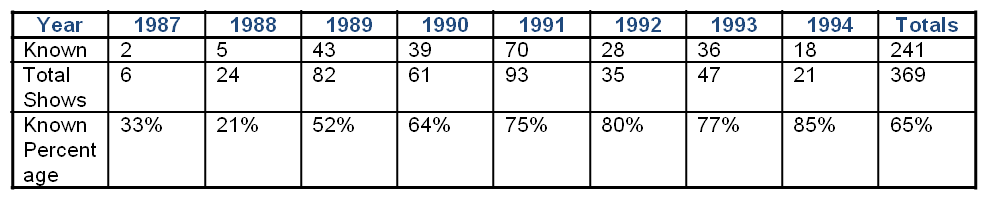
Set Lists 1987-1994

Understandably this leads to a raft of suggestive stats. As a first example, the fact that Annorexorcist appears in the set-list in mid-1987 and then again six months later in January 1988 suggests it likely featured at two further intervening shows. Likewise, given it was a leftover from Fecal Matter, there’s a possibility it may have appeared at the two shows prior to its May 1987 appearances. Raunchola (A.K.A. Erectum) flops into the territory of God knows — a first appearance in January 1988, a last appearance in March with just one intermediate show, yet then a space of sixteen performances until the next fully revealed set. There’s simply no way of knowing when either song died out. There is, however, good reason to believe there was more live life to them than there strictly limited edition status. Pen Cap Chew and If You Must also have a chequered history; they appear at the start of 1987, are excluded from the May gig (though Pen Cap Chew did make the KAOS Radio performance), then reappear in January-March 1988. In conversation with Jack Endino early in 2012 he stated, with regard to If You Must “…at the time we recorded it (Jan 88), they were opening their set with it. Much later he decided he didn’t like it, who knows why.” There’s a good chance that he’s correct and that both songs featured in the final two gigs of 1987 but then hard to discern if the January 23, 1988 appearance was their final showing or if they made some brief resurrection later in the year.

We’re looking at the gap between reality and posthumous truth. Vendetagainst (A.K.A. Help Me, I’m Hungry) exists for a brief appearance in 1987…Then a gap of 83 shows and 29 months until it pops up twice; November 5 and 8 with a gap of one show. Blandest, only ever seen on June 11, 1988 in studio, likewise appears for two shows in July. Blandest may have been present at the eight ‘ghost’ shows between March and that date, or the show a week later in Ellensburg. It’s also hard to believe that the song wasn’t featured at all earlier.

On a related note, it isn’t a surprise Chad Channing knowing Blandest, but it’s unusual that he would be aware of Vendetagainst, a song recorded a full year before his arrival in the band. I’m speculating but, in the month pause between their show in August 1989 and the commencement of touring in late September, the band seems to have decided to take stock of the songs they had left in reserve and trained up on them. During this phase the band are varying elements of their set almost nightly, it’s as if they’re keeping material alive with new releases in mind. The set is knee-deep in, as yet, unreleased songs; Token Eastern Song, Dive, Polly, Even in His Youth, Breed, Vendetagainst, Sappy, even a jam on Hairspray Queen. Nirvana were a very smart unit, already one eye to the future and a range of possibilities.

While unsurprising that the rarities are conspicuous by their relative absence from the live record, it’s fun to consider the fate of a certain portion of Bleach. Essentially the gaps in the known set-lists cast a veil over the likely presence of some songs. Blew, Mr. Moustache and Sifting were all given a first airing in June 1988 in studio, but eight set-lists are unknown meaning it’s October 30, 1988 before the songs are first seen. Likewise, it’s unlikely that Negative Creep and Scoff were first performed when they’re first ‘visible’ to us twenty years later, in April and May 1989 respectively given they were definitely finalised and recorded by the start of the year and there are ten shows leading up to the known displays.

The most remarkable disappearances from the Bleach sessions are Big Long Now (I dissect it’s likely performance in the Songs The Lord Taught Us chapter of the Dark Slivers book) and the way Swap Meet doesn’t appear at all until November 1990 — that gap for the latter just doesn’t ring true. A further curious feature is that, with the exception of Blew, the ‘late arrivals’ from Bleach into the Nirvana live record are all clustered toward the back-end of the album. Apparently Bruce Pavitt and Jonathan Poneman were involved in deciding how to sequence Bleach and it’s quite intriguing that those songs that were rushed into place to fill out the album, that weren’t ready for live performance until late 1988 or even later in 1989, were all shoved to the rear. The first side of Bleach places some of the band’s earlier recorded works (Floyd the Barber, Love Buzz, Paper Cuts) to the front of the album so it seems Sub Pop were aware at the time that certain songs were rush-jobs.

Disquiet: MTV Unplugged in New York

http://www.nirvanafreak.net/art/art18.shtml

Earlier today we focused on the subject of Nirvana cover songs and pointed out that in 1993 there were two performances strongly dependent on cover songs; Sao Paolo and then MTV Unplugged in New York. The latter show is, of course, a triumph — it’s funny, beautifully performed, featuring some of the vocal performances for which Cobain will always be known. It also led to the CD release which is the Nirvana album that anyone who doesn’t really like rock music has in their collection. The quality of what took place on stage is undeniable and I have no wish to deny it, I love the performance same as anyone else.

…But. I don’t wish to be a killjoy but all the talk of how the band ‘wanted to do something different’, or how ‘most Nirvana songs don’t really sound good acoustically’ feels a little like press statements to put a positive gloss on what occurred. Six of fourteen songs performed were covers, there’s no reason at all why the band couldn’t have worked over their extensive catalogue and brought a few more originals to the blend. The With the Lights Out box-set indicated that a surprising number of the late era Nirvana songs started off as acoustic tracks, so did Sappy, while other songs had been attempted in acoustic format at one point or another (see LiveNirvana’s guide to Rehearsals to see the band trying to work out songs acoustically in July 1993.) With that in mind it wasn’t that the Nirvana catalogue couldn’t be adapted…It was that they weren’t willing to take the time required to do so.

Instead, Nirvana played every single acoustic, or at least QUIET, song they ever placed on an album; there was nothing left unless they wanted to do some more work — a handwritten set-list mentioned at NirvanaGuide.com states Marigold and Old Age were also under consideration just one day before the band were due on stage, apparently Been a Son was considered. The band went on stage nervous about a lack of practice and comments, for example by the Kirkwood brothers, indicate Kurt was hardly a meticulous attendee at the rehearsals, nor a sober one. The last-minute nature of their practicing doesn’t indicate an enthusiastic desire to engage with the performance.

The band clearly didn’t put deep thought into the shows. The Meat Puppets toured with Nirvana for seven shows in late October-early November so their inclusion seems to have been dreamt up on the spot during the negotiations with MTV, barely a few weeks before it took place. Their three songs in the Unplugged set are beautiful, and gorgeously performed, but there’s genuinely no reason to speak of them as anything more than rock star level karaoke on a batch of tracks Cobain had known for years and with guests handling the instruments. Likewise the claim that the acoustic format meant they couldn’t play most Nirvana songs is belied by the fact that Nirvana’s performance was quite clearly amplified (particularly on The Man Who Sold the World) so it’s not like they couldn’t airbrush some volume over their songs.

The band added precisely one new song — The Man Who Sold the World — during their preparation for the show. Jesus Don’t Want Me for a Sunbeam and Where Did You Sleep Last Night had been honed and perfected years before. While a revelation for audiences who hadn’t witnessed those songs, for the band there was little fresh or new about what they did on stage. Though I’m happy to give credit to the band’s explanation that they wanted to ‘break the mould’ of the MTV Unplugged series, I’m still unsure that it truly explains why the band could barely pull eight originals, all predictable choices long practiced as acoustic or semi-acoustic renditions, together. Plus, the series had only commenced in November 1993 so why did it require ‘its mould’ breaking? Surely Springsteen’s all electric performance the next year was far more daring? If they’d been willing to practice they could have adapted a few more originals. Kurt’s refusal to play an encore, explained by how well he’d done on Where Did You Sleep Last Night, could just as readily be about the fact that there was nothing else that they had bothered trying.

Rather than seeing Unplugged as ‘the Phoenix rising from the ashes’ one last time, perhaps look at the show as very much apiece with the overall trajectory of Nirvana in 1993-1994. The concert featured no new originals — neither did any of the sixty shows from October onward. There was an unwillingness to practice or dedicate time to the band — precisely as Kurt exhibited at their studio visits from 1992 onward, he was going through the motions and doing the minimum required. The band only played one cover that wasn’t long perfected — just like their voracious appetite for on-stage covers collapsed after 1991. The band resisted playing their best songs — just as they tried to avoid Nevermind’s core songs in their final radio performances in 1991 or tried to insert Rape Me into the 1992 VMAs.

I think what we’re seeing is a far more curmudgeonly set of decisions taking place; firstly, to stubbornly refuse to give MTV even a sniff of a hit; secondly, a refusal to spend time working hard on music prior to the show; thirdly, a lack of desire to spend time on Nirvana or creating music as a band. The deliberately funereal stage decoration has been commented on before but I think it was a very stark and deliberate comment by Cobain, who had a tendency to incorporate art and other creative elements as self-expression. Nirvana really was dying by November 1993 and he knew it. MTV Unplugged in New York came wrapped in songs mentioning death, dressed as death, wreathed in bad vibes amongst the band itself…The show was a quiet death.

1992-1994: Maps

I don’t want to lose whatever respect or credibility I’ve earned with you but I confess I’m listening to Pavement’s Slanted and Enchanted for the first time ever today. Apologies for delay too, office systems down so all a bit chaotic.

Now…As promised, the conclusion of Nirvana U.S. touring in map form! Though not the Salem of witch trial legend, it still seems neatly coincidental that Nirvana’s most testing year would commence in a town of that name. While previous years have taken me two or three slides to capture, the whole of 1992 can be taken in one:

1992_Shows

I even abandoned the naming convention I’d previously adopted given Salem is the only ordinary looking show on the map. Nirvana essentially abandoned America for the full year; two TV shows, two benefits, two secrets. If it wasn’t for the thirty days out in the Pacific (Australia, New Zealand, Japan, Hawaii), and the smattering of European festival shows, it’d be entirely possible to declare the band missing, presumed dead. I’m being gentle including the TV shows.

It does explain some part of why, despite Nirvana being an American band, something like Reading 1992 should loom so large in the popular imagination; the entire peak of Nirvana’s fame, as far as live concerts went, was spent off abroad at these kinds of show. Reading would have been one of the view shows all year where a massive press contingent could be guaranteed. It’s precisely the reason Britain receives tonnes of U.S. news; there’s lots of footage and reportage, it’s therefore cheap to buy and as a result we all get to learn it.

1993 was basically more of the same; America’s finest nowhere to be seen — I’m being kind including Saturday Night Live just to expand the engagements:

1993_Jan-Sept_Shows

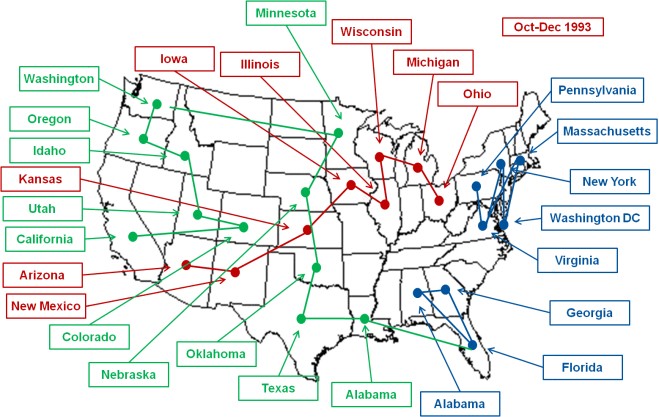
That changes, however. The map becomes almost impossible to follow given how much the band crams into the final months of 1993. This is the most extensive touring Nirvana has done in the U.S. in their entire history. Looking back at past posts, at the maps for 1991, 1990, 1989, there had been big tours before but the scale and coverage achieved this time around was unprecedented. Of course, one thing to point out is that this kinda touring isn’t exactly uncommon for bands — this was the age of multi-year tours taking place, show after show… Nirvana staying out for the best part of three months was long by their standards. Having kicked off in Arizona (red line) the band took the obligatory pop over to Canada between Ohio and the start of the North-East U.S. visitation (blue line, November) and then the criss-crossing of central and western states in December:

1993_Oct-Dec_Shows

1994 was the usual post-Christmas smattering of appearances. On this occasion, however, given the finality of ensuing events, it seems apt that Nirvana should retreat so far into their own past. The map needed to show the band’s U.S. presence in 1994 barely needs to show more than the map for 1987, or 1988—they hop across the borders of Washington State to two locations, they head home, then gone:

1994_Shows


Kurt Cobain and Lyrical Meaning

There’s a late 1993 interview on YouTube in which Kurt Cobain, when asked about the meaning in his lyrics, straight up denies his lyrics have any meaning raising his hand in the air and declaring “swear to God brother…”

If he means, “I don’t intentionally write meaningful stuff” he would still be playing loose with the truth; he admits over and again to songs having a story line or an autobiographical element, he just refuses to do so in a uniform way or without disclaimers. If he means “my songs have no meaning” then he’d be either (take your pick) wrong, lying or willfully self-deceptive. It’s a well known fact that, at least after his early writing visible on Incesticide, Kurt often mashed lyrics together at short notice. Again, however, that wasn’t a uniform writing pattern. There’s no evidence of how long the songs written in late 1990-early 1991 took to write but they were written at home, in private, not in the run up to album recordings or on the spot at rehearsals.

Also, the key point is that ‘meaning’ isn’t automatically entangled in authorial intent. If an artist writes a song and deliberately makes it about a specific topic (i.e., Sweet Child of Mine was written, deliberately, as a wistful love song hence the focus of all the lyrics) then fine, its about that topic but it doesn’t mean that the images used aren’t tied to other ideas in an artist’s work. The other way to void meaning would be to do a William S. Burroughs style cut-up in which all lyrics are found and thrown together from other sources – the author doesn’t write any of them. But even Burroughs arranged those cut ups into narratives and stories that he did, deliberately, construct. Therefore authorial meaning was returned to words that didn’t originally have any.

In the case of Kurt Cobain, the fact that he wrote fast, that he wrote things on the spot, actually brings us closer to interior meaning. Why? Because all the words and images poured onto pages came from his internal world without being warped or corrupted by deliberate intention – these words and images were what spilt out of him.

This is why, when studying Kurt Cobain’s life and works, the same themes occur again and again whether in lyrics, in diary entries, in his suicide note, in the authors he payed homage to or in his art work. He didn’t deliberately set out to write more songs about rape than about heterosexual sex – but that’s what came out when he sat down. He didn’t mean to write numerous songs in which the character is restrained, bound, under control – but that’s what came out.

A good comparison would be to query the meaning of a quality film. The Godfather is a film about the Mafia. Well, yes! True! …But it’s also a film about the bonds of family, about inheritance, the corrupting of good intentions…And on top of that it’s a film displaying Hollywood’s love affair with glamorous violence and crime, its relationships with organised crime (the tale is that the word Mafia is never used because the makers were pressured by associates of local crime families) and also the influence on screen portrayals of crime can have on individuals who have modelled themselves on it since then. Kurt Cobain’s lyrics aren’t Transformers; all surface explosions and no depth. Kurt Cobain’s lyrics bear comparison to detailed cinematic work.

The quest for meaning has given too much credibility to his own statements regarding his ‘meaninglessness’ while simultaneously every Nirvana fan looks at In Utero and can add up countless personal references and links to other songs in the Nirvana catalogue. Its part of the reason I adore Kurt Cobain so much; I think he’s, inadvertently, one of the most psychologically honest artists ever to breach the mainstream world and the linkages and connections between songs written across his entire career are quite stunning to behold.

Flowers of Romance and Bathroom Destruction

Brett (Beautiful Day) commented that Flowers of Romance would have been another good choice to include on the cover shot for the Dark Slivers book – Dan808 replied too pointing out how curious it was that “Cobain picked that as one of his favourite albums rather than PiL’s Metal Box or PiL’s debut.” I can see a connection to a topic I briefly comment on in relation to the song Beans in the Post Mersh chapter of the book.

This is a argumentative theory, not a fact. But Kurt Cobain wanted to include Beans on Bleach – it would have been there if not for others intervening. While reciting the reason for the exclusion, there’s not been much desire to ask ‘why would Kurt Cobain want to include this song?’ I think it’s similar to Axl Rose’s decision to wedge a similar scrap of dubious quality at the end of Use Your Illusion II, My World. In each case, sticking a solo track at the end of your band’s album is a declaration of ownership and authority over the album and therefore the band – everyone else is submerged in the group identity, you aren’t, you’re allowed to show your experiments and stand out as an individual. Flowers of Romance was a difficult album for PiL, until that point the music had been essentially the creation of Keith Levine and Jah Wobble with John Lydon confined to lyrics. On this album, Wobble had left, Levine contributed but was a heroin-induced wreck, so Lydon dominated the music too. To mark it even more thoroughly as HIS property he gave it a title that tied it to a very early Sex Pistols song (a jam track they used to use in various forms to open shows). So, if looked at as the singer’s declaration of independence and dominance, rather than simply as a musical composition, Flowers of Romance seems to be an album that would resonate with Mr. Cobain.

As an aside, the timing of that list of favourite albums is interesting. The final album on it is PJ Harvey’s Dry, released in June 1992. So, the famous list of fifty albums was created either in late 1992 or sometime in 1993. Given Kurt was very much off doing his own thing and divorcing himself from the band (see the piece from earlier this week on trends in press coverage) its a neat coincidence with the concept above – but I do think a coincidence. It’s also a nice coincidence with the whole issue of the bathtub filling with sewage and wrecking his stuff.

Also, I’m interested in the unknowing, the things that can never be truly known. What we do with them is we stitch a narrative over the top of the gap to connect known events and thus cover the absence in between.  I’ve talked a lot on this blog (see Killing Nirvana Pt. 1 and Pt. 2 plus Trending Kurt Cobain’s Creativity) about the nosedive in Nirvana’s activity post-fame. The incident that I took as the inspiration for the cover is of deep significance to that theme.

Kurt Cobain stated that he lost a number of notebooks with all their lyrical ideas. There’s little further comment on the incident in the nearly two years left to run so its impossible to tell how much was lost, how many potential lines or new song ideas went missing in that event. It creates an absence; Kurt Cobain never publically assesses the damage caused or the quantity of work he couldn’t recover. We therefore can’t see whether Kurt wrote more than he appears to have done in the first half of 1992. Its still unlikely there was much (given overall trends, tours, TV, press, marriage, heroin…) but the survival of those journals and notes could have meant a Nirvana that had twenty new songs left in them rather than the dozen or so they do come out with.

Anyways, just to show I’m paying attention to the comments. 🙂

And Dan808 – yes, if you want a copy of the book, drop me at email, NirvanaDarkSlivers@gmail.com and I’ll put you on the pre-order list. No payment needed until I can confirm postage back to you and you decide you’re cool with it. Stay good!

Rape Me

I’m intrigued by ghosts, by what is present through known absence — the building that once was, the house sparrows gone from London skies. Kurt Cobain’s music contains quite a number of haunting presences and Rape Me particularly intrigues me.

The song endured an unusual trajectory in terms of its writing. The solo acoustic is quite a lengthy initial effort (admittedly degenerating into scratch lyrics.) Yet it is almost all stripped away leaving just a skeletal refrain when performed live in June 1991. That form is then retained all the way to its showing in Seattle on September 11, 1992. The ultimate second verse and bridge are then created in the fifty or so days leading up to an October 26, 1992 demo session. It’s very common for Kurt to retain the core of a song and shift the elements around that ‘spine.’ But it’s unusual to find three distinct iterations of a song. While some initially pointed out cosmetic similarities to suggest Rape Me was a response to Smells Like Teen Spirit, it was mainly reinterpreted as the female rape victim in Polly’s internal fury toward her attacker.

I’d first point to the fact that the time of the rewrite makes this song not an assault on the discomfort of fame as felt in late-1991/early-1992 but a comment on betrayal and external judgment which was his situation right then-and-there in late 1992. But then what I’d suggest is that, rather than Polly or Smells Like Teen Spirit, the real family ties for this song lie elsewhere in Kurt Cobain’s catalogue.

In its solo acoustic rendition, Rape Me’s true lineage stretches back through Even in His Youth, all the way to Laminated Effect on the Fecal Matter demo. In Laminated Effect, the first verse dwells on a key character who, “raped by his daddy” ends up dying of AIDS with the song ending with the refrain of “made not born” to suggest that his fate was the creation of the father. Rape Me begins not as an anti-rape song but as a song in which the father rapes his son. In the case of the former, the very next line is “told he was at fault” while, in Rape Me, the next line’s motif is “my embarrassment.” It’s an intriguing combination that it’s the victim not the perpetrator who is left with the guilt and negativity. It’s a connection he made again in Floyd the Barber with the raped victim responding with the chorus “I was shaved, I was shamed.”

Even in his Youth is overtly and knowingly bonded to Laminated Effect by the insertion of the line “kept his body clean” taken wholesale from the latter song. This ties the disappointing and shameful son in Even in his Youth directly to the unsympathetically treated and ultimately doomed son in Laminated Effect. While lacking the rape motif of Rape Me and Laminated Effect the crucial connection is the association of the father in all three cases with the main character’s guilt and shouldering of the responsibility for perceived failings.

The first ghost of this song lived within Kurt; in his retention of the memory of what this song’s inspiration and scenario had initially been, even long after all visible male-on-male rape motifs were erased. This can be seen in the way his Journals propose two video treatments for the song; one dwelling on the forced feminization of men in prison; the second in which a man takes on the female role and is examined in stirrups in a gynecologists’ office. Whenever these entries were written (late 1993?) it’s still about the feminization and abuse of a man, not a woman. He reinforced this once again by using the image of a seahorse on the cover of the single specifically because with seahorses it’s the father who rears the young.

So, the song morphed from a song about incestuous rape of a male child, into an anonymous refrain, into the ultimate version in which the refrain was harnessed to a commentary on the media’s treatment of his family. This same bonding of past family and present family seems to have haunted Kurt given it’s precisely the same sandwich he made on Serve the Servants.

On the October 26, 1992 demo of Rape Me it was creepy that Kurt should insist on inserting the cries of his two month old child into a song with this theme. Yet — as with the image of the male seahorse that rears the baby, as with the refrain “made not born”, as with the son accepting that his father’s shame was the son’s own fault — there’s a genuine point to it. The image of the seahorse fulfills a deeper purpose in that it is there not just as an inversion of roles but also because it shows the father influencing the fate of a child at the earliest phase of existence.

This was a song about family and specifically about what a father bequeaths genetically to his child — the guilt and self-critical negativity is the crux of the issue, not the rape itself. In the initial demo of Rape Me and in Laminated Effect what takes place is not a literal rape, it’s the father imposing, against the child’s will, a fate and an identity upon them via the sex act that created them. The line about “our favourite inside source” therefore possesses a double-meaning; the supposed traitor in the Cobain camp in late 1992 but also the internal source of his inspiration. Again, it’s the same trick as used in Serve the Servants where “that legendary divorce”, despite its sarcastic phrasing, is indeed a crucial event for Kurt — the fact he’s fed up of hearing it doesn’t erase its importance. The wry line about the “inside source” refers back to whatever it is that his father has placed within him that makes him who he is.

In each case, and in Even in his Youth, the child’s negative feelings about himself leads within the lyrics to a line holding destruction as the son’s ultimate destiny. The end result of the father’s presence in each song is that the son has no alternative fate other than the release of death. Placing Frances Bean Cobain in a rendition of Rape Me wasn’t just about being ghoulish; it was symbolic of the relationship between a father and their child. It was a statement of Kurt’s fear of what bad things he had willed to his baby made by placing his child inside a song originally about being raped by his father.

These are the ghosts within Rape Me. The first is Kurt Cobain the enraged husband railing against the media. The second is Kurt Cobain, the shameful and un-masculine son. The third is his father, the source of Kurt’s feelings of inadequacy. The fourth is Kurt Cobain, the fearful parent unsure of his influence on the child. Emphasize this by rereading his suicide note and the context in which he refers to the potential for his child to follow him and to become him.

 Thank you. Now, if someone could pass me a torch? I just crawled up my own ass and it’d take a lot of work to clamber back out of here in the dark.

Trends Continued.

Reinforcing yesterday’s post, let’s consider the circumstances in which the new songs on In Utero were created. There were few practices in 1992, very few live concerts (just sixteen shows after the Asia tour concluded in February, even altogether it was still Nirvana’s quietest year since 1988.) The October 25-26, 1992 demo session resulted in recordings of five of the pre-Nevermind songs that ended up on In Utero plus one new song (Frances Farmer Will Have Her Revenge on Seattle which had also been attempted at a session in April.) It seems likely that the disrupted nature of the October session meant only this number of songs could be demo’ed. All Apologies and Heart Shaped Box were certainly already in existence.

The January Rio de Janeiro session, again, seems to indicate a stuttering, halting machine. The Other Improv and Gallons of Rubbing Alcohol Flow Through the Strip are little more than scratch lyrics over meandering on-the-spot tunes (not a comment on how fun they are to listen to.) M.V. has barely twenty-five words and is little more than a doodle. I Hate Myself and I Want to Die has a sketchy demo feel. It leaves a feeling that they’re jamming these songs together on the spot rather than any deeper or more extensive process of creation taking place.

From February Nirvana is basically all over. One more song has so far emerged, You Know You’re Right plus the charming solo scrap Do Re Mi. There was always a lull after an album release (it happened in early 1989 and again in late 1991) but twice in a row now the lulls lasted at least a year. It doesn’t suggest a band that wants to spend time together, creating together. It feels rushed, like they’re getting back to their real lives after a brief distraction.