Overdue Musings on the Nirvana “E-Coli” Leak and Others

https://www.youtube.com/watch?v=CYkmppiNdN4

Sure, if you’re a Nirvana fan then you’ll have caught this over the last few weeks. A nine minute long jam referred to as “E-Coli” leaked. I’ve been taking my time over this one, trying to soak it in and enjoy it gradually rather than rattling off something vast.

First though, did you catch the “Big Cheese” alternative take? Beautiful. It’s not particularly common to come across alternative takes of earlier Nirvana songs simply because the band didn’t have the cash to spend endless time in studio revising and tweaking. The take is from the Love Buzz/Big Cheese single sessions in mid-1988, it’s completely different to the first live version of Big Cheese from just a few months earlier, much closer to the final single version but retaining all sorts of curiosities and diversions. The structure isn’t quite as stripped down and simplified; the vocals incorporate all sorts of barks and wails (including one point which compares neatly to the squeal he makes on Blandest.) It reminds one that Cobain, in mid-1988, was only just coming out of a spell of writing the relatively twisted songs that had featured at the January 1988 session, that “Big Cheese” was one of the first songs to emerge after that spell and still – at first – was quite a rambling piece. The squealing and random vocal effects hark all the way back to what he did on Fecal Matter, to the helium-voice intro to “Beans”, to his apparent liking for the weirdo fringe of the Eighties’ punk scene like Butthole Surfers. This is a song in transition between the oddball side of his music and the slimmed down music he’d pour out on “Bleach” where the weirdness was confined mainly to his lyrics rather than to the muscular grunge tunes.

A slightly clearer version of “Do Re Mi” came out too, nothing much added or taken away – just nice to have a reason to listen to this great little song again in detail. Reviewing these outtakes always means I’m listening to a heightened degree but here it’s all pretty familiar and it – once again – stokes my curiosity regarding his decision to sing in this affected pitch. It has me looking back to the recent “Pennyroyal Tea” leak which was good evidence of Cobain’s love of making music, his desire to try things different ways until he had what he felt was best. Perhaps we’d have ended up with a “Do Re Mi” that sounded just like this, perhaps we’d have seen a more naturally toned version, perhaps there still are other experiments out there because it sounds too well-developed and too well-done for Cobain to have decided to attempt a falsetto in the moment. Ah, possibilities…

As for “E-Coli”, it’s a lurching song that sounds heavily improvised, very loosely structured at this point in time. It’s akin to some of Nirvana’s more jammed together tracks from around the time of Rio de Janeiro. The repetition of the central riff to such a heavy degree gives it a similarity to Scentless Apprentice and makes me think it’s very early stage – Cobain wasn’t much of one for mantra-like repetition for more than a curtailed four minutes. I was surprised when the tracks leaked earlier in August that “Gallons of Rubbing Alcohol…” so clearly had a second guitar track added to something that sounded so off-the-cuff. Same here, I keep feeling there’s a second guitar at work but, again, the backing guitar sounds fairly unconsidered – more a noise-making element than a counter-rhythm or melody. Cobain’s voice sounds beat-up which, again, makes me feel this is a late 1992 rehearsal or a January in Brazil piece. Cobain does his “I have no lyrics yet” wailing and ad-libbing effort which I always rather enjoy even if it does show this is something early stage at best. I’ve been trying to think if it’s comparable to the improvisation Nirvana perform on the radio in Holland years earlier – this sounds more like a work up of potential song ideas than that piece though, that had a uniformity and a one note approach that really didn’t make it look like a song.

Not Nirvana: The Most Important Book I’ve Read in Years

I just closed Nick Davies’ “Hack Attack.” If you’re in the U.S. the Kindle edition is $9, the hardback is out at $16. In the U.K., the book is on ‘buy one get one half price’ at Waterstones or is £7.49 on Amazon. It’s money very well spent.

It’s the account of the ten year battle to finally bring to light the role of Rupert Murdoch’s News International organisation in using illegal means to acquire information; the way the organisation deliberately attacked individuals and their families if an individual dared to protest their behaviour; how News International created a climate in which neither police, regulators nor politicians dared tackle their corruption because the consequences would be massive assaults and vilification by a news organisation that owned a vast percentage of news coverage online, on paper and on TV in the U.K. and internationally. It’s about how that organisation explicitly and knowingly lied over the course of a decade to the police, to the regulator, to the courts, to all the democratically elected representatives of the British people. Andy Coulson even sees fit to lie directly to the Prime Minister’s face for months on end.

Here are a few numbers. In the court trials that took place over the last few years, the representatives of our democracy, the Crown Prosecution Service, were able to muster £1.7 million, one full time solicitor and one administrative assistant to make the case. News International spent £30-40 million aggressively defending its representatives and deployed an army of legal representatives and support staff. Why does it matter? It’s an example of what happens when greater powers are invested in private corporations than in our public services. The corporation is able to devastate any attempt to make them take responsibility for the harm they’ve done to the public good. The government that the people have elected to represent, as best as possible, their collective interests and to protect them from harm is no longer able to wield true power in the face of the buying power possessed by the corporations. There is nothing defending the lives and well-being of the public; we are all at risk.

It goes deeper. News International is an organisation that recognises that governments are the only bodies able to exercise any control over their behaviour. Therefore News International deliberately advocates the shrinking of governments, the reduction of their revenue, the weakening of their regulatory powers, the most stringent controls over their spending. News International does so in order to ensure that it possesses a competitive advantage over the only organisation able to exercise any restraint upon their corruption. It attacks tax levels, attacks public service in general, in order to reduce the expertise and skills available to the judiciary, to the police force, to the tax authorities, to all levels of our political establishment making it less likely wrong-doing will be detected, prevented or punished.

The hacking scandal was not a case of a few celebrities getting their fingers burned. Of the hackers exposed after all those years, one had hacked a minimum of 5,500 people, another had hacked a further 1,600. Those people included the family and friends of a couple who’s child was abducted. It included the family and friends of a murdered school girl – the newspaper’s representatives went further and didn’t hand over evidence that at the time they believed indicated where the girl was, they wanted to claim credit themselves and to sell more papers so didn’t give it to the police. News International went after the family and friends of two girls murdered in the town of Soham. In other words, if you, your family, your parents, your children, your friends – anyone you know – gets caught up in a tragedy, all their conversations and information (medical records, police records, bank records, employment records, diaries, etc.) and yours too would immediately have become something News International stole and used to make profit for their company.

News International destroyed 210 million emails during the course of the investigations. The leaders within the police service who led the early investigations were being wined and dined by, and were friends with, the people they were meant to investigate – the police deliberately misled parliament, the public, the courts and the inquiries. The Press Complaints Commission which was meant to ensure that newspapers respected the laws of this country saw its role as being to deflect criticism away from its richest benefactors and was too scared to speak out against them because it would mean News International (the Sun, the Times, the News of the World, Sky News) would send teams out to attack and slur them. The governments, both Labour and Conservative, were too busy trying to ensure good coverage and to avoid attempts to undermine them with sleaze stories, critical coverage and attacks that they were unwilling to speak out and decided instead to give jobs to people who had broken the law, to attend their parties, call them friends, privilege their views. News International was allowed to tell your government and my government what their policies should be. Surely that’s meant to be the right of the people?

At root, in amidst the sheer scale of it all, there’s a simpler story of bullies and damaged people who gain satisfaction from the exercise of power over ‘the little people’; it’s a tale of people who grew up as we all did on the bible tales of doing unto others as you would have done unto yourself…Then abandoned that in favour of personal profit over any moral consideration. Rebekah Brooks, having acquired information indicating that people she called friends, Sarah and Gordon Brown, had just learnt their six month old baby had cystic fibrosis – an incurable condition that would lead to life-long health problems and a life expectancy of between 37 and 50 years – called them and reduced them to tears by refusing to allow them time to reveal the information themselves because Mrs Brooks wanted to sell newspapers by using their pain as an exclusive front page story.

It’s an amazing book. Well written, lengthy but with so many moments of stunning revelation that you’ll barely be able to close your mouth at times for sheer fury. I found myself punching the air through sheer frustration as the suit-wearing white-collar criminals slipped through the net (while setting themselves up as judge and jury over everyone else.) Amazing. Nick Davies’ “Hack Attack”. An amazing book and I’d like to bow respectfully to the author for what sounds like a harrowing experience over more than a decade.

So…I Went to See Brett Morgen’s Montage of Heck and…

…And I think you should too.

No, really. I can say, hand on heart, Montage of Heck is the best film about Kurt Cobain and the Nirvana phenomenon ever released. I did a quick sketch a month back summarizing other films on the topic and it’s safe to say there’s nothing like this out there (https://nirvana-legacy.com/2015/02/18/nirvana-and-kurt-cobain-on-film/). There’s a strong echo of Live! Tonight! Sold Out! in the editing style that doesn’t seem accidental and I hope that sounds like a fair compliment; it looks like a video work Cobain himself helped put together. Gosh.

At the ICA in London the viewing was shown ‘at the director’s desired volume’ which made a real difference – I don’t think I’ve ever heard Nirvana material sound so good. The sheer intensity of the sound, often tipping right over into a whine of white noise, made the live footage feel as close as I can imagine is possible to being there. There’s a relentlessness about the sonic layer of the film, long sections clamp down on your hearing and won’t let go, whole spittle-flecked mad dog raging going on – then suddenly a sharp cut, or a switch to a single voice, numerous moments where the near silence becomes equally hard-edged and intriguing. Again, that surge and mute approach seems very ‘Nirvana’ – a fair indication of the deep attentiveness paid to all aspects of this film.

The talking heads aspect of the film is actually kept exceedingly brief – the conversations with Don Cobain, Kim Cobain, Wendy O’Connor, Krist Novoselic, Tracy Marander, Courtney Love are a way to add emphasis to key points, to flesh out various topics. I enjoyed listening to Jenny Cobain – she was a down-to-earth lady and I felt nothing but sympathy for the description she gave of this increasingly unruly (and even cruel) teenager. Don Cobain came across as a quiet man, at one point he seems to have tears in his eyes, but he can’t get words out – again, I can understand why he might be a difficult person to maintain a bond with. I was slightly creeped out noticing how similar Cobain’s mother and ex-wife look these days. Comments about the absence of Dave Grohl and so forth don’t really get the point – this isn’t an interview centred film. Most people are stripped down to a bare few sentences, each well-chosen. It means the words do stick in the mind. Wendy describing watching her son come home looking ever more destroyed by heroin was desperately sad. Novoselic’s emphasis and re-emphasis of how much Cobain hated being humiliated is a very powerfully made point.

There’s tight interweaving of key themes. Novoselic’s point about humiliation is then returned to in Love’s description of Cobain’s reaction to her ‘thinking about’ cheating on him, which in turn harks back to Cobain’s audio tape recounting an early sexual humiliation, which links to the present issues around masculinity and physicality that run through the tale. The family ‘issue’ is obviously core – it’s funny seeing the early footage of a Cobain family Christmas circa 1970 echoed in the Cobain family Christmas circa 1993. Each one positioned just before a collapse, a disaster. There’s a lot of skill involved in having a film appear to barrel along at this seemingly unhinged velocity while discreetly creating these connections.

It’s great how much of the ‘Nirvana story’ is let pass by-the-by. The big milestones are logged via imagery rather than dwelt on with wordy exposition – the film allows existing biographies (and the endless churn of articles year-after-year) fill that role while it focuses on showing Cobain himself changing and reacting. I’ve seen comments stating that x or y isn’t mentioned and should be – I didn’t notice. Tobi Vail maybe is the biggest absence but there’s so much of more interest going on that losing an on-off girlfriend from the mix didn’t strike me as a crucial or noteworthy flaw. Of far more interest was the film’s see-saw with Cobain’s family life and upbringing at one end of the movie – and Cobain’s family life and bringing up of his daughter at the other. While the stuff about Cobain’s childhood doesn’t add anything fresh to what is already known, the material focused on Frances Bean Cobain, Courtney Love and Kurt Cobain as a family unit is genuinely interesting because it’s perhaps the most detailed portrayal of that aspect of Cobain’s life ever seen. I’m not gooey about love and kids and so forth but there is something very sweet watching this young couple playing with one another, then watching them with their daughter too. I found it heart-warming and rather than feeling voyeuristic it stirred empathy and affection. Kudos! Like it! Watching Kurt, in bizarre drag, mimicking a letter Courtney reads out is both bizarre and funny – it’s also an indication of how connected the two seem to be, Cobain’s miming seems perfectly timed, Courtney’s words, his mouth. There are also plenty of moments where the physical similarity between the two is obvious, they’re very much alike.

The film certainly packs a punch the way watching any destructive path can be expected to. I did watch intently for the entire duration. The whirl of live footage, home movies, animations, cartoons, press interviews, studio footage, words on screen kept the accelerator pressed firmly to the floor. Notes of disquiet the film raised for me were that it quietly makes a very strong case for Cobain as poster-boy for mental health issues – the imagery taken from his artworks is almost entirely unpleasant, bloody, gynecological. Sure, most teens have a dark phase as they begin to expand their worldview and incorporate not just the fairy tales of youth but also the harsher sides of reality, but Cobain’s seems to extend throughout his rather short life. The well-known tale of his failure to sleep with a girl is disturbing not for the intertwining of suicide plans and sex, nor for the squeamish details of the girl’s unpleasant scent, but for the very fact that he took the time to perform the tale to tape – what for? Why? This endless self-documentation feels uncomfortable in itself. The early discussion of childhood hyperactivity and medication puts this theme front and centre, as does discussion of stomach issues and let alone the new theory raised about the reasons for Cobain’s suicide which – if true – does make him look manic. A few weeks ago I watched “Night Will Fall”, documentary film footage of the concentration camps (well worth a watch incidentally) and was shocked by the conjunction of images of skin-bone bodies being poured into pits then suddenly people walking or being held up, somehow still alive despite the seeming absence of any content to their emaciated bodies. There’s something brutal about the human body and in this film Cobain spends a lot of time half-naked and just looks so tiny. Beyond all the discussion – the statement from his diary claiming that he’d tried heroin ten times between 1987 and 1990 was a big addition to understanding of his use of chemicals (it looks unlikely that there’s a year from age 15 onward where he’s not on something frankly) – I felt the sight of his body made a silent case for there being something very wrong.

Wendy O’Connor’s sniping at Don Cobain – a man she hasn’t been married to in over three decades – did a neat job of undermining the ‘loving mum’ image, it’s probably the moment in which the problems in Cobain’s childhood stand out moststarkly; if this is the kind of spite and bile this lady can summon at this far remove, decades after the end of their marriage, it suggests the atmosphere in the house at the time must have been toxic. It made me feel infinite sympathy for Don Cobain who has received such harsh reviews from his son and others yet comes across more as chronically ill-equipped to deal with emotion rather than harsh or unpleasant. Already seen in the trailer, Wendy tells a tale of Cobain visiting in the autumn of 1991 and playing her a pre-release tape of “Nevermind” to which Wendy responds by warning Cobain that it’s going to make him a star (“better buckle up kid because you are not ready for this.”) I admit it still just didn’t ring true for me – one listen to “Nevermind” and his mum had the foresight to see he was about to become a runaway success…? I mean, fine, but Cobain himself still looked surprised and disarmed for the next few months after this supposed warning, it’s never mentioned by him in any interview, lots of people hearing that pre-release tape thought it was going to do well but I can’t recall anyone listening to it and thinking this was the next global smash in the making. It was clearly too good a story not to include but it’s one of the few moments where my immediate reaction inside the auditorium was to feel doubt about the honesty of what I was hearing.

I don’t have any time whatsoever for the murder theories that have circulated around Cobain/Love and seeing the couple together in this welter of home footage simply emphasised the unlikeliness of anything of that nature – yet, I’m not convinced of the new “Kurt felt I’d betrayed him just by thinking of cheating on him” tale. I mean, another one? Another tale…? I think I’m a bit jaded and fed up of fresh explanations. On the one hand, Love comes across as an intense being and it’s an intense topic she’s discussing so I can understand the bundle of hand activity she goes through when discussing it (cigarettes, water bottles, waves, etc.), on the other, not a clue what to make the tale. As a similar aside, Morgen has reiterated again and again that Love had no say in what went in the film – I certainly believe this is all his work but I have trouble believing any director would put this much footage of Courtney Love’s breasts on screen without any permission or sign-off of any sort. Frankly I can’t believe he’d leave himself that open to a lawsuit by not having worked out a very solid contract backing up what he could/couldn’t do with all this material prior to commencing the film. I really did get tired of seeing Courtney’s breasts by the way. This is not a sexy film though Cobain’s still photos of Courtney naked surrounded by flowers were remarkably beautiful.

Now…Do I have any criticisms? Well, yeah, I do. I’ll reemphasise that it is the finest film about Kurt Cobain and Nirvana ever made – it’s probably the only film I’d say is essential to the canon. Having said that, however, it isn’t “Senna.” The latter movie did an awesome job of bringing one closer to a genuinely likable individual, teased out the various threads of his being and life, had real zip to it, speed, momentum, fast motion. So a first difficulty here is that watching Cobain doesn’t make one ‘like’ Cobain particularly – he doesn’t come across as a particularly sympathetic character. In many ways its fascinating watching this much intimate and personal material yet feeling he’s still a closed book – the similarity between him and his father in this regard stood out for me. I think it’s a consequence of seeing someone who can talk about actions (“I planned to kill myself…I invited myself over to her house…I was grossed out so I left…”) but quite clearly has so much difficulty openly stating his feelings. There’s an intriguing match in the way that Jenny Cobain seems to do the talking for Don – then later there’s the sequence I mentioned where Courtney Love speaks for Kurt Cobain (which in itself points toward the way Courtney Love often spoke for Cobain in interviews and so forth.)

There are funny moments in the film, good lines, plus he’s a natural at playing with his baby – but, again, those moments where he comes across as amusing and quick-witted and self-depreciating are outweighed by the gory cartoons, the vicious one-liners, the harsh writing. The footage from MTV Unplugged toward the end is enjoyable and brings something new to this mix because he seems at ease and the wise-cracks are actually funny. This film doesn’t make the case for Cobain as a fun person to be around, it doesn’t focus much on him as someone concerned about supporting a wider musical community or particular social or political causes, it doesn’t show him as a friendly person…It’s not easy to warm to someone who is both distant and seemingly so self-centred.

“Senna” was also – by contrast – cut to the bone, whippet-fit. Morgen’s fandom is clear in that it seems he’s had great difficulty cutting things out. The film is overlong and it is over full – I’m a Nirvana fanatic and I still felt restless at points. The technique was usually to spend time advancing the plot, then suddenly there’d be a five-to-ten minute ‘drum solo’ in which imagery and sound was slung at the audience. It really was like watching a band suddenly derail a song with elongated solos. Once, maybe, a few times over the full span of the film, cool…But this was constant and began to feel more like a way to cram more clips in rather than a way to illustrate or expand on a theme or key point. If the film wanted to be less plot-orientated and more impressionistic then cool, that’s fine, but it’d still need to be a chunk shorter in that case. On that same point, just removing the over-familiar live footage, the pieces cribbed from Live! Tonight! Sold Out!, the well-known interview footage would have left a far more fighting-fit result. If the film is aimed at Nirvana novices then I’d understand the overload of totally non-exclusive material but not the way it assumes so much pre-knowledge on the part of the viewer. If the film is aimed at Nirvana fanatics then I’d understand the assumption of pre-knowledge but not the overload of well-known material. This isn’t a ‘huge’ criticism by the way, I just think it’d be a more effective film if it was shorter and if it was clearer in its intent; rare material junkies or novices?

Another point would be that I’m not sure I learnt anything particularly new. That’s fair enough really; the tale is well-known, well documented. Barring that realisation that I’d never seen such a good case made for Cobain as loving family man and talented child amuser – there’s nothing else that didn’t stick close to “Come as You Are”/”Heavier Than Heaven”. There was no revelation. Did I feel ‘closer to the real person’? Yep, in the sense that I thought “wow, so young…Wow, so thin…Wow, so fucked up…” at several points. Ultimately I think it’s a true and honest portrayal of the real person; sometimes funny, sometimes loving, sometimes intensely focused, sometimes vicious, sometimes defensive. Cool, all good. Again, this is a very minor criticism. I did like the way comment was made on the Vanity Fair piece and on the derailment of that Nirvana book in 1992 in a way that didn’t get stuck into who was right or wrong in each case. Not shying away from the worst sides of Cobain was an honest move. Watching the home movie footage in “Montage of Heck” ultimately made me think that I’m not surprised people told Lynn Hirschberg that there was something really grim about the way the Cobain couple were living – and it’s long since been shown that most of what she stated in the article was basically true with slight tweaks needed to dates and times. Fans have long debated the extent and depth of Cobain’s heroin addiction and I think “Montage of Heck” does leave little room for doubt that while Cobain’s addiction flexed and varied it was a pretty solid presence – almost everything in this film post-1991 looks a touch sordid even before Cobain seems to nod out during his child’s first haircut.

I’d been trying to consider what the film might look like to a non-Nirvana fan – could it be watched just casually? Could it be watched and enjoyed by a fan of documentaries in general rather than of this topic in particular? The answer is yes, it’s a good primer on the subject of Kurt Cobain and it’s worth a look…But I can’t imagine it being held up as a masterclass of documentary film making simply because of that excessive length, the flabbiness, the overuse of what are innovative techniques once, twice, even three times but not as often as here. There’s too much about it that wouldn’t be of interest if one wasn’t a fan – but it should deservedly receive a wide-viewing on its TV debut next month. It’ll reignite both the “Kurt was so beautiful”  and the “I don’t wanna support a junkie scumbag” viewpoints – both have ample support herein. I can’t imagine there’ll be many converts outside of the next generation of teenage angst-ers looking for an idol who looks and sounds like an angry seventeen year old throughout the entire film. I’m also delighted that the film didn’t go down the posthumous deification angle; that Tupac: Resurrection film was gross in how one-sided and ‘touched up’ its portrayal of the subject was. “Montage of Heck” most definitely does not make Cobain look glamorous, charming or delightful. It does make him look very damaged.

So there we have it. A solid piece of work, some beautifully imaginative directorial touches, a few shards of new Cobain music, a great insight into the life and times of the last rock icon, a more human portrayal than has yet been managed. On the other hand, I can see what the Guardian meant now when its critic Peter Bradshaw said he wanted to learn more about the music. I was hoping to see more about Kurt Cobain as artist and creative but instead – beyond emphasising that he worked hard and did an awful lot of drawing, writing and playing music – that whole area felt like a sidebar to its core concern which was to show Kurt Cobain reacting to family pre-Nirvana and to family-post-fame. Fine! It’s a good piece of work. Kudos Mr Morgen.

Nirvana’s Sudden Rise: September 1991 – November 1991

In an interview for European broadcaster VPRO in late November 1991, Dave Grohl and Krist Novoselic explained:

Chris Novoselic (Krist): Yeah, I haven’t really come to grips with it yet. We’ve been in Europe ever since everything’s happened.

Dave Grohl: We haven’t been back to America since this whole thing’s blown up, so we really don’t know how insane it is over there yet.

In some ways these are odd statements. Nirvana returned to the U.S. in early September, were touring from the middle of that month right the way through to their homecoming show at the Paramount Theatre in Seattle on Thursday, October 31. The interview on Monday, November 25 in Amsterdam took place just over three weeks later. Had so much changed in just three weeks…?

The indications are that they did. “Smells Like Teen Spirit” had been on the radio since August 27 – the band acknowledged it was getting a good reaction, that it was popular, that it was doing well. That wasn’t the same, however, as ubiquitous domination of the airwaves. The release of “Nevermind” followed early in the brief September tour but, again, it was doing better than expectation but it wasn’t – yet – crushing all before it. ‘Lift off’ was finally achieved with the video premier on September 29 on MTV’s 120 Minutes and its move to the Buzz Bin on MTV in the first week of October. That left barely three weeks for Grohl, Novoselic and Cobain to detect what was occurring before they departed the country once more.

What they could see happening was limited. The shows were all booked in larger club venues but still just clubs – all sell-outs, all crazy, but not packed stadium level attendances. From the stage there’d be no way of seeing that the band’s power had shifted in between the shows playing support to Dinosaur Jr back in June, through the larger European shows with Sonic Youth in August, now their own headlining shows in October.

In terms of press attention, likewise, there was certainly more of it – September/October was the heaviest attention Nirvana had ever seen with some 25 interviews (judged by the LiveNirvana Interview Archive) across those two months in the U.S. They were, of course, being invited on TV consistently for the first time (though these were not their first interview with a TV camera present) so the nature of the attention had also changed but while ratcheting up, it wasn’t yet madness. Europe, by contrast, sees 39 interviews in a little over a single four week period in November – sometimes 4-5 interviews in a single day.

Translating that increased attention into sales and star-level popularity…That’s another step altogether. The record label shipped a quantity of albums to retailers – they didn’t know what had happened until sales figures were returned to them so September sales wouldn’t be accurately reflected until well into October (at least.) This wasn’t an instantaneous process – information took time to flow in and to be recorded officially. So, increased attention and sell-out shows demonstrated to the band that they were doing well – but didn’t give them the total vision of what was happening. The media engagements were a means to an end – a necessary evil which Nirvana would increasingly lament from the end of the year onward, Cobain was already starting to turn down interviews by the time they left Europe. The interviews of September/October were mainly only visible as magazine covers and TV broadcasts in November – there was a delay in the band’s actions becoming omnipresent imagery.

“Nevermind” was certified Gold and Platinum by the Recording Industry Association of America on Nov 27. The expectation that the album might achieved 200,000 in sales had been vastly exceeded in just ten weeks from Sept 23. The band’s awareness of this velocity consisted of their management telling them backstage before or after shows what new milestone had been reached. What does one say except “hey, cool…”? Nirvana, however, still needed to pay back their $287,000 advance to the record company before they would see royalties from those sales (See ‘Ownership of Nirvana’ post from 2013: https://nirvana-legacy.com/2013/01/11/ownership-of-nirvana-part-one/). That meant they were seeing performance revenue but it would be quite some time after before they saw royalties for record sales. The shows, at that point in time, were not increasing in size compared to months earlier – the spaces might be full but that didn’t mean vast new wealth reflecting their status, all it meant was more people failing to get in – it would be the Asia/Pacific tour of 1992 before venues were consistently scaled up to accommodate numbers in the many thousands.

The final issue is ‘momentum’. Hearing the album was meeting expectations in early October, hearing it was exceeding expectations by mid-October, hearing it was five times what the label and management had expected by late October…Nirvana’s limited visibility of the velocity of what was happening went hand-in-hand with being unable to see when it might subside. What distinguished “Nevermind” was that it continued to sell right the way through the next two years – 3 x multiplatinum by February 1992, 4 x multiplatinum by June 1992, 5 x multiplatinum by November 1993. That’s the difference between a satisfying, but temporary success versus an enduring triumph. Each week, throughout October and November, everyone was waiting for the other shoe to drop and it never did.

Thus, I hope it’s clear why shell-shocked members of Nirvana might sit in an interview in late November with no idea what awaited them in the U.S. or what had truly occurred in their absence. They had been on the road and hadn’t seen the racks of magazine covers, hadn’t heard or seen the permanent rotation on U.S. radio or MTV, they had only a limited awareness of crowds wanting Nirvana tickets and unable to get them, and they certainly weren’t rich men just yet.

Why am I thinking of that this week? Well, people – very reasonably – ask me how “I Found My Friends” is going…Answer? I’ve no idea. Via Amazon I can access the Nielsen ratings which currently state ‘zero copies’ under the SOLD category. Meanwhile Amazon’s sales ranking shows this table:

Picture3

Which is actually just a record of a book compared to other books – the book might only sell 20 copies a day but would move up the rankings if other books suddenly sold fewer than 20 or down the rankings if other books sold more than 20. Since March 24 it’s been ranked 20,000 – 60,000 – 5,000 – 15,000 and everywhere in-between. There’s no actual knowledge to be drawn from it.

Similarly, so far, media attention has – to a large extent – been non-spontaneous. That’s starting to change; 4-5 organisations have been in touch of their own accord, without prompting from me or the publisher, asking for review copies or interviews. That’s nice to see. Likewise, it’s tricky comparing activity to what might then occur; I’ve been on a couple of U.S. student radio stations, plus written two pieces for U.S. newspapers, seen the press release go up in a number of places…All of which is bloody good fun actually! But I’ve no idea whether it means the book is doing well or not. Likewise, books and music releases mainly do well in the moment – the massive triumphs have that momentum we spoke of earlier. I’ve no idea what momentum the book might have.

The main thing, ultimately, is I’m waiting to see what reviews say. I’m intrigued – I’m a grown man (nearly!) and can cope with measured criticism, all good. So far, it’s all been pretty positive, which is pleasing and I’m delighted that – so far – people who took part in the book are pleased with it…But I want to know more; are they happy? Are Nirvana fans like the crew at LiveNirvana chuffed with it? What do random Amazon users say? Will the magazine/newspaper reviews continue to be friendly…? I’m curious…How could I not be intrigued…? It’s a fun journey and its only week one. 😉

A Blog Post About the Quest for Bands who Supported/Were Supported By Nirvana 1987-1994

On writing and Nirvana

I was invited by Isabel Atherton, my dear agent and all-round quality soul, to contribute a blog post to her site…I had an inkling very swiftly of what I wanted to say…Then late night, in amid preparing something else, I kept scribbling away and the result was what I hope is an overdue thank you to the bands and individuals who took part in the book…

Courtney Love to Sue over Fake Nirvana Song

http://consequenceofsound.net/2015/03/courtney-love-suing-person-behind-this-fake-nirvana-song-called-flaccid-bone/

Immediate respect to Mr. John Jung for passing this on to me – how fascinating. If the individual who started this whole sorry tale wanted attention they’ve certainly got it. Incidentally, to focus on more positive issues worthy of attention, do check the Facebook pages for Monkeywrench and Bloodloss, two early Mark Arm bands – John supports both pages.

First things first, it’s very visibly a fake. If this was a Nirvana cut then it’d be near incredible for it to be so fully formed yet not to arise in the comprehensive record of Nirvana studio work. Similarly, a full Nirvana cut in this type of quality that wasn’t recorded in studio? Near impossible on the technology of the time – this isn’t a pre-digital or early-digital effort. if you wanted to dissect it further then instrumentally there are plenty of points where the ‘squareness’ of the backing doesn’t match Nirvana’s more fluid style – that’s even before one gets to the voice. The treatments applied in an attempt to make it sound more like Cobain, or at least to veil it, are pretty ineffective – it just isn’t Cobain.

Second things, do I believe there really is going to be a legal action? Not really. I feel it’s more like a ‘cease and desist’ situation. There is a valid claim that the back story the person has constructed involving thieving from Courtney Love, involving hacking into supposedly digitized archives, is pretty fair reason for a mild bit of legal action – they’re using Courtney as a source of legitimacy to try and back up the credibility of their fake. I think it’s a warning shot – but I’m also sure locating the individual concerned isn’t a difficult business. One view might be “why is Courtney bothering if it isn’t real?” I think it isn’t unreasonable for her to be pretty annoyed by the individual concerned and the way they’ve formulated things – I can also imagine that having been recently involved in the premieres of “Montage of Heck” perhaps issues involving Kurt Cobain are sensitive right now? But I’m speculating. I see no reason why the threat of legal action should make anyone doubt that this is a fake song.

A shame in a way, there’s clearly a talented musician or group of musicians at work behind the smokescreen. And I don’t mind fakes really – it keeps collectors on their toes, is an irritant at best, an understandable attempt to get a rise out of people…And sometimes, just sometimes, I can see why people would want to test themselves against the individuals they see as the finest examples of their art. On the other hand, however, it does soak up the time and the minds of people who put a lot into sourcing lost Nirvana material, it is a bit tiresome hearing another awful impersonation – the joke gets old pretty quick. I mainly shrug and feel a little bit sorry for people – it isn’t worth being annoyed about.

In the meantime, yep, guess you may have noticed, the team at my publisher for “I Found My Friends” arranged for the final chapter to be provided to SPIN and ESQUIRE magazine on Friday. I confess it was a nice surprise – I didn’t know about either, I only found out when people sent me the links. Naturally I blush that there’s a lazy factual error (Daniel or Calvin Johnson? Oops…) that came about when I was rushing during the post-completion editing process – I think I even seeing it but not reading it properly. Naturally though I just hope you enjoy the chapter. I wanted it to not be about Cobain’s death – this book was about the memories of the musicians who shared the stages with Nirvana, who shared the band’s life in the underground, so though it couldn’t be ignored, his death wasn’t as important to me as so many good lives in the book. Likewise, I wanted to make some small mark of respect to other people who lost someone close, to other musicians who didn’t survive. Having felt loss these past years I think it is a special feeling, I think our loved ones deserve our pain, and that both Kurt Cobain AND the others mentioned all deserve to be recalled by those who cared for them. Paying small respect was the least I could do.

Here’s the links if you didn’t see them. Book is out March 31 in the U.S., it’ll be much later on European sites.

http://www.spin.com/articles/nick-soulsby-oral-history-of-nirvana-excerpt/

Full chapter at Esquire:

http://www.esquire.com/entertainment/books/a33510/nirvana-kurt-cobain-book-excerpt-i-found-my-friends/

As a passing comment, there are hundreds of comments on the relevant Facebook posts for Spin and Esquire. My favourite was the one stating that they suspect I’ve been paid by Courtney Love to write the book. Gosh, she’s one impressive woman – to pay off 210 people from 170 bands, plus my agent, the team at the publisher…Incredible. On a personal note, if anyone is looking for a ghost writer I’d totally go for it! 😉

Kurt Cobain’s Contributions to Melvins’ Houdini Album

Gosh, has it really been a month since I was working on this? Darn…Sorry…Sorry…

A diversion today though, wanted to look at Melvins’ Houdini record. I’d always noticed that commentary on Cobain’s involvement with the album is focused on his role/non-role on the production side with barely a mention made of the part he played as a musician on the release. I couldn’t help but want to satisfy my curiosity by grabbing a copy of the album and finding out why…

…Oh dear…It’s pretty obvious. The real story of Houdini, the real fun and drama, come from discussing the record company’s cynical behaviour – their determination to have the name ‘Kurt Cobain’ written on the record by any means necessary and to see if Melvins’ association with Nirvana could be turned, at the peak of Nirvana’s fame, into success for their own artist. I’d have to admit though that a lot of albums never make money I can understand a label executive wanting to exploit the very clear and visible connection between their ‘token grunge band’ and the world’s biggest group – it’s logical, it’s sensible, it’s helpful. Melvins’ status at the time is also fascinating, this was a pretty drug-addled time and examining the album, it’s not bad but there’s definite filler compared to their most glorious excursions. Thing is, for Cobain’s name to be exploited in this way he had to agree to it – his instinct to support his friends, coupled with the fact that it’s fair to say that in the early days he’d made use of his Melvins’ connections and owed them to some extent for early breaks, meant he was happy to involve himself despite there being no apparent evidence of him being interested before in the mechanics of recording beyond asking for a particular sound and a producer fulfilling the desire as best they could. Similarly the mood is visible in the way the relationship between Melvins and the production staff broke down a touch, you can see it in the way that Jonathan Burnside – an experienced producer who’d worked on several other Melvins’ albums and releases – was relegated to ‘engineer’ in the credits when it’s become very obvious that Cobain certainly was not producing in any active sense. Melvins also had to join in with the urge to use Cobain’s presence for commercial purposes. Buzz Osbourne has stated he wanted Cobain there for inspirational purposes and so forth – yeah? Let’s just check, Kurt Cobain had been a presence in the life of Melvins for some ten years by that point but suddenly he was wanted as a collaborator? Alas, hate to say it, but I think it’s more likely that just as Melvins’ arrival on a major label was tied directly to Nevermind’s explosion, the arrival of Cobain in an amorphous and vague role on Melvins’ first major label record was simply a knowing desire to try to keep the label happy and gain some commercial glitter. Nothing wrong with that, useful to have a rock star friend.

Did I say filler earlier? That’s where the Cobain contributions come in; Cobain is given a credit for playing on two songs – Spread Eagle Beagle and Sky Pup. What that involvement amounts to is participation in Melvins’ very own Moby Dick (a la Led Zeppelin.) Spread Eagle Beagle is a lengthy percussion piece that doesn’t feel the desire to go anywhere in a hurry. Lulls at about five minutes and ten minutes – where the drums give way to the light rumbling of what sounds like a steel sheet then the patter of drum sticks being rubbed – almost count as moments of tension simply because so little happens. I’m a fanatic for unusual noise records, for a certain quantity of extremity, but this doesn’t have the same momentum Melvins lent to something like their collaboration with Lustmord – it’s just ten minutes of relatively static thudding, little intricacy or drama. On live bootlegs of Nirvana sometimes you’ll hear for a few seconds the drummer warming up, clattering a few drums before the start of an actual song, just setting the beat and waiting for his comrades to join in…This feels like Melvins playing those few seconds ad infinitum, over and over, while everyone else is too busy nodding out to join in. It could be a joke – that they’ve tagged this nothingness onto the end of a real record in which case it’s a bit sad because Melvins have always managed to be whimsical, experimental, out for just trying things and seeing what might happen – without creating ‘nothing.’

There are several sources within the song. First, a drum kit keeping up a solid heavy thump in the middle, a consistent zing of bent metal that echoes accentuates or follows certain moments in the main rhythm, a separate and far lighter set of accents is being added by a separate drum kit occasionally echoing the main rhythm while a further piece of equipment producing something like the sound of a light switch or thin stick being hit on the edge of a drum – a whip sound – sometimes intervenes. The rhythm is fairly unvarying – the pauses give me the impression of active improvisors pausing to look one another in the eye before a change of direction…Except the direction doesn’t change. The ‘song’ pauses then simply proceeds in pretty much the same manner as it had been. There’s a change up at about six minutes in to a far denser drumming with each instrument gradually rising up for the next couple minutes and the pace picking up while still amounting to little more than a swifter clatter.

For evidence of Cobain’s continued collaborative or creative impulses in the 1993-1994 period Spread Eagle Beagle isn’t the place to go. It’s impossible to tell what contribution he made, there’s no way of teasing out a signature sound or anything identifiably Cobain-esque. In a way that’s perhaps what makes me smile widest because, if I was being generous and clever-clever, I’d suggest that the anonymity of Cobain’s presence is precisely the point. The album’s own merits were being overshadowed by the mere presence of an (unwilling) global superstar. Whatever Melvins did on the album, the label were far more concerned with just plastering Cobain’s name on it. Cobain himself undoubtedly knew that he was helping friends but simultaneously that he was being exploited due to his fame and that it wasn’t just ‘helping friends’, it was also supporting the label people suggesting and coaxing them into it…These are musicians, while most people simply say what they feel is wrong/right, musicians can comment via music, via performance. What Melvins create at the end of the album, was a graffitti track stating “yes, Kurt woz ‘ere” at the same time as it makes him completely invisible, a cipher, a name, nothing more. They’d erased him from the track even as they satisfied their bosses that they’d included him. Great! Doesn’t mean I necessarily am going to listen to the track often even if it potentially says much about the circumstances of the album. Buzz Osbourne’s apparent resentment/irritation with Cobain’s posthumous status perhaps has roots in this kind of moment where Melvins’ own achievements are pushed to one side in favour of their friend’s commercial cachet. Understandably annoying.

So what of Sky Pup where Cobain was coaxed into handling a guitar? Hmm. Perhaps this feels disrespectful but in the songs four minute duration the usual heavyweight chug of Melvins at full pelt is stripped back to a pretty jazzy bass/drums duet which works neatly, but the guitar is missing in action. Oh, no wait! There it is. There’s a repeating sequence during the early minute or so of the song – I was aware that this was Cobain on a right-handed guitar with Buzz Osbourne manipulating the peddles but then it dissolves to a low-in-the-mix watery sounding diarrhea that eventually becomes nothing more than drain noises for the rest of the song matched against some vocal chokes and coughs and ad-libbed squarks. I was hoping to say more about it but there really isn’t anything there to comment on. Apparently Cobain handed the guitar back as rapidly as possible – there’s no indication that this was a live jam, it sounds like a recording of the guitar was mixed in later with the rest of the band playing over the top. I wouldn’t even be surprised if that introductory semi-riff was looped after the fact or if the same minute or two was reused throughout most of the song. There’s some kind of a solo from about 1.50 through around 2.30 then a skeletal 25 seconds in which the finger positions move back-and-forth a couple of times without achieving anything much. There’s a hint of Gallons of Rubbing Alcohol’s spindly moments at that point but it makes the latter Nirvana jam look like gold-dust by comparison (I really like Gallons I admit.)

The most crucial reason that the two Cobain contributions stand out is simply that everything else on the album actually sounds like a Melvins’ song. This is a cohesive and coherent album if one erases Sky Pup and deletes the ten minute marathon finale. That final track simply feels like a band low on inspiration needing to get the song up to some kinda contractually mandated run-time though, in tone, it at least feels consistent with the album as a whole. Sky Pup is a mid-album interlude adding neither a pause for breath nor an intriguing switch to leftfield – it doesn’t sound like it belongs on the same album as the other tracks. It’s a remarkable commentary really – to make the interloper stand out so prominently on the album that it’s clearly the thing that simply didn’t fit into what the Melvins were doing with the Houdini album prior to the intervention of major labels and the potential cash bonanza.

Anyways, a good album…If one deletes Sky Pup and Spread Eagle Beagle.

Smothered in Musical History, Jaded by Reissues and Reprisals Galore

Picture1

Lengthy absence acknowledged – sorry peoples, normal service to be resumed as soon as possible and I’m still itching to talk about a few things I’ve been up to on the Nirvana front. Soon…Soon…

Over here, is it me or has the reissue/retrospective/boxed set/deluxe edition industry kicked into overdrive recently? I’m currently whipping through the three CD edition of Oasis Definitely Maybe which reminds me precisely why I enjoyed these guys at age fifteen – singing out loud while working the day job has it’s appeal plus they had b-sides most bands would kill for.

Similarly, if the nation of Ireland had done nothing else other than come up with the Therapy? Troublegum album then i’d still count their entire history a success. As it is, they didn’t just come up with Troublegum, they did pretty well with Infernal Love too so I can only recommend that if you have a little spare cash both reissues are well-worthy (three CD Troublegum being the best, two CD Infernal Love still top notch.) A complete reminder of why these albums tore my head off all those years ago – Troublegum is musical perfection.

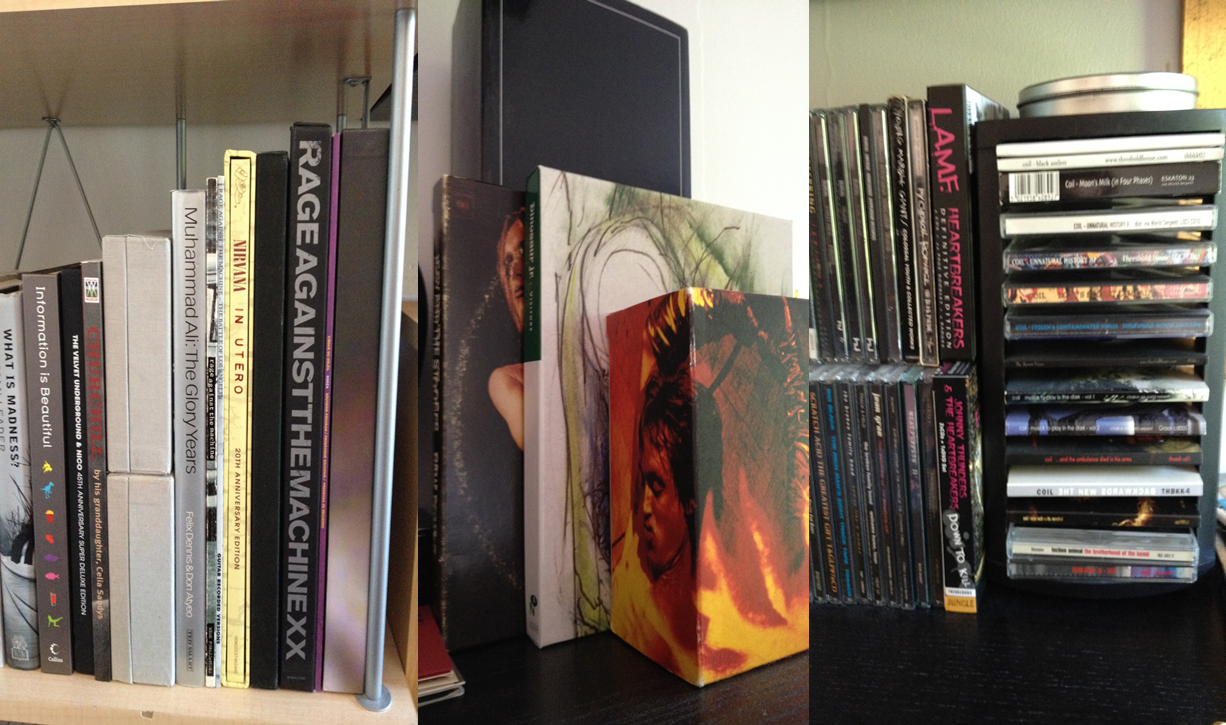
Thing is…I’m also looking at the three CD Young Marble Giants package on my shelf alongside then the four disc Heartbreakers LAMF Definitive Edition next to the Heartbreakers Down to Kill rarities collection; on the shelf above is the complete Beatles in Stereo next to Iggy and the Stooges three CD/1 DVD Raw Power deluxe edition and the Stooges Complete Funhouse Sessions eight CD box and the Dinosaur Jr Visitors 7″ vinyl Record Store Day boxset; in the middle just above me is the Nevermind Super-Deluxe plus the Singles box plus With the Lights Out bookended by the glorious Joy Division Heart and Soul boxset and the Sex Pistols four disc from 2001 or so; and I know over my shoulder if I spin this chair around I’ll see the two Unwound vinyl boxsets Kid is Gone and Rat Conspiracy nestled next to my Pennyroyal Tea Record Store Day 7″; to the left of me you can find the two Throbbing Gristle live boxs, plus the Rage Against the Machine Super Deluxe, plus the Arab Strap box, plus the Nirvana In Utero super-deluxe and the Bleach deluxe…Elsewhere there’s Weezer Pinkerton deluxe, Sonic Youth Goo/Dirty/Daydream Nation deluxe, the Throbbing Gristle album reissues, the Jimi Hendrix album reissues, Superfuzz Bigmuff deluxe, the Crass reissues, more Stooges, Azura Plane, the Slits, a Bob Marley retrospective, the Deathprod boxset… Get the picture?

Picture2

Essentially, I think it does say many things about me (not wishing to turn this into a personal reminiscences blog but what the heck…) that I’m totally the target audience for these kinds of releases – musically omnivorous, prone to obsessiveness, collecting bug on overdrive, not much money but even less sense…I’m a dream consumer for the music industry. There’s a certain internal revulsion too – do I really need…? No of course I don’t, there’s no belonging I possess that, in an existential sense I really ‘need’, it’s all about want and wish – which somehow feels so unnecessary but ultimately harmless, pleasurable, no worse than someone else’s desire for art, clothes, property – any physical display. But the actions of others doesn’t rob me of that nagging discomfort with myself nor of a right to feel disconcerted by my consumption of music.

There’s nothing sinister about the re-heating of old releases – it’s entirely overt behaviour by record companies, entirely welcomed by fans (if done well), definitely interesting for the musically inquisitive. Likewise, though books like Retromania make good points about the crowding of the culture industry with repetition and repeat, ultimately it was a foreseeable consequence of the accumulation of physical recording media – there was going to come an age where the glut of material available meant new releases from new bands were just a tiny pimplehead on a Jabba the Hutt style long and thick body. It has a positive too, the willingness to discover the past, to acknowledge past creation, past moments of inspiration – it doesn’t have to fall into maudlin nostalgic comfort though some would argue that’s all any of it consists of.

Anyways, though it’s nice to play it safe and re-purchase old favourites for those slightly battered, shambolic, tinny or hiss-consumed shades of the main release, though it’s fun to be reminded precisely how stunning certain albums were and always will be (usually more to those who experienced them first time around but often to those who never had that chance)…There’s still plenty going on out there, plenty to be explored so I don’t think it’s the death knell just yet. But I still need a break which is no bad thing.

January 16, 1993 — Cobain Quits on Stage

After all the rumours of sheer catastrophe, the latest additions to the audio/video record of Nirvana’s performance in São Paulo in January 1993 actually didn’t seem so bad…But. It took me some time to realize that it’s only just over thirty minutes into the performance before Cobain gives up on playing and more-or-less goes on strike. For his comrades on stage it must have seemed like no time at all before things fell apart.

Making it worse, this isn’t a situation where it’s NIRVANA as a unit wrecking things, Buenos Aires back in October is the obvious contrast where they’re all sabotaging the show in one form or another. This time around it’s Cobain, on his own, ignoring Novoselic and Grohl and doing precisely what he feels like doing with no consideration for them. Throughout the rest of the show there are moments where they both seem to be coaxing him along, encouraging him – when Grohl insists on them playing Rio it sounds so enthusiastic but simultaneously looks like a way of keeping Cobain playing something, anything. It’s a tragedy that the existing record doesn’t show the moment when Novoselic walked off or where Kurt started mashing a watermelon into his strings. It does make one wonder whether the performance was as bad as stated given the moment where Cobain sang “we will f*** you” during the Queen classic isn’t clearly present either.

This is the first time they’ve been on stage together since Nirvana had witnessed an audience tear Calamity Jane to shreds in Argentina so, though the noise is muted on the recording, the audience are unlikely to have been passive recipients of whatever was going on. Imagine tens of thousands of revved up locals staring down the band – is it any wonder no one is willing to call it quits and step off stage? If the legal/contractual threats that stopped Novoselic from quitting part way through weren’t sufficient then a relatively buoyant audience certainly must have helped keep the tension levels elevated.

I admit I marveled at how functional Cobain is while high. Later the same year he overdosed in New York and was still on stage later, even if it did create a poor performance he still staggered through it. Here in Brazil the reports from backstage emphasise that Cobain was visibly drugged up before he went on, heck, he’s certainly no zombie even if there are so many moments where it’s obvious something isn’t right – the foul-ups in Teen Spirit where he can’t even hit the two notes of the verses quite right are a fair example. His voice is certainly not at its best, he sounds strained and hoarse at numerous points – even more grainy than his regular approach and loses the note entirely at the end of Teen Spirit. Whinging about the lighting twice over inside the first fifteen minutes of the recording isn’t anything, stage lighting blinding musicians isn’t exactly uncommon, but this is a guy who barely has his eyes open and doesn’t interact with crowds a whole lot – what’s he planning on looking at?

Negative Creep has that same tentative vibe as Buenos Aires where the first minute or so of each song felt like he was trying to remember it, tuning, preparing at a time when the band had plenty of guitars all tuned and ready to go. His yelp of “is everyone having a good time tonight? Rock n’ Roll!” has the same feel of sarcasm his applause at the conclusion of Live and Loud does – that he knows it’s not amusing, that it’s not going well. “I could shave on stage and you’d eat it up,” within a very ad-libbed (enjoyably so) rendition of Something in the Way sums up his feeling that he feels he’s faking it and no one’s noticing – it’s followed by the line about Brett Michaels and Poison then a reference to Guns n’ Roses/Led Zeppelin, I usually take his references to hair metal bands as points where he’s feeling self-critical or conscious of reasonably made comparisons given his band has stepped over into that pop-rock sphere – in this context that interpretation, that it’s his inner issues on display, makes sense.

Of course, he’s been through these songs so many times that he can’t fuck up hugely, most of the set are tracks he’s played in concert right the way back to 1990 if not before – there are four tracks from Bleach, Polly/Breed/Dive/Been a Son/Molly’s Lips he’s been rocking since 1989 – yet he’s still not putting much into them. It isn’t, however, a disaster at first – just lacklustre. It emphasizes how deliberate a choice it is to go from pausing, tentative performance to simple destructiveness – that’s an aspect I don’t think I’ve seen mentioned before, that it isn’t just a bad performance, it’s a deliberate refusal to cooperate. The solo in Blew is just bizarre, there’s not even an attempt to work within the confines of the song.

And that’s it, off he spins. Krist and Dave do their best to set down some kinda base but Cobain just ignores them and crunches the most cackhanded chords and directionless note runs without any reference to attempting musical cooperation or performance. There are moments when the band try to lock in behind him and he just spirals off to wherever – I love noise records and the ten minutes or so from Blew onwards certainly qualify. Staging the kinda guitar-wrecking he normally saves for the finale at this early stage is a declaration that the show is over.

I’ve always wondered about the presence of TV cameras and their effect on Cobain; think back – Top of the Pops (takes the piss), Jonathan Ross show (plays a different song to the one intended), first MTV live appearance (finishes early), MTV VMAs (refuses to play Teen Spirit and annoys them with Rape Me), Live and Loud (eliminates Teen Spirit again and spends fifteen minutes making noise and harassing cameramen), MTV Unplugged (plays barely half a set of Nirvana originals and avoids any ‘hits’ – questions about the ability to play some of those hits acoustically to one side for a moment), Rio de Janeiro (‘mocksturbation’ to cameras of Brazil’s largest TV network)… TV seems a guarantee of non-cooperation from Cobain. Why? It’s certainly the clearest indication that he’s moved to a different level of fame, it’s definitely showing he’s been moved into the “TV musical light-entertainment” category which may have itched and it’s showing him that whatever he’s doing is now acceptable mainstream music. Did that worry him? No idea, but the chain of less than cooperative behaviour is telling.

I’ll leave you to work through the covers – he at least sounds like he’s having more fun, they’re pretty competent renditions. Apparently around the time of the Mia Zapata benefit Cobain was deeply into a drug spell – noticeable that, again, the show revolved more around covers and casual fun. Part of me thinks a rendition of the Stooges’ classic “No Fun” at this show would summarise the decision to just stop, give up, surrender and do something more enjoyable – playing sappy covers almost flaunting the unwillingness to please the audience even if the band weren’t willing to risk legal action and financial damage by finishing early.