Nirvana: Live! Tonight! In Your Lounge!

Credit where it’s due, the Nirvana Live Guide is the most remarkable website. I’ve hunted high and low and there isn’t another band’s fans who have organised such a detailed and impressive reservoir of information on the set-lists, locations and movement of a band.

The early years of Nirvana weren’t exactly awash with money. As late as September 1991 Kurt Cobain appears to have been sleeping in his car for certain periods of time; the Sub Pop contract from 1989 was only going to have offered the band a pittance to split between them, doubling each year but still to a less than liveable wage. The deals put in place in 1991 finally bestowed a decent advance, publication rights and so forth but until that money started to flow this was a hand to mouth existence.

I should qualify, however, that there’s a clear line dividing Nirvana’s career:

House-Dorm Parties 1987-1994

In 1987-1988 a third and then a quarter of Nirvana’s shows were house parties or in college dorms; this proportion may tail off significantly but as late as 1991 the band, on the verge of worldwide triumph, still plays a local dorm party. Imagine that, Nirvana in your living room.

The early high percentage of shows taking place in peoples’ homes and college facilities simply shows a band, just starting out, needing to take whatever they can get. This wasn’t a band who could refuse shows, it wasn’t a band making vast money performing. This was subsistence musicianship, a band scrabbling for beer money, for any kind of audience. The glory years of Nirvana’s career were 1990-1991 but even then, paying a few dues, getting some casual stage time seems to have appealed. Post-1992 they left it all behind and became what most would think of as a purely professional outfit.

Dave Foster: The Enigma…February-May 1988

Human interaction is a wonderful thing, it leads to mind-changing revelation, to more subtle refinement of ideas, or to the strengthening of existing thoughts by virtue of defending them. This past week certainly brought me to a few new musings and, credit where its due, the gentleman responsible is Dave Foster, formerly of Nirvana, presently of Mico de Noche. Let’s choose a soundtrack here then pause a moment, it’s been a heavy week with the Boston Marathon stuff then Waco, Texas blowing sky high for the second time in twenty years. Stop. Breathe. Then let’s get back to the good side of life:

Rereading Azerrad’s book, the way in which Dave Foster is portrayed immediately felt doubtful; frankly only one perspective is permitted — Kurt Cobain’s — with no real examination of why Dave even joined the band in the first place, why he persisted with the long journeys needed to make it happen, let alone stuck with what was, at the time, a band that barely made it out of house party territory (they played four house parties of the eight shows played in the period he was with the band), that had only played seven gigs (and one radio show) in the year since their inception. The one-sided nature of the coverage makes me suspicion of its honesty on this point — it’s easier to rely on the Cobain perspective of ‘cultural difference’ and unreliability, something reinforced by the sacking letter included in Kurt Cobain’s Journals, to explain this four month stint in the band. But, intriguingly, it’s one of the few critical letters in those Journals where Kurt acknowledges that the person he’s talking to has a positive; he explains how good a drummer he thinks Dave is — that’s rare.

What reinforces my uncertainty about the existing tale of Dave Foster is that, for all the talk of his unreliability, this is a man who is so dedicated to music that he’s been a regular presence in underground bands ever since; Helltrout being the most notable outlet with others following right up to the present day. The dedication to personal privacy, the desire to remain underground and not to let something he does because he wants to, not because he must, turn into something dictated by others or by the need for cash…I find that admirable. After all, I’m writing this daily blog, for no profit, with no affiliation or pressure from any source, simply because I love the topic and want to pour it out — why wouldn’t I be impressed by someone who so fervently has remained DIY? There also doesn’t seem to have been any discomfort or ongoing issue between Dave and Nirvana given Helltrout shared stages with Nirvana at gigs as soon as February 1989 and again in 1990.

But there’s more. The reason I’m fascinated by these short months in Nirvana’s existence is that they’re the real start of the band’s rise to any kind of significance. Dave Foster’s second show was the first time Nirvana had played under that name, until then they barely stuck with a name for more than a show or two; Foster’s spell on drums saw them cement their identity. Meanwhile, though it was the recording from January 23, 1988 that sparked Sub Pop’s interest in the band, it was the band with Dave Foster on the drum stool that was the version seen by Jonathan Poneman and Bruce Pavitt and therefore the version that hooked the band a first deal for a musical release on a label. On top of that, April saw Nirvana’s first show in Seattle following March’s final appearance at the Community World Theater in Tacoma that had been, more or less, Nirvana’s live home in 1987-early 1988; a real ‘changing of the guard’.

Musically too, there was change afoot during these months. Both Blew and Big Cheese first evolved sometime between January and the March 19, 1988 show — there’s little knowledge at present of how those songs came about. There’s also a degree of uncertainty regarding when, and how, Blandest, Mr Moustache and Sifting came about; their studio appearances in June are the first sighting but it’s unclear if these were last minute write-ups in the short weeks before recording or already worked up demos. Similarly, Annorexorcist died at this point in time; the last known appearance is in January but there’s such a black hole during these months that it’s unclear if that was the last time the band considered that song worth playing — who knows?

Well, to be fair, there are two people in the world today who perhaps, if memory hasn’t faded completely, if events twenty-five years back aren’t completely obscured by time, would know.
Anyways, that’s what I’m curious about at the moment. I love the black holes of history. As a final teaser to Nirvana’s ‘lost’ drummer…Tap 3/19/1988 Tacoma Nirvana into YouTube and go listen to the drumming on the available audio of that performance; quality. Start with Bad Moon Rising, it rocks!

Live Set-Lists and Side A Dominance: Bleach

Often my excursions into the online Nirvana forums are motivated simply by an early inkling of something that might end up here on the blog — a testing of the waters. Similarly, a lot of material that I place here is the equivalent of letting you see my working out — I want to give you all the data so you can work it all out for yourselves and use it as you wish.

While examining the 1992 set-lists I diverted, on a sudden whim, into another area. What I’d noted was that despite the increasingly recurrent complaints about fame and Nevermind and the demanding nature of audiences, Nirvana were solidly wedded to that album throughout the year; there was only one occasion all year, January 24, when the band played less than eight songs from Nevermind and on 17 occasions played ten-eleven songs, virtually the full album! As usual it seems that complaining to the media wasn’t the same as taking any action. It was fun, to me, to see how totally dominant Nevermind was that year.

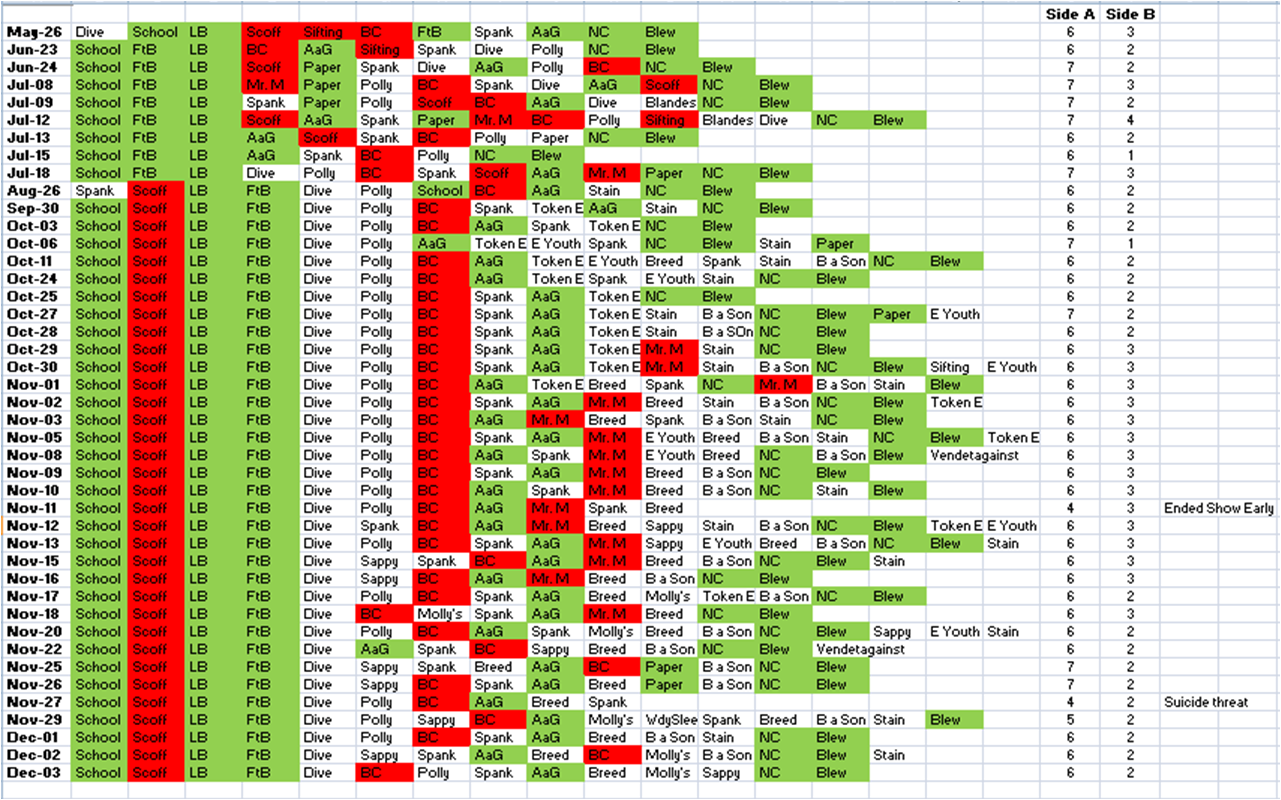
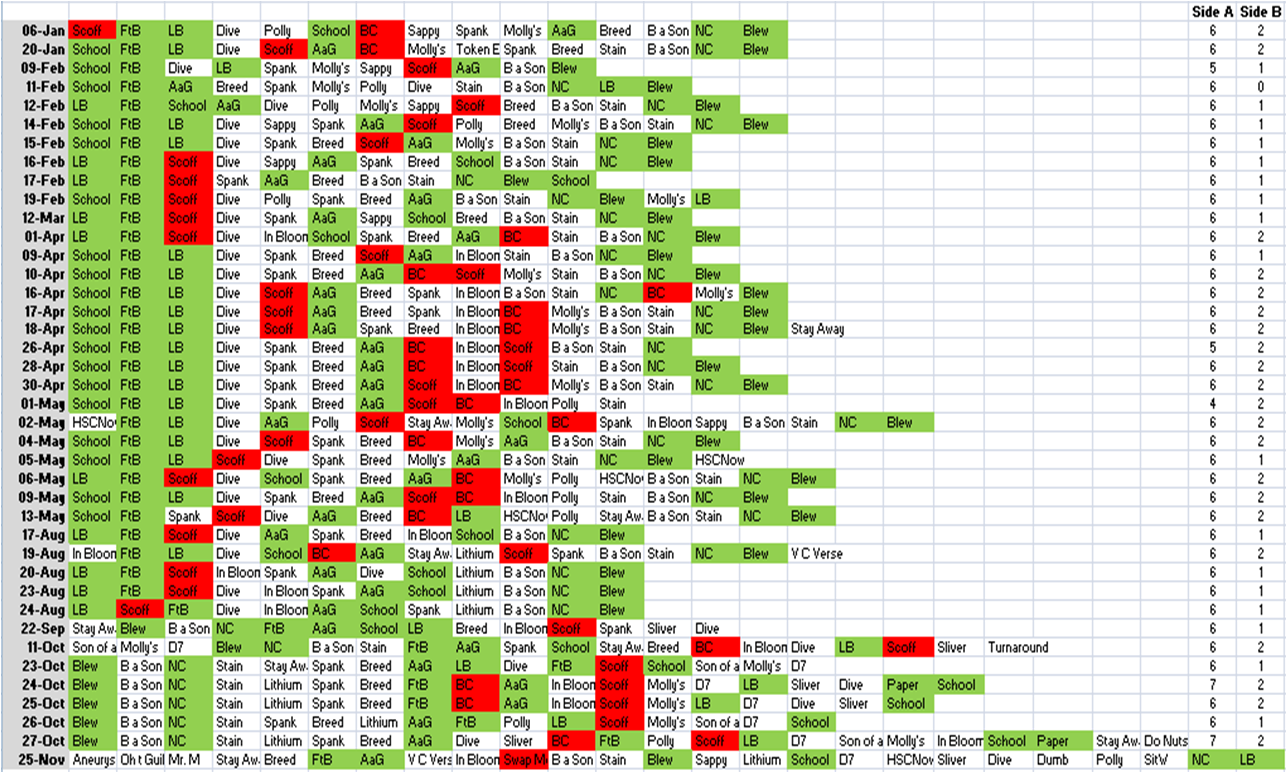
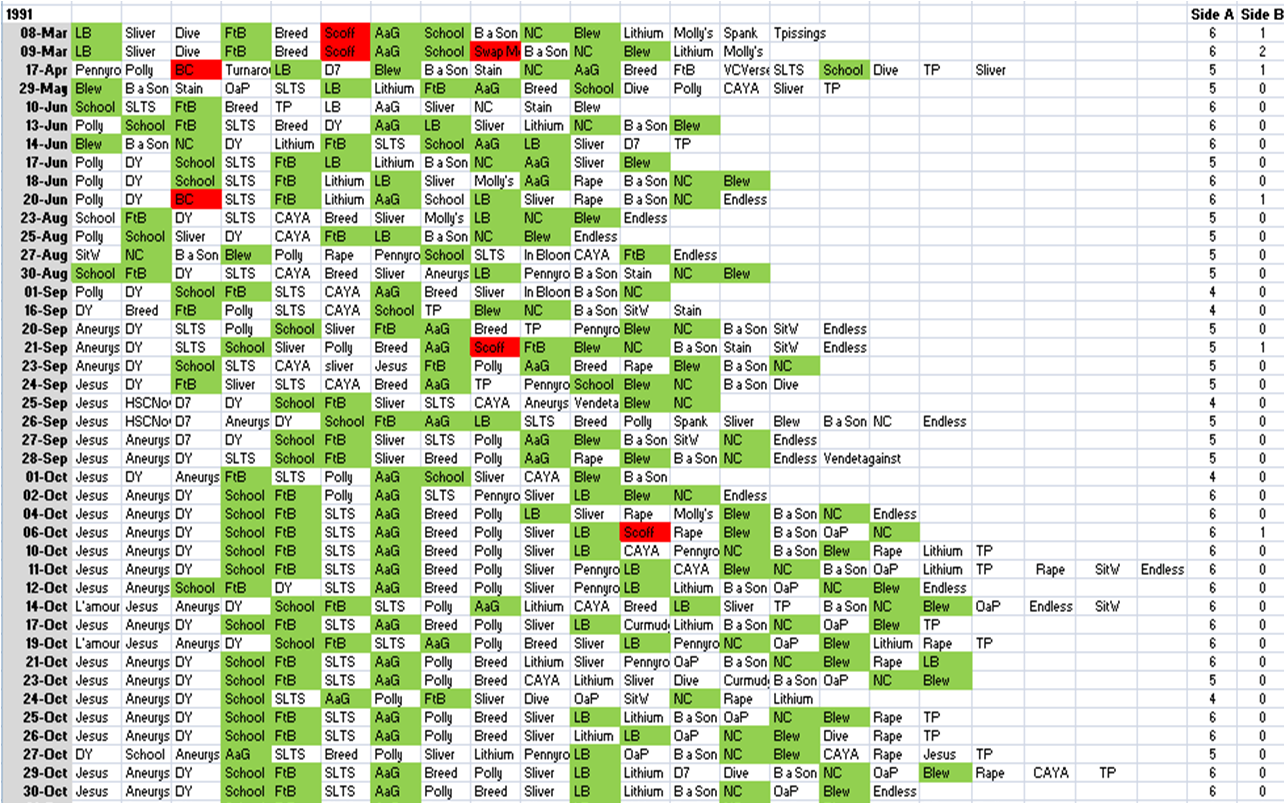
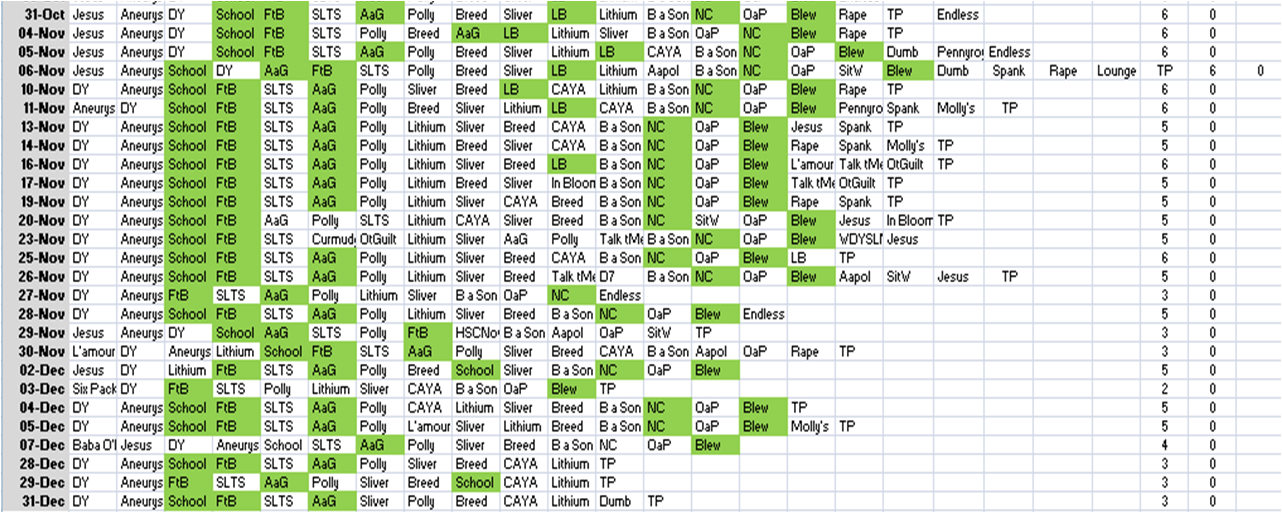
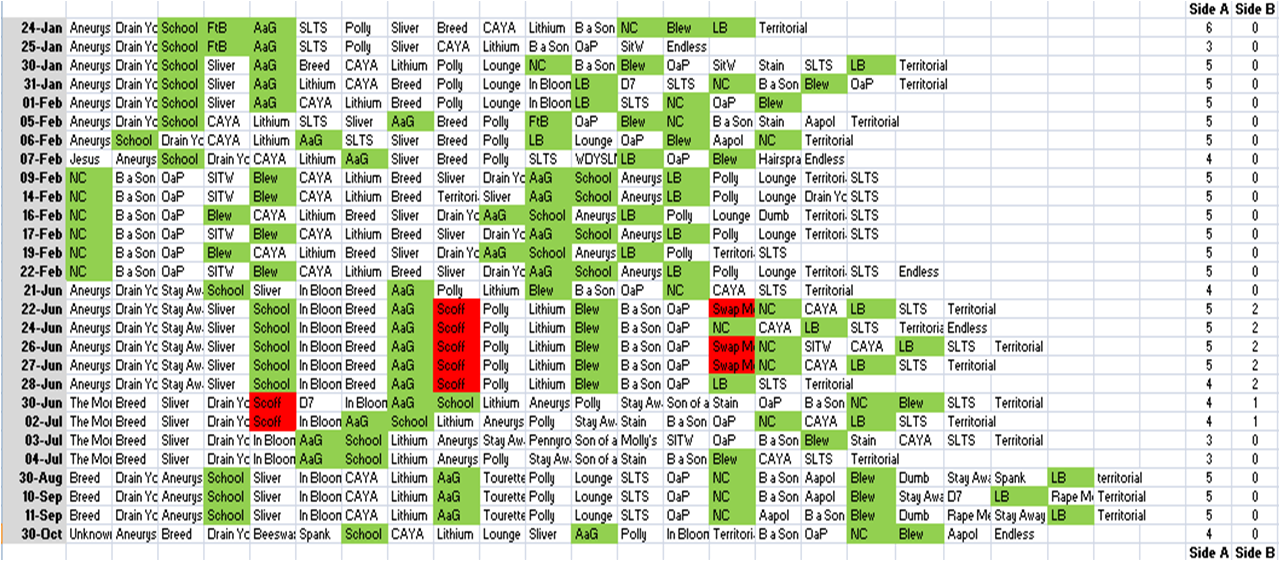
But there was a deeper oddity. I’ll leave it to one side for the moment and simply show the outcome of the data work I engaged in to explore the idea. I worked only with the fully complete set-lists in order to avoid skewing results via incomplete set information. This is the preference for Side A/Side B of Bleach across 1987-1988 (green equals Side A, red equals Side B):

Side a_Side b Dominance 1987-1988 Bleach

Total victory for Side A of Bleach. And 1989:

Side a_Side b Dominance 1989 Bleach

So, in 1989, the only occasion where Side B came close to parity with the prevalence of Side A is at the notorious show at the Piper Club where Kurt dumped his guitar and threatened suicide and one show where the band quit early. And on into 1990:

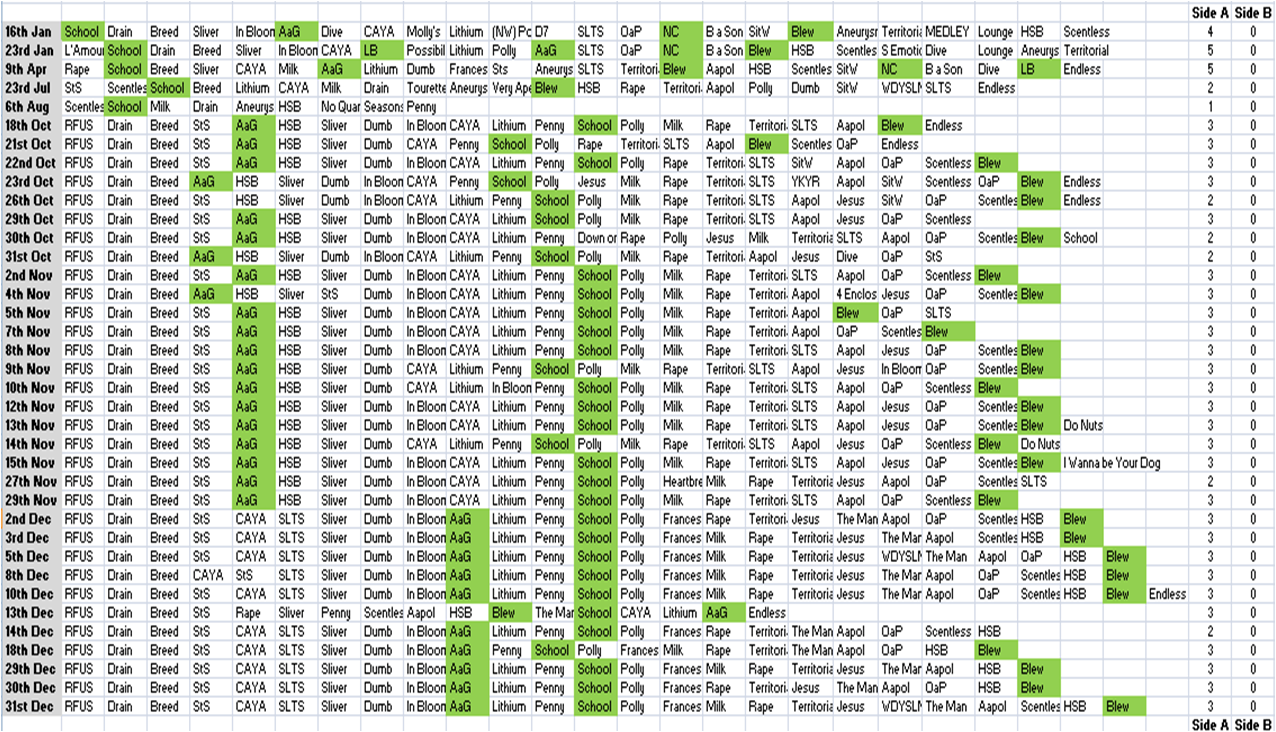
Side a_Side b Dominance 1990 Bleach

1991:

Side a_Side b Dominance 1991 Bleach P1

Side a_Side b Dominance 1991 Bleach P2

1992:

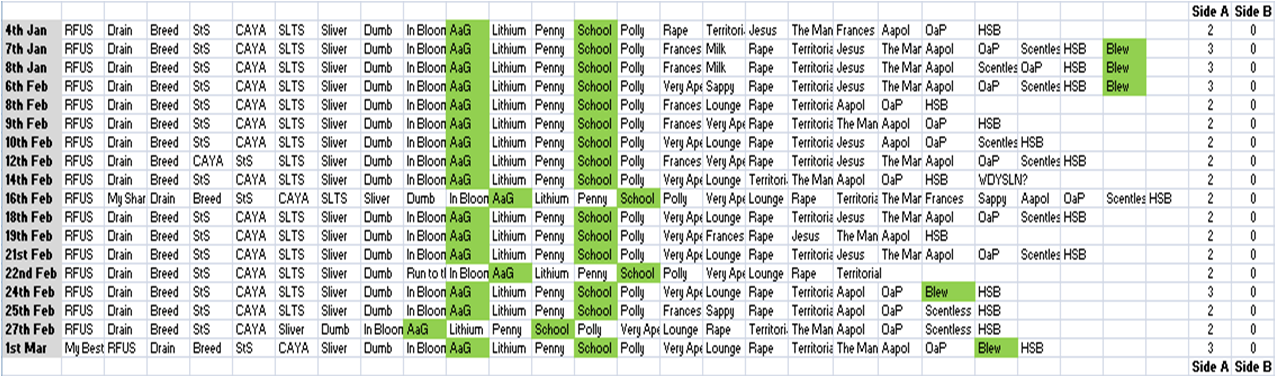
Side a_Side b Dominance 1992 Bleach

And, finally, 1993 and 1994:

Side a_Side b Dominance 1993 Bleach

Side a_Side b Dominance 1994 Bleach

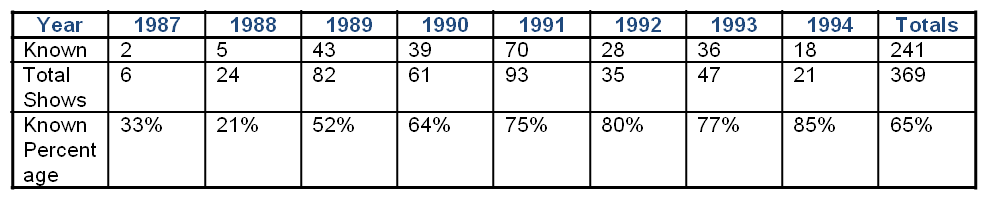
What am I saying? I’m saying, that there is never, at any point in Nirvana’s entire career, in the full record of 241 live shows where Nirvana played more songs from Side B of Bleach, not one. It makes July 12, 1989 one of the most special Nirvana gigs, simply by virtue of the fact that they played more of Side B on the date, four songs, than on any other known occasion.

OK, I’m accepting of the fact that Side A had seven songs compared to Side B’s five but it’s still the level of dominance that is of interest to me; as early as December 21, 1988 Nirvana are playing five from Side A; in 1989 they play the whole of Side A at nine of 43 known shows and six of seven Side A songs at a further THIRTY shows; even as late as September 1992 they’re still kicking out five of seven. By contrast, the reappearance of Swap Meet and Scoff for seven dates in June-July 1992 was the first time since October 6, 1991 — 56 shows and eight months back — that Nirvana played anything at all from Side B of Bleach, with July 2, 1992 being the last time the band would ever play anything from that side of the album.

It lends weight to the story that Sub Pop insisted on Nirvana placing their songs on Bleach in order of preference; their favourites to the front. As a second thought; Side A was heavily loaded with the older Nirvana songs, ones that had benefitted from more time and energy. This can be seen in the way that Love Buzz and Floyd the Barber were already present in 1987, Paper Cuts was added by January 1988, Blew by March then School in October. Side B, by contrast, didn’t begin to build until the March 1988 appearance of Big Cheese with Mr. Moustache and Sifting arising for the summer single recording session then appearing in concert in October. Though each side needed more songs, it was Side A that had the most complete and honed material earliest suggesting that the rushed material was shoe-horned onto Side B to get the album up to twelve songs.

Side a_Side b_Bleach Overall

Remember, what we’re looking at here is not a question of aesthetic quality; it’s simply a very basic question of how many songs from Side A/Side B appeared — answer? Side A won 241 times across seven calendar years. But what of Nevermind and In Utero?

Mourning Seattle

Grunge, as a coherent scene, peaked in the late Eighties and was long gone by the time Nevermind put the word into popular parlance. Most grunge bands barely sold, only the crossovers who had either left grunge behind or barely connected to it in the first place, so basically Nirvana, Soundgarden and Pearl Jam made it out. Even by 1991, Nirvana’s name was tied to a ghost and they have remained, in the popular view, the key exemplar of something that was already dead. It’s extraordinary in fact that such a minor scene should receive coverage at all.

The survivability of grunge as a form recognised and acknowledged in popular musical history was based on two, separate, but connected, events. The first was the power of the British music press and Sub Pop’s work in cracking open coverage thousands of kilometres away from the epicentre of the scene. With the best will in the world, alas, it’s reportage and repetition that creates perceived importance — in 1989-1990 the world was primed and waiting for something to come out of the Seattle scene thanks to the hammering of the topic by the music press. The second factor, the one that elevated grunge to a hallowed status, was its perceived role as the incubator for the band that breached the alternative/mainstream divide; Nirvana.

The two elements, grunge and Nirvana, are so intertwined that amidst the flurry of books on grunge that emerged between 2007-2011, virtually all featured Kurt Cobain on the cover. On Facebook there’s a similar sampling of the popular mind; dozens of memorial sites to grunge, hundreds to Nirvana, hundreds more to Kurt Cobain — the grunge sites are barely distinguishable from the Nirvana/Kurt Cobain tributes. Without Nirvana’s success pushing the origin myth of their emergence from grunge, without Nirvana’s success forcing the word grunge into every account of punk, alternative, rock, metal and post-1980 guitar music, grunge wouldn’t be mentioned as a scene anymore than a dozen other localised punk scenes of the 1980s. It’s similar to the way No-Wave has achieved some underground recognition on the back of the stature of Sonic Youth, Swans and, for a time, Lydia Lunch — a scene barely bigger than four bands is now a regular fixture in accounts of music.

The ‘icon’ mantle Kurt Cobain inherited has been hung over grunge also. The fact that grunge had disintegrated long before Nevermind made it out is barely registered; the arm’s length relationship between Nirvana and the grunge scene is only commented on among fanatics; the names and stories of the true grunge bands (Green River, Melvins, Soundgarden, Skin Yard, Mudhoney) something for music trivia fetishists. The immortal bonding between Kurt Cobain and grunge has created a mourning of the grunge scene. The difference was that while grunge was a very local, barely registering scene, Nirvana had a chance to connect in some way with the huge audiences who still exist for them whether on record or on MTV or as live event. Fans have been smothered ever since in memorabilia whether aural, literary, visual or tactile (*shudder* Kurt Cobain action figures…) The ‘big bang’ of Kurt Cobain’s suicide also created an emotional trauma of vast scale for fans setting a standard of significance that makes it impossible for another band to match.

Grunge, by contrast, melted away without any such mass audience, without MTV coverage, with records sold in such low amounts that Sub Pop was going to go bust before the Nirvana money flowed in; there was no mass connection. Grunge has gained its significance purely as a synonym for Nirvana. This means the harking back to a supposed golden age in Seattle is such an unusual mental phenomenon; it’s a desire to return to something that very few people saw, or heard, or had any part in — it’s completely divorced from any personal connection.

The amorphous identity of grunge also assists its assimilation into the music-based world views of fans the world over. It’s become a cliché of the Sixties generation to claim that you had to ‘be there’, a way of keeping out newcomers and preserving a sense of exclusivity around a set archetype to which followers must adhere despite lip-service to anti-authoritarianism; the result is that very few people hark back to the hippy era or ethos, few mimic or enthuse about it. The original wave of punk had a similarly strict mission statement and presentation, again, the rigidity of the identity created a limited life-span and shelf-life. Grunge, by contrast, had no vision for life, no projected purpose behind it. The result is that it can be used to cover a wide span of lifestyles and attitudes — it’s an appealingly broad church in which anyone can find what they wish. The pretence was that this fuzziness meant that Generation X had no commitment to anything at all, but that’s untrue. It was a generation that permitted individuals their own choice of ambition without imposing or demanding a single unified identity of its adherents.

The appeal of the grunge era only exists as a comparison, a longing for fresh possibilities that most of those who wish they had been there can never confirm even existed. The idea of the alternative nation, in reality little different from the pre or post-generations, appeals in the same way that the hippy or punk did — as something to hark back to when seeking something to put in opposition to whatever exists in the present day — without the weakness caused by a too uniform and defined presentation.

In actual fact, while the participants in the original scene wax lyrical about how enjoyable it was for them, the sense of open possibility and no responsibilities unburdened fun; it’s those components — youth in other words — not the scene itself that is being memorialised. Grunge consisted of extremely poor people, playing to limited appreciation, with limited futures visible, increasingly saturated with drug casualties and with a time-limit after which the usual college or steady job paths beckoned. What those people are eulogising and memorialising is the wild years of their youth when they didn’t know what they were doing perhaps but it felt good just doing it. What the fans of grunge are enthralled and inspired by is a wish that they had experienced their own mad years, or a wish that they could recapture that same directionless but ecstatic freedom.

Grunge, Seattle, the North-West scene…It’s so perfect because it’s no more real than the British tabloid vision of a mythical England of cricket, warm beer, social deferment, local employment, temperance — a world also, quietly, devoid of immigration, in which the working classes are invisible, where women keep their traps shut, where discomfort is locked away. It’s a different form of the golden era myth, the comforting kneejerk belief that “things were better” once upon a time whereas appreciating the beauties of the here-and-now, the conquered travesties of the past, or working/fighting to make this present era closer to what one wishes for — it’s all too much work. Easier to claim the fight is lost than to go for it.

Presence and absence are permanently intertwined. The appearance or discovery of a new shred of unheard Nirvana music, or a new piece of information, doesn’t salve the absence or make it go away, it emphasizes it — reminds one of the gap where something once lived. Grunge has a similar ghostly quality; it was absent long before 1991 but resurrected as, first, a genre label and explanation for Nirvana; secondly, as a tombstone for rock music or for the Eighties underground; thirdly, and presently, as a vision of dead desire, something that can’t be attained and therefore seems more appealing than what we actively possess.

Sub Pop Album No.2 for Nirvana: What Would it have Looked Like?

I admit inspiration this time around came from a conversation in the forum at LiveNirvana initiated by Chris Hickman — all credit to him. He rightly pointed out that the April 1990 Smart Studios session was intended as the kick-off to album two, not just a rehearsal. With that in mind though, it’s clear that a significant chunk of the album known as Nevermind simply didn’t exist until late 1990 or even on into 1991, a year after this first shot for Sub Pop. Nirvana also hadn’t quite discovered the Pixie-fied formula that would drive a number of the songs on Nevermind, it simply wasn’t there yet. The dynamic of minimal guitar on verses then all-out choruses hadn’t evolved yet; most of the songs that had made it to the studio by spring 1990 were a step on in tone and brightness compared to Bleach, but the guitar’s presence still consisted of (a) constant or (b) the Sliver/Here She Comes Now (and later D7) model of building from quiet to loud across a whole song.

The record of what songs Nirvana had in existence and what songs appeared soon after the April 1990 session serves as a good guide to the likely shape of ‘Sheep’; the second Nirvana Sub Pop album. Often commentary on Nirvana simply wraps the 1989 to 1991 work altogether as if Nevermind was an inevitable product and only needed some tweaks prior to its mid-1991 recording. This simply isn’t true. A finalised album prior to the end of 1990 would have been a quite different beast. Let’s look firstly at what songs were in existence and unused by April 1990:

Songs Available in Mid-Late 1990

I’ve excluded the more or less abandoned songs that ended up on Incesticide; Blandest was gone though not forgotten given it had appeared in a set-list during the summer of 1989 (and also evidenced by the later inquiry as to its whereabouts made in 1992 of Jack Endino while Nirvana were preparing Incesticide); Vendetagainst had reappeared in late 1989 perhaps down to Nirvana’s knowledge of how few songs they had in reserve. In fact, down to the summer of 1990, Nirvana did have a dozen songs available, just a very different dozen to the DGC set.

So, half of Nevermind didn’t exist. Tourette’s was the only In Utero song likely to be in existence. Note that 1988’s entire output of new songs had been used up on Bleach just as almost all early 1991’s writing would be used up on Nevermind, same as the hurried writing in late 1992-early 1993 was swallowed whole by In Utero — Nirvana always reacted to the time pressure leading up to an album release to hammer some new material into shape. If an album was to be out before the end of 1990 then a further spell of work was needed.

And that’s where we diverge from reality. Those who believe it was preordained that Smells Like Teen Spirit and a number of other crucial Kurt Cobain compositions were written will suggest that a lot of lyrics, ideas for riffs and so forth, were probably floating around in his journals and in rehearsals for a while. I agree. Likewise, they would argue that the songs were a response to the circumstances of his life in mid-1990 to mid-1991 so a lot of the urges and desires that found expression in those songs would still have emerged. True.

Yet other crucial circumstances in mid-to-late 1990 were the commencement of business deals that funnelled a small but important sum of money into Nirvana’s pockets via publishing. That was all wrapped up in the preparation for a major label move and without it critical factors that allowed Kurt Cobain to write those songs would have changed. For a start, examine the record of how many shows Nirvana played from June 1990 to June 1991:

Gigs June 1990-June 1991

Late 1990 through early 1991 was indeed the greatest spell of writing Kurt Cobain would ever achieve but it relied thoroughly, not just on emotional traumas like the break-up with Tobi Vail, but on the availability of money so that the band didn’t need to be paid to play — heck, without that influx of cash it’s intriguing to wonder whether the conjunction of Tobi break-up and heroin love affair would have been kick-started either. Sub Pop wasn’t scribing the band many vast pay cheques so this long spell of minimal activity wouldn’t have occurred. Kurt Cobain’s songs would have had to have been churned out at speed — like the work done prior to the Blew EP the year before. Likewise, instead of being the product of a man who confessed later to having sunk into depression and near complete isolation at this time, they would have been the works of a guy spending a lot of nights plastered in sweat and whipping his body around a crowded stage in front of a posse of mouth-foaming punk rock fans.

The major label deal also allowed Kurt Cobain to commit to the more pop-orientated side of his vision. His music had already diverged from straight-forward grunge, but little in the spell up to summer 1990 showed the great leap toward the mainstream that would occur. The original of In Bloom was far grittier, Polly was a lone fully acoustic effort though Lithium was starting to show the band playing with loud-soft dynamics, Sappy was still a far rawer effort than its resurrection in 1993. The core of the songs the band had available would not have been jarringly out of place on Bleach; Breed, Tourette’s, Token Eastern Song, Even in his Youth, Stay Away, maybe even a revised Vendetagainst. These songs would have made the serviceable core of an album that sounded a lot closer to the pop-tinged but still overdriven roar of Dive, Been a Son and Stain. In that context Polly, or Lithium, or Sappy, would have served the role that About a Girl did on Bleach; the showcases for Kurt’s pop chops on an otherwise tough sounding record.

The change in circumstance, another indie record as opposed to a shot at pop stardom, needing to tour rather than sitting quietly writing up a heartbreak, pressure to write new songs in summer 1990 rather than spring 1991; these factors would all have changed the eventual results that emerged.

Note, however, that despite the April 1990 recording session, Nirvana didn’t immediately commence extensive writing in April-July 1990. In fact it’s unclear whether anything other than Verse Chorus Verse and Sliver came into being in those three months. The absence of any visible rush to do anything seems to indicate that there was no pressure on Nirvana to push a new album out, despite the ostensible purpose of the April session. It seems to hint that April was far more about getting a good sounding demo tape together at Sub Pop’s expense, testing out that ‘Top 40 drum sound’ in preparation for a REAL shot at the Top 40, than it was about kicking off a new album for Sub Pop.

On this Day; January 23, 1988 the Journey to Incesticide

Twenty five years ago today, Kurt Cobain, Krist Novoselic and Dale Crover entered the studio with Jack Endino and recorded five of the songs that would end up on Incesticide.

Back last year I asked Jack Endino if, when listening to the songs he worked on that made it onto Incesticide, whether there were any moments that gave him a particular pride and he replied: “No. None of them were recorded or mixed with any time spent (due to budget), plus I had only been working as a recording engineer for three years at that point. The songs with Dale drumming were all mixed in a total of two hours… ten songs on the original 1/23/88 demo, do the math. It would have been nice to remix them with some care taken.” It’s interesting to me that I’ve listened to these songs for some eighteen years now and never had any complaint regarding the sound quality or its features, yet, to the ear of a trained recording engineer, it felt less satisfactory – maybe sometimes less sonic knowledge is aural bliss.

The stories regarding this first studio session are well known; Nirvana recorded at speed, just six hours or so of work, instrumental versions done first, then Kurt’s vocals, mixing done within two hours, out the door. The session was paid for from Kurt’s wages as a janitor hence the fade-ending to the song Pen Cap Chew because “the multitrack master tape ran out just at the start of the second chorus, and the band didn’t want to buy another reel, so more correctly the song is “permanently incomplete”, not “unfinished”. You can’t finish it when a third of the song is missing. I did the fade ending for the hell of it, just so they could listen to what was there less jarringly.” That same night the band played all the songs from the studio session in the precise same order with two more songs tacked on the end.

This is what intrigues me, the guesses that can be made based on the band’s behaviour. LiveNirvana contains a ‘set-list’ for one practice session prior to the January 23, 1988 studio visit and suggests there were two more preparatory sessions. The band knew before they arrived in studio that they needed to move quick; the banged through the instrumentals then Kurt did his vocals one after the other in just one take; that evening, having driven umpteen miles to a performance, they then ran through all the songs in precisely the same order. It suggests to me that between the January 3 practice and the January 23 session, the band actually planned out a clear order of what they were going to play and practiced it ensuring they could act smoothly in studio and explaining why they duplicated the studio running order that evening. The extrapolation that can be made from this is that one of the preceding practice sessions, if a recording ever turns up, should have the same (or a close) order. As a touch of support to this, in March when Dave Foster joins the band, the set list has curious similarities:

Set Lists Jan-Mar 1988

The top line is the January 23, 1988 performance – the bottom line and a bit is March 19, 1988. Note immediately that despite a change of drummer and a gap of three months the only changes to the opening five songs are Love Buzz has supplanted If You Must as the opener and Papercuts and Spank Thru swap fourth and fifth place. The next disconnect is interesting too; the next song in March was Hairspray Queen. On January 23, though the next full song played was Aero Zeppelin, in fact Nirvana attempted Hairspray Queen and stopped due to a broken string – if not for that accident of fate, the same song would have been in sixth place both nights. The next point of comparison is to look at Beeswax, Mexican Seafood, Aero Zeppelin and Pen Cap Chew as a unit – in January the broken string meant the band shunted that unit up by one song, in March they play those same four songs together, with Hairspray Queen back in place, with If You Must dropped in beforehand having been shoved out of its starting position. The only other change is that Beeswax and Aero Zeppelin have swapped positions. Now the band bring in the new songs; Big Cheese replaces Annorexorcist, Blew is squeezed into the longer set…But the ending is still pre-determined; Erectum is the big set closer with whatever jams and covers the band feel like shoved on the end (the band play Bad Moon Rising at the end in March.)

From the coincidences surrounding January 23, 1988 it’s therefore possible to extrapolate the decisions taken by the band before that date; to suggest a likely set-list for at least one practice prior to the session; to suggest that Kurt and Krist taught Dave Foster this specific set-list in practice after that date; and to suggest a likely set-list for the only other show the band played between January 23 and March 19.

As my tribute to Nirvana’s first studio session I thought I’d simply show how an event taking place so long ago could still inspire thought and consideration today. Happy twenty-fifth!

The Path to an Album Part Two

With only three sets of comparable data trying to state a definitive and rigid prediction is simply impossible. What yesterday’s post and today’s post are presenting aren’t in anyway scientific measures — it’s just as easy to say Nirvana had releases in 1989, 1991 and 1993 so they’d obviously pump an album out for late 1995. Reemphasizing the difficulty in such a clumsy rule as the gap between first and last song played live from an album, if Talk to Me was to feature on a mythical fourth Nirvana album then taking its Nov 1991 appearance as the start date, Nirvana were overdue for an album as early as July 1994 — that’s the problem with limited data…

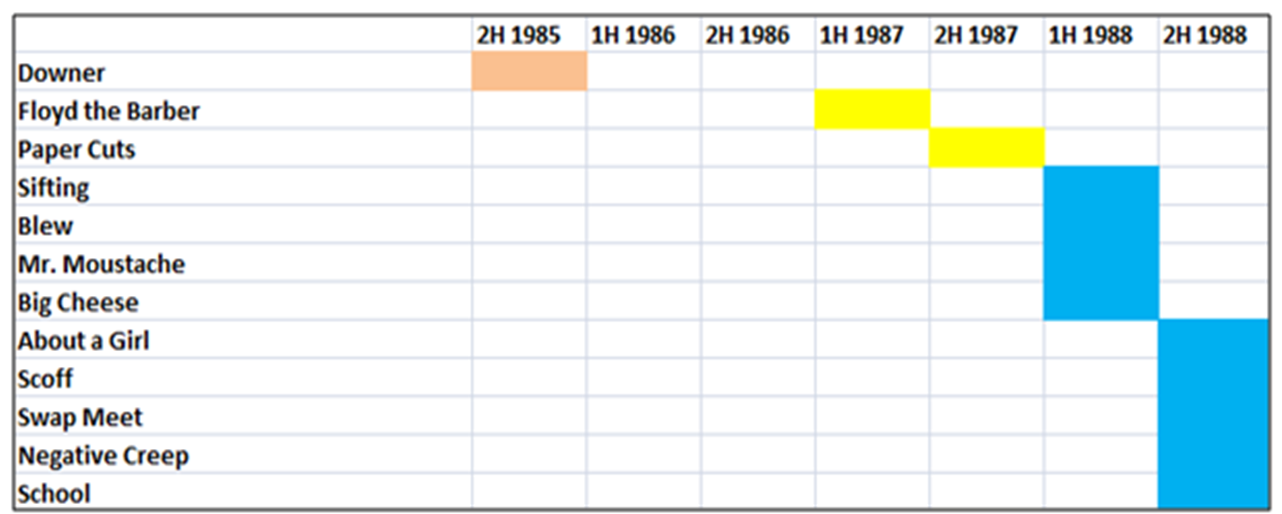
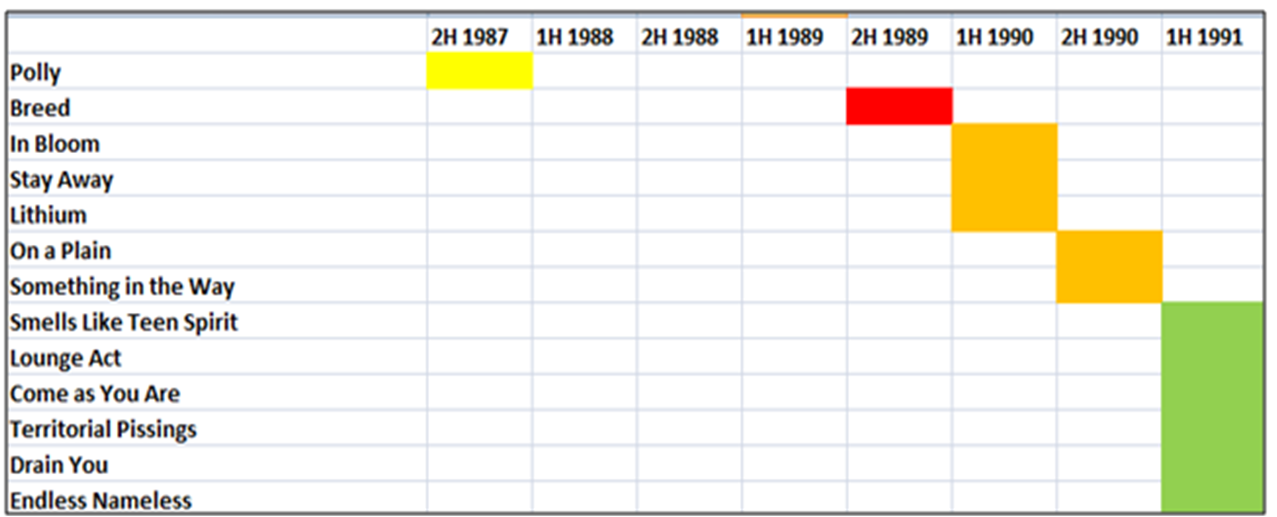
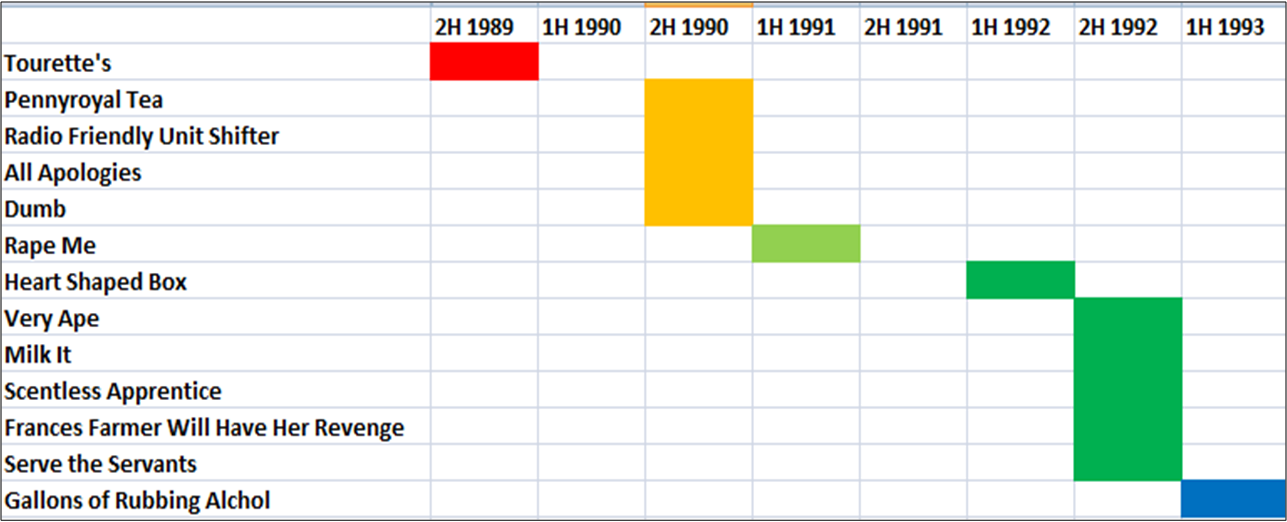
Let’s try it another way. In Dark Slivers I tried to pin down Kurt Cobain’s writing to likely periods of six months, it’s impossible to go further and naturally a few songs will shift period if new information appears. This meant working from known demos, live dates, likely evidence (i.e., the news story Polly was based on.) While not as precise as the live appearance data it’s still possible to attempt to measure the first and last songs being developed prior to an album to show how a Nirvana album evolved over time. Let’s start with Bleach:

Bleach Development_v2

Gillian G. Gaar argues convincingly for Fecal Matter having been recorded around March 1986 but still it’s unclear if Downer’s origins were in late 1985 or early 1986. I’m also shy of placing Downer here simply because it wasn’t Kurt Cobain’s choice to include it on Bleach, it was Sub Pop’s. Now Nevermind:

Nevermind Development_v2

Some of the first half 1991 songs may have already been sketched out in 1990, hard to say but the overall pattern is still clear. Again, note the one ‘early riser’ then the clicking into place over the two years prior to an album. Finally, In Utero:

In Utero Development_v2

A far more ramshackle pattern and with a few provisos. Firstly, Krist Novoselic believes Tourette’s was first written in late 1989, but the earliest evidence for it is a ten second run-through of the main riff during soundcheck in November 1991 so either it stays where it is or it fills that gap between Rape Me and Heart Shaped Box. The consequence would be to shorten the album’s development down to three years.

As it stands, and compared to yesterday’s fairly sturdy pattern in the live performances, what we’re looking at is a greater span of potential. Eliminating Downer brings the development of Bleach down to a mere two years. Shifting Tourette’s into the 1991 slot makes In Utero a three year process. Nevermind, however, remains a four year project. Returning to the attempt to estimate when a fourth Nirvana studio album may have arrived, let’s take You Know You’re Right’s appearance in October 1993 as the de-facto starting point, seeing as we have so little else to work from. We’re hitting second half of 1995 all the way to first half of 1997 to finish writing meaning an album release anywhere between first half of 1996 to the last half of 1997.

There’s nothing unexpected here in predicting a wider gap between In Utero and the next Nirvana album. To get In Utero out just two years after Nevermind Kurt (and the record label) had needed a further year and a half, even leaning on the half-a-dozen songs already in place. By comparison, to create Nevermind, Nirvana had started from scratch with just one song dating before late 1989 and it had taken a full two years to get the rest done. Following In Utero we’re looking at a situation comparable to the latter example; there was next to nothing in the vault the band could kick off from, they were starting from scratch.

The only hope would have been scraping together Opinion, Talk to Me, Verse Chorus Verse, together with You Know You’re Right and Do Re Mi to make a bedrock of five songs up to first half 1994. Even then, however, staying true to form, Kurt Cobain would likely have needed a crucial year and a half to wring another seven songs out. He admitted himself he was never a prolific writer, he was neither a miracle worker, nor blessed with the equally divine ability to pull songs out of his ass — he would have needed free time and inspiration to get more out.

In conclusion, if we extrapolate from the gap between first and last song for an album to appear live, we’re talking an album sometime December 1995 to July 1996. If we look at the overall developmental path for Nirvana albums, the earliest date is still on track, first half 1996, but the potential late date is pushed out as far as second half 1997…

…But then again, it’s art, not science. Nirvana may have bucked the trends of their album development, and the trends of 1993-1994 in general. Rebirth and rejuvenation were possible. But there are quite a few ‘ifs’ involved. Either way, a longer wait was likely.

The Path to an Album Part One

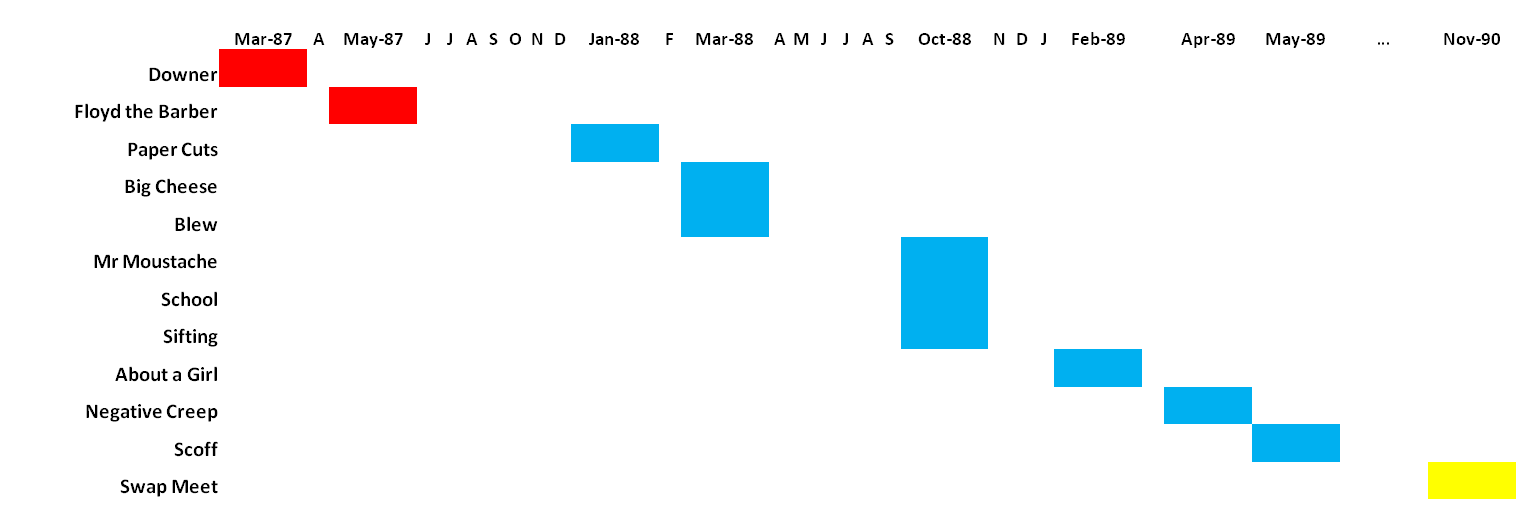
While examining the live sets over the past month, arranging data and seeing how it fell, one noticeable element was how strangely regular the development pattern toward each album was if judged according to the live record. For comparison, here’s when the songs on Bleach first appeared at a live show:

Bleach Development

Ignoring the weird outlier of Swap Meet (it’s unlikely this was its first performance), the span from the time the first track for Bleach appeared live to the last is 27 months. Then again, to be fair, Downer was Sub Pop’s inclusion in 1992 not Kurt Cobain’s, so perhaps we could start in May 1987 with Floyd the Barber as the first song for Bleach; 25 months. Now Nevermind:

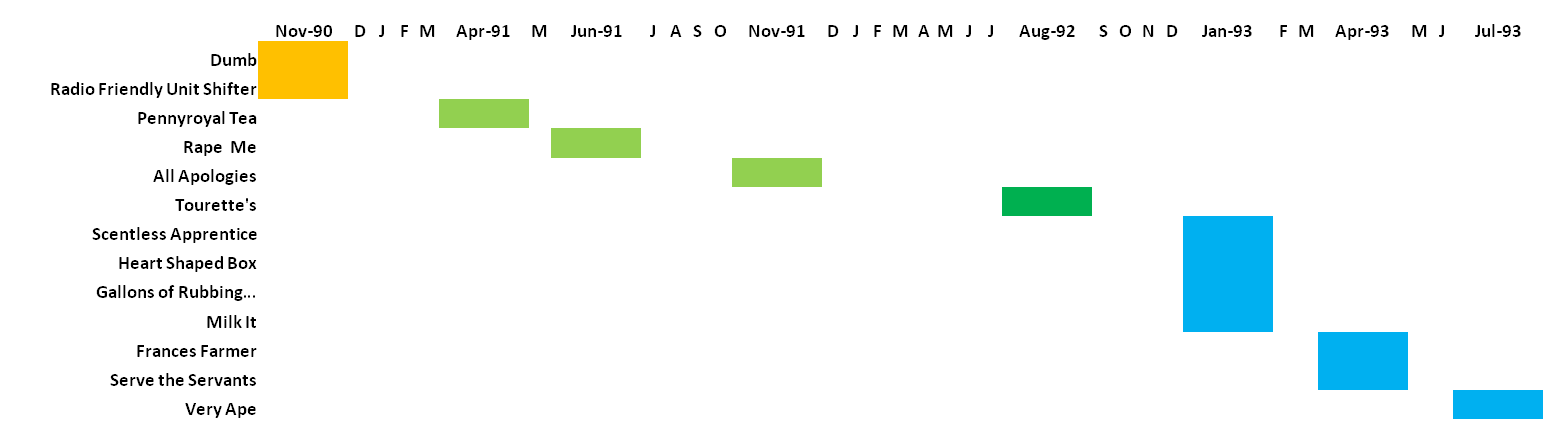
Nevermind Development

Nevermind is almost precisely the same, a grand total of 26 months from first song to last to appear in the live record. Finally, In Utero is a little different:

In Utero Development

A total of 33 months between the first live appearance of its first song and the last. The result is three albums, each whipped into shape over the course of two years, one month up to two years, nine months.
Prediction is the art of making oneself look a fool but at least it can act as a guide. In this case, if Nirvana had stuck to the norm, a new album would have been likely around two and a half years after its first song made a live appearance. The problem is, after each of Nirvana’s first two albums, the first songs attempted straight after were explicitly intended for stop-gap recordings and singles — it suggests perhaps You Know You’re Right would be for that same purpose.

On the other hand, as a counter-argument, during the Bleach sessions Nirvana didn’t record any leftovers for singles which is why there was the pressure around whacking songs out in 1989 (Do You Love Me, Dive, Been a Son, Stain). Similarly the Nevermind sessions didn’t yield any B-sides, Nirvana had to reach back and grab Aneurysm from the previous January, then further back to the BBC session that yielded Turnaround, Son of a Gun and Molly’s Lips, and then they ran out forcing them back into the studio to crank out some quick-fire material in April 1992. For In Utero the band, for the first time, deliberately made sure they had enough in reserve they wouldn’t need to come near a studio for a good length of time; February saw them record Sappy, I Hate Myself and I Want to Die, Moist Vagina as full band compositions, then Marigold without Kurt. So, maybe, for the first time, the band wouldn’t have been putting together throw-aways, perhaps the gap to the next album would have been shorter and You Know You’re Right may have had a place in a greater piece of work.

Taking You Know You’re Right as performed in Chicago on October 23, 1993 as the first live rendition of a song for the next Nirvana album, even then the trend would suggest the last song for the album wouldn’t have made it on stage until some point between Nov 1995-Jun 1996. Of course, that last song, in the case of Bleach, Nevermind and In Utero, had only made it on stage one-two months before the release of the related album suggesting an album, at the earliest, in December 1995 to July 1996.

But, of course, the data is flawed…Let’s talk more tomorrow because the pattern is worse not better than the live data would suggest.

Nirvana Live: Missing From Action Part Two

It’ll be no surprise to learn that a lot of Incesticide’s early material suffers from the limitations of our vision at twenty years distance. Yet, what is noticeable is more the centrality of some songs to Nirvana’s live identity in the early days. Mexican Seafood is remarkable, it’s present in every fully known set-list from March 1987 when the band first perform, until February 1989 just days before the band departs for their first gigs in California. Hairspray Queen and Aero Zeppelin have a similar dependability which elevates these three songs above the rarities described in Part One of this piece, as well as above a number of the dashed off last-minute additions to Bleach. It certainly looks like these three songs were held in higher affection than the barely performed Scoff or Swap Meet.

As an aside on those two songs, it’s fascinating how deep Nirvana’s collective memory was; they seem never to banish a song from mind; Scoff and Swap Meet are reprised in September 1991 and June 1992 respectively as cases in point. It’s a fascinating working practice specifically related to the way they play their live performances; songs are stashed away, like Vendetagainst, then after a year, two years, out of favour, they’re given an airing. It suggests that, at least from 1987-1992, there was substantial practice going on behind the scene to keep a solid grip on the lesser songs. On the one hand, it gives credibility to the rumours about songs like Clean Up Before She Comes, Opinion and Talk to Me springing to life in the Cobain basement in 1994 — no song seems to have been forgotten if there was any use that could be made of it. On the other hand, it makes one wonder why Mrs. Butterworth, utterly unseen, invisible, unknown (and actually unnamed) until the With the Lights Out box-set was erased so thoroughly alongside, according to Gillian G. Gaar, two other 1987 compositions. The song stands alongside Big Long Now as a genuine ghost in the catalogue; a song with a murky past, a gossamer thin presence, and no future.

Similarly, Beeswax looks ever more like a lucky addition to the January 23, 1988 session and doubly-lucky to still merit a place on Incesticide. The song receives just two work-outs in 1988 with only one intervening show at which its presence is therefore likely. This is a no more impressive record than Annorexorcist or Rauchola, Downer, If You Must and Pen Cap Chew are all given more visible shots as part of the Nirvana live experience.

While all of Nevermind gets its day on stage, the higher percentage of available set-lists makes the rapid fall off in appearances from certain songs at least noteworthy. Lounge Act is the very last of the Nevermind tracks to make it on stage and the quickest to depart; after that one show in Ireland it crops up just once more that year, returning only in 1992 to make inconsistent appearances in sets throughout the year.

When it comes to In Utero, the drawn out nature of the album’s creation is the greatest point of note. The first appearances of Milk It in January, plus Gallons of Rubbing Alcohol’s only known appearance, is slightly misleading given it was only a soundcheck appearance, it’s April before the band really give it a full live shot. There’s still an ‘outlier’, however, on the album just as Scoff and Swap Meet were on Bleach, just as Lounge Act was on Nevermind. Very Ape doesn’t make an appearance until late July, it serves a purpose on the album but fades from the live set only to be brought back in to pep things up for 1994. It’s curious that the song should follow the exact same trajectory as Lounge Act, again, it’s a positive feature that even on the In Utero tour there was some apparent desire to add at least some freshness to playing, the reappearance of Sappy after a long absence also bearing this out.

There is a persistent tendency to trial songs live, for a month, two months, at a time then move on. Thus tracks like Curmudgeon, Sappy, Talk to Me, Oh The Guilt, Verse Chorus Verse receive brief flurries of activity then either vanish permanently, or vanish until the next time the band are considering the need for songs for future releases. This fits with Kurt Cobain’s method of writing; most lyrics seem to be written in a flurry of inspiration, tweaked for a short period, then concluded – potentially with later rewriting before a recording session. He never seems to have mused on a song for lengthy periods (six months, a year…) even if a song remained unused for that long. Thus the appearances and disappearances mark renewed enthusiasm, keeping a song in mind, then putting it away again. He doesn’t seem to have ever wholly forgotten many songs though, especially after 1989.

On the other hand, in the late spell, the enthusiasm for working songs over seems to vanish. As someone commented the other week, there’s a rumour that I Hate Myself and I Want to Die, but no definitive confirmed sighting in 1993-94. You Know You’re Right appears once in full form (plus its main riff appears in an on stage noise jam), M.V. doesn’t appear at all, Gallons of Rubbing Alcohol makes it into a soundcheck apparently but that’s it. These songs were functional items fulfilling a need for extra material to be used wherever. Their absence from setlists simply confirms there B-Side status.

Nirvana Live: Missing From Action Part One

There were clear gaps in the live record, songs that showed up far later than seems realistic or that simply don’t show up at all. This post is just a brief look at those two circumstances.

The early days of the band were deservedly the core of Gillian G. Gaar’s latest book Entertain Us. Beyond the reprised tale of rags to riches, the early days retain a mystery. The band’s rising status and ‘most likely crossover success’ status in 1990 owed a lot to Sub Pop’s success at shoving a low-selling strictly local scene onto a global stage — in 1987-1988 this was just one band in a field of thousands. The live stats support this with just 7 of 30 set-lists known:

Set Lists 1987-1994

Understandably this leads to a raft of suggestive stats. As a first example, the fact that Annorexorcist appears in the set-list in mid-1987 and then again six months later in January 1988 suggests it likely featured at two further intervening shows. Likewise, given it was a leftover from Fecal Matter, there’s a possibility it may have appeared at the two shows prior to its May 1987 appearances. Raunchola (A.K.A. Erectum) flops into the territory of God knows — a first appearance in January 1988, a last appearance in March with just one intermediate show, yet then a space of sixteen performances until the next fully revealed set. There’s simply no way of knowing when either song died out. There is, however, good reason to believe there was more live life to them than there strictly limited edition status. Pen Cap Chew and If You Must also have a chequered history; they appear at the start of 1987, are excluded from the May gig (though Pen Cap Chew did make the KAOS Radio performance), then reappear in January-March 1988. In conversation with Jack Endino early in 2012 he stated, with regard to If You Must “…at the time we recorded it (Jan 88), they were opening their set with it. Much later he decided he didn’t like it, who knows why.” There’s a good chance that he’s correct and that both songs featured in the final two gigs of 1987 but then hard to discern if the January 23, 1988 appearance was their final showing or if they made some brief resurrection later in the year.

We’re looking at the gap between reality and posthumous truth. Vendetagainst (A.K.A. Help Me, I’m Hungry) exists for a brief appearance in 1987…Then a gap of 83 shows and 29 months until it pops up twice; November 5 and 8 with a gap of one show. Blandest, only ever seen on June 11, 1988 in studio, likewise appears for two shows in July. Blandest may have been present at the eight ‘ghost’ shows between March and that date, or the show a week later in Ellensburg. It’s also hard to believe that the song wasn’t featured at all earlier.

On a related note, it isn’t a surprise Chad Channing knowing Blandest, but it’s unusual that he would be aware of Vendetagainst, a song recorded a full year before his arrival in the band. I’m speculating but, in the month pause between their show in August 1989 and the commencement of touring in late September, the band seems to have decided to take stock of the songs they had left in reserve and trained up on them. During this phase the band are varying elements of their set almost nightly, it’s as if they’re keeping material alive with new releases in mind. The set is knee-deep in, as yet, unreleased songs; Token Eastern Song, Dive, Polly, Even in His Youth, Breed, Vendetagainst, Sappy, even a jam on Hairspray Queen. Nirvana were a very smart unit, already one eye to the future and a range of possibilities.

While unsurprising that the rarities are conspicuous by their relative absence from the live record, it’s fun to consider the fate of a certain portion of Bleach. Essentially the gaps in the known set-lists cast a veil over the likely presence of some songs. Blew, Mr. Moustache and Sifting were all given a first airing in June 1988 in studio, but eight set-lists are unknown meaning it’s October 30, 1988 before the songs are first seen. Likewise, it’s unlikely that Negative Creep and Scoff were first performed when they’re first ‘visible’ to us twenty years later, in April and May 1989 respectively given they were definitely finalised and recorded by the start of the year and there are ten shows leading up to the known displays.

The most remarkable disappearances from the Bleach sessions are Big Long Now (I dissect it’s likely performance in the Songs The Lord Taught Us chapter of the Dark Slivers book) and the way Swap Meet doesn’t appear at all until November 1990 — that gap for the latter just doesn’t ring true. A further curious feature is that, with the exception of Blew, the ‘late arrivals’ from Bleach into the Nirvana live record are all clustered toward the back-end of the album. Apparently Bruce Pavitt and Jonathan Poneman were involved in deciding how to sequence Bleach and it’s quite intriguing that those songs that were rushed into place to fill out the album, that weren’t ready for live performance until late 1988 or even later in 1989, were all shoved to the rear. The first side of Bleach places some of the band’s earlier recorded works (Floyd the Barber, Love Buzz, Paper Cuts) to the front of the album so it seems Sub Pop were aware at the time that certain songs were rush-jobs.