Soundgarden: Walking Alone

Soundgarden are the grunge band that never really fit into the tales of late Eighties Seattle as it was written from the very late Eighties onward. It’s strange trying to wedge them in alongside Mudhoney, Screaming Trees, Nirvana, et al., they don’t belong to the same wave of music philosophies or sounds. Yet this was a band recording demos in Bruce Pavitt’s basement as early as April 1985; who shoved three songs out on the 1986 Deep Six compilation alongside all the grunge originators; who managed a single and two EPs on Sub Pop (including two of the earliest catalog numbers in the Sub Pop discography); who contributed Sub Pop Rock City to the Sub Pop 200 compilation and, as late as 1991, kickstarted the Temple of the Dog tribute to the late legend Andrew Wood. They were grunge to the bone but at the peak of their fame were never really associated with that lineage; it was Nirvana who were the figure head for grunge, with Soundgarden therefore written up as a deviant strain of heavy metal.

This didn’t mean that straddling the lines didn’t win Soundgarden their successes; along with Pearl Jam and Nirvana, they’re one of the trio of Seattle/State of Washington bands who parlayed their way to multi-platinum sales. Yet it was very visible that this was a band who didn’t get nominated for the rock awards their colleagues were put in for. Instead they were nominated for a Grammy award for Best Metal Performance as early as 1990, again in 1992, again in 1995. It was only at this point in their history, with the grunge bubble firmly burst, that they finally managed to soften sufficiently (or the world had hardened enough) for a Best Hard Rock Performance nomination too to come their way.

That’s part of why the Nirvana/Soundgarden/late Eighties Seattle mix has felt so uncomfortable. Soundgarden toppled over from the garage rock and punk styling of bands like Mudhoney or early Nirvana right into the metal end of the spectrum; until the emergence of Earth as a force in avant-garde metal there isn’t another significant Seattle band who tilted so far that way. The band, despite its heritage, despite the many quirky and off-kilter aspects of its sound and identity and lyrical concerns, made its home in the metal world whereas the bands that followed and overtook them never went that far.

In terms of their sound, the band certainly drew far more firmly than their Seattle peers from the vocabulary of Seventies hard rock. For all the comparisons, none of the other bands had the technical ability to really pull off a Black Sabbath, let alone a Led Zeppelin, tribute barring the downtuning. Alongside that, while a lot of the Seattle crowd drew their vocal heritage from the likes of Iggy Pop and David Yow, Soundgarden had Chris Cornell channeling Robert Plant’s high-pitched vocalizing, a move straight out of the Eighties metal handbook. On both levels, despite the more graveled sound, Soundgarden acted as a musical bridge to the Guns n’ Roses of that world; later sharing a stage with them as a short-lived support act made a theoretical musical sense. Again, the vocals scored Soundgarden as different to their growling peers.

The band also, to some extent, blotted their reputation when it came to applying for entry to the ever-so-slightly holier-than-thou right-on politics of the early Nineties alternative rock boom. Soundgarden could perhaps be accused of having been a bit too clever, their parodying of mainstream rock clichés ended up sounding precisely like mainstream rock to those not looking deeply at the band’s attitudes and public statements. As examples, plans to call their first A&M album (Louder than Love) Louder than Fuck were well known at the time; a promo release (Louder than Live) featured the band playing Spinal Tap’s Big Bottom; while Big Dumb Sex just ended up sounding like a big dumb sex song; Full on Kevin’s Mum didn’t help — it all reinforced the mistaken vibe that this was just another swaggering rock band, even blatant jokes like having songs called 665 and 667 that could be played backwards to find a song about Santa as a parody of Christian fears about concealed messages on rock albums didn’t play so well.

Soundgarden’s parallel path can partially be explained by the reality that the narrative of grunge in popular literature and journalism was tied firmly to the story of Nirvana. While the two bands did share a stage once in 1988, the deep local heritage of Soundgarden still didn’t win them more than a tangential mention in the Nirvana tale. Soundgarden were grunge’s history by mid-to-late 1989 when grunge became something anyone in the world was mentioning. By 1992 they had moved far beyond it when the resurgence of interest in grunge took place with Nirvana’s smiley face stamped over the top.

That issue with the available accounts warping the perceived historical reality has continued; the medium rewrote the memory. The flurry of Nirvana tomes in the late nineties, the regular release schedule ever afterwards, these tales had little reason to acknowledge a band who had gone by the time the ‘heroes’ of the tale were on the rise. Soundgarden certainly had a place in the burst of grunge histories that started emerging around the end of the last decade but it was still Nirvana’s late appearance in the story of grunge that made for the cover images — book after book with a Nirvana/Kurt front cover despite the band’s rather late, and rather dilettantish, relationship with the grunge sound.

The timeline certainly makes a crucial difference. As Soundgarden had departed Seattle prior to Sub Pop’s brainwave of inviting over Everett True to report on the local scene, the band didn’t benefit from the wave of publicity and exposure in the British music press that formed some of the earliest readily available writing on grunge; Soundgarden had stopped being grunge just before the media started discovering grunge even existed. Similarly, their move away from the Seattle labels and onto SST, then all the way out to a major label, A&M, by end of 1988 divorced them from the premier purveyor of grunge right before Sub Pop began to truly gain exposure and notice — a commodity whose worth can be overstated given Sub Pop was nearly bankrupt until the Nirvana money began to flow.

By being on a major label from 1988, Soundgarden aligned themselves with the generation of alternative musicians who started to emerge prior to the explosion provoked by Nirvana’s Nevermind; Jane’s Addiction, Faith No More, Red Hot Chili Peppers even (and yes, all owing a debt to the skuzzy vibe Guns n’ Roses had inaugurated). There was a geographic difference here too with Soundgarden rising in what was a wave of bands dominated by the State of California, not State of Washington. It’s no surprise that in joining the late Eighties version of the alternative Soundgarden lost a good chunk of the indie audience defining the agenda in Seattle at that point, and were never in step with the new alternative, a more explicitly punk-aligned alternative, that came of age just a couple of years later.

By 1994, in an interview with Metal Hammer magazine, father of the alternative nation, Thurston Moore, could chuckle and refer to Soundgarden as “just a bunch of noise”. It was because the band he was referring to had left grunge behind in 1988 and continued on into a sound and vibe that meshed too closely to the heritage of Seventies and Eighties metal to be a ready fit for the punk sound and vibe of the Nineties new wave.

…But still…Badmotorfinger…Superunknown…Bad ass and almighty rock albums; no denying.

Branding and the Success of Nirvana (A.K.A. the Nirvana Logo and Beyond)

Over this past week of holiday the crucial theme has been electricide; I’ve set fire to the toaster twice, I made an attempt to burn out the blender while squeezing oranges (which is how I annihilated my parents last one too), today I yanked the wiring out of an extension cable. As an aside, my mum was bemused that rather than rescuing her toast I simply poured the whole lot out onto the terrace balcony upstairs; she was even more amused when I swept up the crumbs and burnt toast dust and proceeded to dump the entire mound of debris off the top balcony and instead of hitting the flower beds I deluged my parent’s bedroom balcony instead. Brilliant. So, please offer kind thoughts and prayers to my dear (and long-suffering) parents and if this laptop blows part way through this communiqué don’t be surpri

In 1989 a lady called Lisa Orth was engaged by Nirvana’s label, Sub Pop, to do the graphic design work for the cover of the album Bleach. Reasonably enough not wishing to pump excessive work into an unknown band, on a nowhere label that apparently still owed her money for previous work, she paid a typesetter, Grant Alden, the princely sum of $15 U.S. dollars and he, in turn, whacked out the band’s name in a font known as Onyx, a proprietary font installed on his Compugraphic typesetter. I’ve not noted any great commentary on the band’s own feelings about the font but, to be fair, it’s the one they used for Bleach, Nevermind and In Utero; for the Blew EP and the Hormoaning EP; all singles on Geffen plus the Oh the Guilt single. The only exceptions are the Love Buzz/Big Cheese single released prior to Bleach; the split single with The Fluid released on Sub Pop as Nirvana were leaving the label; the Here She Comes Now split single with the Melvins released on another label and the Incesticide compilation. More fool me spending a whole book (Dark Slivers: Seeing Nirvana in the Shards of Incesticide) arguing the unity of Incesticide with Nirvana’s catalogue when the font on the front declares that the compilation is something different!

Anyways, the logo has become part of the band’s identity. A brand is something beyond who someone is or what someone is. My comrades more deeply involved in branding work will be able to supply far more sophisticated definitions of the purpose, function and definition of a brand so in advance I’ll admit I’m just making an argument here not a technical dissertation. Leaving to one side the infinitely irksome ownership of the brand concept by the world of business and it’s vomitorious and nausea-invoking bleed into other areas of human life (“be your own brand!” “Think about your personal brand!” Please hit anyone who ascribes to these views…) there’s something here that seems very simple at root. A brand is a rapid-fire statement of identity that goes beyond a recognised visual symbol to link the mind of the onlooker, in an instant, to a list of associated individuals or products and, in turn to that amorphous but no less real set of values, declared moral allegiances and/or deeper purposes that the company, or object, or band attach themselves. It’s a mental shortcut.

The element that most organisations are seeking to establish, when they speak of their brand, is a positive shortcut. On a daily basis an individual is beset by thousands of barely noted collisions with products, or people, or companies – the brain is sifting data in vast quantities and deciding what to look at, what to choice, what to ignore, or even just filing away the items that would be competing if a decision did have to be made at some point versus those items that wouldn’t even compete hypothetically. Yes, decisions are complex involving personality, quality, price (whether monetary or via some other means such as time and effort), loyalty, group opinion as well as recognition – but the brand is an attempt to cut through those factors and often it succeeds in being associated in a human mind with certain qualities, with a dependable outcome, with a particularly desirable level of result.

Doing precisely what I criticised earlier in this piece (that bit about nausea…) certain reports now state that evolutionary markers used to try and ensure maximum breeding potential (http://www.economist.com/node/4455484) are now, in humans, being transferred to brands. With a vast number of potential mates to choose from individuals use pointers provided by the presence of a brand as a first-sight shorthand way of indicating the qualities, values, class, status and power of a potential partner. Thank God, for most of us, then that it’s an infinitely more complex process with other psychological and physical factors coming into play but still, the adoption, by an individual, of a trusted symbol, can provide a message to an onlooker.

Looking past the well-known logo of Nirvana, past the smiley face symbol that apocryphal tales state was based on the logo of a strip club in Seattle. Nirvana benefitted from a variety of personal indicators of quality. Firstly, it was Jack Endino’s recognition of Dale Crover’s name that led him to accept a studio booking from a young band he’d never heard of until then. Dale Crover, as drummer in the Melvins, had built up credibility that Nirvana benefitted from. Jack Endino’s personal credibility in Seattle music circles meant Jonathan Poneman and Bruce Pavitt of Sub Pop were willing to have a look at this band at a time when Nirvana’s recorded music alone was getting tossed in the trash at indie labels across the U.S. In both cases, it wasn’t the music that opened the door. At a later stage, the move to DGC was greased by the way label executives respected the taste and recommendations of Sonic Youth’s power-couple, Kim Gordon and Thurston Moore; again, the personal connection brought Nirvana their new home.

The Sub Pop label itself was a hive of brand-orientated thinking:
http://www.fastcocreate.com/1681976/punk-rock-branding-how-bruce-pavitt-built-sub-pop-in-an-anti-corporate-nirvana#1
Everything from the Singles Club idea, the use of Reciprocal Recordings as the ‘house studio’ in the early days, the commissioning of photography from Charles Peterson with a very specific style and look, the Sub Pop Sunday shows, the Lamefest events in U.S. and U.K., the decision to lure journalist Everett True over to create a buzz in the British media – the entire label was built around the idea that they had the music, that their product was good, but what would elevate them above the hundred other indie labels with decent bands was how they staged events and managed appearances.

Nirvana: Live! Tonight! In Your Lounge!

Credit where it’s due, the Nirvana Live Guide is the most remarkable website. I’ve hunted high and low and there isn’t another band’s fans who have organised such a detailed and impressive reservoir of information on the set-lists, locations and movement of a band.

The early years of Nirvana weren’t exactly awash with money. As late as September 1991 Kurt Cobain appears to have been sleeping in his car for certain periods of time; the Sub Pop contract from 1989 was only going to have offered the band a pittance to split between them, doubling each year but still to a less than liveable wage. The deals put in place in 1991 finally bestowed a decent advance, publication rights and so forth but until that money started to flow this was a hand to mouth existence.

I should qualify, however, that there’s a clear line dividing Nirvana’s career:

House-Dorm Parties 1987-1994

In 1987-1988 a third and then a quarter of Nirvana’s shows were house parties or in college dorms; this proportion may tail off significantly but as late as 1991 the band, on the verge of worldwide triumph, still plays a local dorm party. Imagine that, Nirvana in your living room.

The early high percentage of shows taking place in peoples’ homes and college facilities simply shows a band, just starting out, needing to take whatever they can get. This wasn’t a band who could refuse shows, it wasn’t a band making vast money performing. This was subsistence musicianship, a band scrabbling for beer money, for any kind of audience. The glory years of Nirvana’s career were 1990-1991 but even then, paying a few dues, getting some casual stage time seems to have appealed. Post-1992 they left it all behind and became what most would think of as a purely professional outfit.

Dave Foster: The Enigma…February-May 1988

Human interaction is a wonderful thing, it leads to mind-changing revelation, to more subtle refinement of ideas, or to the strengthening of existing thoughts by virtue of defending them. This past week certainly brought me to a few new musings and, credit where its due, the gentleman responsible is Dave Foster, formerly of Nirvana, presently of Mico de Noche. Let’s choose a soundtrack here then pause a moment, it’s been a heavy week with the Boston Marathon stuff then Waco, Texas blowing sky high for the second time in twenty years. Stop. Breathe. Then let’s get back to the good side of life:

Rereading Azerrad’s book, the way in which Dave Foster is portrayed immediately felt doubtful; frankly only one perspective is permitted — Kurt Cobain’s — with no real examination of why Dave even joined the band in the first place, why he persisted with the long journeys needed to make it happen, let alone stuck with what was, at the time, a band that barely made it out of house party territory (they played four house parties of the eight shows played in the period he was with the band), that had only played seven gigs (and one radio show) in the year since their inception. The one-sided nature of the coverage makes me suspicion of its honesty on this point — it’s easier to rely on the Cobain perspective of ‘cultural difference’ and unreliability, something reinforced by the sacking letter included in Kurt Cobain’s Journals, to explain this four month stint in the band. But, intriguingly, it’s one of the few critical letters in those Journals where Kurt acknowledges that the person he’s talking to has a positive; he explains how good a drummer he thinks Dave is — that’s rare.

What reinforces my uncertainty about the existing tale of Dave Foster is that, for all the talk of his unreliability, this is a man who is so dedicated to music that he’s been a regular presence in underground bands ever since; Helltrout being the most notable outlet with others following right up to the present day. The dedication to personal privacy, the desire to remain underground and not to let something he does because he wants to, not because he must, turn into something dictated by others or by the need for cash…I find that admirable. After all, I’m writing this daily blog, for no profit, with no affiliation or pressure from any source, simply because I love the topic and want to pour it out — why wouldn’t I be impressed by someone who so fervently has remained DIY? There also doesn’t seem to have been any discomfort or ongoing issue between Dave and Nirvana given Helltrout shared stages with Nirvana at gigs as soon as February 1989 and again in 1990.

But there’s more. The reason I’m fascinated by these short months in Nirvana’s existence is that they’re the real start of the band’s rise to any kind of significance. Dave Foster’s second show was the first time Nirvana had played under that name, until then they barely stuck with a name for more than a show or two; Foster’s spell on drums saw them cement their identity. Meanwhile, though it was the recording from January 23, 1988 that sparked Sub Pop’s interest in the band, it was the band with Dave Foster on the drum stool that was the version seen by Jonathan Poneman and Bruce Pavitt and therefore the version that hooked the band a first deal for a musical release on a label. On top of that, April saw Nirvana’s first show in Seattle following March’s final appearance at the Community World Theater in Tacoma that had been, more or less, Nirvana’s live home in 1987-early 1988; a real ‘changing of the guard’.

Musically too, there was change afoot during these months. Both Blew and Big Cheese first evolved sometime between January and the March 19, 1988 show — there’s little knowledge at present of how those songs came about. There’s also a degree of uncertainty regarding when, and how, Blandest, Mr Moustache and Sifting came about; their studio appearances in June are the first sighting but it’s unclear if these were last minute write-ups in the short weeks before recording or already worked up demos. Similarly, Annorexorcist died at this point in time; the last known appearance is in January but there’s such a black hole during these months that it’s unclear if that was the last time the band considered that song worth playing — who knows?

Well, to be fair, there are two people in the world today who perhaps, if memory hasn’t faded completely, if events twenty-five years back aren’t completely obscured by time, would know.
Anyways, that’s what I’m curious about at the moment. I love the black holes of history. As a final teaser to Nirvana’s ‘lost’ drummer…Tap 3/19/1988 Tacoma Nirvana into YouTube and go listen to the drumming on the available audio of that performance; quality. Start with Bad Moon Rising, it rocks!

Rereading Nirvana at 20/13 Distance

The political context to the release of Michael Azerrad’s Come as You Are in 1993, a book I’ve lived with some twenty years, is well-established by now. Azerrad retained editorial independence yet the invitation for him to create the book in the first place was a consequence of the need to combat the negative publicity increasingly swirling around the band in mid-to-late 1992 as substantially accurate talk of extensive drug abuse, intra-band tension and so forth got going. The book remains the bible for Nirvana given the extensive cooperation provided by the band and the detailed personal information provided by Kurt Cobain. It’s now very possible to speculate, reasonably, about how honest Kurt was being, the extent to which he played up certain stories, whether he was playing to his image as the divorce-damaged teenage punk, the grunge monk, or whatever other pieces of his figurehead role he chose to parody.

One piece that isn’t commented on is, if you reread the book, ever noticed that it sticks so true to film plotting? We discussed a couple months back how, often, narrative structures taken from fiction funnel, package and guide the content of non-fiction works. Come as You Are is a perfect example of the ‘triumph of the will’ hero story. In the tale, the hero to be goes through a time of challenge that turns him into champion he must become. Having become that champion he proceeds to advance on his mission, defeating all enemies, overcoming all obstacles until eventually victory is achieved and, even if the peace is uncertain, the future is faced with a positive certainty that it will be valiantly conquered.

Ignoring my hyperbole, welcome to Come as You Are, a book in which the happy young adolescent is armed with the angst, the instrument and the mode through which he can win; in which drummers are discarded for a variety of sins and in which the book takes the time to say they were too uncommitted, limp-wristed and/or mediocre to serve the hero; in which family and social groups don’t match up to the Christ figure’s standards; in which everything falls into place and the final requirement — the magical incantation/powerful weapon, the Holy Grohl — is acquired and Nirvana almost unquestionably win because they simply must.

The Charles Cross biography published in the early 2000s has a similar background, equally well-known, in which Courtney Love chose to grant Cross access to Kurt’s materials, plus her personal cooperation, with him retaining editorial independence. This came in the midst the damaging saga of the Nirvana LLC battles and the mounting froth from the conspiratorial minded — another well-timed publication that, as far as I can see, can still be trusted but not without a question or two in mind.

This time, however, the story couldn’t just be a march to glory given the, now-known, tragic ending. But it didn’t require much tweaking to construct an equally serviceable plot, equally tried and tested in fictional productions, in which the hero triumphs but is defeated and laid-low by his own Achilles’ Heel, his particular fatal flaw. On this reading of the Kurt Cobain story (and yes, in each case we’re looking at storybooks) all the same people are discarded, the same battles and enemies summarily dealt with…And then the already long-known flaws conspire; depression, plus drugs, plus anti-industry urges, all bring ‘Camelot’ crashing to the ground in rubble.

In each case, what I’m saying is that the books neither leave interpretation of conflicts between individuals up to debate (they come down on the side of Kurt almost without question); they overestimate struggle while neglecting what was always in there favour (i.e., not to denigrant the achievement, but our hero’s band is best friends with a well-established band, Melvins, who get them access to the number one producer in town, Endino, who gets them access to the number one record label in town, Sub Pop, who support and sell them), overestimate individual achievements (Dave Grohl admits he played virtually all the drum parts laid down by Chad Channing earlier, so would Nevermind not have sold anyway no matter who was on drum stool?) and relies on anecdote rather than data to try to portray what happened. I’m not stating that they’re untrue, but I am saying reserved judgement and a healthy openness to other views may be beneficial — fiction can contain great truth but it can’t replace fact.

Anyways, just to complicate that commonly marketed cliché that there are only seven plots in any story: http://www.ipl.org/div/farq/plotFARQ.html

Kurt Cobain Singing Aged Two/Frances Bean Singing

It’s impossible to look at something like this without trying to ‘read backwards’, attempting to see the man in the child’s voice. And of course it’s an illusion, any fleeting similarities are pretty much in one’s own head. Ultimately, it’s a simple reminder that there are no set paths, one’s genetics only dictate so much of who one is or could be, but or does one float free of one’s origins in a bubble of pristine innocence.

So what is this? Well, it’s not an early attempt at a long-lost album; it’s not an evolutionary milestone in the development of an icon; it’s not even an insight into the pre-fame era. It’s just an unknown child, somewhere in the now distant past, one of millions who at some point sang into a mic and mimicked whatever the hits of the day were that appealed to a two year old. It’s authentic, but it’s simply a reminder that without the genuine intent behind it, it might as well be anyone…
…And that brings us to this.

Again, we’re faced with a shred of material barely worth a glimpse (not helped by the irksome commentary and the appalling quality.) In this case, we’re looking at a human being and trying to read backward to the person who came before them — just another space-filling “oh doesn’t she look like her father/mother…Oh look at the eyes, look at how she’s dressed today…” It’s a nothing really. Trying to read genetic singing characteristics, trying to seek a voice that had been honed and gristled by a decade of growling from the tones of a young girl who wasn’t yet two years old when that voice departed.

Hard not to look though isn’t it? There’s an air of importance provided because of who it is rather than what it is which partially obscures any question of quality or ability. It’s why the greatest album ever made probably lives in the bottom drawer of a dusty and abandoned desk unit and we’ll never see it — because greatness is as much a consequence of consumption and exposure as it is about innate aural quality or natural talent.

Nirvana’s Release Schedule 1988-1993

Modern hip hop is remarkably business-driven and one element that’s particularly interesting is the knowledge that an artist needs to keep momentum with their audience which means regularly feeding the market with a release of some sort. The consequence is a veritable flood of single releases on iTunes, accompanied with the obligatory (and cheap) YouTube video, promoting a new mixtape being shoved out via download sites with a new one coming in four months time. Even if the official album release may take a lot longer there’s always product just out or just on the way permitting artwork releases, track listing releases, talk of collaborations and so on and so on – feeding the media.

This isn’t a new phenomenon, on my shelf I have The Beatles in Stereo boxset and it’s quite extraordinary thinking of the Sixties record industry where a band like The Beatles would still be required to hurl two albums out a year, plus a standalone double A-side single or two. Just like the modern hip hop label has adopted and updated the Motown model of inhouse production teams working day in, day out, to pass musical backing to the vocalists modern hip hop also adopted the approach to music releases and the concept that the audience must be fed almost constantly or many float away to the next ‘buzz’. Building the fanatical fanbase that is the bedrock of a long-term career, as well as taking advantage of the short-term broad-based peak of excitement that makes for multi-million sales, is the objective.

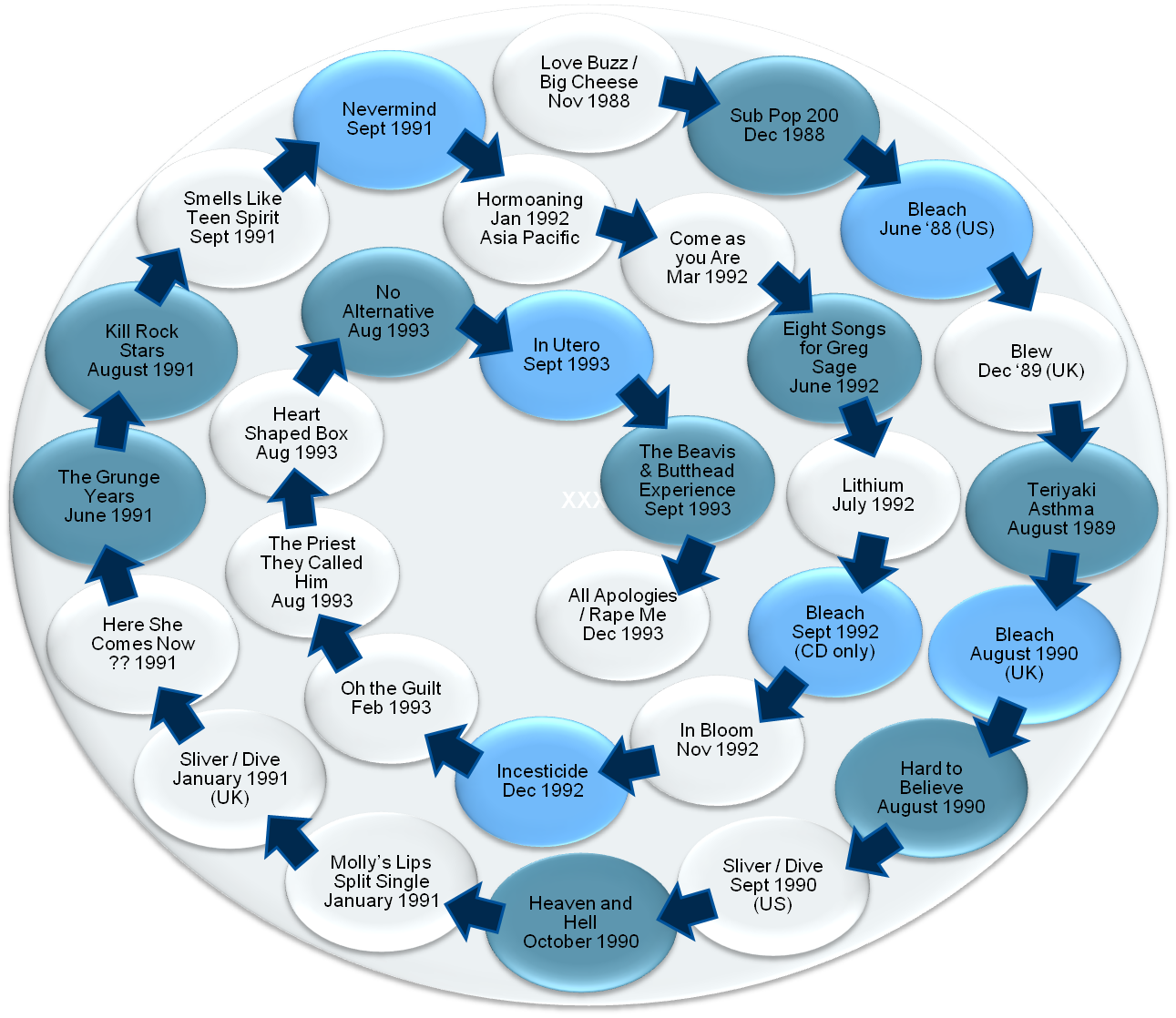
Intriguingly, there’s a suggestion that Nirvana may have been equally aware that succeeding meant keeping product in the market, keeping regular music releases out there to draw in fresh audiences and keep existing ones ‘warm’. Take a look at this graphic attempting to show the timeline of Nirvana releases (dark blue = compilation appearance, light blue = album):

Picture1

Apologies for missing Sub Pop Rock City out (no confirmed month of release but sometime in 1989) and for placing Teriyaki Asthma in the wrong location. Essentially, for all the low amount of money available to Sub Pop the band’s only significant gap in the release schedule is from December 1989 to August 1990; eight months. There’s then a fairly steady drip of material emerging right through until another short gap from February to August 1993 in the run-up to In Utero.

It was already very clear that Nirvana’s record labels targetted specific markets — the Blew EP hitting the UK market to coincide with touring, the Hormoaning EP hitting the Pacific audience to coincide with touring. It’s also simple common practice to release a single to trail an album — Smells Like Teen Spirit for Nevermind, Heart Shaped Box for In Utero. In other words, it’s already clear that the timing of some Nirvana releases was dictated by commercial considerations whether regional or promotional; heck, Incesticide was their ‘Christmas album’. What interests me more is the way the gaps between albums are filled with regular releases, particularly on Geffen where there seems to be a sharp awareness of keeping music emerging. Certainly there was an awareness of the need for other outlets beyond the main singles and albums — In Utero was the first time Nirvana had staged an album session and made sure to record sufficient usable outtakes that they could fill other releases; Nevermind had relied on the remains from January 1991’s studio outing, plus live outtakes, but had still forced Nirvana back in studio in April 1992. For whatever reason, Nirvana’s method at Pachyderm Studios in February 1993 guaranteed they didn’t have to return to the studio anytime soon.

I’m not saying that the ‘master plan’ was flawlessly executed. Certain releases were delayed and so forth, decisions rested in the hands of a variety of record labels. But neither was the release schedule random given the significant investment to be made in pressing, promoting and distributing releases; the record labels didn’t pour out money purely for fun or without a desire to create an impact. Especially while on Geffen, there simply was never a gap of more than a few months.

Axl Rose: The Alternative Way ‘Out’

I finally, at long last, finished reading the “Whatever Happened to the Alternative Nation?” articles yesterday:

http://www.avclub.com/articles/part-2-1991-whats-so-civil-about-war-anyway,46507/

In one piece, the very reasonable comparison is made between Axl Rose and Kurt Cobain. The obvious comparisons – small town misfits, serious parental issues, physical similarities which is why they could both fit the required rock star mould of 1991-1992 – are made but the most crucial one is the yearning of each individual for control over their own creativity, a desire to be free of the constraints either of poverty or of management, fans, press and so forth. The crucial realisation, of course, is that a human personality is such a complex accretion of memories, moments and impulses that despite the similarities between the two individuals, an identical outcome couldn’t be guaranteed.

In the case of Axl Rose, aggression was always launched outward; violence toward girlfriends, trash-talking in the media, pointed and explicit lyrical tirades, a refusal to ever take public responsibility for anything that has ever been less than ideal at any point in a twenty-five year musical career. In the case of Kurt Cobain, the aggressive impulses within him were, near constantly, aimed inward; he would commence criticising his own music in public almost as soon as it arrived in the hands of the public, his lyrics dripped in disdain for his various supposed failings, he talked about himself in a persistently downbeat manner in interviews and in private with the hangdog style drawing understandable sympathy. Yet Kurt’s own record wasn’t devoid of violence or threats thereof; he readily admitted to the voicemails left for the two authors attempting to write a book on Nirvana in 1992; he cheerfully made threats related to the Vanity Fair article; domestic disputes did lead to police call-outs… Neither artist was devoid of minor sins; Axl was far more persistently hubristic about it all – Kurt was a sweeter creature when he wished.

Yet there are similarities in their reaction to audiences and the other demands of fame. Axl Rose’s crimes against courteous concert-hosting are well-known ranging from provoking a riot at the St Louis show, to more recently slow-clapping a fan out of the venue, to massive delays in shows, walk-offs and so forth – if it wasn’t Axl Rose involved some would consider it reasonable to walk off stage if things were thrown at a band. Kurt Cobain, on the other hand, had his own sins such as significant numbers of cancelled shows, responding to on-stage provocations by walking off (or in the case of one show peeing into a shoe that was thrown at him), more positively (in some ways) perceived acts of sexism by audience members were responded to with Nirvana halting shows and having a go at audience members. In each case, the band took it as their role to police the audience and react to what they didn’t like.

Yet Axl Rose represents something else within the Nirvana story; the way out. Axl Rose’s willingness to ignore the wishes, hopes and desires of all other individuals made him supremely able when it came to building a life outside of the spotlight. His sobriety, compared to the persistent drunkenness or drug issues of his band members, made him the only able to play dictator. Kurt, by contrast, was dictator of Nirvana yet increasingly was unable to steer the ship. Both men increasingly rejected contact with the press if they couldn’t control the nature of the dialogue, similarly time in the studio became a scarce commodity for each band; Kurt barely showed up for band sessions after Nevermind, Axl meanwhile did much of his work for Use Your Illusion separate to the band, then didn’t even appear in studio alongside them for the recording of The Spaghetti Incident? album. A significant area of contrast, at first glance, would be the difference between Nirvana’s relative retreat from live performance versus Guns n’ Roses embarking on mammoth world touring throughout 1992-1993. Yet looking a little further back, Guns n’ Roses gave only 21 concerts in 1989-1990, a wonderfully comparable situation to the 21 shows Nirvana managed between March 1992 until October 1993.

While Kurt Cobain’s control over his environment increasingly fell apart, Axl’s increased as he purchased the Guns n’ Roses brand, shed recalcitrant band members, dispensed with managers and girlfriends until eventually all that was left was Axl and his loyalists. Kurt went through a similar distancing from his former comrades, yet his retreat was toward the companionship of his wife and child on the one hand, and drug buddies on the other. The contrast between the chaos around Kurt and the increasing stillness around Axl is noteable. Axl’s decision was one Kurt Cobain would have envied. Axl never stopped his creative endeavours, this was a man who taught himself rhythm guitar in the early nineties purely to allow himself to more fully realise his own visions and to dictate directions to his band, yet one who simultaneously was willing and able to hook in a large number of collaborators to be spliced into the ever more gargantuan constructions he was trying to fashion. Axl simply stopped participating in the business of music; no press, no live performance, “no” to whatever management ever asked of him (including one alleged incident when apparently, having been pressured to finish some recordings, Axl drove an SUV over the CDs sent to him by his manager) – he refused to be made to treat his music as just a job, or to kowtow to any expectations.

It relied on a very visible rudeness and an unwillingness to please anyone except himself, it needed him to be free of any need to earn money – which was something Guns n’ Roses’ success had already earned him – but Axl Rose did make the great escape. It led to him being criticised rather than praised given he wasn’t playing the game, the music industry machine had been cheated of one of its biggest stars, but Axl Rose survived and made music the way he wanted to regardless of external pressures and now tours, pretty well, as and when he wants. Kurt Cobain rejected the performing, recording and talking aspects of his role, was towed back into it for the In Utero tour and once again ran from it. Yet he didn’t have the same cocoon ready to receive him; and his music hadn’t yet opened up to significant quantities of collaboration; the expression of his visions rested firmly in his own hands and he wasn’t used to letting others craft the sounds around his words or vice versa. He was early in a journey it took Axl Rose from 1987 until 1995 to execute; Kurt Cobain was barely two and a half years into his flight from the music industry.

That’s often how I look at the aged Axl Rose, not as a has-been or a man out of touch with the music world and begging to be let in. Axl Rose shows no interest in whether his record company makes money, there’s not been much mellowing in his refusenik attitude to the media, he still comes out to play as and when he darn well feels he’ll perform his best – it’s very easy to dislike his way of doing things but I think he’s a man who rose to the peak of the industry with all its necessary compromises and pressures, then found the strength and stubbornness to walk away. Kurt Cobain would have loved to take that same walk but had a conflicted desire to be decent to people and to fulfil his responsibilities that meant he couldn’t leave but nor could he stay.

Anyways, here’s Axl Rose on Jimmy Kimmel. Funny, and I want a Halloween tree:

I Admit It…

No excuses, no explanations of long-winded absence of significance…I simply ran out of time and that was the end of that today…Sheesh. 18.00 and still nothing? I think it’s clear I’m ready for holidays to commence next week…Back to normal tomorrow. Slipping! Slipping…

In the meantime, here’s something I saw back at the weekend. I confess I rather like jigsaws at the moment, I enjoy the patience. This one, I think you’ll agree, is either the triumph of capitalism in a comfy box or just quite fun.

Nirvana_Jigsaw

The Myth of the ‘Alternative Nation’

One of the tragic findings of market research firms and sociologists is that when enough people are lined up under an overall guidance, personality makes surprisingly little difference. Individual morality and beliefs fade, not because the group imposes will on the individual, but because the individual and the group work together to find the point of agreement at which they can coexist while the central decision of the group remains unchanged. It’s simply a case that there are significant boundaries to how exceptional an individual can be – on multiple levels the choices available are constrained by social norms, educational structures, physical requirements, the need to exchange/interact. We’re only exceptional by comparison to a norm, the depth of our exceptionalism relies on what the norm is and can stretch to. It’s why a modern western society can be so accepting of a diversity of life choices and still pull toward an imaginary centre, even without laws mandating a set social reality, and simultaneously why most “alternative lifestyles” aren’t more than a few steps from the norm, they’re expressions of an accepted consensus. That doesn’t mean individuals disappear, it just means the overall movement continues regardless.

That’s where the purveyors of the idea of an ‘alternative nation’ and Kurt Cobain, with his oft-expressed annoyance at the nature of his audiences, both proved tragically deceived. What they were, in fact, doing was observing an overall cultural moment then trying to claim that the music should mean the audience was a specific and unified phenomenon. This meant attempting to place a box round an amorphous and ill-defined component of the whole of late Eighties-early Nineties youth then painting music over the top of them as if music was so clearly decisive in defining social values. Too much energy was invested in setting up an imaginary conflict between those listening to heavy metal, who as a consequence were supposedly macho and sexist; versus those who listened to the next fashion trend in music who were apparently purveyors of enlightenment. Essentially distinguishing aspects of the front-men, characteristics of the band identities, were observed and then assigned uncritically to the audience as if one was a simple reflection of the other. It produced a simplistic vision in which you, individual music consumer, were not simply listening to Axl Rose or Kurt Cobain, you were merely a blank template through which the media-distorted and accentuated aspects of their personas were projected.

As an aside, the false nature of the ‘alternative nation’ hypothesis set up a moment in which Axl Rose, as a huge fan of Nirvana’s music and of up-and-coming currents of alternative music such as industrial, was fundamentally precisely the alternative consumer being tagged as the ‘alternative nation’ at the same time as being held up as the pantomime villain the ‘alternative nation’ was attempting to topple. The ‘alternative nation’ was a ragged tarpaulin hung over a very broad tent of people and saying nothing about those within its confines. Instead of seeing the gap with reality and then reacting by halting the lazy attempt to read the characteristics of the audience from the item hung over their heads, the challenge was resolved by an appeal to invisible enemies; the claim that some parts of the audience were illegitimate, unworthy, untrue. Of course, as usual with these kinds of witch-hunts, no one actually believed that they could possibly be the person being targeted. It would have been a lot more true to simply recognise that whatever comments could be made about the actions and beliefs of Kurt Cobain or Axl Rose, those actions and beliefs belonged to those individuals and were true or untrue of most of either audience because those two individuals were inherently just part of the generation making up the audience rather than superior to it.

The idea of an ‘alternative nation’ fundamentally undervalued the audiences. The bands tagged as the representative voices of a new generation didn’t arise and then create the audience; those bands arose because that audience was already in existence – the fact it took the means of music production, distribution and promotion time to recognise that there was a music consuming audience, with liberal social values, that would be interested in listening to something more than Genesis, is the crux of the issue. The audience itself was already there and consisted, like any audience, of those who can critically listen and distinguish between fact and fiction and who do think about the perspectives the bands are relaying; plus those who critically listen but primarily to the music rather than the lyrical philosophies and intent; plus those who could give a darn either way. The idea of ‘alternative nation’ was essentially an elitist view in which the masses slavishly follow the ‘great men of history’ and therefore are defined as a single bloc, with a single intent – rather than a temporary accretion of range of individuals with a range of reasons for listening. It suggested that you, as a member of that audience, regardless of whether you were in a music venue or listening in a public or private location, were indistinguishable from someone in a completely different location.

To reemphasise, it relied on overrating the unified nature of music audiences; a few thousand people in a room pledged to deliver a particular social/political change is a movement, a few thousand people with nothing else to do on a Saturday night and a desire to pump fist/head is just a crowd. Consequently, whether that audience listened to Guns n’ Roses or to Nirvana was a foolish distinction to make; the audience listening to either band didn’t base their views on gender, race or sexual orientation wholesale on the politics of the band they were observing.

The belief that there was ever one single audience for grunge, or more specifically for the music of Nirvana/Pearl Jam/Alice in Chains et al., and that it wasn’t, at least from 1991 onward, primarily a mainstream rock audience, relied on an overestimation of the difference between rock music and this particular sub-category. The music had fed – just as Guns n’ Roses, Poison, Whitesnake did – on Led Zeppelin, on the Beatles, on Black Sabbath, on punk and emerged with a different sound but a vast range of shared characteristics that made them close brethren. If you wanted to state that those specifically pledged to the K Records DIY scene, or those ascribing to Riot Grrl, or a living within one of the small local scenes of any music subgenre that defined itself not be sound but by a particular methodology or philosophy, therefore derived actions or behaviour or opinions from the music – you’d have a case. But within the melting pot of the mainstream, a non-‘scene’ with no core pledge or commitment, trying to distinguish the fans was ridiculous…

…Except it did serve a purpose. Kurt Cobain felt at times he had been rejected and spurned as a sell-out by those who remained in the K Records circle; to what extent this was true versus being representative of his own inner conflicts is hard to say but I’ve yet to see any comments attributed to any of the key figures in the underground scene doing anything other than celebrating Nirvana. From mid-1992 Nirvana’s sound was refocused, attempting to push away from the mainstream tone into which the band had dived. In the background, launching attacks on both Guns n’ Roses and Pearl Jam simultaneously set up a distinction between a supposed ‘past’ generation, represented by Guns n’ Roses who were busy selling seven million of each volume of Use Your Illusion at precisely the same time Nirvana was declaring them irrelevant, and a ‘false’ generation of fans who preferred Pearl Jam and therefore weren’t real fans. The fact that Nevermind (and In Utero) were selling to precisely the same hard rock audience as Use Your Illusion I and II or Ten or Vs was the background reality; the fact that listening to a record isn’t the same as endorsing all its views was reality; the fact that Kurt Cobain despised the sexist, homophobic, racist and macho element of his audience; none of these made the existence of a cohesive or coherent ‘alternative nation’ a reality.

Instead, that idea rests in the realms of utopia, like the Leninist idea that a bourgeois vanguard could spark the ‘natural proletariat’ to rise up and take over the revolution; or that anyone and everyone will become an entrepreneur if they’re simply encouraged by changes to the tax system; or that creating a monotone nation with a unifying strand of race, religion or creed will miraculously remove all social tension. Kurt Cobain’s demand in the original liner notes for fans to “leave us the fuck alone!” was always a hopeless request for people to deselect themselves and felt more like a sop to the conscience of the writer than a genuine avenue of progress. The myth of the ‘alternative nation’, unlocatable, hidden, impossible to distinguish from simply ‘the young’ laid a heavy burden on Kurt’s shoulders at the same time as fuelling a good many playground battles but it was always destined for disappointment as reality warmed the Earth and the idea evaporated.