Yesterday we mentioned the opportunity for the exceptional, the unexpected. Today I present to you the evidence that yes, reality can break its rhythmically predictable bounds. That evidence comes in the form of the MTV Live and Loud performance of December 13, 1993.
A single, barely fluctuating set-list persisted throughout December 1993 with only minimal changes right the way to the grand finale on March 1, 1994. The only time that a significant step away from the normal sequence occurred was for this single performance broadcast by MTV. In amid a tour consisting of a barely shifting choice of songs this performance freshened things up.
At first glance it seems a fair conclusion that Nirvana still felt TV appearances had significance, had more focus from senior management, and therefore had to be taken seriously — it can be seen in the fact that the band bothered having a proper rehearsal for it running through ten songs. The question follows whether the band needed to create a fresh one-off set-list to match the show time allotted and whether that show time was arbitrary or was set by MTV; the show featured just 18 songs compared to between 22 and 25 at every other show that month.
It’s clear that Nirvana used MTV Live and Loud as a showcase for In Utero. The band had to cut songs to match the time permitted. They cut between 3-5 songs off their normal set from Nevermind, but only 2-3 from In Utero; meanwhile they kept their three usual grabs from Bleach (Blew, About a Girl, School) and Incesticide’s usual sole representative (Sliver) — no cuts lost from the commercially lesser albums despite the sense that would have made at an event about promoting the band to the mainstream audience of MTV. A normal set list at the time featured the following breakdown divided by album (various dates for comparison):
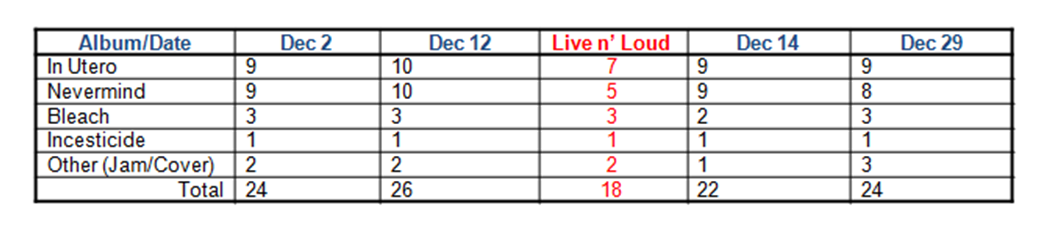
It made perfect sense to cut from their best known album if the priority was simple boredom, however, as with my commentary back in December regarding MTV Unplugged in New York) there appears to be a similar refusal to give MTV the favourites given an aversion to Nevermind doesn’t affect them at any other point in the tour. The most glaring case is that this is the one and only time in December that the band doesn’t play Smells Like Teen Spirit. In fact it’s one of only nine occasions on the whole Oct 1993-Mar 1994 In Utero tour that the band didn’t play it; the last time until Nirvana’s final gigs on Feb 27 and Mar 1, 1994. Also, it’s the only occasion throughout the whole tour when Nirvana simultaneously cut In Bloom — another crowd-pleaser.
Certain cuts make absolute sense in certain contexts; the removal of the mellow Polly, Jesus Don’t Want me for a Sunbeam and Dumb are understandable deletions — bringing Lori Golston’s participation on cello down to a barely audible part on two songs — if the desire is to maintain tempo uber alles just as surely as they were extremely reasonable additions for MTV Unplugged in New York where the contrasting desire was to the fore.
The opposite desire is also visible, the urge to increase volume and heaviness; according to the Nirvana Live Guide the MTV Live and Loud appearance was the final time Nirvana finished a gig with a rendition of Endless Nameless and one of only three appearances it made after October. On this occasion they spent a full fifteen minutes, a fifth of their time on stage simply making a glorious and utterly un-MTV friendly racket. It’s the most extensive destruction Nirvana staged at any point in the In Utero tour, a harking back to former stage-wrecking glories that had since been given up. I also suggest it served a function; it meant Nirvana could fulfil an allotted stage time while simultaneously cutting short the amount of usable material MTV had to work with. The band had simply walked out quarter of an hour early during a previous live appearance on MTV in 1992, this time the sense of time-wasting is tangible — look how much aimless yet calmly methodical activity Kurt persists with during that final spell; ramming the guitar into the speakers, ‘baseball batting’ the angel stage set, treating his guitar as a skateboard, a persistent effort to hit the ceiling with his guitar, lots of running directly at cameramen who back away nervously, or alternatively moving away as they try to shoot him.
It returns us to the question of running time — a Nirvana show in late 1993 consisted of well over twenty songs, perhaps with a jam on the end but usually not. On this one occasion the band played 16 full songs then fifteen minutes of noise — they could have fitted at least another four songs in but for whatever reason chose to resurrect the noise jam and destruction rather than play out another tranche of hits. It’s sad, however, that at this point in time, the urge to change meant cutting from the normal set-list rather than thoroughly revising what the band was capable of playing together. The absence of rehearsal time, of time together, was showing.
Throughout the audible antagonism toward MTV there’s quite a few element of further aggression. For starters he beckons the audience on stage, anathema to MTV directors who might prefer to look after their expensive cameras rather than face an stage invasion by adrenalized mosh-pit junkies. Around that Kurt amuses himself spitting on camera lens forcing a switch from camera to camera as they clean the previous one — he’d done something similar at the start of year, exposing himself to a camera on stage in Rio de Janeiro. The applause to the audience at the end is a sarcastic move taken direct from comedienne Joan Rivers who usually starts a gig (and ends it) insinuating the audience are performing seals.
MTV Live and Loud was the last significant deviation from script for Nirvana. It was a last defiant roar at the cameras, a refusal to play to or please the wider corporate audience (regardless of the desires of the audience in the room) and yet another reinforcement of Kurt Cobain’s highly uncooperative relationship with TV that ran all the way through Top of the Pops, The Word, Saturday Night Live and all the band’s MTV performances.
I reedited this at 22.00 UK time because the image that had stuck with me all day was exactly the kinda overloaded final thought that journalists usually end an article with – all the image consists of is Kurt Cobain, alone on the stage for the final five minutes of the show, menaced by or menacing the cameramen, trying to throw is guitar as far up and away as he can, completely divorced from the band and obsessively going through whatever internal processes that keep him there jerking from one act to the next in a whimsical and unhappy looking manner. Take a look, isn’t there something a bit scary about it in retrospect? Maybe. That’s the problem with final images, they never live up to billing.
 Nirvana Legacy