Nirvana Live: 1987-1989

Tail end of last year we started looking at a chart showing the first appearances of Nirvana songs in concert as detailed at the Nirvana Live Guide — shall we continue?

New Originals_1987-1988

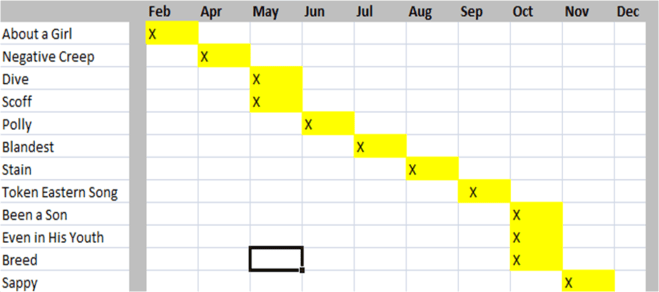
Naturally it’s worth disregarding the tranche of new songs in March — anything they played was by definition a new performance given it was Nirvana’s first show. What’s most noticeable really is how many of the songs emerging in 1987 and the first month of 1988 were simply discarded; Hairspray Queen, Aero Zeppelin (these two until 1992), Beeswax (until 1991), Downer, If You Must, Pen Cap Chew, Annorexorcist, Vendetagainst, Erectum/Raunchola — most of an album is thrown away by the end of January 1988. The speed with which new songs were appearing would be impressive were it not for the fact that the band wasn’t exactly overworked at the time so there was plenty of time to come up with new songs. The issue was perhaps one related to the nature of the songs being created — Nirvana’s 1987 identity lay in relatively complex new wave songs, with extremely long-winded lyrics, hardly conducive to fast preparation. To be fair, Kurt Cobain was honest in saying that he was hardly a constant or prolific writer, he relied on catching the moments of inspiration and getting them noted down, recorded, before they burnt out. 1987 still relied on three year old songs refreshed and reprised from their Fecal Matter form to flesh out the setlist. On the other hand, wow, almost every month Nirvana perform (and for which a set-list is available) there’s a new song featured. The band were moving at speed.

Of course, particularly in the early years, we’re looking at a record with gaps — a particularly low percentage of set-lists from 1987-1988 are present, even in 1989 only just over 50%. Given Mr. Moustache and Sifting were present in vestigial form back at the June 1988 recording sessions for the first Sub Pop single, it’s likely they made it onstage for the first time during the seven-eight shows seen between that recording session and the next full set-list on October 30. Likewise it seems unlikely that the apparent appearance of Blandest in July 1989 was the first or only time the song received an airing before its abandonment:
New Originals_1989

What’s also interesting is the ‘late’ arrival of a handful of the tracks from Bleach. A good portion of Bleach was written long before the album session, however, there was significant rewriting of Blew, Sifting and Mr. Moustache after their first appearance and as late as mid-December (evidenced by the footage captured on the With the Lights Out DVD.) Meanwhile, the fact Negative Creep and Scoff don’t make any showing of any sort until April-May 1989, though partially a consequence of the long gap in the record, also suggests that those two songs specifically were last minute hurried additions to Bleach; the brevity of their lyrics likewise.

The nearly uniform month by month drip of new songs is quite remarkable in 1989, December is the first month in which the band play that year (even if only a smattering of shows) in which they don’t chuck either a fresh original, or a rarity into the mix. It says a lot about their desire to keep the experience of playing entertaining that they vary their shows so much. It made sense in 1987 through early 1989 when the band were repeatedly replaying Washington State venues (take a look back at the maps on this blog) — they’d be seeing the same audiences quite regularly — yet, from mid-1989 they were setting off on their travels, the audiences were brand new to Nirvana’s performances, the knowledge and trade of Nirvana rarities was minimal, the only people who would know it was a new song, or an abandoned track, were the band. I feel that it was for the band’s own pleasure that they made these efforts to vary their performances.
Kurt Cobain: Hell (and a Happy New Year)

IMG-20121222-00040

Written by James Joyce while at college:

“…never to be free from those pains; ever to have the conscience upbraid one, the memory enrage…ever to curse and revile the foul demons who gloat fiendishly over the misery of the dupes, never to behold the shining raiment of the blessed spirits; ever to cry out of the abyss of fire to God for an instant, a single instant, of respite from such awful agony…”

Joyce was describing a visceral vision of Hell as a physical and simultaneously mental experience in which torture took place both upon the body and the mind.

Not that I’m becoming monomaniacal or anything — I’m starting to feel like a vicar on a Sunday morning beginning a sermon “…And THAT made me think of God/the Bible/blah blah blah…” in relation to any experience of life whatsoever — but I’d been trying for weeks to summarise how difficult Kurt Cobain’s life seems to have been. This quotation came closest.

Kurt’s life, by the end of 1993, involved physical pain (from an eternally undiagnosed stomach ailment) along with the damaging effects of persistent drug abuse including overdoses and what must have been regular (and uncomfortable) comedowns; he felt buffeted and lacking control over the persistent demands of music as a career — unable to find peace when called on by management, band, press, fans; he looked to the future with fears including whether his daughter would inherit his wounded nature, whether his marriage could survive, whether he had the money to avoid being flung back into penury and employment (he’d never enjoyed working for a living); as In Utero shows he was a very angry and frustrated man at this point, ferociously defending his family from the intrusions of muck-raking journalists, the authorities, in fact anyone who felt they could comment on his life — there’s a tiredness within In Utero, an exhaustion.

On top of this, his creative muse seems to have burnt itself out — this can’t have failed to escape his notice, that the crucial thing he had achieved in life had ceased to give him pleasure or to flow as naturally as it had until hitting age 25, he must have worried if he was done already. His friendship group, his social life, had shrunk away to nothing, core relationships (primarily with his band and wife) were troubled at best robbing him of a primary confidante and isolating him (semi-deliberately) from others.

A further issue with Kurt Cobain is the way he seems to have had a deeply active conscience ‘upbraiding him.’ His songs lavish nothing but blame and criticism upon his own shoulders; as the clearest cases he writes Lithium on Nevermind and All Apologies on In Utero calling down responsibility for his situation upon his own failings. His suicide note dwells on the same elements; he doesn’t lash out at the world, he simply cracks a sardonic half-smile and points out how useless he feels he is and how much of a danger to his daughter’s future happiness — that’s a phenomenally harsh thing to think of oneself, that one’s personality is so toxic it could pollute one’s child in such a way. There’s not much funny in his regular self-flagellation, no matter how sarcastically phrased — the same joke replayed year-after-year finding different ways to call himself a bad person; he doesn’t even blame anyone for it, not even his parents, he seems to feel that he was an unloved and unwanted child because he deserved it like the figure at the centre of Scentless Apprentice.

With all this going on, what aspects of Hell were not being visited upon him in his view? He had the physical pains, the conscience, the anger, the audiences he felt were gloating over his predicament, the absence of relief or visible hope. Whatever responsibility he bore for this perception of the world, it’s a brutal blend wrapped up in a slim frame and a lot for one being to carry day-after-day.