All Respect to McCartney…But.

http://www.guardian.co.uk/music/2012/dec/12/paul-mccartney-kurt-cobain-nirvana

Please imagine the first paragraph of this post as a morass of colourful swearing interrupted by attempts to draw breath and come up with something that beats the imagination of the previous elaborate expletive. It was looking ever more likely these past few years that the surviving members of Nirvana (version circa 1990-1993) were ever more likely to get together more formally. A charitable examination would compare it to the period of time it took Johnny Rotten to become comfortable playing Sex Pistols’ songs while on tour with Public Image Ltd, then the ongoing time before the surviving Sex Pistols were able to get back on stage together. Alternatively, perhaps the span of time prior to Jimmy Page and Robert Plant getting together for the No Quarter collaboration and then the, eventually, stage appearances of the remnants of Led Zeppelin. It takes a while before one’s own past feels like a costume one would wish to inhabit again.

On the other hand, a less charitable view would be that gazing into one’s past happens once one’s inspiration, one’s vision of the future, runs dry. Kurt Cobain is a fair example of that (in my view) given the covers he played, the originals he (apparently) was practising in his basement, the calls to family members not seen in a decade, addressing the suicide note to his childhood imaginary friend… Again, Johnny Rotten is a good example — by the time he began singing the odd Sex Pistols’ song he had shed the whole of the first (and best) edition of PiL and was about to start the long decline in PiL’s creative energies that led eventually to the Sex Pistols reprise. In the case of Foo Fighters…With all due respect to a really cool bloke, it’s a long time since Foo Fighters set the world alight musically and a while since they had a new musical idea. It’s understandable, to me, why Dave Grohl might be open to looking back to Nirvana. Krist has barely been involved in music in years yet has recently looked like a man more than happy to acknowledge his part in the most important rock band of the past few decades. Paul McCartney meanwhile is a very pleasant bloke, a surprisingly underrated musical and lyrical talent compared to his former Beatles’ comrade John Lennon, and a willing collaborator with anyone going. But. He’s also a guy with a voice now on its last legs if the Olympics 2012 performance is anything to go by and one who hasn’t had a genuinely fresh musical thought since before Nirvana even existed.

I have a feeling the story is being over-hyped; a one-off charity performance with celebrity friends (see the Living Like a Rock Star post from last week) likely consisting of a couple of the softer-edged Nirvana tracks, a smattering of Foo Fighters songs plus some Beatles classics is a perfectly worthy endeavour but, no, it isn’t a reformation. And in the end, it’s harmless. Given Kurt’s respect for The Beatles, having Paul McCartney sing is songs would probably tickle his ego no end. The fact that it turns Nirvana into a slightly fluffy cabaret act doesn’t bear thinking about…Just focus on the money for a good cause and pray no one gets it into their heads to call it Nirvana, or, worse, to persist with it beyond this one-off display.

1992-1994: Maps

I don’t want to lose whatever respect or credibility I’ve earned with you but I confess I’m listening to Pavement’s Slanted and Enchanted for the first time ever today. Apologies for delay too, office systems down so all a bit chaotic.

Now…As promised, the conclusion of Nirvana U.S. touring in map form! Though not the Salem of witch trial legend, it still seems neatly coincidental that Nirvana’s most testing year would commence in a town of that name. While previous years have taken me two or three slides to capture, the whole of 1992 can be taken in one:

1992_Shows

I even abandoned the naming convention I’d previously adopted given Salem is the only ordinary looking show on the map. Nirvana essentially abandoned America for the full year; two TV shows, two benefits, two secrets. If it wasn’t for the thirty days out in the Pacific (Australia, New Zealand, Japan, Hawaii), and the smattering of European festival shows, it’d be entirely possible to declare the band missing, presumed dead. I’m being gentle including the TV shows.

It does explain some part of why, despite Nirvana being an American band, something like Reading 1992 should loom so large in the popular imagination; the entire peak of Nirvana’s fame, as far as live concerts went, was spent off abroad at these kinds of show. Reading would have been one of the view shows all year where a massive press contingent could be guaranteed. It’s precisely the reason Britain receives tonnes of U.S. news; there’s lots of footage and reportage, it’s therefore cheap to buy and as a result we all get to learn it.

1993 was basically more of the same; America’s finest nowhere to be seen — I’m being kind including Saturday Night Live just to expand the engagements:

1993_Jan-Sept_Shows

That changes, however. The map becomes almost impossible to follow given how much the band crams into the final months of 1993. This is the most extensive touring Nirvana has done in the U.S. in their entire history. Looking back at past posts, at the maps for 1991, 1990, 1989, there had been big tours before but the scale and coverage achieved this time around was unprecedented. Of course, one thing to point out is that this kinda touring isn’t exactly uncommon for bands — this was the age of multi-year tours taking place, show after show… Nirvana staying out for the best part of three months was long by their standards. Having kicked off in Arizona (red line) the band took the obligatory pop over to Canada between Ohio and the start of the North-East U.S. visitation (blue line, November) and then the criss-crossing of central and western states in December:

1993_Oct-Dec_Shows

1994 was the usual post-Christmas smattering of appearances. On this occasion, however, given the finality of ensuing events, it seems apt that Nirvana should retreat so far into their own past. The map needed to show the band’s U.S. presence in 1994 barely needs to show more than the map for 1987, or 1988—they hop across the borders of Washington State to two locations, they head home, then gone:

1994_Shows


Aging Gracefully

http://www.politico.com/news/stories/1112/83331.html?hp=l13

In their heyday, Nirvana were atypical rock stars. It’s heartening to see that Krist Novoselic, as much as Dave Grohl, has persisted in evading the lame clichés, the tedious spectacle of mainstream rockers behaving like grey-haired apes. I talked the other week about Bruce Pavitt’s continued efforts to support grassroots music (his book Experiencing Nirvana will split profits with The Vera Project http://www.theveraproject.org/) — it’s another case of a denizen of the grunge scene continuing to make a worthwhile contribution to things that are important to them.

In the case of Krist, his long involvement in political causes is well-known particularly from his publication of the exceedingly readable Of Grunge and Government. At the time of Nirvana, Krist arguably formed the band’s heart contributing substantial amounts of its humour and leading the band into several of its political engagements notably against censorship laws and the raising of substantial funds for Serbian rape victims. To see him move on to the FairVote organization (http://www.fairvote.org/) has been heartening.

The generation that had come of age in the time of mass movements wrote the script regarding Generation X; they defined the youth of the late Eighties and early Nineties as some kind of passive, uninspired and morally/socially disinterested mass. This was always a simplification, one that could just as easily be applied to any generation, based on an inability to comprehend a generation that didn’t use massive organisations as their key method of political expression. That reaction was certainly real; it was a move away from bodies that imposed a set persona and character upon their followers. Instead individuals were equally capable and willing to commit time, money, energy to causes — they just didn’t feel that being in favour/against one issue meant they were part of a single congealed mass (left wing, right wing, etc.), nor that it meant they automatically agreed with other related or unrelated causes or issues.

The ‘slacker’ tag overlooked the fact that the scene from which Nirvana emerged, and a substantial amount of work within the alternative music scene, was focused on causes not as easily reduced to mass appeals for cash. A lot of the ‘new politics’ couldn’t be solved that way given they were about attitudes rather than the presence or absence of a political permission, or a physical element. Krist exemplifies Generation X, showing the forebears of modern activism that, despite not lining up alongside the megalomaniacal LiveAID style of action, a generation wanted to seek change and had decided to do so by focusing locally, attending to the lives of those around them rather than to distant abstracts, and were attentive to things that were less photogenic, less interesting to TV news, but were no less worthwhile.

This doesn’t, of course, mean that there weren’t weaknesses in the political nature of the generation. The absence of a specific organisational identity — such as a political party, a cohesive movement with an administrative core, a trade union, a web of think tanks or entities (as existed for the U.S. Conservative Movement) — while laudable in theory (anti-hierarchical! Individualistic! Open to opinions and debate!), made it very difficult for conversations to take place with the wielders of actual power. In a world run via conversations between organisations, where organisations act as the proxy for individual voices, it’s hard for diverse cacophony to have an impact. Again, however, the trajectory of Nirvana — or perhaps Krist specifically — shows a move from individual awareness, to initial actions (marches, protests, concerts, speeches) to committed organisational politics via a defined body.

I take the message of Nirvana to be to engage positively and soulfully with the world. Seeing Krist Novoselic use his middle age, not to turn into another embarrassing wreck, but to fight for something…It’s good to see Nirvana’s heart still beats.

Nirvana in the U.S. 1991 – Maps

These maps take time, apologies for the delay!

The onset of major label time did break up Nirvana’s touring activity, the band barely made it out of the West Coast for most of 1991. In some ways this was the key Nirvana trend, long periods of localised activity, sticking to ‘home turf’ for months on end: Tour_Jan-Aug 1991

Of course, compared to 1987 to mid-1989 that ‘turf’ did now extend all the way down through California with Washington State only soaking up a certain amount of time. The band’s trip round the U.S. in September-October followed a regular pattern with the path set so that after running in circles in the North-Eastern states, most of October was always bringing them closer to home:

Tour_Sept-Oct 1991


Kurt Cobain and Lyrical Meaning

There’s a late 1993 interview on YouTube in which Kurt Cobain, when asked about the meaning in his lyrics, straight up denies his lyrics have any meaning raising his hand in the air and declaring “swear to God brother…”

If he means, “I don’t intentionally write meaningful stuff” he would still be playing loose with the truth; he admits over and again to songs having a story line or an autobiographical element, he just refuses to do so in a uniform way or without disclaimers. If he means “my songs have no meaning” then he’d be either (take your pick) wrong, lying or willfully self-deceptive. It’s a well known fact that, at least after his early writing visible on Incesticide, Kurt often mashed lyrics together at short notice. Again, however, that wasn’t a uniform writing pattern. There’s no evidence of how long the songs written in late 1990-early 1991 took to write but they were written at home, in private, not in the run up to album recordings or on the spot at rehearsals.

Also, the key point is that ‘meaning’ isn’t automatically entangled in authorial intent. If an artist writes a song and deliberately makes it about a specific topic (i.e., Sweet Child of Mine was written, deliberately, as a wistful love song hence the focus of all the lyrics) then fine, its about that topic but it doesn’t mean that the images used aren’t tied to other ideas in an artist’s work. The other way to void meaning would be to do a William S. Burroughs style cut-up in which all lyrics are found and thrown together from other sources – the author doesn’t write any of them. But even Burroughs arranged those cut ups into narratives and stories that he did, deliberately, construct. Therefore authorial meaning was returned to words that didn’t originally have any.

In the case of Kurt Cobain, the fact that he wrote fast, that he wrote things on the spot, actually brings us closer to interior meaning. Why? Because all the words and images poured onto pages came from his internal world without being warped or corrupted by deliberate intention – these words and images were what spilt out of him.

This is why, when studying Kurt Cobain’s life and works, the same themes occur again and again whether in lyrics, in diary entries, in his suicide note, in the authors he payed homage to or in his art work. He didn’t deliberately set out to write more songs about rape than about heterosexual sex – but that’s what came out when he sat down. He didn’t mean to write numerous songs in which the character is restrained, bound, under control – but that’s what came out.

A good comparison would be to query the meaning of a quality film. The Godfather is a film about the Mafia. Well, yes! True! …But it’s also a film about the bonds of family, about inheritance, the corrupting of good intentions…And on top of that it’s a film displaying Hollywood’s love affair with glamorous violence and crime, its relationships with organised crime (the tale is that the word Mafia is never used because the makers were pressured by associates of local crime families) and also the influence on screen portrayals of crime can have on individuals who have modelled themselves on it since then. Kurt Cobain’s lyrics aren’t Transformers; all surface explosions and no depth. Kurt Cobain’s lyrics bear comparison to detailed cinematic work.

The quest for meaning has given too much credibility to his own statements regarding his ‘meaninglessness’ while simultaneously every Nirvana fan looks at In Utero and can add up countless personal references and links to other songs in the Nirvana catalogue. Its part of the reason I adore Kurt Cobain so much; I think he’s, inadvertently, one of the most psychologically honest artists ever to breach the mainstream world and the linkages and connections between songs written across his entire career are quite stunning to behold.

Living Like a Rock Star

It seems that the idea of ‘a rock star’ has been whittled down to a final form easily recognised and described by everyone. It makes it hard, however, to recall how recent the clichés involved are. The entire industry of pop music, let alone rock music (a 1970s creation), didn’t exist until the mid-1950s. In retrospect the worship of Elvis, or the hysterical reactions to The Beatles seem hard to comprehend but in each case these artists were the first of their kind, there was no mould to be filled early in their careers and, afterwards, no template for what a mid-career music star should do or should behave. The association with sexuality (albeit a gentle sexuality at the time) began with Elvis; the drug connection (while quietly present within jazz) surfaced in The Beatles; the wildman image was already appealing and became a core part of the identity we’re describing here thanks to The Rolling Stones.

The Seventies solidified and deepened the ideal that had been forged. The drugs became omnipresent and almost celebrated as a sign of wealth and decadence. The sex became essentially a form of public display with groupies and orgies replacing the quieter awareness that flocks of girls were surrounding the stars. The bad boy image was fleshed out with destructive acts carried out on musical instruments or hotel rooms, flirtations with black magic or Satanism or whatever other flavour of the month would rile people. Again, while historical precedents can be found in the blues (whether Robert Johnson selling his soul or Lead Belly’s repeated arrests for violence) these elements only cemented into an identity at this point, one that would be worn like a uniform in the Eighties rock scene.

Punk stripped down the musical style and rejected the increasing move to omnipotent and untouchable rock god status — yet it did so by retaining the focus on certain core pieces of the, now established, identity; the violence, drugs, sex, the bad (and photogenic) behaviour all wrapped up in a package designed to appeal to an audience on lower budgets. Punk didn’t produce a brand new rock star image, it selectively embellished the existing one in the interests of accessibility – anyone could do it and it doesn’t take much effort to mimic something sordid. The same era also saw the question posed, for the first time, what does an aging star do? The answers were semi-retirement (Lennon), finding God (Dylan), vast over-indulgence (Elvis) or increasingly soft and friendly tunes and plenty of quality-lite collaboration with friends (Jagger, Bowie, McCartney) with the occasional death to spice it up and make it dangerous again.

The Eighties didn’t revolutionize this image; the Eighties were basically a blending of aspects of punk with the now stable vision of the rock stars. What occured instead was a constant escalation into cartoon realms; who could do what, with whom, who did the most – the image of the rock star reached its grand finale. With the mainstream model so rigidly defined, it was the first time there had truly been an underground bubbling away, an all-encompassing term for bands that departed from the image that would be promoted, funded, given access to recording facilities. A lot of the older generation, who had set the model, were now so firmly established that they were now core to the pop scene rather than living separately in a rock ghetto.

Nirvana’s ‘revolution’ was therefore less a case of a fundamental musical shift, it was about the change in the image. The music itself was a merging of existing styles, definitely radio-friendly, not that divorced from existing rock modes. But Nirvana explicitly rejected the rampant sexism, the charmless and nihilistic violence, the self-aggrandisement (marrying models, flagrant consumption, extroverted partying, fast cars…) It didn’t make them saints, or pure beings, but it was the first time a female-friendly, pro-gay rights, enlightened rock image had been projected in an uncompromised fashion since the age of The Beatles and Jimi Hendrix. Nirvana knew it too, they spoke again and again about their opposition to, and difference from, the established view of what it meant to be a rock star, how it was the music that differentiated them from heavy metal, how bored and played out rock was. The glitch in what they were saying was, however, that their problem was not one of music — it was about the entire concept of what being a rock star was. Nirvana didn’t tear down rock music, they tore down the ROCKSTAR.

Having shown how false the image was, it was impossible to put the idea of the rock star back together again. Kurt Cobain personally killed the heroin chic that had ruled since the early 70s by being brought low and, in the eyes of many, destroyed by it all within barely two years of the early 1992 peak of fame. The decline was so fast it retained the ability to actually shock; from peak-to-trough it had never been so swift or so submerged in sordid detail — the junkie baby rumours were important for a much broader reason which is that it killed the sense of deviant fun that had somehow survived even Sid Vicious’ ending (at the time seen as an overdose.) There had been drug deaths before, there had been long declines, but there hadn’t been many deaths while still firmly in the spotlight, few cases in which the grossness of the experience had been so visible to the public eye and so indefensible. It was hard to celebrate the drugs.

Kurt simultaneously wrecked the idea of the all-conquering rock God by abdicating his throne; rock stars didn’t quit, they were immortals who could only be destroyed by outside forces. Kurt Cobain ruined the ideal of the rock star as the most fun a man (almost always a man up to that point) could have by never ceasing to show he despised it. Others had reacted to fame by retreated from the spotlight but it had seemed an affectation that could only be afforded by the very rich; one they’d repent when they needed the income or attention and in the meantime they’d sit very nicely in their penthouses drowning in entertainments. Kurt was the biggest rock star in the world and just at the crucial moment when everyone was looking his way…He laid waste to a few of the clichés. It was fitting that his suicide came with both heroin and a bullet; symbol of hedonism and metaphor of manliness forever stained all in one fell swoop.

There’s not really been much since. Billy Corgan was the last rock star of the old mould but only on record, in person he was very much the new generation intent on hauling down the idol of the ROCKSTAR. The components of the image — drugs, hedonism, sex, self-aggrandisement, destruction — are all still there but the arms race that had flowed from the fifties onwards had ceased when Kurt Cobain one-upped the entire world. There was no way to top what he did, nor to restore the pieces he showed were simply laughable. The baton passed to the world of hip hop which has been busy running through a remarkably similar and tired tale at high speed from initial revolution, through excess, into cartoon, division into mainstream and underground, finally coming ending up indistinguishable from pop music and certainly with not an ounce of rebellion left in it.

Its why the article below stirred a certain nostalgia in me; it fondly reminded me that revolutions rarely demolish what came before, they either adopt them or mutate them into tweaked shapes.

Alternative all-stars join the 25th anniversary of Dinosaur Jr’s You’re Living All Over Me

Rock star guests, casual collaborations among old friends who share vanity labels and private studios, tributes to their own history, the ability to toss half-baked projects out on name alone, diversions into other business ventures and kids kicking off their own bands…It may be enacted by bands I adore, but it all feels kinda familiar. And all with the same friendliness the Travelling Wilburys or Live Aid brought to a previous generation.

Studio Life

http://www.huffingtonpost.com/2012/12/05/dave-grohl-sound-city-documentary_n_2244520.html

The trailer for Dave Grohl’s documentary on the Sound City studio where Nirvana recorded Nevermind has just emerged. I enjoy the snippet where Brad Wilks, drummer of Rage Against the Machine chuckles “we chose Sound City because Nevermind was recorded there,” as if it’s the most obvious thing in the world that less than a year after Nevermind’s recording it had already set such a standard that RATM should want to work there.

The trailer dwells briefly on the death of the studio in 2011 as newer facilities took over and digital became the way of the future — it also implies that the decline of the music industry and the spread of low-cost recording technology has put paid to the recording budgets that allowed dedicated studios to thrive. Yet this isn’t an uncommon piece of the Nirvana story. As well as Sound City, Reciprocal Recording, Nirvana’s key locale, had already closed by mid-1991. It then became Word of Mouth Production and saw one Nirvana session in 1992 until it too closed in 1993. The list goes on; Butch Vig’s Smart Studios (Nirvana, April 1990) went out of business in 2010; The Music Source in Seattle which Nirvana recorded at in Autumn 1989 then again in January 1991 survived from 1969 to 1996 before owner Jim Wolfe closed it down. Viewing the history of Nirvana studio visits means looking over a clutch of tombstones.

It isn’t all gloom of course; Robert Lang Studios (Nirvana’s home for the fleeting January 1994 visit) remains a fully functioning facility, meanwhile Pachyderm Studios (In Utero sessions, February 1993) rolls on happily. Yet, following the trail, means coming across not just the ‘dead’ studios, but the lost. I can’t even find present day evidence of the BMG Ariola Ltda studio where Nirvana recorded in January 1993. BMG Ariola no longer exists as a distinct entity, the facilities themselves are now hidden somewhere inside the Sony identity. The name has gone, the location may or may not still exist, the owners have moved on — until someone furnishes me with the evidence it’s no more than a spectre.

There’s already, however, a sense in which studios were something more than a physical space. By the time Nirvana hit Barrett Jones’ Laundry Room Studios in 1992 it had already moved through four locations in Arlington, Virginia before settling in Seattle. The history page of the official website then shows it shifting through a further four locations from 1993 to present day. The point being that with the studio gear changing, with the location shifting so fundamentally, it’s unclear whether the studio is more than a name. Yet, actually, the name itself has significance. Instead of marking the physical presence of bands in a defined location, Laundry Room Studios remains as a marker of Barrett Jones’ first efforts in his parents’ basement laundry room. So, again, there’s a personal history, this time of the producer and owner, inscribed into the existence of the studio making it (for want of a better phrase) a mind-space floating free of present day location; tethered somewhere in the past.

That’s the wider point hinted at by interviewees in the trailer; there’s a spell in which they sit reciting lists of bands and artists who made use of Sound City. While focused on a single location, the studio’s significance within the trailer is as a haunted house. The past presence of an artist shouldn’t have any relevance to someone recording there but that link back to their predecessors seems to spark smiles on a host of places (“That’s what I’m talking about!” says Dave Grohl to emphasize the significance of studio ghosts.) Past residents act as a mark of taste, a source of inspiration, a reassurance that one has made it; music tourists walking through the phantoms. The studio is decorated to ensure this particular point is unmissable; the cameras trail down walls loaded with memorabilia indicating the people who haunt the hallways and the past records that acted as ancestors — in the sense of being previous Sound City recordings — to whichever album was being made in the present. Pachyderm Studios takes this to a further extreme given it houses a Neve Mixing Console that previously saw service in Jimi Hendrix’s Electric Ladyland studio and the Record Plant where John Lennon among others recorded. Even the equipment in the studio is haunted by those who came before.

It’s often hard to separate a celebration from a lament; there are few tributes until the life of something is passing — memory and remembrance imply a look back at what has gone. When interviewing Miti Adhikari about his involvement in Nirvana’s penultimate radio session, I asked (long-windedly) “the studio in which these songs were recorded, some producers seem to work hard to minimise or eliminate room noise, to what extent did the studio in which the songs were recorded matter to the music created?” I was just meaning the physical conditions.

His answer reinforced the sense that the value of a studio isn’t so much about the technical facts of recording or its physical realities. He replied; “these songs were recorded in Studio 4, Maida Vale. The studio is legendary, as it is easier to name the artists who haven’t recorded there than the artists who have. The place reeks of history and music and anyone who records there is acutely aware of this and wants to play their part in creating yet another bit of history. The sound of the room is the USP and has been loved by musicians through the ages.”

Again, Dave Grohl refers in the trailer to “the social” in music; it seems that a lot of that communion isn’t with those who are present; it’s with the ghosts in the machines, in the walls, with the echoes rolling through the building.

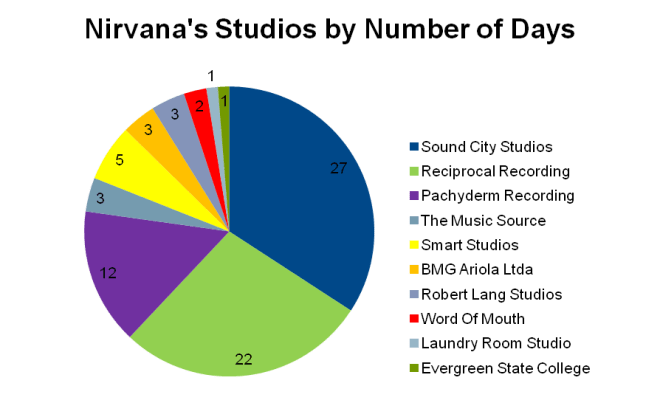
Well, anyways, here’s the breakdown of Nirvana’s time in studio by number of days spent and songs recorded.

Studio_Number of Days

While Sound City was the longest committed length of time Nirvana spent in studio in one go, Reciprocal Recording was the place where a core chunk of Nirvana songs were made. I sometimes wonder if the flitting between studios in 1992-1994 was a physical manifestation of Kurt Cobain’s discomfort with making music…

Studio_Number of Songs

Preferred Remembrance Part II

So what could I imagine being worthy future Nirvana releases?

Well, OK, clearing away what is already known to be on the way — Autumn 2013 will see the Super-Deluxe edition of In Utero which presumably will include the Rio De Janeiro and Word of Mouth outtakes, plus the unmixed versions and leftovers from Pachyderm Studios in February. It’d be nice to see some of the earlier versions of In Utero material also. In some ways, given the drawn out origins of In Utero, with some songs dating back to 1990, there’s potential for quite a span of material to be incorporated.

Moving beyond that, there are enough alternative takes left from studio sessions, plus radio session tracks and TV performances to make for a solid CD (or two) along the lines already provided by With the Lights Out; the outtakes from June 1988, the unreleased Sappy take, the jam performed on Dutch radio in late 1991 alongside takes of Here She Comes Now and Where Did You Sleep Last Night, the audio of Seasons in the Sun seen on the With the Lights Out DVD, the jams from January 1994…There’s enough.

For the anniversary of his death coming up in 2014, however, it would be great to see a Kurt Cobain collection. This would naturally have to, finally, feature an officially approved release of the Fecal Matter demo of Easter 1986 (see Gillian G. Gaar’s book Entertain Us for a really well-argued explanation of why this recording took place later than was thought), could feature more of the radio session with Calvin Johnson from 1990, could finally spit the 1994 basement demos out (and stop teasing everyone with their existence) and could gather up some of Kurt’s wider musical experiments which run into far more unusual terrain than anything seen on Incesticide. I can’t imagine Montage of Heck ever seeing official release but some of the other scraps would be good to hear cleaned up. Such a release could also hoover up some of Kurt’s collaborative work; The Go Team single, the two tracks performed with Earth, Mark Lanegan. In some miraculous future maybe someone will have found the 1982 Cobain demos too…Let’s dream.

Either in combination with that, or as a separate release in its own right, I’d very merrily listen to a two CD set of Kurt’s acoustic (or electric if they exist) home demos. While it’s fair to say that the pieces seen so far aren’t exactly musical triumphs on the guitar front, they do possess a desirability simply because there’s so little material where Kurt’s voice is laid so bare, so stark.

Likewise, there are enough unusual live renditions available that a fully-polished and mastered major label disc would be of genuine interest despite the stirling work done by the fan community. The unusual 1991 take of Vendetagainst (A.K.A. Help Me I’m Hungry) often referred to as Come On Death would be great to hear in better fidelity; the opening jam from the Rio de Janeiro concert would be worthwhile; Curmudgeon, Oh The Guilt, variations on some of the early Nirvana songs likewise; and of course the various songs with alternative lyrics in their initial iterations — a release bringing these together would garner much goodwill from a fan base fed up of hearing yet another carbon-copy edition of Been a Son.

A similar project could gather together at least some portion of the many live covers Nirvana performed over the years. I’ve always adored the version of My Sharona from 1994; Bad Moon Rising and Run Rabbit Run from 1988 are both quality, Krist’s version of The End is great… There’s enough material out there and with a half competent mixing it’d be possible to use the shorter scraps and quotations Nirvana used live to segue between the more fully fleshed out songs. It’d be nice to see post-hoc mixing that actually does expand on the audio experience rather than just being used as a way of punching the listener in the head with VOLUME. It’d be lovely to have a covers collection.

The only other place I can imagine Nirvana going on record (not including endless reissues of full live shows on CD and/or DVD) would certainly be one for the hardcore only…Maybe that would preclude it receiving official support, but who does anyone imagine is forking out for vinyl reissues of Incesticide or scraps of extra Nevermind material anyway? J Mascis recently released an album with his friends under the name Heavy Blanket consisting of a short selection of studio jams. Nirvana’s live jams are intriguing, varied, interesting for refocusing on the musical talents of these individuals — the Nirvana: Live, Tonight, On Tape article by Brett Robinson I shared on Facebook and Twitter yesterday points to a couple of good examples. A single disc selection wouldn’t outstay its welcome, at least not with fans whose ears are open to feedback and raucous sprawls of sound.

That’d be the barrel fully scraped I believe – nothing left. The Swans official website (www.swans.pair.com) has always run an intriguing project offering CD-R issues of a vast number of the band’s performances. If Universal had the patience then a custom-built website offering similar access to the live archive (whether as downloads or with a CD ordering option) would appeal. Beyond that…My imagination runs dry.

…Unless…Unless someone loses their mind and goes down the road of Having Fun With Elvis on Stage — this is worth a look if one wishes to see how bad posthumous recordings can be:

http://en.wikipedia.org/wiki/Having_Fun_with_Elvis_on_Stage

Other bright ideas for Nirvana recordings welcomed!

Preferred Remembrance

Yet another Jimi Hendrix album on the way but at least nothing more from Tupac:

http://www.pastemagazine.com/articles/2012/11/new-jimi-hendrix-album-to-feature-12-previously-un.html

Oh…Hold up. Nothing more since October I mean:

http://www.taletela.com/news/20481/listen-tupacs-last-ever-track-lets-get-it-on-leaks

Anyways, the point here is about the kind of legacy we wish an artist to leave behind. In the case of Jimi Hendrix his death was followed by a raft of albums across the next decade, of varied quality to say the least, including overdubbed session musicians and a lot of unstructured jamming. Tupac’s death resulted in a similar flood of material ranging from early demos verging on beat poetry, to bawled out live tracks, unnecessary remixes, and lots of soul-heavy production and ill-matched collabos.

In each case, the artist concerned had a tendency toward incontinent recording with every last thought or improvisation committed to tape to be sifted at a later date for lines worth tweaking and guitar parts worth reprising. By contrast The Notorious B.I.G. left nothing more than a few stray verses and sketches requiring substantial ‘heavy lifting’ by other artists to create anything approaching song length. The Beatles’ vast six disc, three volume Anthology project laid bare a paucity of genuinely unheard originals but at least an awful lot of practice covers and variations.

Nirvana could never leave an archive like the former examples; prior to fame they didn’t have the money to spend lengthy sessions in studio and post-fame they didn’t want to do so. The resource that could, potentially, be delved into in more detail would consist of any surviving rehearsal tapes (so expect Boombox Demo sound quality and clarity) or remaining home demos of which there’s little proof any exist after 1992 that are anything other than alternatives to known renditions. In a post a few weeks back I pointed to ‘The Empty Cupboard’; a studio archive with a few alternative takes and a few jams left to go. Meanwhile the only visible hint at rehearsal material is With the Lights Out’s first shot at Scentless Apprentice indicating there’s worthwhile In Utero era demos and Gillian G. Gaar’s comment that a couple of brief shreds from a 1987 rehearsal are still unreleased. As far as home demos go, well, there are a number of more experimental pieces still to emerge officially but well bootlegged — I discuss these in more detail in the Post-Mersh chapter of Dark Slivers. Then finally there’s the rumoured 1994 demos described in the Dry as a Bone chapter released as a sample on here the other week.

So what we’re seeing instead is a continued discography bearing greatest similarity to The Beatles’ treatment. The custodianship of the Nirvana legacy, I would argue, has actually been in relatively good hands — there have been no ludicrous attempts to ‘improve’ (i.e., corrupt) the remaining recordings with unnecessary guest appearances, remixes, artificially created acapella or instrumental renditions. The most that has happened is some typical modern day remastering work involving compressing everything at the expense of dynamic range and beauty. Some complaints were aimed at the one disc Sliver release with three new tracks slammed on to sweeten the compilation but that release did have a purpose for those unwilling to sift the entire box set and, so far, that approach hasn’t been reprised.

What it does mean, however, is that the kind of jumbled releases seen thirty years after The Beatles and Jimi Hendrix ceased to be (e.g., Anthology, West Coast Seattle Boy) are actually what we’ve already seen in the form of With the Lights Out. They’re also what we’re more likely to see in future. The absence of a strong studio archive leaves it more likely that future releases will rely on effective gathering of live material (we’re seeing it already with the Live at Reading, Live at the Paramount releases) to create something approximating an official equivalent to Outcesticide.

…But at least we won’t see that bloody awful Duets album that they put together for Notorious B.I.G. It’s my vote for the worst album I’ve ever heard. I whipped it out of the laptop, slotted it back in the case, walked out into the cafeteria area at work and began offering it to passersby. Nirvana’s post-finale releases may not have scaled the heights at all times but at least they haven’t been an open insult to fans and to the artists concerned. We should be grateful they haven’t plumbed these depths…

Too Many Books About Nirvana

The title paraphrases the most common reason I received for rejection by publishers over the course of 2012 when I submitted Dark Slivers. It’s actually a not unreasonable position to take given the pressures the literary sector is under.

Providing a similar perspective, here’s a quick look at my ‘Nirvana Shelf’, this doesn’t include general volumes on grunge, punk or alternative, also a couple of tab books are elsewhere:

Nirvana Books

Now, I was told in my youth that Napoleon Bonaparte is the most written about individual who has ever lived with several thousand volumes between his rise to power and the present day. I’m also aware that historians and other trustworthy professionals have come to accept that each generation emphasises and focuses upon different aspects of a subject thus reflecting the social mores and interests of whenever the present day happens to be. While this opens the door to saying that some topics have a universal and continuous relevance, it doesn’t mean that there’s an infinite amount that is worth saying on any topic.

As a personal choice, naturally I’ll continue to buy Nirvana books as they emerge — Gillan G. Gaar and Charles Cross are guarantees of quality reads. There’s no way I could have written Dark Slivers without the work done by these two, plus Michael Azerrad and others, in pinning down the story of Nirvana so thoroughly. I also relied on the work done at the Internet Nirvana Fan Club, LiveNirvana and the Nirvana Live Guide. Having absorbed all these volumes over the years I was focused, while writing, on trying to create something that had something different to say — hopefully you can tell from the blog.

What I want to look at here and find interesting is the publishing phenomenon that was Nirvana. The peak of the era has long since passed but if we examine by date:


Books Published 1992-2012

It’s wonderful how clear the pattern is. Until Kurt Cobain’s death Nirvana are simply another popular band hitting it big, with barely enough time for anyone to begin writing the tale. His death (and canonization as a fully fledged musical saint) leads to a flurry of publication between mid-1994 and 1998. The peak in 1997 is deceptive incidentally given three of those publications are James Adler’s slim volumes on the Nirvana studio albums. Things tail off until the greatest hits release in 2002 then With the Lights Out in 2004 spark things up again. Having product emerging around which one could tag a publication seems to have become a motivating factor for publishers to take a chance on an author over the past ten years.

I excluded more general studies of grunge from the graph just to give it a focus. It’s intriguing that it’s only from 2007, at twenty years distance, that grunge becomes a book subject with six published in the four years to end of 2011. I’d theorize that the release/imminent release of the twentieth anniversary edition of Bleach, then of Nevermind, sparked the refocus upon grunge given two volumes came out that year then a further three in 2011.

After the pause in 2005 the rest of the calendar belongs to a small set of trusted authors. Gillian G. Gaar alone releases four of the nine volumes singlehanded. Everett True took time for releases in both 2006 and 2007. Charles Cross returns for a single volume and Mat Snow edited compilation of press articles arrives in 2011. It’s still Gillian, however, who rules the roost with releases in 2006, 2009, 2011 and 2012.

Having convinced publishers there was a definite market it seems it was just a case of having the hook or angle. The result, if we look at ‘type’, ends up as band bios, Kurt Cobain bios, song studies, essay/article compilations, photo studies, album studies and then the volume on legacy (which I admit I don’t recommend.) I’m sure there are more possibilities. It’s a shame so many have been repeats. Of course, with this quantity, it’s hard to argue for more.

Whether you, as a reader, find value in the idea of yet more Nirvana works depends on whether you feel that reading about Nirvana (or indeed any topic) is simply about establishing the facts then closing the book, or whether you feel that reading is just as much about the act of thinking and exploring in real-time, the reader’s experience, as it is about the subject under discussion.